The HOA Said the Drainage Pipe Was Their Right—Until Gary Found What His Father Had Written
Chapter 1: The Water Came Through After Midnight
The sound woke Gary Carter at 12:43 a.m.
Not rain against the roof. Not wind worrying the loose gutter over the back porch.
Water was striking the foundation.
He sat upright in the dark and listened. A hard, steady slap came from beneath the bedroom window, where the ground had always sloped away from the house. For sixty-eight years, through hurricanes, ice storms, and one spring flood that carried a refrigerator into the county road, water had never gathered there.
Gary pulled on his work pants, stepped into old rubber boots, and took the flashlight from the kitchen drawer.
The back door resisted when he opened it. Brown water pressed against the threshold, carrying pine needles, mulch, and scraps of pale foam. It reached nearly to the porch step.
His flashlight beam crossed the garden. Tomato cages leaned in moving water. The gravel path had disappeared. Beyond the garden fence, the stone-lined basin his father had built was overflowing toward the house.
Gary stepped down carefully.
The water was warm.
That stopped him.
Rainwater in October should have been cold enough to sting through his boots. This water carried a faint chemical smell beneath the mud—detergent, hot asphalt, something sour he could not name.
He followed the current uphill, passing the shed and the row of pecan trees. At the edge of his lot, a thirty-inch drainage pipe emerged from the embankment beneath Briar Glen, the subdivision that had risen behind his property over the last twelve years.
Water roared from it under pressure.
A rusted green shutoff wheel stood on a vertical stem beside the pipe. Brown water curled around its concrete base. Gary knelt and touched the housing. It vibrated beneath his palm.
Someone had opened the line fully.
He took photographs with his phone: the flow, the pipe number, the waterline against the shed, the oily film collecting along the fence. He filmed long enough to capture the sound.
Then something pale turned in the basin.
Gary waded toward it and reached down.
One of his koi floated against the stones, its orange side washed gray beneath the flashlight. He lifted it with both hands, though there was no movement to save. The fish had been in the basin nearly nine years. His father had bought the first two after retiring, saying a place ought to contain something that served no practical purpose.
Gary laid the fish on the grass above the flood line.
A light moved near the side gate.
“Mr. Carter?”
Gary turned.
A man in a reflective rain jacket had climbed over the locked gate and was crossing the yard with a tool bag. Gary recognized Brian Allen, the maintenance contractor whose white pickup often sat outside the HOA clubhouse.
“You need to get back over that fence,” Gary said.
Brian stopped. “Carolyn sent me to check the control.”
“You entered locked property.”
“We have easement access.”
“At one in the morning?”
“The upper streets are holding water. I need to make sure the line stays open.”
Gary aimed the flashlight at the pipe. “That water is headed for my house.”
Brian glanced toward the basin, then at the dead fish on the grass. His face changed for half a second before he looked away.
“We’ve had heavy rainfall.”
“This isn’t rainwater.”
“I’m not authorized to make that determination.”
“You’re authorized to climb fences but not identify what comes through your own pipe?”
Brian tightened his grip on the tool bag. “Closing this valve could flood twenty-seven homes.”
Gary moved between him and the green wheel.
“I didn’t say I was closing it.”
“Then let me inspect it.”
“Not until daylight, and not until you show me the agreement that lets you enter without notice.”
Brian exhaled through his nose. “You’re making this harder than it needs to be.”
Gary looked at the water creeping toward his porch.
“No,” he said. “Somebody already did that.”
Brian did not argue again. He climbed back over the gate, less confidently than he had entered. His pickup lights swept across the yard and disappeared uphill.
Gary remained outside until dawn.
He dug a shallow diversion trench away from the foundation, stacked sandbags left from an old county job, and moved what tools he could from the lower shed shelves. The flow weakened shortly before six, but by then the garden was flattened and a brown stain marked the house.
At seven-thirty, an email arrived from the Briar Glen Homeowners Association.
NOTICE OF DRAINAGE INTERFERENCE AND ACCESS OBSTRUCTION.
Gary read it standing at the kitchen counter, his wet clothes leaving a dark patch on the linoleum.
The notice claimed he had interfered with community stormwater infrastructure, obstructed an authorized inspection, and endangered residents by restricting access to a drainage asset. It instructed him not to alter the valve, block the pipe, chain the gate, or impede HOA representatives.
There was no mention of the contaminated water.
No mention of the dead fish.
At the bottom, under Carolyn Miller’s electronic signature, one sentence had been bolded:
The Association’s rights are established by a permanent drainage easement recorded against the Carter property.
Gary printed the notice.
He carried it to the hall closet, pulled down the metal deed box, and spread its contents across the dining table. Tax receipts. Boundary surveys. His mother’s death certificate. A yellowed plat of the original forty acres before most of it had been sold.
He found no drainage easement.
At nine, a courier delivered a paper copy of the notice by certified mail.
Gary signed for it, closed the door, and slit the envelope with his father’s old pocketknife.
A photocopied legal description had been attached. The text was faint, but the final line was clear enough.
Executed by property owner Donald Carter.
Gary read his father’s name twice.
Then he looked through the window toward the green wheel standing in brown water.
His father had not merely known about the pipe.
He had signed for it.
Chapter 2: The Easement Everyone Thought Was Final
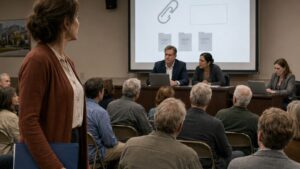
Gary’s backyard appeared on the clubhouse screen under the words COMMUNITY DRAINAGE ASSET.
The photograph had been taken from outside his fence. It showed the green wheel, the pipe, and part of his shed, cropped so tightly that the brown stain on the foundation was not visible.
Carolyn Miller stood beside the screen with a wireless remote in one hand.
“This structure,” she said, “is essential to protecting the lower section of Briar Glen.”
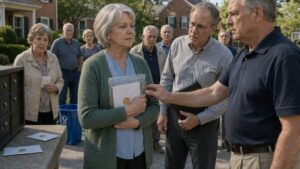
Nearly fifty folding chairs faced her. Homeowners filled most of them. Some had come in work clothes. Others held printed copies of the HOA email announcing an emergency meeting about “unauthorized interference with stormwater management.”
Gary sat in the last row beside Ruth.
His sister had driven in from the city wearing a navy coat and the expression she used when she believed a problem had already become too expensive.
Carolyn advanced the slide. A map appeared, showing Gary’s lot below a fan of subdivision streets.
“The drainage easement predates the Association,” she continued. “It allows runoff from the dominant properties to pass through the Carter parcel. Without that route, water could back up into homes on Greenbriar Court and Willow Trace.”
A man near the front raised his hand. “Was the line blocked last night?”
“Our contractor was denied access.”
Several heads turned toward Gary.
He kept his hands on his knees.
Carolyn looked directly at him. “Mr. Carter has concerns about water on his property. We respect those concerns. But private disagreement cannot override recorded infrastructure rights.”
“Was the water tested?” Gary asked.
The room became still.
Carolyn’s smile held. “This meeting is about access.”
“The water killed fish in my basin.”
A woman by the aisle shifted in her chair. “I smelled something yesterday morning. Down by the walking path.”
Carolyn clicked to another slide. “Heavy storm runoff often carries organic material. That does not prove contamination.”
Gary stood. “Then test it.”
“The HOA attorney has advised that we first restore unrestricted inspection access.”
“You mean enter my property whenever you choose.”
“The easement provides that right.”
“Show me the complete easement.”
Carolyn lifted a folder from the table. “A recorded copy is available to any affected owner.”
“That isn’t what I asked.”
A murmur moved through the room.
Gary could feel Ruth looking at him. He disliked speaking in public, especially in rooms where people watched for anger they could use as proof. During thirty-two years with municipal maintenance, he had learned that the loudest person in a meeting was rarely the one who understood the system.
Carolyn’s voice cooled. “Are you alleging that the Association fabricated a county record?”
“I’m saying you’re showing one page of something that controls my land.”
The HOA attorney leaned toward his microphone. “Mr. Carter, the Association is prepared to schedule a joint inspection tomorrow morning.”
“With whose engineer?”
“Our contractor and a drainage consultant.”
“Chosen by you.”
“Qualified professionals.”
Gary looked at Brian, who stood near the side wall. Brian lowered his eyes.
“No,” Gary said. “Not until I see the agreement that authorizes access and the maintenance records for the line.”
The response was immediate. Two homeowners spoke at once. Someone asked what would happen if it rained again. A man in the second row said his insurance deductible was ten thousand dollars.
Carolyn waited until the room settled.
“Let the minutes reflect,” she said, “that Mr. Carter has refused a reasonable safety inspection.”
Ruth caught Gary’s sleeve when he sat down.
“You walked into that,” she whispered.
“He didn’t bring records.”
“You could have let them inspect.”
“They already inspected at one in the morning.”
“And now everyone thinks you’re trying to flood them.”
Gary said nothing.
Ruth leaned closer. “They offered to buy the property last year. Maybe we should reconsider.”
He turned to her. “You drove forty miles to say that here?”
“I drove forty miles because half the county received an email with our name in it.”
“Our name?”
“You know what I mean.”
“No. I know what you mean when you say sell.”
Ruth’s jaw tightened. “I mean stop letting this house decide the rest of your life.”
Before Gary could answer, Carolyn called for questions.
A homeowner asked whether the HOA could fine Gary. The attorney explained that his lot was outside the Association, but the easement could be enforced in court. Another asked whether the HOA would cover flood damage if the pipe failed. Carolyn said the board was reviewing all contingencies.
Reviewing meant no.
When the meeting ended, people left in small groups. Few looked at Gary directly. The woman who had mentioned the smell paused beside him.
“It was like bleach and pond water,” she said quietly. “Not normal rain.”
“Did you report it?”
She glanced toward Carolyn. “This morning.”
“What did they say?”
“That landscaping chemicals wash off during storms.”
Gary thanked her.
Outside, Ruth waited beside his truck.
“You embarrassed her,” she said.
“She embarrassed herself.”
“That’s not what the room saw.”
Gary unlocked the driver’s door.
Ruth stood between him and the cab. “Dad left both of us the property.”
“And you left me the property.”
“I left because my work was in the city.”
“You left when he got sick.”
Her face hardened, but she did not move. “That doesn’t make every decision you make correct.”
Gary looked past her toward the clubhouse windows. Carolyn was speaking to the attorney while Brian gathered cables from the floor.
“Sell your half if that’s what you want,” he said.
“You know I can’t without forcing a partition.”
“Then don’t.”
“That’s your answer to everything. Say as little as possible and make everyone else live inside the silence.”
Gary opened the truck door.
Ruth stepped away. “At least find out what Dad signed before you turn this into a war.”
Two days later, Gary sat across from Lisa Green at the county records office.
She wore thin-framed glasses and moved through the database with deliberate patience. After ten minutes, she found the instrument number from Carolyn’s attachment.
“The easement is real,” Lisa said.
Gary watched the scanned document appear on her monitor.
Donald Carter’s signature was at the bottom, witnessed and notarized. The filing date was twenty-eight years earlier, long before Briar Glen existed.
“It grants drainage across the southern portion of the parcel,” Lisa said. “Successors and assigns. That language would carry forward.”
Gary felt a dull pressure behind his ribs.
“So Carolyn was right.”
“About the existence of an easement.”
Lisa scrolled to the final paragraph, then stopped.
“What?”
“This reference.”
Gary leaned closer.
The paragraph stated that use of the drainage route remained subject to the specifications and maintenance obligations contained in Exhibit B.
Lisa clicked through the scanned pages.
The document ended at Exhibit A.
“Where’s B?” Gary asked.
“It isn’t in this image set.”
“Was it never filed?”
“I didn’t say that.”
“You said it isn’t here.”
“I said it isn’t in this image set.” Lisa removed her glasses. “Older records were scanned in batches. Attachments were sometimes indexed separately, especially oversized plans.”
“Can you find it?”
“I can show you how to trace it.”
Gary’s irritation rose. “The HOA is using this to enter my land.”
“And I’m not going to guess at a public record because you need a quick answer.”
Her tone was not unfriendly, but it stopped him.
Lisa turned the monitor slightly toward him and pointed to a notation in the margin.
“Exhibit B was prepared by a civil firm under a separate plan number. Start there. Check plat supplements, engineering attachments, and any cross-reference under the original owner’s name.”
Gary copied the number.
As he stood, Lisa added, “Mr. Carter?”
He looked back.
“If someone showed you this easement without the referenced exhibit, they showed you an incomplete agreement.”
Chapter 3: The Page Missing From the County File
The easement ended by pointing to a page no one could locate.
Gary spent three mornings at the records office following references through microfilm, scanned plats, and engineering indexes. Each trail ended with a number that had been replaced, transferred, or entered under a company that no longer existed.
Lisa did not do the work for him. She showed him where subdivision records were stored, how plan revisions were labeled, and why an easement attachment might appear under an engineering project rather than a property owner.
“You worked municipal maintenance?” she asked when he recognized an old inspection code.
“Thirty-two years.”
“Then read the margins. Engineers put the truth where nobody else looks.”
On the fourth morning, Gary found a supplemental index entry for a drainage improvement labeled CARTER RELIEF CONNECTION.
The file contained no drawing, only a transmittal sheet with a handwritten notation:
Full field plan retained by owner.
Gary stared at the words.
“My father kept it.”
“Possibly,” Lisa said.
“He kept everything.”
“That may be useful for once.”
Gary almost smiled.
He drove home and climbed the attic stairs before removing his jacket. Dust lay thick on the rafters. Boxes crowded the narrow walkway: Christmas decorations, his mother’s dishes, old payroll records, and tools Donald Carter had refused to discard even after his hands became too weak to use them.
Gary opened three document boxes before finding a long cardboard tube behind an army footlocker.
DON CARTER—DRAINAGE was written on the side in black marker.
He carried it downstairs and cleared the kitchen table.
Inside were rolled plans, correspondence, and a folded sheet of onionskin paper. The first drawing showed the southern boundary before Briar Glen, when the land above had been pasture and two county roads. A blue line traced a natural swale toward the stone basin.
The second drawing was newer.
A pipe crossed the same route. Near the side gate, Donald had drawn a green circle with four spokes—the shutoff wheel. Red pencil arrows marked an emergency flow path from the upper road.
Gary unrolled the final sheet.
EXHIBIT B appeared in the lower corner.
He read it once standing, then again seated.
The drainage right was conditional.
The upstream owner had to maintain sediment control, prevent discharge of untreated non-stormwater, inspect the line annually, repair defects within thirty days of written notice, and coordinate access with the Carter property owner except during an immediate life-safety emergency.
If violations remained uncorrected after notice, use of the easement could be suspended or terminated.
Gary placed both hands on the table.
Carolyn had quoted the right and omitted every obligation attached to it.
He photographed each page, then called Lisa.
“I found Exhibit B.”
“Is it marked as part of the recorded instrument?”
“Yes.”
“Bring it in. We’ll compare signatures and plan numbers.”
“It says they need permission to enter.”
“Except emergencies, according to what you just read.”
“It says the line can be terminated.”
“After the notice procedure.”
“They’ve violated half the conditions.”
“Then document each one.”
Gary heard caution in her voice and mistook it for resistance.
“You still think they own the pipe.”
“I think public records matter more when you read all of them.”
“I did.”
“Then don’t skip the process just because you finally found language you like.”
The words irritated him because they were accurate.
He ended the call, gathered the plans, and noticed a smaller folded map beneath Exhibit B.
It was hand-drawn on county grid paper. Donald’s writing filled the margins: pipe elevations, rainfall measurements, temporary pump capacity, names of homeowners who had called during a flood.
Gary knew the date printed at the top.
He had been twenty-eight. His mother had still been alive. Donald had spent that winter recovering from surgery, though Gary remembered him leaving the house one night against medical advice because water had crossed the upper county road.
On the map, Donald had designed the emergency connection himself.
The green wheel was not something imposed on him by an outside developer. He had specified its location, its diameter, even the concrete pad beneath it.
Gary’s first reaction was not relief.
It was betrayal.
All morning he had believed his father had been misled into signing an incomplete agreement. The map showed otherwise. Donald had understood the system well enough to build it.
Gary searched the remaining papers more roughly.
He found letters to the former landowner above the property. The earliest thanked Donald for allowing a temporary drainage route during the flood. Later letters requested a filtration box, annual inspection reports, and a permanent channel that would bypass the Carter basin.
The responses became less frequent.
Then the land was sold.
A development company purchased it. Briar Glen was approved. The temporary connection remained.
Gary read his father’s final letter.
The language was restrained, almost formal. Donald warned that increased pavement would produce greater runoff than the emergency line had been designed to carry. He requested a meeting before subdivision construction began.
There was no response attached.
On the hand-drawn map, beside the green wheel, Donald had written six words in red pencil:
Temporary until they build it correctly.
Gary sat alone at the kitchen table with the conditional easement on one side and his father’s map on the other.
The HOA had not invented its right.
His father had created it.
And someone had spent nearly three decades pretending the word temporary was never there.
Chapter 4: What His Father Agreed to Save
Ruth recognized the date before Gary finished spreading the papers across the kitchen table.
“November seventeenth,” she said. “That was the night Dad left the hospital.”
Gary looked from her to the hand-drawn map. “He was discharged that afternoon.”
“No. He signed himself out.”
Ruth removed her coat but did not sit. The map lay between them under the yellow light: contour lines, pipe measurements, names written in Donald Carter’s narrow block letters. Near the southern boundary, the green wheel had been marked with a circle and four short spokes.
Gary tapped the note beside it.
“Temporary until they build it correctly.”
“I can read.”
“You knew about this?”
“I knew there was a flood.”
“That isn’t what I asked.”
Ruth pressed both palms against the back of a chair. “I was nineteen. Mom called me at school because Dad had gone missing from his room. By the time I got here, half the old road was underwater.”
Gary remembered pieces of that night: truck headlights reflected in brown water, neighbors carrying children through knee-deep runoff, Donald standing beside a portable pump in his hospital slippers. Gary had remembered it as one more example of his father refusing to rest.
He had not remembered the pipe.
Ruth traced a row of names on the map. “These were the houses along the lower road.”
“There were only nine then.”
“Nine families.”
Gary rolled the edge of the plan flat. “And he gave them a permanent right through our land.”
“He gave them somewhere for the water to go.”
“For one storm.”
“At first.”
The distinction sharpened his anger rather than easing it. He pulled the correspondence closer and showed her the later letters, each asking for filtration, inspection reports, and a separate permanent channel.
“They ignored him.”
“They delayed him.”
“For twenty-eight years.”
Ruth finally sat. “That doesn’t mean he was tricked into the first agreement.”
Gary turned toward the sink. Outside, the stone basin stood empty except for a shallow film of discolored water. He had drained it after the koi died and stacked the remaining fish in a temporary stock tank beside the shed.
“He knew what he was signing,” he said.
“Yes.”
“And never told me.”
Ruth gave a tired laugh with no humor in it. “You were there.”
“I was working county nights.”
“You came home every morning and asked whether the pump held. Dad thought you understood.”
“I understood we were helping during a flood. I didn’t understand he had burdened the property.”
“He didn’t use words like burden.”
“He should have.”
Ruth looked at him for a long moment. “You hear yourself, don’t you?”
Gary faced her.
“You’re angry because he made a decision about the land without explaining it to you. You’ve spent years doing the same thing to me.”
The refrigerator motor clicked on. Neither of them spoke over its low hum.
Gary folded his arms. “You wanted nothing to do with this place.”
“I wanted not to spend every weekend being told how much you had sacrificed for it.”
“I never said that.”
“You didn’t have to.”
She reached into her bag and removed a small envelope. The paper had softened along the folds.
“I found this after Dad died. It was in the drawer with his insurance papers.”
Gary did not take it.
“What is it?”
“A letter he never mailed.”
“To who?”
“To me. Maybe both of us.”
She unfolded it carefully. Donald’s handwriting slanted more than it did on the drainage map, evidence of the tremor that had worsened during his final year.
Ruth read only one section.
“I should not have made Gary believe keeping the place was the same as keeping faith with me. A house can be changed without being surrendered. Tell him that if he will not hear it from me.”
Gary looked away.
Ruth set the letter beside the map. “He knew what you promised him.”
“He asked me not to let the development swallow the property.”
“He was frightened. So were you.”
“I gave him my word.”
“And then you turned his fear into a rule nobody else was allowed to question.”
The accusation would have sent him out of the room a week earlier. Now the drainage map held him there.
The old floodplain streets still existed below Briar Glen, though most of the original houses had been replaced. Gary and Ruth drove them that afternoon with Donald’s map across the console.
At the lowest intersection, Gary stopped.
The land dipped exactly as Donald had drawn it. During a severe storm, runoff from the ridge would have collected there before crossing the county road. The temporary connection had carried that water south toward the Carter basin instead.
A woman raking leaves in her yard watched their truck. Her home stood where one of the original nine houses had been.
Ruth pointed through the windshield. “Dad didn’t save a subdivision. He saved people he knew.”
Gary studied the slope, calculating without intending to. Pavement had tripled. Roof area had multiplied. The old emergency line had never been designed for the volume Briar Glen now sent through it.
“He also warned them,” Gary said.
“Yes.”
“He gave them one year.”
“Yes.”
“And when they didn’t build the bypass, he kept letting them use it.”
Ruth leaned back. “Maybe because shutting it would have flooded those houses.”
That answer followed Gary home.
He found Carolyn’s request for a joint inspection still unopened on the counter beneath two certified notices he had drafted but not mailed. For the first time, he considered that refusing access had not only protected his boundary. It had prevented anyone from examining a dangerous pipe before the next storm.
Ruth saw where he was looking.
“You should have let them inspect.”
“Not with their contractor alone.”
“You could have asked for someone independent.”
“I asked for the full agreement.”
“And when they didn’t give it to you, you stopped talking.”
Gary slid the request aside. “I didn’t trust them.”
“That may have been reasonable. It still had consequences.”
Headlights crossed the kitchen window.
A white pickup stopped at the road. No one came to the door. After less than a minute, it drove away.
Gary went outside.
A large envelope lay against the porch step. There was no note, only his name written in black marker.
Inside were twelve photographs printed on ordinary office paper.
The first showed the drainage pipe from inside the HOA access vault. A fracture ran along the lower seam. The next showed standing black water behind a clogged filter frame. Several carried digital date stamps from four months earlier.
The final page was a copy of an inspection form signed by Brian Allen.
Under URGENT CORRECTIVE ACTION, Brian had written:
Replace cracked section before next major storm. Current discharge may bypass filtration and undermine downstream foundation.
Below that was an email transmission line.
Sent to: Carolyn Miller.
Gary checked the date.
Carolyn had received the warning months before brown water reached his house.
Chapter 5: The Day the HOA Cut the Chain
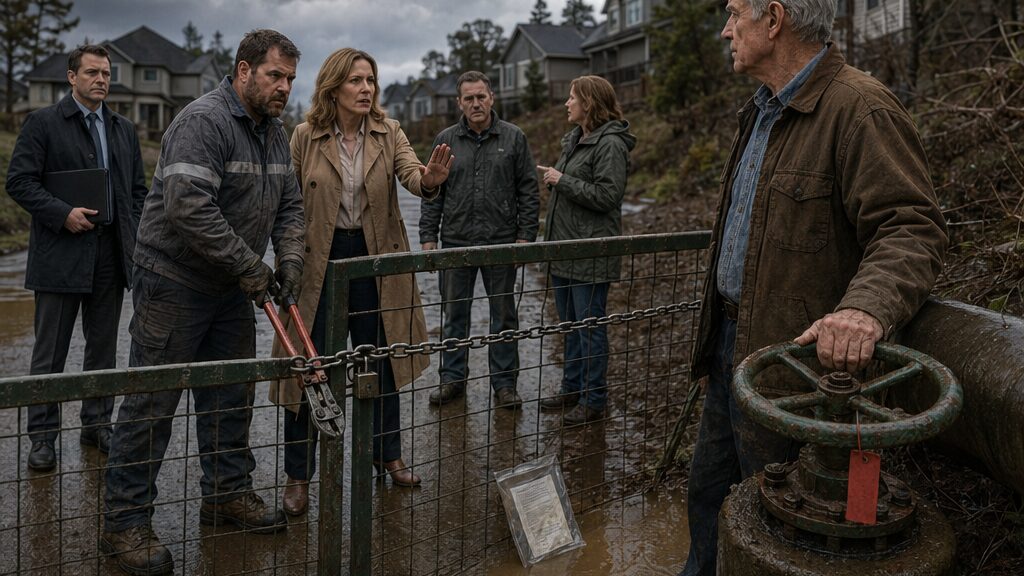
The jaws of the bolt cutters closed around Gary’s gate chain at 8:12 the next morning.
“Don’t,” he said.
Brian froze with both handles raised.
Carolyn stood behind him in a tan raincoat, accompanied by the HOA attorney, two homeowners, and a drainage consultant carrying a hard case. Clouds had lowered over Briar Glen, dark enough that the streetlights were still on.
“This is an emergency inspection,” Carolyn said. “The storm warning changes the access requirements.”
Gary stood inside the gate. On the ground by his boots lay a certified termination notice sealed in a clear plastic sleeve. Behind him, the green shutoff wheel rose from its concrete base, rust around the stem and a fresh red inspection tag tied to one spoke.
“You received written notice of the violations yesterday,” Gary said.
“We received allegations.”
“You received photographs from your own contractor four months ago.”
Carolyn’s attention shifted to Brian.
Brian lowered the cutters but did not put them down.
The attorney stepped forward. “Mr. Carter, the easement provides emergency access to maintain continuous drainage.”
“Exhibit B provides emergency access during an immediate life-safety event. It does not authorize you to cut a locked gate the morning before a forecast storm.”
A homeowner behind Carolyn spoke sharply. “My basement flooded six years ago. Are you really going to stand there arguing over a chain?”
Gary recognized him from the clubhouse meeting.
“I’m arguing over an unsafe pipe.”
“You’re the one threatening to close it.”
“I haven’t closed anything.”
Carolyn raised a folder. “The Association has a recorded property right.”
Gary bent, picked up the plastic sleeve, and slid it beneath the chain so the first page faced outward.
“And I have served notice under the same recorded agreement. Untreated discharge. No annual inspection reports. Failure to correct a documented fracture. Unauthorized entry.”
“You cannot terminate critical infrastructure overnight.”
“The agreement gives thirty days after written correction notice. My father issued the first one twenty-seven years ago. I issued another after the flood. This filing suspends access until compliance is established.”
The attorney crouched to read the page. His expression tightened.
Carolyn did not look down. “We are not litigating this at a fence.”
“No,” Gary said. “You’re trying to cut through it.”
The second homeowner, a woman from the meeting, stared at the red tag. “What does that say?”
Gary turned it so she could read.
UNSAFE FOR FULL-PRESSURE OPERATION.
Carolyn’s voice sharpened. “That tag was placed by Mr. Carter. He has no authority to certify the system.”
“I placed it so nobody mistakes the condition. The finding belongs to Brian.”
Every face turned toward him.
Brian shifted the bolt cutters to one hand.
Carolyn said, “This is not the time.”
Gary kept his eyes on Brian. “Your inspection form says the cracked section could bypass filtration and undermine my foundation. Did you write that?”
Brian’s mouth moved before sound came.
“Gary,” Carolyn said, “he is a contractor, not a structural engineer.”
“Did you write it?”
Brian looked at the homeowners, then at the attorney. The cutter blades touched the pavement with a metallic click.
“Yes.”
The woman beside Carolyn stepped back.
Gary asked, “When?”
“June.”
“And who received it?”
Brian rubbed rain from his forehead though the rain had not started. “The board account.”
“Carolyn’s address is printed on the transmission line.”
“She received it.”
Carolyn’s cheeks colored. “We discussed monitoring the condition. Replacement required a special assessment, and the consultant did not classify it as an imminent failure.”
“The consultant never saw the downstream outlet,” Brian said.
The words seemed to surprise him as much as anyone else.
Carolyn stared at him. “You said access had been denied.”
“In June? No. We didn’t request access in June.”
The attorney rose from his crouch. “Carolyn, we should step aside.”
She ignored him. “Brian, you told me the pipe remained functional.”
“It does remain functional.”
“That is what we relied upon.”
“I also told you the filter frame was blocked.”
“You said it could be cleared during routine service.”
“After the cracked section was replaced.”
The first drops struck the plastic sleeve under the chain.
One of the homeowners took out a phone. Carolyn saw it and pointed toward the street.
“No recording. This concerns privileged HOA legal matters.”
“It concerns water coming toward our homes,” the man replied.
Gary rested his right hand on the green wheel.
The group went quiet.
Carolyn’s gaze fixed on his fingers. “If you turn that, any resulting damage will be yours.”
“If I leave it fully open, the next surge could widen the fracture and send more contaminated water against my house.”
“You do not know that.”
“Your contractor does.”
The wheel felt cold and rough beneath Gary’s palm. He could close the line in fewer than twelve turns. The recorded notice was in place. The agreement allowed suspension. For the first time since the flood, he held the practical power Carolyn had claimed as hers.
He also knew the grade of Greenbriar Court.
He pictured the nine houses Donald had marked on the old map, then the dozens now standing above them.
The county weather alert sounded simultaneously from three phones.
FLASH FLOOD WATCH UPGRADED. HEAVY RAIN EXPECTED BY LATE AFTERNOON.
The woman homeowner looked from Gary to Carolyn. “What happens if he closes it?”
Water would collect behind the upper junction. Depending on how fast it rose, it could back into the lowest storm drains.
Gary answered honestly. “Some streets may flood.”
“And if he leaves it open?” she asked.
Brian looked at the tagged pipe. “We don’t know how long the damaged section holds.”
Carolyn folded her arms. “Then the responsible action is immediate access.”
“Not by cutting my chain,” Gary said. “Bring an independent inspector. Bring the county. Agree in writing that entry does not waive the violations.”
“There isn’t time for your conditions.”
“There was time in June.”
Carolyn stepped toward the gate until only the chain separated them.
“You think this is about winning against me,” she said quietly. “I have families calling me because their insurance carriers are already threatening higher premiums. Three sales are pending. If this drainage route is declared invalid, property values fall before we can redesign anything.”
“So you hid the report.”
“I managed a risk while the board reviewed costs.”
“You left the risk on my side of the fence.”
Her composure slipped. “Because the alternative was putting it on two hundred homeowners.”
There it was—not innocence, but the reason she had given herself.
Gary removed his hand from the wheel.
“I’m not cutting them off this morning,” he said.
Relief passed through the homeowners, followed by uncertainty.
“But nobody enters without an agreed inspection team. The line stays where it is until the county responds.”
Carolyn looked at Brian. “Cut it.”
Brian did not move.
“Brian.”
He set the bolt cutters on the pavement.
“No.”
The word barely rose above the wind, yet it changed the group more than shouting would have.
Carolyn’s face went still.
The HOA attorney closed his folder. “Forced entry after notice creates unnecessary exposure. We should seek emergency relief.”
“By the time you seek relief, the storm will be here,” Carolyn said.
Gary lifted the red tag. “Then help me build a safe temporary route.”
She gave him a hard look, as though the suggestion itself were a trap.
A county sedan appeared at the end of the road. Gary had called the code office before dawn and sent the photographs, the easement, and Brian’s report.
The inspector stepped out, surveyed the group and the bolt cutters, then asked everyone to keep their hands off the gate.
While the inspector examined the papers, Gary’s phone vibrated.
An email from Lisa Green showed the county recorder’s stamp across his termination notice.
Recorded: 8:37 a.m.
At that same moment, thunder moved over Briar Glen.
Gary looked from the stamp to the green wheel.
He had won the right to close it.
Now he had only hours to decide whether using that right would make him no better than the people who had sent their danger downhill.
Chapter 6: A Legal Victory That Could Flood Them
The pipe began shaking before the rain arrived.
A low metallic hammer traveled through the buried line and rattled the green wheel on its stem. Gary crouched beside the housing, one hand against the concrete base, and counted the pulses.
Pressure was building upstream.
The county inspector had ordered the gate left closed while he contacted emergency management. Carolyn and the HOA attorney had returned uphill. Brian remained outside the fence, staring at the line as if it might expose every decision he had delayed.
“How much room in the upper vault?” Gary asked.
“Maybe eighteen inches.”
“That isn’t enough.”
“No.”
Gary unlocked the gate.
Brian hesitated. “You’re letting me in?”
“You’re coming in under my supervision. No tools unless I ask.”
Brian stepped through and closed the gate behind him.
Together they opened the access cover near the wheel. The pipe shuddered again. Murky water pressed against the inspection glass.
Gary pointed toward the old service trench running east of the basin. “We can set a temporary pump there and send controlled flow to the county ditch.”
Brian followed the grade with his eyes. “That ditch hasn’t carried stormwater in years.”
“It still falls three feet before the culvert.”
“We’d need two pumps.”
“Three, if the forecast is right.”
“And six hundred feet of hose.”
Gary looked uphill. Several homeowners had gathered behind the fence, no longer standing as a delegation. They watched like people who had begun to understand that authority and safety were not the same thing.
“Call your equipment supplier,” Gary said.
Brian shook his head. “Carolyn controls the emergency account.”
Gary called her himself.
She answered on the fourth ring.
“The county says the easement is under dispute,” she said before he spoke. “You cannot restrict the system without a court order.”
“I have a bypass plan.”
A pause.
“What kind?”
“Portable pumps from the upper vault through my east trench to the county ditch. We reduce pressure on the cracked section and protect the lower streets.”
“How much?”
“Brian estimates twelve thousand through tomorrow.”
“That is not authorized.”
“Authorize it.”
“The board cannot approve that expenditure by phone.”
“You approved bolt cutters by phone.”
Her silence carried a faint office echo.
Gary continued. “The first heavy band arrives in less than two hours.”
“If you restore full access and leave the valve open, our contractor can manage the existing system.”
“Your contractor says it may fail.”
“Your proposed route is untested.”
“So is sending another storm through a cracked pipe.”
“I will not commit Association funds while you are holding our infrastructure hostage.”
Gary looked at the green wheel. “Then I’ll close it enough to protect my property.”
“If you do, we will hold you responsible for every flooded home.”
She ended the call.
Brian had heard enough to understand.
“She won’t release the account,” Gary said.
“She thinks if she pays, it proves the report mattered.”
“It did matter.”
“I know.”
Gary turned on him. “You knew in June.”
Brian’s face tightened. “I sent the report.”
“And then?”
“I called twice.”
“And then?”
“My company gets seventy percent of its work from Briar Glen.”
There was no defense in his voice, only the shape of the fear.
Gary looked toward the waiting homeowners. “So you kept servicing an unsafe line.”
“I told myself monitoring was better than losing the contract and having somebody cheaper ignore it completely.”
“That worked out well.”
“No.”
The answer was immediate.
A pickup pulled to the curb carrying two portable pumps. The homeowner who had complained at the meeting climbed out.
“I own a landscaping company,” he said. “These aren’t enough for the whole flow, but they’ll move some.”
Behind him, the woman homeowner arrived with rolled discharge hose borrowed from a construction crew. Someone else brought sandbags. None apologized to Gary. They simply unloaded equipment.
The inspection report had traveled through the neighborhood faster than any board email.
Gary opened the old service trench with a shovel while Brian connected hoses. The county inspector approved a temporary discharge point at the roadside culvert and called for additional emergency pumps.
Ruth arrived carrying Donald’s map in a plastic portfolio.
“I found something,” she said.
Gary wiped mud from his hands.
She unfolded a letter written in their father’s hand. It proposed the same emergency bypass—portable pumping through the east trench—after the original flood. The upstream owner had rejected it as too expensive for a temporary problem.
Gary read the final paragraph.
Until permanent construction is complete, I will permit controlled use through the valve, provided flow is reduced during high-pressure events and the Carter property owner remains present.
“He marked the wheel,” Ruth said.
On the map, a red line crossed one spoke at the halfway position.
Gary looked at the rusted wheel. Decades of weather had nearly hidden the matching notch cut into the metal.
His father had not intended the wheel to be merely open or closed.
It had been designed for judgment.
Rain began in large, scattered drops.
Gary took hold of the wheel with both hands. He turned it once, then again. Rust cracked from the stem. The pressure hammering softened but did not stop.
Brian watched the inspection glass. “Keep going.”
Gary counted six turns until the red notch aligned with the fixed mark on the housing.
Halfway.
The damaged line continued carrying controlled flow. The pumps took the excess toward the county ditch. Water rose in the upper vault, then stabilized four inches below the emergency overflow.
For the next three hours, the neighborhood worked under steady rain. Gary directed hose placement, checked pump strainers, and measured the pressure every fifteen minutes. The same homeowners who had accused him of obstruction hauled sandbags along his garden wall.
At dusk, the heaviest band struck.
The green wheel trembled beneath Gary’s hand but held at the halfway mark.
No brown water reached the house.
No storm drains backed into Greenbriar Court.
Carolyn arrived after dark.
Headlights filled the road behind her. A sheriff’s cruiser stopped first. Behind it waited a tracked compact bulldozer on a contractor’s trailer.
The deputy approached the gate with Carolyn and the HOA attorney.
Carolyn held a packet beneath her coat.
“We have an emergency access demand,” she said. “Open the line fully, or the contractor will create access to the upstream junction.”
Gary looked past her at the bulldozer.
Then he pointed to the pumps carrying water safely through the east trench.
“The system is stable.”
“It is operating only because homeowners supplied unauthorized equipment.”
“They supplied what you refused to fund.”
The deputy raised one hand. “Nobody is moving machinery until I understand who owns what.”
Gary removed the county-stamped termination notice from the waterproof sleeve and passed it through the gate.
Carolyn watched the deputy read it.
Rain ran from the brim of Gary’s cap. Behind him, the green wheel remained fixed at the red halfway mark his father had cut decades earlier.
Carolyn had come prepared to force the gate.
Gary had already proved the neighborhood did not need her to.
Chapter 7: The Meeting Where Silence Stopped Helping
Carolyn began the emergency meeting by placing a repair invoice in front of Gary.
“Twenty-three thousand, four hundred dollars,” she said. “Temporary pumps, contractor standby, road control, and emergency inspection. The Association expects reimbursement.”
The clubhouse still smelled of wet carpet from boots tracked through the previous night. Every chair was occupied. Homeowners stood along the back wall, some holding insurance letters, others photographs of water pooled against their curbs.
Gary sat at the end of the board table with Ruth beside him. The removable locking pin from the green wheel rested in his coat pocket.
Carolyn remained standing.
“Mr. Carter suspended a recorded drainage route hours before a major storm,” she continued. “Whatever concerns existed about maintenance, his unilateral action created an avoidable emergency.”
The HOA attorney watched his notes instead of Gary.
Brian sat in the second row, alone.
Gary looked at the invoice. “The line stayed open at controlled capacity.”
“Because residents supplied pumps after you restricted it.”
“Because you refused to pay for a bypass.”
“I refused to approve an unengineered proposal during a crisis.”
“You arrived with a bulldozer.”
A few people shifted in their seats.
Carolyn’s expression did not change. “To reach the upstream junction if conditions became life-threatening.”
“The deputy told you the contractor had no authority to enter.”
“And no entry occurred.”
The sentence was technically true. Gary felt the familiar urge to let that truth expose itself without his help. In county meetings, silence had often protected him from saying more than the records could prove.
But the room had already learned to fill his silence for him.
Carolyn turned toward the homeowners. “The board must determine whether Mr. Carter’s actions increased community risk and whether legal enforcement is necessary.”
Ruth touched Gary’s sleeve once.
He stood.
“I did increase the risk.”
The room quieted.
Carolyn looked at him sharply.
Gary removed the locking pin from his pocket and placed it on the table. It was a plain steel rod, worn smooth where it had held the wheel in position.
“I refused the first joint inspection,” he said. “I had reason not to trust the people requesting it, but I could have demanded an independent inspector instead. I didn’t. I kept my father’s map to myself while I decided what it meant. That made it easier for everyone here to believe I was trying to block the system without understanding it.”
Ruth lowered her eyes.
Gary continued before pride could stop him.
“The easement is real because my father created it. He designed the emergency connection after the old flood. Some of the homes below the ridge would have taken water without it.”
A man near the aisle folded his arms. “Then why are we here?”
“Because temporary help became permanent privilege, and the obligations disappeared from the version your board relied on.”
Gary unfolded Donald’s letter and placed copies along the table. The meeting secretary distributed them row by row.
“My father allowed controlled flow while the upstream owner built a safer route. He required filtration, inspections, and repair. He also wrote that neither side should hide information from the other, because secrecy would turn neighbors into enemies.”
Carolyn glanced at the letter but did not pick it up.
Gary looked at her. “He was right.”
The admission altered the room. It did not make everyone sympathetic. It made them listen.
Brian stood.
Carolyn said, “You are not on the agenda.”
“I should be.”
He carried a folder to the front and laid his June inspection form beside the invoice.
“I reported the cracked section and blocked filter,” he said. “I recommended replacement before the next major storm.”
“You also stated the system remained operational,” Carolyn replied.
“I stated it could remain operational at reduced pressure while repairs were scheduled.”
“That language is not in your final report.”
Brian swallowed. “It was in the draft.”
“Which was not certified.”
“Because you asked me to remove it until the board reviewed funding.”
A murmur rose from the chairs.
Carolyn’s composure tightened around her.
“I asked you to distinguish observations from engineering conclusions.”
“You asked me not to trigger a special assessment.”
The HOA attorney leaned toward the microphone. “We should avoid characterizing privileged communications.”
Brian looked at him. “You weren’t copied.”
The woman who had smelled the runoff raised her hand without waiting to be recognized. “How much would the repair have cost in June?”
Brian answered. “Less than the emergency response.”
Carolyn finally sat.
“You all want a simple answer,” she said. “There wasn’t one. We had three pending home sales, an insurance renewal under review, and owners already objecting to increased dues. Announcing that our primary drainage route might fail would have affected every property here.”
“It did affect property,” Gary said. “Mine.”
“I know that.”
The words came without warmth, but also without denial.
The clubhouse doors opened. A representative from the HOA’s insurance carrier entered with the drainage engineer and handed the attorney a letter.
The attorney read it silently. His shoulders lowered.
Carolyn said, “What is it?”
He passed the letter to her.
The insurer would not renew the Association’s stormwater liability coverage unless the board adopted a permanent engineered redesign, documented all easement obligations, and removed unilateral access authority from any single officer. Until then, claims involving the damaged line would be subject to reservation.
A homeowner near the front asked, “What does that mean?”
“It means denial is no longer cheaper,” Ruth said.
No one corrected her.
The drainage engineer outlined two options. The first was a full bypass along the eastern boundary, expensive but independent of Gary’s basin. The second was a filtered junction using part of the existing route, with pressure controls, annual inspections, and compensation to the Carter property.
Carolyn looked at Gary. “Would you consider the second option?”
The question was careful, stripped of command.
Gary touched the locking pin on the table.
“Yes. Temporarily during construction, and permanently only under a new recorded agreement.”
Someone in the back asked whether he intended to sue.
“I intend to repair my foundation, restore the basin, and keep unauthorized people off my land.”
“That sounds like yes,” the man said.
“It sounds like terms.”
Carolyn folded the insurer’s letter. “The board can negotiate terms privately.”
“No,” Gary said.
Her eyes lifted.
“My father made a private arrangement because people needed help quickly. The next owner relied on memory. The developer relied on the easement. Your board relied on an incomplete scan. I relied on silence.”
He looked around the room.
“If the Association wants access across my property, the owners should hear the cost, the conditions, and the risks before voting.”
The attorney began to object, but several homeowners spoke over him.
Gary slid the steel locking pin to the center of the table.
“I will permit controlled temporary flow for thirty days,” he said. “After that, access continues only if the redesign, repair fund, and full agreement are approved in a public vote.”
Carolyn stared at the pin.
For the first time since the flood, the choice no longer belonged to her or Gary alone.
It belonged to the people who would have to pay for the truth.
Chapter 8: The Wheel Turned for the Last Time
The new drainage line could not be opened until Gary signed the final inspection sheet.
The engineer stood beside him at the rebuilt junction, clipboard protected beneath a clear cover. Fresh concrete had replaced the cracked pad. A filtration vault sat uphill of Gary’s boundary, and a pressure regulator separated the HOA line from the narrow section crossing his property.
Three months earlier, brown water had curled around the old green wheel.
Now the basin stones had been scrubbed clean. New soil covered the ruined garden beds. The foundation repair was complete, though the mortar remained lighter than the original wall.
Gary read every line.
The agreement provided annual independent inspections, water-quality testing after major storms, advance notice for routine access, emergency entry only under defined conditions, compensation for the easement area, and automatic suspension if maintenance deadlines were ignored.
Ruth stood near the shed with Lisa Green, who had come to confirm that the corrected exhibit matched the document scheduled for recording. Several homeowners waited beyond the open gate.
Carolyn stood apart from them.
She was no longer HOA president. The board had appointed a temporary committee after the public vote approved the redesign and restricted contracting authority. She remained a homeowner and real-estate agent, but the title that had once preceded every sentence was gone.
Gary reached the final page.
“You understand that signing permits the controlled connection to operate?” the engineer asked.
“I understand.”
“And that the old wheel will be removed from service?”
Gary looked at it.
Rust remained in the grooves despite cleaning. The red halfway mark his father had cut was still visible on one spoke.
“Yes.”
He signed.
The engineer signaled to the crew. A technician opened the upstream control slowly. Water entered the filtration vault with a hollow rush, passed through the regulator, and emerged into the stone-lined basin.
Clear water.
Gary crouched and dipped two fingers into it. Cold, odorless, carrying only a little grit from the new pipe.
The woman who had first reported the smell let out a breath behind him.
No one applauded. Gary was grateful for that.
Carolyn approached while the engineer checked pressure readings.
“I received the final settlement release,” she said.
“The repairs were completed.”
“And the Association published the corrected records.”
“I saw them.”
She watched the clear water run between the stones.
“I should have disclosed Brian’s report.”
Gary waited.
“I believed we had time,” she said. “Then I believed admitting we did not have time would create a larger problem.”
“It did.”
“Yes.”
She did not ask him to forgive her. He did not offer it.
After a moment, she said, “Three of the pending sales closed.”
Gary glanced at her.
“The buyers received the new drainage disclosure,” she added. “One requested a credit. The others said they preferred knowing.”
“That usually costs less.”
A faint expression crossed her face, almost a smile, but it did not settle.
“I suppose you were right about that.”
“Not about everything.”
Carolyn looked toward Ruth.
“No,” she said. “Neither was I.”
She returned to the homeowners.
The crew detached the old wheel from its stem. When the retaining bolt came free, Gary expected the metal to feel heavier. It weighed less than twenty pounds.
He carried it into the shed.
Donald’s annotated map lay on the workbench beneath a new wooden frame. Gary had almost stored it back in the attic, but Ruth had stopped him.
“Things hidden upstairs have caused enough trouble,” she had said.
Now she followed him inside.
“You left something out of the ownership papers,” she said.
Gary leaned the wheel against the wall. “What papers?”
“The revised property agreement.”
“I thought we settled that.”
“You settled repairs and easement compensation. You didn’t answer whether I get a voice before the next emergency.”
Gary studied the wheel’s worn center.
Ruth had not forced a sale. Instead, she had contributed part of her share of the settlement to restore the basin and had attended every design meeting. She had also corrected him whenever he spoke as though the house belonged only to the person who stayed.
“What do you want?” he asked.
“A written co-ownership plan. Expenses, major repairs, future sale decisions. No assumptions.”
“You planning to move back?”
“No.”
“Then why does it matter?”
Her eyes narrowed.
Gary nodded. “That was the wrong question.”
“Yes.”
He took the locking pin from the workbench drawer. It had sat there since the public meeting.
“I’ll have the attorney draft something.”
“An attorney we both choose.”
“All right.”
“And you don’t get final authority just because you know where every pipe is buried.”
“I know where most of them are.”
“Gary.”
“All right.”
Ruth touched the edge of Donald’s map. “Dad would have hated all this paperwork.”
“He would have signed it without reading the last page.”
“He would have read it. He just would have assumed everyone meant well.”
Gary lifted the green wheel and mounted it on two iron hooks above the workbench. Then he placed the locking pin beneath it.
The object no longer looked like a weapon or a boundary. It looked like a tool that had been asked to carry too much meaning because people had failed to write down what they owed one another.
Outside, the engineer called that the pressure test was complete.
Lisa stepped into the shed and examined the framed map.
“The recording package is ready,” she said. “Both owners sign this time.”
Ruth looked at Gary.
“Both owners,” he said.
They returned to the basin. The new flow ran steadily through the stones without rising toward the garden. Small ripples reflected the open gate, the repaired fence, and the people standing on both sides of the property line.
Gary signed the corrected exhibit. Ruth signed beneath him. Lisa gathered the pages for filing.
By late afternoon, the crew had removed the temporary pumps and rolled the last hose from the east trench. The homeowners drifted uphill. Carolyn left without coming back to the gate.
Ruth loaded her bag into her car.
“You locking the shed?” she asked.
Gary looked toward it.
For years he had locked every outbuilding before sunset, even when he was working ten yards away. His father had done the same. Tools lasted longer when access had limits.
But Ruth now had a key to the house, the gate, and the document box.
“Not today,” he said.
After she drove away, Gary returned to the shed.
The old green wheel hung beside Donald’s map. The red pencil note remained visible beneath the glass:
Temporary until they build it correctly.
Gary left the locking pin on its hook. He switched off the light and pulled the door nearly closed, stopping before the latch caught.
Through the opening, he could hear clear water moving through the basin.
Then he walked back toward the house and left the shed unlocked.
The story has ended.