He Built a Fountain Over the Neighborhood Drainage Line, Then the Storm Exposed Everyone’s Mistake
Chapter 1: The Fountain Standing Above the Property Line
“The easement belongs to me now.”
George Anderson said it from inside the fountain.
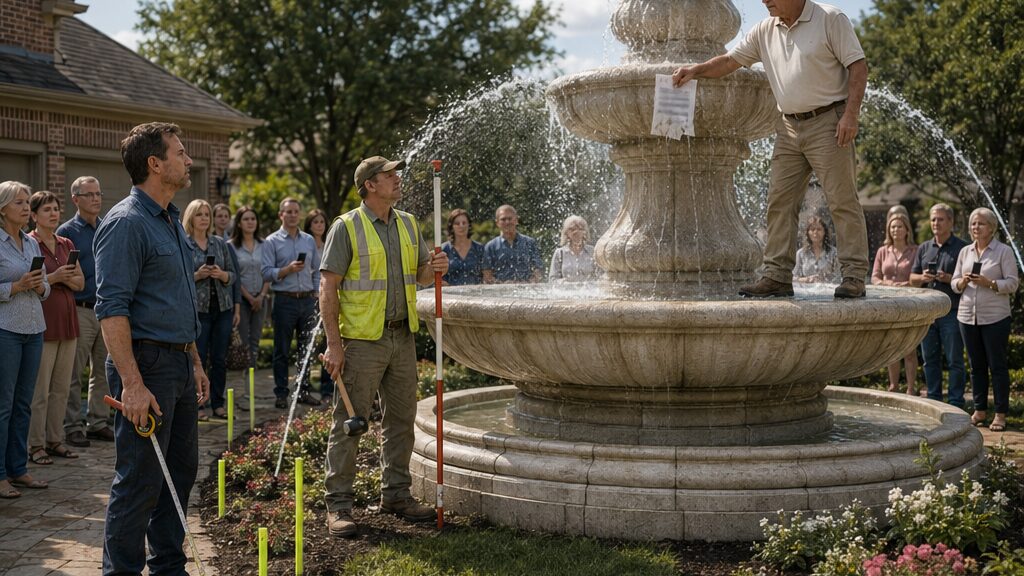
He stood with one work boot planted on the rim of the middle basin and the other in six inches of circulating water, as if the three tiers of pale stone were a platform built for announcements. Sunlight flashed off the spray behind him. Water ran over carved leaves, struck the basin, and fell in clean, measured sheets.
Brian Flores remained on his side of the narrow strip of grass between their properties.
“That isn’t how an easement works,” he said.
George laughed. Several people walking toward the neighborhood garden tour slowed near the sidewalk. George noticed them and raised his voice.
“Then complain to the county. Tell them I stole the dirt under my own fountain.”
Brian looked past him, toward the rear corner of the landscaped bed. The fountain had not been there the previous spring. Neither had the low retaining wall, the polished river rock, or the row of ornamental grasses hiding the natural dip between the houses.
That dip mattered.
For as long as Brian had lived there, stormwater had entered from the yards uphill, crossed behind George’s property, then followed the shallow swale toward the street inlet. It was not dramatic. Most people probably thought it was a sag in the lawn.
George had filled it, leveled it, and poured a foundation over the lowest point.
“You built over the drainage route,” Brian said.
“I built on my property.”
“The recorded route crosses your property.”
George stepped down into the lower basin. The fountain placed him almost two feet above Brian even there. “I have a fountain. You have a complaint. Guess which one the neighborhood can see.”
The onlookers smiled uncertainly. One of them lifted a phone, then lowered it when Brian glanced over.
Brian felt an old pressure gather behind his ribs, the familiar heat that had filled every argument between his father and the people living beside them. Fence posts, tree roots, parked trailers—his childhood had been measured in disputed inches and doors slammed hard enough to shake pictures from walls.
He kept his voice level.
“You have a fountain sitting on a drainage line.”
George spread his hands. Water splashed against his trousers.
“And it’s still standing.”
“For now.”
The smile left George’s face for half a second.
Then the fountain pump hummed louder, and a fresh arc of water climbed above his shoulder.
Brian went home before the exchange became the kind of scene George wanted.
Inside his garage, he pulled a folding ladder away from the rear wall and climbed to the shelf where he kept old property documents. He found the closing packet, the title policy, and a faded subdivision map folded into quarters. The recorded plat was not there.
He searched the county database from his work laptop instead.
Brian spent his weekdays turning field measurements into municipal utility drawings. He knew how roads, pipes, grades, and property lines could look harmless on paper until one number was wrong. He also knew the difference between seeing a line and proving what it meant.
The subdivision plat appeared after three searches under an earlier development name.
A dashed corridor crossed six lots.
DRAINAGE AND UTILITY EASEMENT—TWENTY FEET.
Brian zoomed in. The line entered behind Nicholas Green’s house, crossed two other yards, passed directly beneath the area where George’s fountain now stood, then continued through Brian’s side yard toward the street inlet.
He printed the page.
For the first time that morning, his anger loosened. The line was there. It had always been there. George could stand on marble and laugh all day, but he could not erase a recorded corridor by pouring concrete over it.
A dark mark near the rear foundation caught Brian’s attention when he carried the printout inside.
The rain three nights earlier had not been heavy. Less than an inch, according to the gauge on his fence. Yet a brown water stain ran along the lowest course of block beneath the guest-room window. Pine needles had collected against the foundation where water had pooled, and the mulch remained damp beneath the dry surface.
Brian crouched and pressed two fingers into it.
Cold mud rose around his knuckles.
He walked to the side yard. The ground dipped from the neighbors’ fences toward his house, then stopped at George’s new retaining wall. On the opposite side, the fountain threw water into the air as though nothing outside its stone basins could possibly move without permission.
Brian photographed the stain, the wet mulch, and the blocked grade.
By noon, he had arranged the images beside the plat on his kitchen table. He was marking approximate elevations when his phone rang.
Jessica Mitchell’s name appeared on the screen.
“Brian,” she said when he answered, “George called the management office.”
“I expected that.”
“He says you interrupted the garden tour and threatened to have his landscaping destroyed.”
“I told him the fountain is inside a recorded drainage easement.”
There was a pause filled by keyboard clicks.
“Wasn’t that project reviewed by the landscaping committee?”
“I wasn’t on the committee when it was installed.”
“You were when it was proposed.”
Brian’s pencil stopped.
Jessica continued carefully. “George says he has minutes showing you reviewed it.”
“I remember a sketch. Planting beds, maybe a fountain concept. Nothing with a surveyed location.”
“He says your initials are on the approval.”
“Then send me the packet.”
“I’ll have to locate it.”
The answer came too quickly.
Brian looked through the kitchen window toward the rising spray. “Jessica, was there an easement review?”
“I don’t know.”
“You manage the records.”
“I said I’ll look.”
The line disconnected before he could ask another question.
Brian opened the plastic tote where he kept old HOA materials. He had volunteered on the landscaping committee for eighteen months, long enough to learn that most requests arrived as photographs clipped from magazines, rough measurements, and hopeful descriptions. The committee judged appearance, not engineering.
Still, his name might be there.
Near the bottom of the tote, he found a thin folder labeled SPRING IMPROVEMENTS. Inside were paint samples, mailbox diagrams, and meeting notes printed from an email chain. One page carried a crude pencil drawing of George’s side yard. A circle marked FOUNTAIN. Curved lines represented planting beds. There were no property lines, grades, or easements.
At the bottom, beneath the chairperson’s summary, were three sets of initials.
B.F. appeared beside the words NO OBJECTION TO DESIGN CONCEPT.
Brian sat back.
He remembered the meeting now. It had lasted twenty minutes in Jessica’s office. George had brought glossy pictures of Tuscan courtyards and talked about improving resale values. Brian had asked whether the project required county review.
Someone—Jessica, perhaps—had said the contractor would handle permits.
Brian had accepted that answer.
Not because it was sufficient. Because challenging it would have lengthened the meeting, annoyed George, and made Brian the difficult person in the room.
His phone vibrated.
A message from George contained a photograph of the same page. George had circled Brian’s initials in red.
Under it, he had written:
You approved it. Maybe check your own paperwork before threatening mine.
Brian stared at the image until the screen dimmed.
The plat on the table proved where the water was supposed to go.
The page in his hand proved he had once helped someone believe it could not.
Chapter 2: Eight Feet Inside the Recorded Drainage Corridor
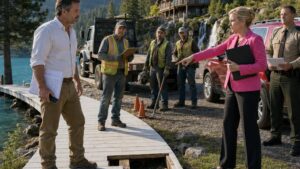
The surveyor drove the first fluorescent stake into the soil beside George’s marble steps at eight twelve Tuesday morning.
George came through his side gate before the surveyor had pulled the mallet free.
“You don’t have permission to mark my yard.”
The surveyor, a narrow man in a sun-faded cap, checked the tablet mounted on his pole. “I have authorization to locate a recorded easement from the adjoining property and public control points. I won’t disturb improvements.”
“You already disturbed something.”
George kicked the stake loose.
The surveyor watched it fall. “I’ll replace it.”
Brian stood near the property line with the certified notice tucked under his arm. He had spent the previous two days deciding whether to send it. Every draft sounded either too apologetic or too hostile. In the final version, he had removed all adjectives.
The fountain obstructs the recorded drainage easement. Please remove the obstruction within thirty days or permit inspection and corrective work.
George pointed at the survey equipment. “This is harassment.”
“This is measurement,” Brian said.
“From the man who approved the fountain.”
“From the man whose foundation is taking water.”
George glanced toward the sidewalk. Neighbors had begun gathering again, drawn by the instrument tripod and bright stakes. The garden tour had ended, but the confrontation had apparently become a neighborhood attraction.
The surveyor reset the first stake and moved toward the rear corner.
Brian followed him along the narrow passage. The natural depression was nearly invisible now beneath fresh sod and river stone. At the back fence, the surveyor located an iron pin two inches below grade, cleaned its cap, then sighted toward a county monument near the curb.
The next stake went into George’s ornamental grass.
The third landed beside the lower fountain basin.
George folded his arms. “You’re measuring from the wrong corner.”
“No,” the surveyor said.
“You didn’t even ask where my property line is.”
“I don’t ask property owners where recorded corners are.”
A few people laughed softly. George heard them.
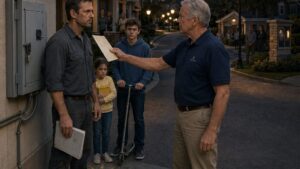
Brian handed him the certified notice.
George looked at the envelope but did not take it. “What is that supposed to do?”
“Give you a chance to fix this before the county gets involved.”
George accepted the envelope with two fingers, opened it, and read only the first lines. Then he walked to the fountain, pulled a strip of clear tape from a utility drawer built into the stone surround, and fastened the notice to the center column.
Water sprayed across the paper.
The ink began to bleed.
“There,” George said. “Now your complaint is part of the landscaping.”
Several phones came up.
Brian felt every face turn toward him, waiting for anger. He could have listed statutes. He could have told them George was risking six homes. Instead, he walked to the irrigation control box beside the hedge and turned the fountain’s auxiliary feed valve clockwise.
The side jets stopped.
Only the main pump continued, spilling water down the tiers.
The surveyor stretched a measuring tape between the rear pin and the newest stake. He read the distance, checked his tablet, then walked directly to the lower basin.
“The easement boundary is here.”
He pointed inside the fountain.
George’s expression tightened. “That’s impossible.”
The surveyor stepped over the rim with care and pressed the final fluorescent stake into a seam between decorative stones.
“The center foundation is approximately eight feet inside the recorded corridor.”
For one clean second, nobody spoke.
The fountain water hit the certified notice in soft, regular taps.
Brian had imagined this moment since finding the plat. He had expected relief. Instead, he saw the faces around him change—not from doubt to support, but from entertainment to calculation.
If the surveyor was right, the fountain had to move.
If Brian had approved it, someone would have to pay.
George reached into his pocket and unfolded a photocopy.
“You all want the complete story?” he asked.
He held up the landscaping minutes, Brian’s initials circled in red.
“Mr. Easement here reviewed the project before I spent a dime. ‘No objection to design concept.’ That’s his handwriting.”
A woman near the curb lowered her phone. Another neighbor looked at Brian.
George turned the page toward him. “Tell them it isn’t.”
“It is.”
The admission came out before Brian could soften it.
George smiled without humor. “There we are.”
“I reviewed a decorative sketch. There was no site plan attached.”
“You knew I was building a fountain.”
“I didn’t know where.”
“You live next door.”
That struck harder because it was partly true.
The surveyor packed his equipment without entering the argument. Before leaving, he gave Brian a preliminary field sheet showing the marked corridor. The line crossed the fountain exactly as the plat had suggested.
Objective proof, Brian thought.
Yet it did not feel objective anymore.
That afternoon he went to the county records office. The permit clerk found no structural permit for the fountain foundation, but decorative water features below a certain depth often fell into a gray category unless electrical or grading work triggered review.
“The HOA may have required more than the county,” the clerk said. “That’s private governance.”
At home, Brian scanned the survey sheet, flood photographs, plat, and committee minutes. The packet looked less like a case against George than a diagram of shared carelessness.
Jessica called near five.
“I received the surveyor’s preliminary finding,” she said.
“Then release the original approval file.”
“I’m reviewing it with counsel.”
“Why does counsel need to review whether I can see committee records?”
“Because your signature creates an exposure question.”
“For whom?”
“For everyone.”
Brian watched George remove the wet notice from the fountain. The paper tore where the tape held it. George left half of it attached to the stone.
Jessica lowered her voice. “If the association relied on your committee review, and George relied on the association, the board may argue that responsibility is not limited to the homeowner.”
“I never reviewed drainage.”
“Can you prove what you did not review?”
“The packet can.”
Another pause.
“Jessica, send me the packet.”
“I can’t authorize that today.”
“You are the records custodian.”
“And I’m telling you the file is under legal review.”
“Is there an easement page in it?”
“I’m not discussing individual pages.”
The careful phrasing told him more than an answer would have.
Brian looked at the survey stakes glowing against George’s dark mulch. The line they formed was bright, straight, and impossible to misunderstand.
Everything around that line had become less clear.
“You knew something was missing,” Brian said.
Jessica did not deny it.
“I’m sorry,” she replied, “but you will not have access to the complete file until counsel advises the board.”
Then she ended the call.
Chapter 3: The Approval File With One Missing Page
Water entered the second house through a crawlspace vent before sunrise on Friday.
Nicholas Green called Brian while dragging plastic storage bins away from the wet wall.
“It’s not deep,” Nicholas said. “Maybe half an inch. But it’s moving the wrong direction.”
Brian crossed two yards in rubber boots, carrying a flashlight and a level. Water had settled in a shallow depression behind Nicholas’s house, following the old swale until it reached the raised ground near George’s landscaping. From there it spread sideways, searching for a lower route.
Inside the crawlspace, the beam from Brian’s flashlight caught a silver line of water beneath the floor joists.
Nicholas crouched beside him. “Tell me this isn’t the fountain.”
“I can tell you the fountain isn’t the only problem.”
“That wasn’t the question.”
“The blocked corridor is redirecting runoff. We need the county engineer to inspect it.”
Nicholas rubbed both hands over his face. “And then what? They order removal, George sues, the HOA’s insurance carrier denies coverage, and we all get a special assessment?”
“Your crawlspace is taking water.”
“It’s concrete. It’ll dry.”
“My foundation may not.”
Nicholas looked away.
His reluctance was not cruelty. Brian knew that. Nicholas had two children nearing college age and a kitchen loan still on the house. A ten-thousand-dollar assessment would not be an abstract consequence.
That made his next words more difficult to dismiss.
“You signed the approval, Brian.”
“I signed a concept review.”
“To everybody else, that sounds like a distinction invented after the flooding.”
By nine, Brian had sent Anna Roberts at county engineering the plat, survey field sheet, and flood photographs. She agreed to schedule a site inspection, but warned him that private-property enforcement required a documented obstruction and access coordination.
Documentation again.
Brian returned home and spread every paper he possessed across his garage workbench. The decorative sketch lay beside the recorded plat. Their scales were completely different. One was an idea drawn to make a yard attractive. The other was a legal map built to control land use.
Yet his initials sat only on the first, and George had spent money as though they applied to both.
At eleven, Jessica finally agreed to meet at the HOA office.
She placed a narrow folder on the conference table but kept one hand over it.
“This is not the complete file,” Brian said.
“It is the portion counsel approved for review.”
He opened it.
George’s application included fountain photographs, stone samples, contractor insurance, an electrical estimate, and a rough cost range far below what the finished structure must have required. Behind the application was the committee summary Brian remembered.
Attached documents were listed on a cover sheet:
A. Design concept.
B. Plant schedule.
C. Site placement drawing.
D. Easement and utility review.
The folder contained A through C.
The tab for D was empty.
Brian touched the cut edge where a page had once been clipped. “Where is the easement review?”
Jessica sat back. “It may never have been submitted.”
“The checklist says received.”
“The checklist may have been marked in anticipation.”
“By whom?”
“I don’t know.”
“You managed the submission.”
“I managed dozens of them.”
Brian looked at her. “You remember this one.”
Her eyes shifted toward the window.
Outside, the subdivision entrance sign stood behind beds of flowering shrubs installed during the same beautification campaign. George’s fountain had been promoted as the centerpiece of that effort.
“We had the garden tour deadline,” Jessica said. “The board wanted visible improvements before the appraisal cycle. George’s contractor said the final placement sheet was coming.”
“And you sent the approval anyway.”
“It was design approval.”
“That distinction didn’t appear in the letter George received.”
Jessica’s mouth tightened. “Neither did a construction guarantee.”
Brian closed the folder. “You knew the engineering attachment was missing.”
“I knew it was delayed.”
“You told us the contractor would handle permits.”
“I believed he would.”
“So did I.”
For the first time, Jessica looked directly at him.
“That is why counsel is concerned.”
The admission sat between them. Neither of them had forged anything. Neither had deliberately ordered a fountain onto a drainage line. They had simply allowed an unanswered question to become somebody else’s responsibility.
Jessica slid the folder back toward herself. “If you force full disclosure now, the carrier may reserve rights. The board could face litigation from George and affected owners.”
“Water is already inside Nicholas’s crawlspace.”
“And a public liability dispute will not make it drain faster.”
“Neither will hiding a page.”
Her expression hardened. “You are not the only person trying to protect this neighborhood.”
“No. I’m just the one with water against his wall.”
When Brian returned home, George’s harassment complaint was waiting in his email.
It accused Brian of unauthorized entry, interference with approved landscaping, reputational harm during the garden tour, and misuse of municipal knowledge for a private dispute. Attached were photographs of the survey stakes, the dripping certified notice, and Brian’s hand on the irrigation valve.
The images made restraint look aggressive.
Nicholas came by before dinner. He stood in the garage doorway, reading the complaint over Brian’s shoulder.
“Drop the county filing,” Nicholas said. “Give the board two weeks.”
“We may not have two weeks.”
“You don’t know that.”
“That’s the problem.”
Nicholas leaned against the workbench. “People are talking about assessments. George says he’ll sue for the full fountain cost. Jessica says the carrier may deny coverage because the review was informal.”
“And your crawlspace?”
“I have fans running.”
Brian turned toward him. “That water crossed three properties to reach you.”
“I know.”
“Then why are you asking me to stop?”
“Because I can dry water. I can’t invent ten thousand dollars.”
After Nicholas left, Brian drove to the Anderson house to return a misdelivered package. Pamela answered the door before he could set it down.
She looked tired. Behind her, George’s voice came from another room, speaking sharply on the phone.
“Pamela, did George change contractors during construction?”
Her fingers tightened around the package.
“Why?”
“The approval lists a different company from the one whose truck I saw here.”
She glanced over her shoulder. “The first contractor asked for more time.”
“For what?”
“Permits. Drainage review. I don’t know all of it.”
“Did George know?”
“He knew delays cost money.”
“That’s not the same answer.”
Pamela’s face closed. “Brian, we put more into that fountain than we should have. George believed the approval meant the location was settled. I believed him because I wanted to.”
She took the package.
“Please don’t make me part of this.”
“I’m not trying to.”
“You already are.”
The door shut softly.
That evening, rainwater filled the old shallow depressions across the connected yards. From Brian’s upstairs window, the pattern was visible: silver pools tracing a route the landscaping had tried to erase.
His phone rang after ten.
He missed it while photographing the water.
A voicemail notification appeared.
Pamela’s voice was almost a whisper.
“Brian, I shouldn’t be calling. George will be furious if he knows. The second contractor sent us pictures during excavation. There was something metal under the fountain site—a cap or marker. George told them to cover it and keep going.”
She stopped speaking for several seconds.
Then she added, “I still have one of the pictures.”
Chapter 4: The Marker George Buried Beneath the Stone
Pamela held the photograph with both hands, as though the paper might accuse her if she loosened her grip.
The image had been printed from a text message. In it, George’s yard was still a construction site: bare soil, stacked stone, a rectangular excavation where the fountain now stood. Near the center of the pit, a round metal cap protruded through the dirt. Its faded yellow paint was scraped along one edge.
A measuring tape lay beside it.
Brian looked from the photograph to Pamela.
“Did the contractor say what it was?”
“He called it a drainage access marker.” Her voice was low. “George said the neighborhood plans were old and that the line had been abandoned.”
“Was that written anywhere?”
“I don’t know.”
“You were there.”
“I was inside most of the day.”
Pamela’s eyes moved toward the fountain beyond the kitchen window. Its water rose in three clean arcs, bright under the morning sun.
“The contractor stopped work,” she said. “He wanted the county to inspect it. George told him we already had HOA approval.”
“And then?”
“He left.”
“The contractor quit?”
“He said he wouldn’t pour over something he couldn’t identify. George hired another crew.”
Brian placed the photograph on the table. There was no relief in having the answer. The picture did not prove the line was active, but it proved someone had asked the right question before the concrete went down.
“Why are you showing me this now?”
Pamela stared at the invoices spread beside her. “Because George told me last night that you invented the marker story.”
Brian waited.
“He knows I saw it,” she said. “He knows the first contractor saw it. He still said it never happened.”
From the yard came the constant spill of water striking stone.
Pamela pressed her lips together. “I helped him hide how much we spent. I told our daughter it cost half of what it did. I told myself that was private. This isn’t private anymore.”
Brian slid the photograph into a clear sleeve.
“I’ll give this to the county.”
“I know.”
“George will know it came from you.”
“I know that too.”
At the county engineering office, Anna Roberts studied the image beneath a magnifying lamp. She compared the cap’s shape with archived drainage plans and rotated the photograph until the excavation lined up with the recorded corridor.
“It appears consistent with an access point,” she said. “I won’t certify it from a photograph.”
“What would you need?”
“Physical inspection.”
“The fountain foundation is over it.”
“Then removal or excavation.”
“Which George won’t permit.”
Anna pushed the photograph back toward him. “The survey establishes encroachment. Your flood evidence establishes consequence. This establishes prior notice, assuming we authenticate it.”
“Is that enough for an emergency order?”
“Not yet.”
Brian leaned forward. “Water has already reached two houses.”
“And if the county enters without authority, George can stop the work in court while the storm system remains blocked.”
She turned her monitor toward him. A forecast map showed a wide band of rainfall moving east.
“This model changed overnight,” she said. “The current estimate is four to six inches in twelve hours next week.”
Brian followed the projected band until it crossed their subdivision.
“What happens if the bypass fails?”
Anna pulled up the development’s original stormwater calculations. “The corridor was designed to carry runoff from six lots. There’s still some surface flow along the fences, but the fountain foundation narrows the route and raises the grade. Under a major event, water will stack behind it.”
“How high?”
“That depends on debris, soil saturation, and how much of the original swale remains.”
“Worst case.”
Anna looked at him. “Foundation vents. Crawlspaces. Possibly finished floors on the lowest lot.”
His house was the lowest lot.
The first contractor’s storage yard occupied the rear of an industrial strip beyond the county line. Brian found the company name on the original application and drove there that afternoon. The contractor remembered George immediately.
“He wanted that fountain finished before some neighborhood tour,” the man said. “Kept telling me the board president was bringing people through.”
“Did you photograph the marker?”
The contractor scrolled through an old work phone. “I photograph everything that stops a job.”
He found six images.
The first showed the cap before excavation widened. The second showed a length of shallow concrete channel leading away from it. The third included a handwritten note on a yellow pad:
POSSIBLE ACTIVE DRAINAGE ACCESS. VERIFY BEFORE POUR.
The fourth photograph showed George standing at the edge of the pit, arms crossed.
Brian studied his face. George did not look confused. He looked impatient.
“What did he tell you?”
“That the HOA had approved the site and the line was obsolete.”
“Did he show you anything?”
“A landscaping letter.”
“Did you warn him?”
The contractor gave Brian a flat look. “I packed my equipment and left a six-thousand-dollar job. What do you think?”
Brian asked him to forward the photographs and a short factual statement. The man agreed after Brian promised the county, not the neighborhood, would receive it first.
By the time Brian returned home, a county vehicle was parked beside George’s fountain.
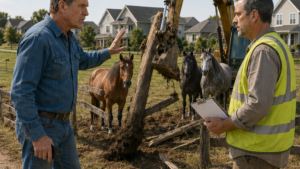
Anna stood with a code officer near the lower basin. George faced them from the patio, holding the HOA approval letter.
“This is selective enforcement,” he said. “My neighbor signed the design review and now works for the municipality.”
“He works for a different department,” Anna replied.
“He knows how to manipulate drawings.”
Brian stopped at the sidewalk.
George saw him and raised the letter. “You couldn’t win with your survey, so now you’re dragging my wife into it?”
Pamela stood behind the screen door. She did not step outside.
Brian approached only as far as his property line.
“The contractor photographs are being authenticated,” Anna said. “This inspection concerns the recorded easement and documented flooding.”
George pointed at Brian. “He approved the fountain.”
“I approved a concept without checking the drainage attachment,” Brian said. “That was my mistake.”
George’s hand lowered slightly.
It was the first time Brian had said it aloud where George could hear.
He continued, “It doesn’t make the drainage line disappear.”
The code officer handed George a document. He read the first page, then looked at Anna.
“You’re ordering removal based on his complaint?”
“Based on the survey, recorded plat, site conditions, and flood evidence,” she said. “You have ten days to remove the obstruction or submit an engineered correction.”
“Ten days?”
“A storm event may arrive sooner. Voluntary emergency access would allow a temporary channel.”
“No.”
Pamela opened the screen door. “George.”
“No one is cutting through my yard because Brian changed his mind.”
Anna’s expression did not shift. “The order includes daily penalties after the compliance date.”
George folded the document once, then again. “My attorney will appeal.”
Jessica’s email arrived before sunset.
The HOA board had authorized an emergency administrative appeal, citing procedural ambiguity in the original approval, reliance on committee review, and potential irreparable damage to an association-approved improvement.
The appeal automatically paused the removal deadline pending a hearing.
Brian read the message twice.
The county had confirmed the violation. The order existed. For less than four hours, he had believed the machine had finally begun moving in the right direction.
Now the fountain was still standing, its water falling exactly where George had directed it.
On Brian’s computer, the forecast map refreshed.
The red center of the storm band shifted south and settled directly over their subdivision.
Chapter 5: The Meeting Where Brian Named His Own Failure
George placed the enlarged copy of Brian’s signed minutes on the easel before Brian reached the front table.
The paper was three feet high. Brian’s initials appeared at the bottom in thick black ink, circled twice.
Residents filled nearly every chair in the HOA clubhouse. Some stood against the back wall. On the television beside the board table, a security camera displayed George’s fountain in real time, its lights glowing beneath the falling water.
Outside, rain had begun tapping the windows.
George rested one hand on the easel. “Before anyone votes to destroy my property, they should know who approved it.”
A murmur passed through the room.
Jessica sat at the center of the board table with two folders aligned in front of her. Nicholas occupied the treasurer’s seat, his calculator and handwritten assessment estimates arranged beside a legal pad.
Brian took the empty chair facing the board.
He had prepared six pages of technical notes. Elevations, rainfall estimates, drainage widths, photographs of standing water. He placed them on the table, then looked at the enlarged initials.
George had chosen the opening because it forced Brian into the position he disliked most: defending himself before he could explain the danger.
Jessica called the emergency meeting to order.
“The purpose tonight is limited,” she said. “We must consider temporary access for drainage mitigation while the county order is under appeal.”
“Limited?” a resident called from the back. “My crawlspace has water.”
Another voice answered, “And I’m not paying for a fountain lawsuit.”
Nicholas tapped his pen against the table. “The preliminary estimate for removal, restoration, and legal costs could require a special assessment if insurance reserves rights.”
“How much?” someone asked.
“Potentially seven to twelve thousand dollars per household, depending on allocation.”
The room changed at once. Shoulders stiffened. People began talking over one another.
Brian saw the relief on George’s face. Money had replaced drainage as the center of the room.
George lifted the enlarged minutes again. “There should be no association cost. Brian reviewed the project. If he made an error, that’s between him and his insurance.”
Brian opened his notes.
The first paragraph explained that the fountain narrowed the active corridor. The second described saturation levels. The third cited county authority.
He could read all of it and remain technically correct.
He could also leave everyone thinking George’s accusation was only a distraction.
Brian closed the packet.
“I signed those minutes,” he said.
The room quieted unevenly.
George folded his arms.
Brian kept his hands flat on the table. “I reviewed a decorative sketch. It showed the shape of the fountain and the planting beds. It did not show grades, property lines, or the drainage easement.”
A board member leaned forward. “Then why did you sign?”
“Because I assumed someone else would verify those things.”
Jessica looked down.
Brian continued. “I asked whether permits and site placement would be reviewed. I accepted an informal answer. I did not ask for the missing attachment, and I did not check the recorded plat even though I knew how.”
George gave a short laugh. “So now it’s negligence instead of approval.”
“Yes,” Brian said.
The laugh stopped.
“I should have checked. I didn’t. That made it easier for the HOA to issue an incomplete approval and easier for George to believe the location had been cleared.”
Nicholas stared at him. “Your attorney told you to say this?”
“I haven’t hired one.”
“You understand you’re admitting liability.”
“I understand water is moving toward six houses while we decide which version of the truth costs less.”
The rain struck harder against the clubhouse windows.
On the television, the fountain continued running in the dark.
Brian turned to the residents. “I filed a request for reimbursement for the water damage inspection at my house. I’m withdrawing it tonight. I’ll pay that cost myself. I will also sign a statement accepting review of my committee role.”
A woman in the second row frowned. “Why would you do that?”
“Because asking everyone else to admit their part while protecting mine would make everything George says about me partly true.”
No one applauded. Brian was grateful for that.
Nicholas looked at his assessment sheet, then pushed it aside.
Jessica opened the first folder. “There is additional information the board has not reviewed in full.”
George’s head turned sharply.
She removed the approval checklist and placed it under the document camera. The television changed from the fountain feed to the page. Four required attachments were listed. The fourth line read EASEMENT AND UTILITY REVIEW.
The box beside it was checked.
“The attachment was not in the file,” Jessica said.
“Because Brian reviewed the design,” George replied.
“No.” Her voice tightened. “Because I processed the approval before the engineering page arrived.”
The room went silent again.
Jessica pressed her fingertips together. “The board had announced the beautification tour. The fountain was being presented as a featured project. The contractor said the final site review would follow. I marked the checklist complete so the design letter could be issued.”
A board member stared at her. “You falsified the checklist?”
“I marked a pending item as received.”
“That is the same thing.”
Jessica did not answer.
George stepped away from the easel. “You told me I was approved.”
“The letter approved the design.”
“It did not say temporary.”
“It also did not authorize construction over an easement.”
He turned toward Brian. “You both want to rewrite this because the county showed up.”
Pamela sat in the last row, her hands clasped around a closed envelope. She did not look at George.
Brian opened the storm forecast on his laptop and projected it onto the screen. The expected rainfall band covered their neighborhood.
Anna stood near the side wall, present only to answer technical questions.
“If the obstruction remains,” she said, “the temporary surface route may fail during peak runoff. Emergency access would allow a crew to cut a controlled channel before that happens.”
“Would they demolish the fountain?” George asked.
“Not tonight,” Anna said. “They would remove enough landscaping and possibly part of the lower structure to restore flow.”
“Possibly.”
“If conditions require it.”
George looked around the room. “There. They cannot even tell you what they will destroy.”
Pamela spoke without standing. “They told us what the water could destroy.”
George’s face changed.
It was not anger first. It was surprise.
Pamela opened the envelope and removed copies of the contractor photographs and invoices.
“We spent almost three times what George told the HOA,” she said. “We borrowed against the house for part of it.”
A whisper moved through the room.
George stared at her. “Pamela.”
“You said the drainage marker was abandoned. The contractor did not say that.”
“You don’t understand construction.”
“I understand the loan payment.”
Jessica restored the fountain camera feed. Its blue lights shimmered beneath the water, beautiful and remote from the damp room.
Nicholas cleared his throat. “The motion is to grant temporary emergency access across the association-controlled side corridor and request owner consent for work within the Anderson lot.”
One by one, the board members voted.
Yes.
No.
Yes.
No.
Nicholas held the deciding vote.
He looked at Brian. “If the county damages the fountain and the carrier denies coverage, every family here may pay.”
“If the corridor fails,” Brian said, “some families may lose rooms.”
Nicholas rubbed the edge of his calculator. Rain ticked against the glass behind him.
“No,” he said at last. “Not without a cost agreement.”
The vote ended in a tie.
Jessica announced that the motion had failed.
Anna closed her field folder. The emergency crew waiting outside could inspect the association corridor, but George’s gate and fountain controls remained private.
George removed Brian’s enlarged signature from the easel and rolled it under one arm.
As residents began leaving, Brian watched water gather along the clubhouse walkway. It flowed toward the curb until a ridge of mulch divided it. Half turned left. Half turned right.
A choice made by an inch of ground.
Anna stopped beside him.
“Without access,” she said, “the county cannot cut through his foundation tonight.”
Brian looked at the site map still glowing on his laptop. The original swale continued through his own side yard before reaching George’s lot.
His retaining wall sat across part of that route.
For years he had thought of the wall as protection.
Now he wondered how much water it was holding in.
Chapter 6: The Night the Fountain Stopped Looking Permanent
Water crossed Brian’s lowest foundation vent at 9:17 p.m.
He saw it in the beam of his flashlight—a black sheet sliding over the concrete lip and disappearing into the crawlspace.
The rain was too loud for him to hear it enter.
He called Anna first.
“It’s at the vent.”
“How deep in the side yard?”
“Eight inches near the wall. More upstream.”
“Get out of the crawlspace and stay out. The crew is two streets over.”
“They still don’t have access.”
“We know.”
Brian ended the call and stepped into the rain.
Across the connected yards, flashlight beams moved behind fences. Nicholas was carrying storage bins into his garage. Two houses uphill had pumps running, their hoses discharging into ground already saturated.
George’s fountain was dark.
For the first time since its construction, no water rose from the center tier. Stormwater circled the lower basin instead, muddy and full of leaves. Without lights or spray, the stone looked smaller.
Not permanent.
Just heavy.
Anna arrived with the emergency drainage crew and a county code officer. The crew rolled a compact excavator into Brian’s driveway and stopped at the side gate.
“We can open a temporary route here,” Anna said, pointing to Brian’s retaining wall. “But your wall blocks the lowest path.”
Brian stared at the stacked concrete blocks. He had built the wall himself after buying the house, one level at a time, to keep runoff away from the foundation.
“How much comes out?”
“Ten to twelve feet initially.”
“That sends water toward George’s fence.”
“It follows the recorded corridor. If the fountain foundation blocks it, pressure will build there instead of against your house.”
“And if the wall fails uncontrolled?”
“It could collapse toward the equipment or release debris into the channel.”
The crew supervisor raised a demolition saw. “We need your written authorization.”
Brian looked toward his house. Water was already inside the vent. He had spent days demanding that George sacrifice stone for the drainage route.
Now the first stone in the way belonged to him.
“Do it,” he said.
The supervisor handed him a wet clipboard.
Brian signed without reading every line.
The saw started with a high mechanical whine. Mud splashed against the operator’s protective pants as the blade cut through the first block. Brian felt the vibration through the soles of his boots.
A section of wall came down.
Water struck the opening immediately.
It rushed through in a brown stream carrying mulch, pinecones, and one of the fluorescent survey stakes. The stake spun twice, caught against a shrub, then broke free and continued toward George’s yard.
Nicholas shouted from the adjoining fence. “The level’s dropping over here.”
Anna checked the marks on a fence post. “Two inches in six minutes.”
A second homeowner called that water had stopped rising beneath the crawlspace.
The small relief lasted less than ten minutes.
At George’s property line, the new channel narrowed against the fountain’s buried foundation. Branches and landscape fabric collected there, forming a dark mat. Water spread sideways across the lawn.
The crew supervisor probed the obstruction with a long-handled rake. “The footing extends farther than the survey estimate.”
“Can you clear it from here?” Brian asked.
“Not without entering the lot. We need the service controls shut down and the lower basin opened.”
George stood beneath his covered patio, dry except for rain blowing across his shoes. Pamela remained inside the side gate.
Anna approached him.
“Mr. Anderson, the temporary route is working upstream, but debris is trapped against your foundation. We need access now.”
“You have an appeal pending.”
“This is emergency mitigation, not final removal.”
“You cut his wall. Cut around mine.”
“There is no safe route around it.”
George looked at Brian. “Convenient.”
Brian crossed the muddy yard until the gate separated them.
“My wall is gone,” he said.
“You chose that.”
“Yes.”
“You want me to choose the same.”
“I want you to open the controls.”
George’s face was pale beneath the patio light. “Do you know what that fountain cost?”
Pamela answered from behind him. “We all know now.”
He turned on her. “Not here.”
“There is nowhere else left.”
A branch struck the fence with a wet crack. Water pressed through the pickets, carrying grass clippings and shredded bark.
George gripped the gate latch but did not open it.
“I was done,” he said.
Brian almost missed the words beneath the rain.
George looked toward the dark fountain.
“I retired, and suddenly every call was about what I used to build. Nobody asked what I was building now. The fountain was supposed to be the one thing in this neighborhood people saw and knew I could still finish.”
Brian said nothing.
“The first contractor wanted another review, another delay, another person telling me to wait. Then the HOA letter came. Your initials were on it.”
“I know.”
“I thought that meant the questions were over.”
“At first, maybe.”
George’s gaze hardened.
Brian continued, “After the survey, they weren’t.”
The water reached the bottom hinge of the gate.
George looked at it.
“You had the plat,” he said. “You knew all this before I poured.”
“I could have known. I didn’t check.”
“That is not better.”
“No.”
The answer unsettled him more than an argument would have.
Brian stepped closer to the gate. “I hid behind the process because I didn’t want a fight. You hid behind the approval because you didn’t want to admit the fountain might be wrong. We can explain both later.”
He pointed toward Nicholas’s yard, where two people were carrying boxes through ankle-deep water.
“Right now, the water doesn’t care which explanation is better.”
The crew supervisor called from the channel. “Debris is building fast.”
Anna raised her voice. “If the blockage shifts on its own, it may release toward the lower lots without control.”
George looked toward the house. “The service key is in the equipment cabinet.”
“Then get it,” Pamela said.
He did not move.
Pamela stepped past him into the rain. Her hair flattened against her face within seconds. She reached for the gate latch.
George caught her wrist, not roughly, but firmly.
“If you open that, they’ll tear it apart.”
“If I don’t, the water will tear through somebody’s house.”
For a moment, neither released the latch.
Then George let go.
Pamela opened the gate.
The crew entered with pumps, rakes, and cutting equipment. Anna directed them toward the lower basin, but the service cabinet remained locked.
The supervisor pulled on the handle. “We need the key. Electrical feed and recirculation valves are behind this panel.”
Pamela looked at George.
He stood under the patio again, rainwater dripping from his sleeves now, both hands empty.
“Where is it?” she asked.
George’s eyes moved from the locked cabinet to the fountain, then to Brian’s broken wall across the yards.
His right hand closed around something in his pocket.
He had the key.
But he did not take it out.
Chapter 7: What Remained After the Water Found Its Course
George took the key from his pocket and placed it in Brian’s muddy hand.
The gesture was so small that, for a moment, no one moved.
Then Anna pointed toward the service cabinet.
“Open it.”
Brian crossed the flooded stone path. The key resisted in the lock, as if grit had worked into the cylinder, but it turned on the second attempt. Inside, labeled switches controlled the pump, lights, and recirculation valves. A brass-handled bypass sat beneath them.
The crew supervisor leaned over Brian’s shoulder.
“That one isolates the lower basin.”
Brian pulled it.
A deep vibration traveled through the stone. Water trapped inside the fountain’s plumbing drained with a hollow rush. The crew removed the cabinet panel, disconnected the electrical feed, and began lifting decorative rock from the channel side.
George stood beneath the patio roof, watching each piece come away.
No one told him to help. No one asked him to leave.
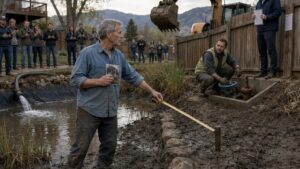
The excavator entered through the open gate and lowered its bucket beside the fountain foundation. The operator worked slowly, shaving wet soil from the buried edge. The first concrete footing appeared wider than the visible basin, extending beneath the ornamental grass and directly across the drainage corridor.
“There’s the blockage,” Anna said.
A mat of branches, landscape fabric, mulch, and leaves had packed against the footing. Water pressed behind it in a rising, trembling pool.
The crew supervisor signaled everyone back.
The excavator hooked the debris and lifted.
The channel opened with a force that made Brian step sideways. Brown water surged beneath the bucket, struck the exposed concrete, then found the narrow gap where the original swale had once run. It carried broken twigs, stones, and the remains of two survey stakes through George’s yard and toward the street inlet.
Across the connected properties, people shouted measurements over the rain.
“Down an inch!”
“Two inches at the fence!”
“The crawlspace vent is clear!”
Brian checked the mark he had scratched into his own foundation block. The waterline slipped below it, slowly but unmistakably.
No one cheered.
The crew continued cutting.
Part of the lower fountain basin had to be broken to widen the temporary route. The stone did not shatter dramatically. It cracked under steady pressure, one section at a time. Each piece was set aside rather than thrown into a pile.
George walked into the rain and stood beside Brian.
“They can save the upper tiers,” the supervisor said. “Maybe the back half of the lower basin too. Not here, though. Anything rebuilt has to sit outside the easement.”
George nodded once.
Brian could not tell whether he was agreeing or simply acknowledging that the choice had already been made.
The rain eased near midnight. By then, water had withdrawn from Nicholas’s crawlspace and dropped below Brian’s foundation vent. The crew installed a temporary lined trench through the opened corridor and anchored it with stone.
Anna inspected each connected yard before allowing the excavator to leave.
“No structural flooding reported,” she said. “We’ll need full assessments tomorrow.”
Brian looked toward the gap in his retaining wall. The blocks lay stacked beside the driveway, their cut edges pale against the mud.
George followed his gaze.
“You destroyed your own wall first,” he said.
“It was in the way.”
“You could have waited for the county.”
“So could you.”
George’s face tightened, but the old argument did not arrive.
Instead, he looked at the dismantled fountain.
“I knew after the survey,” he said.
Brian waited.
“I kept telling myself your signature mattered more. That the HOA letter mattered more. Something had to matter more than the money I buried under there.”
“The money mattered.”
“Not enough to flood six houses.”
“No.”
George wiped rain from his eyes with the back of his wrist. “You could have said that like you won.”
“I didn’t.”
“That almost makes it worse.”
Brian looked toward Pamela, who stood in the kitchen doorway wrapped in a towel.
“It probably does.”
Six weeks later, the county hearing room smelled of paper, damp coats, and burnt coffee.
The final responsibility order divided the costs rather than assigning them to one person. George was responsible for construction performed after the first contractor’s warning and for the removal work within his property. The HOA carried the cost of the incomplete approval and emergency legal review. Jessica received formal discipline from the management company and was removed from approval authority pending retraining.
Brian’s name appeared in the order too.
His committee review had not authorized the encroachment, but the hearing officer described his failure to request the missing attachment as “contributing procedural negligence.” Because Brian had withdrawn his reimbursement claim and voluntarily accepted the cost of restoring his wall, no separate damages were assessed against him.
When the decision was read, Nicholas leaned toward Brian.
“You could appeal that language.”
“It’s accurate.”
“It makes you look responsible.”
“I was responsible.”
Nicholas looked down at the order. “Not equally.”
“No.”
That distinction mattered. Brian had learned that admitting fault did not require accepting every fault in the room. George had concealed the marker. Jessica had advanced an incomplete approval. Brian had remained silent when he knew a question had not been answered.
The truth did not become fairer by flattening those differences.
After the hearing, Pamela approached him in the hallway.
“George is rebuilding part of it,” she said.
Brian hesitated. “The fountain?”
“Not the fountain exactly.”
The restored drainage corridor followed the rear property line in a broad, shallow curve. Native grasses now held the soil where polished stone had once covered the ground. The county approved a rain garden outside the easement, using the salvaged lower basin as a catchment pool.
The upper tiers were gone.
George had stored them behind his garage.
The remaining basin sat low among rushes and flowering plants, collecting roof runoff before releasing it through a stone-lined spillway. During ordinary rain, water pooled there quietly. During heavier storms, it overflowed into the restored swale and continued toward the street inlet.
Brian stood beside the new channel while George adjusted a flat stone along its edge.
“That one’s too high,” Brian said.
George did not look up. “I know.”
“You’re sending water left.”
“I said I know.”
Brian waited.
George moved the stone half an inch lower.
Water from a garden hose passed over it, divided briefly, then joined the channel again.
The repaired retaining wall beside Brian’s house included a removable section aligned with the emergency overflow path. It was not as solid-looking as the old wall. That was the point.
Nicholas had voted for the permanent drainage plan after the storm. He still complained about the assessment at every board meeting, but he no longer called the swale wasted space.
Jessica delivered the complete revised records herself. She did not apologize in a speech. She simply placed the indexed file on the table and said, “Nothing pending is marked received.”
George and Brian did not become friends.
They spoke when a property issue required it. They exchanged tools twice. Pamela waved when Brian collected his mail. Some evenings, George sat near the rain garden without turning on the small recirculation pump installed outside the drainage corridor.
One late summer afternoon, a short storm crossed the neighborhood.
Brian watched from his side yard as water entered the shallow channel behind the six houses. It moved around the grasses, passed through the former fountain site, and continued toward the inlet.
George stood on the opposite side.
Neither man spoke.
The water did not rise into the air now. It did not glitter for anyone or prove who owned the ground beneath it.
It simply followed the course they should have protected from the beginning.
The story has ended.