Respect, Before Recognition
Part I — The Spill No One Wanted to See
By the time Nolan Carter noticed the man on the floor, three other people had already seen him and decided not to stop.
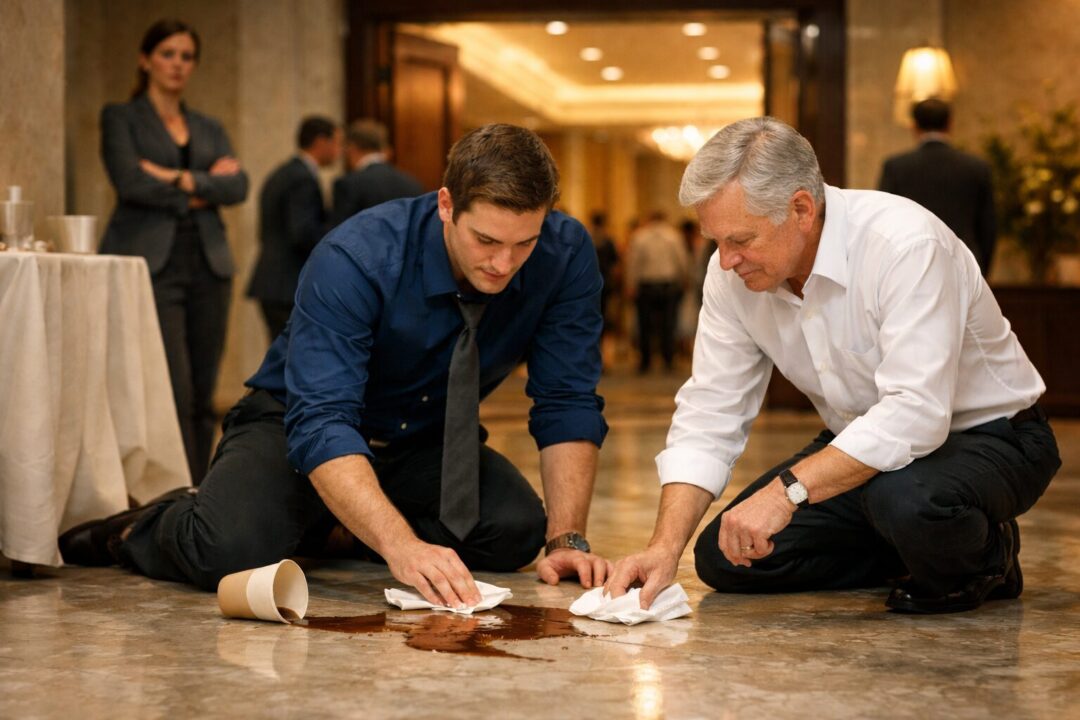
That was what stayed with Nolan later, long after the applause, long after the speech, long after his own name had been called beneath the ballroom lights. Not the spill itself. Not the napkins. Not even the silver-haired man kneeling in a pressed white shirt on the polished hallway tile, wiping up dark liquid with the calm focus of someone cleaning his own kitchen table.
It was the hesitation around him.
The corridor outside the Grand Crescent Ballroom was crowded with the nervous energy of a corporate event about to begin. Staff in black slacks hurried past with trays. Junior employees adjusted name badges and smoothed jackets they could barely afford. Managers checked phones with a kind of practiced urgency that said they wanted to look important before important people arrived.
Someone had dropped a coffee near one of the linen-draped side tables. The paper cup lay on its side, bleeding a brown crescent across the pale floor.
And in the middle of all that polished tension, an older man was crouched down, cleaning it himself.
Nolan slowed without meaning to.
He was twenty-six, three months into his first real corporate role, and still learning how to move through rooms like this one without looking like he didn’t belong. That evening mattered more than he wanted to admit. The company’s annual leadership dinner was full of vice presidents, board members, and people whose names were spoken with lowered voices. Nolan had spent most of the afternoon trying not to sweat through his navy shirt.
He should have kept walking.
Instead, he stopped.
The older man did not look like hotel staff. His shirt was too crisp, his posture too composed. Even crouched on the floor, he held himself with an unhurried steadiness that didn’t belong to someone panicking over a mess. He folded the napkin once, pressed it against the spreading coffee, and reached for another.
Two people passed. One glanced down and immediately looked away.
Then Marissa Vale appeared at Nolan’s shoulder.
Marissa was the kind of person who always looked as if she had entered the evening half an hour before everyone else and already mastered it. Her charcoal blazer fit perfectly. Her hair was pinned back in a style so precise it seemed to resist humidity on principle. She worked in operations, two levels above Nolan, and had a reputation for never being caught uncertain.
She looked down once, then turned to Nolan with a flat expression.
“Leave it,” she said. “Keep moving.”
Nolan frowned. “He’s doing it alone.”
“Maintenance will handle it.”
The older man said nothing. He kept cleaning.
Maybe that was what made the moment feel wrong. If the man had looked embarrassed, Nolan might have looked away too. If he had snapped at someone for help, the spell might have broken. But he seemed almost peaceful, as though the spill was simply the nearest problem and therefore the one he intended to solve.
Marissa shifted her phone in her hand. “We’re late.”
Nolan looked toward the ballroom doors, where warm light spilled through the opening as guests began taking their seats. Then he looked back at the coffee creeping toward the man’s polished shoes.
He heard himself answer before he fully decided to.
“Not fast enough.”
Marissa gave him a sharp look, but Nolan had already crossed the few feet of tile between them. He grabbed a stack of cocktail napkins from the side table, loosened his tie by a fraction without thinking, and knelt down.
The floor was colder than he expected.
“I’ve got the floor,” he said quietly.
The older man looked up.
His face was lined but not frail, calm but not distant. Silver hair, clear eyes, the kind of expression that carried both patience and attention. For one strange second Nolan had the feeling of being studied, not judged exactly, but registered.
“It’s alright,” the man said.
“I know,” Nolan replied, already pressing napkins against the spill. “Still.”
For a few seconds they worked side by side in silence. The man took the edge nearest the table. Nolan handled the mess that had spread farther out. Their hands moved in efficient turns, no fuss, no speeches, no performance of decency. Just two people trying to clean the floor before someone stepped in it.
Behind them, the corridor had gone oddly still.
Nolan could feel eyes on his back. He didn’t need to turn to know Marissa was still standing there, caught between irritation and disbelief.
The man folded one damp napkin over another and rose to his feet with more ease than Nolan expected. He smoothed the front of his shirt, then offered Nolan the remaining clean napkin.
“Thank you,” he said.
There was nothing grand in the words. Nothing theatrical. But something in the way he said them made Nolan stand up a little straighter.
“No problem,” Nolan said.
The man held his gaze for a brief moment, as if fixing him in memory.
Then he turned and walked toward the ballroom.
Marissa exhaled through her nose the instant he was gone.
“You really didn’t need to do that,” she said.
Nolan dropped the damp napkins into a nearby bin. “Someone needed to.”
“That’s not the point.”
He looked at her. “What is the point?”
For the first time since he had met her, Marissa seemed not to have an answer ready.
She glanced toward the ballroom doors, then back at him, lowering her voice. “At events like this, perception matters.”
Nolan almost laughed. It wasn’t funny, but it was the kind of sentence that became ridiculous if you held it too long in your mind.
He reached for the knot of his tie and tightened it again. “Maybe.”
Marissa stared at him for a second, then turned sharply and headed into the ballroom.
Nolan followed a moment later, though the oddness of the hallway scene stayed with him. Not because he thought he had done anything noble. He hadn’t. It had taken less than a minute.
But because of the man’s face.
Because of the calm.
Because of the way the corridor had felt, for those few seconds, like a test nobody had announced.
Part II — The Room Where Names Mattered
Inside the Grand Crescent Ballroom, everything shimmered with expensive restraint.
Round tables dressed in white linen filled the room in careful arcs around a low stage. Crystal glasses glinted under amber lights. A screen behind the podium displayed the company logo in slow, dignified motion. At Nolan’s table, people were already speaking in softened voices, as if they had all silently agreed that success sounded best one volume below normal conversation.
He sat near the back with the other junior employees, where the sightlines were decent and the status was not.
Marissa sat two tables ahead.
Nolan tried to let the hallway moment fade. He listened to half a conversation about regional growth targets. He nodded when someone asked whether he liked the hotel. He even laughed at a joke he barely heard. But every few minutes his mind returned to the silver-haired man in the white shirt.
Who had he been?
Not hotel staff. Not exactly an attendee either, at least not in the ordinary sense. There had been something too self-possessed about him, something that didn’t fit with the way everyone else had been performing the evening.
Dessert plates were being cleared when the lights shifted.
The low conversation softened into silence. The master of ceremonies, a senior vice president with a polished smile, stepped to the microphone and welcomed everyone to the annual leadership recognition dinner. He spoke about vision, resilience, culture, and shared values in sentences that had probably been revised six times by communications.
Then his tone changed.
“And now,” he said, “it’s my honor to welcome the man whose standards built this company long before most of us ever entered it.”
A small ripple moved through the room.
Nolan looked toward the stage.
The man from the hallway walked out in a dark suit jacket, the white shirt now hidden beneath tailored wool, and the ballroom rose to its feet.
For a second Nolan didn’t stand.
His body forgot how.
Around him chairs scraped back, hands came together, faces brightened. At the table ahead, Marissa went very still before rising with everyone else. The applause rolled across the room like surf.
Nolan stood last.
The man took his place at the microphone with the same calm he had shown on the floor outside, as if kneeling over a coffee spill and receiving a standing ovation belonged to the same uninterrupted self.
“This is Arthur Holloway,” someone whispered at Nolan’s table, sounding half awed, half delighted to possess the information.
The founder.
Nolan felt heat rise beneath his collar.
He had seen Arthur Holloway’s name on internal strategy decks, on the company timeline in orientation materials, in the framed photographs lining the executive floor. But those images showed a younger man, sharper around the jaw, easier to mythologize. They had not prepared him for the reality of a person kneeling on tile with napkins in his hands.
Arthur waited for the applause to fade.
When he finally spoke, his voice was low and even. He didn’t sound like a man trying to impress a room. He sounded like a man fully accustomed to rooms listening.
“I’ve spent a lot of years being introduced by my job title,” he said. “It’s one of the least interesting things about me.”
Soft laughter moved through the crowd.
Arthur smiled faintly, but his eyes stayed thoughtful. He spoke for several minutes about the early days of the company. Not the version polished for investors or newsletters, but the rougher one—late invoices, borrowed office space, furniture assembled by hand, meetings held in rooms no one would brag about now. He talked about mistakes made under pressure and the difference between intelligence and judgment.
Then he rested both hands lightly on the sides of the podium and looked out over the ballroom.
“Titles,” he said, “are easy to respect when they’re visible.”
The room went still.
“What’s harder,” he continued, “is recognizing character before you know it comes with a title.”
Nolan’s chest tightened.
He did not need to look at Marissa to know she understood exactly where this was going.
Arthur’s gaze moved through the audience, unhurried, until it landed near the back of the room.
“Nolan Carter,” he said. “Would you come up here for a moment?”
The silence before the applause was somehow worse than the applause itself.
For one impossible second Nolan simply sat there, as though the name belonged to someone else. The people at his table turned toward him all at once. Someone touched his sleeve. Across the room, Marissa had gone pale.
Nolan stood.
The walk to the stage felt unreal in the way dreams sometimes do—everything overly bright, overly sharp, every step somehow both too slow and too fast. He was aware of his heartbeat, of the edge of the stage beneath his shoe, of hundreds of eyes following him upward.
Arthur waited for him with a small, unreadable smile.
When Nolan reached him, Arthur turned back to the audience.
“Ten minutes before this dinner,” he said, “I spilled coffee in the corridor outside this room.”
A murmur moved through the tables.
“It wasn’t dramatic,” Arthur said. “It wasn’t noble. It was coffee. And a floor. That’s all.”
A few people smiled uncertainly.
“But moments like that have a way of simplifying everyone around them.”
He let the sentence settle.
“Most people assumed someone else would handle it. Some pretended not to see it. One person was advised very clearly to move on.”
Now the ballroom was silent in a different way. Not formal silence. Human silence.
Arthur looked at Nolan, then back at the room.
“He stayed anyway.”
The words were simple. Their effect was not.
“He did not know who I was,” Arthur said. “And that is precisely why it mattered.”
Nolan kept his hands loosely at his sides, afraid that if he moved at all he might reveal how badly they were shaking.
Arthur reached to the podium table and lifted a small dark box.
“In this company,” he said, “we talk too often about potential as if it’s something hidden in forecasts and performance reviews. Sometimes potential is much easier to see. Sometimes it’s visible in the speed with which a person chooses dignity over appearance.”
He held the box out.
“When everyone else was measuring status, Nolan responded to need. That instinct cannot be trained into someone easily. It’s either there, or it isn’t.”
The applause began before Nolan took the box.
This time it was louder.
Not polite. Not ceremonial. Real.
He accepted it with both hands, more from instinct than thought. It was heavier than it looked. Inside, he would later find a handwritten note, a company insignia pin given only to a handful of emerging leaders each year, and an invitation to join a mentorship program personally overseen by Arthur’s office.
But in that moment the contents hardly mattered.
Arthur leaned slightly toward him and spoke low enough that only Nolan could hear.
“You thought no one important was watching,” he said.
Nolan swallowed. “I didn’t think about that.”
“I know,” Arthur replied.
And somehow that was the highest praise Nolan had ever received.
Part III — What People Revealed in Silence
After the applause, the rest of the evening passed in a blur of handshakes, widened eyes, and changed tones.
People who had not known Nolan’s name an hour earlier now used it with warm certainty. A vice president stopped him near the dessert station to say Arthur Holloway noticed very few things by accident. Two directors congratulated him as though they had always expected this of him. A senior manager clapped him on the shoulder and told him to “stay exactly who you are,” which sounded wise until Nolan realized it came from a man whose assistant had once cried in a stairwell.
Recognition had a strange effect on rooms. It didn’t only elevate the person being recognized. It exposed everyone else’s habits of attention.
Nolan spoke when spoken to. Thanked people. Smiled. Tried not to look overwhelmed.
Eventually he slipped out into the corridor again, needing air that didn’t feel curated.
The floor had long since been cleaned properly. No stain remained. The side table had been reset with fresh linen and untouched glasses. If Nolan had not been there himself, he might have thought he had imagined the whole thing.
The ballroom doors opened behind him.
Marissa stepped out.
For once there was no practiced certainty in the way she carried herself. She stopped a few feet away, arms folded tightly, phone absent now, as if she had finally run out of objects to hold between herself and discomfort.
“I owe you an apology,” she said.
Nolan looked at her, surprised less by the words than by how difficult they seemed for her to say.
“You don’t owe me anything.”
“Yes,” she said. “I do.”
The hallway hummed faintly with distant music and the clink of silverware being collected.
Marissa exhaled. “I wasn’t trying to be cruel.”
“I know.”
“I was trying to protect you from looking… inexperienced.”
Nolan gave a small, tired smile. “That worked out well.”
To his relief, she almost smiled back. Almost.
Then her face settled into honesty. “I’ve been in rooms like that too long,” she said. “You start thinking the smartest thing is always to read hierarchy correctly. To move toward power. To avoid the wrong kind of visibility.” She looked toward the spotless floor between them. “Sometimes that instinct rots something in you.”
The admission was quiet enough that Nolan almost missed it.
He thought of Arthur’s words at the podium. Titles are easy to respect when they’re visible.
“What matters,” Nolan said slowly, “is what you do before you know.”
Marissa let out a breath that might have been a laugh or might have been regret.
“Apparently.”
They stood there a moment longer, not as enemies and not quite as allies, but as two people who had shared the same test and answered it differently.
“Congratulations,” she said at last, and this time the words were clean.
“Thank you.”
She nodded once and returned to the ballroom.
Nolan stayed where he was.
A few minutes later, the side door near the stage opened, and Arthur Holloway stepped into the corridor with his jacket unbuttoned, looking for all the world like a man escaping his own honor. The noise of the ballroom dimmed behind him.
He spotted Nolan and came over, one hand in his pocket.
“I hope we didn’t embarrass you beyond recovery,” Arthur said.
Nolan let out a surprised laugh. “I’m still deciding.”
Arthur smiled.
Up close, outside the theater of the stage, he looked older again. Not weaker. Just more human. Nolan found that reassuring.
“I meant what I said,” Arthur told him. “Not because you helped me. Because you helped without calculation.”
Nolan hesitated. “Anyone should have.”
Arthur tilted his head. “But they didn’t.”
The simplicity of that left no room to hide.
Arthur leaned lightly against the wall, as if neither of them needed to rush back yet. “Companies become what they reward,” he said. “Most leaders know that in theory. Fewer understand how quickly people notice what is actually honored.”
Nolan looked down at the box in his hand.
“I don’t know if I’m the person everyone thinks I am now.”
Arthur’s expression softened. “Good. The people who frighten me are the ones who decide too quickly that they deserve the version of themselves others are applauding.”
That sat with Nolan for a moment.
“I was just trying to help,” he said.
Arthur nodded. “Then keep becoming the kind of man for whom ‘just trying to help’ is not small.”
The music swelled faintly through the ballroom doors. Someone inside laughed too loudly. The night, with all its polished surfaces, went on.
Arthur straightened and buttoned his jacket again.
“My office will contact you Monday,” he said. “Don’t let that alarm you.”
“I’ll try.”
Arthur started back toward the doors, then paused.
“And Nolan?”
“Yes?”
Arthur’s eyes held the same calm attention they had in the corridor before anyone knew what the moment was.
“Never become so important that you can’t be the man on the floor.”
Then he went back inside.
Part IV — The Measure of a Man
By Monday morning, the story had spread through the company in half a dozen different versions.
In one, Arthur Holloway had intentionally staged the spill, as though billionaires had nothing better to do than test junior employees with coffee. In another, Nolan had given some stirring speech in the hallway before kneeling down, which was ridiculous considering he had barely managed two full sentences. By midweek, someone from another department stopped him in the elevator and asked whether it was true he had known who Arthur was all along.
He hadn’t.
That misunderstanding bothered him more than the exaggerations. Because the whole point, as Arthur had understood instantly, was that Nolan had acted before the room could become useful.
The mentorship invitation became real. So did the extra meetings, the careful attention, the shift in how people listened when he spoke. Doors opened a little faster. His emails were answered a little sooner. It would have been easy—dangerously easy—to mistake that new warmth for proof that his value had changed overnight.
But some evenings, when work ran late, Nolan found himself remembering the corridor before the ballroom doors opened. The coffee spreading over tile. The bystanders. Marissa’s clipped voice. The older man kneeling in his white shirt, untroubled by who was watching.
That was the true center of the story. Not the stage. Not the applause. Not even the box that now sat in the top drawer of Nolan’s desk.
Just the private second in which a person either moved closer to need or farther from it.
Months later, Nolan would keep that lesson in ways no one saw. He stayed late with a new analyst who had made an error she was terrified to admit. He learned the names of the overnight cleaning crew. He stopped once in the lobby to help an intern pick up papers scattered by a broken folder while two directors walked around the mess. None of it felt dramatic. That was the point.
Arthur Holloway retired the following year, and at his farewell gathering he said many memorable things about growth, failure, patience, and legacy. But the sentence Nolan carried home was the simplest one.
Character announces itself quietly.
It did.
It had, on a hotel corridor floor, in the shape of an old man kneeling beside a coffee stain and a young man deciding, before he knew anything useful, that no one should have to clean it alone.
And that was why the moment lasted.
Because the stain disappeared.
The applause faded.
The event ended.
But somewhere beneath all the titles, beneath the promotions and the polished introductions, the real measure remained exactly where it had always been:
in what a person chose to do when the floor was wet, the room was watching, and no advantage had yet appeared.