They Tore Down Michael’s Cedar Fence, but Four Survey Stakes Stopped the Entire Development
Chapter 1: The Morning the Cedar Fence Disappeared
The excavator bucket lifted Michael Hall’s final cedar post out of the ground as if it were a weed.
Wet soil clung to the concrete footing. A length of fence rail still hung from one side, twisting before it dropped beneath the machine’s track and split with a sound Michael felt in his chest.
He stopped at the edge of his patio, one hand still wrapped around his coffee mug.
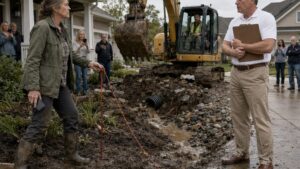
Beyond the torn line of grass, men in reflective vests moved between foundation forms. A concrete truck idled in the neighboring lot, its drum turning with a low mechanical growl. Orange paint marked a rectangle across the disturbed ground. Two sections of Michael’s fence lay buried under mud. Others had been stacked carelessly beside a dumpster.
For several seconds, no one noticed him.
Michael set the mug on the patio wall and walked downhill.
He had built the fence eleven years earlier, one section at a time, after work and on weekends. He had chosen cedar because it held up in the damp shade beneath the pines. He remembered cutting the rails on sawhorses, checking each post twice with a level, and refusing his father’s suggestion to leave the last corner until spring.
A straight line, his father had said, should not need defending.
At the time, Michael had believed him.
“Stop the machine.”
The excavator operator glanced toward the man standing near the forms.
Patrick Wilson turned around.
He was broad through the shoulders, with a white hard hat tucked under one arm and a rolled plan in his hand. He looked first at Michael, then at the excavator, as though deciding which interruption mattered more.
“Kill it,” Patrick called.
The bucket stopped above the churned earth.
Michael stepped over a broken rail. The cedar was dark with moisture where the fresh splinter exposed it.
“You removed my fence.”
Patrick’s expression did not change. “Fence was inside the construction line.”
“It was on my property.”
“We’re working from the approved site plan.”
“You didn’t call me.”
Patrick pointed with the rolled plan toward the vacant lot. “We called through the association. Notices went out. We had a crew scheduled and concrete booked.”
Michael looked at the men guiding the chute toward the forms. “You’re pouring now?”
“Footings on the far side.”
“Then stop.”
Patrick exhaled through his nose. “Mr. Hall, I’m not stopping a concrete truck because you disagree with a fence location.”
The name caught Michael’s attention. Patrick knew who he was. That meant this had not been a crew arriving at the wrong address or mistaking an abandoned barrier for scrap.
“You knew whose fence it was.”
“I knew whose yard was beside it.”
“That isn’t the same answer.”
One of the workers looked away. The excavator operator rested both hands on the controls without moving.
Patrick unrolled the plan against a stack of lumber. It was a simplified drawing of the new house, drainage path, driveway, and setback lines. A dark boundary ran along Michael’s side. The foundation corner sat inside it with several feet to spare.
“Approved by the architectural committee,” Patrick said. “Reviewed by the association. Permit issued by the county.”
Michael studied the line. It did not match the place where his fence had stood. More importantly, it did not match the iron pin he remembered near the rear corner, though he had not seen the pin in years.
“Where did this boundary come from?”
“It’s on the exhibit.”
“That’s not what I asked.”
Patrick rolled the sheet halfway closed. “I build from approved documents. I don’t survey residential lots.”
“Neither do I. That’s why I used one when I built the fence.”
“Then bring me the survey.”
The words were reasonable enough to make Michael’s anger feel less useful. Patrick had machinery, workers, a permit number, and a drawing with approval stamps. Michael had broken boards in the mud and a memory of an old document somewhere inside his house.
A pump coughed behind them. Concrete began flowing into the opposite footing.
Michael looked toward the truck. “You’re continuing.”
“That section isn’t disputed.”
“You didn’t know there was a dispute ten minutes ago.”
Patrick’s mouth tightened. “We have a schedule. The Taylor family has a construction loan with deadlines, and I have eight people on payroll. I’m not trying to take your property. I’m trying to build the house we were hired to build.”
Michael could hear the invitation inside the explanation: become emotional, become unreasonable, become the difficult neighbor the crew could dismiss.
He bent and pulled one cedar board from the mud. The rail had been crushed near the center, but one end still showed the pencil mark he had made before cutting it.
“What did you do with the posts?”
“Most are there.”
“Most?”
“One footing came up with the excavator.”
“You mean the boundary marker?”
Patrick looked at him more carefully. “It was a fence post.”
Michael walked toward the rear corner. The ground had been stripped almost bare, but close to the tree line he saw a shallow depression filled with brown water. Beside it, beneath a torn root and a mat of wet leaves, something metal caught the light.
He crouched and cleared the mud with two fingers.
The top of a narrow iron rod appeared.
Not a fence nail. Not reinforcement steel. A survey pin.
Patrick came close enough to see it.
Neither man spoke for a moment.
Michael wiped his hand on his jeans. “Was that visible before you started?”
“Not like that.”
“That wasn’t my question.”
Patrick looked toward the forms, then at the operator. “Old pins get moved. Landscapers hit them. Owners install their own markers. It doesn’t establish anything by itself.”
“But it was here.”
“It was near a fence.”
“A fence you tore down.”
Patrick’s jaw shifted. “Get a surveyor. If we’re wrong, we correct it.”
Michael stood. “And until then?”
“We continue where the permit allows.”
The concrete chute moved to the next section. Men raked the gray mixture into place, working quickly before it began to set.
Michael could have stepped into the excavation. He could have stood in front of the truck or called the sheriff and described the scene as trespass. Instead, he took out his phone and photographed the exposed pin, the broken cedar, Patrick’s plan, the machinery, and the wet concrete.
Patrick watched him.
“You can document whatever you need,” he said. “But don’t enter the active work area.”
Michael almost laughed. The warning was so cleanly phrased that it sounded prepared.
He gathered three unbroken boards and carried them to his side of the torn line. Under one of them lay the old bottom rail, still attached to a post fragment by two rusted screws. He remembered driving those screws while his father held the level against the cedar.
His father had believed silence kept a man from giving away his dignity. Michael had spent most of his life agreeing.
Now the machines were running where the fence had stood.
Patrick rolled the plan and tucked it under his arm. “We’ll be digging the side footing tomorrow.”
“What time?”
“Noon, unless the inspector moves us.”
Michael looked at the orange paint crossing the muddy ground. It ran within inches of the exposed metal pin.
Patrick followed his gaze. “Bring something official before then.”
The excavator restarted.
Michael picked up his coffee mug from the patio wall. The coffee had gone cold, and a thin layer of grit floated across the surface.
At the bottom of the yard, Patrick raised one hand toward the operator.
By noon the next day, the machine would dig directly beside the pin.
Chapter 2: The County File Was Missing One Line
Michelle Lee turned the permit sheet sideways, studied the lower corner, and said, “This is not a certified boundary survey.”
Michael sat across from her at the county planning counter with his old folder open on his knees.
The public office was quiet except for a printer, the low murmur of two clerks, and the occasional click of the number display above the waiting area. Through the glass partition behind Michelle, shelves held rolled plans and archive boxes marked by subdivision name.
Michael slid Patrick’s permit number across the counter.
“Then what is it?”
“A site exhibit.” Michelle traced a finger along the page on her monitor. “It shows the proposed house, drainage, driveway, and assumed lot dimensions.”
“Assumed by whom?”
“The preparer.”
“Who certified it?”
She paused. “No one, as a boundary survey.”
Michael leaned closer. “But the county approved the permit.”
“The county reviewed the structure against the submitted site information. We do not establish private property lines during routine residential permitting.”
“So someone drew a line, and you approved a house against it.”
“We approved a house based on an application representing that the line was accurate.”
The distinction irritated him because it sounded both evasive and true.
Michelle enlarged the digital plan. The line along Michael’s property was smooth and unbroken. There were no bearings, no monument references, no surveyor’s seal.
Michael opened his own faded survey. The paper had softened at the folds. A licensed surveyor’s stamp sat near the bottom, dated twelve years earlier. The rear corner was tied to an iron rod under the pines.
Michelle compared the two.
“They are not identical,” she said.
“How far off?”
“I can’t give you a legal measurement from these images.”
“How far do they look?”
She reached for a clear scale, then stopped before touching the old survey. “Approximately eight inches at the rear portion. Possibly more depending on how the front point was interpreted.”
Eight inches.
It was less than the width of a fence post and enough to move a footing, a drainage swale, or an entire argument.
Michael felt the first clean edge of relief. He had not imagined the line. His fence had followed the older survey.
Then Michelle enlarged another portion of the approved set.
“The setback is measured from this assumed boundary,” she said. “If your recorded line controls, the proposed foundation corner may not meet the required side setback.”
“May not?”
“A licensed surveyor needs to establish it on the ground. Then an inspector or plan reviewer can determine whether a revision is necessary.”
“They’re pouring concrete.”
“I understand.”
“They tore out the fence yesterday.”
“That’s a private civil issue unless it affects permit compliance.”
Michael closed his eyes briefly. Everywhere he turned, the problem divided itself into smaller problems, each owned by a different person.
“Can you issue a stop-work order?”
“I can flag the file for review. I cannot stop work based only on a homeowner’s copy of an older survey.”
“What would you need?”
“A current boundary survey, preferably tied to the proposed foundation layout.”
Michael looked at the clock above the waiting room. It was 9:18. Patrick had said the side footing would be dug by noon the next day.
Michelle printed the approved exhibit and placed it beside his old survey. “You should also contact the association. Their architectural approval appears to be based on the same exhibit.”
“I already spoke to the superintendent.”
“I said the association.”
Michael folded his arms.
Michelle noticed. “You don’t trust them.”
“They approved a line no surveyor signed.”
“That does not answer me.”
He looked down at the two sheets. “No.”
She nodded as if distrust were a fact she could file but not resolve. “Then use writing. Ask for the documents they relied on. Do not move equipment, remove markings, or enter the work area.”
“Everyone keeps warning me not to interfere with work happening on my property.”
“Because if the boundary is disputed, conduct matters.”
Michael left with copies, a review request number, and Jessica Moore’s name from the county’s public surveyor list.
Jessica answered on the fourth ring.
He described the fence, the iron rod, the approved exhibit, and the concrete schedule.
“You want a full boundary or the disputed line?” she asked.
“The disputed line first.”
“Emergency rate applies.”
“How soon?”
A keyboard clicked. “Tomorrow at seven-thirty.”
“They start digging at noon.”
“Then tell them a licensed surveyor will be on site. In writing.”
Michael called Patrick from the parking lot.
“A surveyor will be there tomorrow morning.”
There was a pause. “Fine.”
“Do not disturb the iron pin.”
“We’re not working at that corner today.”
“And do not remove anything else from the line.”
Patrick’s voice hardened. “Send me the surveyor’s license information. I’m not accepting homemade stakes.”
“She doesn’t use homemade stakes.”
“I’m telling you what I need.”
Michael ended the call before the conversation became what Patrick expected.
At home, he spread both plans across his kitchen table. He placed a ruler along the old bearing line and marked four rough points in pencil—front corner, two intermediate positions, rear pin. Four places where a surveyor might make the invisible visible.
His phone buzzed.
An email from Carol Anderson carried the subject line: EMERGENCY COMPLIANCE REVIEW.
The body stated that Michael’s “attempted interference with duly approved construction activity” would be discussed at a special HOA meeting Wednesday evening. It warned that unauthorized obstruction could result in enforcement costs and fines.
Michael read it twice.
The fence had been gone for less than a day. The association had already found language making him the problem.
He searched his filing cabinet for the original survey notes. Beneath tax records and appliance manuals, he found the closing packet from when he purchased the house. The legal description matched Jessica’s preliminary reading. The iron rod under the pines was listed as the rear monument.
That should have settled something inside him.
Instead, it made him remember a thick white envelope he had carried from the mailbox weeks earlier. The association logo had been visible through the window. He had placed it on the entry table beneath a hardware catalog and never opened it.
Michael went to the hall.
The envelope was still there.
He tore it open.
Inside was a request dated six weeks earlier. The architectural committee had asked adjoining owners to attend a boundary clarification meeting regarding the Taylor construction. The letter referenced “an unclear rear corner condition” and requested that Michael provide any prior survey documents.
A second page showed the meeting date.
Michael had spent that evening repairing a cabinet door in his workshop. He had seen the association envelope and decided nothing inside it deserved his time.
At the bottom of the page, Carol Anderson had written a note in blue ink:
If we receive no response, the committee will proceed using the applicant’s submitted exhibit.
Michael stood alone in the hallway with the letter in his hand.
The HOA had not earned his trust. Patrick had not earned the right to remove the fence. None of that changed what the unopened envelope proved.
He had possessed the document that might have challenged the line before the excavator arrived.
He had chosen silence and called it principle.
Chapter 3: Four Orange Stakes Against the Machines
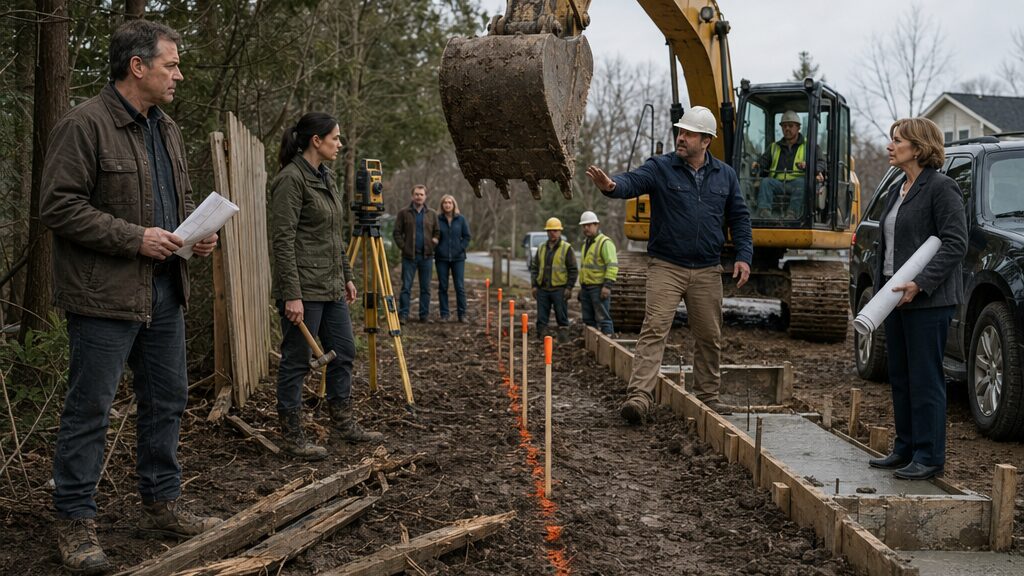
Jessica Moore drove the first orange stake directly through Patrick’s painted footing line at 7:46 Tuesday morning.
The hammer struck three times. Each blow carried across the quiet development.
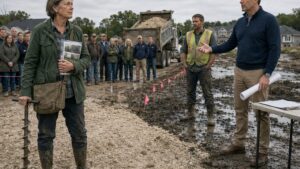
Michael stood several feet back with his old survey folded under one arm. Beyond the boundary, the new foundation forms held yesterday’s concrete, pale gray and damp along the edges. The excavator waited beside the dirt pile with its bucket lowered.
Patrick arrived before Jessica placed the second stake.
He stepped from his truck already wearing his hard hat. “What are you doing inside the construction area?”
Jessica did not look up from her instrument. “Establishing the recorded boundary.”
“You have permission from the property owner?”
“I have permission from Mr. Hall to survey his parcel. I don’t need your permission to recover monuments.”
Patrick looked at Michael. “I told you to send the license information.”
“I did.”
“At midnight.”
“It was ten-fifteen.”
Jessica moved to the instrument tripod and checked the display. “The rear rod matches the recorded monument within tolerance. The front corner is undisturbed. I’m running the line between them.”
Patrick walked toward the first stake but stopped before touching it.
“That stake is inside our approved limit.”
“That is the issue,” Michael said.
A pickup slowed on the road. Two residents watched through the windshield before continuing. News moved quickly through the association when machinery stopped.
Jessica placed the second stake beside a shallow trench. Then the third.
The orange markers formed a straight line that did not follow Patrick’s paint. Near the rear corner, the difference narrowed. Closer to the planned side footing, the gap widened enough to see without a ruler.
Patrick crouched beside the third stake. “How much?”
Jessica checked her field tablet. “Your proposed footing line crosses the required setback by roughly eight inches at this station, assuming the foundation layout marks are accurate.”
“Roughly?”
“I’ll issue certified results after processing.”
Patrick stood. “Then we don’t have certified results.”
“You have recovered monuments and a field line.”
“I have an approved permit.”
“You have a permit based on a site exhibit.”
Patrick’s face changed slightly. Michael saw that he understood the distinction. Whether he had understood it before remained unanswered.
A concrete crew truck arrived. The excavator operator climbed into the cab and started the engine. Its diesel rumble shook droplets from the pine branches.
Patrick raised a hand toward Jessica. “Clear your equipment from the active zone.”
“The tripod is on Michael’s parcel.”
“The excavation swing crosses it.”
“Then the operator should not swing there.”
Patrick turned to Michael. “You’re creating a safety problem.”
Michael unfolded the single page Jessica had prepared before fieldwork. “Her license number is here. The county review request is here. The survey job number is here.”
“I’m not discussing paperwork beside running equipment.”
“You asked for something official.”
“I asked for a certified survey.”
Jessica lifted the hammer again and drove the fourth stake beside the exposed rear pin.
The four orange stakes now stood between the excavator and the painted footing line.
Patrick looked toward the operator. “Start stripping the side.”
The bucket lifted.
Michael’s body tightened, but he did not step forward. He stayed outside the marked work area, holding the paper at his side.
The operator rotated the cab and lowered the bucket teeth toward the first section of earth. He moved slowly, watching Patrick for direction.
“Hold the recorded line,” Patrick called.
The operator hesitated.
The bucket moved past the first stake, then the second, shaving soil from the construction side. Near the third, the painted footing line crossed beneath the orange marker. There was no room to follow both.
The operator stopped.
The bucket hung above the fourth stake, its steel teeth less than a foot from the fluorescent plastic.
The engine continued to rumble, but no one moved.
One of the concrete workers looked at Patrick. “Those surveyed?”
Jessica answered before Patrick could. “Recorded boundary recovery. Field job number JM-4821.”
The worker’s expression tightened. “I’m not pulling one.”
“No one asked you to,” Patrick said.
“You told us to strip the side.”
Patrick stared at the orange line. Machinery, labor, concrete delivery, and scheduling had all narrowed to four pieces of plastic in the mud.
Michael expected satisfaction. What he felt instead was pressure. If Patrick ordered the operator forward, Michael would have to decide whether to call the county, the sheriff, or an attorney. If Patrick stopped, the association would blame him for every hour lost.
Patrick signaled for the engine to idle down.
The sudden quiet made the stakes seem brighter.
“We stop this section,” he said. “Only this section.”
Jessica returned to her instrument. “That would be sensible.”
Patrick walked toward Michael. “You think this proves your fence was legal?”
“It proves the line.”
“It proves where she put stakes this morning.”
Michael held out the page. “The recovered monuments match my recorded survey.”
Patrick did not take it.
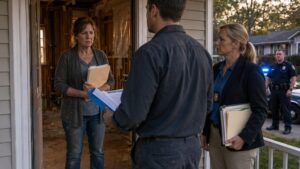
A dark SUV pulled onto the unfinished driveway. Carol Anderson stepped out carrying a document tube and a leather folder. Her gray jacket and low shoes were too clean for the mud, but she crossed the lot without hesitation.
“What has been stopped?” she asked.
Patrick pointed at the stakes. “Hall hired a surveyor. Her line conflicts with the approved exhibit.”
Carol looked at Jessica. “Was the association notified of this survey?”
“The landowner hired me,” Jessica said.
“That isn’t what I asked.”
“It is the answer that matters.”
Carol opened the document tube and removed a large site exhibit. She spread it across the hood of Patrick’s truck.
“This plan was reviewed by the architectural committee, the property manager, the applicant’s designer, and the county.”
“No surveyor signed it,” Michael said.
Carol’s eyes moved to him. “You were invited to the boundary review and chose not to participate.”
The sentence landed harder because it was true.
Michael saw Patrick glance between them.
Carol tapped the exhibit. “The association cannot allow one resident to halt approved construction by placing markers after work has begun.”
“I didn’t place them.”
“You commissioned them.”
“Yes.”
“You also failed to provide the older survey when requested.”
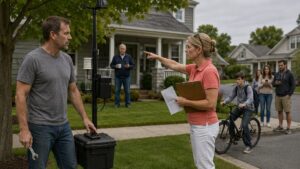
Michael felt the workers listening. A neighbor had stopped near the roadside. The scene no longer looked like a contractor tearing out a fence. It looked like a difficult homeowner arriving late with competing paperwork.
He could have blamed Carol for using an unsigned exhibit. He could have said her committee had no authority to erase a recorded boundary. Both statements might have been true.
Instead, he said, “I should have answered the letter.”
Carol’s expression shifted, surprised by the admission.
Michael continued. “That does not authorize anyone to remove my fence or build across the recorded line.”
Patrick folded his arms. “We still don’t have final certification.”
Jessica removed a field printout from her case. “You have enough to know proceeding would be reckless.”
Carol looked at the four stakes, then at the idle excavator. “The board will review this tomorrow evening.”
“The county is reviewing the permit now,” Michael said.
Carol returned the exhibit to its tube. “Until then, the association’s approval remains in effect.”
“Does that mean you’re ordering him to cross the stakes?”
Her gaze held his. “It means your interference is not automatically protected because you hired a professional.”
Michael looked toward the broken cedar stacked beside the dumpster. One rail had been ground into the mud beneath a machine track. The evidence of what had already happened seemed less powerful than Carol’s clean folder.
“What happens if the board decides against me?” he asked.
“The governing documents allow recovery of costs caused by unauthorized obstruction,” she said. “That can include contractor delay.”
“How much?”
“That depends on the delay.”
Patrick looked away first.
Carol closed her folder. “There will be a formal vote tomorrow. Until then, no one is to remove the stakes, and no additional work will occur within the disputed strip.”
It was the closest thing to a stop order anyone had issued.
Michael should have felt that he had won the morning.
Then Carol added, “If the board finds that Mr. Hall delayed valid construction after refusing the earlier review, fines and associated costs will be assessed to his property.”
The excavator operator shut down the engine.
The four orange stakes remained upright in the mud, but now they marked more than a boundary.
They marked the line between stopping the development and being charged for every hour it stood still.
Chapter 4: The Letter Michael Chose Not to Answer
A photograph of Michael’s unopened HOA letter appeared on the first page of the compliance packet.
Carol had enlarged it until the association logo and postmark were impossible to miss. Beneath the image, a caption read: NOTICE DELIVERED SIX WEEKS BEFORE CONSTRUCTION.
Michael sat at the end of the clubhouse table with his copy of the packet closed in front of him.
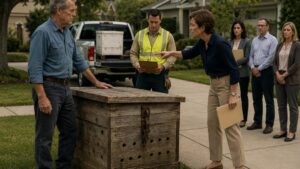
Across the room, Patrick leaned against the wall with his arms folded. Benjamin Taylor sat beside Carol, turning a pen between his fingers. Two neighboring residents occupied chairs near the back, close enough to hear but far enough to avoid appearing involved.
Carol opened the meeting at seven precisely.
“This review concerns interference with approved construction activity,” she said, “and the costs resulting from that interference.”
Michael looked at the photograph again. The envelope had been on his entry table while the association discussed the line, while Benjamin’s plans moved through review, while Patrick scheduled machinery.
He had seen it every day.
Carol continued. “Mr. Hall was notified that the rear corner required clarification. He did not attend the meeting, submit documents, or request additional time.”
Patrick shifted against the wall. Michael could not tell whether the movement meant agreement or discomfort.
“The association therefore relied on the applicant’s submitted exhibit,” Carol said. “That exhibit was approved by the county as part of the permit package.”
“It wasn’t certified by a surveyor,” Michael said.
Carol met his gaze. “You will have time to speak.”
He closed his mouth.
That was how she preferred meetings: orderly, timed, one voice owning the room until another was granted permission.
Carol summarized the work stoppage, the idle crew, and the potential delay charges. She did not mention the destroyed fence until Michael asked.
“The fence is part of a separate damage matter,” she said.
“It was removed because of the same line.”
“The board is not deciding liability tonight.”
“You’re deciding whether to charge me for stopping work on the line that caused it.”
Carol’s expression hardened. “You were asked not to interrupt.”
Michael held her gaze. “I was asked to remain silent while you described me.”
One of the residents shifted in her chair.
Carol glanced toward the property manager. “Record that Mr. Hall was warned regarding meeting procedure.”
Michael almost laughed, but the sound would have turned against him. He opened his packet instead.
The page after the envelope photograph contained the simplified exhibit. The next showed a list of projected delay costs. None showed Jessica’s field results in full.
“Where is the survey?” he asked.
“It was received this afternoon.”
“Then why isn’t it included?”
“Because it has not been reviewed by the association’s counsel.”
Jessica had warned him this would happen. Facts did not become powerful merely because they were correct. Someone still had to place them where they could not be avoided.
Carol called on Benjamin.
He sat straighter but did not look at Michael. “I followed the process I was given. The builder submitted the plans. The association approved them. I had no reason to think there was a problem.”
Michael watched the pen turn between Benjamin’s fingers.
“Did you ever look at the old fence?” Michael asked.
Carol started to intervene, but Benjamin answered.
“Yes.”
“Did it match the chalk line?”
Benjamin stopped turning the pen.
Patrick looked at him.
“At the rear, mostly,” Benjamin said.
“And near the side footing?”
A longer pause followed.
“No,” Benjamin said. “Not exactly.”
The room changed. No one spoke, but the silence no longer belonged to Carol.
“When did you notice?” Michael asked.
“The week before excavation.”
“Why didn’t you say anything?”
Benjamin’s shoulders tightened. “Patrick said the approved line controlled.”
Patrick pushed away from the wall. “I said the approved plan controlled construction. That’s not the same thing.”
“You told me the fence was probably old.”
“It was old.”
Michael felt the impulse to press until Benjamin admitted everything—to turn his hesitation into proof of bad faith. Then he saw how Benjamin gripped the pen, thumb white against the plastic.
Benjamin was not confident. He was afraid.
That did not make his silence harmless.
Carol closed the discussion. “The applicant is not required to independently verify every feature after professional review.”
“No,” Michael said. “But he noticed.”
“And so did you,” Carol replied.
The words landed cleanly.
Michael looked down at the photograph of the unopened letter.
“Yes,” he said.
Carol seemed prepared for denial. His answer forced her to wait.
“I received it,” Michael continued. “I saw the envelope. I did not open it until yesterday.”
One of the residents drew a quiet breath.
Michael placed both palms on the table. “I should have answered. I should have brought my survey before construction started.”
Patrick watched him more closely now.
“But my failure to answer did not move the boundary,” Michael said. “It did not make an unsigned exhibit accurate. And it did not give anyone permission to tear down my fence.”
Carol’s face remained controlled, but she no longer looked certain of the room.
The admission cost Michael more than he had expected. He felt exposed without feeling forgiven. There was no relief in naming his mistake, only a sharper understanding of where it ended and where theirs began.
The property manager cleared his throat. “The insurer has responded regarding the fence claim.”
He passed a letter to Carol, who read it before sliding it toward Michael.
The contractor’s insurer would not authorize immediate payment while ownership of the fence line and responsibility for the disputed area remained unresolved.
Michael read the sentence twice.
“They destroyed it,” he said.
Patrick answered from the wall. “The carrier is waiting for a determination.”
“You gave the order.”
“I gave an order based on the approved plan.”
“And now your insurer says the plan might protect you.”
Patrick’s expression tightened. “That’s not what I said.”
Carol collected the papers. “The board will postpone any fine until counsel reviews the competing records. Construction within the disputed strip remains paused. Other work may proceed.”
It was not a victory. It was a delay disguised as balance.
Michael left the clubhouse carrying the packet under one arm. Benjamin followed him into the parking lot.
“Mr. Hall.”
Michael stopped but did not turn immediately.
“I didn’t ask them to remove the fence,” Benjamin said.
“You watched them mark across it.”
“I thought they knew what they were doing.”
“You noticed it was wrong.”
“I noticed it looked different.”
Michael turned. “That is how people avoid responsibility. They change what they knew into something they merely noticed.”
Benjamin looked toward the clubhouse door. “My rate lock expires next month. If the build stalls, I may lose financing.”
There it was—not entitlement, but fear wearing the same silence Michael knew too well.
“I’m sorry about your financing,” Michael said. “It still isn’t eight inches of my land.”
He walked to his truck before Benjamin could answer.
At home, the work site was dark. The four orange stakes stood along the torn boundary, pale under the security light.
One of them leaned sharply toward Michael’s yard.
He crossed the grass and crouched beside it. The plastic had been bent near the base but not pulled free. A boot print marked the mud beside it. He photographed the print, then called Jessica.
She arrived Wednesday morning with a replacement stake and a hard case of field records.
“I can reset it,” she said. “But don’t assume the boot print proves who bent it.”
“I didn’t.”
“You wanted to.”
Michael looked toward Patrick’s site trailer. “Yes.”
Jessica removed the damaged stake and checked its coordinates before placing the new one. Then she opened her tablet.
“I reviewed the photos you sent from Monday.”
“What about them?”
“One wasn’t yours.”
She turned the screen toward him.
The image showed the rear corner before excavation. Michael’s fence stood intact. The old iron rod was visible beside the lowest rail, cleared of leaves and circled in yellow paint.
A timestamp appeared in the corner.
“Where did this come from?” Michael asked.
“Patrick’s project photo archive. The county requested preconstruction images after I filed my survey.”
Michael enlarged the photograph. Patrick’s white hard hat lay on the ground near the marker.
“He saw it.”
“He photographed it,” Jessica said. “That establishes more than seeing.”
Michael stared at the yellow circle around the rod.
Patrick had not discovered the marker after the fence came down.
He had documented it before ordering the machine forward.
Chapter 5: The Photograph Taken Before the Fence Fell
The photograph showed the iron marker in clear morning light, circled with yellow paint before the excavator ever touched Michael’s fence.
Patrick sat across from Michael inside the site trailer, looking at his own timestamp in the lower corner.
Carol stood near the door. Jessica remained beside Michael with the field file open on her tablet.
For several seconds, the only sound was the portable heater ticking beneath the window.
“You took this at six-forty-three Monday morning,” Michael said.
Patrick rubbed one thumb along the edge of the printed image. “I take progress photos before every excavation.”
“You cleared the leaves from the marker.”
“I checked what it was.”
“And then removed the fence.”
Patrick looked toward Carol.
The movement was small, but Michael saw it.
Carol did too. “Do not imply that the association directed field operations.”
“I didn’t imply anything,” Patrick said.
“You looked at her,” Michael replied.
Patrick pushed the photograph back across the folding table. “I called the property manager. I said there was an old rod near the fence. I was told the architectural exhibit had been reviewed and that the fence was inside the approved work limit.”
Carol’s voice sharpened. “You were told to follow the permit.”
“I was told the financing inspection was Friday and any delay would put the Taylor closing schedule at risk.”
“That was information, not direction.”
Patrick gave a humorless breath. “You called three times before seven-thirty.”
Michael watched the two of them begin separating responsibility into narrower pieces.
“Why didn’t you stop?” he asked.
Patrick turned to him. “Because old rods are not always controlling monuments. Because your fence didn’t match the exhibit. Because you hadn’t responded to the association. Because I had a concrete crew booked, equipment rented, and workers already on site.”
“And because Carol wanted the schedule kept.”
Patrick did not answer.
Carol stepped closer to the table. “The association manages dozens of exterior projects. We cannot suspend construction every time a homeowner points to an old piece of metal.”
“No one pointed to it,” Michael said. “Patrick found it before I arrived.”
Carol’s mouth tightened.
Jessica tapped the image. “A recovered monument in apparent conflict with a site exhibit should have triggered verification.”
“You are offering a professional opinion after the fact,” Carol said.
“I am offering the same professional opinion I would have offered Monday morning.”
Patrick stood and walked to the trailer window. Outside, his crew framed interior walls on the uncontested side of the foundation. Hammers struck in uneven rhythm.
“You think I wanted this?” he asked. “That excavator costs money whether it moves or not. The concrete company charges for cancellations. Those men don’t get paid because a board president and a homeowner dislike each other.”
Michael rose slowly. “You still gave the order.”
Patrick turned. “Yes.”
The admission stopped the room.
“I gave the order to remove the fence,” he said. “I believed the approved line was valid. I also knew the rod should have been checked. Both things are true.”
Carol looked at him as though he had broken an agreement no one had written down.
Patrick continued. “I called. I documented it. I was told to proceed. I proceeded.”
“You made the choice,” Michael said.
“Yes.”
There was no apology in the word, but there was no escape either.
Michael had expected the admission to feel like leverage. Instead, he noticed the stack of payroll envelopes near Patrick’s desk, each marked with a worker number. Beside them sat a notice from an equipment lender.
Patrick followed his gaze.
“You asked why I kept moving,” he said. “Friday payroll is thirty-one thousand dollars. If this site shuts down and the HOA withholds payment, I miss it. If I miss payroll, the crew walks. If the crew walks, I lose the next contract.”
“That doesn’t make the fence yours.”
“No. It explains why I made a bad decision quickly instead of a good decision late.”
Carol folded her arms. “The association has made no determination that the decision was improper.”
Patrick looked at her. “Your attorney can determine whatever language you want. The fence is gone.”
Jessica closed her tablet. “The field facts are established. The remaining issue is what each party does with them.”
Carol asked Michael to meet her later that afternoon in the HOA records room.
She was alone when he arrived. On the table lay a check request form, a draft agreement, and a confidentiality clause.
“The association is prepared to authorize reimbursement for your documented fence materials,” she said. “The contractor will contribute labor. In return, you withdraw the county permit objection and agree that the settlement is not an admission of fault.”
Michael read the number.
It covered the cedar he had purchased eleven years earlier, adjusted slightly upward. It did not cover removal, survey fees, damage to the yard, or his time.
“You prepared this before today,” he said.
“We began discussing resolution once the survey was received.”
“Before Patrick admitted he saw the marker.”
“The photograph does not change the practical need for resolution.”
“It changes responsibility.”
Carol sat across from him. For the first time, she looked tired rather than controlled.
“If this permit is voided,” she said, “every owner whose project relied on an association exhibit may question whether the board followed proper review. Insurance premiums rise. Assessments rise. People who had nothing to do with your fence pay for it.”
“So I should accept less to protect the board.”
“You should accept a solution that restores your property.”
“And hides how it happened.”
“It avoids unnecessary damage.”
Michael looked through the records-room window at the clubhouse parking lot. A maintenance worker pushed empty trash bins toward the storage enclosure. Ordinary association work continued around the dispute.
Carol lowered her voice. “You have never made it easy to work with you.”
“No.”
“You ignore notices. You do not attend meetings. You assume every request is an intrusion.”
“Sometimes it is.”
“And sometimes your silence leaves everyone else to make decisions without you.”
He felt the truth of that and disliked her for delivering it while asking him to conceal hers.
“I admitted that last night,” he said.
“Then act like you understand it.”
“I do.”
Michael slid the confidentiality clause back across the table.
“That’s why I won’t sign this.”
Carol’s eyes narrowed. “You would rather expose the association to claims?”
“I would rather correct the record that caused the damage.”
“We are offering payment.”
“You’re offering payment if I stop asking whose line you approved.”
She leaned back. “What do you want?”
“A revised permit. A recorded boundary agreement. Replacement of the fence. My survey costs. And a rule requiring certified surveys for future construction near disputed lines.”
“That is not a settlement. That is policy-making through threat.”
“It is making sure the next quiet homeowner does not come outside after the machine starts.”
Carol gathered the papers into one stack. “If this goes to an open hearing, Patrick’s company may lose the project. Benjamin may lose his financing. The association may face claims beyond this lot.”
Michael thought of the payroll envelopes. He thought of Benjamin turning the pen between his fingers. He thought of the cedar rail under the excavator track.
For years, he had believed firmness meant refusing to be moved. Now every available choice moved someone.
“I’m not asking the county to shut down the entire project,” he said. “I’m asking them to correct the disputed side.”
“You cannot control what follows once the issue becomes public.”
“No. Neither could you when you told Patrick to keep moving.”
Carol’s face closed.
Michael stood. “Schedule an emergency hearing. Open to the membership.”
“You may not like what people say.”
“That has been true since Monday.”
He left the unsigned check request on the table.
By sunset, the request for an open hearing had been delivered to every board member and copied to the county inspector.
The dispute was no longer confined to eight inches of wet ground.
It had become a question the association would have to answer where everyone could hear it.
Chapter 6: The Hearing Where Silence Became Permission
Carol framed the vote as a choice between Michael’s fence and the stability of the entire development.
She stood at the front of the clubhouse beneath the association seal, one hand resting on a stack of financial projections.
“A full permit suspension,” she said, “could affect contractor solvency, owner financing, insurance exposure, and future assessments.”
Every chair was occupied. Residents lined the rear wall. Patrick sat near the aisle, still wearing work boots. Benjamin sat alone in the front row.
Michael waited at the side table with four photographs laid facedown beside a salvaged cedar board.
The board was thirty inches long, cracked through one end and stained with mud. He had washed it but not sanded away the excavator track.
Carol finished her summary. “This is not a referendum on whether property rights matter. It is a determination of how to correct a disputed condition without creating broader harm.”
The association attorney adjusted his glasses. “The board should understand that formally invalidating the architectural approval may invite review of other projects approved through similar exhibits.”
A murmur moved through the room.
Michael saw the fear take shape. It was no longer his fence against Benjamin’s house. It was assessments, insurance, delayed additions, old patios, and every resident wondering whether paperwork beneath their own property might be incomplete.
Carol looked toward him. “Mr. Hall may speak.”
Michael carried the cedar board to the center table and set it down.
No one knew what to make of it.
He had brought notes, but he left them folded in his pocket.
“Six weeks before construction,” he said, “the association sent me a letter asking for my survey.”
Carol watched him without expression.
“I received it. I did not open it.”
The room became still.
“I thought ignoring the board was the same as refusing bad process. It was not. It left other people to decide what my silence meant.”
Patrick lowered his gaze.
Michael continued. “I should have answered. I should have provided the survey before the first machine arrived.”
A man near the back whispered something to the resident beside him. Michael did not try to read the reaction.
“My mistake did not change the boundary,” he said. “But it helped create the space in which other people pretended the boundary did not need checking.”
He turned over the first photograph.
It showed Jessica’s first orange stake driven through Patrick’s painted footing line.
The second showed all four stakes aligned beside the forms.
The third showed the excavator bucket suspended above the fourth.
The fourth showed the old iron marker circled in yellow before the fence was removed.
Michael placed the images in a row.
“These first three were taken after the damage,” he said. “The last was taken before it.”
Patrick shifted in his chair.
Carol said, “The board has reviewed the photograph.”
“The room has not.”
Michael pointed to the timestamp. “Patrick found the marker before excavation.”
Someone near the wall asked, “Then why did they keep going?”
Patrick stood before Carol could respond.
“Because I made the call to proceed.”
His voice carried without effort.
“I had an approved plan. I also had a marker that did not match it. I called the association. I was told the project schedule could not slip. I chose the schedule.”
Carol’s posture stiffened. “You were not instructed to disregard a legal boundary.”
“No,” Patrick said. “You were careful not to say it that way.”
The attorney leaned toward his microphone. “We should avoid characterizing privileged communications—”
“They weren’t privileged,” Patrick said. “They were phone calls.”
Carol looked at him. “Your company is responsible for field decisions.”
“Yes.”
The admission carried no anger now, only fatigue.
“And the board is responsible for approving an exhibit no surveyor certified,” Michael said.
Carol turned toward him. “You are still asking this association to expose every member to consequences.”
“No. I am asking it to record the error that already occurred.”
The attorney spoke again. “Any correction must be narrowly drawn. Voiding the entire permit could trigger lender and insurance review.”
Benjamin stood.
For a moment he seemed uncertain whether anyone would let him speak. Then Carol nodded.
“I don’t want the permit defended as submitted,” he said.
Michael looked at him.
Benjamin faced the board. “I knew the chalk line did not follow the fence near the side yard. Patrick told me the plans were approved. The property manager told me delays could affect my financing. I let that be enough.”
His voice weakened, but he continued.
“My mortgage rate expires in three weeks. If the project resets, I may not qualify at the new payment. I was afraid of that.”
The room listened differently now.
“But I don’t want a house built partly on someone else’s land,” Benjamin said. “And I don’t want Mr. Hall blamed because I stayed quiet.”
Carol’s hand tightened against the table.
Michael had wanted Benjamin to admit what he knew. He had not expected the admission to contain anything that made punishment harder.
The attorney requested a recess. Carol refused.
“If we delay again,” she said, “we repeat the same mistake.”
It was the first sentence she had spoken all evening that sounded less like procedure than recognition.
She looked at Michael. “What correction are you proposing?”
Michael took the folded agreement from his pocket.
“Not a full shutdown,” he said. “The uncontested portions continue. The side footing is revised to the certified setback. The contractor pays documented fence damage and survey costs through insurance or direct settlement. The Taylors accept the narrower side yard. The association records that the original architectural approval relied on an uncertified boundary exhibit.”
Residents began whispering at the final condition.
Carol heard them. “That language creates exposure.”
“It also creates a reason to change the process.”
“What process?”
“No future project within five feet of a disputed or unverified property line receives architectural approval without a certified survey.”
The attorney reached for the document. Michael did not hand it over yet.
“There is one more condition,” he said. “A boundary agreement signed by me, Benjamin, the association, and the contractor. Everyone signs the same line. No private settlement. No document saying the damage occurred without fault.”
Carol’s face hardened again. “You want the association to admit liability.”
“I want the association to admit what it approved.”
“That distinction may not survive legal review.”
“Then write it precisely.”
Patrick came forward and read the first page. “If the footing revision stays limited to the side, I can keep the crew working.”
“What about the cost?” Carol asked.
“I’ll cover demolition and replacement labor. The insurer can argue about materials later.”
Michael shook his head. “No later. A payment schedule goes in the agreement.”
Patrick looked at him. “You don’t trust me.”
“No.”
Patrick nodded once. “Fair.”
Benjamin approached the table. “I’ll pay the difference if insurance doesn’t cover the full materials.”
“You didn’t remove the fence,” Michael said.
“No. I benefited from everyone pretending it was acceptable.”
The words settled between them.
Carol asked for the document.
This time Michael handed it to her.
She read while the room waited. The association attorney leaned close, marking changes in the margin. Patrick asked for one provision protecting his workers from delay penalties if the county review extended beyond the revised footing. Benjamin requested written confirmation for his lender.
The discussion became slower and less dramatic than the conflict that had brought them there. Sentences were narrowed. Dates were inserted. Responsibilities were assigned.
It was the kind of work that should have happened before the excavator arrived.
At ten-thirty, Carol placed the revised agreement on the table.
“The board will vote on provisional acceptance,” she said. “Final language remains subject to county and insurer review.”
Michael looked at the signature lines.
His name was first.
Carol had placed it there deliberately, perhaps to remind him that public responsibility did not belong only to institutions.
Michael picked up the pen.
“I’ll sign when the language states that my failure to attend did not authorize removal of the fence.”
The attorney added the sentence.
Michael read it twice.
Then he signed.
Benjamin signed beneath him. Patrick added his name with a quick, heavy stroke.
Carol stood over the final line.
For the first time since the conflict began, the room did not wait for Michael to speak.
It waited for her.
Chapter 7: The New Fence Followed the Truth
The county stamp landed on the revised setback plan with a flat blue thud.
Michael watched the permit clerk lift the page, check the date, and slide it beneath the glass.
“Foundation revision approved,” she said. “The side footing must follow the certified boundary survey. The inspector will verify before the next pour.”
Michelle Lee stood beside Michael with the recorded agreement tucked inside a red folder. The paper had gathered signatures slowly over three weeks—Michael’s, Benjamin’s, Patrick’s, Carol’s, then the county reviewer’s acknowledgment.
Nothing about the process had felt victorious. Every correction required another document, another phone call, another sentence narrowed until no one could later pretend it meant something else.
Michelle handed him the stamped copy. “Keep this with the survey.”
“I plan to.”
“And give the contractor a copy before excavation resumes.”
“He already has one.”
She glanced at him. “You’ve become difficult to surprise.”
“I was always difficult.”
“No,” she said. “You were difficult to reach.”
Michael looked at her.
The clerk called the next number before he could answer.
Outside the county building, he stood beside his truck and examined the revised drawing. The new footing shifted away from his property. It was not a dramatic change on paper—one adjusted line, two corrected dimensions, a note referencing Jessica Moore’s survey.
On the ground, it meant the house would stand where it belonged.
When Michael returned home, Patrick’s truck was parked near the torn boundary.
Patrick waited beside the site trailer holding a white envelope. Behind him, two workers unloaded cedar posts, bags of concrete, and stacked rails from a flatbed.
Michael stopped at the edge of the yard.
“What is this?”
“One day of labor,” Patrick said. “Per the agreement.”
“You brought a full crew.”
“I brought the men who removed it.”
The workers did not look toward Michael. They began carrying materials to the boundary in silence.
Patrick held out the envelope. “Fence reimbursement. Survey cost. Yard restoration allowance.”
Michael opened it and checked the amount. It matched the payment schedule exactly.
“No insurance letter?”
“They paid part. I covered the rest.”
“You didn’t have to tell me that.”
“I know.”
Michael folded the check back into the envelope.
Patrick glanced toward the foundation forms. The corrected side trench had been marked farther from the property line. Jessica’s four orange stakes still stood between the work areas, faded now from rain and sunlight.
“I lost two days,” Patrick said. “Not the company.”
Michael waited.
“Carol wanted the project reassigned after the hearing.”
“Why wasn’t it?”
“Benjamin refused to sign the change order unless I stayed.”
That surprised Michael more than he showed.
Patrick rubbed a hand over the back of his neck. “He said I admitted what I did when it mattered.”
“You admitted it after there was a photograph.”
“Yes.”
The answer was too honest to argue with.
Patrick pointed toward the lumber. “We can rebuild the fence on your original design. Same height. Same spacing.”
Michael looked at the new cedar. It was pale and clean, without the dark grain and weathered silver of the old boards.
“Not all of it,” he said.
Patrick frowned. “The agreement covers full replacement.”
“I kept some of the old rails.”
“You want us to reuse damaged material?”
“One section.”
“For what?”
“A gate.”
Patrick studied him, then nodded toward the workers. “Show us.”
Michael led them to his workshop, where he had stacked the salvaged cedar against the wall. Most of it was split beyond use. Three rails remained sound enough to cut down. One bore the dark crescent left by the excavator track.
Patrick ran his thumb across the mark.
“You sure you want that visible?”
“Yes.”
They built the fence from both ends, following the taut line Jessica had established between the permanent corner points. The workers set each post on Michael’s side of the boundary, leaving the recorded clearance beside Benjamin’s future yard.
No one hurried.
Michael checked the first post with his old level. Patrick watched the bubble settle between the marks.
“You always check twice?” Patrick asked.
“Three times when someone else is paying.”
Patrick almost smiled.
Near midday, Benjamin arrived carrying bottled water and a brown paper bag from the sandwich shop. He set the food on the workbench they had moved outside.
“I wasn’t sure whether coming over would help,” he said.
“It helps if you’re useful,” Michael replied.
Benjamin looked toward the salvaged rails. “What can I do?”
Michael handed him a sanding block.
The shared gate was narrower than the old fence panel, built between two new posts at the midpoint of the property line. It would allow access for maintenance only when both owners agreed. The agreement did not require it. Michael had added it after the hearing, once the anger no longer needed every inch of the boundary closed.
Benjamin sanded the old cedar carefully. He did not try to remove the excavator mark.
“Carol sent the new policy this morning,” he said.
Michael kept measuring the gate frame. “What policy?”
“Certified survey required for any project within five feet of a boundary unless both owners sign an existing survey acknowledgment.”
Patrick looked over from the post hole. “That will slow approvals.”
“It should,” Michael said.
Benjamin nodded. “Carol wrote that the rule was adopted to improve procedural consistency.”
“That sounds like her.”
“She also included an apology.”
Michael stopped measuring.
“To the association,” Benjamin clarified. “For insufficient review controls.”
“Not to me.”
“No.”
Michael resumed marking the cedar. “Then it was a policy statement, not an apology.”
Benjamin seemed disappointed on his behalf.
Michael was not. Carol had signed the agreement. Her name sat beneath language stating that the association had approved an uncertified exhibit and that Michael’s absence had not authorized entry onto his land. It was more than warmth and less than remorse.
It was enough to prevent repetition.
Late in the afternoon, Jessica returned to replace the temporary stakes with permanent capped markers. She checked each position, recorded the coordinates, and removed the faded orange plastic one at a time.
The first stake had stopped Patrick’s paint line.
The second had shown the distance widening.
The third had forced the operator to slow.
The fourth had stopped the excavator with its bucket in the air.
Jessica laid all four old stakes beside Michael’s workshop.
“You keeping these?” she asked.
“For a while.”
“People usually throw them away.”
“People usually don’t build a fence around them.”
She gave him the final monument record. “The boundary is no longer ambiguous.”
Michael looked toward Benjamin, who was helping Patrick hang the gate.
“The boundary wasn’t the only ambiguous thing.”
Jessica followed his gaze but did not ask.
By sunset, the new cedar rails ran straight from the front corner to the pines. The permanent survey caps sat low in the soil behind them, visible only if someone knew where to look.
Patrick packed his tools and handed Michael the gate key.
“You built the latch,” Michael said. “You keep the second key until construction is done.”
Patrick closed his hand around it. “You trust me with that?”
“No. The agreement tells me what happens if you misuse it.”
This time Patrick did smile.
Carol arrived as the crew was leaving.
She stepped from her SUV with a folder held against her side. Her shoes stayed on the gravel instead of crossing the mud.
“The board has recorded the policy amendment,” she said. “A copy is included with the signed agreement.”
Michael accepted the folder.
Carol looked at the rebuilt fence. “It appears properly resolved.”
“Properly marked,” Michael said.
She nodded once. “The association regrets that the review process did not identify the conflict earlier.”
The sentence was polished, cautious, and meant for minutes.
Michael could have demanded something personal. He could have asked whether she regretted the calls to Patrick, the threat of fines, or the private settlement offer.
Instead, he said, “Next time a resident does not answer, don’t treat silence as consent.”
Carol held his gaze. “Next time you receive a boundary notice, answer it.”
“Agreed.”
It was not reconciliation. It was a line both of them understood.
After she left, Benjamin stood on his side of the new gate with a copy of the recorded boundary agreement in his hand.
Michael had made the copy that morning. He passed it through the open gate.
“Keep it with your closing documents,” he said.
Benjamin accepted it. “I’m sorry I waited until the hearing.”
Michael looked at the new house, the corrected footing, and the narrow strip of ground that had nearly carried more weight than either of them could afford.
“So am I,” he said.
Benjamin nodded.
Michael closed the gate between them. The latch settled without force.
The salvaged cedar rail crossed its center, scarred by the machine but still straight enough to hold.
The story has ended.