Eleven Days After His Father’s Funeral, the Neighborhood Board Ordered Him to Tear Out the Road They All Needed
Chapter 1: The Wreath Stopped Against an Old Stone
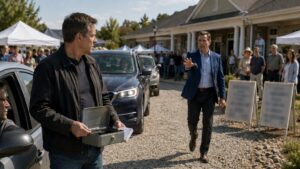
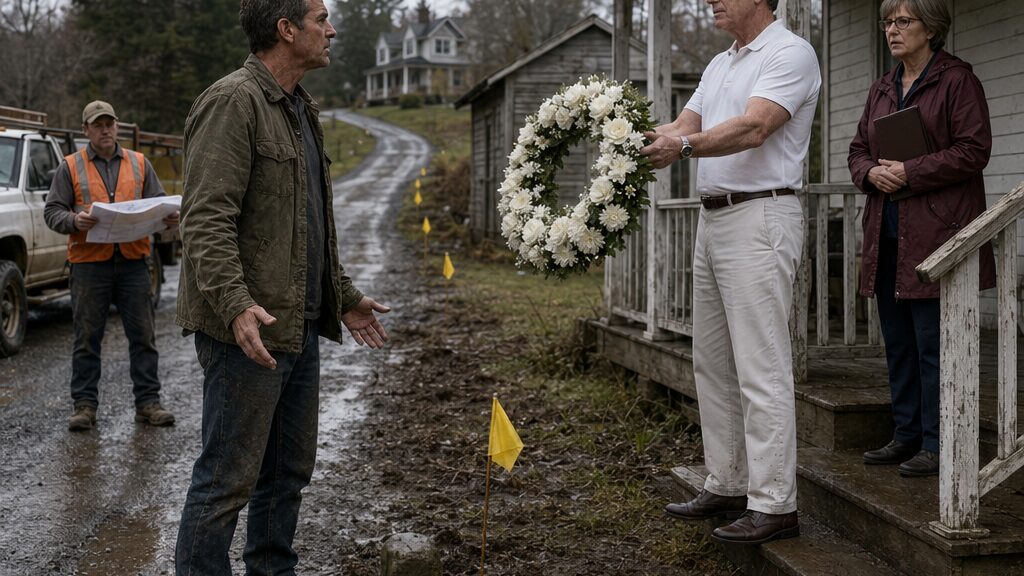
The white wreath hit the gravel hard enough to break one of its wire supports.
It rolled once through the mud, shedding two carnations, then tipped against a stone near the edge of the driveway.
“Remove the rest of this by Friday,” Frank Wright said.
Nicholas Clark looked past him toward the porch. A pale hook still hung from the railing where the wreath had been. Eleven days earlier, the funeral-home driver had placed it there because the farmhouse was too crowded with casseroles, folding chairs, and people Nicholas barely remembered.
Now Frank stood between Nicholas and the porch in a clean white polo, holding the empty hook as though it were proof of a violation.
Behind him waited Donna Hill, another board member, and a road contractor wearing an orange vest. No one spoke.
Nicholas had been kneeling beside the drainage ditch when they arrived. The soil was slick from an early shower, and when he stood, one boot slid. His palm struck the driveway. Frank had watched him regain his balance, then lifted the wreath from the railing without asking.
“It was from my father’s funeral,” Nicholas said.
Frank glanced at the wreath in the mud. “I understand that. But this is an inspection, and the approach needs to be clear.”
“The approach was clear.”
“The property has to be evaluated as it stands.”
Nicholas rubbed grit from his hand. He could smell wet cedar from the tool shed and the faint sourness of cut flowers. His father had always claimed gravel smelled different before rain. Nicholas had thought that was one more thing the old man said because silence made him uncomfortable.
Donna looked at Frank. “We could have moved it onto the porch.”
“It was already on the porch,” Nicholas said.
Frank’s mouth tightened, not with embarrassment but impatience. “We’re here because the association has received repeated complaints about runoff, loose aggregate, and the condition of this access road.”
“Repeated complaints from who?”
“This isn’t personal.”
The contractor unfolded a map against the hood of his truck. Yellow flags already stood along the uphill side of the driveway, beginning near Nicholas’s mailbox and continuing toward Frank’s stone entrance pillars.
Nicholas had not given anyone permission to place them.
Frank pointed along the line. “The recommendation is to widen the drive, install proper drainage, and pave the upper section. Your portion will need to be removed or reconstructed so the work can proceed.”
“My portion.”
“The neglected section.”
The words were delivered softly, almost kindly. That made them worse.
Nicholas looked uphill. Beyond a stand of maples, the roof of Frank’s house caught the weak afternoon light. The place sat above the old farmhouse like it had been designed to overlook it: white stone, black shutters, three garage doors, and a circular drive that disappeared behind clipped hedges.
His father had called it the wedding cake.
Frank followed Nicholas’s gaze. “Homes up there represent a significant investment. Standards protect everyone.”
“People down here don’t count?”
“I didn’t say that.”
“You didn’t need to.”
Donna shifted the folder beneath her arm. The contractor studied the map.
Nicholas could feel the shape of his anger before he decided what to do with it. It began behind his ribs, sharp and familiar. The last time he had felt it this clearly, his father had been sitting at the kitchen table asking him to come by Saturday and help spread fresh gravel.
Nicholas had said he had work.
His father had said, You always have work when I ask.
Nicholas had hung up.
Four days later, the neighbor below the feed store found his father collapsed beside the shed.
Frank stepped closer and held out a document. “This is notice of the board’s intended corrective action. You have thirty days to present an alternative plan.”
Nicholas did not take it.
Frank lowered the paper. “Refusing delivery won’t invalidate it.”
“Put it in the mailbox.”
“It has to be acknowledged.”
Nicholas looked down at the wreath.
One white ribbon lay across the gravel, darkened where a tire had splashed mud earlier that morning. The wreath had stopped against a squat stone mostly buried beneath weeds. Nicholas had seen stones like it along the property line as a child, though he had never paid attention to their markings.
Now a number showed beneath the bent wire frame.
Nicholas crouched.
Frank mistook the movement for surrender. “I know this is a difficult time. That’s why the board waited.”
“Eleven days?”
“We have schedules to consider.”
Nicholas lifted the wreath carefully. Its soaked weight pulled at his wrists. Beneath it, the stone stood several inches inside the line of yellow flags.
He set the wreath against the porch steps and wiped mud from the top of the marker with his thumb. The number had been chiseled deeply enough to survive decades.
He looked at the contractor. “What line are those flags supposed to follow?”
The contractor glanced at Frank before answering. “The parcel edge shown on the project map.”
“Which survey?”
“I was given a site plan.”
“By the county?”
Frank said, “Nicholas, this is not the time to interrogate a man doing his job.”
Nicholas took out his phone and photographed the stone, the nearest flag, and the visible stretch of driveway between them. He did not photograph Frank. He did not photograph the wreath in the mud, though he knew everyone expected him to.
Donna came closer. “Was that marker on the site plan?”
The contractor folded one corner of the map back. “There are no monument numbers listed.”
“What does that mean?” she asked.
“It means this isn’t a certified boundary survey.”
Frank exhaled through his nose. “It’s sufficient for a preliminary estimate.”
Nicholas stood. “Then your flags are preliminary too.”
“The board has authority to inspect common access areas.”
“This isn’t common property.”
“It serves association homes.”
“That doesn’t make it yours.”
Frank’s face changed then, the practiced patience thinning enough to reveal something harder underneath. “Your father understood that living beside a managed neighborhood comes with obligations.”
“My father lived here before your neighborhood existed.”
“And the area changed. He chose not to.”
Nicholas looked at the porch window. Inside, his father’s brown work jacket still hung from the peg beside the door. Nicholas had tried twice to move it and twice had left it there.
Frank extended the notice again. “Sign for this.”
Nicholas took the paper, not because Frank had won, but because refusing it had begun to feel childish.
At the bottom, beneath estimated legal fees and language about corrective action, a deadline had been printed in bold.
Thirty days.
The driveway had carried school buses, fuel trucks, ambulances, moving vans, and every expensive vehicle belonging to the homes uphill. His father had graded it every spring for forty years. Now a board formed long after the first stone had been laid wanted Nicholas to tear it out.
He signed only his initials.
Frank collected the acknowledgment. “I suggest you hire someone familiar with association covenants. Emotion won’t help you here.”
Nicholas looked at the muddy wreath, then at the stone numbered 17.
“No,” he said. “Probably not.”
Frank turned toward the contractor. “Let’s finish the measurements.”
The contractor did not move.
He kept looking at the marker.
Nicholas noticed.
“Something wrong?” he asked.
The man rubbed the edge of the folded site plan with his thumb. “The line Mr. Wright gave me puts the widening six feet past that stone.”
Frank’s head turned sharply. “That marker may be obsolete.”
“Maybe,” the contractor said. “But I’d want a licensed survey before I cut anything.”
Nicholas looked from the yellow flags to Frank.
“Who gave you that map?” he asked.
The contractor hesitated only a moment.
“Mr. Wright did.”
Chapter 2: Thirty Days to Erase Forty Years
The certified envelope arrived the next morning with a cost estimate large enough to make Nicholas sit down at the kitchen table.
Corrective grading: $18,400.
Drainage installation: $11,750.
Paving contribution: $27,000.
Legal and administrative costs: pending.
His father’s checking account held less than nine thousand dollars. Probate had frozen most of it. Nicholas had his own mortgage, a truck payment, and two weeks of unused bereavement leave he had already stretched into three.
Beside the envelope, the white wreath leaned in a shallow cardboard box. He had rinsed the mud from it with the garden hose, but several blossoms remained gray at the edges.
The refrigerator hummed behind him. It was still full of food other people had brought: lasagna, chicken casserole, green beans in foil trays. His father would have complained about waste and eaten all of it anyway.
Nicholas turned the estimate over as if a blank back might contain better numbers.
The phone rang.
Amy Roberts did not say hello.
“Did you threaten the board president?”
Nicholas stared at the window above the sink. “Who told you that?”
“I got copied on an association email because my name is on the estate filing.”
“I asked who told you.”
“Frank Wright wrote that you interfered with an inspection and made statements about restricting access.”
“I said this wasn’t their road.”
“That is not the same thing as saying you’ll block it.”
“I didn’t say I’d block it.”
Not yet, he thought.
Amy went quiet. Nicholas could hear traffic through her car speaker.
“I requested a valuation,” she said.
He sat straighter. “Of what?”
“The house and land.”
“When?”
“Last week.”
“Before the funeral?”
“The day after.”
The answer settled between them with more force than if she had raised her voice.
Nicholas folded the estimate along its existing crease. “Dad had been dead one day.”
“And the bills didn’t die with him.”
“You could have told me.”
“You weren’t answering anybody.”
“I was here.”
“Exactly. You were here, walking around like if you touched enough of his tools, he might come back and explain why he left us another mess.”
Nicholas looked toward the mudroom. His father’s jacket hung in the dimness.
“What did the valuation say?”
“That the property is worth more as part of the neighboring development than as a separate farmhouse.”
“According to Frank?”
“According to a licensed agent.”
“Recommended by Frank.”
Amy sighed. “Nicholas, probate expenses are already building. The roof is bad. The septic system is old. Neither of us lives there.”
“I’m living here now.”
“You’re hiding there now.”
He ended the call before he could say something he would have to remember.
For the rest of the morning, he searched the farmhouse.
His father had never trusted filing cabinets. Receipts lived in coffee cans, warranty manuals inside cookbooks, insurance papers beneath the good towels. Nicholas found tax statements in a bread box and a forty-year-old tractor title taped behind the basement stairs.
The documents concerning the driveway were in the tool shed.
He knew that before he found them because the old man had kept everything related to physical work near the tools used to do it.
The shed smelled of cedar shavings, dry oil, and damp earth. Along the back wall stood coffee tins labeled in black marker: BOLTS, COPPER, GATE PARTS, DRAINAGE. A dented cabinet held packets of invoices bound with rubber bands.
Nicholas carried them to the workbench.
The oldest gravel receipt was dated 1983. Twelve tons of crushed stone.
Another from 1987 listed grading and ditch clearing. Then 1991, 1994, 1998. The handwriting changed, the paper became brighter, the prices climbed, but his father’s grease-darkened thumbprints appeared on nearly all of them.
Every year or two, fresh gravel.
Every spring, drainage.
Every storm, repairs.
Neglected, Frank had called it.
Nicholas found a yellow legal pad with totals in his father’s cramped handwriting. Several entries included percentages beside initials he did not recognize. Others had the words association share underlined twice.
No checks were attached.
He heard tires on gravel and stepped outside.
Amy parked beside the mailbox. She wore dark slacks and a raincoat, clothes chosen for offices rather than sheds. She looked at the white wreath drying against the porch wall.
“I heard what he did,” she said.
Nicholas waited.
“I’m not defending that.”
“You’re just selling to him.”
“I requested information.”
“Without telling me.”
“You would have said no before I finished the sentence.”
“You didn’t give me the chance.”
Amy walked past him into the shed. On the bench, the receipts formed small stacks by decade.
She touched the top one. “What are these?”
“Proof Dad maintained the road.”
“Proof he spent money on it.”
“Same thing.”
“No. It isn’t.”
He looked at her.
Amy picked up a receipt and read the faded description. “You’re searching for a reason to fight.”
“I already have one.”
“Because Frank insulted Dad?”
“Because they’re trying to charge us sixty thousand dollars to destroy work Dad paid for.”
“And if the land records say the association can do that?”
“Then I’ll put a gate across the upper road and let Frank explain to everyone why they can’t reach their houses.”
Amy lowered the receipt.
“That’s exactly the kind of thing Dad would say.”
Nicholas felt the comparison like a shove.
“He never closed it.”
“He threatened to.”
“Maybe he should have.”
“And maybe that’s why nobody up there trusted him.”
Nicholas swept the receipts into one stack harder than necessary. “You wanted this sold before he was buried.”
“I wanted to know whether we could afford to keep it.”
“You wanted to be done.”
“Yes,” Amy said. “I did.”
Her honesty left him with nowhere easy to place his anger.
That evening, Nicholas attended the association meeting in a converted sales office at the entrance to the upper development. Framed photographs showed the same hillside before houses had been built, except the old farmhouse had been cropped from every image.
Frank sat at the center of the table. Donna was beside him, along with the association attorney and two homeowners.
Nicholas placed copies of the gravel receipts on the table.
“This road was maintained,” he said.
Frank barely glanced at them. “By your father, at his discretion.”
“For homes that use it.”
“The association’s position concerns present conditions.”
“The present condition exists because the upper road drains onto my property.”
The attorney raised a hand. “Mr. Clark, it would be unwise to make access threats while estate ownership remains unsettled.”
Nicholas looked at Frank. “Then maybe nobody uses the road until ownership is settled.”
Donna’s eyes widened.
The attorney leaned forward. “Are you stating an intent to obstruct access?”
Nicholas knew he should slow down. Instead, he heard Frank’s voice from the day before—Your father understood obligations—and pictured the wreath tumbling through mud.
“I’m saying if it’s entirely my responsibility, it can be entirely my decision.”
Frank sat back.
For the first time, he seemed almost relieved.
“Then we should clarify that point,” he said. “The upper parcels possess permanent recorded access rights. Your father knew that. You cannot gate the road, close it, or interfere with its use.”
He slid a photocopied page across the table.
At the top was a county recording number.
Beneath it, one word appeared repeatedly.
Easement.
Chapter 3: The Faded Line Beneath the County Glass
Margaret Brown recognized the parcel number before Nicholas finished reading it aloud.
She looked up from her monitor. “Clark farm.”
He held the photocopy Frank had given him. “You know it?”
“I know the number. Your father came in often enough.”
“For what?”
“Maps. Road records. Anything that made people impatient.”
Margaret said it without smiling, but not unkindly. She wore reading glasses on a chain and kept three sharpened pencils aligned beside her keyboard. Behind her, rolling shelves filled the county archive room from floor to ceiling.
Nicholas placed the association’s easement copy on the counter.
“I need the original.”
“You need the recorded instrument. The original is likely long gone.”
“The board says this gives them permanent access.”
Margaret examined the first page. “This is incomplete.”
His pulse quickened. “How incomplete?”
“It has the granting language and legal description, but not the referenced survey exhibit.”
“Can you pull it?”
“I can request the file.”
“How long?”
Margaret looked toward a cart stacked with archive boxes. “Records older than 1970 are being transferred for scanning. If it’s already boxed, today. If it’s already moved, longer.”
Nicholas thought of the thirty-day deadline, now reduced to twenty-eight.
Margaret read his expression. “Sit down.”
He sat at a table beneath green-shaded lamps while she disappeared between the shelves.
The room smelled of paper, dust, and old paste. A copier clicked somewhere behind a partition. Nicholas looked at the framed county maps on the wall and imagined his father sitting in the same chair, demanding copies, correcting clerks, refusing to leave until someone found what he wanted.
That image brought no comfort. It felt too much like recognition.
Margaret returned carrying a flat gray folder.
“Your father paid for certified copies in 2004,” she said. “That saved us some trouble.”
Inside lay a folded survey on yellowed paper, its creases reinforced with transparent tape. Margaret opened it beneath a glass weight.
The date in the lower corner read June 14, 1962.
Nicholas leaned closer.
The farmhouse parcel had been drawn as a long irregular shape following the slope. A narrow road entered from the county lane, passed the house, then turned uphill toward land that had later become the managed neighborhood.
Margaret traced the road with one pencil.
“Here’s the original Clark access.”
The line continued beyond the farmhouse.
“And this is the easement granted to the upper tract.”
“How much of it is on our land?”
She checked the scale. “Approximately forty feet at the narrowest crossing, more if you count the drainage shoulder.”
Nicholas stared at the survey.
Frank’s circular drive, his stone pillars, every delivery truck and luxury car reaching the upper homes—all of them had to pass across the section Frank had called an eyesore.
“The marker,” Nicholas said.
“What marker?”
He showed her the photograph on his phone.
Margaret enlarged it with two fingers. “Monument seventeen.”
Her pencil moved over the paper and stopped at a tiny square marked M-17.
It was the same place where the funeral wreath had come to rest.
“The project flags were six feet past it,” Nicholas said.
“Then the preliminary plan crosses farther into your parcel than this survey allows.”
A sharp satisfaction rose in him.
“So they can’t touch the driveway.”
“I didn’t say that.”
“They can’t widen it.”
“Not without an agreement or a new easement.”
“And I can close what’s mine.”
Margaret removed her glasses.
“No.”
The satisfaction stopped.
She turned to the recorded instrument and read the granting language carefully. “The easement appears appurtenant. It runs with the upper parcels. Permanent ingress and egress.”
“Frank said the same thing.”
“On that point, Frank is likely correct.”
Nicholas pushed back from the table. “Then what good is the boundary?”
“It prevents them from taking more land because they prefer a wider road. It does not permit you to trap lawful users behind a gate.”
“It says the servient owner has discretion.”
“Over maintenance methods and reasonable conditions. Not over whether residents may reach their homes.”
He looked again at the faded line. A moment earlier, it had seemed like a weapon left for him by his father. Now it resembled a chain connecting the farmhouse to everyone uphill.
Margaret tapped a paragraph near the bottom.
“There’s more.”
The print was small and blurred where the fold crossed it.
Nicholas bent closer.
Costs necessary for ordinary maintenance and preservation of access shall be borne proportionately by the benefiting estates, subject to reasonable administration by the owner of the servient parcel.
“Benefiting estates,” he said.
“The upper properties.”
“They were supposed to pay.”
“Some share, yes.”
“How much?”
“The instrument doesn’t specify percentages. There may have been a later agreement.”
Nicholas thought of the receipts in the shed and the handwritten words association share.
“My father paid for everything.”
Margaret’s expression changed slightly. “Did he keep invoices?”
“Forty years’ worth.”
“Canceled checks?”
“I haven’t found them.”
“Correspondence?”
“Not yet.”
She replaced her glasses. “Receipts prove expenses. They do not automatically prove who owed them or whether he sought reimbursement.”
“He wrote down their share.”
“That helps establish what he believed.”
“What do I need to establish what they owed?”
“A maintenance agreement, board minutes, assessment records, invoices submitted and refused, or a pattern of past payments.”
Nicholas looked toward the archive shelves.
“You said he came here often.”
“He did.”
“For this road?”
“Sometimes.”
“What was he looking for?”
Margaret hesitated.
“He wanted to know how far the association could go without his signature. He also wanted to know what duties he retained if they stopped maintaining the crossing.”
“When did he ask?”
“More than once. The last time was maybe three years ago.”
“Did he say why?”
“He said people liked roads better when someone else paid for them.”
That sounded like his father. Sharp enough to be funny, bitter enough to discourage questions.
Nicholas took out the notice and set it beside the survey.
“They’re charging me for grading, drainage, paving, and legal costs.”
Margaret read the first page. “This is an association demand, not a county order.”
“They made it sound official.”
“It is official within their process. That does not make every claim correct.”
“Can I use this survey to stop the deadline?”
“You can use it to dispute the scope of work. You should speak with an attorney before threatening access again.”
Nicholas looked away.
Margaret caught it. “You already threatened access.”
“I said if it was my responsibility, it was my decision.”
“That sentence will sound less reasonable each time their attorney repeats it.”
He folded his arms. “Frank threw my father’s funeral wreath into the mud.”
Margaret’s hand stilled on the paper.
“I’m sorry,” she said.
It was the first uncomplicated expression of sympathy Nicholas had heard since the inspection. He found he did not know what to do with it.
“So am I,” he said.
Margaret made copies of the survey, the complete easement, and the page containing the cost-sharing clause. Before sealing them in a county envelope, she searched the recording index again.
“There’s a reference here,” she said.
“To what?”
“A supplemental maintenance ledger.”
Nicholas moved beside her monitor.
The entry dated from 1989. It listed the Clark parcel, the upper tract, and an association name that had since changed.
“Where is it?”
Margaret opened the digital image attached to the index. Only a cover sheet appeared.
“The scanned file is missing the exhibits.”
“Can you pull the paper copy?”
She searched another database, then frowned.
“It was checked out for consolidation into an association road file.”
“By who?”
“The request log only shows the organization.”
“When?”
“Six years ago.”
Frank had been association president for seven.
Nicholas felt the old satisfaction return, but this time it carried caution.
“Does the county have another copy?”
“Possibly in the association’s recorded submissions. Possibly not.” Margaret wrote a file number on a slip of paper. “Your father may have kept one.”
Nicholas thought of the oil cans, coffee tins, warped cabinets, and decades of receipts in the shed.
“What would the ledger prove?”
Margaret slid the paper toward him.
“Who
Chapter 4: The Bills His Father Never Sent
Nicholas found the maintenance ledger inside an empty motor-oil can with the bottom cut out.
He had nearly thrown the can into the scrap pile. It felt too heavy, and when he tipped it, a narrow black notebook slid onto the workbench, followed by three folded envelopes bound with a brittle rubber band.
The notebook smelled of oil and cedar dust. Its blue cover had faded almost gray.
On the first page, his father had written:
CLARK ROAD—SHARED COSTS.
Below it were dates, loads of gravel, hours of grading, culvert replacements, ditch work, and percentages assigned to properties uphill. Some entries showed payments received. Most did not.
Nicholas turned the pages slowly.
1989: association paid one-half.
1991: check returned for new signature.
1994: no response.
1998: agreed by phone, never paid.
The later entries became shorter.
2007: Frank says board did not authorize.
2011: Sent copies again.
2016: Paid myself. Road could not wait.
Nicholas laid the county copies beside the notebook. The easement language and his father’s handwritten percentages matched closely enough to make his chest tighten.
The association had not merely benefited from the road. For years, it appeared to have understood that it owed part of the cost.
A truck door closed outside.
Amy entered the shed carrying two coffees. “You’re not answering your phone.”
He held up the notebook.
She set one cup beside him. “What is that?”
“The missing ledger.”
“You found it here?”
“In an oil can.”
“That sounds like Dad.”
Nicholas opened to the first decade. “They used to pay.”
Amy leaned over the bench. Her gaze followed the columns until her finger stopped beside a line written in purple ink.
She did not move.
“What?” Nicholas asked.
“That’s mine.”
The note read: Three trucks, late because of school bus.
The letters were large and uneven.
“I wrote that,” Amy said. “I used to sit on the grader with him.”
Nicholas looked at her.
“You hated the grader.”
“I hated the noise.” She turned another page. “He’d let me hold the clipboard. Every time a truck came, I wrote down the time.”
A second note appeared farther down: twelve loads, one short.
Amy gave a small breath that almost became a laugh. “He made me count twice because I missed one.”
Nicholas had remembered the road as his father’s obsession—a strip of stone that consumed Saturdays, money, and every conversation about the property. But the notebook held Amy’s childhood handwriting, his own initials beside fuel totals, and small family arguments reduced to figures.
The driveway had not merely been maintained around them.
They had maintained it together.
Nicholas opened one of the envelopes. Inside were photocopied invoices with cover letters addressed to the association. His father had requested reimbursement for culvert repairs, aggregate, and equipment rental.
Each letter ended the same way:
Payment may be remitted within thirty days.
None included threats.
Amy read the final letter. “He never showed us these.”
“He never showed anybody anything until he was angry they didn’t know.”
“You do that too.”
Nicholas closed the envelope. “You signed something with the real-estate agent.”
Amy’s face tightened. “A preliminary authorization to obtain offers.”
“You signed for the estate.”
“I signed for my interest.”
“You let Frank believe the property was available.”
“It is available unless we decide otherwise.”
“We hadn’t decided.”
“We weren’t deciding anything. You stopped answering calls, and I started getting notices.”
“So you sold around me.”
“I didn’t sell it.”
“You opened the door.”
Amy put both hands on the workbench. “I have a daughter starting college next year. I have a mortgage. Probate is charging fees, the roof leaks, and Dad left us a road dispute no one knew existed. You get to stand here and call that legacy because you don’t have to explain to anyone why the money is disappearing.”
Nicholas heard the truth in it and resented her more for saying it.
“He paid bills these people owed,” he said.
“And he chose not to make them pay.”
“You don’t know that.”
“Neither do you.”
She looked at the ledger again.
“Maybe he kept every receipt because he meant to fight. Maybe he kept them because he liked being the one everyone needed. Maybe he was too proud to ask twice.”
“He asked more than twice.”
“Then why didn’t he go to court?”
Nicholas had no answer.
Amy picked up her coffee. “Finding proof Frank was wrong doesn’t make Dad right about everything.”
After she left, Nicholas carried the ledger and invoices into the farmhouse. He spread them across the kitchen table, where funeral cards still stood along the wall.
Near dusk, Donna Hill called.
Her voice was low. “Are you alone?”
“Yes.”
“I need to ask you about some invoices.”
Nicholas looked at the three envelopes. “What invoices?”
“Road contractor bills from six years ago. Drainage, gravel, and shoulder repair. They were listed in an old board index, but the copies aren’t in our current file.”
“My father kept copies.”
Donna was silent for a moment. “Do they show the association share?”
“Yes.”
“How much?”
“Depends on the year.”
“I shouldn’t discuss board records outside a meeting.”
“But you called me.”
“I voted for the violation notice based on the packet Frank gave us. It said the Clark section had been privately maintained and that no association funds had ever been committed.”
“That’s false.”
“I’m beginning to think so.”
Nicholas turned to the 2016 entry. Paid myself. Road could not wait.
“Did Frank know these invoices existed?”
“I asked him this afternoon. He said they were disputed and irrelevant.”
“That isn’t an answer.”
“No.” Donna’s voice hardened. “It isn’t.”
A vehicle moved slowly past the farmhouse and continued uphill. Its tires pressed the loose gravel into the damp road.
Donna lowered her voice again.
“Nicholas, three contractor invoices were logged into our records six years ago. Frank checked out the original road file the same week.”
“What happened to them?”
“That’s what I want to know.”
Nicholas looked at the old ledger, then at his father’s final unsent request for reimbursement.
Donna spoke before he could.
“And I want to know why Frank removed those invoices from the packet before the board voted against you.”
Chapter 5: The President Who Could Not Admit the Road Was Failing
Frank asked Nicholas to use the service entrance.
The main doors of the association clubhouse were unlocked. Nicholas could see the polished lobby through the glass, but Frank stood beside the narrow delivery door and held it open with one hand.
“It’s closer to the meeting room,” Frank said.
Nicholas looked past him at the empty lobby.
“Of course it is.”
Frank let the door swing inward.
The room beyond had folding tables, stacked chairs, and no windows. A coffeemaker sat unplugged on a metal cart. Frank had removed his suit jacket and rolled his sleeves, but his watch still flashed beneath the fluorescent lights.
On the table lay a single-page purchase proposal.
Nicholas remained standing.
Frank slid the page toward him. “This would resolve the immediate problem.”
The figure was higher than the valuation Amy had requested and lower than the farmhouse would be worth if absorbed into the upper development.
“You want the whole parcel,” Nicholas said.
“The association wants a stable access solution.”
“The association, or you?”
“My interest is aligned with the neighborhood’s.”
Nicholas read the conditions. The sale required withdrawal of his objection, surrender of maintenance claims, and confidentiality regarding all prior road expenses.
“You want me to sign away the invoices.”
“I want both sides to avoid expensive litigation over records no one can reliably interpret.”
“My father interpreted them.”
“Your father interpreted everything in his favor.”
Frank’s tone stayed controlled, but his thumb pressed hard against the table’s edge.
Nicholas folded the proposal once.
“Donna says you removed invoices from the board packet.”
“Donna is nervous.”
“Did you remove them?”
“I excluded disputed material.”
“Without telling the board.”
“I made an administrative judgment.”
“An administrative judgment that left me responsible for everything.”
Frank walked to the coffeemaker, then seemed to remember it was empty.
“The road requires substantial work,” he said. “The association does not have unlimited reserves.”
“How limited?”
“That is confidential financial information.”
“Then why are you trying to buy my land?”
“Because a purchase can be financed. An emergency repair assessment cannot be hidden from residents.”
The last word landed differently from the others.
Nicholas set the folded proposal down.
“There it is.”
Frank turned.
“You delayed the assessments.”
“I postponed increases during a period when several homeowners were already under financial pressure.”
“You told them the reserves were healthy.”
“I told them they were adequate for projected needs.”
“The road was a projected need.”
“The engineering report changed.”
“After you ordered a paving plan.”
Frank’s mouth tightened. “You have no idea what it takes to keep this neighborhood stable. People bought here based on certain expectations. Some of them have most of their savings tied up in their homes.”
“So do I.”
“You inherited yours.”
Nicholas said nothing.
Frank seemed to hear himself only after the words were out. He looked away first.
A phone vibrated on the table. Frank silenced it without checking the screen.
“My refinancing is under review,” he said.
Nicholas had not expected that.
Frank walked toward a wall map of the development. “The appraisal flagged the access road and drainage. If the association records show deferred maintenance, it affects more than my house. Sales, insurance renewals, lending. You think this is about one man wanting a prettier driveway.”
“You threw a funeral wreath into the mud because of a loan review?”
“No.”
“Then why?”
Frank faced him. “Because your father spent twenty years treating every request as an insult. He refused paving, refused widening, refused to sign updated access terms. Every conversation became a test of who could outlast whom.”
“And you decided I was him.”
“I decided the road could not wait through another year of Clark silence.”
Nicholas felt the accusation because it was not entirely wrong.
Frank tapped the purchase proposal. “Sell. The estate gets cash. Your sister gets certainty. The association gets control of the crossing. No assessments, no public dispute, no lawsuit.”
“And no record of what my father paid.”
“He chose to pay it.”
“You chose to let him.”
Frank’s restraint cracked.
“He would call after a storm, announce what he had spent, and demand reimbursement for work no one authorized. He never submitted bids. Never waited for votes. He did what he wanted and sent a bill afterward.”
“Because the road was failing.”
“Because he wanted to prove we could not function without him.”
Nicholas thought of the ledger inside the oil can. He could imagine his father at the table, writing association share in heavy pencil, waiting for someone to admit he had been right.
Frank was not inventing that part.
But neither had the upper homes stopped using the road.
“What changed six years ago?” Nicholas asked.
Frank did not answer.
“The invoices Donna found were from the same year you checked out the road file.”
“We replaced the entrance landscaping.”
“You built the retaining wall.”
“It improved drainage.”
Nicholas had spent enough time under vehicles to recognize a man lying about the cause of a failure he could already see.
“Show me.”
Frank’s estate sat at the first bend above the farmhouse. The retaining wall ran along the inside edge of his circular drive, faced with pale stone and planted with clipped shrubs.
Below it, loose gravel had collected in a shallow fan across the shoulder.
Nicholas crouched and pushed aside the stones. Water had carved a narrow channel under them.
“The old ditch ran here,” he said.
Frank stood behind him. “The contractor redirected it.”
“Into the shared road.”
“Into an approved drain.”
“Where?”
Frank pointed toward a metal grate almost hidden by ornamental grass.
Nicholas stepped closer. The grate sat higher than the eroded channel. Water would have to flow uphill to reach it.
“You narrowed the ditch and raised the intake.”
“The installation passed inspection.”
“By the association.”
“By the contractor.”
“The contractor you hired.”
Frank’s phone vibrated again. This time he checked it.
A weather alert filled the screen.
Heavy rain was expected overnight, with flash flooding possible along low roads and slopes.
Nicholas looked from the alert to the gravel gathered below the retaining wall.
“If this channel fills,” he said, “the water will run straight down the road.”
Frank pocketed the phone. “The board votes on repairs tomorrow.”
“The storm gets here tonight.”
“We have temporary barriers.”
“Barriers won’t move water.”
Frank’s expression hardened again, but fear had entered it now.
“If you publicize the reserve issue or interfere with access,” he said, “the association will seek emergency relief before morning.”
“You’ll sue me while the road washes out?”
“I’ll do what is necessary to protect the residents.”
Nicholas looked downhill toward the farmhouse. From there, the gravel road appeared narrow but intact, a pale line carrying every house above it.
The first drop struck the dust beside his boot and left a dark circle.
Then another.
Frank’s phone sounded a third warning.
This one said the storm had accelerated.
Chapter 6: The Night Every House Needed His Driveway
Headlights stopped above the farmhouse at the exact place where the road had begun to collapse.
Nicholas saw them through the kitchen window shortly after ten. They remained fixed in the rain, angled toward the ditch instead of moving downhill.
Then a horn sounded twice.
He was already pulling on his father’s brown work jacket when the phone rang.
Donna’s voice came through broken by static. “There’s a medical emergency at the top. The ambulance can’t get past the washout.”
Nicholas opened the mudroom door. Rain struck the porch sideways.
“How bad?”
“A section of the shoulder is gone. Frank put cones out, but the pavement edge is breaking.”
“Is the ambulance above it or below?”
“Below. The resident is uphill.”
Nicholas looked toward the tool shed.
A padlock hung from the door. He had installed it that afternoon after Frank’s threat, telling himself it was to protect the equipment. The heavy chain beside it could have stretched across the lower road.
For one sharp second, he imagined leaving both in place.
Frank wanted emergency relief. Let him explain emergency access.
Then another horn sounded, longer this time.
Nicholas crossed the yard.
The shed smelled exactly as it had when his father was alive: fuel, wet cedar, rust, and stone dust. He switched on the hanging bulb and found shovels, drainage pipe, steel plates, a gasoline pump, and the small loader his father had refused to sell.
Nicholas unlocked the rear cabinet.
Inside were bags of coarse gravel mix intended for washout repairs.
His father had always kept some dry.
Donna arrived in a raincoat, followed by Frank in soaked dress shoes. Behind them, the ambulance waited near the lower bend, red lights pulsing against the trees.
Frank raised his voice over the rain. “We need to get them through.”
Nicholas climbed onto the loader.
“Who’s uphill?”
“An elderly resident,” Donna said. “Possible cardiac event.”
“How many people are at the house?”
“Her husband and a neighbor.”
Nicholas turned the key. The engine coughed once, then caught.
Frank stepped in front of the machine. “The upper edge is unstable. You can’t drive over it.”
“I’m not going over it.”
“What are you doing?”
“What my father did every time your road failed.”
He drove toward the washout.
Water had cut beneath the paved section above the farmhouse, leaving a dark cavity under one wheel track. The ditch beside Frank’s retaining wall had overflowed, sending a brown sheet down the slope. Each surge carried more gravel with it.
Nicholas stopped the loader short of the broken edge and climbed down.
“Kill the headlights,” he told Donna. “Use the ambulance lamps from below. I need to see the water.”
Frank stared at him. “That makes no sense.”
“White light hides the depth.”
Donna signaled to the driver. The headlights dimmed, leaving the road washed in red flashes.
Now Nicholas could see the current. It struck the decorative wall, curved around the raised drain, and crossed the road before plunging into the old ditch near his parcel.
He pointed. “The intake is too high. The water can’t reach it.”
Frank said nothing.
Nicholas handed him a shovel.
Frank looked at it as if it were an accusation.
“Either dig out the grass around that grate,” Nicholas said, “or stand somewhere else.”
Frank took the shovel.
Nicholas and Donna cleared debris from the old drainage path while Frank hacked at the ornamental grass. The county surveyor, called by the emergency dispatcher, arrived with reflective stakes and warned them not to load the unsupported pavement.
“We only need a narrow lane,” Nicholas said.
“For an ambulance?”
“For the medical crew. They walk from here. We stabilize enough for the patient to come down on the stretcher.”
The surveyor studied the gap. “That might hold if you bridge the shoulder.”
Nicholas returned to the shed for the steel plates.
His father had used them once when a propane truck sank after a spring thaw. Nicholas remembered standing in this same rain-dark road at sixteen, furious because he had wanted to spend the evening elsewhere.
Watch the downhill edge, his father had told him. Roads fail where people don’t look.
At the time, Nicholas had thought it was another lecture about work.
He laid the plates over compacted gravel, keeping them clear of the hollow beneath the pavement. The medical crew crossed on foot carrying equipment.
Frank remained beside the grate, mud streaking his white shirt. When the blocked intake finally opened, water rushed into it but immediately backed up.
“The pipe’s too small,” Nicholas said.
“It met the plan,” Frank replied.
“It met the landscaping plan.”
The words passed between them without argument. The road had made the truth visible.
Nicholas directed the water toward the old ditch with sandbags and a temporary trench. The flow weakened across the road. He used the loader to place coarse gravel behind the steel plates, then compacted it in shallow lifts.
Donna watched the red lights disappear uphill with the medical crew.
“You knew where everything was,” she said.
Nicholas wiped rain from his eyes. “Dad labeled the cabinets.”
“That isn’t what I meant.”
He looked at the ditch.
“I used to help him.”
Frank stood several feet away, listening.
Nicholas could still hear his father’s voice over the loader’s engine. Not instructions exactly. Corrections. Always corrections.
Too much stone.
Wrong angle.
Don’t fight water. Give it somewhere better to go.
Nicholas had stopped coming because every repair felt like a judgment on the life he had chosen elsewhere. Yet his hands remembered the work even when he had tried not to.
The medical crew returned forty minutes later with the resident secured to a stretcher. The husband walked beside her, one hand resting near her shoulder.
At the steel plates, the crew slowed.
Nicholas knelt in the water and watched the downhill edge as they crossed. Gravel shifted beneath one plate but held.
The ambulance doors closed.
Only after it pulled away did Nicholas realize Frank was standing beside him.
“You could have left the gate closed,” Frank said.
“There isn’t a gate.”
“You know what I mean.”
Nicholas looked uphill. “You would have called a judge.”
“I would have tried.”
“And while you tried?”
Frank lowered his eyes.
Rainwater streamed from the retaining wall, still missing the elevated drain.
Donna pointed her flashlight at the exposed channel. Beneath the decorative stone, the old ditch line remained visible. Fresh concrete narrowed it exactly where the water had jumped the road.
“The board never approved this change,” she said.
Frank removed his wet glasses and wiped them on an equally wet sleeve. “The landscaping contract included drainage improvements.”
“Not a culvert reduction.”
“The contractor said it was sufficient.”
Nicholas said, “Until tonight.”
The county surveyor photographed the channel, grate, wall, and washout. “This will need a full inspection. The temporary repair isn’t safe for regular traffic.”
“How long?” Donna asked.
“Depends on weather and whether the retaining wall has to be opened.”
Frank looked toward his house. For the first time, it seemed less like a castle above the farm than a building stranded behind a bad decision.
By dawn, the rain had weakened.
The ambulance had returned once to report that the resident was stable. The remaining homeowners uphill had parked away from the damaged edge and walked the final distance.
Nicholas sat on the shed step with his father’s jacket dripping around him.
Amy’s car came down the county lane shortly after six. She parked near the mailbox and crossed the yard holding a plastic document sleeve beneath her coat.
“You look terrible,” she said.
“Road looks worse.”
“I heard.”
She sat beside him. For a moment they watched water move through the temporary trench.
“I found something in Dad’s desk,” she said.
Nicholas did not reach for the sleeve.
“What?”
“A letter. It wasn’t mailed.”
“To the board?”
“To us.”
That made him look.
Amy removed several handwritten pages.
“He wrote it after the last big dispute. The year Frank wanted to put in the stone entrance.”
Nicholas recognized their father’s squared handwriting.
Amy read silently at first, then stopped at one paragraph.
“He says a family got trapped uphill during an ice storm in 1978. Their child couldn’t breathe. The old owner of this parcel had chained the road during a boundary fight.”
Nicholas watched the ambulance tracks pressed into fresh gravel.
“What happened?”
“Dad cut the chain and drove them out himself.”
Nicholas took the pages.
Near the bottom, his father had written:
A man can own the ground beneath a road. That does not mean he should own every life that has to cross it.
The final lines were addressed to Nicholas and Amy.
I have been angry about what they failed to pay. I have been angrier that they made me ask. But I kept the road open because once you close a road for pride, pride has to answer for whoever is left behind it.
Nicholas read the paragraph twice.
Amy folded her hands between her knees. “He wasn’t asking us to let them use us.”
“No.”
“He was asking us not to become him on his worst day.”
Nicholas looked toward the damaged crossing, where Frank stood alone beside the failed drain.
The records gave Nicholas a claim. The storm had given him proof. The letter took away the last excuse to use either one only as a weapon.
Amy touched the page.
“There’s another line,” she said.
At the very bottom, their father had written:
Make them carry their share. Just don’t make someone else carry your anger.
Chapter 7: A Road Agreement Written for the Living
Nicholas placed the photograph of the muddy funeral wreath beside the board’s violation notice.
Then he laid the 1962 survey beneath both of them and aligned its monument number with a close-up of the stone marked 17.
No one in the meeting room spoke.
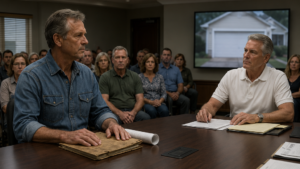
The association had opened the session to every homeowner because the washed-out road was still restricted to one lane. Folding chairs filled the old sales office. Wet coats hung over their backs, and the room smelled faintly of damp wool and coffee.
Frank sat at the center of the board table, though he no longer looked as if the seat belonged to him. Donna had placed three contractor invoices in front of her. The association attorney kept a legal pad open but had not written anything since Nicholas entered.
Amy sat in the second row holding their father’s letter inside its plastic sleeve.
Nicholas remained standing.
“This is what the board called debris,” he said, touching the photograph. “This is what the board ordered removed.” His finger moved to the notice. “And this is the boundary used to justify work beyond the recorded easement.”
Frank looked at the table rather than at him.
A homeowner near the back raised a hand. “Are you saying the board tried to take part of your land?”
“I’m saying the paving plan crossed the recorded line by roughly six feet. A licensed survey will establish the exact distance.”
The county surveyor stood near the wall and gave a brief nod.
Nicholas moved to the easement. “The upper properties have lawful access across my parcel. I cannot close the road because I’m angry. I should not have threatened to.”
The admission shifted the room. Several residents had arrived prepared to defend their access rights. Now they glanced at one another, deprived of the argument they expected him to make.
Frank finally looked up.
Nicholas continued. “But access is not the same as ownership. The easement also requires the benefiting properties to share ordinary maintenance costs.”
Donna lifted the invoices. “That obligation was not included in the packet used for the violation vote.”
One of the homeowners leaned forward. “Why not?”
Donna looked at Frank.
He folded his hands. “The invoices were disputed. Nicholas’s father ordered work without board authorization and requested reimbursement afterward.”
“Some of them were disputed,” Donna said. “Others were approved in minutes that remained in the archive.”
She distributed copies down the table.
The room filled with the sound of turning paper.
Nicholas watched Frank’s face. There was no surprise in it, only exhaustion.
Donna tapped the first invoice. “This contractor bill was approved at fifty percent association participation. The payment was never issued.”
She tapped the second.
“This culvert repair was acknowledged as necessary after storm damage.”
Then the third.
“This one was entered into the road file six years ago, when the current retaining wall was installed.”
Frank said, “The board lacked sufficient reserves.”
A woman in the front row stared at him. “You told us the reserves were fully funded.”
“I said they were adequate for expected expenses.”
“The road was an expected expense.”
Frank’s jaw tightened. Nicholas had heard the same exchange privately, but the words sounded different in a room full of people who had trusted him.
The attorney spoke carefully. “The question before the board is not whether every past decision was ideal. It is how to restore safe access while limiting further liability.”
“That is why I brought an agreement,” Nicholas said.
He placed a stapled document beside the survey.
The association attorney had expected a demand letter. Nicholas saw it in the way the man’s hand paused.
Nicholas had spent the previous day with a property attorney and the county surveyor, rejecting two versions that gave either side too much control. The third version was plain enough to understand without legal training.
It required the association to withdraw the demolition order and pay for professional drainage correction, road stabilization, and a certified boundary survey. Future ordinary maintenance would be divided among the benefiting properties according to a recorded schedule. Nicholas would retain administration of the section on his parcel but could not unreasonably delay necessary work or block lawful and emergency access.
The association would also reimburse part of the documented expenses his father had paid during the previous six years—the period supported by clear invoices, minutes, and contractor records.
Not forty years.
Not every handwritten figure.
Only what they could prove.
A homeowner read the reimbursement section and frowned. “Why should current residents pay bills we didn’t know existed?”
Nicholas looked at him. “You shouldn’t pay for everything my father wrote in a notebook. Some of it was never approved. Some of it may never be proven.”
Amy lowered her eyes.
“But the road served your houses,” Nicholas continued. “It still does. The association accepted that benefit while failing to keep records and failing to collect enough money to maintain it. Not knowing about a debt does not make the road free.”
Another resident said, “Some of us moved here only two years ago.”
“Then the repayment schedule should account for that. The agreement allows the association to use reserves, a limited assessment, and future transfer fees. That is your board’s decision, not mine.”
The room grew restless. The numbers were no longer abstract. They had entered mortgages, retirement plans, and household budgets.
Frank leaned toward the microphone. “The proposal exposes residents to costs they did not create.”
Nicholas met his eyes. “Your buyout exposed Amy and me to losses we did not create.”
“That offer provided certainty.”
“It required silence.”
The attorney glanced at Frank.
Nicholas took Frank’s unsigned purchase proposal from his folder and placed it on the table without passing it around.
“I’m rejecting this. I’m also rejecting advice to seek an emergency order restricting nonessential access until the dispute is resolved.”
Frank’s expression changed.
The association attorney said, “You were advised to do that?”
“My attorney said the drainage failure and unauthorized expansion gave us grounds to request temporary conditions.”
Several residents began speaking at once.
Nicholas raised one hand.
“I’m not doing it.”
The room quieted again.
He looked toward Amy. She removed their father’s letter from the sleeve and gave it to him.
Nicholas had intended to read only one line. Standing there, he realized that would allow him to hide behind his father one last time.
“My father was not easy to deal with,” he said.
Amy’s face lifted.
“He kept records nobody could find, ordered work before asking for permission, and expected people to understand what he would not explain. He could turn being needed into a reason not to trust anyone.”
Nicholas felt the old instinct to stop. Silence waited for him like a familiar room.
He went on.
“I learned some of that from him. I ignored the first notice. I threatened a gate before I knew what the easement allowed. I was angry at this board, but some of that anger belonged somewhere else.”
He looked at the letter.
“My father asked me to help repair this driveway four days before he died. I told him I had work. The truth is, I did not want another Saturday of being corrected by him.”
No one shifted now.
“When Frank threw the wreath, I decided protecting the road was the same as protecting my father. It isn’t. A road is not a monument. It is a responsibility.”
He read the final sentence from the letter.
“Make them carry their share. Just don’t make someone else carry your anger.”
The paper trembled once in his hand. He folded it before anyone could see whether the movement continued.
Donna turned to Frank. “Did you remove the invoices from the board packet?”
The question had already been asked privately. Here, it had nowhere to disappear.
Frank stared at the three bills.
“I removed them,” he said.
A murmur moved through the room.
“They were incomplete,” he added. “I believed including them would create confusion before we understood the association’s exposure.”
“You understood enough to request the road file,” Donna said.
“Yes.”
“And enough to condition a private purchase on waiver of maintenance claims.”
Frank did not answer immediately.
When he did, his voice was lower.
“Yes.”
The attorney closed his legal pad.
Frank looked toward the residents. “I postponed assessments because several sales were already at risk. My own refinancing was among them. I believed if the road project could be completed through acquisition of the Clark parcel, the neighborhood could avoid a special assessment and stabilize property values.”
“You believed we didn’t need to know,” Donna said.
“I believed I could solve it before you had to.”
Nicholas recognized the logic. It was his father’s logic in better clothes: do the work alone, reveal the cost later, resent everyone for not understanding.
Frank had caused harm deliberately. That did not make his fear imaginary.
Donna called for a recess.
The vote took place forty minutes later.
The board withdrew the violation notice unanimously. It approved the road agreement subject to final legal review, the certified survey, and a repayment plan capped at the six years supported by verified documentation. It also authorized removal of part of Frank’s retaining wall so the original drainage path could be restored.
Frank abstained from the first vote.
On the second, concerning his resignation as president, he voted with the majority.
At the county recorder’s office the following afternoon, Margaret Brown watched from behind the counter while Nicholas, Donna, Amy, and Frank signed the final agreement.
Frank read every page twice.
When he reached the signature line, he paused.
Nicholas waited without prompting him.
Frank signed.
“I was wrong about the wreath,” he said afterward.
It was not enough to cover the road, the invoices, or the concealment. It was also not nothing.
Nicholas nodded once. “You were.”
Outside, the county surveyor was resetting monument 17 beside newly graded gravel. The stone stood upright now, its number clear above the shoulder.
Amy joined Nicholas near it.
“The agent called again,” she said.
“What did you tell her?”
“That we aren’t listing yet.”
“Yet?”
She gave him a tired half smile. “I’m trying not to inherit the family habit of making permanent decisions while angry.”
Nicholas looked toward the farmhouse. The roof still needed work. Probate remained unfinished. Keeping the property would require money neither of them had planned to spend.
But the choice was theirs again.
A week later, the association contractor completed the temporary grading. Fresh gravel covered the repaired crossing, pale and uneven before the first vehicles pressed it into place.
Nicholas took the funeral wreath apart. Most of the flowers had browned, but one length of white ribbon remained clean where it had been folded beneath the wire.
He tied it loosely to the post beside monument 17.
Not as a warning.
Not as evidence.
Only long enough for the road to remember what had happened there.
Then he opened the shed, started his father’s loader, and waited as the first shared load of gravel came slowly down the hill.
The story has ended.