He Smiled When His Neighbor Claimed Fourteen Inches—Because the Boat Had Exposed Something Bigger
Chapter 1: The Boat Appeared Before Breakfast
When William Clark opened the side door, the morning light was gone.
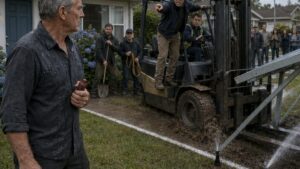
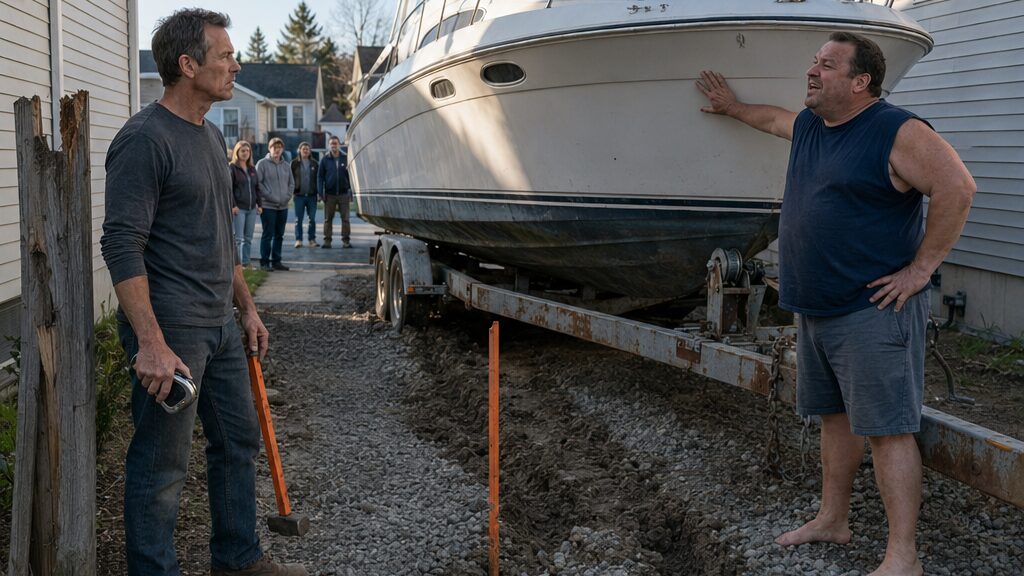
A white fiberglass hull filled the narrow space between his house and Donald Miller’s, close enough that William could see dried water spots along the cruiser’s blue stripe. The boat sat high on a rust-flecked trailer, its bow angled toward the street and its stern wedged near William’s air-conditioning unit. One trailer tire rested in a fresh trench where gravel had been pushed into the lawn.
The wooden fence post beside the gate had split from top to bottom.
For several seconds, William remained on the threshold with one hand on the knob. The side yard had always been narrow, but it had never felt sealed. Now the hull turned it into a tunnel with no exit.
Donald stood beside the trailer in a navy tank top and shorts, barefoot in the churned dirt. Sweat darkened his shirt between the shoulder blades. He slapped the boat’s hull as though introducing a prize.
“Morning,” he said.
William stepped outside.
The cruiser was nearly thirty feet long. Its trailer tongue crossed the gravel strip and stopped near William’s driveway. Deep tracks showed where Donald’s pickup had backed and corrected several times. A section of decorative edging had been flattened. The broken fence post leaned toward the house, held upright only by a lower rail.
“You hit the fence,” William said.
Donald glanced at it. “Old wood.”
“It wasn’t split yesterday.”
“It was leaning.”
William crouched beside the damaged post. Pale splinters lay in the soil. The break was fresh enough that the exposed wood still smelled sharp and clean beneath the odor of hot rubber and lake mildew.
Across the street, a garage door lifted. Someone inside paused before pulling out.
Donald followed William’s glance and grinned. “You planning to make a neighborhood event out of this?”
“I’m trying to understand why your boat is in my yard.”
“Your yard?” Donald swept one hand toward the strip as if presenting evidence. “This is access space. Everybody’s used it.”
“Not for storage.”
“It’s temporary.”
“How temporary?”
Donald shrugged. “Until I decide where I want it.”
William straightened. “Move it back onto your property.”
The grin remained, but Donald’s eyes hardened. “It is on my property.”
William looked at the trailer tongue, then at a faded indentation near the broken post where an old metal marker sat below the gravel. He had uncovered it three weeks earlier while measuring for a drainage repair.
The tongue appeared to cross the line by more than a foot.
Donald stepped closer. “You don’t use this strip. You walk through here twice a year to check a pipe. I need room for the trailer. That’s what compromise looks like.”
“Compromise usually involves asking.”
“I sent the association an email.”
“You didn’t send me one.”
Donald laughed. It was loud enough to draw another resident onto a front porch. “Because the association understands how this place works. You don’t own every inch just because you bought a measuring tape.”
William said nothing.
He went into his garage and returned with a small sledge, a tape measure, and an orange survey stake. Donald’s laugh faded as William placed the stake beside the exposed marker.
“What are you doing?”
“Checking.”
“You already checked. You came out here looking like somebody stole your porch.”
William drove the stake through the loose gravel. The first strike rang against compacted soil. The second seated it upright.
Donald folded his arms. “You’re serious about this.”
William hooked the tape to the marker and drew it across the strip toward the trailer tongue. The tape passed beneath a safety chain and stopped against the metal coupler.
Fourteen inches.
He wiped grit from the yellow blade with his thumb, took out his phone, and photographed the reading.
Donald moved closer. “You taking pictures of my boat now?”
“Of the measurement.”
“Same thing.”
William started a video. He framed the old marker, the orange stake, the tape, and the trailer tongue.
“Saturday, June fourteenth,” he said evenly. “Trailer tongue extends approximately fourteen inches beyond the recorded corner marker. Fence post damaged during placement.”
Donald stared at him, then barked out another laugh.
“You hear yourself?” he said, turning toward the people watching from the street. “Fourteen inches. He’s building a criminal case over fourteen inches of dirt.”
A resident near the curb lowered a coffee mug without drinking.
Donald stepped onto the torn edge of William’s lawn. “You know what this is? Wasted space. That’s all. You weren’t using it. Nobody was using it.”
William lowered the phone.
“Move the boat.”
Donald leaned forward and spat into the exposed soil beside William’s right boot.
The sound was small. The silence afterward was not.
William looked down at the wet mark. He felt the old, familiar pressure behind his ribs—the moment before words became irreversible. Years of maintenance meetings had taught him to wait through that pressure. Years of hospital visits had taught him something else: waiting could be useful, but it could also become a hiding place.
Donald mistook the pause for defeat.
“That’s what I thought,” he said. “Go call the board. Go write down your fourteen inches. The boat stays.”
William looked up.
Then he smiled.
It was not broad, and it carried no humor. Donald’s confidence flickered for the first time.
“What?” Donald asked.
William retracted the tape. “Nothing.”
He lifted the orange stake long enough to photograph its position from a second angle, then drove it back into the same hole. The bright plastic stood between the broken post and the trailer tongue like a warning neither man was ready to name.
Donald’s voice rose. “You think some little stick changes anything?”
“No.”
“Then why are you smiling?”
William gathered his tools. “Because now the distance is recorded.”
A car slowed at the curb. The driver looked from the boat to the damaged fence before continuing.
Donald followed William toward the garage. “You touch that trailer, I’ll have you charged with theft.”
William stopped at the threshold.
“I haven’t touched your trailer.”
“Keep it that way.”
William entered the garage and closed the side door. The cruiser’s hull blocked the window, turning the room dim.
He set the tape measure on his workbench. Behind a box of plumbing fittings sat a large white envelope sealed with a strip of blue security tape. His name and property address were printed across the front. In the upper corner was the return address for Joseph Ramirez, Licensed Professional Surveyor.
William broke the seal.
The survey inside was dated three weeks earlier.
Chapter 2: Fourteen Inches Became a Neighborhood Argument
“Please don’t escalate this over a few inches.”
Rachel King delivered the sentence before sitting down.
She placed a slim association folder on William’s kitchen table and kept one hand over it, as if the papers might escape. Her navy blazer looked too formal for a Sunday afternoon, but the tightness around her mouth suggested she had dressed for a hearing rather than a neighborly visit.
Outside the window, the cruiser’s hull reflected sunlight into the room.
“Fourteen inches,” William said.
Rachel exhaled. “That is exactly the kind of phrasing that turns a manageable issue into a legal dispute.”
“It became a legal dispute when a trailer crossed my recorded boundary.”
“We don’t know that yet.”
William unfolded Joseph Ramirez’s survey.
“We do.”
Rachel did not touch it. “I received Donald’s complaint this morning.”
“His complaint?”
“He says you threatened to have his boat removed without association approval.”
“I told him to move it.”
“He described the exchange differently.”
William glanced through the window at the orange stake. Donald had not pulled it out, but one side was scuffed where a shoe had struck it.
Rachel opened her folder. “The association site plan identifies that strip as shared maneuvering space.”
“That site plan is a landscaping diagram.”
“It has guided practice for years.”
“Practice doesn’t transfer title.”
Rachel’s expression tightened. “I’m asking for forty-eight hours. No contractors, no towing company, no additional notices. Let the board review the documents.”
“The boat blocks access to my foundation and air-conditioning unit.”
“Is there an emergency?”
“There doesn’t need to be.”
“That answer won’t help me persuade the board.”
William leaned back. He had spent too many work meetings watching people redefine a problem until responsibility disappeared. A leaking valve became deferred maintenance. A broken guardrail became an observation. A trailer on private land became a few inches.
A knock sounded at the side door.
Joseph Ramirez entered carrying a hard map case and a tablet. He was compact, gray at the temples, and careful about where he placed his boots. He glanced once toward the hull outside.
“That is closer than the photographs suggested,” he said.
Rachel stood. “You’re the surveyor?”
Joseph handed her a business card. “I’m the surveyor who located the recorded corners.”
She showed him the HOA diagram. “Our plan indicates shared access.”
Joseph studied it for less than a minute.
“This is not a boundary survey.”
“It was distributed to every owner.”
“It can be distributed to every person in the county. It still would not establish a property line.”
Rachel’s face reddened slightly. “So you’re saying it has no relevance?”
“I’m saying it shows shrubs, irrigation heads, and suggested fence locations. It does not contain bearings, distances, a surveyor’s seal, or a reference to the recorded subdivision plat.”
William watched her grip the folder more tightly.
Joseph led them outside.
Two additional orange stakes now marked the line: one near the street and one behind the cruiser’s stern. William had placed them that morning using Joseph’s measurements. Together, the three stakes formed a straight path through the gravel.
Donald emerged from his garage as soon as he saw them.
“So now we’re having a conference?”
Rachel held up one hand. “We’re reviewing.”
Donald pointed at the stakes. “Those weren’t there when I bought the house.”
“The corners were,” Joseph said.
Donald looked him over. “And you are?”
“Licensed surveyor.”
“Paid by him.”
“Paid to locate recorded monuments.”
Donald turned to Rachel. “You see the problem? He hires somebody, they draw a line, and suddenly I’m the criminal.”
“No one called you a criminal,” William said.
“You made a video like I hit a pedestrian.”
“You broke my fence.”
“The trailer bumped old lumber.”
Joseph knelt by the central stake and aligned the survey overlay on his tablet. He showed Rachel the recorded plat beneath the current aerial image. The digital line ran directly through the position of the trailer tongue.
“The encroachment at this point is thirteen and seven-eighths inches,” Joseph said. “Approximately fourteen, allowing for surface irregularity.”
Donald gave a short laugh, but it lacked the force of the one from the previous morning.
Rachel stared at the screen. “And the full strip?”
“Within Mr. Clark’s parcel.”
“All of it?”
“All of it.”
For one brief moment, William felt the satisfaction he had expected when he ordered the survey. The line was real. The measurement was correct. The argument should have ended there.
Then Rachel closed the tablet cover.
“The board still needs to review this.”
Joseph looked at her. “Review what?”
“Association responsibility. Prior usage. Whether removal could damage common landscaping.”
“There is no common landscaping under the trailer,” William said. “There’s my gravel and my broken fence.”
Donald stepped nearer to Rachel. “You told me the maneuvering strip was available.”
“I said the diagram showed shared access.”
“You said the board had always treated it that way.”
Rachel’s eyes moved toward William, then away.
There it was: not ownership, but something that had sounded close enough when Donald needed it to.
Rachel drew a paper from her folder. “Until the board meets, neither party is to alter the disputed area. No towing, no fence replacement, and no removal of the stakes. This is a temporary preservation directive.”
William read the page. “You’re prohibiting me from clearing my own land.”
“I’m preventing both sides from making the situation worse.”
“The situation is a boat.”
“The situation is now a liability issue.”
Donald smiled again. “Sounds like the boat stays.”
Rachel turned sharply. “Temporarily.”
But the word had already done its work.
After they left, William remained at the kitchen table with the survey spread before him. Through the window, Donald walked the length of the cruiser, inspecting the tie-down straps as though the board had approved permanent storage.
Someone tapped on the back door.
Stephanie Moore stood outside holding a covered casserole dish she clearly had no intention of discussing. She had lived two houses down for nineteen years and had served as the association’s secretary for nearly half of them.
“I saw Rachel’s car,” she said.
William let her in.
Stephanie placed the dish on the counter. “Donald called three board members before breakfast. Told them you were arranging an illegal seizure.”
“I haven’t called a towing company.”
“Yet.”
William folded the preservation directive. “You know something about that landscaping plan.”
Stephanie’s gaze settled on the survey.
“The board talked about that strip years ago,” she said.
“What did it decide?”
“That depends on which minutes you read.”
William waited.
Stephanie looked toward the window, where the three orange stakes remained visible beneath the boat’s shadow.
“We never corrected the official minutes,” she said. “And I think that may be why Rachel is trying so hard to keep this informal.”
Chapter 3: The Rule Nobody Had Authority to Make
Stephanie locked the records drawer when William said the words shared maneuvering space.
The click was deliberate.
They stood in the association’s small records room the following Tuesday, surrounded by metal cabinets and banker’s boxes labeled by year. A copier hummed in the adjoining office. Through the frosted glass door, William could see Rachel’s silhouette moving between her desk and the conference table.
“You brought me here to look at the old minutes,” he said.
“I brought you here to understand how the mistake happened.”
“Then open the drawer.”
Stephanie kept the key between two fingers. “Once I do, this stops being a neighbor dispute.”
“It stopped being that when Rachel issued a directive against clearing my property.”
“She was trying to prevent a lawsuit.”
“By protecting the encroachment.”
“By buying time.”
William looked at the locked drawer. “Time for whom?”
Stephanie’s shoulders lowered.
“For all of us who signed things we didn’t examine closely enough.”
She unlocked it.
Inside were folders from the development’s early years: irrigation changes, fence approvals, drainage complaints, landscape revisions. Stephanie removed one marked EAST ACCESS CORRIDORS and placed it on the table.
The first document was a faded site plan identical to Rachel’s copy. Green lines showed hedges and lawn edges. Pale arrows curved through the spaces between houses. None of the arrows were labeled as easements.
“Those arrows were meant for maintenance carts,” Stephanie said. “The developer’s landscapers needed room before the rear gates went in.”
“They cross private parcels.”
“We knew.”
“And the board kept distributing the plan.”
“It was easier than commissioning a corrected community map.”
William turned the page.
A meeting summary from twelve years earlier referred to “continued shared maneuvering access between Lots 18 and 19 where practical.” No vote count appeared. No legal review was attached.
“This is not a rule,” William said.
“No.”
“It isn’t an easement.”
“No.”
“It isn’t even a recorded board resolution.”
Stephanie pulled out a chair. “The president at the time wanted the language because three owners had trailers. People had been turning through side yards since construction. Nobody objected, so we wrote down what was already happening.”
“You wrote custom as if it were authority.”
“We wrote a compromise.”
“On land the association didn’t own.”
Stephanie flinched, but she did not argue.
William searched deeper in the file. An old color photograph showed his house before he bought it. The landscaping was sparse, the fence absent. A utility trailer stood partly across the same strip now occupied by Donald’s cruiser.
Near its wheel, faded almost white with age, was an orange landscaping flag.
The image unsettled him more than the vague minutes. Donald’s claim had not appeared from nowhere. Someone had crossed that line before. Perhaps several people had. The absence of objection had hardened into expectation, then into permission, then into something Donald called ownership.
Stephanie watched him study the photograph.
“The previous owner didn’t care,” she said.
“The previous owner’s choices don’t bind me.”
“No. But they explain why Donald thought the space was usable.”
“He could have asked.”
“He did ask Rachel.”
William looked up.
Stephanie reached for another folder and stopped halfway. “You didn’t know?”
“Know what?”
“Donald showed her an email before he bought the boat.”
She opened a printed correspondence from eight months earlier. Donald had asked whether a cabin cruiser could be maneuvered beside his house. Rachel’s response stated that the association had historically regarded the strip between the two properties as common maneuvering space, subject to neighbor cooperation and damage responsibility.
No legal guarantee. No ownership claim. But enough reassurance for a man looking for the answer he wanted.
William read it twice.
“He never cooperated with me.”
“No.”
“Rachel never copied me.”
“No.”
“And this does not authorize storage.”
“It doesn’t.”
“Then why hide it?”
Stephanie’s mouth tightened. “Because it makes the association look careless, not because it makes Donald right.”
A shadow crossed the frosted glass. Rachel entered without knocking.
“You are not authorized to remove original records,” she said.
“We’re reading them,” Stephanie replied.
Rachel saw the printed email in William’s hand. Her expression changed from irritation to calculation.
“That communication was preliminary.”
“You called private land common space,” William said.
“I described historic practice.”
“To someone deciding whether to buy a thirty-foot boat.”
“I also said cooperation was required.”
“You never asked for mine.”
Rachel closed the door behind her. “I thought Donald had spoken to you.”
“He hadn’t.”
“And when you saw him preparing the area?”
William did not answer.
The room grew still.
Rachel looked at Stephanie, then back at him. “You did see the preparation, didn’t you?”
William returned the email to the table. “We’re discussing what the association told Donald.”
“We’re discussing the entire sequence.”
Stephanie’s eyes narrowed. “What preparation?”
Rachel hesitated, realizing she had said more than intended.
William could still picture it: Donald’s pickup idling beside the house two Saturdays earlier, a rented compactor in the side yard, gravel spread in a fresh gray strip. William had watched from his kitchen while Donald measured turning clearance with a length of rope.
At the time, Joseph had already painted small survey marks near the curb. The final report had not arrived, but William understood what the marks suggested.
He had told himself not to confront Donald without the sealed document.
He had also wanted Donald to see, once and permanently, that confidence did not move a line.
Stephanie studied his face.
“You knew he was grading for the trailer?”
“I knew he was working in the side yard.”
“You knew what for?”
“I suspected.”
“Did you ask?”
“No.”
Rachel folded her arms. “Donald says you stood in your driveway and watched.”
“He never asked permission.”
“That isn’t what she asked,” Stephanie said.
William looked again at the old photograph. The faded orange flag stood beneath the trailer wheel, almost invisible unless someone knew to search for it.
Donald had relied on a careless email. Rachel had relied on an old custom. The board had relied on silence. William had relied on a survey he had not yet shown anyone.
Every person involved had treated the missing conversation as somebody else’s responsibility.
Stephanie gathered the records into a neat stack. Her movements were slower now.
“I’ll give you copies,” she said. “The email, the photograph, the minutes. All of it.”
Rachel stepped forward. “The board has not approved disclosure of internal correspondence.”
“I was secretary when those minutes were created,” Stephanie said. “And I’m done pretending vague language becomes clearer when we keep it in a drawer.”
Rachel left without replying.
Stephanie fed the first page into the copier. The machine light moved beneath the glass, illuminating the old words one line at a time.
When the copies were finished, she handed them to William.
“You own the strip,” she said. “Nothing in there changes that.”
William slid the pages into his folder.
“But?” he asked.
Stephanie locked the drawer again.
“But you saw the survey paint before Donald moved the boat.”
William held her gaze.
She placed the key in her pocket.
“So why didn’t you warn him?”
Chapter 4: William’s Silence Entered the Record
Donald placed William’s unopened survey envelope in the center of the hearing table before anyone had taken a seat.
The blue security strip had been cut cleanly across the top. William’s name and address faced the board. In the upper corner, beside Joseph Ramirez’s return address, the mailing date was impossible to miss.
Three weeks before the boat arrived.
Donald kept two fingers on the envelope as if it were evidence that might disappear.
“He had this,” he said. “He watched me prepare the ground, and he had this.”
Rachel King stood near the projection screen with a stack of copied records held against her chest. The HOA board president occupied the middle chair. Two board members sat on either side, avoiding William’s eyes.
Stephanie Moore had chosen a seat in the back row.
William sat opposite Donald. Between them lay the bent orange survey stake Donald had pulled from the gravel that morning.
The board president tapped a pen against a legal pad. “Mr. Miller, you were instructed not to disturb the markers.”
“I didn’t disturb it. My trailer tire caught it.”
“The tire is four feet away from the line,” William said.
Donald turned toward him. “You want to discuss distances now?”
“We are here to discuss distances.”
“No. We’re here because you let me spend money preparing that space, then waited until the boat was in place so you could make a spectacle.”
William felt several residents shift behind him.
The room was the association’s converted sales office, too small for the number of people who had come. Folding chairs lined the back wall. Someone had opened the blinds, and the afternoon sun fell across the carpet in bright rectangles. On the screen, Rachel had frozen an image of the site plan—the green landscaping lines, the pale arrows, the space between Lots 18 and 19 marked as if nobody owned it.
The board president looked toward Rachel. “Can we establish the timeline?”
Rachel set down her papers.
“Mr. Clark commissioned the survey on May nineteenth. Preliminary paint marks were placed on May twenty-third. The final sealed report was delivered on May twenty-six.”
“And the boat?” one board member asked.
“Positioned on June fourteenth.”
Donald leaned back. “Thank you.”
William looked at Rachel. “You’re leaving out your email.”
“We will address it.”
“You told him the area was common maneuvering space.”
“I described historic use.”
“You gave him that description before the survey.”
Donald slapped the table once. “Because that’s what the association told everybody for years.”
The president raised a hand. “One person at a time.”
Joseph Ramirez sat near the end of the table, map case upright between his shoes. He had resisted attending until Rachel circulated a summary suggesting the survey line was “subject to association interpretation.” Then he had called William and said professional measurements were not voting matters.
Rachel displayed the recorded subdivision plat. Joseph rose and pointed to the bearings along William’s eastern boundary.
“The monument at the front corner and the rear iron pin both match the recorded plat,” he said. “The line between them passes beneath the trailer tongue and along the inner edge of the starboard tire. There is no recorded easement in favor of the association or Lot 19.”
The board president frowned. “So the association cannot authorize storage there.”
“Not legally.”
Donald’s face tightened. “But you can’t say I acted out of nowhere.”
Joseph glanced at the old site plan. “I can say the association diagram is not a survey.”
“That isn’t what I asked.”
“No,” Joseph said. “It isn’t.”
The answer gave Donald more ground than William expected. Donald picked up the printed email Rachel had sent him months earlier.
“I asked before I bought the boat. I asked if I could get it beside the house. She said the strip had always been used for maneuvering. I hired a grading crew based on that.”
Rachel spoke carefully. “The same email says neighbor cooperation was required.”
“I thought cooperation meant not damaging anything.”
“You split my fence,” William said.
“And I offered to replace the post.”
“After you called it old wood.”
Donald’s jaw moved. For a moment, William saw the man from the side yard again—the grin, the spit, the certainty that loudness could become ownership.
Then Donald looked toward the residents.
“He stood there while the gravel went down,” he said. “Ask him.”
The room went quiet.
William had expected the survey to be the difficult part. He had expected Donald to deny the line, Rachel to delay, the board to protect itself. He had not expected silence to feel like an object placed before him.
The board president turned to William. “Did you observe the grading work?”
William looked at the bent stake on the table.
“Yes.”
A murmur moved through the back row.
“Did you tell Mr. Miller you had commissioned a survey?”
“No.”
“Did you tell him the preliminary markings suggested his planned access crossed your parcel?”
“No.”
Donald let out a short breath through his nose. Not triumph. Something closer to confirmation.
Rachel folded her hands. “Why not?”
William could have said the report was not final. It was true. He could have said Donald had not asked permission. Also true. He could have said Rachel’s office had a duty to correct its own map before telling residents what they could use.
All of it was true.
None of it answered the question.
“I wanted the final document before I argued with him,” William said.
Donald shook his head. “That’s not all.”
William met his eyes.
“No,” he said. “It isn’t.”
The admission changed the room. Even Joseph looked up.
William placed both palms on the table. “I saw the paint marks. I believed the line would be where it is now. I watched the grading because I thought if I stopped him before the report arrived, we’d have the same argument we’ve had about drainage, trash cans, and the rear gate. I wanted one document that ended it.”
“So you let me finish,” Donald said.
“I did not tell you to continue.”
“That’s not the same as warning me.”
“No.”
Stephanie’s voice came from behind them. “It isn’t.”
William turned slightly. She did not look away.
The board president removed his glasses. “Mr. Clark, are you saying you intentionally withheld information?”
“I’m saying I chose not to speak until I had certainty.”
“And by then the boat was in place.”
“Yes.”
Donald pushed back from the table. “There. That’s the whole thing.”
“No,” William said. “The whole thing includes you never asking me, ignoring the stakes, breaking the fence, and spitting at my feet.”
Donald’s face reddened.
The board president struck the table with the flat of his hand before Donald could answer.
“This hearing will not become another confrontation.”
The board recessed for twenty minutes.
William waited in the hallway beside a vending machine that had not worked in years. Stephanie stood at the opposite wall. Neither spoke until Donald walked past them toward the parking lot, phone pressed to his ear.
“He should never have put the boat there,” Stephanie said.
William watched Donald through the glass doors. “You don’t need to soften it.”
“I’m not.”
“I knew enough to warn him.”
“Yes.”
“I thought waiting made me careful.”
Stephanie looked toward the hearing-room door. “Sometimes waiting is just a quieter way of deciding for somebody else.”
The words stayed with him when the board called them back.
The president read the decision from a single page. The association would not recognize Donald’s use as permanent. It acknowledged that the recorded boundary favored William and ordered Donald to propose a relocation plan within ten days.
But the board would not authorize towing, approve a contractor, or accept liability for removal. Until the compliance period ended, both owners were forbidden from altering the site.
Donald laughed once. “So nobody wins.”
William looked through the blinds toward the cruiser’s hull visible beyond the parking lot.
The board president continued. “The association will also review its historical communications and site diagrams.”
Rachel’s shoulders stiffened.
William folded the decision. The line was his. The boat was still there. The board had confirmed both facts while solving neither.
Donald stood and picked up the bent orange stake.
“That stays with the record,” Rachel said.
He dropped it back onto the table.
At the door, he turned toward William.
“If anyone touches that cruiser,” he said, “I’ll file for an emergency order before the first tire leaves the ground.”
Chapter 5: The Notice on Donald’s Glass Door
Rainwater reached the bottom row of William’s foundation vents on the ninth day.
The storm had begun before dawn and continued in hard, slanting bands that drove leaves against the cruiser’s hull. Water normally ran along the gravel strip toward a rear drain. Now the trailer tire sat in the channel, and the grading Donald had ordered formed a shallow ridge that redirected runoff against William’s house.
William stood beneath the eave with a flashlight and watched the water climb.
The central orange stake leaned under the force of the current. Donald had bent it during the hearing week, and William had straightened it twice. He stepped into the runoff, gripped it near the base, and pressed it upright until the plastic aligned with the rear marker.
The boat had turned a measured line into a dam.
He called Rachel first.
Her voicemail answered.
He called the board president.
No answer.
At seven fifteen, water slipped through the lower vent and disappeared beneath the house.
William went inside and opened the drawer where he kept contractor cards. His fingers passed over plumbers, electricians, roofers, and stopped on the number for a licensed hauling company Joseph had recommended.
The hauling supervisor arrived that afternoon after the rain weakened.
He walked the length of the boat without touching it. He photographed the tire positions, trailer frame, damaged fence post, and distance to the house. Then he crouched beside the coupler and examined the angle toward the street.
“We can move it,” he said.
“Without damaging the boat?”
“No honest contractor promises that.”
William looked at him.
The supervisor stood. “We document existing condition. We use wheel dollies under the rear axle, pull the tongue forward, then rotate. But the clearance is tight. If the trailer frame shifts, it could scrape the fence or the foundation.”
“The fence is already damaged.”
“The boat isn’t yours. That matters more.”
William handed him copies of the survey, board decision, and photographs.
“What else?”
“Proof of notice. Proof the compliance period expired. Written authorization from the property owner—that’s you. And a destination.”
“Commercial storage.”
“Prepaid?”
“For thirty days.”
The supervisor studied him. “You’ve prepared.”
“I prefer not to improvise.”
“That can be good.” He glanced toward Donald’s house. “It can also make people feel like you decided everything before they entered the room.”
William said nothing.
The supervisor pointed to the water staining the foundation. “You have a legitimate access and drainage issue. But once that cable tightens, legitimacy won’t make the scene gentle.”
After he left, William sat at his kitchen table with the formal cure notice before him. It required Donald to remove the cruiser by six the following evening or authorize relocation. William had attached the recorded survey, photographs, repair estimate, and commercial-storage information.
He read the notice twice.
Beyond the window, rainwater dripped from the boat’s railing in a steady rhythm.
Years earlier, the side strip had held a different kind of equipment.
A portable oxygen concentrator had rolled through the gate on rubber wheels. Then a folding ramp. Then, during the final month, a narrow medical transport chair that required William to remove the gate hinges so the attendants could turn beside the house.
His wife had hated the front entrance because neighbors could see the ambulance lights. She had asked him to keep the side path clear.
He had promised.
After she died, he rebuilt the gate and spread new gravel himself. He never explained to Donald why he checked the drain after every storm or why a trailer in that strip felt larger than its dimensions.
The property line mattered because it was recorded.
The path mattered for reasons no document carried.
William signed the notice.
At dusk, he crossed the wet lawn to Donald’s front porch. The glass storm door reflected both houses, the white cruiser, and the orange stake standing between them.
He taped the notice at eye level.
Donald opened the inner door before William stepped away.
“What is this?”
“The compliance period ends tomorrow.”
Donald read the first page through the glass. His face changed.
“You hired a tow company.”
“A hauling company.”
“You touch that boat, I’ll call it theft.”
“The notice gives you the option to authorize relocation.”
“I’m not authorizing anything.”
“Then it will be removed from my property under the documented procedure.”
Donald pushed open the storm door. William moved back enough to keep it from striking him.
“You think because that board got nervous, you can take my boat?”
“The board denied you permanent use.”
“The board also refused to approve a tow.”
“They don’t own the land.”
Donald held up the old HOA email, now sealed inside a plastic sleeve.
“This says common maneuvering space.”
“It also says neighbor cooperation.”
“You stood there and let me grade it.”
“I admitted that.”
“You admitted it in a room. That doesn’t pay me back.”
“For what?”
“For storage. Grading. The purchase itself.”
William looked at him. “You bought the boat because of an email from a property manager?”
“I bought it because I had a place to put it.”
“You thought you did.”
Donald’s fingers tightened around the sleeve. “My attorney says reasonable reliance matters.”
“It may.”
The answer stopped him.
Donald had expected denial. William saw it in the pause.
“Then you know this isn’t clean,” Donald said.
“No. It isn’t.”
“But you’re towing it anyway.”
“The water reached my foundation this morning.”
“I can cut a drain channel.”
“You had ten days to propose a solution.”
“I was trying to stop you from taking the boat.”
“That was your proposal.”
Donald opened the storm door wider. “You want to know why I didn’t move it? Because the storage yard wants eight hundred dollars a month, and I don’t have it. I put everything I had into getting that cruiser ready.”
William heard the pressure beneath the anger but did not yet understand it.
“You should have considered that before crossing the line.”
Donald’s face closed again.
“And you should have opened your mouth before I did.”
For a moment, neither moved.
The formal notice shifted beneath the tape as wind pressed against the glass. William saw his own reflection over the printed words.
“I’ll be here at six tomorrow morning,” he said. “The crew will not move anything before the deadline.”
“You’re going to regret this.”
“Maybe.”
Donald stared at him.
William returned home and called the hauling supervisor. He authorized the truck but added restrictions: no cutting chains, no entering Donald’s garage, no removal if the trailer registration was disputed, no movement beyond the commercial storage lot, and immediate stop on William’s signal.
“You’re giving yourself a lot of ways to halt the job,” the supervisor said.
“I’m giving us a way not to make the wrong damage permanent.”
At five forty the next morning, diesel noise rolled through the dark street.
William stepped outside as the flatbed turned the corner, amber lights rotating across the wet houses. The tow crew followed in a smaller truck carrying dollies and a portable winch.
Donald stood barefoot on his porch, phone pressed to his ear.
When he saw William, he raised the plastic-sleeved HOA email like a warning.
“My attorney is calling back,” he said.
The flatbed stopped beside the curb.
Chapter 6: The Winch Tightened and William Raised His Hand
The cable snapped taut at the same moment Donald’s phone rang.
The sound cut across the side yard—a metallic crack followed by the low vibration of the winch taking weight. The cruiser shifted less than an inch, but the trailer suspension creaked loudly enough to bring porch lights on along the street.
Donald answered the call.
“They’re moving it now,” he said. “Yes, right now.”
The hauling supervisor stood beside the front dollies, one hand raised toward the winch operator. Two crew members watched the trailer tires. A third held a measuring rod between the hull and William’s wall.
The cable passed within inches of the central orange stake.
William stood beside it with the survey folded in his back pocket.
Donald paced near his driveway. “The association told me I could use it. I have the email. He knew before I put it there.”
He listened, then turned away from the crew.
“No, the association didn’t sign the authorization. He did.”
The supervisor looked at William. “Ready for the first pull?”
William checked the fence, the foundation, the rear tire, and the stake.
“Six inches,” he said.
The winch operator engaged the motor. The cable tightened again. The trailer tongue moved toward the street while the rear axle settled onto the dollies. Gravel grated beneath steel.
Donald ended the call.
“That was my attorney.”
William did not ask what the attorney had said.
Donald came closer. “He says I can seek damages.”
“That’s different from stopping the removal.”
“He’s filing.”
“When?”
Donald’s mouth tightened.
The answer was clear.
The supervisor called out a measurement. “Nine inches to the post.”
The split fence post leaned toward the trailer. One wrong shift could crush it completely or drive it into the hull.
“Hold,” William said.
The winch stopped.
Donald stepped into the gap. “You enjoying this?”
“No.”
“You smiled when this started.”
“I did.”
“Everybody saw it.”
William looked at the cruiser’s bow, rising above both of them.
“I thought I knew how it would end.”
Donald gave a bitter laugh. “With me losing.”
“With the line being respected.”
“That’s the same thing to you.”
Before William could answer, Donald held out his phone.
The screen showed a message thread. William saw only the most recent line at first.
When can we finally take it out?
Beneath it was another message.
I can come the first weekend next month if the engine is ready.
Donald kept the phone angled toward him.
“My son,” he said. “He hasn’t stayed more than an hour at my house in two years.”
William looked from the message to Donald.
“I bought the boat because he used to go out with me when he was a kid. Before his mother and I split up. Before every conversation became about what I failed to do.”
The hauling crew waited in silence. The residents watching from their porches could not hear every word, but they understood the movement had stopped.
Donald continued, quieter now.
“He works two states over. I told him I had the cruiser. Sent pictures. He said maybe we could fix it together.”
“You could have stored it somewhere else.”
“I couldn’t afford somewhere else.”
“You could have asked me.”
“I thought the association already answered.”
“You knew cooperation was required.”
Donald looked toward the glass door where the notice had been posted. “I thought you’d complain, then let it go. Like everybody did before.”
“And when I didn’t?”
“I thought if I acted like the argument was already over, you’d back down.”
William glanced at the wet patch of soil near where Donald had spat days earlier. Rain had erased it. The memory remained.
“You damaged the fence.”
“I know.”
“You threatened to take my house.”
“I was angry.”
“You humiliated me in front of the street.”
Donald lowered the phone. “I know.”
The words did not sound like an apology. They sounded like a man finally naming the weight he had been carrying badly.
The supervisor stepped toward William. “We need a decision. Holding the trailer on the cable like this isn’t ideal.”
William looked at the orange stake. It had begun as proof that Donald was wrong. At the hearing, bent on the table, it had become proof that William’s silence belonged in the story too.
The legal path remained open. The notice had expired. The commercial lot had accepted payment. The hauling company had documented the scene. William could nod, and within minutes the cruiser would be on the street.
Donald would lose the space, the money, perhaps the boat.
William would regain his land.
All of that could be lawful.
He raised his hand.
“Stop the job.”
The winch operator released tension slowly. The cable settled with a metallic hum.
Donald stared at him. “What are you doing?”
“Not giving you the strip.”
“I didn’t say—”
“Listen.”
William stepped between the central stake and the trailer tongue.
“The boat leaves my property today. That does not change.”
Donald’s face hardened again, but William continued before he could speak.
“You have two options. Authorize relocation to the storage yard, sign responsibility for the fence and drainage repairs, and work out payment terms in writing. Or I authorize the crew to continue under the notice, and the storage company handles it as an involuntary removal.”
“You already paid them.”
“For thirty days.”
“I can’t repay all of that now.”
“I didn’t ask for all of it now.”
Donald looked toward the flatbed, then at the message still visible on his phone.
“What’s the difference?” he asked.
“The difference is whether you cooperate before the next pull.”
The board president arrived in a sedan and parked crookedly at the curb. Rachel climbed out from the passenger side carrying a folder. Neither approached immediately.
Donald noticed them and laughed without humor. “Now they show up.”
“They can witness the agreement,” William said.
“You planned that too?”
“I told Rachel the crew was coming.”
“Of course you did.”
William did not defend himself.
The hauling supervisor removed a standard relocation authorization from his clipboard. “Destination is the commercial yard. Owner can reclaim or extend storage directly. Existing condition is photographed. No impound fee if authorization is signed before transport.”
Donald read the form.
His hands shook slightly.
“What about the damage?” he asked.
“Separate agreement,” William said. “Fence post, gravel, and drainage channel. You pay what you caused. The association pays for correcting what its records caused.”
Rachel approached when she heard that.
“The board has not approved that allocation.”
William turned to her. “Then the crew continues, and every party can argue afterward.”
The board president looked at the cable, the survey stake, and the residents watching from both sides of the street.
“We can authorize mediation on repair costs,” he said.
“No,” William replied. “You can authorize correction of the maps and the misleading access language. The fence damage is between Donald and me.”
Rachel opened her folder. “Our insurer requested the archived communications last night.”
Stephanie must have sent them.
Rachel continued, “They advised us not to defend the maneuvering-space description as an ownership right.”
Donald looked at her. “You told me it was usable.”
“I told you what the board had historically allowed.”
“You didn’t tell me you had no authority.”
Rachel’s voice dropped. “I should have.”
The admission settled over the yard.
William felt no satisfaction from it.
Donald read the relocation form once more. Then he signed.
The crew repositioned the dollies. This time Donald stood beside the supervisor and answered questions about the trailer brakes and coupler lock. He did not shout when the winch engaged.
The cruiser moved forward in measured increments.
At the central stake, the split fence post caught against a trailer guide. The supervisor called for another stop.
William and Donald both reached toward the post.
Their hands stopped inches apart.
“I’ve got it,” Donald said.
William stepped back.
Donald lifted the broken wood clear while the trailer rolled past. The post was lighter than he expected; the lower half had rotted beneath the soil before the impact finished it. He held it against his chest as the rear tire crossed onto the dollies.
Nine minutes after the cable first tightened, the trailer tongue cleared the orange stake.
The cruiser entered the street.
Donald watched it climb onto the flatbed. His phone remained in his pocket.
When the final chain was secured, the hauling supervisor handed him a copy of the relocation receipt. Donald folded it carefully.
William stood beside the restored strip. The gravel was scarred, the drainage channel blocked, and the fence open. The space looked larger without the hull, but not whole.
Donald approached with the broken post under one arm.
“You really going to make me pay for all of it?” he asked.
“For what you damaged.”
“And the storage?”
“We’ll put it in writing.”
Donald looked toward the orange stake.
“I still think you let this happen.”
William did not look away.
“I did not cause you to cross the line,” he said. “But I should have told you where it was before you did.”
Donald absorbed that.
Then William pointed toward the flatbed.
“You have one hour to confirm the storage account in your own name. After that, the company follows its standard terms.”
Donald took out his phone.
For the first time since the boat appeared, he did not argue before acting.
Chapter 7: The New Fence Followed the True Line
Donald returned three weeks later carrying the split fence post across both arms.
William saw him from the garage before Donald reached the side yard. The post had dried to a dull gray, but the fresh break still showed pale wood beneath the weathered surface. Donald had removed the rusted nails and wrapped one end with a strip of cloth so the splinters would not catch his shirt.
He stopped beside the first orange stake.
“I figured you’d want this before the contractors came,” he said.
William set down the box of gate hinges he had been sorting.
“They’re coming tomorrow.”
Donald nodded toward the post. “It won’t hold anything.”
“No.”
“I know.”
He placed it carefully on two sawhorses instead of dropping it onto the gravel.
The side yard had changed since the boat left. The drainage channel was open again, and the foundation had dried, but tire trenches still cut through the strip. Orange stakes traced the legal line from the curb to the rear corner. Joseph Ramirez had added small white caps to two of them while preparing permanent markers.
Donald looked down the length of the yard.
“It seems wider now.”
“It’s the same width.”
“I know that too.”
William waited.
Donald pulled a folded agreement from his back pocket. The storage company had transferred the cruiser into his name on removal day. He had extended the account for two months, though the cost had forced him to postpone engine repairs.
“My attorney reviewed the repayment terms,” he said. “He said they’re reasonable.”
“That sounds painful for him.”
Donald almost smiled.
The agreement divided responsibility without pretending every kind of harm was equal. Donald would pay for the broken fence post, damaged gravel, and restoration of the drainage channel. The HOA would fund a corrected property diagram, permanent boundary markers, and repairs connected to its misleading maneuvering-space language. William would absorb the prepaid first month of storage and waive any claim for inconvenience or emotional distress.
Donald had argued about that last part when Rachel presented the draft.
He had not argued today.
“I can’t pay the repair total at once,” he said.
“I know.”
“I can do monthly payments.”
“That’s what the schedule says.”
Donald looked toward William’s house. “You trust me to keep up with it?”
“No.”
Donald’s head turned sharply.
William picked up the hinge box. “That’s why it’s written down.”
After a moment, Donald gave a low breath that might have been a laugh.
They carried the old post into the garage together. William leaned it against the wall near the workbench. The original bent orange stake rested on the shelf above it, still marked by gravel and a black scrape from the trailer tire.
The final HOA meeting began that evening in the same room where Donald had displayed William’s survey envelope.
This time, the center of the table held a corrected site plan.
Joseph stood beside the projection screen and aligned the recorded plat with the new association drawing. The vague arrows through private side yards were gone. Each parcel line was marked clearly, and any future access arrangement would require written permission from the affected owner.
Rachel sat beside the board president with a thicker folder than before.
“Our insurer has completed its preliminary review,” she said. “The association cannot characterize privately owned strips as common maneuvering space without a recorded easement or owner agreement.”
One board member shifted in his chair. “Do we know how many homes are affected?”
“Seven may require corrected diagrams. Three have structures or landscaping near inaccurate lines.”
A murmur rose from the residents.
There it was—the cost Rachel had been trying to hold behind closed doors. Correcting William’s problem meant admitting it was not the only one.
The board president raised his voice. “The association will pay for professional verification where the historical diagrams conflict with recorded plats. No owner is being ordered to remove anything tonight.”
The room settled slowly.
Stephanie sat in the back row again, but this time she had brought the original minutes in a clear folder. When the president invited comments, she stood.
“I wrote part of the language that caused this,” she said. “We believed we were preserving cooperation. We used words like shared and common without asking whether we had authority to use them.”
She did not apologize for the entire board. She did not ask anyone to forgive her. She simply placed the minutes on the table and sat down.
Rachel then summarized the repair agreement between William and Donald.
Donald signed first.
His pen paused above the line concerning damage responsibility, but only for a second. He wrote his name, slid the document across, and kept his eyes on the paper.
William signed beneath him.
The board president asked whether either man wished to add anything before the agreement became part of the record.
Donald shook his head.
William looked at the corrected plan on the screen. The new boundary was precise and clean. It gave no indication of the spit in the dirt, the rainwater at the foundation, the tow cable, or the message from Donald’s son.
A line could show where ownership ended.
It could not show how people reached the point of needing it.
“I was right about the property,” William said.
The room became quiet.
“I was wrong to think that gave me permission to stay silent while the problem grew.”
Donald looked up.
William kept his voice even.
“I should have warned him when I saw the grading work. That would not have made the land his. It might have prevented the damage.”
One of the residents near the wall folded her arms, perhaps disappointed that the statement did not produce a clearer winner.
William no longer needed one.
Donald leaned toward his microphone.
“I should have asked him instead of asking for an answer I liked from the association,” he said. “And when he objected, I tried to make him look small.”
The board president waited, but Donald had finished.
There was no applause.
Rachel collected the signed pages and placed them in the folder. “The agreement is accepted. The corrected access policy takes effect immediately.”
The following morning, the fence contractor arrived with treated posts, gravel, and a compact trencher. Joseph set two permanent metal markers along the true line. Each sat nearly flush with the ground, visible only when someone looked for it.
Donald worked beside the contractor without being asked. He cleared damaged gravel into a wheelbarrow and carried sections of old rail toward the driveway. William installed the new gate hardware.
By noon, they reached the question neither plan had answered.
The contractor held a tape across the opening. “Standard gate is thirty-six inches. You have room for forty-eight if you want it.”
William looked at the narrow path.
A thirty-six-inch gate would establish control. It would also make the side yard harder to use for maintenance equipment. Years earlier, he had removed hinges to create enough room for the medical transport chair.
Donald wiped dust from his hands.
“Could you keep it wide?” he asked. “Not for the boat. That’s never coming back here.”
William said nothing.
Donald pointed toward his own rear yard. “I have a mower and a small utility cart. I can bring them through my side, but the turn is tight. If we ever need to move something larger, I’d ask first.”
The last two words carried more weight than the request.
William measured from the permanent marker to the house. A forty-eight-inch gate would remain entirely on his parcel. It would preserve access without creating an undefined shared strip.
“Forty-eight,” he told the contractor.
Donald nodded once. “Thank you.”
“It stays locked from my side.”
“Understood.”
“And permission is specific. Not permanent.”
“Understood.”
The contractor marked the hinge position.
By late afternoon, the new fence followed the true boundary from front to rear. The repaired drainage channel curved beneath the gate, and fresh gravel covered the trailer trenches. The permanent marker remained visible beside the first post.
Donald carried the last section of broken rail to the curb.
“My son and I went to the storage yard Sunday,” he said.
William tightened a hinge bolt. “How did that go?”
“He told me the engine needs more work than I admitted.”
“He was right?”
“Yes.”
Donald looked embarrassed, but not angry.
“He said we could repair it there. We don’t need the boat beside the house to work on it.”
William tested the gate. It swung smoothly across the gravel and stopped just short of Donald’s side.
“That sounds cheaper than another survey.”
Donald gave a brief smile.
When the contractor left, William returned to the garage. He took the bent orange stake from the shelf and turned it in his hands. The plastic was gouged near the tip. For weeks, it had stood for proof, then warning, then accusation.
He placed it inside an empty corner beside the old fence post.
Outside, Donald rolled his utility cart toward the new gate and stopped.
He did not touch the latch.
William stepped out, unlocked it, and opened the gate wide enough for the cart to pass. Donald moved through carefully, keeping both wheels well inside the marked boundary.
Afterward, William closed the gate.
The latch settled with a clean metal click on the true line.
The story has ended.