They Ordered Ryan King to Move the Ditch Their Entire Neighborhood Secretly Depended On
Chapter 1: The Notice Beside the Turning Iron Wheel
“You have until Tuesday to move the ditch.”
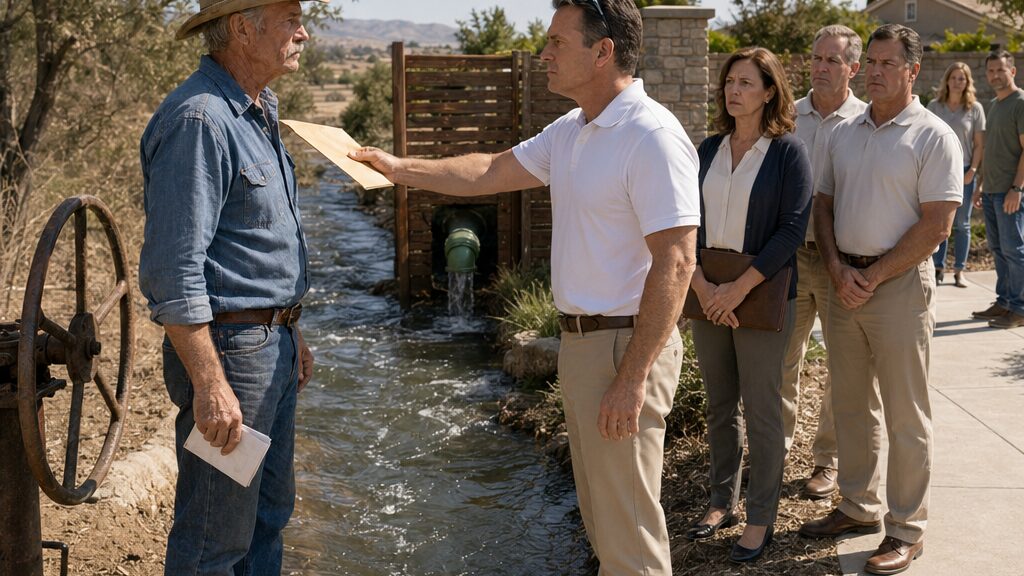
Ryan King looked past Richard Harris at the water sliding between the cottonwood roots.
It moved with the same low, steady sound it had made all morning, carrying a ribbon of reflected sky through the dry grass. Behind Ryan, the old iron wheel turned in short, reluctant clicks where the current pressed against the gate mechanism.
Richard held out a thick white envelope.
“After Tuesday,” he said, “the association begins assessing two hundred dollars a day.”
Ryan did not take it.
Two board members stood behind Richard in matching white polos. Laura Mitchell stood a little apart from them, one hand gripping a leather folder against her hip. Beyond the split-rail fence, two residents had stopped on the paved walking path to watch.
Ryan glanced at the ditch again.
“You want me to move running water.”
“We want you to correct an encroachment.”
Richard’s sunglasses rested on top of his head. His shoes were clean despite the dust, and his voice carried the practiced patience of someone explaining a rule to a person he had already decided would not understand it.
“The channel falls inside the association’s managed landscape corridor,” he continued. “It is exposed, it attracts debris, and it is inconsistent with the entrance plan.”
“The entrance plan came ninety-eight years after the ditch.”
“That is not the issue.”
“It is the only issue.”
Richard extended the envelope farther. Ryan took it at last, not because he accepted it, but because the man seemed prepared to hold it there all day.
Across the front, beneath the association’s embossed seal, were the words NOTICE OF AESTHETIC AND SAFETY VIOLATION.
Ryan read the first paragraph. Then the second.
The order required him to reroute, pipe, screen, or otherwise remove the visible channel from the landscaped boundary by Tuesday at five in the afternoon. Failure would result in daily fines, legal costs, and “corrective action undertaken by the association.”
He folded the pages once.
“You intend to come onto my land and fill it?”
Richard gave a small smile. “We intend to enforce our recorded authority.”
Ryan stepped toward the wheel.
The metal spokes were dark with age except where generations of hands had polished the outer rim. The date 1897 had been stamped unevenly into the hub. His great-grandfather had ordered the gate from a foundry two counties north, then hauled it home in pieces and assembled it beside the ditch.
Richard followed him.
“Mr. King, walking away from the conversation doesn’t change the deadline.”
Ryan crouched beside the gate box. A decorative cedar screen had been installed along the association side of the fence. From the walking path, it looked like part of the entrance landscaping.
From the ditch bank, Ryan could see the green pipe behind it.
He had noticed the pipe years ago. At first it had looked narrow enough to serve a maintenance spigot. Later, a second coupling had appeared, then a concrete collar beneath the weeds. He had told himself it was none of his business until someone crossed the fence.
Now he saw the fresh wet line around the joint.
He put two fingers against the pipe. It vibrated.
“Who signed the diversion authorization?” he asked.
Richard’s smile thinned.
“This is not a diversion.”
Ryan looked at him.
“What is it?”
“A community service connection.”
“Who signed it?”
“The development plans were approved before most of the current board lived here.”
“That wasn’t my question.”
One of the board members shifted his weight. Laura lowered her folder and looked toward the pipe.
Richard stepped closer. “Your obligation today is to acknowledge the notice.”
Ryan reached for the iron wheel.
Richard caught the front of Ryan’s work shirt in one fist.
The movement was quick enough that Laura gasped. The two residents on the path stopped speaking.
Ryan looked down at Richard’s hand.
For a moment he felt the old heat rise through him, the same heat that had ended barroom arguments badly when he was twenty-five. He saw how easily he could shove Richard backward into the bank. He also saw the phones already lifted on the path.
Ryan wrapped his hand around Richard’s wrist and removed it from his shirt.
“Do not touch me again.”
He did not raise his voice.
Richard’s face had reddened around the collar. “You are interfering with association infrastructure.”
“I’m standing on my land.”
“That is disputed.”
Ryan turned the wheel one quarter-turn.
The old gears resisted, then moved with a grinding complaint. Water thickened against the gate. Behind the cedar screen, the green pipe shuddered hard enough to strike the wood.
A hollow bang traveled beneath the ground toward the development entrance.
Everyone heard it.
Laura stared at the screen.
Ryan kept his hand on the wheel. “That pipe is pulling from this channel.”
Richard looked toward the residents. “That proves nothing except that he is tampering with a shared system.”
“Shared by whose signature?” Ryan asked.
No one answered.
The water beneath the wheel changed pitch, pressing harder through the narrowed opening. Ryan could have turned it farther. Another half-rotation would reduce the side flow enough to make whatever pumps lay beyond the fence start sucking air.
He stopped.
Richard stepped back and straightened his shirt. “You have now threatened essential community services in front of witnesses.”
“Then tell the witnesses what service runs through my fence.”
“The association does not discuss infrastructure with nonmembers.”
“I’m not a nonmember when you want to fine me.”
Laura spoke for the first time. “Richard, do we have the easement number?”
He looked at her sharply.
“The engineering packet has the relevant approvals.”
“I asked for the easement number.”
“We are not conducting a records review on the ditch bank.”
Ryan released the wheel.
That answer told him more than a number would have.
He unfolded the notice and examined the attached map. The paper showed the association boundary in heavy blue lines. The managed landscape corridor reached across the fence, swallowed the ditch, and continued ten feet into Ryan’s pasture.
He knew the old survey monuments. One stood near the north cottonwood. Another was buried beneath the gravel access road. Neither matched the line on the page.
“Where did this survey come from?”
Richard’s confidence returned by a fraction. “It was commissioned by the association.”
“By whom?”
“The board.”
“When?”
Richard took the envelope from Ryan’s hand, turned to the final page, and tapped a printed certification block.
Ryan read the date.
Six months earlier.
The survey had been produced long after the development was built and long after the green pipe had been installed.
Laura leaned close enough to see it. “I thought this was the original plat.”
“It reflects the current management area,” Richard said.
“That isn’t what he asked.”
Richard closed the packet. “The deadline stands. Any further interference will be documented.”
He signaled to the other board members and started back toward the path. Laura remained for a moment.
Her eyes moved from the modern pipe to the date stamped into the wheel.
“Mr. King,” she said quietly, “did you know that connection was there?”
Ryan looked at the wet joint.
“I knew something was taking water.”
“For how long?”
He could have answered.
Instead, he took the folded notice from her and slid it into his back pocket.
“Long enough to know your map is wrong.”
Laura studied him, then followed the others.
When they were gone, Ryan reopened the notice beside the turning wheel. The heavy blue corridor crossed not only the ditch but the pump shed, the lower pasture road, and a strip of ground where his father had once set boundary posts by hand.
At the bottom of the map was a note he had missed.
Existing association-controlled water feature and conveyance infrastructure.
Ryan read it twice.
The board was not merely claiming the right to hide his ditch.
On paper, it was claiming the ditch itself.
Chapter 2: The Archive File With Two Missing Pages
“The decree is here,” the county clerk said. “But two of the pages it refers to are not.”
Ryan stood at the counter while she opened the brown file beneath a green-shaded lamp.
The records room smelled of paper, dust, and old floor wax. On the wall behind her, a clock ticked loudly enough to divide the silence into pieces.
She placed the first sheet under a clear protective cover.
The heading had faded, but the date remained visible: March 3, 1897.
Ryan recognized his great-grandfather’s surname in the handwritten petition below it. The document established a senior right to divert water through the King Ditch and maintain gates, banks, access paths, and related structures across the recorded route.
The clerk turned the page.
A later order confirmed priority against downstream claims filed after 1904. Another page described the iron headgate and maintenance road.
Then the file stopped.
“The index references an amendment from 1932 and a maintenance agreement from 1968,” she said. “Neither is in this folder.”
“Lost?”
“Possibly misfiled. Possibly transferred when the water district records were consolidated.” She pointed to a notation in the margin. “The 1968 agreement may have imposed notice duties when flow changed beyond a stated amount.”
Ryan felt the first crack in the certainty he had carried into the building.
“Does that affect the right?”
“Not the priority date. It may affect how enforcement is handled.”
He looked back at the decree.
The right was there. So was the responsibility, though part of it had vanished into missing pages.
“Can you certify copies?”
“I can certify what we have.”
“Make two sets.”
The clerk raised an eyebrow. “Expecting company?”
“I already had it.”
While the copies ran, Ryan used a public computer to search property instruments under the association’s name. He found utility easements, sewer agreements, landscaping bonds, and a stormwater permit. Nothing granted access to the ditch.
He searched the parcel number again.
No water easement.
No conveyance right.
No recorded license for the green pipe.
The clerk returned with two thick packets and a smaller folder of scanned aerial images available through the county mapping archive.
Ryan spread the photographs across a table.
Twelve years earlier, the association entrance had been unfinished. The ditch appeared as a dark line beyond the fence. No pipe was visible.
In the next year’s image, a narrow trench ran from the entrance pond to the ditch.
Two years later, the trench had been covered and the cedar screen installed.
By the fifth year, the entrance lawn had doubled in size. The pond had been enlarged. A second fountain appeared near the stone sign.
Ryan moved through the images slowly.
The diversion had not been a temporary construction measure. It had grown with the landscaping.
The county clerk leaned over his shoulder. “That looks expensive.”
“It looks thirsty.”
She pointed to a pale rectangle beside the pond. “Pump housing?”
“Probably.”
He printed the images twice.
By the time he left, the sun had dropped behind the courthouse roof. Both packets sat on the passenger seat of his truck, identical except for the yellow sticky note marking the missing amendments.
At home, Carolyn’s car was parked beside the ranch house.
She was at the kitchen table with his books open, sorting receipts into piles.
“You stopped answering your phone,” she said.
“I was at the courthouse.”
“That usually makes people answer faster.”
Ryan placed the packets on the table.
Carolyn removed her glasses and studied the certified stamps. “You found it.”
“Most of it.”
He explained the missing pages, the notice duties, and the absent easement. She listened without interrupting, which made him more uneasy than questions would have.
When he finished, she picked up one of the aerial images.
“So they have no recorded right to the pipe.”
“None I could find.”
“And the HOA’s map?”
“Commissioned six months ago. It moves their management corridor across the ditch.”
Carolyn looked toward the dark kitchen window. “You need an attorney.”
“I need the county water office.”
“You need both.”
“I know what the decree says.”
“You know what the pages we have say.”
Ryan began arranging the duplicate packets. One for filing. One for the water officer. He placed the decree first, then the property searches, then the aerial images in chronological order.
Carolyn watched him.
“You always make two copies when you’re scared.”
“I make two copies when one might disappear.”
“That is not a denial.”
She rose and went to the narrow cabinet beside the pantry. From its bottom shelf she pulled a battered ledger with a cracked black cover.
Ryan knew it before she placed it on the table.
The wheel log.
His father had begun it in the 1970s, recording gate openings, seasonal flow, repairs, and downstream calls. Ryan had continued for years, then less consistently after his father died.
Carolyn opened it near the middle.
A photograph slipped loose and landed beside the certified decree.
Ryan’s father stood at the headgate, one hand resting on the iron wheel. He was younger than Ryan remembered him, though his face already carried the deep lines from sun and wind. On the back, in Ryan’s mother’s handwriting, were the words: First spring after the north bank repair.
Carolyn turned several more pages.
Her finger stopped beside an entry dated six years earlier.
Flow below normal. No obstruction at headgate. Loss between north bend and Hill turnout. Check after irrigation season.
Ryan said nothing.
She turned to the following year.
Same loss. Possible underground draw near development fence.
The next page held no follow-up.
Neither did the next.
Carolyn looked at him. “You knew.”
“I suspected.”
“You wrote ‘underground draw.’”
“I didn’t know where it went.”
“You did not look?”
“I walked the bank.”
“Did you call Patrick?”
“No.”
“The county?”
“No.”
“The association?”
Ryan shut the ledger.
“They had already fenced the path and posted private-property signs. Every conversation with them became a threat about dust, cattle, or the road. I wasn’t going to knock on their door and ask permission to inspect my own water.”
“So you let it keep disappearing.”
“I didn’t let anything.”
Carolyn’s expression tightened. “You noticed it for six years.”
Ryan looked at the photograph of his father.
The promise had been made beside that same wheel during the last summer his father could still walk the ditch. Never let outsiders control the headgate. Ryan had carried the words as if they excused every refusal to involve anyone else.
“The right was ours,” he said.
“That is not the same as the responsibility being only yours.”
His phone rang on the counter.
The screen showed the county water-resources office.
Ryan answered.
“This is Deborah Adams,” a woman said. Her tone was efficient, without greeting. “I received an emergency filing from the Cedar Vale Homeowners Association.”
“What emergency?”
“They allege you manipulated a shared water structure and threatened to terminate service to fire reserves and community facilities.”
“It is not shared.”
“That is one of the questions I am coming to determine.”
“I have the decree and twelve years of images.”
“Good. Bring all of it.”
“When?”
“Tomorrow afternoon. Until then, do not turn the gate again.”
Ryan looked at the two packets.
“Did they tell you about the unrecorded pipe?”
“They told me you endangered essential service in front of witnesses.”
The accusation settled over the kitchen more heavily than the documents.
Deborah continued. “Mr. King, whether they have a lawful connection and whether you acted lawfully today are separate issues. I suggest you understand that before we meet.”
The line went quiet.
Ryan looked at the wheel log beneath Carolyn’s hand.
Richard had taken one quarter-turn and turned it into an emergency claim.
If the county believed the ditch served the neighborhood, the old decree might protect Ryan’s right while still making him look like the man willing to shut off everyone else’s water.
Chapter 3: The Water Officer Refuses an Easy Victory
Deborah Adams arrived with a yellow enforcement seal hanging from one hand and did not put it on the gate.
She stood beside the iron wheel in a dark county polo, reading Ryan’s certified decree while a sheriff’s deputy waited near the road. Her county truck was parked nose-out, as if she expected the meeting to end badly.
Richard and Laura had come from the association side. Richard carried a binder. Laura carried nothing.
Ryan set his duplicate packet on the tailgate of his truck.
“The connection is unrecorded,” he said. “The county search is in section three.”
Deborah did not look up. “I read your submission.”
“Then you know the pipe should be closed.”
“I know there is no recorded easement in the documents provided.”
“That means closed.”
“It means unauthorized until someone establishes otherwise.”
Richard opened his binder. “The development has used the connection continuously for twelve years. It supplies the entrance pond, irrigation network, and emergency fire-storage system.”
“Continuous use does not manufacture a senior right,” Deborah said.
“It establishes reliance.”
“It may establish reliance. It does not establish ownership.”
Ryan watched Richard absorb the correction. It was small, but it was the first time someone in authority had told him no.
Deborah crouched beside the wheel and ran a gloved hand along the gear housing. She found the fresh scrape from Ryan’s quarter-turn, then checked the grease points.
“When was this last fully serviced?”
“Spring before last.”
She tested the wheel. It moved unevenly, catching before the gears engaged.
“This bearing has been dry longer than that.”
“The gate still works.”
“That was not my question.”
Ryan felt Laura glance toward him.
Deborah stood. “The decree is senior. The ditch route predates the association. Based on what I have today, Mr. Harris cannot claim permanent control over this structure.”
Richard’s jaw tightened.
Ryan expected relief. Instead, Deborah lifted the yellow seal between two fingers.
“I also cannot shut the side connection without assessing emergency uses. If this line feeds fire storage or creates an animal-welfare problem at the pond, we need a managed closure.”
Richard seized on the words. “Exactly.”
Deborah looked at him. “Do not mistake caution for agreement.”
She asked to see the entire line.
They followed the ditch north, then crossed through a maintenance gate Laura unlocked from the association side. Behind the cedar screen, the green pipe widened underground before entering a concrete pump box.
The box had no permit number.
The electrical panel bore a contractor sticker worn nearly blank by the sun.
Deborah photographed every fitting.
At the entrance pond, the koi moved beneath the surface in slow flashes of white and orange. The fountain sent two high arcs over the water. A separate tank stood behind the landscaping wall, marked for fire suppression.
Deborah checked the tank gauge.
“Half full.”
Richard said, “The line replenishes it.”
“How often?”
“As needed.”
“Metered?”
“No.”
“Usage logs?”
“The irrigation controller records run times.”
“That is not a water meter.”
Laura opened her mouth, then closed it.
Deborah walked to the pond equipment. “How many gallons?”
Richard looked toward Laura.
“Approximately eighty thousand,” Laura said.
“And backup aeration?”
“The koi technician has portable units.”
“How quickly can they deploy?”
Laura hesitated. “I would need to call.”
Ryan looked at the pond. He had pictured the fountain stopping. He had not pictured living things circling beneath the surface while residents searched for trucks.
Deborah seemed to notice the change in his face.
“This is why seals do not go on just because one party is angry and the other has an old document.”
“I am not angry.”
Richard gave a short laugh.
Ryan turned toward him, but Deborah spoke first.
“You grabbed him yesterday.”
Richard’s expression changed. “There was a misunderstanding.”
“There were witnesses.”
“He was interfering with community infrastructure.”
“You have not established that it belongs to the community.”
The laugh disappeared.
Deborah ordered the pump held at its current rate until she completed the downstream inspection. Richard objected. Ryan objected louder.
“You are allowing them to keep taking water.”
“For several more hours.”
“They have taken it for twelve years.”
“And if I shut it now without documenting consequences, you may spend the next twelve months defending the manner of enforcement instead of the right itself.”
Ryan hated that she sounded correct.
They drove downstream in separate vehicles.
Patrick Hill met them at the edge of his orchard. He did not shake Ryan’s hand.
The first rows looked healthy from the road. Farther in, the soil changed color. Young trees stood with curled leaves and narrow trunks wrapped against heat. Several had already browned from the top.
Patrick bent and broke a twig between his fingers. It snapped dry.
“These went in last spring,” he said. “I planned for the allocation in the district schedule. I got sixty percent.”
Deborah checked a flow gauge at the turnout.
“How long has the deficit been consistent?”
“Bad for five years. Worse for two.”
Ryan stared at the gauge.
Patrick looked at him. “You wrote me off as a complainer.”
“I said the district measurements were inconsistent.”
“You said your headgate was clean.”
“It was.”
“And the water vanished by magic between your place and mine?”
Deborah’s attention moved to Ryan.
Patrick continued. “I asked you to walk the line with me.”
“I walked it.”
“Alone.”
Ryan saw the wheel log in his mind. Possible underground draw near development fence.
Patrick stepped closer. “Did you know?”
“I knew the flow was short.”
“That is not what I asked.”
Richard had remained near the vehicles, but now he came forward. “This is precisely why unilateral control is no longer workable. An entire system cannot depend on one private owner’s judgment.”
Ryan turned on him. “Your pipe caused the loss.”
“If it did, you tolerated it.”
The words landed because Ryan had no clean answer.
Deborah raised one hand. “Enough.”
She walked back to the turnout and made another note.
“The association connection is unauthorized based on current records,” she said. “Mr. Harris’s claim of permanent community ownership is rejected pending further review.”
Patrick folded his arms.
Deborah looked at Ryan. “Your senior right remains valid. Your ability to maintain and regulate the headgate remains valid. But the missing amendments matter, and so does any failure to report a known material change in flow.”
“I did not know the cause.”
“When did you first suspect a diversion?”
Ryan looked toward the orchard rows. Beyond them, the ditch narrowed into a glittering line between dry banks.
Patrick waited.
Laura waited.
Even Richard had gone still.
Deborah held the unused yellow seal at her side.
“Mr. King,” she said, “did you know water was disappearing before the HOA served that notice?”
Chapter 4: What Ryan Chose Not to Say
Carolyn placed the open wheel log on the kitchen table before Ryan had removed his hat.
The HOA notice lay beside it. So did the certified decree, the aerial photographs, and the picture of Ryan’s father standing at the iron wheel. Under the overhead light, the documents looked less like evidence against Richard than evidence arranged against Ryan himself.
“You did not answer Deborah,” Carolyn said.
Ryan hung his hat on the chair.
“I told her I needed to check my records.”
“You wrote the records.”
He moved toward the sink and filled a glass. His hand remained steady until he raised it. Water touched the rim and trembled there.
Carolyn turned the ledger so the entry faced him.
Possible underground draw near development fence.
Six years old. His handwriting. His judgment.
His failure to act.
“I suspected a leak,” he said.
“You suspected a draw.”
“I did not know it belonged to the association.”
“You knew where it was.”
“Their fence blocked the bank.”
“You could have called the county.”
Ryan set the glass down harder than he intended. “The county had just approved their second entrance fountain during a drought restriction. I did not expect them to care about a few missing inches in Patrick’s turnout.”
“So you decided for everyone.”
He looked at her.
Carolyn did not retreat. She had his mother’s habit of becoming quieter when she was angriest.
“You decided Patrick could live with less,” she said. “You decided the residents did not deserve a warning. You decided I did not need to know any of this, even though I keep the ranch accounts and will inherit the responsibility.”
“The ranch is not yours yet.”
“No. It is yours, which is why you think every problem belongs inside your own head.”
Ryan took the maintenance ledger and carried it to the old pump shed.
Carolyn followed.
The shed smelled of grease, mouse dust, and sun-baked wood. Tools hung from nails according to a system his father had established before Ryan was born. On the back wall, a narrow shelf held gate bolts, worn seals, and another stack of logs.
Ryan opened the oldest one.
His father’s entries were precise. Dates, flow readings, repairs, downstream calls. Nothing decorative. Nothing left to interpretation.
Near the final pages, the handwriting weakened.
Ryan found the entry from the summer of his father’s last illness.
Show Ryan south bearing. Tell him outsiders do not touch headgate. King duty to keep order.
Carolyn read over his shoulder.
“There,” Ryan said. “That is what he asked.”
“He asked you to keep order.”
“He said outsiders do not touch it.”
“He did not say never tell anyone what is happening.”
Ryan shut the book.
For years he had remembered the promise as a command to hold the line alone. It was easier that way. A gate had one operator. A right had one owner. Explanations invited requests, and requests became claims.
Carolyn lifted the newer maintenance ledger.
“There is a six-year gap after your last flow note.”
“I kept the wheel working.”
“You stopped keeping the record.”
“I knew what I had done.”
“That is not the point of a record.”
The words struck harder than Patrick’s accusation.
Ryan sat on the workbench. Outside, the ditch moved past the shed wall with a faint rushing sound. The water did not know who owned it. It only responded to grade, pressure, and whatever obstruction a person put in its way.
“I thought the development would expose itself,” he said.
Carolyn leaned against the doorframe.
“How?”
“The pipe would fail. Someone would sell. A contractor would ask for an easement. They would come to me eventually.”
“And then you would have been right.”
“I was right.”
“You were waiting to be proven right.”
Ryan looked at the old logs stacked between them.
That was the truth he had avoided because it did not excuse him.
He had resented the development from the first grading crews. He had watched them remove sagebrush, straighten the road, and build a stone entrance where cattle once crossed. Every complaint about dust or equipment confirmed what he already believed: they wanted the landscape without the labor that sustained it.
When the flow began dropping, he had not wanted cooperation.
He had wanted consequence.
“I suspected they were taking it,” he said. “I never proved it.”
Carolyn nodded once. “That is what you tell Deborah.”
Across the association boundary, Laura Mitchell sat alone in the boardroom while Richard spoke through the conference-room phone.
The emergency meeting had ended twenty minutes earlier. Two board members had left after authorizing the association attorney to respond to the county. Richard had remained long enough to tell Laura which records to provide.
“Use the approved infrastructure summary,” he said now. “Not the maintenance drafts.”
Laura opened the reserve-study folder on the table.
“What maintenance drafts?”
“The contractor’s preliminary notes. They were never adopted.”
“If Deborah requests the full file—”
“She requested evidence of reliance. We give her irrigation expenses, pond maintenance, and fire-tank service history.”
“That does not prove authorization.”
“Continuous operation matters.”
“You told the board the connection was included in the original development approvals.”
“It was represented to me that way.”
“By whom?”
Silence came through the speaker.
Laura began opening archived meeting packets. The digital folder contained eleven years of budgets, invoices, landscape contracts, and inspection reports. The pump appeared under changing descriptions: irrigation booster, pond supply assembly, north service connection.
No easement number.
No water-right account.
No payment to Ryan or any prior owner.
“Richard, where is the engineering packet?”
“I will locate it.”
“You said yesterday that it contained the approvals.”
“I said the relevant approvals existed.”
“That is not the same sentence.”
His voice hardened. “Laura, we have residents asking whether their homes will lose fire protection. This is not the moment to undermine the board.”
She looked through the glass wall at the darkened lobby. “It may be exactly the moment.”
Richard ended the call.
Laura remained at the table.
A closed-session packet from three years earlier carried the subject line Pump Replacement and Risk Review. She had attended that meeting, but the discussion had focused on a reserve shortage and the cost of replacing a corroded valve.
Inside the packet was a four-page contractor report she did not remember seeing.
The first page described abnormal suction pressure.
The second recommended a meter.
The third contained a paragraph underlined in red:
No recorded easement, license, or source authorization was provided for review. Ownership and lawful access to the upstream conveyance should be confirmed before replacement or expansion.
At the bottom was Richard’s handwritten note.
Do not circulate. Creates title concern.
Laura read it twice.
Then she photographed every page.
At the ranch, Ryan called Deborah.
“I knew there was a loss six years ago,” he said. “I suspected it was near the development fence.”
“Did you notify anyone?”
“No.”
“Why not?”
Ryan looked at Carolyn across the kitchen.
“Pride,” he said. “And because I wanted them to be the ones forced to come to me.”
Deborah was silent for several seconds.
“That complicates your position.”
“I know.”
“It does not authorize their connection.”
“I know that too.”
“I will inspect again Monday morning. Until then, the pump remains at the present rate. No increase. No gate movement.”
Ryan agreed.
An hour later, Laura called. Her voice sounded careful and breathless.
“I found a contractor warning,” she said. “Richard had it before the latest pump work. It says no authorization could be confirmed.”
“Send it to Deborah.”
“I am going to.”
“Then why call me?”
“Because the pump control log shows someone increased the run schedule this afternoon.”
Ryan stood.
“By how much?”
“Twenty percent.”
“Deborah ordered no increase.”
“I know.”
Through the kitchen window, he could see the ditch reflecting the final light. Its surface seemed unchanged, but somewhere beneath the association’s entrance, an unauthorized pump was pulling harder.
“Shut it down,” Ryan said.
“I do not have access authority.”
“Who does?”
“Richard and the maintenance contractor.”
Ryan reached for his keys.
The sound came before he reached the door.
A distant metallic crack traveled across the pasture, followed by a low mechanical roar. Carolyn turned toward the window.
Beyond the fence, water rose behind the stone entrance wall, spilled through the hedges, and spread in a shining sheet across the association road.
Chapter 5: The Padlock, the Dry Fountain, and the Blame
Water crossed the entrance road in a muddy current while the fountain coughed twice and stopped.
By Monday morning, the manicured median had become a shallow channel. Mulch floated against the curb. One of the ornamental shrubs leaned sideways where the soil had washed from its roots.
Deborah stood beside the ruptured pump box with a county inspector and the sheriff’s deputy. Ryan remained behind the temporary barrier until she waved him through.
Richard was already there.
He wore boots now, but the cuffs of his khaki trousers were soaked. He pointed toward Ryan as soon as he saw him.
“This happened after he manipulated the headgate.”
Deborah did not turn. “The control log shows the association increased pump duration Saturday evening.”
“Because the fire tank was below target.”
“You were ordered to maintain the existing rate.”
“We maintained necessary service.”
“You increased suction against a line already flagged for pressure instability.”
Richard’s face tightened. “The upstream restriction caused the instability.”
Ryan stepped toward the broken pipe.
The green casing had split beside an older coupling. Water still seeped through the gravel, carrying fine soil into the lower landscaping bed.
Deborah held up one gloved hand.
“Do not touch anything.”
Ryan stopped.
The instruction irritated him, though he understood it. The pipe, the wheel, and the road were no longer merely physical objects. They were evidence.
Laura approached carrying a clear plastic folder. Her eyes looked as though she had not slept.
“I sent the report to your office,” she told Deborah.
“I received it.”
Richard turned. “You released privileged board material?”
“I released a safety report requested by the county.”
“You had no authority.”
“I am the treasurer. The board has a duty to preserve records, not hide them.”
Two residents stood beyond the barrier. Others watched from porches or the walking path. Word had moved faster than the floodwater.
Deborah directed the inspector to the pump controls, then walked with Ryan to the ditch.
The iron wheel stood where it always had. Water pressed through the gate, though the flow below the side connection was stronger now that the pump had failed.
Deborah examined the mechanism.
“The line rupture makes continued diversion unsafe,” she said. “I am sealing the connection pending emergency review.”
Ryan had imagined those words since Friday.
He had imagined Richard’s expression. The bright county tag. The sound of metal closing over the system that had taken water without permission.
He had not imagined how little satisfaction remained.
Deborah passed a chain through the valve assembly and around two spokes of the 1897 wheel. The new links gleamed against the weathered iron. She closed the county padlock and fixed the yellow seal where no one could break it without leaving evidence.
Richard watched from the fence.
“You are cutting off a residential community,” he said.
“I am securing an unauthorized and damaged diversion.”
“The distinction will mean little when property values fall.”
Deborah faced him. “Your continued operation after notice contributed to the rupture.”
“That has not been established.”
“The digital control record is time-stamped.”
Richard looked toward Laura.
She did not lower her eyes.
By late morning, the entrance pond had dropped several inches. The fountain bowls remained empty. Without the spray, the entrance seemed strangely small, all stone and exposed plumbing.
A koi-pond technician arrived with portable aerators. Residents carried extension cords from the clubhouse while the technician set white hoses across the lawn.
Ryan helped lift one of the units from the truck.
An elderly resident recognized him.
“You are the rancher,” she said.
Ryan set the machine near the pond wall. “Yes.”
“Did you know this was our water?”
“It was not yours.”
Her mouth tightened.
He heard how the answer sounded only after it left him.
Laura stepped between them. “The board did not tell residents that the source was disputed.”
“We paid dues for it,” the woman said.
“I know.”
The woman looked from Laura to Ryan. “Then where did the money go?”
No one answered.
The emergency board meeting began at noon in the clubhouse, but too many residents came for the room. Folding chairs filled the lobby. Others stood along the walls.
Ryan took a seat near the back. Richard sat at the front with the association attorney and the remaining board members. Laura placed the contractor report beside the microphone.
Richard opened the meeting.
“This community is facing an infrastructure crisis caused by an external landowner asserting a disputed historical claim.”
Murmurs moved through the room.
Ryan kept his hands on his knees.
The association attorney leaned toward Richard, but he continued.
“Whatever administrative imperfections may exist, twelve years of established use cannot be erased by one man turning a wheel.”
Laura switched on her microphone.
“The pipe did not rupture because Mr. King turned the wheel one quarter-turn on Friday.”
Richard stared at her.
She held up the pump log.
“It ruptured after the Saturday run schedule was increased twenty percent despite a county order.”
A resident near the front asked, “Who increased it?”
Laura looked at Richard.
He reached for his microphone. “The increase was necessary to restore fire-storage levels.”
“Who authorized it?” she asked.
“As board president, I have emergency authority.”
The room changed.
Until then, Richard’s decisions had existed behind titles, summaries, and technical language. Now the residents could see the chain clearly: warning, order, increase, rupture.
Laura opened the contractor report.
“Three years ago, the association was advised that no recorded easement, license, or source authorization had been provided for the connection.”
Richard stood. “That was a preliminary draft.”
She read the final sentence aloud.
“Ownership and lawful access to the upstream conveyance should be confirmed before replacement or expansion.”
The young family from the entrance path sat together in the second row. The father lifted a hand.
“Was it confirmed?”
Laura looked at the board.
“No.”
“Did we pay to expand it?”
She turned to the reserve records. “The pump assembly was upgraded two years ago.”
The room grew louder.
Richard struck the table lightly with his palm. “The board acted to preserve a critical community asset. Had we announced an unresolved water question, lenders could have delayed sales and insurers could have increased premiums.”
“So you hid it,” someone said.
“I managed a risk.”
“You moved it onto us,” another resident replied.
The association attorney requested a recess.
The residents refused to leave.
Laura made a motion to suspend Richard’s unilateral emergency authority pending an independent investigation. One board member seconded it. The vote passed by a narrow margin.
Richard remained standing after the result.
He looked at Ryan in the back row.
“This is what you wanted.”
Ryan could have said yes.
Friday morning, he might have.
Instead, he looked through the clubhouse windows at the stopped fountain and the white aerator hoses stretched over the grass.
“I wanted you off my water,” he said. “I did not tell you to hide the pipe from your neighbors.”
The meeting adjourned without a solution.
Outside, the koi technician told Laura that the portable units could stabilize oxygen temporarily, but the pond would need makeup water within forty-eight hours. Trucking it in would cost more than the association’s available emergency balance.
“The reserve account is already short from the pump repair,” Laura said.
The technician nodded toward the houses. “Then somebody needs to decide what matters more—the pond, the lawn, or the fountain. You cannot save all three.”
Residents had gathered near the dry fountain. Without its constant rush, Ryan could hear individual conversations: fear about fire protection, anger over dues, questions about insurance and assessments.
A child stood beside the young family Ryan had seen on Friday. The boy watched Ryan with the direct attention children gave to people adults discussed when they thought children were not listening.
He pointed toward the ditch beyond the fence.
“Are you the man who turned off the neighborhood?”
The boy’s mother caught his hand. “Do not bother him.”
Ryan looked at the stopped fountain, then at the yellow county seal visible through the cedar screen.
He could defend himself with dates, maps, and signatures.
None of them would answer the child’s question.
Chapter 6: The Offer That Required Ryan’s Confession
Richard offered Ryan more money than the ranch earned in a year before the county hearing had even begun.
They stood in an empty side corridor outside the hearing room. The association attorney remained several feet away, holding a draft agreement in a blue folder.
Richard’s voice was low.
“Three hundred thousand for a permanent access easement. The association repairs the line, assumes maintenance, and withdraws every violation notice.”
Ryan looked at the first page.
The agreement described the diversion as an established community connection. It contained confidentiality terms and required Ryan to waive claims for past use.
“No meter,” he said.
“Operational details can be handled later.”
“No downstream guarantee.”
“This resolves your dispute.”
“It resolves yours.”
Richard glanced toward the hearing-room doors. Residents were entering in small groups. Patrick stood near the far wall with photographs of his orchard.
“You have your recognition,” Richard said. “The board is in chaos. My authority is suspended. What else do you need?”
Ryan returned the folder.
“For the water to go where it is supposed to.”
Richard’s composure slipped.
“You think those people will thank you for drying their entrance?”
“I am not asking them to.”
“You will be remembered as the man who shut the gate.”
Ryan looked at him. “And you will know why I had to.”
He walked into the hearing room.
Deborah sat at the front beneath the county seal. The room had no raised bench, only long tables, metal chairs, and microphones that made every movement sound louder.
Ryan placed his duplicate packet on the table.
Carolyn sat behind him. Laura sat with the residents rather than beside Richard. Patrick arranged three dead twigs beside his photographs.
Deborah opened the hearing by stating what had been established.
The 1897 decree remained valid.
No recorded easement authorized the association diversion.
The pump had operated continuously for years.
The county had evidence that association leadership received a warning and failed to verify lawful access.
The headgate records were incomplete.
Ryan’s reporting history remained under review.
Then she looked at him.
“Mr. King, before we discuss emergency flow, I need a direct answer for the record. When did you first suspect that water was being drawn near the development boundary?”
Ryan heard the room settle.
His attorney was not there because he had refused to hire one. Carolyn had told him that was pride. She had been right about enough things lately that he no longer dismissed the possibility.
He opened the wheel log.
“Six years ago.”
A murmur passed behind him.
Deborah continued. “What did you do?”
“I inspected the visible bank.”
“Did you contact the association?”
“No.”
“The county?”
“No.”
“Downstream users?”
Ryan looked at Patrick.
“No.”
“Why?”
The clean answer would have been uncertainty. The accurate answer included it, but it was not the whole truth.
“I did not trust the association,” Ryan said. “Every prior contact had been about dust, equipment noise, cattle fencing, or how my property affected their entrance. I believed that if they had installed something, they would eventually have to come to me.”
Deborah waited.
Ryan felt Carolyn’s presence behind him.
“And I wanted that,” he added. “I wanted them forced to admit they needed the ditch after treating it like an eyesore. I let my resentment become an excuse not to report the loss.”
Patrick lowered his eyes to the dead twigs.
Richard leaned toward his attorney, but the attorney placed a hand over the microphone.
Deborah asked, “Do you accept that your delay may have contributed to downstream harm?”
“Yes.”
The word cost less than he had feared and more than he wanted.
Patrick stood when invited.
“My young trees received less than the scheduled flow,” he said. “Some can be replanted. Some of the older rootstock may recover. But reopening everything to the neighborhood before downstream delivery is restored would repeat the same problem with better paperwork.”
A resident objected. “Our fire tank cannot wait for an orchard.”
Patrick held up one of the dry twigs. “Neither could this.”
The room tightened.
Laura requested the microphone.
“The association can stop ornamental irrigation immediately,” she said. “The fountain can remain off. The entrance lawn can go dormant. The pond and fire reserve are the only urgent uses.”
Deborah turned to the irrigation contractor seated near the wall.
“Can those uses be separated?”
The contractor approached with a diagram.
“The existing pipe cannot be trusted,” he said. “But a temporary surface line could run from the ditch to a metered manifold. One branch to the fire tank, one to the pond. No landscape zones.”
“How soon?”
“Tomorrow, if access is granted.”
“Flow rate?”
He gave a number.
Ryan calculated it against the headgate reading and Patrick’s scheduled delivery.
“Too high,” he said.
The contractor looked at him. “That is the minimum practical rate for filling.”
“For how long?”
“Six hours to raise the pond and tank to safe levels.”
Patrick shook his head.
The argument began moving around Ryan: emergency authority, animal welfare, fire code, crop loss, tanker costs, insurance exposure.
Deborah let it continue for several minutes, then shut off the microphones.
“This hearing will not convert unauthorized use into permanent entitlement,” she said. “It will also not use enforcement to create avoidable harm. I need an operating proposal, not positions.”
Ryan looked down at the iron wheel in the photograph beside his packet.
His father’s hand rested on it as if possession alone were protection.
Ryan understood now why the maintenance logs had once included downstream calls. The gate had never been only a boundary. It had been a point where choices became consequences somewhere else.
He took a blank sheet from Carolyn’s folder.
“Patrick receives his full scheduled flow first,” he said.
Patrick looked up.
Ryan drew the ditch line.
“After the Hill turnout reaches target for twelve continuous hours, we run a temporary metered branch to the fire tank and pond. No fountain. No lawn. The meter stays at the headgate where the county and I can read it.”
Richard shook his head. “You cannot personally control community emergency infrastructure.”
“I am not proposing personal control.”
Ryan wrote three columns: county, downstream, association.
“Deborah sets the cap. Patrick verifies delivery at his turnout. Laura or another board representative signs the daily reading. Carolyn records the headgate figure with me.”
Carolyn leaned forward.
It was the first time Ryan had included her in the system without being asked.
Patrick studied the numbers. “What happens if my turnout drops?”
“The temporary line closes until your scheduled flow returns.”
A resident asked, “And the pond?”
“The aerators stay running.”
Laura said, “The association will accept permanent removal of ornamental use from the connection.”
Richard turned toward her. “You do not have authority to concede that.”
“The residents can vote.”
Deborah examined Ryan’s sketch.
“This would require a written emergency order and access waivers.”
“Write them.”
“And your senior right remains subject to review regarding notice obligations.”
“I understand.”
Richard stood.
“This is coercion disguised as compromise. He admits he withheld knowledge for six years, and now you are giving him control.”
Ryan faced him.
“I am giving the water an order everyone can see.”
The room went quiet.
Deborah called a recess to draft terms.
Outside, Patrick found Ryan beside the building.
“You should have called me,” Patrick said.
“I know.”
“I might have helped you inspect the line.”
“I know that too.”
Patrick looked toward the association residents gathered near the parking lot.
“I do not trust them.”
“Neither do I.”
“That is not a plan.”
Ryan almost smiled. “Carolyn said something similar.”
Patrick rubbed the dead twig between his fingers until the bark flaked away.
“I will support forty-eight hours,” he said. “Not permanent access. Not until my turnout holds.”
“That is what I proposed.”
“I am making sure you heard it from me.”
Ryan nodded.
When the hearing resumed, Deborah read the emergency conditions aloud. The association would pay for the temporary metered line. The county would inspect it. The pond and fire reserve would receive limited flow only after downstream delivery stabilized. All ornamental use remained prohibited.
The order required Ryan’s consent because the temporary connection crossed his controlled headgate area.
Deborah placed the paper before him.
He signed.
Then he added one handwritten condition beneath his name.
Emergency authorization expires after forty-eight hours unless replaced by a publicly recorded agreement.
Richard read it and stared at him.
Ryan closed the duplicate packet.
“I will turn the wheel tomorrow morning,” he said. “Exactly as far as the meter allow
Chapter 7: The Wheel Turned Only as Far as Fairness Allowed
The fountain had been dry for fourteen days when the neighborhood gathered around it to vote.
Without water, every stain showed. Mineral lines marked the stone bowls. Dust collected where the spray had once fallen. The lawn surrounding the entrance had faded to a tired yellow, except for narrow strips residents had kept alive with buckets of household rinse water.
Ryan stood beyond the decorative wall beside the ditch gate.
A new brass plate had been fixed to the post next to the weathered iron wheel. Its engraved marks showed three positions: downstream delivery, emergency shared flow, and closed maintenance. The plate looked too bright against the old metal, as if it had not yet earned the right to be there.
Carolyn held the day’s flow sheet on a clipboard. Patrick waited farther down the bank beside the measuring staff at his turnout. Deborah stood near the temporary meter with the county inspector.
On the other side of the fence, folding chairs faced a small table where Laura and the remaining board members sat. Residents filled the chairs and stood along the path. The koi pond was visible behind them, its level lower but stable under the portable aerators.
Richard stood apart from the board.
His suspension had not prevented him from attending. He wore no white polo this time, only a gray shirt with the sleeves rolled once. The loss of his title had not made him smaller, but it had removed the space people once cleared around him.
Laura tapped the microphone.
“The proposed agreement establishes a permanent metered emergency connection limited to fire storage and pond health,” she said. “No fountain supply. No entrance-lawn irrigation. Downstream scheduled delivery takes priority.”
A resident near the front raised her hand.
“What happens when the orchard does not need its full amount?”
“Unused allocation remains in the ditch unless the county approves temporary supplemental use,” Laura said.
“So Mr. King still decides?”
Ryan heard the question pass through the crowd before anyone looked directly at him.
Deborah answered.
“Mr. King retains the senior right and physical control of the headgate. He does not have unrestricted discretion under this agreement. Meter readings, delivery schedules, maintenance notices, and emergency adjustments become public records shared by all parties.”
Richard stepped forward.
“That sounds reassuring until the next disagreement. Then the entire community is again dependent on one private landowner.”
Laura looked at him. “The community was already dependent on one private landowner. You concealed it.”
Several residents murmured.
Richard did not flinch. “I inherited a functioning system. I protected property values and fire reserves while others ignored the risks.”
Ryan felt the last phrase reach him.
Others ignored the risks.
Richard was not wrong about that.
Laura opened a file.
“The insurance carrier completed its preliminary review yesterday. The contractor report, the handwritten instruction not to circulate it, and the unauthorized increase after the county order establish potential individual misconduct. The association’s legal counsel has recommended pursuing recovery for the rupture costs.”
Richard’s face remained controlled, but one hand closed around the back of an empty chair.
“You are presenting allegations as findings.”
“I am presenting records.”
She continued.
“The board voted this morning to remove you as president and refer the matter to the association’s insurer and civil counsel.”
No one applauded.
Ryan was grateful for that.
Richard looked across the fence at him.
“There,” he said. “You have what you wanted.”
Ryan shook his head.
“I wanted the pipe off my ditch.”
“You have my position, my reputation, and a neighborhood that will spend years paying for this.”
“You made those decisions.”
“And you watched the water disappear for six years.”
The crowd quieted.
Carolyn’s pen stopped over the clipboard.
Richard walked closer to the fence.
“Tell them that part again,” he said. “Tell them how you suspected a diversion and said nothing. Tell them this could have been handled before the pump failed, before the pond dropped, before their assessments increased.”
Ryan looked at the residents.
Some already knew from the county hearing. Others had only heard pieces. It would have been easy to point at Richard’s hidden report, the false corridor map, and the hand on his shirt.
Those things were true.
They were not the entire truth.
“I knew water was short,” Ryan said. “I suspected the loss was near your boundary. I did not know the connection’s size or purpose, but I chose not to report what I suspected.”
A man near the back asked, “Why?”
“Because I was angry before this started.”
Ryan placed one hand on the iron wheel.
“I watched the development treat the ditch like something ugly left behind by people who did not matter. I believed eventually someone would be forced to admit they needed it. I waited for that moment instead of calling the county or Patrick.”
He looked downstream.
“Trees died while I waited.”
Patrick did not nod or look away.
Ryan continued.
“The senior right is mine. The silence was mine too.”
The crowd remained still.
Then the elderly resident Ryan had met beside the pond raised her hand.
“Will you sign the agreement?”
“Yes.”
“Even after what he did?”
Ryan looked at Richard.
“This is not an agreement with him.”
Laura called for the vote.
Paper ballots were passed through the rows. Residents marked them against chair backs, on folders, and against their knees. No one spoke while the board counted.
Ryan waited beside the wheel.
Carolyn leaned toward him. “You do not have to stand like you are waiting for sentencing.”
“I have been told my posture could use work.”
She gave him a brief smile.
Laura returned to the microphone.
“The agreement is approved.”
The margin was not overwhelming, but it was enough.
Deborah carried the recorded operating order to the headgate. Laura signed for the association. Patrick signed for the downstream users. Carolyn signed beside Ryan as co-maintenance recorder.
Ryan paused before writing his name.
He had expected the second signature to feel like surrender.
Instead, it felt like setting down something he had carried too long.
Deborah checked the meter.
“Patrick first,” she said.
Ryan gripped the iron rim. Carolyn placed her hand on the spoke opposite his.
Together they turned the wheel toward the downstream mark.
The gears caught, resisted, then moved. Water pressed through the main channel with a deeper sound. The meter on the emergency branch remained at zero.
Patrick drove to his turnout.
For nearly an hour, nothing changed except the numbers on the main gauge. Then Patrick’s voice came through Deborah’s radio.
“Flow is rising.”
Ryan watched the brass marker.
“Hold position,” Deborah said.
They waited until Patrick confirmed full scheduled delivery. Only then did Deborah authorize the second movement.
Ryan and Carolyn turned the wheel a few inches toward the emergency mark.
The temporary branch trembled. The meter began counting.
Beyond the fence, water entered the fire tank first. A resident checked the gauge and called out the increase. After the tank reached its required level, the manifold redirected a limited flow toward the pond.
The koi technician watched the inlet.
“Enough,” he said. “Keep it there.”
The dry fountain did not move.
The yellow lawn remained yellow.
No one asked Ryan to save either one.
Richard stood near the empty stone bowl.
“People will remember who closed the gate,” he said.
Ryan looked at the water moving in two measured directions.
“They should.”
Richard seemed surprised.
Ryan released the wheel.
“They should also remember who opened it without permission, who ignored the warning, and who stayed silent after he suspected the loss. Remembering only one of us would be too easy.”
Richard looked toward the residents, then back at the dead fountain. He had no answer that would restore the authority he had lost.
He left before the pond inlet began to run.
By early autumn, Patrick had replaced the worst of the young trees. Not all survived, and the settlement money could not return the missed season. The association’s insurer covered part of the rupture and pond emergency. A civil claim against Richard remained unresolved, moving slowly through letters, interviews, and attorneys.
The entrance lawn was replanted with drought-tolerant ground cover. The fountain bowls stayed empty. Residents filled the lower basin with stone and native grasses rather than pay to remove it.
The ditch continued beside them, uncovered.
On the first cool morning after harvest, Carolyn met Ryan at the headgate with the maintenance log.
She recorded the date, the downstream reading, the emergency meter, and the wheel position. Her handwriting was smaller than his father’s and more precise than Ryan’s.
Ryan opened the old tool box mounted to the gate post.
Inside lay his father’s heavy padlock.
It had not secured anything for years. Ryan had kept it because his father had used it, and because throwing it away had felt too much like breaking the promise made beside the wheel.
He lifted it from the box.
Carolyn looked up from the log.
“You replacing it?”
“No.”
Ryan closed the empty box.
The new county seal and shared maintenance lock hung from the post, each with a recorded key holder. The headgate remained under his right, but no longer under his silence.
He carried the old padlock to the truck.
Behind him, Carolyn wrote the final reading of the morning while the iron wheel held at the brass mark—no farther toward the neighborhood than fairness allowed, and no farther away than responsibility permitted.
The story ha