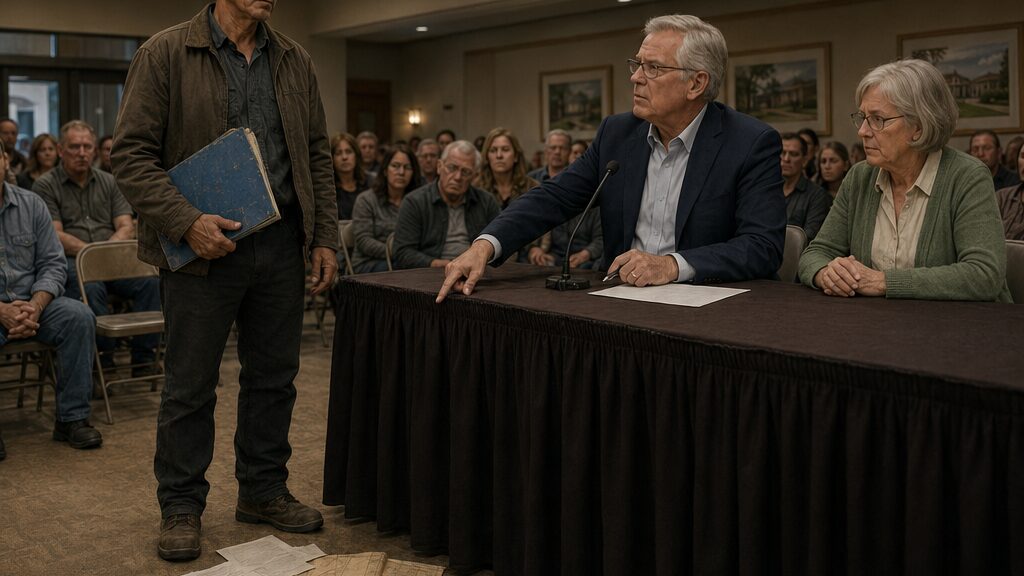
They Silenced the Renter at the HOA Meeting Until His Old Survey Folder Reopened the Land Beneath Them
Chapter 1: The Renter Whose Papers Covered the Meeting Room Floor
“Pick those up on your way out.”
Charles King pointed toward the papers scattered across the clubhouse floor as though Raymond Martinez had thrown them there himself.
Raymond remained beside the folding table, one hand still half raised from trying to catch his weathered blue folder. A late-fee notice lay beneath a chair. The parking warning had slid near the baseboard. An older plat, yellowed at the folds, protruded from beneath a woman’s shoe.
Forty residents watched from rows of metal chairs.
Charles leaned back behind the board table. The small folding microphone sat inches from his hand.
“This is an owners’ meeting,” he said. “Renters may observe. They do not interrupt board business.”
A few people lowered their eyes. Someone near the rear gave a brief, uncomfortable laugh.
Raymond crouched and collected the first sheet.
He had come prepared to ask three questions. The first concerned a two-hundred-dollar late fee attached to an assessment he had never received. The second concerned an eight-hundred-dollar violation for storing construction equipment on the property, although the photographed equipment belonged to a contractor working two buildings away. The third concerned a warning that his assigned parking space would be revoked if the fines remained unpaid.
He had expected resistance.
He had not expected Charles to sweep the folder from the edge of the table with one impatient hand.
Barbara Wilson, the board secretary, shifted in her chair. “Charles, perhaps we should let him finish.”
“The agenda is already twenty minutes behind,” Charles said. “We have insurance renewals, delinquent accounts, and a roof reserve that is underfunded by nearly sixty thousand dollars.”
He looked toward Raymond.
“And we have one renter who believes every notice requires a public hearing.”
Raymond retrieved the parking warning. “I asked who approved the assessment.”
“It was approved.”
“By the board?”
“By the association.”
“That is not the same answer.”
Charles’s expression tightened. “This is exactly the problem. You do not understand the distinction between living here and owning here.”
Raymond placed two papers inside the folder. He kept his movements slow because anger had already begun to gather behind his ribs, and he knew what anger did to a room like this. It made the quiet person look unstable. It made the loud person look necessary.
“My lease assigns me Space Eighteen,” he said. “The violation photograph is not my building, and the assessment does not appear in the meeting minutes posted to residents.”
“You are not entitled to litigate board procedure from the floor.”
“I am asking who authorized the charges.”
“I did.”
The answer came too quickly.
Barbara looked toward Charles. The board treasurer stopped turning a pen between his fingers.
Raymond stood. One sheet remained on the floor: a blank authorization page he had brought in case no one would accept responsibility.
Charles folded his arms. “Now you have your answer. Pay the balance, comply with the parking directive, and take future concerns through your landlord.”
A resident in the front row said, “What if the photo is wrong?”
Charles did not look at her. “Then the management company will review it through the proper channel.”
“I did use the proper channel,” Raymond said. “Twice.”
“And now you are disrupting a meeting.”
Charles reached for the microphone and pushed the switch down. The small green light went dark, though Raymond had never been allowed to use it.
“The board has been lenient,” Charles continued. “That ends tonight. If the account remains unpaid, the assigned parking privilege will be withdrawn at the end of the week.”
Raymond felt the room change. The fines were no longer numbers printed on white paper. Without the parking space, he would have to leave his truck on a county road beyond the rear gate. His knees no longer tolerated the climb well, especially carrying the drafting cases he sometimes repaired for a local engineering office.
Charles mistook his silence for surrender.
“Pay,” he said, “or discuss moving with your landlord.”
Raymond bent, picked up the final sheet, and laid it flat in front of Charles.
“Fine.”
Charles blinked. “Fine?”
“I will pay the disputed amount under protest.”
Barbara turned toward him. “Mr. Martinez, you do not need to decide that tonight.”
“Yes, I do.”
Raymond opened the blue folder and removed the three notices. He arranged them in a line beside the blank page.
“I want the decision in writing,” he said. “The charges, the parking revocation, and the name of the person authorizing them.”
Charles gave a short laugh. “You want me to write down that I told you to pay your bill?”
“I want you to sign what you just said.”
“Why?”
“So there is no misunderstanding later.”
The answer pleased Charles. Raymond could see it in the way his shoulders settled. A signed page would end the discussion. It would show the room that the board president had reduced a challenge to paperwork.
Charles pulled the authorization sheet toward him.
Barbara leaned close. “We should have counsel review any statement concerning parking rights.”
“This is administrative,” Charles said.
He wrote in firm block letters. He listed the late fee, the violation fine, and the withdrawal of Space Eighteen. Beneath them, he added that the actions were authorized under the president’s enforcement authority pending formal board ratification.
Raymond noticed that phrase.
Pending formal board ratification.
Charles signed his name with a sharp final stroke. Then he lifted the page so the room could see it.
“There,” he said. “Official enough for you?”
Raymond took the paper without answering.
Charles slid the microphone closer to himself again. “Now collect the rest of your documents and allow the owners to continue.”
Raymond placed the authorization inside the blue folder. He tucked the notices behind it, then reached for the old plat whose corner had remained visible beneath the front-row chair.
The woman moved her foot.
“Sorry,” she whispered.
Raymond unfolded the edge before putting it away. A faded parcel number ran along the lower margin. Most people would have seen only a string of letters and digits.
Raymond saw a slope covered in waist-high grass. He saw wooden stakes with pink ribbon snapping in dry wind. He saw Catherine Miller holding a range pole beside a shallow creek while he called measurements from a transit mounted on uneven ground.
He had written that parcel number hundreds of times twenty-seven years earlier.
It should have disappeared when the developer recorded the final subdivision documents.
Instead, the same number appeared at the bottom of Charles King’s signed authorization.
Raymond closed the folder carefully.
For the first time that evening, he looked past Charles, through the clubhouse windows, toward the dark parking lot and the low retaining wall beyond it.
The wall, the spaces, the clubhouse itself—all of it sat inside the boundary described by that old number.
And Raymond could no longer remember seeing the release that was supposed to have removed his name from it.
Chapter 2: The Four-Hundred-Dollar Price of Asking One Question
A silver sedan occupied Space Eighteen when Raymond returned from work Thursday afternoon.
The temporary parking placard bearing his unit number was gone from the post. In its place, a white sticker read BOARD ASSIGNMENT in heavy black type.
Raymond stopped his truck in the lane and stared at it until a car behind him tapped its horn.
He pulled forward and parked beyond the rear gate, where the pavement narrowed beside the county road. The walk back took nine minutes. By the time he reached his building, the handle of his drafting case had carved a red line across his palm.
A sealed envelope waited beneath his door.
The association logo appeared in the upper-left corner. His name had been typed without a unit designation, as if whoever prepared it had wanted the envelope delivered personally rather than processed through the management company.
Inside was a one-page invoice.
Records Research and Administrative Response: $400.
The description stated that the charge covered staff time spent answering his procedural questions, locating minutes, and preparing the written authorization he had requested.
At the bottom, beneath the payment deadline, was one sentence:
Continued interference with association operations may result in additional administrative remedies.
Raymond read it twice.
Then he opened the blue folder and placed the new invoice behind Charles’s signed page.
He could have called immediately. He could have gone to the clubhouse, where Charles often spent late afternoons speaking with the property manager. He imagined laying the invoice on the table and asking whether four hundred dollars was now the price of one question.
Instead, Raymond made coffee and took out the previous year’s meeting packets.
He kept every notice. It was a habit that had outlived his surveying career, his business partnership, and two apartments. Documents stayed where people did not. A date remained a date even after someone changed the reason for it.
He reviewed the posted minutes month by month.
The special assessment appeared in a treasurer’s report but nowhere as a motion. The violation policy had been discussed but not amended. The records fee did not appear at all.
At six thirty, someone knocked.
Barbara Wilson stood outside holding a covered casserole dish she clearly did not expect him to accept.
“I made too much,” she said.
Raymond looked at the dish, then at her.
“You came to discuss the meeting.”
Barbara exhaled. “May I come in?”
He stepped aside.
She placed the casserole on the kitchen counter and kept her purse over one shoulder. Her eyes went directly to the blue folder on the table.
“I did not agree with the way Charles handled that,” she said.
“But you recorded it.”
“I record what happens.”
“Did the board vote on a records fee?”
Barbara’s fingers tightened around the purse strap.
“That is not a simple question.”
“It is a yes-or-no question.”
“The management contract allows recovery of extraordinary administrative expenses.”
“Did the board vote?”
“No.”
The word seemed to cost her.
Raymond slid the invoice across the table.
Barbara read the amount and shook her head. “I have never seen this charge before.”
“Who created it?”
“I do not know.”
“You are the secretary.”
“I prepare minutes. I do not approve every communication the manager sends.”
“The manager did not sign it.”
There was no signature at all.
Barbara lowered herself into a chair. “Charles has been under pressure. The insurance carrier nearly doubled the master-policy premium. Eleven units are behind on assessments. Owners come to meetings demanding lower dues and then accuse the board of negligence when something breaks.”
“That explains a roof reserve,” Raymond said. “It does not explain charging me four hundred dollars for asking where a fee came from.”
“No. It does not.”
He waited.
Barbara looked toward the window. From there, Space Eighteen was visible between two trees. The silver sedan remained parked beneath the new placard.
“Charles sent a community message this afternoon,” she said.
Raymond opened his phone.
The email sat unread in a folder where association notices were automatically filtered. Its subject line was Maintaining Order and Respectful Participation.
Charles described an unnamed renter who had disrupted the meeting, scattered documents, refused established channels, and attempted to intimidate volunteers with technical demands. He reminded owners that guests and tenants possessed no voting rights and asked residents not to encourage confrontational behavior.
Raymond read the message without moving.
“He made it sound as if I threw the folder,” he said.
“I know.”
“Will you correct him?”
Barbara looked down.
“I asked whether we should issue a clarification. He said that would inflame things.”
“He already inflamed them.”
“I have lived here eighteen years. These people are my neighbors.”
“So am I.”
Her expression changed, but she did not answer.
Raymond closed the email. He understood then that Barbara’s visit was not courage. Not yet. It was discomfort seeking relief in private.
He returned to the table and opened the folder.
The old plat rested beneath the recent notices. Its paper had softened along the folds, and one corner was reinforced with clear tape that had yellowed years ago. He spread it beside Charles’s authorization.
The parcel numbers matched.
Along the left margin, in faded type, was a reference he had not noticed at the meeting:
Subject to Surveyor Consent Covenant, Instrument 94-11738.
Raymond’s hand stopped.
He remembered the number now.
Not the full document, but the argument surrounding it.
The original developer had needed access across an adjoining strip while financing was being rearranged. Raymond and Catherine had agreed to hold certain survey certifications and common-land approvals in escrow until their final invoice was paid. A consent covenant had been recorded as temporary protection.
The development failed. Another company acquired the project. Raymond’s firm dissolved soon afterward.
There should have been a release.
He searched the folder, finding old field sheets, a photocopied invoice, and correspondence he had not opened in years. No release appeared.
Barbara watched him. “What is it?”
“An old recording reference.”
“Does it concern the association?”
“It concerns the parcel.”
Her eyes shifted toward the folder.
Raymond closed it before she could see more.
The action was instinctive and immediate.
Barbara noticed.
“You knew something about this property before the meeting,” she said.
“I knew the parcel number.”
“That is not what I asked.”
Raymond stood and carried the empty coffee cup to the sink. “You should go.”
“Raymond—”
“You came because you wanted me to know you disagreed privately. Now you know.”
Barbara rose slowly. At the door, she paused.
“If Charles acted without a vote, I will not certify that he had one.”
It was not a promise to speak publicly. It was narrower than that.
For the moment, it was enough.
After she left, Raymond took the old plat from the blue folder again. He copied the instrument number onto a yellow notepad and searched the county recorder’s online index.
The system showed an entry from 1994, then a later attempted filing from 1997.
Status: Rejected.
Reason: Incomplete acknowledgment.
Raymond stared at the screen.
The rejected filing listed two required parties.
Catherine Miller.
Raymond Martinez.
He closed the laptop and sat in the dim kitchen with the plat before him.
At eight the next morning, the county recorder’s office would open.
For the first time since the meeting, Raymond stopped thinking about what Charles had done.
He began wondering what he himself had failed to finish.
Chapter 3: The Covenant Recorded Beneath the Clubhouse Foundation
“There is no release recorded under that instrument number.”
Sarah Lewis said it without drama, her eyes moving between the county database and the photocopy Raymond had placed beneath the glass partition.
Raymond stood at the public counter with the blue folder tucked under one arm. Behind Sarah, shelves held oversized index books and rolled plats in cardboard sleeves. A printer clicked steadily somewhere beyond the records room.
“Check the rejected filings,” he said.
“I already did.”
She turned the monitor slightly, though the screen remained too far away for him to read comfortably.
“One submission in 1997. Rejected for an incomplete acknowledgment. Nothing corrected afterward.”
“So the covenant remains.”
“The document remains recorded.”
“That means it remains enforceable.”
Sarah looked at him over the rim of her glasses. “Those are not the same sentence.”
Raymond disliked her immediately for being precise in the way he had once been precise with clients.
He opened the folder and removed the old plat. “The covenant is tied to this parcel.”
Sarah accepted the paper and carried it to a wider table. She unfolded it carefully, smoothing each crease with the side of her hand.
“Where did you get this?”
“I prepared the original boundary work.”
Her eyes moved to the surveyor’s certification block. Raymond’s name appeared beside Catherine Miller’s beneath the name of their former firm.
“You are that Raymond Martinez.”
“I am.”
Sarah looked from the plat to his worn work jacket. “And you live there now?”
“I rent Unit 214.”
She said nothing for a moment.
Then she returned to the computer and searched by legal description rather than instrument number. Raymond watched lines appear on the screen: subdivision map, access easement, utility dedication, amended declaration, transfer of common elements.
Sarah printed a page and marked three entries with a pencil.
“The original covenant was not broad ownership,” she said. “It did not give your firm title to the land.”
“I know what it did.”
“Do you?”
Her question landed harder than Charles’s ridicule because it held no contempt.
Sarah pointed to the printed abstract.
“It appears to require consent from the named surveying parties before material alterations to access lanes, parking boundaries, and certain common-area grades. The purpose was likely to protect unfinished survey obligations while the development transferred.”
“The board changed the parking plan.”
“That may be relevant.”
“They moved the rear access gate two years ago.”
“That may also be relevant.”
“They assessed owners for drainage work along the clubhouse foundation.”
Sarah lifted a hand. “You are moving faster than the record.”
Raymond’s frustration rose. “My parking space was revoked yesterday under authority tied to this parcel.”
“And that may give you a legitimate issue to raise with an attorney.”
“I do not need an attorney to read a covenant.”
“You may need one to understand whether later declarations superseded it, whether the rights were assignable, whether they expired by performance, or whether a court would treat them as abandoned.”
The words cut through the clean victory he had imagined on the drive downtown.
He had pictured returning to the clubhouse with a certified copy and watching Charles’s certainty disappear. He had pictured a single document reversing every fee, every parking decision, every insult.
Sarah saw the change in his face.
“You are not the secret owner of the condominium,” she said.
“I never said I was.”
“You were thinking something close to it.”
Raymond looked away.
A county counter clerk passed behind them carrying a stack of deed books. The printer clicked again.
Sarah softened her tone. “The document matters. That is not the same as saying it controls everything.”
“What does it control?”
“On its face, it creates a consent requirement tied to specified land changes. If no valid release exists, someone should determine why the association’s title review did not address it.”
Raymond tapped the authorization Charles had signed. “This parking revocation was issued personally by the board president.”
Sarah read it. Her eyebrows rose at the phrase pending formal board ratification.
“This is not a recorded instrument,” she said.
“It connects his action to the parcel.”
“It connects his name to the decision. That may matter procedurally. The covenant is a separate issue.”
“Together they show he acted without authority.”
“They show questions.”
Raymond almost laughed. “I was charged four hundred dollars for asking questions.”
Sarah held out her hand. “Let me see the invoice.”
He gave it to her.
She read the description, then returned it without comment. County employees learned not to make faces at private disputes, but her silence conveyed enough.
“What can you certify?” Raymond asked.
“That Instrument 94-11738 remains in the public record. That the 1997 release attempt was rejected. That no later release appears under the names or legal description we have searched.”
“And the consent language?”
“I can provide a certified copy. I cannot certify your interpretation.”
It was less than Raymond wanted.
It was also more than Charles expected him to possess.
Sarah requested the original plat book from storage. While they waited, she asked him to explain how the covenant had been created.
Raymond gave her the narrow version.
The developer had run short of money. His surveying firm had completed the boundary, grading verification, and initial common-land staking. The temporary covenant protected their unpaid work during a proposed transfer. Another company eventually finished the condominiums.
“And then?” Sarah asked.
“The project moved on.”
“That is not what the record says.”
“The firm closed.”
“Still not what I asked.”
Raymond’s jaw tightened.
Sarah returned to the rejected release entry. “Two acknowledgments were required. Catherine Miller’s appears notarized. Yours does not.”
“Then the filing was incomplete.”
“Why?”
“I would need to see it.”
She disappeared into the back room.
Raymond stood alone at the counter. Through the tall windows, he could see the county parking deck and a strip of pale sky. His truck sat below, dusty and slightly crooked in a public space that required no board approval.
Sarah returned carrying a gray archival sleeve.
Inside was the rejected release packet.
Catherine’s signature appeared on the second page, dated June 18, 1997. A notary seal pressed through the paper.
Raymond’s signature line was blank.
Attached correspondence showed that the acquiring developer had offered a reduced payment to settle the final invoice and clear the covenant. Catherine had accepted on behalf of her portion.
Raymond had written three words beside the amount in blue ink.
Not acceptable. R.M.
He remembered the room where he had written them.
A borrowed office. Two metal desks. Catherine standing by a window while rainwater crawled down the glass. The final invoice had represented months of fieldwork, fuel, equipment rental, and wages they had already paid from their own accounts. The settlement offered less than half.
Catherine had said something to him that day.
Take the loss before it takes the company.
He had refused.
The company closed anyway.
Sarah placed another page beside the packet. “There is also a handwritten notation from the filing clerk. The release could not be accepted without your acknowledgment or a court order.”
Raymond read it.
No corrected release received.
For years he had told himself the developer abandoned the paperwork. That the failure belonged to people with deeper pockets and better attorneys. He had not lied exactly.
He had simply stopped the memory before reaching his own blank signature line.
“Does Catherine still have an interest?” he asked.
“Her name remains in the covenant, but she signed the attempted release. Clarifying the present record may still require her participation, depending on what counsel determines.”
“So I need her.”
“You may need both of you.”
Sarah began assembling the certified-copy request.
Raymond slipped the rejected packet back into the archival sleeve. The blue folder felt heavier under his hand than it had when he entered.
Charles had acted recklessly. The records fee had not been voted on. The parking revocation carried Charles’s personal signature. None of that had changed.
But the old covenant was no longer a clean weapon.
It was a door Raymond himself had left half closed.
Sarah pushed the certification form across the counter.
Before Raymond signed, she placed one final photocopy beside it.
At the bottom of the rejected release, beneath Catherine’s completed acknowledgment, his own name appeared above an empty line.
“You should speak with her before you threaten anyone with this,” Sarah said.
Raymond stared at the blank space.
Catherine had signed twenty-nine years ago.
He had not.
And if she remembered the day as clearly as he suddenly did, she would not let him tell the story as though Charles King were the first man to use silence as leverage.
Chapter 4: The Former Partner Who Would Not Protect Raymond’s Version
“I knew that board would eventually find you.”
Catherine Miller did not invite Raymond farther into the office. She stood behind a scarred drafting table with one hand resting on a rolled highway plan, studying the blue folder beneath his arm.
The office was smaller than the one they had shared years ago. Two computer monitors occupied one wall. Survey stakes leaned in a plastic barrel near the door. The air held the familiar dry smell of paper, dust, and printer toner.
Raymond closed the door behind him. “The county found the covenant.”
“I assumed they would.”
“There is no release.”
“I know.”
Her answer stopped him more effectively than an accusation.
Catherine pulled out a stool and sat. Her silver hair was cut shorter than he remembered, but she still wore a field pencil behind her right ear.
“You checked?” he asked.
“Years ago.”
“When?”
“When the second management company called me about a title exception. I told them I had signed everything sent to me.”
“They never contacted me.”
“They said they had.”
Raymond placed the folder on the drafting table. Its spine, split long ago, was held together with two strips of blue cloth tape.
Catherine touched one strip with her fingertip. “You still repair things instead of replacing them.”
“It works.”
“That was always your standard.”
He removed the certified copies Sarah had prepared. Catherine did not reach for them.
“The HOA president personally authorized fines and took my parking space,” Raymond said. “He issued a four-hundred-dollar fee for requesting records. The covenant may require our consent for the parking changes.”
“Our consent?”
“Our names are recorded.”
“My acknowledgment is in the rejected packet.”
“The release was never accepted.”
“Because you did not sign it.”
Raymond kept his eyes on the documents. “The settlement did not cover what we were owed.”
“No. It did not.”
“The developer expected us to accept less than half after we had carried payroll for months.”
“I remember the invoice.”
“Then you remember why I refused.”
Catherine leaned back. “I remember why you said you refused.”
He looked at her.
She removed the pencil from behind her ear and placed it parallel to the table’s edge.
“The company was already finished, Raymond. Our equipment note was overdue. The landlord had changed the locks once. That settlement would not have saved the firm, but it would have paid the crew we still owed.”
“It would have erased the rest.”
“It would have closed the project.”
“It would have told them they could use our work and decide afterward what it was worth.”
Catherine’s expression tightened. “You wanted the full invoice acknowledged.”
“We earned it.”
“You wanted your name attached to the refusal.”
“That is not the same thing.”
“It was by then.”
Raymond opened the folder and took out the old unpaid invoice. He had kept the original beneath a translucent cover. The total at the bottom looked larger than he remembered, perhaps because he now understood how little of it could ever be recovered.
Catherine glanced at it.
“You wrote ‘not acceptable’ on the offer,” she said. “Then you told me not to sign anything else.”
“I did not stop you.”
“No. You only made it clear that signing meant I was abandoning the partnership.”
The room seemed to narrow around the drafting table.
Raymond remembered the rain on the borrowed-office window. Catherine standing with her coat buttoned, ready to leave. He had remembered her impatience. He had not remembered the way she held the release in both hands before signing.
“I thought you were giving them what they wanted,” he said.
“I was trying to keep two field technicians from losing a month of wages.”
“We paid them.”
“After I borrowed against my house.”
Raymond looked up sharply.
Catherine gave a small, humorless smile. “There are parts of that year you never asked about.”
He had assumed her family helped. He had assumed many things because asking would have required hearing answers he could not control.
“The covenant protected our claim,” he said.
“For a while. Then it became debris no one cleared because every new owner assumed someone else had handled it.”
“It may still protect residents from unauthorized changes.”
“It may. That does not make your reason for leaving it open noble.”
Raymond pressed his palm against the folder’s taped spine.
Catherine finally examined the county copies. She read the legal description, the consent language, and Charles’s signed authorization. Her attention sharpened at the phrase pending formal board ratification.
“This man should not have signed this alone,” she said.
“So you will help?”
“I did not say that.”
“The board is using rules it did not properly adopt.”
“And you are using a record you knew was unresolved.”
“I had not looked at it in twenty-nine years.”
“You moved into the development.”
“Because the rent was affordable.”
“You recognized the name.”
“I recognized the property.”
“And said nothing.”
Raymond closed the folder. “There was nothing to say until they tied enforcement to the old parcel.”
“There was something to say when you signed the lease.”
“To whom? My landlord? The property manager? That I once surveyed the hill before any of these buildings existed?”
“That the county record still carried your name.”
“I did not know for certain.”
Catherine held his gaze. “You knew enough to hide the plat from Barbara when she asked.”
He had not told her about Barbara.
His face must have shown it.
Catherine turned one of the certified pages toward him. A sticky note had been attached to the copy at the recorder’s office.
Contacted by HOA counsel regarding recorded parties.
“Sarah called you?” he asked.
“No. The association attorney did.”
“When?”
“This morning.”
Charles had moved faster than Raymond expected.
“What did you tell them?”
“That I signed the attempted release and that you did not.”
“Anything else?”
“That the original invoice was disputed.”
Raymond felt the first clean edge of fear.
“They will say I kept a financial interest hidden.”
“You did keep it hidden.”
“The covenant is not a lien for the invoice.”
“No, but most residents will not understand the difference when Charles explains it.”
Raymond pictured the community email: a renter with a secret claim, disrupting meetings to pressure owners. Charles would not need to prove corruption. He would only need to make Raymond’s silence look calculated.
Catherine returned the papers to the folder.
“You came here wanting me to confirm your version,” she said.
“I came because the record may require your signature.”
“It may.”
“Will you sign a clarification?”
“After an attorney drafts one that protects the residents and closes the old matter properly.”
“Charles could revoke the charges before then.”
“That is your current dispute. Do not mix it with our old one unless you are willing to explain both.”
Raymond walked to the window. The office overlooked a storage yard lined with stakes and orange cones. A young survey crew loaded a tripod into a truck without speaking. Their movements were practiced, each person anticipating the next.
He and Catherine had once worked that way.
“What do you want me to say?” he asked.
“The truth.”
“I have not lied.”
Catherine’s voice softened. “You have been arranging facts in the order that hurts you least.”
His phone vibrated.
An association email appeared on the screen before he could silence it.
Important Disclosure Regarding Resident Conduct.
Charles had named him.
The message stated that Raymond Martinez possessed an undisclosed financial interest connected to an old development dispute and had attempted to use that interest to challenge legitimate community obligations. Owners were advised that the board was consulting counsel regarding possible interference with association property.
Raymond read it twice.
Beneath the message, comments from residents had already begun appearing on the community portal.
One asked whether Raymond had rented the unit under false pretenses.
Another asked if he could claim their parking spaces.
A third demanded that the board remove him from future meetings.
Catherine watched his face.
“He found enough,” she said.
Raymond lowered the phone. “He is making it sound as if I planned this.”
“Did you?”
“No.”
“Then tell them what you did plan.”
He looked toward the old invoice lying inside the open folder.
Catherine slid the county copies back to him but kept one hand on the folder.
“I will help clarify the covenant,” she said. “I will not help you pretend your signature line was blank by accident.”
Raymond’s fingers tightened around the cover.
“What exactly are you asking?”
“At the next owners’ meeting, before you accuse Charles of hiding anything, tell them why the release failed. Tell them what you refused. Tell them what it cost.”
“And if that destroys my credibility?”
“Then you will know whether you wanted justice or only leverage.”
She released the folder.
Raymond carried it to the door.
Behind him, Catherine unrolled the highway plan and returned the pencil to her ear.
“I will sign,” she said, “only after you stop asking everyone else to be public about the things you keep private.”
Chapter 5: The Private Offer Made After the Public Accusation
Charles called at 9:17 Sunday night.
Raymond knew the number only because the association president had printed it beneath every warning sent during the past year. He let the phone ring four times before answering.
“Raymond,” Charles said.
There was no microphone in his voice now. No room of seated owners. No careful projection toward the back row.
“What do you want?”
“I think this situation has moved beyond what either of us intended.”
“You sent my name and private history to the entire community.”
“I corrected an omission.”
“You accused me of hiding a financial interest.”
“You did hide it.”
Raymond looked at the blue folder on his kitchen table. Catherine’s condition sat inside it more heavily than the certified documents.
Charles continued before he could answer.
“I am prepared to reverse the late fee, the violation charge, the administrative fee, and the parking reassignment.”
“All of it?”
“In writing.”
“That is different from Thursday.”
“We have more information now.”
“You mean you know the covenant was never released.”
A pause.
“The board has been advised that the record requires clarification.”
“By whom?”
“Our attorney.”
“When were you advised?”
“That is privileged.”
“Before or after you took my parking space?”
Another pause, longer this time.
Charles exhaled. “This does not need to become a public spectacle.”
“It became public when you knocked my folder onto the floor.”
“I did not knock it.”
“You swept it off the table.”
“I moved it because you refused to follow procedure.”
Raymond nearly ended the call. Then he heard something beneath Charles’s defensiveness—a faint strain, as if he were reading from notes he no longer trusted.
“What is the condition?” Raymond asked.
“A mutual resolution. The charges disappear. Your parking assignment is restored. You agree that the covenant does not give you authority over association operations, and both parties keep the terms confidential.”
A document arrived in Raymond’s email while Charles spoke.
The subject line read Settlement Communication.
Raymond opened it on his laptop. The proposed agreement was four pages long. The first page contained everything Charles had promised. The second required Raymond to release all claims related to prior parking, access, grading, assessment, and common-area changes. The third prohibited him from discussing the dispute with residents.
“You want me to sign away questions no one has answered.”
“We need certainty.”
“You want silence.”
“I want to prevent panic.”
Raymond scrolled to the final page. “Whose panic?”
“Do you know what happens if residents believe four years of board decisions may be challenged? They stop paying. They demand refunds. They hire attorneys. The master insurer asks whether access and drainage improvements were properly authorized.”
“Were they?”
“We acted on professional advice.”
“Then why are you calling me on Sunday night?”
Charles did not answer immediately.
When he did, the anger had drained from his voice.
“The building’s insurance premium rose eighty-seven percent this year. The roof reserve is short. Eleven owners are delinquent. Three are on fixed incomes and already choosing which bills to delay. If this turns into litigation, there will be a special assessment.”
“That does not justify inventing fees.”
“No.”
The admission was so quiet Raymond almost missed it.
Charles continued. “But leadership is not performed in a vacuum. Every correction has a cost.”
“So you chose the cost I could bear.”
“I believed you were refusing ordinary enforcement because you were a tenant who did not understand the process.”
“You never asked what I understood.”
“You did not tell us.”
There it was—the same truth Catherine had placed before him.
Raymond looked at the confidentiality agreement beside the closed folder. For several seconds, neither man spoke.
“Put the reversals on the agenda,” Raymond said.
“I cannot do that before we resolve the covenant.”
“Then there is no agreement.”
“Raymond, be practical.”
“I was practical twenty-nine years ago. I kept the document that protected our unpaid work.”
“And left everyone after you to untangle it.”
Charles’s accuracy angered him more than the insult had.
“You do not get to use my mistake to hide yours,” Raymond said.
“No. But neither do you.”
The call ended without goodbye.
Ten minutes later, Raymond’s landlord called.
The landlord’s voice was apologetic and hurried. He had received a message from the property manager concerning a dispute that might affect the unit.
“I do not care about board politics,” he said. “You pay on time. You keep the place in good shape. But if the association starts billing legal costs to my account, I cannot absorb that.”
“They cannot fine you because I requested records.”
“They can make my life expensive without calling it a fine.”
Raymond rubbed his forehead.
“The charges will be reversed if I sign a settlement.”
“Then sign it.”
“It releases broader claims.”
“Claims you did not know you had last week.”
“That does not make them meaningless.”
The landlord was silent.
“My lease renews in six weeks,” Raymond said.
“I know.”
The two words carried the consequence without stating it.
After the call, Raymond printed the settlement. He placed it beside the blue folder rather than inside. The pages looked clean, temporary, designed to disappear once signed.
He imagined accepting.
Space Eighteen restored. The fees removed. His landlord relieved. Charles able to tell the board that the matter had been resolved responsibly.
Raymond could keep the covenant’s history private. Catherine would not need to return. Residents would never hear that he had once refused a settlement and helped leave the title problem unresolved.
It would be victory in every way visible from his apartment window.
He left the agreement unsigned.
At eight the next morning, he walked to the clubhouse carrying the blue folder. The property manager had called a special board session for Tuesday evening. A notice near the entrance stated that resident conduct and recorded-property matters would be discussed in executive session before the open meeting.
Charles stood in the corridor speaking to the board treasurer.
When he saw Raymond, he dismissed the treasurer with a nod.
“You have until noon,” Charles said.
“For what?”
“The settlement.”
“I already answered.”
“Then understand what happens next. Counsel will explain that your covenant is not ownership. Residents will hear that you withheld the release. Your landlord will hear that your actions may increase his assessments.”
“That sounds less like procedure than the threats you accuse me of making.”
Charles’s jaw shifted. “I am trying to contain damage.”
“To the association?”
“To people who live here.”
“And to your position.”
Charles looked toward the closed meeting-room door.
“When I took over, this place had unpaid bills in drawers,” he said. “The former president approved favors for friends. Parking spaces changed hands without records. Contractors were hired because someone knew someone. I spent three years making every rule apply to everyone.”
“You made a rule that renters cannot speak.”
“I enforced the bylaws.”
“You enforced the version that protected you.”
Charles stepped closer. “Do you think resignation fixes the roof? Do you think humiliating me refunds anyone’s insurance premium?”
Raymond studied him.
For the first time, he understood that Charles was not afraid only of exposure. He was afraid that the disorder he had spent years containing would return and be blamed on him.
That fear did not excuse what he had done.
But it changed the shape of the fight.
“I do not want to humiliate you,” Raymond said.
Charles gave a tired laugh. “You brought certified records to my hallway.”
“I want every charge reversed publicly. I want the board to review the decisions affected by the covenant. And I want the residents told that the records fee was never approved.”
“In exchange for what?”
“The whole truth.”
Charles’s eyes narrowed. “Whose?”
“Mine first.”
Raymond left before the answer could become another negotiation.
He found Barbara waiting outside his apartment after lunch.
She held no casserole dish this time. A manila envelope was pressed beneath her arm.
“I should not have these,” she said.
Raymond unlocked his door.
Inside, Barbara laid two versions of the previous board minutes on the table. One was marked Draft One. The other was the version distributed to owners.
A paragraph in the first draft summarized advice from the association attorney regarding the old covenant. It warned that parking reconfiguration, rear-gate relocation, and drainage work might require review before further enforcement action.
In the distributed version, the paragraph was gone.
Raymond checked the dates.
The attorney’s warning had been given six weeks before Charles signed the fines and revoked Space Eighteen.
“Who removed it?” he asked.
Barbara pointed to a handwritten instruction in the margin of the first draft.
Delete until counsel resolves. C.K.
“He told me it belonged in executive-session notes,” she said. “I believed him.”
“Did counsel resolve it?”
“Not that I can find.”
Raymond looked at the initialed instruction.
Barbara’s voice dropped. “There are other changes. References to objections were shortened. A treasurer’s concern about enforcement authority was removed entirely.”
“Why bring this now?”
“Because silence stopped being neutral.”
Raymond placed the two versions beside the unsigned settlement.
The blue folder remained closed between them.
Charles had not merely misunderstood the covenant after the meeting. He had known enough to pause—and had chosen to punish Raymond instead.
Barbara pressed her hands together.
“If I put the correction on the agenda, Charles will know I gave these to you.”
“Yes.”
“I may lose every friend I have on that board.”
Raymond thought of Catherine signing the release alone. Of his landlord’s renewal decision. Of the blank line that had protected his pride for twenty-nine years.
“Then do not do it for me,” he said. “Do it because your name is on the minutes.”
Barbara stared at the altered pages.
After a moment, she picked up her phone and opened the agenda file.
The microphone item was not listed. Neither was public comment from Raymond.
Barbara added both.
Then she scheduled the revised agenda for immediate delivery to every owner.
Chapter 6: The Meeting Where Both Men Lost Their Safest Lies
The microphone was gone from Raymond’s side of the room.
The folding table where residents usually addressed the board stood empty except for a plastic cup of water. Its cable had been coiled and placed behind Charles’s chair.
Raymond noticed before he noticed the crowd.
Every metal seat was occupied. More residents stood along the walls. Some held printed copies of Charles’s community email. Others carried the revised agenda Barbara had sent less than twenty-four hours earlier.
Charles sat at the center of the board table with the association attorney on one side and the treasurer on the other.
Barbara’s chair was empty.
At seven precisely, she entered carrying the folding microphone.
Conversation stopped.
She set it on the resident table, uncoiled the cable, and connected it to the floor outlet. The green light came on beneath her thumb.
Charles’s face did not change, but the hand holding his pen became still.
“This meeting will come to order,” he said.
He moved through the opening formalities quickly. When he reached the recorded-property matter, he read from a prepared statement.
“The association has learned that a tenant residing in Unit 214 possesses an unresolved interest arising from a decades-old commercial dispute. That tenant failed to disclose the interest while challenging ordinary enforcement measures.”
Raymond remained seated with the blue folder across his knees.
Charles continued. “Counsel has advised that this document does not confer ownership or unilateral control over association property.”
A murmur moved through the room.
That much was true.
Charles looked directly at Raymond. “Before residents are misled, the board believes they should understand that Mr. Martinez refused to complete a release after a prior developer offered settlement.”
Several heads turned.
Raymond felt the old instinct rise—the urge to wait, to let Charles make every accusation, then answer only what could be disproved.
The folder offered that kind of safety. Dates. signatures. certified copies. Facts arranged in his preferred order.
Barbara walked to the resident table and touched the microphone.
“Mr. Martinez is listed for public comment.”
Charles said, “Tenants do not possess speaking rights under the bylaws.”
“The agenda was distributed to all owners,” Barbara replied. “Removing the item now requires a board vote.”
The treasurer looked down.
No one made a motion.
Raymond carried the folder to the microphone.
As he opened it, the room became so quiet that the tearing sound from the repaired spine seemed unnaturally loud.
He removed the documents one by one and placed them across the table in chronological order.
The original invoice.
The 1994 covenant.
The 1997 settlement offer.
Catherine’s signed acknowledgment.
His blank signature line.
He spoke before Charles could interrupt.
“The board president is correct about one thing. I refused the release.”
The room shifted.
Charles’s prepared statement lowered by an inch.
Raymond placed the old invoice beside the rejected packet.
“My surveying partner and I completed work for the original development. We were not fully paid. A reduced settlement was offered. Catherine Miller signed. I did not.”
Someone near the back asked, “Why not?”
“Because I believed accepting less would erase the value of our work.”
“Did it?” another resident asked.
Raymond looked at the invoice.
“No. The firm closed anyway. My partner borrowed against her home to cover wages I believed the settlement would dishonor.”
He had not planned to say that last part. Once spoken, it left him without the version of himself he had preserved for nearly three decades.
“I moved here knowing I had surveyed the property,” he continued. “I did not confirm whether the covenant remained recorded. When I recognized the parcel number at the last meeting, I checked. I should have disclosed that connection before using the document to challenge the board.”
Charles leaned toward his microphone. “Then you admit the association was right to warn residents.”
“I admit my silence made suspicion reasonable.”
The distinction quieted Charles.
Raymond placed the certified county record on the table.
“The covenant does not make me an owner. It does not make me the association’s landlord. It does not cancel every decision made here. It does require review of certain parking, access, and common-land changes if no valid release superseded it.”
The association attorney spoke for the first time. “That is a fair summary of the preliminary issue.”
Charles turned toward him sharply.
The attorney continued. “Its current enforceability remains unresolved.”
“Then there is no basis for accusing the board of invalid action,” Charles said.
“There was a basis to pause enforcement,” Raymond replied.
He removed the two versions of the minutes.
Barbara stood behind him now.
“The association attorney warned the board six weeks before my fines were issued that parking and access actions might require review.”
Charles’s face hardened. “That communication was privileged.”
“The advice may be,” Raymond said. “The fact that a warning existed and was removed from distributed minutes is board procedure.”
Barbara handed copies to the other board members.
The treasurer read the deleted paragraph, then looked at Charles. “I asked that enforcement wait.”
“You asked whether we should wait,” Charles said.
“I made a motion in executive session.”
“No second was recorded.”
“Because you ended the discussion.”
A low wave of conversation spread through the residents.
Charles struck the table once with the flat of his hand. “This is exactly the instability I warned about. People hear the word covenant and assume every assessment is void. The association has insurance obligations, roof obligations, drainage obligations. If owners stop paying while lawyers review twenty-nine years of records, the cost will fall on every household.”
An older resident stood. “Are the assessments void?”
The attorney answered carefully. “No such conclusion has been made. Most prior decisions may remain valid. Specific actions require review.”
“What about refunds?”
“Unknown.”
“What about the gate?”
“Unknown.”
The room became restless, not triumphant. Raymond saw fear replace curiosity. Charles had been right about that much. People were calculating what uncertainty might cost them.
Raymond looked at the documents spread across the table.
He could press harder. He could demand immediate suspension of every disputed action. He could allow residents to turn their fear entirely toward Charles.
Instead, he moved the old invoice aside.
“I am not asking this board to declare every past decision invalid tonight,” he said.
Charles studied him.
Raymond continued. “I am asking for four actions. Reverse the charges issued to me without a recorded vote. Restore Space Eighteen while the parking plan is reviewed. Hire independent counsel to examine decisions affected by the covenant. And prepare a corrected public record showing both the board’s warning and my role in the failed release.”
A resident near the aisle said, “So we pay for another lawyer?”
“Yes,” Raymond said.
The direct answer produced several unhappy voices.
“It is still cheaper than pretending there is no defect,” he added.
Charles stood.
“For three years, I have been asked to enforce rules evenly. Every time I do, someone claims special circumstances. We had unpaid accounts, unrecorded parking favors, contractors working without authorization. I stopped that.”
“You also created a fee to punish a question,” Barbara said.
“The management agreement allowed administrative recovery.”
“Not four hundred dollars without a vote.”
Charles looked around the room. His authority had not vanished. Many residents still understood his fear. Some even nodded when he spoke of unpaid accounts.
That made what followed quieter.
He reached beneath his papers and removed a prepared correction.
“I drafted this as part of the proposed settlement,” he said.
He read the reversals aloud: the late charge, the violation fine, the records fee, and the parking revocation. His voice remained steady until he reached the paragraph acknowledging prior legal notice.
There he stopped.
The attorney leaned toward him. “Charles.”
Charles looked at the deleted minutes, then at Barbara.
“I directed the secretary to remove preliminary counsel concerns from the distributed draft,” he read. “I believed publication before resolution would create confusion and unnecessary financial risk.”
He paused.
“That decision also prevented owners from evaluating whether enforcement should continue. I authorized enforcement to proceed.”
No one applauded.
The absence of applause made the admission feel heavier.
Charles signed the correction and slid it across the table.
Raymond did not pick it up immediately.
Catherine entered from the rear of the room. She had arrived unnoticed during the discussion and now stood beside the wall holding a narrow document envelope.
Raymond met her eyes.
She gave one small nod.
The clarified release could move forward, but only because he had told the part of the truth that did not protect him.
Barbara made the motion for an independent review. The treasurer seconded it. Four board members voted in favor. Charles abstained.
The charges were reversed by separate vote. Space Eighteen was restored pending review.
When the motions ended, Charles remained standing.
He took another sheet from beneath his prepared statement.
This one was not on association letterhead.
“For the stability of the review,” he said, “and because my decisions are now part of what must be examined, I will resign as president effective at the close of this meeting.”
A woman in the front row whispered his name.
Charles signed the page.
Then he placed it beside the correction, exactly where he had dropped Raymond’s authorization after the first meeting.
The folding microphone remained between them, its green light still on.
Chapter 7: What Raymond Removed From the Blue Folder Before Leaving
The notice arrived twelve days after Charles resigned, and the first sentence disappointed almost everyone.
No assessment, fine, parking decision, or common-area project would be automatically canceled.
The independent attorney retained by the association had written the notice in careful language. Prior actions would be reviewed individually. Some might require ratification. Others might require correction, new consent, or no action at all. Owners were warned not to withhold dues while the review continued.
By noon, copies had appeared beneath windshield wipers and beside the clubhouse mailboxes. Two residents argued near the rear gate about whether the association had wasted money hiring another lawyer. Someone had written NOT GOOD ENOUGH across one copy in red ink.
Raymond read his at the kitchen table.
His late fee, violation charge, and records fee had already been removed from his account. Space Eighteen had been restored. The white BOARD ASSIGNMENT sticker was gone, and his unit placard had returned to the post.
He had received what he originally asked for.
It did not feel like winning.
The blue folder lay open beside the notice. Charles’s signed authorization remained near the front, followed by the two versions of the minutes, the certified covenant, and the failed release packet. At the back was the old unpaid invoice.
Raymond had carried that invoice from office to office, apartment to apartment, and finally into the condominium built on the land it described. Its edges had darkened where his fingers repeatedly touched it.
A knock came at the door.
Catherine entered holding the clarified release prepared by independent counsel. Her signature was already notarized.
“You have read it?” Raymond asked.
“Three times.”
“And?”
“It preserves the right to review the disputed changes. It releases the old commercial claim after that review. It does not pretend we own anyone’s parking lot.”
Raymond took the document.
The language was narrower than the covenant and cleaner than the settlement Charles had offered. It acknowledged the unfinished survey obligations, confirmed that Catherine claimed no remaining payment, and established a process for Raymond’s consent to be replaced by an independent technical review.
His signature line waited at the bottom.
Catherine sat across from him. “You could ask for more.”
“I know.”
“You could make them pay the invoice as a condition.”
“The association did not hire us.”
“The land benefited from the work.”
“That was the argument I made twenty-nine years ago.”
“And now?”
Raymond looked toward the window.
Space Eighteen was visible below. His truck sat within the painted lines. Beyond it, the rear gate opened and closed as residents entered with groceries, children, and work bags. None of them knew the details of the grading measurements or the developer’s unpaid balance. They only knew that an old record had become another expense in a building already full of expenses.
“The invoice is not theirs,” he said.
Catherine nodded once, as if she had been waiting years to hear him say it.
Raymond signed the clarified release.
They drove together to the county recorder’s office. Sarah Lewis reviewed the acknowledgments, checked the legal description, and compared the parcel number against the certified copy.
“This will not erase the original covenant,” she said. “It will show how its remaining obligations are to be resolved.”
“That is enough,” Raymond replied.
Sarah stamped the document with the recording date.
The sound was ordinary—a metal mechanism striking paper—but Raymond felt it through the counter.
Catherine watched him slide the receipt into the blue folder.
“Do you still need that thing to prove you mattered?” she asked.
Raymond knew she did not mean the folder.
He opened it and removed the unpaid invoice.
For a moment, he considered putting it back. The invoice was evidence that the work had been done and that someone had failed to honor it. Without it, the old dispute felt less complete.
Then he folded it once along an existing crease and handed it to Catherine.
She did not take it.
“What am I supposed to do with that?”
“Whatever we should have done after the crew was paid.”
Catherine studied his face, then accepted the paper.
“I am not framing it.”
“I was hoping you would shred it.”
She almost smiled. “That costs four hundred dollars in administrative time.”
The laugh that escaped Raymond surprised both of them.
Outside the county building, Catherine tore the invoice into four pieces and dropped them into a recycling bin. She did it without ceremony.
The independent review continued.
The rear-gate relocation was approved after an engineer confirmed that it did not interfere with the original access lane. The clubhouse drainage project required revised documentation but no reconstruction. Three parking changes were suspended until owners received proper notice and the board held a recorded vote.
There were no mass refunds. No one discovered that Raymond controlled the property. The association remained responsible for its roof, insurance, and unpaid accounts.
Some residents thanked him.
Others avoided him.
One owner told him the entire problem could have been handled privately. Another asked whether his challenge would increase next year’s dues. Raymond answered when he knew and admitted when he did not.
Barbara became interim board president because no one else accepted the nomination.
At her first meeting, she read every motion twice before calling for a vote. Residents complained that the process was slow. She told them slow was cheaper than invisible.
Raymond’s landlord renewed his lease for one year. The rent increased modestly, but no legal charges appeared on the account. The landlord signed the renewal in the property manager’s office and said, “I still wish you had taken the settlement.”
“So do I sometimes,” Raymond replied.
That was the most honest answer he could offer.
Charles remained in the condominium.
He no longer occupied the center seat at meetings, but Raymond saw him in the parking lot, collecting mail or carrying groceries from his car. Residents who once stopped him for advice now offered brief greetings and continued walking. Others still sought him out, especially when an insurance question arose.
He had lost authority, not citizenship.
One evening, Raymond entered the clubhouse early for the meeting that would receive the final independent report.
Charles was alone inside.
The board tables had been rearranged into a shallow U. The folding microphone rested on a chair near the wall, its cable wrapped around the base.
Charles picked it up.
For a moment, Raymond thought he intended to speak.
Instead, Charles carried it to the resident table and placed it at the center. He unwrapped the cable, connected it to the floor outlet, and pressed the switch.
The green light came on.
“You could have stayed,” Raymond said.
Charles kept his eyes on the microphone. “Not as president.”
“The review did not find theft.”
“No.”
“It found bad procedure and concealed advice.”
“Yes.”
Raymond waited.
Charles straightened the microphone so it faced the first chair.
“I believed if people saw uncertainty, they would stop trusting the board.”
“They stopped trusting it because you hid the uncertainty.”
“I know that now.”
There was no apology in the words, but there was no defense either.
Charles looked toward the blue folder beneath Raymond’s arm.
“Did you get what you wanted?”
Raymond considered the restored parking space, the reversed charges, the recorded release, and the invoice Catherine had torn apart.
“No,” he said. “I got what could be corrected.”
Charles nodded as though he understood the difference.
Voices approached from the corridor. Barbara entered carrying copies of the report, followed by the treasurer and several residents.
Charles stepped away from the table.
He did not take a seat in the front row. He walked toward the rear of the room, paused beside the door, and looked once at the microphone he had returned.
Then he left.
Raymond sat at the resident table.
He placed the blue folder before him and opened it. The space where the unpaid invoice had rested was empty. He considered filling it with the final report, then closed the folder instead.
Barbara called the meeting to order.
When public comment began, she switched on the microphone and turned it toward Raymond.
He did not need the folder to tell him what to say.
The story has ended.