The HOA Sent a Crew to Tear Down the Only Bridge His Sister Could Cross
Chapter 1: The Machine Was Already Pulling the Post
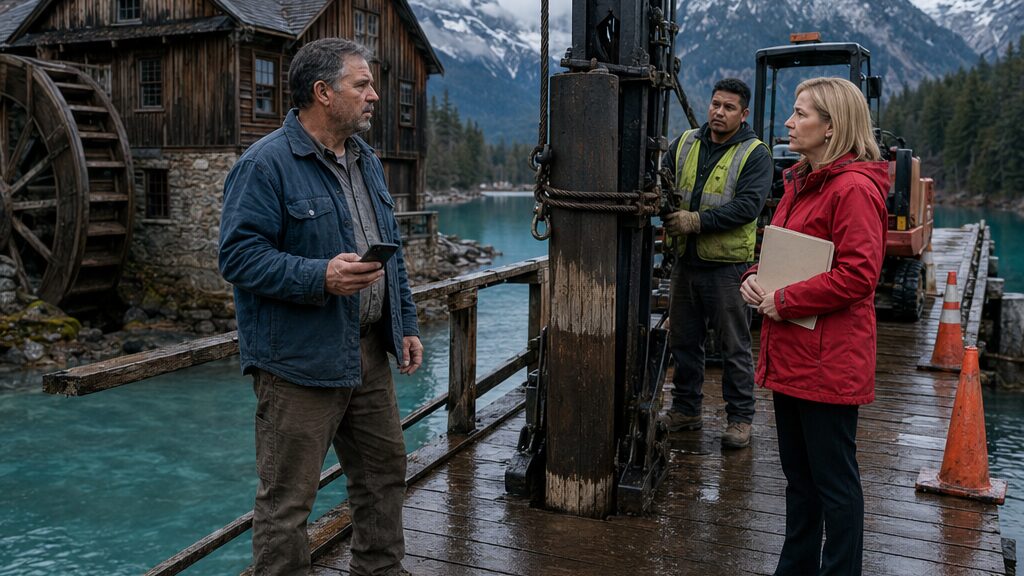
The support post moved three inches before Timothy Martinez reached the bridge.
He knew because he had marked it.
The pencil line he drew the night before was still visible above the dark wet wood, a small record of where the replacement beam had settled after he drove it into place. Below it, an older faded mark showed the highest water level from a storm twelve years earlier.
The mechanical puller groaned again.
Timothy stopped halfway down the gravel path leading from his house to the old mill approach. The sound did not belong there. Not at six forty in the morning. Not on his bridge.
A metal clamp wrapped around the new support post, and a worker in a safety vest stood beside the machine watching the cable tighten.
For a moment, Timothy thought he was looking at the wrong property.
Then he saw the orange cones.
The same orange cones he had placed two days earlier to mark the unstable section of the bridge were now arranged around the crew’s equipment.
Not to protect people from the damage.
To protect the crew from him.
“Stop the machine.”
The worker looked over.
He was a broad-shouldered man with a rain jacket pulled tight around his neck. He glanced toward the bridge entrance, then back at Timothy.
“You’re Timothy Martinez?”
“Yes.”
“Then you should have received the notice.”
The cable tightened.
The post shifted again.
Timothy walked faster.
“Stop the machine.”
The worker raised a hand toward the operator. The engine dropped from a roar to a low mechanical hum, but the tension remained.
Timothy stepped onto the bridge and looked down at the damaged support.
The replacement post was not decorative. It was not a landscaping project. It was holding the side of the bridge that carried the only safe path between his house and the county road.
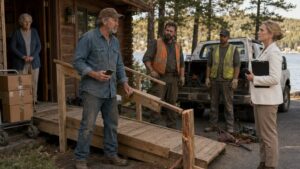
Behind him sat the old mill building, its wooden walls darkened by years of mountain rain. Beyond it stretched the turquoise lake, calm enough to hide the problem underneath.
The bridge always looked stronger than it was.
That was the danger.
“Who authorized this?” Timothy asked.
The worker pulled a folder from his truck.
“Steven Lopez. Removal contractor.”
“That’s your authorization?”
“No. This is.”
He handed Timothy a printed work order.
At the top was the HOA logo.
Timothy read the first sentence.
Unauthorized exterior alteration.
He looked up.
“This says nothing about the bridge.”
Steven shrugged slightly.
“It says the structure violates association standards.”
“What property description?”
Steven frowned.
“The address.”
“My address isn’t a property description.”
Before Steven could answer, another vehicle rolled down the gravel road.
A white SUV stopped near the mill.
Heather White stepped out wearing a bright red jacket that looked completely out of place against the wet wood and gray morning. She carried a folder under one arm and walked toward them without hesitation.
She did not hurry.
She did not need to.
She believed she already owned the situation.
“Mr. Martinez,” she said. “I’m disappointed we have to do this in person.”
Timothy looked at the machine.
“I’m disappointed you brought one.”
Heather opened the folder.
“You were notified that unapproved construction would be removed.”
“I submitted an emergency repair request.”
“You submitted incomplete material.”
“I submitted photographs, measurements, and a safety report.”
Heather’s expression barely changed.
“The bridge is visible from common lake areas. The HOA has responsibility for maintaining the appearance of shoreline structures.”
Timothy looked from her to the lake.
“The HOA has responsibility for appearance?”
“And enforcement.”
“Does it own the bridge?”
A brief pause.
It was small.
Most people would have missed it.
Timothy did not.
Heather adjusted the folder in her hand.
“The bridge is within the association’s managed area.”
“That wasn’t my question.”
Steven looked between them.
Heather’s voice became firmer.
“Mr. Martinez, this is not the time to argue technicalities.”
“No,” Timothy said. “This is exactly the time.”
He took out his phone and started recording.
Heather noticed.
“You don’t have permission to record a private enforcement action.”
“I’m standing on my property.”
“The bridge is disputed property.”
“Then show me the document that says you can remove it.”
Heather handed him the violation notice instead.
Timothy read it.
Violation date: two days earlier.
Removal authorization: today.
He looked at Steven.
“When did you arrive?”
“Six twenty.”
“Before sunrise.”
“We were scheduled.”
“Scheduled by who?”
Steven did not answer.
Timothy looked back at the post.
The lower rail section was already gone.
A gap opened along the side of the bridge where the handrail had been attached. It was only a few feet long, but it changed everything. The bridge had been dangerous before.
Now someone had made it less safe.
“You removed the rail before proving you had authority.”
Heather crossed her arms.
“We are correcting unauthorized work.”
“You are removing support from a bridge someone uses.”
“Someone?”
The question came from Heather without emotion, but Timothy heard the assumption behind it.
A project.
A structure.
An object.
Not a person.
Timothy looked toward the house.
“I live here.”
“I know.”
“My sister lives here too.”
Heather waited.
Timothy did not continue.
He had spent weeks refusing to use Sandra’s condition as an argument. He hated the idea of turning her recovery into a bargaining tool.
She deserved privacy.
Not a sentence in an HOA meeting.
Not a medical explanation attached to a repair request.
“She has access needs,” he finally said.
Heather glanced at the bridge.
“If that was included in your application, we would have reviewed it.”
“It was.”
“That is not what our records show.”
Timothy looked at the paper in her hand.
Then at the machine.
Then at the missing rail.
He understood something important.
This was not a disagreement about wood.
It was a disagreement about who had the right to define what the wood meant.
“I’m not stopping you from reviewing anything,” Timothy said. “But you are not removing anything else until you show written authority.”
Steven stepped toward the machine.
“Mr. Martinez, I’m contracted to do a job.”
“And I’m asking you to stop before you make the bridge unsafe.”
The two men looked at each other.
Steven glanced at the post.
The pencil marks were still there.
The lower flood line.
The higher shift line.
He looked uncomfortable.
Finally, he shut off the machine completely.
The sudden silence felt heavier than the noise.
Heather stared at Timothy.
“You understand this does not end the violation.”
“I understand.”
“You may be responsible for all costs.”
“I understand.”
“And if the board determines the work was improper, you will have to remove everything.”
Timothy looked down at the bridge.
“No.”
Heather’s expression tightened.
“No?”
“You already removed something.”
He pointed at the missing rail.
“You changed the condition of the bridge before resolving who controls it.”
For the first time, Heather did not have an immediate response.
Then a voice came from across the bridge.
“Timothy?”
He turned.
Sandra stood at the far end near the house path.
Her walker rested beneath both hands.
She had a coat pulled over her shoulders, and her face was pale from the cold.
Timothy immediately moved toward her.
But the missing rail was between them.
The space was only a few feet.
It looked like nothing.
It might as well have been a locked door.
Sandra looked down at the open side of the bridge.
Then at the workers.
Then at Timothy.
“I thought they were finished.”
Timothy swallowed.
“They’re not.”
Her fingers tightened around the walker handles.
And Timothy realized the repair crew had not only removed wood.
They had removed the one thing he had promised her would never be taken away.
The ability to cross home on her own.
Chapter 2: The Application Nobody Put Before the Board
Heather White’s violation notice said Timothy Martinez had never contacted the HOA.
The receipt on his kitchen table said otherwise.
Timothy placed both papers side by side and stared at the contradiction.
One was dated Monday.
The other was stamped Tuesday.
Both claimed to describe the same situation.
Neither admitted the other existed.
Sandra sat at the kitchen table with a cup of tea between her hands. She watched Timothy move documents around without saying anything.
He had spent years fixing things.
Pipes.
Roof leaks.
Foundation cracks.
Old machinery at the municipal maintenance department before he retired.
Problems usually had a source.
A broken pipe leaked.
A damaged beam sagged.
A failing hinge made noise.
Paperwork failures were different.
They could disappear until someone needed them.
“I should have included the letter,” Sandra said.
Timothy looked up.
“No.”
“You know it’s true.”
“The repair was necessary.”
“That’s not what I said.”
He looked back at the documents.
She was right.
The application had included photographs of the bridge supports, measurements of the damaged post, and his written explanation of the safety issue.
It had not included the letter from her physical therapist explaining why the bridge was her only reliable access route during recovery.
Timothy had left it out intentionally.
He told himself it was about privacy.
Part of it was.
But another part was pride.
He did not want the HOA looking at his sister and seeing a reason to approve his repair.
He wanted them to approve it because he was right.
A knock sounded at the door.
Timothy opened it to find George Adams standing outside with a tablet.
The HOA property manager looked tired.
Not angry.
Tired.
“I need to clarify something,” George said.
“That would be a first.”
George ignored the comment.
“Heather showed me the notice from yesterday.”
“She showed you a notice. Did she show you this?”
Timothy held up the delivery receipt.
George’s eyes moved to the date.
“Yes.”
“You received it.”
“Yes.”
“With the photographs?”
George hesitated.
That hesitation was enough.
“What happened to the rest of the file?”
George looked toward the bridge.
“I have a scanned copy.”
“Of what?”
“The application.”
“Not my question.”
George sighed.
“Some attachments were not in the version the board reviewed.”
Timothy felt something settle inside him.
Not anger.
Not yet.
Something colder.
“Who removed them?”
“No one removed them.”
“Then where are they?”
George looked uncomfortable.
“I don’t know.”
“You manage the files.”
“I manage what is submitted through the system.”
Timothy picked up the receipt.
“This proves it was delivered.”
George nodded.
“Yes.”
“Then why does Heather’s notice say I never contacted anyone?”
George did not answer.
The silence became an answer.
Later that afternoon, Timothy walked with George back toward the bridge.
The cut rail lay beside the path.
A piece of the repair that had existed yesterday.
A piece that did not exist today.
George looked at it.
“You should not have started work before approval.”
Timothy stopped.
“I know.”
The admission surprised George.
“I filed the emergency notice.”
“You did.”
“I believed that was enough.”
“It wasn’t.”
Timothy looked across the lake.
The old mill reflected in the water.
The bridge connecting everything together.
“You know what the problem is, George?”
“What?”
“Everyone keeps talking about whether I followed the process.”
George waited.
“Nobody is asking what happens if the process takes too long.”
A gust moved across the lake.
The damaged rail knocked softly against the ground.
George lowered his voice.
“Heather believes you changed the appearance of a shared structure.”
“And what do you believe?”
George looked away.
“I believe the file is incomplete.”
“That wasn’t my question either.”
George said nothing.
Timothy walked to the bridge entrance.
The orange cones were still there.
But now they blocked Sandra’s path.
The thing meant to warn people had become the thing stopping her.
That evening, Timothy returned to the HOA office with printed copies of every document he had.
Heather was already there.
She did not look surprised.
“I assume you are here to appeal the violation.”
“No.”
She looked up.
“I’m here because you approved a removal without knowing what you were removing.”
Heather closed the folder in front of her.
“The bridge is part of the lakefront appearance standards.”
“Show me where.”
“I don’t need to debate every clause.”
“Yes, you do.”
She leaned back.
“Mr. Martinez, you seem to believe being upset changes the rules.”
“I believe knowing the rules matters.”
“And I believe you ignored them.”
The accusation landed because there was truth in it.
Timothy had started temporary stabilization before receiving written approval.
He had done it because the damaged support had shifted during a storm.
He had done it because waiting felt irresponsible.
But responsibility did not erase procedure.
He knew that.
“I should have waited for written approval,” he said.
Heather seemed almost surprised by the admission.
“But that does not give you authority to destroy a safety repair without confirming ownership.”
Her expression changed slightly.
“You keep using that word.”
“Ownership?”
“Yes.”
“Because nobody has shown me proof.”
Heather stood.
“You will receive additional documentation.”
“When?”
“Through proper channels.”
Timothy looked at her.
That phrase had become a wall.
A way to delay without saying no.
Before he left, George followed him outside.
“Timothy.”
He stopped.
George looked nervous.
“There’s something you should know.”
“What?”
George glanced back at the office.
“The bridge does not have a simple ownership record.”
Timothy waited.
“The file is complicated.”
“How complicated?”
George looked toward the lake.
“Complicated enough that I don’t think Heather knows everything.”
Timothy felt the answer forming before George said it.
“Does the HOA own the bridge?”
George did not answer directly.
“I don’t think anyone has checked in years.”
The next morning, Timothy stood at the bridge entrance looking at the old support posts.
The machine marks were still visible.
The missing rail.
The damaged edge.
The repair he had started.
The repair they had interrupted.
Then his phone buzzed.
A message from George.
Attached was a photograph of an old document page.
At the bottom was a handwritten note.
County records required before any shoreline structure changes.
Timothy looked at the bridge.
Then at the mountains beyond it.
The fight had started over whether he had permission to repair the bridge.
Now the question had changed.
Who had the right to tell him he could not?
Chapter 3: The Bridge That Belonged to Three Different Maps
The county clerk placed three maps on the counter and said the same sentence three times.
“I need you to understand that all three are correct.”
Timothy Martinez stared at the papers.
“That’s impossible.”
The clerk folded her hands.
“It is inconvenient.”
The first map showed the shoreline boundary.
The second showed the county access easement.
The third showed the old mill maintenance area.
The bridge appeared differently on each one.
Not dramatically.
Just enough.
Enough to create years of confusion.
Enough for people to argue.
Timothy had spent his life working around infrastructure. He understood that lines on paper mattered.
But he also understood something else.
Structures did not exist on paper.
They existed in weather.
In weight.
In water.
In whether someone could safely walk across them.
“I need someone who can explain what this means,” Timothy said.
The clerk pointed toward the hallway.
“Amanda Brown.”
Amanda arrived twenty minutes later carrying a folder and wearing a county jacket covered with rain spots.
She did not enter like Heather had.
She did not assume she was already correct.
She studied the maps first.
Then the photographs Timothy brought.
Then the bridge.
“You repaired the support post?”
“Yes.”
“Before approval?”
“Yes.”
Amanda looked at him.
“You’re not denying it.”
“No.”
“That helps.”
“Does it?”
“It helps me understand the situation.”
They drove back to the lake together.
Amanda walked slowly across the damaged bridge, examining the cut rail, the replacement post, and the old support plates beneath the wood.
“The HOA says this is their structure.”
“They say that.”
Amanda looked at the shoreline.
“The HOA owns some shoreline parcels.”
“But not the bridge?”
“I didn’t say that.”
Timothy almost laughed.
Everyone had the same habit.
They avoided giving the answer because the answer created responsibility.
Amanda crouched near the base of the bridge.
“This structure crosses a county access easement.”
“What does that mean?”
“It means certain access rights exist regardless of private ownership.”
“Can I repair it?”
“Emergency stabilization may be possible.”
“May?”
Amanda stood.
“Mr. Martinez, the county does not want to inherit a private dispute.”
“This isn’t just a dispute.”
“I know.”
She looked at the damaged support.
“That’s why I’m here.”
A small shift of the wood caught her attention.
She reached out but did not touch it.
“When did this move?”
“After the crew removed the rail.”
Amanda looked toward the missing section.
“That changes the condition.”
“It changes the safety.”
“Yes.”
For a moment, Timothy thought he finally had the answer.
Then Amanda continued.
“But I still cannot authorize permanent reconstruction today.”
“Why not?”
“Because the old mill covenant may control maintenance responsibility.”
“The mill?”
She nodded.
“The original property agreements are older than the subdivision.”
Timothy looked at the weathered building beside the lake.
The old mill had always been there.
Long before the HOA signs.
Long before the neighborhood roads.
Long before anyone cared about shoreline appearance.
Amanda walked toward the mill-side footing.
“The bridge touches three different histories.”
She pointed.
“County access.”
The shoreline.
“The mill covenant.”
She looked back at him.
“That is why nobody has a simple answer.”
Timothy felt the frustration return.
Not because she was wrong.
Because she was careful.
Careful was useful.
But careful did not keep a bridge standing during a storm.
“When can you inspect?”
“After the next significant rainfall.”
He stared at her.
“Why?”
“To see how the structure responds.”
“It is already responding.”
“Yes.”
“And it is already failing.”
Amanda looked at him.
“I understand why you are frustrated.”
“No, you understand why the paperwork is complicated.”
She did not argue.
That bothered him more.
Later that afternoon, Timothy walked the bridge alone.
The lake was quieter than it should have been.
The damaged rail section remained beside the path.
He ran his hand over the replacement post.
The pencil marks were still visible.
The flood line.
The shift line.
A record of what happened before anyone arrived.
Then he noticed something near the mill side.
A crack.
Not in the wood.
Below it.
The footing.
He crouched.
The opening was wider than before.
He took out his phone and photographed it.
For the first time since the crew arrived, he felt something worse than anger.
Time was running out.
The bridge had survived storms before.
It had survived neglect.
It had survived people arguing over who was responsible for it.
But it might not survive another delay.
His phone rang.
Sandra.
He answered immediately.
“Are you okay?”
A pause.
Then her voice.
“I need to tell you something.”
Timothy stood.
“What happened?”
“I tried to cross.”
His grip tightened around the phone.
“When?”
“This morning.”
“Why didn’t you call me?”
“Because I knew you would come running.”
“That’s the point.”
“No,” Sandra said softly. “That’s the problem.”
He looked at the cracked footing.
The bridge.
The gap where the rail had been.
“You’re not a burden.”
“I know.”
“Then why?”
“Because you keep fighting everyone to prove I’m not one.”
Timothy had no answer.
The lake moved below him.
Sandra continued.
“I don’t need you to win this because I need saving.”
He closed his eyes.
“I need you to fix it because I need to live here too.”
The words stayed with him after the call ended.
That evening, the weather report changed.
The storm was arriving earlier.
And waiting for perfect permission suddenly looked a lot like choosing failure.
Then another message appeared on his phone.
From Heather White.
Removal resumes tomorrow at sunrise unless you sign the no-work agreement.
Timothy read it twice.
Then he looked back at the bridge.
The machine was coming back.
And this time, he knew exactly what question he needed answered.
Chapter 4: Sandra Tried to Cross Before the Rain
The sound that stopped Timothy was not a scream.
It was the sharp scrape of rubber against wet wood.
He dropped the wrench in his hand and ran.
“Sandra!”
She stood halfway across the bridge.
Her walker was angled toward the missing rail section, one front wheel resting near the edge where the crew had removed the barrier. Her face was tense, not from panic, but from the effort of holding herself still.
Timothy reached her in seconds.
He grabbed the walker handle and pulled it back.
“Why didn’t you call me?”
Sandra looked at him.
“Because you would have carried me.”
“That’s not a bad thing.”
“It is if I never get to do anything without you deciding what is safe.”
The words landed harder than he expected.
He stepped back.
The bridge creaked beneath them.
Not loudly.
Just enough.
Enough to remind them both that this argument was happening on the exact thing they were fighting over.
Timothy guided Sandra back toward the house.
He did not speak until they were inside.
The missing rail was visible through the window.
A gap.
A warning.
A reminder.
“You could have fallen.”
“I know.”
“You could have been hurt.”
“I know.”
“Then why?”
Sandra placed both hands on the kitchen table.
“Because my appointment was today.”
Timothy stopped.
“What appointment?”
“My mobility evaluation.”
“You should have told me.”
“I did tell you.”
“No, you didn’t.”
“I told you last week.”
He searched his memory.
She had mentioned leaving the house.
He remembered that.
He did not remember the date.
Because he had been focused on the bridge.
The application.
The HOA.
The documents.
The fight.
Sandra looked toward the window.
“You know what everyone keeps saying?”
Timothy waited.
“That you’re protecting me.”
He frowned.
“I am.”
“Yes.”
She turned back.
“But sometimes you’re protecting yourself.”
He looked away.
The sentence hurt because it was close to something he had not wanted to admit.
“I promised you something,” he said.
“When?”
“When you moved here.”
Sandra softened slightly.
“You said this house would not become a place where I had to ask permission to live.”
He nodded.
“I meant it.”
“I know.”
“Then why are you making it sound like I failed?”
“Because you’re acting like needing help is the same as losing.”
The kitchen went quiet.
Outside, the lake moved against the shoreline.
Timothy had spent years believing responsibility meant carrying everything alone.
That was how he worked.
That was how he survived after losing his wife.
That was how he helped Sandra when she needed somewhere to recover.
But he had never considered that carrying someone could become another way of keeping them from standing.
“I didn’t include your letter,” he said.
Sandra looked at him.
“What?”
“The medical access letter.”
Her expression changed.
“Why?”
“Because I didn’t want them looking at you like a reason to approve my repair.”
“You thought you were protecting me.”
“Yes.”
“And you decided for me.”
Timothy had no answer.
The truth was uncomfortable because it was not simple.
He had been fighting the HOA because they ignored a real need.
But he had also hidden that need because he wanted to win without having to explain.
His pride had protected his argument.
Not Sandra.
The next morning, the rain forecast changed.
The storm was arriving earlier.
Timothy stood at the bridge entrance with his phone, photographing the damaged section again.
He included everything this time.
The missing rail.
The shifted post.
The narrow path.
Then he added one more photograph.
The walker.
Not Sandra.
Not her face.
Just the object that showed what the bridge was actually for.
He sent the updated documentation to the county and the HOA.
An hour later, Heather responded.
Her message was short.
Removal will resume at sunrise unless you sign the no-work agreement.
Timothy read it while standing beside the bridge.
The orange cones moved slightly in the wind.
The same cones he had placed to protect people.
The same cones that now marked the place where his sister could not safely pass.
He looked at the damaged rail.
Then at the house.
Then back at the bridge.
This time, he would not argue only about wood.
He would argue about what the wood allowed someone to do.
Chapter 5: The Fee Ledger Behind the Ownership Claim
Heather White asked security to remove the bridge timber before Timothy finished carrying it into the meeting room.
“That does not belong here,” she said.
Timothy placed the cut rail section on the floor anyway.
“It belonged on the bridge.”
Several board members looked uncomfortable.
The emergency HOA meeting had been called because the removal order had become more complicated than anyone expected. What began as a simple enforcement action had turned into a dispute over records, authority, and a structure sitting between three different property histories.
Heather stood at the front of the room.
“We are here to discuss unauthorized construction.”
Timothy looked around.
“No. You’re here because a crew removed part of a bridge before confirming who had authority to remove it.”
Heather’s expression hardened.
“Mr. Martinez, you continue to avoid the central issue.”
“Which is?”
“You performed work without approval.”
Timothy nodded.
“I did.”
The room became quieter.
He continued.
“I should have waited for written approval.”
Heather seemed prepared for an argument.
She was not prepared for agreement.
“But,” Timothy said, “that does not answer whether the removal was authorized.”
George Adams sat near the end of the table.
He avoided eye contact.
Timothy placed the delivery receipt down.
Then the removal notice.
Then the photograph of the bridge before and after the crew arrived.
“I submitted an emergency repair request.”
Heather looked at George.
“According to the records we received, it was incomplete.”
Timothy turned.
“According to whose records?”
George shifted.
“Timothy.”
“No. Answer it.”
George looked down.
“The board received the scanned version.”
“Not the complete version.”
A board member frowned.
“What does that mean?”
George did not respond quickly enough.
Heather answered for him.
“It means the information provided was insufficient.”
Timothy opened another folder.
“I found the original delivery confirmation.”
He placed copies around the table.
“The packet included photographs, measurements, and a written description of the damaged support.”
Heather picked up the page.
“This does not include the medical information.”
“No.”
“Then your claim of necessity was incomplete.”
Timothy looked at her.
“My sister’s private medical information is not required to understand that a damaged bridge is dangerous.”
“But it is relevant.”
“Yes.”
He paused.
“And I should have included it.”
The admission changed the room.
Not because it solved anything.
Because it removed the easiest argument against him.
He was not claiming perfection.
He was identifying the problem.
Heather looked at the cut rail.
“You still changed the structure.”
“I stabilized it.”
“Without permission.”
“Because the support shifted.”
“You are not qualified to determine that.”
Timothy looked at the photographs.
“I spent thirty-two years maintaining public infrastructure.”
Heather’s expression did not change.
“That does not make you exempt from rules.”
“No.”
He looked at her.
“But it means I know when something is failing.”
The board secretary flipped through a stack of papers.
“Can we discuss the maintenance assessment?”
Heather turned.
“What?”
The secretary held up a document.
“The lake access maintenance fee.”
Timothy noticed Heather’s face change.
Only slightly.
But enough.
The secretary continued.
“This assessment appears on homeowner statements.”
“What does it cover?” Timothy asked.
Heather answered immediately.
“Common shoreline upkeep.”
“Does that include the bridge?”
Silence.
Timothy looked at George.
Then at Heather.
“Which structure did those fees maintain?”
Heather closed her folder.
“This meeting is not about accounting.”
“It becomes about accounting when people pay for something nobody inspected.”
A board member leaned forward.
“Are there bridge inspection records?”
George looked down.
No answer.
That was the answer.
The cut rail sat on the floor between them.
A piece of the bridge.
A piece of evidence.
A piece of a problem nobody wanted to hold.
Heather ended the meeting early.
She did not withdraw the violation.
She did not approve the repair.
But when Timothy walked outside, one board member followed him.
“I don’t know what happened here,” the board member said.
Timothy waited.
“But I don’t think we should be tearing out something we don’t understand.”
It was not victory.
It was not enough.
But it was the first crack in the wall.
That night, Timothy sat at his kitchen table reviewing every message and timestamp.
The storm was closer.
The bridge was weaker.
And somewhere inside the HOA’s records was the missing piece.
His phone buzzed.
A message from Steven Lopez.
Timothy opened it.
It was a photograph.
A desk.
A stack of documents.
And on top was his complete emergency application.
The timestamp showed it had been received two days before the removal order.
Below the image, Steven had written:
I thought you should know. This was already there when we were told to remove the bridge work.
Timothy stared at the screen.
The application had not disappeared.
It had been ignored.
Chapter 6: The Order Heather Signed After She Knew
The rain started before sunrise.
By the time Timothy reached the bridge, the machine was already there.
Steven Lopez stood beside it, one hand resting on the equipment controls.
He looked different than he had the first morning.
Less certain.
More careful.
Across from him, Heather White held a folder under her jacket while Amanda Brown measured movement near the damaged footing.
The same bridge.
The same post.
The same pencil marks.
But the balance had changed.
“Turn it off,” Amanda said.
Steven looked at Heather.
She nodded slowly.
The machine went quiet.
Timothy walked onto the bridge.
“You came back anyway.”
Heather looked at the damaged structure.
“I came because this situation has changed.”
“It changed when you removed the rail.”
“That is not what I mean.”
Amanda stood.
“The footing has shifted.”
Heather looked at her.
“Is the bridge unsafe?”
Amanda did not answer immediately.
That was enough.
“Yes,” Amanda said. “It is currently unsafe.”
Timothy looked at Heather.
“This is what I was trying to prevent.”
Heather’s expression tightened.
“I understand that.”
“No. You understand it now.”
The rain tapped against the wood.
For a moment, nobody spoke.
Then George Adams arrived.
He looked exhausted.
“I need to tell the truth before this gets worse.”
Heather turned sharply.
“George.”
“No.”
His voice was quiet.
But firm.
“I should have said this yesterday.”
Timothy looked at him.
“What did you do?”
George swallowed.
“The complete application arrived.”
Heather closed her eyes briefly.
Timothy noticed.
“You knew?”
George looked at him.
“I received it.”
“When?”
“Two days before the removal.”
The rain seemed louder.
Timothy looked at Heather.
“You signed the order after knowing there was a repair request.”
Heather did not answer.
George continued.
“I thought if the board reviewed the full file, they would ask questions about the bridge records.”
“What questions?”
George looked at the old mill.
“The maintenance assessments.”
Amanda turned.
“Explain.”
George hesitated.
“The HOA has collected shoreline maintenance fees for years. But the bridge records are incomplete. The deed information is unclear. The inspections are missing.”
Timothy stared at him.
“You buried the application because you were afraid of paperwork.”
George nodded.
“Yes.”
It was not a defense.
It was an admission.
Heather looked toward the bridge.
“I did not know everything George knew.”
“But you knew enough to sign the second order.”
Her silence answered.
Amanda walked to the marked support post.
“This post tells us something important.”
She pointed at the lower and higher pencil lines.
“The damage existed before the repair.”
She touched the newer mark.
“The movement increased after the rail was removed.”
Steven looked down.
“I documented when we arrived.”
Timothy looked at him.
“Why?”
Steven shrugged.
“Because I wasn’t sure the order made sense anymore.”
Another small shift.
Another person moving away from certainty.
Amanda opened her folder.
“The county easement includes an emergency stabilization clause.”
Heather looked surprised.
“What does that mean?”
“It means immediate action can be taken when access or safety is at risk.”
Timothy looked at the bridge.
“So the repair was allowed.”
“Temporary stabilization was allowed,” Amanda corrected.
He nodded.
“That’s enough.”
A loud crack interrupted them.
Everyone turned.
The mill-side footing moved slightly.
Not enough to collapse.
Enough to prove the argument was over.
Amanda raised her voice.
“Everyone off the bridge.”
The workers moved immediately.
Timothy did not.
He looked at the structure.
The damaged rail.
The support post.
The mill foundation.
Then he looked at Amanda.
“The old mill footing.”
She frowned.
“What about it?”
“The covenant map.”
“You think it can support a temporary brace?”
“I know this mill. I inspected structures like this for decades.”
Amanda studied him.
“You’re suggesting using the original support point.”
“Yes.”
“It is not the fastest option.”
“No.”
He looked toward the house.
Sandra stood at the doorway watching.
“But it is the right one.”
Amanda looked at the maps again.
Then the bridge.
Then the storm moving across the lake.
“Show me.”
Timothy walked toward the mill.
For the first time since the crew arrived, nobody was telling him to stop.
They were asking him to prove what he knew.
He reached the old footing and drove the probe into the mud beside the stone.
The tool struck something solid.
A foundation.
Still there.
Still standing.
Amanda looked down.
“That might work.”
Timothy nodded.
“Might?”
She almost smiled.
“Now you sound like me.”
The rain continued falling.
The bridge was still damaged.
The storm was still coming.
But the fight had changed.
The question was no longer whether Timothy had permission to repair.
The question was whether they could finish before the water rose.
Chapter 7: What Had to Remain Standing
The probe struck stone.
Timothy Martinez stopped moving.
For a second, the rain was the only sound.
Then he pulled the tool back and drove it into the mud beside the old mill footing again.
Solid.
Not loose soil.
Not a rotted foundation.
Stone.
The same foundation that had supported the mill long before the lakefront homes, the roads, and the association signs existed.
Amanda Brown crouched beside him.
“You’re sure?”
Timothy wiped rain from his face.
“I’m sure it’s there.”
“That’s not the same as knowing it can carry the load.”
“No.”
He looked toward the bridge.
“But it means we have something to test.”
The storm had already changed the shape of the property.
Water ran down the hillside in thin streams. The lake had risen against the shoreline. The damaged bridge moved slightly whenever the wind pushed against it.
Every minute mattered.
Steven Lopez stood beside the silent machine.
“So what happens now?”
Amanda answered before Timothy could.
“Now we stop arguing about ownership and stabilize what is failing.”
Heather White stood several feet away, holding the same folder she had carried through every confrontation.
But she was not holding it like a weapon anymore.
She was holding it like something heavier.
A responsibility.
“The board will need documentation,” she said.
Timothy looked at her.
“The board has had documentation.”
She accepted the criticism without responding.
Amanda opened her folder.
“The emergency clause allows temporary stabilization. It does not approve a permanent redesign.”
“I know.”
“You will have to follow the structural plan.”
Timothy nodded.
Years ago, that answer would have bothered him.
He would have heard it as someone telling him how to do work he understood better than they did.
But standing beside a damaged bridge while his sister waited on the other side of the house, he understood something different.
The goal was not to prove he was right.
The goal was to keep the bridge standing.
“Tell me what needs to be done.”
Amanda looked surprised.
Then she began explaining.
The old mill footing could support a temporary brace if they reinforced the connection point. The damaged post would need to come out. The replacement post he installed would be inspected and reused if it met the requirements.
The same post that started the conflict.
The same post Heather had called an unauthorized alteration.
Timothy looked at it.
The pencil marks were still there.
The flood line.
The shift line.
A record of the moment everyone should have paid attention.
The workers moved carefully.
No one rushed now.
Steven removed the pulling equipment and helped reposition tools.
At one point, he looked at Timothy.
“I owe you an apology.”
Timothy continued measuring.
“For what?”
“For assuming you were just trying to change the look of the place.”
Timothy tightened a bolt.
“You had paperwork.”
“I did.”
“And I had assumptions too.”
Steven looked at him.
“About me?”
“About everyone.”
The admission was quiet.
But true.
Timothy had spent the entire fight believing the people on the other side could not understand because they did not care.
Some did not understand.
Some made bad choices.
But some were also trapped by the same incomplete information he was fighting against.
Near noon, Sandra appeared at the edge of the property.
Amanda noticed her first.
“Should she be out here?”
Timothy turned immediately.
“I’ll take her back.”
Sandra shook her head.
“No.”
She moved slowly with her walker.
Timothy started toward her.
She raised a hand.
“Don’t.”
He stopped.
The word was familiar.
Not angry.
A request.
Sandra reached the work area and looked at the bridge.
Then at the notes Timothy had made.
The measurements.
The photographs.
The records.
“You finally wrote everything down.”
Timothy looked away.
“I always write things down.”
“You write down problems.”
She touched the walker handle.
“You don’t always write down people.”
He knew what she meant.
For years, he had documented damage.
Failures.
Measurements.
Costs.
He had not documented the reason behind them.
Amanda handed Sandra a clipboard.
“Can you help us?”
Timothy looked at her.
Sandra smiled slightly.
“I can hold a clipboard.”
It was a small thing.
But Timothy understood.
He did not have to carry every part of this himself.
Sandra recorded measurements while Amanda checked the temporary brace.
She did not stand aside.
She participated.
By late afternoon, the new support was in place.
The bridge was not finished.
But it was stable.
The orange cones were moved.
Not around the damaged area.
Around the new supports.
A warning that now protected the repair instead of blocking access.
Three weeks later, the final inspection took place.
The permanent repair was not exactly what Timothy originally designed.
The rail spacing was adjusted.
The support connection was reinforced.
The materials were chosen to match the old mill appearance instead of the modern design Timothy preferred.
He had accepted changes he once would have fought.
Not because he was giving in.
Because the bridge was more important than winning.
The HOA withdrew the violation.
The reimbursement was limited.
The association covered the portion connected to the neglected maintenance responsibility but did not admit every mistake publicly.
Heather never gave a speech.
She never apologized in front of a crowd.
She simply signed the revised agreement.
That was all.
It was enough.
On the morning Sandra crossed the finished bridge for the first time, Timothy walked beside her.
Not in front.
Not behind.
Beside.
The lake was calm.
The old mill stood quietly at the end of the path.
The repaired support post was back in place.
The pencil marks remained.
Timothy had wanted to sand them away.
Amanda told him not to.
“Keep them,” she said. “They show what happened.”
So he did.
Sandra reached the middle of the bridge and stopped.
She looked down at the water.
Then back toward the house.
“I forgot what this felt like.”
Timothy smiled.
“What?”
“Going somewhere because I wanted to.”
He nodded.
They continued across.
At the far end, Heather stood near the corrected boundary marker.
For a moment, Timothy expected another argument.
Another document.
Another claim.
Instead, she looked at the bridge.
Then at the marker.
Then she stepped aside.
She walked across without stopping him.
Without claiming the structure.
Without pretending nothing had happened.
Timothy watched her leave.
The bridge was still there.
That was what mattered.
Not the violation notice.
Not the meeting.
Not the argument over who had authority.
The bridge remained standing because people finally stopped asking who owned the problem long enough to fix it.
And for the first time in months, Timothy crossed it without thinking about what might break.
The story has ended.