They Fined His Bronco, So He Built the One Museum Their HOA Could Never Control
Chapter 1: The Yellow Notice on the Green Bronco
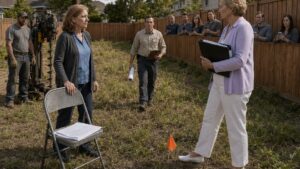
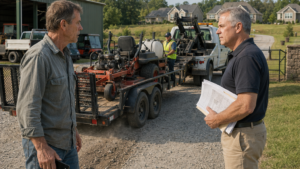
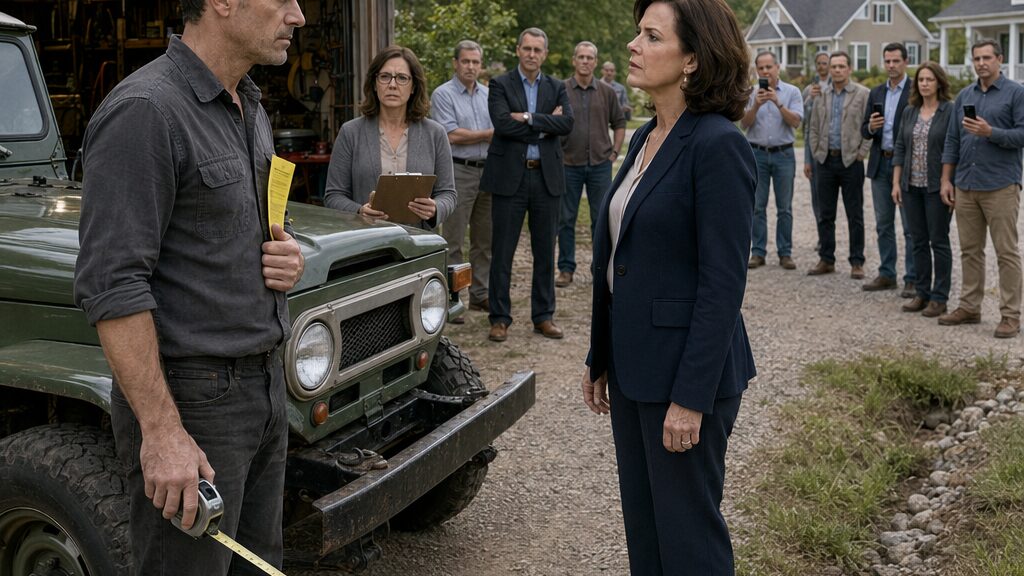
Katherine Lee slid the yellow notice beneath the Bronco’s windshield wiper while its engine was still running.
One corner of the laminated sheet snapped in the warm air spilling through the grille. Against the deep green paint, it looked less like paperwork than a warning flag.
Daniel Harris kept both hands on the steering wheel.
Beyond the open driver’s window, Katherine stood in pressed slacks and a navy jacket, her posture square to the vehicle. Nicole Green waited half a step behind her with a clipboard held against her ribs. Two other board members stood near the gravel shoulder. Farther back, three residents had stopped along the subdivision road. One of them was holding a phone upright.
Daniel watched the screen turn toward him.
“Seventy-two hours,” Katherine said. “After that, the daily assessment begins.”
Daniel switched off the ignition.
The Bronco shuddered once before settling into silence. Without the engine, he could hear cicadas in the trees and the faint metallic ticking under the hood. He opened the door carefully, forcing Katherine to step back.
He did not reach for the notice.
“What am I correcting?” he asked.
Katherine’s expression tightened, as if the question itself were another violation.
“The exterior storage of an inoperable or commercial-use vehicle. Unapproved mechanical activity visible from a common roadway. Damage to landscaped ground. Failure to comply with the amended architectural standards.”
Daniel looked past her toward the road. The closest subdivision house sat more than two hundred yards away, behind a row of young maples and a white vinyl fence. His workshop stood deeper on his twelve acres, half hidden by mature oaks. The Bronco was licensed, insured, and warm from a test drive.
“It drove here,” he said.
“That isn’t the issue.”
“It’s the first issue listed.”
Nicole shifted the clipboard. Her face showed discomfort, but not disagreement.
Katherine tapped the notice with one finger.
“The board has already discussed this. We are not conducting the hearing in your driveway.”
Daniel finally removed the paper. The plastic was warm from the windshield.
Across the top, in red letters, was the word RESTORE. Beneath it sat his name, the address of his workshop, and a list of alleged violations. The language had the polished stiffness of a form copied from somewhere else and altered in a hurry.
At the bottom, the notice threatened daily fines, suspension of contractor access through the subdivision road, and recovery of legal costs.
Daniel read that last part twice.
“You’re threatening to stop my suppliers from using the road.”
“We’re advising you of available remedies.”
“Under which recorded agreement?”
Katherine’s gaze moved briefly toward the residents with the phone.
“The association’s authority is explained in the amended covenants.”
“Which page includes my parcel number?”
No one answered.
The cicadas seemed louder.
Daniel folded the notice once, not sharply enough to crease it, and slipped it into the chest pocket of his work shirt.
Katherine lifted her chin. “You’ve lived beside Westridge Estates long enough to understand how the community operates.”
“Beside it,” Daniel said.
Nicole looked at Katherine.
The small reaction was enough to tell him the wording had landed.
Katherine recovered quickly. “Your father accepted the shared road terms. You have benefited from association maintenance for years.”
“That wasn’t my question.”
A resident lowered his phone, then raised it again.
Daniel walked to the rear of the Bronco and opened the cargo door. Inside lay a steel tape measure, a battered survey mallet, two shop rags, and a shallow wooden box filled with old fasteners. He took the tape measure and closed the door.
Katherine stepped into his path.
“What are you doing?”
“Checking something.”
“This changes nothing about the deadline.”
Daniel hooked the end of the tape against the edge of the gravel and walked toward the drainage ditch. Thirty feet out, he stopped near a patch of weeds and crouched.
The board members watched him as if he were performing for the phones.
He wasn’t.
He pushed aside dry grass with the mallet handle. Beneath the roots, a dark metal cap showed through the dirt.
Daniel scraped around it with his fingers.
The survey pin had been there his entire life. His father used to strike it gently with the heel of his boot when explaining where the old farm ended and the new development began. Daniel had not thought about that lesson in years.
Katherine came closer but remained on the gravel.
“That marker has no bearing on your present obligations.”
Daniel extended the tape from the road edge to the pin.
“What survey did the board use?”
“The association has maps.”
“Recorded maps?”
“The documents have been reviewed by counsel.”
“Then you can send me the page.”
Katherine’s mouth flattened. “You will receive whatever the board determines is necessary.”
Daniel rose and reeled in the tape.
There it was. Not certainty. Position.
He knew the difference.
As a mechanical engineer, he had spent fifteen years watching people defend assumptions because admitting uncertainty felt like surrender. A machine did not care how confident someone sounded. Either the measurements aligned or they did not.
The board members began walking back toward the subdivision. Nicole stayed behind long enough to glance at the Bronco.
It had belonged to Daniel’s father before the cancer reduced him to a recliner by the shop window. The body restoration was finished. The engine was finished. The driver’s seat had been reupholstered.
The passenger seat remained stripped to its frame.
Nicole looked from the unfinished interior to Daniel.
“You should come to Thursday’s meeting,” she said quietly.
“Will the covenant page be there?”
“I don’t know.”
“Then find out before you vote on another fine.”
Her cheeks colored. She followed the others without answering.
Katherine reached the paved road, then turned.
“The contractor-access restriction begins automatically if the violation remains unresolved.”
Daniel’s suppliers used that road because the county route on the west side had been abandoned years earlier. A flatbed could not reach his workshop through the old farm track without crossing a shallow creek. Katherine knew that. The board knew it too.
The threat had not been written for appearance.
It had been written to stop his work.
Daniel stood beside the Bronco until the group disappeared past the first white fence. Then he entered the workshop, laid the yellow notice on his drafting table, and flattened it beneath a steel ruler.
He called up the county property database on an old desktop computer.
The digital map showed his acreage, the subdivision, the road, and a web of parcel lines too coarse to answer anything. He zoomed in until the image blurred. The subdivision boundary appeared to bend near his southeast corner, but the layer did not display recording dates or covenant references.
He searched his father’s file cabinets.
Invoices. Tax statements. Equipment manuals. A deed from 1987. A road-maintenance agreement copied so many times that half the signatures were gray shadows.
Nothing showed the HOA boundary clearly.
By late afternoon, the yellow notice had become the brightest object in the dim workshop.
Daniel carried it outside with the tape measure and returned to the survey pin. He drove a narrow spade into the soil beside it and loosened the packed earth. Another inch of metal emerged, then a stamped cap.
He wiped it clean with his thumb.
A number was engraved across the top.
It did not match the survey reference printed on Katherine’s notice.
Daniel read both numbers again, then looked toward the subdivision road.
For the first time that day, he smiled.
Chapter 2: The Boundary Line That Stopped Short
William Carter placed the original subdivision plat beneath the glass scanner, adjusted one corner, and said, “Your parcel isn’t on this map.”
Daniel leaned closer.
The document was large enough to cover most of the records counter. Its paper had yellowed at the folds, but the ink remained dark: roads, lot numbers, drainage easements, signatures, dates. Westridge Estates occupied the eastern half in a neat arrangement of curved streets and rectangles.
Daniel’s twelve acres sat beyond the thick boundary line.
Not partly beyond it.
Entirely beyond it.
William pointed with the capped end of a pen. “This is the founding plat. Recorded twenty-nine years ago.”
“And the amended covenants?”
“Different file.”
“Do amendments add land?”
“They can, if the owner consents and the annexation is recorded.”
“Did my father consent?”
William gave him a tired look. “That’s what we’re checking.”
The county records office smelled of paper, old carpet, and the burnt coffee someone had left on a warming plate. Daniel had arrived when the doors opened, carrying the yellow notice, his deed, and the survey-pin number written on a shop receipt.
William had been at the counter for nearly forty years, according to the framed service certificate behind him. He moved carefully, not slowly. Each time he opened a folder, he pressed the pages flat with both hands as if they deserved more respect than the people arguing over them.
He pulled a second file from a cart.
“This is the first covenant amendment. Landscaping rules, exterior materials, accessory structures.”
“My parcel?”
William traced the legal description.
“No.”
A second amendment followed. Then a third.
No parcel number. No deed reference. No annexation signature from Daniel’s father.
Daniel took the yellow notice from his folder and placed it beside the plat. The red heading looked childish next to the county document.
“So they have no authority.”
William did not answer.
Daniel looked up. “You just showed me the line.”
“I showed you one line.”
“What other line matters?”
William removed his glasses and cleaned them with a square of cloth.
“People come in here wanting records to behave like verdicts. They don’t. Records tell you what was filed. They don’t always tell you what a judge, a board, a planner, or an insurer will do with it.”
“The HOA says I’m inside its covenants.”
“These documents do not support that statement.”
“That’s authority.”
“That’s one kind.”
Daniel felt the first clean release of pressure since Katherine had touched the Bronco. He imagined walking into Thursday’s meeting with the plat enlarged behind him. He imagined Katherine searching for words while residents studied the boundary.
Then William opened another folder.
The page inside was not a covenant. It was a road agreement.
The copy was faded, but Daniel recognized his father’s handwriting before he saw the name. The capital H leaned left. The final stroke of Harris ran beneath the signature like a narrow road.
Daniel’s relief thinned.
“What is that?”
“Shared-access and maintenance agreement. Recorded four years after the subdivision plat.”
William read silently for a moment.
The agreement granted Westridge Estates residents, utility providers, emergency vehicles, and authorized service traffic nonexclusive use of the road along Daniel’s southern boundary. In return, the association maintained the paved section from the county junction to the fork leading toward Daniel’s workshop.
The language went further.
Any owner increasing commercial or public traffic beyond ordinary agricultural or residential use could be required to contribute proportionally to maintenance, drainage improvements, and safety measures.
Daniel touched the signature.
“My father never ran a business open to the public.”
“Not according to this file.”
“He repaired cars.”
“Private work is different from public access.”
“My suppliers already use the road.”
William nodded. “That may be considered ordinary service traffic. Depends on frequency, weight, and how the agreement has been applied.”
Daniel glanced at the yellow notice.
“Can the HOA stop my suppliers?”
“Not under the architectural covenants you’ve shown me.”
“Under this?”
“Only if your use violates the road agreement or creates a documented hazard. They can’t simply declare it.”
The answer should have satisfied him.
It did not.
The dispute was no longer clean.
William searched the index again, this time under Daniel’s father’s name. A microfilm record appeared. He sent the image to the printer, waited for the machine to cough out three pages, and arranged them on the counter.
The first page was a survey sketch. The second was a letter between the county and Daniel’s father. The third contained a handwritten note referencing possible “educational display access” and a future public-use review.
Daniel read the phrase twice.
“What educational display?”
William looked through the remaining pages.
“There’s no application attached.”
“Then why is it mentioned?”
“Could have been preliminary. Could have been abandoned.”
Daniel knew every project his father had completed. He knew the tractor restoration, the machine shed addition, the unsuccessful attempt to rebuild a 1950s service station facade. He knew which cars had been sold to pay medical bills and which ones remained under tarps.
He had never heard about an educational display.
William turned the survey sketch around.
A narrow access branch had been penciled from the shared road toward the old hayfield east of Daniel’s workshop. The line ended in a rectangle labeled FUTURE USE.
The handwriting was his father’s.
Daniel stared at it until the records room seemed to recede.
“Can I get certified copies?”
“Of all of it?”
“Yes.”
William began marking request numbers.
Daniel folded the yellow notice and placed it beside the original plat while the copies were prepared. The fold crossed the word RESTORE, splitting it between two panels.
He thought of Katherine saying his father had accepted the shared road terms. She had been right about that much.
He thought of the threat against contractor access. She had not been right about the power she claimed.
Both facts could exist at once. Daniel disliked that more than he wanted to admit.
William returned with the certified packet.
“At the board meeting,” Daniel said, “I can show them the boundary.”
“You can.”
“And they have to withdraw the notice.”
“They should withdraw any part based solely on covenant authority.”
“Should?”
William set the packet down.
“If they want to fight, they can make you spend time proving what the record already suggests. Associations sometimes rely on expense as leverage. So do property owners.”
Daniel heard the warning beneath the neutrality.
“I’m not looking for leverage.”
William’s eyes moved to the yellow notice.
“No?”
Daniel put the notice back in the folder.
Outside, the county parking lot shimmered in the afternoon heat. He sat in the Bronco with the certified plat across his lap. The thick boundary line stopped exactly where William had shown him. Daniel’s land remained blank beyond it, untouched by lot numbers or covenant references.
He should have driven directly to Katherine’s house.
Instead, he returned to the workshop and spread the documents over his drafting table.
The old road agreement occupied the center. He measured the penciled access branch, scaled it against the known road width, and calculated the approximate dimensions of the rectangle marked FUTURE USE.
It matched the east hayfield.
The same field his father had refused to sell when medical bills rose.
Daniel opened a drawer looking for older property records and found a rusted key taped beneath the handle. It opened a narrow cabinet at the back of the workshop.
Inside were rolled plans, brittle receipts, and a red folder labeled ACCESS.
At the bottom lay a county letter with a sentence underlined twice:
Any future public or institutional use shall require updated road-capacity review, emergency access approval, and proportional maintenance contribution.
Daniel sat down.
The HOA did not control his land.
But if he ever opened it to the public, the road could control what he built there.
Chapter 3: The Agreement His Father Never Explained
The faded sign design unrolled across Daniel’s workbench and stopped beneath his hands.
COUNTY MOTOR HERITAGE ROOM.
The letters were drawn in block capitals, each one carefully shaded in pencil. Beneath them, his father had sketched the outline of an old coupe, a farm truck, and the Bronco before its body had been repaired.
Daniel did not remember climbing into the workshop attic.
He remembered only the red ACCESS folder, the penciled rectangle on the county sketch, and the need to find whatever his father had hidden behind the words future use.
The attic held thirty years of things too useful to discard and too painful to examine: carburetor boxes, cracked gauges, rolled upholstery, coffee cans filled with bolts. Dust coated the rafters. The heat pressed against Daniel’s back.
The sign design had been stored inside a mailing tube tied with cotton string.
Behind it were floor plans.
Not for a large museum. A modest one-room building with wide doors, six vehicle bays, a workbench for demonstrations, and a narrow wall labeled LOCAL INDUSTRY AND FARM TRANSPORT. Another page proposed school visits twice a month and a Saturday repair clinic.
The Bronco appeared in the center bay.
Daniel carried everything downstairs.
He laid the yellow violation notice over the corner of the plan to keep it from curling. The bright sheet covered part of the word Heritage.
By noon, anger had replaced surprise.
His father had signed the road agreement. His father had drawn the plans. His father had marked the field. Yet he had never mentioned any of it.
Daniel called George Robinson.
George answered on the sixth ring.
“You still have that old alignment rack?” Daniel asked.
“Good morning to you too.”
“Did my father ever talk to you about a museum?”
Silence.
It lasted just long enough.
Daniel closed his eyes.
“George.”
“You found the plans.”
“That isn’t an answer.”
“It’s the only reason you’d be asking.”
Daniel looked at the Bronco. The unfinished passenger seat stood on a low dolly near the wall, its bare springs catching the light.
“Come by,” he said.
“I can’t today.”
“Then I’ll come to you.”
George’s garage sat eight miles west, behind a small brick house with a chain-link fence. By the time Daniel arrived, the overhead door was open. George stood beside a stripped pickup cab, wiping his hands on a red rag.
He was seventy-two and built like the heavy tools he no longer lifted alone. His shoulders had narrowed, but his hands remained broad and scarred.
Daniel placed the rolled plans on the bench between them.
George did not touch them.
“He told you,” Daniel said.
“He talked about it.”
“You helped draw the vehicle layout.”
“I told him six bays was too many for that building.”
“You knew.”
George tossed the rag aside.
“Your father had ideas every Tuesday and abandoned half of them by Friday.”
“He recorded a road agreement.”
“That part was real.”
“Why?”
George looked toward the open door.
Outside, a delivery truck passed on the county road. The sound faded before he answered.
“Because the subdivision developer wanted access to the south junction. Your father wanted the option to bring people in from that side someday.”
“For this?”
“For something like it.”
Daniel unrolled the sign.
George’s face changed when he saw the lettering.
“He kept that.”
“He kept everything except the conversation.”
“That conversation happened.”
“Not with me.”
George rested both hands on the bench.
“It was supposed to.”
The garage seemed suddenly smaller.
Daniel waited.
George glanced at the pickup cab, buying time. “After you left engineering, he thought you two could make the shop into more than repair work. Not a tourist place. Nothing flashy. A place for school groups. Old farm equipment. Cars built when people still fixed what they owned.”
Daniel’s jaw tightened.
“I came back to help him.”
“You came back because he was sick.”
“I stayed.”
“You worked.”
“That’s what he needed.”
George’s voice softened. “It wasn’t all he needed.”
The words struck harder because George did not raise them.
Daniel turned away.
On a shelf sat a line of restored carburetors, polished and tagged. His father used to say a clean workbench could make a dishonest mechanic look competent. Daniel had laughed the first hundred times. Near the end, he had stopped laughing at anything.
“He never asked me,” Daniel said.
“He did.”
Daniel faced him.
George held his gaze. “The week before the final treatment. You were under the Bronco replacing the transfer case seal. He brought the plans out.”
“I would remember.”
“You told him the road wasn’t rated, the drainage was wrong, the insurance would be impossible, and he needed to stop starting projects he couldn’t finish.”
Daniel felt the garage tilt around him.
The scene returned not as a memory but as disconnected pieces: his father’s slippers on the shop floor, a rolled tube under one arm, Daniel’s own hands black with gear oil. A voice asking whether six cars would fit in the east field building.
Daniel had answered with calculations.
He had not looked out from beneath the vehicle.
George continued quietly. “He put the plans away.”
“He was dying.”
“He knew.”
“I was trying to keep the shop running.”
“I know.”
“Then don’t make it sound like I dismissed him.”
George’s mouth tightened. “You did dismiss him. You had reasons. Both things can be true.”
Daniel rolled the sign too tightly. The paper crackled.
George reached for it.
“Careful.”
Daniel released his grip.
For several seconds neither man spoke.
Then George said, “He wasn’t asking you to build it right then. He wanted to know whether you still saw a future here.”
Daniel looked toward the road again.
“And what did you tell him?”
“I told him you’d come around.”
“You were wrong.”
“Maybe I was early.”
Daniel left before anger could turn into something less controlled.
On the drive back, he passed the southern entrance to Westridge Estates. The road was smooth and freshly sealed. Children rode bicycles along the sidewalk. A landscaping crew worked near the stone sign.
Near the fork to his property, a school bus slowed to let a delivery van turn.
Daniel watched the maneuver in his mirror. The road narrowed at the drainage swale. Two larger vehicles would have difficulty passing without one taking the shoulder.
Katherine had exaggerated her authority.
That did not make the road wider.
At the workshop, three emails waited.
The first was from the HOA board, confirming Thursday’s meeting.
The second contained the amended violation notice and a revised fine schedule.
The third had been forwarded by a neighboring resident.
Katherine had sent a community-wide message warning that Daniel might be planning “a high-traffic commercial attraction involving outdoor vehicle storage, event activity, and substantial disruption to neighborhood access.”
Daniel read it twice.
No permit had been filed. No plan had been shared. She was building opposition to something she could not yet know existed.
Unless the old county file had reached her first.
He looked at his father’s plans.
The yellow notice still held down one curling corner.
Daniel opened the county planning website. The preliminary-use form asked for parcel number, current use, proposed use, anticipated attendance, access route, and public benefit.
He entered the information slowly.
Under proposed use, he typed:
Limited educational motor heritage exhibit and restoration demonstration space.
Under anticipated attendance, he hesitated.
The angry answer came first: enough people to make Westridge regret the notice.
He deleted it.
He entered twenty-five visitors per scheduled day.
Then he attached the old sketch, the access agreement, and a photograph of the east field.
The final box asked whether adjacent property associations had been notified.
Daniel selected no.
He submitted the inquiry before he could change his mind.
A confirmation number appeared on the screen.
Outside, a vehicle slowed on the subdivision road, paused near his drive, then continued.
Daniel folded the yellow notice along its existing crease and set it over his father’s sign design.
For the first time, he could not tell whether he was rescuing the plan or using it as a weapon.
Chapter 4: A Legal Victory With a Shared Road
The county planner approved Daniel’s museum concept for conditional review and rejected his entrance design in the same breath.
She drew a red X across the access lane on his site plan.
“This turning radius does not work for fire apparatus,” she said. “And your visitor traffic would queue on the shared road.”
Daniel looked at the mark as if it were a bad measurement.
The conference room was small, with fluorescent lights and a window overlooking the county parking lot. His plans covered most of the table: the east field converted into a gravel parking area, the proposed exhibit building, drainage channels, a loading pad, and a direct entrance from the road maintained by Westridge Estates.
He had spent three weeks refining them.
“The radius meets the commercial standard,” he said.
“For a two-axle delivery vehicle. Not for the county ladder truck.”
“The nearest station does not use a ladder truck for this district.”
The planner turned to another page.
“The fire marshal reviews all equipment that may respond, not only what usually responds.”
Daniel leaned back.
Beside the planner sat a building inspector and a survey technician. William Carter had provided the certified records but had declined to attend. His note had been brief: The records speak for themselves. The design must speak for you.
The survey technician tapped the boundary sheet.
“The proposed use is not prohibited by the Westridge covenants because the parcel was never annexed. That question appears settled.”
It was the sentence Daniel had expected to feel like victory.
Instead, the red X remained in the center of the table.
The planner continued. “The county can consider a limited museum use. But approval would require an emergency turnaround, stabilized parking, drainage mitigation, noise restrictions, operating-hour limits, and a road contribution agreement.”
“With the HOA.”
“With every party to the recorded access agreement.”
Daniel’s fingers tightened around his pen.
“How much road contribution?”
“That depends on projected use.”
“I listed twenty-five visitors per scheduled day.”
“You also listed school groups, deliveries, demonstration events, and six vehicle bays.”
“Not simultaneous.”
“Then show us how they are separated.”
The inspector slid the plan back toward him.
“You designed a building,” he said. “You haven’t designed what happens when people arrive.”
Daniel stared at the entrance he had drawn. It was the shortest route from the shared road to the exhibit field. It also passed within sight of the first six houses in Westridge.
He had told himself that was unavoidable.
Now, with the red line running through it, he could see how much of the route had been chosen because Katherine would have to watch every visitor pass.
The realization made him angry at the inspector for seeing it.
“What is the next step?” Daniel asked.
“Submit a traffic study and revised access plan,” the planner said. “Then public notice.”
“Public notice to whom?”
“Adjacent owners, parties to the road agreement, and the association.”
Daniel folded the plan along its existing creases.
By the time he reached the hallway, Katherine was waiting near the elevators.
She held a leather folder against her side. Nicole stood beside her, studying a printed packet.
Daniel stopped.
Katherine’s gaze moved to the rolled plans under his arm.
“So it is a commercial attraction.”
“It’s a county review.”
“You told no one.”
“I was not required to tell your board before filing a preliminary inquiry.”
“You use our road.”
“The agreement says shared road.”
“It says maintained by the association.”
“And proportional contribution if use increases.”
Katherine’s expression sharpened. She had not expected him to quote it.
Nicole looked up from the packet.
“The planner sent us the attachments,” she said. “There’s an old survey memo in here.”
Katherine turned toward her. “Not now.”
Nicole held the page out.
“It says Daniel’s parcel was never incorporated into Westridge.”
Daniel took one step closer.
“What date?”
Nicole read the header. “Eighteen months ago.”
Katherine reached for the packet, but Nicole did not release it immediately.
“Why did the board request this?” Nicole asked.
“It was part of the road-insurance review.”
“And we had it before the violation notice.”
Katherine lowered her voice. “This hallway is not the place.”
Daniel watched Nicole let go.
The page disappeared into Katherine’s folder.
“What did the survey memo say about covenant authority?” he asked.
Katherine looked directly at him.
“It raised questions. It did not resolve every obligation attached to your land.”
“That wasn’t my question.”
“No,” she said. “You prefer questions with only one acceptable answer.”
The elevator opened.
She stepped inside, then turned before the doors closed.
“You submitted a public-use plan without accounting for emergency access, drainage, or resident safety. That is exactly why informal exceptions become expensive.”
The doors met between them.
Daniel wanted to dismiss the statement as deflection.
The red X on his plan made that difficult.
That evening, the HOA meeting room was full before he arrived.
Folding chairs lined the walls. Residents stood near the back with printed copies of Katherine’s community email. Daniel recognized the same man who had filmed the violation notice. This time his phone was pointed toward the board table.
Katherine sat at the center beneath the Westridge Estates seal. Nicole sat to her right, quieter than usual. Two board members arranged packets in front of them.
A photocopy of Daniel’s yellow notice appeared on the first page.
Katherine called the meeting to order.
“The board has received confirmation,” she began, “that Mr. Harris intends to develop an event-oriented motor facility using the association-maintained entrance.”
“Museum,” Daniel said from the second row.
Katherine did not look at him.
“The applicant’s own county submission anticipates public traffic, deliveries, group visits, outdoor vehicle movement, and amplified instructional activity.”
“Amplified?” Daniel asked.
A few residents turned.
Katherine lifted a page. “The application references demonstrations.”
“Mechanical demonstrations.”
“Which may create noise.”
Daniel stood.
“You told residents I was planning a high-traffic commercial attraction before the county accepted the inquiry.”
“We received information through proper channels.”
“The old survey memo too?”
Nicole’s pen stopped moving.
Katherine’s voice cooled. “This meeting concerns road and safety impacts.”
“It concerns whether you had authority to put that notice on my vehicle.”
A resident near the aisle spoke before Katherine could respond.
“My daughter waits for the school bus at that fork. Are you bringing flatbeds through there?”
Daniel looked at her.
“Occasionally.”
“How occasionally?”
“I don’t know yet.”
Another resident asked about weekend traffic. Someone else asked whether engines would run outdoors. A man in the back complained about property values. The questions overlapped.
Daniel answered the ones with measurements.
Twenty-five visitors.
Limited days.
No overnight activity.
No entrance from the residential street beyond the shared road.
But each answer exposed another variable he had not fully resolved.
The school bus stop.
Delivery timing.
Shoulder width.
Drainage after parking stabilization.
He could calculate all of it. He had not yet calculated any of it because the boundary had seemed like the only question that mattered.
Katherine waited until the room grew restless.
Then she lifted Daniel’s rejected site plan.
“The county’s own staff determined that Mr. Harris’s proposed entrance would obstruct emergency turning movement and create traffic queuing on the association road.”
The room quieted.
She placed the plan on a display stand. The red X was visible from the back row.
“This is not speculation,” she said. “This is his design.”
Daniel stood beside his chair, unable to deny the page.
“It was a preliminary plan.”
“It was the plan you submitted.”
“And the county told me to revise it.”
“After you proposed it.”
The distinction sounded smaller in the room than it had in his head.
Nicole looked at him, not with accusation but disappointment.
Daniel saw what the residents saw: a man insisting the board had no power while quietly designing a use that depended on their road.
Katherine lowered the plan.
“The board will seek an injunction against any public activity until all shared-access obligations are resolved.”
The HOA attorney began explaining procedure.
Daniel sat down.
The yellow notice on the packet in his lap no longer looked like proof of only Katherine’s overreach. It looked like the beginning of a conflict he had entered certain that every burden belonged to someone else.
When the meeting ended, residents gathered around the displayed plan.
Katherine left it standing beneath the red X.
Chapter 5: The Museum Plan Built From Anger
The fire marshal circled Daniel’s preferred entrance in red and wrote UNUSABLE across it.
He set the marker down.
“No variance on this geometry.”
Daniel stood on the edge of the east field with the marshal, the county planner, and a survey technician. Stakes marked the proposed building corners. The grass was high around their boots. Beyond the field, the shared road curved past the subdivision’s first row of houses.
“I can widen the throat,” Daniel said.
“You can widen it until you reach the drainage easement.”
“I can pipe the ditch.”
“Then the county engineer reviews storm capacity.”
“I can move the entrance south.”
“You lose sight distance.”
“North?”
“You interfere with the school-bus stop.”
Each answer closed another option.
The marshal pointed toward a stand of pines near the workshop.
“Your workable route is behind those trees. Separate public traffic from the residential fork, build a full turnaround on your land, and reinforce the shared section from the county junction.”
“That adds six hundred feet of road.”
“Yes.”
“And takes almost two acres out of the field.”
“Yes.”
Daniel looked toward the pines.
The route was safer. It was also expensive, indirect, and almost invisible from Katherine’s house.
The marshal seemed to read his hesitation.
“Are you designing access,” he asked, “or a message?”
Daniel did not answer.
By afternoon, the original plans lay beneath the yellow notice on his drafting table.
He pulled the sheet free and held it by both ends.
The laminate resisted when he tried to tear it. For one second he pulled harder, seeing Katherine’s hand on the Bronco, the phones along the road, the red X displayed before the neighborhood.
Then he stopped.
He pinned the notice above the table instead.
Below it, he placed a clean sheet of drafting paper.
The new entrance curved behind the pines. The parking area shifted west. The exhibit building moved closer to the workshop. He marked a dedicated emergency turnaround, a pedestrian path, delivery windows, and a buffer between the museum grounds and the subdivision.
By midnight, the plan was technically better.
It also required Daniel to fund road reinforcement, surrender part of the hayfield, and accept attendance limits in writing.
He disliked every concession.
The next morning, Nicole Green appeared at the workshop door.
She had never entered before.
Daniel left her standing on the threshold while he wiped metal dust from his hands.
“The board didn’t send me,” she said.
“That would be more convincing if you weren’t carrying a board folder.”
She looked down at it.
“I brought copies.”
“Of what?”
“The survey memo. The insurance correspondence. The refinancing schedule.”
Daniel’s expression changed.
Nicole stepped inside.
Her eyes moved across the workshop: the stripped passenger seat, the old signs, the drafting table beneath the yellow notice. She paused at the museum sketch but did not ask about it.
She placed the folder on the table.
The survey memo was the same document she had glimpsed at the county office. It stated plainly that Daniel’s parcel had not been annexed into Westridge and that architectural-covenant enforcement would be “legally uncertain and potentially unsupported.”
The memo predated the violation notice by eighteen months.
Daniel read the final paragraph.
“Katherine knew.”
“The board knew there was a question.”
“Did you?”
“I knew we requested a review. I was told the result was inconclusive.”
“It isn’t written that way.”
“No.”
Nicole opened the insurance correspondence.
Westridge was negotiating a renewal after two drainage claims and a dispute involving an unapproved home business. The insurer had demanded proof that shared roads, commercial traffic, and covenant enforcement were being actively managed.
The subdivision was also refinancing a major resurfacing project. Loss of insurance or uncertainty over road obligations could increase every household’s assessment.
“Katherine thought if the board admitted it couldn’t control your property,” Nicole said, “the insurer would treat the road as unmanaged.”
“So she invented jurisdiction.”
“She overstated it.”
Daniel looked at her.
Nicole did not retreat from the wording. “She issued a notice she had been warned might not be enforceable.”
“Why are you giving me this?”
“Because she told residents the county rejected your museum.”
“They rejected my entrance.”
“I know that now.”
Daniel closed the folder.
“You voted for the notice.”
“Yes.”
“You signed the fine schedule.”
“Yes.”
“And now you want what?”
“I want the board to stop hiding behind certainty it doesn’t have.”
“That sounds useful now that the documents may become public.”
Nicole’s face tightened.
“My mortgage is tied to the same property values Katherine is trying to protect. My family cannot absorb another large assessment. I wanted the road issue controlled.”
“And you assumed I didn’t care what happened to anyone inside the gates.”
“You didn’t act like you cared.”
The directness stopped him.
Nicole gestured toward the first plan rolled near the wall.
“You filed for a public attraction without telling the people whose road you would use.”
“It is also my road.”
“That is the sentence you keep using.”
“Because it’s true.”
“So is the part where ambulances and school buses use it.”
Daniel looked at the new design.
Nicole followed his gaze.
“What is that?”
“A route behind the pines.”
She studied the sheet.
“It avoids the bus stop.”
“And requires a reinforced turnaround, a longer drive, and two acres I planned to use.”
“For what?”
Daniel glanced at his father’s sketch.
“More exhibit space.”
Nicole noticed the older drawing then.
“This wasn’t your idea.”
“It was my father’s.”
She waited, but Daniel offered nothing else.
“You should tell people that,” she said.
“It doesn’t change the traffic.”
“No. It changes why they think you’re doing it.”
“I’m not asking them to approve my reasons.”
“You are asking them to believe your limits.”
Daniel folded his arms.
Nicole gathered the papers except for the survey memo.
“That copy is yours.”
“You could be removed as treasurer for giving it to me.”
“I know.”
“Why now?”
“Because Katherine is preparing to seek a private agreement. She’ll withdraw the fines if you withdraw the museum inquiry and accept architectural review voluntarily.”
Daniel laughed once.
Nicole did not.
“She believes that will protect the refinancing.”
“And her position.”
“Yes.”
The admission came without hesitation.
After Nicole left, Daniel remained at the drafting table.
He ran cost estimates.
The reinforced road would consume most of his reserve. The turnaround would remove two exhibit bays. Attendance limits would reduce revenue before the museum opened. Restricted delivery hours would complicate restoration work.
Each constraint made the project less useful as retaliation.
That was the point.
By evening, George arrived without being invited. He looked at the plans, then at the notice pinned above them.
“You finally put that thing somewhere it can’t blow away.”
Daniel handed him the new layout.
George studied it.
“You moved the entrance.”
“The first one was wrong.”
“That hurt to say?”
“More than it should have.”
George traced the pedestrian path with one finger.
“Your father would have liked this.”
“He drew six bays.”
“He drew six because eight wouldn’t fit.”
Daniel almost smiled.
Then George pointed to the name block.
It still read COUNTY MOTOR HERITAGE ROOM, copied from the old sketch.
“You keeping that?”
“No.”
“What are you calling it?”
Daniel looked at the Bronco.
“Heartland Motor Heritage Museum.”
George nodded. “Bigger name.”
“Smaller building.”
“Better road.”
Daniel did not argue.
Two days later, the county planner offered a private administrative variance if Daniel reached agreement with the HOA. It would avoid a public hearing and shorten review by months.
Katherine’s proposed terms arrived the same afternoon.
Daniel read them at the workbench. The association would withdraw the fines, acknowledge his parcel was outside the architectural covenants, and allow limited museum traffic.
In exchange, Daniel would accept permanent HOA review over signage, exterior vehicle display, operating hours, and any future land use.
It was a quieter version of the same yellow notice.
He laid the offer beneath it.
Then he opened the county portal and selected Request Public Hearing.
In the explanation box, he wrote:
The recorded boundary, shared-road obligations, proposed public use, and enforceable limits should be reviewed in one open proceeding.
He attached the revised plans.
He attached the survey memo.
He attached the original violation notice.
Before submitting, he added one more document: a statement acknowledging that his first traffic design was inadequate.
Daniel read the sentence twice.
Then he clicked submit.
The confirmation page listed the hearing date and warned that all attachments would become public record.
For the first time, Katherine’s withheld memo and Daniel’s rejected plan would appear in the same file.
Chapter 6: The Hearing Where Neither Side Won Cleanly
Katherine Lee asked the county to prohibit every public use of Daniel’s property before Daniel had spoken a word.
She stood at the lectern in the hearing room, one hand resting on a binder thick with exhibits.
“The association is not attempting to control Mr. Harris’s private land,” she said. “We are asking the county to protect a residential access road from conversion into a commercial corridor.”
Behind her, nearly every chair was filled.
Residents from Westridge occupied the left side. Daniel sat on the right with George, his revised plans, and the original yellow notice sealed inside a clear evidence sleeve. Nicole sat near the aisle, separate from the board.
Three county commissioners faced the room from a raised desk. The planner and fire marshal sat below them.
Katherine continued.
“The proposed use includes public events, vehicle deliveries, group attendance, exterior mechanical demonstrations, and signage visible from nearby homes. The applicant’s first design failed basic emergency-access review.”
She displayed the rejected plan.
The red X was still across the entrance.
Daniel felt the old embarrassment return, but this time he did not look away.
Katherine described the school-bus stop, drainage claims, insurance concerns, and road maintenance. None of those details was false. She omitted only the part where the HOA had claimed covenant authority it did not possess.
When she finished, the chair of the commission turned to Daniel.
“You may present.”
Daniel carried three items to the display table: the certified founding plat, the revised site plan, and the yellow notice.
He set them side by side.
The bright sheet looked small beneath the room’s flat lights.
“My parcel is outside the recorded Westridge boundary,” he said. “The association’s architectural covenants do not include it.”
He pointed to the plat line.
“The board was advised of that uncertainty before this notice was issued.”
Katherine’s attorney shifted in his chair.
Daniel continued before the room could react.
“The association is also correct that my first access design was inadequate.”
A murmur moved through the residents.
Daniel placed the rejected plan behind the revised one.
“I treated the boundary question as if it answered every other question. It did not. The shared-access agreement gives me lawful use of the road, but it also gives me obligations if I increase traffic.”
He turned to the new plan.
“The revised proposal moves public entry behind the pine stand, away from the bus stop. It includes a full emergency turnaround on my land, reinforced road surface from the county junction, scheduled deliveries, drainage improvements, no outdoor amplified sound, and no public vehicle access through residential streets.”
One commissioner studied the attendance table.
“You request a maximum of one hundred fifty visitors per day.”
Daniel shook his head.
“That was the upper threshold modeled by the traffic consultant. I am requesting seventy-five.”
The planner looked up.
The number was lower than the county staff recommendation.
The commission chair asked, “Why?”
“Because the road can support more under controlled conditions. The neighborhood should not have to live at the edge of capacity every open day.”
George sat very still behind him.
Daniel added, “School groups would be scheduled separately. Deliveries would occur before public hours. If emergency access is obstructed, the museum closes until it is clear.”
A resident near the front whispered something to her husband.
Katherine returned to the lectern for questions.
“Mr. Harris’s voluntary number can be changed later,” she said.
“Not if it is a permit condition,” Daniel replied.
The chair looked between them.
“Mr. Harris, are you offering seventy-five as an enforceable daily cap?”
“Yes.”
“And limited operating days?”
“Thursday through Saturday, ten to five. Two evening events per year, ending at eight.”
Katherine opened her binder.
“The association should retain authority to review future changes.”
“The county retains that authority,” Daniel said. “The HOA does not gain jurisdiction over land outside its covenants because I agree to traffic limits.”
The exchange remained quiet, but the room had changed.
Daniel was no longer asking the county to declare him free of everyone. Katherine was no longer able to make every restriction sound necessary.
The fire marshal testified next. He approved the revised turnaround and access route. The county engineer confirmed that the reinforced road and drainage plan would offset the projected public use.
Then the chair called for testimony concerning the survey memo.
Nicole rose from her seat.
Katherine turned toward her.
Nicole walked to the lectern carrying no binder.
“As HOA treasurer,” she said, “I participated in the vote authorizing the violation notice.”
Daniel watched her hands tighten around the lectern edge.
“At the time, I believed the association’s legal review supported covenant enforcement against Mr. Harris’s property. I later learned the board had received a survey memorandum stating that his parcel had never been annexed and that architectural enforcement was potentially unsupported.”
The HOA attorney stood.
“I object to the characterization of privileged board communication.”
The chair replied, “This is not a courtroom. We will determine the weight.”
Nicole continued.
“The memorandum was included in the insurance review file. I did not read it before the vote because I relied on the president’s summary.”
Katherine’s face had gone pale, but her voice remained controlled.
“The memorandum was preliminary.”
Nicole looked at her.
“You told us it confirmed shared authority.”
“It confirmed shared obligations.”
“That is not what we were voting on.”
No one raised a voice.
The lack of drama made the break feel final.
The commission entered a recess.
Daniel returned to his seat. George leaned toward him.
“You could ask them to remove the road contribution,” he said. “After that testimony, they might.”
Daniel looked at the residents across the aisle.
Some avoided his eyes. Others studied the revised plan displayed on the screen. The woman who had asked about the school bus was reading the delivery schedule.
“The road still needs reinforcement,” Daniel said.
“Wasn’t asking what it needs.”
“I know.”
When the commission returned, the chair summarized the findings.
The HOA had not established architectural-covenant authority over Daniel’s parcel. The yellow notice and related fines could not support county enforcement. The shared-access agreement remained valid. The museum use was conditionally compatible if Daniel completed the road, drainage, emergency-access, noise, and attendance requirements.
The permit would be reviewed after one year.
No side received everything it had requested.
Daniel received the right to build.
He also received a list of obligations long enough to fill four pages.
Katherine received protection for the road.
She also received a public finding that her board had asserted authority unsupported by the recorded covenants.
The chair asked whether Daniel accepted the conditions.
Daniel stood.
“Yes.”
Katherine rose immediately.
“The association reserves all rights to challenge the finding.”
“You may,” the chair said. “But no fines related to architectural covenants may continue against this parcel under the record before us.”
The gavel came down once.
There was no applause.
Residents gathered their papers. The county planner asked Daniel to sign the acknowledgment sheet. The fire marshal reminded him that no public opening could occur before final inspection.
Nicole remained near the back wall.
Katherine closed her binder with both hands.
Daniel approached the evidence table and removed the yellow notice from its sleeve. For months it had represented the moment someone tried to make him smaller in front of his own workshop.
Now it sat beside a permit that required him to give up land, money, time, and certainty.
He understood why that was better.
Outside the hearing room, phones began vibrating almost at once.
Nicole checked hers first.
“The board called an emergency meeting,” she said.
Katherine stopped near the elevator.
“For what?” Daniel asked.
Nicole read the message.
“Removal of the president. Review of legal expenditures. Suspension of all enforcement involving disputed parcels.”
Katherine’s face did not change.
The elevator doors opened behind her.
Daniel could have said something about consequences. He could have held up the yellow notice. He could have made the moment resemble the victory he had imagined in the workshop.
Instead, he folded the notice along its old crease.
Katherine looked at the revised plan under his arm.
“You’ll still have to build every part of that,” she said.
“I know.”
“And if the road fails, the permit fails.”
“I know that too.”
She stepped into the elevator.
Before the doors closed, Daniel said, “The museum was my father’s idea.”
For the first time, Katherine looked surprised.
Then she was gone.
Daniel walked toward the county exit with George beside him and Nicole several steps behind.
In his pocket, his phone vibrated with the conditional approval notice.
A second notification appeared beneath it.
Westridge Estates Emergency Board Meeting—7:00 p.m.
The museum could now be built.
Whether anything around it could be repaired remained unsettled.
Chapter 7: The Cars Arrived Before Sunrise
The first flatbed reached the county junction at 5:42 a.m., twenty-eight minutes before Daniel had authorized any vehicle to enter.
Its amber lights flashed against the dark pines. A red Mustang sat strapped to the deck, polished enough to catch the glow from the road markers Daniel had installed every fifty feet.
Daniel stepped into the lane and raised one hand.
The driver braked.
Behind the first truck waited another carrying a blue Camaro, then a third with a silver Corvette beneath a fitted cover. Their engines idled in a low mechanical line that carried toward Westridge Estates.
George came out of the museum building wearing a reflective vest over his work shirt.
“They’re early,” he said.
“I noticed.”
The driver lowered his window. “Dispatcher changed the route. Said we should beat school traffic.”
“The permit says deliveries begin at six-thirty.”
“We can wait.”
“You will.”
Daniel directed the trucks into the temporary holding strip he had built on his own land beyond the new entrance. No vehicle touched the subdivision shoulder. No trailer blocked the fork. The drivers shut down their engines one by one.
Silence returned gradually.
Six months earlier, Daniel would have considered the early arrival harmless. The road was empty. The museum was nearly ready. Nobody had been delayed.
Now he walked the entire emergency lane with a flashlight before allowing George to unlock the loading gate.
The revised entrance curved behind the pines exactly as the plans required. The reinforced surface had taken more money than Daniel wanted to remember. Two acres of field had become a turnaround, drainage basin, and planted buffer. The museum itself had lost two planned exhibit bays.
It was smaller than his father’s drawing.
It was also real.
At six-thirty, Daniel waved the first flatbed forward.
The Mustang rolled down the ramps beneath the steel sign reading HEARTLAND MOTOR HERITAGE MUSEUM. The sign faced the county road rather than the subdivision. Its lights were shielded downward. From Katherine’s house, only the edge of the structure could be seen through the trees.
George watched the car settle onto the concrete display pad.
“You could’ve aimed the sign east,” he said.
“I could’ve done a lot of things.”
“That almost sounded mature.”
Daniel handed him the wheel chocks.
By eight, the exhibit floor held eleven restored vehicles. The Bronco occupied the center bay beneath soft overhead lights, its passenger seat still unfinished. Daniel had resisted putting it on display that way, but George insisted.
“People should see that not everything opens complete,” he had said.
Near the entrance, the yellow violation notice hung in a simple black frame beside a certified copy of the founding plat. Daniel had refused Nicole’s suggestion to include Katherine’s name. The exhibit card described the notice as an unsupported enforcement action that led to a boundary review, a public-use application, and the museum’s final road agreement.
The last line remained covered by a strip of paper until opening.
At nine-forty, visitors began gathering outside the gate. The local history teacher arrived with twelve students. A food-truck operator backed into the service area at the scheduled time. Nicole stood near the road with two volunteers, checking parking reservations against the seventy-five-person limit.
She was no longer HOA treasurer.
After the emergency meeting, the board had removed Katherine as president, suspended the disputed fines, and ordered an independent review of legal expenses. Nicole had declined nomination for the vacant position and instead joined the temporary road committee.
She and Daniel still disagreed often.
Their disagreements now came with measurements attached.
At nine-fifty-three, a volunteer radioed from the entrance.
“Delivery van stopped in the emergency lane.”
Daniel looked through the front windows.
A bakery van had pulled partly across the red-striped turnaround while the driver argued with a parking volunteer. The public gate was due to open in seven minutes. The line outside stretched past the museum sign.
George saw Daniel’s face.
“You can move him in thirty seconds.”
“That isn’t the rule.”
Daniel walked outside.
The bakery driver pointed toward the food area. “They told me service entrance, but the signs sent me here.”
“The lane stays clear.”
“I’m unloading two boxes.”
“Move first.”
Visitors watched from behind the rope line. Several phones were already raised, though this time they were aimed at the cars.
The driver muttered but returned to the van.
As it moved, the rear wheel dropped into the soft edge beside the turnaround and spun. The van stopped at an angle, blocking more of the lane than before.
The opening time passed.
Nicole approached Daniel. “The gate line is backing toward the junction.”
“Then hold it at the reservation point.”
“People are asking why.”
“Tell them emergency access is blocked.”
“We could open the pedestrian gate.”
“No.”
The old instinct pressed against him: solve the immediate problem, minimize the delay, prove the system worked.
But the permit did not say emergency access mattered only when convenient.
Daniel called the contracted tow operator. He then walked to the waiting crowd.
“We’re delaying opening,” he said. “A vehicle is obstructing the emergency turnaround. The gate stays closed until the lane is clear.”
A man near the front looked at his watch.
“How long?”
“I don’t know yet.”
No speech followed. No apology large enough to turn the delay into theater.
People waited.
Twenty-three minutes later, the van was pulled onto stable ground and redirected to the service entrance. Daniel walked the lane with the fire marshal, who had arrived for the opening inspection. Only after the marshal nodded did Daniel signal Nicole.
The gate opened at 10:27.
The students entered first.
They moved quietly among the vehicles, reading placards about farm trucks, regional manufacturing, and repair practices. George demonstrated a mechanical fuel pump at the workbench. The food truck began serving coffee and breakfast sandwiches. Visitors filled the building without crowding it.
The road held.
The turnaround remained clear.
The museum worked because the limits worked.
Shortly after noon, Daniel saw Katherine standing alone near the entrance exhibit.
She wore no board jacket and carried no folder. Her hair was pulled back more casually than he had ever seen it. For several minutes she studied the framed yellow notice without noticing him.
When she did, her eyes went first to the card beneath it.
“I expected my name,” she said.
“It wasn’t necessary.”
“You could have included the meeting footage.”
“I didn’t build a museum about you.”
Her mouth moved as if she almost smiled, but the expression did not settle.
She looked around the exhibit floor. “The traffic is lighter than the projections.”
“The reservations are staggered.”
“And the road reinforcement held.”
“So far.”
She nodded toward the Bronco.
“You left the seat unfinished.”
“My father did.”
Daniel did not correct the statement.
Katherine read the exhibit card again.
“I thought you wanted everyone to see that I lost.”
“At first, I did.”
“And now?”
Daniel glanced through the open workshop doors. A student was listening while George explained why a stripped bolt sometimes revealed more about the mechanic than the machine.
“Now I want them to see what had to change.”
Katherine looked at him. “The board?”
“Me too.”
The admission remained between them.
She stepped closer to the framed notice.
The paper strip still covered the final line.
Daniel reached up and removed it.
“Read that part,” he said.
Katherine did.
The final sentence beneath the notice was short:
A boundary can protect what is yours, but responsibility determines what you build there.
She stood motionless for several seconds.
“I was trying to keep the neighborhood from becoming unmanageable,” she said.
“I know.”
“I told myself uncertainty would make people panic.”
“So you replaced it with authority.”
“Yes.”
The word came quietly.
Daniel did not offer forgiveness. Katherine did not ask for it.
Outside, another group arrived at the reservation checkpoint. Nicole directed them toward the west parking row. No horns sounded. No truck blocked the school-bus fork.
Katherine looked toward the museum sign.
“It’s not visible from my kitchen.”
“That was intentional.”
“I assumed the opposite.”
“I know.”
She left without visiting the rest of the collection.
Near closing, Daniel found George beside the Bronco with the passenger-seat frame resting on two stands.
“You planning to leave that unfinished forever?” George asked.
“I thought you said people should see it.”
“They have.”
George placed a roll of dark upholstery on the workbench.
Daniel ran his palm over the material. It matched the driver’s seat closely, though not perfectly. The original dye lot no longer existed.
“It’ll be different,” Daniel said.
“Most finished things are.”
They worked after the last visitors departed.
Daniel stretched the material while George secured the first row of clips. Through the interior windows, museum volunteers covered the cars and swept the floor. The framed yellow notice remained lit near the entrance, no longer bright enough to dominate the room.
When the seat was finished, Daniel carried it to the Bronco.
George guided the rails while Daniel lowered it into place. The bolts aligned on the first attempt.
Daniel tightened them by hand, then with a short wrench.
He sat in the passenger seat.
From there, he could see the whole museum: the smaller building, the limited bays, the old county map, the workbench, and the doors leading to the road he had once treated as nothing more than his right to use.
George leaned through the driver’s side.
“Well?”
Daniel pressed one palm against the new upholstery.
“It fits.”
Outside, the final volunteer switched off the sign. The museum settled into darkness around the green Bronco, both seats complete at last.
The story has ended.