The HOA Called It an Empty Field Until Paul Opened the Gate They Had Ignored for Years
Chapter 1: The Notice Attached to the White Gate
The excavation notice was fastened to the white gate with two bright plastic clips, as if someone expected the wind to object.
Paul Miller saw it before he reached his driveway. The paper hung at eye level on the narrow gate that opened into the fenced rise beside his house. Behind it, knee-high grass leaned around a weathered stone marker, and small white flowers had grown through the lower rails.
He set the grocery bag on the pavement.
NOTICE OF SITE PREPARATION, the top line read.
Below that, the homeowners association announced that grading for two pickleball courts would begin Saturday at seven in the morning. Residents were asked to avoid the common parcel until construction was complete.
Paul read it twice, not because the language was difficult, but because the date was less than forty hours away.
A blue clipboard clicked shut behind him.
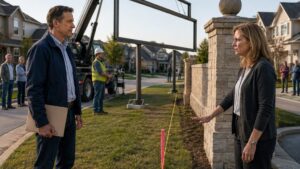
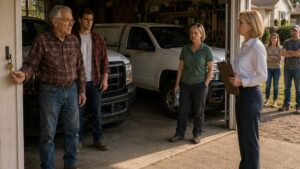
“I was coming to speak with you,” Kimberly Roberts said.
She stood at the end of his driveway in a white polo shirt, navy shorts, and running shoes too clean for the gravel shoulder. Her HOA badge was clipped near her collar. She had the composed expression she used at meetings when someone had exceeded their allotted three minutes.
Paul left the notice attached to the gate.
“You approved excavation?”
“Site preparation,” she corrected. “The grading permit is complete.”
“That wasn’t my question.”
Kimberly drew a breath through her nose. “Your written objection was reviewed. The board voted six to one to proceed.”
“Did the board complete a cultural-resource review?”
Her fingers tightened around the clipboard.
It was slight, almost nothing, but Paul saw it.
“A what?”
“A review of historic or archaeological resources before ground disturbance.”
Kimberly glanced over the fence. The rise was small enough that most residents treated it as a landscaping inconvenience. Its grass was uneven. The fence needed paint. The old marker inside had lost nearly all its lettering.
“It’s an empty field, Paul.”
“No,” he said. “It’s a parcel no one has bothered to understand.”
Her expression sharpened. “We have a survey. We have engineering drawings. We have county approval for grading and drainage. Jeffrey has spent nine months assembling the project.”
“Then the cultural review should be easy to produce.”
“What exactly are you suggesting?”
“That the rise was recorded decades ago as a possible ceremonial site.”
Kimberly looked toward the stone marker again, this time with irritation instead of indifference.
“You’ve been saying that since the recreation committee proposed the courts.”
“I said the board should verify it.”
“And every time this neighborhood tries to improve something, you produce another reason to wait.”
Paul looked past her toward the row of houses curving around the common parcel. A child’s bicycle lay on one lawn. Two plastic campaign signs for the court project still stood near the clubhouse entrance: MORE SPACE FOR FAMILIES. INVEST IN OUR COMMUNITY.
Kimberly followed his gaze.
“Families have asked for this for four years,” she said. “We have residents driving twenty minutes to use public courts. We have younger homeowners asking why their dues only maintain things built before they moved here. The contractor’s price expires Monday.”
“Deadlines do not change the ground.”
“No, but delays change costs.”
She flipped open the clipboard and removed a copy of his objection. His letter occupied one page. It stated that the parcel might contain a recorded cultural resource and requested that the board verify all applicable review requirements before construction.
He had not attached the inventory page. He had not included the old map. He had not mentioned the grant number he remembered seeing in the subdivision’s drainage files.
Kimberly tapped the letter.
“This says ‘might.’ It says ‘verify.’ It does not identify an active restriction, a recorded easement, or a stop-work order.”
“Because I don’t issue stop-work orders.”
“Then what do you want me to do with this?”
“Ask the county whether cultural review was completed.”
“We already asked whether permits were complete.”
“That is not the same question.”
Her mouth tightened. “You know, this is exactly the problem. You speak as if everyone else is too careless to understand the words you’re using, but you never say what you actually want.”
Paul felt the old answer rise in him: I want you to read before you authorize machinery.
Instead he said, “I want the board to avoid a mistake.”
“The excavator arrives Saturday.”
For several seconds neither of them moved. A lawn sprinkler clicked across the street. Water struck the curb in brief silver arcs.
Kimberly closed the clipboard.
“If you have an enforceable document, submit it by noon tomorrow. Otherwise, stay outside the marked work zone.”
She reached for the notice as though to straighten it, then thought better of touching the gate.
“Seven o’clock?” Paul asked.
“Yes.”
“And you intend to grade the rise itself?”
“The final layout shifts the west court six feet. Jeffrey says the slope has to be cut down.”
Paul looked through the fence. The weathered marker stood near the western edge.
“Then the board should be very certain.”
“We are.”
She walked away before he could answer.
Paul carried the groceries inside. Angela was at the kitchen counter slicing peaches into a glass bowl. She looked up when he entered without the reusable bag.
“What happened?”
“They posted the construction notice.”
“For when?”
“Saturday.”
Her knife stopped.
Paul returned for the groceries, then came back with the notice folded under his arm. He placed it beside the fruit bowl. Angela read it while he put milk in the refrigerator.
“You told them about the inventory.”
“I told them the parcel may be recorded.”
“That isn’t what I asked.”
He closed the refrigerator door.
Angela had lived with him long enough to recognize the difference between his silences. Some meant he was thinking. Some meant he believed the other person should already understand.
She set down the paper. “Show me what you sent.”
Paul went to the small room off the hallway that had once been their daughter’s bedroom and was now lined with file boxes. He brought back a printed email and placed it on the counter.
Angela read the single-page objection. Her eyes moved steadily to the end.
“Where is the county sheet?”
“I didn’t attach it.”
“The one from 1978?”
“Yes.”
“Why not?”
“Because it is an inventory entry, not a final determination.”
“It says the rise may be a ceremonial earthwork.”
“It says ‘reported.’ The file was incomplete.”
“But it is the reason you asked for the review.”
“Yes.”
Angela looked toward the back windows. From the kitchen, the top of the white fence was visible beyond their lilac hedge.
“Then why didn’t you give it to them?”
Paul folded the construction notice along its existing crease.
“They have a board attorney. They have a project manager. They certified the permits were complete.”
“That still isn’t an answer.”
He carried the notice to the desk in the adjoining room. On its surface lay the yellowed county inventory page, folded inside a clear sleeve. Beside it sat the small brass key to the white gate.
Angela followed him.
She looked at the inventory, then at the email he had sent, comparing what he possessed with what he had chosen to share.
“You wanted Kimberly to ask the right question,” she said.
“I wanted the board to perform its duty.”
“And if they didn’t?”
Paul picked up the gate key, feeling its worn teeth press into his palm.
“They were warned.”
Angela’s face changed—not with anger, but with something that made him look away.
“You didn’t warn them with everything you knew,” she said.
Outside, the construction notice snapped once against the white gate.
Chapter 2: What Paul Chose Not to Send
Angela found the map beneath Paul’s closed laptop at eleven twenty that night.
He had gone upstairs, saying he wanted to sleep before deciding whether to contact the county in the morning. But the desk lamp remained on, and the edge of a folded sheet protruded from beneath the computer.
She pulled it free.
The photocopy showed the subdivision before most of the houses existed. Roads were thin black lines. Drainage channels were marked in blue pencil. Near the Miller lot, an oval had been drawn around the rise with a note typed in fading ink:
Reported earthwork or ceremonial feature. Field confirmation incomplete.
A county inventory number appeared in the margin.
Beside the map lay the brass gate key and Paul’s handwritten list of contacts. One number had been crossed out. Another was underlined twice.
Angela heard him on the stairs.
“You said you were going to bed.”
“I was.”
He came into the room wearing his reading glasses and carrying a glass of water. His gaze went directly to the map in her hands.
“You hid it under the laptop?”
“I was reviewing it.”
“You closed the laptop on top of it.”
Paul set down the water. “The wording is uncertain.”
“The wording is enough to ask somebody to stop for a day.”
“It may be enough to trigger a records search. That does not mean it automatically prohibits work.”
“Then why are you acting as if Saturday will prove you right?”
He removed his glasses and cleaned them with the edge of his shirt.
“I am not acting.”
“That is exactly what you’re doing.”
Angela lowered her voice, though there was no one else in the house.
“You spent thirty-two years telling agencies that early consultation mattered. Now you have a document that might prevent a machine from reaching that fence, and you are measuring how little you are required to say.”
Paul replaced his glasses.
“The board dismissed me before reviewing anything.”
“So this is about Kimberly.”
“No.”
“Then send her the map.”
He looked at the inventory number, not at Angela.
“If I send an unresolved entry without context, they’ll accuse me of exaggerating it.”
“They already accuse you of exaggerating.”
“They need to ask the county directly.”
Angela folded the map along its old crease. “You want them to discover that they should have listened.”
“I want them to follow the process.”
“Those are not always the same thing.”
The next morning, Angela drove to the county records office without waiting for him.
Paul sat beside her, silent through most of the twenty-minute trip. He had called the planning clerk shortly after breakfast and requested access to the old subdivision file. The clerk had sounded doubtful until Paul gave the inventory number.
The records office occupied the ground floor of a brick county building built before security glass had become standard. A clerk met them at a counter carrying a gray archival box.
“You’re asking about the common parcel off Willow Creek Drive?” she said.
“Yes,” Paul replied.
The clerk set the box down. “The electronic index has almost nothing. Most of this was scanned badly or never scanned.”
She lifted out a thin file. Inside were two photographs of the rise taken before the subdivision’s streets were paved. The fence did not yet exist. The mound appeared broader without houses around it.
Angela studied the photographs.
“So someone knew about it.”
“Someone recorded a report,” the clerk said carefully. “That is not the same as confirmation.”
She found the inventory sheet and compared it to Paul’s copy.
“This was entered in 1978 after a local survey. The follow-up field visit was postponed. I don’t see a closure memo.”
Paul leaned closer. “No determination of eligibility?”
“Not in this file.”
“No consultation record?”
“Not here.”
The clerk searched another folder, then shook her head.
Angela felt both relief and disappointment. The rise had not been invented by Paul’s memory, but neither had the county placed a clear protective label on it.
“Would this stop construction?” she asked.
“By itself? Probably not.”
Paul’s jaw shifted slightly.
The clerk continued. “It would justify asking whether any later project created a review obligation. County permits usually address grading, drainage, erosion control. Cultural review can come through a different process.”
“What kind of later project?” Angela asked.
“State or federal involvement. Certain funding. Certain permits. Sometimes a local preservation ordinance, though I don’t believe your township has one.”
Paul’s attention moved to the larger subdivision box.
“Do you have the original stormwater approvals?”
“Possibly in engineering.”
He asked for the project number.
The clerk gave him a form to complete, then glanced at the wall clock.
“I can request the engineering archive, but it may take several days.”
“The work begins tomorrow morning,” Angela said.
The clerk looked uncomfortable. “Then I would advise the association to contact the county planning department and describe the concern precisely. I can note that the site inventory remains unresolved, but I cannot issue a stop from this desk.”
Paul thanked her.
Outside, Angela stopped beneath the concrete overhang while Paul carried the copies to the car.
“You heard her,” he said. “The inventory alone may not stop anything.”
“She also said the board should ask the right question.”
“I already told Kimberly that.”
“You told her to ask. You didn’t tell her why.”
Paul unlocked the car.
Angela did not get in.
“Call her now.”
He looked across the parking lot. “Kimberly has the same access to county staff.”
“She doesn’t have the inventory number.”
“She can request it.”
“By tomorrow morning?”
His silence answered.
A county truck backed out of a maintenance bay, beeping at regular intervals. Angela waited until it turned onto the street.
“What are you protecting?” she asked.
“The site.”
“No. What are you protecting in yourself?”
Paul opened the passenger door for her. “We should go home.”
By noon, Kimberly had sent a neighborhood-wide email confirming the construction schedule. It thanked residents for their patience and described the project as fully permitted. A second paragraph warned that unauthorized interference with contractors could expose homeowners to liability.
Paul read it at the dining table.
Angela stood behind him.
“Are you going to answer?”
“I will send the inventory number to the county.”
“To Kimberly?”
“To the county.”
He typed a short email to the planning department, identifying the parcel and asking whether cultural-resource review had been considered. He attached the old inventory sheet.
Angela watched the cursor hover over the recipient line.
“You left the board off.”
“They’ll be contacted if necessary.”
“If necessary,” she repeated.
Paul sent the message.
That afternoon, he went to the garage to find a file box labeled WILLOW CREEK—ORIGINAL DEVELOPMENT. Angela returned to the desk to gather the loose papers.
Under the legal pad, she found a page in Paul’s handwriting.
At the top was the subdivision parcel number. Beneath it, he had written:
2008 stormwater grant—federal pass-through?
A string of letters and numbers followed.
Angela carried the note to the garage. Paul was kneeling beside an open box, sorting old closing documents.
She held the page where he could see it.
“What is this?”
He stayed still.
“The subdivision received drainage funding after the creek flooded,” he said.
“Federal funding?”
“Possibly passed through the state.”
“And that could require the review the clerk described.”
“It could.”
“You already knew that yesterday.”
“I remembered there had been a grant. I did not know the funding source.”
“But you knew enough to write down the number.”
Paul rose slowly, one hand on the shelf.
Angela looked toward the garage window. Across the side yard, beyond the lilacs, the white gate stood closed. The notice remained clipped to it.
“Why does this number matter more than the map?” she asked.
Paul took the paper from her, but he did not answer.
Chapter 3: The Bucket Stopped Above the Gate
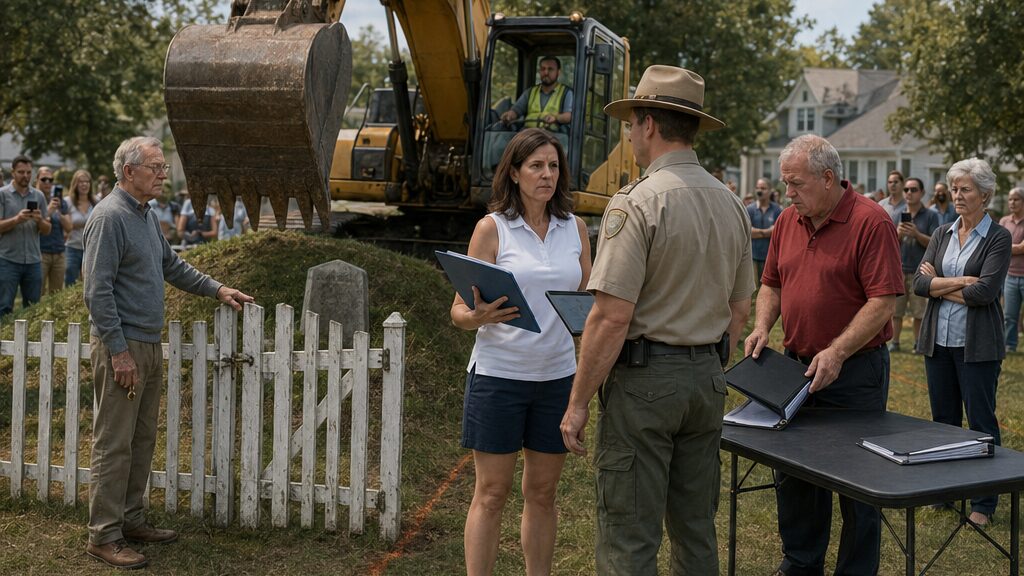
The excavator bucket began to descend just as Paul Miller inserted the brass key into the white gate.
Kimberly saw him from beside the folding registration table and felt irritation arrive before fear. Nearly thirty residents had gathered along the marked boundary, some carrying coffee, others holding phones. The contractor had parked the yellow machine on plywood mats to protect the curb. Orange paint outlined the future courts across the grass.
Paul turned the key.
“Mr. Miller,” the excavator operator called through the open cab window, “you need to stay outside the work zone.”
Paul opened the gate inward.
Kimberly crossed the grass quickly, the blue project clipboard pressed against her side.
“Paul, close that.”
He stepped through the gate but stopped beside the old marker.
“You posted this as common property,” he said. “I’m not interfering with the machine.”
“You are inside a restricted area.”
“I’m opening an existing gate.”
The operator kept the bucket suspended several feet above the fence line.
Residents murmured behind Kimberly. She could feel their attention shifting away from the project banners and toward the narrow gate, the old man beside the marker, and the machine hanging above both.
Jeffrey Hill approached carrying the black permit binder.
“We went over this,” he said. “County grading approval, erosion plan, contractor insurance. Everything is here.”
Paul looked at Kimberly, not Jeffrey.
“Read the cultural-review approval number.”
Someone near the table laughed uncertainly.
Kimberly opened the clipboard. The top pages were the schedule, board authorization, contractor certificate, and county grading permit.
“We have all required approvals.”
“Then read the number.”
“This is not your hearing.”
“No,” Paul said. “It is your excavation.”
Heat rose along Kimberly’s neck. She had spent weeks calming residents over dues, noise, parking, and the removal of three trees. The courts were supposed to be the first visible proof that the board could finish something.
She turned to the operator.
“Hold position.”
The bucket stopped moving.
A tan county vehicle pulled to the curb.
Kimberly stared at it. “Did you call someone?”
Paul did not answer.
A county heritage officer stepped out wearing field boots and carrying a tablet. He spoke briefly to the operator before approaching the gate.
“Who is the project representative?”
Kimberly raised her hand. “I’m the HOA president.”
“I received a notice regarding a potentially recorded cultural resource within the disturbance area.”
Paul stood quietly inside the fence.
Kimberly forced her voice to remain even. “The county issued the grading permit.”
The officer nodded. “Grading approval does not necessarily complete every review connected to the project. May I see the full authorization packet?”
Jeffrey offered the black binder.
The officer began turning pages. Kimberly watched his finger pause at the drainage drawings.
“Is this work funded through the Willow Creek stormwater improvement award?”
“It’s a recreation project,” she said.
Jeffrey answered at the same time. “The drainage portion is.”
The officer looked from one to the other. “What portion?”
Jeffrey pointed to the plans. “The courts require new runoff controls. We bundled the swale replacement and catch basin work into the same contract.”
“Funding source?”
“State pass-through grant.”
The officer’s attention sharpened. “Do you have the environmental and cultural-review clearance associated with that award?”
Jeffrey opened the binder wider.
“There should be a county determination behind the engineering approval.”
He searched the back section, then the front. Plastic sleeves clicked against the rings.
The officer turned to Kimberly. “Do you have a consultation reference number?”
She looked down at the blue clipboard. For the first time, its neat order felt absurd. Meeting minutes. Vote tally. Contractor schedule. Resident notification. Every page proved that the board had acted. None proved it had asked the question now holding the excavator in the air.
“We were told the permits were complete,” she said.
“By whom?”
“Our project manager.”
Jeffrey’s face hardened. “The engineering office signed off.”
“Engineering review and cultural review are separate,” the officer said. “Until I confirm the funding conditions and the status of this inventory entry, no ground disturbance can occur within the marked area.”
A recreation-committee resident called from behind the barrier. “Is this because of Paul?”
The officer glanced toward the crowd. “This is because the record requires clarification.”
Kimberly heard several phones begin recording.
She looked at Paul. He had not smiled. That made the moment worse. He stood beside the marker with one hand resting on the open gate, as composed as if he had been waiting for someone to use the correct vocabulary.
“You knew the grant mattered,” she said.
“I knew it might.”
“You could have told us.”
“I asked whether the review was complete.”
“That is not the same as telling us the project could be stopped.”
Paul’s gaze moved briefly toward Angela, who stood near their hedge with her arms folded.
“No,” he said. “It isn’t.”
The answer unsettled Kimberly more than denial would have.
The heritage officer walked through the gate and crouched beside the marker. Grass covered its lower edge. He brushed away loose stems without touching the stone.
“Has anyone entered this enclosure for documentation recently?”
“No,” Kimberly said.
Paul said, “Not officially.”
The officer photographed the marker and the contour of the rise. Then he called the planning department. His side of the conversation consisted mostly of dates and file numbers. At one point, he repeated the grant identifier Paul had written in his notes the night before.
Kimberly turned sharply.
“How did you get that number?”
Paul did not answer.
The officer ended the call.
“The stormwater award included federal pass-through funds,” he said. “The county is checking whether required review was completed when the current construction scope was approved. The old site inventory also appears to remain unresolved.”
A silence settled across the staging area.
The machine idled, its engine sending a low vibration through the plywood mats.
The officer addressed the operator. “Raise the bucket and shut down.”
The operator complied. The steel teeth lifted away from the gate.
For one brief second, Kimberly felt relief. Nothing had been disturbed. No one had been hurt. The problem might still be reduced to missing paperwork.
Then the officer added, “The stop applies to the entire contract area until further notice, including the drainage work.”
Jeffrey closed the binder too quickly.
Kimberly looked at him. “You said the drainage approval was final.”
“It was.”
“He just said it wasn’t.”
“He said they’re checking.”
Residents had begun talking over one another. Someone asked whether dues would increase. Another wanted to know if the contractor would charge a delay fee. A man near the curb accused Paul of sabotaging the neighborhood.
Paul stepped back through the white gate and locked it.
The small click of the key was nearly lost beneath the voices.
Angela came toward him.
“You got the stop,” she said quietly.
“The county issued the stop.”
“You knew they would.”
“I suspected.”
She searched his face. “Are you pleased?”
Paul looked at the raised bucket, then at Kimberly standing beside the folding table as residents pressed questions toward her.
“No,” he said.
But Kimberly saw something in the way he placed the key in his pocket: not pleasure exactly, but confirmation.
The heritage officer asked her and Jeffrey to surrender copies of the complete project file. Kimberly handed over the clipboard. Jeffrey opened the black binder on the table and began removing duplicate contracts.
A folded printout slipped from the rear pocket.
Jeffrey caught it before it fell.
Kimberly saw a county email header across the top and the words REQUEST FOR CULTURAL RESOURCE CLARIFICATION in the subject line.
Their eyes met.
Jeffrey folded the page once, slid it beneath his contractor invoice, and closed the binder before the officer turned back.
Kimberly said nothing.
The excavator engine died, leaving the white gate and the old marker in a sudden, accusing quiet.
Chapter 4: The Grant Buried Inside the Project
Cynthia Walker saw Paul’s name before she saw the chain.
Someone had driven two wooden stakes beside the white gate and stretched a hand-painted sign between them.
PAUL MILLER COST US OUR COURTS.
A thick steel chain now looped through the gate latch and around the fence post. A laminated HOA notice beneath it said the parcel had been secured for public safety.
The excavator remained where the operator had shut it down Saturday morning. Its bucket rested on the plywood mats, harmless now, though the machine still made the small fenced rise look trapped.
Cynthia stopped on the sidewalk with two grocery bags cutting into her fingers.
A neighboring homeowner stood near the sign, taking a photograph.
“About time people knew who did this,” he said.
Cynthia set the bags down. “The county stopped the work.”
“Because Paul called them.”
“He raised a question.”
“He always raises a question.”
The man walked away before she could answer.
Cynthia had supported the courts. She had signed the recreation committee’s petition and spoken at two meetings about her grandchildren needing somewhere close to play. Paul had opposed the widening of the clubhouse parking lot three years earlier and questioned the removal of old maples near the drainage swale. She had come to think of him as a person who treated caution like a private virtue everyone else was required to finance.
But the chain bothered her.
Paul had kept the gate key for years because the HOA never replaced the rusted lock. Now the board had sealed the gate as though he were the threat to the ground behind it.
She carried her groceries home, put away the cold items, then drove to the county planning department.
The lobby was crowded with contractors carrying rolled drawings and homeowners clutching property surveys. Cynthia waited beneath a television displaying permit numbers until a planning clerk called her forward.
She gave the subdivision name and the stormwater grant number from the emergency notice the HOA had emailed Saturday afternoon.
The clerk’s expression changed as soon as she entered it.
“This project is under an administrative hold,” she said.
“I know. I’m trying to understand why the recreation courts are connected to a drainage grant.”
The clerk turned her monitor slightly, though not enough for Cynthia to read the screen.
“The original award was for drainage improvements after repeated flooding along the creek corridor. Your association later requested approval to combine portions of that work with redevelopment of the common parcel.”
“So the courts were paid for by the grant?”
“Not exactly. The grant covered eligible drainage components. The association funded the recreational surface and equipment. But they were bid as one construction package.”
“And that matters because?”
“Because the full scope was reviewed as one undertaking.”
Cynthia recognized the word from years of board minutes. Undertaking sounded harmless when typed in a packet. Here, it seemed to carry weight.
“Was a cultural review required?”
The clerk chose her words carefully. “The county is determining whether the earlier review adequately considered this parcel. The site inventory should have been reconciled before bidding if the disturbance area included the recorded rise.”
“Should have been?”
“Yes.”
“Then Paul was right.”
“The concern was valid,” the clerk said. “That does not establish what the site is, and it does not determine the final project outcome.”
Cynthia leaned against the counter. “Can they just cancel the courts?”
“They can, but there may be contract costs. There may also be consequences if grant deadlines are missed.”
“How much?”
“I can’t answer that.”
On the drive home, Cynthia passed the clubhouse. Through its glass doors she saw Kimberly and Jeffrey seated at a folding table with papers spread between them. Jeffrey pointed repeatedly at a page. Kimberly sat with her hands pressed to her temples.
By Sunday evening, the neighborhood email list had become a courtroom without rules.
One resident demanded that Paul reimburse the contractor’s delay fee. Another accused the board of misusing grant money. A recreation-committee member posted that children were being punished over “an unverified pile of dirt.” Someone else replied with a photograph of the old marker and asked whether children needed courts badly enough to risk disturbing graves.
Paul answered none of it.
Cynthia went to the Miller house near dusk. Angela sat on the porch steps with a cup of tea. Paul stood at the railing, looking toward the chained gate.
“That sign should come down,” Cynthia said.
Paul glanced at her. “I didn’t put it up.”
“I know.”
Angela shifted to make room, but Cynthia remained standing.
“I spoke to county planning. They said consultation should have happened before bidding.”
Paul’s face revealed no surprise.
“You knew that,” Cynthia said.
“I suspected it.”
“You use that word often.”
“It is accurate.”
She looked at the chained gate. “People think the stop-work order means the grant is lost.”
“It may be.”
“And if it is, the association could owe the contractor and still have to complete the drainage work.”
“Yes.”
Cynthia waited for him to add something reassuring. He did not.
“You could tell people you worked in compliance,” she said.
“That would not change the documents.”
“It might change how they treat you.”
Paul’s gaze stayed on the mound. “That is not the same as changing what happened.”
Angela looked down into her cup.
Cynthia understood then that the silence between them had begun before she arrived.
On Monday morning, Kimberly called an emergency meeting of former and current board officers to reconstruct the project history. Cynthia had served as secretary two years earlier, so she went to the clubhouse expecting to answer questions about archived minutes.
Jeffrey had already arranged three binders across the table.
“We need facts, not theories,” he said when she entered.
Kimberly looked exhausted. “We’re trying to identify when the heritage issue first appeared.”
Jeffrey pushed a binder toward Cynthia. “It didn’t. Not formally.”
Cynthia sat down.
The minutes from her term were stored on an old association laptop in the locked cabinet. She connected the charger and searched by parcel number, then by “mound,” “historic,” and “survey.”
Nothing appeared.
Jeffrey watched over her shoulder. “Because nobody raised it.”
She tried “county inquiry.”
A file opened from a closed executive session held twenty-six months earlier. Cynthia remembered the meeting only vaguely. It had concerned grant eligibility, drainage easements, and a resident complaint about removing the fence.
Halfway down the second page, one line stopped her.
County staff requested clarification regarding an unresolved heritage inventory entry associated with the western common parcel. Project manager to follow up before final design.
Cynthia read it twice.
Kimberly came around the table. “Who was project manager then?”
No one answered.
The minutes listed Jeffrey.
He leaned over Cynthia and tapped the screen.
“That was preliminary. The design changed after that.”
“Did you follow up?” Kimberly asked.
“I spoke with engineering.”
“That isn’t what the minutes say.”
“They asked for clarification. They didn’t issue a requirement.”
Cynthia scrolled to the next meeting.
The heritage inquiry was absent.
It was absent from every later set of minutes too.
She looked toward the window. From the clubhouse, the chained white gate was visible across the common lawn, with Paul’s name still painted beside it.
“The board knew there was a question two years ago,” Cynthia said.
Jeffrey closed the laptop.
“No,” he replied. “The board knew there was an email.”
Chapter 5: The Email Jeffrey Said Never Arrived
“The email was not a directive,” Jeffrey said. “It was a staff question.”
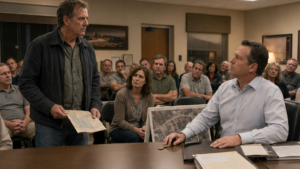
Kimberly stood at the end of the clubhouse table while residents filled every chair and lined the walls. The emergency meeting had not officially begun, but Jeffrey was already defending himself.
The blue project clipboard lay in front of her. She had carried it to the fenced parcel that afternoon, intending to remove the construction notice. Instead, she had found the gate chained and the protest sign still standing. She had leaned the clipboard against the fence while she cut the plastic clips from the notice.
For the first time, she had understood how thin the clipboard was compared with the ground it claimed to authorize.
Now the county email appeared on the projection screen behind Jeffrey.
REQUEST FOR CULTURAL RESOURCE CLARIFICATION.
The subject line was impossible to soften.
Jeffrey pointed to the first paragraph. “Read the language. ‘Please confirm whether the recorded inventory feature falls within the revised disturbance area.’ That is not a stop. That is not a denial.”
Cynthia sat near the front with the old minutes printed in her lap.
“It assigned follow-up to you,” she said.
“I followed up with engineering.”
“Where is the response?”
“There were phone calls.”
“Documented where?”
Jeffrey’s eyes narrowed. “Not every conversation becomes a memo.”
Kimberly struck the gavel once. The room quieted unevenly.
“The meeting is now in order.”
She read the county’s temporary hold notice aloud. It prohibited construction within the contract area until review of the old inventory and funding requirements was complete. The contractor had submitted a delay claim. The grant administrator had warned that failure to meet the seasonal drainage deadline could jeopardize reimbursement.
Each sentence reduced the room’s anger to numbers.
A resident near the back asked, “What does this cost us?”
“The contractor is currently claiming eighteen thousand dollars,” Kimberly said. “That figure may change.”
The room broke open again.
She raised the gavel but did not strike it. “There is more.”
She explained that the grant had been intended for drainage improvements after flooding damaged three lower properties. The courts had been added later because the common parcel required regrading and the board believed combining the work would save mobilization costs.
That part had once sounded efficient. Now it sounded like a door through which every liability had entered.
Jeffrey leaned toward his microphone.
“We combined compatible scopes. That is normal project management.”
Paul sat beside Angela in the second row. He had brought no binder, no title card, no visible proof of his former work. When several residents turned toward him, he kept his hands folded.
A recreation-committee member stood.
“Paul knew all this and waited until the equipment arrived. Why aren’t we discussing that?”
“We will,” Kimberly said.
Paul looked at her then.
She had spent three days replaying their exchange beside the gate. He had asked for the approval number with the precision of someone who knew it would not exist. She hated that he had withheld the explanation. She hated more that she had used his manner as permission not to investigate.
The HOA attorney sat at a side table. Kimberly turned to him.
“Please summarize the board’s exposure.”
He adjusted his glasses.
“If the cultural inquiry was received and not resolved, that may affect representations made in the grant and construction documents. The association’s responsibility will depend on who knew what, when they knew it, and whether the project could reasonably have been paused.”
Jeffrey crossed his arms. “The president signed the authorization.”
The words landed with deliberate force.
Kimberly looked at him.
“You told me the file was complete.”
“I told you engineering had approved the design.”
“You said all required reviews were finished.”
“I said the permits were finished.”
The distinction was narrow enough to pass through a locked gate.
Cynthia stood and carried the printed minutes to the front table.
“These minutes show the board was told about the unresolved inventory two years ago.”
Jeffrey did not take them.
Kimberly read the line Cynthia had highlighted. Beneath it was her own name in the attendance list. She had been vice president then.
A memory returned—not of the email, but of Jeffrey saying the county was “chasing a dead file” and that he would handle it. She had accepted the phrase because the drainage grant was already months behind.
“I was in that meeting,” she said.
The room became still.
Jeffrey’s face changed. “You don’t remember the discussion.”
“I remember enough to know there was uncertainty.”
“Uncertainty is not a prohibition.”
“No,” Kimberly said. “But it was enough to ask before I signed.”
That admission cost her something visible. Her shoulders lowered, as if she had stopped holding up a structure no one else could see.
Jeffrey pushed back from the table.
“You want to make me the reason this failed? Fine. Tell them about the numbers.”
He turned toward the residents.
“The original drainage estimate was short by nearly sixty thousand dollars after material prices rose. The board had three choices: raise dues, abandon the grant, or combine mobilization with the recreation project. People in this room threatened to vote out anyone who proposed another assessment.”
Several residents looked away.
Jeffrey continued. “I found a way to complete the drainage work and give the neighborhood something it had asked for. The county email came before the final court alignment. Engineering shifted the design. I believed the question no longer applied.”
“Then why was the email removed from the binder Saturday?” Kimberly asked.
Jeffrey stared at her.
A murmur passed through the room.
“I saw you fold it under the invoice,” she said. “Before the officer collected the file.”
His jaw tightened. “Because I knew exactly what everyone would do with an informal email once the equipment was stopped.”
“Which is?”
“Pretend it was a warning written in fire.”
Cynthia placed the minutes beside the blue clipboard.
“It was a warning written in ordinary words,” she said. “That was the problem.”
The HOA attorney asked Jeffrey to provide his complete project archive by the next morning. Jeffrey agreed, but only after insisting the county had never ordered him to stop.
Kimberly understood his reasoning because she had used a version of it herself. No one had issued the perfect sentence. No one had taken responsibility away from them. They had treated the absence of a command as proof of safety.
She looked toward Paul.
“You requested the cultural review on Thursday,” she said. “When did you first identify the grant connection?”
Paul did not move.
Angela did.
She stood slowly beside him.
Paul turned toward her. “Angela.”
“No,” she said, not loudly. “They are asking the right question now.”
The room’s attention shifted from Kimberly and Jeffrey to the couple in the second row.
Angela faced the board.
“Paul found the old subdivision grant number before construction began. He understood that federal pass-through funding might connect the drainage contract to a cultural-review requirement.”
Kimberly felt the last simple version of the story disappear.
“When?” she asked.
“Thursday night,” Angela said. “Possibly earlier.”
A resident near the wall whispered, “He let them bring the machine.”
Paul rose.
His face was controlled, but not calm.
“I notified the county Friday morning.”
“Did you notify the board?” Kimberly asked.
“No.”
“Did you tell me the grant could trigger a separate review?”
“No.”
“Why?”
Paul looked at Angela. She remained standing, but she did not rescue him.
The room waited.
He could no longer answer with a document, a permit number, or a carefully limited phrase.
Kimberly closed the blue clipboard.
“We will reconvene tomorrow night,” she said. “Mr. Miller will explain why he allowed this board to reach the gate.”
Chapter 6: The Truth Angela Would Not Soften
The applause began when Paul stood, and Angela did not join it.
It came from only part of the packed clubhouse—residents who believed he had saved the mound, residents who wanted someone simpler to praise than a county process, residents relieved that the excavator had not broken the soil.
Paul waited until the clapping faded.
Angela remained seated in the front row, her hands folded over her purse.
The brass gate key rested in his pocket.
Kimberly sat behind the blue clipboard. Jeffrey had provided three storage boxes and an electronic archive that morning, but his chair at the board table was empty. The HOA attorney occupied one end. Beside him sat a tribal historic-preservation representative invited by the county to explain the consultation process.
Paul approached the microphone.
“My name is Paul Miller,” he said. “I worked for more than thirty years in federal cultural-resource compliance.”
A murmur moved through the room.
He saw the immediate change in several faces: surprise, satisfaction, vindication borrowed from a profession they had not known he possessed.
“I reviewed agency projects involving historic properties, burial concerns, and consultation duties. I retired six years ago.”
Someone near the back said, “So you knew exactly what they were doing.”
Paul looked toward the voice.
“I knew what questions should have been asked.”
“That’s not the same answer,” Kimberly said.
“No.”
She leaned closer to her microphone. “When did you believe the grant might require review?”
“Thursday evening, I remembered the subdivision had received stormwater funding. That night I located the grant number. Friday morning, Angela and I confirmed that the old site inventory remained unresolved. I sent the inventory to the county.”
“But not to the board.”
“Correct.”
“Why?”
He removed the gate key and placed it on the table beside the microphone.
The small piece of brass looked insignificant under the fluorescent lights.
“Because I had already warned the board,” he said.
Kimberly’s expression did not change. “That explains what you did. It does not explain why.”
Paul felt Angela’s attention without looking at her.
He had spent his career teaching people to separate personal intent from procedural fact. Intent did not cure a missed review. Good motives did not restore disturbed ground. The discipline had served him well whenever the person under examination was someone else.
“When I was younger,” he said, “I worked on a transportation project involving a site that local records described as uncertain. The agency completed its paperwork. We consulted late because the schedule was under pressure and everyone believed later was still adequate.”
The room had gone quiet.
“No remains were disturbed,” Paul continued. “But descendant representatives were brought in after decisions had already narrowed. We asked them to comment on choices they had not helped shape. The project complied on paper. It did not earn trust.”
The tribal representative watched him steadily.
“I signed that file,” Paul said. “For years, I told myself the process had succeeded because construction paused and the legal requirements were eventually met. That was not the whole truth. We had treated consultation as an obstacle to clear instead of a relationship that should begin before the plans hardened.”
He touched the key with one finger.
“When Kimberly dismissed the inventory concern, I recognized the same habit. I also recognized something in myself that I did not want to name.”
Angela finally looked up at him.
“I wanted the board to be forced to listen,” Paul said. “Not only persuaded. Forced.”
The words produced no dramatic reaction. They settled slowly, changing the shape of the room.
A resident who had applauded lowered his hands into his lap.
Paul continued. “I believed that if I gave Kimberly every answer, she would treat the information as one more favor extracted from the difficult neighbor beside the field. I wanted the missing approval discovered in public. I wanted the machine stopped where everyone could see who had failed.”
Kimberly’s voice was low. “You used the site to teach us a lesson.”
“Yes.”
Angela’s eyes closed briefly.
“I believed I was protecting it,” Paul said. “I was also protecting my pride.”
The HOA attorney asked, “Could the project have been stopped before Saturday if you had sent the grant record directly to the association?”
“I cannot say with certainty.”
“Could it have increased the chance?”
“Yes.”
That answer hurt more than accusation.
The tribal representative leaned toward her microphone.
“May I clarify something?”
Kimberly nodded.
“Nothing presented so far establishes the exact nature of the rise. The county inventory created a responsibility to investigate. The funding connection created a responsibility to review and consult. Those duties matter even when the final finding is uncertain.”
She looked toward Jeffrey’s empty chair, then Kimberly, then Paul.
“This is not a contest over who gets to control the story of the parcel. Not the board. Not one homeowner. Not the county. Consultation is not punishment theater.”
Paul felt the phrase reach him with precision.
A resident asked whether the HOA should be sued. Another demanded Jeffrey’s removal. The representative raised one hand.
“Accountability may be necessary. But removing one board member does not create a responsible process. Nor does placing permanent control in the hands of the person who happened to know the most.”
Paul looked at the gate key.
For years, he had kept it because the old lock jammed and no board officer wanted the nuisance. He had cut the grass inside the fence twice each summer. He had straightened the marker after winter frost. Those acts had become, in his mind, a kind of claim.
Angela stood.
“I told Paul to let the county see what the board had failed to see,” she said. “I did not understand that he meant to let the equipment arrive.”
Paul faced her.
“I thought he had given them enough,” she continued. “When I learned he had not, I stayed quiet until Saturday because part of me wanted Kimberly embarrassed too.”
Kimberly looked at her.
Angela did not look away. “That was not protection either.”
No one applauded.
The absence felt honest.
Kimberly opened the clipboard and removed the project summary.
“The contractor will release the association from the court construction if we pay documented mobilization costs,” she said. “The grant administrator may allow the drainage funds to be redirected to the original creek corridor, but a revised plan is due within ten business days.”
“That would cancel the courts,” a committee member said.
“Yes.”
“And the money we already spent?”
“Some will be lost.”
The room shifted toward the practical pain of consequence.
Paul picked up the key, then stopped. Instead of returning it to his pocket, he slid it to the center of the board table.
“There is another option for the parcel,” he said.
Kimberly regarded him carefully. “Which is?”
“Freeze all recreational development within the fenced area. Complete the cultural review with the county and appropriate tribal representatives. Redirect the grant to drainage work outside the parcel. Establish a preservation agreement that identifies who may enter, who maintains the fence, how records are held, and how future decisions are reviewed.”
“Under your control?” someone asked.
“No.”
The word came more easily than he expected.
“Under shared responsibility,” he said. “With independent review before any future ground disturbance.”
Cynthia leaned forward. “Could the association adopt that without waiting for the full site determination?”
The tribal representative answered. “An interim protection agreement could be drafted while consultation continues.”
Kimberly looked at the cancellation estimate, the grant deadline, and the key on the table.
“If I support this,” she said, “the courts end.”
“Yes,” Paul replied.
“So does the project I told everyone would prove this board could deliver.”
Paul could have said that leadership was not measured by delivering the wrong project. The sentence formed, polished and useless.
Instead he said, “Yes.”
Kimberly studied him, perhaps waiting for triumph. He gave her none.
She gathered the pages into one stack.
“I will request the contractor’s final cancellation terms tomorrow,” she said. “I will also ask the grant administrator to review the drainage redirection.”
A recreation-committee member shook her head. “And your position?”
Kimberly’s fingers rested on the blue clipboard.
“That will be addressed after the agreement is decided.”
Paul looked toward Angela. Her face had not softened, but the distance in it had changed. It was no longer a closed door. It was a question he would have to keep answering through action.
The tribal representative reached for the brass key at the center of the table, then stopped short of touching it.
“One person should not have to guard that gate,” she said.
Paul nodded.
For the first time since the notice appeared, he understood that letting go of the key would be harder than winning the argument.
Chapter 7: The Day the Gate Opened Both Ways
Kimberly arrived carrying the signed cancellation order in a clear plastic sleeve.
Six weeks had passed since the excavator stopped above the white gate. The machine was gone now, along with the plywood mats, orange paint, and project banners. Only a pale rectangle in the grass showed where the registration table had stood.
Paul waited beside the fence with Angela, Cynthia, the tribal historic-preservation representative, and several residents. The gate itself had been removed for repair and rehung that morning. Fresh white paint covered the rails, but the old brass latch remained.
Kimberly held out the sleeve.
“The contractor accepted the final settlement,” she said. “No court construction. No claim beyond mobilization and design costs.”
Paul took the document but did not open it.
“And the grant?”
“Conditional approval to redirect the remaining funds to the original creek corridor. The revised drainage plan has to pass tonight.”
Her tone was steady. The strain beneath it was not.
Cynthia looked toward the clubhouse. “Then we should get inside.”
The special meeting began twenty minutes later.
Every chair was occupied, though the room felt different from the packed meeting in which Paul had confessed his silence. There were fewer phones raised. No signs leaned against the walls. On the front table sat three documents instead of the old project binders: the contractor cancellation, the revised drainage plan, and an interim preservation agreement for the fenced parcel.
Kimberly called the meeting to order.
She summarized the proposal without defending it. Grant funds would repair two failing catch basins, restore the creek-side swale, and reinforce the drainage corridor below the lowest homes. No grant money would be used within the fenced rise. Any future ground disturbance there would require independent review and consultation.
“The agreement does not declare what the site is,” she said. “It establishes how the association will act while that question is properly examined.”
The tribal representative sat beside the county heritage officer. Paul had reviewed the draft language, but his name appeared nowhere as owner, guardian, or final authority.
That had required more revision than any legal provision.
Kimberly moved to the first vote: cancellation of the recreation project.
The motion passed by a wide margin.
A few residents voted no. One woman from the recreation committee wiped her eyes but remained seated. No one mocked her. The courts had represented years of promises, and losing them did not become painless merely because the reason was serious.
The second vote concerned the drainage plan.
Before Kimberly could call for discussion, the rear door opened.
Jeffrey Hill entered carrying the black binder.
He had not attended a board meeting since surrendering the project archive. The board had suspended him as treasurer pending removal, but the formal vote had been delayed until the project records were reconciled.
He stood at the back.
“You can’t vote on this plan tonight,” he said.
Kimberly’s hand tightened around the gavel. “You are recognized for three minutes.”
Jeffrey walked forward and placed the binder on the table.
“The revised drainage work was negotiated by people with a direct interest in avoiding blame. The contractor settlement was approved in executive session. The preservation language was drafted with outside parties who are not association members.”
The room shifted uneasily.
Paul felt the familiar impulse to dismiss the objection. Jeffrey had concealed the email. He had removed it from the binder in front of Kimberly. His credibility was damaged by his own choices.
But credibility and procedure were not the same thing.
Jeffrey opened the binder to the bylaws.
“A material change to a capital project requires full notice,” he said. “Residents received the final drainage drawings four days ago, not ten.”
Kimberly looked at the HOA attorney.
He read the cited section, then examined the meeting notice.
“He is correct about the ten-day provision,” the attorney said.
A low wave of frustration moved through the room.
“The grant deadline is Friday,” Cynthia said. “If we postpone, we lose the funding.”
Jeffrey faced the residents. “Then maybe you should ask why the new plan was rushed the same way the old one was.”
Kimberly went pale.
Paul understood the force of the challenge because it was not entirely false. The revised plan was better. Its purpose was necessary. Its process had still been compressed by a deadline.
He rose.
Several people turned toward him with expectation, as though he would find a technical exception.
“We should not vote on the drainage plan tonight,” he said.
Cynthia stared at him. “Paul, the grant expires.”
“I know.”
“The county approved the redirection.”
“That does not suspend the association’s notice rule.”
Jeffrey’s mouth tightened, deprived of the argument he had expected.
Kimberly said, “We could lose nearly two hundred thousand dollars.”
“Yes.”
“And you still think we should delay?”
Paul looked at the three documents on the table. Six weeks earlier, he would have argued that a good outcome justified forcing the board to confront its failures. Now the same reasoning stood in front of him wearing cleaner clothes.
“If we adopt a corrected process by breaking the first rule that becomes inconvenient,” he said, “we have corrected nothing.”
The HOA attorney asked for ten minutes to consult the grant administrator.
The meeting recessed.
People gathered in tense groups. Angela joined Paul near the side wall.
“You may have just cost the neighborhood the drainage work,” she said.
“I may have.”
She studied him. “And you didn’t enjoy saying it.”
“No.”
“That is new.”
Across the room, Kimberly stood alone beside the blue clipboard. She had kept it through every meeting, but the original court schedules had been removed. The top page now contained a checklist for independent review.
The HOA attorney returned with his phone still in hand.
“The grant administrator will accept a provisional board resolution tonight if the membership vote occurs after the full notice period. Contract execution will remain suspended until ratification.”
Cynthia exhaled.
The attorney continued. “If the members reject the plan later, the association may owe additional design costs.”
“That is a real risk,” Kimberly said.
“Yes.”
She looked toward Paul, then Jeffrey.
“We will vote only on the provisional resolution and schedule final ratification after proper notice.”
Jeffrey closed the binder.
For a moment Paul thought he would object again. Instead, Jeffrey nodded once and returned to the back row.
The provisional drainage resolution passed.
Then Cynthia introduced a governance amendment requiring independent review of future projects involving historic records, grant conditions, environmental restrictions, or disputed common property. No project manager could certify their own compliance file. Material inquiries had to appear in board minutes until formally resolved.
The amendment passed without unanimity but with enough votes to adopt it.
Finally, Kimberly read the interim preservation agreement.
The county would maintain the official file. The tribal representative’s office would participate in consultation. The HOA would maintain the fence but could not alter the interior without review. Two keys would be stored in a lockbox accessible under agreed procedures. Paul would no longer hold the only key.
When discussion ended, Kimberly did not immediately call the vote.
“There is one more matter,” she said.
She removed a single page from beneath the blue clipboard.
“My resignation as president becomes effective after tonight’s meeting.”
No one spoke.
“I authorized the construction start while questions remained unresolved. Jeffrey withheld information, but I had enough uncertainty to pause the work and chose not to. That decision was mine.”
She placed the resignation on the table.
A resident asked whether she was leaving the association.
“No,” Kimberly said. “I have volunteered for the drainage implementation group, if the next board accepts me.”
The answer surprised Paul more than resignation would have. Disappearing could have been punishment. Staying required something slower.
Jeffrey was removed as treasurer by formal vote. He did not protest. Before leaving, he placed the black binder beside Cynthia.
“The complete cost history is tabbed in the back,” he said. “You’ll need it.”
It was not an apology. It was useful.
At the fenced rise, the group gathered again before sunset.
The tribal representative inspected the repaired gate. A small metal lockbox had been mounted on the inside fence post. The county heritage officer entered the first key. The second remained on a plain ring in Angela’s hand.
Paul stood beside her.
For years, he had opened the gate by turning his shoulder toward everyone else, shielding the lock with his body out of habit. This time he stepped aside.
Angela offered the key to the tribal representative.
“Together?” she asked.
The representative placed her hand over the ring, and they turned it between them.
The latch released.
Angela pulled from outside while the representative guided the gate from within. It swung open in both directions before settling at the center.
No one entered immediately.
The grass had grown high around the marker. A few white flowers bent along the path. Nothing about the rise announced certainty. That was no longer treated as permission to ignore it.
Kimberly stood several feet away, holding the blue clipboard against her side. Cynthia spoke quietly with the county officer about the ratification notice. Jeffrey had already gone.
Paul looked at the open gate.
Angela removed the brass key from the ring and placed it in his palm.
For a moment, his fingers closed around it automatically.
Then he opened the lockbox.
Inside were two labeled hooks and a paper log for recording access. He hung the key where another authorized person could reach it, closed the metal door, and turned the combination dial.
Angela watched him.
“You sure?” she asked.
Paul looked through the gate toward the old marker, then back at the neighbors standing outside the fence.
“No,” he said.
He let his hand fall from the lockbox.
“But it is not mine to keep.”
The story has ended.