She Booted His Truck During the HOA Dinner, Then Learned Why He Kept Blocking Her Driveway
Chapter 1: The Truck Was Still There at Six Forty-Five
The truck was still there at 6:38.
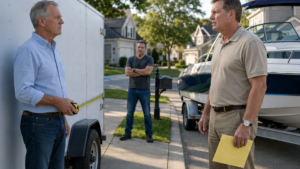
Virginia Martin stood at the bottom of her front steps with her car keys pressed into her palm and watched the blue pickup idle across the mouth of her driveway. Its rear bumper extended past the white boundary post. One oversized tire rested beside the small metal sign she had installed years earlier: PRIVATE DRIVEWAY—NO PARKING.
Seven minutes remained before the first appointment at her clinic.
She checked the time again, as though the numbers might correct themselves.
6:39.
The pickup belonged to the new neighbor, Richard Allen. He and his family had moved into the brick house next door four days earlier. The first two evenings had been filled with delivery vans, flattened boxes, and men carrying furniture through the open garage. Virginia had tolerated the noise and the blocked curb. Moving was disorder. Disorder passed.
But this was Monday morning, and Richard’s truck was parked crosswise as if the driveway were an unused piece of pavement rather than the only route from her garage to the street.
Virginia crossed the narrow strip of lawn and knocked on the Allens’ front door.
No answer.
She knocked again, harder.
A light came on upstairs. Nearly a minute later, Richard opened the door in a gray bathrobe, holding his phone. He was broad-shouldered, with damp hair flattened on one side and the irritated expression of a man interrupted during something important.
“Your truck is blocking my driveway,” Virginia said.
Richard looked past her toward the street.
“It’s not blocking the whole thing.”
“My car can’t get out.”
“You can angle around.”
“I already checked.”
He glanced at his phone. “We got in late. I’ll move it when I’m dressed.”
“My first patient is at six forty-five.”
That made him look at her, though not with concern.
“It’s six forty in the morning.”
“Exactly.”
Richard exhaled through his nose. “That strip has always been overflow parking. The agent told us.”
Virginia pointed toward the survey stake beside the sign. “That strip is part of my driveway.”
“It looks shared.”
“It isn’t.”
For a moment neither moved. Virginia heard the faint vibration of his phone in his hand.
Richard looked down at the screen. “Give me ten minutes.”
“I don’t have ten minutes.”
His mouth tightened. “Then call somebody. I’m not moving a truck in my robe.”
The door closed.
Virginia remained on the porch long enough to hear the dead bolt turn.
At 6:42, she photographed the truck from the street. She captured the bumper against the boundary post, the tire beside the sign, and the narrow gap between the pickup and the opposite hedge. Then she photographed the fluorescent survey cap embedded near the curb.
At 6:44, she called Anna Garcia.
Anna answered on the second ring. “Tell me you’re parking.”
“I’m not leaving yet.”
Silence.
“What happened?”
“The new neighbor blocked the driveway.”
“I’ll move the first family into the consultation room.”
“The child is already nervous.”
“I know.”
Virginia looked at the pickup. “Reschedule the seven-fifteen if you have to.”
“Virginia—”
“Just do what you can.”
She ended the call before Anna could ask anything else.
Richard came outside at 6:49 wearing jeans and a sweatshirt. He carried a travel mug and moved without hurry. Virginia stood beside her car, watching him unlock the pickup.
“You could have left a note last night,” he said.
“I didn’t know it would still be here.”
“You saw us moving.”
“I saw you unloading. I didn’t agree to give you my driveway.”
He paused with one hand on the door. “You’re making this bigger than it is.”
Virginia heard the phrase and felt something inside her settle into a colder shape.
“I have photographs,” she said.
“Of a truck?”
“Of where it was parked.”
Richard gave a short laugh, climbed into the cab, and started the engine. The pickup reversed, its tires grinding over loose gravel near the boundary post. He rolled down the window before pulling away.
“You should check the HOA map,” he called. “That space isn’t as private as you think.”
By the time Virginia reached the clinic, it was 7:06.
The waiting room lights were on. A little boy sat between his parents with both hands clamped around a stuffed dinosaur. He watched Virginia hurry through the glass entrance in her coat, then looked at the clock above reception.
His mother stood.
“We’ve been here since six-thirty.”
“I’m very sorry.”
“He hasn’t slept,” the woman said. “We worked all weekend to get him ready for this.”
Virginia crouched so she was level with the boy. “You did the hard part by coming in.”
He pressed the dinosaur against his mouth.
Anna appeared behind the reception desk and gave Virginia a look that contained several questions, none of which could be asked in front of the family.
The appointment began twenty-eight minutes late. The next family left before Virginia finished. The parent did not make a scene. She simply told Anna they would find another office with early appointments that began on time.
At noon, Virginia stood in the supply room eating crackers over the sink.
Anna entered carrying the day’s printed schedule. Two rows had been crossed out.
“Do you want me to document the reason?” Anna asked.
“It was one morning.”
“That isn’t what I asked.”
Virginia folded the empty cracker wrapper into smaller and smaller squares.
“Put down transportation delay.”
Anna leaned against the cabinet. “Your transportation was ten feet from your kitchen.”
“I know where my car was.”
“Then say what happened.”
Virginia dropped the wrapper into the trash. “It won’t happen again.”
On the desk outside, a dental-supply catalog lay open to security equipment for office parking lots. A bright yellow wheel boot filled half the page, clamped around a black tire. Virginia noticed it only because of the color.
She closed the catalog.
That evening, she placed printed photographs in a folder, wrote the date and time on the back of each one, and measured the width of the driveway at three points. She did not knock on Richard’s door again.
At 9:17, her phone buzzed.
The message came from an unfamiliar number.
Richard Allen. Melissa gave me your number. I checked the neighborhood plan. The strip beside your drive is marked shared access. Please stop photographing our vehicles like we’re doing something illegal.
A second message arrived before Virginia could respond.
You may want to talk to the HOA before putting up more signs.
Virginia opened the photograph of the boundary stake, enlarged it, and stared at the stamped cap until the letters blurred.
For the first time, she wondered whether the document in her closing file said exactly what she had always believed it said.
Chapter 2: The Map in the HOA Office Was Wrong
Matthew Scott placed two maps on the conference table and aligned their bottom edges with unnecessary care.
On the left was a faded neighborhood plan inside a plastic sleeve. On the right was a photocopy from Virginia’s closing documents. The lines appeared similar until they reached the narrow strip between her driveway and the Allen property.
There, one line curved. The other ran straight.
Matthew tapped the older map.
“This is what the association has used since the neighborhood was turned over by the developer.”
Virginia remained standing. “And this is the recorded plat attached to my deed.”
“I understand.”
“Then why are we discussing the other one?”
“Because Richard’s purchase packet included the association plan.”
“That doesn’t change my deed.”
Matthew sat back. He wore a blue button-down shirt with the sleeves precisely folded twice. Behind him, labeled binders filled a bookcase in the small HOA office.
“It creates ambiguity,” he said.
“For whom?”
“For the board.”
Virginia looked at the obsolete map again. A pale green strip ran beside her driveway and was labeled ACCESS. The lettering stopped before the rear property line. On her copy, the same strip lay inside the legal description of her lot.
“Was that supposed to be utility access?” she asked.
“It may have been.”
“Then it was never parking.”
Matthew folded his hands. “Virginia, I’m not saying Richard should block you.”
“He already has.”
“I’m saying the board cannot enforce a boundary dispute based on documents we haven’t verified.”
“I sent photographs.”
“Photographs show a vehicle. They don’t establish ownership.”
She slid her copy toward him. “This does.”
“It’s not certified.”
The word landed with more force than it deserved.
Virginia gathered the papers. “Where do I get what you will consider certified?”
“The county records office.”
“And while I do that?”
Matthew hesitated.
“He keeps using my driveway?”
“I’ll ask both parties to avoid escalation.”
“Both parties.”
“We need cooperation from everyone.”
Virginia tucked the papers into her folder. “I’m not parking on his property.”
“No. But the additional signs could be considered confrontational.”
“They say no parking.”
“They appeared after the dispute began.”
“They appeared after his truck blocked me.”
Matthew’s expression softened into the practiced patience of someone trying to contain a problem rather than solve it.
“Bring me the county record,” he said. “Then we’ll know what we’re dealing with.”
The county records office occupied the first floor of a concrete building downtown, between the marriage-license counter and property-tax services. Virginia took a number and waited beneath fluorescent lights while two appointments at the clinic proceeded without her.
When her number appeared, the records clerk accepted the address and searched the parcel database.
“You’re looking for the current recorded plat or the original subdivision plan?” the clerk asked.
“Both.”
“That usually means neighbors.”
Virginia almost smiled. “Is it that obvious?”
“Only because nobody asks for both when things are going well.”
The clerk returned with a large sheet rolled loosely around one hand. She spread it beneath a clear protective cover.
The original subdivision plan showed the green access strip. A notation near the rear line identified it as temporary construction access for lots still under development.
Then the clerk opened a second image.
“This correction was recorded three years later,” she said.
The straight line from the first map had been replaced by the curve in Virginia’s closing document. The temporary access strip had been absorbed into Virginia’s parcel after the last undeveloped lot was completed.
“So it’s mine.”
“According to the current plat, yes.”
“And the HOA map is wrong.”
“It’s old,” the clerk said. “Wrong depends on what they’re using it for.”
“They’re using it to let someone park across my driveway.”
The clerk’s eyebrows rose slightly. “Then I’d get a certified copy.”
Virginia paid the fee. The clerk embossed the document, signed the certification, and slid it into a protective sleeve.
For several seconds, Virginia felt the clean relief of being right.
By the time she returned to the HOA office, Matthew was preparing to leave.
She laid the certified plat over the faded map.
“The temporary access ended before either of us owned these houses.”
Matthew read the notation twice.
“This appears clear,” he admitted.
“Then send Richard a violation notice.”
“I need the board to review it.”
“You needed records. Here they are.”
“I said we would know what we were dealing with. I didn’t promise immediate enforcement.”
Virginia stared at him. “What exactly is left to review?”
“Whether this falls under HOA parking enforcement or a private-property matter.”
“You were willing to rely on the HOA map when he claimed it helped him.”
“I was explaining why he believed he could park there.”
“He believes it because the board keeps giving him reasons not to stop.”
Matthew stood. “Be careful, Virginia.”
“With what?”
“Self-help remedies. Towing, chains, immobilization devices. Your deed may establish the boundary, but that does not automatically authorize every response.”
She thought of the yellow wheel boot in the supply catalog.
“I haven’t threatened any response.”
“I’m telling you now so neither side makes this worse.”
Neither side again.
That night, Virginia searched commercial parking-control equipment on her laptop. A supplier offered a heavy-duty yellow boot with tamper-resistant locks and overnight shipping. The page included photographs of apartment lots, office garages, and vehicles immobilized beneath red warning signs.
She saved the page without ordering.
The next morning, Richard’s truck was parked in his own driveway.
The morning after that, it was at the curb.
For two days, the dispute seemed reduced to an ugly misunderstanding held in place by a certified document.
Then, just after noon on Friday, Anna called Virginia into the reception area.
A dental-supply driver stood near the door holding a clipboard. Through the front windows, Virginia could see the company’s box truck angled along the street.
“I can’t get into the rear garage,” he said. “Somebody’s pickup is across the access.”
Virginia’s stomach tightened.
“That delivery goes to my house.”
The clinic’s oversized sterilization unit had been shipped to her residential garage because the clinic’s service entrance was too narrow. Installation was scheduled for the weekend.
She drove home behind the delivery truck.
Richard’s pickup sat across the driveway exactly as it had Monday morning. This time no one answered his door. The driver tried reversing from the opposite direction, but the pickup and hedge left no safe turning radius.
“I can’t leave the unit on the curb,” he said. “And I can’t block traffic while we wait.”
“How long can you stay?”
“I’m already behind.”
Virginia called Richard. The call went to voicemail. She texted him a photograph and the words Move your truck now.
No response.
The driver wrote something on his clipboard. “There’ll be a redelivery charge.”
“How much?”
“I don’t set it.”
He climbed back into the cab.
As the box truck pulled away, Virginia stood beside the certified plat inside its plastic sleeve. It proved the driveway belonged to her.
It did not clear a single inch of pavement.
Chapter 3: Every Blocked Morning Cost More Than Money
Anna placed a ledger on Virginia’s desk and kept one hand on it when Virginia tried to slide it aside.
“Read the last column.”
“I have patients.”
“You have twelve minutes before the next one.”
Virginia looked down.
The spreadsheet listed every appointment changed during the previous four weeks. Beside each name, Anna had entered the reason, staff time lost, refund issued, or balance written off. A second page contained delivery charges and overtime.
At the bottom, one number had been circled.
Virginia shut the folder.
“No.”
“That isn’t an accounting term.”
“We’re not discussing this during clinic hours.”
“We never discuss it after clinic hours either.”
Through the wall came the high whine of a polishing tool, followed by a child’s muffled laugh. Virginia lowered her voice.
“The driveway issue is temporary.”
Anna opened the ledger again. “Two families transferred out. Three appointments were moved twice. The sterilizer delivery cost us another four hundred and eighty dollars.”
“I know.”
“Do you?”
The question stung because Anna was the one who had been shifting schedules, calling parents, and staying late.
Virginia turned toward her computer. “I’ll cover it.”
“With what?”
The screen showed the clinic’s operating account. Virginia minimized it before Anna could see the balance, but Anna’s expression told her the movement had been too quick.
“Virginia.”
“I said I’ll cover it.”
“Are we in trouble?”
“No.”
The answer came too fast.
Anna stepped back from the desk. “That sounded like the answer you give insurance companies.”
A patient knocked softly on the open door. His father stood behind him, holding a jacket and a plastic bag containing a toy airplane.
“We’re ready,” the father said.
Virginia smiled and rose. “So am I.”
The child was eight and afraid of anything that covered his mouth. Virginia had planned the appointment for the first quiet hour of the morning, before the waiting room filled. Instead, Richard’s truck had delayed her eighteen minutes. The child had listened to another patient cry through the wall while waiting.
Now he would not sit in the chair.
Virginia showed him the mirror. She let him hold the suction tube. She lowered the chair only halfway.
“We can stop whenever you say,” she told him.
He looked at the clock.
“My mom said we were going to be first.”
“You were supposed to be.”
“Are you late a lot?”
His father closed his eyes briefly.
Virginia crouched beside the chair. “Not usually.”
The boy gripped the toy airplane until one wing bent.
After another ten minutes, his father said, “Maybe today isn’t the day.”
Virginia could have persuaded him to stay. She knew the sequence of words, the breathing exercise, the small choices that gave frightened children a sense of control.
But the boy had already put on his jacket.
At reception, his father declined to reschedule.
When the door closed, Anna entered the operatory and placed the toy airplane’s broken wing on the counter. It must have fallen from the bag.
Neither woman spoke.
That afternoon, Virginia ordered the wheel boot.
The confirmation email arrived immediately. The device would come in a yellow shipping carton within three business days.
She told herself it was evidence of seriousness, not a plan. A physical reminder that she had alternatives. She called the sheriff’s non-emergency line and asked about unauthorized parking on private residential property. The person who answered advised her to document notices, consult local towing rules, and avoid confrontation.
“What about immobilizing the vehicle?” Virginia asked.
There was a pause.
“You’d need legal advice on civil liability.”
“I’m asking whether it’s prohibited.”
“I can’t interpret that for you.”
Every answer seemed designed to leave the truck exactly where it was.
The boot arrived on Thursday.
The box was larger than Virginia expected and bright enough to be seen from the street. She dragged it inside before Richard could notice. The metal device was heavy, its yellow arms wrapped in foam. A laminated instruction card showed how to lock it around a tire.
Virginia tested the key once.
Then she closed the box and stored it in the hall closet.
Over the next week, Richard blocked the driveway twice. Once for forty minutes while a contractor measured windows at his house. Once overnight because, according to his text, his teenage son needed the main driveway clear for friends.
Virginia sent each photograph to Matthew.
Matthew replied with variations of the same message: The board is reviewing jurisdiction.
She installed a second sign beside the first. It cited the recorded plat number and warned that unauthorized vehicles could be removed at the owner’s expense.
The following afternoon, she found Richard photographing it.
“You’re escalating,” he said.
“I’m giving notice.”
“You’re making the neighborhood look hostile.”
“You’re parking on my property.”
“It’s six feet of pavement.”
“It’s the six feet between my garage and the street.”
Richard lowered his phone. For an instant, exhaustion showed beneath his irritation. His eyes moved toward his house, where the garage door remained closed despite the mild afternoon.
Then his expression hardened again.
“You own a business,” he said. “You should understand that people need flexibility.”
Virginia almost asked what that meant. Instead she said, “Move your truck when it’s there.”
He smiled without warmth. “Maybe the board should decide whether those signs comply with the covenants.”
Two days later, an envelope bearing the HOA logo arrived at the clinic.
Anna brought it into Virginia’s office and waited while she opened it.
The letter cited two complaints: unapproved signage and conduct creating a hostile residential environment. Attached were photographs of Virginia’s signs, her security camera, and the yellow box being carried through her front door.
Richard had photographed the wheel boot shipment.
The final page announced a formal hearing before the board. Homeowners could attend. Statements would be entered into the association record.
Virginia read the date twice.
Anna took the letter from her and placed it beside the cancellation ledger.
“You told me we weren’t in trouble,” she said.
Virginia looked through the office window at the waiting room, where three children sat beneath painted clouds and smiling cartoon teeth.
For years she had kept the clinic open by making every crisis look temporary. The loan left by her former partner. The suppliers who had shortened their payment terms. The weekends she spent reconciling accounts after telling the staff everything was fine.
Now Richard’s truck had given those private numbers a public shape.
The hearing notice lay on top of the ledger like a verdict delivered before anyone had listened.
Virginia reached for the ledger and, for the first time, did not close it.
Chapter 4: The Birthday Lights Hid a Public Trap
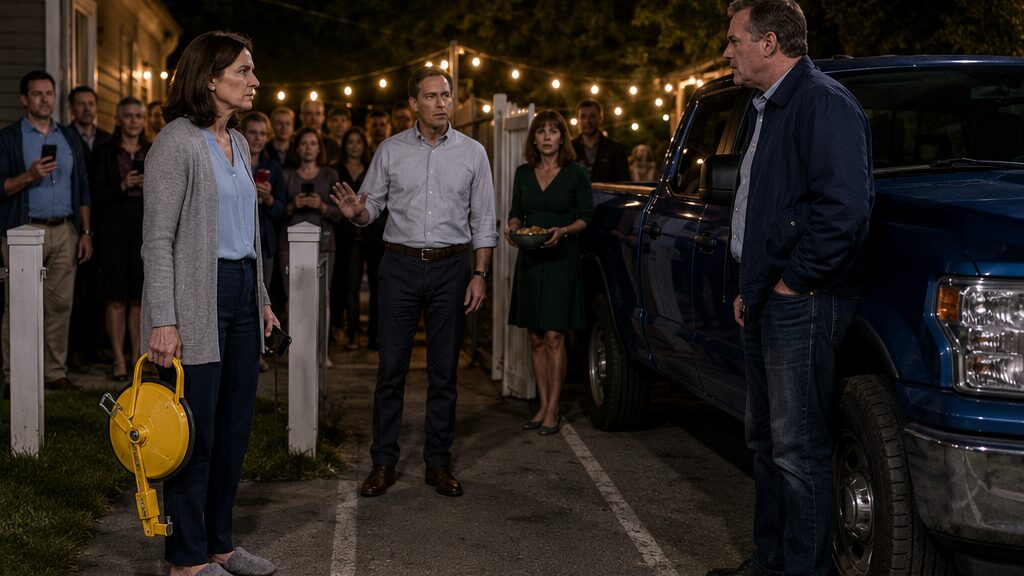
By eight o’clock Sunday evening, Richard’s truck was parked beneath three strands of white party lights, its rear bumper extending across Virginia’s driveway as if the boundary posts had been placed for decoration.
Music drifted from the Allen house. Cars lined both sides of the street. Through the open backyard gate, Virginia could see folding tables, trays of food, and neighbors holding paper cups beneath a banner that read HAPPY BIRTHDAY, MELISSA.
She had not been invited.
That did not surprise her. What stopped her halfway down her front walk was the laughter.
A man near Richard’s truck pointed at Virginia’s newest sign.
“So this is the famous private highway?”
Richard stood beside him with one hand in his pocket. “Careful. She might invoice you for looking at it.”
Several guests laughed. Matthew Scott was among them, holding a plate near the garage. He did not laugh, but he did not correct Richard either.
Virginia remained in the shadow of her porch.
The certified plat was inside her desk. The cancellation ledger was at the clinic. The photographs were backed up in two places. She had done everything in the order reasonable people claimed to respect.
Richard had parked there anyway.
Her phone showed 8:03.
At 6:45 the next morning, a five-year-old girl with a repaired cleft palate was scheduled for a procedure that had already been postponed once. Virginia needed to leave before six.
She opened the camera and photographed the truck from the street. The white boundary post was visible behind the rear wheel. So was the sign citing the recorded plat.
Richard noticed her.
He raised his cup in greeting. “Getting another one for the collection?”
Conversation near the truck thinned.
Virginia walked closer. “Move it.”
Richard glanced toward the crowded driveway on his side. Melissa’s sedan was parked near the garage. Two other vehicles filled the remaining space.
“We’ve got guests.”
“That doesn’t make my driveway yours.”
“It’s one night.”
“You’ve said that before.”
A woman beside him shifted her plate from one hand to the other. Matthew moved nearer, his posture careful.
“Virginia,” he said, “this may not be the best time.”
“That truck is on my property now.”
“I understand, but everyone’s trying to have a pleasant evening.”
Virginia looked at him. “Everyone?”
Matthew’s mouth tightened.
Richard lowered his cup. “You can get out if you need to.”
“No, I can’t.”
“You haven’t tried.”
“I don’t have to prove it by damaging my car.”
One of the guests murmured something about calling a tow company. Richard heard it.
“She’s already been warned about that,” he said. “The board told her not to escalate.”
The words moved through the small group with the efficiency of gossip. Virginia saw the assumption settle over their faces: she was the difficult one; Richard was the man trying to keep a birthday dinner from becoming a scene.
Melissa appeared through the gate carrying a bowl. She stopped when she saw Virginia.
“Can this wait until tomorrow?”
Virginia looked at the truck, then at the people standing beneath the lights.
“No.”
She returned to her house.
The yellow carton stood inside the hall closet, unopened since delivery. Virginia pulled it into the entryway and cut through the tape with her keys. The wheel boot was heavier than it had appeared in the catalog. Its painted arms struck the hardwood with a dull metallic knock.
For a moment she remained crouched beside it.
The sheriff’s dispatcher had not told her it was illegal. Matthew had not shown her a rule forbidding it. The posted notice warned that unauthorized vehicles could be immobilized or removed at the owner’s expense. She had proof, dates, photographs, and a certified plat.
What she did not have was another month to wait.
Virginia carried the boot outside.
She was still wearing house slippers.
The conversation near the truck stopped before she reached the curb. The yellow metal caught the party lights and seemed brighter than everything around it.
Richard stared at the device.
“You cannot be serious.”
Virginia placed it on the pavement and took another photograph of the truck.
Matthew stepped forward. “Virginia, let’s slow down.”
“I have been slowing down for a month.”
“This is exactly the kind of unilateral action I warned against.”
She pointed to the posted notice. “It has been there eleven days.”
Richard laughed once, but the sound held no amusement. “You put that thing on my truck, and we’re done being polite.”
Virginia opened the laminated instruction card. Her hands were steady.
She read the warning aloud, not to perform for the guests but to make the words part of the record.
“Unauthorized vehicles parked beyond this boundary may be removed or immobilized at the vehicle owner’s expense.”
“That sign isn’t an ordinance,” Richard said.
“No. It is notice.”
She knelt beside the front tire.
Someone lifted a phone. Then another.
The boot’s inner arm slid behind the tire. Virginia adjusted the outer plate, aligned the locking bar, and pressed until the mechanism clicked.
The sound was small.
It changed the entire street.
Richard set down his cup. “Take it off.”
“No.”
“You have no right.”
“I have a recorded plat, six written notices, photographs from nine separate dates, and documented business losses.”
“You have a grievance and a piece of paper.”
Virginia rose, holding the key.
Richard moved toward her. Matthew stepped between them, one palm extended.
“Everybody needs to stop,” he said.
Virginia looked past him. “The truck stays until it is moved off my property under supervision.”
Melissa’s face had gone pale. “This is my birthday.”
“I asked him to move it.”
“You knew we had people here.”
“That is why he thought I wouldn’t act.”
The silence afterward was worse than shouting. Virginia could feel the phones pointed at her. She could hear plates being set down inside the yard.
Richard turned toward the guests.
“You all see this, right? She came over during a family dinner and locked my property.”
Virginia held up the boot key. “After you parked it on mine.”
The sheriff’s deputy arrived twenty-three minutes later.
By then the music had stopped. The guests had divided themselves into quiet clusters. Some remained near the backyard gate; others watched from cars.
The deputy examined the sign, the tire, and Virginia’s certified plat. He asked Richard whether he had been told not to park there.
Richard said the ownership was disputed.
Virginia handed over the county certification.
The deputy read it beneath the beam of a flashlight.
“This appears to show the strip inside her parcel,” he said.
Richard folded his arms. “That doesn’t mean she can seize my truck.”
“She hasn’t seized it,” Virginia said.
The deputy looked at her. “Ma’am, did a towing company install this?”
“No.”
“Do you have a private immobilization agreement?”
“I own the property.”
“That wasn’t my question.”
The strength Virginia had felt while locking the mechanism began to thin.
“I bought the device.”
The deputy returned the plat. “This is likely a civil matter. I can document the obstruction, but I can’t tell you that personally immobilizing a vehicle is lawful under every circumstance.”
Matthew spoke quietly. “I warned her.”
Virginia turned toward him. “You also refused to enforce the correct map.”
“I told you the board was reviewing it.”
Richard pointed at the boot. “If that damages my wheel, she’s paying. If I miss work, she’s paying. If I have to hire somebody to remove it—”
“You told the neighborhood you weren’t working,” Melissa said.
The words escaped her before she seemed to understand she had spoken.
Richard looked at his wife.
Melissa lowered her eyes. “I mean tomorrow. You said you didn’t have to go in tomorrow.”
No one commented, but Virginia saw the change in Richard’s face. The anger remained. Something else appeared beneath it—fear, quick and private.
The deputy asked Virginia to remove the boot voluntarily while he supervised Richard moving the truck. If she refused, he said, the parties could seek emergency civil relief and allow a court to decide.
Virginia looked at the yellow metal around the tire.
For weeks she had imagined this moment as a clean line: before the boot, Richard controlled the driveway; after the boot, he did not.
Instead the device had trapped both of them.
She unlocked it.
Richard moved the truck to the street while guests watched. When he climbed out, he did not return to the party.
He stood beside the cab and faced Virginia across the boundary line.
“I’m filing against you,” he said. “The HOA, civil court, your insurance company—whoever will listen.”
Virginia lifted the boot with both hands.
Richard’s voice grew louder.
“And when they ask why a dentist was out here locking people’s vehicles during a birthday dinner, I’m going to make sure they know exactly where she works.”
Chapter 5: The Garage Held What Richard Would Not Admit
At 5:51 Tuesday morning, Melissa Allen stood outside Virginia’s front door holding a folded HOA notice that Virginia had never seen.
Her makeup was absent, and her hair was tied back without care. She looked less like the woman who had arranged matching tablecloths for a neighborhood dinner and more like someone who had not slept since the party ended.
Virginia opened the storm door but not the main one.
“What is that?”
Melissa held out the paper. “Richard took it from the mailbox.”
Virginia did not move.
“When?”
“Last week.”
The notice bore the HOA letterhead and Matthew’s signature. It instructed the Allens to stop parking on the disputed strip until the board completed its review. A line near the bottom referenced Virginia’s certified plat.
Richard had known.
Virginia unlocked the door.
Melissa stepped inside and saw the yellow boot under the console table. Its paint was scratched near the locking bar.
“I’m not here to defend what he did,” she said.
“You did Sunday.”
“There were twenty people in my yard.”
“That is not a reason.”
“No. It’s the reason I did it.”
Virginia folded the notice along its original crease. “Why did he keep parking there?”
Melissa looked toward the window facing the Allen house.
“Our garage is full.”
“I noticed.”
“Richard’s father was supposed to stay with us for two weeks after a hospital discharge. It became three months. Most of his things are in the garage because he thinks he’s going back to his own place.”
“That still doesn’t explain the truck.”
“There’s another car inside.”
Virginia waited.
Melissa pressed her fingers against the strap of her purse. “Richard lost his job in February. He told everyone he was consulting because he couldn’t stand saying he’d been laid off. We fell behind on the car. He moved it into the garage when the lender started sending people.”
The answer was so ordinary that Virginia almost rejected it. No secret scheme. No hidden legal claim. Only boxes, illness, debt, and a man protecting his pride with someone else’s driveway.
“Why not park the truck on the street?”
“He says it makes the house look crowded. And sometimes the association sends reminders about overnight street parking.”
“So he chose my property because it was easier.”
Melissa’s eyes filled but did not spill. “Yes.”
Virginia placed the notice on the kitchen counter.
“How long has he known the plat was valid?”
“Since the day you brought it to the HOA office. Matthew called him.”
“Then every time after that—”
“He knew.”
The kitchen clock ticked toward six. Virginia thought of the morning appointments, the ledger, and Richard standing under the party lights telling neighbors she had invented the dispute.
Melissa looked at the boot.
“He is going to use that against you.”
“I know.”
“He has pictures.”
“So do I.”
“Not just pictures of the truck. Pictures of you. He’s sending them to board members with captions.”
Virginia’s hand tightened around the edge of the counter. “What captions?”
“That you stalk our house. That you installed the signs to intimidate us. That you planned what happened Sunday because you wanted attention.”
“Did you tell him that was false?”
Melissa did not answer quickly enough.
Virginia walked to the front door and opened it.
“Please,” Melissa said. “There’s more.”
Virginia kept her hand on the door.
“If the repossession issue becomes part of the hearing, I don’t know what he’ll do.”
“That is not mine to expose.”
“You may have to. He’s going to claim the garage was always available and that he parked there only because the strip was shared.”
Virginia looked back at her.
Melissa’s face had tightened with shame. “I am asking you not to say why the garage wasn’t available.”
“You want me to defend myself while protecting the lie he used to hurt me.”
“I want you to tell them he knew the boundary. I’ll confirm that. Just leave the car out of it.”
“And the job?”
“Please.”
Virginia thought of Richard’s brief panic when Melissa had mentioned work in front of the guests. His cruelty had not come from confidence. It had come from protecting the appearance of confidence.
That made him easier to understand.
It did not make the clinic’s losses disappear.
“I won’t volunteer your finances,” Virginia said. “But I will not lie if the board asks why he kept parking there.”
Melissa nodded once. It was not relief, exactly, but it was enough for her to leave.
At the clinic, Virginia placed the boot beneath her desk because she could not bear to see it in her hallway. Anna noticed the yellow edge almost immediately.
“You brought it to work?”
“I didn’t want it near the front window.”
Anna sat opposite her. “The insurance carrier called.”
Virginia stopped arranging files.
“They want a written account of Sunday,” Anna continued. “They said any claim involving intentional immobilization may fall outside your general coverage.”
“May.”
“That is the word they used.”
Virginia looked down at the cancellation ledger. “Richard hasn’t filed anything yet.”
“He sent a preservation letter.”
“When?”
“Yesterday afternoon.”
Anna slid a printed email across the desk. Richard demanded that Virginia preserve all photographs, text messages, security footage, and communications related to the truck. He claimed damage to the wheel assembly, lost use of the vehicle, public humiliation, and reputational harm.
At the bottom, he identified Virginia not simply as a homeowner but as the owner of Martin Pediatric Dentistry.
“He wants the business attached to this,” Virginia said.
“He already attached it.”
Anna tapped the desk. “You need counsel.”
“I need the board to read the plat.”
“You need to stop treating this like the right document will make everybody reasonable.”
Virginia looked away.
Anna’s voice softened. “How bad are the accounts?”
“They’re managed.”
“That isn’t a number.”
Virginia opened the operating report. For several seconds, neither woman spoke.
Then Virginia rotated the screen.
Anna read the balance, the loan payment, and the outstanding supplier invoices. Her expression changed slowly.
“How long?”
“Since before you came here.”
“You let me order equipment.”
“We needed it.”
“You let me tell staff we were stable.”
“We are open.”
“That is not the same thing.”
Virginia closed the report. “I promised the people who stayed after my former partner left that I would keep the clinic running. I wasn’t going to frighten everyone every time the balance dipped.”
“This is not a dip.”
The intercom chimed from reception.
Anna stood but did not leave immediately. “You cannot protect people with information they don’t have.”
After she was gone, Virginia opened Richard’s preservation letter again.
One photograph showed her carrying the yellow boot toward the truck. Another showed her kneeling beside the wheel. The boundary sign had been cropped out of both.
Virginia enlarged the images.
The party lights remained visible. So did the guests. But the white post and the edge of her driveway were missing, making Richard’s truck appear parked beside the curb rather than across private access.
She checked the metadata printed beneath the files. The images had been exported the morning after the party.
At 3:17, Matthew emailed the evidence packet for the hearing.
Richard’s submission included the same cropped photographs, plus one taken from an angle that made Virginia’s sign appear several feet closer to his property than it actually stood. A typed statement claimed the sign had been moved before the dinner.
Virginia compared it with her own timestamped photograph.
The bolt pattern at the base of the post was identical. The sign had not moved.
Richard had not merely hidden his reason for parking there.
He had begun altering the shape of the truth.
Chapter 6: At the Hearing, Silence Became Its Own Lie
Richard’s first exhibit was a photograph of Virginia kneeling beside his tire.
The image appeared on a portable screen at the front of the community clubhouse. Cropped tightly, it showed the yellow boot, Virginia’s slippers, and her hands closing the lock. The property marker, warning sign, and driveway entrance were outside the frame.
Richard stood beside the screen in a navy jacket.
“This is what happened during my wife’s birthday dinner,” he said. “Without a court order, without a towing company, and after the HOA told her not to take action.”
Virginia sat at the opposite table with the certified plat, the cancellation ledger, and the yellow boot arranged in front of her. Anna sat behind her. Melissa sat in the second row beside her teenage son, both silent.
Matthew and three board members occupied the long table at the front.
Richard changed the image. The next photograph showed Virginia’s security camera.
“She has recorded my family, photographed our guests, and installed threatening signs. This stopped being about parking weeks ago.”
Matthew looked toward Virginia. “You will have time to respond.”
Richard lifted a folder. “I am asking the board to order removal of the signs, prohibit further surveillance aimed at our property, and require reimbursement for damage and loss of use.”
“Do you have a repair estimate?” a board member asked.
“I have an inspection scheduled.”
“Then no confirmed damage?”
“Not yet.”
The distinction mattered, but not enough. The photograph remained on the screen.
When Richard finished, Matthew called Virginia forward.
She had prepared a sequence: boundary history, recorded correction, dates of obstruction, notices, losses. Each piece was numbered. Each photograph had a timestamp.
She looked at the boot instead.
Its yellow paint had seemed decisive beneath the birthday lights. Here, under fluorescent fixtures, it looked blunt and childish.
Virginia stood.
“I should not have put that device on his truck myself.”
The room shifted.
Richard turned toward Matthew as if the case had ended.
Virginia continued. “I had documented the parking. I had posted notice. I owned the device. None of those facts gave me certainty that personally immobilizing his vehicle was lawful or covered by my insurance. I acted before I had that certainty.”
Matthew removed his glasses.
Richard smiled.
Virginia placed the boot key on the table. “That was my mistake.”
The smile faded when she lifted the certified plat.
“It was not the beginning of this dispute.”
She laid the corrected county document over the obsolete HOA map and explained the temporary construction access, the later boundary correction, and the certification date. She did not rush. She did not call Richard dishonest. She let the lines speak first.
Then she opened the cancellation ledger.
“These are the appointments changed because I could not leave my driveway. These are the refunds. This is the failed equipment delivery. This is staff overtime.”
Richard leaned toward his microphone. “Those numbers could be anything.”
Anna stood behind Virginia. “I prepared the ledger from our scheduling system and invoices.”
Matthew raised a hand. “Ms. Garcia, you are not yet recognized as a witness.”
Virginia looked at him. “She is here because I spent a month pretending the losses were manageable when they were not.”
That admission cost more than the one about the boot.
She felt Anna’s attention sharpen behind her.
Virginia faced the board. “The clinic inherited debt when my former business partner left. I did not tell my staff how narrow our margin had become. Every blocked morning mattered. I kept describing this as inconvenience because I was ashamed to say that repeated inconvenience could close a business.”
No one moved.
Richard looked down at his folder.
Virginia selected two photographs and placed them side by side beneath the document camera. One was Richard’s cropped image. The other was her timestamped original from the same evening.
“The photograph on the left removes the boundary marker and sign. The one on the right shows where the truck was.”
A board member leaned toward the screen. “Are these from the same time?”
“Within ninety seconds.”
Richard’s chair scraped. “Cropping a photo is not altering evidence. It’s focusing on the relevant action.”
“The location was relevant,” Virginia said.
Matthew studied both images. “Why did your written statement say the sign had been moved?”
Richard opened his mouth, but Melissa spoke from the second row.
“It wasn’t moved.”
Every face turned.
Richard stared at his wife.
Melissa stood slowly. “The sign was in the same place before the dinner. Richard knew about the corrected plat before that night.”
“Melissa,” he said.
“You knew.”
Her voice was quiet, but the microphone at the public-comment stand caught it.
Matthew looked at Richard. “When were you informed?”
Richard’s jaw tightened. “You called me after Virginia brought the county copy.”
“And I instructed you not to park there while the board reviewed the issue.”
Richard said nothing.
Virginia reached into her folder and removed the notice Melissa had given her. “This was delivered to the Allen address last week.”
Matthew recognized it. “That is the interim directive.”
“I never received it,” Richard said.
Melissa closed her eyes.
Virginia did not mention the hidden car, the repossession attempts, or Richard’s job. She did not need to. His knowledge of the boundary was established.
A board member asked, “Then why did you continue parking there?”
Richard glanced toward Melissa and their son. For the first time that evening, his anger seemed to lose its target.
“The street rules are inconsistent,” he said. “Our garage wasn’t available. I thought this would be temporary.”
Virginia heard her own first morning in those words.
Temporary.
Richard looked at the plat. “I was dealing with things at home.”
“That may be true,” Virginia said. “But you made me carry the cost of them.”
He looked at her, and for one brief moment there was no audience between them.
Matthew called a recess.
The board returned thirty minutes later with a proposed resolution. The HOA would acknowledge the corrected plat, prohibit parking on Virginia’s access strip, direct removal of one sign pending architectural review, and ask both parties to waive further claims.
Virginia read the final paragraph twice.
“Where are the documented losses?”
Matthew folded his hands. “The association cannot accept responsibility for private conduct.”
“You relied on the obsolete map after the corrected plat was produced.”
“We needed time to verify it.”
“You called Richard that day.”
“To advise him of the dispute.”
“And you sent him an interim directive that was not enforced.”
Matthew lowered his voice. “This proposal gives you everything necessary going forward.”
“No. It gives the board protection going forward.”
Richard leaned back, exhausted now rather than triumphant.
Matthew pushed the document toward Virginia. “It ends the conflict.”
Virginia looked at the waiver clause. By signing, she would release Richard and the HOA from all claims connected to the blocked access, the failed delivery, and the hearing. Richard would release claims related to the boot.
It was the kind of agreement she once would have accepted because it put the street back in order.
Anna’s words returned to her: You cannot protect people with information they don’t have.
Virginia set the pen down.
“I will accept responsibility for the boot,” she said. “I will not sign away the losses caused before it.”
Matthew’s expression hardened. “Then what are you asking for?”
“A corrected access policy. Reimbursement supported by records. Removal of Richard from any parking or enforcement role. A written correction to the complaint he distributed. And no confidentiality clause hiding that the association used the wrong map.”
Richard gave a tired laugh. “You want a public confession.”
“I want the record to stop repeating what did not happen.”
Matthew collected the unsigned pages.
“The board will refer this to mediation,” he said.
Virginia closed the ledger. It was not victory. The truck could still appear tomorrow. The insurance question remained. The clinic debt remained.
But for the first time, she had stopped asking a document to speak in place of her.
Matthew stood to adjourn the hearing, then looked directly at her.
“Understand this, Virginia. Mediation may not give you everything.”
She placed the yellow boot back in its carton.
“Neither did silence.”
Chapter 7: The Boundary Held Only After the Truth Did
Richard arrived at mediation without his truck.
Virginia saw him through the glass wall of the conference room, stepping out of Melissa’s sedan with a folder tucked beneath one arm. The absence of the lifted blue pickup was more noticeable than its presence had ever been. For months it had filled every argument before either of them spoke. Now the parking space outside the office held only pale lines on asphalt.
Matthew arrived five minutes later with an attorney representing the HOA. Anna sat beside Virginia, though the mediator had initially questioned whether an office manager belonged at a property dispute.
“She prepared the loss records,” Virginia had said.
Anna had added, “And I know which numbers are real.”
The mediator placed a draft agreement in the center of the table.
Richard avoided looking at Virginia. He appeared smaller without the truck behind him, his shoulders curved inside a jacket that no longer fit cleanly across his back.
The proposal required him to stop parking on Virginia’s parcel and to withdraw his complaint about her signs. Virginia would remove the larger warning sign and release all claims against Richard and the association. The HOA would update its map internally.
Virginia reached the final page.
A confidentiality clause prohibited either party from discussing the obsolete map, the hearing, the disputed photographs, or the settlement terms.
She put the pages down.
“No.”
The HOA attorney leaned forward. “Which provision concerns you?”
“The one that makes the board’s error disappear.”
“It protects everyone from continued reputational harm.”
“It protects the association from admitting that it used the wrong map after receiving the corrected one.”
Matthew’s jaw tightened. “We did not knowingly use an incorrect map.”
“You called Richard after I gave you the certified plat.”
“To inform him that the issue remained under review.”
“You told me you needed time. You told him not to park there. Then you did nothing when he ignored you.”
Richard stared at the table.
The attorney tapped the document. “This agreement provides permanent access protection.”
“It provides private protection,” Virginia said. “The next homeowner who sees that old plan will face the same problem.”
“There may never be another dispute.”
“That is what everyone said about mine.”
The mediator asked what Virginia wanted changed.
She had arrived with six demands. Sitting across from Richard, she understood that not all of them served the same purpose.
“I want the association’s official property-access map corrected and distributed to affected homeowners. I want written acknowledgment that the temporary access strip expired. I want reimbursement for the delivery charge, documented appointment losses, and staff overtime. I want Richard removed from the parking committee. And I want the complaint he circulated corrected in writing.”
Richard looked up. “You want me humiliated.”
“I want you to correct what you said.”
“I said you put a boot on my truck.”
“You said I moved the sign and invented the boundary.”
His eyes shifted toward Melissa, who sat behind him against the wall.
The mediator turned to Richard. “Is that accurate?”
Richard rubbed one thumb against the edge of his folder. “I believed the sign had been repositioned.”
“No,” Melissa said.
Her voice was quiet, but everyone heard it.
Richard closed his eyes.
The mediator waited.
Finally, Richard said, “I knew where the marker was.”
The room remained still.
Virginia had imagined hearing those words in front of the board. In those versions, they had felt like a door opening. Now they sounded tired.
“Why did you submit the cropped photographs?” the mediator asked.
Richard glanced toward his teenage son sitting outside the glass wall with headphones around his neck.
“Because the full pictures made it obvious where I parked.”
No one spoke for several seconds.
The admission did not restore Virginia’s mornings or bring back the families who had left the clinic. It did something narrower and more useful. It ended the argument over what had happened.
The discussion moved to money.
The HOA attorney disputed several entries in Anna’s ledger. Anna answered with appointment records, invoices, and payroll reports. When the attorney suggested that the clinic’s existing debt made the losses speculative, Virginia felt the old reflex rise—the desire to close the folder, protect the practice, and insist everything was under control.
Instead she opened the operating statement.
“The debt existed before Richard moved in,” she said. “That is why the disruptions mattered.”
Anna looked at her, but Virginia kept speaking.
“My former partner left the practice with obligations I chose to carry. I told the staff we were stable because I believed uncertainty would make them leave. I was wrong. Hiding the risk did not reduce it.”
The mediator reviewed the figures. The final reimbursement was less than Virginia had requested but enough to cover the failed delivery, documented refunds, and a portion of the staff overtime.
Richard’s attorney proposed that he pay half and the HOA pay half.
Matthew objected.
The mediator looked at him. “Your board possessed the corrected plat and issued an interim directive it did not enforce.”
The objection ended there.
Richard agreed to resign from the parking committee. The HOA agreed to adopt a formal obstruction policy and distribute the corrected map. The confidentiality clause was removed.
One issue remained.
Richard’s claimed damage from the wheel boot had never been confirmed. The inspection found no mechanical damage, but he still sought compensation for loss of use and the cost of the inspection.
Virginia agreed to pay the inspection fee personally.
Anna turned toward her. “You don’t have to offer that.”
“Yes,” Virginia said. “I do.”
Richard studied her.
“You’re admitting it was wrong?”
“I already did.”
“But you still think I deserved it.”
Virginia looked through the glass at the empty parking space outside.
“I think you needed to be stopped. I also think I chose a method before I knew whether I had the right to use it. Those are separate things.”
Richard nodded once, almost unwillingly.
The agreement was signed just after noon.
Outside, Melissa waited beside the sedan while Richard spoke privately with the mediator. She approached Virginia with both hands inside her coat pockets.
“He’s selling the truck,” she said.
Virginia had noticed the listing photograph among Richard’s papers.
“Because of the settlement?”
“Partly. Mostly because we can’t keep it.”
Melissa looked toward the building. “His father is moving into assisted living next month. We’re clearing the garage.”
Virginia could have said she was sorry. The words would have been true but incomplete.
“I hope it gets easier,” she said.
Melissa nodded. “I hope your clinic stays open.”
This time Virginia did not answer automatically.
“So do I.”
At the clinic that afternoon, Anna gathered the staff in the consultation room. Virginia expected questions about mediation. Instead, Anna placed a new payment schedule on the table.
“We went through the operating expenses,” she said. “There are changes we can make without cutting anyone’s hours.”
A hygienist had offered to delay a bonus. The front-office staff had identified software services they did not use. Anna had negotiated a revised payment plan with the equipment supplier.
Virginia looked around the room.
“You did this without asking me.”
Anna folded her arms. “We learned from you.”
A few people smiled, but Virginia felt the truth beneath the joke.
“I should have told you sooner,” she said.
“Yes.”
“I thought keeping the numbers to myself was protecting everyone.”
“It made us think you didn’t trust us.”
Virginia rested her palm on the payment schedule. “I do.”
“Then let us help.”
The yellow boot remained beneath Virginia’s desk until Friday.
She carried it to the shipping store in its original carton. The supplier had sent a replacement locking bar after she reported the scratch, but she had never opened the smaller package. She returned both.
The clerk asked why she no longer needed the device.
Virginia looked at the photograph printed on the carton: a bright yellow clamp fixed around a tire.
“The boundary works better without it,” she said.
Two weeks after mediation, the HOA installed a narrow reflective marker at the edge of Virginia’s parcel. The corrected map arrived by mail with a written notice explaining that the strip was private access, not shared parking. Richard’s correction appeared in the same association bulletin that had summarized his complaint.
It did not apologize.
It stated that he had misunderstood the boundary, continued parking after being directed not to, and submitted photographs that did not show the full location. He accepted responsibility for those statements.
Virginia read it once and placed it in the same file as the certified plat.
Richard’s truck disappeared the following Saturday. A buyer drove it away while Richard stood in the yard with his hands in his pockets. He and Virginia saw each other across the empty strip.
Neither waved.
On Monday morning, Virginia stepped outside at 6:42.
Her car was already packed. The clinic keys were in her coat pocket. Anna had texted that the first family had arrived early and the child was drawing at the reception desk.
At 6:44, headlights turned into the street.
A contractor’s van slowed near the Allen house. The driver began to angle toward the space beside Virginia’s dr