They Towed His Car Twice Before Learning Who Owned Every Parking Space
Chapter 1: The Reserved Sign Reflected in His Window
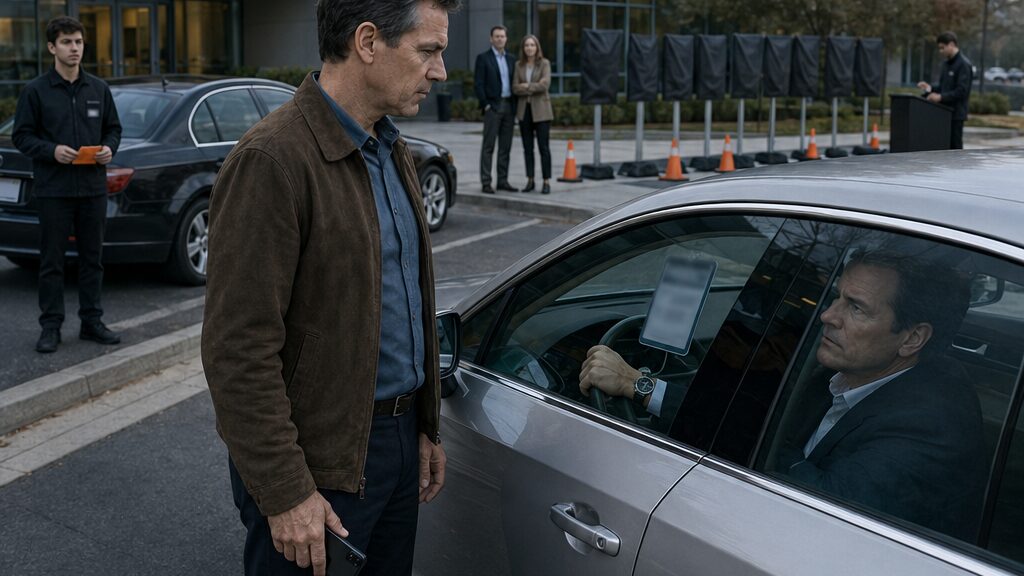
Nicholas Baker was smiling from behind the wheel of a silver Mercedes parked directly beneath Benjamin Jackson’s reserved sign.
The smile was not warm. It was the small, patient expression of a man waiting for someone else to understand that the conversation was already over.
Benjamin stopped beside the painted curb and looked from the black-and-white placard to the credential hanging from the Mercedes’s rearview mirror. The laminated tag carried the property-management company’s logo and Nicholas’s assigned parking number.
Behind Benjamin, two office tenants slowed near the entrance. One of them whispered something. The other laughed.
Benjamin set his leather case on the hood of his own car, which he had left idling several feet away, and walked to the driver’s window. He wore a brown suede jacket over a blue shirt, ordinary enough for the building, expensive enough not to look careless. Nicholas glanced at him once and then returned his attention to his phone.
Benjamin knocked lightly on the glass.
Nicholas lowered the window two inches.
“Yes?”
“You’re in my space.”
Nicholas looked past him at the sign, as though seeing it for the first time. “Parking assignments were revised.”
“I wasn’t notified.”
“Then you should speak with management.”
“I thought I was.”
That earned a longer look.
Nicholas lowered the window another inch. His tie was loosened, but everything else about him was arranged: silver watch, clean cuffs, parking credential facing outward. “Guests use street parking after nine.”
Benjamin glanced at the dashboard clock. It was eight seventeen in the morning.
“After nine in the evening?”
Nicholas’s jaw tightened. “The revised access policy applies during controlled hours.”
“Which policy?”
“You can request a copy upstairs.”
“Do you know the policy number?”
Nicholas stared at him.
The two tenants near the entrance had stopped pretending not to watch. A valet attendant in a black jacket stood beside a portable podium near the far row. The restaurant next door would not open for hours, yet temporary cones already blocked several spaces.
Benjamin took out his phone.
Nicholas’s expression shifted. “You cannot photograph vehicles on managed property.”
Benjamin photographed the reserved sign, then the credential hanging inside the Mercedes.
“What policy prohibits it?”
“You’re becoming disruptive.”
“I asked you to move your car.”
“And I explained that your assignment has changed.”
Benjamin looked again at the placard. His name was not printed on it. The space was identified by number, a choice he had approved years earlier because he had not wanted ownership displayed like a title. The agreement was in his office files. The land records were in the county system. None of that mattered in the parking lot unless he used it.
He could have said, I own this building.
He could have watched Nicholas’s face rearrange itself.
Instead, Benjamin photographed the curb, the sign, the Mercedes, and the uninterrupted strip of pavement beside the space.
Nicholas opened his door suddenly, forcing Benjamin to step back.
“You need to move your vehicle from the drive aisle,” Nicholas said.
Benjamin turned. His sedan was not in the drive aisle. It sat beside the curb in an unmarked loading pocket, leaving more than enough room for traffic.
A valet attendant approached with an orange slip in one hand.
Nicholas pointed toward Benjamin’s windshield. “Issue a violation warning.”
The attendant hesitated. He could not have been older than twenty-two.
“For what?” Benjamin asked.
“Obstruction and unauthorized parking.”
“My car is not obstructing anything.”
Nicholas stood now, one hand on the roof of the Mercedes. “You were advised to use the street.”
“By someone occupying my assigned space.”
The office tenants laughed again, though less comfortably this time. Benjamin could feel their attention settle on him. They saw a visitor arguing with the man who ran the building. They did not know that Nicholas’s authority existed because Benjamin’s signature appeared at the bottom of a management contract.
The valet attendant slid the warning beneath Benjamin’s windshield wiper.
Benjamin photographed him doing it.
Nicholas folded his arms. “Are we finished?”
“Not quite.” Benjamin lifted the orange slip and read it. “This says I was parked in a designated fire lane.”
“That area must remain clear.”
Benjamin pointed to the curb. It was gray concrete. No red paint. No FIRE LANE stencil. No posted restriction.
“Where does the fire lane begin?”
Nicholas gave a thin smile. “You can challenge the notice through the formal process.”
“What is the policy number?”
“You’re repeating yourself.”
“Because you haven’t answered.”
The smile disappeared.
For a second, Benjamin thought Nicholas might recognize something—not his face, perhaps, but the habit of asking for exact language. Benjamin had attended two annual review meetings by video. Nicholas had spoken at both. Benjamin had kept his camera off during the last one because he had been recovering from surgery and did not want the discussion diverted toward him.
Nicholas looked at the valet attendant. “Have the vehicle removed if it remains after ten minutes.”
Then he got back into the Mercedes and raised the window.
Benjamin stood beside the reserved placard while the engine started. In the dark glass, the sign appeared reflected next to Nicholas’s hanging credential: one marker representing a contractual right, the other representing delegated authority. Only one of them seemed to carry any force.
The Mercedes backed out.
Nicholas did not apologize. He drove toward the private ramp leading to the management spaces on the fourth-floor level.
Benjamin moved his sedan into the reserved space and sat behind the wheel without starting the engine. The orange warning rested on the passenger seat. He had come to review a roofing estimate and sign a tenant-improvement approval. Both could wait.
Across the lot, the valet attendants began repositioning cones.
One of them slipped temporary black sleeves over the reserved placards in the far row. Benjamin counted as he watched.
Four.
Eight.
Twelve.
Sixteen.
Those spaces belonged to the property. He knew because he had paid to restripe them after the parking structure renovation. They had never been licensed to the restaurant.
A dark SUV pulled in from the street. A valet opened the passenger door while another attendant accepted folded bills from the driver. The cash disappeared into a small metal box beneath the podium.
Then the SUV was guided into the first of Benjamin’s sixteen spaces.
Chapter 2: Two Tows and a Fee Without a Clause
The invoice was waiting in Benjamin’s email before he reached his office.
TOW ADMINISTRATION CHARGE: $60.
He stared at the line for several seconds, then opened the attached statement. The charge had been posted at 8:43 that morning, twenty-six minutes after Nicholas ordered the orange warning placed on his windshield.
Benjamin printed it.
The paper slid from the machine with the management company’s logo at the top and his ownership entity listed beneath it as the account holder. The absurdity was almost elegant: the property’s owner had been billed for the administration of threatening to tow his own car from his own land.
He opened the accounting portal and searched backward six weeks.
The first towing incident appeared on a Thursday night. Benjamin remembered it clearly. He had returned from a tenant dinner at nine forty and found the reserved space empty. He had parked there, gone upstairs for forty minutes, and returned to bare pavement.
At the time, he had assumed a towing contractor had made an error. He paid the release fee himself rather than calling the management office after hours.
The second tow had occurred eleven days later. Same space. Same contractor. Same explanation: unauthorized overnight parking.
Benjamin had paid that fee too.
He had told himself it was cheaper than making a scene.
Now he found a $60 administrative charge attached to each incident. Beneath them was another line item repeated monthly.
PARKING OVERSIGHT FEE: $60.
He opened the original parking agreement from the digital archive. The document granted him uninterrupted access to the designated space, twenty-four hours a day, subject only to emergency closures and scheduled maintenance. There was no oversight fee. No controlled-hours provision. No revised guest rule.
He placed the orange warning over the signed clause and photographed both together.
His phone rang.
Sarah Lee did not begin with a greeting. “Did you send me a tow invoice from your own property?”
“Three of them, technically.”
“I saw two historical charges and one from this morning.”
“This morning was only a warning.”
“They invoiced the warning?”
“Apparently administration begins before enforcement.”
There was a pause. Sarah had represented him through two refinancings, a contractor dispute, and the death of his business partner. Her silences were rarely empty.
“Benjamin, what did you say to the manager?”
“I asked him to move.”
“And when he refused?”
“I documented it.”
“You didn’t tell him who you were.”
“No.”
“Why?”
Benjamin looked through the office window toward the parking structure. From here, the reserved sign was a white rectangle no larger than a business card.
“He should not need to know who I am to follow the agreement.”
“That is morally satisfying,” Sarah said. “It is not an explanation for why you let them tow you twice without calling me.”
He leaned back.
The first tow had embarrassed him more than he admitted. The driver had made him recite the license plate number through a metal window while two restaurant customers waited behind him. Benjamin had nearly called Nicholas that night. Instead, he had paid, taken the receipt, and promised himself he would address it during the quarterly review.
The review came. Benjamin approved the packet without asking about parking.
“I didn’t want to be the owner who demanded special treatment,” he said.
“You were not asking for special treatment. You were asking them to honor a written assignment.”
“There were larger issues.”
“There are always larger issues.”
She asked him to forward the full contract, all parking invoices, and photographs from the morning. He sent them while they remained on the phone.
Sarah read quickly. “The agreement is clear. Continuous access. No monthly administrative fee. No unilateral reassignment without written notice.”
“What about the fire lane?”
“Send me the current site map.”
Benjamin accessed the building archive. The latest approved fire-safety plan was dated fourteen months earlier. He enlarged the parking level and traced the marked emergency route with his finger.
It ran along the opposite side of the structure.
There was no fire lane beside his reserved space.
He opened photographs from both towing nights. In one, the reserved placard stood behind his sedan. In another, the curb beside it was visible from end to end. Gray concrete. No paint. No sign.
Sarah went quiet again.
“This is not a misunderstanding,” she said.
“No.”
“Do you believe he knows the space is yours?”
“He knows it is assigned under an ownership agreement. I don’t know if he knows my name.”
“You’ve attended meetings with him.”
“By video. He may never have connected the account to me.”
“That does not make the charges less deliberate.”
Benjamin gathered the printed invoices into a stack. Two towing charges. Three administrative fees. One recurring monthly fee. A fire-lane warning for a lane that did not exist.
The pattern disturbed him more than Nicholas’s arrogance. Each item was small enough to dismiss in isolation. Sixty dollars. A warning. A few hours without a vehicle. Nothing likely to trigger outside review.
Together, they showed someone testing how much inconvenience could be imposed without resistance.
Sarah asked, “What else happened this morning?”
Benjamin told her about the temporary sleeves covering the sixteen valet spaces.
Her typing stopped.
“Those are listed as owner-controlled spaces,” she said.
“I know.”
“Are they in use?”
“They took cash from a driver.”
“Do the monthly reports show valet income?”
Benjamin opened the latest property statement. Parking revenue appeared under one category: employee permits and two tenant leases. No restaurant payments. No valet income. No miscellaneous cash receipts.
He searched the previous month. Then the month before that.
Nothing.
Sarah said, “Do not confront him yet.”
“I was considering terminating the contract.”
“Based on the parking conduct, you may have grounds. But if there is unreported revenue, terminating him before preserving records could make this harder.”
“He has access to the records.”
“So do we, if we move carefully.”
Benjamin looked again at the photographs from the two towing nights. In both, the far row was partly visible. He enlarged the second image until the pixels softened.
Temporary black sleeves covered several placards.
He had been standing within view of the valet operation and had not noticed it.
Not because it was hidden particularly well. Because he had been preoccupied with appearing reasonable.
Sarah requested access logs from the building system. The records showed entries after six each evening under a generic code: VALET OPERATIONS. The code appeared five or six nights a week.
“Where is the revenue?” Benjamin asked.
“It is not in the ownership reports.”
“How long does the code go back?”
Sarah scrolled.
“Eleven months.”
Benjamin felt the answer settle before either of them said it aloud. Nicholas had not merely taken his space. He had reasons for controlling who parked near the valet row, who asked questions, and who believed management policy was beyond challenge.
Sarah sent a formal preservation notice to the management company before ending the call.
A minute later, another file arrived in Benjamin’s inbox: six months of evening access logs.
Every week showed valet activity.
The revenue columns beside those entries were blank.
Chapter 3: Sixteen Spaces After the Offices Closed
At seven o’clock Tuesday evening, all sixteen supposedly restricted spaces were occupied by restaurant customers.
Benjamin watched from the shadowed corner of the second parking level. The office building had emptied enough that every car movement echoed against the concrete. Valet attendants moved briskly between the restaurant entrance and the temporary podium, exchanging keys, claim tickets, and folded cash.
The reserved placards had disappeared beneath fitted black sleeves printed with VALET.
One attendant guided a sedan into space eleven. Another pulled a coupe from space four. A third opened the metal cash box, counted bills, and made a mark on a clipboard.
Nothing about the operation looked improvised.
That was what troubled Benjamin most.
The attendants wore matching jackets. Cones created an orderly lane. A laminated rate card hung from the podium. The neighboring restaurant’s guests handed over keys without hesitation. Whatever Nicholas had arranged, he had given it the appearance of legitimacy.
Benjamin photographed the row from three angles. He recorded arrival times and plate numbers without including faces. At seven twenty, he crossed the walkway to the restaurant.
Inside, dinner service was building. Glassware caught the warm light above white tablecloths. A host asked whether he had a reservation.
“I need to speak with the owner about the valet agreement.”
The host’s posture changed. “Is there a problem with your vehicle?”
“No. With the agreement.”
Jonathan Scott appeared five minutes later wearing a dark apron over a dress shirt. He was broad-shouldered, tired around the eyes, and visibly irritated before Benjamin introduced himself.
“If this is another complaint about wait times, the attendants are independent contractors,” Jonathan said.
“My name is Benjamin Jackson.”
Jonathan waited.
“I own the building and the parking structure next door.”
The irritation vanished, replaced by caution.
“Nicholas said ownership was aware.”
“Aware of what, exactly?”
Jonathan looked toward the dining room, then toward the host. “Let’s use my office.”
The room behind the kitchen was narrow and hot, with invoices clipped to a wall beside a refrigeration schedule. Jonathan closed the door and remained standing.
“We pay for sixteen spaces after business hours,” he said. “Tuesday through Saturday. Additional event access on request.”
“How much?”
“Eight hundred a month base. Sometimes more for holidays.”
“Paid to whom?”
“The management office.”
“Which account?”
Jonathan did not answer immediately. He pulled open a drawer and removed a folder. The invoices inside carried the management company’s logo, the building address, and an authorization line signed by Nicholas Baker.
They looked official.
The payment instructions did not.
Rather than directing funds to the management company’s established account, the invoices named an operating entity Benjamin had never seen. The bank description was abbreviated and generic enough to pass without attention.
Jonathan turned his computer screen around. “We pay electronically. Every month.”
Benjamin read the account label twice.
“Did you ever receive a license agreement signed by ownership?”
“Nicholas said the parking provision fell under building operations.”
“That is not the same thing.”
“He showed me a site plan.”
“A site plan proves where the spaces are, not who may rent them.”
Jonathan’s face hardened. “You think I knew this was unauthorized?”
“I think you benefited from an arrangement without verifying the person offering it had the authority to make it.”
The kitchen door opened briefly, releasing the sound of plates and shouted orders. Jonathan waited until it closed.
“Six months ago, we were losing dinner reservations because customers couldn’t park,” he said. “The city removed street spaces for a bike lane. A garage two blocks away raised its rate. Nicholas came to me. He had invoices, schedules, branded paperwork. He said the property owner wanted better cooperation between the businesses.”
“He used those words?”
“Close to them.”
“Did he use my name?”
“No.”
That answer mattered.
Jonathan sat at last. “If those spaces disappear tomorrow, I lose staff. I lose customers. We’re already operating on thin margins.”
Benjamin looked through the small office window. A line cook passed carrying a tray. Beyond the kitchen, tables were filling.
His first impulse had been simple: stop the valet operation, secure the records, terminate Nicholas. The simplicity weakened in the presence of workers who had built their schedules around an arrangement they believed was real.
“How many people depend on the valet service?” Benjamin asked.
“Directly? Six attendants across the week. Indirectly, everyone here.”
“That does not make the agreement valid.”
“I know.”
Jonathan’s voice had lost its defensiveness. In its place was something less comfortable.
“I also knew the account was unusual,” he said.
Benjamin said nothing.
“The first invoice had the management company’s name. The payment portal didn’t. I asked Nicholas. He said it was a separate parking-services account for tax and insurance reasons.”
“And that was enough?”
“It was convenient.”
The admission settled between them.
Jonathan opened the payment history. There were eleven monthly transfers, several event surcharges, and smaller weekend adjustments. The first payment had been made eleven months earlier.
Benjamin photographed the screen with Jonathan’s permission.
“Send Sarah Lee copies of every invoice and confirmation,” he said. “Her information is on this card.”
Jonathan took it but did not put it away.
“Will you shut us down?”
“Not tonight.”
“That isn’t an answer.”
“It is the only answer I can give until I know where the money went.”
Jonathan looked toward the dining room. “Nicholas will know I showed you.”
“Not if you do nothing publicly.”
“You’re asking me to keep paying him?”
“No. I’m asking you to preserve records and wait for written instructions.”
Jonathan leaned back, rubbing one hand across his forehead. “He told me the owner never came here.”
Benjamin felt the words more sharply than he expected.
“That was mostly true,” he said.
“Nicholas said the owner only cared whether the checks arrived.”
Benjamin looked down at the invoices. He had reviewed quarterly summaries, maintenance reserves, occupancy rates, and capital projects. He had not walked the parking levels at dinner time. He had not spoken to the valet attendants. He had not looked at the small recurring charges applied to his own account.
He had wanted professional distance. Nicholas had translated that distance into absence.
Jonathan sent the files while Benjamin waited. The email contained eleven invoices, bank confirmations, and a spreadsheet tracking added event payments. Each invoice carried a reference code tied to the parking row.
The code began with the number printed on Benjamin’s reserved placard.
Outside, an attendant ran past the restaurant window with a ring of keys.
Benjamin returned to the parking structure and stood beside space sixteen. A temporary sleeve covered the placard. He lifted its lower edge.
The original reserved marker remained underneath, intact and ignored.
His phone vibrated with a message from Sarah.
The first restaurant payment had been made five months before Benjamin’s earliest towing incident.
He looked down the occupied row and understood the timing differently.
The towing had not begun when Nicholas mistook him for a guest.
It had begun after Benjamin started appearing near the spaces Nicholas had already sold.
Chapter 4: The Account That Never Reached the Ledger
The official report showed zero dollars in valet revenue.
Benjamin read the line twice, then turned the page as if the missing money might have been placed under a different heading.
Parking income appeared in three neat categories: monthly tenant permits, visitor validations, and two leased executive spaces. The totals matched the quarterly statements he had approved. Beneath them, a row labeled OTHER PARKING SERVICES contained a single figure.
$0.00.
Across Sarah Lee’s conference table, the same six-month report glowed on a laptop beside the invoices Jonathan Scott had provided. Eleven monthly transfers. Event surcharges. Weekend adjustments. Nearly every payment carried the management company’s branding.
None appeared in the ownership ledger.
Sarah scrolled to the records request she had sent Wednesday morning. “I asked for all parking agreements, transaction histories, cash logs, electronic payment records, operating-account statements, and correspondence connected to the sixteen spaces.”
“And this is what they sent?”
“This and forty-seven pages of employee parking permits.”
Benjamin lifted the printed response. “Nicholas narrowed the request.”
“He interpreted ‘parking operations’ to mean the records he wanted us to see.”
At the bottom of the management company’s cover letter, Nicholas’s name appeared above a declaration that the production was complete to the best of his knowledge.
Benjamin set it down.
His first instinct was no longer to call Nicholas. It was to drive to the building, walk into the fourth-floor office, and end the contract before anyone could produce another carefully incomplete answer.
Sarah seemed to recognize the thought.
“Firing him today would feel decisive,” she said.
“It would be decisive.”
“It would also alert him that we know more than the restaurant arrangement.”
“He already received a preservation notice.”
“He received a notice broad enough to sound routine. Let him believe this is a contract dispute.”
Benjamin looked at the official ledger again. “Four hundred thirty-one transactions are not a contract misunderstanding.”
They had reached that number after combining Jonathan’s bank confirmations with valet claim records recovered from a third-party payment portal. The records were imperfect. Some customers had paid cash. Others had paid through a digital link printed on the valet podium. Six months of captured transactions totaled just under twenty-two thousand dollars.
Ownership had received nothing.
Sarah opened the portal export. Each entry included a date, amount, partial vehicle identifier, and service category. Instead of restaurant valet, the category field used a code:
RP-16.
Benjamin recognized the structure immediately. The letters referred to reserved parking. The number referred to the sixteen spaces.
His parking row had not merely been borrowed. It had been converted into an accounting product.
Sarah selected the earliest available entry. “The payment destination was opened eleven months ago.”
“By Nicholas?”
“The registration lists an operating entity, not a person.”
She enlarged the account details.
The entity’s name resembled the management company’s parking division, but one word was different. It could pass unnoticed on an invoice. It would not survive careful comparison.
Benjamin traced the abbreviated name with his finger. “Could Nicholas have opened it without corporate approval?”
“Possibly. But the account was created with a business identification number associated with a subsidiary.”
“So the company knew.”
“Not necessarily. Someone had access to information that made the account look internal.”
Sarah’s caution irritated him, though he knew it was the reason he trusted her. She would not turn resemblance into proof merely because anger made the conclusion convenient.
The management company sent a second production Thursday afternoon.
It contained valet schedules but no payment records.
Nicholas attached a note explaining that the restaurant had conducted an independent curbside service and that building management had provided only traffic coordination as a courtesy. He described the sixteen spaces as “temporarily available during low-demand periods.”
Benjamin read the sentence aloud.
“Temporarily available,” he said. “For eleven months.”
Sarah pointed to the next paragraph.
Nicholas claimed that any money exchanged between the restaurant and valet attendants fell outside the management company’s control.
Jonathan’s invoices contradicted that. So did Nicholas’s signature.
Yet the explanation revealed something useful. Nicholas was no longer denying the spaces had been used. He was separating himself from the revenue.
On Friday morning, Sarah obtained read-only access to a broader management portal under the audit clause in Benjamin’s contract. The system contained thousands of ordinary entries: janitorial invoices, elevator inspections, landscaping charges, access-card replacements.
The hidden payments did not appear in the main ledger.
They did appear in an ancillary-revenue dashboard.
The dashboard loaded slowly, each month arranged in pale columns. Sarah filtered by property address. For a moment, the screen remained blank.
Then a row appeared.
RP-16.
Gross activity accumulated month by month. The total matched the valet records closely enough to eliminate coincidence. A small portion had been deducted for processing and “operational support.” The remainder had moved to the unfamiliar account.
Benjamin leaned closer. “Who can view this dashboard?”
“Regional directors. Corporate revenue personnel. Possibly property accountants, depending on permissions.”
“Was any of it reconciled to my statements?”
“No.”
Sarah opened the incentive documents stored in the same portal. The company rewarded regional directors for generating ancillary income, but the language allowed amounts to remain classified as pending until quarterly reconciliation.
The designation beside RP-16 was still PENDING.
After eleven months.
Benjamin felt his certainty change shape. Nicholas had authorized the arrangement, issued the invoices, and targeted Benjamin’s access. That responsibility remained clear. But the dashboard showed the income inside a company system. Someone had built a place for it to sit unseen.
“This is wider than one manager,” he said.
“Or the system is loose enough that one manager learned where to hide.”
Neither possibility made him feel better.
They mapped the dates against the enforcement records.
The first monthly restaurant payment arrived eleven months earlier. Benjamin’s first tow occurred five months later, two days after he visited the building during dinner hours to inspect a water leak. His second tow followed another evening visit. The invented monthly oversight fee began after he questioned why cones blocked the reserved row.
The fire-lane warning came the morning after Sarah requested historical parking reports for an unrelated refinancing review.
Each act that had seemed petty now aligned with a moment when Benjamin had moved closer to the operation.
At noon, the management company’s compliance officer called Sarah and described the matter as an “internal classification issue.” The officer offered to correct the parking reports and credit Benjamin’s fees.
Sarah placed the call on speaker.
“Does the correction include the restaurant payments?” she asked.
“We are still determining whether those funds were management revenue.”
“They were collected using your branding, your director’s signature, and an account linked to your subsidiary.”
“We cannot authenticate documents we have not independently reviewed.”
“You received them yesterday.”
“We are reviewing them.”
Benjamin listened to the careful rhythm. No admission. No denial. Just enough distance to protect the company while Nicholas remained exposed.
When the call ended, he said, “They are preparing to isolate him.”
“They may have good reason.”
“They also have an incentive.”
Sarah closed the laptop. “Both can be true.”
Near four, an email appeared from an internal management address Benjamin did not recognize.
The subject contained only his property address.
The message body was one sentence.
The exported records are incomplete. I need to speak with you before Monday.
It was signed Emma Torres.
Chapter 5: The Employee Who Enforced What She Feared
Emma Torres entered the vacant conference room carrying the reserved placard that had disappeared from Benjamin’s parking space.
She held it against her coat with both arms, as though someone might try to take it before she reached the table.
The fourth floor was nearly empty. Through the glass wall, Benjamin could see the darkened reception desk and rows of unoccupied workstations. Nicholas’s office door remained closed at the end of the corridor, its blinds lowered.
Emma set the placard beside a thick black logbook.
“I removed this six weeks ago,” she said.
Benjamin looked at the familiar number printed beneath the word RESERVED. Along one edge, adhesive residue showed where a temporary valet sleeve had repeatedly been attached.
“Why?”
“Nicholas told me the assignment had been suspended.”
“He had no authority to suspend it.”
“I know that now.”
“You had access to the agreement.”
Emma did not defend herself. She sat down and placed her employee badge on the table, separate from everything else.
“I had access to the summary screen,” she said. “It showed the space as owner-controlled. Nicholas said ownership had approved a revenue test and that the placard needed to stay underneath in case the arrangement ended.”
Benjamin opened the logbook.
The pages contained dates, tow authorizations, warning numbers, valet counts, cash estimates, employee initials, and handwritten comments. Some entries had been crossed through but remained readable.
This was not an official ledger. It was a record someone kept because the official system could be changed.
“How long have you been making duplicates?”
“Eight months.”
“Why?”
“Because numbers disappeared.”
Her answer was quiet enough that the air-conditioning nearly swallowed it.
Emma explained that the management office once used a shared spreadsheet to track after-hours parking. When the restaurant arrangement expanded, Nicholas directed staff to stop naming the restaurant and use the RP-16 code. Weekly totals were entered, then removed after he exported them to the ancillary dashboard.
At first, Emma assumed corporate accounting handled the rest.
Then one month’s totals vanished before reconciliation. When she asked about them, Nicholas told her the revenue was being used to offset an operations shortfall.
“What shortfall?” Benjamin asked.
“Security hours. Cleaning coverage. Overtime.”
“Were those expenses reported to ownership?”
“Some were. Not all.”
She opened the logbook to a page marked with a folded corner. The handwritten totals showed valet income in one column and staffing expenses in another. For several months, part of the money appeared to have paid for legitimate building costs that exceeded budget. Later entries showed larger unexplained withdrawals.
“Nicholas said the company cut his operating budget and still expected the same service levels,” Emma said. “He told us the parking program kept people employed.”
“Did it?”
“For a while.”
That was the justification, Benjamin realized. Not a complete lie. Not the truth either.
Nicholas had faced real pressure: maintain service, avoid complaints, produce revenue, protect the contract. He had responded by creating a system he alone controlled. Once the system worked, the purpose widened.
“When did you know it was wrong?” Benjamin asked.
Emma looked at the placard instead of him. “Before I admitted it to myself.”
She turned several pages.
Benjamin saw his license plate.
The first towing authorization carried Nicholas’s initials. The second carried Emma’s.
She placed one finger beside her own signature.
“I approved this one.”
Benjamin did not speak.
“He told me your vehicle had been repeatedly warned and that you were interfering with contracted valet operations.”
“You knew the space was owner-controlled.”
“I knew the code. I didn’t know who you were.”
“Would it have mattered?”
Emma’s face tightened.
The question was harsher than Benjamin intended, but he did not withdraw it.
She considered before answering. “It should not have.”
The room remained still around them.
“I was afraid of losing my job,” she continued. “Nicholas had already written up two employees for questioning towing targets. Our evaluations included enforcement response and ancillary performance. He called it accountability.”
“Towing targets?”
Emma pushed the logbook toward him.
A monthly worksheet listed warnings, removals, and collected administrative fees by employee. High numbers were highlighted. Low numbers carried comments about insufficient control.
Benjamin found the three charges applied to his account.
Beside the second tow, Emma had written: DIRECTOR ORDER—NO EXCEPTION.
“You preserved this while continuing to enforce it,” he said.
“Yes.”
“You watched people get charged.”
“Yes.”
“You removed my sign.”
“Yes.”
She accepted each statement without asking him to soften it.
“Why come forward now?”
“Because Nicholas ordered us to delete the duplicate exports after the preservation notice arrived.”
“And you didn’t.”
“No.”
“Why not?”
Emma looked through the glass wall toward Nicholas’s dark office.
“Because he said the company would protect anyone who stayed aligned with management. He didn’t say the company would protect anyone who told the truth.”
Benjamin closed the logbook.
He had imagined this moment differently. An employee with records. A clear division between those who caused harm and those who resisted it. Instead, Emma had done both. She had preserved evidence and signed a towing order. She had feared Nicholas and helped extend his authority.
He understood the fear. That did not erase the cost.
“What do you expect from me?” he asked.
“Nothing.”
“That is not why you contacted me.”
“I want the records preserved outside this office. After that, you can decide what happens to me.”
Sarah, seated near the end of the table, had remained mostly silent. Now she asked, “Who else knows these duplicates exist?”
“No one knows I kept the full book. Nicholas knows I refused to certify that the export was complete.”
“Has he threatened you?”
“Not directly.”
Emma took out her phone and opened an email received twenty minutes earlier.
MANDATORY PERFORMANCE REVIEW—MONDAY, 8:00 A.M.
The listed attendees included Nicholas, a corporate compliance officer, and two board representatives from the management company.
The subject line described the meeting as an emergency review of records misconduct.
“He is going to terminate you,” Sarah said.
Emma nodded.
“And claim the incomplete production was your responsibility,” Benjamin added.
“Yes.”
Benjamin stood and walked to the glass wall. Below them, the parking structure stretched beneath white lights. The temporary valet sleeves were already in place over the far row.
His instinct was to promise Emma protection. Another part of him wanted her removed along with Nicholas. Both reactions felt too easy.
He thought of the first tow, when he had paid the fee because challenging it seemed beneath him. Emma had signed the second because challenging Nicholas seemed dangerous. Their silences were not equal, but both had enlarged the same system.
When he returned to the table, he said, “I will not promise that you face no consequences.”
Emma lowered her eyes. “I understand.”
“I will promise that Nicholas does not get to define them alone.”
She looked up.
“Give Sarah copies of everything,” Benjamin said. “Keep the originals where they are for now. Attend Monday’s meeting.”
“You want me to let him start?”
“Yes.”
Emma glanced at the placard. “Will you be there?”
Benjamin rested his hand on its scratched edge.
“He believes I am still a guest,” he said. “For a few more minutes, that may be useful.”
At 6:14 that evening, Nicholas sent the formal meeting notice.
Emma Torres would be reviewed for unauthorized record retention, failure to follow document-destruction procedures, and misconduct affecting the management company’s client relationship.
Benjamin’s name did not appear among the attendees.
Chapter 6: The Meeting Where Ownership Was Not the Strongest Proof
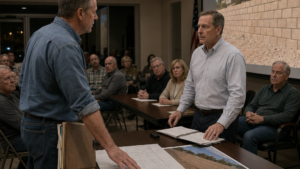
Nicholas began Emma’s termination meeting before noticing Benjamin seated beside company counsel.
The conference room blinds were open to the morning light. At one end of the table sat two board representatives, the compliance officer, and an attorney for the management company. Emma occupied a chair near the door with no papers in front of her.
Benjamin sat quietly beside Sarah.
Nicholas entered carrying a blue folder and speaking before he reached his seat.
“This is an internal personnel matter involving unauthorized retention of proprietary records,” he said. “I recommend immediate separation before the employee causes additional exposure.”
Then he looked up.
His stride shortened.
Recognition did not come all at once. First he saw the brown suede jacket. Then Benjamin’s face. Then Sarah’s legal pad and the management-company attorney seated opposite them.
Nicholas recovered quickly.
“This individual is not authorized to attend an employee review.”
Benjamin said nothing.
The compliance officer cleared her throat. “Mr. Baker, please sit down.”
Nicholas remained standing. “He has been involved in repeated parking violations and has already demonstrated hostility toward management staff.”
One board representative looked toward the attorney. “Who is he?”
Nicholas answered before anyone else could.
“A guest associated with one of the tenants. We have had ongoing access problems with him.”
Benjamin watched Sarah write down the exact words.
The company attorney leaned toward Nicholas. “Are you certain?”
“Yes.”
“Please identify the tenant.”
Nicholas opened the blue folder. Inside were copies of the tow authorizations, the fire-lane warning, and the orange notice from Monday morning.
“The vehicle is not attached to an active tenant permit,” he said. “The driver repeatedly occupied controlled areas and interfered with valet coordination.”
Benjamin placed the signed parking agreement on the table.
Nicholas glanced at it. “That document is outdated.”
“What replaced it?” Benjamin asked.
“The revised management policy.”
“Policy number?”
Nicholas’s eyes hardened with recognition. It was the same question from the parking lot.
“This meeting is not about your parking complaint.”
“No,” Benjamin said. “It is about what happened when an employee preserved records you ordered destroyed.”
Emma flinched but remained silent.
Nicholas turned to the board representatives. “This is exactly the kind of escalation I warned about. People challenge basic operations, staff lose control, and suddenly routine decisions become accusations.”
His voice was steady now. He knew this room better than Benjamin did. He knew the language of corporate risk: control, disruption, exposure, routine decisions.
Benjamin let him continue.
Nicholas described declining parking compliance, restaurant congestion, staffing shortages, and pressure from ownership to hold costs flat. He said the valet arrangement had been an operational accommodation designed to reduce traffic and support the neighboring business.
Some of it was true.
The city had removed street parking. The restaurant had struggled. Security hours had been cut. The management company had demanded improved ancillary performance without raising the operating budget.
Nicholas had been given contradictory goals and limited tools.
Then he had chosen secrecy.
“The guest involved,” Nicholas said, pointing toward Benjamin without looking at him, “refused clear instructions and created unnecessary conflict. The enforcement actions were justified.”
Benjamin opened the deed.
He did not slide it across the table immediately.
“Did you review the ownership schedule attached to your management contract?” he asked.
Nicholas looked toward the company attorney.
“This is becoming theatrical.”
“Did you review it?”
“I am familiar with the client structure.”
“What is the client’s name?”
“The building is held through an ownership entity.”
“That is not what the deed says.”
Sarah pushed the document forward.
The first board representative read the recorded owner’s name, then looked at Benjamin.
Nicholas did not move.
Benjamin placed his driver’s license beside the deed.
The room became quiet without becoming dramatic. No one gasped. No one smiled. The air simply changed as each person understood that Nicholas had documented months of enforcement against the individual whose signature sustained the contract.
“You own the property personally,” the compliance officer said.
“Yes.”
Nicholas’s face remained controlled, but color had risen above his collar.
“That does not invalidate operational rules,” he said.
“No,” Benjamin replied. “Your lack of recognition is not the primary issue.”
That answer unsettled him more than accusation would have.
Benjamin removed the reserved placard from a canvas bag and placed it on the table. Emma had surrendered it to Sarah after their Friday meeting. The scratched number faced Nicholas.
“This is not proof that I deserve better treatment than anyone else,” Benjamin said. “It is proof that your office removed a valid assignment, concealed the removal beneath valet sleeves, and then created violations to keep the assigned user away.”
Nicholas sat down at last.
Sarah distributed the transaction summary.
Four hundred thirty-one paid valet transactions.
Nearly twenty-two thousand dollars collected.
Zero dollars reported to ownership.
The reference code RP-16 appeared at the top of every page.
Nicholas studied the figures. “Those totals include gross customer activity, not management revenue.”
Jonathan Scott entered through the side door.
He looked uncomfortable in a suit, as if he had dressed for a bank meeting rather than a confrontation. He took the empty chair beside the compliance officer and placed eleven invoices on the table.
“I paid the management account listed here,” Jonathan said. “Nicholas presented the spaces as authorized.”
Nicholas turned on him. “You operated the valet service.”
“Yes.”
“You collected customer fees.”
“Yes.”
“And you retained revenue.”
Jonathan nodded. “After paying the monthly license amount and event charges you invoiced.”
“There was no license.”
“That is not what you told me.”
Jonathan’s voice stayed low. “I should have verified it. The account name looked wrong. I asked once and accepted your explanation because I needed the spaces.”
His admission prevented the room from dividing into innocent and guilty sides. Benjamin saw one board representative glance at the other.
Nicholas opened the blue folder again. “The revenue offset property expenses. Security, cleaning, traffic control. Ownership benefited.”
“Some of it did,” Benjamin said.
He placed Emma’s duplicate logbook beside the transaction summary.
Nicholas’s composure cracked.
“That document was maintained without authorization.”
“It shows legitimate expenses,” Benjamin said. “It also shows cash withdrawals, unsupported transfers, and towing fees tied to employee evaluations.”
The compliance officer turned sharply toward Nicholas. “Employee evaluations?”
Emma spoke for the first time. “We were scored on warnings, removals, and collected administrative fees.”
Nicholas looked at her with open contempt. “You signed those authorizations.”
“Yes,” Emma said. “Including the second tow of Mr. Jackson’s vehicle.”
The admission hung there.
Benjamin could have shielded her from it. He had chosen not to.
Emma continued. “I followed directives I believed were wrong because I was afraid of losing my job. I preserved the records for the same reason. Neither choice cancels the other.”
Nicholas leaned back. “So the employee admitting misconduct is now the company’s source?”
“No,” Benjamin said. “The records are the source. Her admission explains how the system survived.”
The company attorney requested a break. No one moved.
One board representative closed the transaction summary. “We can suspend Mr. Baker immediately, reimburse the client, and conduct an internal investigation.”
“What about the account?” Sarah asked.
“We will determine individual responsibility.”
“And the incentive dashboard?” Benjamin asked.
The representative’s expression changed slightly.
Sarah opened the corporate compensation policy. Regional directors received credit for ancillary revenue entered into the dashboard before full reconciliation. The system allowed pending revenue to improve performance metrics without appearing on client statements.
Nicholas had exploited it.
The company had built it.
The second representative folded his hands. “That policy was not designed to conceal client funds.”
“But it rewarded the appearance of income before anyone confirmed where it belonged,” Benjamin said.
“We are prepared to separate Mr. Baker from the company.”
“And renew the property contract under new leadership?”
The representatives exchanged a look.
“That would provide continuity,” one said.
There it was: the convenient ending. Nicholas removed, Emma disciplined, reports corrected, contract preserved.
Benjamin imagined how satisfying it would feel to accept. Nicholas had targeted him, billed him, and stood in this room calling him a guest. Let the company discard him and pay back the money.
But the parking system had not grown in an empty room. Employees had been pressured. Reports had been structured to hide pending income. Benjamin had approved summaries without asking why the person running his property seemed to possess more practical authority than anyone accountable to him.
He touched the reserved placard.
“I will not renew under the current terms,” he said.
Nicholas stared at him.
The board representative began, “Mr. Jackson—”
Benjamin continued.
“Renewal requires full restitution, an external audit of ancillary revenue, reimbursement of every unsupported tow and fee, written protection for employees who preserve requested records, and removal of unilateral towing authority from the on-site director.”
“That is extensive.”
“So was eleven months.”
The representative looked at Sarah. “And if the company declines?”
“The contract expires in thirty days,” Benjamin said. “A transition firm assumes operations, and the records go to every party entitled to review them.”
Nicholas’s voice turned flat. “You would destabilize the building over parking.”
Benjamin looked at the man who had built a private kingdom from signs, warnings, and borrowed power.
“No,” he said. “I am refusing to let parking remain the place where no one has to account for anything.”
The compliance officer collected the duplicate ledger. Emma’s termination notice remained unsigned.
Outside the conference room, office employees moved past the glass without knowing what had changed.
Inside, the management company asked for forty-eight hours to respond.
Benjamin slid the reserved placard back toward himself.
“You have until tomorrow at five,” he said.
Chapter 7: Every Space Accounted for Before Morning
The towing signs came down before the first office employee arrived.
Benjamin stood beside the parking entrance while a maintenance worker loosened the final metal bracket. The sign had warned that unauthorized vehicles would be removed at the owner’s expense. For months, the phrase had sounded less like a rule than a threat whose meaning depended on who was allowed to define unauthorized.
The worker lowered it carefully.
“Where do you want this?”
“In storage,” Benjamin said. “Not the trash.”
Across the lot, the sixteen valet sleeves had been removed. The original reserved placards were visible again, each one carrying a temporary white label with an audit number and a new access code.
Three weeks had passed since the conference-room meeting.
The management company had accepted most of Benjamin’s conditions twenty minutes before his deadline. It agreed to an external audit, reimbursement of unsupported fees, protection for employees who cooperated, and immediate suspension of Nicholas’s towing authority. The contract would continue only through a supervised transition period.
Nicholas had not returned to the building.
The company’s public explanation called his absence administrative leave. Its private settlement language described unauthorized operational decisions, reporting failures, and misuse of company systems. Nowhere did it use the word theft. Nowhere did Nicholas admit that he had deliberately targeted Benjamin.
Sarah had warned him that a complete confession was unlikely.
“Documents can establish conduct,” she had said. “They cannot force someone to describe his own motives honestly.”
The audit had still answered enough.
Nicholas authorized the valet arrangement. He created the invoices, directed payments to the ancillary account, and used part of the revenue to cover security and cleaning expenses the management company had refused to fund. Later, he approved transfers that had no clear property purpose.
But he had not built the weakness alone.
Corporate staff could see the pending revenue dashboard. No one reconciled it to Benjamin’s ownership statements. Regional managers were rewarded for generating ancillary income before determining whether that income belonged to clients. The system encouraged numbers first and questions later.
The maintenance worker carried the towing sign away.
Benjamin turned toward the restaurant entrance, where Jonathan Scott waited with a folder beneath one arm.
They met beside the valet podium. It had been moved six feet away from the traffic lane and fitted with a printed rate schedule, a permit number, and instructions identifying which spaces could be used and during which hours.
Jonathan handed Benjamin the temporary license agreement.
“Sarah already reviewed it,” he said. “I signed every page she marked.”
Benjamin opened to the payment section. The monthly fee would now pass through the property’s official account. Customer charges would be separately recorded. The restaurant could continue using twelve spaces on regular evenings and all sixteen only during approved events.
“You understand this is temporary,” Benjamin said.
“Six months, with a review after three.”
“And no cash payments outside the system.”
“I understand.”
Jonathan looked toward the restaurant windows. Inside, employees were setting tables for lunch.
“I should have asked more questions,” he said.
“Yes.”
The answer made him wince, but Benjamin did not soften it.
Jonathan nodded. “I kept telling myself the paperwork looked professional.”
“It did.”
“And that Nicholas knew more about the property than I did.”
“He did.”
“That made it easy.”
Benjamin closed the folder. “That is usually what makes these arrangements dangerous.”
They signed at the valet podium rather than in an office. One attendant watched from a few feet away while entering the morning inspection into a tablet. The new system required each occupied space, payment, exception, and complaint to be visible to the restaurant, management staff, and ownership.
No one person could erase a row without creating a record of the change.
When Jonathan returned inside, Emma Torres crossed the lot carrying a cardboard box.
Benjamin had offered her the permanent property-manager position two days earlier. She knew the building better than anyone remaining, and the audit had confirmed that her duplicate records preserved information the company might otherwise have lost.
She had declined.
“You’re sure?” he asked as she approached.
“Yes.”
“You would have oversight. Not Nicholas’s authority.”
“I know.”
She set the box on the hood of her car. Inside were personal items from her desk, along with the black duplicate logbook sealed in a clear evidence sleeve.
“The company offered to transfer me,” she said. “Different property. Different regional office.”
“Will you take it?”
“No.”
Benjamin waited.
Emma looked at the newly exposed placards. “I spent too long telling myself I was protecting my job so I could protect other people later. Most days, later never came.”
“You did preserve the records.”
“I also signed your tow authorization.”
“Yes.”
She met his eyes, perhaps expecting reassurance.
Benjamin gave her none that would erase the truth.
“You cooperated when it mattered,” he said. “That should count. It should not cancel what came before.”
“That’s why I can’t manage this building.”
He understood then that refusing the position was not surrender. It was the first decision she had made without measuring what a superior wanted from her.
“What will you do?”
“I have an interview with a facilities company. Smaller sites. No towing program.”
A faint smile touched her face.
Benjamin held out his hand. Emma shook it.
Before leaving, she took the old reserved placard from the box. The audit team had returned it after copying the adhesive residue and identifying marks.
“You should put this back,” she said.
By noon, it was mounted above Benjamin’s space.
A small metal plate had been added beneath it. The plate displayed the access code, the audit reference, and a phone number that routed disputes to an independent service rather than the on-site manager.
The sign no longer represented privilege. It represented a boundary that could be checked by anyone.
That afternoon, Sarah sent the final restitution schedule.
The recovered funds and the management company’s contribution would cover the audit, every unsupported towing and administrative charge, and reimbursements for other drivers caught in the same enforcement pattern. Jonathan would repay the portion of the valet fees that could not be recovered from the operating account, spread across the temporary license term so the restaurant would not lose staff.
Nicholas offered partial repayment through counsel.
His letter denied personal enrichment beyond authorized performance compensation. It acknowledged poor judgment, inadequate documentation, and an overly aggressive response to parking violations.
It did not acknowledge Benjamin by name.
Benjamin read the letter once and placed it in the file.
He could have demanded a public apology. He could have prolonged the dispute until Nicholas used the exact words Benjamin believed were true.
Instead, he required the payment, the audit findings, and the corrected records to remain part of the contract history.
By evening, the parking lot was full without being chaotic. Office workers left through the main entrance as restaurant customers arrived. Valet attendants used the approved row. The tablet at the podium recorded each key and each space.
Benjamin stood beside his sedan for a moment before unlocking it.
Months earlier, he had believed dignity meant never needing to announce his authority. Nicholas had treated that silence as emptiness. Emma had treated it as distance. The management company had treated it as permission to send clean reports without asking what daily life beneath them looked like.
Benjamin still had no desire to become the kind of owner who inspected every receipt and challenged every employee.
But he had begun walking the property twice a week.
He spoke with tenants. He reviewed exceptions instead of only totals. He required quarterly meetings to include the people who issued warnings, balanced accounts, and answered complaints.
Presence, he had learned, did not have to mean control.
It could mean refusing to let borrowed authority become invisible.
His phone vibrated with the final reimbursement notice.
The two towing fees had been returned. The three administrative charges had been reversed. The restaurant payments were recorded in the proper ledger. Every affected vehicle owner had been identified and credited.
Benjamin looked up at the reserved placard.
Morning light had once reflected it in Nicholas’s window like a powerless decoration. Now the same number appeared in the official access system, the audit report, and the reconciled ledger.
Every space was accounted for.
So was every decision that had tried to make it disappear.
The story has ended.