They Ordered Her Grandfather’s Stone Sundial Removed Before Its Shadow Reached Noon
Chapter 1: The Stones Appeared Before Anyone Understood Why
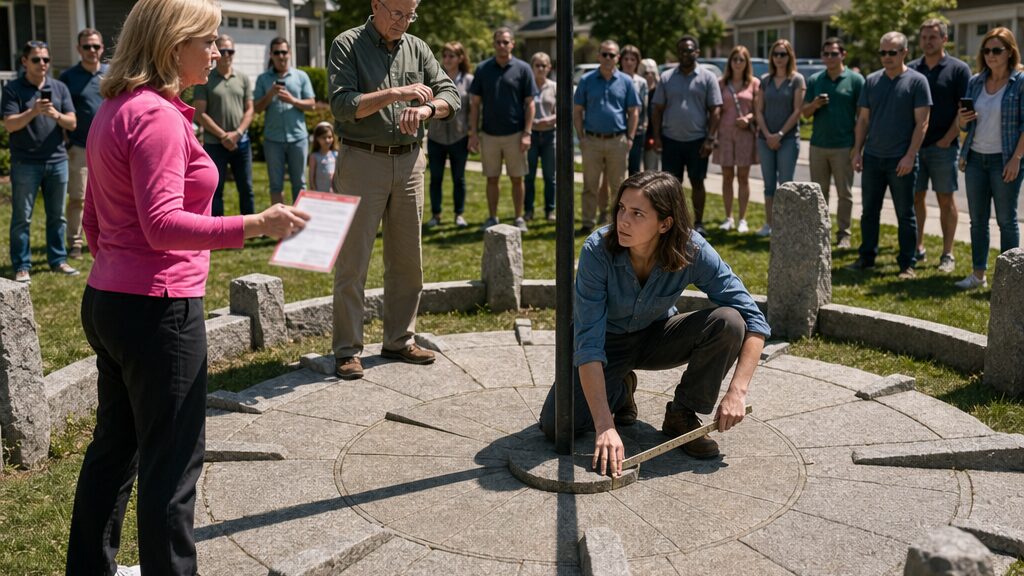
The western upright shifted just as the first neighbor stopped on the sidewalk.
It did not fall. It moved only enough for its shadow to jump across the grass and miss the chalk mark Sarah Allen had drawn before sunrise.
She dropped the steel level, caught the gray slab with both hands, and pressed her shoulder against its rough face.
“Stay,” she whispered.
The stone weighed more than she did. Its lower end sat in a narrow bed of compacted gravel, but the soil beneath one corner had softened overnight. Sarah could feel the imbalance through her palms.
A woman walking a small white dog had stopped beside the mailbox. Across the street, a garage door remained half open while its owner watched from behind a stack of storage bins.
By eight-thirty, almost everyone on the block had seen the circle.
Seven upright stones stood in Sarah’s front lawn, each cut from pale concrete cast to resemble weathered granite. Three shorter crosspieces linked them near the top. Smaller markers curved around a black metal post fixed at the center. From the sidewalk, it looked less like a garden feature than the remains of a monument someone had assembled in the wrong century.
Sarah wedged a cedar shim beneath the leaning upright and checked the bubble again.
Centered.
She stepped back, breathing hard.
“You built that by yourself?”
Richard Green stood at the property line with a coffee mug in one hand. He had been a surveyor before retirement and still looked at yards as if every fence concealed a measurement dispute.
“Mostly.”
“Mostly means your mother helped?”
“Mostly means I borrowed her car without telling her what the bags of concrete were for.”
Richard’s eyebrows rose, but the corner of his mouth moved.
He crossed the lawn carefully, avoiding the chalk arcs. “Foundation depth?”
“Thirty inches for the center post. Eighteen for the uprights.”
“Not enough for a public structure.”
“It isn’t public.”
Richard looked toward the sidewalk, where three people now stood with their phones raised.
“That distinction may be having a difficult morning.”
Sarah ignored him and unrolled the plans on a folding worktable. The paper had softened at the creases and yellowed along the edges. Dennis Allen’s handwriting crowded the margins in slanted capital letters: seasonal correction, true solar noon, local latitude, drainage allowance.
Her grandfather had drawn every line by hand.
She had spent four months translating those lines into measurements after school and after Catherine went to bed. She had built molds in the garage, mixed concrete in small batches, and carried the finished pieces into the yard before dawn over three weekends.
Dennis had wanted to finish the model with her.
She had told him she was busy.
Three weeks later, he had gone into the hospital and never returned home.
Sarah placed a small brass compass over the plan. The central post’s morning shadow fell between two unfinished markers, exactly where it should have been—except for the western upright she had just corrected.
A sharp voice came from the sidewalk.
“What is this supposed to be?”
Brenda Nelson stood with one hand resting on her hip and the other holding a phone. She wore bright walking clothes and white sneakers that had not touched the grass.
Sarah kept her eyes on the compass. “It’ll make sense at noon.”
“That is not an answer.”
“It’s the answer you need.”
Brenda’s expression tightened. She chaired the HOA architectural committee and spoke at meetings with the careful patience of someone who expected everyone else to become unreasonable first.
“You placed multiple permanent structures in a visible front-yard area,” she said. “There was no application, no engineering review, no setback verification, and no notice to adjacent owners.”
“They’re inside our property line.”
“That does not exempt them from review.”
Sarah rolled the plans halfway closed.
Brenda’s gaze dropped to the exposed paper.
For one second, all the authority left her face.
Her eyes fixed on Dennis’s handwritten note beside the north marker.
Sarah saw the recognition before Brenda looked away.
“You know these plans,” Sarah said.
“No.”
“You looked right at his writing.”
“I looked at an old sheet of paper sitting beside an unapproved structure.”
“You knew my grandfather.”
“Everyone knew Dennis.”
“That isn’t what I asked.”
Brenda lifted her phone. “I am asking whether your mother authorized this.”
Sarah did not answer.
That was enough.
Brenda stepped off the sidewalk at last, stopping beside the folding table. “Where is Catherine?”
“At work.”
“Does she know the scope of what you installed?”
“She knows I was building something.”
Richard made a low sound into his coffee.
Brenda glanced at him. “Are you involved?”
“No.”
“Did you inspect it?”
“No.”
“Then please don’t give anyone the impression that you approved it.”
Richard’s face remained neutral. “I wouldn’t.”
Sarah disliked the answer even though it was true.
Brenda scrolled through her phone. “The management office opens at nine. I will ask them to issue a formal notice.”
“You can wait three hours.”
“Function does not replace permission.”
“You don’t even know the function.”
“That is because you refused to explain it.”
Sarah looked at the circle, at the central post and the empty space where the noon marker still needed to be set. Explaining it now would turn Dennis’s work into a proposal again—something to be examined by the same people who had laughed whenever he talked too long about shadows and seasons.
Proof was different.
Proof did not ask.
A sedan slowed in the street. Two children on bicycles stopped at the curb. One of them asked whether the stones were real.
“Concrete,” Sarah said.
The child looked disappointed.
Brenda tapped her screen. “You understand that the association can require removal.”
“After a hearing.”
“For continuing or hazardous conditions, temporary action may be accelerated.”
“It isn’t hazardous.”
“One stone was leaning when I arrived.”
Sarah’s hand tightened around the edge of the table.
Richard set down his mug. “The base has been corrected.”
Brenda looked at him.
He added, “That is not an inspection.”
By ten o’clock, Sarah had reset the final marker. She used Dennis’s worn folding rule, pressing its brass hinge flat against the concrete. When she stepped back, the circle looked balanced again.
The satisfaction lasted less than a minute.
The property manager’s golf cart stopped at the curb.
Brenda walked beside it, carrying a red-bordered sheet inside a clear plastic sleeve. Without speaking to Sarah, she fastened it to a temporary yard stake just inside the property line.
NOTICE OF UNAPPROVED EXTERIOR ALTERATION.
Sarah read the first paragraph twice.
Immediate correction requested. Potential safety concern. Owner response required by five that evening.
Catherine’s name appeared at the top.
“You put this against my mother,” Sarah said.
“The home belongs to your mother.”
“I built it.”
“The association deals with the owner of record.”
Brenda turned toward the sidewalk, where more neighbors had gathered. “Everyone needs to remain outside the installation area until it has been assessed.”
“It’ll be assessed at noon.”
“By whom?”
“The sun.”
Someone laughed.
Sarah could not tell whether it was admiration or mockery.
Brenda folded her arms. “That sentence is exactly why this should have gone through review.”
Sarah looked down at Dennis’s plans. A faint pencil note near the center read: Do not set final noon stone until observed. Conditions reveal error better than confidence.
Her stomach tightened.
She had calculated the marker three times. Still, she had never tested the full-scale structure. Clouds had covered the last two days, and the morning shadows could not prove the noon alignment.
If she was wrong, everyone would watch the shadow miss.
If she was right, Brenda could still order it removed.
Sarah rolled the plans and secured them beneath her arm.
Then she walked to the curb and faced the loose semicircle of residents.
“Come back when the shadow reaches twelve,” she said.
Chapter 2: At Noon the Ridiculous Stones Began Telling Time
The shadow was less than two inches from the noon marker when Brenda ordered everyone off the lawn.
“Behind the sidewalk,” she called. “Now, please.”
No one moved immediately.
Nearly thirty residents had gathered along the curb and driveway edges. Parents stood behind children. Two men watched from the shade of an open garage. Someone had brought a folding chair, as though Sarah’s front yard had become a scheduled performance.
Sarah knelt beside the smallest marker with Dennis’s folding rule in her hand.
The marker was wrong.
Not by much. Perhaps half an inch. But the black line cast by the central post was approaching at a slight angle, and if Sarah left the stone where she had set it, the shadow would clip its edge instead of dividing it cleanly.
Her calculations had used the dimensions from Dennis’s original drawing. She had forgotten that the metal post she installed was one-quarter inch wider.
Brenda stepped closer. “Sarah, I am not going to repeat myself.”
Sarah lifted the marker.
A murmur passed through the crowd.
“She’s moving it,” someone said.
Brenda glanced at her phone. “You told people this was already completed.”
“I told them to come at noon.”
“That is not the same thing.”
Sarah placed the marker along the chalk arc, shifted it the width of her little finger, and pressed it into the prepared gravel bed.
Richard stood outside the circle, watching the post rather than her.
“Thirty seconds,” he said.
Brenda turned on him. “Please do not encourage this.”
“I stated a time.”
“You are lending credibility to an unreviewed installation.”
Richard’s gaze remained on the shadow. “Accuracy and approval are separate questions.”
Sarah wanted him to defend her more clearly. She also knew he was right.
Brenda raised the violation notice so the plastic sleeve flashed in the sun.
“This is an unapproved pile of masonry in a front yard,” she said. “Whether it performs a trick does not eliminate the safety issue.”
Sarah stood.
Dust clung to her knees. Sweat had darkened the collar of her shirt. She could hear someone’s phone recording from close behind her, its microphone catching every breath.
“Please stand clear of the stones,” she said.
Brenda gave a short, disbelieving laugh. “You don’t get to direct a crowd on property subject to an active violation.”
Sarah did not answer.
The shadow moved.
At first it touched the outer edge of the curved concrete path. Then it crossed the first engraved line Sarah had cut into the central disk. It advanced slowly enough that the crowd became quiet by degrees.
A child near the mailbox pointed.
“It’s going to that rock.”
The line reached the noon marker.
It did not clip the edge.
It divided the stone through its center.
The child looked at his mother. “It says twelve.”
No one laughed this time.
Sarah watched the shadow settle into Dennis’s alignment as precisely as a needle entering a groove. The surrounding stones changed with it. What had looked random from the sidewalk became a sequence. Each marker belonged to the arc. Each upright framed the movement. The central post was no longer a metal pole in a ring of concrete. It was the fixed point around which the entire arrangement made sense.
Richard checked his watch.
“Twelve-oh-one by civil time,” he said. “Close enough for true solar noon this week.”
A woman near the driveway stepped forward. “It’s a sundial?”
“More than a clock,” Sarah said before she could stop herself. “The outer stones mark the seasonal shift. At the solstices, the line reaches the longer cuts. The uprights frame sunrise positions from the street side.”
Brenda stared at the noon marker.
Her expression had not softened, but something uncertain moved behind it.
Sarah unrolled Dennis’s plans over the table.
“He designed it,” she said. “My grandfather.”
Several residents came closer. Brenda began to object, then stopped when Richard raised one hand.
“Stay outside the inner ring,” he said. “Until the footings are checked.”
His caution gave the crowd permission to remain.
Sarah showed them the small annotations Dennis had made beside each arc. A girl leaned over the table, tracing the air above one drawing without touching it. An older resident asked why the stones were so large.
“So people could stand inside the measurement,” Sarah said.
The words caught in her throat.
Dennis had said that once in the garage. A clock on a wall tells you the time, he had told her. A sundial makes you stand inside it.
She had barely looked up from her phone.
Now the neighbors were photographing the shadow, the plans, the central disk. A child crouched at the edge of the circle and watched the line move past noon.
For several minutes, Sarah believed she had won.
Then Richard bent over the unrolled sheet.
“What’s this number?” he asked.
His finger rested near the lower-right margin, where Dennis had written a parcel reference beneath three erased pencil lines.
Sarah read it aloud.
Richard looked toward the narrow common green beyond the Allen yard, a strip of grass running between the houses and the stormwater basin.
“That isn’t your lot.”
Brenda’s head turned sharply.
Sarah followed Richard’s gaze. “What is it?”
“Old common-area designation,” he said. “Before they consolidated the drainage parcels.”
Brenda stepped toward the table. “Let me see that.”
Sarah placed her hand over the margin.
“You said you didn’t know the plans.”
“I said I did not recognize the handwriting.”
“That’s not what you said.”
Brenda’s jaw tightened. “This demonstration is over.”
A few residents protested.
She faced them instead of Sarah. “The fact that the object functions does not establish that it is structurally safe, properly located, insured, or approved. The association cannot permit a teenager to install heavy masonry and invite children around it because everyone enjoyed watching a shadow.”
The crowd’s warmth cooled into discomfort.
Sarah hated how reasonable Brenda sounded.
Richard tapped the plans. “The center post is aligned to the Allen lot. But the original bearing line continues toward the common green.”
“Original,” Brenda repeated. “Not current.”
“You’ve seen this reference before,” Sarah said.
Brenda ignored her.
The property manager approached with another sheet. “The committee chair is requesting accelerated correction pending safety review.”
“You already gave us until five,” Sarah said.
“That was for a response.”
“What does accelerated correction mean?”
“Removal or stabilization measures may be required before the hearing.”
“May be?”
Brenda took the paper from the manager. “Begin dismantling by six this evening. Start with the crosspieces and any loose markers. The central post can remain until a contractor evaluates the footing.”
A chorus of objections rose from the sidewalk.
Brenda lifted her voice only slightly. “If anyone is injured now that a crowd has been invited, the association and homeowner may both face exposure.”
Sarah looked at Catherine’s name printed at the top of the page.
Again, the order belonged to her mother.
Not to Sarah.
The admiration around her suddenly felt useless. Phones could capture the shadow, but they could not sign an application, pay a fine, or protect Catherine’s house.
Brenda fastened the new warning over the first notice.
“You proved it works,” she said quietly.
Sarah looked at her.
For one brief instant, Brenda’s eyes rested on Dennis’s notes with something close to grief.
Then she turned away.
By one-thirty, the neighbors had gone home. The circle stood empty beneath the hard afternoon light. Its shadow had moved beyond the noon marker, lengthening toward stones no one had stayed to understand.
Sarah carried the plans inside before the wind could lift them.
Catherine was already standing in the entryway.
She had come home early in her work clothes, her bag still over one shoulder. In one hand she held the removal order that had been taped to the front door.
“Tell me,” Catherine said, “that this is not the first time the HOA has heard about those plans.”
Chapter 3: The Old Plans Included Land That Was Never Theirs
The demolition estimate lay across Dennis’s plans like a sentence.
Catherine had printed it before breakfast. The contractor’s total was circled in black ink, with an additional line for hauling, lawn repair, and disposal of reinforced concrete.
Sarah stood at the kitchen counter, still holding the spoon she had used to stir coffee she did not want.
“We don’t need a contractor.”
“We need someone insured.”
“I built it. I can take it apart.”
“That took you four months.”
“I wasn’t working full days.”
Catherine slid the estimate closer. “The fines start tomorrow if the board decides we ignored the order. The management company has already copied their attorney.”
“You haven’t even asked why the plans show common property.”
“I am asking why you built a permanent structure without telling me.”
“I told you I was working on Grandpa’s project.”
“You said it was a garden model.”
“It is in a garden.”
Catherine closed her eyes.
The exhaustion in her face made Sarah regret the answer, but not enough to apologize.
“You used my car,” Catherine said. “My address. My property. And now my name is on every notice.”
“They rejected him before.”
Catherine’s eyes opened.
The room changed.
Sarah placed both hands on the rolled plans. “You knew that.”
“I knew he talked to the board about something years ago.”
“Something with this exact parcel number.”
“I don’t remember the number.”
“But you remember the meeting.”
Catherine pushed back from the table. “Start with the crosspieces today. We can store them in the garage while I request a hearing.”
“You want me to destroy it before the hearing?”
“I want to show cooperation.”
“That’s what you did with Grandpa.”
Catherine’s face went still.
Sarah knew she had struck the place she intended to strike. That did not make the satisfaction clean.
Her mother picked up the estimate and folded it once.
“At noon yesterday,” Catherine said, “you got to stand in the yard while everyone looked at something beautiful. I got a call at work from a property manager asking whether I understood my liability exposure.”
“It’s safe.”
“You don’t know that.”
“Richard said—”
“Richard said accuracy and approval were separate questions.”
Sarah looked toward the front window. The upper crosspieces were visible above the hedge, silent and absurd against the neighboring roofs.
“I’m not taking it down.”
Catherine set the folded estimate beside her. “Then prove the HOA already approved it, or prove they knew enough to owe us a proper review. You have until the hearing request is processed. After that, I hire the contractor.”
The HOA office occupied one room beside the community clubhouse, with beige filing cabinets, a copier, and a counter designed to keep residents several feet from the property manager’s desk.
Sarah arrived carrying the plans in a clear sleeve.
The manager looked at the parcel number she had written on a sticky note.
“I can search current architectural applications.”
“It’s older. Maybe eight or nine years.”
“Then it may be in archived minutes.”
“I need anything submitted by Dennis Allen.”
The manager typed for less than a minute before shaking her head. “No architectural application under that name.”
“What about a common-area proposal?”
“That would be board records, not owner architectural records.”
“Can I see them?”
“Meeting minutes are available by written owner request.”
“My mother is the owner.”
“Then your mother needs to submit it.”
Sarah leaned closer to the counter. “Brenda Nelson saw these plans yesterday.”
“I can’t speak to what a committee volunteer may have seen.”
“She knew the handwriting.”
The manager’s professional expression did not change. “There is no formal proposal in the system under Dennis Allen.”
The sentence was too polished. Sarah heard the gap inside it.
“In the system,” she repeated.
The manager looked toward the copier. “Older records were scanned selectively.”
“Where are the originals?”
“Some are stored off-site. Some are in the records room.”
“Can you check?”
“Not without a specific approved request.”
Sarah left with a one-page form and no proof.
Richard was waiting near the common green when she returned. He had brought a survey tripod and a faded field notebook.
“I’m not certifying anything,” he said before she reached him.
“I didn’t ask you to.”
“You were going to.”
Sarah handed him the plan sleeve.
He studied the parcel reference, then set the tripod near the drainage path. From the sleeve, he removed a photocopy rather than the original and aligned Dennis’s north arrow with his compass.
Sarah watched him work without speaking. Richard measured from the curb, then from the old utility marker near the basin. He paced a line across the Allen lawn and continued onto the common green.
The afternoon sun cast his narrow shadow ahead of him. At one point it crossed the faint pencil bearing on Dennis’s photocopy almost exactly.
Richard stopped beside a shallow depression in the grass.
“This is where the center would have been.”
“The center of what?”
“The original installation.”
Sarah looked back toward her yard. From this point, the front-lawn sundial seemed compressed and slightly crowded between the walkway and the hedge.
On the common green, the same circle would have opened toward the whole street.
Richard unfolded another section of the drawing.
The sheet extended farther than Sarah had realized. Along the lower edge, Dennis had drawn a curved path, low seating stones, and four rectangular panels labeled seasons, local birds, planting cycle, and neighborhood history.
Sarah stared at the notes.
“It wasn’t supposed to be his,” she said.
“No.”
“Then why did he build the small model at home?”
“Models are how people ask others to imagine something.”
“He never asked me to imagine it.”
Richard closed his notebook. “Maybe he did.”
Sarah remembered the small stone disk on Dennis’s workbench. The brass post. The pencil lines he had asked her to check.
She had said she had homework.
She had not had homework.
“He let everyone think he wanted a monument in his yard,” Sarah said.
Richard looked toward the clubhouse. “Dennis sometimes preferred being misunderstood to being negotiated with.”
“That sounds like blaming him.”
“It is not always blame to name the part someone played.”
Sarah bristled. “Did you know about the proposal?”
“I knew he was measuring this green. I knew he attended two meetings. I did not see the final plan.”
“You could have asked.”
“Yes.”
The answer landed harder because he did not defend himself.
Back at the house, Sarah spread the plans across the garage floor. The common-area drawing connected perfectly to the dimensions she had used for the front yard. She had built only the central instrument and upright frames. The educational path and shared seating had remained folded beneath another panel.
Dennis had not designed a private memorial.
Sarah had made it one.
Catherine entered carrying two bottles of water. Her gaze moved over the expanded drawings.
“You found the rest.”
“You knew it was for the green.”
“I knew that was his first idea.”
“First?”
Catherine sat on the step leading into the house. “He changed it after the board meeting.”
“The HOA says there was no proposal.”
“There was no application. Not the way they define one now.”
“That sounds convenient.”
“It was a presentation. He brought the model. Brenda helped him set it up.”
Sarah turned. “Brenda helped him?”
Catherine twisted the cap from one bottle but did not drink. “At the beginning.”
“Why didn’t you tell me?”
“Because every time his name comes up in this neighborhood, you hear only the part where people failed him.”
“Maybe because they did.”
“They did. And he made it easier.”
Sarah stared at her.
Catherine rested the bottle between her palms. “After the board raised safety conditions, he refused to revise anything. He said if they could not understand the design as it was, they did not deserve it.”
“That sounds like him.”
“It also sounds like you.”
The words struck with more accuracy than Sarah wanted to allow.
She gathered the photocopies into a stack. “I’m requesting the old minutes.”
“I already did.”
Sarah paused.
Catherine took a folded email from her pocket. The management company had responded that no formal common-area proposal by Dennis Allen existed in the retained digital archive.
At the bottom, Brenda had been copied.
“She knew we were looking,” Sarah said.
“She knows now.”
“No. She knew yesterday.”
Catherine’s silence confirmed more than an answer would have.
Sarah crouched beside the plan and traced the bearing line from the Allen lawn into the green.
“Who made him withdraw it?”
Catherine looked toward the open garage door. The sundial’s afternoon shadow stretched across the driveway, no longer pointing anywhere a neighbor would recognize.
“I was at the meeting,” she said.
Sarah waited.
Catherine folded the email along its existing crease.
“And Dennis did withdraw the proposal,” she continued. “But it wasn’t because no one wanted it.”
Chapter 4: Brenda Had Kept the Small Sundial Hidden for Years
Rebecca Taylor placed the miniature sundial in the center of Brenda’s dining table and said, “Tell her where you got it.”
Sarah remained near the doorway, uncertain whether she had been invited inside or merely permitted to witness the argument.
The model was smaller than she remembered from Dennis’s garage. Its circular base was cut from pale stone, no wider than a dinner plate, with a brass post rising from the center. Fine lines crossed its surface. Age had darkened the grooves, but Dennis’s precise lettering remained visible around the edge.
Brenda stood opposite her daughter, still wearing the navy blouse she used for committee meetings.
“You had no right to go through that cabinet.”
“You gave me the key when you asked me to find your election files.”
“Not to search through personal things.”
Rebecca touched the stone base. “This isn’t personal? You’re preparing a vote to destroy the full-size version.”
Sarah stepped closer. A narrow beam of sunlight entered through the blinds and struck the brass post. Its shadow crossed the table and reached the locked cabinet behind Brenda.
“You told me you barely knew his plans,” Sarah said.
Brenda looked at her. “I said there was no formal application.”
“You also said you didn’t recognize his handwriting.”
“I should not have said that.”
It was the first admission Sarah had heard from her, and it came without apology.
Rebecca pulled out a chair but did not sit. “Mom helped your grandfather test this.”
Brenda’s mouth tightened. “That is an oversimplification.”
“Then make it accurate.”
For several seconds, the room held only the faint ticking of a clock above the kitchen entrance.
Brenda finally lowered herself into a chair. She turned the model so that Dennis’s initials faced away from Sarah.
“Eight years ago,” she said, “the board wanted something for the common green. A garden, a seating area, some kind of feature residents could use. Dennis brought this to an informal planning meeting.”
“He designed the whole thing already,” Sarah said.
“He had a concept.”
“He had bearings, construction notes, drainage calculations.”
“He had drawings.”
Sarah heard the dismissal and leaned forward.
Rebecca interrupted before she could answer. “You liked it.”
Brenda looked toward the blinds. “I thought it was interesting.”
“You came home talking about how the shadow changed every day.”
“That does not mean I approved a permanent installation.”
“You helped him present it.”
Brenda folded her hands. “I helped him carry the model into the clubhouse.”
Rebecca laughed once, sharply. “You spent three Saturdays with him in his garage.”
Sarah looked from daughter to mother.
Brenda’s silence confirmed it.
The hidden model changed the shape of everything Sarah had believed. Brenda had not simply recognized Dennis’s handwriting. She had stood close enough to learn how his lines worked.
“Why keep it?” Sarah asked.
Brenda looked down at the stone. “He left it after the last meeting.”
“And you locked it away.”
“It was not mine to display.”
“But it was yours to hide?”
Rebecca’s expression shifted. The anger in her face carried an older hurt, one Sarah did not understand.
Brenda stood abruptly. “The board vote is in two days. I have records to prepare.”
“What records?” Sarah asked. “The ones that leave him out?”
“The enforcement packet concerns your structure, not an abandoned discussion from eight years ago.”
“It concerns the same design.”
“It concerns an unapproved installation on private property.”
“You’re separating them because that helps you.”
Brenda turned to her. “No. I am separating them because they are separate.”
She crossed to a sideboard and removed a thick folder. Inside were photographs of Sarah’s yard, copies of the violation notices, sections of the covenants, and a preliminary memo from the association’s insurer.
Sarah saw a line highlighted in yellow: unsecured decorative masonry may present foreseeable climbing and tipping risk.
“Children were inside the circle,” Brenda said. “Residents were touching the crosspieces. One parent posted a photograph of a child leaning against an upright.”
“The upright is reinforced.”
“You have no stamped engineering document.”
“I used Dennis’s specifications.”
“Dennis was not a structural engineer.”
“He worked for the city for thirty years.”
“As a technician.”
The words were accurate, but Sarah heard the old condescension inside them.
Brenda closed the folder. “Do you know what happened at the pool before your grandfather’s proposal?”
Sarah did not.
Rebecca pulled out a chair and sat slowly.
“A child slipped from the raised edge near the old fountain,” Brenda said. “The injury was not severe, but the claim lasted almost a year. The insurer threatened not to renew unless the board removed anything children could climb. Premiums went up. Assessments went up. Residents blamed the board.”
“And that made the sundial dangerous?”
“It made every new common feature a liability question.”
“You could have revised it.”
“We asked Dennis to lower the stones, remove the overhead pieces, add a perimeter barrier, and submit a maintenance plan.”
“The whole point was to stand inside it.”
“That was his answer too.”
For the first time, Brenda’s voice lost its committee-room polish.
She sat again, not across from Sarah but beside the model.
“He said if we reduced it to signs around a pole, we would destroy the experience. He was probably right. But right does not pay an insurance deductible.”
Sarah looked at Rebecca. “My mother said he didn’t withdraw because nobody wanted it.”
Rebecca’s mouth hardened. “He didn’t.”
Brenda said, “Rebecca.”
“No. You don’t get to tell half of this again.”
Rebecca turned to Sarah. “The board president wanted the issue gone before the annual meeting. Residents were angry about the pool assessment. They needed one clean decision that looked responsible.”
Brenda’s fingers rested against the model’s base.
“I told Dennis the votes were not there,” she said.
“That wasn’t all you told him,” Rebecca replied.
Brenda’s eyes closed briefly.
Sarah waited.
“I told him,” Brenda said, “that if he forced a formal vote, the minutes would describe the design as an unacceptable hazard. I said it would follow every future version he submitted.”
“So you threatened him.”
“I warned him.”
“You gave him a choice between withdrawing and having the neighborhood label his work unsafe.”
Brenda met her gaze. “Yes.”
The answer was quiet.
It was also worse than a denial.
Sarah imagined Dennis carrying the miniature sundial out of the clubhouse while people discussed premiums and liability. She imagined Brenda walking beside him, already knowing he would rather disappear than let the board record his work as foolish.
“You let everyone say he was bitter because they rejected his yard sculpture,” Sarah said.
“He refused to explain what happened.”
“You could have.”
“I had just been appointed committee chair. The board president had supported me. The insurer was threatening renewal. I believed keeping the decision informal protected him.”
“Did it?”
Brenda looked at the locked cabinet.
No one answered.
The doorbell rang.
The property manager stood outside with a folder requiring Brenda’s signature. Through the open doorway, Sarah could see the committee motion authorizing removal if the Allens failed to begin dismantling before the hearing.
Brenda read the top page.
Rebecca stood. “Don’t sign it.”
“The hearing remains available.”
“Then wait for the hearing.”
“The crosspieces are still standing.”
“They stood through a storm last night.”
“That does not establish safety.”
Brenda took the pen.
Sarah wanted to call her a coward. The word reached the back of her throat and stopped there, not from mercy but because Brenda’s fear had become visible. She was not preserving a rule. She was preserving the version of herself who had made the same choice eight years earlier and still needed it to have been necessary.
Brenda signed.
The scratch of the pen sounded louder than it should have.
The property manager gathered the folder and left.
Rebecca stared at her mother. “You chose the board when he needed you.”
“I chose what I believed would keep the neighborhood insured.”
“And now?”
“Now I am applying the rules to an unsafe structure.”
Rebecca picked up the miniature sundial.
Brenda reached for it. “Leave that here.”
“No.”
“It belongs to Dennis’s family.”
“Exactly.”
Rebecca carried it to Sarah and placed it in her hands.
The stone was heavier than it looked. Its brass post was cool, but the base retained the warmth from the strip of sunlight.
Outside, Rebecca walked with Sarah to the curb.
“I left for college two weeks after that meeting,” she said. “I knew my mother had pressured him, but I told myself Dennis would try again after things settled.”
“He didn’t.”
“No.”
“Did he withdraw voluntarily?”
Rebecca looked back at the closed front door.
“He signed the withdrawal,” she said. “But Brenda had already told the board he would. By the time he entered the room, his choice had been announced for him.”
Chapter 5: Her Grandfather’s Silence Was Not the Whole Truth
The hidden panel opened with a dry tearing sound that made Sarah think she had ruined the plans.
She froze over the workbench.
A strip of yellowed adhesive clung to her thumb. Beneath the loosened fold, another sheet had been tucked into the backing, so neatly aligned that she had mistaken its edge for reinforcement tape.
Catherine looked up from the garage steps. “What happened?”
Sarah lifted the upper page carefully.
Two new diagrams appeared beneath it.
The first showed the sundial in the Allen yard, exactly where Sarah had built it. The second showed the larger circle crossing the property line and extending into the common green. Dotted lines connected the two locations, with seasonal shadows drawn across both.
At the bottom, Dennis had written:
Private test phase only. Final installation requires shared access, assigned maintenance, and community instruction.
Sarah read the sentence twice.
“He never meant it to stay in our yard,” Catherine said.
Sarah did not answer.
Beside the diagrams were columns titled volunteer roles, inspection schedule, stone cleaning, seasonal calibration, and school visits. Dennis had listed no names, only responsibilities. One household would inspect drainage after heavy rain. Another would check the markers twice a year. A volunteer would explain the instrument during neighborhood events.
The project had not been designed around Dennis at all.
It had been designed to continue without him.
Sarah unfolded another flap. A handwritten note ran along the margin.
Revised safety request is not unreasonable. My refusal became personal after their language did.
She sat down on the concrete floor.
Catherine came closer. “What does it say?”
Sarah turned the page toward her.
Her mother read in silence.
“He knew,” Sarah said. “He knew some of their changes made sense.”
“He was angry.”
“He let me think they rejected everything.”
“Did he tell you that?”
Sarah opened her mouth.
Dennis had never described the meeting directly. He had referred to the board as people who could look at a shadow and complain about the pole. Sarah had built the rest from tone, rumor, and Catherine’s reluctance.
“He didn’t correct me,” she said.
Catherine sat beside her. “Neither did I.”
The miniature sundial rested on the workbench under Richard’s portable lamp. Its brass post cast a narrow shadow across Dennis’s notes, touching the words shared access.
Sarah reached for the pages she had prepared for the hearing.
She had spent most of the night assembling them: copies of Brenda’s committee motion, the missing proposal sketch, Rebecca’s account, and a statement accusing the HOA of suppressing Dennis’s work.
Every page was true.
Together, they told only the story Sarah wanted.
“Where are the invoices?” Catherine asked.
Sarah looked up.
Her mother held a white envelope.
“What invoices?”
“The attorney reviewed the emergency motion and the hearing request. The management company charges for document retrieval. The contractor charged a cancellation fee after I delayed removal.”
“How much?”
Catherine handed her the papers.
The total was less than the demolition estimate but more than Catherine’s monthly mortgage payment.
Sarah stared at it. “They can’t charge us for all of this.”
“They may not be able to. But disputing it costs money too.”
“You should have told me.”
“I tried to tell you that this was not happening only in the yard.”
Sarah folded the invoices along the center.
Catherine’s voice remained steady. “I will not lose the house over the sundial.”
“You won’t.”
“You cannot promise that.”
Sarah looked through the open garage door. The outer stones stood in the morning light, their shadows falling short and separate across the grass.
For months, she had imagined the structure as repayment. Dennis had died before seeing the plans completed, and she had believed finishing them would correct the last thing she had failed to do for him.
But Dennis’s final notes did not ask anyone to finish alone.
By late morning, Sarah carried the plans and miniature sundial to Richard’s workshop. The room smelled of sawdust, machine oil, and old paper. Survey rods leaned in one corner beside a metal cabinet labeled with faded tape.
Richard studied the hidden diagrams under a magnifying lamp.
“He built two coordinate sets,” he said. “Private test and community installation.”
“Can the structure be moved without ruining the alignment?”
“The center post can remain where it is only if the outer seasonal markers cross into the common green. If they move the entire center, every bearing changes.”
“So we split it.”
“Legally, you would need an easement.”
“Can the HOA grant one?”
“Yes.”
“Would the insurer accept it?”
“Not because you ask nicely.”
Sarah placed the invoices beside him.
Richard did not look surprised. “You need stamped footing details, controlled access during installation, a maintenance agreement, and someone responsible after you leave for college.”
“I can be responsible.”
“You will not be here forever.”
The sentence struck the same place as Dennis’s volunteer list.
Sarah opened the plans to the final diagram.
“Could reinforced foundations work?”
“Probably.”
“Lower the crosspieces?”
“That would help.”
“Move the nearest upright farther from the sidewalk?”
“Yes.”
“Then it won’t be exactly his design.”
Richard removed his glasses. “Which design? The first one he refused to change, or the last one he hid under the fold?”
Sarah looked down.
The last diagram included lower outer stones and a widened path. Dennis had already revised more than she knew.
Richard pointed to a note in the corner: preserve function, not pride.
She almost laughed.
“Did he write that for himself?” she asked.
“Most useful notes are.”
They carried a measuring wheel to the common green. Sarah began at the central post in her yard and followed Dennis’s dotted line toward the drainage path.
The noon shadow would not reach the green that day; the season placed it shorter. But by matching the plan’s angles, they marked where it would fall at different times of year.
Richard drove small flags into the grass.
From above, Sarah imagined the two shadow diagrams overlapping: the structure she had built for herself and the one Dennis had intended for everyone.
A group of children approached on bicycles and stopped at the curb.
“Is it getting taken down?” one asked.
Sarah nearly gave the answer she had used before.
Wait until the hearing.
Wait for the vote.
Wait for proof.
Instead, she said, “Some of it may have to move.”
The child frowned. “Then how will it tell time?”
“We’ll have to make sure it still can.”
It was not mysterious. It did not make Sarah feel powerful.
It was also the first honest explanation she had offered before being cornered.
That evening she sat at the kitchen table with her accusation spread before her. Catherine worked across from her, sorting bills.
Sarah read the opening line aloud.
“For eight years, Brenda Nelson concealed the truth about Dennis Allen’s community sundial—”
She stopped.
The sentence would wound Brenda. It might even force a public correction. But it offered no engineering review, no insurance solution, and no reason for the board to let the stones remain.
Sarah tore the page in half.
Catherine looked up.
Sarah tore the remaining sheets as well, not the evidence, only the speech built to punish.
Then she opened a blank document.
She typed four headings: inspection, easement, funding, maintenance.
Under them she added a fifth.
Admission of unauthorized construction.
Her fingers rested above the keyboard.
“It feels like giving them the first half of the vote,” she said.
Catherine moved the stack of bills aside. “Maybe it gives them a reason to listen to the second.”
Sarah began to write.
Chapter 6: The Hearing Changed When Sarah Admitted What She Had Done
“The HOA is right about one thing,” Sarah said. “I broke the rules.”
The community clubhouse went silent.
The miniature sundial sat on the table before her beneath a portable demonstration lamp. Its brass post cast a sharp shadow across the stone face and onto the edge of Dennis’s unrolled plans.
Sarah had expected whispers when she admitted fault. Instead, the residents in the folding chairs seemed to lean toward her without moving.
At the board table, Brenda looked down at the enforcement packet.
Catherine sat in the first row with the invoices folded inside her purse. Richard stood near the wall beside a mounted survey drawing. Rebecca had taken a chair at the aisle.
Sarah kept both hands flat on the table.
“I installed permanent masonry without architectural approval. I used my mother’s property without telling her the full scope. I invited residents into the yard before the structure had been inspected. Those were my decisions.”
The HOA president glanced toward Brenda, perhaps expecting an objection.
None came.
Sarah continued. “The sundial works. That does not make those decisions acceptable.”
A board member adjusted his glasses. “Then are you agreeing to removal?”
“No.”
The room shifted.
“I am asking you to consider a correction plan instead of immediate removal.”
The property manager distributed copies while Sarah described the proposal. A municipal inspector would review the central post and existing footings. The upper crosspieces would come down until reinforced supports were approved. The outer seasonal markers would extend onto a narrow common-area easement, following Dennis’s final alignment. A maintenance covenant would assign drainage checks, cleaning, and twice-yearly calibration.
“The Allen household will not ask the association to absorb the construction cost,” Sarah said. “I will apply for community project funding and contribute earnings from my part-time job. Any work involving the common green will be performed by an insured contractor.”
The insurance representative joined by speakerphone. His voice emerged flatly from the conference unit.
“Our concern remains climbing access, tipping risk, and unclear responsibility.”
Sarah turned to Richard.
He unfolded the survey drawing and fixed it to the display board.
“The revised layout moves the nearest upright farther from the sidewalk,” he said. “The crosspieces would be lowered and mechanically anchored. Reinforced foundations are feasible. Calibration can be preserved if the easement follows this bearing.”
A board member pointed toward the drawing. “You’re saying part of a private structure would occupy common property.”
“I’m saying the final instrument would be shared,” Sarah replied.
“And if residents damage it?”
“The maintenance agreement addresses that.”
“And after you leave?”
“The agreement belongs to the property and the volunteer committee, not to me.”
The words cost more than she expected.
The HOA president turned to the insurance representative. “Would those conditions satisfy underwriting?”
“Not automatically. We would require stamped structural plans, controlled construction access, annual inspection, and removal of any overhead element not meeting load requirements.”
Sarah glanced at the drawing.
Annual inspection meant cost. Stamped plans meant delay. Removing a crosspiece might change the appearance Dennis had fought to preserve.
She thought of the note beneath the hidden fold.
Preserve function, not pride.
“We accept those conditions,” she said.
Catherine’s head lifted.
The president asked, “Mrs. Allen?”
Catherine stood. “If the board approves the easement and limits our financial responsibility to the agreed construction and maintenance terms, yes.”
The property manager began writing.
For a few minutes, the hearing became practical. Deadlines replaced accusations. The inspector described soil requirements. A board member proposed a temporary barrier during construction. Richard corrected the width of the easement by eighteen inches.
Sarah felt the room moving toward possibility.
Then Brenda opened the enforcement packet.
“There is a threshold issue,” she said.
Her voice was composed again.
“This proposal is based on the claim that the installation continues an earlier community project. The packet contains no formal prior application, no approved minutes, and no board authorization.”
Rebecca shifted in her chair.
Sarah picked up the miniature sundial. “Because the earlier proposal was kept informal.”
“That is an interpretation.”
“You helped Dennis build this.”
Several residents turned toward Brenda.
The shadow from the lamp moved slowly across the model as Sarah rotated it, revealing Dennis’s initials.
Brenda did not deny it.
The HOA president frowned. “Is that correct?”
“Yes,” Brenda said. “Before I joined the architectural committee, I assisted Dennis with the prototype.”
“And was a proposal presented?”
“An informal concept was discussed.”
“Why is that not in the packet?”
“The current enforcement does not depend on it.”
Sarah heard murmurs behind her.
The president looked at Brenda more carefully. “The question is whether the community-use element has prior context. That appears relevant.”
Brenda’s fingers tightened around the folder.
Sarah could have pressed harder. She could have read Rebecca’s statement or accused Brenda of threatening Dennis. The old speech remained in pieces in the kitchen trash, but she remembered every line.
Instead, she said, “The history does not approve what I built. I am not asking you to grandfather it. I am asking you not to pretend the design appeared without any relationship to this neighborhood.”
Brenda looked at her.
The resemblance between them became unbearable in that moment: the same refusal to explain until explanation could no longer protect anything.
The president asked for the complete earlier record.
Brenda removed a single sheet from behind the insurance memo.
It was a copy of Dennis’s withdrawal note.
Sarah had never seen it.
The message was brief. Dennis withdrew the concept pending a future board willing to consider a revised community design. Beneath his signature, a handwritten notation stated: committee chair informed; no formal vote required.
Brenda had included the withdrawal but not the drawings or meeting correspondence that gave it meaning.
“You knew this existed,” the president said.
“Yes.”
“And chose not to reference it in the summary?”
“I believed it would confuse the enforcement question.”
Rebecca stood. “It would complicate it.”
The president asked her to remain seated.
Sarah looked at Brenda. “You said the rules needed to be consistent.”
“They do.”
“Then the record does too.”
Brenda closed the folder.
The board recessed for fifteen minutes.
Residents gathered in low-voiced groups. Catherine came to Sarah’s table and touched the edge of the plan.
“You agreed to annual inspection,” she said.
“I know.”
“That may cost more than we planned.”
“I know.”
Catherine looked toward the board’s closed conference door. “You also didn’t use the meeting to destroy her.”
“I wanted to.”
“That isn’t what I said.”
Before Sarah could answer, the board returned.
The HOA president summarized the motion: immediate removal would be suspended for thirty days. During that period, the Allens must obtain stamped plans, remove the crosspieces temporarily, and secure the central area. Final preservation required approval of the easement, insurance conditions, and maintenance covenant.
The vote stood tied.
One board member supported removal. One supported conditional preservation. The president had voted for the revised plan.
Brenda held the deciding vote.
She stared at the motion sheet.
The portable lamp continued shining across the miniature sundial. Its shadow had moved beyond the line Sarah had aligned at the start of the hearing, measuring the minutes no one acknowledged.
Brenda raised her hand.
“Before I vote,” she said, “I need the microphone.”
Chapter 7: The First Shared Shadow Fell Where Dennis Intended
The sundial no longer stood entirely inside the Allen property line.
A narrow strip of fresh concrete crossed the boundary between Sarah’s lawn and the common green, pale enough to show where private ground ended and shared ground began. Three outer markers had been relocated beyond it. The nearest upright stood farther from the sidewalk, its base reinforced beneath a new layer of sod. The crosspieces had returned at a lower height, secured with steel brackets approved by the inspector.
From the street, the circle looked less imposing than it had six weeks earlier.
It also looked complete.
Sarah stood beside the original noon stone with a pry bar in her hands.
“This one has to move,” Richard said.
“I know.”
“You’ve known for twenty minutes.”
“I’m making sure.”
Richard glanced at the survey marks. “The measurements are not changing while you stare at them.”
The stone was the first marker Sarah had cast from Dennis’s mold. A shallow nick crossed one corner where she had dropped it on the garage floor. At the noon demonstration, the shadow had divided it exactly, proving the entire structure worked.
Now the approved alignment placed noon thirteen inches beyond it, across the easement seam.
Leaving the stone where it was would preserve the memory and ruin the instrument.
Sarah fitted the pry bar beneath its edge.
Residents moved around the common green carrying folding chairs, water bottles, and printed diagrams. A temporary table held the miniature sundial Rebecca had returned, along with Dennis’s plans beneath clear protective sheets.
Catherine stood behind the table unfolding the plans one panel at a time.
She did not hide the rejected safety revisions.
The original tall crosspieces appeared beside Dennis’s later lowered design. His angry notes remained visible alongside the sentence admitting that some of the board’s concerns had been reasonable. Residents stopped to read both versions.
A board member asked Catherine whether displaying the rejected drawings might confuse people.
“They were part of what happened,” Catherine said.
She smoothed the final fold flat.
Brenda arrived carrying a box of educational markers. She wore no committee badge, though Sarah knew she remained chair until the next election.
For the first time since the hearing, they faced each other without a folder or violation notice between them.
“The seasonal labels came back,” Brenda said. “The lettering is smaller than Dennis proposed, but the insurer approved the rounded edges.”
Sarah looked into the box. Four low plaques identified the solstices and equinoxes. Another explained the difference between clock time and solar time.
“They’re good,” Sarah said.
Brenda nodded once. “The corrected meeting record is on the association website.”
Sarah had already read it.
The revision stated that Dennis Allen had presented a community sundial concept eight years earlier, that the design had received informal interest, and that the committee chair had urged withdrawal before a formal vote because of insurance pressure. It also acknowledged that the old summary had omitted material context.
Brenda had written the correction herself.
She had not excused her choice.
She had not called it a misunderstanding.
The document ended with a sentence Sarah had read several times: The absence of a formal vote should not be represented as the absence of a proposal.
“You included everything,” Sarah said.
“Not everything.”
“What did you leave out?”
“How certain I was that I was doing the responsible thing.”
Sarah rested both hands on the pry bar. “Do you still think you were?”
Brenda looked toward the reinforced uprights and the temporary barrier around the work area.
“I think I was afraid of being the person who approved the next problem.”
“That isn’t an answer.”
“It is the only one I have.”
Before Sarah could reply, two children approached the box.
“Can we put those down?” one asked.
Sarah almost said she would handle them.
The markers had to follow Dennis’s angles precisely. A few inches in the wrong direction would distort the seasonal line. She had spent six weeks checking every measurement after the contractor left.
Richard watched her.
Sarah handed each child a plaque.
“I’ll show you where they go.”
They walked together along the outer arc. Sarah explained how the central post cast different shadow lengths during the year. She showed them the small alignment holes drilled into the concrete pads and let them rotate the markers until the bolts settled.
The children asked questions before she finished answering the previous ones.
Why did the shadow move?
Why was noon not exactly twelve?
Why did winter make it longer?
Sarah answered without telling them to wait.
At the third marker, one child pointed back toward the original noon stone.
“What’s that one for?”
“It used to mark noon.”
“Why doesn’t it anymore?”
“Because I built the first version in the wrong place.”
The child accepted this immediately.
Adults rarely did.
When the markers were secured, Sarah returned to the stone. The gathering had grown. Neighbors stood along the curved path Dennis had drawn years before. The path was narrower than his first version, and the seating consisted of low benches rather than stones, but people were already using them.
Richard placed a wooden block beneath the pry bar.
“Ready?”
Sarah pressed down.
The noon stone lifted from the soil with a soft grinding sound. Dirt clung to its underside. For a moment it balanced on the edge of the hole that had held it since the first demonstration.
Then Richard slid a lifting strap beneath it.
Together they carried it across the property seam.
The new base waited thirteen inches beyond the old one, centered on the line Dennis had drawn between private test and community installation.
Sarah lowered the stone carefully.
It did not fit.
One corner caught against the reinforced pad.
Her stomach tightened as neighbors watched.
Richard crouched, checked the base, and pointed to a thin ridge of cured concrete.
“Contractor left an edge.”
“Can we grind it?”
“Not before noon.”
The central shadow was already shortening toward the inner arc. They had less than forty minutes.
Catherine came from the table. “What happens if it isn’t set today?”
“We use a temporary marker.”
Sarah heard the defeat in her own voice.
The first shared noon had been scheduled after inspections, signatures, easement recording, and weeks of construction. Residents had rearranged workdays. The municipal inspector had promised to stop by. Dennis’s full plans were displayed for the first time.
And the stone that mattered would not sit flat.
Brenda examined the ridge. “How much needs to come off?”
“An eighth of an inch,” Richard said.
She looked toward her house. “I have a masonry rubbing block.”
Sarah stared at her.
“Dennis gave it to me with the model,” Brenda said. “I’ll get it.”
She returned minutes later carrying a scarred rectangular tool wrapped in an old cloth. Sarah recognized Dennis’s handwriting on the cloth: fine finish only.
Brenda offered it without ceremony.
Sarah took it.
The block rasped against the concrete ridge. Dust collected along the pad. Richard checked the level after each pass while the shadow continued moving across the inner disk.
When the stone finally settled, Sarah pressed both palms against it.
Centered.
Stable.
The nicked corner faced the Allen house. The opposite edge extended over common ground.
At eleven fifty-five, residents gathered outside the inner ring. The children stood near the markers they had installed. Catherine placed Dennis’s plans beside the miniature model and stepped back rather than guarding them.
The municipal inspector checked the barrier opening, then nodded to Sarah.
She removed the rope.
No one rushed inside.
They entered carefully, reading the plaques and following the curved path. Richard stood near the noon marker with his watch. Rebecca arrived at the last moment and placed one hand on her mother’s shoulder before joining the crowd.
Sarah remained beside the central post.
The line of shadow approached the property seam.
At first it lay entirely across the Allen lawn, dark against the pale central disk. Then its tip reached the narrow band of new concrete marking the easement.
It crossed without interruption.
Private ground did not change the shadow.
Neither did common ground.
The line continued until it touched the relocated noon stone and divided it through the center.
A child whispered, “Twelve.”
Richard checked his watch. “Twelve-oh-two civil time.”
A few people laughed softly.
There was no applause.
Sarah was grateful for that.
Residents leaned closer to see the alignment. One older neighbor traced the air above the seasonal markings. A parent read the educational plaque aloud to a younger child. Someone asked Richard about latitude, and he pointed toward Sarah.
“She explains it better.”
Sarah looked at the crowd.
Six weeks earlier, she would have let them guess. She would have waited until someone said the wrong thing, then corrected them with proof.
Brenda stood near the miniature sundial, watching the large shadow rest across the new boundary.
“Sarah,” she said.
The conversations quieted.
Brenda’s hands were empty. No phone, no folder, no notice.
“Would you explain how it works?”
The question carried no challenge.
It was not an apology either.
Sarah looked at Dennis’s full plans spread across the table—the original design, the rejected changes, the hidden revisions, and the maintenance list that no longer depended on one person.
Then she faced the neighbors before anyone had to guess.
“The post stays still,” she began. “Everything else changes around it.”
The story has ended.