The Street Looked Perfect Until The Camper Stayed Too Long
Part I — The Lawn Chairs Facing the Street
By the time the burgers came off the grill, Samantha knew half the neighborhood had already counted how many nights the camper had been parked outside her mother’s house.
The camper sat crooked against the curb under a maple tree, faded white with peeling blue stripes and one stubborn window that never fully closed. Children rode bicycles past it slower than necessary. Adults glanced at it while pretending to look at their paper plates.
Samantha sat on the fold-out metal step holding a cup of warm soda she had stopped drinking twenty minutes ago.
She could hear laughter from the backyard.
Not relaxed laughter. Neighborhood laughter. The kind that paused whenever someone walked too close.
Inside the camper, fourteen-year-old Benjamin stayed hidden behind drawn curtains with his headphones on.
That hurt more than the staring.
Her mother crossed the grass carrying a bowl of potato salad like she was hosting a magazine spread instead of a public family failure.
Laura looked perfect even in the fading heat. Cream sweater. Gold earrings. Hair sprayed into place.
Her smile tightened when she reached the curb.
“So,” she said loudly enough for three nearby neighbors to hear, “how long is this camping trip supposed to last?”
A couple near the mailbox suddenly became fascinated by their drinks.
Samantha forced a smile. “Just until I figure things out.”
Laura nodded like they were discussing weather.
“Well,” she said, “the street’s getting crowded.”
Then she walked away before Samantha could answer.
That was how it had been for three weeks.
Nothing openly cruel.
Just small corrections. Public ones.
The camper had appeared after Samantha lost her apartment and quietly brought Benjamin from Arizona after his father disappeared into another cycle of missed calls and unstable promises.
Laura had agreed immediately.
“Of course you can stay here,” she’d said.
But what she meant was: stay near here. Temporarily. Quietly. Invisibly.
The camper had belonged to one of Samantha’s elderly clients. He’d stopped driving after cataract surgery and let her borrow it “for a month or two.”
Now it sat outside Laura’s carefully maintained suburban house like visible proof that something inside the family had gone wrong.
Linda from across the street wandered over holding a bowl of chips.
Linda never arrived anywhere accidentally.
“You settling in okay?” she asked gently.
Samantha nodded.
Linda lowered her voice. “You know how these neighborhoods are. People talk when they don’t understand things.”
“Things?”
Linda glanced at the camper.
“You know. Sudden situations.”
Samantha looked toward the backyard.
Her mother was laughing too loudly at something a man had said.
“I think they understand perfectly,” Samantha said.
Linda hesitated.
“That’s not what I meant.”
But it was.
Later that night, after the lawn chairs folded and porch lights blinked out across the cul-de-sac, Samantha climbed into the camper and found Benjamin sitting in darkness.
“You okay?” she asked.
He shrugged without removing his headphones.
A grocery bag sat beside him with unopened school registration papers sticking out from the top.
“You should’ve come outside for a little while.”
Benjamin looked toward the curtain.
“They stare.”
Samantha swallowed.
“They’re just curious.”
“No,” he said quietly. “They already decided.”
That line stayed with her long after he fell asleep.
Because the worst part was that he was right.
The next morning, Laura knocked once before opening the camper door herself.
Samantha jolted awake.
“You can’t just walk in,” she said.
Laura ignored that completely.
“There’s a letter on the kitchen counter,” she said. “From the homeowners’ association.”
Something cold moved through Samantha’s stomach.
Laura crossed her arms.
“Apparently several neighbors complained about the camper.”
“Several?”
Laura gave a humorless laugh.
“You think people don’t notice?”
Samantha rubbed her eyes. “It’s temporary.”
“That’s what you said three weeks ago.”
Benjamin stayed perfectly still on the opposite bench pretending not to listen.
Laura noticed him immediately.
“You need to decide something soon,” she said. “Because this isn’t stability for him.”
Samantha looked up.
“What’s that supposed to mean?”
“It means he’s a kid, Samantha. He needs structure. School. Routine. Not…” Laura gestured vaguely toward the camper.
“Not what?”
Laura’s voice sharpened.
“Not living in a parking situation.”
“It’s not a parking situation.”
“Then what is it?”
Samantha stared at her mother.
There it was again.
Not concern.
Presentation.
Everything sounded like it had already been edited for an audience.
Laura picked up the HOA letter from the tiny counter and held it out.
“If this becomes an issue,” she said carefully, “you may need to think about sending Benjamin back to his father.”
Benjamin’s face changed instantly.
Samantha stood up so fast she hit her shoulder against the cabinet.
“He’s not going back there.”
Laura sighed like she was the reasonable one in a difficult meeting.
“I’m trying to help.”
“No,” Samantha said softly. “You’re trying to make this less embarrassing.”
Laura’s expression froze.
Then she handed over the letter and left without closing the camper door behind her.
Outside, a woman walking her dog slowed just slightly while passing the curb.
Not enough to be obvious.
Enough to see inside.
Enough to see everything.
Part II — The Things People Pretended Not to Notice
The neighborhood had rules about everything.
Trash cans couldn’t stay visible after pickup day.
Grass couldn’t grow past a certain height.
Cars couldn’t remain parked in the same position too long.
And apparently, daughters weren’t supposed to come back broken.
Samantha started waking before sunrise so fewer people would see her brushing her teeth in the camper sink.
Still, somehow, Laura always seemed awake first.
One morning Samantha stepped outside carrying two garbage bags only to find them already gone.
Laura stood near the garage wiping her hands.
“I moved them,” she said casually. “Before people started walking.”
Samantha stared at her.
“You went inside the camper again?”
“They were leaking.”
“You could’ve asked.”
Laura gave her a tired look.
“I’m trying to prevent the street from looking neglected.”
The word neglected hung there longer than it should have.
Benjamin spent more time inside the house now.
At first Samantha told herself it made sense. Air conditioning. Real showers. Wi-Fi.
But slowly she noticed something else.
Laura was building routines around him.
Dinner at six.
Homework at the kitchen island.
Curfew reminders.
Medication questions.
“You remember to take your allergy pills?”
“Did you finish the enrollment forms?”
“You need proper sleep before school starts.”
One afternoon Samantha walked into the kitchen and found Laura explaining Benjamin’s school schedule to a neighbor like she was his parent.
“I’m basically raising a teenager again,” Laura joked lightly.
The neighbor laughed.
Samantha stopped in the doorway.
Laura saw her immediately but didn’t correct herself.
That hurt more than the joke.
Later, inside the camper, Samantha folded laundry too aggressively while Benjamin sat reading.
“She means well,” he murmured.
Samantha laughed once.
“That’s the problem.”
Benjamin looked up.
“What does that mean?”
“It means people can control you while convincing themselves they’re helping.”
He went quiet after that.
A few days later, Linda approached Samantha while she was checking the camper tire pressure.
Linda handed her a folded twenty-dollar bill.
“For gas,” she whispered kindly. “Until things improve.”
Samantha stared at the money like it might burn her hand.
“I didn’t ask for this.”
“I know.”
“Then why are you giving it to me?”
Linda looked embarrassed now.
“People are concerned.”
Concerned.
That word followed Samantha everywhere.
Concerned neighbors.
Concerned conversations.
Concerned smiles.
Nobody yelled at her.
Nobody told her to leave.
They just slowly transformed her into a neighborhood condition.
At night, Samantha started hearing front doors close whenever she stepped outside.
Not slammed.
Just noticed.
One evening she returned from work early and heard Laura speaking to two women on the porch.
“…she’s always struggled emotionally,” Laura said quietly.
Samantha stopped moving.
The women glanced toward the camper.
Laura lowered her voice even more.
“She has a good heart. She just gets overwhelmed.”
One of the women nodded with visible pity.
That was somehow worse than judgment.
Samantha walked away before they saw her.
But later that night, when Laura entered the camper without knocking again, Samantha finally snapped.
“You don’t get to tell people what’s wrong with me.”
Laura blinked.
“What are you talking about?”
“You make me sound unstable.”
Laura folded her arms immediately.
“You lost your apartment.”
“I lost a lease after my client died and the family sold the house.”
“You’re living in a camper.”
“I’m working two jobs.”
“You brought a teenager here with no long-term plan.”
Samantha stared at her mother.
Every sentence sounded reasonable by itself.
Together, they felt like being erased.
Laura softened slightly.
“I’m not your enemy.”
“Then stop talking about me like I’m a problem people need updates on.”
Laura looked genuinely confused.
“I’m trying to explain the situation.”
“No,” Samantha whispered. “You’re trying to explain me.”
Laura left without answering.
Benjamin sat silently in the corner pretending not to hear.
But after a long time he finally said, “Dad used to do that too.”
Samantha turned.
“What?”
“Explain people instead of listening to them.”
The camper suddenly felt very small.
Part III — The Rain Against the Roof
The truth arrived by accident.
Samantha had gone inside the house looking for Benjamin’s insurance paperwork when Laura’s phone buzzed on the kitchen counter.
She wasn’t trying to snoop.
But Benjamin’s father’s name flashed across the screen.
Robert.
Arizona.
Her stomach dropped instantly.
The message preview read:
Maybe it’s better if he comes back after October.
Samantha stopped breathing for a second.
Laura entered from the laundry room carrying towels and froze when she saw the phone in Samantha’s hand.
Neither of them spoke immediately.
Then Laura said carefully, “I was going to tell you.”
“When?”
Laura set the towels down.
“It was just a conversation.”
“You called him?”
“He called me first.”
“And you answered.”
Laura’s face hardened slightly.
“Because someone has to think practically.”
Samantha laughed once in disbelief.
“You really don’t think I can do this.”
“That’s not what I said.”
“You just made plans for him behind my back.”
Laura’s voice sharpened.
“I made a backup plan.”
Benjamin appeared silently in the hallway.
Nobody noticed him yet.
Samantha stepped closer.
“You told everyone I needed help. Fine. You let neighbors treat me like a charity case. Fine. But you don’t get to decide whether I keep him.”
Laura’s expression cracked for the first time.
“I am trying to stop this family from falling apart again.”
“There it is,” Samantha said.
Rain started hitting the windows.
Hard.
Heavy summer rain that made the whole house sound trapped underwater.
Laura rubbed her forehead.
“You don’t understand what it was like last time.”
“We’re always living inside your last time.”
Benjamin shifted slightly in the hallway.
Still unseen.
Laura looked suddenly older.
“When people see disorder,” she said quietly, “they remember it forever.”
Samantha stared at her.
“This isn’t about him,” she whispered. “It’s about your neighbors.”
“That is not fair.”
“You care more about this street than your own daughter.”
Laura stepped forward.
“I care that people see you sleeping in a camper!”
“I care that you only love people when they make you look calm!”
Silence crashed through the kitchen.
Then Benjamin spoke.
“Stop.”
Both women turned.
His face looked pale.
Not angry.
Exhausted.
He walked back toward the camper without another word.
The rain intensified.
Later that night Samantha found him sitting on the narrow camper bed staring at nothing.
“I’m sorry,” she said softly.
Benjamin shrugged.
“It’s okay.”
But it wasn’t.
After a long silence he finally spoke.
“I like staying in the house sometimes.”
The words landed gently and still hurt.
“Why?”
“It feels normal.”
Samantha looked down at her hands.
“I’m trying.”
“I know.”
He hesitated.
“But people don’t look at me weird in there.”
That nearly broke her.
Outside, rainwater slid along the curb beneath the camper tires.
Samantha suddenly understood something terrifying:
Love was not automatically stability.
And maybe everyone around her already knew it.
The next afternoon Laura knocked before entering.
That alone felt strange.
She sat carefully across from Samantha inside the cramped camper.
For once, neither of them looked angry.
Just tired.
Laura touched the edge of the table.
“When you were nineteen,” she said quietly, “you disappeared for three days after your father left.”
Samantha stiffened.
“You never talked to anyone. I didn’t know where you were.”
“I came back.”
“Yes,” Laura said. “But neighbors asked questions. Family asked questions. Everyone looked at me like I had failed you.”
Samantha almost laughed.
“So this is about embarrassment.”
Laura’s eyes flashed.
“No. It’s about fear.”
That answer stayed suspended between them.
For one second Samantha saw it clearly:
Laura truly believed control was protection.
Which somehow made everything sadder.
Part IV — The Meeting That Was Never About Parking
The flyer appeared taped to the camper door two days later.
COMMUNITY DISCUSSION REGARDING STREET SAFETY AND VEHICLE CONCERNS.
Thursday. 7 PM.
Hosted at Linda Matthews’ home.
Samantha stared at it until her face went hot.
Laura stepped outside almost immediately.
“I didn’t organize that.”
“You didn’t stop it either.”
“It’s just a conversation.”
Samantha looked at her mother.
“That’s what people say before they corner somebody politely.”
Thursday night felt like walking into a staged performance where everyone already knew their lines.
Linda’s living room smelled like candles and coffee.
Neighbors sat carefully spaced apart with folded hands and sympathetic faces.
Nobody looked openly hostile.
That made it worse.
Linda smiled gently. “We just want everyone to feel heard.”
Samantha almost walked out right then.
Instead she sat stiffly beside Benjamin while Laura remained near the fireplace looking deeply uncomfortable but not uncomfortable enough to leave.
A man from two houses down cleared his throat.
“It’s mainly about visibility issues on the street.”
Another woman added quickly, “And long-term parking concerns.”
Then someone else said, “People are also worried about stability for the young man.”
Benjamin lowered his eyes immediately.
Samantha felt something inside her tighten hard.
Not one person asked how she was doing.
Only whether she belonged there.
Laura finally spoke.
“Maybe everyone should lower the temperature a little.”
But even that sounded managerial instead of protective.
Linda leaned forward kindly.
“We’re all trying to support you, Samantha.”
There it was again.
Support.
The cleanest word for pressure ever invented.
Samantha looked around the room.
Polite smiles.
Soft concern.
Careful voices.
Nobody yelling.
Nobody cruel.
And somehow every sentence still stripped another layer off her dignity.
One neighbor asked whether she had considered “more stable options.”
Another suggested “temporary youth placement resources” for Benjamin.
Youth placement resources.
Benjamin stood abruptly.
“I’m going outside.”
Nobody stopped him.
Samantha followed seconds later and found him sitting on the curb beside the camper.
The neighborhood lights glowed softly across perfect lawns.
“You okay?”
He nodded too quickly.
“No.”
He kicked lightly at the pavement.
“They talk like I’m not here.”
Samantha sat beside him.
“They think they’re helping.”
Benjamin looked at her carefully.
“Are we leaving?”
She hadn’t planned to answer honestly.
“Yes,” she whispered.
“When?”
“Soon.”
He nodded slowly.
But he didn’t look relieved.
That scared her more than anything yet.
Later that night, while Laura washed dishes inside the house, Samantha quietly packed two duffel bags into the camper.
Not much.
Clothes. Medication. School papers.
Enough to disappear quietly before another meeting could happen.
Benjamin stood near the doorway watching.
“You already decided.”
“I can’t stay here.”
He looked torn in half.
“I know.”
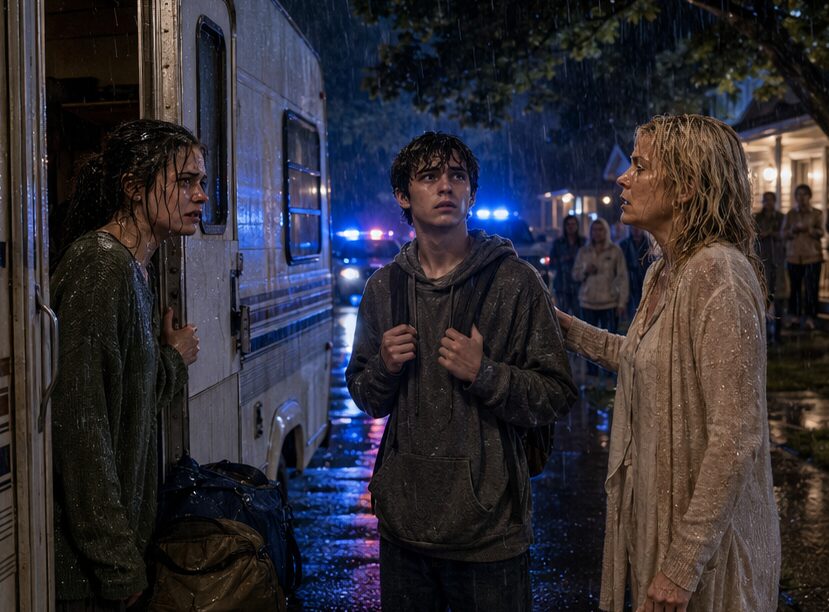
Rain started again around midnight.
Soft at first.
Then harder.
Samantha climbed into the driver’s seat and inserted the borrowed key.
The engine coughed weakly.
Then died.
A knock hit the camper door.
Laura.
Of course.
She stood outside in the rain wearing a cardigan over pajamas.
Her eyes immediately found the bags.
“No.”
Samantha opened the door halfway.
“Move.”
“You’re leaving in the middle of the night?”
“Yes.”
“With no plan?”
“With my own plan.”
Laura grabbed the edge of the door before Samantha could close it.
“You cannot keep running every time life gets difficult.”
Samantha laughed sharply.
“You mean every time people start looking at you differently.”
“That’s not fair.”
“Nothing about this has been fair.”
Rain hammered the roof.
Lights flicked on across nearby houses one by one.
Porch lights.
Windows.
Witnesses waking up.
Laura’s voice cracked louder now.
“You think living like this is healthy for him?”
“You think humiliating me publicly is healthy?”
“I gave you somewhere to stay!”
“You gave me a curb!”
Benjamin appeared behind Samantha.
Laura saw him instantly.
“Benjamin, tell her this is crazy.”
He froze.
And in that hesitation, everything finally broke.
Part V — The Street Full of Light
The argument spilled into the street before either of them realized it.
Rain soaked Samantha’s sweater instantly.
Laura still gripped the camper door with one hand.
Neighbors gathered beneath porches pretending concern had simply pulled them outside naturally.
Linda stood near her mailbox clutching a robe closed at the throat.
Someone had already called the police.
Samantha didn’t even know who.
Maybe nobody meant harm.
Maybe everyone did.
Blue lights washed over the wet pavement a minute later.
The whole street suddenly looked unreal.
Laura pointed toward the camper.
“She’s taking him somewhere unstable again!”
Again.
That word hit Samantha harder than the shouting.
“You don’t get to rewrite my life every time you’re embarrassed by it!”
“I am trying to protect this family!”
“No,” Samantha shouted. “You’re trying to protect the neighborhood version of this family!”
Benjamin stood between them trembling silently.
One officer approached carefully.
“Ma’am, let’s calm this down.”
But nobody was calm anymore.
Years had entered the street all at once.
Laura stepped toward the camper again.
“You are not dragging him through another disaster!”
Samantha recoiled instinctively when Laura grabbed the door harder.
That movement changed everything.
Not physically.
Emotionally.
Like her body had finally admitted something before her mouth could.
Suddenly she was crying.
Not neat tears.
Not movie tears.
The kind that made breathing feel broken.
Neighbors watched openly now.
Rainwater ran down Samantha’s face while she tried to wipe tears away angrily.
“I’m tired,” she said, voice collapsing. “I’m so tired of being managed.”
Laura looked stunned.
As if she had expected resistance but not damage.
Samantha shook her head.
“You never ask what I need. You decide what would make me easier to explain.”
For the first time all night, Laura had no immediate answer.
Only fear.
Benjamin looked between them both.
Then he spoke quietly.
“She’s not running away.”
Nobody moved.
Rain struck the pavement in hard silver lines.
Benjamin swallowed.
“She’s trying to breathe.”
Silence spread across the street.
Real silence this time.
Not polite silence.
Not waiting silence.
The kind that arrives after somebody finally says the thing everyone already knew.
Laura’s grip loosened from the camper door.
Samantha covered her mouth trying to stop crying hard enough to breathe again.
One neighbor looked away first.
Then another.
Because suddenly the situation no longer looked like disorder.
It looked personal.
And witnessing personal pain felt different from observing a neighborhood problem.
Laura stared at Benjamin.
Her face had changed completely now.
Not angry.
Lost.
Like she had just realized the thing she kept trying to fix had been fear all along.
The officer spoke gently.
“Maybe everyone should head inside for tonight.”
Nobody argued.
Not even Laura.
Part VI — The Space Left at the Curb
Three days later, Samantha left before sunrise.
Not with Benjamin.
That was the part nobody would have expected.
After the night in the rain, Benjamin admitted he wanted to finish the school semester nearby with a friend’s family two streets over.
“Just until things settle,” he said carefully.
Samantha nodded like that sentence didn’t hurt.
Because she understood now.
Love and stability were not always the same thing.
And forcing him to choose would only make him carry their damage longer.
Laura stood on the porch while Samantha loaded the last bag into her car.
The camper had already been returned to its owner.
Only the empty curb remained.
For a moment Samantha thought her mother might finally apologize.
Instead Laura said quietly, “You could’ve stayed.”
Samantha looked at her for a long time.
“In the camper,” she answered.
Laura’s face tightened.
Neither of them said the deeper thing aloud.
You only know how to help people if they stay beneath your control.
A cold morning wind moved through the trees.
Benjamin stood in the driveway holding his backpack straps.
Samantha hugged him hard.
“You call me if you need anything.”
“I know.”
She pulled back.
He looked older than he had a month ago.
So did she.
As Samantha opened the car door, Laura suddenly said, “I was scared.”
Samantha paused.
Not because the words fixed anything.
Because they were true.
That was the hardest part.
She looked at her mother standing alone on the porch of her perfect suburban house.
Then she nodded once and got into the car.
Months later, the neighborhood looked exactly the same.
Trimmed lawns.
Identical mailboxes.
Children riding bikes in circles after dinner.
No camper by the curb.
No visible disorder.
Everything restored.
But every morning Laura still glanced toward the empty space outside the house before picking up the newspaper.
Like some part of her expected the camper to return.
Or feared it never would.