The Birdhouse They Knocked Down Became the One Thing Their Neighborhood Could Not Ignore
Chapter 1: The Tower Above the Cedar Fence
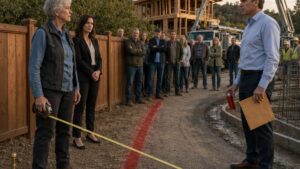
Jennifer Wright’s shadow crossed Frank Allen’s workbench before her voice reached him.
“That has to come down.”
Frank kept one hand on the roof section balanced against his shoulder. The piece was nearly four feet wide, built from narrow cedar shingles he had cut and sanded himself. Above him, the unfinished birdhouse rose past the top of the fence, its stacked chambers casting long angular shadows across the lawn.
He looked at Jennifer, then at the ladder.
“I’m not finished.”
“That’s the problem.”
She stood on the other side of the open gate with her arms folded, her pale blouse too clean for a yard full of sawdust. A leather folder was tucked beneath one elbow. Frank recognized it. Architectural committee paperwork.
He turned back to the ladder.
Jennifer stepped farther into the yard. “Frank, I’m speaking to you as committee chair.”
“And I’m answering as the man whose yard you’re standing in.”
Her jaw tightened. “The structure is over the permitted height. It’s visible from the walking path. It may also be inside the maintenance easement.”
“May be.”
“You submitted no application.”
Frank fitted the roof section against the upper frame and checked the alignment by touch. The edges met cleanly. He had planed them twice that morning.
Jennifer waited.
The silence had worked for him most of his life. In the cabinet shop, it kept apprentices from making excuses. In arguments, it kept him from saying what could not be taken back. Since his wife died, silence had also kept people from asking questions he did not intend to answer.
Now it seemed only to make Jennifer more certain of him.
“You knew there was a review process,” she said.
“I know where the forms are.”
“That isn’t the same thing.”
Frank drove the first brass screw into the roof frame. The cedar gave a soft, dry creak.
Across the fence, a sprinkler clicked through Margaret Green’s flower bed. Margaret herself had stopped near the property line with a watering wand in her hand. She watched without pretending not to.
Jennifer glanced toward her, then pulled out her phone.
Frank climbed down one rung. “What are you doing?”
“Documenting the condition.”
“You already saw it.”
“The committee needs measurements.”
From behind the fence she retrieved a telescoping measuring pole, the kind used by home inspectors. Frank stared at it. She had not come over because she happened to notice his work. She had arrived prepared.
Jennifer extended the pole beside the birdhouse. The top disappeared above the lower roofline.
“Twelve feet, eight inches,” she said.
“Twelve feet, six.”
She lowered the phone. “That does not help you.”
“It helps your accuracy.”
Margaret let out a breath that might have been a laugh. Jennifer ignored it.
Frank had begun the project two weekends earlier with a pile of cedar boards stacked beneath a canvas tarp. The design looked complicated from a distance, but every level served a purpose. Narrow openings for wrens. Deeper chambers for bluebirds. Sloped roofs to shed rain. Removable panels for cleaning.
The uppermost chamber was larger than it needed to be.
He knew that.
He also knew the entire tower was larger than the original pencil lines on the old garden sketch folded inside his workshop drawer.
Jennifer walked around the base. “How deep is the footing?”
“Deep enough.”
“That isn’t an answer.”
“It’s thirty inches with a gravel bed.”
“Did you verify the easement?”
Frank looked toward the rear edge of his yard. Beyond the fence, the community walking path curved between maples and trimmed hedges. A shallow drainage channel ran beside it, dry most of the year.
“The maintenance crews haven’t crossed this yard in fifteen years.”
“That doesn’t erase the easement.”
“No. It just makes it unused.”
“Those are not the same thing.”
Her tone was controlled, but Frank heard something beneath it: urgency, not merely annoyance.
He set the drill on the bench. “What exactly happens if this stands until Monday?”
Jennifer closed the measuring pole. “The association’s insurer is conducting a site review Tuesday morning.”
“And my birdhouse is the center of their business?”
“Anything outside approved specifications becomes their business.”
“It wasn’t here last year.”
“It’s here now.”
For the first time, Frank looked past her anger and saw the strain around her eyes. She had always been strict, but not hurried. Today she kept checking her phone, as though someone might call and demand an answer she did not have.
He could have asked.
Instead he said, “Then they can look at it.”
Jennifer stared at him. “You don’t get to make that decision for everyone.”
“And you don’t get to make it for me.”
Margaret turned off the water. The sprinkler’s ticking stopped, leaving the yard strangely exposed.
Jennifer slipped the phone into her pocket. “If you finish it after being told it is noncompliant, the board may require removal at your expense.”
“Then send me the notice.”
“I would rather not.”
“That makes one of us.”
She flinched almost imperceptibly. Then she gathered the measuring pole and left through the gate.
Margaret waited until Jennifer had crossed the street.
“You could have told her,” she said.
Frank lifted the roof section again. “Told her what?”
Margaret looked toward the workshop.
He followed her gaze. Through the open door, past clamps and planes and jars of screws, the corner of a yellowed page was visible beneath a stack of patterns.
“She asked about a form,” Frank said. “Not my life.”
“She asked why you were willing to fight.”
“She didn’t ask that.”
Margaret leaned her watering wand against the fence. “Nobody asks the right question when you make every question feel unwelcome.”
Frank climbed the ladder.
The carved perch waited in his pocket, wrapped in an old shop rag. It was small compared with the structure, only a narrow piece of cedar shaped like a branch. On the underside, almost invisible from the ground, were two initials he had traced from the old sketch.
He fixed it beneath the lowest opening.
For a moment, his thumb rested over the letters.
Margaret said nothing more.
By sunset, the roof was secure. Frank stood beneath the tower and studied the proportions. It was too tall. He could admit that to himself because no one had asked him to say it aloud.
The upper chamber lifted the whole structure beyond grace and into stubbornness.
But from the kitchen window, it would be visible above the fence exactly as she had once drawn it in the margin of a hospital notepad: birds above the hedge where she could see them while sitting at the table.
He gathered the extension cord and carried the drill toward the workshop.
A plastic sleeve had been fastened to his back gate.
Inside it was an orange violation notice, dated that afternoon and signed by Jennifer Wright on behalf of the architectural committee.
Frank had not yet put away his tools.
Chapter 2: The Morning the Cedar Tower Fell
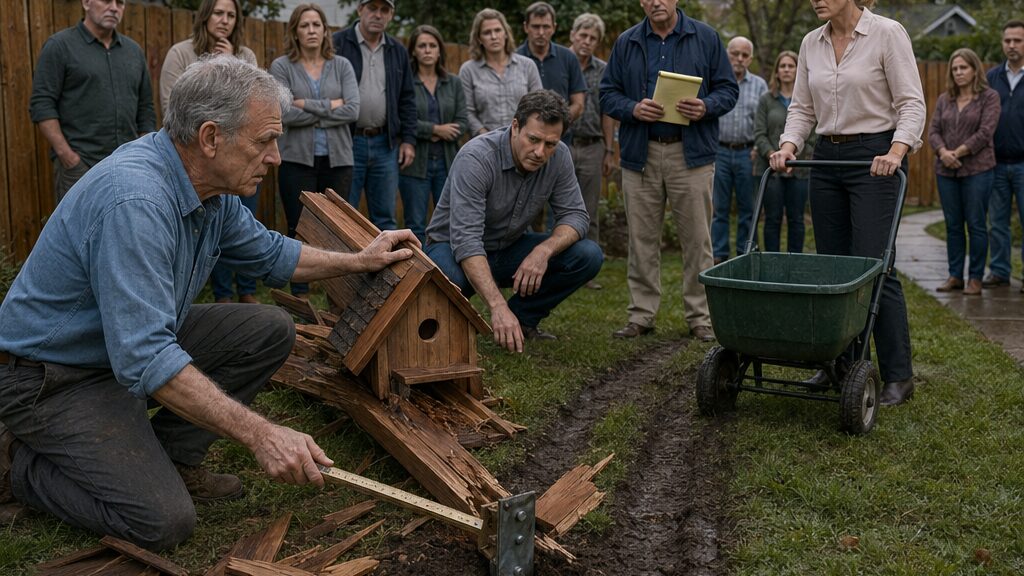
The birdhouse lay face-down across the wet grass, its upper roof split open like a dropped crate.
Frank stopped on the back step with one hand still gripping the doorframe.
For several seconds, he heard only the low hum of a distant mower and water ticking from the gutter. The tower had stood less than twelve hours.
Now cedar shingles covered the lawn. One side panel had torn free. The carved perch was buried beneath the lower frame.
He crossed the yard without shoes.
At first glance, the damage invited a simple explanation. The post leaned at an angle. Soil had lifted around the footing. A gust could have taken the structure if the ground had softened overnight.
But the air had been still. Frank knew because he had left a paper cup on the workbench, and it remained upright.
He crouched beside the base.
The post had not snapped.
It had shifted sideways in the earth.
Frank brushed wet soil from the concrete collar. The footing was intact. So was the steel bracket. The cedar post bore a long scrape where something had pressed against it.
“Frank?”
Margaret stood at the fence in a robe and garden shoes.
He did not look up. “Don’t step on the lawn.”
She froze. “What happened?”
“That’s what I’m checking.”
Andrew Martin came through the side gate ten minutes later, carrying a travel mug and wearing yesterday’s jeans. Margaret had called him before Frank could object. Andrew lived three houses down and worked as a civil engineer for the county. He had the habit of observing first and offering conclusions only after he had made everyone wait.
He walked around the fallen structure.
“Wind?” Margaret asked.
Andrew looked at the trees. “Maybe.”
Frank removed the lowest panel and examined the joinery. The mortise had held. Two screws had bent, but neither had pulled free.
“Not the joint,” he said.
Andrew crouched beside him. “No.”
“Post didn’t fail.”
“No.”
Margaret folded her arms against the morning chill. “Then how did it fall?”
Andrew pointed toward the grass.
Two shallow parallel lines ran from the disturbed footing toward the side gate. Rain had darkened them but had not erased them. At the edge of the lawn, the tracks curved sharply.
Frank stood.
The lines were too narrow for a vehicle and too evenly spaced for footprints. One track was deeper than the other, as if the load had shifted to one side.
“A cart,” Andrew said.
Margaret looked across the street.
Frank followed her gaze.
Jennifer’s green garden cart stood beside her garage.
By eight-thirty, six homeowners had gathered along Frank’s fence. Nobody admitted calling anyone else. News traveled in the neighborhood through curtains, dog walks, and open garage doors.
Jennifer arrived with Gregory Robinson and two architectural committee members. Gregory wore a windbreaker over a golf shirt and carried a yellow legal pad. Jennifer had changed into dark slacks and low shoes. Her hair was tied back.
She stopped when she saw the damage.
For a fraction of a second, something passed across her face. Not surprise. Not exactly.
Then the committee chair returned.
“This is what I was concerned about,” she said. “A structure of this height can become dangerous without proper review.”
Frank looked at her shoes. The soles were clean.
One committee member photographed the broken roof. The other murmured something about children on the walking path.
Gregory raised a hand. “Let’s not draw conclusions.”
Jennifer pointed toward the post. “The conclusion is on the ground.”
“The conclusion,” Frank said, “is that it was moved.”
The group went quiet.
Jennifer faced him. “What are you suggesting?”
Frank took a folding rule from the pocket of his work shirt. He opened it and measured the distance between the tracks.
Twenty-three inches.
He walked through the gate and crossed the street.
Jennifer moved after him. “Frank, you cannot enter my property without permission.”
He stopped at the edge of her driveway.
The green cart had two ribbed rubber wheels mounted twenty-three inches apart.
Andrew joined him and crouched beside the left wheel. Mud packed the grooves.
Jennifer’s voice sharpened. “That proves nothing. Half the garden carts in the neighborhood look like that.”
Frank laid the folding rule across the wheel centers.
“Roll it forward,” he said.
“What?”
“Once.”
“I am not participating in this performance.”
“Then I will ask Gregory to photograph the tread.”
Several neighbors had already lifted their phones. Gregory noticed and said, “Put those away, please. This isn’t helping.”
Jennifer stared at Frank.
He waited.
She gripped the cart handle and pulled it forward eighteen inches.
The wet tread left two fresh marks on the driveway’s dusty edge. The spacing matched. More than that, the right wheel carried a small nick that produced a broken gap in the pattern.
Andrew walked back to the lawn. He knelt over the deeper track and pointed to the same repeating gap.
Margaret covered her mouth.
The committee member lowered her camera.
Frank folded the rule one section at a time.
Jennifer’s face had gone pale, but her chin stayed high. “I moved the cart through the gate yesterday.”
“With what in it?” Andrew asked.
“Yard waste.”
“The tracks end at the post.”
Jennifer looked toward Gregory.
He did not rescue her.
Frank stepped closer, keeping enough distance that she could not claim intimidation. “Did you touch the birdhouse?”
Her eyes went to the splintered cedar. “I tried to shift it.”
A murmur passed through the neighbors.
“You tried to move a twelve-foot structure alone?” Margaret asked.
“I was moving it a few inches.”
“With a garden cart?” Andrew said.
Jennifer’s composure cracked. “I was trying to relieve pressure at the base. It was leaning toward the path.”
“It wasn’t leaning,” Frank said.
“You don’t know what it looked like from my side.”
“I built it.”
“And you built it without approval.”
The answer landed harder than an apology would have.
Frank looked at the broken upper chamber. A corner of the roof had split along the grain. The cedar could be repaired, but not invisibly.
“You could have talked to me,” he said.
Jennifer gave a short, disbelieving laugh. “I did talk to you.”
“You ordered me.”
“I warned you.”
“You came into my yard after dark.”
“I entered through an unlocked gate because you refused to respond reasonably.”
Gregory stepped between them. “Enough.”
“No,” Jennifer said. She pointed toward the rear of Frank’s lot. “Everyone is staring at the cart because it is easier than looking at why I was concerned. Ask him where that footing sits.”
Frank said nothing.
Andrew’s attention shifted from Jennifer to him.
“What does she mean?” he asked.
Jennifer’s voice was steadier now. “Ask Frank whether he checked the drainage easement before he poured concrete.”
The neighbors stopped whispering.
Andrew looked toward the shallow channel beyond the fence, then back at the base of the fallen post.
“Frank?”
Frank put the folding rule into his pocket.
He had seen the easement note on the plat.
He had simply decided it no longer mattered.
Chapter 3: The Rule Frank Chose to Ignore
Andrew placed the drainage map over Frank’s birdhouse sketch, and the shaded easement line passed directly through the footing.
Neither man spoke.
They sat at the small conference table in the HOA office Monday morning. The property manager had printed the original subdivision plat, the maintenance map, and Frank’s lot record. Jennifer stood near the filing cabinets. Gregory occupied the chair at the head of the table, though he had spent most of the meeting rubbing his forehead.
Andrew tapped the overlap with one finger.
“The footing is about fourteen inches inside the recorded easement.”
Frank studied the pages as if they belonged to someone else.
The birdhouse drawing beneath the transparent map was his own: elevations, joints, drainage angles, roof pitches. He had measured every chamber twice. He had calculated wind load using a formula from an old outdoor-structure manual.
The one line he had not measured was the one printed on a plat from twenty-two years ago.
“You knew about this?” Gregory asked.
“I knew there was an easement.”
Jennifer let out a breath.
Gregory looked at Frank. “That is not the same answer as whether you knew the structure was inside it.”
“I assumed the line followed the channel.”
Andrew shook his head. “The maintenance corridor is wider than the channel. Crews need access from either side.”
“They’ve never used my yard.”
“They may not have needed to.”
Frank leaned back. “There’s a six-foot gate.”
“For hand access,” Andrew said. “Not for excavation equipment.”
Jennifer folded her arms. “This is what I was trying to explain.”
Frank turned to her. “You explained nothing. You told me it was too tall.”
“It was too tall.”
“That doesn’t give you permission to move it.”
“No,” she said. “It doesn’t.”
The direct admission unsettled him more than another argument would have.
Gregory slid a document across the table. “We are separating the issues. Jennifer’s actions will be reviewed by the board. Your violation will also be reviewed. Effective immediately, reconstruction is prohibited until the architectural committee approves a compliant plan.”
“Jennifer chairs that committee.”
“Not for this matter,” Gregory said. “She is recused.”
Jennifer’s mouth tightened, but she did not object.
Frank read the temporary suspension notice. It carried no fine yet. It did, however, require all pieces of the structure to be removed from the lawn within seventy-two hours.
“The cedar stays on my property,” he said.
“It can stay in your workshop,” the property manager replied. “It cannot remain as debris.”
“Debris.”
The word made the broken panels sound disposable.
Andrew lifted the transparent overlay. Beneath it, Frank’s design appeared whole again. “You can move the footing twelve feet east and lower the top section. Most of the structure could be preserved.”
“No.”
The answer came before Andrew had finished.
Gregory blinked. “Frank, this is not a final design discussion.”
“It is final for me.”
Andrew turned in his chair. “Why?”
“Because that’s not where it goes.”
“According to what?”
Frank’s eyes shifted to his drawing.
The original reason was not on the page. The placement aligned with the kitchen window. From the chair at the small breakfast table, the structure would rise above the hedge. He had stood there with a mug in his hand and imagined what she would have seen.
He could have said that.
Instead he said, “Because I designed it for that location.”
Andrew’s expression changed. Not anger. Disappointment.
“You designed a foundation over an easement.”
“I designed around conditions that have existed for fifteen years.”
“You assumed they would never change.”
Frank folded the suspension notice. “That seems to be what everyone in this room does.”
Gregory’s face reddened. Jennifer looked down.
The meeting ended without resolution. Frank carried his drawings home beneath his arm and refused Andrew’s offer of a ride.
Along the walking path, a maintenance worker had marked the drainage channel with small orange flags. Frank stopped beside one and looked through his fence. From that angle, he could see how the fallen tower had occupied the narrow strip between yard and path. If it had gone the other direction, the upper chamber might have crossed the fence.
No children had been there.
No one had been hurt.
Those facts felt less comforting than they had the day before.
At home, Frank spread the pages across the kitchen table. The transparent easement map lay over his design like a verdict.
Margaret knocked once and entered through the back door carrying a plate covered with foil.
“I’m not hungry,” he said.
“It’s not food.”
She set the plate down anyway. Beneath the foil were brass screws, the carved perch, and two intact cedar shingles she had collected from the grass.
Frank picked up the perch. Mud darkened one edge, but the initials were undamaged.
Margaret looked at the maps. “Andrew told me the hearing is Wednesday.”
“Andrew talks too much.”
“He said you refused to move it.”
“I refused his version of it.”
“Is there a difference?”
Frank placed the perch beside the drawings. “Twelve feet east puts it behind the maple.”
“So?”
“So it cannot be seen from the kitchen.”
Margaret said nothing.
He realized what he had admitted and immediately resented her for hearing it.
She walked toward the workshop.
“Leave it,” he said.
Margaret opened the door.
The room smelled of cedar, machine oil, and the faint mineral odor of sharpening stones. Patterns hung from pegs. Cabinet doors leaned against one wall. On the central bench, beneath a stack of tracing paper, lay the yellowed garden sketch.
Margaret pulled it free.
Frank rose so quickly his chair struck the wall.
“That is not yours.”
“No,” she said. “It was hers.”
The page showed a low cluster of birdhouses arranged around a slender post. Vines climbed a trellis beside them. At the bottom corner, in small pencil letters, were two initials.
Margaret’s fingers paused over them.
Then she looked at Frank’s larger drawing on the kitchen table and back at the old sketch.
“Her design was half the height.”
Frank held out his hand. “Give it to me.”
“You told me to burn these after the funeral.”
“I changed my mind.”
“No. You hid them in your workshop and changed her design.”
His hand remained extended.
Margaret did not return the page.
“She wanted birds outside the window,” Frank said.
“She wanted a garden.”
“I promised her.”
“You promised to finish what she started. You did not promise to build a monument nobody could question.”
The words struck cleanly because they contained no accusation he could disprove.
Margaret turned the sketch toward the light. Cedar dust clung to the fold lines.
“You let everyone think this was about pride,” she said.
“It is none of their business.”
“It became their business when you poured concrete over the easement.”
Frank looked at the initials beneath her thumb.
Margaret lowered her voice. “Why are you so determined that nobody know what it means?”
He could not tell her that once people knew, every disagreement would soften. Jennifer would lower her voice. Gregory would make exceptions. Neighbors would arrive with casseroles and careful expressions.
The birdhouse would stop being something he had built and become something they allowed because his wife was dead.
“I don’t need pity,” he said.
Margaret folded the sketch along its old crease.
“No,” she said. “But you may need honesty.”
She placed the page on top of the transparent map.
The small original sanctuary sat beneath the broad shaded easement line. It would have fit outside it.
Frank stared at the two designs together.
Margaret picked up the foil-covered plate and left the cedar pieces behind.
At the door, she stopped.
“I’ll stand beside you at the hearing,” she said. “But I will not defend a lie of omission.”
After she was gone, Frank remained at the table.
The initials on the old drawing faced him from beneath the map, small enough that he had almost built an entire tower to avoid saying them aloud.
Chapter 4: The Sketches Margaret Was Asked to Burn
Margaret placed the preserved sketches on Frank’s workbench before he could tell her to leave.
The paper made almost no sound, but he reacted as if she had dropped a tool onto finished wood.
“You took those from my kitchen.”
“I brought them back.”
“You had no right to keep them in the first place.”
Margaret stood opposite him, both hands resting on the bench. The workshop lights showed every crease in the pages. Pencil lines had faded to gray. Cedar dust clung to the folds, pressed into the paper during years of being hidden beneath Frank’s patterns.
“You told me to burn them,” she said.
“That was a long time ago.”
“Three days after the funeral.”
Frank looked away.
A broken side panel from the birdhouse leaned against the wall. The split ran through one of the narrow entrances, turning the round opening into two unfinished halves. He had already removed the bent screws and sorted the usable shingles by length. Order usually quieted him. Tonight, every neat stack looked like evidence of avoidance.
Margaret unfolded the largest sketch.
His wife had drawn a low central house with two smaller boxes beneath it, all mounted on a post beside a trellis. Notes filled the margins in her sloping handwriting: morning light, climbing vine, visible from table.
Margaret tapped the last phrase.
“That is why you put it there.”
Frank lifted a hand but did not touch the page. “You already knew.”
“I suspected. That is not the same thing as you saying it.”
“I do not owe the board an explanation for where she sat.”
“No. But you owe them the truth about the easement.”
He turned toward the shelves. “You sound like Jennifer.”
Margaret’s expression tightened. “Do not use her mistake to erase yours.”
The words held him still.
Outside, someone rolled a trash bin along the curb. Its wheels rattled over the pavement, a faint echo of the tracks across his lawn. The sound faded, but Frank remained facing the shelves.
Margaret lowered her voice. “I defended you Sunday because she entered your yard and touched what was not hers. I would defend that again. But I will not stand in a room and pretend you were blindsided by a rule you chose to ignore.”
“I did not believe the easement mattered.”
“You did not check because you did not want the answer.”
Frank picked up a cedar shingle and examined its edge. “It had not been used in fifteen years.”
“That is still not the same as abandoned.”
He put the shingle down harder than necessary.
Margaret opened another page. This one showed the sanctuary from the kitchen window. The roofline sat below the hedge. Small birds had been indicated with quick arcs of pencil, more suggestion than detail.
“The original was smaller,” she said.
“I know what it was.”
“Then why did you make it twice as tall?”
Frank’s mouth went dry.
He had asked himself the same question while installing the upper chamber. At the time, he had called it an improvement. More nesting space. Better visibility. Stronger proportions.
The truth was less useful.
The original design had felt too small for the years she did not get.
He took the page from Margaret and laid it flat. “She kept adding to it.”
“On paper.”
“She wanted more houses.”
“She wanted birds near the window. She did not ask you to build something over the fence line.”
“You were not there for every conversation.”
“No,” Margaret said. “But I was there when she told you not to turn every promise into a debt.”
Frank’s eyes moved to her face.
Margaret had known his wife longer than he had. They had shared early morning walks, garden cuttings, and the kind of conversations that did not require a husband’s presence. Frank had always respected that friendship. At that moment he resented it.
“She said that to you?”
“She said you would keep working after there was nothing left to fix.”
The workshop seemed to narrow around him.
Frank turned away and opened a drawer he did not need. Inside were brass hinges, packets of screws, and the old hospital notepad from which he had traced the carved perch. He closed it again.
Margaret watched him. “You enlarged the design because the original felt insufficient.”
“You do not know that.”
“I know grief can make a person mistake size for devotion.”
His hand tightened on the drawer pull.
She did not step back.
For years, people had treated his silence as strength because it was easier than challenging it. Margaret had not. She had simply waited until silence began harming something outside him.
“The hearing is tomorrow,” she said. “Gregory will ask why you refused relocation. Jennifer will explain what she did, or she will try not to. Andrew will show the map. What will you say?”
“The structure was secure.”
“That answers a different question.”
“It matters.”
“Yes. So does the fact that she damaged it. So does the fact that you built over an easement. More than one thing can be true.”
Frank looked at the broken panel. “That seems to be everyone’s favorite discovery this week.”
Margaret folded her arms. “Bring the sketches.”
“No.”
The answer was immediate.
“Why?”
“Because the hearing is about property rules.”
“It stopped being only about property rules when half the neighborhood decided you built that tower to prove nobody could tell you what to do.”
“I do not care what they decided.”
“You care enough to refuse every solution.”
Frank moved around the bench and gathered the sketches into a stack.
“If I bring these,” he said, “the room changes.”
“It should.”
“They will speak softly. Gregory will offer an exception. Jennifer will apologize because she thinks grief makes me fragile. Every decision after that will be contaminated.”
“Compassion is not contamination.”
“Pity is.”
Margaret studied him for a long moment. “You think telling the truth means asking for special treatment.”
“It often becomes that.”
“Only if you use it that way.”
Frank placed the sketches inside a flat drawer and shut it.
Margaret’s hand came down on the drawer front before he could lock it.
“You do not have to ask them to excuse the easement,” she said. “You can tell them what the birdhouse means and still admit where you were wrong.”
“That sounds simple when you are not the one saying it.”
“No. It sounds necessary.”
He met her eyes.
Margaret removed her hand from the drawer. “I will attend tomorrow. I will not bring the sketches without your permission.”
“Good.”
“But I will not lie if someone asks whether there was a reason for the placement.”
Frank’s expression hardened. “You would tell them?”
“I would tell them you are not a reckless fool. Then I would tell them you made a reckless choice.”
For the first time that evening, something close to a smile threatened at the corner of his mouth. It disappeared before it formed.
Margaret picked up her coat from the stool.
At the workshop door, she paused beside the damaged birdhouse panel.
“She drew the lower version because she wanted you to maintain it without climbing a ladder when you got older,” she said.
Frank looked at the split cedar.
“She thought of that?”
“She thought of you having to live after her.”
Margaret left him beneath the white workshop lights.
The next evening, Frank arrived at the community clubhouse carrying the easement map, his construction drawings, and the orange violation notice.
The sketches remained locked in the workshop drawer.
Chapter 5: Jennifer’s Reason Was Not an Excuse
Gregory Robinson asked Frank whether he wanted Jennifer formally censured before anyone had discussed the birdhouse.
The question silenced the clubhouse.
Nearly thirty folding chairs faced the board table. Residents stood along the rear wall because the property manager had stopped adding seats. The broken cedar panel rested on an easel beside a printed photograph of Jennifer’s green garden cart. Someone had enlarged the image enough that the mud packed into the wheel tread was visible from across the room.
Jennifer sat at the far end of the table, separated from the two architectural committee members by an empty chair.
Gregory adjusted his microphone. “Mr. Allen, because you are the homeowner directly affected, the board would like your position before considering disciplinary action.”
Frank remained seated in the front row.
“You are asking for a sentence before the hearing,” he said.
A few residents murmured agreement.
Gregory’s fingers tightened around his pen. “I am asking whether removal from the committee is part of the remedy you seek.”
Jennifer looked at Frank for the first time since he entered.
He could have said yes. Sunday’s tracks, the broken cedar, and her first attempt to blame the structure were all in the room with them. Several neighbors had already demanded her resignation in emails copied to the entire board.
Frank looked at the photograph of the cart.
“I want the record corrected,” he said. “The rest can wait until she explains why she entered my yard.”
Gregory nodded with visible relief. “Then we will begin there.”
The property manager summarized the violation, the unapproved construction, and the damage. Andrew presented the easement map. He did not soften his conclusion for Frank.
“The footing was located inside the recorded maintenance corridor. The height increased the potential reach of a fall toward the community path. The joinery was sound, but placement remained noncompliant.”
A man near the rear called out, “It did not fall until she touched it.”
Andrew faced him. “That is also true.”
Jennifer sat with her hands clasped on the table.
When Gregory invited her to speak, she did not stand.
“I moved the structure,” she said. “No one directed me to do it. I did not have authority to enter the property or interfere with the post.”
The room stirred.
“I believed I could shift the base a few inches away from the path without bringing it down. I was wrong.”
“You thought you could move twelve feet of lumber with a garden cart?” Margaret asked from beside Frank.
Jennifer looked toward her. “I thought I could brace the weight while loosening the soil.”
Frank pictured her in the dark, one hand on the cart, the other against the post. The attempt seemed both reckless and strangely desperate.
“Why at night?” he asked.
Jennifer’s eyes returned to him.
“The insurer’s representative was scheduled to walk the common path Tuesday morning. I received the final route late Saturday.”
Gregory leaned toward his microphone. “That route had not been distributed to the full board.”
“No,” Jennifer said. “It had been sent to me because I was coordinating exterior conditions.”
The property manager shifted in her chair.
Jennifer continued. “Last year, a resident tripped on an uneven section of the path. The claim was settled, but the insurer warned that unmanaged hazards could affect renewal terms. We were told to document anything that might create exposure.”
A resident near the aisle said, “A birdhouse is not a collapsing wall.”
“No,” Jennifer replied. “But from the path it appeared to lean over the fence.”
“It did not lean,” Frank said.
“I know that now.”
“You could have measured it.”
“I tried to speak to you.”
“You issued an order.”
Jennifer’s composure thinned. “Because every conversation with you ended the moment you decided the question was foolish.”
The room quieted again.
Frank felt Margaret turn slightly beside him, but she did not look at him.
Jennifer went on. “I had forty-eight hours before the inspection. Gregory would not authorize emergency removal without a board vote. The committee could issue a notice, but the notice did not solve what I believed was an immediate risk.”
Gregory’s face tightened. “I told you not to take unilateral action.”
“You told me we would discuss it Monday.”
“And you decided that was insufficient.”
“Yes.”
The word came without defense.
One of the committee members pushed her chair back. “You let us tell residents the wind might have caused it.”
Jennifer looked down at her clasped hands. “I did.”
“Why?”
“Because I was ashamed.”
The admission changed the temperature of the room. Anger remained, but it no longer had a flat surface to strike.
Jennifer looked toward the broken panel. “When it shifted, the upper section turned faster than I expected. I let go of the cart. The structure came down. I checked the path and the fence. Nothing crossed into the common area. I should have called Frank immediately.”
“But you did not,” Gregory said.
“No.”
“You arrived with the committee and called the collapse evidence of unsafe construction.”
Jennifer swallowed. “I was trying to make the result justify what I had done.”
Frank watched her without satisfaction.
That sentence, more than the confession, sounded true.
A resident demanded that she be removed. Another asked whether the association would pay for the repairs. Voices rose, overlapping until Gregory struck the table with the side of his hand.
Frank stood.
The room lowered itself around him.
“Jennifer was wrong,” he said. “The board will decide what that costs her.”
Several residents nodded.
Frank picked up the transparent easement map and held it over his drawing. “I was also wrong.”
Margaret’s shoulders eased beside him.
“I knew the easement existed. I decided it was inactive because that suited my plan. I did not submit the required application. I refused relocation before I had even looked at the measurements Andrew offered.”
Jennifer stared at him.
Frank laid the two pages on the table. “None of that gave her permission to enter my yard. None of what she did makes this line disappear.”
Gregory cleared his throat. “The insurer has postponed the site review until Monday.”
“How long?” Frank asked.
“Four days.”
“And if the damaged structure is removed and the easement cleared?”
“The immediate issue is resolved. Any replacement still requires approval.”
One resident called, “Make them approve the original.”
Andrew shook his head before Gregory could answer. “The original placement cannot be approved.”
Frank looked at the broken panel. The cedar entrance had been split through the center, but the grain on either side still aligned.
He thought of the smaller sketch locked in his workshop.
Gregory asked, “Would you like the board to table reconstruction until the disciplinary review is complete?”
“No.”
Frank folded the map.
“I want forty-eight hours.”
“For what?” Gregory asked.
“A revised design.”
Margaret looked at him sharply.
Jennifer’s lips parted, but she said nothing.
Frank lifted the broken panel from the easel. “You will have drawings, footing dimensions, height, clearance, and access measurements.”
Gregory leaned back. “Are you agreeing to relocate it?”
“I am agreeing to submit a design.”
“That is not quite the same thing.”
“It is more than you had when this meeting began.”
Frank carried the broken cedar panel toward the door.
Behind him, Gregory called for a recess. Residents began talking at once, but Frank did not turn around.
For the first time since the tower fell, he knew exactly what he had to cut.
Chapter 6: The Smaller Design That Cost Him More
Frank set the tallest surviving section on the saw table and drew a pencil line through its center.
The mark crossed three cedar chambers, two roof braces, and forty hours of work.
He stood with the pencil in his hand until the workshop clock clicked through another minute.
Then he lowered the saw guard.
The blade’s first contact with the cedar produced a clean, high sound. Dust lifted around his wrists. The upper tower separated from the lower frame and settled onto the outfeed table with a weight that seemed too small for what it had cost him to remove.
He switched off the saw.
In the sudden quiet, Frank could hear birds in Margaret’s maple.
He had spent the first night after the hearing recalculating proportions. The essential parts of the design fit within six feet: the carved perch, the sloped cleaning panels, the lower nesting chambers, and the roof angle copied from his wife’s sketch. The upper chambers had never been essential.
They had been an argument made from wood.
Andrew arrived at eight carrying a laser level and a roll of marking flags. Jennifer came five minutes later with the green garden cart.
She stopped at the workshop entrance. “Where do you want this?”
Frank looked at the cart. The right tire still bore the nick that had matched the tracks.
“By the side gate.”
Jennifer wheeled it there without comment.
Andrew spread the revised site plan across the workbench. “You moved the footing thirteen feet east.”
“Twelve feet, nine inches.”
“Outside the easement by nine.”
“Ten and a quarter.”
Andrew checked the scale, then nodded. “Ten and a quarter.”
Jennifer examined the elevation drawing. “The overall height is six feet, four inches.”
“From finished grade.”
“The guideline says six.”
“The guideline allows decorative roofs up to six inches if they do not contain usable space.”
She looked at him.
Frank waited for the objection.
Jennifer traced the roofline with one finger. “You left the upper roof hollow.”
“Yes.”
“So it complies.”
“That is why it is drawn that way.”
A faint flush rose along her neck. “I was confirming.”
Andrew rolled up the site plan. “Let’s confirm the footing.”
They crossed the backyard together.
The old hole had been filled temporarily with gravel. Orange flags marked the drainage corridor. The new location sat beyond the maple’s drip line, visible from the kitchen at an angle rather than directly.
Frank drove a stake into the center point.
Andrew measured from the fence, the path, and the easement boundary. Jennifer recorded each number on the review sheet. She read them back twice.
Frank noticed her hands were unsteady.
At the final measurement, Andrew said, “This location works.”
Jennifer signed beneath his note.
She offered the clipboard to Frank. “You should keep a copy.”
“I intend to.”
The words could have been an insult. He made them neutral.
Back in the workshop, the damaged pieces waited on the bench. Jennifer remained near the door while Andrew inspected the salvaged post bracket.
Her attention settled on the carved perch beside the original sketch.
Frank had taken the page from the drawer before dawn. He had not yet decided why.
Jennifer picked up neither object. “That piece survived.”
“The perch did.”
“You designed the new frame around it.”
Frank fitted a brace against the lower chamber. “Yes.”
She studied the two initials on the underside. “Were those always there?”
He looked at her.
Jennifer stepped back. “You do not have to answer.”
The restraint surprised him enough that he did.
“They were in the original design.”
“Whose?”
Frank adjusted the brace until its edge met the pencil mark. “My wife’s.”
Jennifer’s face changed, not into pity but recognition of a boundary she had already crossed.
“I did not know,” she said.
“You were not supposed to.”
She nodded once. “That does not make what I did better.”
“No.”
“And it does not make the original placement compliant.”
“No.”
For a moment, they stood inside the same uncomfortable truth.
Andrew called from the yard that the concrete delivery had arrived. Frank lifted the revised frame.
Jennifer reached for one side.
“I have it,” he said.
She let go immediately.
Frank carried the frame to the door, then stopped.
“The cart can take the smaller pieces,” he said.
Jennifer nodded.
They loaded salvaged cedar into the green cart. The same wheels that had cut tracks through wet grass now rolled openly across the yard, carrying roof shingles, brackets, and the lower panel. Jennifer kept both hands on the handle. Frank walked beside her rather than behind.
By noon, the new footing was poured. Andrew checked the post sleeve for level while Frank adjusted the braces. Jennifer photographed each stage for the architectural file, asking before every picture.
Margaret watched from her side of the fence.
When Frank looked toward her, she raised one eyebrow at the reduced frame.
He ignored the expression, though he understood it.
The new structure was better proportioned. He had known that from the drawing. Seeing it assembled made the fact harder to resist. The roof no longer fought the house behind it. The chambers looked connected rather than stacked. From the walking path, it appeared part of the garden instead of a challenge above it.
That realization irritated him until he understood why.
He had confused the size of the object with the seriousness of the promise.
The work stopped when Andrew tested the central panel.
A crack, almost invisible beneath the mud stain, ran from the mounting edge toward the carved ventilation slot. Under pressure, the cedar flexed.
“It cannot go back in,” Andrew said.
Frank took the panel from him. “I can spline it.”
“It carries the lower roof.”
“I know what it carries.”
Andrew held his gaze. “Then you know a repair is not enough.”
The panel came from the oldest cedar in the structure. Frank had cut it from a board his wife had chosen years earlier for a window box that was never built. He had saved the offcut through two workshop cleanouts.
Jennifer looked from the crack to Frank. “Could it be used somewhere nonstructural?”
He did not answer.
Margaret opened the gate and entered carrying a shallow wooden box.
Inside were the two intact shingles she had collected, the old hospital notepad, and several narrow cedar strips.
“I found these in the garage,” she said. “She gave them to me when you were clearing the basement.”
Frank touched one strip. The grain matched the cracked panel.
“You kept these too?”
“I keep what people tell me to destroy when they are not thinking clearly.”
Andrew coughed into his hand to hide a smile.
Frank placed the cracked central panel on the bench. He traced the usable section, then marked a smaller rectangle around the ventilation slot.
“It can become the rear access door,” he said.
“It will not carry weight there,” Andrew replied.
Frank cut the damaged edges away.
By late afternoon, the new frame stood temporarily braced above the cured footing sleeve. The old cedar had not been erased. It had changed jobs.
Jennifer paid for the replacement support panel at the lumber supplier without announcement. Frank learned only when the delivery driver handed him a receipt marked paid.
He found her beside the cart.
“You did not need to do that quietly,” he said.
“I thought you preferred quiet.”
“Not when it hides responsibility.”
Jennifer absorbed the correction. “Then I paid for the panel because I broke the original.”
Frank folded the receipt and put it in his pocket. “All right.”
It was not forgiveness. It was the first clean exchange they had managed.
Before everyone left, Frank locked the tools in the workshop and took the original sketch from the bench.
Margaret was closing her gate when he called to her.
She turned.
“Bring this tomorrow,” he said, holding out the folded page.
Her eyes moved from the sketch to his face. “To the inspection?”
“To the installation.”
“Are you sure?”
Frank looked at the smaller structure beyond her shoulder. Its roofline sat below the hedge. From the kitchen, the carved perch would still be visible.
“No,” he said. “Bring it anyway.”
Chapter 7: What They Rebuilt Without Erasing Her
The inspector pressed both hands against the new post while Jennifer Wright stood three feet away beside the green garden cart.
Frank watched the level clipped to the cedar frame. Its bubble held steady between the black lines.
The inspector leaned harder.
Nothing shifted.
Andrew Martin had already checked the footing twice, but he watched the test with the same concentration he had given the muddy tracks. Gregory Robinson stood near the walking path with the property manager and two board members. Margaret Green waited by Frank’s gate, holding the original sketch inside a clear sleeve.
Several neighbors had gathered along the path. They kept a respectful distance, though not enough to pretend they were passing by.
The inspector released the post. “Footing depth?”
“Thirty-six inches,” Frank said. “Concrete below frost line. Galvanized sleeve, removable fasteners.”
“Easement clearance?”
Andrew answered. “Ten and a quarter inches beyond the recorded boundary at the closest point.”
The inspector checked the site plan against the orange flags still marking the maintenance corridor. “Overall height?”
“Six feet, four inches,” Jennifer said. “The upper four inches are decorative roof space with no usable chamber.”
Frank glanced at her.
She had memorized the revised design.
The inspector opened the rear access panel. It was made from the salvaged center section, the original ventilation slot still visible near the top. He tested the latch and examined the smooth interior edges.
“This panel has been repaired?”
“Recut,” Frank said. “It no longer carries structural load.”
The inspector nodded and shut it.
A bluebird landed on the fence, then lifted away when one of the neighbors moved.
Frank looked toward the kitchen window. From the chair at the small table, the new birdhouse would be visible between the hedge and the maple trunk. Not above everything. Not demanding to be seen.
Just present.
The inspector made one final note on his clipboard. “The installation meets the submitted plan.”
A sound passed through the gathered neighbors—not applause, exactly, but a release of breath and quiet voices.
Gregory stepped forward with a prepared sheet of paper.
“Before everyone disperses,” he said, “the board has an announcement regarding the disciplinary review and the architectural process.”
Frank saw Jennifer’s shoulders tighten.
Gregory unfolded the paper. “The board has determined that the committee chair acted outside her authority by entering a private lot and interfering with an owner’s structure. Effective immediately—”
“Stop.”
Frank’s voice carried farther than he intended.
Gregory lowered the page. “Frank?”
Jennifer looked at him, alarm replacing resignation.
Frank walked from the footing to the edge of the path. “You asked me at the hearing what remedy I wanted.”
“Yes.”
“I said I wanted the record corrected.”
“It has been.”
“Not all of it.”
Gregory glanced at the board members. “The board has a duty to address misconduct.”
“So address it.”
“That is what I am doing.”
“No. You are reading a punishment after making decisions in private.”
The neighbors went still again.
Gregory’s face reddened. “This process followed the bylaws.”
“The same bylaws that let one committee chair issue a notice, inspect a property, decide there was an emergency, and then act without a second person present?”
Jennifer’s gaze dropped to the cart.
Frank continued. “If she steps down and nothing changes, the next person gets the same authority.”
One of the board members said, “What are you proposing?”
Frank took the folded easement map from his pocket.
“Written notice before any exterior inspection unless there is an immediate threat to life or property. Two committee members for disputed site visits. No physical interference with an owner’s property without consent or emergency authorization. A clear appeal process before fines begin.”
Gregory stared at him. “You prepared this?”
“Andrew helped with the wording.”
Andrew lifted one shoulder. “He rejected most of my first draft.”
A few neighbors smiled, but the tension did not break.
Frank looked at Jennifer. “She should correct the record. She should pay for the damage she caused. She should not control my application.”
“I already recused myself,” Jennifer said.
“That needs to be policy, not courtesy.”
The property manager took the map and the attached page from Frank. She read quickly, then passed it to Gregory.
“This is workable,” she said.
Gregory looked less convinced. “It cannot be adopted on the spot.”
“No,” Frank said. “But you can commit to a vote.”
A woman near the fence said, “And publish the procedure.”
Another resident added, “Including who can enter a lot.”
The pressure shifted. It was no longer directed only at Jennifer.
Gregory folded his prepared disciplinary statement. “The board will circulate draft rules within ten days and hold an open vote at the next meeting.”
Frank nodded. “That is an answer.”
“What about Jennifer?” someone called.
Jennifer stepped away from the cart before Gregory could respond.
She faced the gathered residents. “I moved Frank’s birdhouse without his permission. I damaged it. When it fell, I allowed people to believe the structure had failed on its own. That was false.”
Her voice trembled once, then steadied.
“I had concerns about safety and insurance exposure. Those concerns did not authorize what I did. I paid for the replacement structural panel and will reimburse Frank for the remaining documented material damage. I have resigned as architectural committee chair.”
Gregory turned toward her. “Jennifer, the board had not announced—”
“I submitted the resignation this morning.”
Frank had not expected that.
Neither, judging by Gregory’s face, had anyone else.
Jennifer continued. “I will remain on the committee only if the board and residents believe I can be useful under the revised rules. If not, I will step away.”
No one applauded. No one shouted.
The absence of either felt appropriate.
The inspector signed the approval form and handed the copy to Frank. “You are cleared.”
Frank folded it and placed it in his shirt pocket.
Margaret approached with the sketch.
“You asked me to bring this,” she said.
Frank looked at the clear sleeve. Through the plastic, his wife’s pencil lines seemed lighter than he remembered. The small sanctuary, the trellis, the note about morning light.
He could put it away again.
Instead he took it from Margaret and turned toward the group.
“This was the first design,” he said.
Conversation faded along the path.
“My wife drew it when she was ill. She wanted birdhouses visible from the kitchen table.”
He kept his eyes on the page rather than the neighbors.
“She did not design the tower.”
Margaret stood close enough that he could feel her presence without looking at her.
“I added the height,” Frank said. “I told myself it was for more nesting space. It was not. The original felt too small after she died.”
The words did not become easier as they left him, but they remained his.
“I treated the promise like something I could repay by making it bigger. Then I treated every question about it as disrespect.”
Jennifer’s eyes filled, though she did not interrupt.
Frank held up the sketch beside the finished structure. “This version is closer to what she drew.”
A child standing with one of the neighbors pointed toward the carved perch. “What are the letters?”
Frank turned the perch slightly so the underside caught the light.
“Her initials.”
The child nodded, satisfied with an answer that required no explanation.
The installation began after the inspector left.
Andrew removed the temporary braces. Margaret fitted the climbing-vine trellis beside the post, following the placement shown in the sketch. Gregory and the maintenance worker carried bags of gravel to define a narrow border outside the easement.
Jennifer loaded the remaining cedar pieces into the green cart.
This time, she stopped at Frank’s gate.
“May I bring these through?”
Frank looked at the cart, then at her.
“Yes.”
She wheeled it slowly across the lawn.
No tracks marked the dry grass.
Frank directed the work. He accepted hands when he needed them and refused them when he did not. When two neighbors tried to lift the roof without waiting, he made them set it down and showed them where the hidden brackets had to align.
“This is still his project,” Margaret told them.
Frank heard no pity in her voice.
By late afternoon, the final shingle was fastened. The repaired access door opened cleanly. The old carved perch extended beneath the lowest chamber, close enough to see from the kitchen window.
The neighbors began to leave in small groups.
Gregory remained by the path with the proposed procedure in his hand. Andrew packed his level. Margaret carried the empty sketch sleeve toward Frank’s workshop.
Jennifer stood alone beside the cart.
“I am sorry,” she said.
Frank wiped cedar dust from his palms.
“I know.”
“I should have said it before the hearing.”
“Yes.”
“I was afraid you would use it against me.”
Frank looked toward the filled hole where the original tower had stood.
“I was afraid the truth would be used for me.”
Jennifer followed his gaze. “I do not expect you to forgive me.”
“That is good.”
The answer hurt her. He saw it and did not take it back.
After a moment, he added, “But you can help maintain the vine if Margaret agrees.”
Jennifer looked toward the new trellis.
“That is not forgiveness.”
“No.”
“What is it?”
“A job that needs doing.”
A small, tired smile crossed her face. “I can do that.”
She wheeled the cart home along the sidewalk.
Frank entered the kitchen after everyone had gone. The house felt different, not because it was less empty, but because he had stopped arranging the emptiness as if no one else could see it.
He sat at the table.
Through the window, the finished birdhouse stood beyond the hedge, its cedar warm in the declining light. The tower was gone. Nothing in the yard reached above the fence.
Margaret appeared in the workshop doorway and placed the original sketch on the bench instead of returning it to the drawer.
“You left this open,” she called.
Frank looked past her.
The workshop door stood wide. Inside, the tools hung in their proper places, and the damaged upper chamber rested in pieces beneath the saw table. He could close the door from where he sat if he rose.
He did not.
A bird swept down from the maple, circled once, and landed on the carved perch.
Its feet settled directly above the initials.
Frank remained at the kitchen table, watching it test the entrance to the new house while the open workshop filled with evening light.
The story has ended.