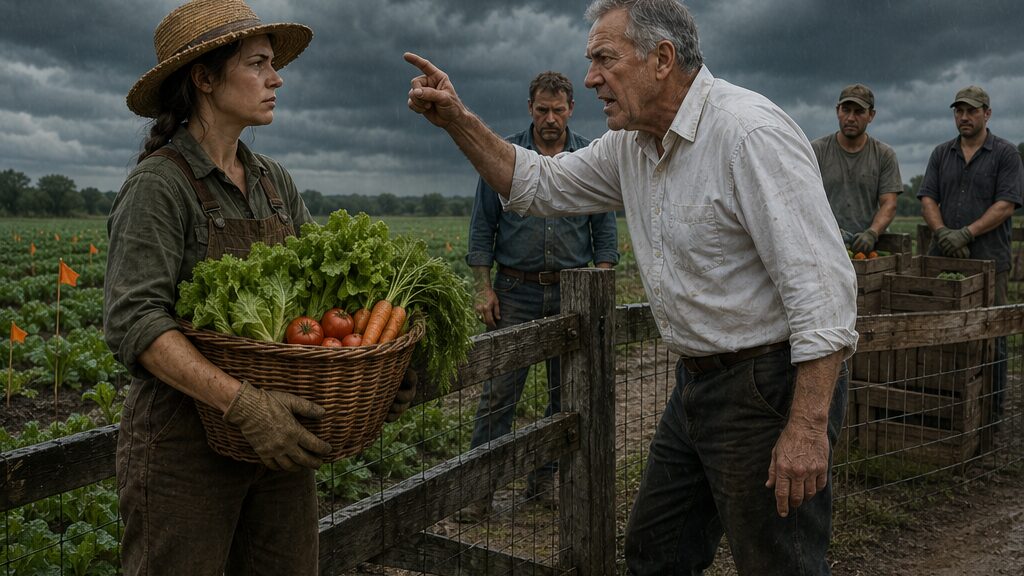
She Carried the Harvest to the Fence, but the Land Was Never His to Take
Chapter 1: The Basket Frank Ordered Her to Empty
“Dump it.”
Frank Hall’s voice carried across the vegetable rows before the first drop of rain fell.
Kathleen stopped at the weathered fence with both hands locked around the wicker basket. Lettuce leaves pressed against her forearm. Carrot tops trembled in the wind, and three tomatoes rolled against one another near the rim.
Frank stood on the other side of the gate in a clean white shirt that made him look as though he had come to inspect the work rather than interrupt it. Mark Wilson and two seasonal farmhands waited several yards behind him. None of them looked directly at Kathleen.
“Dump what?” she asked.
“You heard me.” Frank pointed at the basket. “Put it on the ground and empty it.”
The sky beyond the cornfields had gone the color of old steel. Kathleen could smell rain and cut vines. She adjusted the basket against her hip.
“I harvested what was ready.”
“From ground you don’t own.”
One of the farmhands shifted his boots. Mark studied the fence post.
Kathleen had known Frank would object when he saw the new irrigation lines. She had expected a closed-door argument in the farm office, perhaps a threat to shut off the well. She had not expected him to wait until the workers were present.
Frank stepped closer. “That produce belongs to Hall Farm.”
“So do the invoices.”
His mouth tightened.
Kathleen had paid for the seed, compost, drip tape, fuel, and hired labor. She had kept every receipt in a blue folder beneath the passenger seat of her truck. She could have said that in front of everyone. She could have explained the agreement her mother had signed before the hospital visits became weekly.
Instead, she said, “Open the gate.”
“No.”
The old wire hinge squealed in the wind. The basket grew heavier in her arms.
Frank turned enough for the others to hear him clearly. “She came back here and planted twelve acres like a signature on a piece of paper made her owner.”
Kathleen felt Mark look at her then, quickly and without commitment.
“It gave me operating use,” she said.
“It gave you permission while Elizabeth was alive.”
The name landed harder than the accusation.
Kathleen kept her face still. Her mother had been dead fourteen months. Frank had managed the grain acres since before Kathleen was old enough to see over a tractor tire. He had taught her how to back a wagon into the equipment shed and how to judge soil moisture with two fingers. After Elizabeth got sick, he had begun speaking about the farm as if every survival decision had passed through him alone.
Kathleen shifted the basket again. “The agreement didn’t end with her death.”
“You don’t know what ended.”
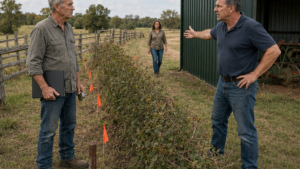
A gust bent the tomato stakes. Beyond the fence, small orange flags flickered between the planted rows. Kathleen had noticed them that morning, bright against the dark soil. They were not county drainage markers. They bore the name of a regional surveying company in black print.
Frank followed her gaze and moved toward the gate.
“You stay out of that field,” he said.
“My crew is still in it.”
“Not after today.”
“You can’t close twelve acres in harvest week.”
“I can close my own ground.”
Kathleen took one step toward him. “Then tell me why surveyors were marking it before sunrise.”
Frank’s expression changed so quickly she almost missed it. Not guilt. Fear.
Then it hardened.
“This is family business.”
“You made it public.”
His hand shot out and caught the front of her work shirt near the collar. The basket struck the fence rail but did not fall. A tomato jumped against the rim.
For one second Kathleen saw the man who had pulled her from a grain bin ladder when she was eleven. Then she saw only his fist twisted in her shirt and Mark standing behind him, doing nothing.
“Let go,” she said.
Frank leaned closer. “You don’t get to walk in here and act like you carried this place.”
Kathleen raised one gloved hand between them, not striking him, only pressing his wrist away from her throat.
“I said let go.”
Something in her voice reached him. His fingers opened.
Kathleen stepped back, breathing through her nose. The rain began as a scattering of dark spots on the fence rail.
Frank glanced toward the workers, perhaps expecting the moment to disappear if no one named it.
Kathleen straightened her shirt.
Then she looked past him at the orange flags.
“Which bank ordered the survey, Frank?”
No one moved.
The storm wind pushed the lettuce leaves sideways in her basket.
Frank’s face emptied.
Kathleen continued, her voice low enough that the men had to listen. “And why are their markers inside the rows Mother assigned to me?”
Mark finally lifted his head.
Frank looked toward the road. “You don’t know what you’re talking about.”
“Then answer.”
Instead, he unhooked a length of chain from the gatepost and drew it through the wire mesh.
“This field is off-limits until I say otherwise.”
“You’ll lose the crop.”
“Then you should’ve asked before you planted it.”
“I did.”
“Not me.”
That was the first honest thing he had said.
Kathleen held his gaze until he looked away. She did not smile, though she felt the balance between them shift—not in her favor, exactly, but away from the certainty he had brought to the fence.
She turned to the farmhands. “Finish the baskets already picked. Don’t cut another row.”
They hesitated.
Frank snapped the padlock shut. “They work for Hall Farm.”
“They worked for me today,” Kathleen said. “They’ll be paid either way.”
The younger farmhand nodded once.
Kathleen walked toward her truck with the full basket in her arms. Rain darkened the shoulders of her shirt. Behind her, Frank began speaking to Mark in a voice too low to carry.
At the lane, an unfamiliar silver pickup turned between the ditch posts.
It moved slowly past the mailbox and stopped beside the equipment shed. A man in a navy jacket stepped out carrying a leather folder stamped with the name of the regional farm lender.
Frank stopped talking.
Kathleen set the basket on her tailgate.
The loan officer looked from Frank to the chained field, then toward the survey flags trembling between the rows.
“Mr. Hall,” he called, “we need to discuss the collateral inspection.”
Chapter 2: The Field Listed Under Two Different Truths
The chain was still on the gate at six the next morning.
Kathleen stood in the wet grass with bolt cutters in one hand and the empty harvest basket in the other. Water dripped from the fence wires. Beyond them, acres of lettuce and tomatoes waited under a pale sky, ready for hands that could not reach them.
She could cut the chain in less than ten seconds.
She set the bolt cutters in the truck bed.
Breaking Frank’s lock would make a clean picture for anyone who wanted to call her reckless. She had already given him too much room to tell the story alone.
Inside the farm office, Frank’s chair was empty. The loan officer had left the previous evening without speaking to her. On the desk sat fuel receipts, seed catalogs, and a coffee cup with a brown ring dried at the bottom.
Kathleen placed the basket beside the filing cabinet and opened the drawer where her mother had kept land papers.
The folder marked VEGETABLE GROUND was still there.
Elizabeth Hall’s handwriting ran across the first page in firm blue ink: Operational Use Agreement. The document granted Kathleen exclusive use of the south twelve acres for vegetable production, including authority to hire labor, maintain irrigation, and sell the harvest. It carried Elizabeth’s signature, Kathleen’s, and a notary seal.
There was no termination date.
There was also no recorded deed.
Kathleen had known that. She had simply trained herself not to consider what it meant.
Her phone rang. The produce buyer’s number appeared on the screen.
“We need confirmation by tomorrow afternoon,” the buyer said. “If you can’t deliver the first load Friday, we’ll source elsewhere.”
“The crop is ready.”
“That wasn’t my question.”
Kathleen looked through the office window at the chained gate.
“I’ll confirm by noon tomorrow.”
After the call, she put the agreement in a document sleeve and drove to the county office.
Rachel Flores met her at the agricultural extension desk with reading glasses perched on her head and soil maps spread across one corner of the table.
“This isn’t really extension work,” Rachel said after scanning the agreement. “But I can help you understand what you’re looking at.”
“I need to know whether Frank can lock me out.”
Rachel read the document twice, then opened the county property database.
“The agreement supports your operational claim,” she said. “It shows permission, investment, and intended control. But it doesn’t change title.”
“My mother owned half.”
“According to the current record, Elizabeth’s interest passed into the estate and then remained unresolved.”
Kathleen stared at the screen. “That was supposed to be handled.”
“Was an attorney involved?”
“My mother had papers prepared.”
“Prepared isn’t recorded.”
Rachel said it without judgment, which made it worse.
Kathleen placed the blue folder of receipts on the table. Seed orders. Irrigation invoices. Payroll records. Soil amendments. Fuel. Repairs. Four years of expenses, each marked with the field number and paid from her business account.
Rachel sorted them into piles.
“This proves you weren’t casually using the ground,” she said. “You built an operation with the family’s knowledge.”
“Frank knew every delivery truck that came down that lane.”
“Knowing and granting legal authority aren’t always the same thing.”
Kathleen’s jaw tightened.
Rachel looked up. “Did your buyer know the transfer wasn’t complete?”
Kathleen closed the folder.
“That’s what I thought,” Rachel said.
“I had a signed use agreement.”
“You had enough to believe you could farm. You may not have had enough to promise uninterrupted access.”
Kathleen wanted to argue. Instead, she looked at her mother’s signature through the plastic sleeve.
Elizabeth had signed it during a good month, when she still drove herself to treatment and corrected Kathleen’s planting schedule from the kitchen table. She had said the rest would be finished after harvest.
There had always been another harvest.
Rachel printed the title record. “We need the collateral filing too.”
They crossed the hall to the county clerk’s counter. The clerk searched by parcel number and returned with a stamped packet held by a brass clip.
The first pages described grain acreage, storage buildings, and equipment. Kathleen followed the legal boundaries with her finger until she reached an attached schedule added three years earlier.
South tract, twelve acres.
Her field.
“That can’t be right,” she said.
Rachel leaned over the page. “It’s listed as part of the secured property.”
“My mother never would’ve pledged that ground without telling me.”
“The original filing date is during her lifetime.”
Kathleen read it again. Elizabeth’s name appeared beside Frank’s on the borrower line.
For a moment, anger rose so sharply that she could not separate it from grief.
Rachel tapped the document. “This may be why Frank is panicking. If your agreement limits how the land can be used, the lender could question the collateral description.”
“He called my vegetables stolen.”
“He may be protecting the loan.”
“That doesn’t make them stolen.”
“No.”
Kathleen gathered the papers too quickly, bending one corner.
Rachel straightened it. “There’s more.”
The collateral schedule had been amended after the original filing. A refinancing notation appeared beneath the parcel description, but the copy did not include the supporting documents.
“We’ll need the lender’s complete packet,” Rachel said.
Kathleen looked at the date.
The first loan had been signed while Elizabeth was ill.
The later amendment had been signed eleven months afterward.
Her phone buzzed with a message from the buyer: Need final answer by tomorrow, 12 p.m.
Rachel slid the property record across the counter. “You can prove you paid for the crop. You can prove your mother gave you operating use. But until we know what happened with this refinancing, both sides are holding part of the truth.”
Kathleen drove back to the farm with the documents on the passenger seat.
The basket remained in the office where she had left it, empty beneath the window. Beside it lay a copy of the collateral schedule that had not been there before.
Frank had circled the twelve-acre description in red.
Underneath, he had written four words:
You never owned it.
Kathleen turned the page over.
The refinancing date was printed again on the back.
It was six months after her mother’s funeral.
Chapter 3: What Frank Saved and What He Never Said
Frank opened the ledger before Kathleen could place the refinancing papers on the workbench.
“You want the truth?” he said. “Start with those numbers.”
The equipment shed smelled of oil, damp plywood, and old grain dust. Against the far wall, unused harvest baskets were stacked beneath a canvas tarp, their handles gray with age.
Kathleen remained near the open door.
Frank turned the ledger toward her. The pages carried Elizabeth’s handwriting for the first several years, then his. Medical travel. Crop losses. Property taxes. Machinery repairs. Interest payments. A red line running month after month.
“You think the farm waited politely while your mother was sick?” he asked. “You think bills stopped because we had hospital appointments?”
Kathleen looked at the figures. “I knew things were tight.”
“No. You knew what she let you know.”
Frank pointed to a year when drought had cut the corn yield nearly in half. “We were thirty days from default. The grain bins were empty, the planter needed a transmission, and Elizabeth’s insurance stopped covering one of the treatments.”
Kathleen’s eyes settled on a payment marked clinic balance.
The amount was larger than her first year’s vegetable income.
“I put my equipment up,” Frank said. “Then the north ground. Then the farm buildings.”
“And the south tract.”
“Eventually.”
“You signed for it after she died.”
His hand flattened on the ledger. “I refinanced what was already pledged.”
“You expanded the collateral.”
“I kept the note alive.”
“With my field.”
“With family ground.”
Kathleen heard the same claim from the fence, but the ledger gave it weight she had not expected. Frank had paid taxes from his personal account twice. He had sold a combine and leased one back. He had covered Elizabeth’s treatment travel when Kathleen was still working two counties away.
“You could have told me,” she said.
“You weren’t here.”
“I came every week.”
“You came for her. Then you left before chores.”
The accusation found its mark because part of it was true. Kathleen had sat through appointments, cooked meals, and changed dressings. She had also driven back to her apartment after dark rather than sleep in the house where every room carried the sound of illness.
Frank turned another page. “The first loan was Elizabeth’s decision too.”
“She signed under pressure.”
“She signed because she understood arithmetic.”
Kathleen stared at her mother’s initials beside several entries. Fuel reduction. Equipment sale. Loan inquiry.
“You’re saying she agreed to pledge the vegetable ground.”
“I’m saying she agreed to save the farm.”
The rain began tapping on the metal roof.
For several seconds, neither of them spoke.
Kathleen had spent a day treating the collateral filing as proof that Frank had betrayed Elizabeth. Now the pages suggested something harder: her mother had known at least part of it. She had given Kathleen operational use of ground already entangled in the farm’s survival.
Frank closed the ledger.
“She didn’t tell you because she wanted you planting,” he said. “She thought having you back on the place would fix everything.”
“Did it?”
His gaze moved toward the stacked baskets. “No.”
The answer was too tired to be cruel.
Kathleen placed the refinancing copy on the bench. “Then explain this date.”
Frank did not touch it.
“The original loan was during her treatment,” Kathleen said. “The amendment was after the funeral. What changed?”
“Interest rates.”
“That’s not all.”
“I moved debt around.”
“You added the south tract under a broader description.”
“It was already part of the operation.”
“It was assigned to me.”
“By an agreement that never changed title.”
His voice sharpened again, but Kathleen no longer heard only authority in it. She heard the panic beneath it.
“What would happen if the lender decided the field wasn’t yours to pledge?” she asked.
Frank looked toward the open shed door.
“That’s why you locked the gate,” Kathleen said. “Not because the harvest was stolen. Because my agreement might complicate your loan.”
“Our loan.”
“No. I didn’t sign it.”
“You benefited from it.”
“So did every acre here. That doesn’t give you the right to hide it.”
Frank pushed away from the workbench. “Rights are easy to discuss after somebody else carries the risk.”
“And control is easy to justify after nobody else sees the books.”
His face reddened, but he did not step toward her.
Kathleen picked up the ledger. “I’m taking this to the kitchen.”
“You’re not taking anything.”
“It has Mother’s records.”
“It has farm records.”
She held it against her side. “Then come with me.”
The farmhouse kitchen had changed little since Elizabeth’s death. A flour jar stood beside the stove. The clock above the pantry ran four minutes slow. Kathleen laid the ledger beneath the yellow pendant light and opened the refinancing packet Rachel had obtained from the lender that afternoon.
Frank remained standing.
They compared the legal descriptions line by line.
The first loan named the main farm parcel and attached buildings. A handwritten notation referenced additional security subject to final review. Elizabeth’s initials appeared beside it.
The refinancing document was different. It listed the south twelve acres explicitly and granted Frank authority as managing borrower.
Kathleen traced the signature block.
Only Frank’s name appeared.
“You said it was already pledged,” she said.
“It was intended to be.”
“That isn’t the same.”
“The bank treated it the same.”
“Because you told them you had authority.”
Frank pulled out a chair but did not sit. “The note was coming due. Grain prices were down. Your mother was gone, the estate wasn’t settled, and you were talking about converting more acres to vegetables.”
“I was trying to build income.”
“You were trying to turn the place into something I didn’t recognize.”
There it was—not the whole truth, but more than debt.
Kathleen looked at him. “So you pledged the field because you didn’t trust me.”
“I pledged it because twelve acres of produce wasn’t going to rescue a farm this size.”
“You never asked to see my contracts.”
“I saw baskets.”
The words hung between them.
To Frank, her work had remained small enough to carry by hand. Colorful, temporary, almost decorative beside the grain acres and steel machinery he understood.
Kathleen shut the packet. “The buyer may cancel tomorrow.”
Frank looked at the window. “Then let them.”
“That crop pays workers. It pays the irrigation note. It pays toward the taxes you keep using to prove nobody else contributes.”
He rubbed a hand across his mouth.
For an instant, she thought he might apologize. Instead, he said, “I did what had to be done.”
Kathleen gathered the ledger and papers.
“Where are you going?”
“To copy these.”
“You’re not taking farm records out of this house.”
She stopped at the doorway. “You grabbed me in front of my crew, called my work theft, and locked me out of a crop because you were afraid your refinancing would be questioned.”
“I was afraid the farm would be taken.”
“Then you should have trusted somebody enough to tell them.”
Frank’s expression shifted, wounded and angry at once.
Kathleen looked down at the final page of the refinancing packet. A county stamp marked the recording date.
She read it once more, then turned the page toward him.
“Mother had been dead six months,” she said. “Whatever she agreed to before that, she didn’t agree to this.”
Frank stared at the date.
He did not deny it.
And in the silence that followed, Kathleen understood that the debt was only the first thing he had hidden.
Chapter 4: The Neighbor Who Chose Silence at the Fence
Kathleen heard the story before she reached the counter.
“She was going to split the place up,” a man near the seed display said. “That’s what Frank told me.”
The feed-store owner glanced toward the door when Kathleen entered, but the man kept talking until he noticed the room had gone quiet.
Kathleen set two irrigation couplings on the counter.
“No,” she said. “Go on.”
The man looked at his boots. “Wasn’t saying I knew anything.”
“That part’s true.”
The feed-store owner rang up the couplings without meeting her eyes. Behind the register, a handwritten board listed diesel prices and delivery dates. Kathleen could feel every person in the store measuring how long she stayed.
“What exactly did Frank say?” she asked.
The owner folded the receipt once before handing it over. “That you wanted the south tract separated. Said you had buyers asking about home lots.”
Kathleen almost laughed. The vegetable field had no road frontage, no sewer access, and flooded at the western corner every spring.
“He said I planned to sell it?”
The owner shrugged. “He said once land gets split, it doesn’t come back.”
Kathleen put the receipt in her pocket. “Neither does a reputation, apparently.”
Outside, empty produce crates were stacked in the bed of her truck. She had brought them for the harvest that remained behind Frank’s chain. Now they rattled whenever the wind crossed the parking lot.
Mark Wilson’s machine yard sat two miles west, behind a row of cottonwoods. Kathleen found him greasing the joints on a grain header with the radio playing low inside the shed.
He saw her truck and wiped his hands on a rag.
“I figured you’d come.”
“That save you the trouble of finding me?”
Mark looked toward the road. “I don’t want this turning into something bigger.”
“It already did.”
Kathleen stepped under the shed roof. A borrowed cultivator sat along one wall, its faded inventory stencil carrying Frank’s farm number.
“You stood there while he called my crop stolen.”
“I didn’t know the paperwork.”
“You knew I had permission.”
“I knew Elizabeth let you plant.”
“You saw the agreement.”
Mark’s hand stopped on the rag.
Kathleen watched his face rather than pressing him. Silence had always worked for men like Mark because other people rushed to fill it.
Finally he said, “Once.”
“Where?”
“Your mother had it on the kitchen table.”
“And?”
“She asked me to look at the field description. I know boundaries better than she did.”
Kathleen felt the air tighten around her. “You read it.”
“Enough.”
“You knew she gave me operational control.”
“I knew that’s what she wanted.”
“When Frank ordered me to empty that basket, you knew.”
Mark dropped the rag on the workbench. “I knew there was a paper. I didn’t know what happened after she died.”
“You could have said that.”
“And then what?”
“The truth would’ve been present.”
He gave a short, humorless breath. “Truth doesn’t pull a planter.”
Kathleen looked at the cultivator against the wall.
Mark followed her gaze.
“My combine goes down, Frank loans me his,” he said. “When his sprayer needs parts, I haul them. Half the farms around here run because somebody owes somebody two favors.”
“So that was your price?”
“It wasn’t a price.”
“It bought your silence.”
His jaw moved.
Kathleen had expected denial. Instead, Mark leaned against the bench as though the words had taken weight from his knees.
“I told myself it was family business,” he said.
“That’s what people call harm when they want to watch it safely.”
He looked at her then. “You didn’t tell anybody the transfer wasn’t finished.”
The accusation was quiet, and because it was deserved, it cut cleanly.
Kathleen crossed her arms.
Mark continued. “You let the buyer think you controlled the ground. You let the workers think there was no question. Maybe Frank was wrong at the fence. He was. But you’re not the only one who left things unsaid.”
She wanted to tell him there was a difference between protecting a dying mother’s intention and protecting equipment access. There was a difference between incomplete disclosure and standing still while a man put his hands on someone.
Both things were true.
So was what Mark had said.
“I thought the agreement was enough,” she said.
“You thought nobody would challenge it.”
“Yes.”
“And Frank thought nobody would challenge him.”
The machine shed filled with the soft ticking of cooling metal.
Kathleen picked up the grease rag and set it beside the gun where it would not slide to the floor.
“Will you confirm what you saw?” she asked.
“To who?”
“The lender. Rachel. The county, if it comes to that.”
Mark rubbed the back of his neck. “I’ll say I saw a use agreement.”
“And that Elizabeth asked you to verify the boundary.”
He hesitated.
Kathleen nodded once. “There it is.”
“I didn’t say no.”
“You didn’t say yes at the fence either.”
She turned toward her truck.
“Wait.”
Mark crossed the shed to a gray metal cabinet. From behind a row of equipment manuals, he removed a small envelope. The paper had yellowed at the edges. Kathleen recognized her mother’s handwriting before he came near.
KATHLEEN, WHEN THE GROUND HAS TO BE DISCUSSED.
Her name was underlined once.
Mark held the envelope but did not release it.
“She gave this to me about a month before she stopped driving,” he said. “Told me I’d know when to pass it on.”
“You decided yesterday wasn’t the time?”
“I decided wrong.”
Kathleen took the envelope.
It was sealed. Something thicker than a single sheet rested inside.
“Why didn’t you tell me?”
Mark looked toward the borrowed cultivator.
“At first because she asked me to wait. After she died, because Frank said the estate would settle it. Then because every month I waited made explaining the last month harder.”
Kathleen placed the envelope carefully on the passenger seat of her truck.
Mark followed her outside.
“I’ll come to a meeting,” he said. “If there is one.”
She closed the door. “There will be.”
As she pulled away, the empty crates knocked against one another behind her. At the first stop sign, she looked at the sealed envelope beside her.
Her mother had not trusted the papers to speak for themselves.
She had trusted Mark.
And Mark had waited until the land was chained, the harvest was threatened, and Frank’s hand had closed around Kathleen’s shirt.
Chapter 5: Her Mother’s Promise Was Not a Finished Plan
The first line of Elizabeth’s letter was an apology.
Kathleen read it twice before lowering herself into the kitchen chair.
I am sorry to both of you for leaving work unfinished and calling that hope.
The sealed envelope had contained six handwritten pages and a photocopy of the operational agreement with notes in the margins. Kathleen placed them beneath the kitchen light, beside the empty basket she had carried in from the farm office.
The basket’s handle had split near one fastening point during the confrontation at the fence. A thin reed stuck out like a broken bone.
Kathleen found waxed cord in the utility drawer and began wrapping the break while she read.
Elizabeth’s handwriting weakened from page to page, the letters leaning harder to the right.
She wrote that Frank had saved the farm when the drought, treatment costs, and machinery debt arrived together. He had sold equipment he loved and taken risks she had been too tired to calculate. Without him, she wrote, there might not have been a farm left to argue over.
Kathleen stopped winding the cord.
For years, she had held two versions of that time: her mother suffering and Frank taking command. Elizabeth’s letter refused to separate them so neatly.
Then came the sentence that made Kathleen put the basket down.
Frank saved the land, but that does not mean he should own every decision made upon it.
Kathleen read on.
Elizabeth had intended the south twelve acres to become Kathleen’s operational ground first and, after the estate work was completed, her legal share. She believed vegetable production could diversify the farm and give Kathleen a reason to return without forcing her into Frank’s grain operation.
But Elizabeth had delayed the deed work.
She had delayed because treatment schedules changed. Because she feared another legal bill. Because Frank had reacted badly when she first mentioned dividing operational control. Because he had heard division where she meant continuity.
Most of all, Elizabeth wrote, she had hoped time would make the conversation easier.
It had only made it late.
Kathleen pulled the waxed cord tight around the basket handle.
Her mother’s note in the agreement margin read: Formal transfer after harvest and lender review.
No date followed.
Kathleen had seen that note years ago. She had read “after harvest” as a promise rather than an unfinished task. When Elizabeth’s health failed, Kathleen had put the papers away. After the funeral, she had planted the next season without calling an attorney, asking the lender, or demanding that Frank sit down with her.
She had told herself she was honoring her mother.
Some part of her had also been afraid that a formal answer might be no.
The phone rang on the counter.
The produce buyer did not waste time.
“We’ve sourced the Friday load elsewhere,” the buyer said. “I can’t hold shelf space on uncertain acreage.”
Kathleen watched water gather at the bottom of the sink where the faucet leaked.
“The crop will be available.”
“Maybe. But we needed certainty yesterday.”
“I understand.”
“We can revisit later in the season.”
Later meant lower prices, reduced volume, and no guarantee.
When the call ended, Kathleen opened her invoice folder. Payroll was due in four days. The irrigation payment followed the week after. She could cover both, but only by using the reserve she had kept for fall planting.
The locked field was already costing more than vegetables.
She returned to the letter.
Elizabeth admitted she had asked Mark to retain a copy because she wanted one person outside the family to understand the boundary and her intent. She had not expected him to serve as a legal witness. She expected him to prevent Frank and Kathleen from reducing the truth to memory.
Then the letter turned directly to Kathleen.
You learned from me that silence keeps a house calm. It does, until the calm becomes more important than the people inside it.
Kathleen leaned back.
The repaired handle lay firm beneath her fingers, thicker where the cord covered the break. It would hold, but it would never look untouched again.
She continued.
Elizabeth wrote that Kathleen’s independence could become another form of avoidance. She praised her work, her discipline, the market she had built. Then she warned that private competence could not protect an operation built on shared land.
Tell the truth before you need it to rescue you, she had written.
Kathleen folded that page along the existing crease.
Frank’s name appeared again near the end.
He will believe this means I chose you over him. I did not. I chose the work I believed each of you could carry. Frank knows how to hold a farm through disaster. You know how to make it live after survival stops being enough. Neither of you can do the other’s work by force.
The last paragraph contained no legal instruction and no clean answer.
It asked them not to sell the farm merely to end the argument. It asked Frank to release authority he had begun treating as ownership. It asked Kathleen to acknowledge that she had inherited intention, not completed control.
The final line was smaller than the others.
Do not use my death to win against each other.
Kathleen sat until the kitchen light began to hum.
For two days, she had imagined placing the refinancing documents in front of the lender and watching Frank’s authority collapse. She had thought exposure might feel like justice.
Now she saw how easily it could become another version of control: her papers against his ledger, her mother’s promise against his years of debt.
Frank had concealed the refinancing. He had lied at the fence. He had grabbed her.
None of Elizabeth’s words softened that.
But the letter also made one thing impossible: Kathleen could no longer present herself as someone who had done everything correctly while everyone else failed her.
She took out her phone and called Rachel.
“I need a formal meeting,” Kathleen said.
“With Frank?”
“With Frank, the lender, Mark, and whoever has authority to discuss the land-use agreement.”
Rachel paused. “Are you planning to challenge the collateral?”
“Yes.”
“That could accelerate the lender’s review.”
“I know.”
“And if the operating agreement isn’t enforceable against the loan, they may freeze use of the field.”
“I know that too.”
“What outcome are you asking for?”
Kathleen looked at the basket.
The old handle had carried vegetables because nobody had tested where it was weakest. The repair could carry weight only because the break was no longer hidden.
“I don’t want Frank’s deal left in place,” she said. “I don’t want the farm sold to punish him. I want the debt shown, the land use shown, and no one person controlling both.”
“That’s not a simple request.”
“It’s simpler than pretending.”
Rachel said she would contact the lender and reserve the county agricultural meeting room. Foreclosure review was scheduled for the following week; any proposal would need to reach the loan committee before then.
After the call, Kathleen photographed Elizabeth’s letter and sent a copy to Frank.
She did not include an accusation.
Only one sentence:
We are going to finish what she left unfinished, and neither of us gets to choose the truth alone.
The message showed as delivered.
Minutes passed without a response.
Then headlights crossed the kitchen window.
Frank’s truck stopped in the yard, but he did not come to the door. He sat behind the wheel long enough for Kathleen to wonder whether he had read all six pages in the cab.
At last, her phone lit.
One message.
Set the meeting.
Chapter 6: The Meeting Where No One Could Stay Neutral
Frank arrived carrying no papers.
He entered the county agricultural meeting room, saw the repaired basket in the center of the table, and stopped.
“You brought that for effect?” he asked.
Kathleen rested both hands on the back of her chair. “I brought it because it belongs in the discussion.”
The basket was empty. The waxed cord around its handle was pale against the dark wicker.
Rachel sat at one end of the table with organized folders and a county parcel map. The loan officer sat opposite her, his leather portfolio open. Mark waited near the wall, hat turning slowly in his hands.
Frank looked at each of them.
“This isn’t a meeting,” he said. “It’s an accusation with chairs.”
“No,” Kathleen said. “An accusation is what happened at the fence.”
The loan officer cleared his throat. “Mr. Hall, we’re here because the collateral inspection identified an active third-party operation on secured acreage. We need a workable account of ownership, use, and repayment.”
“Third party?” Frank said. “She’s family.”
“Family is not a loan category.”
Frank pulled out a chair but remained standing behind it.
Rachel began with the property record, the operational agreement, and the refinancing documents. She spoke plainly, naming what each paper established and what it did not.
Elizabeth had granted Kathleen use of the south tract.
The transfer of legal title had never been completed.
The original farm debt had been authorized during Elizabeth’s lifetime.
The refinancing had added explicit collateral after her death under Frank’s management.
No document resolved the conflict between Kathleen’s operation and the lender’s security interest.
Frank’s fingers pressed into the chair back.
“I kept payments current,” he said.
“Until this quarter,” the loan officer replied.
Kathleen looked at him. That part had not been in Rachel’s notes.
“How far behind?” she asked.
Frank stared at the parcel map.
The loan officer answered. “Two payments. A third is due next month.”
Kathleen felt the room shift. Frank had not merely been afraid of future scrutiny. The farm was already approaching the edge.
“You knew,” she said.
“I knew we were tight.”
“You knew the lender was coming.”
“I knew inspection was possible.”
“So you locked me out before they saw me harvesting.”
Frank’s voice rose. “I locked you out because you were selling crops from collateral without coordinating a dollar of it through the farm account.”
“The expenses didn’t run through the farm account either.”
“That was your choice.”
“It was the only way you’d let me operate.”
Rachel lifted a hand before the exchange could accelerate.
“We need the income picture,” she said.
Kathleen opened her own folder.
She laid out seed invoices, irrigation payments, payroll, market contracts, and four years of sales records. The buyer’s cancellation sat on top.
“I paid for the operation separately,” she said. “I also did not disclose to the buyer that the deed transfer was unfinished.”
Frank looked at her.
She forced herself not to look away.
“I believed the use agreement protected the crop,” she continued. “I also avoided testing that belief because I was afraid the answer would interfere with planting.”
The loan officer examined the sales figures.
“You represented uninterrupted access?”
“Yes.”
“That creates risk for future contracts.”
“Yes.”
Frank lowered himself into the chair.
Kathleen’s admission had taken something from him. Not victory, but the defense that she had come only to expose him.
Rachel turned to Mark. “You indicated that you had firsthand knowledge of Elizabeth Hall’s intent.”
Mark’s hat stopped moving.
“I saw the agreement,” he said. “She asked me to check the boundary description.”
“When?”
“Before she stopped driving.”
“Did you understand the south tract was intended for Kathleen’s exclusive vegetable use?”
“Yes.”
Frank looked at him. “You never told me that.”
Mark’s face tightened. “You knew she was farming it.”
“That wasn’t the question.”
“No.” Mark placed his hat on his knee. “It wasn’t.”
Rachel waited.
Mark swallowed. “I stood at the fence when Frank called the harvest stolen. I knew there had been permission. I didn’t speak because I borrow equipment from him and didn’t want to get pulled into it.”
Frank’s expression went still.
Mark continued before courage could leave him. “I told myself I didn’t know enough. Truth is, I knew enough to say she wasn’t some trespasser.”
No one praised him.
That seemed right to Kathleen. Delayed honesty could help repair damage without becoming heroism.
The loan officer reviewed Kathleen’s sales history again.
“The vegetable operation is profitable,” he said.
Frank gave a dismissive breath.
“Not large,” the officer added, “but profitable. More importantly, it produces annual cash flow on acreage currently contributing little to the grain plan.”
Frank leaned forward. “You’re suggesting twelve acres can carry this note?”
“No. I’m suggesting shutting down income during delinquency was not rational.”
Color rose in Frank’s face.
Kathleen placed Elizabeth’s letter beside the basket.
“This isn’t legal authority,” she said. “It’s context. My mother acknowledged Frank saved the farm. She also intended me to operate the south tract and expected the transfer to be finished.”
Frank did not reach for the letter. He had already read it.
Kathleen continued. “I’m not asking the lender to erase the debt or pretend the collateral never existed. I’m asking for a restructuring.”
The loan officer closed the sales folder. “What structure?”
“The south tract remains inside the repayment plan, but its operation is governed by a recorded long-term land-use agreement. Vegetable income goes into a dedicated account. Agreed expenses come out first. A fixed share goes toward the farm note.”
Frank shook his head. “So she gets control and I get her leftovers.”
“No,” Kathleen said. “The account is visible to everyone named in the agreement. So are the grain accounts, the equipment debt, and the loan payments.”
His eyes narrowed.
“No more private refinancing,” she said. “No more pretending my crop is separate when the debt needs it, then calling it yours when control matters.”
Rachel slid a draft framework across the table. “Management authority would be shared for collateral decisions. Neither party could pledge or restrict the south tract alone.”
Frank did not touch it.
“And if I refuse?” he asked.
The loan officer’s answer was immediate. “We proceed with default review. A forced sale remains possible.”
The words settled without drama.
Kathleen looked at the parcel map. The farm was not an abstraction there. It was outlined in black: house, sheds, grain acres, drainage ditch, vegetable field. A lifetime reduced to numbered boundaries.
“I won’t agree to a sale just to end this,” she said.
Frank looked at her sharply.
“I also won’t agree to your control continuing,” she added. “If the farm survives, it survives with the books open.”
“You think one meeting makes you manager?”
“No. I think hiding my own uncertainty helped create this. I’m done doing that.”
The loan officer leaned back. “The lender may accept restructuring based on the vegetable revenue and revised grain projections. But only if there is enforceable shared authority and immediate access to full accounts.”
Frank’s mouth became a flat line.
Rachel pushed the draft closer to him.
“Your past payments matter,” she said. “They do not grant permanent unilateral control.”
For the first time, Frank looked at the basket rather than the documents.
“I carried this place,” he said.
Kathleen heard no boast in it now. Only exhaustion.
“You did,” she said. “But carrying something through disaster doesn’t mean nobody else gets a hand on it afterward.”
His gaze rose to hers.
The room held quiet long enough for the heating vent to click on.
Then Frank stood.
“I want ten minutes with her,” he said.
The loan officer glanced at Rachel.
“Before I sign anything,” Frank added. “Private.”
Kathleen looked at the empty basket between them. She had come prepared for refusal, anger, even an attempt to discredit her records.
Frank’s voice held none of those things.
That made the request more dangerous.
Rachel closed her folder. “The small conference room across the hall is open.”
Frank moved toward the door, then stopped without turning.
“Kathleen,” he said. “Bring the letter.”
Chapter 7: The First Harvest No One Could Claim Alone
The chain was gone from the field gate.
Kathleen saw that before she saw anything else.
No fresh lock hung from the wire. No orange survey flags moved between the rows. The gate stood open just wide enough for a person to pass through without touching it.
She stopped her truck beside the fence and left the engine running.
Three weeks had passed since the county meeting. Long enough for the lender to approve the restructuring. Long enough for Rachel to record the land-use agreement and establish the shared account. Long enough for Frank to sign away the authority he had treated as his alone.
Not long enough for Kathleen to stop remembering his fist twisted into her shirt.
The field had survived the delay better than she expected. Some lettuce had bolted and several tomato rows had gone soft before the workers could return, but the later planting remained strong. Red fruit showed beneath the leaves. Carrot tops ran in clean lines through the dark soil.
The repaired basket sat on the passenger seat.
Kathleen lifted it carefully by the handle. The waxed cord held.
The first legal harvest under the new agreement was smaller than the load she had lost, but every vegetable in the basket had been cut after access was restored and every sale would move through the account they could both see.
She walked through the open gate.
The seasonal farmhands were already filling crates near the wash station. One raised a hand. Neither mentioned the fence confrontation. Their pay had cleared on time, though Kathleen’s reserve account was nearly empty because of it.
She set the basket at the end of a row and began cutting lettuce.
The work settled her. Knife through stem. Loose soil shaken from roots. Damaged leaves stripped away. No argument could change what was ready and what was not.
By midmorning, the basket held lettuce, carrots, and the first firm tomatoes from the late row.
A truck door closed beyond the fence.
Kathleen looked up.
Frank stood beside his pickup on the road side of the gate.
He wore the same white work shirt he had worn during the confrontation, though the sleeves were rolled and the collar lay open. He did not come through.
The farmhands noticed him. One carried a crate toward the wash station without slowing. The other turned his back and kept cutting.
Frank rested one hand on the gatepost.
Kathleen continued down the row until she reached the basket. Then she lifted it and walked toward him.
He remained outside the fence.
“I brought the signed account forms,” he said.
“They were filed yesterday.”
“I know.”
Kathleen stopped several feet inside the gate. The basket rested against her hip, heavy but balanced.
Frank looked across the field. “The west rows came back.”
“They lost some yield.”
“How much?”
“Enough.”
He nodded. His eyes moved to the cord around the handle.
“You fixed it.”
“It broke.”
“I saw.”
Neither of them mentioned how.
Frank took a folded document from his shirt pocket. “The lender wants the first deposit by Friday.”
“The buyer takes delivery tomorrow.”
“Same buyer?”
“No.”
He looked at her.
“The first one filled the contract elsewhere,” Kathleen said. “This one pays less.”
“I can cover the difference from the grain account.”
“No.”
“It was my lock.”
“It was also my failure to secure the transfer and disclose the risk. The loss goes in the shared record.”
Frank’s expression tightened, not with anger this time but with the discomfort of having an offer refused for reasons he could not dismiss.
“You don’t have to turn every mistake into a principle,” he said.
“You turned every sacrifice into authority.”
The words landed between them.
Frank lowered his gaze to the folded document.
“That’s fair,” he said.
Kathleen had imagined many apologies during the weeks after the fence. In some, he admitted everything plainly. In others, he could barely speak. None had included those two small words.
They were not enough.
They were more than nothing.
Frank unfolded the paper. It was a copy of the management amendment. His signature appeared beside Kathleen’s, Rachel’s notary seal beneath both.
“I almost didn’t sign,” he said.
Kathleen waited.
“At the meeting, I thought if I gave up control, everything I did while your mother was sick would become evidence against me.”
“It doesn’t disappear because you signed.”
“No.”
“Neither does what happened at the fence.”
His hand tightened around the page.
“I know.”
She studied his face. He looked older than he had three weeks ago. Not defeated. Reduced to his actual size.
“Why did you sign?” she asked.
Frank looked past her toward the farmhouse roof above the trees.
“Because after everyone left the meeting, I went back to the office and there wasn’t anybody there to argue with.”
Kathleen said nothing.
“I sat in Elizabeth’s chair,” he continued. “Kept thinking about what she wrote. That I knew how to keep the farm alive through disaster.”
“You did.”
“I thought that meant I was the only one who understood what losing it would cost.”
He folded the document again, but less neatly.
“Then I realized I’d already lost both of you in every way that counted. Your mother was gone. You wouldn’t come through the office door if I was inside. If I forced a sale or kept control, maybe I’d keep the title another year. Maybe two. But I’d be preserving a farm nobody wanted to stand beside me on.”
The farmhands worked in the distance. Water ran through the wash station hose and struck the metal table in a steady rhythm.
Kathleen shifted the basket.
“I’m not standing beside you yet,” she said.
Frank nodded. “I know.”
“And signing doesn’t erase the refinancing.”
“No.”
“Or your hand on me.”
His eyes met hers then. “No.”
There was no defense in the answer.
Kathleen felt the old reflex rise—to end the conversation before it asked anything more of her. Silence had always offered a clean exit. She could carry the basket to the truck, shut the gate, and let the legal agreement do all future speaking.
Instead, she stayed.
“What happens now,” she said, “is that you ask before you enter this field. You disclose every loan discussion. You don’t direct my workers. You don’t speak for my operation in town.”
“All right.”
“And I provide the sales records. I make the agreed deposits. I tell you before acreage changes affect the collateral.”
Frank nodded again.
The boundaries sounded ordinary when spoken aloud. Their absence had nearly destroyed everything.
He glanced through the open gate.
“May I come in?”
The question made Kathleen’s throat tighten.
Not because it repaired the past. Because he had stopped where he once believed he had the right to advance.
She looked at the basket between them.
“Why?”
“To help carry that to the wash station.”
“I can carry it.”
“I know.”
The answer held no challenge.
Kathleen stepped closer to the gate. Frank kept both hands at his sides.
She remembered the first basket striking the fence when he grabbed her. The tomatoes rolling against the wicker. Mark looking down. Frank telling her that she had never carried the farm.
This basket contained a smaller harvest. It represented a contract she had lost, money she would not recover, and an agreement that depended on two flawed people telling the truth before the next emergency made secrecy tempting.
It was not victory in the form she had imagined.
It was heavier.
Kathleen moved through the opening and set the basket on the top fence rail.
Frank reached toward one handle, then stopped before touching it.
She let the pause remain.
Beyond them, the land stretched past the vegetable rows into grain fields Frank had spent most of his life protecting. Neither operation could claim the whole meaning of the farm. Neither could survive indefinitely by pretending the other did not count.
Kathleen placed her hand beneath one side of the basket.
Then she nodded.
Frank took the other.
They lifted together.
The repaired handle held as they carried the first recognized harvest through the open gate.
The story has ended.