The Morning My Neighbor Smashed Our Mailbox and Turned the Whole Street Against Us
Chapter 1: The Two Inches Charles Claimed Gave Him Permission
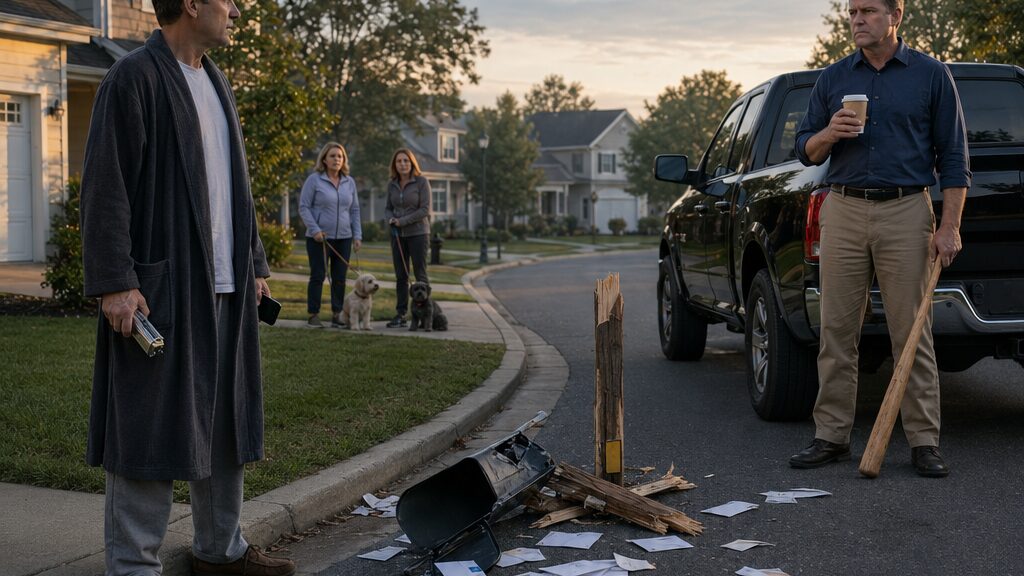
The baseball bat struck the mailbox before Samuel reached the front door.
The first blow bent the metal door inward. The second tore the box from the cedar crossarm. By the time Samuel stepped onto the porch in his robe and bare feet, the third blow had sent envelopes sliding across the damp pavement.
Charles Allen stood beside the broken post with the bat hanging from one hand.
Two women walking small dogs had stopped at the corner. Neither spoke. Charles looked toward them, then toward Samuel, as though witnesses made the moment more official.
“What are you doing?” Samuel asked.
Charles lowered the bat carefully. “Correcting a violation.”
The words were delivered without heat. That made them worse.
A paper cup sat on the hood of Charles’s spotless black pickup. He picked it up, took a drink, and nodded toward the splintered post.
“Two inches too high,” he said. “You’ve had notices.”
Samuel looked at the envelopes near the curb. One was addressed to the couple across the street. Another carried a pharmacy logo. The mailbox had always received overflow route mail when the carrier could not fit parcels or certified notices into the smaller boxes farther down the row.
“You hit it with a bat.”
“You ignored the association.”
“You’re not the association.”
Charles gave a thin smile. “Somebody has to care what this street looks like.”
Samuel had heard variations of that sentence for three years. It had appeared in meeting comments, neighborhood messages, and handwritten notes slipped beneath doors. Charles noticed trash bins left out past sunset, edging that crossed sidewalks, holiday lights that remained after the approved date. He spoke of standards the way other men spoke of weather emergencies.
The two dog walkers moved on, faster than before.
Samuel kept his hands visible. The bat was no longer raised, but its presence changed the distance between them. He remembered hospital corridors and the way people had spoken over his wife as though calm voices made cruel decisions reasonable. Since then, Samuel trusted dates, measurements, and records more than anyone’s tone.
“Wait here,” he said.
Charles laughed once. “I’m not going anywhere.”
Samuel went inside.
His measuring tape was in the second drawer of his desk, beside copies of the two HOA notices. He returned with the tape, his phone, and shoes he had not tied properly.
Charles was leaning against the truck now, drinking coffee while the broken mailbox lay at his feet.
Samuel photographed the scene first: the bat, the truck, the splintered cedar, the letters, the house numbers visible down the street. Then he crouched beside the remaining post.
“What are you doing?” Charles asked.
“Measuring.”
“You can’t measure it now. You broke the top.”
“The mounting line is still here.”
A faint pencil mark crossed the wood beneath the fractured crossarm. Samuel hooked the tape at the curb line and extended it upward. Forty-four and three-quarter inches.
The current association standard allowed forty-two to forty-five.
He photographed the number.
Charles set down his coffee. “That’s not where the box sat.”
Samuel pointed at the bolt holes.
“It sat there.”
“The diagram says forty-three.”
“The old diagram says forty-three. The adopted standard gives a range.”
Charles’s face changed, though only slightly. His mouth tightened first. Then he looked toward the empty corner where the walkers had been.
Samuel took another photograph.
“You should have waited for the board,” he said.
Charles folded his arms. “The board has been waiting for months. People here keep testing what they can get away with.”
Samuel pulled the tape free. At the base of the broken post, half-hidden beneath torn wood fibers, a small yellow route plate had been exposed. The plate was no larger than two fingers and stamped with a sequence Samuel recognized from the installation paperwork.
Route 6B. Auxiliary point.
He touched it with his thumb.
The mailbox was not merely his receptacle. Years earlier, when the subdivision’s curb layout had been revised, the postal service had approved this reinforced post as the overflow and signature point for eleven houses on the eastern side of the block. Most residents did not know because ordinary letters still went into their individual boxes. The shared function became visible only when parcels, certified notices, or temporary delivery exceptions were involved.
Charles mistook Samuel’s silence for uncertainty.
“See?” he said. “You don’t even know what you installed.”
Samuel stood.
“I know exactly what it is.”
The confidence in Charles’s expression faltered again.
A sedan slowed as it passed. The driver stared at the debris. Somewhere farther down the street, a garage door opened.
Charles picked up the bat and carried it toward his truck.
“Don’t remove that,” Samuel said.
Charles stopped.
“It’s evidence.”
Charles turned, the bat held low against his leg. “Evidence of what? Property maintenance?”
“Leave it.”
For a few seconds neither man moved. Samuel could hear water ticking through a sprinkler head across the street.
Then Charles dropped the bat onto the grass.
“You’re making this bigger than it is,” he said.
Samuel looked at the exposed route plate.
“No,” he said. “You already did.”
Charles drove away without his coffee cup. It remained on the hood until the truck turned, rolled backward, and spilled across the windshield.
Samuel gathered the loose mail without opening anything. He placed each piece in a clean grocery bag, then photographed the broken post from four angles. Inside, his hands began to shake hard enough that he had to set the phone on the kitchen counter.
He did not call Charles. He did not call Margaret Nelson, though the HOA office opened in twenty minutes.
Instead, he found the number printed on the old postal installation approval.
When the automated system asked whether his call concerned missing, delayed, or damaged mail, Samuel looked through the window at the empty socket beside the curb.
“Damaged delivery equipment,” he said.
Chapter 2: The Rule Book Proved Less Simple Than Revenge
The two mailbox standards were both stamped “current.”
Samuel laid them side by side across his desk.
The first had been attached to the warning Margaret Nelson sent six weeks earlier. It showed a fixed height of forty-three inches from the road surface to the bottom of the box.
The second appeared in the association’s online amendments. It allowed a range from forty-two to forty-five inches and had been adopted eighteen months before Margaret’s notice.
Samuel checked the dates again.
The fixed diagram had been superseded.
He printed both versions, circled the adoption language, and placed the measuring tape across them. On his monitor, the driveway recording waited at 5:41 a.m., the image frozen on Charles standing beside the intact mailbox.
Samuel clicked play.
Charles entered the frame from the left carrying a flashlight and a tape measure.
Not the bat. Not yet.
He crouched beside the post, measured from the curb, stood, then measured again. Afterward, he photographed the mailbox with his phone and walked out of frame.
At 6:08, he returned in the pickup.
At 6:10, he removed the bat from the truck bed.
Samuel watched the sequence twice.
Charles had not acted in sudden anger. He had checked the height, gone home or driven somewhere, then returned prepared to destroy the box.
Samuel copied the footage to two drives and uploaded a third copy to secure storage. Only then did he call the police.
The officer who arrived was younger than Samuel expected and careful not to step on the scattered wood.
“Did he threaten you?”
“No.”
“Did he swing the bat while you were outside?”
“No.”
“Any dispute before today?”
“Association notices. Nothing physical.”
The officer studied the remaining post and the camera mounted beneath Samuel’s eave.
“You have the whole thing recorded?”
“Yes.”
“That helps.”
Samuel showed him the footage on a tablet. When Charles appeared with the tape measure the officer leaned closer. When the bat came down, he stopped taking notes.
“He admitted doing it?”
“On camera.”
“And said the HOA authorized him?”
“He said he was correcting a violation. He implied authority.”
The officer looked toward Charles’s house three doors away.
“This will be documented as property damage and possible criminal mischief. The mailbox issue may involve other jurisdiction, depending on ownership and use. Don’t confront him.”
“I hadn’t planned to.”
The officer’s glance rested briefly on Samuel’s robe, now belted over work clothes.
“Good.”
At the HOA office, Margaret Nelson received him standing behind her desk. She wore a navy cardigan and reading glasses on a chain. Her office walls displayed framed photographs of landscaped entrances and plaques recognizing years of volunteer service.
Samuel placed the two standards before her.
Margaret did not sit.
“This is deeply unfortunate,” she said.
“Which part?”
“The escalation.”
“Charles destroyed my mailbox.”
“I understand there was a disagreement about compliance.”
“There was no disagreement while he was swinging the bat.”
Margaret pressed her lips together. “We should avoid loaded language until the board reviews the situation.”
Samuel set his phone on the desk and played the footage.
Margaret watched the first strike, then looked away before the second.
“Please stop that.”
“He measured it the night before.”
“I saw.”
“He knew where it stood.”
“I saw that too.”
Samuel pointed to the adopted standard. “It was compliant.”
Margaret adjusted her glasses. “The notice used a prior visual guide. That may have been an administrative oversight.”
“Charles acted on that oversight.”
“Charles is not an agent of the association.”
“He seems to think he is.”
Margaret finally sat. “Mr. Allen has been an active resident. He reports conditions. Many people report conditions.”
“Do many people destroy them afterward?”
Her expression cooled. “The association will address his conduct.”
“When?”
“At the next scheduled review.”
“That’s in twelve days.”
“We can call a special meeting if counsel advises it.”
Samuel looked at the plaques behind her. Everything in the room appeared arranged to show steadiness, service, and control.
“I’ve filed a police report,” he said.
Margaret’s fingers stopped on the edge of the outdated diagram.
“That was your right.”
“And the postal service has opened a damaged-equipment case.”
“That may complicate repairs unnecessarily.”
“The post has an auxiliary route designation.”
For the first time, Margaret looked directly at him without the soft expression she used for procedural discomfort.
“How many homes?”
“Eleven, according to the original approval.”
She leaned back.
Samuel watched her calculate liability.
“Do not circulate the footage yet,” she said.
He had expected denial, perhaps defensiveness. The request surprised him more.
“Why?”
“Because residents will see a violent image without context.”
“The context is that he used a bat.”
“The context also includes disputed standards, prior notices, and board review. Once a video spreads, facts become harder to manage.”
“You mean reputation becomes harder to manage.”
“I mean resolution becomes harder.”
Samuel gathered the papers slowly.
Margaret lowered her voice. “Let us handle Charles.”
“You had months to handle him.”
Her eyes moved toward the old diagram.
That was not an answer, but it was close enough to one.
At the police station, Samuel signed the report and submitted a copy of the recording. The clerk gave him a case number. It was a small satisfaction, almost mechanical, but he felt some pressure release when the number printed across the page. The event now existed somewhere beyond memory and neighborhood opinion.
By early afternoon, Joseph Perez from the local post office returned Samuel’s call.
Joseph spoke in a tired, direct voice.
“I’ve reviewed the route record. Your post is listed as auxiliary delivery equipment for the east row.”
“That’s what I thought.”
“Until the site is secured and recertified, carriers can’t leave accountable items there.”
“What happens to them?”
“They’ll be held.”
“For my address?”
“For all linked addresses.”
Samuel looked toward the window. A delivery truck had stopped near the entrance to the subdivision.
“How long?”
“That depends on replacement approval.”
“Can the carrier use the individual boxes?”
“For ordinary mail, yes. Not for oversized parcels, signatures, certain medications, or items already coded to that point.”
Samuel gripped the phone.
“How many addresses are active on the designation?”
Joseph paused, keys clicking in the background.
“Eleven.”
Chapter 3: Eleven Houses Learned What One Broken Post Controlled
Kimberly Torres was waiting beside the empty post when Samuel returned from the post office.
She held a yellow delivery notice in one hand and her phone in the other. Her hair was pulled back, and she wore blue medical scrubs beneath an open jacket.
“My father’s prescription is sitting fourteen miles away,” she said before Samuel had closed his car door.
Samuel glanced toward her house. Kimberly’s father lived with her and rarely came outside except to sit on the porch in the evenings.
“I’m sorry.”
“Are you?”
“Yes.”
“Because the message going around says you asked them to hold everything.”
“I reported destroyed equipment. The postal service decided what had to be held.”
Kimberly stepped closer, keeping the paper raised between them.
“This says unavailable delivery point.”
“That’s accurate.”
“It also says the hold may continue until the dispute is resolved.”
“The dispute is with Charles and the HOA.”
“My father’s medication isn’t.”
Samuel looked at the ragged socket in the ground. Someone had placed an orange safety cone over it, but the cone leaned because splintered wood remained inside.
“I didn’t destroy the box.”
“I know who swung the bat.”
Her voice softened only enough to become sharper.
“I’m asking what you did afterward.”
Samuel could have told her everything then. He could have explained the route designation, the certification requirement, the board’s delay, and Margaret’s request for silence. Instead, he said, “I followed the required process.”
Kimberly stared at him for a moment.
“That sounds like something the HOA says.”
She walked away.
By the third day, the street had changed.
People who once waved from driveways now stopped Samuel near the curb. A retired couple wanted to know why their granddaughter’s birthday package had been redirected. A man from the corner complained that he had lost an hour of work driving to the postal counter. Another resident asked whether Samuel planned to sue the association and whether that would increase dues.
Charles’s black pickup remained in his driveway. He did not come outside while people questioned Samuel.
At the post office, a line of residents from the subdivision formed beneath a sign directing customers to parcel pickup. Boxes accumulated behind the counter with handwritten route notes attached.
Joseph met Samuel near a side desk.
“I need a realistic timeline,” Samuel said.
Joseph slid a printed site report toward him. “A permanent replacement requires association approval because the post sits in a common easement.”
“How long?”
“If they use an approved contractor and submit the dimensions correctly, maybe two weeks. Longer if they argue about ownership.”
“They’re already arguing.”
“I assumed they would.”
Samuel read the report. Near the bottom, beneath the permanent-replacement instructions, a paragraph described temporary secure mounting.
“What is this?”
Joseph leaned over.
“A steel temporary frame. We can certify one for limited use if it’s anchored, accessible, and approved by whoever controls the easement.”
“How fast?”
“Two or three business days after installation.”
Samuel looked up.
“You didn’t mention that on the phone.”
“You asked what happens after destruction. I told you. This is an alternative, but the HOA has to sign. Your board president was emailed yesterday.”
“Margaret knows?”
“She received the same report.”
Samuel folded the paper once.
Joseph watched him. “You should give that section to your neighbors.”
“They’re already blaming me.”
“That doesn’t make the section less useful.”
Samuel put the report in his folder.
Outside, Kimberly was helping her father from a car. The older man moved carefully, one hand on the door frame, the other holding a small pharmacy bag. Kimberly saw Samuel but did not acknowledge him.
He told himself the temporary frame was Margaret’s responsibility. The common easement belonged to the association. Samuel could not authorize construction. He could not force the board to act.
All true.
None of it explained why he did not walk over and show Kimberly the report.
That evening, Charles appeared at the edge of Samuel’s driveway.
He had no bat and no coffee. Without them, he looked smaller.
“You’ve made your point,” Charles said.
Samuel was carrying the broken crossarm toward the garage.
“My point?”
“People are furious.”
“They should speak to the person who destroyed the post.”
“They think you’re using the postal service to punish everyone.”
“I don’t control the postal service.”
“You knew what that box did.”
Samuel stopped.
Charles studied his face and found what he wanted.
“You did know.”
“I knew it had an auxiliary designation.”
“And you said nothing.”
“You never asked before you hit it.”
Charles’s jaw tightened. “That’s not an answer.”
“It’s the only one you’re getting.”
Charles glanced at the crossarm in Samuel’s hands. “Margaret says repairs can’t begin while you’re preserving the site for evidence.”
“That’s false. The police photographed it.”
“She says your complaint complicates contractor access.”
“Also false.”
Charles stepped onto the driveway.
“You’re enjoying this.”
Samuel felt the accusation land because part of it was true. Not the delayed prescriptions. Not the elderly residents standing in line. But Charles’s loss of certainty, his sudden need to ask rather than command—Samuel was not sorry for that.
“You destroyed property you didn’t own,” Samuel said. “Consequences are not the same as revenge.”
Charles looked toward the dark windows of nearby houses.
“You keep telling yourself that.”
The next morning, Samuel emailed the police report number and the adopted mailbox standard to every resident who had contacted him. He included a short explanation that the postal hold had been initiated by damaged route equipment, not by a personal request.
Within an hour, one neighbor replied with thanks.
Another asked why Samuel had not disclosed the shared route sooner.
Then a screenshot appeared in the neighborhood message group.
It showed only part of Joseph’s site report—the paragraph stating that Samuel had been informed of the delivery restrictions on the first day. The temporary-frame paragraph beneath it had been cropped away.
Above the image, someone had written:
Samuel knew the whole street would lose packages and let it happen to get revenge on Charles.
By noon, fifteen residents had reacted to the message.
Charles did not comment.
Samuel opened his folder and looked at the uncropped report. His eyes settled on the temporary mounting option.
He could correct the rumor in less than a minute.
Instead, he closed the folder.
Chapter 4: The Street Chose a Villain Before Hearing the Records
A photograph of Samuel’s broken mailbox had been placed on every chair in the HOA clubhouse.
The image was enlarged enough to show the splintered cedar, the crushed metal door, and three envelopes lying near the curb. Someone had printed a caption beneath it:
DELIVERY DISPUTE—EMERGENCY RESIDENT MEETING.
Samuel picked up the copy from the chair nearest the aisle.
The photograph had been cropped just above the yellow route plate.
Residents filled the room in small, tense groups. Several held postal notices or pickup receipts. A woman near the back had brought a parcel with a bright hold sticker still attached. Nobody waved to Samuel when he entered.
Kimberly sat in the second row beside her father. He leaned on a folding cane, pale but alert. She looked at Samuel, then at the folder under his arm.
Charles stood near the board table in a pressed shirt and clean work boots. A silver measuring tape rested beside his water bottle as if it were official equipment.
Margaret tapped the microphone.
“This meeting concerns delivery interruption, property damage, and restoration of the shared auxiliary point.”
“Then why is his complaint stopping the repair?” someone called.
“It isn’t,” Samuel said.
Several heads turned.
Margaret raised one hand. “We’ll follow the agenda.”
“The agenda has been following us for seven days,” another resident said. “My packages are still across town.”
Charles stepped toward the microphone before Margaret invited him.
“I think people deserve a plain explanation.”
Margaret’s jaw tightened. “Mr. Allen, you will have an opportunity.”
“I’m not avoiding responsibility.” He faced the room. “I removed a structure that had been cited twice and remained out of compliance.”
“You smashed it,” Kimberly said.
Charles nodded as though accepting a technical correction. “I used the wrong method.”
A low sound moved through the room.
Samuel watched Charles place one hand beside the measuring tape.
“The post was two inches above the approved height,” Charles continued. “It blocked sight lines and created an inconsistent streetscape. I believed immediate correction was necessary because prior notices had been ignored.”
Samuel opened his folder.
“Show them the rule you used.”
Charles picked up the tape instead. He extended it several inches, then let it snap back.
“The approved diagram specifies forty-three inches.”
“The old diagram.”
“It’s the diagram residents received.”
“Because the board sent the wrong one.”
Margaret leaned toward her microphone. “The association acknowledges that an outdated visual guide was attached to certain notices.”
The room quieted.
Samuel placed the current standard on the document camera. The page appeared on the screen behind the board: forty-two to forty-five inches.
“My post measured forty-four and three-quarter,” he said.
Charles looked toward Margaret.
Samuel added the photograph of the tape aligned with the remaining mounting holes. The number was clear.
A man in the front row turned to Charles. “You broke it when it was legal?”
Charles’s shoulders stiffened. “The field measurement was disputed.”
“You measured it yourself the night before,” Samuel said.
The room shifted again.
Margaret pressed the microphone button harder than necessary. “There is video evidence currently under review.”
“Play it,” Kimberly said.
Several residents repeated her.
Margaret shook her head. “Not without counsel present.”
Samuel understood then why she had asked him not to circulate the recording. Once residents saw Charles arrive with a tape, leave, and return with a bat, the board could no longer describe the event as an impulsive misunderstanding.
Charles could not tolerate the silence.
“The board knew I was monitoring violations.”
Margaret turned toward him. “Reporting concerns does not confer enforcement authority.”
“You asked residents to help maintain standards.”
“By submitting reports.”
“You thanked me for doing it.”
“That did not authorize property damage.”
The words landed harder than anything else Margaret had said. Charles’s face reddened. For the first time since the mailbox fell, Samuel saw him without certainty.
Margaret faced the residents.
“No homeowner has authority to modify, remove, or damage another resident’s property. The board did not authorize Mr. Allen’s action.”
The statement gave Samuel what he had wanted since dawn on Monday: an official line separating Charles from legitimate authority.
It should have felt clean.
Instead, Kimberly stood.
“Fine,” she said. “Charles had no authority. Samuel’s mailbox was compliant. Can someone explain why we still don’t have the temporary frame?”
Margaret looked down at her papers.
Samuel felt the folder become heavier in his hand.
“The postal report says a temporary secure mount can be approved,” Kimberly continued. “It says the board received that option on Tuesday.”
Residents turned toward Margaret.
She adjusted her glasses. “The temporary installation requires several approvals.”
“How many?” Kimberly asked.
“Easement approval, contractor certification, carrier access—”
“Joseph Perez said the post office could certify it in two or three business days.”
Margaret looked at Samuel.
Kimberly followed her gaze.
“You knew too,” she said.
It was not an accusation yet. It was a question offered one last chance to remain a question.
Samuel could have opened the folder. He could have shown the full report and explained that only the HOA could sign. He could have admitted that he had not pushed Margaret, had not told the residents, and had allowed Charles’s humiliation to feel like part of the remedy.
Instead, he said, “The board controls the easement.”
Kimberly’s face hardened.
“That wasn’t what I asked.”
Charles leaned toward his microphone. “He knew the consequence from the beginning.”
Samuel turned on him. “You created the consequence.”
“And you kept it going.”
The room erupted—not loudly at first, but through overlapping demands, chairs shifting, papers lifted into the air.
Margaret called for order.
Samuel stared at the enlarged photograph on the screen. The broken post looked almost black against the pale street. Charles’s measuring tape lay on the table between them, bright and precise, as though a number could decide which man had caused more harm.
Kimberly stepped into the aisle.
“Did Joseph tell you about the temporary mount?”
Samuel met her eyes.
“He said it required HOA approval.”
“That’s still not an answer.”
Margaret struck the gavel once.
Samuel heard himself say, “I had no authority to install it.”
The words were accurate.
They were also the lie he had chosen.
Chapter 5: The Board’s Quiet Arrangement Finally Became Visible
The email did not contain Charles’s name.
It referred to him only as “our eyes on the street.”
Samuel found the phrase in a printed message tucked between landscaping invoices in the HOA records room. The email had been sent from Margaret’s account to two board members eleven months earlier.
Our eyes on the street have identified recurring compliance problems along the east row. Informal resident observation remains useful while management capacity is limited.
The attached list included eight addresses.
Samuel’s was third.
He photographed the page before the records clerk returned.
“You’re limited to formally requested documents,” the clerk said from the doorway.
“This was in the mailbox-inspection file.”
She crossed the room quickly and removed the page from the table.
“That may have been misfiled.”
“Who are the board’s eyes on the street?”
“I wouldn’t know.”
Samuel held up his phone. “I have the page.”
The clerk looked toward Margaret’s closed office door.
Ten minutes later, Margaret asked Samuel to join her.
The old mailbox inspection sheets were arranged across her desk. Each carried handwritten measurements in Charles’s narrow block printing. Some included photographs of leaning posts, faded numbers, or decorative brackets. A few had notes such as SECOND NOTICE ADVISED or OWNER DISMISSIVE.
“You allowed him to conduct inspections,” Samuel said.
“We allowed residents to report observable conditions.”
“He entered measurements on association forms.”
“He was provided blank checklists during a volunteer cleanup initiative.”
“And kept using them.”
Margaret removed her glasses. “Charles is persistent. At times, that persistence was useful.”
“Useful enough that you ignored escalation.”
“We did not know he would destroy property.”
“He measured my mailbox before dawn.”
“Which we learned afterward.”
Samuel placed the photographed email on her desk.
Margaret’s face barely changed, but she sat straighter.
“You called him your eyes on the street.”
“That was careless wording.”
“It was permission to someone already looking for it.”
“No.” Her voice sharpened. “Permission would require a motion, recorded authorization, or management directive. None exists.”
“You keep describing what protects the association.”
“I am describing facts.”
“You’re describing liability.”
Margaret glanced toward the door and lowered her voice.
“Do you think I wanted this? We have four board members, two of whom rarely attend. Management raised its fees twice. Residents demand enforcement and then accuse us of harassment when they receive notices. Charles volunteered. He took photographs. He documented obvious issues.”
“He also treated your silence as a badge.”
“I told him repeatedly that he had no enforcement power.”
“Show me.”
Margaret did not answer.
Samuel leaned back.
That absence mattered more than the email.
Later that afternoon, Charles opened his garage door while Samuel was photographing the damaged curb socket. The black pickup was parked inside beneath bright overhead lights. Shelves along one wall held labeled storage bins. A workbench displayed a level, a laser measure, and a stack of property brochures.
Charles stepped out holding a folder.
“You’ve been digging,” he said.
“So have you.”
Charles glanced at Samuel’s camera. “Margaret told you about the reports?”
“She didn’t have to.”
For a moment, Charles seemed prepared to close the garage. Instead, he opened the folder and showed Samuel a printed home appraisal appointment.
“Friday,” he said.
Samuel waited.
“The bank values the house Friday. We’re refinancing.”
“That doesn’t explain my mailbox.”
“It explains why standards matter.”
“No. It explains why they matter to you.”
Charles walked to the edge of the driveway. His lawn was cut evenly enough to show stripes.
“Three sales have come in below asking,” he said. “One owner rented to college kids. Another painted a garage door without approval. Trash sits out. Landscaping slips. Then everybody acts surprised when values soften.”
“You thought breaking a mailbox would improve an appraisal?”
“I thought visible noncompliance spreads.”
Samuel looked past him into the ordered garage.
Charles continued more quietly. “I ran for the board because someone needed to do the work. Margaret told people I was too confrontational. Then she called whenever she needed photographs.”
The admission carried no remorse. It did carry injury.
“You wanted the board seat,” Samuel said.
“I wanted consistency.”
“You wanted authority.”
Charles’s eyes narrowed. “You work in records. You know systems fail when nobody enforces them.”
Samuel did know. He also knew how easily a person could hide inside procedure until human cost became an entry on a form.
“The board denied you authority,” he said.
“They used me without giving me a title.”
“And you decided a bat would settle the difference.”
Charles looked toward the street. “I made a bad decision.”
“You made several decisions. You measured it. You left. You came back armed.”
The word made Charles flinch.
“It was a baseball bat.”
“It was enough to keep me on the porch.”
Neither spoke for several seconds.
Then Charles held up the appraisal notice.
“If Margaret makes me the only responsible party, I’ll release every message she sent me. Every address she asked me to check. Every time she told me to keep pressure on someone without putting the board’s name on it.”
“You should release them.”
“That would damage the association.”
“You damaged the association.”
Charles gave a tired, almost humorless smile.
“So did you.”
The words followed Samuel home.
At six that evening, an email from Margaret appeared with an attachment marked CONFIDENTIAL SETTLEMENT DISCUSSION.
The association would fund immediate replacement of the shared post. Charles would pay restitution for Samuel’s damaged mailbox and accept daily fines beginning on the date of destruction. Samuel would agree not to distribute the video, internal correspondence, or records concerning informal compliance reporting. Charles would sign the same confidentiality clause.
The delivery point could be restored within seventy-two hours.
At the bottom, beneath the attorney’s signature, one sentence had been added:
This resolution allows all parties to move forward without further community division.
Samuel read it twice.
On the kitchen counter, the full temporary-mount report remained beneath his keys.
He could restore the mail, recover his loss, and let the truth disappear into a settlement no neighbor would ever see.
Chapter 6: Eighteen Days of Silence Cost More Than the Mailbox
The ambulance stopped in front of Kimberly’s house while three postal hold notices remained taped inside her storm door.
Samuel heard the siren cut off and stepped outside before he had put on shoes.
Two emergency workers carried a medical bag up the porch steps. Kimberly stood in the doorway, one hand pressed against the frame. Her father was visible behind her, seated low in a dining chair with his head bent forward.
A neighbor moved toward Samuel from the sidewalk.
“His medication didn’t come.”
Samuel looked at the notices.
One was dated four days earlier.
Kimberly saw him through the open door. The expression on her face stopped him at the property line.
He remained there until the emergency workers brought her father out on a stretcher. The older man was conscious, embarrassed, and trying to tell Kimberly he could walk.
She held his hand without looking at Samuel.
At the post office, Joseph found the prescription package in less than ten minutes.
It had arrived two days earlier with signature service and had been placed in the subdivision’s held-items section. A pickup notice had been generated, but Kimberly had been working double shifts and her father could not make the fourteen-mile trip alone.
Joseph set the parcel on the counter.
“This medication should have been flagged for direct coordination,” he said. “The system didn’t identify it as urgent.”
“Could it have gone to the temporary frame?”
“If we had one.”
Samuel unfolded the site report.
“You offered that the first week.”
“I sent the option to you and the HOA.”
“Did I tell you the board hadn’t signed?”
“You said they were reviewing liability.”
Samuel remembered the conversation. He had said the board was reviewing. Joseph had asked whether Samuel wanted him to contact Margaret directly.
Samuel had answered, “Not yet.”
At the time, the words had felt cautious. Now they sounded deliberate.
“How soon could it have been done?” Samuel asked.
“If the association signed on Tuesday? Friday, maybe Monday.”
“Before today.”
Joseph looked at him for a long moment.
“Yes.”
Samuel placed both hands on the counter.
“I told myself I couldn’t authorize it.”
“You couldn’t.”
“That’s not the same as saying I couldn’t help make it happen.”
“No,” Joseph said. “It isn’t.”
The answer contained no accusation, which made it harder to resist.
By afternoon, Samuel had made a list of every affected household. He drove two elderly residents to the post office and collected written authorizations for a neighbor to retrieve parcels for three others. He printed directions, counter hours, and identification requirements and placed them at each door.
At Kimberly’s house, the storm door opened before he knocked.
Her father had returned from the hospital. Kimberly stood outside and pulled the door closed behind her.
“He’s stable,” she said.
“I’m glad.”
“Are you?”
Samuel let the question remain.
“I knew there was a temporary option,” he said.
Kimberly folded her arms.
“I knew it required the HOA’s signature. I also knew Joseph could pressure them and explain the process. I didn’t ask him to. I didn’t tell you.”
“Why?”
Samuel looked toward the empty post down the street.
“Because Charles expected everything to be fixed around him. He broke it, then wanted the inconvenience removed before anyone understood what he’d done.”
“So you let everyone feel it.”
“I told myself the board was responsible.”
“They were.”
“Yes.”
“And?”
“And I was angry enough not to hurry them.”
Kimberly’s face changed—not toward forgiveness, but away from uncertainty.
“My father didn’t swing the bat.”
“I know.”
“Neither did the people standing in line after work.”
“I know.”
“You had proof Charles was wrong. You didn’t need us to suffer for it.”
Samuel swallowed.
“No.”
She looked through the glass at her father, then back at Samuel.
“At the hearing, I’m telling them all of it.”
“You should.”
That answer surprised her.
“I’m telling them what Charles did, what Margaret hid, and what you knew.”
“You should tell that too.”
Kimberly studied him as though searching for another carefully limited truth.
“What changed?”
Samuel thought of the hospital years earlier: his wife asking a nurse to explain a delay, Samuel standing beside her with forms and dates, believing accuracy would force urgency. The records had been correct. The help had still come late.
“I ran out of ways to call silence restraint,” he said.
That evening, he organized transportation for every resident who still had held items. A neighbor with a van agreed to make two trips. Samuel paid for fuel without announcing it. Joseph arranged a dedicated pickup window and assigned a clerk to the subdivision’s parcels.
The work did not erase the eighteen days. It did make the nineteenth less damaging.
At home, Samuel walked behind the garage and pulled the broken mailbox post from beneath a tarp. Mud had dried along the base. The yellow route plate remained attached.
He carried it inside and placed it beside the measuring tape on his desk.
Then he opened Margaret’s settlement agreement.
He deleted the unsigned document.
In a new email, he attached the driveway footage, the current and outdated standards, Joseph’s complete site report, Margaret’s “eyes on the street” message, and the records showing Charles’s unauthorized inspections.
Last, he attached a statement of his own.
He wrote that Charles had destroyed compliant property after being denied enforcement authority. He wrote that the board had encouraged informal surveillance while avoiding responsibility for it.
Then he wrote what no document required him to admit:
On the first week, I learned that a temporary delivery frame could be approved. Although I lacked authority to approve it, I did not press the association or inform affected residents as quickly as I could have. My anger at Mr. Allen influenced that decision. Other residents carried consequences they did not create.
Samuel read the paragraph until the urge to soften it passed.
He addressed the email to Margaret, the entire board, the HOA attorney, Kimberly, and every affected household.
At 11:43 p.m., he pressed send.
Chapter 7: Samuel Refused the Easy Version of Being Right
Margaret began the hearing by placing all responsibility on one unauthorized resident.
Her prepared statement rested in neat pages beneath the clubhouse microphone. Every chair was occupied. Residents stood along the walls, holding folded notices, printed emails, and photographs of the broken mailbox.
“The association did not direct, approve, or condone Mr. Allen’s actions,” Margaret said. “His decision to damage private property was personal, unilateral, and outside every established procedure.”
Charles sat at the far end of the board table. He kept his hands clasped in front of him.
Samuel stood beside the aisle with the broken cedar post under one arm.
When he laid it across the table, dirt fell onto Margaret’s papers.
The yellow route plate faced the room. Beside it, Samuel placed the measuring tape Charles had left on his lawn.
Margaret stared at both objects.
“Mr. Clark,” she said, “you’ll have an opportunity to speak.”
“I’m preserving the context.”
A board member shifted the post away from the microphone. It was too long to fit neatly, and that seemed appropriate. For eighteen days, every official response had tried to reduce the damage to a category small enough to manage.
Margaret resumed.
She summarized the outdated notice, the valid height range, and the video showing Charles measure the post before returning with the bat. She announced that the mailbox had been compliant. She confirmed that Charles had no enforcement authority.
A murmur moved through the room.
Charles leaned toward his microphone.
“You told me to keep documenting violations.”
Margaret did not look at him. “You were asked to report concerns, not act upon them.”
“You called me when residents ignored notices.”
“We are not discussing informal communications yet.”
“Because they make your statement less convenient?”
The HOA attorney raised one hand. “Mr. Allen, you will wait.”
Charles sat back, but the line had already changed the room.
Margaret continued with the proposed penalties: restitution for the damaged box, daily fines for unauthorized property modification, reimbursement of certain emergency delivery costs, and suspension from all volunteer compliance activity.
For several seconds, Samuel heard only paper moving.
This was the easy version.
Charles had acted alone. The association had been misled. Samuel had been the patient homeowner who gathered proof and waited for order to restore itself.
Margaret turned to him.
“Mr. Clark, you may present your statement.”
Samuel carried no pages to the microphone. The statement had already reached everyone by email.
He looked first at Kimberly. Her father sat beside her, thinner than Samuel remembered from the week before but upright.
“The mailbox was compliant,” Samuel said. “Charles knew the exact height before he damaged it. The board had told him he had no authority to enforce anything.”
Charles’s eyes dropped.
Samuel touched the broken post.
“He caused the delivery interruption.”
A few residents nodded.
Then Samuel continued.
“But I helped it last longer.”
The room became still enough for him to hear the air system click on.
Margaret reached toward her microphone. “Mr. Clark, your written statement has been received. We can address operational issues separately.”
“No. They were not separate for the people whose mail was held.”
He unfolded Joseph’s report and held it where the front row could see the highlighted temporary-mount section.
“On the first week, I learned that a secure temporary frame could have been approved. I could not authorize it. The HOA controlled the easement. But I could have told every affected household. I could have asked the postal supervisor to contact the board directly. I could have pushed harder.”
A resident near the wall said, “Why didn’t you?”
Samuel looked at Charles.
“Because I wanted him to feel the consequences.”
Charles looked back at him without triumph.
Samuel faced the room again.
“I told myself I was following procedure. The truth is that I was angry, and procedure gave me somewhere to hide that looked respectable.”
No one spoke.
Kimberly stood.
“My father missed a prescription delivery,” she said. “That was not entirely Samuel’s fault. The package was held because Charles destroyed the delivery point, and the board failed to approve the temporary frame.”
She looked at Samuel.
“But he knew there was another option before most of us did.”
“Yes,” Samuel said.
Kimberly continued. “After my father went to the hospital, Samuel arranged rides and pickup authorizations for every house affected. That mattered. It does not erase what he withheld.”
“No,” Samuel said. “It doesn’t.”
The directness loosened something in the room. Not forgiveness. Something more useful: the end of guessing.
Charles pushed his chair back.
“If we’re telling everything, then tell them why I was inspecting properties.”
The HOA attorney said his name in warning.
Charles ignored him and opened a folder.
He held up printed emails.
“Margaret sent me addresses. She asked for photographs. She told me which owners had challenged notices and which violations needed more pressure.”
Margaret’s face went pale.
“I never authorized direct contact.”
“You wrote, ‘A reminder from another resident may work better than another formal notice.’”
“That did not mean intimidation.”
“It meant you wanted enforcement without the board’s name attached.”
Charles distributed copies to the nearest residents. Hands reached for them.
Samuel watched Margaret’s authority change shape. Until that moment, it had rested on her ability to name the limits of everyone else’s responsibility.
A board member read one email aloud.
“‘Please continue observing the east row. Your documentation helps us avoid unnecessary management visits.’”
Margaret removed her glasses.
“We had limited resources,” she said. “Residents complained that standards were slipping. Mr. Allen was willing to document visible issues.”
“You knew he was confronting people,” Kimberly said.
“I knew he spoke directly.”
“You knew he acted like he represented you.”
Margaret looked around the room. “I believed I could manage his involvement.”
Charles gave a short laugh.
“You believed I was useful until I became expensive.”
Margaret’s eyes hardened. “And you believed being useful gave you permission to destroy a neighbor’s property.”
For once, neither accusation canceled the other.
The HOA attorney called for a recess. Residents refused to leave.
The board moved into a hurried closed discussion at the far side of the room while everyone else remained seated. Samuel returned to his chair.
Kimberly sat beside him.
“You could have let them make you the hero,” she said.
“I tried that version for eighteen days.”
Her father leaned forward.
“Being right is expensive,” he said quietly. “Being honest usually costs more.”
Samuel nodded.
Across the room, Charles sat alone. The appraisal folder rested beneath his hand, its corners worn now. He did not look like a neighborhood sheriff. He looked like a man who had mistaken attention for authority and was only beginning to understand the difference.
The board returned after twenty minutes.
Margaret did not take the microphone. Another board member announced the decisions.
Charles would be fined, billed for restitution, removed from all volunteer roles, and prohibited from contacting residents about compliance matters.
Margaret’s informal reporting arrangement would be independently reviewed. All prior violation notices based on Charles’s inspections would be reopened. The temporary mail frame would be installed the following morning, with permanent replacement scheduled within ten days.
Then the board member read the final motion.
“Every compliance action submitted or materially supported by Mr. Allen during the previous twenty-four months will be suspended pending review.”
Residents began checking one another’s faces.
The issue was no longer one mailbox.
It was every warning, every photograph, every unexplained measurement, and every resident who had believed a neighbor’s judgment carried the force of the board.
Chapter 8: The New Mailbox Stood Lower, but the Street Saw More
The first letter delivered to the rebuilt mailbox was addressed to Samuel.
He found it at seven on a Tuesday morning, resting alone inside the clean metal box. The new post stood half an inch lower than the old one, not because the previous height had been wrong, but because Samuel had chosen the middle of the approved range.
The cedar crossarm had been made partly from salvaged wood.
One section still carried a shallow dent from the bat.
The contractor had offered to discard it. Samuel had asked him to plane it smooth enough to use without removing the mark entirely.
The envelope contained the association’s final findings.
Charles was responsible for the replacement cost, postal coordination expenses, and eighteen days of fines. The police matter had been resolved separately through restitution and a property-damage agreement. No dramatic federal charge appeared. The postal inspector had documented damage to approved delivery equipment and required corrective measures, but the case remained what it had always been: serious because people depended on the object, not because it produced an impressive legal title.
Margaret had resigned before the review concluded.
The board’s report found that she had not authorized property destruction, but had encouraged informal enforcement in ways that blurred authority and allowed harassment to grow without records or oversight.
New rules required every inspection to be conducted by management or two designated board representatives. Residents could submit concerns, but could not measure, confront, photograph through windows, or issue unofficial deadlines. All notices had to cite the current standard and include an appeal process.
Samuel folded the letter and placed it on the kitchen counter.
Outside, the mail carrier tested the new locking compartment and marked the route plate on a handheld device. The eleven linked households had already received notice that normal delivery had resumed.
Kimberly crossed the street carrying two cups of coffee.
“One for you,” she said.
Samuel accepted it.
They stood beside the rebuilt post.
“My father got his refill yesterday,” she said. “Delivered to the door this time.”
“How is he?”
“Annoyed that everyone keeps asking.”
“That sounds better.”
“It is.”
She ran one finger over the salvaged section of cedar.
“You kept the damaged piece.”
“Part of it.”
“Why?”
Samuel looked at the shallow dent.
“So replacing it wouldn’t become the same as pretending it didn’t happen.”
Kimberly nodded, though she did not tell him whether she agreed.
A black pickup slowed near the curb.
Charles parked several feet away and stepped out carrying an envelope. The truck was still clean, but not polished. Dust showed around the wheel wells.
He approached without looking at the new mailbox.
“This is the final restitution payment,” he said.
Samuel took the envelope but did not open it.
Charles glanced toward Kimberly. “The board said I could deliver it personally.”
“They said you could,” Kimberly replied. “Not that you needed to.”
Charles accepted the distinction.
For a moment, the three of them stood near the object that had divided the street.
Charles finally looked at the repaired post.
“It’s lower.”
“Half an inch,” Samuel said.
A familiar defensiveness crossed Charles’s face, then disappeared.
“Still within range?”
“Yes.”
Charles nodded.
He seemed to search for a sentence large enough to repair what he had done. None came.
“I shouldn’t have touched it,” he said.
“No,” Samuel replied.
“I thought the board would back me.”
“They didn’t.”
“I thought if things kept slipping, people would stop caring.”
Samuel looked down the street. Trash bins stood beside two garages after the approved collection time. A child’s bicycle rested on a front lawn. Nothing appeared endangered by either fact.
“You cared about control,” Samuel said. “That isn’t always the same thing.”
Charles’s mouth tightened, but he did not argue.
He looked at Kimberly.
“I heard about your father.”
She waited.
“I’m sorry.”
Her answer came after a long pause.
“He didn’t need your standards. He needed his medication.”
Charles lowered his eyes.
“I know.”
It was not a full apology. It did not ask forgiveness. Perhaps that made it more honest than anything he could have offered.
Charles walked back to his truck and left.
Kimberly watched him go.
“The committee meets Thursday,” she said.
“What committee?”
“The new resident procedures group. Clear notices, current documents, delivery contingencies. They asked me to join.”
“That makes sense.”
“They asked for you too.”
Samuel shook his head.
“I don’t need another position.”
“It isn’t enforcement.”
“That’s what people say before they discover how much they enjoy being listened to.”
Kimberly smiled slightly.
“You could help publish the records.”
That made him pause.
“Public standards, revision dates, appeal forms,” she said. “No private lists. No unofficial inspectors.”
Samuel looked at the route plate attached to the post.
“I’ll build the archive,” he said. “Someone else can chair the meetings.”
“Fair.”
Over the next weeks, the reopened violation cases changed the neighborhood in small ways. Several fines were withdrawn because they relied on outdated standards. Other violations remained valid, but residents received time to correct them and a clear explanation of why.
No one applauded Samuel in the clubhouse. A few residents continued to avoid him. One man whose package had been delayed never returned Samuel’s greeting.
Samuel stopped expecting the truth to repair every relationship.
Kimberly’s father began sitting on the porch again. Margaret’s house went on the market. Charles kept his lawn striped but no longer walked the street with a clipboard.
The new mailbox gathered ordinary life: bills, catalogs, birthday cards, a padded envelope for Kimberly’s father, and a postcard from Samuel’s daughter.
One Saturday, Samuel opened the maintenance compartment at the back of the post. Inside were spare bolts, the route paperwork sealed in plastic, and the small tools needed for adjustments.
He added the old measuring tape.
It had once been evidence that he was correct. Charles had used another like it to justify control. For eighteen days, both men had treated numbers as though accuracy could decide what they owed other people.
Samuel closed the compartment and locked it.
The mailbox stood where the broken one had stood, carrying the same route and serving the same eleven houses.
The dent remained visible only if someone came close enough to look.
The story has ended.