The Truck She Called an Eyesore Carried a Promise the Whole Neighborhood Misunderstood
Chapter 1: The Photograph Taken Beside the Open Hood
“The towing rule applies whether you agree with it or not.”
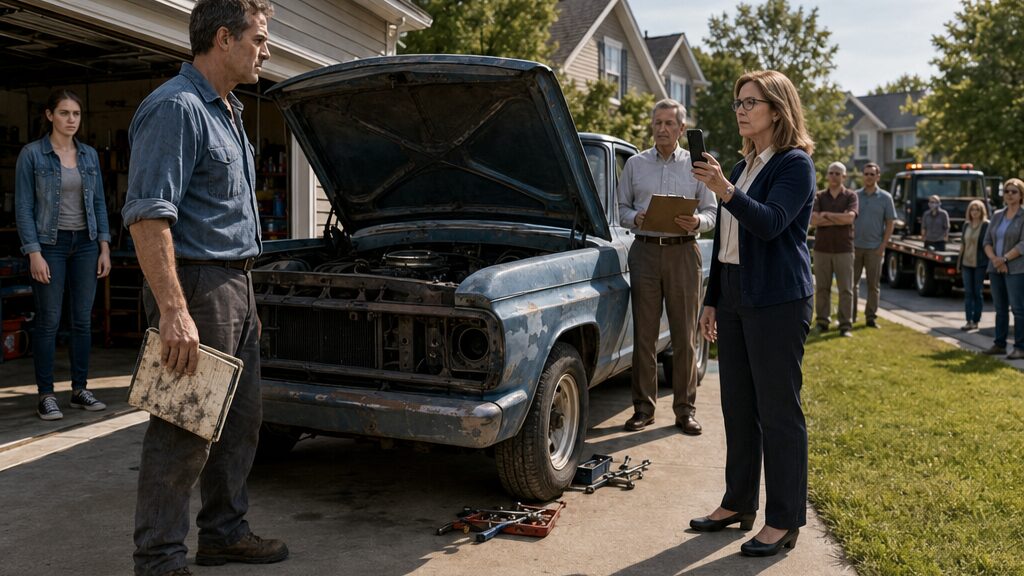
Janet Thompson stood at the edge of Brian Anderson’s driveway with her phone raised chest-high, the camera lens pointed past him at the truck. The hood was open, its faded blue metal lifting between them like a wall.
Brian kept one hand on the wrench inside the engine bay.
“You’re standing on my property,” he said.
“I’m documenting a violation.”
“You’re photographing me.”
“You’re in front of the violation.”
Janet tapped the screen.
The shutter sound was small, but in the quiet street it carried farther than it should have.
Behind Brian, the truck sat unevenly on its tires, the front bumper removed and placed on two blocks near the garage wall. Patches of primer showed through the worn paint. The grille was missing. A folded tarp lay beneath the rear axle, darkened by old grease.
It had looked temporary in March.
By July, temporary had become the neighborhood’s favorite word for permanent.
Janet stepped sideways for a clearer angle. Her lawn behind her was cut to a uniform height, the edging clean enough to look drawn with a ruler.
“You’ve had four months,” she said.
“I’ve had parts on back order.”
“You said that in May.”
“It was true in May.”
“And now?”
“Still true.”
She lowered the phone just enough to study him over it. “That truck hasn’t moved.”
“It doesn’t need to move while I’m rebuilding it.”
“That’s not how an abandoned vehicle is defined.”
Brian straightened slowly. Sweat had darkened the collar of his work shirt. There was a black streak across his forearm where he had wiped away oil without thinking.
“It isn’t abandoned.”
“Then prove it.”
The request landed harder than the accusation.
Brian could have reached through the open window, turned the key, and made the engine catch. He could have shown her the rebuilt carburetor, the new belts, the labeled wiring, the brake lines he had bent by hand.
Instead, he set the wrench on the fender.
“I don’t owe you a demonstration.”
Janet’s mouth tightened in the way it did at board meetings when someone treated a rule as optional.
“You owe the association compliance.”
“I’m not talking to the association.”
“I’m the compliance chair.”
“You’re my neighbor.”
“Today I’m both.”
A sedan turned into the street. Brian recognized Emily’s car before it reached the house.
Janet turned, saw it too, and raised her phone again.
Brian stepped into the frame.
“Put it down.”
“I’m taking a picture of the driveway.”
“You already have six.”
“Seven.”
Emily slowed at the curb. For one second, Brian saw the decision in her face: keep driving or pull in.
She pulled in.
Janet moved back without lowering the phone. Emily parked beside the mailbox, leaving the driveway entrance clear. She got out with her backpack hanging from one shoulder.
“What happened?” she asked.
“Nothing,” Brian said.
Janet answered at the same time. “Your father has been notified that the truck may be towed.”
Emily looked from Janet to the open hood.
“Towed?”
“If it remains in violation.”
“It’s not going anywhere,” Brian said.
Janet took another photograph.
Emily flinched at the shutter sound. “Can you not do that?”
“I need a current record.”
“With me in it?”
“You walked into the scene.”
Brian stepped toward Janet. Not fast, but enough that she lowered the phone.
“Go home.”
“I will when I’m finished.”
“You’re finished.”
For a moment neither moved.
Then Janet gave a small, satisfied nod, as if his anger had supplied something the photographs had not.
“The property manager will issue formal notice,” she said. “Seven days is more than fair.”
She crossed the strip of lawn between their houses and disappeared through her side gate.
Emily waited until the latch clicked.
“Dad.”
Brian turned back toward the truck.
“Don’t.”
“She said they’re towing it.”
“She says a lot of things.”
“Is she wrong?”
He picked up the wrench.
Emily came closer. “Is she wrong?”
“Yes.”
“Then why didn’t you show her?”
“Because I don’t perform for Janet Thompson.”
“That’s not what I asked.”
Brian leaned over the engine bay again, though he had lost track of what he had been tightening.
Emily dropped her backpack on the garage floor.
“People are talking about it.”
“People always talk.”
“They’re calling it junk.”
He tightened the same bolt twice.
Emily watched him. “You said it would be done by spring.”
“I said I was aiming for spring.”
“You said that last fall too.”
The wrench slipped. His knuckles struck the edge of the intake manifold.
Emily stepped forward. “Are you okay?”
“I’m fine.”
A bead of blood rose across his skin. He wiped it on a rag.
From inside the garage, the old wall clock clicked loudly between seconds.
Emily looked at the workbench, the labeled parts bins, the unopened cardboard box containing the new fuel tank. “You could move it into the garage.”
“No room.”
“You could clear room.”
“I know what I could do.”
Her expression changed—not anger, exactly. Something closer to resignation.
“That’s what you always say.”
She picked up her backpack and went inside.
Brian remained beside the truck until the front door shut.
Only then did he climb into the cab.
The bench seat smelled of dust, old vinyl, and the faint sweetness of fuel. The dashboard was still stripped to metal. A bundle of wires hung below the steering column, each one marked with tape in his father’s handwriting.
Brian turned the key.
The starter caught on the second rotation. The engine stumbled, coughed once, then settled into a rough but steady idle.
Across the narrow space between the houses, a curtain shifted in Janet’s kitchen window.
Brian kept the engine running for ten seconds.
Long enough to prove she was wrong.
Not long enough to make anything right.
He shut it down.
That night, someone taped a white envelope across the truck’s windshield. The association’s name appeared at the top in blue letters. Beneath it, in heavier print:
NOTICE OF VEHICLE AND PROPERTY VIOLATION
COMPLIANCE REQUIRED WITHIN SEVEN DAYS
Emily found it first.
Brian was in the kitchen rinsing grease from his hands when she came through the door holding the envelope by one corner.
“They really did it.”
He dried his hands.
“Give it to me.”
She pulled it back. “No. I want to read it.”
“It’s addressed to me.”
“It’s about the truck Grandpa said was supposed to be ours.”
Brian stopped.
Emily stared at him. “Wasn’t it?”
He took the notice from her more sharply than he intended.
“Go finish your homework.”
“I’m nineteen.”
“Then go do something nineteen-year-olds do.”
She looked toward the garage. “Maybe I’ll work on the truck.”
“You don’t know enough yet.”
Her face closed.
Brian regretted the words before she turned away, but he did not call them back.
Later, after the house went quiet, he carried the notice into the garage and placed it beside the restoration notebook.
The notebook was swollen from years of oil-stained hands and damp winter air. Most pages held measurements, part numbers, sketches, and short notes written by Brian and his father.
He opened it to the section on the dashboard.
A page had been folded inward.
Brian unfolded it.
Across the top, in his father’s square block letters, was one name.
EMILY.
Chapter 2: Seven Days Written Across the Windshield
The notice was still taped across the windshield at five-thirty the next morning.
Brian could have removed it before anyone woke. Instead, he left it there while he raised the hood and set a work light across the radiator support.
The white paper caught the beam. Seven days looked larger in the dark.
He worked before sunrise because the street was quiet then. No phones. No passing opinions. No Janet standing at the property line counting how long the hood remained open.
He checked the ignition timing, tightened a ground strap, and traced the new wiring to the rear lights. The engine ran. The headlights worked. The brakes held pressure.
The fuel tank did not.
The replacement sat unopened in the garage because the mounting straps sent by the supplier belonged to a different model year. Until the correct pair arrived, Brian had rigged a temporary marine tank behind the seat, feeding the engine through a reinforced line under the cab.
It was suitable for testing in a shop.
It was not suitable for pretending there was no risk.
He closed the hood before six-thirty and removed the notice.
At seven-fifteen, Janet placed a packet in his mailbox.
The first page was titled PROJECT VEHICLE RESTORATION DISCLOSURE. Beneath it were boxes for expected completion date, storage plan, fluid containment, insurance verification, daily work hours, contractor information, and photographs from all four sides.
Brian read the first page, folded the entire packet in half, and carried it inside.
Emily sat at the kitchen table with coffee and her laptop.
“What’s that?”
“Nothing.”
“That’s becoming your favorite answer.”
He put the packet beneath a stack of mail.
Emily looked past him toward the driveway. “Did you see the neighborhood group?”
“No.”
“There are twelve comments.”
“I’m not in the group.”
“You left it.”
“Exactly.”
“One person said the truck lowers resale value.”
Brian opened the refrigerator.
“Another said it reminds them of the house on Palmer where the garage caught fire.”
His hand stopped on the milk carton.
Emily noticed.
“What?”
“Nothing.”
She closed the laptop halfway. “You knew about that?”
“I heard about it.”
“Janet lived there.”
Brian set the milk on the counter. “Janet has lived in three neighborhoods.”
“She lived across the street from the fire.”
“That doesn’t make this the same thing.”
“No, but it explains why she keeps talking about insurance.”
“It explains why she likes rules.”
Emily reopened her laptop. “Those aren’t always different things.”
At noon, William Jackson called from the HOA office and asked Brian to come by before five.
The office occupied a converted room beside the community pool. It smelled faintly of chlorine and printer toner. William sat behind a folding table with the property manager beside him.
Janet had already arranged her photographs in chronological order.
March: truck intact but faded.
April: grille removed.
May: hood raised, bumper off.
June: rear wheels on ramps.
Monday: Brian standing in front of the open engine bay, arm lifted toward Janet’s phone.
“You make it look like a crime scene,” Brian said.
Janet folded her hands. “I didn’t alter anything.”
“No. You just chose where to stand.”
William slid the disclosure packet toward Brian.
“This isn’t a permit,” he said. “It’s a way to document that the vehicle is an active project.”
“I don’t need the board’s permission to repair my own truck.”
“That’s not what I’m offering.”
“It has an expected completion date.”
“An estimate.”
“Which becomes another deadline.”
William leaned back. He was not a large man, but he had the patient stillness of someone accustomed to arguments he did not enjoy.
“Let me inspect it,” he said. “You can show me current work, fluid containment, basic safety. If it’s clearly active, we pause enforcement.”
Janet turned toward him. “That is not the established process.”
“It’s an alternative resolution.”
“It creates special treatment.”
“It creates information.”
Brian looked at the photographs again. In every one, the hood was open.
He heard his father’s voice as clearly as if the old man were leaning against the doorway of the municipal garage: If you’re right, show your work.
Brian pushed the packet back.
“No inspection.”
William’s expression hardened slightly. “Why?”
“Because I’m not inviting the association into my garage every time somebody dislikes how a project looks.”
“You wouldn’t be inviting the association into your garage. I’m asking to see the vehicle.”
“Same principle.”
Janet exhaled through her nose. “Then the deadline stands.”
William looked at Brian for another second, giving him room to reconsider.
Brian did not.
Outside, Sandra Garcia was waiting beside her mailbox when he returned home.
She had been an auto-parts clerk for thirty-two years and could identify most engines by sound, though she claimed she had forgotten half of what she once knew.
“You turned down an inspection,” she said.
“News travels fast.”
“Janet walked home before you drove out.”
Brian unlocked the truck.
Sandra came to the edge of the driveway but did not cross it. “Start it.”
He looked at her.
“I heard it Monday night,” she said. “Sounded rich.”
“It was cold.”
“Start it.”
He turned the key. The engine caught with less hesitation than before.
Sandra listened, head tilted.
“New water pump?”
“Yes.”
“Rebuilt carb?”
“Yes.”
“You’ve done real work.”
Brian shut it off.
She nodded toward the notice folded on the dashboard. “That doesn’t mean you’ve handled this well.”
“You too?”
“I knew your father long enough to know stubbornness can look respectable right up until it costs something.”
Brian climbed out.
Sandra glanced toward the open garage. Her eyes settled briefly on the cardboard box marked FUEL TANK.
“What are you running now?”
“A test tank.”
“Mounted?”
“Temporary.”
Her gaze returned to him.
“Temporary how?”
“Secure enough.”
“That isn’t an answer mechanics use with each other.”
Brian closed the truck door.
Sandra lowered her voice. “Janet may be enjoying this too much, but don’t hand her a reason.”
“She already decided what the reason is.”
“Then don’t make her accidentally correct.”
That evening, Emily came into the garage while Brian was under the truck tracing the temporary fuel line.
He heard her shoes on the concrete but did not slide out.
“You missed dinner,” she said.
“I’ll heat it up.”
She crouched near the rear tire. “Is that the new tank?”
“No.”
“Where is it?”
“In the box.”
“Why?”
“Wrong straps.”
She leaned farther down, following the line with her eyes.
Brian rolled out from beneath the chassis. “Don’t touch anything.”
“I wasn’t.”
“It’s not safe under here without stands.”
“The truck is on stands.”
“You know what I mean.”
Emily stood and pulled out her phone.
“What are you doing?”
“Taking a picture.”
His chest tightened. “Put that away.”
“Why?”
“Because I said so.”
“That worked great with Janet.”
The flash went off beneath the truck.
Brian reached for the phone, but Emily stepped back.
On the screen, the temporary line was clearly visible where it ran from the cab, beneath the floor, and toward the engine.
“What is that?” she asked.
“A fuel line.”
“Temporary?”
“Yes.”
“Safe?”
“For testing.”
“That wasn’t my question.”
Brian looked at the photograph.
The line was reinforced. The fittings were clamped. He had checked them every morning.
But in the image, stripped of his knowledge and intention, it looked exactly like what Janet had claimed: a risk hidden beneath an unfinished truck.
Emily lifted her eyes from the screen.
“Is she wrong?”
This time Brian did not answer.
Chapter 3: The Engine Started Before the Trailer Arrived
The towing contractor parked at the end of the street at eight-twelve Saturday morning.
The flatbed remained near the entrance, amber lights turning slowly above the cab.
By eight-fifteen, three neighbors had stepped onto their porches.
By eight-twenty, Janet stood on the sidewalk with her phone ready.
Brian raised the truck’s hood.
Emily watched from the garage doorway. She had not spoken to him since Thursday night except to ask whether he wanted coffee.
He had said no.
He had wanted it.
William arrived carrying a clipboard. Behind him came the insurance inspector, a compact man in a pale work shirt with a small flashlight clipped to his belt.
Janet crossed the driveway before either man reached Brian.
“I want it documented that the compliance period expired at midnight.”
William looked at his watch. “Good morning to you too.”
“The contractor is waiting.”
Brian glanced toward the flatbed.
“That one isn’t mine,” he said.
Janet’s eyes narrowed. “What?”
A diesel engine sounded from the opposite end of the street.
A white pickup rounded the corner towing a large enclosed vehicle trailer. It moved slowly between the parked cars, polished aluminum sides reflecting lawns, mailboxes, and the people now gathering in small groups.
The trailer stopped in front of Brian’s house.
The driver climbed out and gave Brian a short wave.
Janet turned to William. “You authorized two trucks?”
“No.”
“I arranged the trailer,” Brian said.
Emily stepped out of the garage.
Janet raised her phone. “So you admit it has to be removed.”
Brian ignored her and opened the driver’s door of the old pickup.
The cab looked worse in daylight. Bare dashboard metal. Hanging wires. Cracked bench seat. A small red marine fuel tank secured behind the passenger side.
The insurance inspector saw it immediately.
“That’s your temporary supply?”
“Yes.”
“Ventilation?”
“Rear slider stays open during testing.”
“Line routing?”
“Clamped to the inner frame, shielded at the crossmember.”
“Street operation?”
“None.”
The inspector crouched near the rocker panel.
Janet photographed him.
Brian felt the old instinct rise in him: explain nothing, concede nothing, make them prove every accusation.
Then he saw Emily holding her own phone at her side, not recording, only watching.
“Before anybody decides it’s abandoned,” Brian said, “I’m starting it.”
Janet gave a short laugh. “An engine running doesn’t make the vehicle compliant.”
“No,” Brian said. “But it makes your photographs incomplete.”
He climbed into the cab.
The key resisted for a fraction of a second before turning.
The starter engaged.
The engine coughed once, then caught. A deep mechanical rhythm filled the driveway, rough at first, then steadying as Brian adjusted the throttle.
Several neighbors stepped closer.
Sandra stood across the street with her arms folded, listening.
Brian switched on the headlights. Both beams lit.
He pressed the brake pedal while Emily checked the rear.
“Lights work,” she called.
He released the parking brake and let the truck roll backward six inches. Then he pressed the pedal. The vehicle stopped cleanly.
The engine idled beneath the raised hood.
For the first time all week, Janet lowered her phone.
William looked at her. “It is not abandoned.”
She recovered quickly. “That was never the only issue.”
“No,” Brian said from the cab. “It wasn’t.”
He shut off the engine.
Silence settled abruptly over the street.
Brian climbed out and closed the hood.
The faded panel came down with a solid metal weight, hiding the rebuilt engine and the argument it had just answered.
Then he reached through the open window and removed the red temporary tank.
The inspector watched him set it on the driveway.
“This setup was for stationary testing,” Brian said. “It should not have stayed in the truck this long.”
Janet’s expression changed. Not triumph. Something more guarded.
William looked at Brian. “You’re acknowledging the concern?”
“I’m acknowledging that part of it.”
“You told me it was safe,” Emily said quietly.
“I told you it was safe for testing.”
“That’s not what you let everyone believe.”
Brian met her eyes.
“No.”
The word cost more than he expected.
The inspector checked the line, fittings, and mounting path. “It’s competent temporary work,” he said. “But I wouldn’t approve continued residential use without the permanent tank installed. Too many variables. Heat, impact, storage, access.”
Janet turned toward the gathered neighbors. “That is exactly what I’ve been saying.”
“No,” Sandra called from across the street. “You said it was junk.”
A few people looked away.
Janet’s face tightened. “I said it presented a risk.”
“You said both,” Brian replied.
William raised one hand. “We’re not doing this as a street argument.”
The flatbed driver at the corner stepped out of his cab, waiting.
Brian reached into the garage and took the grease-marked restoration notebook from the workbench. Beneath it was a single-page agreement.
He handed the paper to William.
“What’s this?” William asked.
“Temporary removal and inspection plan. The truck goes to the municipal training garage today. No fuel system work in the driveway. Final inspection before it returns.”
William read the page.
Janet leaned closer. “The municipal garage is allowing private work?”
“After hours, under the supervisor’s training program,” Brian said. “The auto-shop students need a restoration project. I cover materials. The city covers nothing.”
“You arranged this when?”
“Thursday.”
Emily stared at him. “After I took the picture.”
Brian nodded.
“So the trailer was always coming?”
“Since yesterday.”
“And you didn’t tell me.”
“I wanted the paperwork signed first.”
“No,” she said. “You wanted nobody to know until you could make it look like your decision.”
The accuracy of it left him with nothing to say.
William finished reading and signed the bottom. “This resolves the immediate violation, provided the vehicle leaves today.”
Janet looked from the signed page to the enclosed trailer.
For several seconds, disappointment and relief competed across her face.
She had wanted the truck gone.
She had also wanted to be right about why.
Brian walked to the trailer and lowered the ramp with the driver. The aluminum surface struck the pavement with a hollow clang.
The neighbors watched as he winched the truck forward.
It looked smaller inside the trailer. Not defeated, exactly. But stripped of the certainty Brian had projected around it.
Before the rear doors closed, Emily stepped up beside him.
“Wait.”
She climbed into the trailer and reached through the passenger window. From the floor beneath the stripped dashboard, she pulled out the restoration notebook.
“I thought you put this in the garage,” Brian said.
“I did.”
She opened it near the back, beyond the page marked with her name.
A narrow torn edge remained close to the binding.
Emily reached into her jacket pocket and unfolded a grease-stained sheet.
Brian recognized his father’s handwriting before she flattened it.
The missing page.
“Where did you get that?”
“It was in Grandpa’s toolbox. Under the drawer liner.”
Brian took one step toward her.
She held the page away.
“Why was this torn out?”
He saw only fragments from where he stood: a dashboard sketch, a date from the week before his father died, and a line beginning with Brian—
“Emily.”
“No. You’ve said my name every time you wanted me to stop asking.”
The trailer driver shifted his weight and looked toward the street.
William quietly led the inspector away. Sandra turned the nearest neighbors back toward their homes.
Janet remained near the sidewalk, but even she lowered her phone.
Emily looked at the page again.
“It says you were supposed to bring this to him.”
Brian’s throat tightened.
The last week returned not as a memory but as a series of unfinished sounds: the municipal garage phone ringing, an overtime request, his father leaving a message he had listened to twice and answered too late.
Emily’s voice dropped.
“What happened before Grandpa died?”
Behind her, the old truck waited in the dark trailer with its hood closed.
Chapter 4: What Brian Left Unfinished Before the Funeral
Emily was waiting inside the municipal training garage when Brian arrived Monday evening.
She stood beside the pickup with the torn notebook page folded against her palm. The truck’s hood had been removed and leaned upright against the cinder-block wall, its faded blue paint facing the work bay like a discarded door.
“You said this place was locked after six,” Brian said.
“The supervisor let me in.”
“You called him?”
“I asked where my truck was.”
Brian set his lunch cooler on the workbench. “It isn’t your truck yet.”
Emily looked at the paper in her hand. “Grandpa seemed to think it was.”
The garage was larger than the bay where Brian normally worked. Fluorescent tubes hummed above two municipal vans, a stripped training engine, and the pickup positioned over a grated floor drain. The permanent fuel tank had arrived that morning. New mounting straps sat beside it, still wrapped in brown paper.
Brian reached for his work gloves.
Emily stepped between him and the bench.
“Not tonight.”
“I only have three hours.”
“You always have three hours for the truck.”
“That’s how work gets finished.”
“That’s how questions get avoided.”
He looked toward the open bay door. Outside, the parking lot had emptied. The last high-school students had left twenty minutes earlier.
Emily unfolded the page.
“Read it.”
“I know his handwriting.”
“That wasn’t what I said.”
Brian took the paper.
The top half held a careful dashboard sketch. The original rectangular instrument panel had been divided into three sections, with a smaller central gauge cluster and an empty space on the passenger side.
An arrow pointed toward that space.
Let Emily decide this part.
Below the sketch, his father had written a parts list, two measurements, and a note:
Brian—bring this Thursday. We’ll settle the wiring before the weekend.
Thursday.
Brian had worked twelve hours that day.
Emily tapped the date. “Did you bring it?”
“No.”
“Why not?”
“The city had two snowplows down.”
“It was August.”
“Storm-damage trucks. Same crew.”
“You know what I mean.”
Brian folded the page along the old crease.
Emily took it back before he could close it completely.
“He called you that week.”
“Yes.”
“How many times?”
“Emily.”
“How many?”
Brian moved toward the pickup. The engine bay without its hood looked exposed and unfinished, every wire and hose visible under the white lights.
“Three,” he said.
She waited.
“Maybe four.”
“And you didn’t go.”
“I went Sunday.”
“He died Saturday.”
The words did not rise. They dropped.
Brian placed both hands on the metal edge of the workbench.
His father’s final voicemail had lasted twenty-seven seconds.
No accusation. No request to hurry.
Just a tired voice saying he had found a way to fit the new gauges without cutting the original steel, and that Emily should choose what went in the empty space because a truck built for someone ought to carry something of theirs.
Brian had listened in the locker room at work.
Then the garage supervisor had asked whether he could take one more overtime shift.
He had said yes before calling back.
“I thought there was time,” Brian said.
Emily’s face tightened. “You always say that like time made the decision.”
“He told me not to miss work.”
“Grandpa told everybody not to trouble themselves.”
“He knew the city was short.”
“He was dying.”
Brian picked up a socket from the bench and turned it between his fingers. It was the wrong size for any job in front of him, but he held it anyway.
“I didn’t know it was that week.”
“You knew he was sick.”
“I knew.”
“And after?”
Brian looked at the truck.
After the funeral, he had brought the pickup home from his father’s narrow detached garage. He had promised Emily they would finish it by spring. Then he had covered it for two months.
When he finally raised the hood, he found the folded page missing.
He had told himself his father must have misplaced it.
“I kept working,” he said.
“No. You kept replacing parts.”
“That is working.”
“Not on what was broken.”
Brian set the socket down.
Emily’s eyes were wet, but her voice remained controlled. “You shut me out because I was there when he died.”
His head lifted.
“That isn’t true.”
“I was in the room. You weren’t. Every time I asked about the truck, you acted like I didn’t know enough to touch it.”
“You didn’t.”
“I knew what he wanted.”
“He wanted it done correctly.”
“He wanted us to do it.”
The word us stayed between them.
Brian looked down at the torn page again. “Why didn’t you show me this earlier?”
“I found it after the funeral.”
“Four months ago?”
“Almost a year.”
“You kept it?”
“I wanted to know when you’d ask about the missing page.”
His first reaction was anger. It came fast and clean because anger was easier to hold than the thing beneath it.
“You let me search for this.”
“You never asked me.”
“I emptied his whole garage.”
“You looked for a drawing. You didn’t ask what he told me.”
Brian stepped away from the bench.
Emily folded the page carefully.
The permanent tank rested beside the truck, solid and new, ready for work that had a clear procedure. Remove temporary line. Clean mounting points. Install straps. Test pressure. Document everything.
He knew exactly how to do all of it.
He did not know how to stand in front of his daughter without the shelter of instructions.
“I listened to the message,” he said. “At work.”
Emily said nothing.
“I could have left. The supervisor would have covered it.”
“But you didn’t.”
“No.”
“Why?”
Brian stared at the hood against the wall.
Its underside still carried three pencil marks from his father, faint measurements near the hinge bracket. Brian had never washed them away.
“Because every time I saw him, he looked smaller,” Brian said. “At work, everything still fit my hands. A broken pump was a broken pump. A bad alternator was a bad alternator. I could fix those.”
Emily’s expression softened, but only slightly.
“So you stayed where you were useful.”
“Yes.”
“And told yourself you were doing it for us.”
Brian nodded once.
“That doesn’t make it better,” she said.
“I know.”
It was the first admission he had made without qualifying it.
Emily looked toward the stripped dashboard. “What goes in the empty space?”
“Your grandfather never decided.”
“He did decide.”
“He said you should.”
“That means he decided it shouldn’t be yours.”
Brian almost corrected her. The dashboard layout had to balance. The original openings limited placement. The wiring harness had already been cut to his father’s measurements.
Instead, he unfolded the page and examined the sketch.
“What would you put there?”
Emily studied him, suspicious of the question.
“I don’t know yet.”
“You’ve had the page a year.”
“I thought about it.”
“That isn’t the same as deciding.”
“Now you sound like him.”
The resemblance in the phrase caught both of them off guard.
Emily looked away first.
Brian pulled a second pair of work gloves from the drawer and placed them on the bench.
“One evening,” he said. “Help me install the tank.”
“That’s not the dashboard.”
“No. It’s the part that has to be done before anything else.”
She glanced at the gloves.
“Are you going to tell me every thirty seconds that I’m holding something wrong?”
“Probably.”
“Then I get to tell you when you’re not listening.”
“That seems less measurable.”
“Still part of the deal.”
She put on the gloves.
They worked side by side beneath the truck. Brian showed her how to support the tank while he guided the straps into place. She learned the difference between a bolt that needed force and one that needed alignment. Twice he reached over to correct her grip. The third time, he stopped himself and explained instead.
At nine-fifteen, the tank sat secure.
Emily ran one hand along the new strap. “That’s it?”
“For mounting.”
“After all this?”
“The important parts usually look ordinary when they’re done right.”
She gave him a sideways look. “That sounds like something you’d put on a garage wall.”
“It sounds like something your grandfather said.”
The next night, Emily returned with graph paper.
Brian had expected a gauge choice.
Instead, she drew an entirely new dashboard face: cleaner lines, a narrow storage slot, modern switches shaped to fit the original steel, and a small rectangular space for a photograph or note.
“You want to cut the panel,” Brian said.
“A little.”
“No.”
“You asked what I wanted.”
“I asked what goes in the empty section.”
“I want the empty section moved.”
“That ruins the original layout.”
“It changes the original layout.”
“Same thing.”
Emily took a carpenter’s pencil from the bench and placed her drawing over her grandfather’s sketch.
“He left me a blank space,” she said. “Not a museum.”
Brian reached for the paper.
She held it down.
“Look at it.”
“I have.”
“No. You’ve checked whether it matches.”
With three firm strokes, she extended her new lines across the old sketch—not erasing her grandfather’s design, but building over it.
Brian watched graphite cross the faded ink.
For a moment it felt like damage.
Then he saw that the original measurements were still visible beneath hers, supporting angles his father had never drawn.
Emily lifted the pencil.
The dashboard on the page now belonged to all three of them.
“Are you going to let me build that,” she asked, “or am I only here to finish what you already decided?”
Chapter 5: The Rule Janet Was Afraid to Ignore
Janet placed a photograph of Brian’s open hood on the meeting-room table and asked the board to ban all driveway vehicle restoration.
The image showed Brian in profile, one hand braced against the truck, the temporary fuel line hidden beneath the cab. The angle made the raised hood look enormous.
“This was not a weekend repair,” Janet said. “It was an ongoing industrial activity in a residential setting.”
Brian sat three chairs away with his own folder unopened in front of him.
William Jackson looked along the folding table at the two other board members. “The proposed language says any disassembled vehicle would have to remain fully enclosed.”
“That is the safest standard,” Janet said.
“It would also prohibit brake work in a driveway,” one board member replied.
“For more than twenty-four hours, yes.”
A low murmur moved through the residents seated behind Brian.
Janet did not turn around.
She had prepared twelve pages. Brian could see colored tabs marking photographs, insurance language, and sections of the community rules.
He had prepared three.
William tapped the proposed amendment. “Before we discuss a permanent rule, I want to be clear about the current case. The truck has been removed under an agreement. The temporary fuel setup has been discontinued.”
“After the deadline,” Janet said.
“Before any tow occurred.”
“Because enforcement began.”
Brian opened his folder.
Janet looked toward him. “Are you disputing that?”
“No.”
The answer interrupted her rhythm.
She waited for the rest.
Brian slid one page across the table. “I’m disputing the ban.”
William read the heading.
PROJECT VEHICLE SAFETY AND SCREENING PROCEDURE
Janet gave a humorless smile. “So now you support regulation.”
“I support rules tied to hazards.”
“And appearance has no value?”
“It has value. It just shouldn’t be treated like danger.”
A resident in the second row shifted loudly. Someone whispered that the truck had looked terrible.
Brian heard it and continued.
“Require fluid containment. Require proof of registration or restoration ownership. Limit power-tool hours. Require a safety inspection if the fuel system is open or temporary. Give a realistic completion schedule with extensions for documented parts delays.”
Janet folded her arms. “That sounds remarkably similar to the form you refused to complete.”
“It is.”
The room became still.
Brian felt Emily’s question from the garage: Are you going to let me build that, or am I only here to finish what you decided?
He had not answered her yet.
He looked at William instead.
“I refused because I thought filing anything meant she was right about all of it. She wasn’t. But I wasn’t right about all of it either.”
William set the proposal flat.
The insurance inspector, seated near the wall, leaned forward. “A safety-trigger system is more defensible than a blanket appearance rule.”
Janet turned toward him. “The association’s insurer specifically warned us about project vehicles.”
“They warned you about fuel, charging systems, welding, and unsecured components. Not unfinished paint.”
A few residents looked at the photograph again.
The open hood no longer carried one simple meaning.
Janet reached for another tab.
“Mr. Anderson received two courtesy warnings before the formal notice.”
Brian looked up.
She placed copies on the table.
One had been mailed in April. The second had been left at his door in May.
William read the dates. “You told me the formal notice was the first written contact.”
“I said it was the first notice I recognized as enforcement.”
“That is not the same statement.”
“No.”
Janet faced the residents now. “This is why discretion becomes favoritism. Mr. Anderson has lived here fourteen years. People know him. People liked his father. So every ignored warning becomes a misunderstanding, while another resident would be fined.”
Sandra Garcia sat in the back row. She did not defend him.
Brian felt the absence.
Janet lifted the April letter. “He was offered the same disclosure process months ago.”
Brian remembered the envelope. He had opened it, read the first paragraph, and dropped it in the workbench drawer beneath a set of old gaskets.
He had called it interference before reading the attachment.
William looked at him. “Why didn’t you respond?”
“Because I believed the work would speak for itself.”
“Did it?”
Brian looked at the photograph.
“Not clearly.”
Janet’s fingers tightened around the letter.
For the first time, he noticed a faint pale mark across the back of her hand. Not fresh. An old burn scar, narrow and uneven.
The insurance inspector closed his folder. “The question is whether the board wants to regulate actual risk or visible discomfort.”
Janet’s voice sharpened. “Visible disorder can indicate risk.”
“It can,” Brian said. “It can also indicate work.”
She turned toward him.
He had expected anger in her face. Instead, he saw something closer to alarm.
“You did not smell smoke coming through a bedroom vent,” she said.
No one moved.
Janet looked down at the photograph as though it had become another image.
“The house on Palmer had a project car in the garage. Fuel containers. Extension cords. Parts stacked against a water heater. The owner told everyone he knew what he was doing.”
Her voice remained level, but the last word thinned.
“The fire crossed the attic before the family next door woke up. Two homes were unlivable for months. The car owner had no proper coverage.”
William spoke gently. “Janet, this property was inspected.”
“After I pushed for it.”
“Yes.”
“And there was an improper fuel setup.”
Brian did not argue.
Janet tapped the photograph. “You all see an open hood. I see the thing people ignore right before they say nobody could have known.”
The room held that statement for several seconds.
Brian understood then why she had photographed everything, why she counted days and demanded forms, why a quiet engine running had not reassured her.
Understanding did not excuse the smile she had worn while humiliating him. It did not excuse calling the truck junk in front of Emily or arranging a tow before the inspection was complete.
But it made her fear real.
“You were right to ask about fuel,” Brian said.
Janet looked at him suspiciously.
“You were wrong to decide everything else from the curb.”
“And you were wrong to hide the part that proved my concern.”
“Yes.”
The word came easier than it had in the driveway.
Not easy. Easier.
William picked up Brian’s three-page procedure. “I propose we suspend the permanent-ban motion and have the property manager combine this with the insurer’s recommendations.”
Janet opened her mouth.
William continued. “The current truck case remains unresolved until final inspection. No penalties accrue while the vehicle is off-site and the agreement is followed.”
One board member nodded. The other asked for a thirty-day review.
Janet stared at the open-hood photograph.
“What happens when it comes back?” she asked.
“Final inspection in the driveway,” William said. “Registration, insurance, permanent fuel system, lights, brakes, containment, and exterior completion.”
“During the neighborhood meeting?”
Brian looked at her. “Why during the meeting?”
“Because the original violation was public.”
“So was your accusation.”
“And your refusal.”
William raised a hand before the exchange sharpened. “Saturday, three weeks from now. Four o’clock. Residents may attend the quarterly meeting as usual. The inspection happens first.”
Janet gathered her papers into a single squared stack.
As she passed Brian, she stopped.
“You think I wanted your truck destroyed.”
“I think you wanted it gone.”
“I wanted the risk gone.”
“You took pictures of my daughter.”
Janet’s jaw shifted. “She entered the driveway.”
“You could have lowered the phone.”
“Yes.”
The admission was quiet enough that only Brian heard it.
Janet walked out.
Sandra waited by the door until most residents had left.
“You did better than your father would have,” she said.
“He would have brought thirty pages.”
“He would have brought none and argued in the parking lot.”
Brian almost smiled.
Sandra nodded toward his proposal. “You going to finish in three weeks?”
“Yes.”
“That wasn’t what I asked.”
Brian thought of Emily’s dashboard drawing laid over his father’s lines.
“I don’t know what finished looks like anymore.”
Sandra opened the door. “Then maybe you’re finally working on the right part.”
Back at the training garage, Emily’s revised drawing remained on the workbench.
Brian placed the board’s inspection date beside it.
Then he picked up the carpenter’s pencil and wrote beneath her design:
Build this version.
Chapter 6: The Red Paint Emily Chose Herself
Emily arrived at the training garage carrying a gallon of red paint Brian had not approved.
She set the can on the workbench beside his carefully labeled supplies.
Brian read the mixing code printed on the lid.
“No.”
“You haven’t even opened it.”
“I can read.”
“It’s automotive enamel.”
“It’s red.”
“That is generally how red paint works.”
“The truck was blue.”
“The truck was rust with blue memories.”
Brian looked toward the body panels suspended from padded stands. He had spent the previous week stripping corrosion, correcting dents, and preparing every surface for a muted factory blue close to the original color.
The hood rested alone beneath the ventilation lights.
Emily pried open the can.
The red inside was deep, warm, and brighter than anything in the garage.
Brian felt the answer rise before he considered it.
“Close it.”
Emily did not.
“The blue is already ordered.”
“Return it.”
“It was Grandpa’s color.”
“It was the color the truck happened to be when he bought it.”
“He chose to keep it.”
“He also chose me to decide part of it.”
“The dashboard.”
“You said build my version.”
“I meant the dashboard.”
“You wrote it under the whole drawing.”
Brian took the lid from the bench and pressed it onto the can.
Emily pulled it away.
Across the garage, three auto-shop students pretended not to listen while removing the bench seat. Their instructor had warned them that private disagreements stayed private, but the room had nowhere for voices to disappear.
Brian lowered his own.
“The body stays original.”
“Why?”
“Because that was the plan.”
“Whose?”
“His.”
“Show me.”
Brian went to the restoration notebook.
He turned through parts lists, sketches, receipts, and measurements. There were notes about chrome, upholstery, steering geometry, gauge placement, and wheel size.
No paint code.
Emily leaned against the bench. “You picked blue.”
“It was already blue.”
“That isn’t the same thing.”
“It matters.”
“To you.”
“Yes.”
“Then say that.”
Brian closed the notebook.
The students had lifted the bench seat free. Dust and brittle insulation covered the bare cab floor.
One of them called to the instructor. “There’s paper under the passenger rail.”
The instructor crouched and reached beneath the bracket. He pulled out a narrow strip of folded masking paper, yellowed and stuck with old adhesive.
Brian recognized his father’s handwriting.
The instructor held it out. “This belong to you?”
Brian unfolded it.
Only two lines remained legible.
Paint comes last. Let the kid choose something I wouldn’t.
Underneath, his father had drawn a crooked arrow pointing toward a small square of color. Whatever sample had once been taped there was gone.
Emily read over Brian’s shoulder.
For several seconds, neither spoke.
Then she said, “He knew you’d pick something careful.”
“He liked careful.”
“He liked arguing with you about careful.”
“That too.”
The instructor guided the students toward the tool cabinet, giving them a task at the far end of the bay.
Brian read the note again.
Let the kid choose something I wouldn’t.
His father had called Emily the kid even after she had started driving. He had said it with pride, as if youth were not a lack of knowledge but permission to see beyond habit.
Brian looked at the red can.
“It’s loud,” he said.
Emily nodded. “A little.”
“It will show every flaw.”
“Then we fix the flaws.”
“It won’t look original.”
“It was never going to be original. Half the parts are new.”
“The shape matters.”
“The shape stays.”
“The chrome will need a warmer finish.”
“You already polished it.”
“It can be adjusted.”
Emily waited.
Brian walked to the hood and ran his palm over the primer. The panel no longer looked like an accusation. Removed from the truck, stripped of faded paint and neighborhood photographs, it was simply metal prepared for a decision.
“When did you choose red?” he asked.
“The day Janet photographed me.”
He looked at her.
“I wanted something nobody could call invisible,” she said.
“That sounds like revenge.”
“It started that way.”
“And now?”
Emily glanced at the note.
“Now I think Grandpa would have laughed.”
Brian could hear it: his father pretending to hate the color, then standing outside after sunset to see how the paint changed under streetlights.
He lifted the red can.
“We spray a test panel first.”
Emily smiled once. “That is the most enthusiastic thing you’ve said all month.”
They spent the afternoon adjusting the formula. Brian added a small amount of darker pigment to keep the red from becoming too bright in direct sun. Emily rejected his first two mixes and accepted the third.
When the hood finally hung inside the spray area, she took the gun.
Brian checked her mask seal, air pressure, distance, wrist angle, and ventilation twice.
“I know,” she said.
“You haven’t painted a hood.”
“I painted the practice panel.”
“A hood has edges.”
“So do conversations. We survived one.”
He stepped back.
Emily laid down the first coat too slowly. The paint gathered near the center ridge.
Brian raised one hand, then lowered it.
She corrected her speed on the next pass.
By the third, the surface had begun to change. Red covered gray primer, first unevenly, then with growing depth. The hood that had divided Brian from Janet in the driveway now reflected Emily’s masked face beneath the garage lights.
After the final coat cured, Brian turned it over.
Underneath, near the hinge where his father’s pencil marks remained protected by clear sealant, Emily signed her initials.
She held out the marker.
Brian hesitated, then added his initials beside hers.
Between them, he copied his father’s small block-letter B from the notebook.
Three marks beneath one hood.
The dashboard came next.
Emily’s design required cutting the steel panel, shifting the gauge cluster, and fabricating a narrow insert. Brian measured each line twice. Before making the first cut, he handed her the tool.
“You do it.”
Her eyes widened. “You said this section had to stay square.”
“It does.”
“And you’re letting me cut it?”
“I’m letting you be responsible for cutting it.”
“That sounds less generous.”
“It’s more useful.”
The cutting wheel bit into the old steel. Sparks ran across the protected floor in brief orange lines. Emily held steady.
They worked late.
The redesigned dashboard did not erase the old one. A portion of the original frame remained visible around the new insert. The central gauges followed her grandfather’s geometry. The switches followed Emily’s cleaner layout. In the passenger-side rectangle, she placed a transparent sleeve containing a copy of the torn notebook page.
Brian looked at it and shook his head.
“You want that visible?”
“Yes.”
“It’s private.”
“It’s part of the truck.”
“So is every mistake I made?”
“No. Just the one you stopped hiding.”
His phone rang before he could answer.
William’s name appeared on the screen.
Brian stepped away from the students.
“The final inspection is still Saturday,” William said. “Four o’clock.”
“I know.”
“There’s been a change. Janet moved the quarterly neighborhood meeting outside.”
“Why?”
“She says turnout will be higher.”
“Because of the truck.”
“I didn’t say that.”
“You didn’t have to.”
William paused. “She circulated the agenda. Project-vehicle policy is the first item.”
Brian looked through the glass toward Emily fitting the final switch panel.
“So she wants a demonstration.”
“She wants the board’s process visible.”
“Same thing from her side of the street.”
“Brian.”
“I’ll be ready.”
“Come prepared for an inspection, not a victory lap.”
After the call, Emily studied his face.
“What did she do?”
“Moved the meeting outside.”
“Good.”
“No.”
“Why not? Let them see it.”
“That is exactly what she wants.”
Emily tightened the last screw in the dashboard. “Maybe it’s what you want too.”
Brian looked at the truck.
The red body panels had been mounted. The chrome grille gleamed beneath the lights. The new permanent tank passed pressure testing. The engine ran cleanly. Insurance photographs had been taken. Registration documents were in order.
For months he had imagined Janet seeing the finished truck and losing the certainty in her face.
That image had kept him working on nights when grief made every tool feel heavier.
Now it seemed smaller than the truck itself.
“I want it home,” he said.
“That’s not the same as wanting to win.”
“No.”
“Then don’t make it about her.”
On Saturday morning, they loaded the pickup into the enclosed trailer.
Brian drove the tow vehicle. Emily sat beside him with the inspection folder on her lap and the truck keys hooked around one finger.
As they turned into the neighborhood, people were already setting folding chairs near William’s driveway. Janet stood beside a portable table, arranging board papers beneath clear weights.
The silver trailer reflected the houses as it moved slowly down the street.
Several residents rose.
From outside, no one could see the red paint.
They saw only the same enclosed trailer that had carried the unfinished truck away.
Brian eased off the accelerator.
Emily looked at him. “You can still turn around.”
“No.”
“What are you going to prove?”
Brian watched Janet lift her head as the trailer approached.
He thought of the running engine, the unsafe fuel line, his father’s missing page, Emily’s red paint, and the three sets of initials beneath the hood.
“Nothing she hasn’t earned the right to inspect,” he said.
The trailer turned toward his driveway.
Chapter 7: When the Hood Closed and the Door Opened
The neighbors stood before the trailer doors opened, already certain they knew what was inside.
Brian could hear pieces of conversation through the open window of the tow vehicle.
“Probably still in primer.”
“They only gave him three weeks.”
“I heard they made him move it.”
Janet Thompson stood beside the board’s folding table with the inspection checklist clipped to a hard-backed folder. William Jackson waited near the driveway beside the insurance inspector. Sandra Garcia remained farther back, one hand resting on a lawn chair she had not unfolded.
Emily sat beside Brian, the truck keys still looped around her finger.
“You’re gripping the wheel,” she said.
“I’m parking.”
“You’ve been parked for thirty seconds.”
Brian loosened his hands.
The enclosed trailer filled most of the driveway. Its polished side reflected the crowd in stretched, uncertain shapes. From where Janet stood, it was the same silver box that had carried the truck away after Brian admitted the temporary fuel system should never have remained in residential use.
She walked toward the driver’s door.
“We need to begin the inspection before the meeting,” she said.
Brian climbed out.
“That was the agreement.”
Janet glanced toward Emily as she came around the front of the tow vehicle.
“Is the vehicle currently insured?”
Emily raised the folder. “Proof is in here.”
Janet looked to Brian rather than taking it from her.
Brian nodded toward Emily. “She has the documents.”
A small hesitation passed over Janet’s face. Then she accepted the folder from Emily.
William approached. “We’ll inspect first. Discussion afterward. No speeches from either side.”
“I didn’t prepare one,” Brian said.
Janet turned a page. “That would be a change.”
A few nearby residents heard her. Brian saw their attention sharpen, waiting for his response.
Three weeks earlier, he would have given them one.
Instead, he walked to the rear of the trailer.
Emily took the latch on the right. Brian took the left.
“Ready?” she asked.
“No,” he said.
She smiled faintly. “Good.”
They released the locks.
The doors opened outward.
For a second, the interior remained dark. The truck existed only as chrome catching thin lines of afternoon light: the edge of the grille, the round headlamp rims, the curve of a polished mirror.
Then Emily lowered the ramp.
The red pickup emerged slowly into the sun.
Conversation stopped.
Its paint was not the sharp, aggressive red Brian had feared when Emily first opened the can. Outdoors, it carried deeper tones along the doors and brighter reflections across the hood. The chrome grille restored the face that had been absent from Janet’s photographs. New glass, clean lights, finished wheels, and straight body lines made the truck look complete without making it look new.
It still looked old.
That mattered to Brian.
It carried its age without carrying neglect.
Emily climbed into the cab while Brian guided from the driveway. She turned the key. The engine started cleanly, settled at idle, and sent a low steady sound beneath the silence of the crowd.
No cough. No fuel smell. No hesitation.
She backed down the ramp.
When all four tires touched the driveway, she pressed the brake. The truck stopped exactly where Brian had marked the concrete with a small piece of chalk.
Sandra let out a breath that sounded almost like a laugh.
Someone behind her said, “That’s the same truck?”
Brian heard another answer: “Has to be.”
Janet did not react to the paint. She opened the inspection folder.
“Permanent fuel tank?”
“Installed and pressure-tested,” Brian said.
The insurance inspector crouched near the rear frame. Brian opened the fuel door and provided the installation receipt.
“Supply line?” the inspector asked.
“New steel line along the factory route. Flexible connection only at the engine and tank.”
“Battery secured?”
Emily opened the driver’s door and released the hood latch.
Brian walked to the front.
For months, the hood had been raised whenever the truck looked most vulnerable—parts missing, wires exposed, tools scattered across the fenders. It had stood between him and Janet on the first evening like a sheet of evidence neither of them understood.
Now he lifted it voluntarily.
The engine bay was orderly but not decorative. New hoses followed clean paths. Wiring sat inside protective loom. The battery was clamped in place. Every fluid cap was fitted. Nothing had been hidden beneath chrome covers or polished panels.
The inspector checked the battery mount, fuel connections, brake reservoir, and wire routing.
“No active leaks,” he said.
Janet checked a box.
“Lights,” she said.
Emily operated the headlights, turn signals, brake lights, and reverse lamps while William walked around the truck.
“Registration?” he asked.
Emily handed it to him.
“Insurance?”
She produced the card.
“Exterior completion?”
Janet looked over the truck slowly.
Brian waited for her to find something: a missing trim screw, a panel gap, an unfinished edge beneath the bumper.
Her gaze reached the hood.
“The exterior is complete,” she said.
No apology followed.
No praise either.
The statement was enough because it cost her precision rather than pride.
William signed the inspection sheet. “The current violation is resolved.”
A murmur moved through the residents. Someone began clapping once, then stopped when no one joined.
Brian was grateful.
He did not want applause. Applause would have turned the truck into a weapon, the inspection into a performance, and Janet into the only person expected to lose.
William addressed the group. “The board will review the proposed project-vehicle procedure during the meeting. Mr. Anderson’s case will serve as one example, including the original safety failure and the corrected process.”
Janet looked at Brian. “You understand the unsafe setup remains part of the record.”
“Yes.”
“The completed truck doesn’t erase it.”
“No.”
Her grip loosened slightly on the folder.
“And the photographs?”
“They don’t erase the work.”
Janet glanced toward Emily. “I should not have taken pictures while your daughter was standing there.”
Emily leaned against the open driver’s door.
“You could have put the phone down.”
“Yes.”
Janet’s eyes moved toward the red hood. “I could have.”
It was not reconciliation. It was not even forgiveness.
It was a fact placed carefully between them without defense.
Sandra came closer and examined the paint.
“Your father would have complained about this color for six straight months,” she told Brian.
Emily smiled. “Then he would have bragged that he chose it.”
“He absolutely would.”
Janet stepped toward the board table as residents began arranging their chairs for the meeting.
Brian watched her go.
A month earlier, he had imagined this moment ending with her stranded beside the truck she had called junk, exposed before the neighborhood she had tried to control.
Instead, she simply returned to her papers.
The punishment he had imagined no longer seemed useful.
Emily held out her hand.
“Keys.”
Brian reached into his pocket, though the keys were still looped around her own finger.
“You have them.”
“These are the shop set.”
“The other set is at home.”
She looked at him.
Brian understood.
He took a small key ring from the inspection folder. Two newly cut keys hung beside the old brass tag his father had used. Brian had polished the tag but left the scratches.
He placed the ring in Emily’s palm.
The crowd had begun turning toward them again. Some residents wanted photographs. A child from three houses down asked whether the horn worked. The insurance inspector closed his case.
Brian lowered the hood.
It came down smoothly and settled with a firm click.
Finished.
Then Emily looked through the windshield at the redesigned dashboard.
“Open it again,” she said.
“The hood?”
“I want Sandra to see underneath.”
Brian almost said the engine bay had already been inspected.
Instead, he released the latch and raised the hood once more.
He showed Sandra the preserved pencil measurements near the hinge. Emily pointed out the three initials beneath them.
Sandra touched none of it.
“Well,” she said quietly. “That’s different.”
Brian looked at the marks: his father’s copied letter between his own initials and Emily’s.
Not preserved exactly.
Carried forward.
Emily returned to the driver’s seat and adjusted it.
Brian closed the hood again.
She turned the key, then looked across the bench.
“You coming?”
“I’ll follow in the tow vehicle.”
“No.”
“The meeting starts in ten minutes.”
“We’re driving around the block.”
“Emily.”
She removed her hand from the ignition.
“I’m not taking it alone.”
Brian glanced at the residents, the board table, Janet’s inspection papers, and the trailer that had carried the truck away when he finally admitted that being skilled did not make him beyond correction.
“This is yours,” he said.
“Not like that.”
“It was always supposed to be.”
“Grandpa wrote my name in a notebook. You’re the one who promised him.”
Brian looked at the passenger door.
Emily waited.
The seat where his father had once ridden was now clean but still creased with age. Behind the dashboard, Brian knew every connection. In the transparent sleeve on the passenger side, the copied notebook page remained visible beneath Emily’s altered design.
He walked around the front of the truck.
Janet watched from beside the folding table. Their eyes met briefly.
She gave no smile, no nod, no sign that the scene meant the same thing to her.
It did not need to.
Brian opened the passenger door.
Emily slid the key into the ignition.
As he sat beside her, she started the engine. The red hood trembled once above the idle, then steadied.
She shifted into drive.
Brian rested one hand on the worn edge of the bench seat, not on the dashboard, not on the steering wheel, and not over hers.
Emily guided the truck out of the driveway.
This time, Brian let her choose the direction.
The story has ended.