The Night the Yellow Property Notices Fell Across the Magnolia Creek HOA Table
Chapter 1: The Notice Nailed Beside His Mother’s Garden
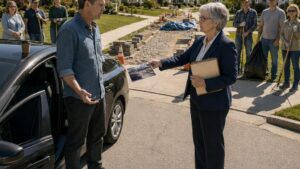
The yellow notice had been stapled directly over the brass survey marker.
Richard Carter stopped halfway through the gate and stared at it, one hand still holding the thermos he had carried from his kitchen. The paper trembled against the cedar post in the faint morning breeze, bright enough to look almost cheerful among the dark boards and wet tomato leaves.
Behind it, only the rounded edge of the marker remained visible—the small piece of metal his father had polished every spring with an old rag and a drop of machine oil.
Richard set down the thermos.
He did not touch the notice at first. He read it where it hung.
FINAL DEMAND FOR REMOVAL.
Ten calendar days.
Utility structure. Agricultural fencing. Mechanical equipment. Unauthorized commercial cultivation.
The language was printed in heavy black letters beneath the Magnolia Creek Homeowners Association seal. At the bottom, in smaller type, the notice authorized the association to arrange removal at the owner’s expense if he failed to comply.
Richard read it twice.
Then he pulled the staple free with the edge of his pocketknife.
“Don’t tear it,” his mother called from behind him.
Margaret stood on the narrow path between the bean rows, wearing a pale cotton shirt and rubber garden clogs. At seventy-six, she moved carefully on uneven ground, but she still carried a harvesting basket against her hip as though it weighed nothing. Green beans filled one side. Three small squash rested on top.
“I wasn’t going to tear it.”
“You looked like you were.”
Richard folded the notice once, then changed his mind and flattened it over the top rail of the fence.
Beyond the garden stood the shed the HOA wanted removed. It was no larger than a one-car garage, painted the same muted green it had been for fifteen years. Inside were a tiller, two irrigation pumps, seed trays, hand tools, and the folding tables Margaret used on Saturdays when she sold produce beside the county road.
Nothing about it was new.
Nothing about it had appeared overnight.
Yet someone had photographed it from three angles. The images were attached to the notice, each marked with a red circle.
Margaret came closer. “What are they saying now?”
“That the whole strip is under the covenants.”
“Is it?”
“No.”
He answered too quickly.
Margaret looked at him, then at the paper. “You’re certain?”
Richard picked up his thermos and carried it to the potting bench. “The house lot is. This isn’t.”
The Carter property sat at the outer edge of Magnolia Creek, where curving streets and identical brick mailboxes gave way to a drainage channel, scrub pines, and the remains of the farm Richard’s parents had owned before the subdivision was built.
Most of the acreage had been sold to the developer twenty-three years earlier. The family had kept the house, the garden strip, and a narrow wedge of land that ran along the drainage easement.
Richard had worked for the county land-use department then. He had reviewed plats, easements, setback requests, and parcel splits until he could recognize a faulty legal description faster than most people recognized a misspelled name.
He unfolded the notice again and studied the parcel number.
The first six digits matched his residential lot.
The final four did not.
He frowned.
Margaret placed the basket on the bench. “What?”
“That’s not the parcel number on my tax bill.”
“Maybe they typed it wrong.”
“Maybe.”
He turned the paper over as though another explanation might be printed on the back.
A wrong digit did not automatically invalidate an enforcement notice. Clerical mistakes happened. Parcel databases changed. Lots were renumbered after corrections and consolidations. He knew better than to build a defense on one inconsistency.
But the number bothered him.
He took out his phone and opened the photograph he kept of the latest county tax statement. The residential parcel ended in 4187.
The HOA notice ended in 4817.
Two numbers transposed.
He enlarged the image, then compared the legal description.
LOT 42, MAGNOLIA CREEK PHASE II.
That was the house.
The shed stood south of Lot 42, beyond the old field line.
Richard looked through the fence toward the brass marker, now uncovered. Its stamped head was faded but readable: C-3.
His father had called it the corner that mattered.
Margaret began sorting the beans, snapping off damaged ends with her thumbnail. “You’ll call them?”
“I’ll send a written objection.”
“That isn’t what I asked.”
Richard kept reading.
The notice listed six previous warnings. He remembered two: one about the shed roof and one about the irrigation trailer being visible from the road. He had responded to both with copies of the recorded plat and received nothing back.
Six made no sense.
“They say they’ve warned us six times.”
Margaret’s hands paused over the basket.
“When?”
“That’s what I’d like to know.”
She resumed sorting. “Maybe some came here.”
“I check your mail.”
“Not every day.”
“Every day that matters.”
The words came out sharper than he intended.
Margaret placed a bean carefully on the bench. “Your father used to say that too.”
Richard looked away.
The garden was already warm with the smell of tomato vines and dark soil. Water ticked through the drip lines. Beyond the fence, Magnolia Creek’s sprinkler systems hissed across trimmed lawns.
His father had died four years earlier, after a winter in which his strength narrowed week by week. During the last hospital stay, he had made Richard promise that Margaret would not have to sell the remaining land to stay in the house.
Richard had agreed before asking how difficult that promise might become.
The garden was part of the answer. Margaret sold enough produce, seedlings, preserves, and herb bundles to cover property taxes, prescription copays, and the repairs she refused to let Richard pay for outright. The income was modest, but it allowed her to call the money hers.
No HOA board needed to know that.
No neighbor needed to discuss it over a mailbox.
He folded the notice into quarters and put it in his shirt pocket.
Margaret watched him. “Don’t make a public fight out of this.”
“They made it public when they stapled that to the fence.”
“It’s still between us and the board.”
“For ten days.”
Her expression tightened. “Richard.”
He knew what she feared. Not the fine, exactly. Not even the shed.
She feared becoming visible as someone who needed help.
“I’ll handle it,” he said.
“That’s what worries me.”
Before he could answer, tires rolled over the gravel shoulder beyond the garden.
A white pickup slowed beside the fence. The door bore the name of a landscaping and property-services company Richard had seen working near the clubhouse.
The driver stopped, lowered his window, and lifted a camera.
Richard walked toward the road.
The man took a photograph of the shed.
“Can I help you?”
The driver lowered the camera but did not put it away. “Just documenting site conditions.”
“For whom?”
The man glanced at a work order clipped to the steering wheel. “Magnolia Creek.”
“Documenting for what?”
“I’m not authorized to discuss the job.”
Richard stepped closer to the open window. “You’re standing on a county shoulder photographing private property. You can discuss why.”
The driver shifted in his seat. “Pre-removal estimate. That’s all I know.”
Richard looked at the work order.
At the top, under the company logo, was a scheduled access date.
Nine days away.
The HOA had not merely threatened removal.
It had already started arranging it.
Chapter 2: Every Neighbor Had Already Heard Amy’s Version
Richard saw the photograph before he reached the end of his driveway.
His shed occupied the center of the Magnolia Creek newsletter, its green paint washed gray by the office printer. A red border had been added around it. Beneath the image, bold lettering announced:
UNRESOLVED EXTERIOR VIOLATIONS MAY AFFECT COMMUNITY INSURANCE AND PROPERTY VALUES.
The newsletter had been folded into every mailbox on the street.
Richard stood beside his own box, holding the page open with both hands. His name was not printed, but the fence, the shed, and the east side of Margaret’s porch were unmistakable.
Across the street, a neighbor closed her mailbox and avoided his eyes.
Three houses down, a garage door lowered before he had passed it.
By the time he reached the corner, he understood that the argument was no longer about a legal description. Amy Gonzalez had turned it into an example.
At the next intersection, Matthew Thompson was rolling his trash bin toward the curb. He stopped when he saw Richard carrying the newsletter.
“I was going to come by,” Matthew said.
“You knew this was going out?”
“I saw a draft.”
“And said nothing.”
Matthew rested both hands on the bin handle. He was broad through the shoulders, with a careful manner that usually made every sentence sound like the beginning of a compromise.
“I told Amy the photograph was too much.”
“But you voted for it.”
“It wasn’t a vote. The communications committee approved the mailing.”
“You’re on the board.”
“I’m one member.”
Richard held up the newsletter. “Convenient distinction.”
Matthew glanced toward the neighboring houses. “People are nervous.”
“About my tomatoes?”
“About selective enforcement. About structures going up without review. About agricultural activity expanding inside a residential community.”
“The garden was here before your house.”
“That isn’t how everyone sees it.”
Richard folded the newsletter along its original crease. “How does Amy see it?”
“As a compliance problem that’s been allowed to continue too long.”
“She claims six notices.”
Matthew’s expression changed just enough for Richard to notice.
“You’ve seen them?”
“I saw the enforcement summary.”
“Did you see my objections?”
“What objections?”
Richard studied him.
“I sent a written response after the shed-roof notice. Certified mail. I sent another after the irrigation trailer warning, with the recorded plat attached.”
Matthew looked genuinely unsettled. “Those weren’t in the board packet.”
“Nothing?”
“There was a note saying you had not provided substantive documentation.”
Richard gave a short, humorless breath. “I provided the same plat the subdivision was built from.”
“Then bring it Friday.”
“Friday?”
Matthew looked down at the trash bin.
“The board scheduled an emergency enforcement session.”
“No one notified me.”
“You should receive something today.”
Richard unfolded the newsletter again. “This arrived first.”
Matthew’s face tightened. “I’m not defending the order of it.”
“You’re standing in the road explaining it.”
“I’m trying to keep this from turning into something worse.”
“It already has.”
Richard walked away before Matthew could answer.
At home, he laid every notice he could find across the dining table. Two yellow originals. One white courtesy reminder. A roof-maintenance letter. A photocopy of his certified-mail receipt.
He opened the tracking history online. The first objection had been delivered to the HOA office eleven months earlier and signed for by the meeting secretary.
The second had been sent four months later.
That one had not reached Magnolia Creek at all.
The address printed on the original notice used the association’s former management office across town. The envelope had been marked undeliverable and returned, then placed unopened in a drawer in Richard’s desk.
He remembered seeing it.
He had assumed the office would correct its own forwarding.
He had not resent it.
The discovery gave him no satisfaction. One missing objection belonged to the HOA. The other belonged to his own certainty that procedure would somehow repair itself.
Margaret came into the room carrying two jars of pickled beans.
“The woman at the corner canceled her order,” she said.
Richard looked up. “What order?”
“Six jars and two herb baskets. She said she didn’t want to get involved.”
“You don’t need her business.”
“That isn’t the point.”
He slid the newsletter beneath a stack of papers, but Margaret had already seen it.
She set down the jars. “They used a picture of the shed?”
“No name.”
“They didn’t need one.”
Richard began aligning the notices by date.
Margaret pulled out a chair but did not sit. “I asked you not to let this become public.”
“I didn’t publish it.”
“You stopped answering them.”
“I answered.”
“You answered on paper. Then when they didn’t listen, you went quiet.”
“They knew where the line was.”
“Maybe. But the neighbors only know what they’ve been told.”
Richard’s jaw tightened. “I’m not explaining your finances to Magnolia Creek.”
“I didn’t ask you to.”
“You don’t have to. That’s where this goes once I start telling them why the garden matters.”
Margaret looked at the jars between them. “You think silence protects me?”
Before Richard could reply, an email notification sounded from his phone.
The subject line read: EMERGENCY ENFORCEMENT HEARING—CARTER PROPERTY.
The attached packet contained thirty-eight pages.
Photographs. Fine schedules. Meeting notes. Six listed notices.
Richard scanned the dates.
Two notices had never been mailed to him. They had been posted only to the association’s online portal, an account tied to an email address he had stopped using after leaving county employment.
Another had been delivered to Margaret’s house during a week she was staying with him after cataract surgery.
A fourth concerned the visible irrigation trailer and had been marked “no homeowner response,” despite his certified letter.
The packet ended with Amy’s recommendation: authorize removal, assess costs to Richard’s account, and suspend access to community amenities until the balance was paid.
Attached separately was a demand for the shed key.
Margaret read it over his shoulder.
“Why would they need your key before the meeting?”
Richard opened the demand.
The HOA requested immediate access so its contractor could identify equipment requiring “relocation, disposal, or secured storage.”
Not inspect.
Not photograph.
Classify for disposal.
At the bottom, Amy had written a personal note.
Cooperation before Friday will be considered when the board determines penalties.
Richard printed the demand and placed it beside the first yellow notice.
Margaret touched the edge of the page. “Are you going?”
“Yes.”
“You said meetings like that are made for people who enjoy embarrassing one another.”
“They are.”
“And you’re still going?”
Richard looked at the line authorizing disposal of the tiller his father had rebuilt, the seed racks Margaret used every spring, and the pump that kept the garden alive through July.
“Yes.”
He reached for the shed key, removed it from the ring, and set it on the table.
Then he placed Amy’s demand over it.
He would bring the key to the meeting.
He would not surrender it.
Chapter 3: The Yellow Papers Fell Before Anyone Knew the Boundary
Amy Gonzalez began the emergency hearing with Richard’s chair still empty.
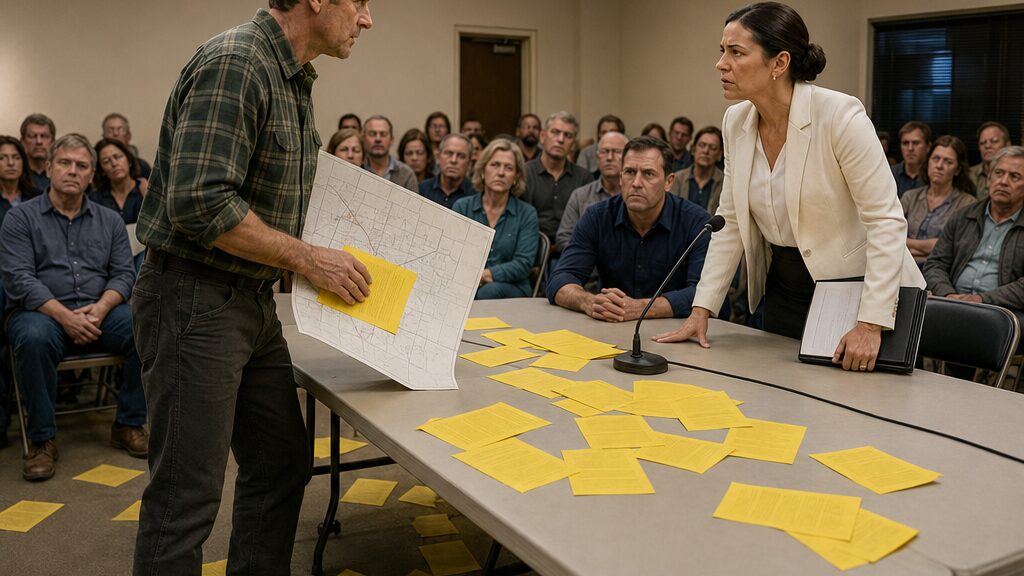
It sat at the far end of the folding table beneath a printed card that read PROPERTY OWNER. Beside it, Amy had arranged a stack of yellow notices in a precise fan, each page angled so the Magnolia Creek seal remained visible.
Richard watched through the narrow glass panel in the meeting-room door.
Nearly every chair was occupied. Neighbors lined the back wall. Matthew sat with the other board members, his hands clasped in front of him. The tabletop microphone stood between Amy’s white blazer and Richard’s empty place.
“The owner was properly notified,” Amy said into it. “His absence should not prevent the association from addressing an ongoing risk.”
Richard remained in the hallway.
He had arrived twelve minutes earlier, but the meeting secretary had asked him to wait while the board completed “preliminary matters.” Through the door, he had heard Amy move directly into his case.
An HOA attorney sat beside her with a closed folder.
A contractor occupied the front row.
Richard unfolded the parcel map once more. It was the only document he had brought inside. The rest remained in a box in his truck.
He had considered carrying everything.
Then he pictured Amy’s thirty-eight-page packet and understood that volume was part of her argument. She wanted the room to see repetition and assume certainty.
He needed them to see one line.
Inside, Amy lifted the top yellow notice.
“Six notices were issued over a period of fourteen months. The violations include an unapproved accessory structure, agricultural fencing inconsistent with community standards, exposed mechanical equipment, and commercial activity.”
A neighbor near the wall whispered something.
Amy continued. “The owner has characterized the affected land as agricultural. The county tax database, however, associates his address with a residential parcel inside Magnolia Creek.”
That was true.
It was also not the whole truth.
Richard opened the door.
Every face in the room turned.
Amy stopped speaking, then recovered without moving from the microphone. “Mr. Carter. We had begun.”
“I heard.”
The meeting secretary hurried to place a sign-in sheet in front of him.
Richard signed and took the empty chair. He laid the folded parcel map beside the fan of yellow notices.
Amy looked at it, then at him. “Do you have copies for the board?”
“No.”
A stir moved through the room.
The board treasurer leaned toward Matthew. The contractor shifted in his chair.
Amy’s expression remained composed, but Richard saw the small tightening at the corners of her mouth.
“Then we’ll proceed with the materials properly submitted in advance.”
“You told the board I submitted nothing.”
“I said you submitted no documentation sufficient to resolve the violations.”
“That isn’t the same thing.”
The HOA attorney leaned toward the microphone, but Amy raised one hand.
“Mr. Carter will have an opportunity to speak.”
Richard looked at the stack of notices. “After you authorize removal?”
“No action has been taken.”
“You hired a contractor.”
“To prepare an estimate.”
“You asked for my key so he could classify my equipment for disposal.”
Several residents turned toward the contractor.
Amy’s fingers pressed flat against the table. “That language is standard.”
“It shouldn’t be.”
The microphone made a faint hollow sound when her hand brushed its base.
Amy drew the notices closer. “This board is not here to debate phrasing. It is here because you have refused to correct visible violations.”
Richard glanced at Matthew.
Matthew did not look away, but he did not speak.
Amy began laying the notices down one by one.
“First warning.”
The page slapped lightly against the table.
“Second warning.”
Another page.
“Final notice regarding exterior structure.”
A third.
“Notice of continued commercial use.”
She moved faster, the papers sliding across one another.
“Notice of hearing.”
The fan broke apart. Several sheets slipped over the table’s edge. One turned in the air and landed near Richard’s boot.
Amy stopped.
For a second, no one moved.
The yellow pages lay across the tabletop and floor, no longer arranged as evidence but scattered like something dropped during an argument.
Richard bent and picked up the notice nearest him.
Amy said, “You may make your statement now.”
He unfolded his parcel map.
“I don’t have a statement.”
A man in the back gave a quiet, disbelieving laugh.
Richard placed the notice over the map.
“I have a question.”
Amy leaned back. “Ask it.”
He aligned the bottom edge of the yellow paper with the printed boundary of Lot 42.
“Read the legal description on this notice.”
“It has already been entered into the record.”
“Read it again.”
The attorney opened his folder. “Mr. Carter, the president is not required to perform—”
“I’m asking about the board’s own document.”
Amy looked around the room, measuring how refusal might appear.
Then she pulled the microphone closer.
“Lot 42, Magnolia Creek Phase Two, as recorded in Plat Book—”
“Stop there.”
Her eyes hardened. “Do not interrupt me.”
“Where does it identify the agricultural strip?”
“The property is associated with your residential address.”
“That wasn’t my question.”
“The structures are accessed through Lot 42.”
“That wasn’t my question either.”
Richard turned the map so the board could see it.
Lot 42 was outlined in blue. South of it, separated by a thin surveyed line, ran a narrow tract labeled RESIDUAL AGRICULTURAL PARCEL.
He placed his finger on the shed’s approximate position.
“This notice orders removal from Lot 42. The shed does not sit inside Lot 42.”
Amy looked toward the attorney.
The attorney studied the map without touching it. “Is that a certified current survey?”
“It’s the recorded subdivision plat.”
“Current survey,” he repeated.
“No.”
“Then it does not establish present physical placement.”
“I didn’t say it did.”
Richard tapped the yellow notice. “I said your notice does not describe the tract you’re enforcing against.”
The room went quiet enough for the air-conditioning vent to become audible.
Matthew leaned forward. “Amy, was the residual parcel included in the enforcement resolution?”
“The structures are part of the Carter property.”
“That isn’t what he asked,” Matthew said.
Amy turned toward him. “The covenants apply to property used in connection with a Magnolia Creek residence.”
“Show me where,” Richard said.
The attorney spoke before she could. “Use restrictions can extend through annexation language, common-use provisions, and owner acknowledgements.”
“Which one are you relying on?”
“We’re not conducting a legal seminar.”
“No. You’re voting to enter my land.”
A woman in the second row lowered her eyes.
Amy gathered the nearest notices, but several remained on the floor.
“Mr. Carter has identified a drafting issue,” she said. “A correctable clerical omission does not erase fourteen months of noncompliance.”
Richard felt the first shift in the room. Not support. Not yet.
Uncertainty.
It was enough.
“So you agree the notice covers only the residential lot.”
“I agree the legal description may require amendment.”
“Before or after you remove the shed?”
The contractor stared at the floor.
Amy’s voice sharpened. “This is exactly the pattern that has delayed resolution. Every practical concern is met with a technical objection.”
Richard almost answered with anger.
Instead, he folded the map along its old crease.
“Boundaries are technical.”
A few people murmured.
Amy’s face flushed, but when she spoke again, her tone was controlled.
“You have spent this entire process presenting yourself as though you never accepted the association’s authority.”
“I accepted it over Lot 42.”
“Only Lot 42?”
“Yes.”
Amy looked at the attorney.
He removed a white document from his folder and passed it to her.
Richard recognized the bank logo before she turned the page around.
The room seemed to narrow.
Amy placed the document beside the microphone.
“Three years ago,” she said, “during the exterior compliance review required for your refinancing, you signed an owner acknowledgement.”
Richard did not reach for it.
He remembered the inspection. The roof repair. The hurried stack of closing papers on a rainy afternoon. He remembered signing a form confirming that the house lot complied after he replaced two damaged fence panels.
He did not remember this page.
Amy read from it.
“The undersigned owner acknowledges Magnolia Creek Homeowners Association authority over exterior improvements, accessory structures, fencing, and property use associated with the residence.”
She turned to the signature block.
“Richard Carter.”
The microphone carried his name through the room with unnatural clarity.
Amy pushed the paper toward him.
“That is your signature, is it not?”
Richard looked down.
The signature was his.
The residents who had begun leaning toward his map now shifted back toward Amy.
Matthew stared at the document.
Richard read the sentence again, searching for a limitation he could not immediately see.
For the first time that evening, he had no precise answer ready.
Amy waited.
When he finally looked up, the yellow notices were still scattered between them, but the balance in the room had changed.
“Yes,” he said. “That’s my signature.”
Chapter 4: His Signature Was Real, but the Story Around It Was Not
“That is your signature.”
Kathleen Wilson did not phrase it as a question.
She sat behind a county records counter beneath fluorescent lights that flattened every color in the room. Between her and Richard lay a clean yellow archival copy of the acknowledgement Amy had produced at the hearing. His signature appeared at the bottom in dark blue ink, unmistakable even beneath the county’s reproduction stamp.
Richard kept his hands off the page.
“I know what my signature looks like.”
“Then don’t waste time trying to make it disappear.”
“I’m not.”
Kathleen raised one eyebrow. She had worked beside him for eleven years, long enough to recognize the difference between his silence and an answer.
The week since the meeting had been filled with phone calls he did not return, messages from neighbors he did not read, and an updated enforcement notice from Magnolia Creek adding three hundred dollars in hearing costs to his account.
He had come to the county office before it opened.
Kathleen had agreed to meet him only because he had once trained her to read legal descriptions from the point of beginning rather than from whatever line looked most useful.
She turned the acknowledgement toward him.
“Where did this come from?”
“A refinancing review three years ago. The bank required an HOA compliance letter.”
“And you signed without reading it?”
“I read what they put in front of me.”
“That isn’t what I asked.”
Richard looked through the glass partition toward the public counter. A clerk was switching on the terminal stations. Somewhere behind the records room, a copier began warming with a low mechanical hum.
“I had roof damage,” he said. “The bank would not release the repair funds until the exterior inspection cleared. I replaced two fence panels, signed the compliance forms, and left.”
Kathleen tapped the first paragraph.
“This language is broader than a fence repair.”
“It says ‘associated with the residence.’”
“Yes.”
“It doesn’t identify the agricultural parcel.”
“No.”
“It doesn’t identify any parcel.”
“That helps you,” Kathleen said. “It doesn’t save you.”
She opened a second file.
Inside was the recorded subdivision plat, copied onto heavy paper. Blue lines marked Magnolia Creek’s residential lots. South of Lot 42, the narrow residual tract remained outside the subdivision boundary.
Richard leaned closer.
Kathleen placed the yellow acknowledgement beside the plat.
“The form references your street address,” she said. “The plat separates the house lot from the residual tract. That supports your argument that you acknowledged authority over the residence, not every piece of land you own.”
Richard felt the tightness in his chest ease by a degree.
Then Kathleen pulled out an older sheet.
Its paper had browned at the folds. Pencil notes covered one margin. The original surveyor had drawn the southern boundary from a concrete monument near the drainage ditch to an iron pin beside the old farm road.
Kathleen pointed to the monument notation.
“C-MON.”
Richard nodded. “Concrete monument.”
“Do you know where it is?”
“Near the culvert.”
“No. It was near the culvert.”
She slid a county road-improvement plan across the counter. A drainage expansion completed seventeen years earlier had removed the monument and widened the channel.
Richard read the construction notes.
MONUMENT DISTURBED DURING EXCAVATION. REFERENCE TIES UNRECOVERED.
His old professional instincts returned before he could stop them. A removed monument did not erase a boundary. Surveyors reconstructed lines from surviving pins, bearings, distances, prior plats, and occupation evidence.
But it created room for disagreement.
“What did the later surveys use?” he asked.
Kathleen brought up a digital parcel map on her monitor. “This point.”
A small symbol appeared along the garden fence.
“The brass marker?”
“Possibly.”
“My father called it Corner Three.”
“That doesn’t make it the original monument.”
“It’s stamped C-3.”
“So are half the reference markers set during subdivision work.”
Richard leaned back.
Kathleen studied him. “You expected the plat to settle this in ten minutes.”
“It should settle which tract the HOA described.”
“That part, yes. But not where the shed physically sits.”
He looked again at the old survey.
The drawn boundary passed north of the drainage easement, then angled toward the farm road. On the modern parcel map, the same line appeared several feet farther south.
Enough to change which side held the shed’s rear wall.
Kathleen closed the file. “You need a licensed survey.”
“I know.”
“And before you ask, no, I cannot certify your interpretation. I can give you public records. I cannot become your expert because we used to share an office.”
“I didn’t ask you to.”
“You were about to.”
Richard almost denied it.
Kathleen gave him the look she used to give junior technicians who blamed software for their own omissions.
He folded the acknowledgement copy. “Can you confirm when the form entered the county file?”
“It didn’t. Magnolia Creek supplied it yesterday with a request for an advisory review.”
Richard stopped.
“Yesterday?”
“They’re building their record too.”
“Did Amy submit the original plat?”
“She submitted the current parcel map, photographs, the acknowledgement, and the enforcement packet.”
“Not this?” He touched the older hand-marked plat.
“No.”
“Was it in the same archive?”
“Yes.”
Kathleen’s expression warned him not to mistake absence for proof of intent.
“She may not have known it existed,” she said.
“She knew enough to ask for an advisory review.”
“So do you.”
The county zoning inspector arrived shortly after nine. He met Richard at the garden that afternoon with a measuring wheel, a handheld receiver, and none of the patience Richard remembered from his own years in government work.
The inspector walked the fence line twice.
Amy remained on the residential side of the gate with the HOA attorney. Matthew stood several yards away, arms folded, saying little.
Margaret watched from the porch.
The inspector measured from the brass marker, checked the county map, and placed two temporary stakes near the rear corners of the shed.
The northern stake landed inside the residential lot.
The southern stake landed almost directly beneath the shed wall.
Amy spoke first. “So it crosses the line.”
“According to the county’s current mapping,” the inspector said, “approximately eighteen inches.”
Richard looked at the receiver. “Parcel mapping is not a boundary survey.”
“I know what it is.”
“You’re measuring from an unverified reference point.”
“I’m providing a field observation, not a legal determination.”
Amy turned toward the attorney. “But the structure may be partly within Lot 42.”
“May be,” Richard said.
The inspector packed his equipment. “Until a licensed survey resolves the discrepancy, the county map is the administrative reference.”
It was not a ruling, but Amy’s face changed as though she had received one.
She left with the attorney before Richard could question her.
Matthew lingered.
“I voted to pause the removal contract,” he said.
“For how long?”
“Seven days.”
“That isn’t a pause. That’s a shorter deadline.”
“It was what I could get.”
Richard looked toward the two stakes. “Did you know about the missing monument?”
“No.”
“Did Amy?”
“I don’t know.”
Matthew shifted his weight. “The signature hurt you.”
“I noticed.”
“You could have told us about the refinancing.”
“I didn’t remember the form.”
“That’s the problem, Richard. Every time something appears, you act as if everyone else should already understand why it doesn’t matter.”
Richard turned away.
Matthew called after him. “You may be right about the tract. But you have not made it easy for anyone to trust you.”
Margaret was waiting in the kitchen when he entered her house.
The old plat lay open on the table. Kathleen had given him a copy, and Margaret had found it in the folder he left by the door.
She had set the yellow acknowledgement beside it.
Richard poured water into a glass.
“The county map puts part of the shed over the line,” he said.
Margaret did not react.
“A real survey may change that.”
Still nothing.
He drank, then noticed her fingers resting on a pencil line drawn beside the drainage channel.
“What is it?”
She looked toward the garden window.
“Your father moved the fence.”
Richard set down the glass.
“When?”
“Years ago.”
“How far?”
“I don’t know exactly.”
“You knew the marker might not be the boundary?”
“I knew he changed where the fence ran.”
Richard pulled out the chair opposite her. “Why?”
Margaret folded her hands.
“He said it was temporary.”
“Temporary for what?”
She looked at the yellow page bearing his signature, then at the old plat whose monument no longer existed.
“I never asked him to explain it,” she said. “And neither did you.”
Chapter 5: The Fence Was Moved for a Reason Richard Never Asked
Margaret placed the notebook on the kitchen table as though she were returning something she had borrowed without permission.
It was small enough to fit in a shirt pocket, bound in cracked brown vinyl, with Richard’s father’s initials pressed faintly into one corner. A strip of electrical tape held the spine together.
“I found it after the funeral,” she said.
Richard did not pick it up.
“You had this for four years?”
“I put it in the desk.”
“Why didn’t you tell me?”
“You were sorting tax papers, hospital statements, equipment titles. I thought it was planting notes.”
“And when did you learn it wasn’t?”
Margaret looked toward the window. “This morning.”
Richard opened the notebook.
The first pages were exactly what she had assumed: rows planted, seed varieties, frost dates, rainfall totals. His father’s handwriting leaned hard to the right, every number pressed deep enough to mark the next page.
Halfway through, the entries changed.
DITCH CREW—ACCESS REQUIRED SOUTH EDGE.
TEMP FENCE SHIFT 6 FT NORTH AT WEST END.
DEVELOPER AGREES RESTORE AFTER CULVERT WORK.
Below that, his father had drawn a rough line between the brass marker and the old farm road.
Richard turned the page.
Met with site supervisor. Keep equipment path open until Phase II drainage accepted. No transfer of ground. No covenant change.
The next entry was dated seven months later.
Still no restoration. Supervisor says final grading delayed.
After that came a name Richard did not recognize, followed by an office number that had long since been disconnected.
Margaret touched the margin. “Your father said the developer needed room for trucks.”
“So he moved the fence north.”
“To keep them off the garden.”
Richard continued reading.
The drainage channel had been unstable during subdivision construction. Heavy equipment needed access from the farm road to reinforce the bank and replace the culvert. Rather than allow trucks across the planted rows, his father had shifted the fence inward, onto his own retained tract, creating a temporary equipment lane along the southern edge.
The shed had been built later, aligned with the moved fence rather than the original property line.
“Why didn’t he move it back?” Richard asked.
Margaret’s mouth tightened. “By the time the work ended, the developer had changed companies. Then your father’s knees got worse. Then there was always another season.”
“That fence has been wrong for twenty years.”
“It has been inside our land.”
“Maybe.”
Richard turned the notebook over, looking for loose papers. A folded sheet slipped from the back cover.
It was a carbon copy of a handwritten site memorandum.
TEMPORARY OCCUPATION LINE FOR CONSTRUCTION ACCESS.
The developer’s representative had signed it. So had Richard’s father.
The document stated that the relocated fence would not alter ownership, possession, or the recorded agricultural boundary. It referred to the original concrete monument and two yellow survey flags placed along the intended restoration line.
No recording stamp appeared anywhere.
Richard read the final sentence twice.
Temporary agreement expires upon county acceptance of drainage improvements.
“This should have been recorded.”
“Your father thought the developer would handle it.”
“He should have known better.”
Margaret’s eyes lifted. “So should you.”
The words landed cleanly.
Richard closed the notebook.
He had spent years believing his father’s boundary habits were exact. He remembered him cleaning the brass marker, warning children not to disturb survey stakes, arguing with a utility crew over six inches of trench placement.
Now that precision looked different.
His father had not mistaken the fence for the boundary. He had trusted a temporary arrangement to be honored and then allowed time, illness, and habit to turn it permanent.
Richard felt anger first.
Not at the developer. Not at Amy.
At the dead man who had left him a problem disguised as certainty.
He carried the notebook outside.
The two temporary stakes placed by the county inspector stood behind the shed. Beyond them, the drainage channel cut through thick summer weeds. Richard followed the fence west, counting his father’s notes against the ground.
Six feet north at the west end.
Four feet near the culvert.
Original line tied to concrete monument.
The concrete monument was gone, but the notebook described the yellow flags.
He crouched near the oldest fence post and pulled away a mat of dead grass. Nothing.
At the next post, he found a length of rusted wire.
At the third, the blade of his pocketknife struck something brittle beneath the soil.
Richard dug with his fingers.
A narrow plastic strip emerged, faded almost white except for a patch of yellow protected beneath the dirt. He pulled it free. The flag’s wire had corroded, but a fragment of survey ribbon remained knotted around it.
Margaret had followed him from the house.
“Is that one?”
“Maybe.”
He measured from the fence.
Five feet, eight inches.
They searched the line together. Near the drainage bank, Margaret found a second ribbon trapped beneath a flat stone, its yellow color preserved in a fold.
The two points matched the temporary memorandum closely enough to give Richard his first solid direction.
Not proof.
But meaning.
His father had moved the fence to protect the garden while granting access for public drainage work. He had tried to accommodate the new subdivision without giving away the agricultural tract.
Richard sat back on his heels.
For days he had thought the discovery would make him feel vindicated. Instead, he remembered his father in the hospital, asking only that Margaret not be forced to sell.
Richard had heard the promise as an instruction about money.
Perhaps it had also been an instruction about unfinished things.
Margaret brushed soil from the yellow ribbon. “He should have told you.”
“I should have asked.”
“You thought you knew.”
“So did he.”
They stood in silence until Richard’s phone rang.
Kathleen’s name appeared on the screen.
“I found something in the planning archive,” she said when he answered. “Not a recorded instrument. A correspondence file.”
“About the drainage work?”
“About the subdivision closeout. The developer acknowledged temporary occupation along the Carter tract, but the county never received a restoration survey.”
“Can you send it?”
“It’s public record. I’ll email the scan.”
“Anything else?”
Kathleen hesitated. “There’s a recent inquiry attached.”
“How recent?”
“Four months ago.”
Richard looked toward Margaret.
“From whom?”
“The Magnolia Creek HOA office.”
The email arrived before Kathleen finished speaking.
It contained the old closeout correspondence and a newer message thread. The meeting secretary had asked the county whether an unrecorded temporary occupation agreement might affect enforcement near Lot 42.
Kathleen’s reply had been cautious: the agreement did not establish a modern boundary, but it created a discrepancy requiring survey review before any removal action.
The secretary had forwarded the answer to Amy.
Amy’s response appeared at the top.
Do not circulate this to the full board yet. I need to assess the broader covenant implications.
Richard read the date.
It had been sent two weeks before the HOA photographed his shed for the newsletter.
Margaret stood beside him, still holding the faded yellow ribbon.
“She knew?” Margaret asked.
“She knew there was a discrepancy.”
“That isn’t the same as knowing you were right.”
“No.”
Richard scrolled farther.
A second message from Amy instructed the secretary to continue standard enforcement while legal counsel reviewed the issue privately.
He felt the anger return, colder now.
Amy had not possessed a hidden deed or a final survey. She had not known where the line belonged.
But she had known uncertainty existed.
She had issued public accusations as though it did not.
At the bottom of the thread, Kathleen had written one final warning:
Removal before boundary clarification may expose the association to avoidable liability.
Amy had received it.
Three months later, she hired the contractor.
Chapter 6: Amy Had Been Afraid of More Than One Unruly Property
Amy placed the confidentiality agreement over the original yellow notice before Richard had taken his seat.
The gesture was so deliberate that he almost laughed.
They were in the HOA office rather than the meeting room, gathered around a smaller table scarred by years of committee work. Amy sat opposite him with the HOA attorney. Matthew occupied the chair near the wall. The board treasurer had joined by speakerphone, his voice occasionally breaking through a soft electrical hiss.
The agreement was three pages.
In exchange for withdrawing all fines and suspending removal, Richard would acknowledge the HOA’s authority over visible improvements associated with Lot 42, accept screening requirements for the shed, and agree not to disclose internal communications concerning the parcel dispute.
Richard read the first page.
Then he read the yellow notice beneath it.
“You’re offering to cancel penalties you may not have had authority to issue.”
Amy folded her hands. “I’m offering a practical resolution.”
“You’re asking me to keep your warning email private.”
“I’m asking everyone involved to stop escalating an uncertain boundary matter.”
“You escalated it.”
Her eyes hardened, but her voice stayed even. “And you ignored repeated opportunities to participate.”
“One objection disappeared from your board packet.”
“One arrived at an obsolete address.”
“The other was signed for at this office.”
“The secretary categorized it as duplicative correspondence because it did not include a current survey.”
Richard leaned back. “So the board never saw it.”
“That was an administrative decision.”
“Yours?”
Amy did not answer.
The attorney slid the agreement closer. “Mr. Carter, neither side benefits from turning a correctable records problem into prolonged litigation.”
“I haven’t threatened litigation.”
“You have accused the association president of withholding information.”
“I have an email.”
Matthew shifted near the wall.
Amy looked at him, then at Richard. “You want an explanation?”
“I want the truth in the board record.”
“The truth is larger than your shed.”
She opened a yellow legal pad beside her. Several property addresses were listed in neat handwriting. Some Richard recognized: a detached garage near the east entrance, a retaining wall along the creek, a pool enclosure built close to an easement.
Amy tapped the list.
“When the management company changed, we discovered that several enforcement files relied on parcel overlays rather than certified surveys. Some involved structures. Some involved fences. One resulted in a settlement.”
Richard scanned the addresses.
“You were afraid my case would reopen the others.”
“I was afraid an unverified agricultural claim would become a reason for every owner to disregard the covenants.”
“That’s not the same thing.”
“No, it isn’t. Both were true.”
The board treasurer’s voice crackled from the speaker. “We have a refinancing review next quarter. Open compliance disputes affect lender confidence and insurance reporting.”
Richard looked at the phone. “So you needed my land to be simple.”
“We needed rules to mean something,” the treasurer replied.
Amy’s gaze stayed on Richard. “I asked counsel to delay enforcement when the county email arrived.”
Matthew straightened. “You never told us that.”
“I raised the need for additional review.”
“You told us legal had found no reason to stop.”
“Because that was counsel’s conclusion after the first discussion.”
The attorney cleared his throat. “Our advice was that existing use restrictions remained enforceable unless a contrary boundary determination was produced.”
Richard looked at Amy. “But you tried to delay.”
“For one meeting.”
“What changed?”
For the first time, she looked tired rather than controlled.
“The board treasurer asked whether I intended to create a special exception for a former county employee who had ignored notices for a year. Two homeowners threatened to challenge earlier fines. The insurance broker wanted a clean compliance report. And you would not answer a phone call.”
“I sent documents.”
“You sent a plat and three sentences. You did not attend hearings. You did not explain the agricultural operation. You did not explain why the shed mattered. You behaved as if any question was beneath you.”
Richard felt the accuracy of it before the anger.
Amy continued. “I thought you were using technical language to exhaust us until we gave up.”
“And when the county warned you?”
“I thought clarification would come quickly.”
“So you published my property in the newsletter.”
Her mouth tightened. “That was a mistake.”
“You arranged removal.”
“That was a choice.”
The distinction hung between them.
A mistake could be blamed on haste. A choice belonged to the person who made it.
Richard looked again at the confidentiality agreement.
He understood her fear now. If she admitted that the board had enforced uncertain lines, every old decision could be questioned. Some challenges would be legitimate. Others would be attempts to escape rules people had knowingly accepted. Sorting them would cost money, time, and authority.
But understanding did not erase the yellow notice nailed over his father’s marker.
“I won’t sign this,” he said.
Amy’s posture stiffened. “Then the fines remain.”
“The survey issue becomes public.”
“It already is.”
“Not the email.”
Matthew looked at her. “The board should have it.”
Amy closed the legal pad. “The board will receive relevant material when counsel completes review.”
“That sentence is why we’re here,” Richard said.
The office door opened.
The meeting secretary stood there holding a printed packet. Her face had lost color.
“Amy,” she said, “something was sent to the neighborhood list.”
Amy rose. “What?”
The secretary placed the packet on the table.
It was a forwarded email chain containing the county warning, Amy’s instruction not to circulate it, and several attachments from Richard’s enforcement file.
One attachment was Margaret’s produce-income worksheet.
Richard recognized it immediately. He had included it in a private hardship request years earlier when asking the county to reduce a permit fee for a replacement irrigation pump. It listed sales from seedlings, vegetables, preserves, and herb bundles. At the bottom was Margaret’s annual prescription expense.
Someone had obtained it from the county correspondence archive and forwarded it with the property dispute.
The subject line read:
WHAT THE CARTERS ARE REALLY RUNNING BEHIND MAGNOLIA CREEK.
Richard stood so quickly his chair struck the wall.
Amy took the pages from the secretary. “I did not send this.”
“Your office had the attachment.”
“So did the county.”
Kathleen would not have released private financial material knowingly, but the worksheet may have been stored in a public permit file. Richard had attached it himself, years earlier, without considering how the file might later be accessed.
His own carelessness again.
His mother’s private arithmetic was now in every resident’s inbox.
Matthew read the first page and swore under his breath.
The attorney reached for the packet. “No one should forward this further.”
“That will fix it,” Richard said.
Amy looked at him. “I said I did not send it.”
He believed her.
That surprised him more than the leak.
Amy’s fear was institutional. Controlled. She wanted the matter contained. Publicizing Margaret’s expenses would make containment impossible.
Richard picked up the confidentiality agreement.
For one brief moment, he imagined signing it. The fines would disappear. The removal would stop. Amy would screen the shed, file the matter away, and tell the residents that a compromise had been reached.
Then Margaret’s financial life would remain gossip without context, while the board’s conduct stayed hidden.
He tore nothing.
He folded the agreement once and placed it back over the yellow notice.
“No secrecy,” he said.
The board treasurer’s voice came through the speaker. “Then we need a formal hearing.”
Matthew looked toward Amy. “Tomorrow.”
“That is not enough notice,” the attorney said.
“It is enough to stop pretending the issue is private,” Matthew replied.
Amy remained standing, the leaked packet in her hand.
Her face had gone still.
“Call the full board,” she told the secretary. “Final hearing tomorrow evening.”
Richard walked to the door.
Amy spoke behind him.
“If this opens every disputed enforcement file in Magnolia Creek, people will blame you.”
He turned.
“No,” he said. “They’ll decide who to blame after they hear what happened.”
He left the unsigned agreement on the table.
By the time he reached his truck, the final-hearing notice had already arrived on his phone.
Chapter 7: Richard Finally Used the Microphone for More Than Proof
“That signature is mine.”
Richard’s voice traveled farther through the meeting room than he expected.
The same tabletop microphone stood in front of him, its black stem angled slightly left, where Amy had used it the week before to read his name into the record. Tonight, Richard had turned it toward his own chair before anyone else arrived.
The room was full again. More residents stood along the back wall than at the emergency hearing. Some held printed copies of the leaked email chain. Others carried old violation notices from their own files.
On the folding table, Richard had arranged the yellow notices in one straight stack.
Each had a white page clipped behind it.
Amy sat across from him without her white blazer. She wore a dark blouse and looked as though she had not slept. The HOA attorney sat at her right. Matthew occupied the center board seat. The board treasurer was present in person this time, his thick folder closed in front of him.
Margaret sat in the first row.
Richard looked at her before continuing.
“I signed the compliance acknowledgement during a refinancing inspection three years ago. I read it too quickly. I assumed it applied only to my residential lot because that was the property being inspected.”
The board treasurer opened his folder.
Richard raised one hand.
“That assumption was my mistake.”
A small movement passed through the audience. Not approval. Surprise.
Amy watched him carefully.
Richard had spent the afternoon deciding how to begin. He had drafted three versions that opened with the county warning, the missing agreement, or the legal description on the HOA’s notices.
All three made him sound like a man presenting a case against someone else.
None explained what he had done to make the conflict worse.
“I received notices and answered some of them,” he said. “When those answers did not change anything, I stopped participating. I believed the recorded plat should have been enough. I believed anyone asking me to explain further was either careless or dishonest.”
He touched the folded parcel map beside him.
“I was wrong about that too.”
Amy’s eyes lowered briefly.
The meeting secretary adjusted the recorder.
Richard turned the first yellow notice over. Behind it, the clipped white sheet showed a revised legal description prepared from the old plat, the drainage records, his father’s field notes, and a preliminary survey reconstruction completed that morning.
“This notice describes Lot 42,” he said. “The structure it orders removed stands partly beside Lot 42 on the residual agricultural parcel. The present county map places eighteen inches of the shed across the residential line, but that map relied on a reference marker installed after the original concrete monument was removed.”
The HOA attorney leaned toward his microphone.
“The preliminary reconstruction is not a certified boundary survey.”
“No,” Richard said. “It is not.”
Several residents turned toward him.
He continued before the attorney could.
“That means I cannot stand here and say the HOA has no authority over any part of the shed. I cannot say the board’s concern was invented. I can say the notices were issued before the boundary was clarified, and removal was arranged after the county warned that the record was disputed.”
He unclipped the next white page.
“This is the temporary construction agreement between my father and the subdivision developer. It allowed equipment access along the drainage channel and moved the fence inward without transferring land.”
Matthew looked toward Amy.
The board treasurer said, “That agreement was never recorded.”
“No,” Richard replied. “It should have been.”
“Then the board could not reasonably have relied on it.”
“The board did not have to rely on it. The board had to stop long enough to investigate it.”
The room became still.
Richard looked at Amy.
She did not look away.
He had imagined this moment differently. In every private version, he exposed the email and let its date do the work. He pictured Amy unable to answer, the room turning against her, the yellow notices becoming proof of deliberate abuse.
But the leaked financial worksheet had changed what public victory looked like.
His mother’s prescription costs had circulated through Magnolia Creek all day. Neighbors who had never bought a tomato from her now knew how much she earned from herb bundles in May.
Richard could not repair that humiliation by creating another one.
He moved the microphone slightly closer.
“I was offered a private settlement yesterday. The fines would have been canceled. The removal would have stopped. I was asked to accept screening requirements and keep the internal correspondence confidential.”
The attorney’s posture tightened. “Settlement discussions are privileged.”
“I am not quoting the terms beyond what affected my decision.”
Amy placed both hands on the table.
Richard faced the residents.
“I refused because the problem is not only my shed. It is the way uncertain records were treated as certain when enforcement was convenient.”
One of the homeowners at the back raised a packet. “What about the rest of us? Are all the old fines invalid?”
“No,” Richard said.
The answer quieted the room faster than agreement would have.
“Some may be valid. Some may involve completely different facts. A disputed line on my property does not erase every covenant in Magnolia Creek.”
A man near the wall frowned. “Then what exactly are you asking for?”
Richard turned to the board.
“Withdraw the Carter fines. Suspend removal. Commission a certified survey using the original plat, drainage records, surviving monuments, and temporary agreement. Review any prior enforcement file that depended on the same parcel overlay. Adopt a rule requiring disputed legal descriptions to be disclosed to the full board before physical removal is authorized.”
The board treasurer shook his head. “That could be expensive.”
“So is removing someone’s property from the wrong parcel.”
A few voices rose, but Matthew struck the table once with his palm.
“Let him finish.”
Richard looked down at the final yellow notice.
The paper had softened along the folds from being handled too often.
“There is one more thing.”
Margaret sat straighter.
Richard had asked her permission before the meeting. She had not given it immediately.
Now he looked at her and waited.
She nodded.
“The garden is not a hobby,” he said. “It is also not the commercial operation the newsletter implied.”
He heard someone shift in the back row.
“My mother sells produce, seedlings, and preserves. The income covers part of her property tax, prescriptions, and household repairs.”
Margaret’s face remained composed, but her fingers tightened around the strap of her handbag.
Richard continued.
“My father asked me before he died to make sure she would not have to sell the remaining land to stay in her home. I treated that promise as private. Then I treated every question about the garden as an intrusion.”
He paused.
“My silence allowed people to fill in the reason for me.”
The microphone carried the scrape of his thumb over the paper.
“I was protecting her independence. But I was also protecting my pride.”
Margaret rose from the front row.
Richard turned toward her.
She did not approach the table. She spoke from where she stood.
“I asked him not to make this public.”
Her voice was quieter than his, but no one interrupted.
“I thought if people knew the garden paid my bills, they would look at me differently. Then somebody sent those numbers to every house anyway.”
Amy closed her eyes for a moment.
Margaret looked at Richard.
“His father made him promise I would keep the land. I never asked Richard to destroy himself keeping that promise.”
Richard felt the words in his chest.
Margaret faced the board.
“I want the garden. I want the right boundary. I do not want revenge.”
She sat down.
For several seconds, the room held only the low hum of the ventilation system.
Then Matthew reached for his microphone.
“I move that all enforcement and removal activity against the Carter property be suspended immediately, that all assessed fines and hearing costs be withdrawn, and that the association commission an independent certified survey.”
The board treasurer opened his mouth.
Matthew continued.
“I further move that disputed parcel information be disclosed to the full board before future physical enforcement is authorized.”
A board member beside him seconded the motion.
The treasurer leaned toward the HOA attorney. They whispered briefly.
Amy remained silent.
The meeting secretary began calling the roll.
Matthew voted yes.
The second board member voted yes.
The treasurer hesitated, then voted yes with the condition that counsel establish a review process for affected files.
Another member voted yes.
The motion had already passed when the secretary reached Amy.
Everyone looked at her.
Amy placed her yellow legal pad on the table. The page remained open to the list of unresolved properties.
“I vote yes,” she said.
Matthew started to move to the next agenda item.
Amy raised her hand.
“I also need to make a statement.”
The attorney spoke softly. “Amy.”
She shook her head.
“I received the county warning before the contractor was hired. I initially asked that enforcement be delayed. I later allowed it to continue without giving the full board the warning or the temporary-agreement reference.”
The room did not erupt.
No one applauded.
A neighbor near the back whispered, “Why?”
Amy looked toward the residents.
“Because I believed delay would weaken enforcement in other cases. Because I was afraid the board would see uncertainty as failure. Because I convinced myself that legal review would resolve the problem before removal occurred.”
She looked at Richard.
“It did not.”
The board treasurer stared at his closed folder.
Amy removed a single sheet from beneath her legal pad.
“For that omission, and for the newsletter photograph, I am responsible.”
She slid the page toward Matthew.
It was her resignation as board president.
Matthew did not touch it immediately.
“You don’t have to decide that tonight,” he said.
“I already did.”
Amy looked at Richard again. There was no request for forgiveness in her expression.
Only recognition of cost.
“I should have stopped the process,” she said.
“Yes,” Richard answered.
The word was neither cruel nor comforting.
It was enough.
The certified survey took six weeks.
The original agricultural boundary ran south of the shed, following the line described in the temporary construction agreement. The brass marker was not the original corner, but a later reference point set during drainage work. The shed remained entirely on the Carter tract.
Richard accepted the association’s request to plant a screening hedge along the side visible from Magnolia Creek. He refused the solid privacy fence the treasurer proposed, explaining that it would block air from the garden.
The corrected agreement identified both parcels separately. It preserved the drainage easement, confirmed the agricultural tract’s status, and required advance notice before either party altered the access line.
Kathleen verified the county filing but did not congratulate him.
“You finally submitted a complete packet,” she said.
Richard accepted that as praise.
Amy remained on the board for thirty days to complete the transition, then stepped down entirely. She and Richard did not become friends. When they passed near the mailboxes, they nodded.
Matthew visited the garden once to inspect the hedge placement and left carrying a bag of squash Margaret insisted he take.
The canceled yellow notices remained in a folder on Richard’s desk until early spring.
One morning, he found Margaret at the potting bench cutting them into narrow rectangles.
“What are you doing?” he asked.
“Using the clean side.”
She wrote TOMATO—EARLY on the blank back of one strip, then tucked it into a seed tray.
Richard picked up another.
The black words FINAL DEMAND FOR REMOVAL covered one side.
The other side was empty.
He turned it over and wrote BASIL.
Margaret placed it beside the first green shoots breaking through the soil.
The story has ended.