The HOA President Quoted the Septic Rule Until the Old Engineer Asked Who Had Written It
Chapter 1: The Notice Read Loudly on the Porch
“You have thirty days to dig up the septic field.”
Eric Baker said it loudly enough for the two neighbors at the roadside to hear.
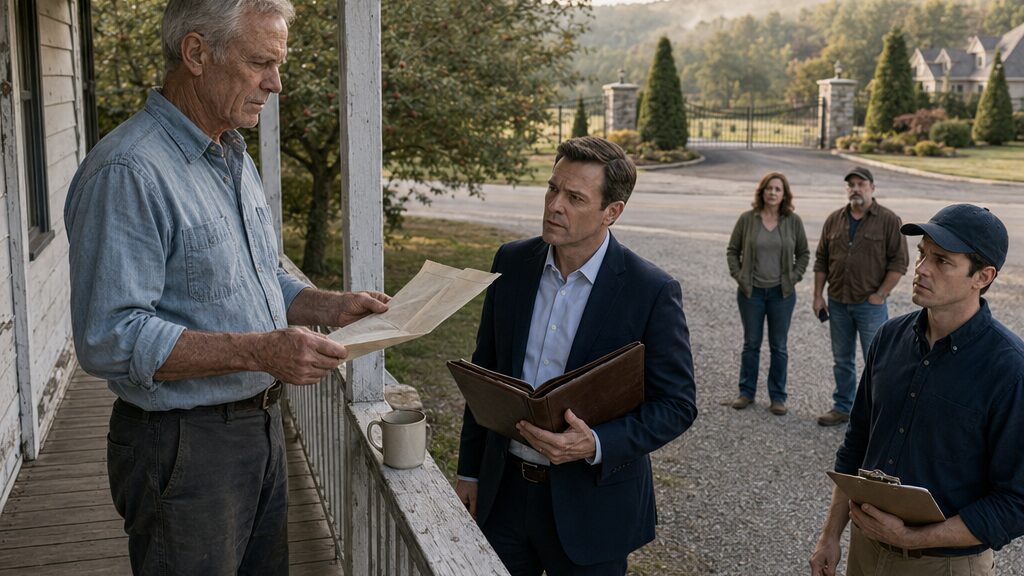
Charles Hall stood behind the screen door with one hand still wrapped around his coffee mug. The porch boards were cool beneath his bare feet. Beyond Eric’s shoulder, the new development’s stone entrance caught the low morning light, every shrub trimmed into submission.
Eric wore a navy blazer despite the hour. A small embroidered crest sat over his left pocket. Under one arm he carried a leather binder thick enough to suggest a lawsuit.
Beside him stood Brian Moore from county environmental health, dressed in khakis and a dark field shirt. He held a clipboard against his chest but had not yet looked Charles in the eye.
Eric continued as though reading a sentence already passed.
“If the system is not removed and brought into compliance by the deadline, the association will assess a penalty of two hundred dollars per day.”
Charles pushed the screen door open.
“The association will?”
Eric smiled. “That’s correct.”
Charles stepped onto the porch. The farmhouse behind him had been standing since before Eric was born. Its white paint had thinned along the porch columns, and one strip of metal roofing above the kitchen had darkened with age. Charles had replaced the joists himself, repaired the well pump twice, and watched a subdivision rise where cattle had once pressed paths through the grass.
His property had never belonged to that subdivision.
At the road, one of the neighbors shifted her weight and folded her arms. Another man held a phone at his side, not openly recording but not putting it away either.
Charles took a sip of coffee.
“Who issued the notice?”
Eric tapped the binder. “The Hillside Preserve Homeowners Association, acting under the applicable county sanitation provisions.”
“That wasn’t my question.”
The smile tightened.
Brian lowered his clipboard and glanced toward the side yard, where the land rolled gently behind the house.
Eric opened the binder. “Mr. Hall, there is no benefit in making this adversarial. We have attempted to address the condition informally.”
“You put a letter in my mailbox last week.”
“We gave you an opportunity.”
“You gave me a photocopy with no county seal and a threat printed in bold.”
The neighbor with the phone raised it a fraction.
Eric noticed. His voice grew smoother.
“This is not about personal feelings. Your leach field lies within the prohibited setback from the Hillside Preserve boundary. The association has a duty to protect its homeowners from sanitation hazards and declining property values.”
Charles looked toward Brian.
“Did the county determine that?”
Brian moved his mouth before sound came. “I’m here to observe the site and review the complaint.”
“That isn’t an answer,” Eric said quickly. “The relevant measurements are clear.”
“You measured it?”
“Our contractor did.”
“Licensed soil evaluator?”
“A qualified contractor.”
Brian’s fingers tightened on the clipboard. Charles saw it then—not uncertainty about the land, exactly, but discomfort with the words being placed around it.
Eric pulled a folded sheet from the binder.
“The controlling provision requires a minimum separation between a subsurface wastewater disposal area and an adjacent residential boundary. Your field does not meet it.”
Charles set the mug on the porch rail.
“How far short?”
“Approximately eleven feet.”
“Approximately.”
“The distinction will not matter once daily penalties begin.”
That line was for the road.
Charles turned his head. The two neighbors looked away almost together, embarrassed at being caught watching and unwilling to leave.
Eric stepped closer to the first stair.
“I understand this property has been in your possession a long time.”
“Since 1979.”
“And that may be part of the difficulty. Standards change. Communities change.”
“County lines don’t move because you plant matching dogwoods.”
Brian looked down, but Charles caught the briefest pull at one corner of his mouth.
Eric did not.
“The development has invested heavily in stormwater correction, road maintenance, and property preservation. Several families have raised concerns about odor and standing water near the shared boundary. We cannot ignore those concerns because you prefer the way things were forty years ago.”
Charles felt the first real movement of anger in his chest. Not at the accusation. At the practiced patience in Eric’s tone, the kind used on people presumed incapable of understanding what was happening to them.
He had heard it in hospital corridors after his wife became ill. He had heard it from bank representatives explaining signatures he had already read twice. He had heard it from Carolyn when she tried not to sound frightened.
He kept his voice level.
“Where is the odor?”
Eric gestured toward the rear acreage.
“Several residents have reported it.”
“Which residents?”
“That information is not relevant to compliance.”
“It is if the complaint is evidence.”
Eric exhaled through his nose.
“Mr. Hall, perhaps the sensible course is to consider whether maintaining three acres at your age is still practical.”
The neighbor’s phone came fully upright.
Brian finally looked at Eric.
Eric went on.
“There are buyers who would take responsibility for the property. Selling before fines accumulate may protect your remaining equity.”
For several seconds Charles heard only a cardinal calling from the maple by the driveway.
The suggestion was not new. A real-estate envelope had appeared twice in his mailbox since winter. No return name, only an offer to discuss “highest and best use.” He had thrown both into the stove.
He looked past Eric to the entrance monument of Hillside Preserve. The stone veneer had been trucked in from Tennessee. The pond behind it was decorative, too shallow for fish and deep enough to breed mosquitoes. Eight months earlier, Eric had introduced himself by complaining about Charles’s equipment shed being visible from three lots away.
Now he had brought witnesses.
Charles picked up his mug again, though the coffee had gone cold.
“You said applicable county provisions.”
“Yes.”
“Which section?”
Eric’s face brightened with relief. He mistook the question for surrender.
He opened the binder on the porch rail, flipped past plats and photographs, and removed the folded page with deliberate care.
“Buncombe County Residential Septic Ordinance. Section Fourteen, Paragraph B. Adopted in 2008.”
He placed weight on the year, as though age alone made a rule sacred.
“Read it,” Charles said.
Eric did.
He read the first sentence cleanly and the second too quickly. The provision described minimum setbacks for new or substantially modified subsurface disposal systems serving residential parcels adjacent to higher-density development. Eric stopped before the qualifying language continued onto the reverse.
“There,” he said. “It could not be clearer.”
“Let me see it.”
Eric hesitated only long enough to make the gesture insulting. Then he passed the sheet over.
Charles unfolded it once, then again.
The copy was poor. A gray shadow ran down the center from the machine glass. Someone had highlighted the setback distance in yellow. The issuing-office footer had been cropped away.
He read the first page without speaking.
Eric glanced toward the road.
“As you can see, we are not inventing standards to inconvenience you.”
Charles turned the sheet.
The second page included exceptions, implementation notes, and the list of the drafting committee. The names were compressed into two narrow columns.
His own sat third from the top.
Charles Hall, P.E.
County Planning and Wastewater Standards Working Group.
For a moment, the porch seemed to tilt backward into another room, another year: fluorescent lights, stale coffee, engineers arguing over clay depth and mountain slopes while rain tapped the courthouse windows.
Eric mistook his silence again.
“You understand now why immediate action is necessary.”
Charles ran his thumb over the copied line bearing his name.
Then he raised his eyes.
Chapter 2: The Man Who Drafted Paragraph B
“I wrote this section.”
Eric’s expression did not collapse all at once. First came annoyance, then calculation, then a small vacancy behind the eyes as he searched for a response that would restore the shape of the morning.
At the road, the neighbor lowered her folded arms.
Charles turned the paper so Eric could see the committee list.
“Third name down.”
Eric leaned in but did not take it.
“That does not mean—”
“It means I know what Paragraph B says.”
Brian stepped closer to the rail. His eyes moved across the copy and stopped on Charles’s name.
“You were on the working group?”
“For eighteen months.”
Eric straightened.
“Past involvement does not exempt your property from present law.”
“No,” Charles said. “It does not.”
The answer unsettled Eric more than denial would have.
Charles folded the first page back, exposing the continuation on the reverse.
“But your reading stopped halfway through the provision. This section applies to new installation, expansion, or substantial alteration on parcels brought into residential-density transition after adoption.”
He touched the next line.
“My system was permitted in 1986. The repair field was recorded at the same time. Nothing has been expanded.”
Eric reached for the page. Charles kept hold of it.
“The required distance you highlighted is measured from the disposal trench to the regulated receiving parcel, not from the edge of the grass your association happens to maintain. The recorded boundary is farther east.”
“Our survey contradicts that.”
“Your contractor’s sketch contradicts it. A survey has a seal.”
The man by the road put his phone into his pocket.
Charles looked at Brian.
“Does the county allow private associations to assess sanitation penalties?”
Brian’s throat moved.
“No, sir.”
Eric turned sharply. “The association has broad nuisance-enforcement authority.”
“That isn’t what he asked,” Charles said.
Brian lowered the clipboard.
“Only the county can issue county environmental-health penalties. An HOA can pursue remedies under its own covenants, but Mr. Hall’s parcel isn’t within Hillside Preserve.”
The morning became very still.
Eric’s fingers rested on the leather binder. The neatness of his clothing suddenly looked less like authority and more like preparation for a photograph.
“You reviewed the notice,” he said to Brian.
“I reviewed the complaint packet.”
“You accompanied me here.”
“For a site observation.”
“You raised no objection to the language.”
“I didn’t see the final notice.”
Charles watched Brian make himself say the last sentence. The younger man’s ears had reddened.
Eric gave a short laugh.
“This is becoming needlessly technical. The distinction between county enforcement and association action changes nothing about the underlying hazard.”
“It changes the two hundred dollars a day,” Charles said.
No one answered.
Charles refolded the ordinance along its old creases. He remembered drafting the exception language after a farmer in Leicester had been told to abandon a functioning system because a developer bought the neighboring acreage. The committee had wanted new neighborhoods protected without allowing them to retroactively erase rural land uses.
He had argued for those exact sentences.
At the time, the words had seemed clean.
Eric closed the binder.
“Even if the penalty wording requires revision, residents have reported wastewater conditions near the boundary. The association cannot simply wait until contamination is confirmed.”
That was better language. More careful. Possibly true.
Charles looked toward the back field.
The nearest apple trees stood beyond the equipment shed, their branches thin from two years of neglect. Past them, the ground descended toward the development fence. After hard rain, water had begun lingering there longer than it used to.
Not sewage, he had told himself.
Compaction. Runoff. The new road cut. Any of a dozen causes.
Brian noticed the direction of his gaze.
“We do have an open drainage complaint,” he said. “Separate from Mr. Baker’s notice.”
Eric seized it.
“Exactly.”
“Separate,” Brian repeated.
Charles handed the ordinance back to Eric.
“You brought a county inspector to stand behind a notice he had never seen.”
“I brought the appropriate official to a site with a credible health concern.”
“You brought him as scenery.”
Eric’s jaw set.
“For someone objecting to public embarrassment, you seem comfortable creating it.”
The words landed closer than Charles wanted. He felt the neighbors listening, felt the satisfaction available to him if he pushed harder. He could explain the ordinance line by line. He could ask Eric to identify the statutory definition of a nuisance, the source of his measurements, the clause granting jurisdiction over property outside the covenant map.
He could dismantle the man in ten minutes.
Instead, Brian said, “I still need to look at the rear area.”
Charles turned to him.
“Today?”
“If you consent. Otherwise I can schedule a formal inspection.”
Eric opened the binder again. “The association expects a written finding.”
“The county communicates with the property owner,” Brian said. “Not through the association.”
That small correction cost him something. Charles could see it in the way he avoided Eric afterward.
Eric gathered the pages into order.
“You should understand, Mr. Hall, this is not personal.”
“You suggested I sell my home before eight in the morning.”
“I suggested a practical alternative.”
“To a fine you had no authority to issue.”
“To a problem you have refused to address.”
Charles’s hand tightened around the cold coffee mug.
“What problem have I refused to address?”
Eric looked toward the field.
“You tell me.”
Then he snapped the binder shut.
The two roadside neighbors began moving away, one toward the development, the other down the shoulder. Whatever spectacle they had expected had changed shape. Eric descended the porch steps with his shoulders held rigid.
At the driveway, he stopped beside Brian.
“I’ll expect the report.”
Brian did not answer.
Eric walked to a black sport utility vehicle parked beyond the mailbox. Its tires had left no mud on the gravel.
When the vehicle disappeared behind the stone entrance, Charles carried the mug inside and poured the coffee into the sink. His hands were steady. He told himself that mattered.
Brian waited by the porch steps.
“You didn’t have to contradict him in front of everyone,” Charles said.
“I did if he was representing my presence as approval.”
“You should have done it sooner.”
Brian accepted that without defense.
“Yes, sir.”
Charles put on his work boots. He came back with an old field cap and found Brian studying the western edge of the property.
“The original permit should be in county archives,” Charles said. “Field location, reserve area, trench depth. All of it.”
“I pulled the scanned card. It supports what you said about the installation date.”
“Then this will be quick.”
Brian did not look relieved.
They crossed the yard past the equipment shed. Grass brushed their shins, wet with morning dew. Charles led by habit, choosing the firmest line along the slope.
At the first apple tree, Brian stopped.
“What?”
Brian pointed with the end of his soil probe.
A patch of grass below them was greener than everything around it.
Charles had noticed it three weeks earlier.
He had not walked close since.
Brian descended several steps and pressed the probe into the earth. It entered with almost no resistance.
He drew it back. Dark soil clung to the steel.
Behind them, the farmhouse porch looked smaller than it had from the road.
Brian wiped the probe with a rag.
“When did you first notice the ground staying wet here?”
Chapter 3: The Wet Ground Behind the Apple Trees
The probe sank again until Brian’s gloved hand nearly touched the grass.
It should have stopped against firm subsoil.
Charles stood uphill beneath the nearest apple tree, aware of the ordinance page folded inside Eric’s binder and of how little that victory meant beside the dark column of soil Brian lifted from the ground.
“Recent rain,” Charles said.
Brian looked toward the sky. “Last measurable rain was six days ago.”
“The development changed the drainage pattern when they cut the upper road.”
“That may be contributing.”
“It is contributing.”
Brian placed the sample on a white plastic sheet and pressed it apart with his thumb.
Charles knew the texture before Brian spoke. Too wet. Fine clay smeared smooth beneath pressure.
“How long?” Brian asked.
Charles examined the fence line instead of the soil.
“On and off this spring.”
“Odor?”
“No.”
“Surfacing effluent?”
“No.”
“Slow drains in the house?”
“Nothing unusual.”
That answer was technically defensible. The kitchen sink had slowed twice, but old pipes slowed. The downstairs toilet had made a hollow sound after flushing, but only during the cold snap.
Brian walked the slope in measured steps, locating the likely trench lines from the scanned permit map on his clipboard. Charles corrected him twice. The second correction came sharper than necessary.
“I know where it is.”
Brian stopped.
“I expect you do.”
There was no challenge in the statement, which made Charles dislike it more.
They moved toward the lower corner. The reserve field lay beyond the active trenches, close to where the development’s stormwater swale emptied after heavy rain. The swale had not existed when Charles designed his system. Neither had the paved road above it, the compacted yards, or the drainage pipe hidden beneath a row of ornamental grasses.
Brian crouched at the edge of the green patch.
“The original setback appears compliant,” he said. “And the system’s age means the new-installation standard would not automatically force replacement.”
Charles let out a breath.
“But?”
Brian inserted the probe at a new angle.
“But if the soil is saturated because the field is failing, grandfathered status doesn’t protect an active discharge.”
“There is no discharge.”
“I said if.”
“You came with a conclusion.”
“I came with a complaint.”
“You stood behind a man threatening illegal fines.”
Brian pulled off one glove.
“I should have corrected him before you did.”
The admission stopped Charles.
Brian continued quietly. “I’m in my probationary year. Mr. Baker has called my supervisor four times since March. Once about drainage, twice about response times, once because I used the phrase ‘preliminary review’ instead of ‘violation.’ That doesn’t excuse this morning.”
“No.”
“No, sir.”
Charles looked down the slope toward the pale fence posts of Hillside Preserve. On the other side, a child’s red bicycle lay in a driveway. A woman was loading groceries into a garage.
Not an invading army. Just houses.
Brian stood.
“I don’t see evidence that justifies emergency excavation. That’s the good news.”
“The bad news?”
“I need additional testing. The field may be receiving runoff it was never designed to carry. A diversion could solve it. A partial repair might. But somebody needs to evaluate the distribution box and the lower trench.”
Charles brushed a flake of bark from the apple tree.
“I can evaluate it.”
Brian studied him.
“Are you currently licensed?”
“No.”
“Then the county will need a licensed contractor for the system opening.”
“I know the regulation.”
“I assumed you did.”
A vehicle turned into the driveway.
Charles recognized the gray hatchback before it cleared the mailbox.
Carolyn.
She parked beside Brian’s county truck and got out carrying a large canvas work bag. She was still in navy clinic pants and walking shoes, her hair pinned back from a morning appointment. Her gaze moved from Charles to Brian, then past them to the probe holes.
“What happened?”
“Nothing,” Charles said.
Brian looked down at his clipboard.
Carolyn started across the yard.
“County trucks usually come for something.”
“An association complaint.”
“Eric Baker?”
Charles disliked how quickly she named him.
“He’s been emailing people,” she said. “One of my patients lives in the development.”
“That does not make it your business.”
Her face changed by one degree.
“I’m your daughter. It became my business when somebody sent me a picture of two officials on your porch.”
“One official.”
Brian lifted a hand slightly. “Ma’am.”
Carolyn stopped beside the green patch. Her attention settled on the soil sample.
“What did you find?”
“We’re not finished,” Charles said.
Brian answered carefully. “The old field appears properly located, but there may be saturation near the lower trench. I’m recommending further evaluation.”
Carolyn closed her eyes briefly.
Charles saw recognition.
“You knew,” he said.
She opened the canvas bag and removed a white envelope creased across the middle.
“I knew someone had looked at it.”
The logo of a septic contractor was printed in one corner.
Charles felt the morning narrow around the envelope.
Carolyn handed it to Brian, not to him.
“This was mailed to my house because he put me down as the emergency contact after Mom got sick.”
“I changed that.”
“You never did.”
Brian looked at Charles before opening it.
“You don’t have permission.”
“It’s addressed to me,” Carolyn said. “The invoice is mine.”
“The property is not.”
“No. The bill is, apparently.”
She removed two sheets. One was an unpaid invoice. The other contained handwritten observations from a site visit conducted six weeks earlier.
Brian read in silence.
Charles knew the phrases without seeing them. Possible hydraulic overload. Persistent saturation near lower trench. Recommend distribution-box inspection. Follow-up canceled by owner.
Carolyn tapped the second page.
“You told me the man came to pump the tank.”
“He did.”
“You didn’t say he found this.”
“He did not make a finding. He made an observation.”
“He asked to come back.”
“At twelve hundred dollars before opening anything.”
“So you canceled.”
“I postponed.”
“You ignored his calls.”
“I was comparing options.”
“You were hoping the ground would dry.”
Charles looked at Brian. “You said a diversion may solve it.”
“It may.”
“And full replacement may not be necessary.”
“That’s correct.”
The words should have helped. Instead, Carolyn’s expression hardened.
“You hear that as proof you were right.”
“I hear it as proof that Eric Baker’s demand was reckless.”
“Both things can be true.”
Charles turned away.
Through the branches, he could see the upper window of his study. The room still held his old calculation books, his drafting scale, and framed photographs from projects completed before Carolyn finished high school. On one shelf sat a picture of his wife laughing beside this same apple tree, one hand raised against the sun.
Carolyn lowered her voice.
“Dad, nobody is asking you to hand over the property.”
“Not yet.”
“I am not Eric.”
“You have brought up selling.”
“I brought up what happens if the house needs work you cannot do alone.”
“I can do the work.”
“You are not licensed to open the system. You just heard him.”
“Licensing is not competence.”
“No. But sometimes it is the rule.”
That struck cleanly because he had spent the morning saying the same thing.
Brian folded the contractor note.
“I can document that the original installation is exempt from the new-system setback requirement. I can also document that further evaluation is necessary. Those are separate findings.”
“How long?” Charles asked.
“I’ll schedule the follow-up within a week. No daily fines. No emergency order based on what I see today.”
A small release passed through Charles, too slight to be relief.
Brian handed the papers back to Carolyn.
“I’ll need a copy of the contractor note.”
“I’ll send it.”
Charles started toward the house.
Carolyn followed him past the apple trees.
“You don’t get to leave in the middle of this.”
“It is my field.”
“That isn’t what I said.”
He climbed the porch steps and entered the study through the side door. The room smelled of paper, cedar, and the faint machine oil he used on his drafting tools. He pulled a bound volume of county standards from the lower shelf and laid it open on the desk.
The 2008 ordinance was cleaner than Eric’s copy. No cropped footer. No yellow highlighting. His own notes filled the margins in narrow block letters.
Carolyn stood in the doorway.
Charles turned to the rural-lot provision. He found the exception, then the maintenance clause Brian had invoked.
The printed words had not changed.
The land had.
Carolyn placed the unpaid invoice beside the book.
“Was it the money?”
Charles did not answer.
She waited.
Outside, Brian’s truck door closed, but the engine did not start. He was likely making notes while the details were fresh. Charles had taught younger engineers to do the same.
Carolyn’s voice softened, which made the question harder.
“Did you hide the failed inspection because you couldn’t afford the repair?”
He looked at the old handwriting in the margin, written by a man who had believed every problem became manageable once properly defined.
Carolyn rested one hand on the back of the empty chair across from his desk.
“Or did you hide it because you didn’t trust me?”
Chapter 4: What Eric Needed the Neighbors to Believe
The photograph arrived on Carolyn’s phone two days later.
Charles’s farmhouse filled a projection screen at the front of the Hillside Preserve clubhouse. Someone had taken the picture from the roadside, using a long enough lens to flatten the yard and make the equipment shed appear almost attached to the porch. A red circle had been drawn around the apple trees. Beneath it, in block letters, were the words POTENTIAL SANITATION IMPACT AREA.
Carolyn held the phone across Charles’s kitchen table.
“They’re meeting tonight.”
Charles kept his eyes on the county standards book open before him. “They meet every second Thursday.”
“This is a special meeting.”
“Then they can feel special without me.”
She pulled out the chair opposite him. It scraped hard across the floor.
“They’re circulating a petition asking the county to declare your property a public nuisance.”
“The county will not declare anything from a petition.”
“That isn’t the point.”
“It is exactly the point.”
Carolyn leaned forward. “The point is that you’re letting Eric tell the whole story while you sit here correcting commas in a twenty-year-old ordinance.”
Charles looked down at the folded copy he had made after the porch confrontation. The page was no longer clean. He had marked the grandfathering clause in pencil and drawn a line toward the maintenance provision Brian had cited. Between them, the paper carried the shape of the problem: one rule protecting him from retroactive punishment, another refusing to protect an actual failure.
“I have not been invited,” he said.
“You own the property they’re discussing.”
“I don’t belong to the association.”
“That did not stop them from putting your house on a screen.”
Charles closed the book.
The truth was that he had received an email invitation at six that morning. Eric’s wording had been careful: Mr. Hall is welcome to offer a statement during the homeowner-comment period, subject to the chair’s time limitations.
Three minutes, perhaps, after Eric had arranged the room and chosen the photographs.
“I won’t stand in line for permission to defend land outside their jurisdiction.”
Carolyn’s expression tightened.
“That sounds principled.”
“It is.”
“It also sounds convenient.”
He stood and carried his coffee to the sink. “I have an appointment with the county next week.”
“And until then?”
“Until then, facts remain facts.”
“Facts don’t remain anything when only one person is explaining them.”
Charles set the cup down harder than intended.
Carolyn watched him, then picked up her phone.
“I’m going.”
“No.”
“I live in the county. It is an open meeting.”
“You will not speak for me.”
“I was not planning to.”
That should have reassured him. It did not.
At seven that evening, the clubhouse parking lot filled beyond its marked spaces. Charles remained at home, though he turned off the radio and left the kitchen window open as if sound might travel half a mile uphill.
Carolyn sat in the back row beside Cynthia Walker.
Cynthia had supported the petition when Eric first circulated it. She had signed beneath a paragraph describing “possible wastewater migration toward residential lots.” Her signature had felt necessary then. Years earlier, when she was eleven, a failed septic tank behind her family’s rental house had contaminated the shallow well. For weeks, every glass of water had smelled faintly metallic. Her younger brother had been hospitalized with an infection no one could conclusively trace.
She had never told Eric that story. She had only told him she wanted certainty.
Now she watched him arrange a stack of copied ordinance pages beside the lectern.
A map of Hillside Preserve appeared on the screen. Charles’s three acres were shaded beyond the eastern boundary in pale yellow, an irregular shape against the development’s clean rectangles.
Eric opened with the cost of the previous year’s stormwater project.
“We have spent more than one hundred and eighty thousand dollars correcting runoff failures inherited from the original developer,” he said. “Several owners are currently refinancing. Appraisers have raised questions about unresolved environmental conditions adjacent to the community.”
A murmur passed through the room.
Carolyn looked at Cynthia. “That is what this is about?”
“That is part of it,” Cynthia said.
At the front, Eric displayed a contractor’s sketch of the wet area. The heading read OBSERVED SATURATION NEAR SHARED BOUNDARY.
“The county has initiated review,” he continued. “We cannot wait for bureaucratic delay while a condition worsens.”
A board member raised a hand. “Did the county issue a violation?”
“They have opened a case.”
“That wasn’t the question.”
Eric’s smile held.
“The county inspector attended the property.”
Carolyn folded her arms.
Cynthia studied the document on the screen. At the bottom was a typed name from a local septic contractor. No license number appeared beneath it. No county stamp. No signature.
She had seen official environmental-health reports before, during the stormwater dispute. They carried case numbers and a line identifying the issuing authority.
This page had neither.
“Where is the county signature?” she asked.
Eric looked toward her, surprised.
“This is supporting documentation.”
“From whom?”
“A contractor familiar with the property.”
“Is it a county finding?”
“No one has represented it as final.”
“You called it evidence of a public-health threat in the petition.”
A few heads turned.
Eric’s tone sharpened by a fraction. “Cynthia, I would expect the treasurer to appreciate the financial exposure.”
“I appreciate accurate records.”
Carolyn looked at her more carefully.
Eric advanced the slide. A page from Section Fourteen filled the screen. The highlighted setback sentence was present. The qualifying language on the reverse was not.
Carolyn recognized the crop from the paper Charles had shown her.
“You left out the second page,” she said.
Eric did not acknowledge her.
Another board member asked whether Charles had been informed of the meeting.
“He declined to attend.”
Carolyn stood. “He declined to participate in a vote your association has no authority to take.”
The room stirred.
Eric rested both hands on the lectern.
“Ms. Green, you are here as a guest.”
“I’m here because that is my father’s house on your screen.”
“And your father has been given every opportunity to cooperate.”
Cynthia heard the word cooperate and understood what had troubled her from the beginning. Eric did not mean inspect, repair, or verify. He meant yield.
Still, when Carolyn sat down, Cynthia did not withdraw her concern.
“If the ground is saturated,” she said, “it needs to be fixed.”
Carolyn nodded once. “Yes.”
That answer changed the room more than denial would have.
The petition vote was postponed after two board members requested the complete county record. Eric agreed, but only after announcing that appraisal deadlines made delay dangerous.
When the chairs began folding and residents gathered in tight groups, Cynthia went to the side table where the meeting packets had been left.
Under a copy of the petition lay the contractor’s original note.
It was longer than the version shown on the screen.
She read the final paragraph twice.
Observed saturation may result from field loading, redirected stormwater, or both. No surfacing effluent confirmed. Further testing required.
On the projected version, only the first sentence remained.
Cynthia folded the original note into her purse.
Twenty minutes later, she parked at the edge of Charles’s gravel drive. He was sitting alone on the porch, though the second rocking chair stood empty beside him.
He did not rise when she approached.
“If you came to explain the meeting, Carolyn already called.”
“I came because Eric removed part of a document.”
She handed him the contractor’s note.
Charles read to the bottom. His face did not change.
Cynthia waited for satisfaction and found none.
“You can use that against him,” she said.
Charles folded the page along its existing crease.
“Yes.”
“But?”
He looked toward the dark line of apple trees.
“But first I have to decide what it can be used against me.”
Chapter 5: The Victory Charles Could Not Keep
“The association’s notice has no legal force.”
The county environmental-health supervisor said it without drama, as if identifying an incorrect date on an application.
Charles sat across from her desk with Carolyn on his right and Brian near the filing cabinet. Eric had not been invited. His leather binder was represented only by photocopies arranged in a neat stack.
The supervisor tapped the first page.
“Hillside Preserve cannot impose county sanitation fines. It cannot order work on property outside its covenant boundary. It cannot represent a contractor’s observation as a county violation.”
Carolyn released a breath through her nose.
Charles felt the clean satisfaction of a correct conclusion. For one moment, the porch confrontation reduced itself to what he had first believed it was: a man with borrowed authority, careless language, and a highlighted paragraph he did not understand.
The supervisor slid a prepared letter across the desk.
“This correction will go to the association and all recipients of its notice. It states that the two-hundred-dollar daily penalty was unauthorized.”
Charles read every line.
Eric Baker’s name appeared twice.
“So the matter is closed,” he said.
“The association matter is.”
The supervisor opened a second folder.
“The drainage review is not.”
Brian shifted his weight.
The folder contained the contractor’s note, photographs of the green patch, Brian’s soil observations, and a copy of the original 1986 permit card.
The supervisor pointed to the permit map.
“Your system is grandfathered as installed. The setback citation was wrong. But maintenance provisions apply regardless of installation date.”
“I know.”
“I expect you do.”
The words carried no mockery, which made them difficult to resist.
She continued. “We have no confirmed surfacing discharge. We also have enough evidence to require evaluation of the distribution box and lower trench. Those are separate findings.”
Charles looked at the correction letter again.
Two matters. Two truths.
The supervisor turned the drainage folder toward him.
“We can dismiss the enforcement referral created by the HOA packet and open a routine owner-initiated maintenance file. No violation finding today. You hire a licensed contractor, submit the results, and proceed from there.”
Carolyn glanced at him. The route being offered was almost generous. It separated Eric’s misconduct from the physical condition. It preserved Charles’s record and allowed the next steps to appear voluntary.
“What deadline?” he asked.
“Thirty days for evaluation.”
“And if the contractor finds saturation from external runoff?”
“We consider drainage correction before field replacement.”
“If the lower trench has failed?”
“Partial replacement may be sufficient.”
The supervisor folded her hands.
“This is the cleanest path.”
Charles understood what she meant. Accept the correction. Open the new file. Let the failed contractor visit remain outside the county record unless someone specifically asked about it.
The unpaid invoice rested in Carolyn’s bag.
Brian looked at the floor.
Charles took out his reading glasses and examined the maintenance form. A question near the bottom asked whether the owner had received prior professional notice of possible malfunction.
Yes or no.
One mark.
He thought of Eric cropping the contractor’s note. Removing words that complicated his case. Charles had despised the act because it turned uncertainty into certainty for an audience.
Leaving the box blank would not be the same.
It would only feel the same.
The supervisor placed a pen beside the form.
“You may take that home if you prefer.”
Charles picked up the pen.
Carolyn’s hand tightened around the strap of her bag, but she said nothing.
He checked yes.
The sound of the pen against paper was faint.
The supervisor looked at the box, then at him.
“I had a contractor inspect the tank six weeks before the complaint,” Charles said. “He observed saturation and recommended follow-up. I canceled the return visit.”
Brian raised his eyes.
“Why?” the supervisor asked.
“The estimate was high.”
Carolyn did not move.
“And?”
Charles looked at the marked box.
“And I believed the condition might be stormwater-related. I intended to compare alternatives.”
“That is not the same as canceling because no problem existed.”
“No.”
The room held the answer without softening it.
The supervisor pulled the routine maintenance form back and set it aside.
“Because you had prior notice, I cannot treat this as a wholly owner-initiated discovery.”
Carolyn leaned forward. “What changes?”
“We open a corrective-action file. Still no finding of contamination. Still no basis for the HOA’s fine. But the county will require a plan rather than simply request an evaluation.”
“How long?” Charles asked.
The supervisor considered him.
“You helped write these standards?”
“Yes.”
“Then you know why disclosure matters.”
“Yes.”
She removed a different form from the folder.
“Ten business days for a preliminary remediation design. It must identify likely sources of saturation, proposed testing, drainage controls, and a repair alternative. A currently licensed installer or soil evaluator must certify field work.”
“I can prepare the design.”
“You can prepare it as the owner and retired engineer. It will still require professional review.”
“I understand.”
“Do you?”
Carolyn looked at the supervisor, but Charles almost smiled. The question was not insulting. It was exact.
“Yes,” he said. “I do now.”
The supervisor signed the correction letter concerning the HOA. Then she signed the corrective-action notice concerning Charles.
She handed him both.
One cleared his name of Eric’s accusation.
The other placed his own name beneath a deadline.
Outside the county building, Carolyn stopped near the concrete steps.
“You could have taken the clean dismissal.”
“It would not have been clean.”
“You know what I mean.”
“I do.”
Traffic moved along the road beyond the parking lot. Brian exited behind them carrying his clipboard.
“Mr. Hall,” he said.
Charles turned.
Brian held out a copy of the 1986 permit map. In the lower corner, faint pencil elevations showed the original slope before the development road had been built.
“I pulled the archived field sheet,” Brian said. “It may help distinguish system loading from redirected runoff.”
Charles took it.
“Thank you.”
Brian hesitated. “For what it’s worth, checking that box was the right thing.”
Charles folded the map once.
“It was the required thing.”
“Sometimes those are different.”
Brian walked toward the county truck.
Carolyn waited until he was out of earshot.
“Ten days.”
“I heard her.”
“You cannot do the field certification.”
“I heard that too.”
“And the contractor will want payment before he comes back.”
Charles looked at the two letters in his hand. Eric’s unauthorized demand had given him thirty days to surrender. The county’s lawful notice gave him ten days to act.
He had won the argument he had prepared for.
The actual problem remained.
At home, he spread the archived map, the ordinance page, and the corrective-action notice across his drafting table. The map’s contour lines were faded but legible. He traced the original drainage path from the upper pasture toward the creek.
Then he laid a recent development plat beside it.
The road cut crossed the old path. The stormwater swale redirected flow toward his reserve field.
Not enough to prove cause. Enough to design around.
Charles sharpened a pencil and began writing in the margins of the ordinance page he had once defended as finished work.
Intercept runoff above active field.
Open distribution box.
Test lower trench.
Preserve reserve area if viable.
His handwriting remained steady until he reached the signature line on the county notice.
Ten days to submit a design bearing his own name.
This time, authorship would not excuse him from what the words required.
Chapter 6: The Plan Drawn on the Same Old Rule
The numbers failed before breakfast.
Charles recalculated the slope twice, then a third time using the archived elevations Brian had found. Each result showed the same thing: the land behind the apple trees no longer drained as it had in 1986.
The road above Hillside Preserve had raised one shoulder of the terrain. Compacted yards shed water faster than pasture. The development swale carried it east, then released it through a pipe aimed almost directly at Charles’s lower field.
But runoff alone did not explain the slow recovery after dry weather.
Charles drew a box around the lower trench.
Partial hydraulic failure likely.
He sat back from the drafting table.
For forty years, his work had depended on refusing to make a drawing say more than the evidence allowed. Now every line seemed to accuse him of delay.
The farmhouse floor creaked behind him.
Carolyn entered carrying two paper bags and a folder.
“You did not answer your phone.”
“I was working.”
“That has been your explanation since I was twelve.”
She set a biscuit beside his elbow and opened the folder.
“I called the contractor.”
Charles looked up.
“You had no authority to do that.”
“I asked whether he would return. I did not hire him.”
“What did he say?”
“He can open the distribution box tomorrow if the outstanding invoice is paid.”
Charles turned back to the drawing.
“I will handle it.”
“With what?”
He did not answer.
Carolyn pulled out a printed application.
“There is a county assistance fund for accessibility-related home preservation. Septic repair can qualify when a resident’s age or mobility makes displacement likely.”
“I am not disabled.”
“It does not require disability.”
“I am not applying for charity.”
“It is not charity. It is a grant funded through housing preservation.”
“I can borrow.”
“Against the property?”
Charles’s pencil stopped.
Carolyn sat across from him.
“Is that what Eric wants? For you to take on enough debt that selling becomes reasonable?”
“He does not decide what I borrow.”
“No. But the bank decides what it lends to a retired man with an open corrective-action file.”
He looked at her.
She looked tired rather than triumphant.
“The grant may cover part of the excavation,” she said. “Not the design. Not everything. Enough to keep you from choosing between the repair and the property taxes.”
Charles pushed the application away.
Carolyn pushed it back, not forcefully.
“You can reject it after you read it.”
The biscuit cooled between them.
By noon, the kitchen table held more paper than dishes. Charles moved his drafting board from the study because Carolyn needed the computer for the grant portal. She asked questions about income that felt invasive until he remembered she already knew what he had paid for his wife’s final year of care.
At one point, she found an old photograph tucked inside a tax folder.
Her mother stood on the porch holding a paintbrush, one cheek streaked white. Two rocking chairs were behind her.
Carolyn placed the photograph beside the application.
“She hated that chair,” Charles said.
“She hated yours. Hers was the one with the flat arms.”
“She said the back hit her wrong.”
“She said that because you bought both without asking her.”
Charles almost objected. Then he remembered the afternoon: the truck, the chairs tied in the bed, his wife staring at them as though he had brought home two grave markers.
He had returned one.
Only his remained.
Carolyn touched the edge of the photograph.
“You always say you promised her you would keep this place.”
“I did.”
“What exactly did she say?”
Charles looked toward the window.
The last months had blurred in practical details—medication times, towels beneath the bedrail, the route to oncology, the quiet after visitors left. But he remembered one evening when rain pressed against the glass and his wife had asked him not to let the land scatter after she was gone.
Keep it together, she had said. Keep us connected to it.
He had translated connected into untouched.
“I may have emphasized one part,” he said.
Carolyn did not smile. “You usually do.”
The contractor came the next morning. Charles watched him uncover the distribution box while Brian observed from uphill. One outlet carried less flow than the others. The lower trench had compacted and partially clogged, but the upper lines remained serviceable.
Brian crouched beside Charles’s sketch.
“If you intercept the stormwater here and replace only the lower segment, you may preserve the reserve area.”
“That is the intention.”
“The diversion cannot discharge toward the development.”
“It will follow the old contour west toward the vegetated basin.”
Brian traced the line.
“This is workable.”
Not approved. Workable.
It was enough.
Charles revised the plan that afternoon. He placed the folded ordinance page beneath tracing paper to protect the kitchen table from pencil pressure. Soon the old rule showed through the new drawing: printed setback language beneath hand-drawn trench lines, arrows, grades, and a shallow diversion channel.
Carolyn returned from the porch with her phone.
“The grant officer says they can expedite review if the county confirms displacement risk.”
“I am not at risk of displacement.”
“You are if the system is condemned.”
“It has not been.”
“Dad.”
He set down the scale.
“Submit it.”
She remained still.
“You heard me.”
“I did. I was making sure you heard yourself.”
They worked until the kitchen grew dark. Carolyn entered financial figures. Charles wrote specifications. They argued over contractor costs, then divided the work into what required licensing and what he could legally complete himself.
For the first time since the notice arrived, the problem took a shape larger than defense and smaller than ruin.
At eight forty, Carolyn’s phone chimed.
She read the message and turned the screen toward him.
SPECIAL BOARD VOTE—SATURDAY, 6:00 P.M.
The agenda item read: Petition for Immediate County Abatement and Legal Action Regarding Adjacent Property.
“The county has not reviewed your plan yet,” she said.
Charles checked the time. Saturday was three days away.
“Eric knows that.”
Carolyn scrolled.
“He attached the cropped contractor note again.”
Charles looked at the original on the table. Cynthia’s copy showed the missing conclusion: No surfacing effluent confirmed. Further testing required.
“He is trying to create a decision before the record catches up,” Carolyn said.
Charles gathered the plan sheets into a clean stack.
“Then the record will have to arrive early.”
“You said you would not attend their meeting.”
“I said I would not stand in line for permission.”
He carried the finished drawing to the porch. His rocking chair faced the apple trees and the dark slope beyond them.
In the storage room off the hall, beneath folded canvas and a box of old tools, he found the second chair. Not his wife’s original—the store had taken that one back decades ago—but a plain wooden chair Carolyn had used during the months of home care.
He wiped dust from its seat and placed it beside his own.
Carolyn watched from the doorway.
“What are you doing?”
“Correcting the arrangement.”
Charles sat in his usual chair and took out his phone.
Eric answered on the fourth ring.
“Mr. Hall.”
“Saturday’s vote concerns my property.”
“You declined the previous opportunity to speak.”
“I’m not calling for an invitation.”
There was a pause.
“What are you calling for?”
Charles looked at the second chair, then at the signed remediation plan resting across his knees.
“To tell you I’ll be there,” he said. “And this time, I’ll read the entire page.”
Chapter 7: The Correction Entered Into the Record
Eric began the vote before Charles had been recognized.
“The motion before the board,” he said, “is to authorize counsel to pursue immediate abatement and all available remedies concerning the adjacent sanitation hazard.”
Charles stood at the back of the clubhouse with Carolyn beside him and the rolled repair plan under one arm. Every folding chair was occupied. Several residents lined the walls. On the projection screen, the same photograph of his farmhouse remained beneath the red circle and the words POTENTIAL SANITATION IMPACT AREA.
Cynthia sat at the board table, her hands folded over a closed packet.
A board member raised his hand. “Mr. Hall is present.”
Eric looked toward the back as though noticing Charles for the first time.
“Public comment will follow the vote.”
“The motion concerns his property,” Cynthia said.
“The agenda was circulated.”
“The corrected county letter was circulated too,” she replied. “It says our notice had no legal authority.”
A stir moved through the room.
Eric’s mouth tightened. “The county’s procedural objection does not erase the underlying threat.”
Charles walked down the center aisle.
He did not ask permission to continue once he reached the front.
He placed three documents on the table beneath the projector light: the folded ordinance page, the original contractor note Cynthia had recovered, and his signed remediation design.
Eric remained behind the lectern.
“You were told public comment would follow board business.”
“You told me I had thirty days to dig up my field,” Charles said. “We have both learned something about the limits of your instructions.”
A few residents shifted, but no one laughed.
Charles preferred that.
He unfolded the ordinance first. The old committee list faced upward.
“You quoted Section Fourteen, Paragraph B on my porch. You stopped before the qualifying language, and you represented an HOA notice as county enforcement. The county has now corrected that in writing.”
He slid copies toward the board members.
“The association cannot fine me two hundred dollars a day. It cannot order excavation on land outside its covenants. It cannot convert a private contractor’s observation into a county violation.”
Eric gripped the lectern.
“And yet your system is under corrective action.”
“Yes.”
The single word changed the room.
Carolyn lowered her gaze, not from shame but because she knew what came next.
Charles placed his hand on the contractor note.
“Six weeks before Mr. Baker came to my porch, a contractor observed persistent wet ground near my lower trench. He recommended a follow-up inspection.”
He looked at the residents, not Eric.
“I canceled it.”
The room went silent enough for the ventilation fan to become audible.
“I believed redirected stormwater from the development road was the primary cause. I also believed I could evaluate the problem myself before paying for another visit. Some of that was technical judgment.”
He paused.
“Some of it was pride.”
Eric’s expression changed. He had expected denial or accusation. Not this.
Charles continued.
“The original system is legally located. It is protected from retroactive setback requirements. That does not mean it is protected from maintenance law, and it does not mean wet ground can be ignored.”
A woman near the front raised her hand without waiting to be called.
“Then why shouldn’t the board act?”
“Because concern does not create authority,” Charles said. “And because false authority damages the chance of getting the actual work done.”
He unrolled the repair plan.
The paper spread across the table, held flat by the ordinance and contractor note. Hand-drawn contour arrows crossed the printed lines of the old regulation beneath it.
“The distribution box has been opened. One lower trench is partially obstructed. The stormwater swale above the boundary is adding load the system was never designed to receive. The proposed correction intercepts that runoff, redirects it west to a vegetated basin, and replaces only the failed trench segment.”
He pointed to the certification block.
“A licensed contractor has agreed to perform the work. The county has accepted the plan for formal review.”
Eric stepped away from the lectern.
“Accepted for review is not approval.”
“No,” Charles said. “It is not.”
Again, the refusal to overstate his position weakened Eric more than a boast would have.
Cynthia opened her packet.
“I have a question for the chair.”
Eric looked at her.
She removed two versions of the contractor note and placed them side by side.
“Why did the meeting presentation omit the final two sentences?”
Eric did not answer immediately.
Cynthia read from the original.
“‘No surfacing effluent confirmed. Further testing required.’ Those sentences appeared in the document sent to you. They did not appear in the petition packet.”
“The summary reflected the relevant concern.”
“You decided uncertainty was irrelevant?”
“I decided the board needed to act before property owners suffered additional losses.”
A man along the wall spoke up. “What losses?”
Eric turned toward him.
“Three refinancing applications have been delayed. Two appraisers requested clarification regarding unresolved environmental conditions. The board has already absorbed substantial stormwater costs. We cannot continue to allow unmanaged adjacent property to threaten every homeowner’s investment.”
The strain in his voice was no longer polished.
Charles saw then what had been underneath the blazer and binder: not only contempt, but fear of presiding over another expensive failure. Eric had promised order to people whose houses represented most of what they owned. He had mistaken control for protection and performance for proof.
None of that excused him.
Cynthia looked around the table.
“I signed the first petition because I wanted the risk investigated. I still do.”
She faced Charles.
“You should have disclosed the earlier inspection.”
“Yes.”
“And the repair should be enforceable.”
“Yes.”
Then she turned to Eric.
“But I did not authorize you to claim county powers we do not have or remove language from a report.”
One board member closed the petition packet.
Another said, “I withdraw my support for immediate legal action.”
Eric looked from face to face.
“If we back away now, we send the message that anyone outside our boundary can create a hazard without consequence.”
Charles tapped the repair plan.
“No one is asking you to back away from the hazard. You are being asked to back away from authority you invented.”
The board voted in two parts.
The motion to pursue forced abatement and penalties failed.
A second motion passed requiring the association to send a written correction to every resident who had received Eric’s notice. Eric would no longer serve as the sole compliance liaison. Any future environmental complaint involving outside property would require full board review and an unaltered supporting record.
Then the county supervisor, present along the side wall, spoke.
“Mr. Hall’s corrective-action case remains open. The county will require completion of the approved work and follow-up testing.”
Charles nodded.
The board entered a formal censure of Eric’s document handling into its minutes.
The county entered Charles’s delayed disclosure into its own file.
No one applauded.
That was right too.
Three weeks later, an excavator opened the failed trench behind the apple trees. Charles stood beside the contractor with the approved plan, resisting the urge to direct every movement of the bucket. Brian checked the new diversion grade and signed the field report after water flowed west toward the vegetated basin instead of south toward the boundary.
The grant Carolyn found covered part of the excavation. Charles paid the remainder from savings, not without pain, but without mortgaging the house.
Eric’s written correction arrived in every Hillside Preserve mailbox. It acknowledged that the association’s notice had misstated its authority and presented an inconclusive contractor observation as an official violation. His signature appeared at the bottom in smaller type than Charles expected.
Cynthia came once during the work and stood near the fence.
“I still want the follow-up test,” she said.
“So do I.”
She nodded, satisfied by the absence of an argument.
When the county closed the corrective-action file, Charles placed the stamped approval beside the old ordinance page in his study. The page remained marked with pencil: arrows, calculations, corrections, and the outline of a plan that had required more from him than remembering who wrote the rule.
That evening, Carolyn arrived with groceries and no work bag.
Charles was already on the porch.
The repaired ground beyond the apple trees lay darker than the surrounding field, the new grass not yet tall enough to hide the contour of the work. Water from an afternoon shower moved along the shallow diversion and disappeared into the basin exactly as designed.
Carolyn sat in the second rocking chair.
It creaked under her weight.
“You fixed the back wrong,” she said.
“I did not build the chair.”
“You put it on the uneven board.”
Charles looked down. One rocker rested across a slight rise in the porch plank.
He shifted the chair two inches.
Carolyn rocked once, testing it.
“Better.”
On the small table between them lay a maintenance agreement they had signed that morning. Charles retained the property and every decision attached to it. Carolyn received access to inspection records, contractor notices, and future repair schedules. Neither could authorize a sale without a direct conversation with the other.
It was not surrender.
It was not the promise he had thought he made.
Beyond the porch, the repaired earth held beneath the fading light.
Carolyn leaned back in the chair her mother had never used.
Charles unfolded the old ordinance page one final time, then set it beside the signed agreement.
For years, he had believed keeping the land meant preventing anyone else from placing a hand on it.
Now two chairs faced the field.
The story has ended.