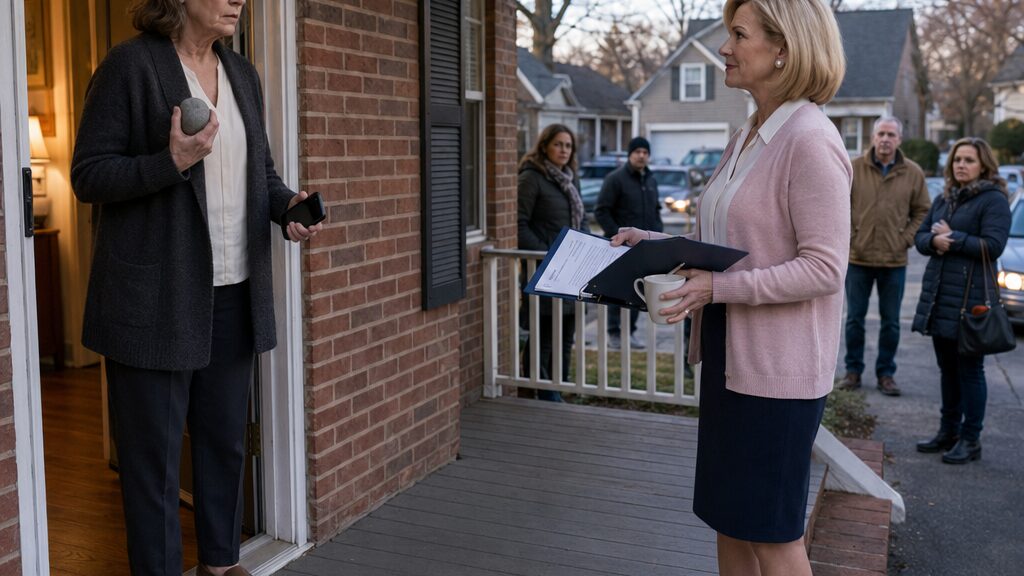
They Took Her Mother’s Christmas Basket Before Dawn, but the Rule Behind It Never Legally Existed
Chapter 1: The Porch Was Empty Before Sunrise
Catherine Walker opened the living-room curtains and saw bare porch boards.
For several seconds, she did not understand what she was looking at. The white railing remained. The brick columns remained. The hooks beneath the eaves still held their loops of dark green wire. But every object she had arranged the afternoon before—the cedar crates, the battery candles, the wrapped empty boxes, the pine branches—was gone.
So was the wicker basket.
She let the curtain fall, then pulled it aside again, as if the decorations might return when she looked properly.
The digital clock on the mantel read 4:47.
Catherine slipped her feet into house shoes and opened the front door. Cold air pressed through her thin nightgown and cardigan. The porch smelled faintly of wet wood and exhaust.
A folded sheet of paper lay near the top step, held down by a smooth gray stone.
Her mother’s stone.
For years, Catherine’s mother had used it to keep handwritten Christmas cards from blowing off the basket. She would tuck a card among pinecones and ribbon, then set the stone at its base and say, “A little weight keeps good things where they belong.”
Now the stone pinned an HOA violation notice to the boards.
Catherine bent slowly and picked it up. The paper was stiff, freshly printed, and marked with the neighborhood association’s green crest.
UNAPPROVED EXTERIOR STORAGE.
IMMEDIATE REMOVAL AUTHORIZED.
ASSESSMENT: $275.
Her first response was not anger. It was a physical emptiness beneath her ribs, as though someone had opened a door inside her and let the heat escape.
She looked toward the driveway. Nothing had been left beside the garage. No crates. No boxes. No basket.
The wicker had darkened with age, and one handle leaned slightly outward where her mother had repaired it with copper wire. It was not valuable. Catherine knew that. The basket would not have brought twenty dollars at a yard sale.
But her mother’s hands had shaped its winter arrangement every December for twenty-three years. Even after arthritis made ribbon difficult, she had insisted on tying the bow herself.
Catherine went back inside and locked the door, although she could not have said why.
Her phone lay charging on the kitchen counter. She opened the doorbell-camera application with fingers that would not quite press where she intended.
The motion log began at 4:28.
The first clip showed headlights sliding across the lawn. A white work van stopped at the curb with no company name visible on its side. Two workers stepped out wearing reflective vests over dark jackets.
Catherine turned up the volume.
A van door slammed. Shoes scraped against concrete. One worker said, “All of it?”
A woman answered from outside the camera’s view.
“All loose items within the porch boundary.”
Catherine froze.
She moved the progress bar backward and played the clip again.
“All loose items within the porch boundary.”
The voice was controlled, brisk, familiar.
In the next clip, Stephanie Wilson stepped into view.
She wore a pale coat buttoned to the throat and held a binder beneath one arm. Even in the grainy black-and-white footage, Catherine recognized the careful angle of Stephanie’s chin when she was explaining something she expected others to accept.
Stephanie pointed toward the cedar crates.
The workers lifted them first.
Catherine watched one man carry away the wrapped boxes. Another collected the candles and greenery. A third clip showed him returning for the wicker basket.
He picked it up by both sides instead of the weakened handle.
The care of that movement nearly undid her.
The basket had not been crushed. It had not been thrown into the van. It had been taken intact.
That was the first good fact Catherine possessed, and she held onto it.
She saved every clip to her phone, then sent copies to her email. Years in a school administrative office had taught her never to trust a single storage location. She created a folder named PORCH REMOVAL and added the notice, photographing the front and back beside the kitchen clock.
At 5:12, she called the property-management number printed at the bottom.
A recorded voice thanked her for contacting the community service line and informed her that normal office hours began at nine.
She left a message.
“This is Catherine Walker at 118 Laurel Brook Drive. Personal property was removed from my porch this morning. I need to know where it was taken and under whose authority. Please call me immediately.”
She listened to herself before ending the call. Her voice sounded calm. Almost too calm.
At 5:26, she called Stephanie.
The call rang four times, then went to voicemail.
Catherine did not leave a second message.
She showered and dressed in charcoal slacks, a cream blouse, and the dark cardigan she wore when she needed to feel composed. By six thirty, porch lights blinked on across the street. Garage doors opened. A delivery truck passed without slowing.
The emptiness of her porch became more visible as the neighborhood woke.
A man walking a terrier stared at the bare boards, then at Catherine through the front window. Two houses down, someone raised a phone toward the porch. Catherine stepped back before they could see her.
At seven fifteen, the school bus stopped at the corner. Children in bright coats gathered beneath the streetlamp. One girl pointed toward Catherine’s house, where the annual display had always included small wrapped boxes labeled with the names of neighborhood children.
Catherine let the curtain close.
She made coffee and placed the notice flat on the kitchen table. The document cited “Emergency Exterior Standards Resolution 14-B,” but it included no adoption date, no hearing information, and no explanation of where removed property would be stored.
At the bottom, one line had been bolded:
FAILURE TO COMPLY MAY RESULT IN CONTINUING DAILY ASSESSMENTS.
Catherine read it three times.
The board had not merely taken her things. It claimed the right to keep charging her after the porch was already empty.
At 7:43, her phone vibrated.
Stephanie’s name appeared on the screen.
Catherine opened the message.
I understand you’re upset. I’ll come by at eight with the enforcement file so we can clear up any confusion.
Catherine looked through the window at the gray stone still resting where the basket had stood.
Then she moved the violation notice beside her phone and waited for Stephanie to arrive.
Chapter 2: The Rule She Could Not Name
Stephanie arrived at 7:58 carrying a white travel cup and a navy binder.
Catherine had not put on makeup. Her hair was still damp at the temples, and she knew Stephanie would notice. Stephanie noticed presentation the way other people noticed weather.
She came up the walkway smiling.
“Morning, Catherine.”
The school bus had just returned from its route around the development. Cars rolled slowly toward the entrance. Across the street, a neighbor stood beside an idling SUV, pretending to rearrange items in the back seat.
Stephanie glanced at the empty porch as if inspecting completed work.
“I’m sorry this became upsetting,” she said. “That was never the intention.”
Catherine remained inside the doorway. “Where is my property?”
“It’s secured.”
“Where?”
“The contractor has a storage facility.”
“I need the address.”
Stephanie’s smile tightened by a fraction. “That information is in the release process.”
She held out the binder.
“I brought the acknowledgment form. Once we get that signed, the management company can explain retrieval.”
Catherine did not take it.
Stephanie shifted the coffee into her left hand and opened the binder herself. A pink tab marked the first page.
“The board adopted emergency exterior standards because we’ve had consistency problems,” she said. “Walkways obstructed, combustible material near outlets, delivery items left indefinitely. The association has to protect everyone.”
The words were gentle. That made them worse.
Catherine looked at the signature line.
“I won’t sign an acknowledgment until I know what I’m acknowledging.”
“It simply confirms receipt.”
“It says I agree the items violated an adopted rule.”
Stephanie gave a small, patient laugh. “Catherine, the decorations were lovely. This isn’t personal.”
“No,” Catherine said. “It was done to my house.”
A car slowed at the curb. Stephanie turned slightly, presenting her composed profile to whoever was watching.
“Rules only work when they apply equally,” she said. “Holiday items can’t be treated differently because they have emotional meaning.”
Catherine felt the sentence land exactly where Stephanie intended.
For one sharp moment, she imagined telling her about the copper wire around the basket handle. About her mother’s hands trembling as she repaired it. About the last December they had arranged pinecones together while pretending not to discuss the diagnosis already printed in a hospital folder.
Instead, Catherine said, “What meeting was the rule adopted at?”
Stephanie blinked.
“The emergency standards were distributed in the fall bulletin.”
“That isn’t what I asked.”
The neighbor across the street had stopped pretending to search the SUV. Farther down the sidewalk, a man walking a retriever slowed.
Catherine stepped onto the porch and closed the door behind her.
“What meeting?” she asked again. “What date?”
Stephanie flipped two pages in the binder.
“It was part of the board’s safety response.”
“Was it adopted at an open meeting?”
“It was reviewed by counsel.”
“Was there a recorded vote?”
Stephanie’s thumb stopped against the edge of the paper.
“I don’t have the minutes in this binder.”
“Then I won’t sign.”
The friendliness left Stephanie’s face, though her voice stayed level.
“You’ve known me for eleven years.”
“Yes.”
“You know I don’t make decisions casually.”
Catherine looked at the travel cup. Stephanie always brought coffee when she expected a conversation to end quickly.
“I know you came to my house before sunrise,” Catherine said.
A garage door across the street stopped halfway down.
Stephanie lowered her voice. “The contractor’s schedule was not my preference.”
“You were on the camera.”
“I was supervising because personal property was involved.”
“That doesn’t answer whether you had authority.”
The silence between them felt suddenly public.
Stephanie closed the binder. “The association received an insurance warning. If we fail to address exterior hazards, every homeowner could pay for it. Higher premiums do not distinguish between sentimental objects and ordinary clutter.”
“That may explain concern,” Catherine said. “It doesn’t explain removal without notice.”
“The emergency clause does.”
“Show me.”
Stephanie reopened the binder and turned to a photocopied page. Catherine photographed it before Stephanie could angle it toward her.
The page was titled Resolution 14-B. The text authorized “prompt corrective action” for exterior conditions presenting an immediate safety risk. There was no signature block on the copy. No date appeared beneath the title.
Catherine zoomed in on her phone.
“What notice period applies?”
“For immediate hazards, none.”
“Who decided my basket was an immediate hazard?”
“The compliance review.”
“Who conducted it?”
“The property manager and the board.”
“When?”
Stephanie’s jaw tightened. “Catherine, this kind of questioning may feel productive, but the practical issue is simple. Your items can be released once the assessment is resolved.”
“So I have to pay to recover property you removed under a rule you can’t date.”
“That is not an accurate characterization.”
“Then give me an accurate one.”
The school bus passed again on its way out of the neighborhood. Several children turned their heads toward the two women on the empty porch.
Stephanie looked down at the acknowledgment form.
“If you choose not to sign,” she said, “the initial assessment remains. Continuing assessments may begin tomorrow.”
Catherine felt heat rise into her face. Stephanie saw it and seemed to mistake it for surrender.
She extended the pen.
Catherine took it.
Then she placed it across the closed binder.
“I’m not signing.”
Stephanie’s expression hardened. “You’re making this much more difficult than necessary.”
“No. I’m asking you to name the meeting where the board gave itself this power.”
“I’ll have management send the relevant record.”
“Today?”
“As soon as staff can process the request.”
Catherine lifted the gray stone from the porch and held up the folded notice beneath it.
“My mother used this stone to hold cards in that basket.”
For the first time, Stephanie looked toward the empty space beside the brick column.
Catherine continued before sympathy could become another method of control.
“I’m going to keep it. You may take your form.”
She opened the door.
Stephanie remained where she was.
“Catherine,” she said, quieter now, “please think about what happens if everyone decides procedure matters more than safety.”
Catherine turned back.
“Procedure is how you prove safety isn’t just whatever the person with the binder says it is.”
She went inside and closed the door.
Her hands began shaking only after the dead bolt slid into place.
She stood in the hallway until Stephanie’s heels crossed the porch, descended the steps, and disappeared down the walk. Then she returned to the kitchen and printed the photograph of Resolution 14-B.
The page bothered her for reasons beyond the missing signature.
The font looked familiar. So did the narrow green border.
She carried it to the small room that had once been her husband’s office and opened the lower drawer of a metal filing cabinet. Inside were twelve hanging folders, one for each year since the neighborhood association had been formed.
Catherine had kept every newsletter, ballot, budget sheet, and violation-policy update that arrived in her mailbox. At school, she had been the person teachers came to when an attendance code vanished or a purchase order carried the wrong date. Records settled arguments that memory distorted.
She opened the folder marked CURRENT YEAR.
The fall bulletin lay near the front.
A single-page insert had been stapled behind it.
EMERGENCY EXTERIOR STANDARDS RESOLUTION 14-B.
Catherine compared it with the photograph on her phone.
Same wording. Same border. Same missing signature.
At the bottom of the insert, where an adoption date should have appeared, there was only blank white paper.
Chapter 3: Red Pencil Through the Minutes
The rule page had no adoption date because, as far as Catherine could determine, there had never been one.
By nine thirty, her kitchen table held six months of board minutes, three newsletters, two budget packets, and every loose insert distributed since spring. She arranged them in chronological order, aligning their corners with the edge of the table.
Then she sharpened a red pencil.
For thirty-two years, red pencil had meant correction. Not punishment. Not embarrassment. A date omitted from a student record, an account number copied incorrectly, a form returned without a signature—red made the missing thing visible.
Catherine circled the first reference to exterior safety in the August minutes.
Insurance inspection discussed. Board to develop response plan.
September contained no vote.
October contained a motion to obtain estimates for walkway repairs, but nothing about porch storage. The fall bulletin announcing Resolution 14-B had been mailed four days after that meeting.
She circled the blank space at the bottom of the insert.
At ten fifteen, she drove to the county records office, though she already knew HOA resolutions were not routinely filed there. She wanted the declaration amendments and any recorded restrictions that might support Stephanie’s claim.
The clerk found the community’s original declaration, two amendments concerning leasing, and an easement revision. Nothing authorized seizure of household property from a porch.
“Associations usually keep their own resolutions,” the clerk said.
“I understand.”
Catherine paid for certified copies anyway.
Back in her car, she called Michael Carter.
He answered on the fifth ring. “Catherine?”
“I need to ask you about Resolution 14-B.”
Silence.
Michael had served as treasurer for four years before resigning the previous spring. Since then, he had treated association business like an illness from which he had narrowly recovered.
“I’m not on the board anymore,” he said.
“I know.”
“And I don’t have access to current records.”
“I’m asking about the months before you left.”
Another pause.
“What happened?”
“They removed everything from my porch at four thirty this morning.”
His breath changed on the line.
“All of it?”
“My mother’s basket too.”
“Lord.”
“Stephanie says the board adopted an emergency rule.”
Michael did not answer.
Catherine tightened her grip on the phone. “Do you remember a vote?”
“I remember discussions.”
“That isn’t the same thing.”
“No.”
“Do you have the treasurer archive?”
“I was supposed to delete the electronic copies after transition.”
“Did you?”
Michael sighed. “Come by after lunch.”
His garage smelled of sawdust, motor oil, and the cardboard boxes he kept meaning to recycle. He had set an old laptop on a folding workbench beside two mugs of coffee.
“I’m not getting dragged back into this,” he said before Catherine sat down.
“I didn’t ask you to.”
“You will.”
“I asked whether a vote happened.”
Michael rubbed both hands over his face.
The archive contained monthly financial reports, vendor invoices, insurance correspondence, and scanned board packets. Catherine watched him open a folder labeled SEPTEMBER BOARD.
There was a draft safety proposal but no final resolution.
October contained an invoice from the property-management company for “policy preparation and distribution.” The invoice date was three days before the board meeting that supposedly authorized the policy.
Catherine marked the date in red on her printed copy.
Michael watched her.
“I questioned that invoice,” he said.
She looked up. “What did they say?”
“That the manager was preparing materials in anticipation of approval.”
“Was it approved?”
“I don’t remember a motion.”
“You would have recorded the financial authorization.”
“I should have.”
The words carried more weight than an answer.
Michael scrolled through his email archive. “Stephanie was under pressure. The insurer had flagged several porches and common walkways. She wanted something in residents’ hands before the next inspection.”
“That explains speed.”
“It explains some of it.”
“Not confiscation.”
“No.”
Catherine studied him. “Why did you resign?”
He closed the laptop halfway.
“Because every question became a loyalty test. If I asked for another week, I was obstructing. If I asked counsel to review language, I was wasting money. Eventually I decided somebody else could be the difficult one.”
“And nobody was.”
Michael looked toward the open garage door.
“No,” he said. “Nobody was.”
It was not the answer Catherine wanted, because it sounded too much like her own.
Before leaving, she found one more document in the September packet: the association’s standing enforcement procedure. It required written notice, a reasonable opportunity to cure, and a hearing before monetary penalties except in narrowly defined emergencies.
Even then, it said nothing about taking personal property.
Catherine underlined the notice paragraph twice.
At home, she assembled a formal records request for all minutes, ballots, legal opinions, inspection reports, and contractor agreements related to Resolution 14-B. She drafted a second letter demanding the location and condition of her belongings.
She had not yet printed either when a truck stopped outside.
Catherine went to the window.
Two workers unloaded the cedar crates onto her porch. Then the wrapped boxes. Then the candles.
The final worker lifted the wicker basket from the truck bed.
Catherine was outside before he reached the steps.
“Please give that to me.”
He paused. “We were told to restore everything where it was.”
“I’ll take the basket.”
He handed it over carefully. The copper-wrapped handle was intact. A sprig of artificial cedar had been bent beneath the rim, but the wicker was unbroken.
Catherine held it against her chest.
“Where was it stored?”
The worker glanced toward the driver. “Management warehouse.”
“Why was it returned?”
“We just got the order.”
“From whom?”
He shook his head. “Ma’am, we only move what’s on the sheet.”
Within ten minutes, the porch looked almost as it had the day before. Almost.
The objects sat in the correct places, but Catherine could see where strangers’ hands had compressed the ribbon and scraped one crate against the brick.
Inside the basket lay a white envelope.
She opened it at the kitchen table.
The note contained no apology and no explanation.
Matter resolved. Assessment withdrawn. No further action required.
Catherine read the final sentence twice.
Then she looked at the unprinted records request waiting on her computer.
They had returned everything before she had formally challenged them.
That did not feel like resolution.
It felt like someone had discovered a reason to stop her from asking the next question.
Chapter 4: Returning the Basket Did Not End It
Samantha Young was standing beside Catherine’s restored basket when she asked, “Why did they give yours back?”
It was two days after the removal. Catherine had left the basket on the porch exactly where the workers had returned it, still holding the white envelope that declared the matter resolved. She had not replaced the bent cedar sprig or retied the ribbon. Each time she passed the front window, the arrangement looked less like a decoration than a display of evidence.
Samantha stood at the bottom of the steps with one hand on a folded stroller. Her dark work pants were creased from sitting, and an identification badge from the medical clinic remained clipped to her jacket.
“I heard they withdrew your fine,” she said.
“They did.”
“Same morning you started asking for records.”
Catherine heard the accusation beneath the statement. “I hadn’t sent the request yet.”
“That’s not what people are saying.”
Samantha pulled three yellow notices from the stroller’s storage pouch. The top one bore the same green association crest as Catherine’s.
“Mine started at fifty dollars,” she said. “Then seventy-five. Now they say it’s twenty-five a day.”
Catherine read the violation: UNAPPROVED EXTERIOR STORAGE. The listed objects were a folding stroller and a narrow delivery shelf beside Samantha’s door.
“I bring the stroller in when I’m home,” Samantha said. “The shelf is so packages don’t sit in the rain while I’m working. Neither blocks the walkway.”
“Did you request a hearing?”
“I requested three. Management says the board is still scheduling them.”
Catherine turned the notices over. Each referenced Resolution 14-B or an “Exterior Delivery Standard” she had never seen.
Samantha looked past her to the basket. “Maybe sentimental things count differently.”
“They shouldn’t.”
“But they did.”
The words struck harder because Samantha was not entirely wrong. Catherine had awakened only after the board touched something she loved. Before that, she had read the inserts, noticed gaps, and filed them away.
“I’m meeting an attorney this afternoon,” Catherine said.
Samantha folded her arms. “For your basket?”
“For the rules.”
Suspicion remained in her face.
Catherine picked up the basket. “Come inside.”
She set it on the kitchen floor rather than on the table. Samantha spread her notices beside Catherine’s copies of the minutes. The pattern was not identical, but it was close: no recorded adoption date, no hearing before penalties, no explanation of appeal rights.
Catherine showed her the unsigned resolution.
Samantha’s anger changed shape. “You had this before they took your things?”
“It came with the fall bulletin.”
“Did you know it was wrong?”
“I knew it looked incomplete.”
“And you didn’t say anything?”
Catherine aligned the notices into a neat stack, though they did not need aligning.
“No,” she said.
Samantha gave a short laugh without humor. “Must’ve been nice to have that choice.”
She took her papers and left before Catherine could answer.
Daniel Robinson’s office occupied the second floor of a brick building near the county courthouse. His conference room held no decorative law books, only a table, four chairs, and a whiteboard crowded with deadlines from other people’s problems.
He read Catherine’s documents without interrupting.
When he reached the doorbell photographs, he leaned closer.
“You did not receive written notice before removal?”
“No.”
“No telephone call?”
“No.”
“And the items were not creating an immediate obstruction?”
“The porch is six feet deep. The walkway was clear.”
Daniel placed the picture aside. “The association may have authority to regulate exterior appearance and safety. That does not automatically give it authority to take possession of personal property.”
“Is it theft?”
“I would not use that word in a demand letter without more facts.”
“Conversion?”
“Possibly. Wrongful control over property can support that claim. But the stronger first step may be records inspection and internal procedure.”
Catherine disliked the caution in his voice until she recognized that it was the same caution she trusted in good records: no conclusion beyond the evidence.
She slid the insurer reference toward him. “Stephanie said this was required.”
“Do you have the insurer’s letter?”
“No.”
“Then we do not know what was required.”
He examined Resolution 14-B. “This page proves the association distributed language. It does not prove the board adopted it. Conversely, the absence of a signature on your copy does not prove they did not.”
“What would?”
“Minutes, ballots if required, counsel communications where privilege has been waived or does not apply, and the version kept in the official policy book.”
He tapped the standing enforcement procedure.
“This is useful. Even if the rule was valid, their own process appears to require notice and an opportunity to cure unless there was an actual emergency.”
“And taking the basket?”
“That is where their exposure increases.”
For the first time since the porch had been emptied, Catherine felt the ground beneath the facts become firm.
Daniel drafted a records demand narrower than the one she had written. It requested adoption records, vote counts, relevant minutes, inspection reports, contractor instructions, storage records, and the association’s current enforcement schedule. He also prepared a preservation notice instructing the board not to alter or destroy related documents.
“This does not start a lawsuit,” he said.
“What does it start?”
“A choice. They can produce the records, correct the problem, or make their position harder to defend.”
At home, Catherine sent both documents by certified email and hand-delivered copies to the management office.
The response arrived forty-three minutes later.
It was addressed to all board members, committee volunteers, and “affected residents,” though Catherine suspected she was the only affected resident who received it.
PENDING LEGAL REVIEW, ALL ASSOCIATION RECORDS RELATING TO SAFETY POLICIES ARE CONFIDENTIAL. UNAUTHORIZED DISTRIBUTION MAY EXPOSE THE ASSOCIATION AND INDIVIDUAL HOMEOWNERS TO LIABILITY.
At the bottom, Stephanie had added a separate notice:
An emergency executive session of the Board of Directors will be held tonight to address privileged legal and insurance matters. Attendance is limited to directors and invited professionals.
Catherine read the message twice.
Then she looked through the window toward Samantha’s house. The stroller was gone from the porch. In its place lay another yellow notice beneath the doormat.
The board had returned Catherine’s basket, but it had not stopped enforcing the rule.
Now it was closing the doors around the records that might explain why.
Chapter 5: The Safety Story Was Only Half True
Stephanie arrived at the clubhouse carrying the insurance letter as if it were a verdict.
The emergency session had ended the night before, but pressure from homeowners forced the board to hold an informational meeting the following Tuesday. No formal votes were listed on the agenda. Folding chairs filled half the room. Catherine sat in the second row with Samantha on one side and Michael Carter on the other.
Stephanie stood behind a narrow table with the property manager and two board members.
“We have heard a great deal of speculation,” she began. “Tonight we intend to provide context.”
She lifted a three-page letter bearing the insurer’s logo.
“This association was warned that unresolved exterior hazards could lead to increased premiums, restricted coverage, or nonrenewal.”
A restless murmur passed through the room.
Stephanie read from the inspection findings: extension cords beneath combustible material, objects narrowing common walkways, seasonal displays obstructing address numbers, packages left where emergency access might be affected.
The concerns were not invented.
Catherine pictured the outlet behind one of her cedar crates. It had been covered by a weatherproof plate, and the candles were battery-powered, but she understood how a photograph taken from the sidewalk could look different.
Stephanie placed the letter on the document camera. The final paragraph appeared on the wall screen.
The association was required to submit a written risk-reduction plan within sixty days.
“If we failed,” Stephanie said, “the increase could have exceeded thirty percent. That would affect every household.”
A man near the back asked, “Did the insurer tell you to remove people’s belongings?”
“The board was instructed to correct hazards.”
“That wasn’t the question,” Samantha said.
Stephanie’s gaze moved to her, then to Catherine.
“The board used its authority to implement a response proportionate to the risk.”
Catherine raised her hand.
Stephanie hesitated before recognizing her. “Catherine.”
“Please show the paragraph authorizing immediate confiscation.”
“The insurer does not draft our enforcement procedures.”
“Then the insurance letter explains why you needed a policy, not why you skipped notice.”
A board member leaned toward the microphone. “These legal distinctions are exactly why the matter is under review.”
Catherine looked at Stephanie. “Was Resolution 14-B adopted before it was distributed?”
Stephanie’s fingers tightened around the paper.
“Yes.”
“At what meeting?”
“The record is being compiled.”
Michael shifted in his chair.
Catherine continued. “Was there a motion?”
“Catherine, this is not a deposition.”
“No. It is a meeting for homeowners whose money and property were affected.”
The property manager interrupted. “The official minutes will speak for themselves once counsel completes review.”
The meeting dissolved into questions about premiums, fines, strollers, flowerpots, and delivery boxes. Stephanie answered each one with the same distinction: safety required action; details were under review.
It was nearly nine when Catherine returned home.
An email from management was waiting.
The association had produced seventeen pages in response to her records request. Most were duplicates of documents she already possessed. One page, however, was labeled REVISED OCTOBER MINUTES.
Catherine printed both versions.
The copy distributed after the October meeting included a motion approving walkway repairs. The revised version contained an additional paragraph:
Upon discussion of insurer requirements, the Board adopted Emergency Exterior Standards Resolution 14-B by majority consent.
Catherine placed the pages side by side under the dining-room lamp.
The added paragraph used slightly different spacing. Its left margin began a fraction closer to the edge. The footer on the revised copy showed a generation date from three days after her property had been removed.
She circled the date in red.
Michael came over when she called. He remained standing while he compared the pages.
“That paragraph wasn’t in the packet I received,” he said.
“Could it have been corrected later?”
“Minutes can be amended.”
“With a vote?”
“Yes. The amendment should be approved in a later open meeting.”
“Was it?”
“Not while I was treasurer.”
He sat down at last.
Catherine opened the insurer letter she had photographed at the clubhouse. “Stephanie was right about the financial risk.”
Michael nodded. “We had already absorbed a smaller increase the year before. Another one would have meant higher dues.”
“She was trying to stop that.”
“She was.”
The answer irritated Catherine because it complicated the clean line she had drawn between harm and motive.
Michael touched the revised minutes. “Trying to solve a real problem doesn’t authorize creating a record after the fact.”
“No.”
“But people will hear ‘insurance’ and panic.”
“I did.”
“So did the board.”
Catherine turned back to the produced documents. Behind the revised minutes was a receipt acknowledgment for the fall bulletin. Residents had been asked to initial a delivery sheet at the annual neighborhood cleanup.
Her own initials appeared in the fourth column.
C.W.
She remembered the afternoon.
Stephanie had stood beside a folding table distributing bottled water and policy packets. Catherine had flipped through hers before signing. The green-bordered insert had caught her attention because it lacked a date at the bottom.
She had almost asked about it.
Then Stephanie had been called away by an argument over parking, and Catherine had placed the packet in her tote.
Months earlier, she and Stephanie had still been navigating the remains of a friendship that had thinned after Catherine’s husband died. Stephanie had brought casseroles, made telephone calls, and eventually begun making decisions Catherine had not requested. When Catherine withdrew, Stephanie treated the distance as ingratitude. Neither woman named the rupture.
Questioning the insert would have meant reopening that careful silence in front of neighbors.
So Catherine had filed it.
She drew a red circle around her initials.
Michael watched her. “Receiving it doesn’t make it valid.”
“No.”
“You couldn’t know what they would do.”
“I knew something was missing.”
“That’s not the same as knowing they’d remove property.”
Catherine set the pencil down. “Samantha was already receiving notices.”
“Did you know that?”
“I saw one on her door in November.”
“And?”
“I told myself it was not my business.”
The room went quiet.
Catherine had spent two days documenting what Stephanie had failed to do. Now the papers showed something less serious but more personal: Catherine had also seen a procedural gap and chosen the comfort of not becoming involved.
Her mother’s advice returned with painful clarity.
Do not create a scene.
It had once meant hold your temper. Preserve another person’s dignity. Do not turn every injury into theater.
Catherine had made it mean something easier.
Do not be seen objecting.
She lifted the red pencil and drew a line from her initials to the blank adoption date.
At the next open meeting, she could expose the altered record and say nothing about when she first noticed the defect. No one might ask.
Or she could tell the whole truth, including the part that made her less innocent.
Chapter 6: The Meeting Where Silence Became Evidence
“They are personal papers from a personal dispute,” Stephanie said. “They should not be displayed as association records.”
The clubhouse was full before the meeting began. Residents stood along the walls and crowded the doorway. Catherine had placed her wicker basket on the evidence table beside the two versions of the October minutes, the insurer letter, the enforcement procedure, Samantha’s notices, and Michael’s archived financial packet.
The basket still held the bent cedar sprig.
Stephanie looked at it as if Catherine had brought an accusation that could not be answered in words.
“This is an open records discussion,” Catherine said. “The basket is property removed under the policy being discussed.”
“It is also emotionally prejudicial.”
One of the board members leaned toward Stephanie. “We should proceed.”
Stephanie’s mouth tightened. She called the meeting to order.
The property manager summarized the records review. Resolution 14-B, he said, had been “approved through board consensus” during a period of urgent insurance negotiations. Documentation had been “administratively supplemented” to clarify the action.
Catherine heard several people repeat the phrase under their breath.
Administratively supplemented.
When public comment opened, Samantha spoke first. She described the stroller fines, the unanswered hearing requests, and the daily assessments that had reached four hundred dollars.
A neighbor described a flowerpot removed from a shared landing. Another admitted his porch had become difficult to navigate after months of deliveries and said some regulation was necessary.
The room did not divide neatly into victims and defenders. People feared arbitrary enforcement, but they also feared higher premiums. They wanted refunds and low dues. They wanted rules and exceptions. They wanted the board held responsible without admitting how often they had ignored meetings.
When Catherine’s name was called, she carried the two versions of the minutes to the front.
Stephanie said, “Please limit your remarks to three minutes.”
“I’ll need six.”
“The policy allows three.”
“Which adopted policy?”
A few people laughed. Catherine did not.
The board member beside Stephanie nodded. “Give her six.”
Catherine placed the original minutes beneath the document camera. Then the revised version.
“These documents contain different accounts of the same meeting,” she said. “The version distributed in October contains no vote on Resolution 14-B. The revised version adds a vote by majority consent.”
She pointed to the footer.
“The revised file was generated after my belongings were removed.”
The room became still.
Stephanie leaned toward her microphone. “Minutes are routinely corrected.”
“Yes. Through an amendment approved at a later meeting.”
“The board had already reached consensus.”
“Consensus is not a recorded motion. And an administrative correction is not a retroactive vote.”
The property manager began to speak, but Catherine lifted one hand.
“I’m not finished.”
Her voice did not rise. It carried anyway.
She showed the standing enforcement procedure requiring notice and an opportunity to cure. Then she displayed the insurer letter.
“The insurer asked for a risk-reduction plan. The letter identifies real safety concerns. It does not require predawn removal, immediate fines, or denial of hearings.”
Stephanie’s expression changed. Not defeat. Exhaustion.
“We had twenty-three days left,” she said. “Counsel had not completed review. Management warned that delaying implementation could jeopardize renewal. I chose action.”
“You chose a method the board had not lawfully approved.”
“I chose not to gamble every homeowner’s coverage on procedural perfection.”
Catherine looked at the people seated behind her. Some nodded at Stephanie’s words.
That was the moment Catherine could have made Stephanie the sole cause of everything. She had the altered minutes. The camera footage. The basket. The room was ready for a villain.
Instead, Catherine reached into her folder and removed the fall bulletin receipt.
“My initials are here,” she said.
Michael turned toward her.
“I received Resolution 14-B months ago. I saw that the adoption date was blank.”
Stephanie stared at her.
Catherine continued. “I had spent most of my working life checking records. I knew missing dates mattered. I did not ask about it.”
The room shifted with small movements: coats brushing chairs, someone lowering a phone, Samantha’s breath catching beside the wall.
“I had also seen notices on other homes,” Catherine said. “I decided they were not my concern. I challenged the rule only after the board took something from me.”
Stephanie’s face softened for an instant, but Catherine did not offer the admission as peace.
“My silence does not make the policy valid,” she said. “It does mean the board was not the only reason this continued.”
Michael stood from the second row.
“I need to add something.”
Stephanie closed her eyes briefly.
Michael approached the microphone with a flash drive and a printed ledger.
“I was treasurer when the policy materials were prepared. The management invoice predates the meeting where approval supposedly occurred. I questioned it privately. When questions became uncomfortable, I resigned.”
He placed the ledger beside Catherine’s papers.
“The financial archive contains no recorded authorization for Resolution 14-B. I kept copies. I also kept quiet.”
The admissions changed the room more than an accusation would have. Residents began asking not only what Stephanie had done, but who else had known enough to question it.
Catherine presented four policy inserts distributed during the same year: exterior storage, delivery shelves, seasonal lighting, and visitor parking. Each lacked an adoption date. Each appeared in newsletters before any matching recorded motion.
The board member beside Stephanie examined them one by one.
“This cannot all be treated as clerical error,” he said.
Stephanie’s composure finally broke at the edges.
“Do you understand what refunds would cost?” she asked. “Do you understand what happens if the insurer interprets suspension as abandonment of the safety plan?”
“Yes,” Catherine said. “That is why I am not asking you to abandon safety.”
She handed the secretary a written proposal Daniel had reviewed.
It suspended enforcement of the four disputed policies, preserved existing rules that had been properly adopted, required hearings on pending fines, directed an independent audit of board records, and ordered the board to draft temporary safety guidance limited to clear walkways and documented hazards.
Samantha read over the copy passed down her row.
“What about money already collected?” she asked.
Stephanie answered before Catherine could.
“No refunds can be authorized tonight. We do not know the total exposure. We do not know whether reserves can absorb it.”
“Then vote to find out,” Catherine said.
Stephanie looked directly at her. “You are asking homeowners to pay for this.”
“I am asking the association to account for what it collected. If correction has a cost, hiding the error does not remove it.”
A man near the back called out, “It might raise dues.”
“Yes,” Catherine said.
The room quieted again.
She could feel people withdrawing from the easy satisfaction of exposing the board. Practical justice had arrived with an invoice attached.
Stephanie folded her hands on the table.
“I will concede that the records are incomplete,” she said. “I will not agree that every enforcement action was improper, and I will not authorize refunds without a binding board decision and verified totals.”
It was not an apology. It was also the first public concession she had made.
Catherine looked at the basket beside the records. Her mother’s stone rested inside it now, weighing down the unsigned resolution.
For years Catherine had believed dignity meant never forcing a room to witness discomfort. Now the discomfort was the evidence that something real was being decided.
She faced the board.
“I move that enforcement under Resolutions 14-B, 16-C, 18-A, and 19-D be suspended immediately; that all pending hearings be preserved without additional daily fines; and that an independent audit determine adoption history, collections, and required corrective action.”
The secretary’s pen stopped above the minutes.
A board member cleared his throat. “A homeowner cannot make a board motion.”
The room stirred.
Catherine held Stephanie’s gaze.
“Then one of you will have to decide whether to make it for me.”
Chapter 7: Every Invalid Fine Had a Name
The vote stopped at two in favor and two against.
The board member who had questioned the altered minutes supported Catherine’s motion. The second member beside him did the same. Stephanie voted against it, as did the remaining director, who warned that freezing enforcement could be interpreted as abandoning the insurer’s safety plan.
All eyes turned toward the empty fifth chair.
The final director had resigned by email that afternoon.
“We do not have a majority,” Stephanie said.
Samantha rose from the back wall. “Then nothing changes?”
“The board cannot act without sufficient votes.”
Catherine looked toward the secretary. “Can the membership call a special meeting?”
The secretary shuffled through the bylaws.
“With a petition signed by twenty percent of owners.”
“How many signatures?”
“Forty-one.”
Several people had already begun gathering their coats. The possibility of reform had sounded simpler before it became paperwork.
Catherine lifted the wicker basket from the evidence table and carried it to the center aisle.
“Anyone who received a fine under one of these four policies,” she said, “write your name, address, and the amount. Anyone willing to sign a petition for a special meeting, add a check beside it.”
The first slip came from Samantha.
Then Michael.
A man who had defended the safety rules wrote down a seventy-five-dollar lighting fine and said, “I still think the cords were dangerous.”
“They may have been,” Catherine said.
“But they should have warned me.”
“Yes.”
Within twenty minutes, the basket held thirty-six folded claims.
The last five signatures came the following morning.
The special membership meeting was held ten days later. By then, management had calculated the immediate consequences of Catherine’s proposal. Suspending enforcement posed little insurance risk if the association adopted temporary guidance requiring clear paths, visible address numbers, and documented notice for correctable hazards.
Refunds were harder.
The association had collected nearly eighteen thousand dollars under the disputed policies. Its operating account could cover the amount only by postponing entrance landscaping, replacing fewer streetlights, and raising monthly dues by six dollars for one year.
The figures were projected onto the clubhouse wall.
A groan moved through the room.
Stephanie stood near the side door rather than at the front table. She had temporarily surrendered the chair to the senior board member but remained president until the vote concluded.
“This is what I was trying to prevent,” she said. “Every correction has a cost.”
Samantha held her folded stroller beside her chair. “So did the fines.”
A homeowner near the aisle turned toward her. “Some of us followed the rules.”
“Some of us tried to get hearings.”
“And now everybody pays.”
Catherine listened until the arguments began repeating.
Then she stood.
“The association collected money under procedures it cannot verify,” she said. “We can pretend that money belongs to us because returning it is inconvenient. Or we can accept that correction costs more when it is delayed.”
A woman in the first row asked, “Would you still say that if your refund were only fifty dollars and your dues went up seventy-two?”
Catherine thought of the returned basket, the withdrawn assessment, and the fact that she personally had nothing left to recover.
“Yes,” she said. “Because I am not owed a refund. I am being asked to help pay for one.”
That changed the room.
Not completely. Some residents still opposed the motion. But the argument could no longer be reduced to Catherine protecting her own interests.
When the ballots were counted, the enforcement suspension passed by eleven votes.
The audit passed by seven.
The refund plan passed by three.
Stephanie remained motionless while the results were read. Then she walked to the front, placed her binder on the table, and adjusted the microphone.
“I am resigning as president effective tonight,” she said.
A murmur rose.
“I do not agree with every conclusion reached here. I do accept that the association requires leadership the membership currently trusts.”
She looked at Catherine.
There was no apology in her face, but neither was there defiance. Only fatigue.
“I will cooperate with the audit.”
She closed the binder and left through the side door.
For the next month, the neighborhood changed in small, inconvenient ways. The landscaping project was delayed. Temporary safety notices appeared on doors, but each included photographs, a correction period, and hearing instructions. Samantha received confirmation that her daily fines had stopped.
The basket remained on Catherine’s dining table. Residents came by to add copies of notices, receipts, and hearing requests. What had once held pinecones and ribbon now filled with names and amounts.
The independent audit arrived on a Monday afternoon in a thick white envelope.
Catherine opened it with Michael and Samantha seated across from her.
The report confirmed that four policies lacked valid adoption records. It ordered the association to refund improperly collected assessments, correct the minutes through recorded public action, preserve original versions of all documents, and create a formal notice-and-hearing procedure.
At the back was a separate recommendation.
The association should establish a permanent records committee independent of enforcement leadership.
A handwritten note from the senior board member was clipped to the page.
Catherine—
We would like you to chair it.
She read the sentence twice, then looked toward the wicker basket.
For the first time, the question was no longer whether she would speak.
It was whether she was willing to remain visible after the argument had ended.
Chapter 8: The Basket Returned With Different Weight
The audit tag was still tied to the basket handle the following December.
Catherine found it when she carried the basket from the hall closet and set it on the kitchen table. A narrow strip of white paper hung beside the old copper repair.
EVIDENCE ITEM 3.
She untied it carefully.
For nearly a year, she had told herself she would restore the basket when the season returned. Yet the pinecones remained boxed in tissue paper, the cedar ribbon lay curled in a drawer, and the handwritten card her mother used every Christmas was still missing.
The new homeowner guide sat in a neat stack beside her.
Its exterior-safety section was only two pages long. Walkways had to remain clear. Address numbers had to stay visible. Open flames were prohibited. Except in documented emergencies, owners received written notice, time to correct the condition, and a hearing before fines. If property ever had to be moved for immediate safety, the owner had to be told where it was stored and how to retrieve it without payment.
Catherine had helped draft every sentence.
She had not chaired the records committee.
Not at first.
When the board asked, she declined before the senior member finished the question. She agreed only to organize the audit files and train whoever accepted the role.
No one did.
Three weeks later, Catherine volunteered for one year.
She insisted on the limit being written into the minutes.
Now, as she slid copies of the new guide into the basket, the doorbell rang.
Stephanie stood outside holding a small envelope.
She no longer wore the pink cardigans she had favored as president. Her coat was plain navy, and she had no binder.
“I found this while clearing the old management files,” she said.
Catherine opened the envelope.
Inside was her mother’s handwritten card.
The paper had bent at one corner, but the blue ink remained clear.
May every person who comes to this door leave warmer than they arrived.
Catherine pressed her thumb against the familiar loop of the final letter.
“It must have fallen beneath the basket lining,” Stephanie said. “The contractor included it with the stored paperwork.”
“Thank you for bringing it.”
Stephanie glanced toward the stack of guides.
“I read the final version.”
“And?”
“It is better than what we had.”
The admission came quietly.
Catherine waited, but Stephanie did not apologize. Catherine did not ask her to.
After a moment, Stephanie said, “I still think waiting could have cost us coverage.”
“It might have.”
“And I still think some residents will use procedure to avoid fixing obvious problems.”
“They might.”
Stephanie gave a small, tired smile. “You always did know how to make agreement sound unnecessary.”
“We agree that the walkway should be safe.”
“That is something.”
“Yes.”
Stephanie turned toward the steps, then paused.
“Your mother’s card was right about this porch.”
Catherine looked at the bare boards.
“It has not felt that way lately.”
“No,” Stephanie said. “I suppose it hasn’t.”
She left without asking to come inside.
Catherine returned to the table and tucked the card among the pinecones. She tied fresh cedar ribbon around the repaired handle, then placed the homeowner guides beneath the arrangement where neighbors could take one without disturbing it.
At dusk, she carried the basket outside.
The porch was not restored exactly as it had been. She left the outlet uncovered and kept the walking path wider. The cedar crates sat against the brick, and the battery candles glowed behind clear glass.
The basket rested beside the front door.
Her mother’s stone held the top guide in place.
Before Catherine stepped inside, a message arrived from the records committee group. The property manager had submitted next month’s policy amendment without a revision history.
A year earlier, Catherine might have saved the message, noticed the omission, and waited for someone else to ask.
She opened the committee folder on her phone and replied that the document would be returned until the original version and change log were attached.
Then she added the issue to the public agenda.
Across the street, Samantha pushed the stroller along the sidewalk and raised one hand. A copy of the homeowner guide rested on the stroller shelf.
Catherine waved back.
She had agreed to serve for one year, not forever. She still disliked meetings. She still rehearsed difficult sentences before saying them. Restraint had not left her.
It had simply stopped being silence.
She went inside, leaving the porch light on and the basket where everyone could see it.
The story has ended.