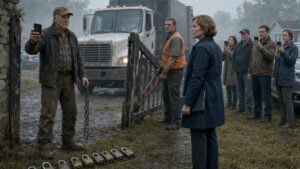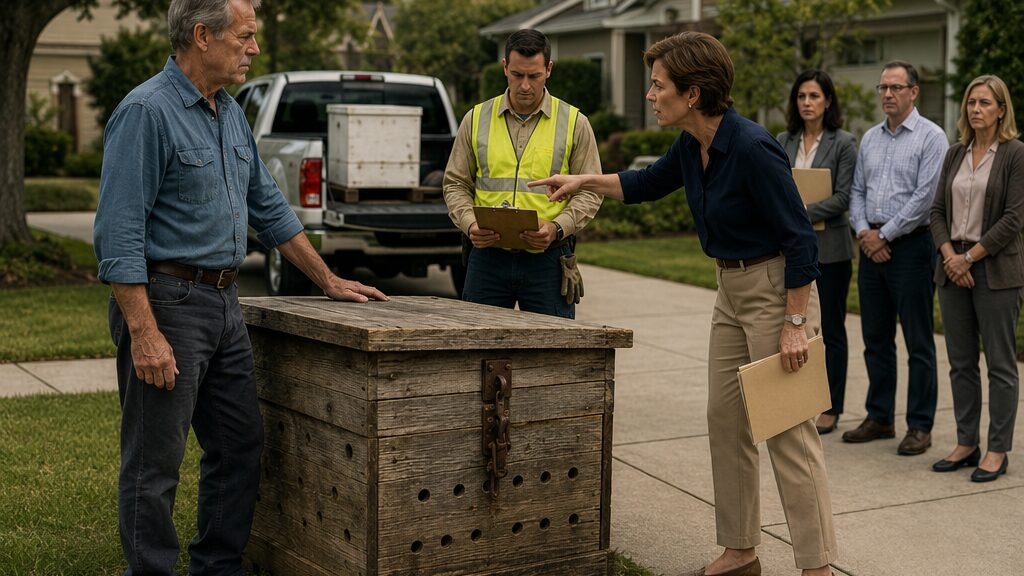
The Neighbor Who Demanded He Remove the Wooden Box Never Asked Why He Built It
Chapter 1: The Box Brenda Wanted Gone Before Sunset
The red ribbon had been tied so tightly around the wooden box that it cut into the soft edge of one weathered board.
Donald Martin saw it before he saw Brenda.
It ran around the box twice, bright against the gray cedar, then ended in a bow too neat to be accidental. A laminated card hung beneath it. The card turned slowly in the morning breeze, flashing the green-and-white emblem of the Maple Ridge Homeowners Association.
Donald stopped halfway down his driveway, one hand still holding the empty recycling bin.
Brenda Hall stood on the sidewalk with her phone raised.
“Don’t touch the notice until I’ve documented it,” she said.
Donald set the bin beside the garage. “You tied something to my property.”
“I posted a violation notice.”
“You tied a ribbon to it.”
“The ribbon makes it visible.”
“It was visible without your help.”
The box sat near the front edge of his lawn, four feet long and waist-high, built from thick cedar boards that had silvered in the weather. Its lid sloped slightly toward the street. A rusted iron latch held it closed. To anyone passing at twenty miles an hour, it probably looked like storage for garden tools or a chest someone had forgotten to move.
Brenda lowered her phone but kept it pointed generally toward him. Her lawn behind her was clipped to an even height. White stones bordered her shrubs. Nothing leaned, faded, or wandered beyond its assigned place.
“That thing has been out here for nearly three weeks,” she said. “I gave you time.”
“You mentioned it once.”
“I asked what you planned to do.”
“You asked when I was taking it to the dump.”
“Because that is where it belongs.”
Donald looked at the red ribbon again. It crossed over a small plugged hole near the side panel. He resisted the urge to pull it free too quickly.
“What does the notice say?” he asked.
“You can read it.”
“I’m asking you.”
Brenda’s mouth tightened. “Unapproved exterior structure. Visual nuisance. Possible pest attraction. Possible effect on neighboring property values.”
“Possible four times.”
“Twice.”
“Still possible.”
“You know what buyers notice first, Donald? Neglect.”
The word settled between them.
For a moment he saw Susan standing beside the box when the cedar was new, one hand resting on the unfinished lid while she argued that it did not need paint. Paint would make it prettier, Donald had said. Susan had answered that prettier was not always healthier.
Brenda stepped off the sidewalk and pointed toward the boards.
“It looks abandoned. There are insects around it. Children walk past here.”
“Children walk past flowers too.”
“Don’t be difficult.”
“I’m standing in my yard.”
“And I’m chair of the architectural committee.”
That was new. Donald knew she served on the committee. He had not heard about the chairmanship.
Brenda seemed to recognize the question in his face.
“Christopher nominated me last month,” she said. “The board approved it.”
“Congratulations.”
“This isn’t personal.”
Donald looked at the ribbon, then at her phone. “You came over before eight in the morning to tie something around a box my wife helped design.”
Brenda’s expression moved, though not enough to soften. She had known Susan. Not closely, but enough to bring soup after the diagnosis and enough to stop bringing it when Susan no longer had the strength to answer the door.
“I respected Susan,” Brenda said. “But Susan isn’t the issue.”
“No. The box is.”
“The neighborhood has standards.”
“The neighborhood has grass.”
“You know exactly what I mean.”
Donald crouched beside the box. He slipped two fingers beneath the ribbon and checked where it pressed against the cedar. The colony inside was quiet at this hour, though he could hear the faintest dry movement if he leaned near the side.
Brenda took a step back.
“What is in there?”
“You’ve been complaining for three weeks and never asked?”
“I asked what it was.”
“No. You asked when I was removing it.”
She stared at him. “Then tell me now.”
Donald reached into his pocket and took out his folding knife.
The blade clicked open.
Brenda lifted her phone again. “I’m recording this.”
He cut through the ribbon in one clean motion.
It snapped loose, falling across the grass like a severed line.
Donald folded the laminated notice inward so the adhesive would not catch dirt. Then he coiled the ribbon around it and tucked both beneath his arm.
“You just removed an official posting,” Brenda said.
“I removed plastic from my property.”
“The violation remains.”
“Then mail it.”
Her voice sharpened. “An emergency complaint has already been filed.”
Donald straightened.
The irritation he had been holding cooled into something heavier.
“What emergency?”
“Unsecured structure. Stinging insects. Potential hazard within the common pedestrian area.”
“This isn’t common property.”
“It is within the setback review zone.”
“That is not the same thing.”
“It means the association can inspect.”
“Who filed the emergency complaint?”
“The committee received concerns.”
“From whom?”
“I don’t disclose residents who report safety issues.”
“You are the resident.”
“That doesn’t make the concern invalid.”
Across the street, a garage door rose. One of the neighbors stepped out with a travel mug, slowed when he saw them, then found a reason to study something inside his car.
Brenda lowered her voice.
“I have scheduled a site inspection for next Monday at nine. The property manager will attend. A county environmental inspector has also been requested because you refuse to identify what you’re keeping in there.”
Donald’s grip tightened around the rolled ribbon.
“Requested by you?”
“By the committee.”
“You are the committee chair.”
“Yes.”
“And you asked the county to come remove something you haven’t examined.”
“I asked them to determine whether it should be removed.”
The distinction sounded rehearsed.
Brenda glanced at the box once more. “You have until sunset to move it behind your fence voluntarily. After that, the inspection proceeds.”
Donald said nothing.
She waited, perhaps expecting an argument, an explanation, or some small admission she could carry back to the board. When none came, she slid her phone into her pocket.
“You make everything harder than it needs to be,” she said.
Donald looked toward her house. A real estate brochure lay on the passenger seat of her car, partly covered by a canvas bag. He could see the corner of a photograph showing a kitchen with white cabinets.
“Monday at nine,” she repeated.
Then she walked home without looking back.
Donald remained beside the box until her front door closed.
He laid his palm on the lid.
The cedar was cool. Under it, almost too faint to hear, came the steady working sound of life hidden in narrow chambers.
“They’re not moving you by sunset,” he said.
The sentence sounded firm in the open yard.
Less firm inside the house.
Donald carried the cut ribbon and notice to the workshop at the back of the garage. He placed them on his workbench beneath a clamp, flattening the laminated card so it would not curl.
The bench was crowded with things he had not touched in months: a carpenter’s square, two tins of unused screws, a roll of copper mesh, Susan’s old project ledger.
He had left the ledger beneath a stack of seed catalogs after the funeral.
Now one corner showed.
Donald pulled it free. The blue cloth cover had faded along the spine. Susan’s handwriting filled the first page in black ink: MAPLE RIDGE POLLINATOR CORRIDOR—YEAR ONE.
Something slid from beneath it and landed facedown on the concrete floor.
An envelope.
The return address belonged to the county environmental services department.
Donald knew its shape before he turned it over. He knew the pale yellow paper, the windowed front, the small line above his name marked SECOND NOTICE.
It was still sealed.
Chapter 2: When the Inspector Lifted the Rusted Latch
The county inspector arrived with a wheeled removal crate strapped inside the bed of his truck.
Donald saw the crate before the man stepped onto the curb.
It was made of white plastic with screened vents and two black handles. Beside it lay a roll of caution tape and a folded protective suit. Brenda stood near the driveway in a navy blouse, speaking quietly to the HOA property manager and two members of the architectural committee.
She stopped talking when Donald came outside.
“You’re late,” she said.
Donald checked his watch. “It’s eight fifty-eight.”
“The inspector has been here five minutes.”
The inspector closed his truck door. He was a compact man in a tan work shirt and county vest, carrying a clipboard beneath one arm. He studied the box, then the distance between it and the sidewalk.
“I’m with environmental services,” he said. “You’re Mr. Martin?”
Donald nodded.
“And this is the structure in question?”
“Yes.”
Brenda answered at the same time. “That’s it.”
The inspector glanced from her to Donald.
The property manager stepped forward with a folder. “The association requested an expedited assessment due to possible stinging-insect activity and an unapproved structure inside the front setback.”
The inspector accepted the folder but did not open it. “Has anyone been stung?”
“No reported incident yet,” Brenda said.
“Has anyone seen a swarm?”
“There has been increased insect traffic.”
“What kind?”
“Bees.”
The inspector looked at the flower beds lining three yards across the street. “That narrows it some.”
One committee member hid a smile by looking down.
Brenda’s posture stiffened. “The point is that Mr. Martin refused to identify what was inside.”
“I didn’t refuse,” Donald said.
“You repeatedly declined.”
“You never asked until last week.”
The inspector raised one hand. “I’m not here to settle the conversation history. I need to examine the structure and determine whether there’s an active hazard.”
He approached the box.
Donald followed, stopping at the corner nearest the driveway. The iron latch had darkened after years of rain. Rust roughened its edges, though the hinge pin beneath it was sound.
The inspector crouched and examined the side panels.
“These holes intentional?” he asked.
“Yes.”
“Ventilation?”
“Partly.”
“What else?”
Donald looked toward Brenda. She had folded her arms.
The property manager opened the association folder as if preparing to record his answer.
Donald said, “Open it.”
The inspector looked up. “You’re giving permission?”
“Yes.”
Brenda took one step forward. “Shouldn’t we clear the sidewalk first?”
“If I see a reason.”
“There are bees inside.”
“You reported possible bees.”
“There are bees. I’ve seen them.”
The inspector took a pair of gloves from his pocket but did not put on the protective suit. He brushed dirt from the latch with his thumb.
Donald watched his fingers close around the rusted metal.
For months, only Donald had opened it. He opened it early in the mornings, when the air was cool and the movement inside was slow. He lifted the lid exactly nine inches, rested it on the wooden stop, checked for moisture, mites, damaged nesting tubes, blocked exits, then lowered it without sound.
The inspector pulled.
The latch resisted.
Brenda exhaled sharply. “It’s rusted shut.”
Donald stepped closer. “Lift before you pull.”
The inspector raised the lower plate, then eased the arm free.
The latch opened with a dry scrape.
He lifted the lid.
A warm, woody scent rose from inside. Beneath the outer shell sat rows of removable nesting blocks drilled with holes of different widths. Reed bundles filled two side compartments. Clear observation panels protected several active channels where pale partitions separated developing chambers. Small native bees moved over the wood, some entering narrow openings with pollen dust bright on their undersides.
No mass rose into the air. No cloud formed. The movement was concentrated and purposeful.
The committee members leaned closer despite themselves.
The inspector bent over the chambers. “Leafcutters?”
“Some,” Donald said. “Mostly mason bees in the spring. A few resin bees later.”
“You managing parasites?”
“Copper mesh inserts. Replaceable liners. I clean the blocks after emergence.”
The inspector touched none of it. His eyes moved from the ventilation channels to the sloped drainage base.
“This isn’t an amateur honeybee hive,” he said.
Brenda looked at the open lid. “It’s still full of bees.”
“It’s a native solitary-bee habitat.”
“What does that mean?”
“It means they don’t behave like a honeybee colony. No communal honey stores to defend. Most native solitary species are low-aggression unless handled.”
“Low-aggression isn’t no aggression.”
“No,” the inspector said. “It isn’t.”
Donald noticed the small satisfaction that returned to Brenda’s face.
Then the inspector looked at the property manager.
“Who described this as unsecured scrap?”
The manager glanced at Brenda before answering. “That language came through the architectural complaint.”
The inspector pointed to the interior frame. “This is purpose-built. Drainage is correct. Materials are untreated where they need to be. The chamber spacing is better than half the public units I inspect.”
One of the committee members asked, “So it’s legal?”
“That depends on its registration status and site approval. But I’m not authorizing destruction today.”
Brenda’s arms dropped. “You brought the removal crate.”
“I bring containment equipment when a report mentions unidentified stinging insects.”
“You’re saying it can stay?”
“I’m saying there is no evidence of an immediate uncontrolled hazard.”
For the first time that morning, the pressure behind Donald’s ribs loosened.
The box had answered for itself.
He looked at Brenda. She was staring into the open habitat, her expression caught between disbelief and offense, as if the bees had violated the same rule he had.
The inspector continued examining the construction.
“Who built this?”
“I did.”
“Under the county pilot?”
Donald hesitated half a second too long.
The inspector noticed. “There was a neighborhood pollinator pilot here about four years ago.”
“My wife applied.”
“Name?”
“Susan Martin.”
Recognition passed over the man’s face. “Science aide from the elementary school?”
“Yes.”
“I remember the corridor proposal. Front-yard habitats, garden connections, public education.”
Brenda turned toward Donald. “Susan did this?”
Donald closed his hand around the lid’s edge. “She started it.”
The inspector nodded slowly. “That explains the build standard.”
The small payoff should have felt cleaner. It should have ended the morning. Brenda had called the box junk, and an official had opened it before witnesses and named its purpose.
Instead, Donald saw the inspector lean closer to the inner right panel.
“Where’s the current tag?”
Donald did not answer.
The inspector looked again. “The pilot units had annual registration labels. Usually aluminum or green composite. This one has mounting holes.”
“It came loose.”
“When?”
“I don’t know.”
“Do you have the renewal certificate?”
“In the house.”
Brenda turned fully toward him now. “Then get it.”
Donald kept his eyes on the inspector. “I said it’s in the house.”
“Bring it out.”
The inspector lowered the lid but left the latch open. “I can wait.”
The county envelope sat on Donald’s workbench, still sealed beside Susan’s ledger.
There were other envelopes too. He knew that now. One in the desk drawer. One beneath a stack of utility bills. He had recognized the department name each time and placed the letters where they would not demand an answer.
“I’ll need a few minutes,” he said.
Brenda’s voice was quieter. “Do you have a current approval or not?”
Donald walked toward the garage.
Inside the workshop, the unopened envelope waited beneath the clamp. He cut it with the same knife he had used on the red ribbon.
The letter inside was dated eleven months earlier.
NOTICE OF LAPSED PARTICIPATION.
A second sheet listed requirements for reinstatement: maintenance record, current photographs, updated site diagram, signature of responsible steward.
Donald read Susan’s name in the old participant line.
He closed his eyes once, folded the pages, and carried them outside.
The inspector read the first page without comment.
“This registration expired,” he said.
“The habitat didn’t.”
“No. Clearly not.”
Brenda took a breath. “Then it isn’t protected.”
“Not under active pilot status.”
“So it has to go.”
“I didn’t say that.”
“You said the registration expired.”
“I also said this is not an emergency removal.”
The inspector handed the letter back to Donald. “The structure can be reviewed for reinstatement or independent approval. But I need the original placement plan.”
Donald felt the loosened pressure return.
The inspector opened his tablet, found the pilot archive, and enlarged a property diagram.
A green square marked the approved habitat location.
It was near the rear side fence, almost forty feet from where the box now stood.
The inspector looked from the map to the lawn.
“This isn’t the approved location.”
Brenda stared at Donald.
The property manager stopped writing.
The inspector pointed toward the sidewalk. “Mr. Martin, did you move this habitat without submitting a revised site plan?”
Chapter 3: Susan’s Project Had Outlived Its Permission
Ashley found the other three envelopes before Donald finished making coffee.
She laid them across the kitchen table in order of date, the oldest on the left and the final notice on the right. All three were unopened.
“Tell me these aren’t what I think they are,” she said.
Donald turned off the coffee maker.
Ashley had come straight from work after his call the previous evening. She still wore the green overshirt from the community garden office, sleeves pushed to her elbows, dark hair tied back with a rubber band she had probably found in her car.
“You went through my desk?”
“I looked for Mom’s site plan because you said the county wanted it. These were in the same drawer.”
“That isn’t an answer.”
“No, it isn’t. The answer is that you ignored the renewal for almost a year.”
Donald poured coffee into two mugs. “I maintained the habitat.”
“That’s not what they asked.”
“The bees didn’t care about a form.”
“The county does.”
“They inspected it. There’s nothing wrong with the construction.”
Ashley pressed her fingertips against the envelopes. “You let Brenda turn this into a public safety case when you had three chances to prevent it.”
“I didn’t let her do anything.”
“You gave her an empty space and she filled it.”
Donald set one mug in front of her. She did not touch it.
Through the kitchen window, the wooden box sat beneath a temporary yellow marker the inspector had placed near its front corner. The inspector had allowed it to remain pending a records review, but the open latch had been secured with a removable county seal. Donald could perform basic external checks. He could not open or move the habitat without written approval.
He disliked the seal more than the violation ribbon.
Ashley followed his gaze.
“Why did you move it?”
“The drainage contractor tore up the side yard.”
“That was two years ago.”
“They were putting in a collection trench. The old site would have flooded.”
“So you moved it to the front.”
“It had morning sun. Dry ground. Clear flight path.”
“And no revised plan.”
“I intended to file one.”
“When?”
He said nothing.
Ashley pushed back from the table. “You keep calling this Mom’s project, but she would have filed the form before the concrete dried.”
“That’s enough.”
“No. You called me because you need help, then you act like asking a question insults her.”
“I didn’t ask you to lecture me.”
“You asked me to find the records.”
Donald picked up the envelopes and aligned their edges. Precise work settled his hands.
Ashley’s voice softened, which made it harder to ignore.
“Dad, what happened when the first letter came?”
He saw it without wanting to: the mailbox lid opening on a cold afternoon, the county seal through the envelope window, Susan’s name still printed above his as co-steward. The funeral flowers had been gone three months. Her shoes remained beside the back door.
“I put it away,” he said.
“And the second?”
“The same.”
“Why?”
“Because the box was fine.”
Ashley looked at him for a long moment. “That isn’t why.”
Donald gathered Susan’s ledger and the original plan tube from the workshop. They drove to the county records office before noon.
The environmental services clerk led them to a small conference room where the inspector from the lawn joined them with a digital copy of the pilot file. He placed Susan’s original application beside Donald’s maintenance ledger.
For several minutes, the only sounds were paper turning and the hum of the ceiling vent.
The inspector paused over Donald’s records.
“You kept emergence dates?”
“Yes.”
“Cleaning cycles, moisture checks, liner replacement, species observations.”
“Yes.”
“This is detailed.”
Ashley glanced at Donald. He looked at the table.
The inspector compared two years of records. “The colony hasn’t merely survived. Occupancy increased after relocation.”
A small warmth moved through Donald before he could stop it.
He had known the box was working. Every replaced liner, every sealed chamber, every spring emergence had told him so. Still, hearing an official say it gave shape to something he had carried alone.
“So the site is suitable,” Donald said.
“Biologically, it may be better than the old location.”
Ashley leaned forward. “Then reinstatement should be possible.”
“Possible,” the inspector said. “Not automatic.”
He turned the old pilot agreement toward them.
“This was a renewable participation program. It was never permanent protection attached to the object itself. Annual review mattered because conditions change—ownership, nearby residents, pedestrian use, species patterns.”
Donald looked at Susan’s signature at the bottom.
The inspector continued. “The project expired after the responsible co-steward failed to renew. Moving the habitat created a second compliance issue.”
“I moved it to keep it dry.”
“I understand the reason.”
“The county would have approved it.”
“Maybe. But you didn’t ask.”
The words were not accusing. That made them land harder.
Ashley opened Susan’s ledger to a page marked with a blue tab. “Mom wrote that the front location could connect to the garden corridor.”
The inspector read the note.
Future possibility—front strip after community notice and safety review.
Donald had seen that line before. He had read only the first half.
Future possibility—front strip.
The rest had become background.
The inspector tapped the page. “She anticipated community review.”
“She anticipated too much talking,” Donald said.
Ashley’s chair moved sharply against the floor. “She anticipated other people living here.”
The inspector closed the file.
“I can recommend temporary preservation while you submit a reinstatement packet. You’ll need an updated site diagram, a pedestrian buffer, signage, emergency contact information, and proof the HOA has been notified.”
“They have been notified,” Donald said.
“Being angry about it is not the same as being consulted.”
Donald looked toward the window. Beyond the parking lot, ornamental pear trees lined the street, all leaf and no fruit.
“How long?”
“Normally thirty days. Because an emergency complaint was filed, the association may impose a shorter internal deadline unless the county issues a preservation hold.”
“Will you?”
“I’ll issue seventy-two hours while I review the hazard claim.”
Ashley asked, “What exactly did the HOA submit?”
The inspector turned his tablet toward them.
The complaint described repeated swarming near children, bees entering neighboring property, an unsecured lid, and an unregistered structure placed within a high-traffic setback.
Attached was a photograph showing a dense cluster of bees hanging from a branch.
Donald leaned closer.
“That isn’t my yard.”
The image showed wooden fencing in the background. Maple Ridge used white vinyl fencing throughout the development.
The inspector enlarged the photograph. “The submission identifies it as adjacent to your property.”
“It isn’t.”
“Did Brenda submit this?” Ashley asked.
“The complaint came through the association portal under committee authority.”
Donald felt anger rise, clean and immediate.
Ashley saw it. “Now you want to talk?”
He stood.
The inspector remained seated. “Mr. Martin, going after the committee chair will not fix your missing approval.”
“She used a false photograph.”
“And you moved the habitat without authorization. Both facts can matter.”
Donald wanted one clean side to stand on. He had expected the open box to give him that. Instead, every answer seemed to split into another question.
When they returned home, a white association vehicle was parked at the curb.
The property manager waited on the porch with a large envelope in hand. Brenda stood several yards away on her own lawn, watching.
“I was instructed to deliver this directly,” the manager said.
Donald took the envelope.
Across the top, beneath the HOA emblem, were the words EMERGENCY ABATEMENT ORDER.
Ashley read over his shoulder.
“Forty-eight hours,” she said.
The order required Donald to remove or professionally contain the habitat pending a board hearing. Failure to comply would authorize the association to arrange removal and assess all costs to his account.
Donald looked past the page toward the wooden box.
The yellow county marker remained beside it. Bees moved in and out through the small openings, carrying pollen into a structure that had outlived its permission.
At the bottom of the order, the emergency basis cited verified evidence of active swarming near an allergic resident.
Donald raised his eyes to Brenda.
She did not look triumphant.
She looked afraid.
Chapter 4: Brenda’s Fear Was Real, but Her Evidence Was Not
Brenda checked the expiration date on the injector twice before she placed it back in the kitchen drawer.
The plastic case clicked shut beside a stack of unopened real estate mailers. Through the window above the sink, Donald’s wooden box sat across the narrow strip between their homes, marked now by the county’s yellow stake and the HOA’s white removal notice.
Her grandson was at the table behind her, eating cereal and scrolling through his phone.
“You packed the other one?” she asked.
He nodded without looking up.
“Show me.”
He reached into his backpack and lifted a red zippered pouch.
“Okay,” Brenda said. “Keep it where you can reach it.”
“I know.”
“I’m only checking.”
“You checked last night.”
Brenda closed the drawer harder than she intended.
Two summers earlier, he had come inside from a park with swelling along his jaw and a sound in his breathing that she still heard when the house became quiet. The urgent-care nurse had said the insect was probably a yellow jacket. Probably had not helped. Neither had the doctor’s explanation that native solitary bees were generally less defensive.
She had not cared which insect had done it. She had cared that his lips had turned gray.
Her phone rang on the counter.
The HOA property manager.
Brenda answered before the second ring. “Did the board approve the emergency order?”
“It was issued yesterday.”
“I mean the removal authorization.”
“There are questions.”
“About what?”
“The county recommended temporary preservation.”
“The county also confirmed the registration expired.”
“Yes, but the inspector disputed immediate hazard.”
Brenda lowered her voice and looked toward her grandson. “He isn’t the one responsible if someone gets hurt.”
“The association is trying to determine whether it would be responsible.”
“That is why we have to act before something happens.”
“The insurer is joining the call at ten.”
Brenda glanced at the clock. “I’ll be there.”
At the management office, the conference table was covered with printed complaints, photographs, and copies of the expired county registration. Christopher Brown sat at one end with a calculator beside his folder, though Brenda had never once seen him use it during a meeting. He kept it there when he was nervous.
The property manager connected the insurance representative by speakerphone.
Brenda repeated the situation: unregistered bee structure, front setback, children using the sidewalk, known severe allergy in the neighboring household, property owners concerned about resale.
The representative listened without interruption.
When Brenda finished, a pause followed.
“Has the county classified the structure as hazardous?” the representative asked.
“Not yet.”
“Has there been a documented sting originating from the habitat?”
“No documented sting.”
“Has there been a swarm event confirmed at the property?”
“We submitted photographs.”
“I’m asking whether the county confirmed one.”
Brenda pressed her fingertips to the edge of the table. “The inspector did not stay long enough to observe a full activity cycle.”
Christopher looked down.
The representative continued. “The association’s general liability policy does not automatically exclude managed pollinator habitat. Coverage questions would depend on notice, maintenance, compliance, and whether the association acted reasonably after becoming aware of a specific risk.”
“So doing nothing creates exposure,” Brenda said.
“Acting without a supported basis can also create exposure.”
“That box is twenty feet from my property.”
“And the county is reviewing it.”
“My grandson has an anaphylactic allergy.”
The room went still.
Christopher looked up. The property manager stopped turning pages.
Brenda had not planned to say it that way. She had referred to an allergic resident in the complaint, but she had not named the relationship.
The representative’s tone changed slightly. “I understand why you’re concerned. Does the county have that medical-risk information?”
“They have the complaint.”
“Do they have a proposed safety buffer or emergency plan?”
“Not yet.”
“Then the prudent course is usually temporary containment, review, and a documented accommodation process. I cannot tell you the presence of the habitat affects coverage based on what you’ve provided.”
Brenda stared at the speakerphone.
“So you won’t support removal.”
“I did not say that. I said the policy does not establish the factual conclusion for you.”
When the call ended, Christopher closed his folder.
“We need to pause the emergency vote,” he said.
“We already issued the order.”
“We can suspend enforcement.”
“And tell residents we waited until after someone was stung?”
“No one has been stung.”
“Yet.”
Christopher rubbed one thumb across the edge of his calculator. “The inspector said these aren’t honeybees.”
“An allergic reaction does not care what label the insect has.”
“That’s not how risk assessment works.”
“It is how emergency rooms work.”
The property manager slid a printed email across the table. “The county asked for seventy-two hours.”
“We gave forty-eight.”
“That is part of the concern.”
Brenda looked at the photographs spread before her. One showed bees clustered thickly on a branch. Another showed insects around a wooden cavity. A third showed a swollen hand copied from a homeowner forum.
She had found the swarm photograph online after the inspector left Donald’s yard. It had looked exactly like what she feared might happen. The committee portal required an image attachment for an emergency request. She had used the photograph because there had been no time to wait for the danger to become visible.
Christopher picked up the swarm image.
“When was this taken?”
“It was submitted with the complaint.”
“That isn’t what I asked.”
“It illustrates the risk.”
“The form labels it ‘active swarm adjacent to subject property.’”
Brenda kept her face still. “It came from a resident concern file.”
“Which resident?”
“The committee receives anonymous reports.”
Christopher turned the page over, then opened the electronic copy on his laptop.
The property manager watched him.
“What are you doing?” Brenda asked.
“Checking the original attachment.”
He clicked twice, enlarged the file details, and read the information in silence.
Brenda felt the room narrow around the table.
Christopher rotated the laptop toward the property manager.
The image had been created three years earlier. The location field identified another county more than a hundred miles away.
Christopher’s voice was quiet.
“This photograph was not taken in Maple Ridge.”
“It was an example.”
“It was submitted as evidence.”
“It represents what can happen.”
“That is not the same thing.”
Brenda looked from him to the property manager. “Donald’s approval expired. He moved the structure without permission. None of that changes.”
“No,” Christopher said. “But this changes the basis of the emergency order.”
Her grandson’s gray lips flashed through her mind.
She pushed the photograph back toward him. “If we wait for proof, proof may be a child unable to breathe.”
Christopher did not raise his voice.
“And if we invent proof, every legitimate concern becomes harder to trust.”
The property manager reached for the phone. “I need to notify counsel and the board president.”
Brenda stood.
“You are all more worried about the wording on a form than the person living next door to that box.”
Christopher looked at her for a long moment. “You had a real reason to ask for protection.”
She stopped at the door.
“You didn’t need a false one.”
Chapter 5: Donald Could Save the Bees or Preserve His Silence
The county notice gave Donald until noon Monday to submit a safety plan or accept temporary closure of the habitat.
Ashley read the sentence aloud in his workshop while he held the rusted latch in a vise.
“You can’t outwait this one,” she said.
Donald tightened the jaws around the hinge plate. “I’m not waiting.”
“You’ve been filing the burr off the same edge for twenty minutes.”
“It catches when the lid swells.”
“The lid is the least of our problems.”
He drew the file across the metal. Rust dust collected on the bench beneath his hand. The latch had been on the box since he and Susan built the first version. She had found it in a coffee can of salvaged hardware at the municipal workshop and insisted they reuse it.
It already knows how to hold something closed, she had said.
Ashley spread the county requirements across the other end of the bench: updated diagram, species-management plan, pedestrian buffer, emergency contact, HOA notice, relocation option.
“The community garden has space along the north fence,” she said. “Morning sun, no sidewalk traffic, water nearby.”
“The box belongs here.”
“The bees need a safe site. They don’t care which property tax bill covers it.”
Donald lifted the latch from the vise and tested the arm.
“Susan chose this neighborhood corridor.”
“Susan chose cooperation.”
“She chose the original side yard.”
“And wrote that the front strip could work after review.”
Donald set down the file. “I’m not letting Brenda decide where Susan’s work belongs.”
“This isn’t about Brenda deciding.”
“It became about Brenda when she filed that order.”
Ashley’s phone buzzed. She looked at the screen, then turned it toward him.
The community garden coordinator had sent photographs of the proposed site. A mulched strip ran behind a low split-rail fence, away from the playground and parking area. Native flowers already grew nearby.
“We could move it thirty yards, not thirty miles,” Ashley said. “You could still maintain it.”
“It would become committee property.”
“It could become shared stewardship.”
“That means six people opening it because they watched a video.”
“It means you train them.”
“No.”
Ashley folded her arms. “You’d rather let the county seal it?”
“They won’t.”
“They will if you submit nothing.”
Donald returned the latch to the vise.
Ashley walked to the cabinet where Susan’s project materials were stored. She opened the bottom drawer before he could object and pulled out the blue ledger.
“We already read that.”
“We read the maintenance pages.”
She flipped toward the back, where Susan had tucked loose sheets between cardboard dividers.
A folded note slipped onto the bench.
Donald recognized the paper. It came from the yellow legal pad Susan kept beside her chair during the last winter.
Ashley unfolded it.
“Don’t,” he said.
She looked at him. “Why?”
“Because it isn’t part of the county file.”
“It’s in the project ledger.”
“It’s private.”
Ashley’s expression hardened. “Everything becomes private when it asks something of you.”
She read silently first.
Then her face changed.
Donald reached for the note, but she moved it out of his hand.
“What does it say?”
“You know what it says?”
“I’ve never seen it.”
Ashley turned the paper around.
Susan’s handwriting weakened near the bottom, but the words remained clear.
Donald will keep the boxes alive if I cannot. The harder task will be making him let other people help. This should never become a memorial that only one person is allowed to touch. A corridor belongs to everyone who maintains the next safe place.
Donald read it twice.
The workshop fan clicked overhead.
Ashley’s voice softened. “She knew you.”
“She wrote that when she was sick.”
“She wrote it because she was thinking past being sick.”
“She didn’t understand what people would do.”
“Brenda isn’t everyone.”
“No. She’s the one with authority.”
“And you gave her the easiest version of you to fight. A man who refused every question.”
Donald turned away.
Through the open garage, the box sat in full sun. The afternoon had become hotter than forecast. Bees clustered near several entrances, moving their wings rapidly.
He stepped outside.
Ashley followed.
The wood felt warmer than it should beneath his palm. The county seal prevented him from lifting the lid fully, but he could see condensation behind one observation panel.
“The ventilation channel’s blocked,” he said.
“Can you clear it without breaking the seal?”
“Not enough.”
More bees gathered at the openings.
The habitat had never overheated in the old side-yard location. The front lawn gave it better morning light, but by late afternoon the nearby driveway reflected heat toward the lower panels.
Donald called the inspector.
The man answered on the fourth ring.
“I need permission to open it,” Donald said.
“What’s happening?”
“Internal temperature is rising. Likely blocked upper vent.”
“Do you have a thermometer reading?”
“Not without opening the lid.”
A pause.
“Break the seal if necessary for animal welfare. Photograph it first. I’ll document verbal authorization.”
Donald put the phone on speaker. Ashley photographed the county strip before he cut it.
The rusted latch lifted beneath his hand.
He opened the lid.
Warm air rolled out with the smell of cedar and damp pollen. Several reed bundles showed moisture near the ends. Donald held the lid at its stop while Ashley brought copper mesh, a narrow brush, and a battery fan from the workshop.
“Upper vent,” he said.
She leaned over the side. “I see it.”
A piece of dried leaf had lodged against the mesh. Ashley worked it free with the brush. Air moved through the channel almost at once.
Donald kept the heavy lid raised.
“Add the wider mesh,” he said.
“That changes the design.”
“It improves it.”
She looked at him over the open box.
“Yes,” she said. “It does.”
They worked for nearly an hour. Donald replaced the blocked panel and added shade spacing beneath the outer roof. Ashley recorded the steps for the county packet. Neither of them mentioned that they were already creating the public documentation he had refused.
When the interior temperature dropped, the bees spread back through the nesting chambers.
Donald did not close the lid immediately.
He stood holding it while Ashley attached the final strip of ventilation mesh. The box no longer looked sealed against the world. It looked like what it had always been: a structure that worked only because openings had been left in the right places.
At the community garden that evening, Donald walked the proposed north-fence site with Ashley. He measured the distance from the path, checked drainage, marked the morning sun angle, and found the nearest emergency vehicle access.
“Fifteen-foot buffer,” he said.
“The county asked for twelve.”
“Fifteen is better.”
Ashley wrote it down.
“We can install a low barrier here,” he continued. “Flight openings face the meadow. Information panel on the opposite side, not directly beside the habitat.”
“You’re designing the move.”
“I’m designing an option.”
She smiled without looking at him. “Of course.”
Back at the house, Donald spread the revised site plan across the kitchen table. Susan’s note lay beside it.
He completed the maintenance history, attached photographs, listed Ashley and the garden coordinator as secondary stewards, and wrote his own phone number beneath EMERGENCY CONTACT.
The final form asked for an explanation of the unapproved relocation.
Donald began with drainage work required immediate movement.
He stopped.
That was true but incomplete.
He crossed it out.
He wrote: I moved the habitat to protect it from flooding and failed to submit a revised plan. I received renewal notices and did not answer them.
The admission sat on the page without decoration.
At nine thirty, Donald called Christopher.
The treasurer answered cautiously. “Mr. Martin.”
“I’m submitting a reinstatement and relocation plan tomorrow.”
“That will help.”
“I want the hearing kept on Monday.”
“There is discussion of postponing it because of the evidence review.”
“Don’t postpone it.”
Christopher was silent.
Donald looked at Susan’s note.
“Put me first on the agenda,” he said.
“Are you sure?”
“Yes.”
“What do you intend to say?”
Donald closed the repaired latch around his hand.
“The part I should have said before Brenda ever tied a ribbon to the box.”
Chapter 6: The Hearing Where Neither Side Stayed Innocent
“Brenda was right about one thing.”
Donald said it before anyone at the board table could introduce the first motion.
The room shifted.
Twenty folding chairs faced the long table in the Maple Ridge clubhouse. Most were occupied. Ashley sat in the second row with the revised site plan rolled across her knees. Brenda sat near the aisle, apart from the architectural committee members who once flanked her.
Donald stood at the public-comment lectern.
On the table before him lay three objects: the expired county letter, the revised site plan, and the rusted latch he had removed from the box that morning.
The board president looked down at the agenda. “Mr. Martin, we have a procedure.”
“You put me first.”
“For a statement limited to five minutes.”
“I won’t need more.”
Brenda’s eyes remained fixed on him.
Donald placed one hand on the lectern.
“She was right that the habitat did not have current approval,” he said. “She was right that I moved it. She was right that I refused to explain what I was doing.”
A murmur moved through the chairs behind him.
The property manager stopped typing.
Donald continued. “The box was part of a county pollinator pilot started by my wife, Susan Martin. The inspector confirmed that it is well built, maintained, and occupied by native solitary bees. That does not erase the fact that the pilot registration expired.”
He lifted the county letter.
“I received this one eleven months ago. I received others before it. I did not open them.”
Brenda leaned back slightly.
Donald heard the surprise behind him, but he did not turn.
“When drainage work threatened the original location, I moved the box to the front lawn. The new site was better for the habitat in some ways. I decided that meant I did not need permission.”
The board president glanced toward counsel, then back at Donald.
“Mr. Martin,” Christopher said, “are you acknowledging the placement violation?”
“Yes.”
The word left no room to hide inside.
Donald set down the letter.
“I maintained every nesting block. I replaced liners, controlled moisture, tracked emergence, and kept the colony alive after my wife died. I did the difficult work I understood. I ignored the work I did not want to do.”
Ashley lowered her eyes to the plan in her lap.
Donald touched the rusted latch.
“I told myself silence was dignity. Mostly it was avoidance.”
No one murmured this time.
The board president folded her hands. “What remedy are you requesting?”
Donald unrolled the revised plan across the table.
“Conditional reinstatement and relocation to the community garden’s north boundary. Fifteen-foot pedestrian buffer. Flight openings away from homes and paths. Secondary trained stewards. Emergency access instructions. Annual county review. The garden has agreed to host it.”
The county inspector, seated near the wall, raised one hand. “Environmental services reviewed the preliminary plan this afternoon. It meets the requirements for provisional approval, subject to final site inspection.”
Brenda turned toward him.
“You reviewed it already?”
“He submitted it this morning.”
Donald pointed to the marked safety zone. “The old site will remain empty. The habitat will not return to my front lawn.”
A neighbor in the back asked, “Then why are we still here?”
Christopher answered before Donald could. “Because the emergency order was issued under contested evidence, and because the association needs to decide whether conditional approval is available under the covenants.”
Brenda stood.
“My grandson could die from a sting.”
The sentence cut through the room more sharply than any accusation she had made on the lawn.
Donald looked at her.
She held a red medical pouch in one hand. He had not seen her take it from her bag.
“He had an anaphylactic reaction two years ago,” she said. “His doctor requires him to carry epinephrine. He stays with me three afternoons a week, and that box was closer to my kitchen than it was to Donald’s front door.”
The room’s attention moved from Donald to Brenda.
She faced the board.
“You keep calling them low-aggression bees as though low means harmless. It does not mean harmless to him.”
The inspector spoke carefully. “No insect habitat can be described as zero risk.”
“Then remove it.”
“The proposed garden site is farther from residences, includes a wider buffer, and has an emergency protocol.”
“Bees fly.”
“Yes.”
“So there is still risk.”
“There is also risk from flowering landscaping, unmanaged ground nests, wasps, and insects moving through the area naturally. The question is whether the managed habitat creates an unreasonable additional risk.”
Brenda gripped the pouch. “I am not willing to experiment with my grandson.”
Donald understood then why she had not looked triumphant when the removal order arrived. Fear had been there all along, beneath the property-value language and the committee authority.
It did not excuse the photograph.
But it was not false.
He stepped away from the lectern.
“Brenda,” he said.
She looked at him as if expecting another defense.
“I should have told you what it was.”
“You should not have put it there.”
“That too.”
Her expression changed, but only slightly.
Donald pointed to the plan. “The new site is more than two hundred feet from your house. The garden will post the emergency contact. Your grandson’s information does not have to be public, but the stewards can know what response is needed if you choose.”
“I want no habitat in Maple Ridge.”
“That isn’t a safety plan.”
“It is the safest plan.”
“It is the only plan that asks everyone else to remove the thing you fear.”
Brenda’s face hardened again. “You do not know what fear does when it becomes real.”
Donald looked at the expired letter.
“No,” he said. “I know what it does when you let it make every decision.”
The words struck both of them.
Brenda sat down.
The board president called Christopher forward.
He brought a folder to the center of the table.
“The emergency complaint included a photograph labeled as an active swarm adjacent to Mr. Martin’s property,” he said. “The original file data places that photograph in another county three years ago.”
Several residents turned toward Brenda.
She stared at the tabletop.
Christopher continued. “The photograph was not merely illustrative. It was presented as current evidence. The board relied on it when authorizing the forty-eight-hour order.”
Brenda lifted her head. “I used it to show what could happen.”
“The form said it had happened,” Christopher replied.
“I was trying to prevent an emergency.”
“You created a false basis for one.”
The board president interrupted. “This is not a disciplinary hearing for Ms. Hall.”
“No,” Christopher said. “But the validity of the order is before us.”
A committee member who had accompanied Brenda to the inspection cleared his throat.
“She told us a resident submitted the image.”
Brenda looked at him. “You agreed the risk was serious.”
“I agreed because I thought the photograph was local.”
The room began to fracture into whispers.
Donald saw Ashley pull out her phone. Her thumb hovered over the screen, perhaps ready to photograph Brenda, post the file details, or send the evidence to every neighborhood group that had discussed the box.
Donald shook his head once.
Ashley looked at him.
Then she put the phone away.
The board president called for order.
“We have two separate matters,” she said. “Mr. Martin’s noncompliant structure and the integrity of the emergency process.”
Donald returned to the lectern.
“Remove the order,” he said. “Not the responsibility.”
The president frowned. “Clarify.”
“I violated the placement and renewal requirements. Fine me under the ordinary schedule if the rules require it. Approve or reject the new plan on its merits. But do not leave an emergency finding in the record when the proof was false.”
Brenda looked at him.
He did not ask the board to remove her from the committee. He did not ask for an apology. He did not mention property values or the red ribbon.
The board recessed for twenty minutes.
Residents gathered in small groups. Some spoke to Ashley about the garden plan. Others approached Brenda, then seemed unsure what to say and moved away. She remained seated with the medical pouch in both hands.
Donald stood near the door.
Christopher came beside him.
“You made their decision harder,” he said.
“It was already hard.”
“You could have asked for dismissal.”
“I moved the box.”
“You could have made Brenda the whole problem.”
“She made herself part of it.”
Christopher looked toward her. “There will be a review.”
“That is the board’s work.”
When the members returned, the president read the motion slowly.
The emergency abatement order was rescinded.
Donald’s ordinary placement violation remained. The board granted thirty-day conditional approval for relocation to the community garden, subject to county inspection, safety buffers, trained stewardship, and annual review.
A separate formal review would examine the architectural committee’s evidence practices and Brenda’s role in the submission.
No one applauded.
Donald was grateful for that.
Brenda stood before the meeting adjourned.
“Will the garden notify me before the move?” she asked.
Ashley answered from the second row. “Yes.”
“And the emergency plan?”
“We can provide the contact procedure without putting your grandson’s medical information on a sign.”
Brenda nodded once.
She did not look at Donald as she left.
The board president gathered the papers, but Donald remained beside the table.
The rusted latch lay on top of the revised site plan.
For years it had held the box closed.
Now the box had a destination, the board had opened an inquiry, and Donald had said aloud the facts he had spent nearly a year refusing to read.
Christopher placed the written decision beside the latch.
“Thirty days,” he said.
Donald folded the order.
Outside the clubhouse, the evening air was still warm.
Ashley joined him on the steps.
“Do you think Brenda will accept it?” she asked.
Donald looked toward the dark line of houses beyond the parking lot.
“No,” he said. “Not all of it.”
“And the colony?”
He closed his hand around the latch.
“We move them before the next heat.”
For the first time, preserving Susan’s work no longer meant keeping it where grief had left it.
Chapter 7: The Wooden Box Stayed, but Not Where Pride Left It
The first sound Donald heard inside the transport screen was not buzzing.
It was scratching.
A faint, dry movement passed through the mesh as he and Ashley carried the sealed habitat across the community garden path before sunrise. The box felt heavier than it had on his front lawn, though nothing inside had changed except the direction of the journey.
“Stop,” Donald said.
Ashley lowered her end carefully.
They stood beside a row of raised beds, the wooden box suspended between them on padded lifting straps. Behind the mesh, a few bees shifted near the blocked openings.
“What is it?” Ashley asked.
“Listen.”
She leaned closer.
The scratching came again.
“They’re moving,” she said.
“They should be quiet at this temperature.”
“Is that bad?”
Donald rested two fingers against the side panel. The cedar was cool, but the colony had been sealed longer than he liked while the county inspector checked the transport route and the garden volunteers cleared the work area.
“It means we finish without standing here talking.”
Ashley tightened her grip.
They lifted together.
The approved site waited along the north fence, marked by two stakes and a rectangle of fresh gravel. A low split-rail barrier enclosed the fifteen-foot buffer Donald had insisted upon. The flight openings would face the meadow, away from the path, homes, and small playground on the opposite side of the garden.
The inspector stood near the base platform with a clipboard.
“Set it down slowly,” he said.
Donald guided the rear corner onto the supports. Ashley lowered her side next. The box settled with a muted wooden knock.
For several seconds no one moved.
Then Donald placed a level across the lid.
The bubble rested slightly left of center.
“Front corner’s low,” he said.
The inspector looked at the gravel. “Within tolerance.”
“Water doesn’t care about tolerance.”
Ashley handed him a cedar shim without being asked.
He drove it beneath the corner with three restrained taps, checked again, and watched the bubble center.
Only then did he remove the transport straps.
The inspector walked the perimeter, measuring the barrier, checking the emergency-access path and the position of the information panel. The panel explained the habitat’s purpose, listed the garden’s phone number, and directed visitors not to touch the structure.
Donald had written none of the wording.
A month earlier, that would have bothered him.
Now he checked only that the panel did not promise more safety than anyone could guarantee.
A vehicle stopped near the garden gate.
Brenda stepped out alone.
She remained on the far side of the marked boundary, holding a folded sheet of paper. No committee badge hung from her blouse. No phone was raised in her hand.
Ashley noticed her first.
“She came.”
Donald looked once, then returned to the box.
The inspector crouched beside the transport screen. “Ready?”
Donald nodded.
He cut the first retaining tie.
The screen loosened but stayed in place. He removed the second, then the third. When he lifted the mesh from the flight side, several bees emerged almost immediately.
One circled the box.
Another rose above the meadow and disappeared toward the flowers.
The rest remained inside.
Donald watched the openings.
“Give them time,” the inspector said.
“I know.”
Five minutes passed. Then ten.
The scratching stopped.
A bee carrying a pale load of pollen entered one of the drilled channels as if the box had always stood there.
The inspector made a note.
“That’s a good sign,” Ashley said.
“It’s one bee.”
“It’s still a good sign.”
The inspector checked the observation panel and the new ventilation mesh. “Internal activity looks normal. No abnormal clustering. They accepted the orientation faster than I expected.”
Donald kept his face neutral, but his shoulders eased.
The colony had survived the move.
The box had survived his mistakes.
A group of community-garden volunteers waited near the tool shed until the inspector waved them closer. They approached only to the barrier. One carried a stack of training binders. Another had brought untreated cedar for a second habitat.
Ashley pointed toward the lumber. “The garden approved the new build.”
Donald examined the boards from a distance. “Too green.”
“They know. It’s being stored until winter.”
“Who designed it?”
“You did.”
“I drew a frame.”
“That is usually how your designs begin.”
The inspector signed the provisional approval and handed Donald a copy.
“Annual review next spring,” he said. “Shared maintenance records. Any relocation requires advance approval.”
Donald folded the paper once.
“I heard you the first time.”
“I believe you did.”
The inspector left to speak with the volunteers.
Brenda remained outside the boundary.
Donald walked toward her but stopped on his side of the rail.
She held out the folded page.
“The garden needed an emergency contact familiar with my grandson’s condition,” she said. “I provided one.”
Donald took the paper.
It listed the medical office, preferred hospital, and steps to follow if her grandson was stung while visiting. His name did not appear. The information was practical and limited.
“Thank you,” Donald said.
Brenda glanced toward the habitat. “The board review is finished.”
Ashley moved away, giving them space without pretending not to listen.
Donald waited.
“I resigned as committee chair,” Brenda said. “They required updated evidence rules and two signatures on emergency submissions.”
“Were you removed from the committee?”
“No. I declined the chair position.”
It was not an apology.
Donald understood that she knew it.
“The photograph was wrong,” she said.
“Yes.”
“I should not have submitted it that way.”
“No.”
Her jaw tightened at his refusal to make the admission easier.
She looked past him toward the box.
“I still don’t like it.”
“You don’t have to.”
“I still think people will get too close.”
“That is why the barrier is there.”
“Barriers depend on people following them.”
“So do sidewalks.”
Brenda almost smiled, but the expression disappeared before it formed.
“My house is no longer on the market,” she said.
Donald remembered the brochure in her car.
“Because of this?”
“Because my grandson may be staying with me longer than expected.”
The answer explained the urgency without erasing what she had done.
Brenda folded her hands.
“Susan would have explained the project before putting it in the front yard.”
“Yes,” Donald said.
The agreement seemed to surprise her.
“She would also have invited half the neighborhood to paint signs,” Brenda added.
“She would have made the signs too large.”
“She always did.”
For a brief moment, Susan existed between them as a person rather than an argument.
Then Brenda stepped back.
“I won’t bring him here without his injector.”
“That is sensible.”
“And I want the garden to notify me before maintenance days.”
“They will.”
She nodded.
No forgiveness passed between them. No friendship returned. What remained was narrower and perhaps more useful: facts spoken plainly, boundaries marked, responsibility divided where it belonged.
Brenda walked toward the gate but stopped before leaving.
“Donald.”
He looked up.
“I should have asked what was inside.”
Then she left.
Later, after the volunteers completed their first training session, Donald returned alone to the empty patch on his front lawn.
The grass beneath the box was pale and flattened. Four shallow impressions marked where the legs had stood. He filled them with soil and pressed seed into the surface with the heel of his hand.
The yard looked larger without the habitat.
It also looked less alive.
Ashley waited beside Susan’s old garden bench near the community plot when he returned. The bench faced the meadow, its paint worn along one arm.
Donald sat and removed the rusted latch from his pocket.
He had polished none of it. Rust still roughened the plate. One screw hole had widened after years of use.
“You’re not putting that back on?” Ashley asked.
“No.”
He placed it on the bench beside him.
“What will you use?”
Donald showed her the new latch in his other hand. It was simple galvanized steel, strong enough for weather but easy for trained hands to open.
Together they walked to the habitat.
Donald installed the new latch while Ashley held the lid steady. When he finished, he tested it once.
It closed cleanly.
Then he opened it again.
Inside, bees moved through the nesting chambers. Fresh air entered through the wider mesh. The maintenance ledger rested in a weatherproof compartment, with spaces for more than one person’s handwriting.
Donald stepped back.
Ashley stood beside him.
Across the path, beyond the safety boundary, Brenda had returned with her grandson. She pointed toward the information panel, then showed him where the marked line began. He kept the red medical pouch clipped to his backpack.
Neither of them crossed the barrier.
Donald looked at the old latch resting on Susan’s bench.
It had done its work. It had held the box closed through rain, neglect, grief, and his stubborn belief that protection meant keeping every other hand away.
The new latch shone briefly in the morning light.
A bee rose from the wooden box, crossed the marked boundary high above their heads, and disappeared into the flowers.
The story has ended.