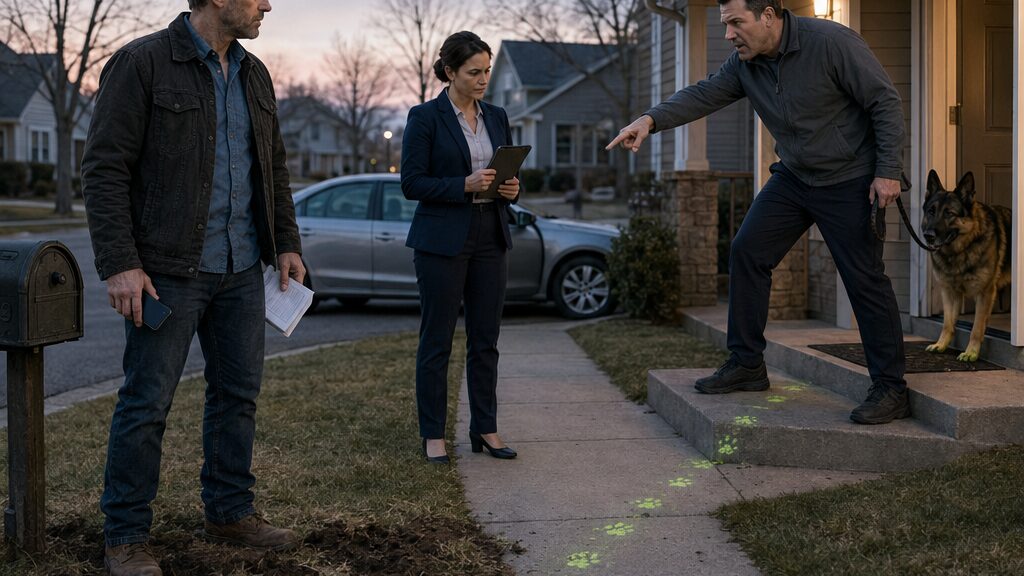
He Turned the Paw Prints Green, Then the HOA Put His Name on the Violation Notice
Chapter 1: The Dog Returned Before the Sprinklers Stopped
The German shepherd squatted beside Mark Harris’s mailbox while the sprinklers were still turning.
Mark stood ten feet away with a brass hose nozzle in one hand and a pair of pruning shears in the other. The sprinkler head clicked left, hissed across the lawn, then clicked back. Water darkened the dog’s coat along one flank. The dog did not move.
Neither did Gregory Miller.
Gregory walked behind it with his head lowered toward his phone, one hand looped loosely through the leash. The blue light from the screen reflected against his face. He wore running shoes and a light jacket, though he was moving too slowly to be exercising.
“Gregory.”
Mark’s voice cut through the mechanical rhythm of the sprinkler.
Gregory looked up, then looked down at the dog as if noticing where it was for the first time.
Mark set the shears on the driveway. “That’s the fourth time this week.”
Gregory glanced at the brown patch surrounding the mailbox post. “He’s almost done.”
“That isn’t the point.”
The dog finished and scratched backward, throwing two wet clumps of soil across the clean edge where Mark’s lawn met the sidewalk.
Gregory tugged once on the leash. “Come on.”
“Are you going to pick it up?”
Gregory checked his jacket pockets with a performance so thin Mark could see the answer before he spoke.
“Forgot a bag.”
“You forgot one yesterday too.”
“I’ll get it on the way back.”
“You didn’t come back yesterday.”
Gregory’s mouth tightened. He glanced toward the houses across the street, where porch lights still glowed in the gray morning. “Mark, it’s grass.”
Mark looked down at the Bermuda turf he had spent three years rebuilding from clay and contractor-grade seed. In October it had begun to lose some color, but the blades were still dense and even except for the mailbox strip. There, repeated urine and foot traffic had softened the soil and burned three pale crescents into the green.
“It’s my grass,” he said.
Gregory gave a short laugh with no humor in it. “That strip isn’t yours.”
Mark thought he had misheard him. “What?”
“The mailbox side. Between the walk and the curb. HOA-controlled.”
“The mailbox is inside my lot.”
“The maintenance strip isn’t.”
Gregory pulled the shepherd toward the sidewalk. The dog resisted long enough to sniff the damp patch once more.
Mark stepped closer. “Who told you that?”
“Laura.”
“Laura Sanchez?”
Gregory shrugged. “Community manager. She’d know.”
He walked away before Mark could ask anything else.
The sprinkler rotated behind Mark and sprayed his work boots.
For several seconds, he watched Gregory and the dog move toward the corner. Gregory’s phone came back up before he had passed the next driveway.
Mark shut off the water.
Inside the garage, he cleaned the mud from the lawn edge with a flat shovel. He scooped the waste into a grocery bag, tied it twice, then carried it to the trash bin. The work took less than three minutes. What stayed with him was Gregory’s certainty.
That strip isn’t yours.
Mark had bought the house nine years earlier. He remembered the survey stakes, the closing documents, the builder’s representative walking the property with a clipboard. He remembered being told that the homeowner maintained everything from the foundation to the curb, except for trees planted in the association easement. He did not remember anyone saying the land beside the mailbox belonged to the HOA.
At seven fifteen, before leaving for work, he opened the doorbell-camera application on his laptop.
The latest clip began at 6:08 a.m. Gregory entered from the left edge of the frame, eyes on his phone. The shepherd moved three feet onto Mark’s lawn and stopped near the mailbox. Gregory stood on the sidewalk without looking up.
The clip captured the entire exchange afterward, including Gregory’s claim about the strip.
Mark watched it twice.
On the third viewing, he noticed something he had missed outside. Gregory had a black plastic bag tied around the leash handle.
It was visible for four seconds before his sleeve covered it.
Mark paused the video and enlarged the frame. The image became grainy, but the knot and folded plastic were clear enough.
He saved a still image, then exported the full clip with the timestamp.
At work, the morning should have been consumed by a failed air-handling unit in an office building downtown. Instead, Mark kept hearing Gregory say Laura’s name.
He spent his lunch break searching the HOA portal on his phone. The declarations were available as scanned documents, most of them crooked and faint. The landscaping rules said owners were responsible for maintaining visible turf within their lot boundaries. Another section gave the association access to utility and landscaping easements but did not transfer ownership.
Nothing described a general “HOA-controlled strip.”
Mark submitted a complaint through the portal.
He attached the timestamped video, two photographs of the damaged grass, and a short statement asking for enforcement of the pet-waste rule. He kept the language plain.
Repeated entry onto privately maintained turf. Repeated failure to remove waste. Direct request made this morning. Resident claims management advised that the area is common property. Please confirm boundary responsibility and address the recurring violation.
Laura replied three hours later.
Thank you for your report. Based on the current information, management cannot confirm a violation occurred within an owner-maintained area. Please provide additional documentation showing an ongoing pattern. Neighbor-to-neighbor communication is encouraged.
Mark read the message while standing beside the failed air handler.
A younger technician asked whether the replacement belt had arrived.
Mark locked his phone. “Not yet.”
That evening, Jennifer came by with takeout. She found him kneeling at the mailbox with a six-foot measuring tape stretched from the curb to the lawn edge.
“You’re measuring grass now?” she asked.
“I’m measuring the lot.”
“That sounds healthier.”
He ignored the comment and held the tape steady while she stepped around him.
Jennifer was thirty, practical, and usually unwilling to indulge his silences. She set the food on the porch and came back outside.
“What happened?”
“Gregory’s dog again.”
“Did you talk to him?”
“Yes.”
“And?”
“He says this isn’t my property.”
Jennifer looked at the mailbox, the sidewalk, then the damaged patch. “Is it?”
“It was when I paid to resod it.”
“That wasn’t my question.”
Mark rolled up the tape too sharply, and the metal edge snapped against his palm. “Laura won’t act without more documentation.”
Jennifer studied him. “So what are you going to do?”
“Document it.”
“How much?”
“As much as it takes.”
She sighed, not because she disagreed about Gregory, but because she recognized the tone. Mark had used it during disputes at work, after supervisors dismissed warnings until equipment failed. Once he decided facts were being ignored, he stopped speaking to people as if they might still be persuaded. He began building files.
“You could ask for mediation,” she said.
“I asked him to pick up after his dog.”
“That isn’t mediation.”
“It shouldn’t require mediation.”
“No. It shouldn’t.” Jennifer picked up the takeout bag. “But don’t turn your whole house into a command center over six feet of grass.”
After she left, Mark returned to the laptop.
He created a folder on the desktop.
Inside it, he placed the video, the still image showing the unused bag, the photographs of the damaged turf, his complaint, and Laura’s response.
He named the folder with that morning’s date.
Before closing the laptop, he opened the camera settings and extended motion recording from thirty seconds to two minutes.
Outside, the sprinkler timer clicked on for the evening cycle.
Chapter 2: Twelve Mornings Recorded in a Silent Folder
On the twelfth morning, Gregory looked directly into Mark’s doorbell camera.
He did not wave. He did not turn away.
He stood on the sidewalk while the shepherd stepped across the sharp lawn edge, circled beside the mailbox, and lowered itself onto the grass. Gregory raised his phone, aimed it toward Mark’s house for a moment, then smiled.
The expression lasted less than a second.
Mark replayed it until the smile stopped looking accidental.
The folder on his laptop now held twelve dated subfolders. Each contained a video clip, a still image, and a short written note. Some mornings the dog left waste. Other mornings it urinated against the mailbox post or crossed the same weakened strip with muddy paws. Twice Gregory carried bags. Neither time did he use them.
Mark had also photographed the lawn every third day from the same angle. The pale crescents had widened into one irregular patch.
He printed the clearest images and arranged them across the dining table.
At the top of the first page, he wrote: Pattern of repeated entry and failure to remove waste.
At the top of the second: Boundary question unresolved.
He was adding timestamps when someone knocked.
Gregory stood on the porch alone.
Mark opened the door but did not invite him in.
“You recording my house now?” Gregory asked.
“The camera records my property.”
“It catches my driveway.”
“It catches the public sidewalk and my front yard.”
Gregory leaned slightly to see past him. His eyes moved toward the papers on the table. “You making a case file?”
“I’m documenting what Laura asked me to document.”
“That’s not normal.”
“Neither is bringing your dog to the same damaged patch twelve times.”
Gregory’s jaw worked before he answered. “You still don’t get it. That’s common ground.”
“Show me where it says that.”
“I don’t need to show you. Laura told me.”
“What exactly did she say?”
Gregory folded his arms. “She said the turf between the sidewalk and the curb falls under association maintenance jurisdiction.”
Mark repeated the phrase silently. It sounded less like Gregory’s language than something copied from an email.
“Maintenance jurisdiction isn’t ownership.”
“It means you don’t get to police it.”
“I’m not policing the curb. I’m asking you to control your dog.”
Gregory looked toward the street, then lowered his voice. “You make everything into a technical argument.”
“Because words mean things.”
“It’s a neighborhood, Mark. Not one of your mechanical rooms.”
The comment landed harder than Gregory could have known. At work, Mark had spent years being called difficult whenever he documented shortcuts. A leaking valve was “probably fine” until it damaged three floors. A vibration alarm was “too sensitive” until a bearing seized. People found his precision irritating right up to the moment they needed his records.
Gregory mistook Mark’s silence for surrender.
“Delete the clips with my house in them,” he said. “And stop taking pictures of me.”
“No.”
Gregory’s face changed. Not outrage—something closer to surprise that refusal could be so plain.
“You really want to make this ugly?”
“You already made it repetitive.”
Gregory stepped off the porch. “Laura was right about you.”
Mark watched him cross the lawn edge instead of using the walkway.
That afternoon, Mark drove to a landscape-supply store on the industrial side of town. He had spent the previous night researching temporary turf markers used for event layouts, irrigation testing, and athletic fields. He rejected anything oil-based, anything persistent, and anything that carried a hazard warning around animals.
The clerk showed him a concentrated fluorescent-green marker.
“Dilute it properly and it fades with watering and sunlight,” the clerk said. “Non-toxic once applied as directed. Don’t pour it straight. Don’t spray concrete unless you want to see it for a while.”
Mark turned the bottle over and read every line.
Safe for turf. Temporary. Water-based. Avoid ingestion of concentrate. Keep pets away during application until dry.
“How long before animals can cross it?”
“Once the treated grass is dry, it’s fine. Couple hours, depending on weather.”
Mark bought the smallest container, disposable gloves, and a narrow hand sprayer.
At home, he placed the bottle beside the printed evidence folder and photographed the label. He downloaded the safety sheet from the manufacturer’s website and printed that too.
He was measuring the dilution ratio when Jennifer entered through the kitchen door.
She stopped at the dining table.
“What is that?”
“A turf marker.”
Her gaze moved from the fluorescent bottle to the twelve folders. “Why do you have a turf marker?”
“To show the route.”
“The route of what?”
“The dog.”
Jennifer set her purse on a chair. “You’re going to dye Gregory’s dog?”
“No.”
“That is exactly what that sentence sounded like.”
“I’m treating a narrow section of my lawn. The dry residue transfers under pressure. Paw prints will show where he goes.”
“And where they go.”
“Yes.”
“Onto Gregory’s property.”
“If that’s where the dog walks.”
Jennifer stared at him. “Dad, this is retaliation.”
“It’s documentation.”
“It can be both.”
The words made him turn away.
He tightened the cap on the bottle and placed it upright.
“I checked the product. It’s non-toxic. Temporary. Used on athletic fields.”
“That doesn’t answer what I said.”
“He looked into the camera this morning.”
“So?”
“He knows. He’s doing it because he thinks no one will stop him.”
Jennifer came closer to the table. “And you think the only choices are letting him do it or setting a fluorescent trap?”
“It isn’t a trap.”
“You’re hiding it from him.”
“Because evidence doesn’t work if the person changes behavior only while being watched.”
“You already have twelve videos.”
“Laura asked for an ongoing pattern.”
“You have one.”
“She’ll say the location is disputed.”
“Then dispute the location.”
“I am.”
Jennifer touched the corner of the printed safety sheet. Her voice softened. “You’re not wrong about Gregory. That’s what worries me. You get so focused on proving you’re right that you stop noticing what it costs.”
Mark began stacking the photographs.
“I asked him twice.”
“I know.”
“I filed a complaint.”
“I know.”
“He was carrying bags.”
“I know.”
“He chose not to use them.”
Jennifer waited, but Mark did not continue.
“You should tell Laura what you plan to apply,” she said.
“She’ll warn him.”
“Then ask for mediation.”
“He doesn’t need a mediator to recognize a property line.”
“Maybe you do.”
He looked at her then.
She flinched, not from fear, but regret. “That came out wrong.”
“No. It came out clearly.”
Jennifer picked up her purse. “Don’t do this tonight.”
Mark said nothing.
She stood in the doorway for several seconds, giving him time to answer. When he did not, she left.
At eleven forty-eight, the street was empty.
Mark switched off the porch light and carried the hand sprayer to the mailbox. He had mixed only enough solution to cover a strip eighteen inches wide and six feet long. He wore gloves and kept the nozzle close to the grass.
Under the flashlight, the liquid looked almost clear as it settled onto the blades.
He sprayed once along the route visible in the recordings. No wider.
The border followed the damaged lawn edge, crossed no sidewalk, and ended well inside the line Mark believed belonged to him.
When he finished, he placed a small lawn-treatment flag near the driveway side, away from the dog’s usual approach. The association rules required temporary marking after chemical applications, and he obeyed that part carefully.
Back inside, he washed the sprayer, sealed the remaining concentrate, and added the product sheet to the folder.
At 12:17 a.m., he checked the camera view.
The treated grass looked ordinary.
Chapter 3: Green Paw Prints Crossed Every Claimed Boundary
The first paw print glowed beside the mailbox before sunrise.
Mark saw it through the living-room window at 5:42 a.m., a bright green shape suspended in the gray-blue light. For a moment he thought the color came from a reflection on the glass. Then he saw the second print two feet away.
He pulled on his boots and went outside with his phone.
The prints began inside the treated strip. Four clear impressions crossed the damaged turf, then angled toward the sidewalk. The front pair were larger and more defined. The back pair overlapped them in places, leaving bright smears where the shepherd had turned.
Mark photographed the first print from above, then crouched low and captured the lawn edge in the same frame.
The trail continued over the concrete.
The color was fainter there but unmistakable: green pads and claw marks stepping across the sidewalk, through the narrow grass strip on the other side, then up Gregory’s front walk.
Mark followed without stepping near them.
Each print answered one question and opened another.
The dog had crossed Mark’s lawn. It had also crossed the strip Gregory claimed belonged to the HOA. Then it had continued onto Gregory’s walkway, brightening again where moisture had gathered along the concrete.
The final prints ended on the dark fibers of Gregory’s welcome mat.
Mark stood at the bottom of the porch steps, phone raised, while the shepherd barked from inside.
The front door opened.
Gregory wore sweatpants and no shoes. He looked at Mark first, then down.
“What the hell is that?”
Mark took one final photograph before lowering the phone. “Your dog’s route.”
Gregory stepped onto the porch and stared at the mat. Under the porch light, the green impressions looked almost luminous.
“What did you put on my property?”
“I applied a temporary turf marker to my lawn.”
Gregory descended one step. “You put chemicals on my dog?”
“No. I treated grass. It dried hours before he crossed it.”
“You tracked it all over my walkway.”
“Your dog tracked it.”
“That’s your answer?”
“It’s what happened.”
Gregory bent and touched one print with his finger. A faint green mark came away on his skin.
He held it up as if Mark had burned him. “I’m calling Laura.”
“Call animal control too. I already prepared the report.”
Gregory’s eyes narrowed. “You’ve been waiting for this.”
“I’ve been waiting for you to stop.”
A car slowed at the curb.
The white vehicle carried the HOA management company’s logo on the door. Laura Sanchez parked behind Gregory’s SUV and stepped out holding a tablet.
Mark felt the timing before he understood it.
Gregory had called her before opening the door.
Laura walked toward them, taking in the prints, the phone in Mark’s hand, and Gregory’s stained finger.
“Mr. Harris,” she said. “Please step back onto your property.”
Mark looked at the walkway beneath his boots and moved to the sidewalk.
Gregory pointed at the mat. “He put fluorescent chemicals all over my house.”
“I did not apply anything to his property,” Mark said.
Laura raised one hand. “I need one person at a time.”
Her voice was calm, practiced, and already tired.
She photographed the mat, then the walkway. When she reached the sidewalk, Mark handed her the printed product sheet he had folded into his jacket pocket.
“What is this?” she asked.
“Manufacturer information. Water-based, temporary, non-toxic when used as directed. I applied it to a narrow section of my lawn after dark and kept the area undisturbed until dry.”
Laura scanned the first page. “Did you submit an exterior-treatment notice?”
“The rules require notices for pesticide, herbicide, and permanent color treatment. This is none of those.”
“Did you notify management?”
“No.”
Jennifer’s warning moved through his mind, unwelcome because it now had Laura’s voice.
Laura looked toward the lawn-treatment flag near Mark’s driveway. “You marked the application area.”
“Yes.”
“But not where a pedestrian or animal approaching from this direction would see it.”
“The marker was on my property. The dog was not supposed to enter it.”
Gregory made a sharp sound of agreement. “Exactly. This was a trap.”
Mark turned to him. “A trap would require me to bring your dog onto my lawn.”
“Mr. Harris,” Laura said. “Do not argue.”
He looked at her. “Then review the route.”
“I can see the route.”
“Not just the walkway. Start at the mailbox.”
Laura hesitated.
That hesitation told Mark she had arrived expecting contamination, not evidence.
He walked toward his yard, keeping several feet from the prints. Laura followed. Gregory came behind them, muttering under his breath.
At the mailbox, Mark showed her the first glowing impressions and the photographs on his phone. He swiped backward through the images in order: treated strip, lawn edge, sidewalk, opposite grass, Gregory’s walkway, welcome mat.
Then he opened the video folder.
“Twelve mornings,” he said. “Same location. Same route. Multiple failures to remove waste. Two recorded conversations. One written complaint.”
Laura held the phone but did not take it from him.
Gregory’s face had lost some color.
“He films everything,” Gregory said. “That doesn’t make the strip his.”
Laura looked down at the green prints crossing the grass between sidewalk and curb. “The association maintains this area.”
“Yesterday you said you couldn’t confirm the violation occurred within an owner-maintained area,” Mark said. “Today you’re treating dye carried across it as damage to private property.”
“I did not say private property.”
“You told me to step back onto mine.”
“That was to separate the parties.”
“Then tell me where mine ends.”
The quiet that followed was broken by the shepherd barking again from Gregory’s house.
Laura locked her tablet screen. “This is not the place for a boundary hearing.”
“It became the place when you refused to answer the complaint.”
Her expression tightened. For the first time, professional patience gave way to something more personal.
“You applied a fluorescent substance without management notice during an active neighbor dispute. Whatever your intention, that is escalation.”
“And twelve incidents weren’t?”
“We had not verified twelve incidents.”
“They’re on my phone.”
“Management has to review them.”
“I sent the first one two weeks ago.”
“You sent one clip and photographs of discolored grass.”
“You asked for a pattern.”
“And instead of submitting the additional material, you staged this.”
Mark heard Jennifer again: It can be both.
He did not answer quickly enough.
Laura saw the pause.
“I’ll need the product container, the dilution record if you have one, and the complete footage,” she said. “Do not wash the affected surfaces until management documents them.”
Gregory stepped forward. “What about my dog?”
Laura turned to him. “Keep the animal away from the area until we confirm the product information.”
Mark handed her the safety sheet. “It’s confirmed there.”
“I said until we confirm it.”
The distinction was small and deliberate. His documentation was now merely a claim. Her review would decide whether it became fact.
By eight thirty, an animal-control officer had visited both houses.
The officer watched three clips, photographed the damaged grass, and examined the product label. He found no sign that the shepherd had been harmed. He also asked Gregory whether he had removed the dog’s waste from Mark’s property.
Gregory said the location was common ground.
The officer wrote something on a form. “Common ground still has pet-waste rules.”
It was the first uncomplicated sentence Mark had heard all morning.
The officer issued no immediate fine but opened a complaint record and instructed Gregory to carry bags and keep the dog off maintained lawns where requested.
Gregory stood in his driveway with his arms crossed as the vehicle left.
Mark believed, for roughly four hours, that the matter had turned.
At 1:16 p.m., a new email arrived from the HOA portal.
Emergency Compliance Notice.
He opened the attached PDF.
The notice accused him of applying an unauthorized coloring agent during an active resident dispute, causing visible staining beyond his claimed parcel, creating a potential animal-contact hazard, and interfering with common-area appearance standards.
The photographs attached to it showed the green prints on Gregory’s walkway.
None showed where the trail began.
The notice required a written admission of application, a remediation plan, and payment for professional cleaning if stains remained after forty-eight hours. Failure to comply would trigger a daily fine.
At the bottom, beneath Laura’s electronic signature, a highlighted map marked the mailbox strip as association-maintained common landscape.
Mark enlarged the image.
The line ran through the middle of the damaged patch, then bent around his mailbox in a shape he had never seen on any closing document.
Jennifer arrived twenty minutes later after he sent her only the words: You were right about the notice.
She read the PDF at the dining table.
“You need to answer this carefully,” she said.
“I can prove every print started on my lawn.”
“That may not be enough.”
“The map is wrong.”
“Do you know that, or do you believe it?”
Mark opened the drawer where he kept the closing papers. He found the deed, the title policy, and a reduced copy of the original survey. The survey lines were faint and partly hidden beneath old staples.
He set it beside Laura’s highlighted map.
The two boundaries did not match.
Not by inches.
By several feet.
Jennifer leaned over the table. “Where did her map come from?”
Mark read the notice again.
A daily fine would begin Monday unless he signed the acknowledgment.
He looked at the glowing trail photographs, the recorded plat copy, and the line Laura had drawn through the grass he had maintained for nine years.
The dog had made Gregory’s path visible.
The violation notice had exposed something larger.
Chapter 4: The Violation Map Did Not Match the Deed
Laura Sanchez highlighted the mailbox strip in yellow and turned her monitor toward Mark as if the color settled the question.
“This is the association-maintained landscape area,” she said.
Mark remained standing. The chair in front of her desk was low and soft, the kind that made a visitor look smaller. He placed his closing survey beside the keyboard instead.
“I’ve never seen that map.”
“It’s the map management uses.”
“That doesn’t make it accurate.”
Laura folded her hands. Behind her, three framed certificates hung in an exact row. The office smelled faintly of printer toner and artificial citrus. A stack of violation envelopes sat near her elbow, each window showing part of a resident’s address.
“The association has relied on this maintenance diagram for years,” she said. “Your fluorescent treatment crossed the boundary shown here.”
“The dog crossed it.”
“The substance originated from your application.”
“On land I maintain.”
“Which is precisely what we are reviewing.”
Mark pointed to the line on her screen. It curved around his mailbox in an uneven hook, leaving a wedge of turf on the HOA side. His closing survey showed a straight property line extending nearly to the curb.
“Where did this diagram come from?”
Laura clicked the file information panel. “Community development records.”
“What year?”
Her eyes moved to the corner of the screen.
“Two thousand twelve.”
“My house closed in two thousand seventeen.”
“The development plan predates your closing.”
“So does the dirt.”
Laura exhaled through her nose. “Mr. Harris, I understand that you are frustrated.”
“No. You understand that I’m objecting.”
Her expression cooled. “The fine will remain active while the matter is reviewed.”
“You’re fining me based on a map you can’t explain.”
“We are fining you because you applied a coloring agent during an active resident dispute without notifying management and allowed it to transfer beyond your claimed parcel.”
“I didn’t allow anything. Gregory allowed his dog onto my lawn.”
“Your intent does not erase the effect.”
Mark opened the product folder and slid the safety sheet across her desk. “Animal control found no hazard.”
“Animal control does not interpret association covenants.”
“They interpreted the pet-waste rule.”
Laura’s fingers tightened over one another.
For a moment, neither spoke.
Then she softened her tone. “This is exactly why associations need consistent procedures. If every resident decides to conduct a private investigation using chemicals, cameras, or physical markers, management loses the ability to control escalation.”
“Consistent procedures would have addressed twelve incidents.”
“You did not submit twelve incidents before the application.”
“You asked for a pattern.”
“I asked for documentation, not a demonstration.”
The distinction was clean enough to sound reasonable. That was what bothered Mark most. Laura did not need to raise her voice or lie directly. She only had to separate each piece from the next until the pattern disappeared.
He tapped the highlighted strip. “Suspend the fine until the boundary is verified.”
“I cannot.”
“Won’t.”
“Cannot without board authorization.”
“Then put it before the board.”
“The next hearing is in nine days.”
“The daily fine starts Monday.”
“You may submit a written appeal. If the board rules in your favor, eligible charges can be reversed.”
Eligible.
Mark gathered his papers.
Laura looked at the closing survey. “You should also understand that even if the property line favors your interpretation, the unreported application may still constitute a notice violation.”
He paused.
That was the part Jennifer had warned him about, and Laura knew it.
Mark could challenge the map. He could not honestly claim he had given management a chance to review the plan before he acted.
“I understand,” he said.
It was the first answer that seemed to surprise her.
At the county records counter, the clerk examined Mark’s reduced survey through reading glasses and asked for the parcel number.
Mark gave it to her.
She searched the database, then disappeared through a door marked STAFF ONLY. The waiting area held metal chairs, a vending machine, and a bulletin board crowded with notices about floodplain updates and recording fees.
Mark sat with the violation map open on his phone.
He compared it again to the closing survey. The difference seemed obvious, but he had spent enough years around mechanical failures to know that obvious was not the same as proven. A misaligned belt looked simple until a bent shaft appeared. A wet ceiling tile suggested a leak directly above until water had traveled twenty feet along a pipe.
The clerk returned carrying a large sheet rolled inside a cardboard sleeve.
“This is the most recent recorded plat affecting your parcel,” she said. “There was a boundary clarification filed after the original development plan.”
“What year?”
“Two thousand sixteen.”
One year before Mark bought the house.
She spread the plat across the counter and weighted the corners with tape dispensers.
The line was straight.
It ran from the front corner marker toward the curb, passing east of the mailbox post. Most of the damaged grass, including the entire treated strip, lay inside Mark’s parcel.
The association’s hooked boundary did not appear anywhere.
Mark placed his phone beside the plat and photographed the two maps together.
“Can I get a certified copy?”
“You can. There’s a fee.”
“I need the filing history too.”
The clerk looked at him over her glasses. “Dispute?”
“HOA.”
Her expression did not change, but she pulled a second request form without being asked.
While the copies were being prepared, Mark studied the notation near the lower edge of the plat. The clarification had corrected several front-lot easements after utility boxes and mail clusters were relocated during construction.
His mailbox sat beside one of those revised easements.
When he returned home, Jennifer was waiting at the dining table with her laptop open.
“I called the management office,” she said.
Mark stopped in the doorway. “Why?”
“To ask how appeals work.”
“I know how they work.”
“You know how to argue. That isn’t always the same thing.”
He set the certified plat on the table.
Jennifer unrolled it carefully. “This is different.”
“It’s recorded. The HOA map isn’t.”
“So you were right about the line.”
“Mostly.”
She looked up. “Mostly?”
“The treatment was inside my parcel. But Laura’s right about one thing. I didn’t notify them.”
Jennifer leaned back. “You’re admitting that now?”
“I’m not admitting the fine is valid.”
“That isn’t what I asked.”
Mark removed his jacket and hung it over the chair. “I should have sent notice.”
The words felt heavier than they deserved. Not because the mistake was large, but because saying it removed the clean shape he had given the dispute in his own mind.
Jennifer closed one browser tab and opened another. “Then say that at the hearing.”
“If I give them one violation, they’ll use it to avoid the map.”
“Only if you let them.”
“How do I stop them?”
“By not pretending you did everything perfectly.”
He looked at the twelve folders stacked near the laptop.
Jennifer turned her screen toward him. “I searched the resident portal for older compliance decisions involving front landscape strips.”
Three scanned notices were open side by side.
One involved a resident fined for replacing turf with gravel beside a mailbox. Another charged an owner for irrigation damage on a strip the HOA called privately maintained. The third ordered a homeowner to restore sod along a curb because the area was “within owner responsibility.”
Each property sat along the same phase of the development.
Each notice used the old hooked maintenance map.
Mark read the dates.
All three had been issued within the past eighteen months.
Jennifer clicked the document properties. “Laura signed every one.”
Mark looked from the recorded plat to the prior fines.
The map was not simply wrong.
It had been used in different ways, depending on which interpretation supported enforcement.
Jennifer opened a fourth file: a board meeting agenda from six months earlier. One line under management updates read: Review pending—front easement map reconciliation.
She pointed to it.
“They knew there was a problem.”
Mark enlarged the line until the letters blurred.
The question was no longer where his lawn ended.
It was how many decisions Laura had made after learning the line might be false.
Chapter 5: Gregory Finally Explained Why He Never Apologized
Gregory came across the sidewalk carrying a roll of black dog-waste bags.
For a second, Mark thought the gesture was meant as mockery. Then Gregory tore one bag free and tied the roll around the leash handle.
The shepherd stood beside him, restless but kept close.
“Can we talk?” Gregory asked.
It was Saturday morning, three days before the board hearing. Mark had been kneeling beside the mailbox with wooden stakes and mason’s string, comparing the certified plat measurements against the physical lawn edge.
He remained crouched. “You’re standing on my side of the line.”
Gregory looked down at the string. “That’s what this is about?”
“That’s what you said it was about.”
Gregory shifted the leash to his other hand. “Not out here.”
He nodded toward his open garage.
Mark followed, leaving the stakes in place.
The garage was cleaner than he expected. Tools hung on a pegboard. Storage bins were labeled by season. A folding chair had been set beside Gregory’s workbench, but Mark stayed standing.
The shepherd lay near the door.
Gregory closed the garage halfway, enough to block the view from the street without shutting out the light.
“I spoke to Laura,” he said.
“I assumed you had.”
“She says you’re pulling county records.”
“I pulled my property record.”
“She says you’re trying to make this into something bigger.”
“It became bigger when she used the wrong map.”
Gregory rubbed the back of his neck. “Look, I’ll keep the dog on the other side from now on.”
Mark waited.
“I’ll clean the damaged patch too.”
“That’s not an answer.”
“It’s an offer.”
“To what?”
Gregory looked toward the dog. “You drop the board appeal. We stop all this.”
“The fine is in my name.”
“She’ll remove it.”
Mark studied him. “She told you that?”
“She said it could be resolved informally.”
“With what terms?”
Gregory did not answer.
Mark took out his phone.
Gregory’s face hardened. “Don’t record me.”
Mark left the phone in his hand but did not open the camera. “Then speak clearly.”
For several seconds, only the faint scrape of the dog’s nails against concrete filled the garage.
Gregory lowered his voice. “Laura told me the strip was association property before you ever complained.”
“When?”
“Last spring.”
“Why were you asking?”
“Because you told me to keep the dog off it then too.”
Mark remembered the exchange. Gregory had laughed, raised one hand, and kept walking. Mark had treated it as the first minor incident, not worth documenting.
“What exactly did she say?”
“She said the association maintained the curbside areas and that you couldn’t claim exclusive use.”
“That isn’t the same as permission to leave waste.”
“I know that.”
The admission came so quickly Mark almost missed it.
Gregory looked irritated with himself.
Mark folded his arms. “Then why did you keep doing it?”
“Because every time you came outside, you talked to me like I was one of your contractors.”
“I asked you to pick up after your dog.”
“You pointed at the grass and started listing dates.”
“Because there were dates.”
“You always have a file. A measurement. A rule.” Gregory’s voice sharpened, then dropped again. “You make people feel like they’ve already failed an inspection.”
Mark looked past him at the pegboard, each tool outlined by an empty hook when removed.
“You label your storage bins,” he said.
“That’s different.”
“Why?”
“Because I’m not using them to prove someone else is careless.”
The answer landed close enough to truth that Mark did not dismiss it.
Gregory rubbed his thumb across the leash handle. “You asked reasonably the first time.”
Mark said nothing.
“I should’ve picked it up.”
The words were not an apology. They were narrower, safer.
“But then Laura told me not to concede the boundary,” Gregory continued. “She said if I admitted the dog was on your parcel, you’d use it against the association.”
Mark’s attention sharpened. “She said that?”
“Not in those exact words.”
“What words?”
“She said management was reviewing the easement issue and residents shouldn’t make statements that could establish private control.”
“Residents?”
“Me.”
The dog lifted its head.
Gregory looked toward the half-open garage door. “She said the map question affected other cases.”
There it was.
Not a secret friendship. Not influence. Fear.
Laura had not protected Gregory because he mattered more than Mark. She had protected an interpretation.
Gregory had accepted that protection because it excused what he already wanted to do.
“Tell the board,” Mark said.
Gregory shook his head immediately. “No.”
“You want me to drop the appeal, but you won’t repeat the reason you think I should.”
“I’m not getting dragged into an association records fight.”
“You’re already in it.”
“I’m offering to fix your lawn.”
“You’re offering to repair the part you denied was mine.”
Gregory’s mouth tightened.
Mark stepped toward the garage opening.
“Wait,” Gregory said.
Mark turned.
“I meant what I said. I’ll keep him across the street.”
“And the hearing?”
“I’m not speaking.”
“Then nothing you said here helps anyone but you.”
Gregory’s face reddened. “You want me humiliated in front of the neighborhood.”
“No. I want the truth in the room where the decision gets made.”
“You already have your documents.”
“This part isn’t in a document.”
Gregory looked at the shepherd, then at the black bags tied to the leash.
“You think because you finally put bags on there, the last two weeks disappear?” Mark asked.
“No.”
The answer was quiet.
Mark’s anger shifted. It did not lessen, but it lost some of its simplicity.
Gregory was not unaware. He had known from the beginning that Mark’s request was reasonable. Pride had made him dismiss it. Laura’s ambiguity had given that pride cover. Now he wanted peace without exposure.
Mark stepped out into the morning.
Behind him, Gregory said, “She’ll erase your fine.”
Mark stopped but did not look back.
“What does she want me to sign?”
Gregory did not answer.
The email arrived that afternoon.
Laura’s subject line read: Proposed Administrative Resolution.
The attachment offered to withdraw the fluorescent-treatment fine, close the pet-related complaint without further action, and classify the mailbox strip as pending review.
In exchange, Mark would agree that the dispute had been resolved privately, release the association from claims connected to prior boundary representations, and refrain from distributing management records or discussing the matter in an open meeting.
Jennifer read the document twice.
“She’s offering you exactly what you wanted at the start,” she said.
“No more dog. No fine.”
“And no correction.”
Mark looked through the window toward the mailbox strip. The mason’s string still ran between the wooden stakes. Gregory had walked the shepherd on the opposite sidewalk that afternoon.
The practical problem had already stopped.
Jennifer rested her hand on the printed agreement. “You could sign it.”
“I know.”
“You wouldn’t be wrong to protect yourself.”
“I know.”
“But?”
Mark tapped the clause releasing the association from prior boundary claims.
“Those other fines stay in place.”
Jennifer closed her eyes briefly. “Then you need to decide what this is about now.”
Mark looked at the neat stack of evidence, the fluorescent photographs on top, the green trail bright against the concrete.
At first, he had wanted one neighbor to admit where the dog had walked.
Laura’s agreement asked him to accept that the truth could remain private as long as his own name was cleared.
He picked up the pen.
Then he drew one line through the signature page and wrote: Declined. Please place the boundary records and enforcement history on the open-hearing agenda.
He scanned the page before he could change his mind.
Chapter 6: Mark Put His Own Mistake Into the Record
Laura displayed the photograph of Gregory’s glowing welcome mat before Mark had taken his seat.
The image filled the portable screen at the front of the clubhouse meeting room. Against the dark fibers, the green paw prints looked harsher than they had at dawn—less like evidence and more like contamination.
Laura stood beside the projection table.
“This photograph,” she said, “shows the result of an unreported fluorescent substance applied during an active neighbor dispute.”
Mark remained near the back wall with Jennifer. Twelve folding chairs faced the board table. Two neighboring homeowners sat in the first row. Gregory occupied a chair near the aisle, hands clasped between his knees.
The HOA board president adjusted the microphone. “Mr. Harris will have an opportunity to respond.”
Laura changed slides.
The next photograph showed a green print on Gregory’s concrete path. The frame was tight enough to exclude Mark’s yard.
“Management’s concern,” she continued, “is not limited to property boundaries. Residents cannot independently introduce substances intended to track or expose another resident’s behavior.”
Jennifer leaned toward Mark. “She’s making the intent the violation.”
Mark opened his binder.
He had arranged the material in the order Jennifer suggested, not the order he preferred. His instinct had been to begin with the plat and force Laura to defend the map. Jennifer had told him that would make everything afterward sound like evasion.
Start with what you did, she had said. Don’t make them pull it out of you.
The board president called his name.
Mark walked to the front and placed the fluorescent product container on the table beside the safety sheet.
“I applied it,” he said.
Laura’s head turned slightly.
Mark kept his eyes on the board.
“I diluted a temporary water-based turf marker and sprayed a narrow section of grass near my mailbox. I applied it after midnight. I marked the area on the driveway side, but I did not notify management beforehand.”
The room became still.
“I believed the rule did not require notice because the product was not a pesticide, herbicide, or permanent color treatment. That was too narrow an interpretation during an active dispute. I should have notified management.”
Gregory looked up.
Laura stopped touching the tablet in front of her.
Mark continued. “I will accept a reasonable notice penalty for that decision. I will not accept the claim that I treated Gregory Miller’s property, created an animal hazard, or caused the underlying conflict.”
The board president glanced toward Laura. “Management verified the product?”
“Yes,” Laura said. “It is classified as temporary and non-toxic when used according to the manufacturer’s directions.”
The answer weakened her opening image without Mark having to challenge it.
He placed the first photograph on the document camera.
The screen changed from Gregory’s welcome mat to the damaged grass beside Mark’s mailbox.
“This is where the trail began.”
He advanced through the images in sequence. Green prints crossed the lawn edge, the sidewalk, the curbside strip, and Gregory’s walkway. The final welcome-mat photograph now appeared as the end of a route rather than an isolated act.
Then Mark showed the twelve timestamps.
He did not play every clip. He played three: the first clear incident, the morning Gregory carried an unused bag, and the twelfth morning when he looked into the camera.
The board president asked, “Were these submitted to management?”
“The first incident was submitted. Management requested documentation of an ongoing pattern. I collected it but applied the marker before submitting the full set.”
Laura spoke before the president could respond. “That is the escalation management has consistently identified.”
“Yes,” Mark said. “That was my mistake.”
The lack of argument left her with nowhere to push.
Mark removed two maps from his binder.
Laura’s maintenance diagram appeared on the left side of the screen. The certified county plat appeared on the right.
Across both, Jennifer had helped him mark the locations of the glowing prints with small numbered circles.
“The association map places the mailbox strip outside my parcel,” Mark said. “The recorded plat filed in two thousand sixteen places most of the damaged and treated area inside it.”
Laura shifted in her chair. “Maintenance jurisdiction can extend beyond recorded ownership.”
“I understand. But the violation notice did not rely only on maintenance jurisdiction. It treated the same area as outside my claimed parcel when the dye crossed it and as owner responsibility in at least three prior enforcement cases.”
Jennifer handed him copies of the earlier notices.
The board president read the first one, then passed it down the table.
Laura’s voice remained controlled. “Those cases involved different physical conditions.”
“They used the same diagram.”
“Management was applying the records available at the time.”
Mark placed the six-month-old meeting agenda under the camera. The line about boundary-map reconciliation appeared on the screen.
“When did management first receive notice that the diagram might conflict with the recorded plat?”
The board president turned to Laura.
She looked at the agenda, then at Mark. “The issue was preliminary.”
“When?”
“Earlier this year.”
“Before these three fines?”
Laura did not answer immediately.
The delay altered the room.
One of the neighboring homeowners in the first row whispered to the other.
The board president repeated the question. “Ms. Sanchez?”
Laura straightened a stack of papers. “Management received a copy of the recorded clarification approximately eight months ago. We postponed implementation because applying it without a full survey review could create inconsistent obligations and expose the association to challenges involving prior decisions.”
There was no gasp, no dramatic movement. Just the sound of the projector fan and a chair creaking near the wall.
The explanation made sense in the worst possible way.
Laura had been afraid that correcting the map would destabilize earlier enforcement. So she had continued using the map that might be wrong.
“You were trying to avoid conflicting rulings,” Mark said.
“Yes.”
“By continuing to issue them.”
Laura’s face tightened. “By preserving the existing standard until counsel and the board completed review.”
“Was Gregory told not to admit the strip was part of my parcel?”
Gregory’s clasped hands separated.
Laura looked toward him. “I advised residents not to make private boundary representations while review was pending.”
“That isn’t what I asked,” Mark said.
The board president raised one hand. “Mr. Miller, did management tell you the area was association-controlled?”
Gregory looked at Laura.
She did not nod. She did not speak. But the years of easy certainty between them seemed to vanish from his expression.
“I was told Mark couldn’t claim exclusive use,” he said.
“Were you told not to acknowledge that your dog entered his parcel?”
Gregory rubbed his palms against his jeans. “Not like that.”
Mark felt the hearing slipping toward the same careful ambiguity that had protected everyone so far.
He closed his binder.
“I’m not asking the board to pretend I handled this perfectly,” he said. “I should have submitted the twelve clips before I applied anything. I should have notified management, even if I believed the rule was unclear. I was angry, and I wanted proof Gregory couldn’t dismiss.”
Gregory looked at him again.
Mark turned toward him rather than the board.
“But the first time I asked you, I asked you to use a bag and keep the dog off the grass. Was that reasonable?”
The question was quieter than everything that had come before it.
Gregory swallowed.
“Yes.”
“Did you know the dog was crossing the area I maintained?”
“Yes.”
“Why didn’t you stop?”
Gregory stared at the floor.
Laura said, “The resident should not be pressured into—”
“I knew Laura said the boundary was under review,” Gregory said.
She stopped.
He continued without looking up. “She said admitting it was Mark’s would complicate the association’s position. I used that. I kept telling myself he was making too much of it.”
The board president leaned toward the microphone. “Did Ms. Sanchez tell you management would protect you from enforcement?”
“No. Not exactly.”
“What exactly?”
Gregory’s face reddened. “She said the pet complaint couldn’t be established as a private-property violation while the boundary was disputed.”
“And the waste?”
Gregory looked toward the projected image of the damaged grass.
“That part was on me.”
The words did not absolve him. They did something more useful: they placed responsibility where the maps could no longer move it.
The board recessed for twenty minutes.
No one spoke to Mark in the hallway. Jennifer stood beside him near the vending machine, shoulder almost touching his.
“You gave them the notice violation,” she said.
“It was mine.”
“You could’ve lost the whole appeal.”
“I know.”
She looked through the clubhouse window at the dark line of lawns beyond the parking lot. “You didn’t.”
When the board returned, the president read from a handwritten motion.
All fines connected to disputed front-easement boundaries would be suspended. An independent survey and document review would begin within ten business days. Prior cases relying on the maintenance diagram would be reopened. Pet-waste enforcement would proceed separately from boundary classification.
Mark’s fluorescent-treatment fine would also be suspended, except for a possible limited notice charge to be determined after review.
Laura sat very still.
The board president looked toward Mark. “This is not a final ruling.”
“I understand.”
The gavel came down once.
The sound was small, but it changed every active notice Laura had tried to keep separate.
By the time Mark left the clubhouse, the map problem no longer belonged only to his mailbox strip.
Chapter 7: The New Boundary Line Left No One Cheering
The landscaping contractor pulled the first wooden stake from the ground and held it up beside the mailbox.
“This one’s wrong,” he said.
Mark stood on the driveway with his hands in his jacket pockets. Six weeks had passed since the hearing, but the yellowed patch around the mailbox still looked like a bruise against the wintering lawn. The green dye had faded after three rains. Only a faint line remained in one crack of Gregory’s walkway, visible when the concrete was wet.
The contractor checked the survey tablet mounted on a tripod, moved three feet toward the curb, and drove a new marker into the soil.
The corrected line ran almost exactly where Mark’s closing survey had shown it.
Not where Laura’s map had put it.
Across the street, Gregory walked the German shepherd on a short leash. A black bag roll swung from the handle. The dog glanced toward Mark’s lawn, but Gregory guided it forward without stopping.
Mark watched until they reached the corner.
The practical problem had ended before the review was complete. Gregory had changed his route the morning after the board hearing and had not crossed Mark’s lawn since. That should have been enough to make the waiting easier.
It had not.
During the review, every official message had used careful language. Preliminary finding. Document inconsistency. Pending reconciliation. No one wrote that the association had enforced a false boundary after learning it might be wrong. No one wrote that Mark had been right.
Then the final packet arrived.
Jennifer brought it over unopened because the envelope had been delivered to her house by mistake. She placed it on the dining table where the fluorescent bottle had once stood.
“You want me to stay?” she asked.
Mark looked at the thick envelope. “You drove all the way here.”
“That isn’t an answer.”
He pulled out a chair for her.
The first page summarized the review. The recorded 2016 plat controlled the parcel boundaries. The association’s maintenance diagram had never been updated after the easement clarification. Eleven prior enforcement actions required reconsideration.
Three residents would receive full reversals and refunds. Five notices would be corrected without reimbursement because no fines had been paid. The remaining cases involved separate violations unaffected by the boundary error.
Laura Sanchez had submitted her resignation effective the previous Friday.
Mark read that sentence twice.
There was no explanation attached to it.
Jennifer turned the page. “Here.”
Mark followed her finger.
His emergency fluorescent-treatment fine had been withdrawn. The cleaning charge was canceled. The pet-waste complaint against Gregory had been sustained, with a written warning and a standard first-offense assessment.
Below that, a separate administrative notice remained against Mark for failure to notify management before applying a transferable marking substance during an active resident conflict.
The amount was $75.
Mark sat back.
Jennifer watched him carefully. “That’s not much.”
“It’s not nothing.”
“You said at the hearing you’d accept a reasonable notice penalty.”
“I said I’d accept one if the rule applied.”
“And?”
Mark read the paragraph again. The review had concluded that the existing language was ambiguous but that a general nuisance provision gave management limited authority to require notice when an application could affect adjacent surfaces.
“They changed the basis,” he said.
“They narrowed it.”
“They found a way to keep something on me.”
Jennifer closed the packet.
“Dad.”
He looked at her.
“Do you think you deserved no consequence?”
The answer rose immediately and stopped behind his teeth.
He remembered applying the dye after midnight. He remembered placing the treatment flag where Gregory would not see it. He remembered Jennifer asking him not to proceed and his decision to say nothing because silence was easier than being challenged.
“No,” he said.
Jennifer waited.
“I think I deserved this one.”
The admission did not feel like defeat. It felt smaller and less satisfying than victory, but cleaner.
He signed the acknowledgment and paid the $75 online.
The HOA office reopened the following Monday under temporary management. The glass door still carried Laura’s name in removable vinyl lettering, though two letters had begun to peel at the edge.
Mark went in to collect copies of the corrected map and the reversed enforcement notices.
The board president met him at the counter.
“We’re revising the complaint process,” the president said. “Boundary disputes will be separated from conduct violations. No more using one to delay the other.”
“That should have happened before.”
“Yes.”
The answer contained no defense.
The president handed Mark a folder. “The board also approved consistent pet-waste enforcement for all maintained areas, regardless of ownership classification.”
Mark opened the folder. The new rule was one page. It did not mention him, Gregory, fluorescent dye, or the hearing. It simply required handlers to remove animal waste immediately and respect direct requests to keep animals off privately maintained turf.
A rule that could have prevented everything now existed because everything had happened.
“Laura thought she was protecting the association,” the president said.
Mark looked up.
“She believed admitting the map error without a full review would expose us to claims we couldn’t manage.”
“She kept using it.”
“Yes.”
“Did the board know?”
“Not the extent of it.”
“That isn’t the same as not knowing.”
“No,” the president said. “It isn’t.”
Mark closed the folder.
Outside, the winter sun reflected off the clubhouse windows. He had imagined this moment differently during the weeks before the hearing. In some versions, Laura admitted she had been wrong. In others, Gregory apologized in front of the board. Sometimes Mark pictured the prior residents thanking him.
None of those things happened.
The corrected map was folded under his arm. That was what he had.
The following Saturday, Gregory appeared beside the mailbox carrying a square of fresh sod.
He set it on the sidewalk before crossing onto Mark’s driveway.
“I checked first,” he said.
Mark looked at the sod. “With whom?”
“The contractor. He showed me the new markers.”
Gregory wore work gloves. The shepherd was not with him.
“What are you doing?”
“That patch is partly mine.”
“Most of it isn’t.”
“I know.”
Gregory lifted the sod again. “I said I’d fix it.”
Mark stepped aside.
They cut out the dead turf together. Gregory used a flat shovel while Mark trimmed the edges with a soil knife. Neither worked quickly. The damaged area had spread beneath the surface, and they had to remove more soil than the green discoloration suggested.
Gregory broke the silence first.
“I got the warning.”
“I saw.”
“And the fee.”
Mark pressed the new sod into place. “Then you saw more than I did.”
Gregory gave him a brief look. “It was less than yours.”
“That seems right.”
They continued working.
After several minutes, Gregory said, “I shouldn’t have kept bringing him over.”
Mark waited for the rest.
No full apology came.
Gregory tamped down one corner of the sod with his palm. “You asked me normally the first time.”
“I did.”
“I made it worse.”
“Yes.”
The blunt answer made Gregory’s mouth tighten, but he did not argue.
When the patch was finished, he gathered the ruined turf into a contractor bag. At the sidewalk, he stopped beside the new survey marker.
“Laura told me she was trying to keep the neighborhood from turning into lawsuits,” he said.
“She tried to keep the map from turning into refunds.”
“Probably both.”
Mark considered that.
“Probably,” he said.
Gregory nodded once and carried the bag home.
The new sod was a slightly different shade from the rest of the lawn. Mark could have replaced a wider section to make the repair invisible. He had enough tools in the garage and enough experience to blend it by spring.
Instead, he left the square as it was.
For the next week, he watered it by hand.
On Sunday morning, Jennifer found him adjusting the sprinkler heads near the driveway.
“You’re moving them?” she asked.
“Two degrees.”
“Of course you are.”
He loosened the collar on the nearest head and rotated the nozzle away from the curb. The revised pattern stopped just inside the confirmed property line. It no longer sprayed the disputed strip or reached the sidewalk.
Jennifer stood beside the mailbox and looked at the new marker.
“Does that feel better?”
Mark activated the test cycle.
The sprinkler rose with a soft click. Water swept across the lawn, reached the straight edge, and turned back without crossing it.
“More accurate,” he said.
“That wasn’t my question.”
He watched the repaired patch darken.
For years, the lawn edge had been proof of what he could control: the soil, the irrigation, the clean division between his work and everyone else’s neglect. Gregory’s dog had crossed it as if the line meant nothing. Laura had moved it on paper whenever the rules required a different answer. Mark had responded by making the path impossible to ignore.
But the corrected line did not restore the lawn to what it had been.
It did not erase the twelve mornings, the hearing, the $75 notice, or the silence between him and Jennifer after he ignored her warning. It did not turn Gregory into a considerate man or Laura into a simple villain.
It only told the truth about where responsibility began.
Mark shut off the test cycle.
Jennifer touched the top of the mailbox post. “Lunch?”
He looked toward the house. The dining table inside was clear now. The evidence folders had been moved to a cabinet rather than left open in the center of the room.
“I’ll make something,” he said.
“You don’t have to turn it into a project.”
“No measurements?”
“None.”
They walked toward the porch.
At the corner, Gregory appeared with the shepherd. The leash was short. The black bags were tied to the handle.
The dog looked toward the repaired patch.
Gregory guided it across the street without being asked.
Mark did not reach for his phone.
Behind him, the sprinkler timer clicked, ready for its new schedule. The next cycle would cover only the land that was his to maintain, then stop at the honest line.
The story has ended.