My Neighbor Used My Gravel Lot for Months—Then the HOA Claimed It Wasn’t Mine
Chapter 1: The Truck Returned After Midnight Again
Headlights swept across Michael Adams’s bedroom wall at 12:17 a.m., cutting through the blinds in two pale bands before sliding away.
He lay still for a moment, listening.
Gravel crackled behind the garage. A diesel engine idled low, then coughed twice before shutting off. A door slammed. Metal clanged against metal.
Michael pushed back the sheet and crossed to the window. Through the narrow gap in the blinds, he could see the rear corner of a white work truck settling onto the gravel strip behind his property. Its right taillight glowed red for a few seconds, then went dark.
The strip looked like nothing from the street. Twenty feet wide, edged by a cedar fence on one side and a row of scrub pines on the other, it had once served as construction access when the subdivision was built. Most neighbors treated it as leftover ground.
Michael had paid $9,200 for it eighteen months earlier.
The deed was in a manila envelope in his kitchen drawer.
He watched a broad-shouldered figure walk away between the houses. Ryan Scott lived three doors down. His HVAC company name was printed in fading blue letters along the truck’s side, though the last word had begun to peel.
Michael returned to bed, but sleep did not.
By morning, a dark stain had spread beneath the truck’s engine. It was round and glossy, nearly the size of a dinner plate.
Michael crouched beside it with his coffee cooling in one hand. He pressed a finger to the edge of the stain, then wiped the oil onto a paper towel.
The truck had been there four nights that week.
He had told himself each time that Ryan might be dealing with a temporary problem. A broken driveway. A delivery. A customer emergency. Michael had built a career estimating delays and allowances for other people’s construction projects. He knew that circumstances rarely arrived neatly.
But the oil changed the calculation.
He wrote a note at his kitchen table.
Ryan—
This gravel parcel is private property. Please do not park your truck or leave equipment here. The truck is leaking oil, and I need the area kept clear.
Thank you,
Michael Adams
He read it twice, removed the sentence about towing, and folded the paper once.
That evening, he tucked it beneath the driver’s-side windshield wiper.
The next night the truck did not come.
Michael felt embarrassed by how relieved he was.
On the second night, it returned at 11:43.
On the third, Michael stepped through his back gate and nearly tripped over a rusted transmission lying beside the fence. It was heavy enough to have crushed the gravel beneath it. Brown fluid had seeped from one end into the stones.
He stood there staring at it while a sprinkler clicked somewhere beyond the houses.
This was no longer a misunderstanding.
He walked around the truck, reading the faded lettering.
SCOTT HEATING & AIR.
The commercial plate was mud-spattered but visible. A plastic bin of copper fittings sat in the truck bed beside two dented refrigerant cylinders.
Michael took out his phone and photographed the transmission, the stain, the truck, and the plate.
He still did not call anyone.
The last time his family had argued over property, lawyers had written letters for nearly a year. His father’s small lot outside Dayton had become a measuring stick for every resentment between Michael and his brother. By the end, neither man cared what the land was worth. They only cared who would surrender first.
Michael had promised himself he would never become that kind of person.
The next morning he carried the note’s carbon copy across the street and waited near Ryan’s driveway.
Ryan came out wearing a stained tan work jacket and carrying a thermos. He stopped when he saw Michael.
“Morning,” Michael said.
Ryan looked toward the gravel strip, then back at him.
“I need you to move the truck,” Michael said. “And the transmission.”
Ryan’s mouth tightened in something that was not quite a smile.
“That strip isn’t hurting anybody.”
“It belongs to me.”
Ryan shifted the thermos to his other hand. “It’s been open since this place was built.”
“I purchased it with the house package.”
“You purchased weeds and rocks?”
“I purchased the parcel.”
Ryan gave a short laugh through his nose. “I’m there at night. Gone before most people wake up.”
“It’s leaking oil.”
“I’ll throw some gravel over it.”
“That isn’t the point.”
Ryan crossed his arms. For one second, Michael thought he might apologize. Instead, Ryan spat into the grass near the curb.
“You work from home, right?” Ryan said. “So you’re watching the neighborhood now?”
Michael felt heat rise into his face. “I’m asking you not to use my property.”
Ryan walked past him toward the truck parked in his own driveway.
Michael turned. “The note was polite.”
Ryan opened his door without answering.
That afternoon Michael found the note torn cleanly in half and wedged into the latch of his back gate. One side had been smeared with engine grease. When he pulled the pieces free, the oil blackened his thumb and forefinger.
He stood with the halves in his palm.
The handwriting was still readable. Please do not park. Private property. Thank you.
The words looked weaker now, not because they were wrong, but because he had expected them to do the work for him.
He carried the pieces inside and placed them on the kitchen table.
At six, Ryan knocked on his front door.
Michael opened it only halfway.
Ryan kept one boot on the porch step. “I heard you went around taking pictures.”
“I photographed my property.”
“You’re making this bigger than it is.”
“You left a transmission against my fence.”
“It’ll be gone.”
“When?”
Ryan looked over Michael’s shoulder toward the kitchen, as if the answer might be somewhere inside.
Then he said, “Sandra already said that strip is for service vehicles.”
Michael’s grip tightened on the edge of the door.
“Sandra Green?”
“The property manager.” Ryan’s expression settled into confidence. “So before you start threatening people, maybe check with your HOA.”
He stepped off the porch and walked away.
Michael watched him cross the street. Then he shut the door, went to the kitchen drawer, and pulled out the manila envelope containing the deed.
Chapter 2: The Map Everyone Trusted Was Wrong
Sandra Green’s email arrived at 8:06 the next morning.
The subject line read: NOTICE OF NUISANCE AND ACCESS OBSTRUCTION.
Michael opened it standing at the kitchen counter, the manila deed envelope beside his coffee.
The notice stated that he had “interfered with customary service access” and placed personal objections on a vehicle using “an association-recognized utility lane.” It instructed him not to block or restrict the gravel strip until the board reviewed the matter.
He read the message twice.
Then he laughed once, without humor.
The truck was still parked there. The transmission still leaned against his fence.
Michael scanned the deed and attached it to his reply.
Sandra,
The gravel strip is not association property or a utility lane. It is Parcel 14-B, recorded in my name. Please withdraw the notice and instruct Ryan Scott to remove his vehicle and equipment.
He added the county recording number, then deleted three sharper sentences before sending it.
Sandra called eleven minutes later.
Her tone was controlled and professional. “I received your document.”
“Then you can see the property is mine.”
“I can see that you sent me a deed page.”
“It has the recording stamp.”
“The association has a site plan showing that area as shared service access.”
“A site plan doesn’t override a deed.”
“I didn’t say it did.”
“You sent me a violation.”
“I sent you a temporary compliance notice because there is a dispute.”
“There isn’t a dispute about who owns it.”
“There appears to be.”
Michael looked through the kitchen window. Ryan was loading a tool case into the truck.
“What exactly do you need?” Michael asked.
“A board review.”
“How long?”
“Our regular meeting is in three weeks.”
“The truck is leaking oil now.”
Sandra paused. “You may want to place an absorbent pad under it.”
Michael closed his eyes.
“You’re telling me to maintain someone else’s commercial truck on my land.”
“I’m telling you to prevent further property damage while ownership and access are reviewed.”
“The ownership is recorded.”
“Customary use can create separate questions.”
That phrase stayed with him after the call ended.
Customary use.
It gave habit the sound of law.
Michael drove to the county recorder’s office that afternoon with the envelope on the passenger seat. He could have ordered everything online, but he wanted a person behind a counter to look at the record and tell him what he was missing.
The recording clerk entered the parcel number and turned her monitor slightly.
“There,” she said. “Transfer recorded eighteen months ago. Taxes current.”
“Any easement?”
She scrolled. “No recorded access easement across the parcel. Utility easement runs along the eastern six feet, but that’s underground service. It does not authorize vehicle storage.”
“Could an HOA map make it shared?”
“Not by itself.”
She printed the parcel history and the recorded plat. Michael paid the copy fee and carried the pages to a bench beneath fluorescent lights.
The county map showed a clean boundary around the gravel strip. Parcel 14-B connected directly to the rear of his main lot. The old construction access ended at the property line.
His certainty should have brought relief.
Instead, it sharpened his suspicion.
When he arrived at the HOA office, Sandra was standing behind a counter with a stack of maintenance invoices. She wore a navy cardigan and reading glasses on a chain. Nothing about her suggested conspiracy. She looked tired.
Michael placed the county map beside the HOA site plan she had emailed him.
The differences were small until he traced them with his finger.
On the county plat, the service lane stopped before his parcel.
On the HOA map, the shaded lane continued through the entire gravel strip to the rear utility boxes.
Sandra glanced from one to the other.
“This is the map we inherited from the developer,” she said.
“It’s wrong.”
“It may be outdated.”
“It shows land I own as common access.”
“It shows a service route used by contractors.”
“That doesn’t make it legal.”
Sandra removed her glasses. “Mr. Adams, the association has landscapers, utility workers, and drainage crews who have used that route for years.”
“Not since I bought it.”
“You never notified us that you intended to restrict access.”
“I didn’t know I had to notify the HOA that I planned to control my own parcel.”
Her expression hardened slightly. “You also didn’t install a gate across the gravel or post a private-property sign.”
“So ownership depends on decoration?”
“No. But expectations matter in a community.”
Michael heard the sentence the way he had heard Ryan’s: weeds and rocks.
Appearance had become permission.
He tapped the deed. “Withdraw the violation.”
“I can’t do that until the board reviews both documents.”
“Then note in writing that I dispute it.”
“I already have.”
He gathered the papers.
As he turned, Sandra said, “Long community use may create rights you aren’t considering.”
Michael stopped.
“Are you giving me legal advice?”
“No.”
“Then don’t make it sound like a threat.”
For the first time, Sandra looked uncertain. “I’m trying to prevent this from escalating.”
“It already has.”
Outside, an older woman stood beside the bulletin board, reading a landscaping notice. Michael knew her by sight from two streets over.
She looked at the papers under his arm. “That the gravel strip behind your garage?”
Michael hesitated. “Yes.”
“I’m Kathleen Walker.”
He knew the name then. She had served on a county records committee years earlier.
Michael showed her the two maps.
Kathleen held them side by side against the hood of his car. She studied the legend, the line weights, and the small block of text in the lower-right corner of the HOA copy.
“Where did Sandra get this?” she asked.
“She said it came from the developer.”
Kathleen tapped the printed date.
“This isn’t a recorded plat.”
“She called it a site plan.”
“It’s a preliminary construction exhibit.” Kathleen traced the shaded lane with one finger. “See this notation? ‘Proposed access subject to final dedication.’”
Michael leaned closer.
The words were faint but readable.
“What does that mean?”
“It means the developer considered dedicating it. It doesn’t mean the county accepted it.”
“Then why would the HOA still use it?”
Kathleen folded the map carefully. “That’s the question.”
She looked toward the office door.
“This drawing should have been replaced before the first homeowner took title.”
Michael slid the county record into the manila envelope. Before closing it, he placed the two grease-stained halves of his torn note inside.
The paper left a faint black mark across the deed copy.
Kathleen noticed.
“What happened to that?”
“My neighbor answered me.”
She looked at the note, then at Michael.
“Documents can tell you where the line is,” she said. “They can’t make people respect it.”
Michael sealed the envelope.
That evening, instead of writing another complaint, he opened a blank spreadsheet and created four columns: date, time, vehicle, activity.
At the top he typed Parcel 14-B.
Chapter 3: Sixteen Nights Recorded Beneath One Pine
At 2:13 a.m., the wildlife camera recorded Ryan and his son unloading two metal tool chests from the truck.
Michael watched the footage the next morning in his home office. The image was grainy and colorless, but the timestamp was clear. Ryan moved quickly, glancing twice toward Michael’s house. His son, thin and long-limbed, struggled with one end of the heavier chest.
Ryan stopped to adjust his grip.
For a moment, he rested a hand on the boy’s shoulder.
Then they carried the chest behind the truck and set it beside Michael’s fence.
Michael paused the video.
He had installed the camera on the pine tree after checking the angle three times. It captured only the gravel parcel and the inside face of his own fence. He had not wanted to turn surveillance into another kind of trespass.
Now the still image on his monitor showed a father and son working in darkness on land they had been told not to use.
Michael entered the date and time into his spreadsheet.
Night nine.
By the end of the second week, he had eleven overnight parking entries, one equipment dump, and four new oil stains. Ryan had begun leaving the truck later in the morning, sometimes until ten or eleven.
Sandra’s temporary notice remained active.
Her emails had become shorter.
The matter is under review.
Please avoid direct confrontation.
The association expects all owners to act cooperatively.
Michael printed each message and clipped it behind the torn note inside the manila envelope.
On night twelve, the camera captured Ryan dragging a refrigerant cylinder from the truck bed and leaving it beside the transmission. On night thirteen, he leaned against the fence and relieved himself near the corner post.
Michael watched that clip only once.
The insult was almost absurd enough to be funny. It was also deliberate. Ryan looked toward the camera’s pine tree before turning away, though Michael could not tell whether he had seen it.
He saved the file and added a factual line to the log.
2:31 a.m.—individual entered parcel and urinated against interior fence post.
No adjectives.
No anger.
The discipline steadied him.
On the sixteenth night, Ryan’s son appeared again. This time the boy carried a folded tarp and a box of filters. When one corner of the box split, filters spilled into the gravel.
Ryan crouched and helped gather them. The boy said something the camera could not record. Ryan sat back on his heels and covered his face with one hand.
Michael leaned closer to the screen.
The posture lasted only a few seconds. Then Ryan stood, slapped dust from his knees, and pointed toward the truck.
It was not the posture of a man who believed himself untouchable.
It was the posture of a man running out of places to put things.
That afternoon Michael searched the business name on the state licensing site. Scott Heating & Air held an active contractor license. The business address matched Ryan’s house.
The commercial vehicle registration matched the truck.
Michael called the city’s small-business compliance desk without giving Ryan’s name. He asked general questions.
Could a residential address serve as an HVAC operating yard?
Only under limited conditions.
Could commercial vehicles and equipment be stored on another residential parcel?
Only with the owner’s consent and proper zoning.
What if refrigerant cylinders and mechanical components were being kept outdoors?
That could trigger fire, environmental, and zoning review.
The clerk directed him to an online zoning map. Ryan’s lot was residential, with no home-occupation permit listed. The gravel parcel was also residential and had no approved commercial-storage use.
Michael sat back.
Until then, his evidence had been about his property. The commercial registration changed the scale of the problem. Ryan was not simply parking badly. He appeared to be operating part of his business from two residential lots without approval.
One report could bring code enforcement, fire inspection, insurance questions, and possibly a licensing review.
It could also shut down Ryan’s work before his son finished helping unload the next box.
Michael closed the browser.
At five that evening, Ryan’s son walked past the house carrying a backpack. He glanced toward the gravel strip, then lowered his head.
Michael remembered himself at that age, carrying lumber for his father on Saturdays and pretending not to hear arguments about bills.
He disliked that the memory mattered.
It did not make the oil disappear. It did not restore the crushed gravel or remove the transmission. It did not excuse the torn note.
But it made the idea of pressing one button feel less clean.
Kathleen came by after dinner. Michael showed her the log, the parcel record, and the zoning information.
“You have enough to force action,” she said.
“I know.”
“You don’t sound pleased.”
“I wanted him to move the truck.”
“And now?”
“Now I know what moving it might cost.”
Kathleen studied him. “That isn’t the same as what his choices cost.”
“No.”
“But?”
Michael looked through the back window. The white truck sat beneath the pine shadows.
“But I waited.”
“You asked him.”
“I waited before that. I bought the parcel and never told the HOA. Never posted it. Never corrected the map.”
Kathleen’s mouth tightened. “You weren’t required to advertise ownership.”
“That isn’t what I said.”
She was quiet.
Michael opened the manila envelope. He removed the torn note and placed the two pieces on the desk. The grease had transferred onto several pages behind it, leaving dark fingerprints across Sandra’s emails.
Kathleen touched the edge of one half.
“You thought being reasonable meant staying private,” she said.
“I thought if I made it public, it would turn into a fight.”
“And now it is one.”
Michael stacked the camera stills by date.
The following morning he called code enforcement. He gave the parcel number, truck registration, business name, dates, and description of stored materials. He emailed the deed, photographs, and log.
The inspector who returned his call spoke in a careful, neutral tone.
“We’ll need access to inspect the parcel.”
“I’ll provide it.”
“Is there an active HOA dispute?”
“Yes.”
“That may affect access claims, but not the zoning review.”
“When will you come?”
“Tuesday morning.”
Michael wrote the time down.
At 3:42 that afternoon, Sandra emailed an emergency hearing notice to the neighborhood. The subject was DISPUTED SERVICE ACCESS AND OWNER CONDUCT. The hearing would take place Tuesday at nine, beside the gravel strip, so board members could view the area.
Michael stared at the screen.
The inspection was scheduled for eight-thirty.
Sandra had arranged the hearing within the same half hour, either by coincidence or because someone at the city had contacted her.
At the bottom of the notice was one sentence addressed directly to him:
Mr. Adams is requested to bring any document he believes establishes exclusive ownership.
Michael printed the email and clipped it behind the torn note.
Then he looked through the window at Ryan’s truck, the leaking stain beneath it, and the narrow path where Ryan’s son had carried the tool chest.
By Tuesday morning, Michael would have to decide whether to show the neighborhood only the deed—or everything else he had found.
Chapter 4: Bring the Deed If It Exists
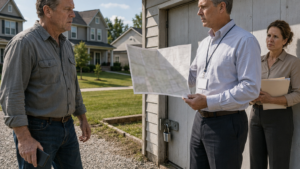
The two code-enforcement inspectors arrived while Sandra Green was still reading Michael’s violation aloud.
Their white city vehicle stopped beside Ryan’s truck at 8:37 Tuesday morning. One inspector stepped out carrying a tablet. The other walked directly toward the oil-darkened gravel beneath the engine.
Sandra lowered her papers.
“This hearing is scheduled for nine,” she said.
The lead inspector glanced at his watch. “Our inspection is scheduled for eight-thirty.”
Ryan stood near the truck with his arms folded. His tan work jacket had been replaced by a clean company shirt, but the collar curled at one side. His son was nowhere in sight.
Michael remained beside his back gate, holding the sealed manila envelope.
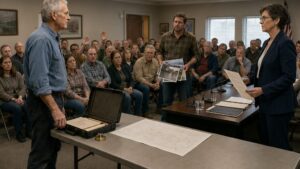
Nearly twenty neighbors had gathered along the sidewalk and driveway edges. Some had come because the HOA notice described a disputed service lane. Others had come because a city vehicle made any suburban disagreement feel official.
Sandra cleared her throat.
“We can coordinate,” she said. “The association also needs to establish whether Mr. Adams has interfered with a commonly used access route.”
The lead inspector looked toward Michael. “You’re the complainant?”
“Yes.”
“And the recorded owner?”
“Yes.”
Ryan gave a short, disbelieving laugh. “That’s what he keeps saying.”
Michael did not answer him.
The second inspector photographed the transmission beside the fence, then crouched near one of the older stains. He pushed aside the upper layer of gravel with a gloved hand. The stones underneath were darker.
Sandra resumed reading.
“The association’s position is that the gravel lane has historically served contractors, utility personnel, and maintenance vehicles. Mr. Adams has issued private directives that may obstruct necessary community access.”
Michael listened until she finished.
Then Ryan said, loudly enough for the neighbors to hear, “Show them the deed if it exists.”
A few people shifted closer.
Michael walked toward the truck.
Ryan moved half a step into his path. The lead inspector looked up, and Ryan stopped.
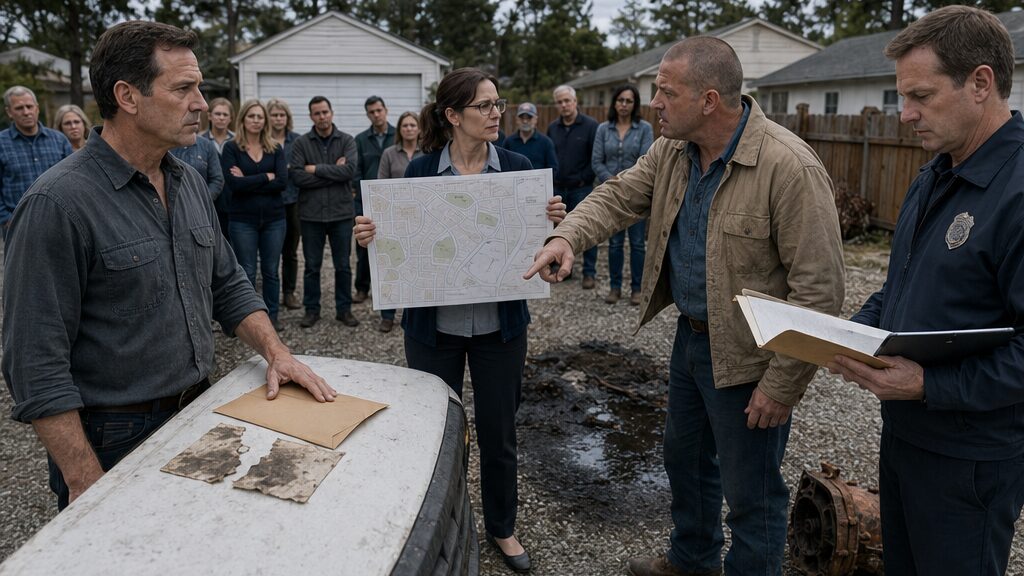
Michael placed the manila envelope on the truck’s hood. He opened it and removed the county plat, the recorded deed, his tax record, and the two halves of the torn note.
The grease-stained paper lay against the white paint.
Ryan’s expression changed when he recognized it.
Michael did not look at him. He turned to the lead inspector.
“The parcel number is highlighted on the deed and the county plat. Would you read it aloud?”
The inspector examined the recording stamp first. Then he compared the legal description with the county printout.
“Parcel 14-B,” he said.
Michael pointed toward the small metal survey marker beside the pine line. “And the truck is parked inside that boundary.”
The inspector consulted the map on his tablet. “According to the county GIS layer, yes.”
The words moved through the gathered neighbors more effectively than any argument Michael could have made.
Someone near the curb whispered, “So it really is his.”
Ryan uncrossed his arms.
Sandra stepped closer. “The association has a conflicting plan.”
Michael looked at her. “A preliminary construction exhibit.”
“That interpretation has not been formally reviewed.”
“The county clerk reviewed the ownership.”
“Ownership and access are separate questions.”
Michael felt the familiar urge to let the papers speak for him. It had always seemed safer than raising his voice. Documents could not lose their temper. They could not say something impossible to retrieve.
But silence had already been interpreted as consent.
“I should have told the association when I bought the parcel,” he said.
Several neighbors looked at him.
Michael continued before he could retreat into the envelope again.
“I assumed the recorded transfer was enough. I saw contractors cross the strip twice and said nothing because they were there for utility work. I didn’t post a sign. I didn’t install a gate across the gravel. That allowed people to keep believing it was common property.”
Ryan seized on the admission.
“So you let everybody use it.”
“I allowed limited access by not objecting. I did not give you permission to park a commercial truck there every night, leak oil, or dump equipment.”
“You never cared until now.”
“I left you a note.”
Michael touched one grease-stained half.
“You tore it up.”
Ryan’s eyes moved toward the watching neighbors. “I was told the strip was association access.”
“Before or after the note?”
Ryan did not answer.
The lead inspector stepped between them without making the motion seem dramatic.
“We’re not determining intent,” he said. “We’re documenting land use, storage, and possible contamination.”
Sandra opened a folder and removed a color copy of the HOA map.
The shaded service lane ran directly through Parcel 14-B.
“This is the map distributed to residents and contractors,” she said. “Mr. Scott’s use was consistent with that designation.”
The board president, standing near the mailbox cluster, nodded. “That’s the plan we’ve always used.”
Kathleen Walker appeared at the edge of the group carrying a slim accordion file. She did not approach Michael immediately. She studied the map in Sandra’s hand.
Ryan pointed at it. “There. That’s what I’m talking about.”
Michael’s ownership had been confirmed, yet the relief lasted less than a minute. The HOA map gave Ryan something his arrogance alone had lacked: a paper explanation that other people recognized.
Sandra handed the map to the inspector.
“We advised Mr. Scott that service vehicles had historically used the lane,” she said.
Ryan turned toward Michael. “She told me I could park there.”
Sandra’s head moved sharply. “I said the lane was recognized for service access.”
“You said the HOA would handle him if he complained.”
“I did not say that.”
“You said his deed didn’t change customary use.”
Sandra’s face went still.
The neighbors no longer watched Michael. They watched her.
The lead inspector raised a hand. “Verbal permission from an association would not authorize commercial storage on privately recorded land. It may be relevant to responsibility, but it does not resolve compliance.”
The second inspector returned from the fence.
“There are at least five areas requiring soil testing,” he said. “Possibly more beneath the truck.”
Ryan stared at the gravel.
“How expensive?” he asked.
“We don’t estimate remediation costs.”
“Can I move the truck now?”
“Not until we finish documenting the site.”
Ryan’s jaw tightened. “I’ve got calls today.”
Michael saw the shift in him then. The confidence did not vanish; it fractured. Behind it was calculation—customers, invoices, perhaps the boy who had carried filters in the dark.
Sandra gathered her papers as if placing them in order could restore control.
“The association will convene a closed review of the mapping discrepancy,” she said.
“No,” Kathleen said.
Her voice was not loud, but it stopped Sandra.
Kathleen stepped forward and opened her accordion file.
“This drawing was never recorded,” she said. “It was a proposed dedication exhibit. The final plat removed the lane from this parcel.”
Sandra’s eyes narrowed. “You don’t have standing in this matter.”
“I’m a homeowner, and you distributed a false boundary map to homeowners.”
“It is an outdated administrative document, not a false statement.”
Kathleen looked toward Michael. “Did you email your deed to the association after you purchased the strip?”
Michael frowned. “I sent it with my exterior-fence request. Eighteen months ago.”
Sandra said nothing.
Michael remembered the application. He had proposed replacing the rear fence and attached the parcel deed because the fence crossed the old lot line. The board had approved the work with a minor condition. He had assumed that meant the records were updated.
Kathleen removed a printed archive index.
“The submission appears in the digital log,” she said. “Deed attachment, parcel 14-B.”
She pointed to the entry.
“Board packet number forty-seven.”
Sandra looked down at it.
Kathleen opened the corresponding packet.
The application was there. The fence sketch was there. The approval was there.
The deed was missing.
Michael looked from the empty attachment line to Sandra.
“Who removed it?”
Sandra closed the folder in Kathleen’s hands.
“This hearing is adjourned pending legal review.”
No one moved.
On the truck hood, the torn note fluttered beside the deed, held in place by Michael’s fingertips.
Ownership had been the question everyone came to settle.
Now it was the easiest part.
Chapter 5: The Record That Disappeared Before the Vote
The settlement draft required Michael to describe the trespass as “an informal access misunderstanding.”
He read the phrase three times at Sandra’s conference table.
The HOA office was small enough that he could hear the printer warming in the next room. Sandra sat opposite him, hands folded beside a yellow legal pad. The board president occupied the chair at the end.
Under the proposed agreement, the association would withdraw Michael’s violation, arrange surface gravel replacement, and pay him $4,800. In return, he would release the HOA from future claims, surrender copies of his camera footage, and refrain from publicly discussing “internal mapping inconsistencies.”
The torn note was specifically listed among the materials to be transferred.
Michael tapped that line.
“You want the note?”
Sandra’s posture remained composed. “We want all evidence connected to the dispute preserved in one confidential file.”
“You mean removed from mine.”
“That is not what it says.”
“It says I surrender the original.”
The board president leaned forward. “Mr. Adams, this offer makes you financially whole without dragging every resident into legal expense.”
“It calls months of trespassing a misunderstanding.”
“The map created genuine confusion.”
“The note did not.”
Sandra’s eyes dropped briefly to the table.
Michael pushed the draft back.
“What happened to my deed attachment?”
The printer clicked in the next room.
Sandra looked toward the board president, but he did not speak for her.
“I removed it from the packet,” she said.
Michael had expected denial. The direct answer unsettled him more.
“Why?”
“Because your fence request was already approvable from the survey sketch.”
“That doesn’t explain removing a recorded deed.”
Sandra exhaled slowly.
“When I reviewed the attachment, I realized the parcel boundary did not match the service-access map we had used for years. I brought it to the previous board president.”
“And?”
“He said correcting the map would require reviewing every contractor entry, drainage visit, and maintenance use across that strip.”
“That sounds necessary.”
“It also raised liability questions. The association had authorized work vehicles to cross private land. There were insurance implications.”
“So you buried it.”
“I deferred it.”
“For eighteen months.”
Her voice sharpened. “I manage four communities. At that time this association was facing a failed retaining wall, a reserve shortfall, and a threatened lawsuit over roof assessments. Your gravel strip had no gate, no sign, and no active complaint.”
“It had an owner.”
“Yes.”
The single word carried no apology.
Sandra looked tired rather than triumphant. That did not make the choice smaller.
“When Ryan asked about parking,” Michael said, “what did you tell him?”
“I said the map showed service access and that the board had not recognized exclusive restrictions.”
“You knew the map conflicted with my deed.”
“I knew there was an unresolved discrepancy.”
“And you let him rely on the wrong version.”
“I did not authorize dumping or oil leakage.”
“No. You only told him I couldn’t stop him.”
Sandra’s mouth tightened. “I told him disputes had to go through the association.”
Michael stood.
The board president slid the agreement toward him again. “Take forty-eight hours.”
“I don’t need forty-eight hours to reject this wording.”
“You may need it to consider the alternative. Code enforcement could issue orders against Mr. Scott, but contamination responsibility may remain disputed. You could spend months recovering cleanup costs.”
Michael looked at Sandra.
“You’re still trying to make silence cheaper.”
“No,” she said. “I’m trying to prevent one mistake from becoming five lawsuits.”
That afternoon, Ryan came to Michael’s house alone.
Michael almost did not open the door. Then he saw that Ryan was not wearing his company shirt. He held the torn-note envelope Sandra had given him—a copy, not the original.
“I heard they offered you money,” Ryan said.
Michael stayed inside the doorway. “Who told you?”
“Does it matter?”
“Yes.”
Ryan rubbed a hand over his closely shaved head. “Sandra said they’re trying to settle.”
“They’re trying to erase.”
Ryan looked toward the gravel strip. The truck had been moved temporarily to the city inspection yard, but the transmission remained tagged beside the fence.
“My yard lease ended six weeks ago,” Ryan said.
Michael waited.
“The owner sold the property. New guy gave us ten days. Every other contractors’ yard wanted first month, last month, and a deposit.”
“That did not make my parcel yours.”
“I know.”
The admission landed quietly.
Michael studied him. “You knew?”
“I knew you probably had something. Nobody carries a deed number around unless they’ve checked.”
“You told people Sandra gave you permission.”
“She told me the HOA map backed me.”
“That is not permission.”
“It was enough for me to keep working.”
Ryan looked down at his hands.
“I had three commercial installations under contract. Payroll was due Friday. My son’s been helping because I let one technician go. I thought I needed a month. Then another month.”
“You could have asked.”
Ryan gave a bitter smile. “After you came across the street with that careful voice? You’d already decided what kind of man I was.”
Michael felt the accusation find a place he did not want to examine.
“I asked you to stop.”
“You did.”
“And you tore up the note.”
Ryan’s shoulders dropped.
“That was wrong.”
Michael said nothing.
“I was mad,” Ryan continued. “Not at you. At the yard, the bank, everybody telling me what I couldn’t afford. You put a polite note on the windshield like I was some stranger dumping trash.”
“You were dumping equipment.”
Ryan flinched.
“I’m sorry about the note,” he said. “And the fence post.”
Michael’s expression must have changed, because Ryan looked away.
“I saw the camera afterward.”
“That apology does not cover the damage.”
“No.”
It was the first thing Ryan had said without defense attached.
Ryan stepped back from the porch.
“If they suspend the permit, I lose the three jobs. If I lose those, I can’t pay cleanup. I’m not asking you to forget it.”
“What are you asking?”
“Don’t ask them to shut me down before I can fix it.”
After he left, Michael sat at his dining table with the settlement draft, the camera log, and the grease-stained note.
The note had once represented restraint. Then humiliation. Now Sandra wanted it hidden, and Ryan wanted time.
Michael could expose everything and still end with an oil-soaked parcel and an insolvent neighbor.
His phone rang at 6:20.
It was the lead inspector.
“We completed our preliminary review,” he said. “The business appears to be operating without an approved storage yard. Because regulated equipment was stored at the residential site, we can pursue emergency permit suspension.”
Michael looked at the torn note.
“Is that automatic?”
“No. The city can issue a correction schedule if the affected property owner agrees and immediate hazards are removed.”
“And if I request suspension?”
“We can move on it tomorrow.”
Michael heard Ryan’s words again: Don’t ask them to shut me down before I can fix it.
The inspector waited.
“Mr. Adams,” he said, “do you want us to seek emergency suspension of the business permit?”
Chapter 6: Justice Was More Expensive Than Revenge
The board president offered Michael full reimbursement before the clubhouse doors opened to the neighborhood.
“Cleanup, new gravel, fence repair, legal review,” he said. “The association will cover all of it.”
Michael stood at the end of the folding table. Sandra sat beside the board’s attorney with a closed binder in front of her. Ryan waited against the far wall.
“There’s one condition,” Michael said.
The board president did not deny it.
“The corrected parcel map can remain an internal administrative revision,” he said. “There is no need to characterize prior use as wrongful.”
“You want to pay me and keep the same map.”
“We want to avoid alarming homeowners over a technical discrepancy.”
“It is not technical when you issue violations from it.”
The president lowered his voice. “If we formally admit administrative error, the insurer may raise premiums for every homeowner.”
“So the residents pay more because the board made a mistake.”
“The association is the residents.”
Michael looked at Sandra. Her face was pale under the fluorescent lights.
“And Ryan takes all the blame?” he asked.
The attorney answered. “Mr. Scott’s conduct exceeded any reasonable interpretation of service access.”
“That is true.”
“Then the simplest resolution is to treat his actions separately.”
Michael opened the manila envelope.
He removed the torn note and placed both halves on the table.
The grease marks had faded to brown.
“Simple for whom?” he asked.
When the meeting opened, every chair was filled. Neighbors stood along the walls. The inspectors sat near the rear with their files. Ryan’s son waited outside the glass doors, pretending to look at his phone.
The board president summarized the dispute in procedural language. He described inconsistent records, unauthorized storage, and environmental review. He did not say that Sandra had removed Michael’s deed.
When Michael’s turn came, he carried the note to the small lectern.
His prepared statement was folded in his pocket.
He did not take it out.
“I own Parcel 14-B,” he began. “The county record establishes that. Ryan used it without permission, damaged it, and continued after I asked him to stop.”
Ryan looked down.
“The association also used an outdated map after receiving my deed. Sandra removed that deed from a board packet because correcting the map would have created cost and liability.”
Murmurs moved through the room.
Sandra’s hands tightened around a pen.
Michael held up the torn halves.
“This was my first attempt to solve the problem. I wrote a note. I expected the note to do what I was unwilling to do publicly.”
The room became quieter.
“I purchased the parcel eighteen months ago. I did not notify neighbors. I did not insist that the HOA correct its map. I saw limited contractor use and stayed silent because I did not want another property fight.”
Kathleen watched from the second row.
“My silence did not give Ryan permission. It did help preserve the false assumption that the strip belonged to everyone.”
The admission cost him more than reading the deed had. Ownership had been easy. This was not.
The board president shifted in his chair.
Michael continued.
“Ryan’s business should not escape consequences. The HOA should not shift all responsibility onto him. And I will not sign an agreement that calls deliberate choices a misunderstanding.”
He placed the note on the table.
“But I am also not requesting emergency suspension tonight.”
Ryan looked up.
The lead inspector leaned forward.
Michael turned toward him. “Can the city use a correction schedule if all hazardous materials are removed immediately, the truck moves to an approved yard, and a binding cleanup agreement is signed?”
“Yes,” the inspector said. “Subject to deadlines and verification.”
The board attorney opened his binder.
Michael outlined the terms.
Ryan would remove all equipment within twenty-four hours. He would relocate the truck to a permitted contractors’ yard and provide proof within ten days. He would pay an agreed share of remediation through scheduled installments.
The HOA would withdraw Michael’s violation, correct and distribute the parcel map, disclose the administrative error to its insurer, and fund the remaining cleanup through applicable coverage.
If either party failed, Michael would support full enforcement.
The board president stared at him. “You prepared this with counsel?”
“No.”
“You understand the association cannot accept liability casually.”
“You already offered to pay everything if I stayed silent.”
A few people turned toward the president.
Sandra closed her eyes briefly.
The insurance representative, seated near the attorney, spoke for the first time.
“If the association acknowledges an administrative mapping error, the policy may cover investigation and a portion of remediation. It would require cooperation and corrective action.”
The board president looked at Sandra.
She said, “The premium may increase.”
“Will you lose your job?” Michael asked.
Her eyes met his.
“I might.”
It was not an answer designed to win sympathy. It sounded like a fact she had carried alone.
“I thought I could correct it later,” she said. “After the retaining-wall claim. After the reserve review. Then Ryan asked about the lane, and admitting the deed existed would have meant admitting I had already delayed.”
She looked toward the neighbors.
“I chose the map that protected the association in the moment.”
“And harmed me,” Michael said.
“Yes.”
Ryan pushed away from the wall.
“I chose it too,” he said. “Because it was cheaper than asking Michael and hearing no.”
His son was visible beyond the glass doors now, watching.
The board attorney drafted changes by hand. Ryan’s payment schedule would begin after thirty days. The association would issue the corrected map within two weeks. Soil testing would start immediately.
When the agreement reached Michael, he aligned the torn halves of the note. From his pocket he removed a short strip of clear tape and joined them across the back.
The repaired page remained crooked.
He placed it beside the agreement.
Ryan signed first.
His hand paused over the final line.
“I need thirty days before the first payment,” he said. “Three jobs are already under contract. Let me finish them, and I can keep payroll current.”
The inspector looked at Michael.
The room waited for him to decide whether mercy would become another form of silence.
“Thirty days,” Michael said. “The truck moves now. The equipment moves now. The payment starts after the third job closes.”
Ryan nodded.
“If you miss it,” Michael added, “I will not wait another month to say so.”
“I understand.”
Sandra signed the map-correction provision. The board president signed the insurance disclosure. Michael signed last.
No one applauded.
Chairs scraped. People gathered their papers. The inspectors left with copies of the agreement.
Outside, Ryan’s son stood beside the clubhouse entrance. Ryan touched the boy’s shoulder as they walked toward the parking lot.
Michael remained by the table.
Kathleen approached and looked at the repaired note.
“You kept the boundary,” she said.
“I nearly let other people define it for me again.”
“But you didn’t.”
Michael folded the note once and returned it to the manila envelope.
Through the open clubhouse doors, Ryan stopped beside his truck and looked back.
“The contractors’ yard can take me next week,” he said. “Until then, I can park at the city inspection lot.”
Michael nodded.
Ryan held up his copy of the agreement.
“Thirty days.”
“Thirty days,” Michael said.
It was not trust.
It was a deadline both men had finally spoken aloud.
Chapter 7: The Gate Closed on Different Terms
The excavator’s bucket lifted the last layer of oil-darkened gravel and exposed another black stain beneath it.
Michael stood behind the temporary orange barrier while the environmental contractor climbed down from the machine. The man pressed a metal probe into the soil, checked the reading, then shook his head.
“We need another eighteen inches,” he said.
Ryan, standing beside a stack of clean gravel bags, went still.
“How much more?” he asked.
The contractor gave him the same answer the inspector had six weeks earlier.
“I don’t estimate on site.”
Ryan looked toward Michael, but Michael kept his attention on the hole.
The original agreement had covered surface removal and limited soil treatment. The contamination had traveled deeper where the truck’s front axle had rested night after night. Freshly exposed earth smelled sharp and metallic.
Sandra arrived carrying an insurance folder and wearing work shoes instead of her usual office flats. She stopped at the barrier.
“The adjuster approved the expanded excavation,” she said. “The association’s portion is covered, less the deductible.”
Ryan rubbed the back of his neck. “And my portion?”
“Your payment schedule remains unchanged unless the final total exceeds the cap.”
“What happens then?”
Sandra looked at Michael.
It was the old motion—passing the difficult part toward him.
Michael noticed it, and this time he did not let the silence stand.
“We follow the agreement,” he said. “If the cost exceeds the cap, we meet before anyone changes the terms.”
Ryan nodded once.
The excavator lowered its bucket again.
Over the previous six weeks, the gravel strip had become the most carefully documented piece of land in the subdivision. Soil samples were labeled by depth. Every invoice carried the parcel number. The association’s insurer required photographs before and after each stage.
The white truck had not returned.
Ryan had moved it to a permitted shared contractors’ yard on the industrial edge of town. Michael had driven past once on his way to a client site and seen it parked between a plumbing van and a roofing trailer. The faded company lettering looked smaller there, where it belonged among other commercial vehicles.
Ryan had finished the three contracted jobs. His first payment arrived on the thirtieth day, before noon.
No message accompanied it.
Michael preferred that.
By late afternoon, the contractor reached clean soil. The dark earth was loaded into sealed bins, and pale crushed stone began filling the excavation.
Sandra watched the first clean layer spread across the parcel.
“The corrected maps are posted,” she said.
Michael turned.
“At the office?”
“And online. Every homeowner received the revision this morning.”
She handed him a printed copy. The old shaded service lane stopped at the edge of Parcel 14-B. The boundary around Michael’s land was solid and unambiguous.
At the bottom, beneath the revision date, a note stated that prior association materials had incorrectly identified private property as common access.
Sandra had signed the correction.
Michael folded the map once.
“I saw the insurance notice too,” he said.
The association had disclosed the claim and administrative error at the previous board meeting. The premium increase was smaller than predicted, though not insignificant.
Sandra looked toward the excavator. “The board renewed my contract for six months instead of a year.”
“I’m sorry.”
She gave him a tired look. “Are you?”
Michael considered the question.
“I don’t want you punished for admitting it,” he said. “I also don’t think the board should pretend you didn’t make the choice.”
“That’s about where they landed.”
“And where did you?”
She watched the clean gravel settle.
“I should have corrected the record when your deed arrived,” she said. “Everything after that was me trying to protect the first delay.”
It was not an apology shaped for a meeting. There was no audience to persuade.
Michael nodded.
“That is what happened.”
Sandra accepted the answer without asking for forgiveness.
Near the fence, Ryan and his son began removing the last of the tagged equipment. The boy had grown more comfortable meeting Michael’s eyes, though neither of them spoke much.
Ryan lifted the rusted transmission with an engine hoist borrowed from the contractor. When it cleared the ground, the fence board behind it sagged outward. Oil had softened the lower edge, and one post leaned several degrees from vertical.
Ryan examined it.
“That’s worse than I thought.”
“The fence company quoted twelve hundred,” Michael said.
Ryan’s mouth tightened. “I can’t add that right now.”
Michael waited.
Six weeks earlier, Ryan might have treated that as the end of the discussion. Now he looked along the fence line, measured the spacing between posts with his eyes, and wiped his hands on his work pants.
“I can rebuild it,” he said. “Labor and materials from jobs where I’ve got extra stock. Not scraps. New pressure-treated posts. Same boards if they’re sound.”
Michael looked at the damaged section.
“You’re an HVAC contractor.”
“I framed houses before I did HVAC.”
“That does not make you a fence company.”
“No.” Ryan glanced at him. “It makes me someone who can fix what I leaned a transmission against.”
Michael nearly refused. A licensed installer would be easier to document. Cleaner. More distant.
Then he remembered that distance had been his preferred solution to every difficult conversation.
“You replace the damaged posts,” he said. “The contractor inspects the soil first. I approve the materials before you start.”
Ryan nodded. “Fair.”
“And this does not reduce the payment schedule.”
“I didn’t ask it to.”
They rebuilt the section the following Saturday.
Michael worked from his side of the boundary, holding boards level while Ryan set the posts. Their conversation stayed practical.
“Higher.”
“That’s level.”
“Your end dropped.”
“It didn’t.”
The boy checked with the spirit level and said, “His end dropped.”
Ryan muttered something under his breath and raised it.
By noon, the fence stood straight again. The new posts were lighter than the older wood, making the repaired section visible.
Michael did not stain them to match.
Some repairs did not need to pretend they had never been made.
When the cleanup was finished, the contractors removed the barrier and raked the new gravel smooth. The parcel looked almost empty again.
But it no longer looked abandoned.
Michael installed two low wooden posts at the entrance and hung a chain between them. Beside the chain, he mounted a small sign:
PRIVATE PARCEL
AUTHORIZED ACCESS ONLY
He kept the wording plain.
That evening, he opened the kitchen drawer and took out the manila envelope. The repaired note lay inside, its taped seam yellowing slightly at the edges.
He removed it from the deed papers.
For months, the note had been evidence—first of his request, then of Ryan’s contempt, then of the HOA’s attempt to control the record. He no longer needed it to prove any of those things.
Still, he did not throw it away.
He folded it once and carried it to the back gate. Inside the small weatherproof box where he kept spare fasteners and the chain key, he placed the note beneath the lid.
Ryan arrived as Michael was closing the box.
He held a white index card.
“The contractors’ yard closes its gate at seven,” Ryan said. “If there’s a genuine emergency and I need to get one service vehicle close to the house, I wanted to ask what the procedure is.”
Michael looked at the new gravel, then at the chain.
The old version of himself would have left the answer vague to avoid appearing harsh. The angrier version might have said never.
Instead, Michael took the card and wrote a phone number on it.
“This is for emergencies,” he said. “You call first. You tell me which vehicle, how long, and why. Permission is for that visit only.”
Ryan read the number.
“Not an open invitation.”
“No.”
“And if you say no?”
“Then the answer is no.”
Ryan slipped the card into his wallet.
“Understood.”
Michael locked the chain across the entrance.
For a moment they stood on opposite sides of it.
Ryan touched the repaired fence post with two fingers, checking the set as if the concrete might still be soft.
“It came out straight,” he said.
“Your end dropped.”
Ryan looked at him, uncertain whether Michael was joking.
Then the corner of his mouth moved.
“Good night, Michael.”
“Good night.”
Ryan walked home.
Michael tested the lock once, then placed the key in the weatherproof box above the repaired note. The boundary was visible now—in the map, in the gravel, in the chain, and in the words he had finally learned to say before resentment had to say them for him.
He closed the gate.
It locked with a clean, ordinary click.
The story has ended.