When the HOA Silenced His Children, He Stopped Paying to Light Their Perfect Street
Chapter 1: The Warning Arrived at Seven Twelve
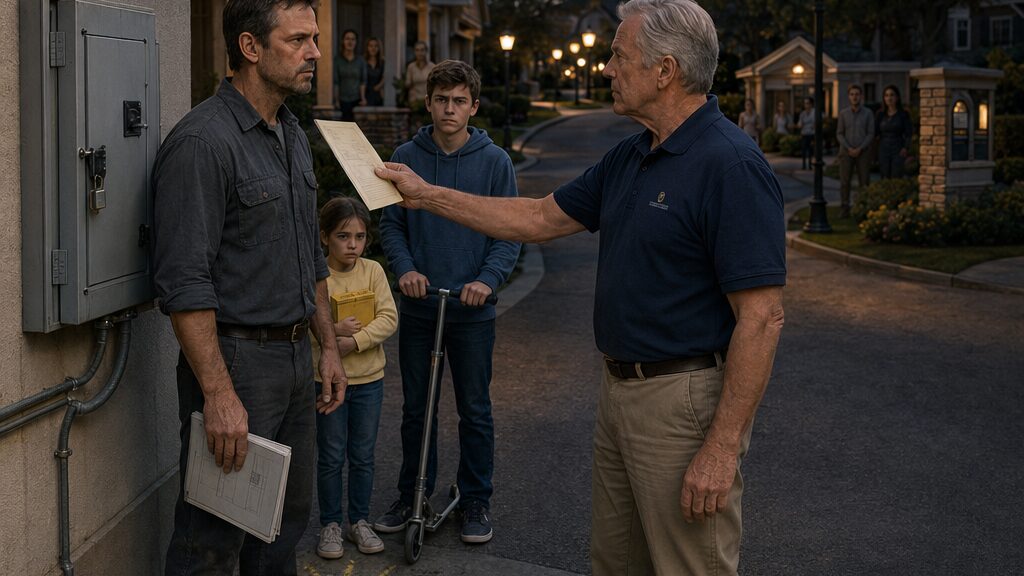
Ronald Moore was photographing Nicholas’s scooter when Larry turned onto the street.
The scooter lay on its side beside the curb, one wheel still spinning. Ronald stood over it with his phone raised in one hand and a cream-colored notice in the other. Behind him, Emma crouched over a yellow chalk sun she had drawn across two squares of sidewalk. Nicholas waited near the basketball hoop at the end of the driveway, his shoulders pulled tight.
Larry slowed his truck but did not honk.
The decorative lamps along Linden Crest had begun to glow, each one casting a careful circle of amber onto clipped hedges and pale stone mailboxes. The development had been designed to look expensive from every angle. Even the entrance monument had recessed lights shining up through ornamental grass.
Ronald lowered his phone as Larry parked.
“Dad,” Nicholas called. “He says we’re violating something.”
Larry stepped out, still wearing his city utility work shirt. “What happened?”
“We were playing.”
“That isn’t the issue,” Ronald said.
He wore a blue polo embroidered with the association’s oak-leaf emblem. His silver hair was combed into place despite the humidity. He held out the notice as though serving official papers.
Larry took it.
EMERGENCY QUIET-HOURS ENFORCEMENT appeared across the top. Beneath it, a box had been checked beside Recreational activity producing repeated or disruptive sound after 7:00 p.m.
The recorded time was 7:12.
Larry looked at his watch. It was 7:16.
“What emergency?” he asked.
Ronald’s mouth tightened. “The board has received complaints.”
“From whom?”
“The board does not disclose individual complainants.”
Emma looked up from the chalk. “I wasn’t making noise.”
“No one said you were,” Ronald replied, without looking at her.
“You photographed my scooter,” Nicholas said.
“It was left in a common visual corridor.”
“It was on our curb.”
“Which faces a common street.”
Larry read the notice again. The rule quoted at the bottom was not one he recognized. He had read the covenants when he bought the house eleven years earlier, and again after his wife died, when every automatic payment and insurance document had suddenly become his responsibility. Quiet hours began at ten on weeknights. Recreational use had never been prohibited at seven.
“When was this adopted?” Larry asked.
“Temporary board authority allows emergency implementation.”
“What emergency?”
Ronald glanced toward the far end of the street. “We have elderly residents. We have working professionals. We have property listings. Families need to understand that shared standards protect everyone.”
Nicholas gave a short, disbelieving laugh.
Larry turned his head. “Inside.”
“But—”
“Take the scooter and go inside.”
Nicholas grabbed the handlebars hard enough that the front wheel struck his shin. Emma remained crouched beside her drawing.
“Emma.”
She placed the yellow chalk in its box and stood. The sun she had drawn was uneven, with eleven long rays and a smiling face too large for the circle. One ray reached almost to Ronald’s polished shoe.
He stepped around it.
When the children were halfway up the drive, Ronald lowered his voice.
“I’m trying to keep this from becoming more serious.”
Larry folded the notice once. “You followed my children down the street with a camera.”
“I documented a violation.”
“You photographed a thirteen-year-old.”
“I photographed association property conditions.”
“My son isn’t property.”
Ronald exhaled through his nose. For a moment, weariness showed beneath the practiced authority. “We have three homes for sale, Larry. One owner has already complained about evening disorder. Buyers notice these things.”
“Two children on a scooter and a bike?”
“Basketballs. Wheels on pavement. Shouting across lots. Chalk markings.”
“They were playing.”
“And I’m telling you the board has determined that play needs reasonable limits.”
Larry kept his voice level. Years of field work had taught him that the person who raised his voice first usually lost control of the job. “Then send me the minutes. The vote. The language you adopted.”
“You’ll receive the formal notice.”
“I’m holding a formal notice.”
“You know what I mean.”
Ronald began to turn away, then stopped.
“There are communities designed around young families,” he said. “Sometimes people discover they would be happier in a different environment. If parents can’t control the disturbance, renting elsewhere can be a practical option.”
For several seconds, Larry heard only the faint electric hum of the lamp beside his driveway.
Ronald had lived three houses down for nearly two decades. He had brought a casserole after Larry’s wife died and stood in the kitchen saying very little while neighbors filled the refrigerator with food no one wanted. He had once helped Nicholas repair a loose bicycle chain.
Now he was suggesting Larry remove his children from their own home.
Larry unfolded the notice and looked at the time again.
7:12 p.m.
Not late enough to be mistaken for nighttime. Not vague enough to be casual. Someone had watched a clock and waited.
“Send me the minutes,” Larry repeated.
Ronald gave a brief nod and walked away.
Inside, Nicholas dropped the scooter against the garage wall.
“You just let him say that.”
“I didn’t let him do anything.”
“You stood there.”
“And yelling would have fixed it?”
“It would’ve shown him he can’t talk to us like that.”
Larry closed the garage door. “Showing him isn’t the same as stopping him.”
Nicholas looked away. Since his mother’s death, he had grown taller without warning, as if grief had stretched him. He was old enough to recognize humiliation and young enough to believe every failure to fight was surrender.
Emma sat on the kitchen floor with the chalk box on her lap.
“Can I finish tomorrow?” she asked.
“Yes.”
“Before seven?”
Larry set the notice on the counter. “You can finish your drawing.”
His phone vibrated.
The message came from the neighborhood distribution list. The subject line read: Emergency Conduct Guidance—Effective Immediately.
Ronald had copied all forty-two households.
The email described repeated evening disruption involving wheeled toys, basketball activity, loud family recreation, and unauthorized sidewalk markings. It did not name Larry, but it listed the block and referenced an incident documented at 7:12 p.m.
Replies appeared before he finished reading.
Thank you for addressing this.
Much needed.
We all paid too much to listen to constant noise.
Another message arrived from a parent two streets over.
Does this apply to children walking home from practice?
Ronald answered within a minute.
Normal pedestrian use is not recreational activity.
Larry read that sentence twice.
Nicholas had stopped near the stairs. “He sent it to everybody, didn’t he?”
Larry locked his phone.
“We’ll handle it.”
“That’s what you always say.”
Nicholas went upstairs.
Emma remained on the floor, tracing the edge of the chalk box with one finger. Outside the front window, the lamps shone evenly down the street Ronald was so determined to protect.
“Dad?”
“Yes?”
She looked toward the sidewalk where her unfinished sun waited beneath the amber light.
“If we can’t go outside,” she asked, “are we still allowed to live here?”
Chapter 2: The Water Erased More Than Chalk
By seven the next morning, Emma’s sun was gone.
She stood on the sidewalk in her school clothes, backpack hanging from one shoulder, staring at a pale yellow stain bleeding toward the gutter. Water still moved in a thin sheet across the concrete.
Larry followed the wet trail to a rotating sprinkler planted in the narrow strip of grass beside Ronald’s property. Its metal head clicked, paused, and fired another fan of water across the sidewalk.
The spray struck Emma’s shoes.
She jumped back.
“That wasn’t there yesterday,” Nicholas said.
Larry stepped into the arc, twisted the sprinkler head toward the lawn, and shut the valve beside the hedge.
Ronald’s front door opened almost immediately.
“You can’t enter my landscaping,” he called.
Larry remained on the sidewalk. Water ran from his work pants into his boots. “Your sprinkler is aimed across a public walkway.”
“It shifted.”
“Then it shifted twenty degrees uphill.”
Ronald walked toward them holding a coffee mug. “The landscaper set it.”
“The landscaper usually waters grass.”
“Are we going to do this before school?”
Emma nudged the washed chalk with the toe of her sneaker. The smiling face had become a blurred eye and half a curved mouth.
Larry took out his phone and photographed the sprinkler, the valve position, the wet sidewalk, and the remains of the drawing.
Ronald watched him.
“So now we document everything?” he asked.
“That appears to be the standard.”
For the first time, Ronald looked uncomfortable.
The school bus rounded the corner. Nicholas took Emma’s hand and guided her past the puddle. Neither child said goodbye.
Larry waited until the bus pulled away.
“If that sprinkler crosses the sidewalk again,” he told Ronald, “I’ll report it as an obstruction.”
“To whom?”
“The county accessibility office, if necessary.”
Ronald’s expression sharpened. “You are turning routine landscaping into an accusation.”
“No. I’m turning it back toward your yard.”
Larry left before the answer came.
That evening, the sprinkler had been moved. By Wednesday, another appeared near the small common lawn opposite Larry’s house. Its reach stopped just short of his property line but swept directly across the route Emma used on her bicycle.
On Thursday morning, Larry found a man from the landscape crew washing blue and pink chalk flowers from the sidewalk near the mail kiosk.
“Who requested that?” Larry asked.
The man lowered the hose. “Work order says remove unauthorized markings.”
“From which board member?”
The man glanced toward Ronald’s house. “You’d have to ask management.”
Larry photographed the work order number printed on the side of the truck.
He collected things now.
Dates. Angles. Email headers. Photographs of wet pavement. Screenshots of rule language that seemed to change depending on who asked. He built a folder on his computer and named it Linden Crest Conduct, as if a neutral title could keep anger from entering the file.
He did not confront Ronald at the mailbox.
He did not call the association attorney.
He did not stand in the street and demand that neighbors choose sides.
Each time Nicholas asked what he planned to do, Larry said, “I’m getting the facts.”
By Friday, Nicholas had stopped asking.
Sharon Hall caught Larry beside the school bus stop that afternoon. She lived next door with her father and served as HOA treasurer. She carried two grocery bags in one hand and a pharmacy sack in the other.
“Can we talk?” she asked.
Larry took one grocery bag from her before answering. “About what?”
“Not here.”
They walked to her porch. Through the front window, her father sat in a motorized chair watching television with the sound low.
Sharon set down the pharmacy bag and folded her arms.
“The board is building a family conduct record.”
Larry stared at her. “A what?”
“That’s Ronald’s phrase, not mine.”
“What does it mean?”
“Repeated notices. Photographs. Neighbor statements. Anything they can use to show a pattern.”
“Toward what?”
“A hearing. Fines. Possibly suspension of common-area privileges.”
“My children use a sidewalk.”
“I know.”
“You voted for this?”
“I voted for a temporary noise clarification. I did not vote to have anyone’s children followed.”
“Then say that.”
Her gaze shifted through the window toward her father.
“There are board dynamics you don’t see.”
“That’s convenient.”
“It isn’t convenient at all.”
Larry handed her the grocery bag. “If Ronald wants a record, he’ll get one.”
Sharon’s face tightened. “Be careful what kind you make.”
The sentence stayed with him until evening.
At 8:04, an email arrived from the official association account.
COMMUNITY CONDUCT NOTICE: PERSISTENT NUISANCE ACTIVITY.
The message referred to “a family unit on the west block” and listed bicycles, chalk markings, ball play, elevated voices, obstruction of visual corridors, and refusal to comply with board guidance.
Larry read it standing in his home office.
Near the bottom, one sentence shifted from bureaucratic language into something uglier:
The board cannot allow one household’s preferences to diminish the quiet enjoyment and market character of the entire community.
He opened the message details. The official address had sent it, but the document properties on the attached PDF identified the author.
Ronald Moore.
Created two days earlier.
Before the second sprinkler appeared. Before the chalk flowers were washed away. Before the supposed pattern had finished forming.
Larry saved the metadata.
Behind him, Nicholas said, “So?”
Larry turned. He had not heard him enter.
“So what?”
“What are you going to do?”
“I’m working on it.”
“You keep saying that.”
“I found proof Ronald drafted this before half the things he listed.”
“And?”
“And that matters.”
“To who?”
“To the attorney. To the board. To anyone reviewing the notices.”
Nicholas pointed toward the screen. “Everybody already read it. Emma thinks people are staring at her at the bus stop.”
“I can’t control what people think.”
“You could at least tell them he’s lying.”
“Not until I know exactly what I can prove.”
Nicholas laughed once, without humor. “You always need one more paper.”
“That’s how you avoid making a mistake.”
“No. That’s how you avoid doing anything where somebody might see you mad.”
The words landed harder because Larry had heard a version of them before, years ago, from his wife. Not about anger. About grief. About silence. About the way he could turn any feeling into a task list and call that strength.
Nicholas left before Larry answered.
The house settled into a tight quiet. Emma sat at the dining table doing homework, her unopened chalk box beside her elbow.
Larry returned to the computer and opened the property folder he had inherited when he bought the house. Surveys. Closing papers. Appliance manuals. A yellowed envelope from the original developer.
He had seen it before without examining it.
Inside was a folded site plan marked with utility lines. Emma must have handled it at some point; yellow chalk dust clung to one corner.
Larry spread the plan across his desk.
A red line ran from the service panel beside his garage, beneath the sidewalk, and out toward the private lane. It branched at each decorative lamp, continued past the mail kiosk, curved around the entrance monument, and ended beside the common lawn.
At the bottom, beside his lot number, someone had typed:
TEMPORARY SHARED LIGHTING SERVICE—BILL TO PROPERTY ACCOUNT PENDING ASSOCIATION TRANSFER.
Larry read the line again.
Then he looked out the office window at forty-two houses glowing beneath lights connected to his address.
Chapter 3: Every Lamp Led Back to His Meter
The county records clerk searched twice before looking up from her monitor.
“There’s no utility easement granted to the association,” she said.
Larry stood at the counter with the developer’s plan flattened beneath a clear document weight. “Check under Linden Crest Residential Association.”
“I did.”
“The original developer?”
“I checked that too.”
“What about a service-transfer agreement?”
She turned the monitor slightly. A list of scanned filings filled the screen: plats, drainage easements, landscaping access, monument maintenance, road dedication exceptions.
Nothing for electrical service.
“If it was recorded,” she said, “it isn’t indexed to this property or the association.”
Larry slid the plan closer. “This line feeds every decorative lamp on the private lane.”
The clerk adjusted her glasses but did not touch the paper. “Then someone should have recorded an easement.”
“Someone didn’t.”
“That appears to be the case.”
At the utility service office, the account history was clearer.
The meter attached to Larry’s house carried two load classifications: residential service and auxiliary exterior lighting. The auxiliary usage rose predictably each evening and had been billed to his property since before he purchased it.
No separate association account existed.
The representative printed eleven years of usage summaries. Larry sat in his truck afterward with the pages spread across the passenger seat, calculating conservative estimates. The amounts varied by season and rate changes, but even without interest, the total was several thousand dollars.
He thought of every annual budget packet Ronald had mailed with warnings about rising maintenance expenses.
Not one had mentioned electricity.
Anthony Williams lived twenty minutes away in a brick ranch house with an old utility trailer parked beside the garage. He opened the door before Larry reached the porch.
“You found the drawing,” Anthony said.
It was not a question.
Larry held up the folded plan. “You knew it existed.”
Anthony stepped aside. “Come in.”
The house smelled of coffee and machine oil. Photographs of construction crews lined one wall. In one, a younger Anthony stood beside the unfinished Linden Crest entrance, wearing a hard hat and holding a coil of cable.
Larry placed the plan on the kitchen table.
“Why is the association’s lighting on my meter?”
Anthony sat slowly. “Because your lot was the first one with permanent power.”
“That explains construction. Not twenty years.”
“It was supposed to be temporary.”
“How temporary?”
“Six months. Maybe a year.”
Larry waited.
Anthony rubbed his thumb along a scratch in the tabletop. “The developer was running out of operating cash. The association hadn’t completed its turnover. We installed the lamps, tied them to the active service, and agreed the HOA would open an account after the final inspection.”
“And they didn’t.”
“The first board kept saying they would.”
“Did you tell them?”
“I told three presidents.”
“Ronald?”
Anthony looked toward the window.
“That’s not difficult to answer.”
“Yes,” he said. “Ronald knew there was an old arrangement. I don’t know what details he remembered.”
“You worked maintenance here after turnover.”
“For nine years.”
“Then you know which lights are on the line.”
“All the decorative ones.”
“Only decorative?”
Anthony’s pause changed the room.
Larry leaned forward. “What else?”
“The lamp at the mail kiosk. Two bollards along the accessible path. The pole near the entrance curve.”
“That pole is decorative.”
“It also lights the bend where the wall blocks the view.”
“You could have said that first.”
“I’m saying it now.”
Larry folded the plan sharply. Yellow chalk dust marked his fingertips.
Anthony watched him. “What are you planning?”
“The account is mine.”
“That isn’t what I asked.”
Larry stood. “The association is using electricity billed to my house while its president fines my children for being visible outside.”
“And that makes you angry.”
“It makes the arrangement over.”
Anthony did not argue. That was worse.
At the utility office the next morning, Larry requested formal separation of the auxiliary load. He brought identification, account records, the county search, and the original plan. The utility required an inspection of the exterior panel and written confirmation that the circuit did not serve Larry’s residence.
A technician arrived late that afternoon.
Ronald watched from across the street as the panel door opened.
He did not approach.
Nicholas stood in the garage with his arms folded. Emma sat on the driveway beside the faded remains of her chalk sun, rolling a yellow piece between both palms.
“What’s he doing?” she asked.
“Separating something that should’ve been separate years ago,” Larry said.
“Will our power go out?”
“No.”
“Will theirs?”
“The streetlights will.”
Nicholas’s expression shifted. “All of them?”
“Yes.”
A flicker of satisfaction crossed his face. Larry recognized it because he felt the same thing and did not want to name it.
The technician labeled the conductors, verified the load, and pulled the disconnect. He capped the feed and attached a utility seal.
“Association will need a new service design before reconnection,” he said.
Larry signed the work order.
At 6:51, the lamps still glowed.
The three of them stood at the front window. No one had agreed to watch together. They had simply arrived there.
At 6:52, the lamp beside Larry’s driveway went dark.
Then the next one.
Darkness moved down Linden Crest in measured gaps, swallowing trimmed shrubs, polished mailboxes, and pale sections of sidewalk. The entrance monument lost its upward glow. The common lawn disappeared beyond the glass.
Across the street, Ronald stepped from his porch.
His face was briefly visible beneath the final lamp near the curve. Then that one went out too.
Emma’s half-washed chalk sun vanished into shadow.
Nicholas whispered, “You actually did it.”
Larry’s phone began vibrating before the street was fully dark.
What happened to the lights?
Is this a power failure?
Anyone else out?
The interior lights of every house remained on. Porch lamps still shone. Only the shared street had gone black.
A message from Ronald appeared.
Restore the association lighting immediately.
Larry locked the screen.
For one breath, the silence felt like victory. Not loud or triumphant. Clean. The kind of clean he trusted—the final click of a breaker opened under proper procedure, the end of a load no longer assigned to him.
Then a car horn sounded near the entrance.
Brakes squealed.
Someone shouted.
Larry was already moving when his phone rang.
The caller was Sharon.
“There’s been a fall by the mail kiosk,” she said. Her voice shook. “One of the older residents missed the edge of the accessible path.”
Larry stopped with his hand on the front door.
“Are they hurt?”
“I don’t know. An ambulance is coming.”
Behind him, Nicholas’s satisfaction had disappeared.
Outside, beyond the dark glass, the street Larry had stopped paying to illuminate no longer looked perfect.
It looked dangerous.
Chapter 4: The Blackout Gave Ronald His Weapon
Ronald began pounding on Larry’s front door before sunrise.
The blows came hard enough to shake the narrow window beside the frame. Larry reached the foyer as the porch light clicked off on its timer, leaving Ronald’s face in the gray light of morning.
“Open the door.”
Larry unlocked it but kept one hand on the edge.
Ronald wore yesterday’s polo beneath an unzipped jacket. His hair was flattened on one side, and the skin beneath his eyes looked bruised from lack of sleep.
“You need to restore those lights now.”
“The utility disconnected the circuit.”
“Because you ordered them to.”
“Because the account is attached to my property.”
Ronald held up several printed pages. “A resident was taken to urgent care last night.”
“I heard.”
“She fell because the path was dark.”
“Is she all right?”
“That isn’t the point.”
“It’s the first point.”
Ronald’s jaw shifted. “A bruised hip and a sprained wrist. No fracture, according to her daughter. You don’t get credit because it could have been worse.”
Larry looked past him. Linden Crest was beginning to emerge from darkness, the road washed flat and colorless beneath the morning sky. The decorative lamp beside the porch stood useless above them.
“I’m going to see her,” Larry said.
“You’re going to reconnect the service.”
“I can’t reconnect a utility seal.”
“You work in electrical systems.”
“For the city. That doesn’t authorize me to tamper with a private utility lock.”
“Then call them.”
Larry stepped away from the door and returned with the folder he had prepared during the night. He pulled out the county search, the account classification, and the signed disconnection order.
“The association has no recorded easement, no service account, and no right to demand that my property carry its lighting load.”
Ronald glanced at the top page without taking it. “You think paperwork makes this responsible?”
“It makes your demand unenforceable.”
Now Ronald accepted the papers. He read the utility account number, then the note showing the auxiliary circuit billed to Larry’s lot.
His face changed only slightly.
Not surprise, Larry thought.
Recognition.
Ronald reached into his own folder and removed a map covered in red circles.
“These are safety complaints from the last four years,” he said. “Poor visibility at the entrance curve. Insufficient lighting by the mail kiosk. Accessibility concerns along the common path.”
Larry stared at the marked locations. They followed the same red service line on the builder’s plan.
“You had these?”
“The board did.”
“And you never told me the lighting circuit attached to my meter served those areas?”
“You never asked before shutting it off.”
Larry felt the words strike where Ronald intended.
“You knew the account was mine.”
“I knew there was an old service arrangement. I did not know you would take unilateral action against forty-one other households.”
“You sent a neighborhood email calling my children a persistent nuisance.”
“That does not justify creating a hazard.”
“And your safety complaints don’t justify hiding a utility burden on my property.”
For an instant, neither man spoke. The argument had divided cleanly, each fact sharp enough to cut and neither clean enough to settle anything.
Ronald folded the utility filing beneath his arm.
“The board will hold an emergency meeting tomorrow evening. Our attorney is reviewing fines, reimbursement claims, and any available action related to deliberate service disruption.”
“You can review whatever you want.”
“We will also distribute a notice explaining why the lights are out.”
“Explain all of it.”
Ronald met his eyes. “I intend to.”
He walked down the steps, leaving Larry beneath the dead porch lamp.
At urgent care, the elderly resident sat in a wheelchair near the curb while her daughter brought the car around. A soft brace enclosed one wrist. Purple bruising had begun to show along her cheek.
Larry stopped several feet away.
“I’m Larry King.”
“I know who you are,” the daughter said.
The older woman touched her daughter’s sleeve. “Let him speak.”
Larry looked at the brace. “I’m sorry you were hurt.”
“Did you shut them off?” the daughter asked.
“Yes.”
“Without warning anyone?”
“Yes.”
The admission sounded different outside Ronald’s porch argument. Smaller. Worse.
The older woman studied him. “I’ve used that path after dark for six years.”
“I didn’t know you went to the kiosk that late.”
“You knew it was an accessible path.”
He had known the bollards lit it. Anthony’s warning had come before the disconnection. Larry had told himself the porch lights and house lights would be enough. He had told himself the circuit belonged to him, as if ownership erased consequence.
“I knew the lights served it,” he said.
The daughter looked away in disgust.
The older woman adjusted the blanket over her knees. “The board should never have left those lights on a homeowner’s bill. And you should not have made the rest of us discover that in the dark.”
Larry had no answer that would not sound like an excuse.
“I’m sorry,” he said again.
This time, she nodded, but she did not forgive him.
When Larry returned home, a notice had already reached every household.
URGENT COMMUNITY SAFETY ANNOUNCEMENT.
The message stated that a homeowner had intentionally terminated established neighborhood lighting in retaliation for lawful conduct enforcement. It referenced the fall, the emergency meeting, and the board’s intention to pursue all remedies.
No mention appeared of Larry’s private account.
No mention appeared of the missing easement.
No mention appeared of eleven years of charges.
Nicholas read the email over Larry’s shoulder.
“He made it sound like you cut power to the whole neighborhood.”
“I cut power to the shared lights.”
“Because of us.”
Larry turned. “Because they had no right to keep billing the circuit to this house.”
“That isn’t what I asked.”
Emma sat at the kitchen table. Her chalk box was no longer beside her homework.
Larry saw the empty space and felt something inside him shift.
“I’m going to deal with the board,” he said.
Nicholas’s mouth hardened. “You already dealt with them.”
Before Larry could answer, the doorbell rang once.
Sharon stood outside holding a thick binder against her chest. She waited until Larry stepped onto the porch and closed the door behind him.
“My father’s asleep,” she said. “I can’t stay.”
“What is that?”
“Old board records.”
Larry looked toward Ronald’s house. “Why bring them now?”
“Because Ronald’s notice left out too much.”
“Did you know the lights were tied to my account?”
Sharon pressed the binder closer. “Not when I joined the board.”
“That isn’t an answer.”
“I found out three years ago.”
Larry went still.
Sharon’s voice dropped. “We discussed transferring the service. We discussed the safety complaints. We discussed the cost.”
“And then?”
She looked at the dead streetlamp above them.
“Then we voted not to tell the neighborhood.”
Chapter 5: The Assessment Nobody Wanted to Name
“I voted to delay it,” Sharon said.
She sat across from Larry at her kitchen table the following morning. Between them lay the binder, two mugs of untouched coffee, and a meeting notice marked with a faint blue handprint.
The print was small enough to belong to a child. Chalk dust had caught in the paper fibers years earlier and survived every filing cabinet since.
Larry touched none of it.
“Why?” he asked.
Sharon glanced toward the hallway. Her father’s motorized chair was plugged into an outlet near the living-room window.
“The engineering estimate was eighty-six thousand dollars.”
“For a new service?”
“For trenching, new conduit, code-compliant controls, meter equipment, repairs at the entrance, and replacement of several deteriorated fixtures.”
Larry opened the binder. “Forty-two homes.”
“Just over two thousand dollars each before contingencies. More if the reserve fund couldn’t cover its share.”
“You had reserves.”
“We had roof damage at the clubhouse, drainage repairs, and insurance increases. Ronald said an assessment would panic sellers.”
“So the board left it on my bill.”
“The board treated it as an inherited operating arrangement.”
“That is a careful way to say theft.”
Sharon flinched but did not argue.
Larry turned through the records. The first relevant minutes were brief: Auxiliary lighting service remains under review. The second year contained an engineering recommendation. The third showed a motion to postpone transfer pending reserve stabilization.
Ronald’s name appeared beside each motion.
Sharon’s did too.
“My father had just moved in with me,” she said. “His care costs were rising. Two other owners were already behind on dues. One widow told me a special assessment would force her to sell.”
“So you decided I could pay instead.”
“I told myself the amount on one electric bill was smaller than the amount that would displace three people.”
“You never asked what it cost me.”
“No.”
The word came without defense.
Larry examined the engineering report. A paragraph near the end warned that the private service arrangement lacked formal access rights and should be corrected within twelve months. Another noted that the entrance curve and accessible path relied on the circuit for minimum nighttime visibility.
Someone had drawn a line through the recommendation.
“Who crossed this out?”
“Ronald.”
“Why?”
“He said draft reports should not circulate until the board chose a funding plan.”
“Did it circulate?”
“Only among the board.”
Larry sat back. “And after three years, the funding plan was to fine my children.”
“That rule was supposed to address complaints.”
“Whose complaints?”
Sharon hesitated. “A buyer backed out of one of the listings after an evening showing. The seller blamed children in the street and noise from the basketball hoop. Ronald was afraid other owners would think the board had lost control.”
“Did the buyer say that?”
“Not directly.”
“So he created an emergency rule from a seller’s guess.”
“There were other complaints.”
“Enough to follow Emma with a camera?”
“No.”
“Enough to wash away chalk?”
“No.”
Her answers came more quickly now, each one loosening something she had held too long.
“Several residents opposed the seven o’clock restriction,” she said. “Two parents emailed Ronald privately. A retired teacher said the wording was discriminatory. I asked him to revise it.”
“But none of you said that publicly.”
“He controls the official account. He said disagreement would confuse enforcement.”
Larry gave a humorless breath. “Order through silence.”
Sharon looked directly at him. “You understand that better than you want to.”
The remark stopped him.
From the living room came the soft mechanical adjustment of her father’s chair. Sharon lowered her voice.
“You didn’t warn him the path would be dark.”
“I didn’t know he used it that night.”
“You knew someone might.”
“I knew the bollards were on the line.”
“And you disconnected it anyway.”
Larry closed the binder harder than necessary. “Are you giving me the records or preparing Ronald’s argument?”
“Both facts can be true.”
He stood and walked to the window. Across the lawns, the dead lamps looked harmless in daylight. Without darkness, they were only black metal posts among expensive landscaping.
“I paid thousands of dollars,” he said. “My children were treated like contamination. Ronald told me to move them into a rental community.”
“I know.”
“And when I finally stopped carrying what belonged to all of you, I became the danger.”
“You became part of it.”
He turned.
Sharon’s face had gone pale, but she held his gaze.
“You were right about the account,” she said. “You were right about Ronald. You were right that the board used your silence. But the woman at the kiosk did not write that email.”
Larry looked down at the old meeting notice. The blue chalk handprint lay across a line approving continued delay.
A child had once touched this paper while adults decided that another household could keep absorbing the cost.
He took photographs of the records, including the engineering recommendation and Ronald’s handwritten instruction not to circulate it. Sharon agreed to provide certified copies for the emergency meeting, though her hands shook when she said it.
“You could lose your board position,” Larry said.
“I may lose my house if the assessment is handled badly.”
“Then why help me?”
“Because avoiding one kind of harm turned into permission for another.”
The front door opened before Larry left.
Nicholas stood there, breathing hard. He must have come through the side yard. His phone was in one hand.
“Emma said you were here.”
Larry gathered the papers. “You should be home.”
Nicholas looked at the engineering map spread across the table. His eyes moved to the red circles marking the accessible path and entrance curve.
“What is that?”
“Board records.”
“You knew those lights were for the path.”
Larry did not answer fast enough.
Nicholas stepped closer. “Before you turned them off?”
“Anthony told me some of them served safety areas.”
“And you still did it.”
“I believed the house and porch lights would give enough visibility.”
“That’s not what you said to us.”
“I said the streetlights would go off.”
“You made it sound like they were decorations.”
“They were mostly decorative.”
“Mostly?”
Sharon rose. “Nicholas—”
He ignored her. “That woman got hurt because you wanted Ronald embarrassed.”
“I wanted the account separated.”
“You wanted him to watch it happen.”
Larry felt the accuracy of the accusation before he could reject it.
Nicholas picked up the map. “Does Ronald have this?”
“The board does.”
“Then he’s going to use it.”
“Yes.”
“And you were going to tell people what?”
“The truth.”
“All of it?”
Larry said nothing.
Nicholas set the map on top of the legal file.
“At the meeting,” he said, “if you leave out the part where you knew, I won’t.”
Chapter 6: His Son Refused the Easy Version
Nicholas placed the safety map beside Larry’s utility filing and pushed both documents across the kitchen table.
“Pick one,” he said.
Larry remained standing. “That isn’t how facts work.”
“It’s how you’re treating them.”
Emma sat at the far end of the table with her unopened chalk box in front of her. She had carried it downstairs after hearing their voices, but she had not lifted the lid.
The emergency meeting was less than twenty-four hours away.
Larry pulled out a chair. “Sit down.”
“I’m already sitting.”
“Then stop trying to turn this into a courtroom.”
Nicholas’s eyes flashed. “You’re the one building folders.”
Larry looked at the papers. On one side, proof that the HOA had used his account without legal authority. On the other, proof that he knew the circuit illuminated areas where darkness carried risk.
Both were true. Neither canceled the other.
“I should have warned the residents,” he said.
Nicholas waited.
“I should have arranged temporary lighting at the path and curve.”
“Why didn’t you?”
“Because I was angry.”
Emma’s fingers stopped moving along the chalk box.
Larry sat across from them.
“I told myself I was following the proper process. The account was mine. The utility confirmed it. The board had no right to demand that I continue.”
“That’s all true,” Nicholas said.
“Yes.”
“But?”
Larry looked toward the window. The dark entrance road was visible beyond the neighboring roofs.
“But I wanted Ronald to stand outside and watch the street go black.”
The admission emptied the room.
Nicholas leaned back. His anger did not disappear, but it changed shape.
Larry continued before he could retreat into explanation.
“I wanted him to feel what it was like to have something taken away while someone else quoted rules at him. I knew the lights served the path. I decided the risk was small enough.”
“You decided for everybody,” Nicholas said.
“Yes.”
Emma opened the chalk box at last. The yellow piece inside was worn flat on one side.
“Was it because of my sun?” she asked.
Larry turned to her. “What?”
“Did you turn them off because they washed it away?”
“That was part of why I was angry.”
Her eyes filled, though she did not cry. “I thought everybody got mad because of me.”
“No.”
“The lady fell after they washed my drawing, and then the lights went out.”
“That was my decision. Not yours.”
“You said you were protecting us.”
“I was trying to.”
“Were you?”
The question was quiet enough that Larry could not defend himself against it.
He reached for her hand. She let him hold it, but her fingers remained stiff.
Nicholas looked at the utility filing. “The HOA was wrong.”
“Yes.”
“They were using your money.”
“Yes.”
“Ronald lied about us.”
“Yes.”
“Then tell people that. But don’t make us the reason you did everything else.”
Larry released Emma’s hand slowly.
He had imagined the meeting in clean sequences: Ronald’s accusation, the county search, the billing history, the hidden engineering report. Each document would narrow Ronald’s room until the truth became unavoidable.
He had not imagined beginning with his own failure.
The doorbell rang.
Ronald stood on the porch alone. No polo this time. He wore a dark sweater and carried a single envelope.
“I need five minutes,” he said.
Larry stepped outside and closed the door.
Ronald handed him the envelope. Inside was a proposed statement.
Larry read the first paragraph.
I acknowledge that I discontinued established neighborhood safety lighting without notice, creating hazardous conditions and causing injury to a resident.
The second paragraph required him to request immediate reconnection and accept responsibility for all utility and legal expenses pending board review. In return, the HOA would suspend fines against his family and reconsider the recreation rule.
“You want me to confess so you can call this resolved,” Larry said.
“I want the lights restored before someone else gets hurt.”
“Then open an association account.”
“That cannot happen overnight.”
“Temporary generators. Portable lighting. Emergency contracting.”
“All of which cost money.”
“So does electricity.”
Ronald’s voice lowered. “You have made your point.”
“No. You’ve made mine. You consider the lights essential when they go dark, but not important enough to pay for while they stay on.”
Ronald glanced toward the window, where Nicholas and Emma were visible at the table.
“You can protect your children by ending this now.”
Larry reread the final sentence of the statement. It prohibited further public claims concerning board conduct until legal review was complete.
“You’re asking me to protect them by saying the board did nothing wrong.”
“I’m giving you a way to prevent months of fines and legal expenses.”
“And preserve your position.”
Ronald’s face tightened. “You think this is about a title?”
“I think you buried an engineering report.”
For the first time, Ronald lost his composure.
“Do you know what would have happened if we had announced that assessment three years ago? People on fixed incomes would have sold. Families already stretched by dues would have defaulted. Every listing would have carried a pending infrastructure charge.”
“So you concealed it.”
“I delayed it while we rebuilt reserves.”
“And spent those years calling the lighting part of the neighborhood standard.”
“It is part of the standard.”
“Paid through my meter.”
Ronald looked toward the dark lamp above them. “I was trying to hold the community together.”
“You decided who had to carry it.”
“And you decided who could walk in darkness.”
The words remained between them.
Larry folded the proposed statement and returned it.
“I won’t sign.”
“Then tomorrow becomes public.”
“It should have been public three years ago.”
Ronald accepted the envelope. “Once attorneys are involved, you do not control where this ends.”
Larry almost told him that control was not the point. The words stopped before they left his mouth. Control had been the point for both of them, each in a different uniform.
“I’ll see you at the meeting,” Larry said.
Ronald walked away.
Inside, Nicholas had not moved the documents. Emma was drawing with one fingertip on the tabletop, leaving no mark.
Larry called Sharon.
“I need the complete board record,” he said.
There was a pause. “Not excerpts?”
“Everything about the service, safety complaints, assessment, and rule.”
“That exposes my vote.”
“Yes.”
“And your knowledge.”
“Yes.”
Another pause followed, longer this time.
“What are you going to propose?” she asked.
Larry looked at his children.
“I don’t know yet,” he said. “But I’m done offering people an easy version.”
Chapter 7: The Meeting Could Not Stay Polite
Ronald opened the emergency meeting with a motion to fine Larry five thousand dollars.
He did not begin with the blackout, the injured resident, or the private meter. He began with the amount.
The community clubhouse was full enough that folding chairs had been placed along both walls. Parents stood near the back. Older residents occupied the front row. The HOA attorney sat beside Ronald beneath the association seal, while Sharon waited at the far end of the table with the complete board record stacked in front of her.
Larry sat between Nicholas and Emma.
Emma’s chalk box rested inside her backpack. Larry could see its square outline against the fabric.
Ronald adjusted the microphone.
“The motion concerns deliberate interference with established common-area safety infrastructure,” he said. “The resulting conditions caused injury, emergency expense, and measurable exposure to the association.”
A man near the rear raised his hand. “Was the lighting association property?”
Ronald looked toward the attorney.
“We’ll address ownership questions after the board’s opening presentation,” the attorney said.
“That sounds like no,” someone muttered.
Ronald continued. He showed photographs of the dark entrance, the mail kiosk, and the elderly resident’s mobility aid beside the uneven path. Then he displayed the community safety notice and a copy of Larry’s disconnection order.
His presentation was careful. Every statement was technically true.
Larry had requested the disconnection.
Larry had not warned residents.
A fall had occurred.
Ronald did not say that the board had known the system belonged to Larry’s account for three years. He did not mention the engineering recommendation. He did not mention the thousands of dollars billed to Larry’s house.
When Ronald finished, he looked directly at him.
“Mr. King may respond.”
Larry stood with his folder, but he did not open it.
“I requested the disconnection,” he said. “I knew the circuit included lights near the accessible path and the entrance curve. I believed the remaining residential lighting would provide enough visibility.”
The room became still.
Nicholas looked at him.
“I was wrong,” Larry continued. “I should have warned residents. I should have arranged temporary lighting before the circuit was shut down. I acted while I was angry, and someone who had nothing to do with the dispute was hurt.”
Ronald’s expression changed. He had expected denial, not admission.
The HOA attorney leaned toward him and whispered, but Ronald held up one hand.
Larry looked toward the elderly resident. She sat in the front row with her wrist still braced.
“I’m sorry,” he said. “Not because the board demanded it. Because I made a decision that affected your safety without speaking to you.”
She gave a small nod.
No applause followed. Larry had not expected any.
Ronald returned to the microphone. “That admission confirms the board’s position.”
“It confirms part of it,” Larry said.
He opened the folder.
“The lighting was never association property. It has been connected to my private utility account since construction.”
He handed copies of the account history to the nearest residents. Pages moved from chair to chair.
“The county has no recorded easement. The utility has no association account. For eleven years, the electricity was billed to my house.”
A parent near the wall asked, “Did the board know?”
Ronald answered before Larry could.
“The board was aware of an inherited service arrangement under review.”
Sharon stood.
Her chair scraped loudly across the floor.
“That is not complete,” she said.
Ronald turned toward her. “Sharon, sit down.”
She remained standing. “The board received a formal engineering recommendation three years ago. We were advised to transfer the service within twelve months.”
Voices rose around the room.
Sharon placed the report on the document projector. The warning about private service and safety dependence appeared on the wall behind Ronald.
A handwritten line crossed out the recommendation.
Do not circulate pending funding decision.
Ronald Moore.
Ronald stared at the image. “That was a draft.”
“It was the engineer’s final recommendation,” Sharon said.
“You voted to postpone it.”
“Yes.”
The admission shifted the attention toward her.
Sharon gripped the table edge. “I voted to delay because the projected special assessment was more than two thousand dollars per home. My father had just moved in with me. Several residents were already struggling. I told myself postponement protected people.”
“And did it?” a woman asked.
“No.”
Sharon’s voice almost broke, but she continued.
“It placed the cost on one household without permission. Then, when that household objected to unrelated enforcement, the board acted as though its cooperation was an obligation.”
Ronald stood. “The quiet-hours rule has nothing to do with the electrical project.”
Larry took out the photograph of Emma’s washed chalk sun and placed it beneath the projector.
Its pale yellow face filled the wall.
“This was called an unauthorized marking,” he said. “My children were photographed, warned, sprayed with sprinklers, and described to the entire neighborhood as a persistent nuisance. That happened while the same board privately depended on my property to maintain the appearance it claimed they were damaging.”
“The board did not authorize anyone to target children with water,” Ronald said.
“You authorized removal of the chalk.”
“As part of common-area maintenance.”
“You drafted the nuisance notice before several of the incidents it listed.”
Larry displayed the document metadata.
Ronald looked toward the attorney again, but the attorney did not intervene.
A resident in the second row raised her voice. “My husband and I objected to the seven o’clock rule. You told us the board had already received overwhelming support.”
Another parent spoke. “You told me the restriction was temporary until complaints were reviewed.”
A retired teacher near the aisle said, “You never replied when I asked how walking with a bicycle differed from recreational use.”
The room did not erupt. It fractured.
Different residents spoke at once—about children, dues, property listings, safety, the blackout, and the hidden assessment. No single side controlled the anger.
Ronald struck the gavel.
“We will maintain order.”
The sound only sharpened the noise.
Larry watched him standing beneath the projected chalk sun, still trying to command a room built on facts he had kept separate.
Finally, the elderly resident raised her uninjured hand.
People quieted.
“The board failed,” she said. “Mr. King failed too. We do not need either one pretending otherwise.”
Ronald’s grip loosened on the gavel.
The HOA attorney requested a recess. Residents refused to leave their seats.
After fifteen minutes of discussion, someone moved to suspend the seven o’clock recreation rule. The motion passed by voice vote. Another resident demanded an independent financial and infrastructure audit. That motion also passed, though Ronald voted against it.
Then the question of the lights returned.
“The utility cannot establish permanent service tonight,” Sharon said. “Temporary lighting can be installed at the kiosk and entrance by morning.”
“We need the full circuit restored now,” Ronald said.
Several residents objected.
“Not without an agreement.”
“Not back on Larry’s bill.”
“Not while the board can fine his family tomorrow.”
Ronald looked at Larry. “You have created a crisis and are using it to negotiate.”
Larry closed his folder.
“I created part of this crisis,” he said. “I admitted that.”
He placed a one-page proposal on the table.
“I will authorize temporary reconnection to my meter for thirty days. Only if the board signs tonight.”
Ronald did not touch the page.
Larry read the conditions aloud.
The HOA would reimburse documented auxiliary electricity charges subject to independent review. It would fund temporary safety lighting immediately. It would begin formal transfer to an association-owned account. The emergency recreation rule would remain suspended pending a resident vote. No conduct action could be brought against Larry’s children for the incidents already listed. The engineering report and relevant minutes would be released to all owners.
“And,” Larry said, “the board accepts an independent audit.”
Ronald’s face had gone rigid.
“You are asking the association to admit liability.”
“I’m asking it to admit responsibility.”
“If I sign this, the special assessment becomes unavoidable.”
“No,” Sharon said. “The cost becomes visible. How we fund it is still a choice.”
Ronald looked around the room. The same residents he had tried to protect from panic now watched him with the hard attention he had spent years avoiding.
The lights outside remained dark.
Larry placed a pen beside the agreement.
“Temporary power starts when the conditions are signed,” he said. “Otherwise, the portable safety units go in tomorrow and the permanent service follows the normal process.”
Ronald stared at the page.
For the first time since the meeting began, no one interrupted him.
Chapter 8: They Relit the Street Under New Rules
Three weeks later, the first HOA-owned streetlight came on without drawing a single watt from Larry’s house.
The new fixture stood beside the mail kiosk, where fresh concrete bordered the repaired accessible path. A separate meter box had been mounted behind the landscaping wall, its account number assigned to Linden Crest Residential Association.
The permanent rewiring would take months. For now, temporary conduit served the entrance curve, kiosk, and walkway. The purely decorative lamps farther down the street remained dark.
No one complained that the development looked less luxurious.
Not publicly.
The agreement signed at the emergency meeting had survived two attorney revisions, a resident vote, and Ronald’s attempt to resign before the audit began. The board had refused to let resignation replace responsibility. He remained long enough to authorize the records release and sign the phased repair contract, then stepped down as president.
The independent review confirmed Larry’s electricity costs. The HOA reimbursed him from reserves and approved a smaller initial assessment, with the remaining work spread across future budgets.
Larry kept most of the reimbursement.
He contributed part of it to widen the accessible path and install low-level emergency lighting with battery backup.
He did not call it an apology.
The elderly resident did not call it forgiveness.
She thanked him when the path reopened, and that was enough.
On the first evening the new light operated, Emma knelt on the sidewalk with her chalk box open beside her. Other children gathered around her, each holding a different color.
The new recreation policy allowed ordinary outdoor play until eight thirty on school nights and nine on weekends. It defined actual noise violations instead of treating childhood itself as disruption.
Emma began with a yellow circle.
Nicholas added long rays around it. A younger child drew a blue house beneath one side. Someone else added a wheelchair ramp leading toward the door. The picture spread across four sidewalk squares until it became less like Emma’s old sun and more like a map of the street as the children believed it should be.
Ronald arrived carrying a roll of removable marking tape.
He wore no board polo and no badge.
“The contractor needs the safe-play boundary marked before the permanent work begins,” he said.
Nicholas looked at Larry.
Larry handed Ronald one end of the tape.
They measured the setback together without pretending the past had disappeared. Ronald worked carefully, checking the distance from the curb twice.
When he finished, he gave Larry a signed copy of the final utility transfer.
“I should have brought this arrangement to the owners three years ago,” he said.
It was not warm. It was not graceful.
It was written down.
Larry accepted it.
“Yes,” he said.
Ronald glanced at the chalk mural. “The sun is outside the marked area.”
Emma looked up.
Ronald studied the tape, then moved it six inches toward the road.
“There,” he said. “Now it isn’t.”
At 7:12 p.m., Emma climbed onto her bicycle.
The new lamp cast a clean pool of light across the repaired path and the chalk sun. Farther down Linden Crest, the unused decorative posts stood dark between the houses. The street looked less perfect than before.
It also looked lived in.
Emma rode past Larry, circled the mail kiosk, and returned with Nicholas coasting behind her on his scooter.
Larry watched them pass beneath the association-owned light.
For years, whenever the lamps came on, he had listened unconsciously for the load change at the panel beside his garage. He had measured responsibility through systems no one else noticed and mistakes no one else was allowed to see.
That evening, he did not look toward the breaker box.
He kept his eyes on his children.
The story has ended.