They Ordered James to Remove His Small Gate, So He Made the Boundary Permanent
Chapter 1: The Footprints Appeared Again Before Sunrise
The fence panel was hanging loose again.
James Taylor saw it before he reached the bottom step of his back porch: one end of the cedar rail had been lifted free of its bracket and pushed inward, leaving a shoulder-wide opening beside the corner post. Beneath it, a fresh line of muddy footprints crossed the narrow strip of ground behind his house.
One print had landed directly on the grass seed he had spread the previous evening.
James stood in the gray light with his coffee cooling in his hand. The subdivision was still quiet. Sprinklers clicked two streets over, and somewhere beyond the community green, a car door closed in the parking area.
He set the mug on the porch rail and walked down.
The rail was not broken. Whoever had moved it knew how to lift it without splitting the wood. That almost made it worse. This was not accidental damage from a child chasing a ball or a delivery worker taking a wrong turn. Someone had deliberately reopened the passage James had closed.
He fitted the rail back into place and pressed until the bracket caught.
The ground told the rest of the story.
The narrow strip ran between his rear fence and the edge of the association’s green space. On the subdivision plan it was unremarkable, no more than a shallow wedge created by the angle of his corner lot. In practice, it formed the shortest line between the green and a small overflow parking area behind the next row of homes.
The official route curved around the clubhouse, followed a sidewalk uphill, and doubled back toward the parking spaces. The unofficial route saved several minutes.
Over the years, convenience had become habit. Habit had become entitlement.
The grass beneath the opening had thinned into brown earth. During dry months, dust collected along the fence. During rain, shoes carried mud across James’s lawn. People passed with grocery bags, folding chairs, dogs, coolers, bicycles, and once a wheeled trash bin that scraped paint from the post.
At first James had said nothing. He had been new to Clearwater Ridge then and unwilling to become the man who complained before learning his neighbors’ names. Later, when the passage grew busier, he placed decorative stones along the edge.
The stones were moved.
He planted low shrubs.
Two were crushed within a month.
He installed a small sign asking residents to use the community sidewalk. Someone pulled it from the soil and left it facedown behind his shed.
James had repaired the same fence panel four times.
That morning made five.
He carried the loose rail into his garage and laid it across two sawhorses. The gouges near the end were fresh. He sanded them, brushed away the dust, and reinforced the bracket with two longer screws.
When he returned outside, a man in running clothes was standing on the green-space side, looking at the closed opening.
The runner glanced at James, then at the fence.
“You closing this now?” he asked.
“It has always been closed.”
The man gave a short laugh. “People have used it forever.”
“That doesn’t make it an entrance.”
The runner looked toward the official sidewalk as though James had personally moved it farther away.
“Seems unnecessary.”
“So does repairing the same fence every month.”
The man said nothing else. He turned and jogged across the grass, but his expression stayed with James longer than the conversation did. It was not anger exactly. It was disbelief that James considered himself entitled to interrupt something everyone else had accepted.
By eight, James had set a temporary barrier across the gap: two wooden stakes connected by a length of orange construction mesh. It was ugly, but unmistakable. No one could claim they had failed to see it.
He took photographs from several angles and returned inside to answer client emails.
Before leaving municipal work, James had spent nineteen years inspecting commercial renovations, apartment conversions, retaining walls, stairs, ramps, and public access projects. Now he reviewed properties for buyers who wanted to know what a polished listing concealed. He noticed uneven foundations, altered drainage, missing permits, and measurements that did not quite agree with deeds.
He trusted lines because lines could be checked.
People were harder.
Shortly before noon, movement outside his office window caught his attention. A woman carrying two grocery bags had stopped beside the mesh. James recognized her from the next block but did not know her name.
She looked toward his house.
Then she set down the bags, pulled one stake from the ground, folded the mesh aside, and carried her groceries through.
James reached the back door as she was replacing neither the mesh nor the stake.
“Excuse me.”
She turned. Her face tightened.
“This is private property,” James said.
“I’m just cutting through.”
“That’s the problem.”
“I’ve done this for years.”
“That is also the problem.”
She picked up the bags. “You know, most people here try to be neighborly.”
James looked at the trampled strip behind her. “Most neighbors knock before using someone else’s yard.”
Color rose along her neck. She stepped through the opening and walked away without answering.
James reset the barrier. This time he drove the stakes deeper.
That afternoon he opened the document box from his home purchase. The folder contained the deed, title policy, inspection photographs, subdivision plat, and a reduced copy of the recorded survey.
He spread the survey across the dining table and found the rear corner pin. The line angled exactly as he remembered, placing the worn strip inside his boundary by nearly four feet at its widest point.
The association owned the green.
James owned the path people had created.
He traced the boundary with one finger. The discovery should have reassured him. Instead it sharpened something that had been gathering for years.
Every footprint suddenly looked less like inconvenience and more like a decision made at his expense.
By evening he had sketched a simple gate: cedar frame, black hinges, latch on the house side. Nothing elaborate. Nothing tall enough to feel hostile. It would sit between the existing fence post and a new narrow post set beside the property line.
He called Christopher Walker.
Christopher had worked with James on municipal projects before starting his own contracting company. He listened without interrupting while James described the opening.
“HOA approval?” Christopher asked.
“It’s a repair to my fence.”
“That wasn’t my question.”
“The documents call it a boundary structure.”
Christopher sighed softly. “Send me the section.”
“I can build a wooden gate myself.”
“I know you can.”
“Then why would I ask permission to stop people from damaging my property?”
“Because being right and being left alone are different things.”
James looked through the window at the orange mesh. It had been pushed aside again.
“I’m finished being left alone only when it benefits everyone else.”
Christopher did not agree, but he did not argue. “At least photograph everything.”
“I already have.”
“I assumed you did.”
James built the gate the next morning.
He measured twice, cut the cedar square, and set the new post in concrete just inside the surveyed line. By late afternoon, the gate swung cleanly and closed with a firm click. It matched the existing fence closely enough that from a distance it looked original.
For the first time in years, the gap was undeniably closed.
A pair of neighborhood children stopped on the green and stared through the slats. Later, the runner from that morning approached, tested the latch, then walked away. Near sunset, two residents stood beside the gate talking in low voices while James watched from his kitchen.
Their annoyance gave him a satisfaction he did not examine closely.
The next day brought no new damage.
Neither did the day after that.
On the third afternoon, a delivery driver rang James’s bell and held out a stiff white envelope.
“Certified,” the driver said. “Signature required.”
The return address belonged to Clearwater Ridge Homeowners Association.
James signed, closed the door, and carried the envelope to the dining table. Through the front window, he could see a pair of muddy shoes abandoned beside the porch mat.
The envelope felt heavier than the paper inside could explain.
Chapter 2: Section Seven Became a Weapon Overnight
The first sentence gave James ten business days to remove the gate.
The second said daily fines would begin immediately afterward.
By the third paragraph, the association had reserved the right to enter the property, remove the structure, recover legal costs, and charge all labor to his account.
James read the letter once standing at the dining table and again seated beneath the hanging light. The language was formal without being precise, severe without explaining who had complained or when the board had met.
A bold heading divided the page:
VIOLATION OF ARCHITECTURAL AND BOUNDARY STANDARDS
Below it, the notice quoted Section 7 of the Clearwater Ridge Community Guidelines:
No temporary or permanent structure shall be installed along a property boundary without prior written approval of the Association.
The sentence ended there.
James turned the page over. Blank.
He opened the thin rulebook stored with his closing papers and found Section 7. The first sentence matched. Beneath it were three additional paragraphs governing fences, retaining walls, drainage improvements, and boundary installations.
He read them slowly.
The notice had not quoted the whole provision.
That did not necessarily make the order invalid. The gate still might require approval. But someone had chosen the shortest and most threatening version of the rule, then presented it as complete.
James placed the notice beside the muddy shoes near the back door. Dried soil flaked from one heel onto the tile.
The contrast irritated him more than it should have. The association had tolerated footprints on his property for years. It had taken three days to produce a certified violation once he blocked them.
He called the management office.
A clerk answered with a practiced brightness and asked for his property number.
“I need the complaint that triggered this notice,” James said. “I also need the minutes from the hearing where the violation was determined.”
There was a pause.
“Architectural matters are handled by the board.”
“I understand. Please send me the complaint and the hearing record.”
“I can send you an appeal form.”
“That is not what I requested.”
“The notice explains your options.”
“It explains the association’s demands. I’m asking for the record supporting them.”
The brightness disappeared from the clerk’s voice. “You’ll need to discuss that with the board president.”
“Dennis Hall?”
“Yes.”
“Please transfer me.”
“He isn’t available.”
“Then note that I requested the complaint, inspection report, photographs, board vote, and hearing record.”
Another pause, shorter this time. “There may not have been a formal hearing yet.”
James leaned back in his chair. “Then who authorized the fines?”
“The board president can issue preliminary notices.”
“This says final enforcement.”
“I can’t interpret the letter for you.”
“You sent it.”
“The association’s attorney prepared it.”
James wrote that down.
“When can I review the file?”
“Homeowner files aren’t available for unscheduled inspection.”
“Give me the next scheduled time.”
She placed him on hold. Instrumental music played for nearly four minutes.
When she returned, she offered an appointment the following Thursday—six days away and one day before the gate’s removal deadline.
James accepted.
Then she added, “Mr. Hall asked me to remind you that the path has served the community for a considerable time.”
“It isn’t a path on the recorded plat.”
“I’m only relaying his statement.”
“Did he say it was an easement?”
“He said longstanding use may establish community access.”
That was carefully vague language. An easement was not created merely because neighbors found a route convenient, but James knew enough to avoid making assumptions. Prescriptive rights varied, and association documents sometimes contained access provisions that did not appear clearly on a reduced survey.
“Send me the document supporting that claim.”
“I’ve already explained the review process.”
The call ended with neither side raising a voice.
James spent the afternoon assembling records.
He photographed the worn ground, damaged post, replaced brackets, crushed shrubs, and relocated sign. He printed the survey and requested a certified full-size copy from the surveyor who had completed the original closing work. He searched county records for recorded easements crossing his parcel.
There were none.
At four twenty, an email arrived from the management office. The subject line read APPEAL MATERIALS. The only attachment was a one-page form requiring James to acknowledge the violation before requesting reconsideration.
He printed it and drew a line through the acknowledgment.
The following morning, James drove to the management office.
It occupied two rooms beside the clubhouse, decorated with framed photographs of seasonal events and a glass case of landscaping awards. Behind the reception counter, binders were arranged by year.
James presented a written records request.
The clerk glanced toward a closed interior door.
“You were told your appointment is Thursday.”
“I’m leaving the request today.”
“I can’t accept legal documents.”
“It isn’t a legal document. It’s a homeowner records request.”
“Then email it.”
“I did. This copy shows the date.”
A man emerged from the interior office before she answered.
Dennis Hall was in his early sixties, broad-shouldered and carefully dressed in pressed slacks and a pale shirt without a tie. James had seen him at annual meetings, usually behind a microphone, speaking in the calm tone of someone who believed calmness itself proved reasonableness.
“Mr. Taylor,” Dennis said. “This could have been handled more simply.”
James held out the request. “It still can.”
Dennis did not take it. “Remove the gate and submit a proper architectural application.”
“And leave the opening available while you review it?”
“The route predates your ownership.”
“So do several trees. That doesn’t make them community property.”
Dennis’s expression stayed composed. “This isn’t about ownership alone.”
“What is it about?”
“Established expectations. Safety. Access. Neighbor relations.”
“Which document grants access?”
“You’re approaching this as an inspector.”
“I’m approaching it as the owner.”
“That distinction may not be as clear as you think.”
James studied him. Dennis did not sound uncertain. He sounded rehearsed.
“Show me the complaint.”
“There have been multiple complaints.”
“Show me one.”
“Residents expect confidentiality.”
“Then redact the names.”
“The board is not required to litigate every enforcement matter at the front counter.”
“I asked for the record, not an argument.”
Dennis’s jaw shifted almost imperceptibly. “You installed a boundary structure without approval. Section 7 is clear.”
“The notice quotes one sentence.”
“One sentence is sufficient.”
“Usually when the rest doesn’t change its meaning.”
Dennis looked at him for a moment, then took the paper.
“We’ll respond through counsel.”
James left without the file.
At home he read Section 7 again, this time with the definitions section beside it. Temporary structures required advance board approval. Permanent boundary improvements were treated differently if built to residential construction standards and authorized by the applicable local agency. The wording was not a free pass. Design restrictions still applied. Materials still mattered. Setbacks and drainage still mattered.
But the association’s letter had erased the distinction entirely.
James called the city permit office and described a permanent steel boundary panel supported by galvanized posts in concrete.
The permit clerk asked for dimensions, location, and whether it would interfere with utilities or drainage.
James answered each question.
“Submit a site plan and survey,” she said. “If it stays within the height limit and outside the utility corridor, it should be a standard review.”
“How long?”
“Normally five business days.”
He called Christopher next.
“I need a proposal,” James said.
“For the wooden gate?”
“For its replacement.”
Silence.
“What are you planning?”
“Permanent posts. Approved steel. Inside my line.”
Christopher exhaled. “You found something.”
“I finished reading the section they quoted.”
“That is not the same as asking whether this is wise.”
“I’m not paying fines for protecting my property.”
“I didn’t say you should.”
“Then price it.”
Christopher agreed to inspect the site the next morning.
At seven that evening, Dennis called.
His tone was more formal than it had been at the office.
“The board has determined that the unapproved gate presents an immediate access obstruction.”
“You haven’t held my hearing.”
“The governing documents permit corrective action.”
“After notice and an opportunity to appeal.”
“You’ve been notified.”
“My records appointment is next Thursday.”
“The maintenance crew is available Saturday morning.”
James looked at the calendar. Saturday was the next day.
“You scheduled removal before my appeal date.”
“We are preventing further disruption.”
“By entering surveyed private property?”
“Counsel will provide final enforcement papers.”
“When?”
“I’ll deliver them personally tomorrow evening.”
James turned toward the back window. Beyond the glass, someone had left a paper cup beside the closed gate.
Dennis continued, “I suggest you make this easy. Remove it yourself before the crew arrives, and the board may waive the labor charge.”
James looked at the incomplete quotation lying beside the open rulebook.
“Bring the full file,” he said.
There was a brief silence.
“I’ll bring what is necessary.”
The line went dead.
James placed the phone down and opened the permit application. If Dennis intended to make the threat final before James could appeal, then James would make sure the rule Dennis relied upon was read to its final word.
Chapter 3: One Quiet No Changed the Entire Dispute
Dennis arrived at six twelve on Friday evening and placed the attorney’s notice directly into James’s hand.
The words across the top were printed in heavy black type:
NOTICE OF IMMINENT ENFORCEMENT ACTION
Dennis remained on the porch after James opened the envelope, his posture straight and his expression arranged into professional regret.
“The maintenance crew will arrive at eight tomorrow morning,” he said. “They’ve been authorized to remove the gate and restore the boundary to its prior condition.”
“My fence is the prior condition.”
“The access opening existed before the gate.”
“The opening exists because people kept lifting my fence rail.”
Dennis ignored that. “All labor, disposal, and attorney costs will be added to your next assessment statement.”
James read the final paragraph. The letter instructed him not to obstruct association personnel.
He folded it once.
“No.”
Dennis blinked as if the word had arrived in the wrong language.
“Mr. Taylor, this is no longer an informal discussion.”
“I understand.”
“Then you understand the consequences.”
“Yes.”
Dennis lowered his voice. “Refusing access will increase your costs.”
“No.”
This time James did not sharpen the word or repeat the reasoning behind it. He simply let it remain between them.
Dennis glanced toward the driveway, perhaps checking whether a neighbor was watching. Two houses away, a garage door was rising.
“You cannot unilaterally disregard the governing documents.”
“I’m not disregarding them.”
“You installed an unapproved structure.”
“And you scheduled removal before my records appointment or appeal.”
“The board has authority to address immediate violations.”
“Come inside.”
Dennis stopped.
James opened the door wider. “You came to deliver final papers. I have papers too.”
Suspicion replaced some of Dennis’s certainty.
“I don’t think entering your home is necessary.”
“You were willing to send a crew onto my property.”
“That’s different.”
“It is. Inside, I’m inviting you.”
For several seconds Dennis remained on the porch. Then he stepped across the threshold.
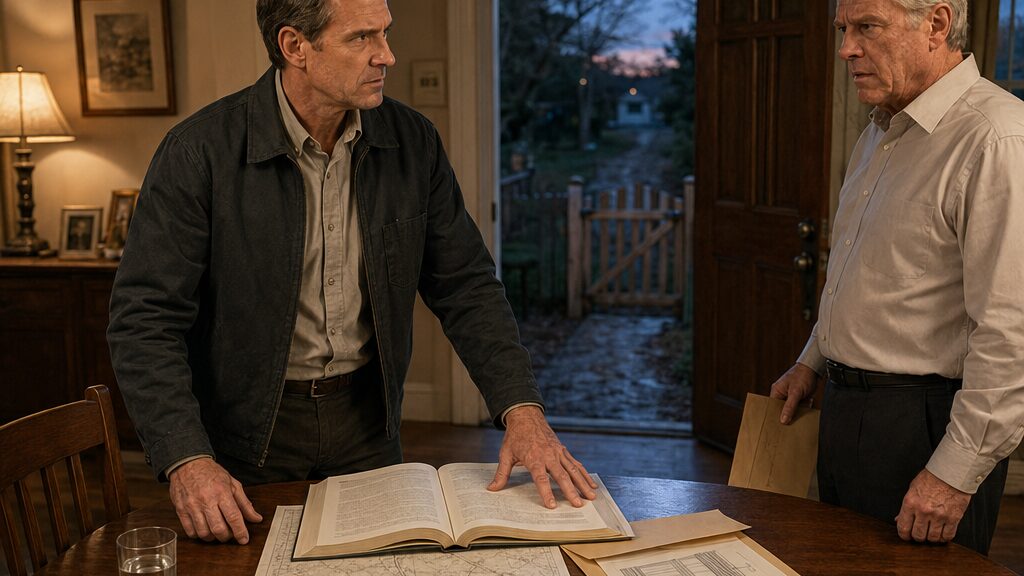
James led him to the dining room, where the overhead light fell across a carefully arranged stack of documents. He offered Dennis water.
“I’m fine.”
James poured a glass anyway and placed it near the empty chair. Dennis did not touch it.
On the table lay a full-size certified survey, the association rulebook, the city permit application, photographs of the damaged fence, and a narrow folder containing Christopher’s preliminary specifications.
Dennis looked at the spread and gave a faint, humorless smile.
“You’ve made this complicated.”
“No. It was always complicated. The board made it sound simple.”
James unfolded the certified survey. The property line was marked in red by the surveyor, running from the rear corner pin along the edge of the worn strip.
“Do you recognize the parcel?” James asked.
“I’m familiar with the subdivision.”
“Look at the line.”
“I don’t need a surveying lesson.”
“Then this will be quick.”
Dennis leaned forward despite himself.
James placed one photograph beside the survey. In it, a measuring tape ran from the fence post to the property marker.
“The narrowest point is twenty-nine inches inside my parcel. The widest is forty-six. There is no recorded pedestrian easement, utility access right, or association reservation crossing that section.”
“Longstanding use can create rights.”
“Not automatically, and not because a board president says so.”
“The association’s attorney disagrees.”
“Then his written opinion should be in the file I requested.”
Dennis’s gaze shifted toward the photographs.
“The route has served residents since before you bought the house.”
“Without permission.”
“You never objected.”
“I replaced damaged landscaping, repaired the fence, installed a sign, and placed barriers.”
“You did not initiate enforcement.”
“Against whom? The people using it never gave me their names.”
Dennis’s fingers rested against the table edge. “This isn’t a courtroom.”
“No. In a courtroom, you would have had to provide the documents.”
James slid the rulebook across the survey and opened it to Section 7.
Dennis barely glanced down. “I know the provision.”
“Read it.”
“I don’t need to.”
“You quoted it in three notices. Read the whole section.”
Dennis’s face tightened. “The first sentence prohibits temporary or permanent boundary structures without prior approval.”
“That’s the sentence your attorney copied. Keep going.”
“It doesn’t alter the violation.”
“Then reading it costs you nothing.”
The room was quiet except for the refrigerator motor in the kitchen. Outside, a child called to someone across the street.
Dennis looked down.
He read the first sentence aloud, quickly. Then the paragraph concerning temporary installations. His pace slowed when he reached the final portion.
“Permanent boundary improvements constructed in accordance with applicable residential standards,” he read, “using approved materials and authorized by the governing local agency, may be installed subject to height, drainage, and utility restrictions—”
He stopped.
James rested one finger beneath the final line.
“Finish it.”
Dennis did not.
James read the remainder himself. “Such improvements shall not be unreasonably prohibited where necessary to protect an owner’s surveyed property from recurring intrusion or damage.”
The water glass remained untouched between them.
Dennis sat back.
“That language does not authorize your wooden gate.”
“You’re right.”
The answer seemed to surprise him.
James closed the rulebook halfway. “The wooden gate is temporary construction. I installed it without an application. You can require me to remove it.”
Dennis’s shoulders eased, but only slightly. “Then we agree.”
“We agree it is coming down.”
James opened the narrow folder.
Inside was Christopher’s proposal for two galvanized steel posts set in concrete and a permanent powder-coated steel panel designed to match the subdivision’s approved dark metal finishes. Behind it lay a stamped site plan and the permit receipt.
“The city completed its review this afternoon,” James said.
Dennis stared at the approval stamp.
James continued, “The panel is under the height limit. It avoids the drainage swale and utility corridor. The posts sit entirely within my property. Approved material, licensed contractor, residential construction standards.”
“You submitted this before the violation period expired?”
“I submitted it after your office refused to provide the enforcement record.”
“This has not been reviewed by the architectural committee.”
James turned the rulebook back toward Dennis. “Section 7 says qualifying permanent boundary improvements may not be unreasonably prohibited when protecting surveyed property from recurring intrusion or damage. I have five years of photographs and repair receipts.”
“The committee can regulate appearance.”
“Christopher matched the approved fence palette used around the pool equipment enclosure.”
Dennis picked up the proposal. His eyes moved across the dimensions, footing depth, material specification, and permit number.
The alarm that entered his face was controlled but unmistakable.
James had expected anger. He had expected another threat, perhaps a declaration that the board would seek an injunction. Instead Dennis looked toward the survey again, specifically at the worn strip beyond the fence line.
“You plan to seal the entire opening?”
“That is what boundary panels do.”
“Permanently.”
“You objected to temporary.”
Dennis set the proposal down with care. “You’re making a point.”
“I’m stopping trespass.”
“You could submit the wooden gate and wait for approval.”
“You scheduled its destruction before allowing me to appeal.”
“The board has to preserve consistent enforcement.”
“Then consistently enforce the part about recurring intrusion.”
“You don’t understand the consequences.”
James almost laughed, but Dennis’s expression stopped him. There was no longer triumph in it. There was worry.
Not worry about losing authority. Something more immediate.
“What consequences?” James asked.
Dennis looked toward the window. The worn path was not visible from the dining room, but both men knew where it lay.
“Residents rely on that route.”
“They rely on my property because you allowed them to.”
“It is more complicated than that.”
“You’ve said that twice without explaining it.”
Dennis stood.
“Delay the installation.”
“The crew arrives Monday.”
“Cancel it.”
“Give me a reason.”
“I’m asking you as board president.”
“You came here to tell me requests were over.”
Dennis’s mouth flattened. He gathered the attorney’s notice but left Christopher’s proposal on the table.
James said, “Your maintenance crew still coming tomorrow?”
“No.”
It was the first concession Dennis had made.
“I’ll notify them that the gate will be removed by the owner.”
“Good.”
Dennis reached the front hall, then stopped with one hand near the door.
James waited.
Dennis turned, and for the first time that evening his voice lost its official cadence.
“If you build that panel exactly as drawn, you will hurt someone who has never damaged your fence, never moved your signs, and never made a complaint against you.”
James felt the satisfaction of victory narrow into something less certain.
“Who?”
Dennis opened the door.
“That,” he said, “is what you should have asked before deciding everyone on that path was your enemy.”
Then he stepped outside, leaving the approved permit open on James’s table and a question no survey could answer.
Chapter 4: The Shortcut Was Hiding a Larger Failure
At seven twenty Monday morning, James saw an older woman’s cane sink three inches into the wet dirt beside his gate.
He had been waiting for Christopher’s truck when movement beyond the fence caught his eye. Emily Harris stood on the green-space side, one hand beneath the woman’s elbow and the other holding the gate open. The older woman placed each foot carefully, testing the ground before trusting it.
Her shoes were clean until the second step.
Then her left heel slid.
Emily caught her before she fell.
James crossed the yard before deciding what he meant to say.
“Stop.”
Emily looked up sharply. “I have her.”
“That ground is unstable.”
“I know.”
“Then why are you bringing her through it?”
The older woman straightened. She was small, silver-haired, and dressed in a blue cardigan despite the mild morning. Her cane had sunk again, leaving a narrow round hole in the path.
Emily’s mouth tightened. “Because the sidewalk around the clubhouse is worse.”
James looked toward the hill beyond the green. From his yard, the official route appeared orderly: a pale strip of concrete curving behind trimmed hedges. He had walked it dozens of times.
“It’s paved,” he said.
“It’s cracked.”
“So report it.”
“We have.”
The older woman freed her cane from the mud. “Emily, please.”
Emily ignored the warning in her voice. “This is Ruth Adams. She lives behind the parking lot.”
James recognized the last name from association mailings, though he could not remember meeting her.
Ruth gave him an embarrassed nod. “I’m sorry about the path.”
“It isn’t a path,” James said.
The words came too quickly.
Ruth’s gaze dropped to the flattened earth.
“No,” she said. “I suppose it isn’t.”
Emily’s expression hardened. “She has a physical therapy appointment. Her daughter is picking her up in the lot.”
“The street route is public.”
“The street route adds almost half a mile and crosses the entrance where drivers come around blind.”
“That doesn’t make my property public.”
“I didn’t say it did.”
“You’re standing on it.”
Emily stepped closer to him, but Ruth placed a hand on her arm.
“He is right about the land,” Ruth said.
The admission disarmed James more effectively than an argument would have.
Ruth continued, “We should have asked. I should have asked.”
James looked at the cane marks, the muddy shoes, and the hand Emily kept beneath Ruth’s elbow. For years he had seen only footprints. None of them had carried names.
“When did the official route become unsafe?” he asked.
Emily gave a short, disbelieving breath. “It didn’t become unsafe. It was built badly and then neglected.”
Ruth glanced toward the clubhouse hill. “The slope is difficult. There’s a raised joint near the top.”
“I inspected the subdivision documents when I bought.”
“Then you saw the proposed walkway,” Emily said.
James looked at her.
“What proposed walkway?”
She pointed across the green, not toward the hill but along its lower edge. “A level connection from the parking lot to the pavilion. The board said it was approved before Ruth moved here.”
Ruth’s face tightened. “They said funding was delayed.”
“How long ago?”
“Six years.”
James looked down the worn strip. It ran almost exactly where a sensible lower route might have connected the two community areas—except it crossed his parcel at the final turn.
The gate clicked behind Ruth as the wind moved it.
“You could have told me,” James said.
Emily stared at him. “When? While you were photographing us?”
“I photographed the damage.”
“You photographed everyone who came through.”
“Because nobody asked.”
“And you never asked why.”
James felt Dennis’s parting words return with irritating precision.
Ruth shifted her weight. “Mr. Taylor, people have misused this opening. Children run through. Some residents take carts through and strike the fence. I have seen it. Emily has told them to stop.”
James looked at Emily.
She did not soften. “Your boundary is yours. I’m not disputing that.”
“Then what are you disputing?”
“The pleasure you’re taking in closing it.”
Before James could answer, a diesel engine sounded at the curb. Christopher’s work truck turned into the drive, towing a small trailer with wrapped steel posts secured along one side.
Emily watched it approach.
“That’s the permanent panel?”
“Yes.”
Ruth’s fingers tightened around the cane handle.
Emily said, “You could lock a gate and give Ruth a key.”
“And make myself responsible for deciding who qualifies?”
“You could delay construction until the board fixes the route.”
“The board threatened to enter my yard before allowing an appeal.”
“So this is punishment.”
“It is protection.”
“For you,” Emily said. “Punishment for everyone else.”
Christopher stepped from the truck but did not come closer. He took in the three of them, Ruth’s muddy shoe, and the open gate.
James felt watched from several directions. Two residents had stopped near the green. One held a phone at waist level, though James could not tell whether it was recording.
“Mrs. Adams needs to go,” he said.
Ruth looked at him directly. “I can take the long way.”
“You’ll miss your ride.”
“That isn’t your responsibility.”
The dignity in her tone left him no comfortable answer.
James moved aside. “Go through.”
Emily helped Ruth across the remaining mud. At the driveway, Ruth paused.
“The board should never have allowed this to become your problem,” she said. “But it became ours too.”
Then she continued toward the parking lot.
By noon, photographs of Christopher’s trailer had appeared on the neighborhood message board. The first post called the steel panel “an aggressive barrier.” Another said James was knowingly blocking disabled residents from community facilities. Someone attached a petition demanding an emergency injunction.
No one mentioned the damaged fence.
No one mentioned the survey.
Emily returned that afternoon alone.
“I didn’t post the petition,” she said from the other side of the gate.
“You challenged me in front of three people.”
“I challenged what you were doing, not whether you owned the land.”
“The posts online don’t preserve that distinction.”
“Then show them the survey.”
“I shouldn’t have to defend ownership of my own yard.”
“No. But Ruth shouldn’t have to become evidence either.”
James had already assembled photographs for a response. One showed the damaged rail. Another showed a bicycle track across newly planted grass. He had considered including the morning image of Ruth’s cane sunk in mud.
He closed the folder.
“What do you want?” he asked.
“A week.”
“For what?”
“To force a board meeting about the lower walkway.”
“They’ve ignored you for six years.”
“They won’t ignore the steel.”
“That is precisely why I’m building it.”
Emily studied him through the slats. “Then use the pressure. Don’t use Ruth.”
She walked away before he answered.
Christopher spent the afternoon marking utilities and checking dimensions. Near four, he set the first wrapped post beside the gate but did not unload the concrete.
James noticed.
“You’re losing daylight.”
“I’m not starting today.”
“The permit is active.”
“I know.”
“The site is clear.”
Christopher removed his gloves. “Also true.”
James waited.
Christopher nodded toward the path. “I’ll build what you contracted me to build. I won’t build it while you’re pretending the only question is whether you can.”
“That is the question the association created.”
“No. It’s the question you like because you know the answer.”
James felt heat rise beneath his collar. “You think I should leave my property open?”
“I think you should decide whether the finished panel is meant to protect your home or make the neighborhood regret crossing you.”
“They should regret it.”
Christopher’s expression did not change.
The bluntness of James’s answer seemed to settle something between them.
Christopher picked up his gloves and returned them to the truck.
“The steel stays wrapped,” he said. “Call me when you know which result you’re paying for.”
He drove away, leaving the galvanized posts beside the fresh wooden gate and James alone with a legal victory that suddenly looked incomplete.
Chapter 5: The Board Had Budgeted for Silence
The accessibility improvement line appeared in the 2019 budget and vanished from every budget after it.
James found the entry at 9:14 Tuesday morning in a binder the management clerk had placed on a narrow table beneath the office window. The amount was modest for a capital project—forty-eight thousand dollars—but the description was unmistakable:
LOWER GREEN ACCESS CONNECTION — DESIGN AND INITIAL CONSTRUCTION
He turned to the following year.
Nothing.
The next year contained a larger landscaping allocation and an emergency pool resurfacing expense. The lower access connection was absent.
James photographed the page.
The clerk looked up from her desk. “Records may be reviewed, not reproduced.”
“State law permits an owner to photograph association records.”
“I’ll need to confirm that.”
“You can.”
She rose and disappeared into Dennis’s office.
James continued.
Meeting minutes from the same period mentioned a “mobility access concern” near the overflow lot. A board motion authorized preliminary design work. The motion passed unanimously.
The next month’s minutes referred to “cost uncertainty.”
Three months later, the project became “deferred pending reserve analysis.”
After that, silence.
Dennis entered the records room carrying a folder.
“You’re reviewing beyond the scope of your gate appeal,” he said.
“The walkway is relevant to why the board tolerated use across my parcel.”
“No board authorized trespass.”
“You called it established community access.”
“I said residents had relied on it.”
“Because the project you approved disappeared.”
Dennis placed the folder on the table. “Budgets change.”
“Where is the reserve analysis?”
“Financial working documents may be privileged.”
“Reserve studies are association records.”
“Draft discussions with counsel are not.”
James turned another page. “Then provide the final study.”
Dennis did not move.
That answer was clear enough.
Inside the capital planning binder, James found an old site plan folded behind a drainage report. A dashed line ran from the overflow parking area along the lower edge of the green, ending near the corner of his lot. The final connection turned away from his property and joined the pavilion through association land.
The worn dirt path was not the planned route. It was the shortcut residents had created after the planned route was abandoned.
Someone had written in pencil beside the dashed line:
PHASE II — HOLD
James unfolded the plan completely.
“You had a route that never crossed my property.”
Dennis’s gaze rested on the pencil note. “The grade required retaining work.”
“That should have been included in design.”
“It was.”
“Where is the cost estimate?”
Dennis glanced toward the clerk. “Give us the room.”
She left and closed the door.
Dennis pulled out the opposite chair. For the first time since the dispute began, he looked tired rather than controlled.
“The original estimate doubled,” he said. “Drainage, lighting, retaining wall, engineering review. The reserve fund had already been hit by roof replacements.”
“So the board deferred it.”
“We prioritized immediate obligations.”
“And allowed residents to cross my parcel instead.”
“We did not direct them.”
“You didn’t stop them.”
Dennis’s voice sharpened. “Would you have preferred we send violation letters to an eighty-year-old woman for choosing the only route she could safely manage?”
“I would have preferred you build what you promised.”
“With what money?”
“The reserve fund.”
“It was underfunded.”
“Then levy an assessment.”
Dennis gave a humorless smile. “Easy to say when you’re not the one facing a room full of homeowners on fixed incomes.”
James understood the pressure. He had attended meetings where a twenty-dollar monthly increase produced anger out of proportion to the amount because the amount was never only money. It was medication, groceries, pride, and fear dressed in accounting terms.
But understanding did not erase the choice.
“You concealed the failure,” he said.
“We delayed a project.”
“For six years.”
“We kept dues stable.”
“You transferred the cost to my property.”
Dennis leaned forward. “And now you plan to transfer it back onto Ruth’s legs.”
The accusation landed because it was not entirely false.
James folded the plan carefully.
“I want the emails and liability review.”
Dennis stood. “Those are privileged.”
“Then I’ll request them formally.”
“You’ve already turned this into something larger than necessary.”
“No. I found what was already large.”
At home, James compared the old site plan with satellite images and his survey. The intended route remained feasible. The landscaping installed two years earlier would have to be removed, but the association still owned sufficient land.
Emily came by after work.
James met her at the front door rather than the gate.
He showed her the plan without inviting her inside.
“They designed the lower connection,” he said. “They held it after the estimate increased.”
Emily traced the dashed line. “Ruth was told permits caused the delay.”
“Permits may have contributed. Money ended it.”
“Can you prove that?”
“Not yet.”
She looked at him. “What do you need from us?”
“Nothing from Ruth.”
Emily’s shoulders eased slightly.
“I will not use her medical records, photographs, or a statement about her condition.”
“She might speak if she chooses.”
“That has to be her choice, not mine.”
“And mine?”
“I need copies of notices residents sent about the official walkway. Dates, responses, anything promising repairs.”
Emily considered him. “I’ll help if you make one thing clear publicly.”
“What?”
“That the land is yours, but access is a real problem. Not an excuse. A problem.”
James nodded.
She did not leave immediately.
“Dennis isn’t wrong about the assessment,” she said. “Some people here can’t absorb much more.”
“He still chose concealment.”
“Yes.”
“And you still used my property without asking.”
Emily met his eyes. “Yes.”
The direct admission stripped the conversation of its easier defenses.
“I’m sorry,” she said. “I should have knocked years ago.”
James folded the plan. He had imagined hearing those words many times. They brought less satisfaction than expected.
The special board meeting that evening filled the clubhouse beyond its folding chairs. Dennis sat at the front between two board members. The HOA attorney joined by speakerphone.
James had submitted the survey, permit, photographs, and records request. Emily sat beside Ruth in the second row.
The first twenty minutes concerned procedure. Dennis described the gate as an unapproved obstruction. James described the enforcement as premature and selective.
Then a board member projected a slide supplied anonymously that afternoon.
It showed a newspaper clipping from twelve years earlier about a municipal community center. The article quoted James, then a building inspector, confirming that the project met code despite complaints that its rear entrance was difficult for wheelchair users.
A resident behind James whispered, “Of course.”
Dennis looked genuinely surprised, but he did not remove the slide.
James stared at his younger face in the clipping.
He remembered the project. The ramp met the maximum permitted slope. The landing dimensions passed. Every number was correct.
He also remembered a woman resting halfway up because the design exhausted her.
He had signed the approval anyway.
Emily turned toward him. “Is that you?”
“Yes.”
The room shifted. James felt it in the silence and in the way residents stopped seeing him as the precise homeowner who had caught the board misreading a rule. Now he was a man who had once defended minimum compliance against practical harm.
Dennis said, “This appears relevant to Mr. Taylor’s current claims about accessibility.”
“It is relevant,” James replied.
The admission seemed to unsettle Dennis more than denial would have.
James stood. “I approved that project because it met the written standard. People told me the route was difficult. I said difficulty was not the test.”
Ruth watched him without expression.
“I was legally correct,” James continued. “I was also wrong.”
No one applauded. No one softened.
But Emily placed a folder on the table before Dennis. It contained four years of repair requests concerning the official path.
“We can discuss Mr. Taylor’s past,” she said. “Then we discuss yours.”
The meeting ended without a vote. The attorney advised the board to review its records before further enforcement.
Dennis caught James in the parking lot.
“I can end this,” he said.
James stopped beside his truck.
Dennis handed him a two-page agreement. The association would withdraw the violation, cancel all fines, reimburse the wooden gate materials, and acknowledge that the disputed strip belonged to James.
In return, James would leave the opening available under a revocable neighbor-access license and withdraw all demands concerning the lower walkway records.
“You get everything you asked for,” Dennis said.
James looked toward the green, where the worn path cut through the dark grass.
“No,” he said. “I get my name cleared while the problem stays hidden.”
Dennis’s face hardened. “You should consider how rare it is for a board to offer complete relief.”
James folded the agreement once.
That was the danger. It offered him precisely enough justice to make silence feel reasonable.
Chapter 6: James Refused the Deal That Cleared His Name
Dennis read the settlement aloud at the emergency hearing as though generosity might become more convincing in a formal tone.
“All existing fines shall be rescinded. The association shall reimburse documented material costs associated with the temporary gate. The association shall acknowledge the surveyed boundary and release Mr. Taylor from all enforcement expenses.”
He paused before the final provision.
“In exchange, the owner shall permit continued pedestrian passage under a revocable accommodation and withdraw pending records demands and external complaints.”
The clubhouse was quieter than it had been at the previous meeting.
James sat at a small table facing the board. To his left were the certified survey and photographs of the damaged fence. To his right lay the approved design for the lower walkway Emily had uncovered in an old homeowner packet.
Dennis placed the agreement down.
“This resolves the dispute without additional expense to the community.”
“For me,” James said.
“For everyone.”
“No. It resolves the fines against me. It leaves residents crossing private property because the association refused to complete its own route.”
A board member adjusted her glasses. “The proposed license would legalize the passage.”
“Until someone falls.”
“The agreement includes liability language.”
“Liability language does not stabilize mud.”
The HOA attorney’s voice came through the speakerphone. “Mr. Taylor, the board is attempting a practical accommodation.”
James looked at the photographs. The worn path appeared almost harmless in summer light. In another image, taken after rain, the mud showed heel marks and the round punctures left by Ruth’s cane.
“Practical for whom?” he asked.
Dennis leaned toward his microphone. “The lower walkway would require a special assessment. We have repeatedly explained that.”
Emily stood from the second row.
“You have never shown residents the final estimate.”
“This is a board hearing,” Dennis said. “Public comment will follow.”
“You told us no final estimate existed.”
Dennis looked at the attorney’s speaker.
James opened the reserve study he had received that morning after a second records demand. Three pages had been missing from the office copy. Emily’s older packet contained them.
“The association’s reserve consultant identified discretionary funds sufficient to cover most of the walkway,” James said. “The remainder could be phased over two budget years.”
The room stirred.
Dennis said, “Those funds were designated for future roof and drainage work.”
“Designated is not the same as unavailable.”
“Using reserves now increases future risk.”
“So does ignoring an unsafe route.”
A resident called from the back, “How much would an assessment be?”
Dennis answered reluctantly. “The preliminary range was between two hundred and eighty and four hundred dollars per unit, depending on the final scope.”
Several people reacted at once. One man shook his head. An older woman whispered that she could not pay that.
James understood why Dennis had feared the number.
Dennis raised a hand for silence. “This is exactly why the board pursued a no-cost accommodation.”
“No cost to the budget,” James said. “Not no cost.”
He stood and carried the photograph of the muddy path to the easel beside the board. Then he placed the walkway design next to it.
One showed what the association had allowed.
The other showed what it had postponed.
Dennis said, “You are asking the community to absorb a major expense because you object to a narrow path.”
“I’m asking the association to stop using my land as its unpaid solution.”
“And if residents vote against an assessment?”
“Then use reserves.”
“And defer roofs?”
“Publish the options. Let owners decide with the real numbers.”
The attorney interrupted. “Mr. Taylor’s demands exceed the scope of his enforcement appeal.”
“They became relevant when the board claimed access justified entering my property.”
James looked toward Ruth. She had sat silently through both meetings, her cane resting against her knee.
Dennis followed his gaze.
“We should not place residents in the position of discussing private limitations,” he said.
Ruth reached for the cane and stood.
Emily moved to help, but Ruth shook her head.
“I would like to speak.”
Dennis hesitated, then nodded.
Ruth faced the room rather than the board.
“I use the shortcut,” she said. “I used it before Mr. Taylor installed his gate. I used it after he asked people not to.”
No one moved.
“The official walk is difficult for me. That is true. It is also true that I never asked the association to claim his property for me.”
Dennis lowered his eyes.
Ruth continued, “I was told the lower walkway was delayed by permits. Then by drainage. Then because another project came first. I accepted those answers because I did not want my neighbors assessed on my account.”
Her hand tightened around the cane.
“But the cost did not disappear. Mr. Taylor repaired his fence. Emily walked me through mud. Other people used my difficulty as permission for their convenience.”
A man in the back shifted in his chair.
“I do not want a path that exists because everyone was too embarrassed to tell the truth.”
Ruth sat.
The room remained quiet.
James looked at the old clipping still tucked in his folder. He had planned not to mention it again. Dennis had already used it against him, and admitting fault had not erased what James had signed years earlier.
But silence now would repeat the same pattern.
“There is something else,” James said.
He placed the clipping beside the two path images.
“Twelve years ago, I inspected a public building with a ramp that met every written standard. People using it told me it was exhausting. I approved it because the measurements passed.”
Dennis watched him carefully.
“I told myself my job was to enforce the minimum, not question the result. That protected the project, the schedule, and me.”
James touched the photograph of the muddy route.
“I recognize that reasoning now.”
A board member asked, “Are you withdrawing your barrier permit?”
“No.”
Emily looked at him.
“My property line remains my property line,” James said. “I will not agree to an access license. I will not leave the opening in place. But I will delay steel installation for seventy-two hours if the board authorizes the lower walkway and publishes the complete financial options.”
Dennis shook his head. “You cannot impose a deadline on association governance.”
“You imposed one on me.”
The attorney’s voice sharpened. “If you file an accessibility complaint with the city, the association will consider all available legal responses.”
“That sounds like litigation.”
“It is notice that litigation may follow.”
James felt the old instinct to narrow the issue—to stay where his documents were strongest and his personal risk smallest.
The settlement remained on the table. With one signature, the fines vanished. His ownership would be acknowledged. He could install a lock, grant access, and let the board’s failure become someone else’s concern.
Dennis slid a pen toward him.
“You have achieved what you wanted,” Dennis said quietly. “Do not turn it into a crusade.”
James looked at the pen, then at the worn path in the photograph.
What he had wanted was to stop the footprints.
What he needed was to stop pretending the footprints were the entire problem.
He pushed the agreement back.
“No.”
This time the word did not feel like victory. It felt like accepting a cost.
James opened his phone and forwarded the prepared complaint to the city accessibility office. Attached were the abandoned site plan, reserve pages, repair requests, photographs of the official route, and the board’s enforcement notices.
The confirmation appeared before anyone spoke.
Complaint received.
Dennis stared at the screen.
James gathered the survey and permit.
“The steel crew returns in seventy-two hours,” he said. “Before then, you can authorize the route you should have built, or explain the records to the city while my boundary closes.”
Outside the clubhouse, the old path lay dark beneath the parking-lot lights, still open for the moment and no longer hidden from anyone.
Chapter 7: The New Path Ended Where His Boundary Began
Welding sparks rose behind James’s fence at eight fifteen on Monday morning.
They flashed white against the galvanized post, scattered over the damp ground, and vanished before reaching the old dirt path. Christopher stood behind a dark shield while one of his workers held the bracket steady.
Across the green, the new concrete walkway curved from the overflow parking lot toward the pavilion. It was not finished, but enough had been poured to show the route clearly. It stayed on association land, followed the lower grade, and ended several feet from James’s surveyed boundary.
For the first time, the neighborhood could see both solutions at once.
A lawful path.
A closed property line.
Christopher lifted the shield and inspected the weld.
“You still want the solid panel?” he asked.
James looked at the section waiting on padded sawhorses. It was six feet wide, powder-coated charcoal, with no openings except a narrow clearance above the ground for drainage. When he had approved the design, he had imagined it as an answer no one could misunderstand.
Now it looked heavier than necessary.
“Set it in place,” James said.
Christopher studied him but signaled to the crew.
Six weeks had passed since the emergency hearing. The seventy-two-hour deadline had not ended with another threat. It had ended with a city accessibility officer arriving at Clearwater Ridge, measuring the cracked upper route, reviewing the abandoned lower-path plan, and asking why an approved community connection had been replaced by an informal crossing over private land.
The question entered the official record.
After that, the board’s position changed quickly, though not gracefully.
The association suspended enforcement against James. The two other board members voted to release the complete reserve analysis and authorize the lower walkway using a combination of reserve funds, delayed landscaping work, and a smaller assessment spread over two years. The city required revised drainage work, handrails near the parking area, and a level landing beside the pavilion.
Dennis accepted formal censure for authorizing removal before the appeal and for failing to disclose the abandoned access project during the first hearing.
He did not resign immediately.
Instead, at the board’s request, he remained through construction because he knew the contracts, the reserve schedule, and every promise that had been made. Some residents considered that too lenient. Others considered it practical.
James had not decided which group he belonged to.
The crew lifted the steel panel upright.
As its edge moved toward the posts, it blocked James’s view of the green one vertical inch at a time.
“Stop,” he said.
Christopher raised his hand. The workers froze.
The panel hung between them, suspended above the old path.
“What’s wrong?” one worker asked.
James walked around it.
From the green-space side, the structure looked less like a boundary than a wall. The approved height was lawful. The finish matched existing association metalwork. The permit was valid.
Every measurement passed.
James placed his palm against the cool steel.
The memory came without invitation: a public building twelve years earlier, a ramp built at the steepest legal slope, a woman stopping halfway while James explained that the design satisfied code.
He had been correct then too.
“Take it down,” he said.
Christopher removed his gloves. “Canceling?”
“Changing.”
“To what?”
James picked up the revised sketch he had made the night before but had not shown anyone. The central section remained steel, but narrower. On both sides, vertical rails preserved the boundary without creating a blank face. Low planting beds would run along James’s side, with climbing greenery trained between the posts. The structure would still prevent passage and protect the fence. It simply would not announce anger from twenty yards away.
Christopher examined the drawing.
“This costs more.”
“I know.”
“You already paid for the solid panel.”
“Use it on another job if you can. I’ll cover the difference.”
Christopher looked at him. “You sure this isn’t for the neighborhood?”
“It’s for me. I have to look at it.”
A slight smile appeared beneath Christopher’s tired expression.
“That’s a better reason.”
The workers lowered the panel onto the sawhorses.
Across the green, several residents had gathered near the unfinished walkway. James saw Emily among them. She was speaking with the concrete supervisor and pointing toward the landing where the route approached the pavilion.
Dennis stood nearby holding a clipboard.
He had changed over the past six weeks, though not in any dramatic way. His shirts were still pressed. His tone remained controlled. But he no longer entered meetings with every answer arranged in advance.
When James crossed the green, Dennis met him beside the fresh concrete.
“The city inspector wants the handrail extended another eighteen inches,” Dennis said.
“Probably right.”
“It adds nine hundred dollars.”
“The reserve can absorb it.”
Dennis gave him a dry look. “You enjoy saying that.”
“Less than I expected.”
They watched the contractor mark the extension.
Dennis tapped the clipboard against his leg. “The board approved your damages reimbursement.”
James had submitted receipts for the fence repairs, destroyed shrubs, survey certification, and legal consultation. The amount was smaller than the threatened enforcement costs but large enough to matter.
“I saw the notice,” he said.
“The check will be mailed Friday.”
“Keep eight hundred of it.”
Dennis frowned. “For what?”
“Landscaping along the new walkway. Shade plants near the landing. Something low maintenance.”
“The association is responsible for the full correction.”
“I know.”
“Then why contribute?”
James looked toward the old dirt strip. The soil had begun to dry and crack now that fewer people crossed it. Grass seed waited in two unopened bags beside his shed.
“Because not every dollar has to prove who lost.”
Dennis glanced at him, then wrote something on the clipboard.
“This does not erase what the board did.”
“I’m not offering erasure.”
“Good.”
It was the closest either man came to an apology that morning.
Emily approached carrying a rolled plan.
“The final landing has been widened,” she said. “Ruth can turn without backing toward the slope.”
Dennis nodded. “The city approved it.”
Emily looked past James toward the boundary crew. “You changed the panel.”
“Yes.”
“Because of the petition?”
“No.”
“Because Christopher refused?”
“He stopped refusing weeks ago.”
“Then why?”
James looked at the new rails being unloaded.
“The original design did what I wanted when I was angry.”
“And this one?”
“Does what I need.”
Emily considered that.
“The land was always yours,” she said.
James almost replied that she had already admitted it. Instead he said, “The access problem was always real.”
They stood in the narrow space between those truths.
Ruth arrived shortly before noon.
Emily had offered to bring her by car, but Ruth had insisted on walking from her house to the overflow lot so she could use the new route from its beginning. The concrete had cured enough for foot traffic, and the handrails were fixed in place.
At the entrance, Ruth stopped.
A small group waited near the pavilion, though no ceremony had been planned. There was no ribbon, no microphone, and no speech. The residents simply moved aside to give her room.
Ruth placed her cane on the pavement.
The rubber tip held.
She took one step, then another. The grade was gentle enough that her shoulders stayed level. At the first landing, she paused and looked toward the old shortcut.
James’s new boundary stood complete now. Narrow steel panels protected the vulnerable section of fence. Open vertical rails allowed light through without leaving space for a person to pass. Fresh soil filled the planting beds along his side.
The small wooden gate was gone.
Ruth looked at James.
“May I?” she asked, pointing toward the old dirt path.
He nodded.
She left the pavement only far enough to stand beside the place where her cane had sunk weeks earlier. The ground still carried faint impressions: shoe edges, bicycle tracks, the shallow channel worn by years of feet choosing the shortest line.
“I should have knocked,” she said.
James stood on his side of the boundary.
“I should have asked why.”
Ruth rested both hands on her cane. “We were all waiting for someone else to solve it.”
“Some of us were billing one another in the meantime.”
That earned a quiet laugh from her.
She returned to the new walkway.
At the pavilion, Emily offered her arm, but Ruth shook her head and continued without it. She reached the landing, turned easily, and walked toward the green.
No one applauded.
The concrete supervisor checked the rail alignment. Dennis reviewed an invoice. Christopher began loading the unused solid panel onto his trailer. Residents gradually returned to their homes.
James went back to the old path with a rake and the bags of seed.
He broke the hardened surface first. Beneath the trampled crust, the soil was dark and loose. He filled the deepest prints, leveled the narrow strip, and scattered seed from the fence to the edge of the green.
Emily appeared on the other side carrying a hose.
“You planned to water from there?” she asked.
“I can reach most of it.”
“Not the far edge.”
James looked at the hose, then at her.
She did not step across the line.
Instead, she passed the nozzle carefully between two vertical rails.
James took it.
“Thank you,” he said.
“You’re welcome.”
He watered until the soil darkened and the last recognizable footprint softened into the ground.
Over the following days, the path lost its shape. Rain pressed the seed down. Fine green shoots appeared first near the fence, then farther out where the earth had been hardest. People used the new walkway because it was level, because it was safer, and eventually because it became the ordinary route.
The permanent boundary remained.
So did the memory of why it had been necessary.
One evening, James stood on his back porch and watched Ruth cross the lower path toward the pavilion. She moved slowly, but she did not stop. Beyond her, the old shortcut had become an unbroken strip of new grass.
At the point where it met his property, the walkway turned.
The boundary began.
Neither erased the other.
The story has ended.