He Cut Down Six Oaks for a Better Lake View, Then Dared the Quiet Neighbor to Sue
Chapter 1: The Trees Were Already Falling When Michael Reached the Slope
The chainsaw bit into the final oak as Michael Walker ran downhill with his deed folder clamped beneath one arm.
The sound was wrong for a Saturday morning. Not the distant cough of a crew clearing storm debris, but a full-throated mechanical scream coming from the wooded strip behind his house. By the time he reached the lower terrace, the cut had already opened like a pale mouth across the trunk.
“Shut it off.”
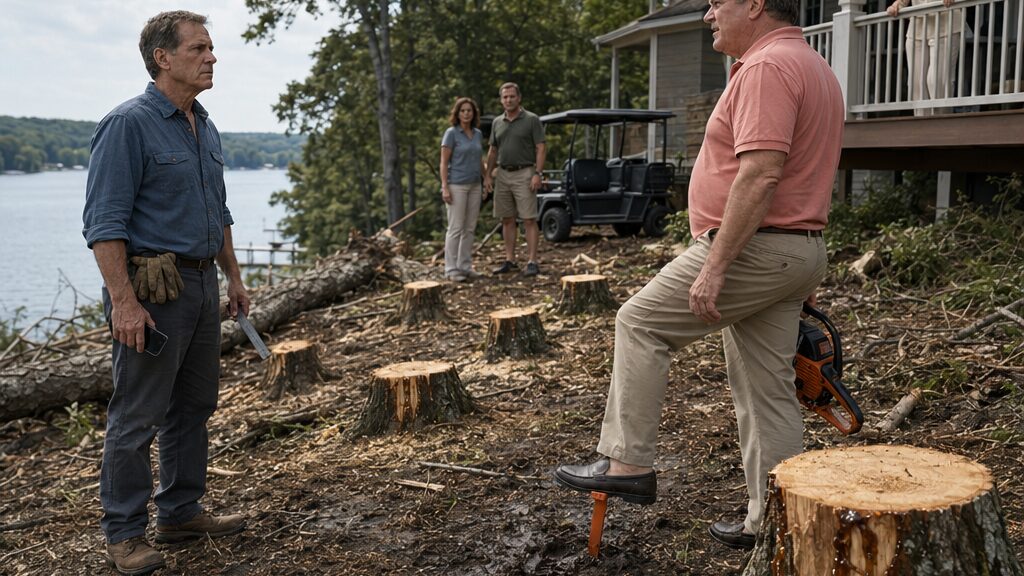
Raymond Mitchell looked over his shoulder without releasing the throttle. He wore tan slacks, loafers, and a salmon-colored polo already darkened beneath the arms. The clothes made the chainsaw seem less like a tool he knew how to use and more like something he had borrowed to make a point.
The oak leaned.
Michael stopped ten feet away. Its crown moved slowly at first, leaves turning silver as their undersides caught the light. Then the trunk split with a report that seemed to strike the lake itself. Branches tore through a younger maple before the whole tree crashed downhill, throwing dirt and shredded leaves into the air.
For two seconds, the chainsaw idled.
Then Raymond switched it off.
“There,” he said. “You got what you wanted.”
Michael stared past him.
Five other stumps punctured the slope. Their exposed wood was raw and wet, rings bright beneath ragged cuts. One trunk had been dragged sideways, crushing ferns and mountain laurel. Yellow sawdust lay in drifts along the ground. A thin run of sap had gathered on the nearest stump and slipped down the bark.
Six.
He counted again because the number refused to settle.
Six oaks.
From the Mitchells’ elevated deck, Barbara Mitchell rested both hands on the white railing. She wore cream pants and a sleeveless blouse, as if she had stepped outside to inspect new patio furniture.
“Michael,” she called, “before you get upset, look at the view.”
He did not look at the lake. He looked at the empty spaces where the crowns had been.
Raymond set the chainsaw on the ground. “The whole back section was gloomy. Half those trees were leaning. We did you a favor.”
“You crossed my property line.”
Raymond gave a short laugh. “That strip has been maintained by the association since before either of us bought here.”
Michael opened the folder. His hands were steady enough to separate the recorded survey from the deed, though the paper made a dry clicking sound against his thumb.
“The county survey was updated four years ago.”
“Survey, easement, setback.” Raymond waved toward the slope. “This isn’t a courthouse.”
“No. It’s my land.”
Two neighboring residents stood farther uphill near an HOA utility cart. Neither spoke. One held a coffee mug against his chest. The other kept glancing toward Barbara, as though waiting for her to explain why the scene was reasonable.
Barbara did.
“The lake was completely hidden from both houses,” she said. “Now the whole section breathes. Once the brush is cleaned up, you’ll see what we mean.”
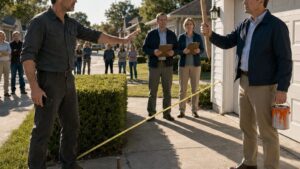
Michael walked toward the nearest orange marker. The stake rose from the mud beside a fresh stump, its plastic cap streaked with sawdust.
“Eleven feet,” he said.
Raymond frowned. “What?”
“The cut line is eleven feet inside the recorded boundary.”
He pointed toward a second orange stake lower on the hill, then a third near the stone drainage channel. The markers formed a straight line. Every stump stood on Michael’s side.
For the first time, Raymond looked at them rather than through them.
A tree-removal contractor stood by the chipper near the access path. He pulled off his earmuffs.
“We were shown the maintenance map,” he said. “Mr. Mitchell said the markers were old.”
Michael looked at Raymond.
Raymond’s expression changed only slightly, but the change was enough. His jaw tightened. His eyes moved toward the watching neighbors.
“That’s not what I said.”
The contractor bent to gather a fuel can. “Crew’s done.”
“You’re not leaving yet,” Michael said.
The man paused. “You need to talk to whoever hired us.”
“I need your company name and proof of insurance.”
Raymond stepped between them. “You don’t need anything from him.”
Michael held his gaze. “Move.”
The word came out quieter than he intended.
Raymond smiled. He looked down, noticed the orange stake near his loafer, and placed his sole on top of it.
The plastic flexed.
Michael heard Barbara say his name, not sharply, but as a warning meant for Raymond.
Raymond pressed harder. The stake folded into the mud until only a strip of orange showed beneath his shoe.
“What stakes?” he asked.
No one answered.
Raymond glanced toward the two residents near the utility cart. “I don’t see any stakes.”
The contractor put the fuel can in the truck.
Michael felt something inside him move toward Raymond—a hot, direct impulse with no words attached to it. For an instant he saw himself crossing the distance, knocking the man backward, forcing him to look at the stumps from the ground.
Instead, Michael closed the folder.
Raymond mistook the movement for retreat.
“It’s a few trees,” he said. “If you think you’ve got a case, sue me.”
He lifted his foot.
Mud clung to the tread of his loafer. The orange stake remained bent in a shallow impression, its top buried beneath the heel mark.
Michael took his phone from his pocket.
Raymond laughed again. “Now you’re taking pictures?”
Michael did not answer.
He photographed the stake before touching it. Then he crouched, slipped on the work gloves he kept folded in his back pocket, and placed a small steel ruler beside the tread impression. He had used the ruler for years when documenting damaged records in the municipal archive—water stains, torn seals, altered dates. Scale established context. Context established meaning.
He took three photographs from different angles.
The laughter stopped.
Michael lifted the stake by its cleanest edge. Mud released it with a soft sucking sound. He photographed the bent plastic, the heel pattern, the fresh stump behind it, and the second marker farther down the line.
“Michael,” Barbara said, “this is getting unnecessary.”
He stood and framed the scene so the Mitchell deck appeared above the cut slope.
“No,” he said. “It became necessary when you kept cutting.”
Raymond moved toward him. “You want to make this ugly?”
Michael photographed the chainsaw oil beside the stump. He photographed the tire tracks from the contractor’s truck. He photographed the drag marks through the ferns and the torn root flare where one trunk had struck the ground.
The contractor climbed into his cab.
Michael walked to the driver’s door and photographed the company name printed beneath a layer of dust. The man lowered the window.
“I told him to wait for confirmation,” the contractor said quietly. “He said he was on the board.”
Raymond called from behind them. “Don’t drag me into whatever paperwork mess you created.”
The contractor looked at Michael. “Office can send you the work order Monday.”
“Thank you.”
The truck pulled away with the chipper rattling behind it.
Raymond picked up the chainsaw. “You’ll hear from the association.”
Michael looked at the machine, then at Raymond’s polished shoes.
“I expect I will.”
Raymond walked uphill toward the utility cart. Barbara stayed on the deck. For a moment, her composure slipped. She looked not at Michael but at the raw opening in the slope, as though the lake beyond it had arrived larger than she expected.
One of the neighboring residents turned away first. The other followed.
Michael remained among the stumps.
The silence after the truck left was worse than the chainsaw. Without the engine, he could hear leaves settling, small branches cracking beneath their own weight, water tapping somewhere inside the drainage channel. The hillside looked exposed and oddly shallow. The lake had always appeared in fragments through the trees. Now it lay open and bright below, a sheet of blue that made the destruction look intentional even from a distance.
He photographed each stump and numbered them on a yellow legal pad.
At the sixth, he stopped.
His father had once stood beside that tree with one hand pressed to the bark. He had said something Michael had spent years refusing to remember precisely.
Keep the hill intact.
Or perhaps: Don’t let them clear the hill.
The exact words had blurred, but the obligation had not.
Michael folded the thought away and returned to the evidence.
Near the utility cart, a magnetic placard displayed the HOA emblem. Beneath it, in smaller lettering, were three lines naming the board officers.
Raymond Mitchell, Vice President.
Michael zoomed in and took one more photograph.
Chapter 2: The Board Called It Landscaping Before Seeing the Damage
The HOA email arrived while Michael was still photographing the sixth stump.
His phone vibrated in his gloved hand. The subject line read: AUTHORIZED SLOPE MAINTENANCE—RESIDENT INTERFERENCE.
He opened it beneath the stripped sky.
Mr. Walker,
Management has been informed that you obstructed an approved contractor performing vegetation and view-restoration work within a community-maintained area. Please refrain from further interference while the board reviews the matter.
The message had been sent by Sarah Lee, the community manager, and copied to the entire board.
Michael read the phrase again.
Approved contractor.
Community-maintained area.
View-restoration work.
Not one sentence mentioned six felled oaks.
He forwarded the email to his personal archive, captured a screenshot showing the time, and added it to the list on his legal pad. Then he finished photographing the slope before the afternoon light changed.
Inside his house, he carried the bent orange stake to the home office without washing it. The room had belonged to his father before Michael bought the property from the estate. Most of the furniture had been replaced, but the green banker’s lamp remained on the desk. Michael switched it on, and a pool of controlled light settled over the mud-streaked plastic.
He laid the recorded survey to the left, the deed to the right, and the stake between them.
Then he called Sarah.
She answered on the fourth ring. “Michael, I’m in the middle of something.”
“So was I.”
A pause.
“I’ve received conflicting reports,” she said.
“You sent an official warning before speaking to me.”
“It is not an official violation notice.”
“It says I obstructed authorized work.”
“That is what was reported.”
“By Raymond?”
“By a board representative.”
Michael looked at the photograph of Raymond’s loafer over the marker.
“Have you been to the slope?”
“No.”
“Have you seen the stumps?”
“No.”
“Have you reviewed the recorded survey?”
Sarah exhaled. “The association has a maintenance map showing that corridor as common responsibility.”
“A recorded easement?”
“A maintenance designation.”
“That wasn’t my question.”
Her voice hardened. “And I’m not going to interpret property law over the phone on a Saturday.”
“Then withdraw the email.”
“I can’t withdraw a communication while the facts are under review.”
“You communicated a conclusion, not a question.”
Another pause, longer this time.
“Send me whatever documentation you believe is relevant,” she said.
Michael almost laughed. The phrase was familiar from years of public-record disputes. It meant the burden had already been assigned.
“I’ll bring it Monday morning.”
“That isn’t necessary.”
“It is now.”
He ended the call before she could answer.
For the next four hours, he built a record.
He downloaded the county parcel map and matched its book and page numbers to his survey. He created folders for photographs, correspondence, contractor information, and HOA communications. He entered times in a spreadsheet and wrote neutral descriptions beneath each image.
At 3:18 p.m., the contractor’s truck entered the lower access path.
At 3:26 p.m., the sixth oak remained standing.
At 3:31 p.m., the sixth oak was down.
At 3:37 p.m., Raymond Mitchell depressed marker three into the soil.
The discipline of the sequence steadied him. Facts had edges. They could be arranged. They did not require him to explain why the empty slope made it difficult to breathe.
Near dusk, a message arrived from one of the neighboring residents.
I didn’t realize the line was there. Sorry about what happened.
Michael typed three responses and deleted each one.
Instead he saved the message.
On Monday morning, the HOA office smelled of printer toner and artificial lemon. Sarah met him at the reception counter wearing a navy blazer and a look of practiced neutrality.
“You could have emailed these.”
Michael set a document box on the counter. “I did. These are the originals for comparison.”
Her gaze moved to the clear evidence sleeve holding the orange stake.
“You brought that here?”
“I brought everything relevant.”
She led him into a small conference room. A framed photograph of the lake hung behind her chair, taken from an angle that made every house invisible.
Sarah opened the association’s property file and removed a laminated map. A green band ran across the rear of several lots, including Michael’s.
“This is the maintenance corridor,” she said.
Michael placed the recorded survey beside it.
The maps did not match.
The green band on the HOA document cut straight across the slope. The county survey followed a jogged boundary marked by bearings, distances, and monument references. In the lower corner of the association map, a date appeared in faded type.
Nineteen years earlier.
“Where did this come from?” Michael asked.
“It was in the landscape committee archive.”
“Is it recorded?”
“I don’t know.”
“Was it prepared by a surveyor?”
“I don’t know.”
“Did anyone compare it with current deeds before approving tree removal?”
Sarah closed the file halfway. “No one approved removal of mature trees.”
“Your email says authorized view restoration.”
“The landscaping chair approved brush clearing and hazard mitigation.”
“Raymond is the landscaping chair?”
“He serves as board liaison.”
Michael pushed the photograph of the six stumps across the table.
Sarah looked at it. Her expression did not collapse, but something in it withdrew.
“These were all cut Saturday?”
“Yes.”
“All six?”
“Yes.”
She picked up the photograph of the orange stake beneath Raymond’s shoe.
“What exactly am I looking at?”
“The current recorded boundary marker being pushed into the ground by your board vice president.”
Sarah set the photograph down carefully.
“He may have believed the marker was obsolete.”
“He said he couldn’t see any markers while standing on one.”
“I wasn’t there.”
“No. But you warned me before asking to see it.”
The words landed harder than Michael intended. Sarah’s mouth tightened.
“I relied on information from a board officer and an approved work order,” she said. “That may have been a mistake. It does not mean the association authorized trespass.”
“It means the association announced a version before checking the land.”
Sarah looked toward the closed door. “I need counsel to review this.”
Michael gathered his papers.
“Until then, I’m requesting preservation of all board emails, landscape committee records, work orders, maps, invoices, and messages concerning my property or the Mitchell property.”
Her eyes sharpened. “Are you threatening litigation?”
“I’m requesting preservation.”
“That distinction may matter to you.”
“It will matter to counsel.”
He returned the orange stake to its sleeve.
At the reception counter, Sarah handed him an envelope.
“This was prepared before our meeting,” she said.
Inside was a formal compliance warning. It accused him of interfering with an association contractor, creating a safety hazard, and using hostile language toward a board representative.
Michael read it once.
“I said ‘move.’”
Sarah’s face showed that she already knew the warning had become indefensible, but she did not take it back.
“I’ll note your response.”
“You’ll attach the photographs.”
“I’ll submit the entire matter.”
Outside, Michael sat in his truck and called the county recorder. A technician confirmed that his four-year-old survey had been recorded with the deed and that no maintenance easement appeared on the parcel index. The older HOA map had no legal reference number.
For the first time since the chainsaw started, Michael felt something close to relief.
The current line was his line.
The relief lasted until Rachel Garcia returned his voicemail.
“I can inspect Tuesday,” she said. “Before I do, I need all previous tree reports.”
“There aren’t many.”
“Any hazard assessments, trimming recommendations, storm reports.”
Michael looked through the windshield at the HOA office.
Years earlier, after a heavy wind, the association had hired an arborist to inspect trees near common drainage areas. Michael remembered a yellow envelope. He remembered reading something about a weak union in one oak and setting the paper beneath a stack of tax records.
“I’ll check,” he said.
Rachel was silent for a beat.
“Mr. Walker, did you receive a prior hazard notice concerning any of those trees?”
Michael tightened his grip on the phone.
“I said I’ll check.”
Chapter 3: Six Stumps Carried More Value Than Anyone Expected
Rachel Garcia stretched the measuring tape across the largest stump, checked the number twice, and said nothing.
She wore a yellow hard hat, a green field jacket, and boots that sank half an inch into the disturbed soil. A tablet hung from a strap at her hip. Beside the stump, Michael had reset the orange survey stake in the original impression, careful not to straighten the bend Raymond’s shoe had left in it.
“What is it?” Michael asked.
Rachel moved the tape to a second position. “The contractor cut above the root flare. That can distort diameter if I use only one measurement.”
“Does it lower the value?”
“It makes me work harder.”
She entered the figures, photographed the growth rings, and moved to the next stump.
Michael followed with the site map on a clipboard. He had marked each oak from one through six, with the stake as the fixed reference point. The system pleased Rachel more than she admitted. She stopped correcting his labels after the third tree.
At oak four, she scraped sawdust away from the bark.
“White oak,” she said. “Mature. Good annual growth. No obvious decay at the cut.”
At oak five, she examined the splintered crown lying downslope.
“Also healthy.”
At oak six, the last tree Raymond had cut, she stood for a long time with one hand on the stump.
“These weren’t saplings,” she said.
“My father planted two of them. The others were already here.”
Rachel glanced at him. “Which two?”
Michael pointed without hesitation.
She entered the information, but did not ask anything else.
By noon, she had documented five healthy mature trees and one with evidence of included bark at a major union. The weakened oak was still substantial, but its condition affected both risk and valuation.
Rachel sat at Michael’s kitchen table with her tablet, photographs, and the old inspection notice he had finally found.
The yellow envelope had been exactly where he remembered it, beneath three years of property-tax statements. The report was seven years old. It recommended monitoring one oak after storm damage and obtaining a climbing inspection if the canopy showed further decline.
Michael had never ordered the follow-up.
Rachel read the notice twice.
“This is the same tree as number two?”
“Yes.”
“Why didn’t you send this yesterday?”
“I wanted you to see the site first.”
“That isn’t an answer.”
He set two mugs of coffee on the table. She did not touch hers.
“The tree was alive,” he said.
“I didn’t say it wasn’t.”
“It had leaves. It wasn’t marked for removal.”
“I didn’t say that either.”
“Then what does the notice change?”
“It changes the condition adjustment. It may change the cost of reasonable mitigation. And if this becomes litigation, it changes how credible your disclosure looks.”
“I disclosed it.”
“After I asked twice.”
Michael sat across from her.
Through the kitchen windows, the Mitchell house stood above the opened slope. Without the oaks, he could see details that had once been hidden—the underside of their deck, stacked renovation materials, a temporary railing near the stairs. The lake shone beyond them.
Rachel turned her tablet so he could see the preliminary worksheet.
“Trunk formula value, restoration costs, cleanup, soil stabilization, replacement planting, lost canopy function. There are several accepted approaches, and opposing experts can disagree.”
At the bottom of the screen was a preliminary range.
Michael read the upper figure first.
“Sixty-two thousand?”
“Approximately, before legal questions and before accounting for the weakened tree in final form.”
“For six?”
“For the loss created by removing six mature oaks from this specific site. You cannot buy six comparable trees and place them back where they stood. Replacement value is not lumber value.”
Michael looked again at the number.
“And if the trespass was willful?”
“That is for your attorney. Some statutes permit enhanced damages. My job is to value trees and restoration, not promise you a multiplier.”
“But the photographs show intent.”
“The photographs show a man standing on a marker. They do not explain the legal meaning by themselves.”
“He said, ‘Sue me.’”
“Then preserve the statement and let counsel use it.”
Her tone was not unkind. It was simply resistant to the shape Michael wanted the case to take.
Rachel scrolled to a photograph of the weakened oak.
“I will not omit this condition.”
“I didn’t ask you to.”
“You asked three times what it changed.”
“Because five healthy trees should not be discounted because one needed monitoring.”
“They won’t be.”
“And the one that needed monitoring still had value.”
“Yes.”
“Then we agree.”
Rachel leaned back. “We agree about the trees. I’m not sure we agree about the report.”
Michael felt the old municipal instinct rise in him—the need to narrow language until nothing dangerous remained.
“What exactly do you think I want?”
“A document with no friction in it.”
“That’s what accurate reports are.”
“No. Accurate reports show friction. They show the part that helps you and the part that doesn’t.”
She finally lifted the coffee and took a sip.
Michael looked toward the banker’s lamp visible through the office doorway. Beneath it lay the orange stake, county survey, HOA map, contractor photographs, and the compliance warning.
The case had seemed clean under that light.
One line. Six stumps. One shoe print. One challenge.
Rachel’s report introduced a gray edge he did not want.
“What happens next?” he asked.
“I complete the valuation. You hire counsel. The insurer hires another expert. Everyone argues over condition, causation, authority, and intent.”
“And the trees remain gone.”
“Yes.”
The answer stripped the number of its satisfaction.
Rachel closed her tablet. “I’ll send a draft by Friday. I’ll identify five trees as apparently healthy based on stump and canopy evidence. I’ll describe one as structurally compromised but not necessarily requiring immediate removal. I’ll also recommend emergency erosion control. The roots were stabilizing that slope.”
Michael nodded.
At the front door, she paused.
“One more thing.”
He waited.
“If those trees mattered for reasons beyond property value, tell your attorney before someone else decides what the story is.”
“They mattered because they were mine.”
Rachel studied him for a moment.
“That may be true,” she said. “It isn’t all that’s true.”
Her truck had barely disappeared when a heavy pounding struck the front door.
Not the bell.
A fist.
Michael looked through the side window.
Raymond stood on the porch, red-faced, holding a legal envelope in one hand and the orange chainsaw in the other.
The bar rested against the concrete step.
He raised the envelope and struck the door again.
Chapter 4: Put the Threat in Writing and Leave My Porch
Raymond hit the door a third time hard enough to rattle the glass.
Michael opened it only as far as the security chain allowed.
Raymond stood close to the threshold, the legal envelope crushed in one fist. The chainsaw rested upright beside his leg, its teeth dark with old oil. He was breathing as though he had climbed the hill at a run.
“You served me at work.”
“My attorney arranged service.”
“You embarrassed me in front of my staff.”
Michael looked at the envelope. “You told me to sue you.”
Raymond shoved it toward the opening. “One hundred eighty-six thousand dollars?”
“That is not a final demand.”
“For trees.”
“For entering my property, removing six mature oaks, damaging the slope, and destroying a boundary marker.”
“I did not destroy anything. The marker is sitting in your office like a trophy.”
“You pushed it into the ground.”
“It was in a maintenance corridor.”
Michael could smell fuel from the chainsaw. He took out his phone, opened a new note, and typed the date and time.
Raymond watched his thumb move.
“What are you doing?”
“Documenting your visit.”
“Record this, then. The board can make your life miserable. Every unapproved structure, every drainage issue, every inch of that retaining wall—we’ll bury you in violations before this reaches a courtroom.”
A vehicle slowed at the curb.
Sarah Lee sat behind the wheel of an HOA sedan, one hand still on the steering wheel. She had apparently arrived to speak to Raymond or to prevent exactly this scene. Her eyes moved from the legal envelope to the chainsaw.
Raymond followed Michael’s gaze and turned.
“Sarah, tell him.”
She did not get out. “Raymond, put the saw in your truck.”
“This is my property dispute.”
“You’re standing on his porch.”
Raymond faced Michael again. The anger in his expression had begun to change. It was no longer the easy contempt from the slope. It carried calculation now, and beneath that, fear.
Michael held up the phone.
“Put the threat in writing,” he said. “Then leave my porch.”
Raymond stared at him.
For one second Michael thought he might kick the door or shove his hand through the gap. Instead, Raymond grabbed the chainsaw, turned, and dragged it down the steps. The bar struck the concrete with a metallic scrape.
Sarah waited until he had crossed the yard.
“I’m going to need a statement about this,” she said through her open window.
“You just witnessed it.”
“I witnessed part of it.”
“You heard the HOA threat.”
“I heard him refer to violations.”
“He said the board would bury me.”
Her expression tightened. “Email me the exact wording.”
Michael closed the door without answering.
Inside, he saved the note, photographed the chainsaw mark on the step, and called his attorney. The call lasted six minutes. By the end of it, Michael had been told not to contact Raymond, not to attend any informal board discussion, and not to assume that one reckless doorstep visit would decide the question of intent.
Still, when he sat beneath the green banker’s lamp that evening, the case felt stronger.
Raymond had come carrying the summons and left another piece of himself behind.
A week later, the HOA meeting room was filled beyond its usual capacity. Residents occupied every folding chair along the back wall. Michael took a seat near the aisle with his attorney beside him. Raymond sat at the board table, jacket buttoned, hands folded as though the porch confrontation had never happened.
Sarah began with a prepared statement.
“This meeting concerns a disputed tree-removal project, property-boundary questions, and the association’s administrative response. It is not a trial.”
The board treasurer leaned toward the microphone. “And we should be clear that the amount being demanded is disproportionate.”
Michael’s attorney placed a photograph on the display screen.
The image showed Raymond’s loafer pressing the orange stake into the mud.
A murmur moved through the room.
Raymond shifted in his chair. “That picture lacks context.”
“What context changes the location of your shoe?” Michael asked.
His attorney touched his sleeve, but too late.
The treasurer raised a hand. “Residents will speak only when recognized.”
Raymond seized the opening. “I was shown a maintenance map. The contractor was approved. The area had been discussed as a storm hazard for years.”
Sarah looked down at her notes.
Michael’s attorney asked, “Was removal of mature trees approved?”
“No,” Sarah said.
Raymond turned toward her.
She continued. “The work order authorized brush clearing, deadfall removal, and inspection of hazardous vegetation. I circulated the association map used by the landscape committee. I did not authorize cutting living oaks.”
The room changed.
It was not an exoneration of Michael, nor a condemnation of Raymond, but it separated the institution’s negligence from Raymond’s choice.
Raymond leaned toward his microphone. “You knew the purpose was view restoration.”
“I knew the committee wanted the corridor evaluated.”
“You told us to proceed.”
“I told the contractor to proceed with approved work.”
Barbara sat in the first row, her hands locked around a white handbag. She did not look at either of them.
Michael felt a small, sharp satisfaction. Sarah had finally refused to carry Raymond’s version.
Then the treasurer displayed the HOA’s older map.
“The association insurer has reviewed the file,” he said. “There is a legitimate ambiguity concerning maintenance responsibility.”
“There is no ambiguity in the recorded survey,” Michael said.
“There is ambiguity in the association’s historical practice.”
“Historical practice does not transfer title.”
His attorney again touched his sleeve, firmer this time.
Sarah read the proposed resolution. The insurer would fund mediation and consider a settlement for restoration costs, provided Michael withdrew his board complaints, agreed to confidentiality, and released the association and its officers from further claims.
The number on the preliminary offer was less than half Rachel’s estimate.
Michael looked across the table at Raymond.
Raymond did not smile. That made the offer more tempting, not less. It meant the pressure had reached him.
“Confidentiality protects the community,” the treasurer said.
“It protects the record from being corrected,” Michael replied.
After the meeting, residents avoided meeting his eyes. One neighbor paused to say the amount still seemed “hard to understand,” then moved away before Michael could answer.
In the attorney’s conference room the next morning, the insurance adjuster joined by video. She spoke in a careful, almost sympathetic voice.
“We recognize that trees were removed and that Mr. Walker experienced a loss. However, liability is shared. The board relied on an old maintenance map. The contractor relied on instructions. Mr. Mitchell relied on association practice.”
“He also stood on the marker,” Michael said.
“That evidence will be disputed.”
“It is a photograph.”
“Photographs are still interpreted.”
His attorney slid a printed settlement offer across the table.
The amount was substantial enough to repair the erosion, plant younger trees, and cover legal expenses. It also required silence.
Michael read the release clause twice.
“What happens to the map?”
“The association may review it internally,” the adjuster said.
“May?”
“That is outside the insurance settlement.”
“And Raymond remains vice president?”
“Board positions are outside the scope of your property claim.”
Michael pushed the document back.
“No.”
His attorney asked for a recess.
When the screen went dark, he said, “You should think about the risk. Enhanced damages are not guaranteed. Intent is contested. The association has resources.”
“So do records.”
“Records are not the same as outcomes.”
Michael heard Rachel’s voice in the sentence and disliked it for that reason.
His attorney opened an email attachment that had arrived during the meeting.
“The insurer also sent this.”
The first page bore the logo of the arborist hired by the HOA seven years earlier. Beneath the date was Michael’s signature acknowledging receipt.
Tree No. 14: structural weakness at major union. Monitor annually. Obtain climbing inspection if decline progresses.
Michael felt the room narrow around the page.
The adjuster had highlighted his signature in yellow.
Chapter 5: The Missing Email Changed Who Shared the Blame
Sarah placed a printed email on the records-room table and kept one hand over the sender line.
“You did not get this from me,” she said.
Michael remained standing.
Two weeks had passed since the insurer produced the hazard notice. In that time, his attorney had requested complete discovery, Raymond had stopped attending visible board business, and three neighbors had forwarded Michael identical language about “shared misunderstanding.” The phrase had spread through the community with the smoothness of something prepared.
Sarah removed her hand.
The email was from Raymond.
The subject line read: WALKER LINE—DO NOT CROSS MARKERS UNTIL VERIFIED.
Michael read it once, then again.
The message had been sent nine days before the trees were cut. Sarah had written that the current survey appeared inconsistent with the landscape committee map and that no work should occur beyond the orange markers until the county record could be checked.
Raymond’s response consisted of two sentences.
The old map governs association maintenance. We cannot keep delaying because one owner objects.
Below it, in a later message to the contractor, Raymond had written:
Proceed with the approved scope. I will handle the boundary issue.
Michael looked at Sarah.
“You warned him.”
“Yes.”
“Then why wasn’t this produced?”
“It was in an archived board account. The search terms used by counsel did not find it.”
“You searched manually?”
“I started to.”
“Why?”
Sarah sat across from him. The fluorescent light gave the fatigue beneath her eyes a gray edge.
“Because the board treasurer asked counsel to prepare a personnel memo stating that I exceeded my authority by circulating the old map.”
“You did circulate it.”
“I did. I relied on a file I should have verified. But they intend to say I independently approved everything that followed.”
Michael set the email down.
“So this is self-protection.”
“Partly.”
The answer was too honest to dismiss.
Sarah continued. “I spent three years telling myself neutrality meant keeping residents from turning every disagreement into a war. I treated records as administrative tools. Raymond treated them as permission. The board treated them as protection.”
“And I treated them as proof.”
She looked at him. “You said that, not me.”
Michael slipped the email into the folder Sarah had prepared.
On the final page was a scanned photograph taken by the contractor during the preliminary site walk. The orange stake stood upright in the foreground. Raymond appeared behind it, pointing down the hill.
The image did not show a shoe or a threat. It showed something quieter and harder to explain away: Raymond had seen the marker days before the cutting.
“Why would the contractor send this?” Michael asked.
“Site documentation. The photo was attached to a maintenance question no one answered.”
“Who failed to answer?”
Sarah did not look away. “I did.”
The clean division Michael had wanted—Raymond guilty, HOA complicit, himself correct—shifted again. Sarah had failed him. She was also the person now placing the failure into the record.
“Will you give this to counsel?”
“I already informed association counsel that additional records exist. I have not sent this packet yet.”
“Why show me first?”
“Because once I send it, I may be placed on leave. And because you need to understand that the association’s mistake does not erase Raymond’s choice.”
Michael closed the folder.
“My attorney will request it formally today.”
Sarah nodded, almost relieved.
Before he left, she said, “The board believes you concealed your hazard notice.”
“I produced it to Rachel.”
“After she asked.”
He turned.
Sarah’s face remained neutral, but the words landed exactly where she intended.
That afternoon, Barbara called.
She did not ask to come to Michael’s house. She asked him to cross the property line and meet in her kitchen.
He nearly refused. Then he thought of the refinance paperwork mentioned in an insurer memo and walked uphill by the front road, avoiding the damaged slope.
Barbara’s kitchen was immaculate except for a stack of unopened envelopes near the fruit bowl. Through the large rear windows, the lake filled the room.
“This is what we wanted,” she said, following his gaze.
“The view?”
“The appraisal.”
She poured coffee but did not sit.
“The renovation went over budget. Then the adjustable rate changed. Raymond said the new view would add enough value to make the refinance work.”
“And you told him to cut the trees.”
“I told him we could not afford another delay.”
“That is not the same thing.”
“No.” She placed both hands on the counter. “It is not different enough either.”
Michael said nothing.
Barbara looked toward the deck. “When I said we fixed the gloomy part, I was trying to make it sound decided. If something sounds decided, people stop asking who made the decision.”
“Did you know the boundary was disputed?”
“I knew Raymond said the old map gave the association control. I also knew Sarah told him to wait.”
The admission hung between them.
“Will you say that in mediation?”
“Yes.”
Michael had not expected the answer.
Barbara continued before he could respond. “But I will not let you describe me as someone who stood by while Raymond invented this alone. I pushed. I kept asking when the contractor would come. I told him the refinance deadline mattered more than another round of emails.”
“Why tell me now?”
“Because his attorney wants me to say I never saw the markers and never heard about Sarah’s warning.”
“And you did.”
“Yes.”
The word came without defense.
Michael noticed the envelopes beside the fruit bowl. One bore the logo of a mortgage company. Another was stamped FINAL NOTICE.
Barbara followed his eyes and turned them facedown.
“We are not asking for sympathy.”
“You are asking for what?”
“A truthful settlement. Not the story where Raymond is a monster and everyone else was helpless. Not the story where you are only protecting trees.”
Michael’s body went still.
“What is that supposed to mean?”
Barbara’s voice softened. “Your father used to sit under the largest oak. Everyone on this end of the lake knew that.”
Michael looked away.
“He asked Raymond once to help clear ivy from the trunks,” she said. “After he got sick.”
“Do not bring my father into this.”
“You already did.”
The anger came so quickly that Michael could not place it behind procedure.
“You cut down what he asked me to protect.”
Barbara flinched, but she did not retreat.
“And you are asking for every legal multiplier because you think money can prove you kept the promise.”
Michael pushed back from the counter.
“You do not know anything about that promise.”
“No,” she said. “But I know what guilt looks like when it dresses itself as principle.”
He left without drinking the coffee.
At home, the banker’s lamp cast its green light over Sarah’s email, Barbara’s admission, Rachel’s report, and the old hazard notice. For the first time, the documents did not align into a single accusation. They pointed in several directions, including toward him.
His attorney answered on the second ring.
“We have the archived email,” Michael said.
“That is excellent for intent.”
“There is more.”
He looked at his signature on the hazard notice.
“I want our filing corrected before mediation.”
A silence followed.
“Corrected how?”
“We disclose the notice in full. We identify the weakened oak separately. We revise the demand if necessary.”
“You understand the other side already has it.”
“That is not the same as us acknowledging it.”
“It may reduce leverage.”
“I know.”
His attorney asked, “Are you sure?”
Michael watched the orange stake through its clear evidence sleeve. Mud had dried in the grooves left by Raymond’s shoe.
“No,” he said. “Do it anyway.”
Chapter 6: The Strongest Case Required Michael to Admit His Weakest Fact
Raymond’s attorney placed the hazard notice beside the $186,000 demand as though the two documents canceled each other.
The mediation room had no windows. A long table divided the parties, with the civil mediator seated at one end. Michael and his attorney occupied one side. Raymond, Barbara, their attorney, and an insurance representative occupied the other. Sarah sat near association counsel, separated from the board treasurer by an empty chair.
At the center of the table, sealed in a clear evidence bag, lay the bent orange stake.
Raymond did not look at it.
His attorney tapped Michael’s signature on the old notice.
“Mr. Walker was informed that one of these trees presented a structural concern. He did not obtain the recommended climbing inspection. He now seeks enhanced damages as though every tree were healthy, protected, and beyond question.”
Michael’s attorney opened his mouth.
Michael spoke first.
“That filing is being corrected.”
Every face at the table turned toward him.
His attorney did not interrupt, but the stillness beside him carried warning.
Michael slid Rachel’s revised valuation across the table.
“Tree two had a weakened union and should have been inspected again. I received the notice. I did not follow up. The revised report separates its condition from the five healthy oaks.”
Raymond’s attorney glanced at the first page.
“This is a material concession.”
“It is an accurate one.”
“And you omitted it from your initial demand.”
“Yes.”
The mediator folded her hands. “Why?”
Michael had prepared an answer about document retrieval, the age of the notice, and the difference between monitoring and removal. All of it was true. None of it answered the question.
“Because I thought any weakness in one tree would be used to excuse cutting all six.”
“It is being used that way,” his attorney said quietly.
Raymond leaned back. “You knew they were dangerous.”
“One tree required monitoring.”
“You ignored it.”
“Yes.”
The word cost less than Michael expected and more than he wanted.
The insurance representative asked Rachel’s total after adjustment. Michael’s attorney gave the revised range. It remained substantial, though lower than the figure in the original demand. The representative began discussing statutory uncertainty, shared negligence, and litigation expense.
Michael barely heard her.
He was looking at the stake.
The orange plastic had been bright on the day of the cutting. Under the fluorescent lights it looked cheap and ordinary, too slight to carry what everyone had placed upon it: boundary, intent, humiliation, proof.
The mediator called for separate sessions.
In the smaller conference room, Michael’s attorney shut the door.
“You strengthened your credibility,” he said. “You also handed them a clean reduction.”
“I handed them the truth.”
“Those are not always different things, but they are not always the same.”
Michael sat.
His attorney placed a yellow pad in front of him. “The current offer covers direct restoration, a significant cash payment, and most fees. No admission of willful conduct. Confidential terms. Raymond keeps his board position. The HOA corrects the map internally.”
“No.”
“Listen before deciding.”
“I heard it.”
“You may not get treble damages. A judge may treat the old map as evidence of confusion. The weakened tree complicates valuation. Juries dislike neighbor disputes that arrive with large numbers attached.”
“They cut five healthy oaks.”
“I know.”
“They ignored a written warning.”
“I know.”
“They tried to put the entire thing on Sarah.”
“I know that too.”
His attorney leaned forward. “What do you want that money cannot give you?”
Michael almost answered, The trees.
But the question had reached farther.
He saw his father in the home office years earlier, thinner than Michael liked to remember, one hand trembling against the banker’s lamp. He had asked Michael to come to the hospital on Thursday. Michael had said he was closing a difficult records appeal and would come Friday.
There had been no Friday.
Afterward, Michael had kept the house, the office, the lamp, and the grove exactly as they were. Maintenance had become devotion. Silence had become proof of love.
Until six trunks fell in less than an hour.
“My father asked me to protect that hill,” Michael said.
His attorney waited.
“I was not there when he died. I told myself keeping the trees was the part of the promise I could still perform.”
“And now?”
“Now I want a judgment large enough to prove I did not fail him again.”
The sentence sounded different outside his own head. Smaller. Sadder.
His attorney pushed the settlement offer aside.
“That is not a legal remedy.”
“No.”
“Then decide what is.”
When the parties reconvened, the mediator summarized the disputed facts. Current survey against old map. Authorized brush work against unauthorized mature-tree removal. One compromised oak against five healthy ones. Institutional failure against individual choice.
Then she asked whether anyone wished to address intent.
Sarah spoke.
“I circulated the wrong map. I should have verified it. But I also instructed Raymond in writing not to cross the visible markers until the discrepancy was resolved.”
Association counsel shifted in his chair.
The mediator looked toward Raymond.
He stared at Sarah. “You told us the area had to be restored.”
“I said evaluated.”
“You knew the contractor was scheduled.”
“I knew brush work was scheduled.”
Barbara placed her hand flat on the table.
“Raymond knew,” she said.
He turned toward her.
She did not look at him. “He knew Sarah had told him to wait. I told him the refinance deadline was approaching. I pushed him to get it done.”
Raymond’s face changed—not into guilt, but into exposure.
“You said the view would save the house,” he told her.
“I did.”
“You said we had no choice.”
“We had choices. We did not like them.”
The mediator let the silence stand.
It was the first surprise that did not arrive in an envelope. Barbara had not changed sides. She had stepped into her own share of blame.
Raymond looked at Michael.
“You think I woke up wanting your trees?” he said. “We put everything into that renovation. The appraiser said the obstructed lake view cut the value. The old association map showed maintenance rights. I believed the line could be resolved afterward.”
“You were told to wait.”
“I believed Sarah was protecting herself.”
“So you stepped on the marker.”
Raymond’s gaze flicked toward the evidence bag.
“That was stupid.”
“It was deliberate.”
“Yes.”
The admission entered the room softly.
The insurance representative requested another recess. When the parties returned, the offer had increased. Raymond would contribute personally. The association would fund slope stabilization. The agreement would acknowledge unauthorized entry without using the words malicious or willful.
There would still be confidentiality.
Raymond would remain on the board.
Restoration would be limited to initial planting, with no long-term survival obligation.
Michael read the terms.
It was enough money to call a victory. Enough to make neighbors say he had done well. Enough to place a number where the grove had been.
The mediator asked whether he accepted.
Michael set the pages down.
“No.”
Raymond’s attorney closed his pen. “Then we may be finished.”
“No cash-only settlement,” Michael said. “No private correction. No one-time planting that dies after the first summer.”
The insurance representative frowned. “What are you proposing?”
Michael opened the folder he had prepared beneath the banker’s lamp the night before.
“The current survey is recorded in every affected HOA file. The board adopts independent verification before any boundary work. Raymond resigns his board position. The association withdraws the warning against me and issues a correction stating that the tree removal was not authorized.”
Raymond shook his head. “You want a public punishment.”
“I want the public record corrected.”
“And the money?”
“Rachel’s adjusted restoration value, legal costs, erosion repair, and a funded five-year care plan. Part of the enhanced-damages claim goes into a hillside preservation account instead of to me.”
His attorney looked at him, surprised.
Michael continued.
“One planting location must be chosen for survival, not appearance. If the original soil cannot support an oak, the plan changes. The agreement states that replacement does not restore the lost maturity.”
The mediator glanced around the table. “Anything else?”
Michael looked at Raymond.
“You acknowledge that you crossed a marked line after being told not to.”
Raymond’s jaw tightened.
“No.”
Michael gathered the proposed terms.
“Then we go to court.”
The room remained still. For the first time since the chainsaw cut into the final oak, Michael did not need the threat of a larger number to hold his ground.
He slid the agreement across the table toward Raymond.
“This is what repair looks like,” he said. “Decide whether you can live with it.”
Chapter 7: The Settlement Could Not Replace What Had Taken Fifty Years
The board secretary read the settlement into the record without once calling the destruction a landscaping dispute.
The meeting room was quieter than it had been the night Michael first displayed the photograph of Raymond’s shoe on the orange stake. No folding chairs lined the walls now. Only the board, the parties, counsel, and a handful of residents remained.
Sarah sat at the far end of the table with a formal reprimand letter in front of her.
Raymond’s chair at the center had been moved aside.
The secretary continued.
“The association acknowledges that the removal of six mature trees from the Walker property was not authorized by the board, exceeded the approved scope of vegetation work, and occurred beyond the current recorded boundary.”
Michael listened without looking at Raymond.
The final agreement had taken three more weeks. Insurance counsel revised each sentence until responsibility sounded almost accidental. Michael’s attorney revised it back. The mediator threatened to declare an impasse twice. Barbara rejected one version because it described her as having no knowledge of the work. Sarah rejected another because it made her the sole approving authority.
In the end, the record contained less certainty than Michael had once wanted and more truth than he had expected.
The settlement required payment for five healthy mature oaks and adjusted value for the weakened sixth. It funded erosion repair, replacement planting, and five years of professional care. The association would correct its property maps, adopt independent survey verification before boundary work, withdraw Michael’s compliance warning, and publish the correction in the board minutes.
Raymond would resign as vice president.
The board secretary reached that provision.
Raymond shifted in his seat but did not raise his head.
Michael had imagined this moment during the first week after the cutting. In those imagined versions, Raymond argued until someone silenced him. Sometimes he apologized. Sometimes the room finally understood what Michael had understood from the beginning.
The real moment was administrative.
A pen scratched across paper. The treasurer cleared his throat. A resident near the door adjusted a coat sleeve.
The secretary asked Raymond whether he acknowledged the required statement.
He stood.
The room seemed to contract around him. He wore a dark jacket and no tie. Without the board placard in front of him, he appeared smaller, though not humbled.
“I crossed the marked property line after being directed not to proceed until the boundary was verified,” he said. “The tree removal exceeded the authorized work.”
He paused.
Michael waited for something else.
Raymond looked directly at him.
“I should not have done that.”
It was not the apology Michael had expected. It did not mention the trees, the porch, the threat, or the challenge to sue. It sounded like a statement prepared to survive public reading.
Still, Raymond had said it into the record.
Michael nodded once.
Sarah introduced the new survey-verification policy. Any project within fifteen feet of a disputed boundary would require a current recorded survey, written notice to affected owners, and approval by someone without a personal interest in the work.
The board treasurer objected to the cost.
Sarah answered without softening her voice. “The cost of verification is lower than the cost of guessing.”
No one argued after that.
When the meeting ended, residents moved toward the door in small groups. Some spoke to Michael. Most offered careful phrases: glad it was resolved, terrible situation, hope the hillside recovers.
The word resolved followed him into the hallway.
Rachel met the restoration crew at the slope three days later.
Temporary erosion blankets covered the rawest section. Straw wattles curved above the drainage channel. The stumps had been ground only where necessary, leaving several root systems in place to slow runoff.
Four young oaks stood in burlap beside the access path.
Rachel examined the planting map and crossed out one marked location.
“We cannot put an oak here,” she said.
Michael looked at the circle she had drawn near the largest former stump. “That is where tree six stood.”
“The soil profile has changed. Too much root disturbance, too much direct afternoon exposure, and the drainage is wrong now.”
“The plan says six replacement trees.”
“The agreement says restoration based on survivability. Not symmetry.”
Michael stared at the empty location.
The entire case had been built on restoring what could be measured: canopy value, trunk diameter, stabilization, care years. The planting map offered circles where the lost trees had stood, as if loss could be reversed by accurate placement.
Rachel folded the map.
“We can plant farther uphill,” she said. “Or use a different native species here.”
“Not an oak.”
“Not if you want it alive.”
Behind them, Raymond and Barbara stood near their property line. The settlement did not require them to attend planting day, but Barbara had asked to see the final locations.
Raymond carried no tools. His hands remained in his jacket pockets.
Michael retrieved the original orange stake from its evidence sleeve. The court seal had been removed after the agreement was signed, but dried mud still filled the tread grooves.
Rachel pointed to the verified boundary point.
“Set it there.”
Michael pressed the stake into the soil. It bent slightly where Raymond’s shoe had damaged it, then held.
A crew member lowered the first young oak into a prepared hole several feet inside Michael’s land. Its trunk was no thicker than Michael’s wrist. Three wooden supports kept it upright.
Raymond watched.
“That will take decades,” he said.
Michael looked at him.
“Yes.”
Raymond’s mouth tightened. He seemed to consider saying more, then walked back toward his house.
Barbara remained.
When the crew broke for lunch, she approached Michael without crossing the stake line.
“The appraisal came through after the settlement,” she said. “Lower than we needed.”
Michael did not know whether she expected sympathy.
“What will you do?”
“Sell some things. Rework the loan. Possibly sell the house later.”
She looked toward the four planted oaks.
“Raymond thinks the agreement cost us the house.”
“It did not.”
“I know.”
The honesty of that answer left no place for Michael’s prepared resistance.
Barbara pointed to the empty circle Rachel had crossed off the map.
“That was the tree your father planted?”
“One of them.”
“Could another oak go somewhere both houses can see?”
Michael followed her gaze uphill. Near the verified boundary, beyond the drainage channel, was a patch with better shade and deeper soil. It lay entirely on his land, but the Mitchell deck would face it.
“For the view?” he asked.
Barbara shook her head.
“So neither of us can pretend it is not there.”
Michael looked at the orange stake between them.
Then he called Rachel back to the map.
Chapter 8: The Boundary Stayed, but the Meaning of It Changed
One year later, Michael found the old orange stake cleaned of mud but standing in exactly the same place.
He noticed it because the morning light caught the faded plastic through the lower branches of the young oak. The stake had lost most of its brightness. Its bent top leaned toward the Mitchell property, and the tread grooves were still visible if he knew where to look.
Someone had wiped the surface without pulling it from the ground.
Michael crouched beside it.
The oak planted near the shared view had survived its first winter. New leaves had opened along the upper branches, smaller and lighter than the leaves of the trees that once stood there. A protective wire guard circled the trunk. Mulch had settled around the base.
Of the six replacement plantings, four were thriving. One had been replaced after summer heat. Another location now held a native serviceberry where Rachel had refused to force an oak into damaged soil.
The restoration report called the first year satisfactory.
Michael had learned to distrust words that sounded complete.
Behind him, a hammer struck metal.
Raymond stood on his own side of the boundary with a new section of wire guard under one arm. Wind had loosened the old guard overnight and bent it against the young trunk.
Raymond lifted the replacement piece.
“I saw it from the deck.”
Michael stood.
Neither man had spoken alone since the settlement meeting. They had exchanged nods at the mailbox and once moved their trash bins around each other without contact.
Raymond pointed toward the tree. “May I?”
Michael looked at the orange stake, then at the verified line marked by two smaller survey pins.
“You can pass it over.”
Raymond stepped to the boundary and held out the wire.
Michael took it.
“I have clips,” Raymond said.
“Pass those too.”
Raymond did.
Michael removed the damaged guard while Raymond remained on his side. The arrangement was awkward. Raymond could see the work but not reach it. Twice he started to offer instructions and stopped.
When the new guard was secured, Michael stepped back.
“That should hold,” Raymond said.
“It should.”
Raymond looked downhill toward the lake. The young tree did not block much of the view. It would not for years.
“The house is going on the market in spring,” he said.
Michael tightened the last clip.
“Barbara told me you might sell.”
“She wants to stay. I do too.”
“But?”
Raymond rubbed one hand over the opposite wrist. “We built as though the value could only go up.”
The sentence contained no request. Michael appreciated that.
Two later boundary disputes had arisen in the community during the year. One involved a fence. The other concerned drainage grading near a shared driveway. Under the new policy, both projects stopped until independent surveys were reviewed. No one lost a tree. No one received a violation for asking work to pause.
Sarah had sent Michael copies of the completed verification forms.
He had filed them beneath the green banker’s lamp.
Raymond nodded toward the stake.
“I cleaned it.”
“I assumed so.”
“It looked like trash.”
“It was evidence.”
“I know.”
Michael waited.
Raymond looked at the young oak rather than at him.
“I almost pulled it out,” he said. “Then I thought that would be exactly the wrong thing.”
A year earlier, Michael would have recorded the sentence in a dated note. He would have measured its usefulness.
Now he only heard it.
“Leaving it was the right thing,” he said.
Raymond gave a brief nod and walked uphill.
Michael remained beside the tree.
The stake had spent months sealed under plastic, protected from weather because its damaged surface could prove what Raymond had done. Once the case ended, Michael had placed it outdoors again. Rain softened the mud. Sun faded the orange. The object was slowly losing its evidentiary sharpness.
He could preserve it.
The clear sleeve remained in his office. He could remove the stake, label it, and store it beside the settlement. Years from now, the tread pattern would still be visible.
He wrapped one hand around the bent top.
The plastic shifted slightly in the soil.
For a moment he saw the slope as it had been before the cutting: filtered light, rough bark, his father moving among the trunks with pruning shears in one hand. Michael had preserved that image so carefully that it had stopped changing. His father never grew weaker in it. Michael never missed the hospital call. The trees never fell.
But memory was not restoration either.
He released the stake.
That afternoon, Rachel arrived for the annual inspection. She measured trunk growth, checked the support ties, and tested the soil moisture.
“The shared-view oak is doing well,” she said.
Michael smiled at the phrase.
“What?”
“Nothing.”
She entered a note on her tablet. “The serviceberry may outperform all of them.”
“That was the tree we did not plan.”
“Often is.”
At the lower edge of the slope, Rachel stopped beside an exposed patch where erosion had returned after a heavy storm. The restoration fund would cover additional stabilization. Michael photographed the area, but he did not feel the old surge of alarm.
A problem could be documented without becoming a betrayal.
Before leaving, Rachel handed him the final annual report.
“You will need to file this with the association.”
“I know.”
She glanced toward the orange stake.
“Still keeping that?”
“For now.”
“That sounds less permanent than last year.”
“It is outdoors. Nothing stays permanent outdoors.”
Rachel smiled. “That may be the healthiest thing you have said to me.”
After sunset, Michael carried the report into his father’s old office.
The banker’s lamp cast green light across the desk. On one side lay the recorded survey and corrected HOA map. On the other were the settlement, the withdrawn compliance warning, and two completed boundary-verification forms from disputes that had never become lawsuits.
He opened the annual report.
Four oaks established.
One oak replaced.
One serviceberry established.
Erosion stabilization continuing.
No unauthorized boundary activity observed.
Michael signed the final page and placed it in the association folder.
For years, the room had been where he made facts hold still. Dates, signatures, measurements, copies. He had believed that if the record was complete enough, nothing important could be taken without consequence.
The record had done its work.
It proved where the line stood. It proved Raymond had crossed it. It forced the board to correct what it had called authorized. It paid for living things that would outlast the argument, though not the loss.
It had not brought back the grove.
It had not returned Michael to the hospital on Thursday.
He switched off the banker’s lamp.
The room did not disappear. The papers remained where he had placed them, even without the circle of green light.
Outside, the young oak moved against the lake wind. Its protective guard held. The faded orange stake leaned beside it, no longer sealed away from rain, still marking the boundary.
Michael left it there.
The story has ended.