The Fence He Moved Eleven Feet Cost More Than the Land He Tried to Take
Chapter 1: The Post Was Already in the Ground
The first blow landed before Scott Carter understood what he was hearing.
A hollow metal crack rolled across the backyard, followed by the grind of machinery and the dull thud of something heavy settling into earth.
He stepped out through the kitchen door with one hand still holding his coffee. Beyond the row of raised beds, a fence contractor stood beside a post driver. A cedar post had already been planted less than six feet from Scott’s pear tree.
Gregory Thompson leaned against the unfinished run of fence as though he were inspecting work on his own porch.
Scott stopped at the edge of the garden.
“Why is that post there?”
Gregory turned slowly. He wore a burgundy polo and clean tan work pants despite the churned soil around his shoes.
“Morning, Scott.”
The contractor looked from one man to the other and lowered his hands from the machine controls.
Scott pointed at the post. “That’s inside my property.”
Gregory smiled, not broadly, but with enough patience to make the smile insulting.
“No, it isn’t.”
The new fence line ran from the back corner of Gregory’s house toward the drainage easement. It cut across the grass at an angle Scott had never seen before. One unfinished panel stood upright near the pear tree, already blocking the narrow path his wife had once used to carry baskets from the garden.
Scott set his coffee on the top rail of a raised bed.
“The old line is farther over.”
“The old fence wasn’t on the line.” Gregory tapped the cedar post with two fingers. “This one is.”
Scott walked past him and looked down. Fresh soil ringed the base. The contractor had laid another post beside a second hole farther toward the street.
Near Gregory’s shoe, a faded orange survey flag lay bent in the grass.
Scott knew that marker.
Years earlier, when the subdivision was still half mud and open framing, a survey crew had placed it near the iron pin. The plastic had bleached almost white, but a narrow stripe of orange remained near the fold.
Gregory nudged it aside with the toe of his loafer.
Scott’s chest tightened.
“Stop the work,” he said.
The contractor straightened. “Sir, I’m working off the approved layout.”
“Approved by who?”
“The association,” Gregory answered. “Architectural review.”
Scott looked at him. “The HOA approved a fence on my land?”
“They approved a fence on my land.”
A sliding door opened behind Gregory’s house. Sharon Thompson stepped onto the patio carrying a glass of iced tea. Her red hair was pinned back, and she wore the composed expression Scott had seen at neighborhood meetings when someone complained too long about parking.
“What’s going on?” she asked.
“Scott thinks the property line moved,” Gregory said.
Scott did not answer the joke.
He walked to the pear tree and crouched near the trunk. The ground had been disturbed where the fence crew had dragged equipment through the mulch. A branch heavy with small green fruit brushed the nearest panel.
His wife had planted the tree with him fourteen years earlier. She had insisted they leave enough room for the canopy even though the sapling had been no taller than Scott’s shoulder.
“You plant for the space it will need,” she had said.
The tree now filled that space. The fence did not.
Scott stood.
“The pin is near here.”
Gregory folded his arms. “Then find it.”
“I will.”
“Good.” Gregory nodded toward the contractor. “Until then, they keep working.”
Scott turned to the contractor. “You’ve been told there’s a boundary dispute.”
The man shifted his weight. “I’ve got a signed approval and a deposit.”
“You also have notice from the property owner.”
Gregory laughed once. “You don’t become the property owner by saying it louder.”
Scott felt the heat rise behind his face. He could have answered. He could have reminded Gregory who had mowed that strip for more than a decade, who had replaced the irrigation head, who had pruned the pear tree where the new fence now stood.
Instead, he looked down the line.
The farther it ran, the worse it became. It did not merely take the narrow strip near the tree. It swallowed part of the garden bed, the stepping-stone path, and the place where an old birdbath had stood until winter.
“How far over do you think this is?” Scott asked.
Gregory shrugged. “It isn’t over.”
“Then you won’t mind a survey.”
Sharon gave a small laugh from the patio.
“Do you know what surveys cost now?”
Scott looked at her.
She raised the glass to her mouth. “I’m just saying, this seems like a lot of drama over grass.”
“It isn’t grass.”
Her gaze moved toward the tree, then away.
Gregory stepped closer to Scott and lowered his voice.
“You haven’t used most of this side yard in years. The new fence improves both properties. More privacy. Cleaner line. Better resale.”
Scott studied him.
There it was—not uncertainty, not confusion, but confidence built from the belief that Scott would not make trouble. Gregory had watched him skip meetings, decline committee invitations, ignore neighborhood arguments. Scott had built a life around staying out of public disputes.
Gregory had mistaken that for surrender.
A second metallic crack broke through the yard.
The contractor had restarted the post driver.
Scott turned sharply. Another cedar post sank into the hole.
“Enough.”
This time the word carried.
The contractor shut off the machine.
Gregory’s smile disappeared. “Don’t interfere with my contractor.”
Scott took out his phone.
Gregory looked at it. “What are you doing?”
“Documenting.”
He photographed the nearest post, the pear tree, the raised bed, the bent orange flag, and the full line from the back corner of Gregory’s house to the easement.
Sharon set her glass down.
“Scott, really?”
He crouched and photographed the soil where he believed the iron pin lay beneath the grass. The ground there had not been dug. That mattered.
Gregory saw what he was photographing and stepped between Scott and the unfinished fence.
“You’re turning this into something it doesn’t need to be.”
Scott lowered the phone.
“I asked you to stop.”
“You made a claim. I showed you the approval.”
“You told me you had approval.”
“I’ll send it to you.”
“Send the whole application.”
Gregory’s jaw tightened for the first time.
Scott picked up his coffee. It had gone cold.
The contractor remained beside the machine, waiting for someone to decide who had authority. Scott understood then that no one in the yard was going to decide in his favor merely because he was calm.
He went inside and closed the kitchen door.
On the counter lay a stack of unopened HOA mail. He had stopped reading most of it after his wife died. Committee reminders, landscaping notices, election ballots—paperwork from people who always seemed to need an answer to a question that should not have involved him.
He moved the stack aside and searched his contacts.
Nicholas Ramirez had surveyed two municipal projects Scott worked on before retirement. Precise, cautious, impossible to hurry.
Scott pressed the call button.
Nicholas answered on the fourth ring.
“Ramirez Surveying.”
“Nicholas, it’s Scott Carter.”
A pause.
“Scott. Been a while.”
“I need a boundary located.”
Behind the kitchen glass, the post driver started again.
Scott watched the cedar post descend beside the pear tree.
“How soon?” Nicholas asked.
“Before they finish taking the yard.”
Chapter 2: Eleven Feet Between Memory and Proof
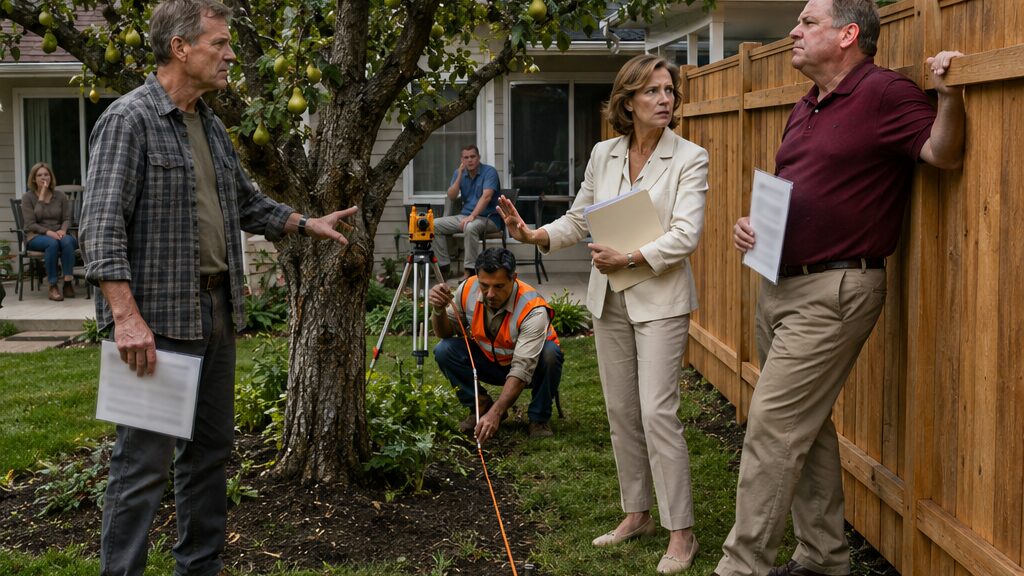
Nicholas Ramirez’s metal probe struck something beneath the soil at 8:17 Monday morning.
The sound was small—a sharp click under the roots of the pear tree—but Scott felt it more clearly than the post driver two days earlier.
Nicholas knelt and worked the probe around the buried object. He wore an orange safety vest over a pale work shirt, and his tripod-mounted instrument stood near the back patio aimed across the yard.
Gregory watched from the other side of the new fence.
Most of the panels were now installed. Only one section near the easement remained open, as though the yard had been sliced apart and not yet sealed.
Nicholas cleared dirt with a narrow hand tool.
A rust-dark circle emerged.
“There’s your pin,” he said.
Scott released a breath he had not meant to hold.
Gregory gripped the top rail. “That could be anything.”
Nicholas looked up. “It’s a capped iron monument.”
“You haven’t measured from it yet.”
“No,” Nicholas said. “I haven’t.”
He did not sound offended. That was one reason Scott had called him. Nicholas treated doubt like weather—something to account for, not argue with.
He set a bright orange flag beside the pin and returned to the instrument.
Two nearby homeowners had found reasons to be outside. One watered a potted plant that did not need water. The other stood on a deck with a coffee mug, pretending to examine a gutter.
Gregory noticed them too.
“This is ridiculous,” he said. “The HOA approved the line.”
Scott placed a clear plastic folder on the garden bench. Inside were the deed, the recorded plat, and the photographs from Saturday.
“Then the measurements should agree.”
Gregory glanced at the folder. “You always did love paperwork.”
Scott did not answer.
Nicholas sighted through the instrument, entered coordinates into a handheld unit, then walked toward the rear corner. He measured again, checked the county monument reference, and returned to the iron pin.
For nearly twenty minutes, the only sounds were button clicks, distant traffic, and the soft scrape of Nicholas’s boots through the grass.
Then he unrolled a spool of orange mason’s line.
He tied one end near the rear monument and carried the line toward the pin beside the pear tree. When he pulled it tight, the result was impossible to soften with explanation.
The orange line ran eleven feet away from Gregory’s new fence.
It passed along the outer edge of Scott’s raised garden, behind the pear tree, and through the place the old birdbath had stood.
The fence had not missed by inches. It had taken a corridor of land wide enough for a small room.
One of the homeowners on the deck stopped pretending to inspect the gutter.
Gregory’s face changed, but only for a moment.
“That line doesn’t match the builder plan.”
Nicholas secured the cord and stood.
“A builder sketch isn’t a boundary survey.”
“It came with the house.”
“So did a plat.”
Gregory stepped around the unfinished section of fence and entered Scott’s yard without asking. He moved toward the orange line, his eyes following it from pin to pin.
“You’re saying every owner before us had it wrong?”
“I’m saying the recorded monuments support this line.”
Scott looked at the tree. The orange cord passed just beyond its outer roots, where he remembered the old fence standing before a storm tore it down nine years earlier.
His wife had been right about the space the tree would need. He had been right about the line.
The vindication arrived without satisfaction.
The cedar panels remained standing.
Nicholas removed a tablet from his case and opened a county map.
“There is something else,” he said.
Scott stepped closer.
On the screen, the recorded subdivision plat showed the lot line exactly where Nicholas had marked it. But another image attached to the county’s archived builder records showed a simplified sales sketch. The sketch used the side of a drainage swale as a visual divider rather than the surveyed boundary.
The two lines were not the same.
Gregory pointed at the second image. “That’s the one the HOA used.”
Nicholas enlarged it.
“It shouldn’t have been used for construction.”
“But it was.”
Nicholas’s expression stayed neutral. “That doesn’t move the monuments.”
Gregory turned toward Scott. “You see? This isn’t me making something up. That drawing has been in the neighborhood file for years.”
Scott saw the opening Gregory was trying to create. A mistake shared by an institution felt less like theft. It could be called confusion, reliance, good faith.
But Gregory had still ordered the work after Scott objected.
“You knew there was a dispute Saturday,” Scott said.
“I knew you were upset.”
“You kept building.”
“I had an approval.”
“Show it.”
Gregory pulled out his phone. “I told you I would.”
He searched through messages but did not hand the device over.
Nicholas began packing his equipment.
“I’ll prepare the stamped survey,” he said to Scott. “You’ll have the preliminary this afternoon.”
“Can you note the encroachment distance?”
“Yes.”
“And the tree?”
“I can show its position relative to the line. Root damage isn’t my field.”
Gregory shook his head. “Now there’s root damage?”
Scott looked at the nearest post. Its hole had been dug within the spread of the pear tree’s canopy.
“I didn’t say there was.”
“You’re building a case.”
“No,” Scott said. “You built the fence.”
For the first time, Gregory had no quick answer.
Nicholas reset the orange flag beside the iron pin, pressing it deep enough that the wire stem held firm. Gregory watched the motion closely.
Scott noticed.
After Nicholas left, Scott drove to the county records office. The building smelled of toner, old carpet, and cooled air. A clerk brought up the subdivision file and confirmed that the recorded plat controlled the legal lot dimensions.
“The builder sketch is informational,” she said.
“Can an HOA approve construction from it?”
The clerk gave him the practiced look of someone avoiding another department’s problem.
“You’d have to ask the association.”
Scott requested certified copies of both documents.
At home, he scanned the preliminary survey and sent Gregory a message.
The survey is complete. The fence is approximately eleven feet inside my property. Please remove it by Friday and restore the disturbed area.
He read it twice before sending.
No threat. No accusation. A fact, a deadline, a remedy.
Gregory replied nine minutes later.
The first image showed a signature page bearing the HOA letterhead and Catherine Anderson’s name.
The second showed a site plan with the fence drawn along the same incorrect line as the builder sketch.
Under the images, Gregory had written:
Approved before construction. You should have raised this when the notice went out.
Scott enlarged the signature page.
The approval looked real.
The date was three weeks old.
He opened his unopened HOA mail and began sorting envelopes.
Halfway through the stack, he found one marked ARCHITECTURAL REVIEW NOTICE.
He had never opened it.
Chapter 3: The Approval That Should Not Exist
By Thursday morning, the HOA management portal no longer described Scott’s complaint as an encroachment.
The new heading read:
MUTUAL BOUNDARY DISAGREEMENT — CARTER/THOMPSON.
Scott stared at the screen until the words blurred.
Mutual suggested equal uncertainty. Disagreement suggested two opinions. Neither word acknowledged the orange line running through his yard or the stamped preliminary survey beside his keyboard.
He downloaded the notice and called the management company.
A representative answered, listened, then said, “The board has temporarily frozen enforcement while the documents are reviewed.”
“Enforcement against whom?”
“Neither owner may alter the disputed area.”
“The fence is already standing.”
“I understand.”
“No,” Scott said. “You’ve frozen the situation after he changed it.”
The representative paused.
“The board has scheduled an informal meeting tonight.”
“At the clubhouse?”
“Yes.”
Scott looked through the kitchen window. Gregory was trimming grass along the new fence as though the land had always belonged to him.
“I’ll be there.”
The clubhouse conference room held twelve folding chairs and a table too large for the space. Catherine Anderson sat at the front with a binder open before her. She wore a cream jacket and the composed expression of someone determined to keep every sentence inside approved procedure.
Gregory and Sharon sat together on one side. Scott took the chair opposite them.
Two homeowners occupied seats near the wall. Neither had been named in the complaint, but Gregory had copied the neighborhood email list when he circulated his version of the approval that afternoon.
Scott had read it.
Gregory’s message described a “longstanding informal boundary” and said Scott had objected only after the fence improved the appearance of the property. It included the signed approval but not the recorded plat, the survey, or Scott’s request that construction stop.
Catherine folded her hands.
“We are here to prevent this from becoming more adversarial.”
“It became adversarial when he kept building,” Scott said.
Gregory leaned back. “Here we go.”
Catherine raised one palm.
“We will speak one at a time.”
She turned to Scott. “The association approved the fence based on the application submitted. We have also received your survey. At this point, the board cannot determine legal ownership. That is outside our authority.”
“You can determine whether your approval process used a certified plat.”
Catherine’s expression tightened.
“We relied on the materials provided.”
Scott placed three documents on the table: the recorded plat, the builder sketch, and Nicholas’s preliminary survey.
“Which one did you rely on?”
Gregory sighed loudly.
Catherine looked at the pages but did not touch them.
“The site plan attached to the application.”
“That plan traces the builder sketch.”
“It was in the association’s property file.”
“It is not a boundary document.”
Gregory leaned forward. “You missed the review period. You had ten days.”
Scott felt every face turn toward him.
Catherine opened her binder and removed a copy of the notice he had found unopened.
“The association did send adjacent-owner notification.”
Scott looked at the envelope date. It matched the one from his kitchen stack.
“I received it.”
“And you did not respond,” Gregory said.
Scott kept his eyes on Catherine. “I didn’t open it.”
A silence settled over the room.
Sharon shifted in her chair.
Gregory gave a short, humorless laugh. “So you ignored the notice, and now everybody else is supposed to pay for your mistake.”
The words landed because they were not entirely false.
Scott had treated HOA mail as noise. He had assumed a recorded boundary could not be changed by a committee, so nothing in the envelope could matter. His silence had not moved the line, but it had removed the easiest chance to challenge the drawing before concrete entered the soil.
Catherine spoke more softly.
“This is why the board prefers compromise. There were failures of communication on both sides.”
Scott looked at the fence approval.
“Did anyone verify the pins?”
“No.”
“Did anyone require a survey?”
“No. The guidelines do not require one unless the applicant reports a dispute.”
“There was no dispute,” Gregory said. “Not until Scott made one.”
Scott turned to him. “I told you before the second post went in.”
“You told me what you remembered.”
“The pin was still in the ground.”
“And nobody could see it.”
Nicholas had warned Scott not to use the survey as a weapon. Sitting across from Gregory, Scott understood why. Facts could establish a line. They could not force anyone to admit what they had chosen not to know.
Catherine slid the approval sheet toward Scott.
“The board is willing to facilitate a compromise adjustment. Perhaps the fence could be moved several feet rather than the full distance while the legal issue is resolved.”
“Several feet onto whose land?”
“No one is conceding ownership.”
“The survey does.”
“The association is not a court.”
Scott looked at the two homeowners near the wall. One avoided his eyes. The other studied the orange marker visible through the clubhouse window where Nicholas had extended the line for the site meeting earlier that afternoon.
Gregory followed his gaze.
“That flag is temporary,” he said. “Anybody can stick plastic in the ground.”
Scott stood and carried the recorded plat to the window. Outside, the orange cord ran straight from the rear monument to the pin beside the pear tree. The fence stood eleven feet away, dark and solid.
He placed the plat on the sill beneath the view.
“The flag is temporary,” he said. “The monument isn’t.”
No one answered.
Catherine finally picked up the application packet.
“This attachment,” she said, “was submitted with the original request.”
She compared it to the certified builder sketch Scott had obtained from the county.
The outlines matched, but not perfectly. On Gregory’s attachment, the proposed fence line appeared darker and slightly shifted. The copied lot dimensions were faint enough to be missed at a glance.
Catherine turned the page over.
“There is no survey certification.”
“I never said there was,” Gregory replied.
“You represented the line as the property boundary.”
“I used the map in your file.”
Sharon looked at him. “You said the contractor checked it.”
“He checked the layout.”
“That isn’t what you said.”
Gregory’s jaw hardened. “Not now.”
Catherine closed the binder.
“The board should not have approved this without clearer verification.”
It was not an apology, but it was the first sentence that did not divide responsibility evenly.
Scott felt the room shift.
Then Catherine examined the application date.
Her eyes stopped.
“Gregory, this was submitted on the fourteenth.”
“Yes.”
She checked another page in the packet.
“And your requested completion date was the seventeenth.”
“I had the contractor scheduled.”
Catherine looked at Sharon, then back at Gregory.
“The property appraisal listed in your exterior-access request was on the fifteenth.”
Sharon’s face lost its color.
“What appraisal?”
Gregory did not answer her.
Catherine laid the page flat between them.
The fence application had been filed one day before an appraiser was scheduled to photograph the Thompson property.
Scott looked from the document to Gregory’s face.
The fence had never been only about privacy.
Whatever Gregory was trying to protect, he had needed those eleven feet to appear as his before anyone had time to question them.
Chapter 4: The Deadline Behind the New Fence
The orange marker was gone by sunrise.
Scott found the small puncture it had left beside the pear tree, a dark hole no wider than a pencil in the damp soil. The wire guard Nicholas had pressed around it lay flattened several feet away.
Across the fence, Gregory’s back door closed.
Scott straightened slowly.
The new cedar boards blocked most of the Thompson yard now, but not the kitchen window. A curtain moved, then settled.
Scott photographed the empty hole, the bent guard, and the disturbed mulch. He called Nicholas before touching anything.
“Don’t reset it yourself,” Nicholas said. “I’ll document the disturbance and place a replacement.”
“Can removing it change anything?”
“Not the monument.”
“I know.”
Nicholas heard what Scott meant.
“It can make a dispute uglier,” he said.
An hour later, Gregory appeared at the opening near the driveway carrying a travel mug.
“You lose something?”
Scott kept his phone at his side. “The survey flag was pulled.”
Gregory glanced toward the tree. “Those things fall over.”
“The guard didn’t.”
“You accusing me?”
“I’m telling you what I found.”
Gregory stepped through the unfinished gate opening.
“You’ve got cameras pointed at my yard now?”
“I photographed my property.”
“That’s not what I asked.”
Scott could see the fear beneath Gregory’s irritation now. It showed in the speed of his questions and the way his eyes kept moving toward his own house.
“The county survey still stands,” Scott said. “The deadline still stands.”
Gregory’s mouth tightened.
“You think a text message gives you authority?”
“No. The deed does.”
“The HOA approved it.”
“The HOA is reviewing its approval.”
Gregory came closer.
“You ignored the notice. If you’d bothered to open your mail, none of this would be happening.”
Scott felt the truth in the accusation and refused to step away from it.
“I should have opened it.”
Gregory blinked, as though he had expected denial.
“But I told you before the fence was finished,” Scott continued. “You kept building.”
Gregory looked toward the pear tree.
“I had a contractor booked. Materials delivered. An appraisal scheduled.”
There it was, spoken aloud for the first time.
Scott waited.
Gregory realized what he had said and lifted his mug.
“Not that it’s your business.”
“Why did the appraisal require eleven feet of my yard?”
“It didn’t.”
“Then move the fence.”
Gregory’s jaw worked once. He turned and went back through the opening.
Scott watched him cross his patio. Sharon stood inside the kitchen with a sheet of paper in one hand. Gregory entered. The glass door shut, but their gestures remained visible.
Sharon held the paper up.
Gregory reached for it.
She pulled it away.
By noon, Scott had sent the stamped survey, photographs, and his original removal request to the HOA management company and county code office. He included no language about theft, fraud, or intent. Only dates, documents, and the fact that the marker had been removed.
At three, Sharon knocked on his kitchen door.
Scott nearly did not recognize her expression. The polished composure from Saturday was gone. She held a thick envelope against her chest.
“Can we talk?”
He opened the door but did not invite her far inside. She stood just past the threshold, staring at the unopened HOA mail still stacked on one end of the counter.
“You really did message him before filing anything?” she asked.
Scott unlocked his phone and opened the thread.
Survey’s done. Your fence is on my land. Please remove it by Friday.
Sharon read the timestamp.
“He told me you went straight to the county.”
“I went after he refused.”
“He said you threatened to sue us.”
“I didn’t.”
She looked down at the envelope in her hands.
“What is the appraisal for?”
Her face closed for a moment.
“Refinancing.”
Scott waited again.
“We’ve had some problems,” she said. “Gregory said we could lower the monthly payment if the valuation came in high enough.”
“And the fence?”
“He told me the appraiser wanted the yard to look finished.”
“That doesn’t explain the line.”
“No.”
She opened the envelope and removed a contractor invoice. The balance due was far larger than Scott expected.
“He paid the deposit from a credit card,” she said. “The rest is overdue.”
“Did you know?”
“I knew about the fence. I didn’t know about the card.”
A second page showed a notice from the lender. The refinance had not been approved. The appraiser had flagged a discrepancy between the lot dimensions and the submitted exterior improvements.
Gregory had not gained value from the fence. He had created a problem that made the loan harder to close.
Sharon’s fingers tightened around the paper.
“He said the survey would go away because the HOA had already approved everything.”
Scott looked through the window at the solid cedar wall.
“It won’t.”
“I know that now.”
The words were quiet, but they changed something.
Sharon turned toward the door, then stopped.
“Did he pull the marker?”
“I didn’t see who did it.”
She nodded once, accepting the boundary of his answer.
When she crossed back into her yard, Gregory was waiting beside the gate opening.
He saw the envelope in her hand and looked toward Scott’s kitchen.
The argument that followed remained muted by glass and distance, but Scott saw Sharon place the survey on the patio table. Gregory swept it aside. She picked it up and flattened it carefully before carrying it inside.
The following morning, Nicholas reset the orange marker and added a heavier wire guard around it.
At ten, a county code officer arrived in a white utility vehicle. Gregory met him near the driveway, speaking quickly and pointing toward the HOA approval.
The officer listened, examined the permit records, walked the fence line, and took photographs of the posts beside Scott’s garden.
Then he removed a bright orange notice from a clipboard.
Gregory followed him to the nearest fence panel.
“You’re posting that on my property?”
“I’m posting it on the structure under review.”
“It’s an approved fence.”
“It has no county permit, and a licensed survey indicates encroachment.”
“The HOA approved it.”
“The HOA does not issue county permits.”
The officer stapled the notice to the cedar board.
The sound was smaller than the post driver had been, but it carried farther.
Scott read the bold heading from his side of the yard:
NOTICE OF VIOLATION.
Below it was a compliance deadline and a warning that daily penalties could begin if the violation remained unresolved.
Gregory stared at the orange paper as though it had appeared without cause.
Scott looked at the orange marker beside the pear tree, then at the larger orange notice fixed to the fence.
One marked the truth in the ground.
The other marked the cost of refusing to see it.
Chapter 5: Every Morning Added Another Red Mark
The first fine appeared on the county portal at 7:03 Monday morning.
Scott had not meant to check so early. He had opened the site to confirm whether Gregory had filed a compliance response. Instead, a red entry sat beneath the case number:
DAY 1 — UNCORRECTED VIOLATION — $100.
He closed the laptop.
Through the kitchen window, the fence stood unchanged.
At eight, Gregory tore the orange notice from the cedar panel.
By nine, the county officer had returned and posted another.
Scott watched from behind the glass, unwilling to let his face become part of Gregory’s argument. The officer photographed the new notice and the staple holes where the first had been.
Gregory came around the fence after the utility vehicle left.
“You happy now?”
Scott opened the kitchen door but stayed inside.
“No.”
“You’ve got fines running against my house.”
“I didn’t issue them.”
“You filed the complaint.”
“I asked you to remove the fence before I filed anything.”
Gregory pointed toward the pear tree.
“Over a strip you barely used.”
Scott looked at the nearest branch. The leaves on one side had begun to curl inward despite the irrigation.
“It was mine before I used it. It’s mine when I don’t.”
Gregory laughed without humor.
“You always know exactly what sentence to say after the damage is done.”
Scott felt the accusation reach beyond the fence, toward the unopened notice and every meeting he had avoided.
“What damage did I do?”
“You stayed quiet until the work was finished.”
“I objected while the second post was going in.”
“You could have answered the HOA.”
“Yes.”
Gregory had expected another defense. Scott’s admission left him with nowhere to push the point.
The second fine appeared the next morning.
Then the third.
The county portal showed each day as a separate red line. Scott stopped checking before breakfast, but the management company emailed copies to both households.
By Thursday, the total had reached $400.
That afternoon, Sharon came through the gate opening carrying a manila folder.
She did not knock at the kitchen. She found Scott beside the pear tree, examining the curled leaves.
“I need you to look at something.”
Inside the folder was a clean copy of Gregory’s original HOA application.
Scott spread it across the garden bench.
The site-plan attachment showed the builder sketch with a thin proposed fence line drawn in pencil. It did not match the darker version Gregory had circulated at the meeting.
Sharon placed the signed approval beside it.
“Catherine emailed this to Gregory before the final packet was uploaded,” she said. “I found it in his account.”
Scott compared the pages.
On the approved copy, the pencil line had been traced in black and shifted closer to Scott’s house. The lot dimension near the pear tree had also been partially obscured by a pasted label.
“Did he do this?”
Sharon looked toward her house.
“I asked him. He said the contractor cleaned up the drawing.”
“That isn’t cleaning it up.”
“I know.”
Her voice broke on the last word, but she did not look away.
Scott photographed both pages and called Catherine.
She arrived thirty minutes later with the management-company representative. They stood at the bench while Scott aligned the originals under clear plastic sleeves.
Catherine’s face changed as soon as she saw the altered attachment.
“This is not the page I signed,” she said.
Sharon folded her arms tightly.
“He submitted it afterward.”
Catherine looked at her. “Are you certain?”
“I found the email chain.”
The representative asked Sharon to forward the messages. She did so from her phone without glancing toward Gregory’s house.
For the first time, the HOA problem was no longer an institutional mistake alone. The board had relied on the wrong map, but Gregory had sharpened that mistake into something deliberate.
Catherine pressed her fingertips to the table.
“The approval may be void.”
“May?” Scott asked.
“There is a process.”
Scott nearly laughed. Instead, he looked at the pear tree.
A small section of soil beside the nearest fence post had sunk. Exposed roots showed through the mulch, pale where the contractor’s auger had sliced them.
He crouched.
One root thicker than his thumb ended in a flat, raw cut less than two feet from the trunk.
Sharon saw it too.
“Was that from the fence?”
Scott touched the dry edge of the wound.
“The hole is directly above it.”
The tree had stood through ice, summer heat, and the year after his wife died when he forgot to prune it. Now half its root spread had been drilled through for a line that should never have existed.
The small satisfaction of exposing the altered document drained away.
Catherine crouched beside him.
“We’ll need an arborist’s report.”
Scott stood.
“Another process.”
She heard the bitterness and accepted it.
“Yes.”
The fines continued.
By the eighth day, they had reached $800. Gregory filed an appeal claiming reliance on HOA approval. The county rejected the request because the permit violation existed independently of the boundary dispute.
On the ninth day, he stood in his driveway arguing with the fence contractor over the unpaid balance. Their voices carried across both yards.
“I’m not paying to remove work you installed wrong,” Gregory said.
“We installed from your marked layout.”
“The association approved it.”
“You gave us the stakes.”
Scott stopped at the kitchen door.
Gregory saw him listening.
“This what you wanted?” he shouted. “Everybody lined up against me?”
Scott did not answer.
The contractor drove away.
That evening, the county total crossed $1,000.
Sharon stood on the Thompson patio with Gregory’s appeal packet in her hands. Gregory spoke quickly, pointing toward the HOA clubhouse, then toward Scott’s yard.
She let him finish.
“No,” she said.
The word carried clearly across the fence.
Gregory stared at her.
“We can file again,” he said.
“I’m not signing it.”
“This affects both of us.”
“So did the loan you didn’t tell me about.”
His shoulders stiffened.
Sharon placed the appeal packet on the patio table.
“You knew the line was disputed. You changed the drawing. You let the fines start because you thought admitting it would make you look weak.”
Gregory glanced toward Scott’s house.
Sharon followed his gaze.
“This isn’t about how it looks anymore.”
She pushed the papers back toward him.
“I will not support another appeal.”
For the first time since the post went into the ground, Gregory stood alone beside the fence.
Chapter 6: The Meeting Where Silence Became a Choice
Gregory’s compromise was already written on the whiteboard when Scott entered the clubhouse.
MOVE FENCE THREE FEET.
The emergency hearing had drawn more homeowners than the original meeting. Every folding chair was occupied, and several people stood along the back wall. Catherine sat at the front table with the HOA attorney on one side and the management-company representative on the other.
Gregory stood beside the whiteboard.
Sharon sat alone in the second row.
Scott carried a flat document case and the replacement orange survey marker Nicholas had removed that afternoon for the hearing. The wire stem was still stained with soil.
Gregory pointed at the board.
“Three feet gives Scott access to the tree and keeps us from throwing away thousands of dollars in materials.”
Scott took his seat.
Catherine opened the meeting.
“This hearing concerns the validity of the architectural approval, the current county violation, and the appropriate association remedy.”
Gregory remained standing.
“I relied on the board’s notice process. Scott had ten days to object. He chose not to. I built according to an approved plan. Now he wants the entire structure removed because he regrets ignoring his mail.”
Several faces turned toward Scott.
He could feel the old instinct rising—the desire to let the documents answer, to wait until someone asked the correct question. Gregory understood rooms better than he did. He offered people a clean explanation before the complicated truth could become uncomfortable.
Catherine looked at Scott.
“Would you like to respond?”
Scott placed the orange marker on the table.
The plastic flag leaned against his document case.
“Yes.”
He stood.
“The notice came to my house. I did not open it.”
The room became quiet.
Gregory folded his arms.
Scott continued before anyone could rescue or condemn him.
“My wife handled most association mail before she died. Afterward, I stopped paying attention to anything that looked optional. That was careless. If I had opened the notice, I could have challenged the builder sketch before construction began.”
Sharon lowered her eyes.
Scott looked directly at Catherine.
“My silence made this harder. It did not move the property line.”
He opened the case and removed four pages.
“The recorded plat.”
He placed it beside the marker.
“Nicholas Ramirez’s stamped survey.”
A second page.
“The application Catherine approved.”
A third.
“And the attachment uploaded after her signature.”
The fourth page landed last.
Catherine turned the pages toward the audience. The altered line was visible even from several feet away because Scott had mounted both versions on a single comparison sheet.
Gregory stepped toward the table.
“That was a clearer copy.”
“No,” Catherine said.
Her voice stopped him.
She pointed to the obscured lot dimension.
“This label did not exist when I signed the approval.”
Gregory looked at the attorney.
“The contractor prepared the final layout.”
The management representative opened a printed email chain.
“The contractor received the altered version from your email address.”
“I forwarded what I had.”
“You sent it at 11:42 p.m. the night before the appraisal,” Catherine said.
Gregory’s face reddened.
“You’re all pretending the HOA didn’t create this problem.”
“The HOA did create part of it,” Scott said.
The room shifted again.
Gregory looked at him, surprised.
Scott kept his hand beside the orange marker.
“The board kept an outdated builder sketch in the property file. It approved construction without a certified survey. The notice process assumed silence meant agreement. Those were failures.”
Catherine did not interrupt.
“But the board did not tell Gregory to keep building after I objected. It did not tell him to remove the marker. It did not alter the attachment. And it did not tell him to ignore the county notice.”
Gregory pointed at Scott.
“You don’t know who removed that flag.”
“No,” Scott said. “I don’t.”
The answer denied Gregory the argument he wanted.
Scott turned toward the whiteboard.
“Three feet does not restore the boundary. It leaves eight feet of my land behind his fence and leaves every damaged root where it is.”
Gregory’s voice dropped.
“You want to ruin us.”
Sharon looked up sharply.
Scott studied Gregory for a moment. The man no longer looked smug. He looked tired, cornered, and furious that anyone could see it.
“I want the fence removed from my property.”
“And the fines? The contractor? The county referral?”
“I didn’t choose those.”
“You started them.”
“I gave you a private deadline first.”
Gregory’s gaze moved toward Sharon.
She did not defend him.
The attorney asked whether Scott wanted the HOA to refer the altered document for further legal review.
Every face turned back to him.
This was the point at which punishment could become the story. Scott felt how easy it would be to say yes to everything: maximum fines, formal referral, attorney fees, full replacement value for the tree whether it survived or not.
He thought of the post driver beside the pear tree. He thought of the unopened envelope on his own counter.
“I want the fence removed,” he said. “I want the soil restored by a qualified crew. I want an arborist to evaluate the tree and the responsible parties to cover treatment. I want the HOA to require certified boundary verification when a neighbor disputes a proposed fence line.”
The attorney waited.
“And the document alteration?”
Scott looked at Gregory.
“That should remain in the association record. If the county or lender asks for it, the board should answer truthfully. I’m not asking the HOA to turn this meeting into something it cannot prove.”
Gregory’s expression changed—not gratitude, but confusion. Scott had refused both surrender and revenge.
Catherine closed the application binder.
“The board will vote.”
The decision took less than ten minutes.
The approval was voided because it relied on an unverified sketch and a materially altered attachment. Gregory was ordered to remove the encroaching structure by the following Friday. The HOA would notify the county of the correction plan, revise its architectural guidelines, and retain certified plats separately from builder marketing materials.
The board also acknowledged Scott’s failure to answer the notice, but stated clearly that adjacent-owner silence did not authorize construction beyond an applicant’s legal boundary.
Catherine read the final sentence twice.
Gregory remained beside the whiteboard.
MOVE FENCE THREE FEET still stood behind him in blue marker.
The compromise had become meaningless.
After the vote, chairs scraped and quiet conversations began. No one applauded. Some homeowners avoided Scott. Others stopped near the document table, studying the two versions of the application.
Sharon approached Catherine to discuss the removal schedule.
Gregory walked toward the door.
Before leaving, he stopped beside Scott.
“You think this makes you better than me?”
Scott looked at the orange marker between them.
“No.”
Gregory waited.
“It makes the line visible.”
For a moment, neither man moved.
Then Gregory left.
Catherine handed Scott the written decision. At the bottom, beneath the board’s signatures, was the final compliance date.
One week.
Scott folded the order and placed it beside the marker.
The fence would come down.
What remained uncertain was whether anything behind it could be restored.
Chapter 7: What the Crew Could Not Put Back
The saw entered the first cedar panel at 8:06 Friday morning.
Its teeth caught, shrieked, then drove through the board Gregory had watched rise beside the pear tree less than three weeks earlier. The panel shuddered between the posts before the removal crew lowered it into the grass.
Scott stood near the garden bench with his hands in his jacket pockets.
On the other side of the fence, Gregory watched with his arms folded. He had not spoken since the crew arrived. Sharon stood several feet behind him beside the patio table, holding a folder of receipts and county forms.
The removal supervisor pointed toward the nearest post.
“We’ll cut the panels out first, then pull the concrete. If the roots are wrapped around the footing, we stop.”
Scott nodded. “The arborist is coming at ten.”
Gregory looked over.
“You scheduled another expert?”
“The board required an evaluation.”
“The board required treatment if there’s damage.”
Scott met his eyes. “We already know there’s damage.”
Gregory turned away.
The second panel came down. For the first time since construction began, morning light crossed the full width of Scott’s garden. The opening made the yards appear strangely exposed, as though the fence had hidden more than land.
The crew stacked the cedar carefully instead of breaking it. Gregory had arranged to reuse any undamaged sections along the correct line if the HOA approved a future application.
Scott had not agreed to that. Not yet.
The nearest post resisted the hydraulic puller. Concrete groaned beneath the soil while the machine lifted by inches.
“Stop,” the supervisor called.
The operator released pressure.
A pale root had risen with the footing, stretched tight against the concrete.
The crew cleared soil by hand. More roots appeared beneath it. Several ended abruptly where the auger had passed through them.
Scott crouched without noticing that he had moved.
The largest cut root lay nearly level with his palm. Its exposed end had darkened around the edges, but the center remained the color of fresh wood.
The arborist arrived while the crew was still digging. She examined the canopy, tested the soil near the trunk, and followed the damaged roots toward the post holes.
“How bad?” Scott asked.
She stood and brushed dirt from her gloves.
“The tree has lost part of its structural and feeder-root system on this side. Some canopy stress is already visible.”
“Will it live?”
“I can’t promise that.”
The answer seemed to quiet the machinery.
Gregory stepped closer to the hole. His face tightened when he saw the roots.
“The contractor should have checked.”
The supervisor looked at him.
“The post locations were marked before we arrived.”
Gregory said nothing else.
The arborist recommended removing damaged tissue cleanly, aerating the compacted soil, installing temporary support, and monitoring the tree through the next growing season. Even with treatment, decline could continue slowly.
Scott looked up into the branches.
His wife had tied a red ribbon to the sapling the day they planted it so no one would step on it. For years afterward, faded threads had remained around the trunk until the bark pushed them apart.
He had believed the tree’s age made it safe.
The fence was gone from the ground by early afternoon. Rectangular shadows remained in the grass where the panels had blocked the sun. The crew filled the holes with clean soil and regraded the strip from the drainage easement to the pear tree.
Nicholas arrived near the end of the work and checked both monuments. He reset the orange flag beside the iron pin, then walked the restored line with the supervisor.
“No disturbance to the monument,” he said.
Scott looked at the small bright marker standing alone in open grass.
It no longer seemed fragile.
Sharon approached while Gregory discussed the final invoice with the supervisor.
She handed Scott the folder.
“This covers the arborist, the treatment plan, and part of the replacement value if the tree dies.”
Scott opened it. A cashier’s check rested between the receipts.
“This is more than the board ordered today.”
“It’s from my savings.”
“You don’t have to do that.”
“Yes,” she said. “I do.”
Scott looked toward Gregory. He was signing the removal paperwork without looking at either of them.
“Does he know?”
“He knows now.”
Sharon’s mouth tightened.
“I defended him before I asked what was true. I can’t undo that.”
Scott closed the folder.
“No.”
She accepted the word.
“But this helps.”
Her shoulders lowered slightly.
By late afternoon, the crew had hauled away the broken concrete and stacked the reusable cedar beside Gregory’s garage. The county officer photographed the cleared strip and marked the physical violation corrected, though the accumulated fines and restoration costs remained.
Gregory paid the supervisor from a bank check Sharon handed him.
When the trucks left, the two yards were separated only by the orange survey line Nicholas had stretched temporarily between the monuments.
Gregory stood beside it.
“The HOA says I can submit another design,” he said.
Scott examined the disturbed ground.
“After the new survey rule is adopted.”
“I know.”
A long silence followed.
Gregory rubbed one hand over the back of his neck.
“The appraiser never counted the extra space.”
Scott looked at him.
“He saw the county dimensions,” Gregory said. “The whole thing was pointless.”
“The fence wasn’t pointless.”
Gregory’s face hardened.
“It showed what you were willing to do.”
“And what you weren’t.”
Scott did not deny it. He had not opened the notice. He had allowed silence to carry more weight than it deserved.
Gregory looked toward the pear tree.
“I didn’t know about the roots.”
“You didn’t ask.”
“No.”
It was the closest he had come to admitting anything without defense attached.
The orange cord moved slightly in the breeze between them.
Gregory nodded toward the bare strip.
“Does it have to stay like this?”
Scott followed his gaze. Open ground, cut roots, raw soil, two homes facing each other without the wall either man had expected.
“What do you mean?”
“The boundary.” Gregory kept his eyes on the line. “Does it have to stay completely bare?”
Scott did not answer.
For the first time, the choice of what stood there next belonged entirely to him.
Chapter 8: The Line They Finally Chose to See
New growth appeared on the pear tree in March.
Scott noticed it above the lowest damaged branch: three small green buds pushing from wood the arborist had warned might die back before spring.
He stood beneath them for several minutes before touching one with the tip of his finger.
The tree was not restored. Two limbs had been removed, one side of the canopy remained thin, and temporary support cables still ran from the trunk to stakes in the ground.
But it was alive.
Along the property line, the orange marker stood inside its wire guard. No fence hid it now.
Gregory had not submitted another privacy-wall application.
For months, the strip remained open while both households adjusted to seeing each other again. Their conversations were brief and practical. A package left at the wrong door. A reminder that the arborist would be working near the line. A request to move a trash bin before the landscaping crew arrived.
Trust did not return simply because the boards were gone.
At the HOA annual meeting, Catherine introduced revised architectural guidelines. Any fence proposed within five feet of a disputed side boundary would require a certified survey or written agreement from both adjacent owners. Builder sketches could no longer be used to establish property lines. Silence from a neighbor would not count as consent to build beyond an applicant’s deeded lot.
No one objected.
Catherine glanced toward Scott from the front table.
“The board also intends to review older property files for similar inconsistencies.”
Scott nodded. That was enough.
He had learned not to mistake institutional correction for apology, but he no longer required the apology before accepting the correction.
After the meeting, Gregory approached him in the parking lot.
“I drew something,” he said.
He unfolded a sheet of graph paper against the hood of his car.
The plan showed no privacy fence. Instead, a low planting bed followed the certified boundary, interrupted by an open section near the pear tree. The highest shrubs would reach only three feet, leaving both yards visible above them.
“I figured roots would be safer than posts,” Gregory said.
Scott studied the measurements.
The line matched Nicholas’s survey exactly.
“You had this checked?”
“Twice.”
There was no humor in the answer.
Gregory pointed to the section near the tree.
“Nothing planted inside its drip line. The arborist’s recommendation.”
Scott looked at him.
“Sharon’s recommendation,” Gregory corrected.
The design was not an apology. Gregory still had not spoken plainly about the altered document, the missing marker, or the weeks he had spent blaming everyone else.
But he had drawn the boundary where it existed instead of where he wanted it to be.
“I’ll pay for my half,” Scott said.
Gregory shook his head. “I owe more than half.”
“This isn’t restitution.”
“What is it?”
“A boundary we both have to live beside.”
Gregory looked down at the drawing.
They installed the planting strip in April.
No contractor came. Gregory dug on his side while Scott loosened the soil on his own. They worked slowly near the pear tree, using hand tools instead of an auger.
Sharon brought out water and placed the trays of low shrubs along the orange cord. She did not offer advice or try to turn the work into reconciliation. She simply checked the labels against the arborist’s approved list.
At the midpoint of the line, Gregory encountered a stone and drove his shovel down harder.
The blade stopped inches from the orange marker.
Both men froze.
Gregory withdrew the shovel and moved his next cut farther away.
Neither spoke.
By late afternoon, a low row of young plants traced the legal boundary. There was no gate, no wall, and no attempt to disguise where one property ended and the other began.
The orange marker remained visible between two shrubs.
Gregory gathered the empty trays.
“You leaving that there?”
“Yes.”
“It’s not exactly attractive.”
Scott looked at the bright plastic flag.
“Neither was the lesson.”
Gregory gave a quiet breath that might once have become a laugh. This time it did not.
He carried the trays to his garage.
Scott stayed beside the pear tree. Above him, the new leaves moved unevenly through the thinner canopy. The damage was still visible if anyone knew where to look.
He no longer felt compelled to hide that either.
The following week, Scott opened an HOA envelope the day it arrived.
Inside was the final notice confirming the new survey requirement. He read it, signed the acknowledgment, and returned it before setting the empty envelope in the recycling bin.
Through the kitchen window, he could see Gregory kneeling beside the planting strip, pressing soil around one of the shrubs that had tilted after rain.
Gregory looked up.
For a moment, they regarded each other across the open yards.
Then Scott raised one hand.
Gregory did the same.
It was not forgiveness. It was not friendship restored. It was recognition without argument.
Scott went outside and checked the pear tree.
One of the new shoots had grown past the damaged branch. He tied it loosely to a support with a strip of soft cloth, leaving enough room for the wood to thicken.
At his feet, the orange marker stood where Nicholas had reset it.
Scott could have removed the flag. The iron monument beneath it was permanent, and the dispute was closed. There was no practical need to keep the bright plastic visible.
He left it in the ground.
Some boundaries were safest when no one had to pretend they could not see them.
The story has ended.