They Called Her Farm a Beautiful Failure Until the Hives Began to Speak
Chapter 1: The Morning They Came to Measure What Was Left
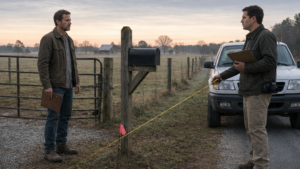
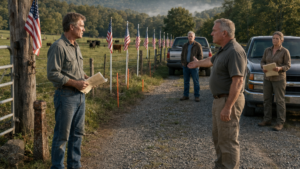
The stranger photographed Rachel’s horses before he introduced himself.
He stood outside the fence with one polished shoe balanced on the lower rail, angling his phone so the two draft mares filled the screen. Bess lifted her head at the shutter sound. June kept chewing, a strand of hay hanging from her mouth.
“Those will have salvage value,” the stranger said.
Rachel pulled the waxed thread through the cracked harness strap and drew it tight with her teeth.
William stood beside the man in a navy coat too clean for the farmyard. He looked older than he had at Christmas, though perhaps it was only the way he avoided her eyes.
“Morning, Mom.”
Rachel cut the thread with her pocketknife. “You brought company.”
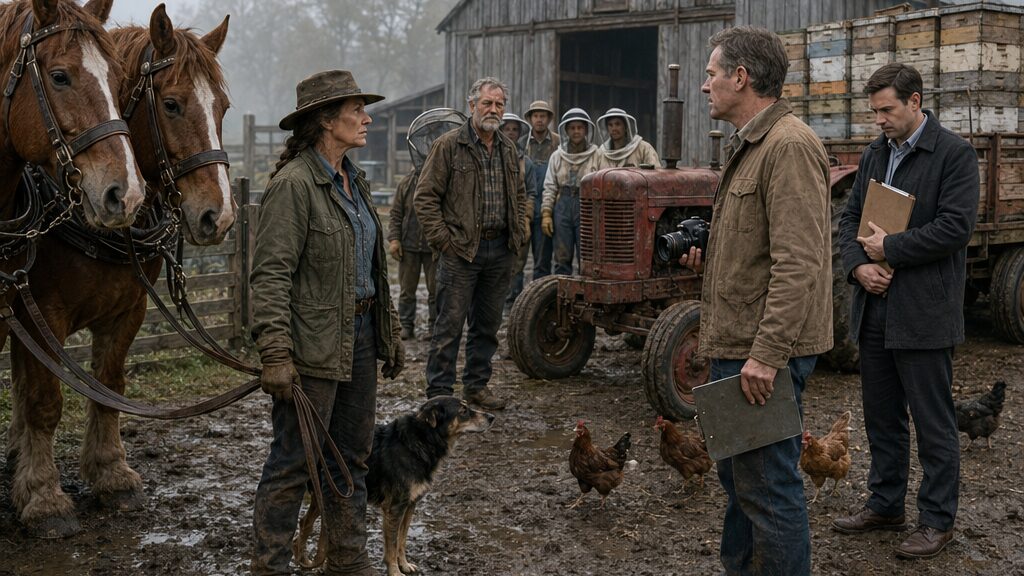
The black-and-white dog, Patch, came out from beneath the honey wagon and planted himself between Rachel and the gate. Chickens scratched near his paws, unconcerned by the visitors.
The stranger lowered his phone. “Thomas Brown. Court-appointed appraiser.”
“I didn’t appoint you.”
“No, ma’am.”
Thomas carried a leather portfolio and a tablet sealed inside a gray case. The tools looked too delicate for mud. Behind him, William held a white envelope by one corner.
Rachel rose from the overturned feed bucket. Her knees objected, but she gave them no answer.
“You said we were meeting with the bank next week,” she told William.
“We are.”
“Then what is he measuring?”
“What’s left.”
The words landed more quietly than an insult. Rachel looked past her son toward the lane, where early mist still clung to the orchard trees. The hives beyond them could not be seen from the yard. Only the barn, the red tractor, the poultry shed, and the weathered farmhouse stood exposed.
Thomas opened his portfolio. “I’ll need access to all structures, equipment, livestock records, and acreage under the Martin deed.”
Rachel’s thumb pressed into the repaired harness seam.
William extended the envelope. “The tax notice moved faster than I expected.”
She did not take it.
“How fast?”
“Thirty days before the lender can advance foreclosure remedies.”
Patch gave a low sound in his throat. William glanced at him, then back at Rachel.
“You guaranteed the emergency note,” she said.
“I guaranteed what you told me was an emergency operating note. I didn’t know there were equipment liens behind it.”
“You didn’t ask.”
“I asked for the books.”
“And I sent them.”
“You sent me three bank statements and a feed receipt.”
Thomas cleared his throat. “I can begin with the outbuildings.”
Rachel took the envelope at last. She did not open it. The county seal showed through the paper.
Thomas walked toward the barn, photographing the sagging gutter, the warped sliding door, and the rust at the base of the tractor’s exhaust pipe. He dictated observations into his tablet.
“Deferred maintenance. Roof replacement likely. Primary tractor, estimated forty-plus years old.”
“It runs,” Rachel said.
Thomas looked over his shoulder. “We’ll verify.”
William stayed near the gate. He watched her lift the harness and hang it on the hook beside the tack-room door.
“You patched that same strap when I was twelve,” he said.
“It was a different crack.”
“It’s always a different crack.”
Rachel faced him. “Say what you came to say.”
His jaw tightened. For a moment she saw the boy who used to count thunder between lightning strikes because his father told him it could predict whether hail would reach the orchard. Then the boy disappeared.
“I filed for partition.”
A hen flapped onto the wagon tongue. Patch barked once and sent it down again.
Rachel heard the words clearly. She still asked, “You filed what?”
“The petition went in yesterday. The court can order a sale if we can’t agree.”
“We do agree. The farm stays a farm.”
“That isn’t agreement. That’s you deciding.”
Thomas turned the tractor key. The starter clicked once.
He tried again. Nothing.
Rachel knew the problem before he opened the side panel. The battery cable had loosened after Dennis moved the packing table the previous evening. She also knew she could repair it in under two minutes.
She remained where she was.
Thomas stepped back and photographed the dashboard. “Primary mechanized equipment nonoperational at inspection.”
“It was running yesterday,” Rachel said.
“That may be. I can only record what I observe.”
“Then observe properly.”
William rubbed a hand across his mouth. “Mom.”
Thomas walked a slow circle around the tractor. “Given the condition of the equipment, reduced orchard yield in the submitted records, and apparent reliance on obsolete animal power, the property may be functionally inactive as a commercial operation.”
The words drew Dennis from the honey shed. Two other workers followed him, carrying empty supers toward the wash station. Dennis’s left leg dragged slightly when he crossed uneven ground.
“Functionally what?” he asked.
Thomas glanced at them. “Are you employees?”
Dennis looked at Rachel before answering. “Depends which piece of paper you’re holding.”
“They’re working,” Rachel said.
Thomas entered another note. “Informal labor arrangement.”
The workers exchanged looks, but Rachel gave them none. She stepped to Bess, laid one hand against the mare’s neck, and clicked her tongue. Both horses shifted together, turning cleanly away from the fence without crowding the wagon. Patch swept behind them. The chickens parted as if a gate had opened through the flock.
Thomas watched despite himself.
Rachel led the mares three steps, stopped them with a word, then backed them precisely between the wagon shafts. Their hooves settled square in the mud.
“They don’t look inactive,” William said.
Thomas recovered his professional expression. “Livestock responsiveness does not establish profitability.”
“No,” Rachel said. “It establishes that you don’t yet know what you’re looking at.”
William’s eyes met hers then, and for one second something passed through them that was not anger. It might have been doubt. It might have been memory.
Thomas closed the tractor panel. “I’ll need production records for the apiary acreage.”
William looked toward the orchard. “What apiary acreage?”
Rachel reached for the repaired harness.
Thomas checked the county parcel map on his tablet. “Eastern and lower fields. Approximately forty-two acres associated with registered hive placements.”
The yard seemed to contract around William.
“You told me there were a few hives behind the apples.”
“There were,” Rachel said.
“How many are there now?”
Dennis stopped beside the wagon, his empty supers stacked against his hip.
Thomas enlarged the parcel map. “We’ll add that sector to tomorrow morning’s inspection.”
Rachel fastened the repaired strap around Bess’s shoulder. The leather held.
Beyond the orchard, too far for William to hear, thousands of bees moved inside their boxes.
Chapter 2: Two Horses Pulled Against the Official Version
“Step away from the fence, please,” Thomas told the workers. “I need a clear photograph of the property, not a staged one.”
No one moved.
Six men stood along the apiary gate in stained jackets and veils pushed back from their faces. Dennis occupied the center, one hand resting on the latch. Behind them, rows of white and blue hive boxes disappeared into the low morning mist.
Thomas lowered his camera. “I’m not accusing anyone.”
“You used the word staged,” Dennis said.
“I said the photograph should not be staged.”
Rachel came up the lane leading Bess and June. The repaired harness creaked softly across their shoulders. Patch followed at their heels, damp with grass.
William stood beside Thomas with his arms folded. He had arrived before sunrise and said almost nothing.
Thomas looked from the horses to Rachel. “Why are they harnessed?”
“The tractor is blocking the honey wagon.”
“I understood the tractor was nonoperational.”
“It has a loose cable.”
“Then repair it.”
“I will after I move it.”
Thomas’s mouth tightened. “Mrs. Martin, this inspection is not a demonstration.”
“No,” Rachel said. “It’s a workday.”
The honey wagon sat loaded with capped supers near the shed, its wheels trapped behind the tractor. Workers had begun harvesting before dawn, and the boxes needed to reach the warm room before the temperature rose. Yesterday’s inspection had already cost them half a day.
Rachel backed the horses into position. She checked the collars, traces, and buckles herself. The leather repair lay flat beneath her palm.
William approached. “You can’t pull both at once.”
“I’m not pulling anything.”
“The tractor and that wagon together must weigh—”
“Move.”
He stepped aside.
Rachel ran a chain from the wagon’s front ring to the tractor frame. Thomas photographed each connection, perhaps expecting negligence. Dennis crouched to inspect the chain, then gave Rachel one short nod.
“Road’s soft near the bend,” he said.
“I know.”
Thomas gestured toward the workers. “For the record, who supervises this operation?”
Rachel took the lead lines.
“Today?” Dennis said. “She does.”
Rachel clicked once.
The mares leaned forward together. Leather tightened. The wagon jolted, and the tractor’s rear tires sank half an inch before beginning to turn. Patch raced along the ditch, barking at the moving wheels. Chickens scattered from beneath the equipment shed, wings beating dust into the mist.
Thomas stepped backward.
Bess and June lowered their heads. Their hooves struck the lane in alternating rhythm. The tractor rolled, then the loaded wagon followed, heavy but steady.
William stared at the repaired strap as it took the load.
Rachel did not look at him. She walked beside the mares, keeping the lines loose enough to trust them and firm enough to guide. At the bend, the right wagon wheel slid toward the soft shoulder.
“Easy,” she said.
Both horses shortened their stride. Dennis and two workers put their shoulders to the wagon. The wheel climbed back onto firmer ground.
Nothing about it was dramatic to the people doing the work. That was what made Thomas’s silence so complete.
They passed the orchard and reached the first hive field. The mist thinned there, revealing row after row of boxes set on stands above the wet grass. Workers spread out without instruction. One opened the apiary gate. Another pulled a veil over his face. Two began unloading supers while Dennis checked the temperature in the warm room.
The farm that had looked broken from the road became a moving system.
Thomas raised his camera, then lowered it again.
“How many active colonies?” he asked.
“Eight hundred and twelve as of last week,” Dennis said.
William turned toward Rachel. “Eight hundred?”
“Some are splits,” she said.
“That isn’t an answer.”
“It’s the accurate distinction.”
Thomas entered figures on his tablet. “Annual yield?”
Dennis hesitated.
Rachel answered. “It changes.”
“Last year.”
“We lost early forage to rain.”
“How much honey?”
Rachel watched a worker lift a full super from the wagon. His arms trembled under the weight.
Thomas repeated the question.
“Just over fifty-one thousand pounds,” Dennis said.
William’s face changed.
Thomas looked up sharply. “The records submitted to the court indicate less than twenty-four thousand.”
Rachel’s grip tightened around the lead lines.
“Those were farm-account sales,” she said.
“What other kind are there?” William asked.
Dennis turned away toward the hives.
Thomas walked down the first row, photographing pallet stacks, extraction equipment, labeled drums, and the workers’ protective gear. “These are commercial quantities. Where is the revenue recorded?”
“It’s recorded,” Rachel said.
“Not in what I received.”
“That isn’t the same thing.”
William followed her toward the warm room. “You let me file using those numbers.”
“You filed before you came.”
“Because you wouldn’t show me anything else.”
A worker rolled a drum between them, forcing William to step aside. The interruption did not cool him.
“You knew the valuation would be wrong,” he said.
“I knew the valuation was already wrong when he called the horses decorative.”
“That does not explain the books.”
Thomas returned from the storage shed carrying a photocopied shipping label. “Who is Martin Field Honey Cooperative?”
Rachel held his gaze. “There is no registered cooperative.”
“That wasn’t my question.”
“It’s the name the workers use for direct sales.”
“Workers are making sales independently?”
“With my permission.”
“Using products harvested from land under lien?”
Rachel said nothing.
The bees filled the pause. The sound was not loud, but once noticed it seemed to come from every direction.
William looked over the hive rows as though seeing not abundance but exposure.
Thomas removed his glasses and wiped mist from them. “I’ll revise my preliminary valuation. The apiary equipment, active colonies, inventory, and production capacity materially increase the operating value.”
Dennis gave a humorless breath. “There. We’ve risen above salvage.”
Thomas replaced his glasses. “They also create material reporting concerns.”
The words erased the small satisfaction from the workers’ faces.
“Concerns for whom?” Rachel asked.
“For the court, lender, tax authority, and possibly anyone paid through an unregistered revenue channel.”
William stepped away from her. “How much money went through it?”
Rachel watched Bess flick her tail against the traces.
“We paid what needed paying.”
“That is not a number.”
“No.”
Thomas gathered the shipping label and his photographs. “I will report the discrepancy. You should expect a financial review.”
By noon, the tractor was running again. Rachel tightened the battery cable, closed the panel, and drove it back to the yard herself. No one spoke of Thomas’s first report or the moment the horses had pulled his version of the farm down the lane.
A county vehicle waited beside the farmhouse.
A woman in a brown field jacket stood at the porch with a document folder under one arm. She introduced herself as Anna Garcia from the agricultural extension office.
“I’m here because of the revised inspection,” she said. “And because your operation may qualify for restructuring.”
William looked toward Rachel.
Anna opened the folder.
“But before we discuss assistance, Mrs. Martin, I need to know why your farm reported less than half the honey it produced.”
Chapter 3: The Money That Never Reached the Farm Account
William found the doubled invoices beneath a stack of feed catalogs, held down by the chipped ceramic rooster Rachel used as a paperweight.
The first invoice matched the farm account: eleven drums shipped to a regional packer.
The second bore the same week’s date and listed thirteen more drums sold through Martin Field Honey Cooperative. Payment instructions led to an account William had never seen.
He laid both invoices side by side on the kitchen table.
Rachel entered carrying two egg baskets. She noticed the papers before she set the baskets down.
“You went through the desk.”
“The drawer was open.”
“It sticks.”
“That’s your defense?”
She began sorting cracked eggs into a separate bowl.
William tapped the invoices. “This is more than a bookkeeping mistake.”
“I never called it one.”
“Anna is waiting at the county office with Thomas’s photographs. The lender copied me on a request for every sales record going back three years.”
Rachel broke an egg cleanly against the bowl. “Then we shouldn’t keep her waiting.”
The empty harness hook showed through the kitchen window beside the tack-room door. Bess and June were in the lower pasture. For once, the hook held nothing.
At the county extension office, Anna had arranged Thomas’s revised photographs across a conference table. In one, the horses leaned into the harness while the red tractor rolled behind them. In another, workers stood among hive rows that continued beyond the edge of the image.
The invoices lay beside those photographs like a rebuttal to the beauty of them.
Anna waited until Rachel and William sat down.
“The good news,” she said, “is that the farm appears operationally viable.”
William gave a short laugh without humor. “That’s the good news?”
“It matters. Productive capacity changes which programs are available.”
“And the bad news?” Rachel asked.
“The operation shown in these photographs is not the operation described in your financial statements.”
Rachel folded her hands.
Anna opened a ledger supplied by Dennis. It contained dates, quantities, buyer initials, worker distributions, and handwritten expenses.
“Martin Field Honey Cooperative has no registration, no tax identification number, and no formal ownership structure,” Anna said. “Yet it handled more than half your direct-market sales.”
“It isn’t a real cooperative,” Rachel said.
“Legally, no. Practically, it appears to function like one when that suits you and like private farm income when it does not.”
William turned toward her. “Did the workers know?”
“They kept the records.”
“That isn’t what I asked.”
Anna slid several pages across the table. “Funds went from honey buyers into accounts controlled by different workers. Some paid packaging costs. Some covered wages. Some made payments to medical providers.”
William scanned the entries.
One name appeared repeatedly beside amounts that were too regular to be ordinary expenses. The recipient was identified only as a clinic billing office.
“Whose medical bills?” he asked.
Rachel looked at Anna. “You said this was about restructuring.”
“It is. I cannot recommend public support without complete disclosure.”
“You have production totals.”
“I need ownership, obligations, tax exposure, payroll, and an explanation for every diverted payment.”
“Diverted,” Rachel repeated.
“That is how the lender will describe money generated by collateralized assets but kept outside the disclosed operating account.”
Rachel’s chair scraped as she stood. “The people who did the work were paid.”
Anna remained seated. “That is one point in your favor.”
William looked again at the ledger. During the previous year’s wet spring, orchard income had collapsed. Yet weekly payments to workers continued. Smaller, but continuous.
“You paid everyone through the bad harvest,” he said.
Rachel lifted her coat from the chair.
Dennis, who had been waiting in the hall, appeared at the open door. “She always did.”
William turned. “With money she didn’t report.”
Dennis entered slowly. His left boot landed heavily on the tile. “With honey money.”
“From assets securing my loan guarantee.”
Dennis’s expression hardened. “Those assets didn’t lift a single box.”
Anna closed the ledger. “Mr. Scott, did the workers consider these payments wages, profit shares, loan repayments, or something else?”
Dennis looked at Rachel.
She gave no sign.
“Different things,” he said.
Anna’s patience thinned. “That answer is exactly the problem.”
Her phone vibrated on the table. She checked the screen, then turned it facedown.
“The restructuring window is narrow,” she said. “If you provide full records, we can examine a cooperative conversion, debt separation, or land-preservation arrangement. If you continue withholding information, the irregular reporting may disqualify the operation before we reach viability review.”
Rachel’s face remained still, but William saw her thumb rubbing the hardened skin along her palm.
“How narrow?” he asked.
“Less than three weeks for a credible proposal. Possibly less, depending on the lender.”
As if summoned, William’s own phone rang.
The farm-credit attorney spoke for less than two minutes. William listened without interrupting. When the call ended, he stared at the conference-room wall.
“What?” Rachel asked.
“They’ve called the guarantee.”
Anna straightened. “The full amount?”
“Unless the delinquency is cured or a restructuring agreement is accepted.”
Rachel’s first response was silence. It was the same silence she had used when hail broke the greenhouse roof, when his father died, and when William had told her he was leaving for college and might not come back.
William pushed the invoices toward her.
“This reaches me now.”
“I know.”
“You knew before I signed.”
“I knew the farm needed the note.”
“That is not the same thing.”
“No.”
His anger sharpened because she would not defend herself. “How much did you keep out of the account?”
Rachel picked up her coat.
“Sit down,” he said.
She stopped.
Dennis watched them from the doorway. Anna did not intervene.
William lowered his voice. “Who were you paying before you paid the farm?”
Rachel looked toward Dennis’s left leg.
The movement lasted no more than a second, but William caught it.
“So it was him?”
Dennis’s jaw tightened. “Don’t make me the answer because she won’t give you one.”
“What happened?”
Rachel put on her coat. “Not here.”
“Where, then? The kitchen where you hide invoices? The shed where everyone keeps separate books? Or should I wait until another attorney explains my own family to me?”
Her face changed at the word family, though only slightly.
“I kept people from losing what they were owed,” she said.
“And decided I didn’t deserve to know what it cost.”
“You were gone.”
“I was gone because every month in that house ended with Dad promising the next crop would fix what the last one broke.”
Dennis stepped fully into the room. “William.”
“No. She wants silence, she can have silence after she answers one question.”
Rachel’s hand closed around the doorknob.
Dennis looked at her for a long moment. Whatever permission he had once waited for, he stopped waiting.
“The missing money didn’t begin with your mother,” he said.
Rachel turned.
Dennis kept his eyes on William.
“It began with your father.”
Chapter 4: The Promise Rachel Had No Right to Keep Alone
Dennis placed the envelope on the honey-shed table and pushed it back toward Rachel.
“I’m not taking the last one.”
The envelope was soft at the corners from being carried in her coat pocket. Inside was a cashier’s check for the final portion of what Rachel had calculated she owed him: missed wages, medical deductibles, travel to physical therapy, and interest she had added without ever asking whether he wanted it.
“You took the others,” she said.
“I took what kept the lights on.”
“You were owed all of it.”
“That isn’t what I said.”
Rain ticked against the shed’s metal roof. Beyond the open door, workers moved empty supers beneath the awning. Their voices stayed low. News traveled quickly on a farm, especially news everyone had helped conceal.
Rachel slid the envelope back across the table. Dennis rested two fingers on it and stopped it between them.
“You told William,” she said.
“I told him where to start.”
“You had no right.”
Dennis gave her a tired look. “That sentence sounds familiar.”
His left leg stiffened when he turned. He walked toward the abandoned equipment barn without waiting for her. Rachel followed because she knew what he meant to show her.
The barn smelled of old oil, mouse nests, and damp wood. A combine header rusted along one wall. Broken hive pallets leaned beneath a window. Dennis opened a dented cabinet and removed a narrow ledger, several clinic statements, and a length of leather darkened with age.
Rachel recognized the leather before he placed it on the workbench.
It had been cut from the harness Dennis wore around his waist the day the platform failed.
Not a horse harness. A safety harness.
Her husband had ordered the crew to stack a second line of extraction tanks before the new support beams were installed. Dennis had objected. Rachel had stood beside the loading door while her husband promised the temporary platform would hold through the weekend.
It had held for less than an hour.
Dennis fell twelve feet.
Rachel had not pushed him. She had not built the platform. She had not signed the equipment order.
She had nodded when her husband said they could not afford another delay.
“I kept this because the insurance investigator wanted it discarded,” Dennis said.
Rachel touched the frayed edge.
“The company paid some,” she said.
“After eight months.”
“You missed eleven paychecks.”
“So did three other people.”
“I paid them.”
“You paid us later.”
“I kept my word.”
Dennis’s hand came down flat on the workbench.
“No. You kept his word. Then you called it yours.”
The sound carried through the barn. Rachel looked toward the door, but no worker appeared.
Dennis lowered his voice. “He expanded too fast. He borrowed against the orchard and ordered equipment he couldn’t pay for. When the platform failed, he hid the losses because he thought one good honey season would repair everything.”
Rachel gathered the clinic statements into a neat stack.
“He died before he could.”
“Yes.”
“So I did.”
“You decided to.”
She looked at him.
Dennis leaned against the bench, taking weight off his left leg. “You never asked whether I wanted repayment over fifteen years. You never asked whether the others wanted cash, a share of the operation, or a clean break. You decided the farm would survive, we would stay, William would inherit, and every dollar would move where you thought it belonged.”
“I kept everyone working.”
“You kept everyone waiting.”
The distinction struck harder because it was true.
Rachel turned toward the rain-blurred doorway. “If I had shown the accounts, the lender would have shut us down.”
“Maybe.”
“The workers would have lost everything.”
“Maybe.”
“William would have sold.”
“Maybe.”
She faced him again. “You have an answer for nothing.”
“I’m not the one pretending to.”
Dennis opened the ledger. Names and amounts filled the pages in several hands. Some entries marked wages. Others listed medical payments, fuel purchases, packaging costs, and money advanced by workers during lean months.
The informal cooperative had not begun as a plan. It had begun as survival. Someone sold honey at a roadside stand. Someone else bought jars. Rachel redirected the proceeds. The workers accepted less in one season and more in another. Over time, the arrangement became ordinary because Rachel never allowed it to become official.
“You told Anna we could restructure,” she said.
“I told her the operation was real.”
“That is not support.”
“No.”
Rachel looked up.
Dennis met her eyes. “I won’t support another plan where you own every decision and call the rest of us protected.”
The rain thickened. Water ran from a hole in the gutter and struck an overturned bucket outside with a hollow, regular beat.
“You would let William sell?”
“I would let the workers choose what risk belongs to them.”
“They’ll choose wages. They have families.”
“Then let them.”
“They don’t know what closing would cost.”
“They know better than you think.”
Rachel closed the ledger. “You stood beside me all these years.”
“I did.”
“You helped keep the accounts separate.”
“I did that too.”
“Then this is your mess.”
Dennis nodded once. “Part of it.”
The ease of his admission left her with nowhere to place her anger.
He pushed the envelope toward her again.
“This money doesn’t fix the part that matters.”
“What does?”
“Tell William what his father did. Tell Anna what you did after. Then ask the workers instead of deciding for them.”
Rachel picked up the old safety-harness strap. The leather had once been designed to spread weight across a body. Cut through, it could hold nothing.
Her phone rang inside her coat.
William’s name appeared on the screen.
She answered without speaking.
“I received an offer,” he said.
“For what?”
“The entire secured property and operating assets.”
Dennis watched her face.
William continued, his voice controlled in the way it became when he was frightened. “It clears the equipment debt, the tax arrears, the farm-credit note, and my guarantee.”
Rachel gripped the cut leather.
“What happens to the house?”
“You keep it. Lifetime occupancy, written into the sale.”
“And the hives?”
A pause.
“The buyer wants vacant possession after harvest.”
Rachel looked through the barn door toward the workers carrying supers beneath the rain.
“When do they need an answer?”
“Soon.”
“How soon?”
“Five days.”
The old leather bent in Rachel’s fist.
Chapter 5: The Offer That Saved the House and Erased the Farm
The purchase contract gave Rachel the farmhouse, the yard around it, and the right to remain there until her death.
William read that paragraph twice.
The county courthouse meeting room had no windows. A framed photograph of wheat fields hung above a cabinet containing stale coffee and paper cups. Across the table, the auction representative waited with a yellow legal pad.
“The buyer understands the family’s attachment,” the representative said.
William looked at the site map. The farmhouse was outlined in blue. Everything beyond it—the orchard, apiary, barns, lower pasture, and packing shed—was shaded for transfer.
“What happens to the horses?” he asked.
“The buyer is willing to discuss personal-property exclusions.”
“And the workers?”
“They are not parties to the sale.”
William knew that. He disliked hearing it.
The representative tapped the financial summary. “This is a clean solution. All secured obligations are satisfied. Your guarantee is released. Mrs. Martin receives residence protection and a relocation allowance if she later chooses to leave.”
A clean solution.
William pictured the honey shed empty, the hive rows lifted onto trucks, and Rachel standing beside the farmhouse with nothing to direct.
He signed nothing.
That afternoon, he found her in the orchard examining storm damage on an old apple tree. She held the contract folded beneath one arm.
“You read it,” he said.
“I can read.”
“What do you think?”
“The roadside parcel is priced low.”
“That wasn’t my question.”
“It is part of my answer.”
She cut a split limb cleanly from the trunk. William watched it fall into the grass.
“The debt disappears,” he said. “You keep the house.”
“The farm disappears.”
“The land doesn’t vanish.”
“No. It becomes something else.”
He stepped closer. “Something that doesn’t drag everyone into court.”
Rachel hooked the pruning saw onto her belt. “You think this is what winning looks like?”
“I don’t know what winning looks like. I know what losing has looked like since I was nine.”
She turned away.
He followed her toward the barn. “I remember the power company shutting us off. I remember Dad telling me not to mention it at school. I remember you cooking on the woodstove and calling it practice for winter.”
“We managed.”
“I was a child. I should not have known the difference between managing and pretending.”
Rachel stopped beneath the harness hook.
The horses stood in the adjoining stall. William reached for the leather out of habit, though he had not handled it in years.
“You’re twisting the trace,” Rachel said.
“I know.”
“You don’t.”
She took one step toward him, then stopped herself.
William worked the strap through the buckle. It caught at the repaired seam.
“You taught me this when I was eleven,” he said.
“You were impatient.”
“I still am.”
“No argument.”
He pulled harder. The leather folded beneath the buckle.
Rachel finally reached past him and loosened it. “You don’t force it. You take the weight off first.”
The words settled between them.
William released the strap. “Did you protect my inheritance?”
Her hands paused.
“Is that why you kept paying everything off the books? Because you thought if the farm account showed the truth, there would be nothing left for me?”
Rachel fastened the buckle properly.
“You hated this place.”
“I hated never knowing what it would take from us next.”
“That is not the same thing.”
“No.”
Dennis entered the barn carrying a medication box for one of the hives. He noticed the contract beneath Rachel’s arm.
“So it’s real,” he said.
William nodded. “It clears everything.”
Dennis set the box down.
“What would the workers do?” William asked.
“If the sale goes through?”
“Yes.”
“Some would find other farms. Some would leave agriculture. A few are too old to start over.”
Rachel’s mouth tightened.
Dennis continued before she could speak. “Most of them would accept closure if Rachel asked them honestly.”
She looked at him. “You speak for all of them now?”
“No. That’s the point.”
William leaned against the stall door. “Anna says a cooperative proposal might work.”
“Might,” Rachel said.
“It requires full records and worker commitments.”
“It also requires time.”
“The buyer gave us five days.”
Dennis looked from one to the other. “Then ask for a vote tomorrow.”
Rachel’s answer came immediately. “No.”
William felt his old anger rise. “You would rather sell than let them decide?”
“I would rather not ask people with mortgages and children to gamble on a farm already under foreclosure.”
Dennis folded his arms. “There it is again.”
“What?”
“You deciding which risks we’re allowed to understand.”
Rachel looked toward the horses. Bess shifted, causing the harness rings to knock softly against the wall.
William picked up the contract. “The buyer’s offer is certain.”
“So was the platform your father built,” Dennis said.
Rachel’s face hardened.
William waited for her to shut the conversation down. Instead she walked to the barn door and looked across the orchard toward the hive fields.
“I’ll review the sale,” she said.
The sentence should have relieved him. It did not.
That evening, William sat in his car at the end of the lane, reading Anna’s preliminary cooperative outline. It divided the farm into pieces: land trust, operating assets, hive ownership, worker voting shares, management limits, and a required sale of nonessential acreage.
The plan did not rescue the farm intact. It cut it apart carefully enough that some of it might live.
His phone showed an email from the buyer.
Revised acceptance deadline: noon in three days.
Attached beneath it was a notice from Anna.
The county review committee could not meet for four days.
William looked toward the farmhouse. One upstairs light burned behind the curtains.
Inside, Rachel laid the buyer’s contract beside the cooperative outline and discovered that certainty expired twenty-four hours before choice became possible.
Chapter 6: Nobody Could Carry the Whole Farm Without Becoming Its Weight
“The plan fails unless the workers receive voting authority,” Anna said.
Rachel sat at the kitchen table with the old horse harness stretched across it. The repaired strap lay beside Anna’s folders, dark leather against white paper.
William stood at the sink. Dennis occupied the chair near the stove. Three workers waited along the wall, hats in their hands. The room felt smaller than it had when Rachel raised a family there.
Anna turned a page.
“The cooperative would own the hives, extraction equipment, honey inventory, vehicles assigned to operations, and the horses if Rachel contributes them.”
“The horses stay with the land,” Rachel said.
“They cannot stay with an idea. Someone must own them.”
Rachel’s fingers rested on the harness buckle.
Anna continued. “The land trust would hold the orchard, hive fields, barns, and access lanes. Rachel may retain the farmhouse parcel and a limited personal acreage. The cooperative leases the agricultural land under conservation restrictions.”
“And the roadside field?” William asked.
“Sold immediately.”
Rachel looked toward him.
“It is the only parcel with enough market value and no essential apiary infrastructure,” Anna said. “Without that sale, the lender will not extend the foreclosure deadline.”
The roadside field had been the first acreage Rachel and her husband bought after their marriage. William learned to drive the red tractor there. Its soil was thin, but the frontage made it valuable.
“How many acres remain?” Rachel asked.
“Just under eighty.”
“There were one hundred and six.”
“There still are today,” Anna said. “There will not be if the entire property goes to auction.”
Dennis shifted his weight. “What about management?”
Anna looked directly at Rachel. “An elected board. Dennis would serve as interim operations manager if chosen. Rachel could hold one seat, not a controlling vote.”
Silence pressed against the room.
One worker near the wall cleared his throat. “And debts from before?”
“Separated where legally possible,” Anna said. “Not erased. The cooperative cannot become a hiding place for prior obligations.”
Rachel heard the warning inside the sentence.
Anna placed a blank disclosure form on top of the harness.
“This only works if every informal account, diverted payment, unpaid tax, worker advance, medical obligation, and unreported sale is disclosed today.”
William turned from the sink. “All of it.”
Rachel looked at the people around her. She knew what each had earned in good years and accepted in bad ones. She knew whose truck needed tires, whose child had started community college, whose spouse had been ill. Knowledge had become her argument for authority.
She pulled the first ledger from beneath the table.
Then the second.
The third came from a locked bread tin in the pantry.
She laid down clinic statements, worker advances, direct-sale receipts, and the notebook containing every payment made after the platform accident.
No one spoke while the paper accumulated.
Finally Rachel said, “The first account was opened because the bank froze the operating line after the accident. Dennis needed surgery. Three workers were owed wages. My husband said the next crop would cover it.”
William stared at the ledger.
“It didn’t,” she continued. “He borrowed more. When he died, I kept the direct sales separate because the lender would have taken every dollar before those people were paid.”
Anna asked, “Did you report the income for tax purposes?”
“Not all of it.”
One of the workers lowered his eyes.
“Did you tell the workers the arrangement could jeopardize the farm?”
“No.”
Dennis’s voice was quiet. “Did you tell us how long you meant to keep doing it?”
“No.”
Rachel opened the medical ledger.
“I paid eleven years of expenses tied to the accident. I paid missed wages from the expansion year. I repaid worker advances with interest when I could.”
“You paid me money I stopped asking for,” Dennis said.
“You were owed.”
“I was also here.”
She looked at him.
He leaned forward. “I could have taken a share. I could have forgiven part. I could have left. You never asked.”
Rachel’s hand remained on the ledger.
“I thought keeping you whole was the decent thing.”
“It kept you in charge.”
The worker nearest the door spoke next. “My family stayed because the farm kept paying. I’m grateful for that.”
Rachel looked at him.
“But I didn’t know the farm was borrowing to do it,” he said. “I would have wanted to know.”
Another worker nodded. Not accusation. Not absolution.
Anna pushed the voting agreement toward Rachel.
“The committee will accept the proposal provisionally if the disclosures are signed, the partition petition is withdrawn, and the roadside parcel is listed today.”
William removed a document from his coat.
“I’ll withdraw the petition.”
Rachel’s head lifted.
He placed the signed request on the table but kept his hand on it.
“That does not mean none of this happened,” he said. “My guarantee was called because you withheld information. The tax exposure is real. The farm may still fail.”
“I know.”
“I need you to say more than that.”
She looked at him for a long moment.
“You were right not to trust the books,” she said. “You were wrong to use half of them to force a sale. Both can be true.”
His face tightened, but he nodded.
Anna’s phone rang. She listened, asked one question, and ended the call.
“The lender added a condition,” she said. “The roadside parcel must be under contract within forty-eight hours, not merely listed.”
William exhaled. “The private buyer offered for everything.”
“They may purchase the roadside parcel separately,” Anna said. “At a lower price. The remaining deficiency would roll into the restructured note.”
Rachel calculated the cost without a pencil. Smaller operating margin. Fewer acres. No room for another failed season.
The buyer’s full contract waited on the counter, guaranteeing her house and ending the risk.
She walked to the window.
Outside, Bess and June stood at the fence. The harness on the table had shaped itself around years of work. Leather remembered pressure. It also cracked where pressure was never released.
Rachel returned to the table.
She signed the disclosures first.
Each signature made visible something she had once called protection.
She signed the land-trust contribution.
She signed the agreement granting workers voting shares.
When she reached the line transferring the horses to the cooperative, her pen stopped.
Dennis said nothing.
Neither did William.
Rachel signed.
Anna collected the pages but left the cooperative term sheet in front of her.
“The private buyer’s offer expires at noon,” William said.
The kitchen clock showed eleven forty-seven.
Rachel lifted the buyer’s contract. She tore through the signature page once, then again, and placed the pieces beside the old harness.
William closed his eyes briefly.
Anna turned the cooperative term sheet toward Rachel.
“Once you sign this, you no longer control the farm alone.”
Rachel looked at the workers, at Dennis, and finally at her son.
“That may be the first useful thing this farm has lost.”
She signed.
Outside, the hives carried on with their low, unbroken sound.
Chapter 7: The Hives Sounded Different When the Work Belonged to Everyone
“They moved the route markers.”
Rachel stood at the edge of the lower apiary with her gloves tucked beneath one arm. The white flags she had placed the previous afternoon were gone. New ones traced a wider curve through the orchard, avoiding the narrow lane she had chosen for the hive wagons.
Dennis tightened a buckle on Bess’s harness without looking up.
“We changed the route.”
“You cannot take loaded wagons across the west slope.”
“We can if we move the smallest colonies first.”
“The ground is still soft.”
“We checked it.”
Rachel looked toward the younger worker holding June’s bridle. He avoided her eyes, though his hands remained steady.
“Who approved this?”
Dennis pulled the trace through the ring. “The board.”
“I am on the board.”
“You were absent.”
“I was repairing the extractor motor.”
“You were invited.”
Rachel had seen the meeting notice pinned beside the time clock. She had assumed they would postpone the decision until she finished.
The assumption tasted familiar.
Beyond the orchard, the hives carried the full spring sound of a strong morning. Bees crossed the sunlight in shifting lines. The farm was smaller now. From the rise, Rachel could see the raw boundary where the roadside field had been sold. Survey stakes marked the future access drive, and the old fence lay stacked beside the ditch.
The money from that land had satisfied the lender’s condition. It had also removed the field where William first learned to steer the tractor.
“Your route adds half a mile,” Rachel said.
“It saves the orchard roots,” Dennis replied.
“It puts the wagons on a grade.”
“A manageable one.”
“According to whom?”
Dennis finally faced her. “According to the people managing it.”
The younger worker lowered his head over June’s collar.
Rachel could have listed every reason the plan might fail. She could see the wagon leaning where the slope steepened, a wheel finding mud, boxes shifting, bees disturbed at the wrong hour. Years of danger arranged themselves inside her mind faster than the workers could fasten a buckle.
She stepped toward Bess.
Dennis placed one hand on the lead rein.
Not blocking her. Holding it.
“We need another person at the rear brake,” he said. “You can take that position.”
Rachel stared at him.
It was not the position she would have assigned herself.
“What if the upper wheel slips?”
“Then you release the brake and let the horses straighten the wagon.”
“That is backward.”
“That is the plan.”
Patch ran between the first hive rows, older and slower than he had been in autumn but still convinced every moving thing required his supervision. Chickens scratched beneath the orchard fence. The red tractor waited near the packing shed with a newly rebuilt starter and the cooperative’s name painted in small letters on its door.
Rachel put on her gloves.
The first two wagons crossed without trouble. Workers walked at the horses’ shoulders while Rachel controlled the rear brake. The west slope held beneath the wheels.
On the third trip, one wheel broke through the damp surface.
The wagon tilted sharply.
A worker shouted. Bees rose from the strapped boxes in an agitated cloud.
Rachel reached for the brake lever.
“Release it,” Dennis called.
Every instinct told her to lock the wheel before the wagon slid farther. She saw the angle, the weight, the rut. She also saw Dennis at Bess’s head and the younger worker steadying June.
“Release it!”
Rachel lifted the brake.
The wagon rolled backward six inches.
For one terrible second, the upper wheel rose.
Then the horses shifted together. Bess stepped downslope while June moved forward, turning the wagon across the grade instead of fighting it. The trapped wheel climbed free. Workers guided the tongue into line.
The boxes remained strapped.
No one was hurt.
Rachel’s hand stayed above the released brake.
Dennis looked back at her. “Again.”
They reset the team and moved forward.
By midday, the relocated hives stood on higher ground beyond the orchard. The new route had taken longer, but the tree roots remained undamaged, and the horses had not been forced through the narrow lane beside the drainage ditch.
The younger worker brought Rachel a jar of water.
“We should have laid boards over that soft patch,” he said.
“Yes.”
“We will next time.”
Rachel drank.
He waited, perhaps expecting more.
“That was a good recovery,” she said.
His shoulders lowered. “The horses did most of it.”
“They usually do.”
At the packing shed, Dennis posted the day’s figures beside the cooperative minutes. Production was below their most hopeful estimate but above the lender’s minimum. The operation had survived winter. It had not become safe from weather, debt, or human error. It had simply become answerable to more than one person.
William arrived near sunset in a rented car.
He wore work boots but carried office shoes in the back seat. He had joined the land trust remotely and reviewed its quarterly records, though he had not moved back to the county.
Rachel found him standing at the old boundary fence, looking toward the sold field.
“They started grading,” he said.
“I saw.”
“I thought it would bother me less.”
“It may later.”
He glanced at her. “Does it bother you less?”
“No.”
They stood without trying to repair the answer.
After a while, William nodded toward the relocated hives. “Dennis said the board changed your plan.”
“He enjoys reporting those details.”
“Did it work?”
“Eventually.”
William smiled, but not broadly enough to become mockery.
Rachel reached into her coat and handed him a folded copy of the latest cooperative statement.
“I already received it.”
“This one has the equipment schedule.”
He accepted it. “You know they email these.”
“I know.”
He placed the paper carefully in his pocket.
At the barn, Dennis and the younger worker prepared Bess and June for the final wagon. Rachel approached as Dennis lifted the old repaired harness from its hook.
For years, the leather had carried the shape of her hands. Now Dennis held one side while the younger worker fastened the other. Neither rushed. Neither asked her to correct them.
Rachel waited.
The younger worker checked the repaired strap twice, then looked at her.
“Would you inspect the trace?”
She stepped forward, ran two fingers beneath the leather, and tested the buckle.
“It will hold,” she said.
Dennis offered her the lead rein.
The familiar weight settled into her palm.
She looked down the lane toward the active hive rows, the red tractor, the orchard, and the missing field beyond them. The farm had survived, but not intact. Neither had the family. Neither had she.
Rachel held the rein for a moment.
Then she placed it in Dennis’s hand.
“You take the front,” she said.
He closed his fingers around it.
Rachel walked beside the team as Bess and June moved forward together, the harness tightening evenly across both horses.
The hives sounded different from the lane—not quieter, not louder, only impossible now to mistake for the work of one person.
The story has ended.