She Treated My Empty Equipment Shed Like Her Own—Until the Water Meter Told a Different Story
Chapter 1: The Trailer Inside My Father’s Shed
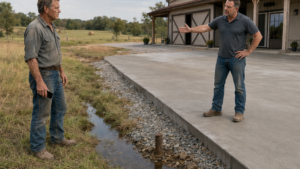
I heard the water before I saw the hose.
At five forty in the morning, with the cattle still gathered along the east fence and the sun barely touching the tops of the maples, water was rushing somewhere it shouldn’t have been.
I stopped halfway across the equipment yard.
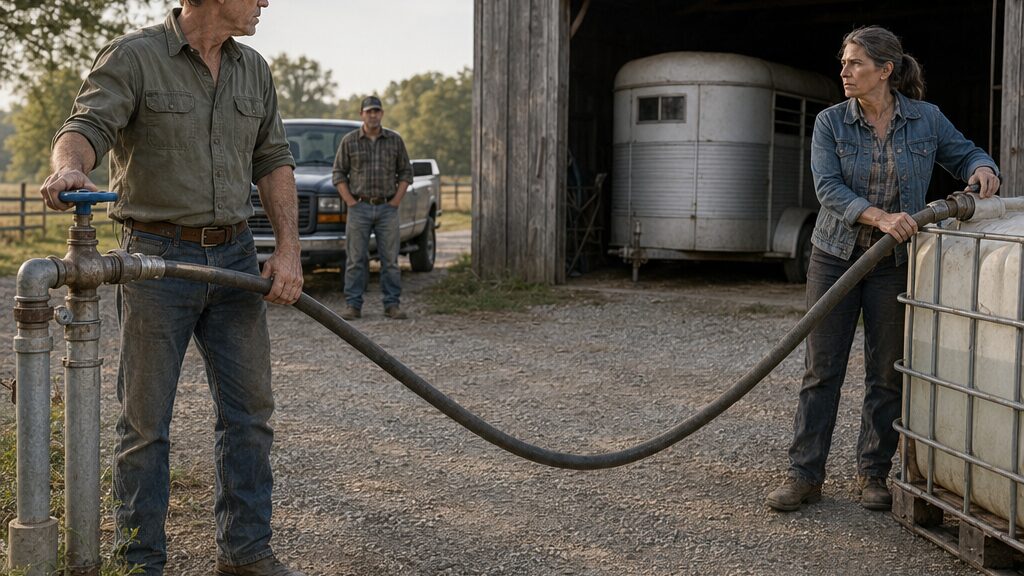
A black hose lay across my gravel lane.
It ran from the standpipe beside the machine shed, crossed twenty feet of gravel, disappeared beneath the fence, and continued toward Nancy Roberts’s pasture.
The blue handle on my valve was wide open.
Then I looked toward the shed.
A two-horse trailer sat inside it.
Nancy’s trailer.
I stood there longer than I should have.
The shed had been mostly empty since I’d sold Dad’s old square baler. I planned to rent the space before winter, and the weather-faded STORAGE AVAILABLE board was still nailed beside the opening.
Empty, though, didn’t mean abandoned.
And it certainly didn’t mean Nancy’s.
I followed the hose to the fence.
On her side, it fed a portable water tank in the back of a pickup. Nancy stood beside it in jeans and rubber boots, watching the level rise.
“Nancy.”
She looked over.
“Morning.”
“What are you doing?”
She glanced at the tank as though the answer ought to have been obvious.
“Filling this.”
“I can see that.”
She wiped her hands on her jeans.
“I’ll be done in twenty minutes.”
I looked back at the shed.
“And the trailer?”
“Needed it out of the sun.”
“You put it in my shed.”
Nancy’s expression tightened.
“It’s not hurting anything.”
That sentence bothered me more than it probably should have.
I walked back to the standpipe.
“David.”
I put my hand on the blue valve.
“Don’t shut that off. I’m almost full.”
“You should’ve asked.”
She crossed toward the fence.
“For water?”
“For water. For the shed. For bringing equipment onto my place.”
Nancy gave a short, unbelieving laugh.
“I’ve been using that shed for years.”
My hand stopped.
“You’ve what?”
“Your dad never cared.”
“That’s not the same thing as asking me.”
“Your dad never made us ask.”
For a moment, neither of us said anything.
Then I turned the blue handle clockwise.
The rush inside the pipe weakened.
Nancy stared at me.
“Seriously?”
The water slowed to a trickle and stopped.
“Seriously.”
Her tank was perhaps three-quarters full.
I disconnected the hose from my standpipe, drained the last water onto the gravel, coiled it carefully, and carried it to the fence.
I didn’t throw it.
I didn’t cut it.
I laid the coil on Nancy’s side.
“Please get your trailer out by noon.”
She folded her arms.
“You’re making a problem where there isn’t one.”
“No. I’m telling you where my property starts.”
“Your father understood how things work out here.”
That one landed.
Dad had been dead four years, but people still used him as a measuring stick whenever they didn’t like something I did.
Your dad would’ve fixed that himself.
Your dad would’ve lent the tractor.
Your dad never charged for that.
Usually I let it pass.
This time I said, “I’m not Dad.”
Nancy looked toward the machine shed.
“No. You’re not.”
She walked back toward her truck.
I should have ended the conversation there.
Instead I heard myself say, “If you’re in some kind of bind, tell me.”
She stopped but didn’t turn around.
“I’m not in a bind.”
“Then there shouldn’t be a problem.”
She climbed into the truck and shut the door.
By seven, she was gone.
The tank went with her.
The trailer didn’t.
At eleven thirty, I was greasing the mower when I checked the shed again.
Still there.
I called Nancy.
No answer.
At noon, I called once more.
At twelve twenty, the trailer finally moved. I watched Nancy pull it across the gravel without looking toward me.
That should have settled it.
Instead, two mornings later, I found the same trailer parked halfway inside the shed again.
No hose this time.
I stood beside it with my phone in my hand, thinking about taking a picture.
Then I put the phone back in my pocket.
Taking photographs of a neighbor’s trailer felt ridiculous.
We weren’t strangers in a subdivision arguing over parking spaces.
Our families had owned adjoining ground for decades.
I told myself Nancy was testing a boundary because I hadn’t been clear enough.
So I walked over and asked again.
She moved it that afternoon.
No shouting.
No sheriff.
No paperwork.
Exactly the kind of outcome Dad would have preferred.
But her words stayed with me.
Your dad never made us ask.
That evening I walked back to the standpipe.
The blue valve had been there longer than I could remember. Dad had installed the line when I was a teenager, running water from the agricultural service near the barn to the equipment yard.
I wiped dust from the pipe.
There were scratches in the paint near the mounting bracket.
At first I thought they were tool marks.
Then I leaned closer.
Two sets of initials had been scratched into the metal years ago.
One was my father’s.
The other was an R.
I ran my thumb over it.
Nancy hadn’t invented the past.
I just didn’t know what the past actually meant.
Chapter 2: The Favor Nobody Ever Wrote Down
The first receipt with the Roberts name on it was seventeen years old.
I found it folded inside a box of pump manuals in the bottom drawer of Dad’s old metal filing cabinet.
PUMP REPAIR was handwritten across the top.
Below the parts total, Dad had written two words in pencil.
Roberts half.
I sat back in his desk chair.
There were three more receipts in the box.
One was for a pressure switch.
Another was for replacing a cracked section of line.
The third covered gravel around the standpipe.
Nancy’s family appeared on all three.
Not as customers.
As contributors.
I spread everything across the desk.
For four years I’d been telling myself I understood the farm I’d inherited because I understood the fields, fences, cattle and machinery.
But farms had another kind of infrastructure.
Favors.
Promises.
Things agreed beside pickup beds that never reached paper.
Dad had been fluent in that world.
I wasn’t sure I was.
I found a pocket calendar from one of the drought years.
Most entries were cattle weights, hay deliveries and equipment repairs.
Then, in July, three words:
Roberts using water.
Two weeks later:
Pump holding fine.
That was all.
Nothing about ownership.
Nothing about permanent access.
Nothing saying when permission ended.
I called Nancy.
“I found some old records.”
There was a pause.
“What records?”
“Pump repairs. Dad had your family paying part.”
“I told you.”
“You told me you used the water.”
“We helped maintain it.”
“Sometimes.”
“What’s that supposed to mean?”
“It means I’m trying to understand the arrangement.”
Nancy went quiet.
Then she said, “There wasn’t an ‘arrangement,’ David. That’s how neighbors did things.”
That sounded exactly like something Dad would have said.
It also explained nothing.
“Did he tell you the shed was yours to use whenever you wanted?”
“Nobody said it was ours.”
“Then why are you putting your trailer in it?”
“Because we’ve always used it when we needed it.”
I looked through the office window toward the shed.
“That’s not the same answer.”
“It is out here.”
“No, Nancy. It isn’t.”
She exhaled.
“I don’t know what happened to you.”
I almost laughed.
“What happened to me?”
“Your father didn’t keep score.”
I looked down at the receipts.
Apparently he had kept some.
“I’ll talk to you later.”
I hung up before I said something I’d regret.
By afternoon I had arranged the receipts chronologically.
The pattern became clearer.
Nancy’s family had contributed during three dry periods.
Then nothing for six years.
One payment appeared after that for gravel.
Then another long gap.
Whatever existed between the farms, it wasn’t a regular utility partnership.
But it wasn’t imaginary either.
That was the part I didn’t like.
I had wanted Nancy to be plainly wrong.
Plainly wrong was easy.
Instead, Dad had opened a door years ago and never written down how far it opened.
Near sunset, I walked to the standpipe carrying one of the receipts.
The meter sat inside a weatherproof box several feet away.
I copied the current reading onto the back of an envelope.
Then I held Dad’s old receipt beside it.
Two generations of the same problem separated by a piece of paper and a row of digits.
I could hear Dad telling me not to turn a neighbor problem into a courthouse problem.
I could also hear Ashley, my daughter, telling me that “Dad would’ve” was the phrase people used when they wanted something from me.
I went into the shed.
Nancy’s trailer was back.
I actually laughed once, because anger would have been easier to understand.
I had asked her twice.
She had moved it twice.
And now here it was again, parked neatly against the wall as if we’d never spoken.
I called her.
“You put it back.”
“I needed somewhere dry.”
“You have a barn.”
“My barn’s full.”
“That’s your problem.”
The silence afterward made me regret the words immediately.
But I didn’t take them back.
Nancy said, “We helped pay for that setup.”
“The water setup.”
“The whole area was something our families used.”
“According to who?”
“According to everybody who was here before you decided everything needed rules.”
That one stayed with me.
“I want the trailer out tonight.”
“I’ll get it tomorrow.”
“Tonight.”
“I said tomorrow.”
She hung up.
I stood there staring at the trailer.
Again, I did nothing.
That was my mistake.
I told myself patience was restraint.
In reality, I was still hoping Nancy would save me from having to draw a line.
The next morning Ashley pulled into the yard shortly after eight.
She had grown up on the farm but lived thirty minutes away now. She came most Saturdays to help with paperwork and, as she put it, prevent me from filing receipts in coffee cans.
She stepped from her SUV and immediately noticed the trailer.
“Whose is that?”
“Nancy’s.”
Ashley looked at me.
“Why?”
“Long story.”
“Is this the water thing you mentioned?”
I nodded.
Ashley walked closer to the shed.
“You told her to move it?”
“Several times.”
“And?”
“She moves it.”
Ashley pointed.
“Apparently not.”
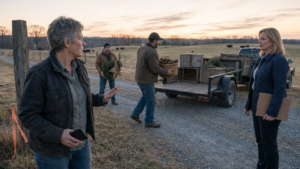
Before I could answer, a pickup slowed on the county road.
The neighboring hay farmer lifted a hand through the window.
Then he called out, “You renting that shared shed now, David?”
I frowned.
“What shared shed?”
He looked confused.
“The one Nancy uses.”
The pickup rolled on.
Ashley turned slowly toward me.
“Shared?”
I didn’t answer.
She looked at the trailer, then at the old STORAGE AVAILABLE board beside it.
“Dad,” she said, “what exactly has Nancy been telling people?”
I had no idea.
And for the first time, the problem no longer felt like it ended at my fence.
Chapter 3: When Courtesy Became Her Permission
Three days later, a farm-supply driver climbed out of his truck and asked me where I wanted the mineral tubs unloaded.
“North side of the barn.”
He checked his delivery sheet.
“Says shared shed.”
I stared at him.
“What?”
He pointed toward the machine shed.
“Customer note says deliveries can be left at the shared shed if nobody’s around.”
“Whose note?”
He glanced down.
“Roberts.”
I felt something inside me settle.
Not explode.
Settle.
That was worse.
“That isn’t a shared shed.”
The driver looked embarrassed.
“All right.”
“It’s mine.”
“Understood.”
“Nothing for Nancy gets left there.”
He nodded quickly.
“No problem.”
After he left, I walked to the standpipe.
The blue valve had become the one part of the yard I couldn’t pass without checking.
That morning I installed a steel cover over the handle with a place for a small padlock.
I hated doing it.
The lock made the farm feel different.
Dad had rarely locked anything except the fuel tank and gun cabinet.
But Dad hadn’t spent a week discovering that a favor could somehow become a neighborhood fact without him knowing.
Nancy appeared while I was tightening the final bolt.
“You locking me out now?”
“I’m locking the valve.”
“Same thing.”
“It’s my water.”
She carried a manila folder under one arm.
“That’s exactly the attitude I’m talking about.”
“What attitude?”
“Like none of this existed before you took over.”
I stood.
Nancy opened the folder.
Inside were photocopies of receipts.
I recognized two immediately.
Pump repair.
Pressure switch.
She held them out.
“My dad paid half.”
“On some repairs.”
“Because we used the system.”
“With permission.”
“Because it was shared.”
“No.”
Her jaw tightened.
“How do you know?”
“Because there’s no agreement.”
“You think people around here wrote contracts every time they helped each other?”
“No. I think helping each other and owning each other’s property are different things.”
She tapped the receipts.
“My family put money into that line.”
“And my father let you draw water during dry years. I know that now.”
Her expression changed slightly.
She hadn’t expected me to acknowledge it.
I continued.
“I’m not pretending nothing happened. But you don’t get permanent access because your dad helped replace a pressure switch seventeen years ago.”
Nancy lowered the folder.
“You’ve got a convenient way of remembering things.”
“I’m using Dad’s records.”
“And I’m using mine.”
For the first time, I understood why she was so certain.
Not correct.
Certain.
To Nancy, those receipts weren’t old maintenance bills.
They were proof that her family had belonged to an arrangement.
Maybe her father had described it that way.
Maybe mine had never corrected him.
Maybe both men had assumed the next generation would understand something they’d never bothered to define.
That didn’t excuse what Nancy was doing now.
But it made the argument harder to dismiss.
“I should’ve asked you about this before I got angry,” I said.
Her face softened by half an inch.
Then I added, “And you should’ve asked before putting your trailer in my shed.”
The softness disappeared.
“I’ll move it when I have room.”
“No. You’ll move it today.”
“There you go again.”
“What?”
“Making rules after forty years.”
I looked at the locked blue valve.
“No. I’m making rules after three conversations.”
She turned and walked away.
I let her.
That afternoon the trailer disappeared.
For several hours, I thought perhaps we’d finally reached the ugly but workable end of it.
Then Nancy came back.
She parked beside my shop and got out without closing her truck door.
“Come look at this.”
Her voice was different.
Sharper.
I followed her to the trailer, now sitting on her side of the property line.
A fresh scrape ran along the lower metal panel near the rear wheel.
The paint was peeled back several inches.
Nancy pointed at it.
“You did that.”
“No.”
“It wasn’t there before.”
“I never moved your trailer.”
“It happened in your shed.”
“Then how does that make it mine?”
“You’ve been messing around in there. Moving things. Locking things.”
“I didn’t touch it.”
She folded her arms.
“Somebody did.”
“Take pictures.”
“I already have.”
“Good.”
That surprised her.
I looked closely at the scrape but didn’t touch it.
There was dirt around the damaged section and a bright edge where the paint had been removed.
I had no idea when it happened.
And that was exactly the problem.
For a week, Nancy had been leaving equipment on my property while I kept relying on conversations.
No photographs.
No written notices.
No record of when the trailer entered or left.
My patience had created an empty space where facts should have been.
Nancy said, “I’ll get an estimate.”
“That’s fine.”
“You’ll need to cover it.”
“No.”
Her eyebrows rose.
“You just admitted it happened on your property.”
“I said I don’t know when it happened.”
“You wanted the trailer gone.”
“That doesn’t mean I damaged it.”
“We’ll see.”
She climbed into her truck.
I stood beside the trailer as she drove away.
The scrape itself didn’t scare me.
What scared me was how little I could prove.
I walked back across the lane and stopped at the blue valve.
For the first time since the dispute started, I took out my phone.
I photographed the locked cover.
Then the meter.
Then the shed.
Then the gate.
I walked around the equipment yard and photographed every angle I could think of.
Ashley had been right.
So had Nancy, in one unintended way.
Things had changed.
The difference was that I finally understood they had to.
Chapter 4: The Meter Moved While I Was Gone
The number on the meter was wrong.
Not wildly wrong.
That would have been easier.
It was wrong by enough.
I stood beside the weatherproof box with my phone in one hand and the photograph from the previous evening open on the screen.
The digits I had photographed before leaving were clear.
This morning, after one night at Ashley’s place, the reading was higher.
I checked twice.
Then a third time.
The blue valve cover was still locked.
At first glance, nothing else looked disturbed.
The shed was empty.
The gate was closed.
The chain hung where I had left it.
For about ten seconds, I almost convinced myself I had misread the earlier photograph.
Then I zoomed in.
Same meter.
Same angle.
Same date stamp.
Different number.
I took another picture.
This time I included the lock, the meter, and the standpipe in one frame.
Then I walked to the gate.
The chain was looped through the post exactly as before, but the mud below it showed fresh tire marks.
I crouched.
The chain itself had two bright scratches along one link where rust had been rubbed clean.
Someone had taken it off.
Someone had put it back.
I looked across the fence toward Nancy’s place.
Nothing moved.
No truck.
No trailer.
No person.
Only the top of her barn and a line of pasture beyond it.
For the first time since this started, I didn’t feel confused.
I felt certain.
That scared me more than uncertainty had.
I called the county water district.
By midmorning, I was sitting across from Mark Green at a gray metal desk in an office that smelled faintly of printer toner and coffee.
He looked at the photographs without touching my phone.
“You’re sure nobody on your place drew water overnight?”
“No.”
“Livestock line?”
“Separate service.”
“Irrigation?”
“Off.”
“Leak?”
“I checked the standpipe and the visible line.”
Mark nodded once.
“Could still be underground.”
“Could be.”
He turned to his computer.
“That meter transmits interval data.”
I hadn’t known that.
“You can see when it moved?”
“Usually close enough.”
He typed for a while, then leaned toward the screen.
“There.”
He pointed.
A usage spike had registered shortly after midnight.
Not a slow leak.
A concentrated draw.
“How much?”
He told me.
Enough to fill several portable tanks.
I stared at the number.
“That wasn’t me.”
Mark kept his voice neutral.
“I’m not saying who it was.”
“I know.”
“What I can say is your service recorded that volume during that period.”
I handed him the earlier photo.
“And the valve was locked.”
“That tells me what you photographed. It doesn’t tell me what happened after.”
It was exactly the answer I expected from him, and somehow that made it more useful.
No drama.
No taking sides.
Just limits.
“Can you print that interval?”
“I can give you a customer usage record.”
“Do that.”
He looked at me for a moment.
“Neighbor issue?”
“Yes.”
“Then document before you argue.”
I almost smiled.
“Learning that.”
He printed the sheet and slid it across the desk.
The timestamp sat there in black ink.
For days, I had wanted proof.
Now I had it.
And it didn’t feel like victory.
It felt like the beginning of a different kind of problem.
On the way home, I stopped at Ashley’s.
She opened the door before I knocked.
“You look terrible.”
“Thanks.”
“You know what I mean.”
I handed her the usage sheet.
She read it.
“So she got through the gate.”
“Looks like it.”
“And still used the water.”
“Looks like it.”
Ashley looked up sharply.
“Then call the sheriff.”
“For what?”
“Trespassing.”
“Maybe.”
“Dad.”
“What?”
“You keep saying maybe after things already happened.”
I set the paper on her kitchen table.
“I need to know exactly what happened.”
“You have a meter reading.”
“I have water use. I don’t have her standing there with a hose.”
“You know it was her.”
“That’s not the same thing.”
Ashley folded her arms.
“You always do this.”
“Do what?”
“Wait until everybody else has made the decision for you.”
“That’s not fair.”
“It’s exactly fair.”
I picked up the paper.
She softened a little.
“I’m not saying go start a war. I’m saying stop acting like every boundary needs a jury.”
I left before we could turn it into an argument.
Back at the farm, I walked the lane from the road to the standpipe.
The tire tracks were clearer in the shade.
A narrow trailer tire.
Not proof by itself.
But not nothing.
Near the gatepost, I found a small smear of fresh grease where the chain had dragged.
I photographed that too.
Then I walked toward the blue valve.
The lock had no visible damage.
That bothered me.
If Nancy had drawn water, she hadn’t forced the cover.
I examined the pipe behind it.
The hose connection below the valve could still be reached with the right fitting.
I had locked the handle.
I hadn’t actually secured the outlet.
Another mistake.
Another half-measure.
I went to the shop and found a threaded cap with a locking tab.
By late afternoon, both the valve handle and outlet were secured.
This time I photographed each step.
Nancy drove past once.
She slowed.
Didn’t stop.
I didn’t wave.
The following morning, Mark called.
“There’s something else.”
I stepped outside the barn to hear him better.
“What?”
“You asked yesterday about service relationships.”
“Yeah.”
“I checked the parcel records attached to the meter account. Your property is the only listed service location.”
“I figured.”
“I’m not giving you legal advice. I’m telling you the utility record doesn’t show any shared account.”
“Understood.”
“So whatever your fathers did, it wasn’t set up through us.”
That should have settled something inside me.
Instead it sharpened a different question.
If Nancy knew she had no formal connection to the service, why was she risking a locked gate and a midnight water draw?
I thanked Mark and hung up.
Around noon, I heard a diesel engine on the county road.
A white service truck turned into Nancy’s driveway.
It had a steel rack, lengths of pipe, and a pump company logo on the door.
Two workers got out.
One walked toward her well house.
The other unloaded diagnostic equipment.
I stood at my fence and watched them disappear behind the barn.
Nancy came outside a minute later.
She saw me.
For a moment, neither of us moved.
Then she looked away first.
That was when the water dispute finally stopped looking like a fight over principle.
Something was wrong on the other side of the fence.
And Nancy had been doing everything she could to keep me from seeing it.
Chapter 5: The Well She Couldn’t Afford to Lose
At five twenty the next morning, Nancy was hauling water in fifty-gallon tanks.
Not one big tank.
Four small ones strapped into the bed of her pickup.
She drove slowly enough that the plastic didn’t slosh over the tops.
I watched from my barn doorway.
She made two trips before sunrise.
Not to my standpipe.
From somewhere else.
By the third trip, I understood why.
Her well wasn’t just struggling.
It was down.
Later that morning, I drove to the county records office to check the parcel service information Mark had mentioned.
The county clerk pulled up the utility and parcel maps.
Nancy’s property showed an old private well.
No connection to my agricultural service.
No easement.
No shared meter.
Nothing in writing that crossed the property line.
I asked the clerk about recorded access agreements.
She checked.
“None between those two parcels.”
“That means none ever?”
“It means none recorded here.”
Another careful answer.
I was getting used to those.
Facts came with borders.
People were the ones who tried to stretch them.
On my way home, I stopped at the water district.
Mark met me near the counter.
“I’m not trying to turn you into my investigator,” I said.
“Good.”
“But I need to understand something.”
He waited.
“If a private well fails, what are the options?”
“Depends on the well.”
“Assume expensive.”
He gave me a look.
“Then drilling, repair, hauling, temporary tanks, conservation. None cheap.”
“How expensive?”
He gave me a range broad enough to make my stomach tighten.
“That bad?”
“Could be less. Could be worse.”
I thought about Nancy’s old barn, the cattle she had sold the previous spring, and the fact that I had not seen a new piece of equipment on her place in years.
Mark said, “This about your neighbor?”
“I think her well failed.”
He leaned back against the counter.
“That would explain need.”
“Not permission.”
“No.”
The simplicity of that answer helped.
Both things could be true.
Nancy could be desperate.
Nancy could still be wrong.
When I got home, I found the black hose lying on her side of the fence.
Dry.
Coiled beside the locked blue valve.
For a minute, I remembered Dad using that same standpipe during a drought.
Neighbors pulled in with tanks.
Nobody kept receipts for every gallon.
Somebody brought diesel.
Somebody else helped fix a pump.
That was how things worked when everybody respected the difference between asking and taking.
I saw Nancy near the pasture entrance that afternoon.
She was tightening a strap over another water tank.
I walked over.
“How bad is the well?”
Her hands stopped.
“Fine.”
“The pump truck was here yesterday.”
“They service wells.”
“How bad?”
She pulled the strap tighter.
“Why do you care?”
“Because you’ve been hauling water since before daylight.”
“Keep track of your own place.”
“I am. That’s how we got here.”
She turned.
“What do you want, David?”
“The truth would help.”
Her face changed.
Not much.
But enough.
“I don’t owe you my finances.”
“I didn’t ask for them.”
“You’re acting like you’re entitled to explanations.”
That almost made me laugh.
Instead I said, “You’re right.”
She blinked.
“I’m not entitled to your business. But you’re not entitled to my water.”
Nancy looked toward the tanks.
“My dad helped maintain that line.”
“We’ve covered that.”
“No, you covered your version.”
“Nancy.”
She stepped closer to the fence.
“You think because your name is on the bill, everything before you disappeared.”
“I think because my name is on the bill, you have to ask.”
For several seconds, she stared at me.
Then she said quietly, “Asking isn’t always simple.”
There it was.
Not an admission.
But the first crack in the wall.
Before I could answer, she climbed into the truck.
I let her go.
That evening Ashley came by.
I told her about the well.
She listened, then said, “So now you’re going to let her use everything again.”
“I didn’t say that.”
“You’re thinking it.”
“I’m thinking she’s in trouble.”
“She was in trouble when she went through your gate too.”
“I know.”
“She blamed you for damaging her trailer.”
“I know.”
“She told people the shed was shared.”
“I know.”
Ashley looked at me.
“Then what changes?”
“The reason matters.”
“Not enough to erase the rest.”
“No.”
That surprised her.
I leaned against the kitchen counter.
“I can feel sorry for her and still say no.”
Ashley nodded slowly.
“Okay.”
It was the first time I had said it out loud.
The next morning, I learned whether I meant it.
I found the gate open.
The chain was hanging from one post.
Nancy’s pickup was parked near the shed.
Her trailer sat inside the equipment yard.
She had not put it in the shed this time.
She had parked it beside the lane.
I walked toward her.
“You opened my gate.”
She was checking a tire.
“I needed to turn around.”
“You took off the chain.”
“It wasn’t locked.”
“It was closed.”
“That road’s been used forever.”
“My lane has.”
“Same thing.”
“No.”
She stood.
Her expression was tired rather than angry.
That almost made it harder.
“I’ve got nowhere to put the trailer while I move equipment.”
“You have your property.”
“Not enough room right now.”
“Then move something.”
She gave a bitter laugh.
“Easy for you to say.”
I looked at the dark circles under her eyes.
“When are they fixing the well?”
Her face closed immediately.
“That’s none of your business.”
“Then don’t make it my business.”
She stepped toward the truck.
I said, “Move the trailer today.”
She stopped.
“Or what?”
The old answer rose in my mouth.
We’ll work it out.
Give me a day.
Let’s not make this bigger.
I swallowed all of them.
“Or I stop asking.”
Nancy turned around.
“What does that mean?”
“It means I put it in writing.”
“You’d really do that?”
“Yes.”
For a second, she looked less angry than hurt.
That bothered me.
Then she drove away.
The trailer stayed.
At two that afternoon, a semi carrying round-bale net wrap and stacked pallets turned onto my lane.
The driver stopped thirty yards from the yard and leaned on the horn.
I walked out.
He pointed past me.
“Can’t get through.”
Nancy’s trailer sat directly across the turning path he needed.
I closed my eyes.
This was no longer about an old favor.
It was blocking today’s work.
And for the first time, sympathy wasn’t enough to make me hesitate.
Chapter 6: The Day I Finally Put It in Writing
Before sunrise, I taped a dated notice to Nancy’s trailer.
I put another copy inside a clear plastic sleeve and fastened it to the gate.
The language was plain.
Remove the trailer by noon.
No further storage in the equipment yard or shed.
No use of the water line without written permission.
No access through the service gate without asking first.
I read it twice before stepping back.
For years, I had thought written boundaries were what people used when neighborliness failed.
Now I understood something uglier.
Sometimes neighborliness failed because nobody wrote the boundary.
I photographed the notice.
Then the trailer.
Then the gate.
Then the locked blue valve.
At eight, Nancy arrived.
She ripped the plastic sleeve off the trailer and marched toward me.
“You put a notice on my property?”
“I put a notice on your trailer while it was on mine.”
“This is ridiculous.”
“You have until noon.”
“You know I can’t move everything today.”
“You only need to move the trailer.”
She held the paper up.
“And this water language?”
“That means exactly what it says.”
Her voice sharpened.
“My family paid into that system.”
“And I checked the records.”
“What records?”
“County. Utility. Property.”
Her face changed.
“There is no recorded easement. No shared service. No agreement attached to the meter.”
“So now you’re hiding behind paperwork.”
“No.”
I looked at the paper in her hand.
“I’m using paperwork because conversations didn’t work.”
She stared at me.
Then she pointed toward the scrape on the trailer.
“You still haven’t dealt with this.”
“There’s nothing to deal with.”
“You damaged it.”
“No.”
“It was on your place.”
“That doesn’t prove I touched it.”
“You were angry.”
“That doesn’t prove I touched it either.”
She stepped closer.
“You’re going to pay for the repair.”
I took out my phone.
Her expression shifted.
I opened the photographs from three days earlier.
The trailer.
The shed.
The gate.
The valve.
Then the picture showing the side of the trailer before she had moved it.
I zoomed in.
The section she claimed I damaged was visible.
So was the scrape.
Nancy stopped talking.
I hadn’t noticed it when I took the photo.
Neither had she, apparently.
But there it was.
Already present.
Bright metal under dirt.
Same place.
Same shape.
I held the screen between us.
“That was before you moved it.”
Nancy looked away.
For one second, I thought she might apologize.
Instead she said, “Maybe it happened the first time.”
“Maybe.”
“You still had it on your property.”
“You put it there.”
“That doesn’t mean—”
“Nancy.”
I lowered the phone.
“I’m done arguing about things you chose to put on my place.”
Her mouth tightened.
“I don’t recognize you anymore.”
That hurt more than I expected.
I kept my voice even.
“You didn’t need to recognize me when you wanted the shed.”
She looked at me for a long time.
Then she left.
At nine thirty, I drove to the county service desk.
The clerk confirmed again that there was no recorded easement or shared utility agreement.
I requested copies.
Not because I thought the documents would magically fix anything.
Because I wanted the facts in one folder.
That mattered now.
By eleven forty-five, Nancy’s trailer had not moved.
At eleven fifty, the semi from the previous day called.
The driver was scheduled to return after lunch.
I stood in the equipment yard looking at the trailer.
This was the moment I had been avoiding from the beginning.
Not the argument.
The consequence.
Anybody could say stop.
The harder part was deciding what happened when the other person didn’t.
At noon, I called Nancy.
She answered on the fourth ring.
“It’s noon.”
“I know what time it is.”
“The trailer is still here.”
“I said I’ll get to it.”
“The delivery truck comes at one.”
“Then tell him to wait.”
“No.”
Silence.
“David.”
“You had until noon.”
“What are you going to do?”
I looked at the notice.
“I’m going to clear my lane.”
“You better not touch my trailer.”
“I’m not going to.”
I hung up.
At twelve ten, I called an authorized tow operator.
I gave him the location and explained that the trailer was on private property after written notice.
He asked whether law enforcement had been involved.
“Not yet.”
He advised me to call the sheriff’s office before moving anything.
So I did.
A deputy arrived first.
He read the notice.
Looked at the photographs.
Asked whether Nancy had been told verbally before.
“Several times.”
“Any written agreement giving her access?”
“None I can find.”
He nodded.
“This is mainly a property issue. I’m not deciding ownership rights.”
“I’m not asking you to.”
“You just want the lane clear.”
“Yes.”
He looked at the trailer.
“Then keep documenting.”
There it was again.
The same instruction from different people.
Document.
Not threaten.
Not perform.
Not win.
Document.
Nancy arrived while the deputy was still there.
She got out fast.
“You called the sheriff?”
“I called because the trailer is still here.”
She looked at the deputy.
“This has been a shared area for decades.”
The deputy raised one hand.
“I’m not here to settle that.”
She pointed at me.
“He’s changing everything.”
“I’m asking you to move your trailer.”
“You know why I need the space.”
“No. You never told me.”
That stopped her.
The deputy looked between us but said nothing.
Nancy’s face hardened.
“I don’t have to explain my finances to you.”
“No.”
I nodded.
“But you do have to ask before using my property.”
Her eyes dropped to the ground.
The tow truck turned into the lane.
The sound of its diesel engine filled the yard.
Nancy looked over her shoulder.
Then back at me.
For the first time since this began, she didn’t look angry.
She looked frightened.
Not of the tow truck.
Of what came after it.
I almost told the driver to leave.
Almost.
Then I looked at the trailer blocking the lane, the notice in Nancy’s hand, and the blue valve behind the fence.
I thought about every time I had avoided a clear answer because I wanted to feel like a good neighbor.
The tow operator climbed down.
“Which one?”
I pointed.
“That trailer.”
Nancy closed her eyes.
I waited for her to argue.
She didn’t.
And as the operator walked toward the hitch, I understood that whatever happened between our farms after this would no longer rest on what our fathers had failed to say.
It would rest on what Nancy and I chose to do next.
Chapter 7: What My Father Meant by Helping
Nancy came to my kitchen door three days after the trailer was removed.
She did not bring the trailer.
She did not bring the folder of receipts.
She did not bring an argument.
She stood on the porch with both hands empty and said, “I need water.”
For a moment, neither of us moved.
The tow operator had taken her trailer to a storage yard after she refused to move it herself. She had collected it the next morning and paid the fee without calling me.
Since then, the property line between our farms had been quieter than I could remember.
Her well-service truck had returned twice.
So had the small tanks in her pickup.
I stepped aside.
“Come in.”
Nancy hesitated before entering.
I poured coffee.
She refused it.
We sat across from each other at the same kitchen table where Dad had once sorted cattle receipts and seed catalogs.
Nancy looked older than she had a week earlier.
Not suddenly old.
Just tired enough that she had stopped hiding it.
“The well pump isn’t the whole problem,” she said.
I waited.
“The casing is bad lower down. They can patch part of it, but nobody will guarantee how long it holds.”
“How long before they can do the work?”
“A week, maybe two.”
“And until then?”
“I haul.”
She rubbed her thumb against the edge of the table.
“I can keep hauling for the house. The livestock is harder.”
There was no accusation in her voice now.
That made it harder to stay angry.
“Why didn’t you tell me?”
Nancy gave a small laugh without humor.
“Because I knew what you’d say.”
“You never asked.”
“I knew.”
“No. You assumed.”
She looked at me then.
“You’d already started talking about renting the shed. You were changing things. I thought if I asked, you’d decide the old arrangement was finished.”
“It was finished.”
“I know that now.”
“That isn’t what I mean.”
She looked away.
I leaned back.
“My father let your family use the water during droughts.”
“Yes.”
“He let you put equipment in the shed sometimes.”
“Yes.”
“But there was never a permanent agreement.”
Nancy didn’t answer.
“I checked everything I could find.”
“I believe you.”
That surprised me.
She continued.
“My dad talked about it like it was settled forever.”
“Mine apparently didn’t.”
“No.”
The room went quiet.
Outside, a tractor passed on the county road.
Nancy stared through the window.
“Maybe they never had the same conversation.”
That possibility had bothered me from the beginning.
Two men shaking hands beside a pump.
One thinking, Use it when you need it.
The other hearing, This will always be here for us.
Nobody lying.
Nobody writing anything down.
Then both men gone, leaving the misunderstanding to people who hadn’t been there.
Nancy said, “I shouldn’t have gone through your gate.”
“No.”
“I shouldn’t have kept putting the trailer there.”
“No.”
She looked irritated by the repetition.
Then, unexpectedly, she smiled.
Barely.
“You could make this easier.”
“I spent a month making it easier.”
The smile disappeared, but she nodded.
“I know.”
I looked at the folder beside my refrigerator.
Inside were meter records, photographs, receipts, county copies and the notice from the trailer.
A week earlier, I had thought that folder would tell me who was right.
It had told me what was legal.
It had told me what happened.
It had not told me what kind of neighbor I wanted to be once I had the right to say no.
Nancy spoke before I could.
“I can pay for water.”
“How much do you need?”
Her shoulders lowered slightly.
We talked numbers.
Daily livestock need.
Tank capacity.
How long the repair might take.
She had already cut usage.
I asked what she could reasonably haul each day.
She told me.
Then I said, “I’ll allow emergency water until the well is repaired.”
Nancy looked at me carefully.
“But.”
“Yes. But.”
I took a sheet of paper from the counter.
“No shed access.”
She nodded.
“No service lane except when you’re filling.”
Another nod.
“You call first.”
“Yes.”
“We record the meter before and after.”
Her mouth tightened.
“David—”
“That’s not optional.”
She looked at me for several seconds.
Then said, “Fine.”
“You pay the actual water cost.”
“Fine.”
“If the repair takes longer than two weeks, we talk again.”
“Fine.”
“And this doesn’t create permanent access.”
Her jaw flexed.
There it was.
The sentence she did not want.
I left it between us.
Finally she said, “Put that in writing.”
I looked up.
“What?”
“You heard me.”
For the first time in weeks, I laughed.
Nancy did too, though she tried not to.
I wrote the terms plainly.
No legal language beyond what was necessary.
No attempt to punish her.
Just what we had both failed to have before: an agreement that said where the favor began and where it ended.
When I finished, I pushed it toward her.
Nancy read every line.
Then she signed.
I signed below her.
She folded her copy carefully.
Before standing, she said, “Your dad would probably think this was too much paper.”
“Probably.”
“He would’ve just told me to fill the tank.”
“Probably.”
She looked toward the window.
“He also would’ve expected me to ask.”
I didn’t answer immediately.
That was the part I had finally understood.
Dad’s generosity had never been the absence of boundaries.
People asked.
He chose.
Because everyone remembered the yes, I had mistaken it for something automatic.
So had Nancy.
“I should’ve been clearer sooner,” I said.
She frowned.
“You told me to move the trailer.”
“I mean before that. When I took over the place. I knew people had old arrangements with Dad. I just assumed they’d disappear on their own.”
“You weren’t the only one assuming.”
“No.”
That was as close to an apology as either of us needed.
Later that afternoon, we met at the standpipe.
Nancy backed her pickup beside the fence with a large portable tank strapped in the bed.
For the first time since the trouble began, her hose stayed coiled until I arrived.
She waited.
That mattered.
I photographed the meter.
Not because I distrusted her.
Because that was the agreement.
Then I removed the lock from the valve cover.
The blue handle looked ordinary again.
For weeks, it had represented everything I was angry about: intrusion, entitlement, my own failure to act.
Now my hand rested on it, and the difference was simple.
I was choosing to turn it.
I opened the valve.
Water rushed through the hose.
Nancy watched the tank.
Neither of us talked much.
There was nothing left to win.
When the meter reached the amount we’d agreed on, I glanced toward her.
I didn’t say anything.
I didn’t need to.
Nancy walked to the standpipe.
She placed her hand on the blue handle.
For one second, I remembered the morning I’d found it wide open, water running across my land while someone else decided that my silence meant permission.
Nancy turned the valve clockwise.
The rush weakened.
Then stopped.
She disconnected the hose, drained it onto the gravel and coiled it on her side of the fence.
“I’ll call tomorrow before I come.”
“All right.”
She climbed into her truck.
Before leaving, she lowered the window.
“David.”
“Yeah?”
“Thank you.”
I nodded.
She drove home.
I put the lock back on the valve cover after she left.
Not because the agreement had failed.
Because the agreement mattered.
The shed remained empty for another month before I rented it to a neighboring hay farmer.
Nancy never parked there again.
Her well was repaired eleven days later.
The emergency water arrangement ended exactly as written.
No argument.
No extension.
No new assumptions.
Sometimes, when I passed the standpipe, I still noticed the old initials scratched beside it.
My father’s.
The R beside his.
I never tried to remove them.
They belonged there.
They reminded me that helping someone could become part of a place’s history without becoming ownership.
Dad had left me the land.
He had also left me something harder to inherit: a way of treating people that depended on judgment instead of rules.
For years I thought honoring that meant saying yes whenever he might have.
I had been wrong.
Generosity only means something when no one can take it without asking.
The story has ended.