When They Fenced Off Margaret’s Back Pasture, an Old Farm Lane Became the One Thing They Couldn’t Ignore
Chapter 1: The Fence Across the Only Working Lane
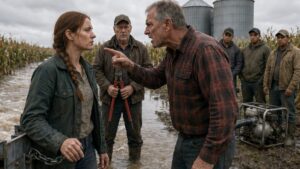
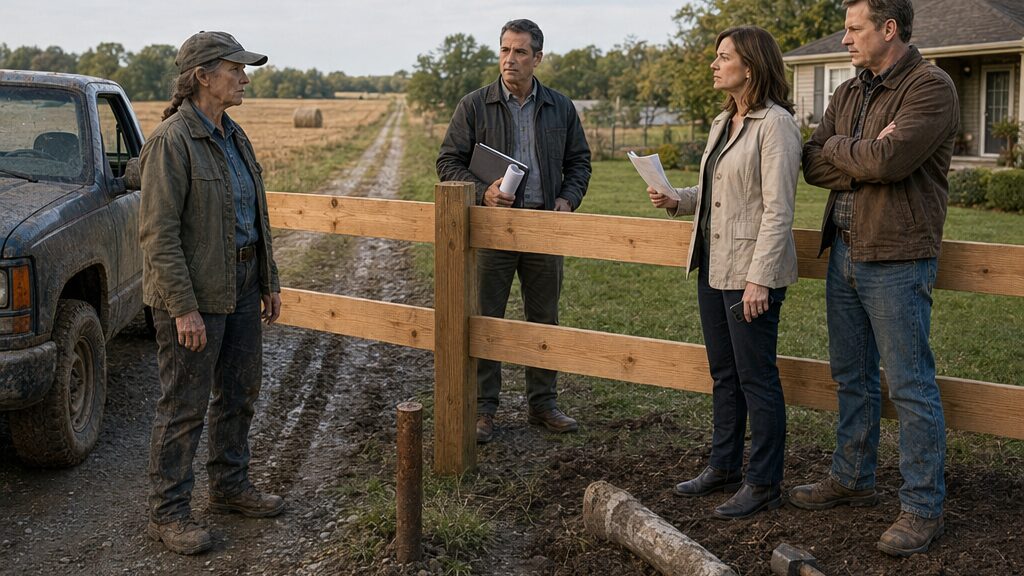
Gregory Carter’s sledgehammer came down before Margaret Hill had both feet out of her truck.
The old wooden post split near the base with a crack that carried across the hay field.
“Gregory.”
He raised the hammer again.
Margaret shut the truck door and walked toward him, boots grinding over the gravel lane her family had used longer than she had been alive.
The second blow knocked the post sideways.
The faded metal reflector her husband had screwed onto it years ago dropped into the weeds.
Gregory rested the hammer against his thigh.
“That post is on our property.”
Margaret looked past him.
That was when she saw the fence.
Fresh cedar ran from the Carter yard toward the pasture, eight feet high in places, its new posts dark with damp soil. The final section crossed directly over the gravel lane.
Margaret stopped.
Beyond it sat her back pasture, the equipment shed, and forty acres she reached with hay wagons, feed deliveries, and cattle trailers.
“You closed the lane.”
Angela Carter stepped from behind the fence contractor’s truck holding a folder against her chest.
“We fenced our property.”
“That’s my access.”
“It’s our land.”
Margaret looked down rather than answering.
The gravel told its own history. Two pale tire tracks curved from the county road, passed the Carter parcel, and continued toward her pasture.
Now they ended against cedar.
Gregory pointed toward the road.
“You can find another way in.”
“There isn’t another equipment entrance.”
“That isn’t our problem.”
Margaret felt the answer rise into her throat and swallowed it.
For thirty-eight years she and her husband had hauled hay through this lane. Before them, her father had used it. Before him, her grandfather had driven cattle through when the road had been little more than crushed limestone.
None of that meant Gregory had to believe her.
Angela opened the folder.
“We had it surveyed.”
She produced a copy of a drawing and then a county permit.
Margaret took neither.
“The survey says the boundary is here,” Angela continued. “The county approved the fence.”
Margaret followed the fence with her eyes.
For one uncomfortable moment, she understood what Angela was saying.
The cedar posts did appear to follow the property boundary.
That was not the same question.
Margaret walked toward the newest corner post.
Gregory moved between her and it.
“Don’t touch anything.”
“I wasn’t going to.”
She crouched.
Half buried beneath loose soil was a rust-dark circle no wider than a quarter.
The old iron survey pin.
The cedar post stood inches away.
Angela gave a small, impatient laugh. “That proves the surveyor knew where the line was.”
“Yes.”
Margaret stood.
Angela seemed surprised by the answer.
Margaret brushed dirt from her knee.
“You probably do own to that pin.”
Gregory stared at her. “Then we’re done.”
“No.”
Margaret pointed toward the gravel disappearing beneath the fence.
“You’re talking about ownership. I’m talking about access.”
Angela’s expression hardened.
“We bought this parcel. We pay taxes on it. We had it surveyed. We got a permit.”
“And I cross it.”
“Not anymore.”
Margaret looked toward the back pasture.
A feed truck was due Wednesday. The hay field would need cutting soon. A cattle trailer could not squeeze through the narrow service path behind the barn.
Angela tucked the permit back into her folder.
“We’re not spending what we spent on this place so trucks can keep coming ten yards from our house whenever they want.”
There it was.
Not the whole argument, Margaret suspected, but more of it than the property line.
She looked again at the broken post.
“That marker didn’t belong to you.”
“It was on our land,” Gregory said.
Margaret bent, picked up the reflector, and slipped it into her jacket pocket.
Angela pulled out her phone.
“I’m calling the county. This has gone far enough.”
Gregory looked satisfied.
Margaret surprised herself by feeling relieved.
“Good.”
Angela paused with her thumb over the screen.
“You think I’m bluffing?”
“No.”
“You’ve been crossing our property after we told you not to. You’re standing here arguing with contractors. Gregory has asked you repeatedly—”
“Call them.”
Angela stared at her.
Margaret pointed toward the fresh cedar post beside the iron pin.
“And tell whoever comes out to bring the county plat.”
Angela’s mouth tightened.
Margaret turned toward her truck, then stopped.
“One more thing.”
“What?”
“Ask for the older parcel book too.”
The confidence on Angela’s face did not disappear.
But for the first time that morning, it moved.
Chapter 2: The Permit That Seemed to Settle Everything
Kevin Lewis looked from Margaret to the fence and asked the one question she had not prepared herself to answer.
“What’s the instrument number for the easement?”
Margaret said nothing.
Kevin held a county tablet in one hand and a clipboard in the other. Mud already marked the edges of his boots from walking the lane.
Angela stood near the cedar fence with her folder.
Gregory stayed several yards behind her.
“The instrument number,” Kevin repeated. “Book and page would work too.”
“I don’t know it offhand.”
Angela glanced at Gregory.
Margaret saw it.
That tiny exchange bothered her more than if Angela had smiled.
Kevin nodded without judgment.
“Okay. Show me what you do have.”
Angela was ready.
She handed him the survey first, then the fence permit.
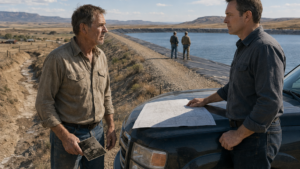
Kevin placed both against the hood of his county vehicle.
Margaret watched his finger move along the survey line.
He walked to the iron pin, checked the cedar posts, then returned to the map.
“The fence appears to be inside the Carter parcel,” he said.
Angela folded her arms.
Gregory exhaled loudly through his nose.
Margaret stared at Kevin.
“I told you it might be.”
Angela blinked.
Kevin looked at Margaret. “Then explain your claim.”
“The lane crosses their parcel. My farm has a right to use it.”
“Recorded?”
“Yes.”
“Where?”
Margaret hated the question because she had spent the morning believing memory was enough to answer it.
“In the farm records.”
“That’s what I need to see.”
Angela pushed the permit closer to him.
“But this is approved.”
“It is.”
“So the fence stays.”
Kevin looked at her.
“I didn’t say that.”
Angela’s hand remained on the paper.
Kevin tapped the permit.
“This authorizes construction subject to existing restrictions and recorded rights. A fence permit doesn’t extinguish an easement.”
The words gave Margaret a brief lift.
Then Kevin turned to her.
“But an easement has to exist before I can enforce one.”
The lift vanished.
Margaret drove back to the farmhouse with muddy tire tracks behind her ending uselessly at the cedar wall.
She went straight to the kitchen cabinet where the property papers had lived for years.
Tax bills.
Insurance.
A newer deed summary.
A farm map.
Receipts for gravel.
Nothing she found said what she needed in language Kevin could enforce.
She read the deed summary twice.
No lane.
No width.
No book and page.
She sat at the kitchen table.
Her husband had known.
That thought came without invitation.
He had known where everything was filed. Which fence belonged to which pasture. Which culvert washed out first in heavy rain. Which county clerk to call when a description did not match the ground.
Margaret had known the farm differently.
She knew which cow would test a weak gate. She knew where water pooled after a March thaw. She could hear a bearing beginning to fail in the hay rake before anyone else noticed.
She had always considered that knowledge equal.
Until a man with a clipboard asked for an instrument number.
A truck door slammed outside.
Timothy came through the kitchen without knocking.
“You called?”
“I said I needed help finding a record.”
“That counts as calling.”
Margaret ignored the remark.
She pushed the deed toward him.
Timothy read it.
“Where’s the easement?”
“If I knew, I wouldn’t have called you.”
He looked up.
Margaret immediately regretted the sharpness.
Timothy pulled out the chair opposite her.
“Mom, is there actually a recorded easement?”
“Yes.”
“You’ve seen it?”
“Years ago.”
“How many?”
She stood.
“Help me with the office.”
The farm office occupied a cramped room beside the mudroom. Timothy opened drawers while Margaret worked through old folders.
After twenty minutes, dust covered the table.
After forty, Timothy stopped.
“You could sell the back forty.”
Margaret turned.
“What?”
“If there’s no access—”
“There is access.”
“If you can’t prove it.”
She shut a drawer harder than necessary.
Timothy rubbed his forehead.
“I’m not saying give it away. I’m saying maybe this is the point where you stop fighting every change like Dad’s coming back if the farm looks exactly the same.”
The room went still.
Timothy’s expression changed first.
“Mom—”
“Keep looking.”
He did.
Neither spoke for several minutes.
Then Timothy pulled a thin notebook from behind a stack of equipment manuals.
Margaret recognized the cover immediately.
Her husband’s handwriting filled the first pages: gravel loads, culvert repairs, dates when the lane had been graded.
Timothy turned toward the back.
A loose yellow slip fell onto the desk.
He picked it up.
Margaret saw her husband’s handwriting before Timothy read the words.
“Record the lane before winter.”
Below it was an old parcel number and a question mark.
Timothy looked at her.
“What did Dad know was wrong with the lane?”
Margaret could not answer him.
Not yet.
Chapter 3: What Her Husband Had Asked Her to Fix
“Record the lane before winter,” Timothy read again Tuesday morning. “That isn’t a casual reminder.”
Margaret reached for the yellow slip.
Timothy kept his hand on it.
“What happened?”
“We got busy.”
“For how many years?”
Margaret looked away.
The notebook lay open between them.
Her husband had written everything down. Gravel in 2008. Culvert pipe in 2011. Grading after the spring flood. The neighbor before the Carters had contributed to a load of stone one year.
Evidence of use was everywhere.
Proof of the legal right was not.
Timothy turned another page.
“Dad wrote the old parcel number three times.”
“I can see that.”
“So why didn’t you record whatever he wanted recorded?”
Margaret closed the notebook.
“Because he died.”
The words ended the argument for several seconds.
Timothy sat back.
Margaret had not intended to say it that plainly.
She picked up the notebook and carried it toward the barn office, though there was no reason to move it there.
Timothy followed.
Her husband’s old wall map still hung behind the desk.
It showed fields by names no county office would recognize: North Hay, Creek Piece, Calving Lot, Back Forty.
The lane was drawn in pencil.
Timothy touched it.
“He wanted this updated?”
“He wanted a surveyor to put the access into whatever new description the county was using.”
“And you said no.”
Margaret looked at him.
Timothy understood from her silence.
“Why?”
“Because nothing was wrong with it.”
“Apparently something was.”
“Not then.”
“That’s the point of recording things before there’s a problem.”
Margaret turned toward the barn door.
She could see the blocked lane from there, cedar bright against the older gray of posts and sheds.
“Your father had been gone four months.”
Timothy said nothing.
“Everybody had an idea for me,” she continued. “Change the accounts. Change the insurance. Put your name on this. Take his name off that. Sell the cattle. Lease the hay ground. Redraw the farm map.”
Her fingers tightened around the notebook.
“He had spent forty years keeping this place working. I wasn’t going to start changing it because people suddenly decided I couldn’t manage it.”
Timothy’s voice softened.
“Updating an easement wouldn’t have erased him.”
“I know that now.”
It was the first admission Margaret had made, and it cost more than she expected.
At the county recorder’s office, the yellow note became more useful than the modern deed.
The recorder entered the old parcel number.
Nothing appeared at first.
Then an older index entry surfaced.
“This parcel doesn’t exist under this number anymore,” the recorder said.
“It was divided?”
“More than once.”
Margaret leaned toward the screen.
The original tract had included both the narrow strip now owned by the Carters and a much larger section later incorporated into the Hill farm.
The recorder opened an index of older instruments.
There were references to transfers, boundary adjustments, and one notation containing language about ingress and egress.
Margaret’s pulse quickened.
“That.”
The recorder opened it.
A reference appeared, but the scanned image did not.
“Older book,” the recorder said. “We may have to pull it manually.”
“How long?”
“Depends where it was archived.”
Timothy leaned against the counter.
“Does the reference mean she has the easement?”
“It means something was recorded.”
Margaret disliked the distinction, but she had learned enough in twenty-four hours not to argue with it.
The recorder printed the index page.
On the drive home, Timothy held it on his knee.
“You could have told me.”
Margaret kept her eyes on the road.
“About Dad wanting this fixed.”
“I didn’t think it mattered.”
“You mean you didn’t want it to matter.”
Margaret almost answered sharply.
Instead she slowed as they approached the Carter property.
The cedar fence stood clean and straight across the lane.
Angela was outside talking with the fence contractor.
Gregory glanced toward Margaret’s truck.
For the first time, Margaret did not see two people simply trying to steal something.
She saw people who had purchased a parcel from documents that apparently made the old arrangement difficult to see.
That did not excuse the broken post.
It did not excuse closing the lane after she warned them.
But it complicated the anger.
Back at the farmhouse, Margaret called Kevin.
“We found an index reference.”
“Reference to what?”
“Ingress and egress under the original parcel.”
A pause.
“Do you have the instrument?”
“Not yet.”
“Then we still don’t have enough.”
Margaret looked at her husband’s notebook.
“I understand.”
She meant it this time.
Late that afternoon, the county recorder called.
Margaret put the phone on speaker so Timothy could hear.
“I found why we weren’t seeing it,” the recorder said. “The easement wasn’t indexed under your current Hill parcel.”
Margaret straightened.
“Where was it?”
“Under the original undivided tract. The dominant parcel number changed when the property was split.”
Timothy moved closer.
“Did the easement get terminated?”
“I haven’t said that.”
Margaret gripped the edge of the table.
“What are you saying?”
“I found the original book reference. I need to compare the later conveyances before I tell you what carried forward.”
Margaret looked through the kitchen window toward the gravel lane disappearing behind the Carter fence.
For two days she had been asking whether she could prove her family had a right to cross that ground.
Now there was a harder question.
The right had existed.
What nobody yet knew was whether it had survived when the land was divided.
Chapter 4: The Right Hidden Under an Older Parcel Number
Kevin laid two maps side by side on the county records table, then pulled the older one half an inch to the left.
“Look here.”
Margaret leaned closer.
The modern parcel map showed the Carter property in clean digital lines. The older plat was faint, copied from a book whose edges had darkened with age.
Across both ran the same narrow route.
Not exactly the gravel as it existed now, but close enough that Margaret recognized the bend around the low ground.
Kevin placed a sheet of transparent paper over the maps.
“The original instrument describes access from the public road to the dominant farm parcel.”
Margaret followed his finger.
“And it carried forward?”
“That’s what I’ve been checking.”
Timothy stood beside her, silent.
The county recorder turned a page in the older conveyance file.
Kevin continued.
“When the original tract was divided, the access right wasn’t terminated. Later deeds reference the prior recorded restrictions generally, even when they don’t spell this lane out in plain language.”
Margaret let out a breath she had been holding since Monday morning.
“So the easement still exists.”
“Yes.”
Timothy looked at her.
For one second Margaret wanted to say, I told you.
She did not.
Kevin tapped the map again.
“But this is where it gets less simple.”
The relief disappeared as quickly as it had come.
“What?”
“The easement is real. The exact width is the issue.”
He pointed to the historic description.
“The old instrument gives a centerline and functional access language, but the width notation is tied to measurements from a fence and stone corner that no longer exist.”
Margaret stared at him.
“So what does that mean?”
“It means you have a right to cross. It does not mean you have a right to remove every section of the Carters’ fence.”
“I never said I did.”
“No. But before anybody touches anything, we need to establish the corridor.”
They drove back to the lane that afternoon.
Angela was waiting beside the fence.
Gregory stood behind her with his arms folded.
The contractor had left.
Kevin carried the map tube and a measuring wheel.
Angela looked at Margaret.
“You found something?”
Margaret could hear the challenge in the question, but there was something else under it now.
Worry.
Kevin answered before Margaret could.
“The county located the original easement.”
Angela’s face tightened.
Gregory took a step forward.
“So this whole fence has to come down?”
“No.”
Margaret turned toward Kevin.
He had already begun measuring from the old iron pin.
“The Carter parcel remains theirs,” he said. “The easement gives the Hill parcel a right of access across part of it.”
Angela looked at Margaret.
“You said this was your lane.”
“It is my access.”
“That is not the same thing.”
“No.”
The admission seemed to unsettle Angela more than an argument would have.
Kevin marked the edge of the gravel with temporary flags.
He walked slowly, checking the old plat against the modern survey.
Margaret followed.
The historic lane line matched the gravel surprisingly well until it reached the newest part of the fence.
Then the two diverged.
Kevin stopped.
“The easement corridor cuts through approximately three panels.”
Gregory stared at the fence.
“Three?”
“Possibly four depending on final clearance for farm equipment.”
Margaret looked at the rest of the cedar stretching toward the Carter yard.
All week she had imagined the fence as one thing.
An insult.
A wall.
A theft.
Now the county map reduced the conflict to a specific span.
About twenty feet.
Maybe a little more.
Angela pointed toward the nearest post.
“So the rest stays.”
Kevin nodded.
“If it meets setback and permit requirements, yes.”
Gregory turned toward Margaret as if waiting for disappointment.
Instead she said, “Fine.”
His expression changed.
Angela said, “You’re fine with it?”
“I need the lane open. I don’t need your whole fence.”
Angela glanced toward the house.
For the first time, Margaret noticed how close the lane actually ran to the edge of the Carter yard.
Closer than it had seemed from the cab of a tractor.
She could imagine a cattle trailer rattling past before breakfast.
She could also imagine Angela looking at the same gravel and seeing something entirely different.
Kevin crouched beside the iron pin.
“This pin marks ownership.”
He pointed toward the flagged corridor.
“That easement marks use.”
Gregory shook his head.
“We paid for everything to that line.”
“I understand.”
“No, I don’t think you do. We were told this was ours.”
“It is yours.”
Gregory gave a short laugh.
Kevin stood.
“Ownership can come with burdens. Easements are one of them.”
Angela went quiet.
Margaret said nothing.
She knew enough now not to enjoy the sentence too much.
Kevin handed Angela a copy of the relevant record.
“This isn’t the formal compliance order yet. I’d rather you remove the obstructing section voluntarily.”
Angela read the first page.
“How much time?”
“If you agree today, we can avoid enforcement.”
Gregory leaned toward her.
“Don’t.”
Angela kept reading.
Margaret watched the muscles in her jaw tighten.
Finally she folded the document.
“I want it in writing.”
“It is in writing.”
“I mean an order.”
Kevin looked at her.
“You want the county to issue a formal violation notice?”
“If you’re telling us to tear out a permitted fence, yes.”
Kevin nodded once.
“That’s your right.”
Margaret heard the word differently now.
Not as a weapon.
As a limit.
Angela handed the papers back.
“Then make it official.”
Kevin gathered the flags and maps.
“The county will serve the compliance notice tomorrow.”
Angela looked past him at Margaret.
“I’m not taking anything down because you say so.”
Margaret met her eyes.
“I know.”
Angela turned toward the house.
Gregory followed.
The cedar fence remained untouched.
But three of its panels were now marked with orange flags.
Margaret stood in the gravel and looked at them.
She had been right.
Just not in the simple way she had wanted to be.
Chapter 5: Angela’s Reason for Refusing the Gate
Angela was waiting at the fence Thursday morning with a tape measure in one hand.
“We can put in a gate.”
Margaret stopped beside her truck.
Angela stretched the tape between two cedar posts.
“Four feet.”
Margaret stared at the opening.
“That’s not a gate for the lane.”
“It’s access.”
“For a person.”
“You said you needed to cross.”
“I said I needed farm access.”
Angela let the tape retract with a metallic snap.
“You can walk through four feet.”
“I can’t put a hay wagon through four feet.”
Angela’s expression hardened.
“There shouldn’t be hay wagons going past our house anyway.”
There it was again.
Margaret looked toward the Carter property.
A clean lawn ran from the cedar fence toward a recently built house with a wide back porch. Landscaping stones edged the flower beds.
From that porch, the gravel lane was plainly visible.
And close.
“How often did you think we use this road?” Margaret asked.
Angela folded her arms.
“Enough.”
“That doesn’t answer me.”
“Trucks. Tractors. Trailers. Dust.”
“During hay season.”
“And cattle.”
“Sometimes.”
Angela pointed toward the house.
“We bought this place because it was quiet.”
Margaret almost laughed, but Angela’s face stopped her.
She was not performing now.
She was tired.
“I know this is a farm,” Angela said. “I’m not stupid. But nobody told us there was a road running through part of what we bought.”
“It doesn’t run through your yard.”
“It might as well.”
A feed supplier truck passed on the county road.
Both women watched it.
Margaret thought of the delivery due the following week.
“That truck needs twelve feet minimum. More if the turn is wet.”
Angela stared at her.
“You mean actual trucks come through there?”
“Yes.”
“How big?”
“Depends what I order.”
For several seconds neither spoke.
Then Angela looked at the four-foot measurement.
Margaret understood something she had not understood before.
Angela had imagined the lane as a path Margaret used because it was convenient.
Margaret had imagined Angela knew exactly what agricultural access meant.
Both had been wrong.
Angela lowered the tape.
“When we bought the place, the seller said there was an old farm track along the edge.”
“That’s true.”
“He said nobody used it much.”
“That can be true too.”
Angela frowned.
Margaret continued.
“Some months nothing goes through there but my truck. Then hay starts. Or cattle need moved. Or feed comes in.”
“And that can’t go another way?”
“No.”
“What about from your east field?”
“Too narrow at the creek crossing for loaded equipment.”
Angela looked toward the lane again.
Margaret could see the calculation happening.
Not sympathy.
Cost.
Noise.
Value.
Control.
“I don’t want this becoming a public road,” Angela said.
“It won’t.”
“How do I know?”
“Because the easement is for the farm parcel.”
“What if you sell?”
Margaret paused.
The question had more weight than Angela probably intended.
“Then whoever owns the farm gets the same access.”
Angela gave a bitter laugh.
“So it never ends.”
“No.”
The word landed between them.
Angela looked toward her house.
“We took out a big mortgage for this place.”
Margaret said nothing.
“We saved for years. Gregory works every hour he can get. We wanted one piece of land that was ours.”
“It is yours.”
“Except you get to drive through it.”
Margaret nodded.
“Yes.”
Angela seemed almost offended by the simplicity.
“You don’t think that’s unfair?”
“I think you should’ve been told.”
Angela looked at her.
“And if you had known we weren’t told?”
“I still would’ve needed the lane.”
The answer did not comfort either of them.
Kevin’s county vehicle pulled in twenty minutes later.
He carried a formal notice.
Angela read it carefully.
The county required removal of the obstructing portion or installation of a vehicle-width gate within the easement corridor.
She pointed to the measurement.
“That’s wider than necessary.”
Kevin shook his head.
“It’s based on historic agricultural use and current equipment clearance.”
Angela looked at Margaret.
“How wide are your trailers?”
Margaret told her.
Angela closed her eyes briefly.
Gregory appeared from behind the house.
“What’s happening?”
Angela handed him the order.
He read the first page and looked at Kevin.
“We’re not tearing out a brand-new fence.”
“You have until tomorrow morning to confirm voluntary compliance.”
“And if we don’t?”
“The county can authorize clearance of the obstruction.”
Gregory stepped toward the lane.
Margaret felt her shoulders tighten.
Kevin did not move.
Angela spoke before Gregory could.
“We’re not agreeing to twelve feet.”
Kevin looked at Margaret.
Margaret surprised herself by saying, “You could put in a proper gate.”
Angela stared at her.
“You’d accept that?”
“If it opens fully and doesn’t block equipment.”
Gregory shook his head.
“We’d be paying to build a gate in our own fence so she can drive through our property.”
Margaret looked at him.
“You’d be building around a right that was already there.”
Gregory’s jaw tightened.
Angela touched his arm.
“Enough.”
It was the first time Margaret had seen her stop him.
Kevin folded the notice back into his clipboard.
“If there’s no agreement by eight tomorrow morning, the compliance crew will proceed with the minimum removal necessary.”
Angela did not answer.
Kevin left.
Margaret walked toward her truck.
Behind her, Angela said, “You really want an excavator out here?”
Margaret turned.
“No.”
“Then tell them not to come.”
“I can’t keep the lane closed.”
Angela stared at the cedar panels.
Neither woman spoke again.
At seven minutes past four that afternoon, Kevin called Margaret.
“The Carters declined voluntary modification.”
Margaret closed her eyes.
“When?”
“Just now.”
“What happens next?”
“Crew is scheduled for eight tomorrow.”
Margaret looked through the farmhouse window toward the distant line of cedar.
For days she had wanted the obstruction gone.
Now machinery was coming to do exactly that.
And for the first time, she wondered how much of the fence she was willing to watch disappear.
Chapter 6: The Morning the Excavator Reached the Fence
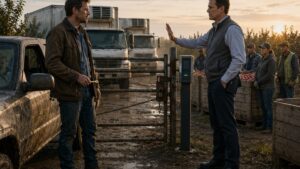
The excavator bucket hung above the first cedar post without touching it.
Gregory stood ten yards away, arms rigid at his sides.
Angela had one hand raised.
“Wait.”
The operator looked toward Kevin.
Kevin looked toward Margaret.
That bothered her.
She had spent the week saying the county should settle the matter.
Now everyone seemed to be waiting for her.
Orange paint marked the exact removal corridor across the fence.
Three full panels and part of a fourth.
Nothing more.
A sheriff’s deputy stood near the county truck, present because Gregory had argued with the compliance crew when they arrived.
No one was yelling yet.
The quiet felt worse.
Angela stepped forward.
“You cannot do this.”
Kevin held up the order.
“The compliance period expired.”
“We have a permit.”
“Yes.”
“Then why does that mean nothing?”
“It doesn’t mean nothing.”
Angela stared at him.
“It means the fence itself was approved. It does not authorize blocking the recorded access.”
Gregory pointed toward Margaret.
“She’s the one who wants this.”
Margaret felt every face turn toward her.
The old iron pin sat in the grass beside the excavator track.
For several days she had imagined this moment as simple justice.
Fence down.
Lane open.
Done.
It no longer felt simple.
She walked toward the marked posts.
“How much are you removing?” she asked Kevin.
“The obstruction within the designated corridor.”
“All the way to that corner?”
“No. Only to the blue mark.”
Margaret looked.
The blue mark stopped short of the Carter yard.
Angela said, “That still takes out almost twenty-five feet.”
“For vehicle clearance and turn radius.”
Gregory gave a sharp laugh.
“Why not take the whole thing while you’re at it?”
Margaret turned toward him.
“No.”
He stopped.
She pointed to the cedar running beyond the blue mark.
“That stays.”
Gregory looked suspicious.
Kevin said, “That’s already the order.”
Margaret nodded.
“Good.”
Angela stared at her.
“You could ask for more.”
“I don’t have a right to more.”
The words seemed to quiet something.
Not the conflict.
Something inside it.
Margaret stepped closer to Angela.
“This is your land.”
Gregory made a sound as if the admission came too late.
Margaret continued.
“The dirt is yours. The fence beyond the corridor is yours. The easement means my farm can cross this part.”
Angela looked at the marked gravel.
“And that’s supposed to make me feel better?”
“No.”
For the first time all week, Margaret did not try to win the next sentence.
Angela looked at her.
Then at the excavator.
“You knew about this years ago?”
Margaret hesitated.
Timothy stood by her truck.
She could feel him watching.
“Yes.”
Angela’s expression changed.
“You knew and never told us?”
“I knew there was access. I didn’t know your purchase papers failed to show it clearly.”
“That’s not what I asked.”
Margaret looked at the gravel.
“My husband wanted us to update the recorded description after the parcel numbers changed.”
“And?”
“I wouldn’t do it.”
Gregory stared at her.
Margaret forced herself to continue.
“I thought the old record was enough. Mostly, I didn’t want to change anything after he died.”
Angela’s anger did not disappear.
But it lost some of its certainty.
“So this could have been clearer.”
“Yes.”
Timothy shifted behind her.
Margaret glanced at him.
“That part is on me.”
Gregory pointed toward the damaged lane marker lying beside Margaret’s truck.
“And the rest?”
Margaret met his eyes.
“The rest isn’t.”
He looked away first.
Kevin approached.
“We need a decision.”
Angela said, “Decision about what? You already decided.”
“There are two options. Remove the marked section now or stop if both owners agree immediately to a compliant gate installation under the order.”
Angela looked at Gregory.
Gregory shook his head.
“We’re not paying for another contractor.”
Angela whispered something Margaret could not hear.
Gregory’s answer was louder.
“No.”
Angela closed her eyes.
Margaret knew that look.
Not surrender.
Calculation without a good option.
She thought about her husband’s notebook.
The old line in pencil.
The years when everyone had understood the lane without needing to explain it.
That time was gone.
It had probably been gone longer than she wanted to admit.
Angela turned toward Kevin.
“If the fence comes out, can we install a gate later?”
“Yes. As long as it meets the recorded access requirements.”
“And she can’t widen it again?”
“Not without another legal basis.”
Angela looked at Margaret.
“Would you agree to a gate?”
“I already said I would.”
“A real one. Something we choose.”
“If my equipment can pass and the county signs off.”
Gregory rubbed both hands over his face.
“This is ridiculous.”
Angela spoke without looking at him.
“It’s where we are.”
That sentence changed the scene more than any county order had.
Kevin nodded to the operator.
The excavator bucket lowered.
Angela stepped backward.
Margaret did not.
The first post resisted.
Hydraulic pressure built with a low mechanical groan.
For an instant the cedar bent but held.
Gregory watched as if something personal were being pulled from the ground.
Margaret understood that feeling too well.
Then the soil broke.
The post rose in one piece, wet clay clinging to its base.
Beneath it lay packed stone.
Old stone.
Gray gravel pressed deep into the earth where years of tires had driven before the fence, before the Carters, before Margaret had ever thought she would need to prove the lane existed.
The excavator set the post aside.
No cheering followed.
No one smiled.
Kevin moved to the second mark.
Margaret stepped toward him.
“Only what’s marked.”
He looked at her.
“That’s the plan.”
“I want it understood.”
Angela heard.
Her eyes met Margaret’s.
Something passed between them that was not forgiveness.
Maybe recognition.
Maybe simply the end of pretending either woman owned the entire truth.
The second panel came free.
Then the third.
With each removal, more of the buried gravel reappeared.
The lane did not look triumphant.
It looked old.
Used.
Necessary.
When the final obstructing post was lifted, the operator backed away.
A clear corridor opened from the county road toward Margaret’s back pasture.
Timothy walked over and stood beside her.
“You okay?”
Margaret watched the exposed lane.
“No.”
He waited.
She looked at him.
“But I think I’m done pretending that’s the same as being wrong.”
Timothy gave a small nod.
Across the open corridor, Angela stood beside what remained of her fence.
Gregory had gone back toward the house.
Kevin rolled up the compliance map.
“The access is clear.”
Margaret looked down at the gravel.
For the first time in days, nothing blocked the road.
But the empty space between the two properties made something else obvious.
Removing the fence had solved the obstruction.
It had not yet solved how any of them were supposed to live beside the lane now.
Chapter 7: The Lane Stayed, but Not the Old Silence
Timothy drove through the new gate without stopping to ask whether Margaret wanted him there.
Three weeks earlier, that would have irritated her.
This morning she stood beside the barn with a coffee mug cooling between her hands and watched his pickup roll over fresh gravel toward the back pasture.
The gate opening was fourteen feet wide.
Not twelve.
The surveyor had recommended the extra clearance after measuring the turn required by Margaret’s largest cattle trailer. Angela had objected until Kevin explained that the recorded corridor allowed sufficient width for the historic agricultural use.
The difference this time was that nobody guessed.
Measurements had been taken.
Documents had been filed.
Responsibilities had been written down.
Timothy parked beside the equipment shed and climbed out carrying a cardboard tube.
“Recorder stamped it yesterday.”
Margaret looked at the tube.
“The final plat?”
He nodded.
“You want to see it?”
“I know what it says.”
“That wasn’t my question.”
Margaret gave him a look.
Timothy smiled and walked into the barn.
She followed.
He spread the new plat across the workbench.
The old farm lane appeared as two clean parallel lines crossing the edge of the Carter parcel and continuing toward Margaret’s land.
There was no pencil.
No family shorthand.
No assumption that somebody would remember what everybody meant thirty years later.
The access corridor was labeled and dimensioned.
So were the maintenance responsibilities.
Margaret touched the paper near the road.
“Looks wider drawn like that.”
“It’s the same ground.”
“I know.”
Timothy glanced toward her.
“That seems to be the theme around here.”
She ignored him.
Outside, tires crunched on gravel.
Angela Carter stepped through the new gate carrying a folder.
The gate itself was cedar-framed steel, chosen to match the remaining fence as closely as possible. Gregory had hired the contractor after the county removal, though Margaret had agreed to split the cost of the heavier hardware required for farm equipment.
It had not been anyone’s first choice.
That was partly why it worked.
Angela stopped outside the barn.
“I brought the maintenance acknowledgment.”
Timothy moved aside.
Margaret wiped her hand on her jeans before taking the papers.
Angela had already signed.
The agreement was short.
Margaret would maintain the gravel surface within the access corridor because the traffic primarily served her farm. The Carters would maintain the gate and keep it unobstructed. Neither side could alter the corridor without written agreement or lawful modification.
Simple sentences.
Margaret thought about how much trouble might have been avoided if those sentences had existed years ago.
“You read all of it?” she asked.
Angela’s mouth tightened.
“Twice.”
Margaret signed.
Timothy added his signature where the document identified him as an authorized representative for the Hill farm.
Angela noticed.
“You’re handling it too now?”
Timothy looked at Margaret before answering.
Margaret said, “He is.”
The words felt strange.
Not wrong.
Just new.
Angela closed the folder after Margaret handed it back.
For a moment, no one moved.
Then Angela said, “Gregory paid for the marker.”
Margaret glanced toward the lane entrance.
A new post stood where the old one had been smashed. It was plain pressure-treated wood, nothing like the weathered post her husband had maintained.
The small metal reflector had been screwed onto it.
Her reflector.
The one Margaret had picked out of the weeds that first morning.
“I saw.”
“He wanted me to tell you.”
Margaret waited.
Angela did not offer an apology on Gregory’s behalf.
Margaret found that she preferred it that way.
Some things became cheap when said only because the situation demanded them.
Angela looked toward the gate.
“We still don’t like trucks going past the house.”
“I know.”
“And I still think whoever sold us the parcel should have disclosed this better.”
“I agree.”
Angela seemed surprised.
Margaret continued.
“But the lane stays.”
“Yes.”
No anger sharpened the answer now.
Only acceptance.
A breeze stirred dust from the fresh gravel. It drifted between them, crossed the invisible property line, and settled on both sides.
Angela watched it.
“You really use cattle trailers that wide?”
Margaret almost smiled.
“You’ll see one next Thursday.”
Angela shook her head.
“I suppose I will.”
She started toward the gate, then stopped.
“I’m not saying we handled this right.”
Margaret looked at her.
Angela glanced down.
“But I understand it better than I did.”
It was not an apology.
It was enough.
“For what it’s worth,” Margaret said, “I should have fixed the paperwork years ago.”
Angela nodded once.
Then she walked home.
Timothy remained beside the workbench.
After a while he said, “You know, admitting you were wrong twice in one month could become a habit.”
Margaret folded the duplicate plat.
“Don’t get ambitious.”
He laughed.
She opened the old metal file cabinet.
The newest survey went into a fresh folder near the front, not behind tax bills or equipment receipts.
Then Margaret took out a second copy.
Timothy watched her.
“What’s that one for?”
“You.”
He stopped smiling.
Margaret held it out.
Timothy did not take it immediately.
“Mom.”
“If I’m in the north field and a delivery shows up, you deal with it.”
“I already help with deliveries.”
“Not what I said.”
His expression changed.
Margaret kept the paper extended.
“If the county calls, you can answer. If the gate needs replaced someday, you don’t need to wait for me. If there’s a question about access, you have the record.”
Timothy took the plat slowly.
“You sure?”
Margaret looked around the barn.
Her husband’s old map still hung on the wall. The pencil line showing the lane had faded until parts of it were barely visible.
For years she had treated that map like preservation.
Now she understood it had also been an excuse.
Keeping something unchanged was not the same as keeping it safe.
“I’m sure.”
Timothy rolled his copy and slid it into the cardboard tube.
Margaret carried hers outside.
They walked together toward the entrance.
Fresh gravel filled the corridor where the cedar panels had stood. The new gate was open, secured against the fence.
At the roadside, the replacement post cast a narrow shadow over the old iron survey pin.
Margaret stopped beside it.
Ownership on one side.
Access crossing through.
Neither fact canceled the other.
A month ago, she would have found that irritating.
Now it seemed almost ordinary.
Timothy opened his truck door.
“You coming to look at the south fence?”
“In a minute.”
He climbed in.
Margaret returned to her own pickup and opened the glove compartment.
Insurance papers.
Registration.
A flashlight.
Work gloves.
She placed the updated plat inside, flattening it carefully beneath the registration folder.
Then she shut the compartment.
Timothy’s truck started down the gravel lane toward the pasture.
Margaret followed.
Neither of them stopped at the gate.
The story has ended.