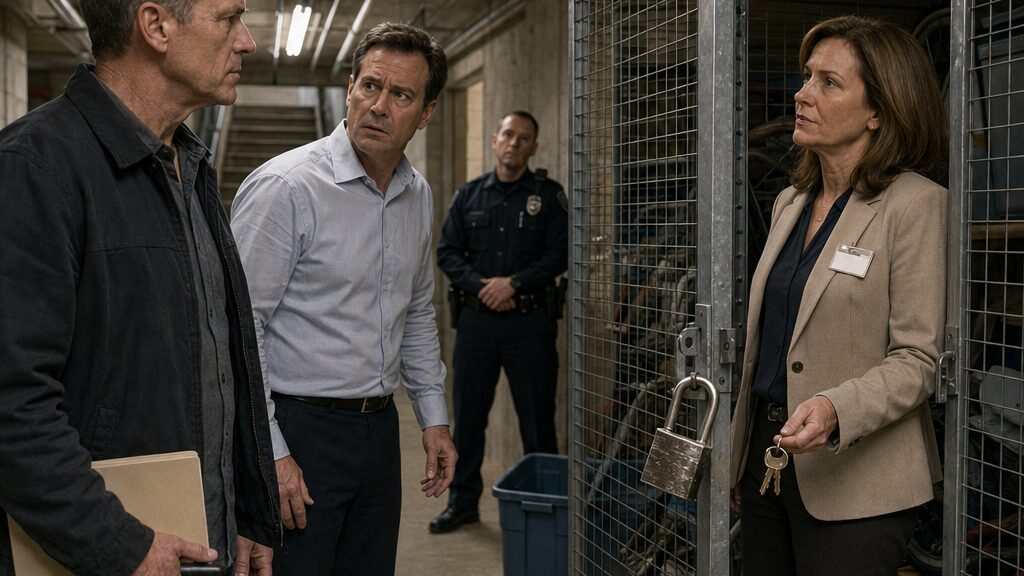
He Put an Alarm on His Basement Storage Door—Then the HOA Used a Key He Never Gave Them
Chapter 1: The Padlock Was Hanging the Wrong Way
Brian Harris stopped with his hand six inches from the padlock.
The brass keyway was facing the concrete wall.
For six years, he had locked the basement storage cage the same way: shackle through the steel latch, body turned outward, keyway facing the corridor. It was an old habit from thirty years around maintenance shops, where small routines kept people from making large mistakes.
Now the lock was backward.
Brian set the grocery bag he was carrying on the floor and stared at it.
The basement corridor smelled of concrete dust, laundry detergent, and the faint metallic dampness that came whenever the building’s pipes sweated in summer. Behind the wire-mesh doors were bicycles, plastic tubs, folding chairs, Christmas decorations, and the accumulated things condominium owners could not bring themselves to throw away.
His unit was at the far end.
It held more than most.
Two bicycles hung from wall hooks. Clear bins were stacked along one side. A folding ladder leaned beside camping gear. At the back, underneath an old wool blanket, sat the battered red toolbox that had belonged to his father.
Brian touched the lock.
It was fully secured.
He tried to remember the last time he had been downstairs. Saturday morning. He had taken out a socket set, replaced a loose hinge upstairs, and returned everything before lunch.
He remembered turning the lock outward.
He always did.
A basement door opened behind him.
Brian turned quickly.
A neighbor carrying a laundry basket came through, nodded, and walked toward the elevators.
Brian waited until the footsteps disappeared.
Then he unlocked his cage.
Nothing looked obviously missing.
The bicycle wheels were still where he had left them. The tubs were closed. His father’s toolbox remained beneath the blanket.
He opened it anyway.
Sockets.
Combination wrenches.
A steel machinist’s ruler.
The old wooden-handled screwdriver his father had sharpened and reshaped so many times that the tip barely resembled the original.
Brian closed the lid.
He disliked the relief he felt.
It made him feel foolish.
He stepped back into the corridor and examined the latch more carefully.
There were marks on the face of the padlock—two dull scratches near the keyway.
He rubbed one with his thumb.
It didn’t disappear.
“Mr. Harris?”
Brian looked up.
Donna Lewis stood near the stairwell door with a clipboard tucked against her beige jacket.
She chaired the condominium association’s compliance committee, although the title had changed twice in three years. Before that, she had managed landscaping complaints. Before that, parking.
Donna approached with the brisk expression of someone entering a meeting already behind schedule.
“Did you receive the inspection notice?”
Brian kept one hand around the padlock.
“What inspection?”
“The basement storage review.”
“I got an email about storage compliance.”
“That’s the one.”
“It didn’t say anyone was entering individual units.”
Donna shifted the clipboard.
“We need to verify clearances.”
“Inside locked units?”
“Where necessary.”
Brian looked at her.
“What does ‘where necessary’ mean?”
“We’ve had an insurance review. There are concerns about access, combustibles, electrical panels, that sort of thing.”
“Which concern is mine?”
“I don’t have the entire report with me.”
“Then why are you asking to inspect mine?”
Donna’s mouth tightened slightly.
“Because your unit is one of the units identified for follow-up.”
“Identified for what?”
“For follow-up, Brian.”
It was the way she repeated it that changed his irritation into something colder.
Not an answer.
A substitute for one.
He held the padlock between them.
“Does the association have a key to these?”
Donna glanced down.
“Not that I’m aware of.”
“Has anybody been down here checking locks?”
“I wouldn’t know.”
“Maintenance?”
“You’ll have to ask management.”
“Did you?”
She gave him a look that suggested the conversation had wandered beyond what she considered useful.
“We’re trying to avoid making this adversarial.”
Brian almost laughed.
Instead, he said, “Then send me the rule you’re relying on and tell me exactly what you need inspected.”
“We already sent notice.”
“You sent a general email.”
“Which you’ve received.”
“Donna.”
She waited.
“If you want access to my locked storage space, show me where the association documents say you can enter it.”
Her posture changed.
Not dramatically. Her shoulders simply straightened.
“The association has obligations beyond what individual owners prefer.”
“That wasn’t my question.”
“I’ll have management follow up.”
She walked away before he could answer.
Brian watched the stairwell door close behind her.
For a moment, he felt almost embarrassed by his own suspicion.
Maybe someone from maintenance had checked numbers on the cages. Maybe he’d turned the lock differently on Saturday. Maybe the scratches were old.
He had spent enough years maintaining industrial equipment to know how quickly certainty could become ego. When something failed, the technician who decided too early what had happened usually wasted the most time.
So he did what he had always taught younger mechanics to do.
He documented the condition before touching anything else.
Brian took out his phone.
He photographed the lock from three angles. Then the latch. Then the floor beneath it.
He reopened the cage and photographed the interior.
That felt excessive.
He nearly deleted those pictures.
Instead, he kept them.
Upstairs, he found the association email Donna had mentioned.
The subject line said BASEMENT STORAGE COMPLIANCE REVIEW.
The message referenced an insurance inspection, general access requirements, and a request that residents ensure stored materials did not obstruct common mechanical equipment.
There was no mention of forced entry.
No scheduled inspection time.
No statement that the HOA could open locked storage cages.
Brian read it twice.
Then a third time.
His own answer, sent four days earlier, was embarrassingly short.
My storage unit is private and locked. I do not consent to entry.
That was all.
He could have added that he would move anything necessary if management identified a specific clearance problem.
He hadn’t.
At the time, he had felt no obligation to explain himself.
That feeling remained, but it no longer felt quite as clean.
He printed the email and carried it back downstairs.
The corridor was empty.
He crouched in front of the lock again, comparing it to the photograph on his phone.
Something flashed silver beneath the ceiling light.
Brian leaned closer.
Along the lower edge of the keyway was a narrow scrape, bright enough that the exposed metal had not yet dulled.
He was certain he had never seen it before.
And this time, he was equally certain of something else.
Someone had touched his lock.
Chapter 2: The Locksmith Would Not Call It Accidental
George Brown rotated the padlock beneath a portable work light and said, “Who else has a key?”
Brian stood beside him in the basement corridor.
“No one.”
George looked at him over the top of his glasses.
“Nobody you’ve given one to?”
“Nobody.”
“Spare in your condo?”
“Yes.”
“Anybody have access to that?”
“No.”
George grunted and turned the lock sideways.
He had a small canvas tool bag at his feet and the patient manner of a man who disliked conclusions delivered faster than evidence.
Brian appreciated that.
“So somebody tried to pick it?” Brian asked.
George shook his head.
“I didn’t say that.”
“What are the scratches?”
“Contact.”
“From what?”
“Something metal.”
“A key?”
“Could be.”
“A pick?”
“Could be.”
George pointed toward the face of the lock.
“This scratch is older. See how it’s darkened? That one’s been there awhile.”
Then he touched the brighter mark Brian had noticed Monday.
“This one hasn’t.”
Brian folded his arms.
“Could normal use do it?”
“Sure.”
“My normal use?”
George smiled faintly.
“You called me because you already know how you use your lock.”
That irritated Brian because it was true.
George inserted Brian’s key and turned it.
The cylinder moved smoothly.
“No damage inside that I can feel. Doesn’t look forced.”
“So what does that tell us?”
“It tells us your lock works.”
“That’s it?”
“That’s what I can prove.”
Brian exhaled.
George handed it back.
“If somebody tried several keys, you’d get marks like that. If somebody was clumsy with the right key, you could get marks like that too. If somebody bumped it with a screwdriver while carrying something past, same story.”
“You think someone’s been messing with it.”
George closed his tool bag.
“I think there’s fresh metal contact around your keyway.”
Brian stared at him.
“You’re very careful with words.”
“Careful words are cheaper than court.”
The sentence stayed with Brian after George left.
Upstairs, he spread the condominium documents across his kitchen table.
Declaration.
Bylaws.
Rules and regulations.
Maintenance responsibilities.
Emergency access provisions.
He had not read most of them since buying the unit six years earlier.
Now he moved through the pages with the same method he once used on equipment manuals—index first, definitions second, exceptions last.
The association had broad authority over common elements.
It could enter units in emergencies involving leaks, fire, structural danger, and urgent repairs.
But the basement cages were assigned limited common elements for the exclusive use of individual owners. The language was tedious, but Brian understood the distinction.
The association could regulate them.
That did not appear to mean Donna could unlock one whenever she wanted.
He marked three pages with yellow tabs.
At 3:17, his phone buzzed.
Donna.
Brian watched it ring until voicemail picked up.
A minute later, a message appeared.
Need to schedule storage inspection this week. Please send availability.
He read it twice.
This was what he had asked her to do, technically.
Schedule.
Ask.
Yet instead of replying, Brian set the phone facedown.
Something about the timing bothered him.
The scratches.
The backward lock.
Donna appearing downstairs.
Now an inspection request.
Maybe it all had a perfectly ordinary explanation.
But he no longer wanted to give her one inch until he knew exactly what had happened.
That evening he returned to the basement.
The padlock was still facing outward.
He drew a tiny pencil line on the side of the steel latch, hidden where the door overlapped the frame.
It was the kind of simple reference mark his father used to make on machinery before disassembly.
His father had called them truth marks.
Not because they proved everything.
Because they told you whether something had moved.
Brian stood there longer than he intended.
Through the wire mesh, the red toolbox was visible beneath the blanket.
His father had died four years earlier.
Brian had cleaned out the house in nine days.
Furniture went to relatives.
Clothes went to charity.
Paperwork went into boxes.
The tools came here.
He had told himself he would sort them when life settled down.
Life had apparently never received the message.
His phone buzzed again.
Donna.
Second request. Need access no later than Friday.
Brian typed:
Please identify the specific condition you believe requires inspection and the governing provision authorizing access.
He stared at the words.
Then deleted them.
He put the phone away.
It was childish, and some part of him knew it.
But the more Donna pushed, the less he wanted to explain.
The next morning, he found the pencil mark misaligned.
Only slightly.
A fraction of an inch.
He stood motionless in front of the door.
The padlock itself looked normal.
He opened the unit.
Nothing obvious was disturbed.
That was almost worse.
If someone wanted his property, they would take something.
If someone wanted access, they might leave everything exactly where it was.
That afternoon Brian bought a small battery-powered contact sensor and a compact camera that could record motion without displaying a light.
He avoided anything connected to the building’s network.
At home, he tested the sensor on a kitchen cabinet.
Open.
His phone buzzed.
Closed.
The notification cleared.
Simple.
Downstairs, he mounted the sensor inside the storage door where it could not be seen from the hallway. The camera went high inside the cage, angled toward the latch and entrance.
He stood on the folding ladder and adjusted it twice.
On the third try, the view on his phone showed the door, padlock area, and enough of the corridor to identify anyone standing there.
He climbed down.
For a moment he felt ridiculous.
A grown man hiding a camera among holiday decorations because an HOA volunteer irritated him.
Then he remembered the fresh scrape.
The misaligned pencil mark.
George’s careful phrase.
Fresh metal contact.
Brian closed the door.
He snapped the padlock shut.
The phone in his pocket vibrated once as the alarm system armed.
He looked down the empty corridor.
If nothing happened, he could admit he had overreacted.
He almost hoped for that.
Then he turned off the basement light and walked upstairs.
Chapter 3: The Alert Came While Brian Was Three Blocks Away
Brian’s phone vibrated against the cup holder while he was stopped at a red light.
The notification showed only four words.
STORAGE DOOR OPENED.
For half a second, he did nothing.
The car behind him honked.
The light had turned green.
Brian drove through the intersection, pulled into the parking lot of a pharmacy three blocks from the condominium, and stopped crooked across two empty spaces.
His hands were suddenly cold.
He opened the camera app.
The live image took two seconds to load.
Empty storage cage.
Door open.
Then Donna Lewis stepped into view.
Brian leaned closer to the screen.
She wore dark slacks, a light jacket, and the same association badge she used at meetings clipped near her shoulder.
She wasn’t carrying a clipboard.
She was carrying keys.
Several.
Brian tapped the recording history.
Thirty-eight seconds earlier, the motion camera had captured Donna standing outside his cage.
She looked down the corridor first.
Then she chose one key from a small ring.
It did not work.
Another.
She pushed it into the padlock, turned it halfway, removed it.
Then a third.
The shackle opened.
Brian watched the clip again.
The third key slid into his lock like it belonged there.
He felt a flash of satisfaction so sharp it embarrassed him.
He had been right.
The scratches were real.
The moved lock was real.
His suspicion was real.
Then Donna pulled the door open and disappeared inside his storage unit, and satisfaction gave way to something heavier.
Brian called the property manager.
No answer.
He called again.
Voicemail.
He opened Donna’s live camera feed.
She was standing beside his stacked bins, looking toward the rear wall.
She moved one plastic tub six inches.
Then another.
When her hand reached toward the blanket covering his father’s toolbox, Brian stopped watching.
He called the police.
The dispatcher asked whether there was an immediate threat.
“No,” Brian said. “I’m not there.”
“Is anyone being hurt?”
“No.”
“Do you know the person?”
“Yes.”
“Do they have permission to be inside?”
“No.”
He gave the building address and explained the storage unit.
The dispatcher told him not to confront anyone and said an officer would be sent when available.
Brian almost laughed at that.
He had spent four days imagining confrontation.
Now that Donna was actually inside the cage, he wanted nothing less.
He saved the video clips to his phone, then emailed copies to himself.
Only after that did he start the car.
By the time he reached the condominium, Donna was standing in the basement hallway.
His storage door was open behind her.
The padlock hung from the latch.
She did not look surprised to see him.
“What are you doing?” Brian asked.
Donna’s eyes moved briefly toward the ceiling, searching for the camera.
“Conducting the inspection we’ve been attempting to schedule.”
“I never gave you permission.”
“We provided notice.”
“You asked me to schedule one.”
“And you refused to respond.”
“That doesn’t become permission.”
Donna exhaled.
“Brian, there are safety obligations in this building. This isn’t personal.”
“You unlocked my door.”
“The association has access responsibilities.”
“With what key?”
She held his gaze.
“Building access.”
“That’s not a building lock.”
“We can argue terminology later.”
Brian stepped sideways so he could see into the unit.
One bin had been moved. A folded camping chair leaned at an angle. The blanket over his father’s toolbox had been pulled back enough to expose one red metal corner.
His jaw tightened.
“Don’t touch anything else.”
“I’ve already completed what I needed.”
“What did you need?”
“Clearance information.”
“What clearance?”
“The insurance inspection identified concerns in this basement.”
“My unit?”
“Several units.”
“So you don’t know.”
“I know enough.”
A stairwell door opened.
The property manager came into the corridor, breathing slightly harder than usual.
“I got your messages.”
Brian pointed toward Donna.
“She opened my storage unit.”
The manager looked from Brian to the open door.
Then to Donna.
“How?”
Donna lifted her chin.
“With access.”
The manager’s expression changed.
“What access?”
Before she answered, another door sounded upstairs.
Footsteps descended.
A uniformed police officer entered the corridor.
Brian had imagined this moment differently.
He had pictured Donna instantly exposed, instantly quiet, the officer seeing everything exactly as Brian did.
Instead, the officer asked everyone to separate.
He asked Brian what belonged to him.
He asked Donna why she had entered.
Donna answered without hesitation.
“I’m the association compliance chair. We have an active insurance-related safety review of basement storage.”
“Did the owner give you permission?”
“We gave him notice.”
“That’s not what I asked.”
Donna paused.
“No.”
The officer looked toward Brian.
“You called?”
“Yes.”
“Do you have anything showing this space is assigned to you?”
Brian reached into the folder he had brought from upstairs.
He had printed the declaration pages Tuesday.
At the time, that had felt paranoid too.
Now he handed them over.
The officer read the highlighted section, then glanced at the number on the storage cage.
Donna said, “The association still retains emergency access rights.”
The officer looked up.
“Was there an emergency?”
“There was a safety issue.”
“Active fire?”
“No.”
“Water leak?”
“No.”
“Electrical hazard?”
“Potentially.”
“Was maintenance responding to something happening right now?”
Donna’s mouth tightened.
“No.”
The officer handed the document back to Brian.
“I’m not deciding your association rules for you. That’s a civil matter unless there’s more to it. But entering a locked assigned space without consent is something I need to understand.”
Donna touched the badge clipped to her jacket.
“My role requires inspection authority.”
Brian had seen her gesture toward that badge dozens of times in meetings.
For the first time, it looked small.
The officer asked, “Is that a government credential?”
“No. It’s association identification.”
“Then let’s not treat it like one.”
Donna’s face reddened.
Brian should have felt victorious.
Instead, he found himself looking at the open cage behind her.
At the displaced bin.
At the corner of the red toolbox.
The police officer asked Brian whether anything was missing.
“I don’t know yet.”
“Do you have evidence she unlocked it?”
Brian took out his phone.
“I have video.”
Donna turned toward him.
For the first time that morning, she looked genuinely surprised.
Brian opened the saved clip.
The officer watched Donna try the first key.
Then the second.
Then the third.
Donna said, “That doesn’t change why I was there.”
“No,” Brian said. “It changes how you got there.”
The officer replayed the moment when the padlock opened.
“Where did that key come from?”
Donna crossed her arms.
“Building maintenance has legacy access materials.”
The property manager stared at her.
“What are you talking about?”
“The old key system.”
“We don’t use that for owner locks.”
“There were blanks.”
“Donna.”
The manager’s voice had changed.
Not angry.
Worried.
“You requested a key?”
“I requested access.”
“From who?”
“Maintenance.”
“On whose authorization?”
Donna looked at him as if the answer should have been obvious.
“Compliance.”
The manager shook his head.
“No.”
Donna’s certainty faltered.
“We’ve discussed the basement issue for weeks.”
“We discussed inspection notices.”
“We discussed getting access.”
“We discussed scheduling access.”
The corridor went quiet.
The police officer asked the manager whether he had authorized anyone to duplicate or issue a key for Brian’s storage unit.
The manager rubbed a hand across his forehead.
“No.”
Donna said, “You knew the deadline.”
“I knew we had an insurance follow-up.”
“And you knew residents weren’t cooperating.”
“That isn’t authorization.”
Brian listened to them and felt his earlier certainty fracture into a different kind of question.
He had expected Donna to be exposed as someone inventing authority because she enjoyed having it.
But she kept returning to the insurance review.
The deadline.
Safety.
Something had happened before his lock was touched.
Something he did not yet understand.
The officer took basic statements and told Donna not to reenter the storage space while the matter was being reviewed. There was no dramatic handcuffing, no shouted accusation, no instant resolution.
Donna walked toward the stairwell with the stiff posture of someone who still believed the argument was unfinished.
Before she left, she turned toward Brian.
“You can make this about me if you want,” she said quietly. “But when you finally read the actual inspection findings, you’ll understand why this started.”
Then she went upstairs.
Brian looked at the property manager.
“What is she talking about?”
The manager did not answer immediately.
He stared at the open storage cage, then at the key still in Donna’s absence represented only by an empty corridor.
Brian held up his phone.
“Did you know she had that key?”
“No.”
“Did you authorize it?”
The manager met his eyes.
“I never approved a key.”
Chapter 4: The Violation Donna Was Right About
Sarah Adams placed the photograph on the table beside Brian’s complaint.
“Before we discuss the key,” she said, “you need to see this.”
Brian did not sit.
The condominium meeting room was barely large enough for the folding table, six stackable chairs, and the cabinet where the association kept old minutes. Sarah sat at one end with a thick folder open in front of her. The property manager occupied the chair beside her.
Donna was not there.
Brian had expected that absence to feel like progress.
It didn’t.
He looked down at the photograph.
At first, he saw pipes.
A concrete wall.
An electrical conduit.
Then he recognized a blue plastic tub.
His blue plastic tub.
The picture had been taken through the mesh side of his storage cage.
“This came from the insurance inspection?” he asked.
Sarah nodded.
“Three weeks ago.”
Brian pulled the photograph closer.
On the wall behind his cage was a red-handled utility shutoff valve. He knew it was there. He had known since moving in.
What he had not noticed was how the newer stack of storage bins narrowed the path beside it.
“The inspector flagged access through this section,” Sarah said.
“Through my unit?”
“Not exactly. The shutoff is technically in a shared utility recess. Your cage was built around part of the access route years ago.”
“Before I bought the condo.”
“Yes.”
The property manager opened a floor plan.
“The cage itself is grandfathered. The problem is the clear width.”
Brian looked at the photograph again.
His first instinct was to find the flaw in their explanation.
“How much width?”
“Thirty-six inches was recommended for service access.”
“Recommended or required?”
Sarah gave him a tired look.
“That question is exactly why this has taken three weeks.”
Brian finally sat.
The property manager pointed toward the photograph.
“The inspector didn’t issue some kind of emergency evacuation order. But the carrier asked us to correct several basement conditions before renewal.”
“Several.”
“Yes.”
“So it wasn’t just me.”
“No.”
Brian leaned back.
“Donna made it sound like my storage cage was the problem.”
Sarah said, “Donna makes almost everything sound like the problem she’s dealing with at that moment.”
It was not quite criticism.
Not quite defense either.
Brian looked toward her.
“Why wasn’t I shown this?”
“We sent the compliance email.”
“You sent everyone a general email.”
“Because we were still identifying which cages needed changes.”
“And Donna decided she’d identify mine from inside it.”
Sarah’s mouth tightened.
“Nobody at this table is defending that.”
“She is.”
“Donna isn’t at this table.”
Brian glanced at the empty chair.
There it was again—that small satisfaction he had felt watching the camera footage.
Then he looked back at the photograph.
A corner of another bin appeared near the bottom.
One he had pushed forward earlier that year when making room for his father’s toolbox.
He could see the problem now.
Not an emergency.
Not permission to open his lock.
But a problem.
Sarah slid another page toward him.
“Brian, the insurance company didn’t tell us to break into storage units. But they did tell us the board needed a documented plan.”
“Then you schedule access.”
“Yes.”
“I would have moved the bins.”
Sarah waited.
Brian knew what she was waiting for.
He looked down.
“I asked Donna to identify the rule.”
“You also ignored two requests to schedule.”
Brian’s jaw tightened.
“Because someone had been touching my lock.”
“We didn’t know that.”
“I didn’t know who it was.”
“Exactly.”
Her voice stayed quiet.
That made it harder to dismiss.
“If you’d replied,” Sarah said, “we might have been standing downstairs with you on Wednesday measuring clearance instead of dealing with police reports on Friday.”
Brian stared at the photograph.
“I shouldn’t have to cooperate with someone who won’t explain what she’s doing.”
“No.”
Sarah folded her hands.
“But sometimes refusing to explain yourself makes everyone else build their own explanation.”
Brian looked at her.
“What’s yours?”
“At first?”
“Yes.”
“I thought you were hiding a serious violation.”
The honesty landed harder than an accusation.
“Why?”
“Because every other owner we contacted either said yes, no, or asked for another time. You sent one sentence saying nobody was entering.”
“It’s my space.”
“It is.”
“And I was right about Donna.”
“You were.”
Sarah tapped the photograph.
“And she was right about this.”
For several seconds, no one spoke.
Brian thought of the blanket pulled partly from the toolbox.
Donna’s hand moving one of his bins.
The duplicate key turning.
Then he imagined a maintenance worker needing that shutoff during a real leak and finding the route narrowed by things Brian could move in ten minutes.
The two facts refused to cancel each other.
That annoyed him more than either one alone.
“Did Donna see this photograph before she entered?”
Sarah nodded.
“All compliance committee members did.”
“So that’s why she was pushing.”
“Partly.”
“What’s the other part?”
Sarah exchanged a glance with the property manager.
Brian noticed it.
“What?”
The manager closed the floor plan.
“We’re still reviewing how she obtained the key.”
Brian sat forward.
“You said you never approved one.”
“I didn’t.”
“Maintenance made it?”
“We’re trying to determine exactly what happened.”
“That sounds like management language for yes.”
“It means I don’t want to accuse an employee before I have the records.”
Sarah opened another folder.
“There used to be a master system in the basement.”
Brian frowned.
“For privately purchased padlocks?”
“No. Years ago, the original cages used association-issued locks. Most owners replaced them over time.”
“So?”
“Some old blanks and key stock were apparently never discarded.”
Brian looked at her.
“My lock wasn’t association-issued.”
“We know.”
“Then how does an old blank open it?”
“We don’t know that yet.”
The property manager said, “Your lock is a common commercial keyway. It’s possible one of the archived blanks matched closely enough to be cut.”
“Cut from what?”
Neither answered immediately.
Brian pushed his chair back.
“You’re telling me Donna may have asked someone to manufacture a key to my private lock.”
“We’re telling you we’re investigating that possibility.”
Brian laughed once, without humor.
“That’s a very comfortable sentence.”
Sarah closed the folder.
“Brian, I’m not asking you to be comfortable.”
He looked at her.
“I’m asking you not to decide the whole story before we know it.”
That irritated him because it sounded like something George Brown might have said.
Careful words.
Cheaper than court.
Brian stood.
“I’ll clear the access.”
Sarah blinked.
“What?”
“The bins. I’ll move them.”
The property manager looked relieved.
Brian held up a hand.
“That doesn’t change the complaint.”
“I didn’t say it did.”
“And nobody enters unless I’m there.”
“Agreed.”
“In writing.”
“Agreed.”
Brian gathered the photograph and paused.
“You said you’re reviewing old key stock.”
Sarah nodded.
“How old?”
She hesitated.
“Maintenance records go back a long way, but inventory isn’t good.”
“That’s not what I asked.”
Sarah opened the folder again and pulled out a photocopy.
“There was a request logged two weeks before Donna entered your unit.”
Brian took the page.
The entry was short.
Archived maintenance key blank requested for basement access review.
No unit number.
No work order.
No emergency.
Brian looked up.
“Who requested it?”
Sarah’s expression changed.
“We’re still confirming that.”
But Brian had already noticed the initials at the edge of the photocopy.
D.L.
Chapter 5: The Board Never Voted to Open His Door
The maintenance log had Donna Lewis’s initials beside the key request.
What it did not have was an emergency work order.
Brian stared at the photocopy across the property manager’s desk three days later.
DATE.
REQUEST.
MATERIAL RELEASED.
INITIALS.
That was almost all of it.
The line beneath the request number—the place where a work order or authorization should have been referenced—was blank.
Brian tapped it.
“This is where the approval goes?”
The property manager nodded.
“Usually.”
“Usually?”
“If it’s tied to scheduled maintenance, yes.”
“And if it’s an emergency?”
“There should still be a work order afterward.”
“Is there?”
“No.”
Across the small office, Sarah sat with her arms folded.
A building maintenance worker had already been interviewed before Brian arrived. The manager would not repeat every detail, but the outline was becoming clear.
Donna had gone to maintenance asking for “legacy basement access.”
The worker had told her the old key stock was obsolete.
Donna had said compliance needed it for the insurance review.
The worker had given her an archived blank.
Later, according to the log, Donna returned it.
Except it had been cut.
Brian said, “Who cut it?”
“We don’t know.”
“Maintenance?”
“No.”
“Then she took it somewhere.”
“That’s the assumption.”
Brian looked toward Sarah.
“You knew about this?”
“No.”
“You knew she was trying to get into units.”
“I knew she was frustrated.”
“That’s not what I asked.”
Sarah’s eyes narrowed.
“I knew she wanted the basement handled.”
“Handled.”
“I used that word.”
“When?”
“At a committee meeting.”
Brian leaned back.
There was an odd relief in hearing her admit it without pretending otherwise.
Sarah continued.
“We had the insurance deadline, three owners who wouldn’t respond, one unit with paint thinner stored next to a furnace-room wall, and another cage built partly across a service panel.”
“So you told Donna to get it handled.”
“Yes.”
“And she did.”
“No.”
Sarah’s answer came quickly.
“I told her to finish the inspections. I did not tell her to make keys.”
Brian looked at the property manager.
“Did the board vote on entry?”
“No.”
“Executive session?”
“No.”
“Written authorization?”
“No.”
“Attorney advice?”
“No.”
“Then this wasn’t HOA policy.”
The manager hesitated.
“It wasn’t authorized HOA action.”
Brian noticed the wording.
“But she was acting as compliance chair.”
“Yes.”
“Using a maintenance resource.”
“Yes.”
“Because the board told her the basement problem had to be fixed.”
Sarah said, “That still doesn’t mean we approved what she did.”
“No. It means this isn’t just Donna.”
The room went still.
That was the sentence no one seemed eager to own.
Brian had spent days imagining a clean line.
Donna on one side.
Everyone else on the other.
But lines drawn through organizations rarely stayed clean.
Sarah rubbed her thumb along the edge of the folder.
“I pushed her.”
Brian waited.
“Not to enter your cage,” she added. “But I kept asking why the inspection list wasn’t closed. Every meeting. Every email. Our renewal premium had already jumped once. I was looking at another possible increase and thinking about owners on fixed incomes.”
Brian said nothing.
“I thought she was being too cautious,” Sarah continued. “I told her we couldn’t let four uncooperative owners hold up the entire building.”
“Uncooperative.”
“That’s how I described you.”
Brian almost smiled.
“At least you’re consistent.”
“I’m not proud of it.”
“But you still think I should’ve responded.”
“Yes.”
He looked at her sharply.
Sarah did not back away.
“You were right not to let her enter without permission,” she said. “And wrong to treat every request like an attack. Both can be true.”
Brian glanced at the log again.
Two weeks.
Donna had requested that blank before his silent alarm, before George examined the scratches, possibly before Brian noticed anything at all.
“Did she try it more than once?”
The manager said, “We can’t prove that.”
“My lock had fresh scratches before Friday.”
“I know.”
“She had the blank for two weeks.”
“I know.”
Brian sat back.
The anger was changing.
Not fading.
Changing shape.
Donna had not made a reckless decision in the heat of a single argument.
She had taken time.
Found a blank.
Had it cut.
Tested it, perhaps more than once.
Then returned to his unit.
That was harder to excuse.
The office door opened.
Donna entered.
No badge.
No clipboard.
Just a dark cardigan and a thin folder.
Brian had not been told she would attend.
She looked at him, then at the log.
“So you’ve already decided what happened.”
Brian said, “The log helps.”
Donna sat opposite him.
“The log doesn’t show the weeks before it.”
“Then tell me.”
“The carrier gave us thirty days.”
“I know.”
“No, you know now.”
Her voice stayed controlled, but the strain beneath it was obvious.
“I had owners ignoring notices. Management telling me they wouldn’t enter without consent. The board asking every week why nothing was finished.”
Sarah shifted.
“Donna—”
“You did.”
“I know.”
Donna looked back at Brian.
“And you wouldn’t answer.”
“I answered.”
“You sent one sentence.”
“Because it’s my unit.”
“And the shutoff behind your bins serves six condos.”
Brian felt the sting because he had already seen the photograph.
Donna noticed.
“You’ve seen it.”
“Yes.”
“So you understand.”
“I understand the inspection.”
“Good.”
“I don’t understand the key.”
Donna looked down at her hands.
For the first time, she seemed smaller without the association badge.
“Maintenance said the blank was old stock.”
“You had it cut.”
She did not answer.
“Did you?”
“Yes.”
Sarah closed her eyes briefly.
Brian asked, “Why not bring the photograph to me?”
“I tried to schedule.”
“You could have knocked on my door.”
“I did once. You weren’t home.”
“You could have left the specific issue.”
“I should have.”
The admission arrived so plainly that Brian almost missed it.
Donna continued.
“But by then, every conversation with you had become about whether I was allowed to ask.”
“Because you wouldn’t answer what gave you the right to enter.”
“I didn’t have the right to enter.”
There it was.
No argument.
No procedural fog.
Donna looked directly at him.
“I thought I had enough responsibility that no one would challenge how I got the result.”
Brian’s anger sharpened.
“That’s not the same thing.”
“I know that now.”
“You knew it Friday.”
“I knew you hadn’t consented.”
“And you went in.”
“Yes.”
“Then don’t make the insurance company your excuse.”
Donna’s face tightened.
“I’m not.”
“You keep bringing it up.”
“Because it’s why I was there. It doesn’t make the entry proper.”
The distinction bothered Brian because it was fair.
He wanted her to be simpler.
Instead she was sitting three feet away admitting the exact wrong choice while refusing to say the underlying concern had been fake.
The property manager cleared his throat.
“The association attorney has recommended a formal review of access procedures and Donna’s compliance appointment.”
Donna nodded once.
“I expected that.”
Brian asked, “What happens to her?”
Sarah said, “That hasn’t been decided.”
“What are the options?”
“Removal from the committee. Written censure. Restrictions on access to management systems. Possible reimbursement obligations depending on your documented costs.”
“And the police report?”
“Separate issue,” the manager said.
Brian looked at Donna.
She looked exhausted now, not defeated.
That difference mattered.
“What do you think should happen?” she asked him.
Brian frowned.
“To you?”
“Yes.”
He had expected to know.
Three days earlier, he would have said remove her, reimburse everything, let the police and lawyers finish the rest.
Now Sarah had admitted her role.
The manager had admitted the old key system existed without proper controls.
Brian himself had seen the blocked clearance.
Nothing excused Donna’s decision.
But nothing made it belong only to her.
The association attorney arrived ten minutes later and reviewed the options in careful language.
Brian’s direct expenses were simple: locksmith visit, replacement hardware, camera, alarm sensor.
Anything beyond that would depend on what claim he wanted to make.
The attorney slid a yellow legal pad toward him.
“We can spend the next few weeks discussing what the association did wrong.”
Brian looked at the damaged padlock sitting beside the maintenance log.
The attorney continued.
“But before we do, I need to know what outcome you’re asking for.”
Brian touched the bright scrape beside the keyway.
The question was more difficult than he had expected.
“What remedy do you actually want, Mr. Harris?”
Chapter 6: His Father’s Toolbox Was Never the Real Violation
Brian lifted the red toolbox from the back shelf with both hands.
For the first time in four years, he carried it out of the storage cage.
It was heavier than he remembered.
Not because of the tools.
Because he had spent four years pretending he was preserving something instead of postponing something.
Sarah stood in the basement corridor holding a measuring tape and a copy of the agreed inspection checklist.
No clipboard.
No committee badge.
No master key.
Brian had unlocked the padlock himself.
“Where do you want it?” she asked.
“The toolbox?”
“The inspection.”
Brian glanced toward the narrow utility recess beside the cage.
“Let’s start with the shutoff.”
The procedure had been arranged in writing.
Saturday at ten.
Brian present.
Property manager present if needed.
No opening of containers.
No photographs of personal belongings except where necessary to document clearance.
The terms had taken three emails to settle.
Brian had answered every one.
That alone felt unfamiliar.
He set the toolbox against the concrete wall outside the cage.
Sarah extended the tape.
“Thirty-one inches.”
Brian looked at the path.
“So they’re right.”
“About the clearance.”
He nodded.
“Say it without flinching.”
Sarah almost smiled.
“They’re right about the clearance.”
“Thank you.”
Brian stepped inside and moved a plastic bin.
Then another.
The work took less than five minutes.
That was the part that embarrassed him.
For weeks, the issue had occupied meetings, emails, police time, lawyers, maintenance staff, and his thoughts at three in the morning.
The physical problem itself required moving two bins eighteen inches.
Sarah measured again.
“Thirty-eight.”
Brian pushed the second bin flush against the opposite wall.
“Forty.”
“More than enough.”
He looked at the open route to the valve.
There was nothing dramatic about it.
No dangerous chemical.
No hidden illegal modification.
Just plastic bins where plastic bins should not have been.
Sarah wrote the measurement on the checklist.
Brian looked toward the red toolbox outside the cage.
“You thought I was hiding something.”
“I did.”
“What?”
“I didn’t know.”
“That’s convenient.”
“I imagined worse than this.”
He laughed quietly.
“So did Donna.”
Sarah capped her pen.
“Brian, you don’t have to make her reasonable just because she was right about one thing.”
“I’m not.”
He lifted the blanket from another stack and folded it.
“My father kept that toolbox under his workbench for forty-two years.”
Sarah looked toward it.
“He worked maintenance too?”
“Machine shop.”
Brian picked up a bin of holiday decorations.
“He could tell if somebody borrowed a wrench because it came back facing the wrong direction.”
“That sounds familiar.”
Brian gave her a brief look.
“He used to say if you couldn’t put a tool back where you found it, you shouldn’t touch it.”
He moved the bin farther down the wall.
“When he died, my sister took photographs. My brother took his fishing gear. I took the tools.”
Sarah did not interrupt.
“I was going to sort them.”
He shrugged.
“Then every time I opened that box, I closed it again.”
Sarah looked around the cage.
“So when Donna wanted things moved…”
Brian rested both hands on the plastic bin.
“It sounded like somebody telling me what had to go.”
“She wasn’t.”
“I know.”
He said it reluctantly.
“At least not at first.”
There was a difference between understanding his own mistake and excusing hers.
Brian was finally beginning to see that.
He had made privacy into a wall so complete that no legitimate question could get through it.
Donna had responded by deciding the wall itself proved guilt.
Both choices had made the next one easier.
The inspection finished before eleven.
Sarah signed the checklist, then turned it toward Brian.
“Read it.”
“I trust you.”
“No.”
He looked at her.
“Read it.”
Brian smiled despite himself.
He read every line.
Storage clearance corrected voluntarily by owner.
Utility access unobstructed.
No additional conditions observed.
Inspection completed with owner present.
He signed beneath Sarah’s name.
The padlock lay on the floor near his shoe.
George had repaired the cylinder as much as possible, but the scrape remained.
Brian picked it up.
“You know what I hate?”
“What?”
“Donna could have gotten this exact result with one photograph and one conversation.”
Sarah nodded.
“So could I.”
She looked at him.
Brian attached the lock to the open latch but did not close it.
“I could’ve answered.”
“Yes.”
“Don’t sound so pleased.”
“I’m the treasurer. I enjoy rare moments when problems cost nothing.”
Brian laughed.
The sound surprised him.
His phone rang.
The property manager.
Brian answered.
He listened for less than a minute.
When the call ended, Sarah asked, “What happened?”
“Donna wants to meet.”
“About what?”
“She says she’ll apologize privately.”
Sarah seemed relieved.
“That’s something.”
“There’s a condition.”
Her relief disappeared.
“What?”
“She wants me to withdraw the formal complaint first.”
Sarah stared at him.
“She said that?”
“Apparently she doesn’t want an apology used against her in the board review.”
“Brian…”
“I know.”
The meeting happened that afternoon in the same association room where Sarah had shown him the insurance photograph.
Donna arrived alone.
Brian did too.
She did not sit.
“I don’t want this dragged out,” she said.
“Neither do I.”
“I’ve already admitted I should not have entered.”
“To the board?”
“I’ve admitted the access wasn’t properly authorized.”
“That’s not the same sentence.”
Donna’s jaw tightened.
“This is exactly what I mean.”
“What do you mean?”
“You want language you can use.”
Brian stared at her.
“No. I want language that means what happened.”
Donna looked toward the window.
“I can apologize to you personally. I will. But if you’re pursuing sanctions, anything I say becomes part of that process.”
“You made the choice before there was a process.”
“And you’ve made choices too.”
Brian almost snapped back.
Then stopped.
She was right about that part.
He said, “I ignored you.”
“Repeatedly.”
“I should’ve answered.”
Donna looked at him, surprised.
“I should’ve asked for the inspection photograph. I should’ve told you I’d move whatever blocked access.”
She waited.
Brian continued.
“But none of that gave you a key.”
“No.”
“And I’m not trading away the complaint for an apology.”
Donna’s shoulders lowered slightly.
“Then I don’t think we have anything else to discuss.”
“Maybe we do.”
She paused.
“I don’t want the board pretending you invented the whole safety issue.”
Donna turned back.
“I don’t want them pretending everyone else was innocent either.”
Brian thought of Sarah admitting she had pushed Donna to get the basement handled.
The undocumented old key stock.
Management’s loose controls.
Donna’s decision.
His own silence.
“Then tell them that,” Brian said.
Donna gave a short, humorless laugh.
“You think they’ll listen?”
“If you take responsibility for your part.”
“And if I don’t?”
“Then they get to make you the whole problem.”
That landed.
Donna looked at him for several seconds.
Neither apologized.
But when she left, the room felt less like a battlefield than it had when she entered.
Two days later, Brian received the board’s preliminary disciplinary options.
Removal from compliance duties was recommended.
A stronger motion proposed suspending Donna from all committee activity for a year and referring every disputed access decision solely to counsel.
Brian read it twice.
Then he called Sarah.
“I want the complaint to stand.”
“Okay.”
“I want my locksmith and security costs reimbursed.”
“Reasonable.”
“And I want the access policy changed.”
“We’re working on that.”
“But I don’t want the maximum sanction.”
Sarah went quiet.
“You’re asking us to go easier on Donna?”
“I’m asking you to deal with what she actually did.”
“Brian, she made a key to your lock.”
“I know.”
His thumb rested on the bright scrape in the padlock.
“Remove her from compliance. Make sure she can’t access maintenance keys. Put the entry rules in writing.”
“And the longer suspension?”
“No.”
“Why?”
Brian looked through the open storage cage at the forty-inch path to the shutoff.
“Because if everybody puts the whole thing on her, nobody fixes what let her think she could do it.”
Sarah did not answer immediately.
Then she said, “I’ll bring that to the board.”
Brian closed the storage door.
The old padlock clicked shut in his hand.
For the first time since this started, he was no longer deciding how hard to push back.
He was deciding what should remain after everyone stopped pushing.
Chapter 7: The New Rule Began With the Same Old Lock
Brian carried the damaged padlock into the hearing room instead of the attorney’s draft demand letter.
He set it on the table in front of him.
The scrape beside the keyway caught the fluorescent light.
Sarah noticed it first.
Donna noticed it second.
Neither said anything.
The monthly association hearing had been moved from the usual conference room to the clubhouse because more owners were expected than normal. Even so, the turnout was modest. A few residents sat in folding chairs along the wall. The property manager occupied one end of the long table. The association attorney sat beside him with a stack of documents arranged in narrow, careful piles.
Brian had seen enough HOA meetings to know that very little happened as cleanly as people imagined afterward.
No one stood and made speeches.
No one applauded.
Mostly, people adjusted papers, cleared their throats, and tried not to say more than they could defend later.
Sarah opened the meeting.
“We have three related matters tonight,” she said. “Mr. Harris’s complaint, the compliance committee review, and the proposed storage-access policy.”
Donna sat two chairs away from Brian.
She wore no association badge.
Brian had gotten used to seeing her without it.
That disturbed him more than he expected.
The badge had once made her seem like the problem.
Now the problem was spread across a table full of people.
The association attorney summarized the facts without decoration.
Brian’s assigned storage cage had been identified near a utility-access area during an insurance inspection.
Brian had declined initial access requests.
Donna had obtained an archived maintenance-key blank, had it cut, and used it to open Brian’s padlock without his consent.
No board vote authorized the entry.
No emergency work order existed.
The physical clearance issue inside Brian’s cage was later corrected during a scheduled inspection with Brian present.
The summary lasted less than five minutes.
Weeks of anger reduced to paragraphs.
Then Sarah said, “Before we vote on discipline, we need to discuss access procedures.”
One of the board members shifted in his chair.
“Shouldn’t we finish the personnel issue first?”
Donna looked at him.
“I’m a volunteer, not personnel.”
“You know what I mean.”
“I do. That’s part of the problem.”
The room tightened.
The attorney raised a hand slightly.
“Let’s keep the discussion on the agenda.”
Sarah turned to Brian.
“You asked to speak before the vote.”
Brian nodded.
He had written three pages the night before.
They were still folded in his jacket pocket.
He did not take them out.
Instead, he picked up the padlock.
“This is what everybody has been arguing about.”
He placed it back on the table.
“The lock isn’t valuable. George charged me more to inspect it than the thing cost.”
A few people smiled faintly.
Brian continued.
“But somebody used a key I didn’t give them. That’s the part I couldn’t get past.”
Donna looked at him but did not interrupt.
“I still can’t get past it,” Brian said. “And I don’t think I should.”
He glanced toward Sarah.
“But I also don’t want this meeting ending with everybody saying Donna was the whole failure.”
The second board member frowned.
“She made the key.”
“Yes.”
“She entered the unit.”
“Yes.”
“Then what exactly are you saying?”
Brian looked toward the owners seated against the wall.
“I’m saying she crossed the line. I’m also saying we had no clear line written down.”
The attorney shifted his pen.
Brian continued.
“Management had old key stock nobody was tracking properly. The board was pushing to close insurance findings. Compliance was being told to get results. Owners got vague notices instead of specific conditions.”
He paused.
“And I didn’t help.”
Donna’s eyes lifted.
Brian said, “I got a request I didn’t trust, so I stopped talking. I decided if the association couldn’t prove its authority exactly the way I wanted, then I didn’t owe anybody an explanation.”
Sarah leaned back slightly.
Brian looked at the damaged lock.
“That was stubborn.”
He heard someone shift in the chairs behind him.
“The storage clearance problem was real. It took me less than ten minutes to fix once I saw the photograph.”
Donna looked down.
Brian continued.
“That doesn’t excuse what happened next.”
He looked directly at her.
“You still had other options.”
Donna nodded once.
“I did.”
It was the first time she had said it publicly.
Sarah asked, “Do you want to respond?”
Donna folded her hands on the table.
“I was responsible for getting the basement review completed.”
Her voice was quieter than Brian remembered from the corridor.
“We had an insurance deadline. I was getting pressure from the board. I was getting no cooperation from some owners.”
She glanced toward Brian.
“And I started treating lack of cooperation like authorization to push harder.”
The room stayed silent.
“I told myself the inspection mattered more than the process.”
Donna looked toward the property manager.
“When maintenance said there were old blanks, I took one.”
The manager’s jaw tightened.
Donna did not look away.
“I had it cut. I tested it. I entered Mr. Harris’s unit.”
One of the residents in the back whispered something.
Donna continued.
“I knew he had not consented.”
Brian felt the sentence settle in the room.
No hedging.
No insurance clause attached.
Then Donna added, “But I also want the board to remember how we got there.”
Sarah’s expression hardened slightly.
Donna noticed.
“You asked me every week why the basement wasn’t closed out.”
Sarah nodded.
“I did.”
“The manager told me we were running out of time.”
The property manager said, “I did not tell you to enter locked spaces.”
“No. You didn’t.”
Donna looked toward the board.
“Nobody told me to make a key.”
She paused.
“But everyone wanted the problem gone.”
That was the sentence Brian had been waiting for without realizing it.
Not an excuse.
A description of the culture around the mistake.
The association attorney spoke next.
“That is precisely why policy matters.”
He distributed a revised draft.
Brian took his copy.
The new procedure was short enough to understand.
For non-emergency inspections, residents would receive written notice identifying the specific condition to be checked.
Access would be scheduled.
Owner consent would be documented.
If an owner refused, the association would use whatever enforcement process the governing documents allowed rather than manufacturing access.
Emergency entry would require an immediate threat to property or safety and a written incident record afterward.
Maintenance keys and access materials would be inventoried.
No committee member could request or remove key stock independently.
Brian read the section twice.
Sarah asked, “Any changes?”
Brian tapped one paragraph.
“Add photographs.”
The attorney looked at him.
“What kind?”
“If you’re claiming a visible obstruction, send the resident the picture if you have one.”
Sarah nodded.
“Specific evidence with the notice.”
“Exactly.”
Donna said, “That would have solved half of this.”
Brian looked at her.
“Probably more than half.”
Sarah wrote the change into the margin.
The board then voted on Donna’s role.
She was removed from compliance duties effective immediately.
Her access to maintenance records and keys was revoked.
The association would reimburse Brian for George’s locksmith visit, replacement hardware, the alarm sensor, and the camera.
The proposal for a year-long suspension from all committee activity came next.
Sarah looked toward Brian before the vote.
He shook his head.
“I don’t support it.”
The second board member looked surprised.
“After what happened?”
“Because removing her from compliance addresses what she abused.”
Brian kept his voice steady.
“If she volunteers for landscaping in six months, I don’t see how that makes my storage room safer.”
A few people smiled again.
Donna did not.
She looked almost embarrassed.
The harsher motion failed.
Afterward, the board adopted the new access procedure unanimously.
Donna voted for it too.
When the meeting ended, owners drifted toward the doors in small groups.
There was no dramatic reconciliation.
Donna gathered her folder.
Brian picked up the padlock.
She stopped beside him.
“I meant what I said.”
“Which part?”
“That I had other options.”
Brian nodded.
“I meant mine too.”
“About being stubborn?”
“Don’t enjoy it.”
For the first time, Donna smiled.
Barely.
Then she walked away.
The next morning, Brian met Sarah and the property manager in the basement for the first inspection conducted under the new policy.
The notice had identified the utility shutoff.
The photograph was attached.
Brian had confirmed the time by email.
He unlocked the storage cage himself.
Sarah checked the forty-inch clearance.
The property manager inspected the valve.
No one touched the bins.
No one touched the red toolbox.
The entire visit took seven minutes.
At the end, the manager signed the inspection record and handed Brian a copy.
“That’s it.”
Brian looked at the open cage.
His father’s toolbox sat on the shelf now instead of hidden under the blanket.
The old tools were still inside.
He had not sorted all of them.
But he had started.
Three duplicates had gone to his brother.
A set of wrenches had gone into Brian’s own workbench upstairs.
The rest could wait without being buried.
Sarah stepped into the corridor.
“You locking up?”
Brian held the repaired padlock.
The bright scrape beside the keyway was still visible.
George had offered to replace the entire thing.
Brian had declined.
Not because he trusted damaged equipment.
Because the lock worked.
And because the mark meant something different now.
At first, it had been proof that someone crossed a boundary.
Then it became proof Brian had been right.
Now it reminded him that being right was only one part of solving anything.
He closed the steel door.
Threaded the shackle through the latch.
Turned the lock outward.
The way he always did.
Then he clicked it shut.
Sarah waited near the stairwell.
Brian tugged once on the lock.
Secure.
The property manager started upstairs.
Brian slipped the only key he carried into his pocket.
No alarm sounded.
No one reached for the door.
And this time, everyone knew exactly whose hand had the right to open it.
The story has ended.