My HOA Poured Concrete Across the Strip I Let Them Use—and Then Called It Theirs
Chapter 1: The Concrete Was Still Wet When Daniel Came Outside
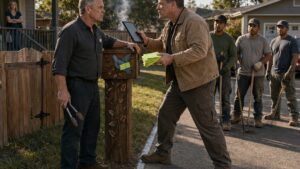
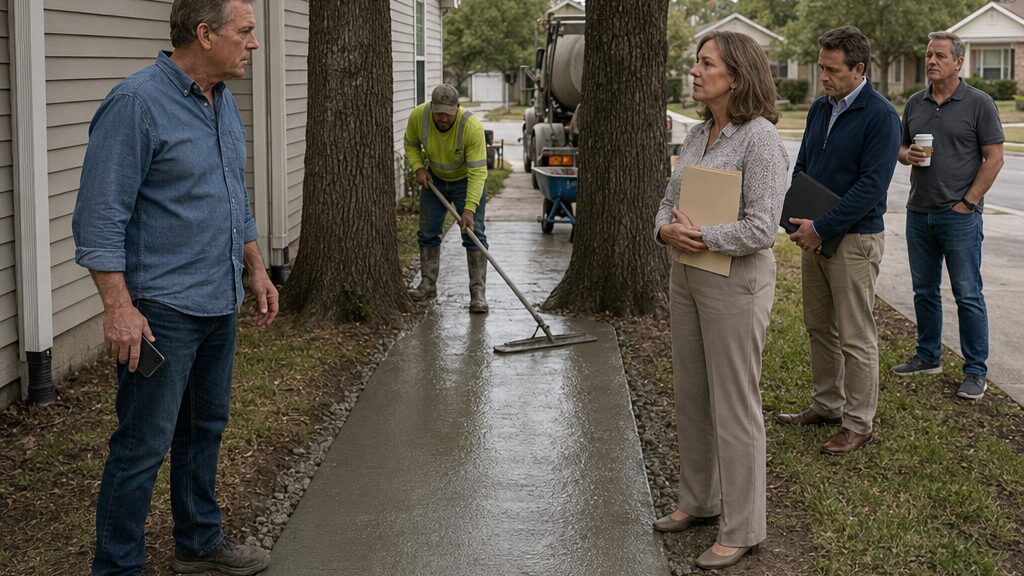
The concrete was still wet when Daniel Taylor stepped through his side door and realized the gray strip running between the two oak trees was no longer gravel.
For several seconds, he simply stared.
A contractor in rubber boots was dragging a finishing tool across the surface. Another worker stood beside a small mixer truck parked partly along the curb. The familiar strip beside Daniel’s house—eight feet of grass, packed soil, and old stone where drainage crews occasionally passed—had become a smooth ribbon of concrete.
It ran from the street toward the rear drainage channel.
And it crossed Daniel’s property marker.
“Stop.”
The word came out sharper than he intended.
The worker nearest him lifted the finishing tool. “Sir?”
“Don’t touch another foot of that.”
The man looked toward the street rather than answering. That was when Daniel saw Catherine Moore.
She stood beside the HOA property manager with a folder tucked under one arm. Samuel Green was farther back in his driveway, coffee cup in hand, watching with the uncomfortable interest of someone who had already decided this problem belonged mostly to somebody else.
Catherine walked toward Daniel.
“Daniel, the contractor is already in the middle of the pour.”
“I can see that.”
“This is the maintenance access improvement we discussed.”
“We did not discuss pouring concrete on my lot.”
Her mouth tightened. “The association has used this corridor for years.”
“For drainage maintenance.”
“Exactly.”
“That doesn’t make it yours.”
The contractor looked between them. “Do you want us to hold?”
Catherine answered before Daniel could.
“No. Continue.”
Daniel felt the heat climb into his face.
For years, he had built his reputation in the neighborhood around not being the man who caused scenes. He moved his truck when landscapers needed space. He let workers pass through the side gate. He fixed loose fence boards before anyone complained. When Samuel’s delivery van once blocked his driveway for forty minutes, Daniel had waited.
His father had called that being neighborly.
But his father had never said anything about standing quietly while someone paved your land.
Daniel started toward the concrete, then stopped himself.
Walking into the work area would accomplish nothing except give everyone a new argument about his behavior.
Instead, he looked directly at Catherine.
“I sent you a certified letter.”
“I received your letter.”
The property manager glanced at her.
Daniel noticed.
He kept his voice level. “The one telling the association that I disputed any permanent right of access here.”
“Yes.”
“And you received it before this work started.”
Catherine shifted the folder against her hip. “The board reviewed your position.”
“That wasn’t my question.”
Samuel lowered his coffee cup.
Daniel pointed toward the contractor but kept his eyes on Catherine.
“Are you authorizing permanent concrete work on this strip after receiving my written objection?”
For the first time that morning, Catherine hesitated.
Only for a second.
“Yes,” she said. “Because the association considers this established maintenance access.”
Daniel’s anger changed shape.
It did not disappear. It cooled.
The property manager looked down at the folder in his hands.
Daniel nodded once. “All right.”
Catherine seemed almost irritated by the answer. “Daniel, I understand you’re upset.”
“No. I asked what I needed to ask.”
The contractor stepped closer. “Just so everybody’s clear, if we stop now, the section already poured is still here. This isn’t something we peel up tomorrow. Once it cures, removal means demolition.”
Daniel looked at the wet surface.
The concrete was nearly four inches thick. Reinforcing mesh showed at the unfinished edge. Fresh gray material extended beyond the narrow wheel track maintenance crews had used for years.
“How wide is this?” Daniel asked.
“Ten feet through here.”
Daniel turned toward Catherine.
“The old access wasn’t ten feet.”
“It needed to be widened for equipment.”
“Whose decision?”
“The engineering plan was approved.”
“By the board?”
“Yes.”
Samuel finally stepped forward. “Dan, they’re trying to fix the drainage issue. We’ve all dealt with the flooding back there.”
Daniel looked at him.
“I know what they’re trying to fix.”
“Then you know why this matters.”
“What matters is whether the association can widen a route on somebody else’s property because it’s convenient.”
Samuel’s expression hardened. “It’s been used forever.”
Daniel almost answered, then stopped.
That sentence bothered him more than Catherine’s.
It’s been used forever.
As though repetition converted permission into ownership.
As though something became communal because one person had been too accommodating to lock a gate.
The contractor asked again whether he should continue.
Catherine said yes.
Daniel did not interfere.
He took out his phone instead and photographed the concrete from the street, then from his backyard, then from beside each oak tree. He photographed the contractor’s equipment, the width of the pour, and the spot where the concrete edged into a patch of exposed roots.
Catherine watched him.
“You’re documenting this?”
“Yes.”
“You know that doesn’t settle the ownership question.”
“No,” Daniel said. “But neither does concrete.”
He walked inside.
His hands were shaking by the time he reached the kitchen.
On the counter sat the green certified-mail receipt he had saved from two weeks earlier. He picked it up and looked at Catherine’s delivery date.
The association had not misunderstood the timing.
They had known.
Jessica Rivera called while he was still holding it.
Daniel almost ignored the phone, then answered.
“You sound strange,” she said.
“The HOA is pouring concrete beside the house.”
“So?”
“On my strip.”
There was a pause.
“Your strip as in your property?”
“Yes.”
“And you’re just standing there?”
“I’m documenting it.”
“Dad.”
He knew that tone.
“You sent them the letter, right?”
“Yes.”
“Then call somebody. A lawyer. The city. Everybody.”
“I’m going to.”
“You always say that after you’ve given people six chances.”
Daniel looked through the kitchen window.
The finishing machine moved slowly between the oak trees.
Jessica’s words landed harder than he wanted them to.
“I didn’t give them permission for this.”
“No,” she said. “You gave them permission for everything before this, and nobody ever heard you say where it stopped.”
He said nothing.
Outside, the mixer truck gave a short mechanical whine.
“I’ll call you later.”
“Dad—”
He ended the call.
By late morning the workers were gone.
Yellow tape blocked both ends of the new slab. Catherine and the property manager had left without coming back to the door.
Daniel walked the edge slowly.
Near the rear oak, where grass met the concrete, something metallic caught the light.
He crouched.
A small iron pin sat only partly visible beneath the slab’s edge, its top smeared gray with fresh cement.
Daniel touched it with one finger.
He remembered seeing that pin years ago when he replaced the side fence.
The survey marker.
And if he remembered correctly, it marked the boundary several feet inside the concrete Catherine had just ordered poured.
Chapter 2: The Property Line Everyone Had Stopped Seeing
Daniel laid the deed across his dining table and measured the distance twice.
Both times, the line ended inside the new slab.
He had bought the house more than twenty years earlier, and most of the paperwork had spent that time in a fireproof box beneath old tax returns and insurance files. The deed description was dense enough to make his eyes hurt, but the recorded plat was simpler.
Corner monument.
Rear line.
Eastern boundary.
Two mature oaks were drawn as reference features on an older survey copy.
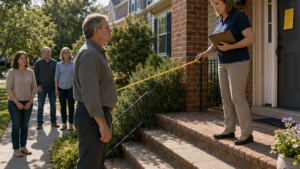
Daniel went outside with a tape measure.
From the house foundation to the iron pin: the number matched.
From the pin toward Samuel Green’s property: the new concrete continued almost three more feet.
Daniel stood on the grass and stared at it.
For the first time since the pour began, he felt something close to relief.
Not victory.
Proof.
He photographed the measurements and drove to the county records office before lunch.
The clerk helped him pull the subdivision plat, his recorded deed, and the association’s original declaration. Daniel searched every reference to drainage, utility access, common areas, and easements.
There was a drainage easement behind the lots.
There was a utility easement along the street.
There was no clearly recorded HOA easement running through the side strip between his oak trees.
He asked the clerk to check again.
She did.
“Nothing under the parcel number that matches what you’re describing.”
“Could it be somewhere else?”
“It could be referenced in another instrument. Title work is broader than what I can tell you here.”
“So this doesn’t prove there isn’t one.”
“No.”
Daniel appreciated the answer because it was careful.
At home, he called an attorney and then a surveyor.
The attorney’s first question irritated him.
“How long has the association used the route?”
“Maintenance crews have gone through there for years.”
“How many?”
“I don’t know. Fifteen? More.”
“And you objected?”
“Not to maintenance.”
“Did you ever give permission in writing?”
Daniel hesitated.
“I don’t remember.”
“That’s something we need to know.”
The certainty he had carried home from the records office weakened.
That afternoon, the property manager emailed him.
The message attached photographs going back years: landscaping carts, drainage equipment, a small excavator, a crew standing near the rear channel.
The final paragraph said the association considered the route a longstanding maintenance corridor and believed Daniel’s current objection was inconsistent with established use.
Daniel read it twice.
Then Catherine called.
“I’m trying to keep this from turning into something larger than it needs to be,” she said.
“You poured concrete after I told you I disputed the access.”
“We improved an existing route.”
“You widened it.”
“For modern maintenance equipment.”
“Onto my property.”
“That is the part we disagree about.”
“No, Catherine. The deed doesn’t disagree.”
“The deed is not the only relevant document.”
Daniel leaned back.
“What document do you have?”
“I’m gathering records.”
“That sounds different from having one.”
There was silence on the line.
Then Catherine said, “You’ve known the association uses that route. You’ve never objected until now.”
“I objected when occasional access became permanent construction.”
“You’re describing a distinction that was never communicated before.”
The sentence stayed with him after the call ended.
Never communicated.
Daniel disliked how closely it resembled what Jessica had said.
The surveyor arrived Tuesday morning.
He was methodical and almost aggressively uninterested in the neighborhood argument. He set equipment near the curb, checked recorded points, walked the rear line, and took measurements without offering Daniel reassurance.
Catherine came outside halfway through.
Samuel stood at the edge of his driveway.
Nobody spoke much.
Finally, the surveyor placed a temporary flag near the concrete.
Then another.
The line between them ran across the slab.
“How far?” Daniel asked.
“I’m not giving you a final opinion until I finish the work.”
“But the preliminary line?”
The surveyor looked toward the concrete.
“It does not appear the slab stays entirely outside your parcel.”
Catherine folded her arms.
“Does your survey account for easement rights?”
“That’s not the same question as ownership.”
Daniel looked at her.
It was the first time he saw uncertainty replace irritation in her face.
Small, but present.
The surveyor returned to his equipment.
Daniel walked back toward the house.
His phone buzzed before he reached the porch.
An email from Catherine.
Subject: Historical Access Documentation.
He opened it.
Three attachments.
The first was an old drainage-service invoice.
The second was a photograph of a crew using the side strip.
The third was a scanned letter.
Daniel enlarged the page.
The date was seventeen years earlier.
At the bottom was his own name.
His own signature.
The first paragraph said he granted the association permission to access the rear drainage area through the side of his property for maintenance purposes.
Daniel read the wording again.
Then a third time.
There was no expiration date.
No limitation on frequency.
No sentence explicitly saying the permission could be revoked.
His earlier certainty disappeared so quickly it embarrassed him.
Catherine sent one additional message beneath the attachments.
This is what I meant when I said the history matters.
Daniel stared at his signature.
For twenty-four hours, he had been asking whether the HOA had taken something from him.
Now he had to ask a worse question.
Had he been the one who gave it away?
Chapter 3: The Permission Daniel Never Thought He Needed to Revoke
Daniel remembered the day he opened the side gate because the water had been halfway across Samuel Green’s backyard.
Seventeen years earlier, the rear drainage channel had clogged after two days of heavy rain. Water backed up against fences, soaked flower beds, and pushed muddy runoff toward three houses.
A maintenance crew arrived with a compact machine too wide for the normal rear access point.
The property manager at the time had knocked on Daniel’s door.
“Could we come through your side yard?”
Daniel had looked at the standing water, then at his grass.
“Of course.”
His father had still been alive then. Daniel could almost hear him: You don’t make people suffer over a patch of ground.
The crew cleared the channel before evening.
Two days later, Daniel signed a short permission letter because the manager said the association needed something for its file in case crews had to return.
He had not hired a lawyer.
He had not negotiated wording.
He had not imagined that seventeen years later someone would hold the paper up as evidence that the route belonged to the HOA.
Now the letter sat beside him on the kitchen table.
Jessica read it on his laptop.
“It says maintenance.”
“Yes.”
“It doesn’t say driveway.”
“No.”
“It doesn’t say concrete.”
“No.”
“Then what are you worried about?”
Daniel rubbed the bridge of his nose.
“That I never told them when maintenance permission ended.”
Jessica looked toward the side window.
“So?”
“So maybe Catherine isn’t inventing the whole thing.”
Jessica closed the laptop harder than necessary.
“Dad, they poured concrete after your letter.”
“I know.”
“She knew you objected.”
“I know.”
“Then why are you suddenly defending her?”
“I’m not.”
It came out louder than he meant.
Jessica leaned back.
Daniel lowered his voice.
“I’m trying to understand how we got here.”
“You got here because you let everybody walk over you.”
“That’s not fair.”
“No? How many times did you complain about the landscaping trucks parking there?”
“I didn’t complain.”
“Exactly.”
“How many times did Samuel cut through the side with his mower?”
Daniel looked away.
Jessica shook her head.
“You kept calling it being easygoing.”
“My father taught me to help neighbors.”
“He didn’t teach you to let people decide what belongs to you.”
The words stung because Daniel could not dismiss them.
After she left, he walked the strip.
Before the concrete, it had never looked important.
Grass on one side.
House wall on the other.
Two oak trunks breaking the line toward the backyard.
Once or twice each spring, drainage crews came through. Later, landscapers began using it to reach the rear common area. Then utility workers. Then contractors left equipment there for a few hours.
Daniel noticed each expansion.
He objected to none of them.
Not because he agreed.
Because each one felt too small to become the neighbor who complained.
That afternoon Samuel came over.
He stopped on the grass because Daniel had placed temporary stakes beside the slab.
“Survey guy finished?”
“Not yet.”
Samuel shoved his hands into his pockets.
“I hope this doesn’t become ugly.”
Daniel almost laughed.
“There’s concrete on my property.”
“I mean uglier.”
Samuel glanced toward the rear yards.
“You remember when they first opened that route?”
“I opened it.”
“Right. And everybody’s used it since.”
“Maintenance crews.”
“Not just crews.”
Daniel looked at him.
Samuel hesitated.
“People have gone through there. Landscapers. Me sometimes.”
“With what?”
“My mower. Wheelbarrow. A couple times my pickup when I was hauling material to the back.”
Daniel stared.
“Your pickup?”
“It was years ago.”
“You drove through my side yard?”
“You knew.”
“I saw tire marks once.”
“I assumed you knew.”
“That’s not the same thing.”
Samuel’s jaw tightened.
“See, this is what I mean. For fifteen years nobody treated that strip like some guarded boundary. Now suddenly there are stakes and attorneys.”
“Because suddenly there’s concrete.”
Samuel looked at the slab.
“It does make things easier.”
“For who?”
“The maintenance guys.”
“And?”
Samuel did not answer immediately.
Daniel noticed.
“And who else?”
“My rear parking pad is hard to reach from the street when I have the trailer hooked up.”
Daniel felt something settle into place.
“The widened route helps you get behind your house.”
“It could.”
“So when you told me yesterday this was about drainage—”
“It is about drainage.”
“But it’s also useful to you.”
Samuel exhaled.
“I didn’t ask them to pour it.”
“That wasn’t my question.”
Samuel’s face colored.
For a moment Daniel saw the same reaction Catherine had shown when pressed into a precise answer.
“I told Catherine that if the route was being improved, it made sense not to keep it so narrow.”
“You told her that?”
“I was asked for input.”
“When?”
“A couple months ago.”
Daniel went still.
“Before I sent the certified letter?”
“Yes.”
Samuel seemed to realize the significance only after answering.
Daniel did not argue further.
He went inside and opened the batch of HOA records his attorney had asked the property manager to preserve.
Most were routine: invoices, maintenance requests, vendor bids.
Then he found a board packet dated nearly four months earlier.
One item was titled Permanent Hardscape Access Improvement.
Daniel opened it.
The proposal showed a ten-foot concrete route along the side of his property.
The same width being poured now.
He scanned the email chain beneath it.
Catherine had requested pricing.
She had asked whether the route could support heavier drainage equipment.
She had asked the property manager to confirm whether the association possessed a recorded easement.
The manager’s reply was short.
None located in current association files. Recommend title verification before permanent installation.
Daniel read it again.
Three months before his certified objection, Catherine already knew the association could not locate a recorded easement.
Yet she had kept the permanent concrete proposal moving.
He looked through the kitchen window at the slab between the oak trees.
Until that moment, Daniel had assumed the concrete was simply the latest step in years of careless expansion.
Now he understood something else.
Catherine had not made the route permanent because she thought nobody would object.
She had been trying to make it permanent before anyone could force the board to answer why it had never secured the right in the first place.
Chapter 4: Why Catherine Could Not Afford to Admit the Route Was Temporary
Catherine placed the engineering estimate in the middle of the HOA conference table before anyone had finished sitting down.
The number at the bottom was large enough that nobody needed her to explain why she had printed copies.
Daniel looked at it, then at the faces around the room.
One board member pressed his lips together. The other turned the page as if a different number might be hiding behind it.
Samuel Green sat three chairs down from Daniel.
The property manager closed the door.
Catherine remained standing.
“This is what happens if we lose the current maintenance route,” she said.
Daniel glanced at the estimate again.
It covered survey work, removal of landscaping, new drainage access from the opposite side of the common area, retaining-wall modifications, and construction of a replacement equipment path.
The total was well into six figures.
“That isn’t the same as losing drainage,” Daniel said.
“No. It’s losing the practical access to maintain it.”
“Access you never recorded.”
Catherine’s eyes narrowed slightly.
“We’re here to solve the problem, Daniel.”
“That’s what I’m trying to do.”
One of the board members tapped the estimate. “If we have to build this alternative route, the reserves can’t absorb all of it.”
The property manager cleared his throat. “Not without delaying other scheduled projects.”
“Meaning?” Daniel asked.
“Potential special assessment.”
The room changed.
Until then, the dispute had belonged mostly to Daniel’s side yard.
Now it had a price that could be divided among every homeowner in the subdivision.
Catherine sat down.
“This is what I’ve been trying to explain.”
Daniel understood something he had resisted admitting.
She was afraid.
Not of him.
Of the number.
Of telling seventy-two households that an access problem the board had ignored for years might cost each of them money.
Daniel leaned back.
“Then answer one question.”
Catherine waited.
“Did you find a recorded easement?”
The property manager looked down.
Catherine did not.
“No.”
The word was quiet.
Samuel shifted in his chair.
Daniel felt the same quick surge of vindication he had felt at the county records office, but it lasted only a second.
Because Catherine continued.
“We have not located one.”
“That matters.”
“I didn’t say it didn’t.”
“You approved permanent concrete before you knew whether you had the legal right to put it there.”
“We had seventeen years of use, written permission, repeated contractor access, and no objection.”
“Until my certified letter.”
“Yes.”
“And then you poured it anyway.”
Catherine’s voice sharpened. “Because the contractor was mobilized, the drainage work had already been scheduled, and if we canceled that week we would have lost the project slot.”
“There were other options.”
“Not inexpensive ones.”
Daniel stared at her.
For the first time, he could see the conflict from her side without agreeing with it.
She had not looked at his strip and thought, I want Daniel Taylor’s land.
She had looked at it and thought, If this route disappears, I have to explain a six-figure problem to everyone.
That made her more understandable.
It did not make the concrete less real.
Samuel leaned forward.
“Can I say something?”
Daniel almost said no.
Samuel continued anyway.
“We are talking about eight feet of grass.”
Daniel turned toward him.
“Not anymore.”
“You know what I mean.”
“No. Tell me.”
Samuel spread his hands. “Nobody is trying to take your house. Nobody is building a garage on your lot. It’s a maintenance route.”
“It’s concrete on property I own.”
“And if you shut it down, everybody pays.”
A board member murmured, “Samuel.”
But he was already committed.
“I’m just saying what people are going to say.”
Daniel looked around the table.
That was the real pressure.
Not Catherine’s title.
Not the property manager.
Not even the legal argument.
Neighbors.
People who waved when he collected his mail.
People whose children had sold him fundraiser cookies.
People who would receive a letter telling them their association dues were no longer enough because Daniel Taylor had decided an eight-foot strip mattered.
Daniel folded the engineering estimate.
“My objection isn’t to drainage maintenance.”
“Then what do you want?” Samuel asked.
“I want people to stop pretending those are the same thing.”
“Same thing as what?”
“Maintenance and ownership.”
The room went quiet.
Catherine looked tired rather than angry now.
“We can probably negotiate a formal easement.”
“Maybe.”
“That’s more reasonable than removing everything.”
“I haven’t said what I’m asking for yet.”
Samuel gave a short laugh.
“That’s the problem. Nobody knows where your line is.”
The remark landed harder than he intended.
Daniel thought of Jessica.
You never told them where it stopped.
He looked down at the estimate.
Maybe that had been true for years.
But not anymore.
After the meeting, Daniel stayed behind while the others left.
Catherine gathered papers slowly.
“You should know something,” she said without looking at him.
“What?”
“The rear drainage problem is worse than it used to be.”
“I know.”
“No. I mean the maintenance equipment is bigger now. The old hand-access route is not enough for what the contractor recommends.”
“Then the association should have secured proper access before designing around my yard.”
She nodded once.
A concession.
Small, but real.
“That should have happened.”
Daniel studied her.
“Why didn’t it?”
Catherine finally looked at him.
“Because every board before this one treated your permission like it solved the issue.”
“And you?”
“I inherited that assumption.”
“But you learned it might be wrong.”
“Yes.”
“Before the pour.”
Her expression hardened again.
“Yes.”
There it was.
Not corruption.
A decision.
A bad one.
But hers.
Daniel walked outside.
Samuel was still in the parking lot, loading a folding chair into his SUV.
As Daniel passed, Samuel said, “You really want to make everyone pay over this?”
Daniel stopped.
“You keep saying everyone.”
“Because everyone uses the drainage system.”
“That isn’t what I mean.”
Samuel frowned.
Daniel looked toward his vehicle.
“You told me the wider route helps you get to your rear parking pad.”
Samuel’s face changed.
Barely.
But enough.
Daniel remembered the construction plan showing the ten-foot width.
“What kind of vehicle do you need ten feet for?”
Samuel shut the cargo door.
“Come on, Dan.”
“What kind?”
“My pickup. Trailer sometimes.”
“So the association route also gives you direct vehicle access behind your house.”
“It’s not like I designed it for myself.”
“Did you ask Catherine to widen it?”
“I said the old track was too narrow.”
“For maintenance equipment?”
“For everything that might need to pass.”
Daniel held his gaze.
Samuel looked away first.
On the drive home, Daniel called the property manager and requested the complete planning file for the concrete project.
When it arrived that evening, he searched Samuel’s name.
One email appeared.
Then another.
The second contained a sketch Samuel had sent Catherine months earlier, showing the widened route continuing toward the rear edge of his lot.
Daniel sat very still.
The drainage problem was real.
The cost problem was real.
Catherine’s fear of a special assessment was real.
But community necessity was no longer the whole story.
Someone had also seen Daniel’s generosity as an opportunity.
Chapter 5: The Survey Stakes Changed What the Argument Was Really About
The first orange survey stake went into the ground three feet inside the new concrete.
Daniel watched the surveyor hammer it down.
Nobody had to explain what it meant.
Catherine stood near the curb with the property manager. Samuel remained in his driveway, arms folded.
The second stake went near the rear oak.
A bright string stretched between them.
It crossed the slab cleanly.
The surveyor checked his instrument again, then pointed.
“That is the property line based on the recorded plat and the monuments I located.”
Daniel looked at the concrete.
“How much of the slab is over?”
“Varies. A little under three feet at this end. More at the rear.”
Catherine stepped closer.
“What about the historic route?”
“That’s a different question.”
“Can you show where it was?”
The surveyor gestured toward the ground beside the slab.
“The old compacted track is still visible in places. Narrower.”
Daniel saw it then.
Faint stone.
Pressed soil.
A strip worn by maintenance tires over years.
The concrete did not simply formalize it.
It swallowed it and expanded beyond it.
Samuel stared at the string.
“That can’t be right.”
The surveyor looked at him. “Which part?”
“The route’s always been wider than that.”
“No,” Daniel said.
Samuel turned.
“You weren’t out here measuring every time a truck came through.”
“No. That was my mistake.”
The answer stopped him.
Daniel walked toward the oak tree.
The arborist arrived shortly after and crouched near the trunk, examining where excavation had cut into the soil beside the slab.
He scraped away loose material with a hand tool.
“How long ago was this poured?”
“Last week,” Daniel said.
The arborist nodded.
“Compaction is the bigger concern right now.”
He pointed toward the concrete.
“Equipment crossed the root zone. Soil was graded. There are exposed feeder roots here.”
“Can the tree be saved?”
“I’m not saying it’s dying.”
Daniel exhaled.
“But this should be remediated.”
Catherine stepped nearer.
“What does that involve?”
“Removing the encroaching material carefully, loosening compacted soil, restoring grade, protecting roots during any demolition.”
Catherine glanced toward the property manager.
Daniel noticed the expression.
Another number being added somewhere.
The oak mattered to him in a way the concrete did not.
His father had helped him prune it after Daniel bought the house.
Years later, Daniel had installed a bench beneath it.
The tree had become part of the shape of the property—the same way the narrow strip had.
Ordinary until threatened.
His attorney called before noon.
“With the survey, the encroachment is much cleaner.”
“Meaning?”
“Meaning you have leverage.”
Daniel looked at the orange string.
“What would you ask for?”
“If you want the strongest position? Complete removal. Restoration. Fees. Written acknowledgment that no permanent association access exists. No future entry without express permission.”
Daniel said nothing.
“You there?”
“Yes.”
“We can also demand an injunction against further use.”
“Even for drainage?”
“If that’s what you want.”
Daniel stared toward the rear common area.
Clouds were gathering above the rooftops.
The municipal drainage inspector had already warned the association that the channel needed scheduled clearing before storm season.
If Daniel blocked all access immediately, Catherine would have to find another route before crews could enter.
He had spent a week wanting the HOA to feel consequences.
Now he finally had the power to create them.
It felt less satisfying than he had imagined.
By afternoon, Catherine came over alone.
She stopped at the orange survey line.
“I’m not going to argue with the stakes,” she said.
Daniel almost smiled.
“That’s progress.”
She accepted the remark.
“The board’s attorney wants to talk settlement.”
“I figured.”
“You can probably force removal.”
“Probably.”
“And you could block maintenance access.”
“Yes.”
She looked toward the drainage area.
“There’s a storm system expected next week.”
“I know.”
“So what are you planning?”
Daniel studied her.
“You’re asking me for permission now.”
Catherine looked down.
“Yes.”
The word mattered.
Not because he needed to hear her surrender.
Because it finally placed the relationship where it belonged.
She was asking.
He was deciding.
Daniel said, “I’m not stopping emergency drainage work.”
Catherine looked up.
“But?”
“Maintenance crews only. No private vehicles. No widening. No parking. No permanent construction. And I want it in writing.”
Her shoulders loosened slightly.
“Temporary?”
“Until we settle the rest.”
She nodded.
“Thank you.”
Daniel surprised himself by believing she meant it.
That evening Jessica came over.
She stood beside the survey stake and looked at the string.
“So you won.”
“No.”
“Dad, the concrete is three feet over your property line.”
“That proves where the line is.”
“That’s winning.”
He shook his head.
Jessica looked frustrated.
“You’re doing it again.”
“Doing what?”
“Backing off as soon as they finally have to listen.”
Daniel stared at the oak.
“I gave the drainage crew temporary access next week.”
Her expression hardened.
“Why?”
“Because a clogged channel doesn’t care whose fault this is.”
“They poured concrete on your yard.”
“Yes.”
“And Catherine knew there was a problem.”
“Yes.”
“So let them figure it out.”
“That means neighbors get water in their yards.”
“That’s not your responsibility.”
Daniel looked at her.
There was a time he would have agreed simply to avoid an argument.
Now he understood that avoiding conflict and choosing restraint were not the same thing.
“It is my responsibility to decide what I do with my property,” he said.
Jessica went quiet.
“That includes letting someone use it when I choose.”
He pointed toward the string.
“And stopping them when I don’t.”
The next morning his attorney emailed a proposed demand.
Daniel read the first page.
Complete removal.
Root remediation.
Reimbursement.
Attorney fees.
Permanent prohibition against any HOA entry or access across the strip.
He read the final clause twice.
Then he opened the document.
He highlighted the paragraph.
Deleted it.
His attorney called within ten minutes.
“Was that intentional?”
“Yes.”
“You understand that provision gives you the cleanest future protection.”
“It gives me the cleanest future fight.”
“That may be the same thing.”
“No.”
Daniel looked through the window.
The orange stakes stood beside the concrete.
For the first time, the boundary was impossible to miss.
“I want a new version.”
“What kind?”
“One that protects the strip and still gives them a legitimate way to maintain the drainage.”
There was a pause.
“You’re proposing an easement?”
“A narrow one. Recorded. Maintenance only. Different route where possible.”
“That’s not maximum leverage.”
“I’m not trying to maximize leverage.”
“What are you trying to maximize?”
Daniel looked at the two oak trees.
“Clarity.”
Chapter 6: Winning the Boundary Meant Giving Up the Revenge
Daniel crossed out the sentence that would have barred the HOA from his property forever.
The mediator watched him do it.
Across the table, Catherine said nothing.
The association attorney leaned toward the property manager and whispered something. Daniel’s attorney turned the draft slightly toward him.
“You’re sure?”
Daniel set down the pen.
“Yes.”
Three weeks had passed since the survey.
In that time, engineers had priced a revised drainage route, the concrete contractor had submitted a removal estimate, the arborist had prepared a root-zone remediation plan, and attorneys on both sides had exchanged enough paper to make the original strip of land seem enormous.
The numbers were spread across the mediation table.
Concrete removal and restoration.
Survey costs.
Engineering redesign.
Legal fees.
Tree remediation.
Temporary drainage access.
Contractor recovery disputes.
Insurance deductibles.
The combined exposure was approaching one hundred eighty-five thousand dollars.
Daniel would not receive anything close to that.
Most of it represented the cost of undoing and redesigning what never should have been made permanent.
Catherine tapped one sheet.
“If the contractor accepts responsibility for the portion outside the approved work description, we recover some.”
“Some,” the association attorney said.
“And insurance?”
“Potentially some additional costs. Not all.”
Catherine pressed her lips together.
Daniel saw what she had been seeing months earlier.
Not a strip of grass.
A budget crisis.
The mediator said, “The remaining issue appears to be future access.”
Daniel slid his marked draft forward.
“I’m willing to grant a recorded maintenance easement.”
Catherine looked up.
Her attorney did too.
“Conditions?” the mediator asked.
“Four feet where engineering allows. Wider only at the turning point they actually need. No resident vehicle access. No storage. No parking. No hardscape on my parcel. Entry for drainage and utility maintenance only.”
Samuel was not in the room, but Daniel had thought about him while drafting every line.
“And notice?” Catherine asked.
“Routine work, forty-eight hours. Emergency drainage, immediate access.”
The property manager wrote quickly.
Catherine stared at the map attached to the proposal.
Daniel had moved the maintenance line away from the oak roots and toward the common-area edge.
“You’d agree to this permanently?” she asked.
“If it’s recorded correctly.”
Her expression held a mixture of relief and suspicion.
“Why?”
Daniel almost laughed.
“Because the drainage still needs maintenance.”
“I mean after everything.”
He looked at her.
“Because I’m not trying to make the neighborhood flood.”
The mediator allowed the silence to sit.
Catherine looked down at her hands.
Then she said, “I authorized the pour.”
Nobody moved.
Her attorney turned slightly.
Catherine continued before he could interrupt.
“The manager recommended confirming title first. I knew that.”
Daniel felt something in the room tighten.
“I also knew your letter disputed permanent access.”
Her attorney said, “Catherine—”
“No. He already knows.”
She looked directly at Daniel.
“The contractor had a short mobilization window. We’d delayed the drainage project twice. I thought if I paused again, we’d lose the slot, prices would go up, and the board would have to explain why we were spending tens of thousands more.”
“So you decided the ownership problem could be handled afterward.”
“Yes.”
“By me.”
She nodded.
Daniel had imagined hearing that admission many times.
In some versions, he had expected satisfaction.
In others, anger.
What he felt instead was tiredness.
Catherine rubbed one thumb against the edge of her folder.
“I thought I was protecting the association.”
“You were protecting the budget.”
“At the time, I thought those were the same thing.”
Daniel understood that answer more than he wanted to.
He had spent years believing silence and kindness were the same thing.
Catherine had spent months believing institutional convenience and community protection were the same thing.
Different mistakes.
Same habit of refusing to name the cost being transferred to somebody else.
The mediator asked whether the admission changed Daniel’s proposal.
“No.”
His attorney looked at him.
Daniel continued.
“It changes who is responsible for authorizing the work. It doesn’t change what the drainage system needs.”
Catherine’s eyes lowered.
The settlement took another two hours.
The contractor would participate in demolition costs subject to final allocation. The association would reimburse Daniel’s survey, legal, and arborist expenses. Root remediation would be supervised. The new maintenance route would be engineered and recorded rather than assumed.
Then came the part nobody could hide.
Even after expected contractor recovery and insurance contribution, the HOA would lose a meaningful amount from reserves.
The property manager said scheduled clubhouse repairs might need to be postponed.
One board member had already warned privately that residents would be angry.
Daniel looked at the settlement sheet.
His name might be on the dispute.
But the bill would arrive in everybody’s mailbox as consequence.
That evening, Catherine stopped him outside the clubhouse.
“Can I ask you something?”
Daniel waited.
“The membership meeting is next Thursday.”
“I know.”
“The board has to explain the settlement.”
“That sounds like the board’s job.”
“It is.”
She hesitated.
“But I think you should explain the access agreement.”
Daniel frowned.
“Why me?”
“Because if I explain it, people will hear damage control.”
“That’s what it is.”
“Yes.”
The bluntness surprised him.
Catherine looked toward the darkened windows of the clubhouse.
“Some residents already think you forced the association into this.”
“I didn’t pour the concrete.”
“I know.”
“They should know that too.”
“They will.”
Daniel studied her face.
She looked older than she had three weeks earlier.
Not defeated.
Exposed.
There was a difference.
“I’m stepping down as president after the settlement vote,” she said.
Daniel had not expected that.
“You don’t have to tell me.”
“I wanted you to know.”
“Why?”
“Because I’m not asking you to help me keep the position.”
Daniel said nothing.
Catherine held out a copy of the proposed access map.
“I’m asking whether you’ll show them why this is better than pretending the old arrangement still works.”
Daniel took the page.
The new route ran beside the narrow strip instead of through the middle of it.
Clear boundaries.
Specific purpose.
Recorded permission.
Everything that should have existed years ago.
He thought of Jessica telling him to fight harder.
Samuel calling it eight feet of grass.
His father telling him neighbors should help one another.
For most of his life, Daniel had interpreted helping as making himself easy to deal with.
Now Catherine was asking him to stand in front of the same neighbors who might blame him for the cost and explain why cooperation required a line.
“Will you do it?” she asked.
Daniel folded the map once.
He had won the boundary question.
The harder question was waiting in a room full of people who would soon know exactly what that victory had cost them.
“Yes,” he said. “But I’m not apologizing for owning it.”
Chapter 7: The Eight Feet of Ground Everyone Finally Learned to Respect
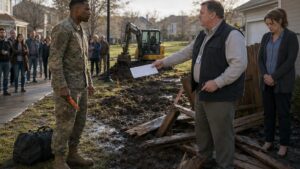
The demolition crew arrived at eight in the morning and parked in almost the same place the concrete truck had six weeks earlier.
Daniel stood beside the rear oak while the first machine rolled off the trailer.
For a moment, the scene felt like a repetition.
Workers in bright vests.
Equipment beside his house.
Catherine near the curb with the property manager.
Samuel watching from his driveway.
But this time orange survey stakes were still standing beside the slab, and every worker had a copy of the marked removal boundary.
Nothing was being assumed.
The foreman walked the line with Daniel before starting.
“We remove to here. Hand work near the roots. No equipment beyond the protective fencing.”
Daniel nodded.
“And the old marker?”
“We expose it. Surveyor verifies before restoration.”
Catherine joined them.
“The arborist will be here at ten.”
Daniel looked at her.
“Good.”
There was no argument left in the exchange.
The machine’s hydraulic hammer started.
The first impact cracked the concrete near the street.
Samuel flinched at the sound.
Daniel did not.
Piece by piece, the slab that had appeared so permanent began coming apart.
Gray sections lifted from the ground and disappeared into a dump trailer. Workers switched to smaller tools as they approached the oak. Beneath the broken concrete, the old compacted maintenance track reappeared in fragments—stone, soil, roots, and the faint path everyone had once treated as too ordinary to define.
Jessica arrived before noon.
She stood beside Daniel and watched a worker clear debris around the old iron marker.
“That’s it?” she asked.
Daniel nodded.
The surveyor had already confirmed it.
A dull metal pin barely wider than a thumb.
Six weeks of arguments had revolved around a line marked by something most people could walk past without seeing.
Jessica folded her arms.
“Looks small.”
“So did the problem.”
She glanced at him.
“That’s not what I meant.”
“I know.”
Across the yard, Catherine spoke quietly with the property manager. She had formally resigned as HOA president after the settlement vote, though she was staying through the transition to finish the remediation work.
She no longer carried the folder she used to press against her side during every disagreement.
Daniel had noticed that.
By afternoon, the concrete nearest the rear oak was gone.
The arborist inspected the exposed root zone and directed workers to loosen compacted soil by hand. Damaged areas were amended and regraded. Protective mulch would go in later.
The tree had not escaped untouched.
Neither had the association.
Final accounting had arrived the day before.
The contractor accepted responsibility for part of the demolition and reconstruction after the project files showed the pour exceeded the original field layout. Insurance covered another portion. The association still had to use reserve money for legal costs, engineering, temporary access, and part of the drainage redesign.
The full chain of mistakes had approached one hundred eighty-five thousand dollars.
Daniel’s reimbursement covered his survey, attorney, and arborist expenses.
No giant check.
No windfall.
Mostly, he got his ground back.
At the membership meeting that evening, every chair in the clubhouse was taken.
Daniel stood along the side wall until Catherine called his name.
He walked to the front carrying one sheet of paper: the final access map.
He heard whispers as he unfolded it.
Catherine had already explained the finances.
That had not gone smoothly.
One resident had asked why the board had approved construction without confirmed property rights.
Another wanted to know why reserves were paying anything.
Someone near the back had said, loudly enough for Daniel to hear, “All this over a strip nobody cared about before.”
Now the room waited for him.
Daniel placed the map on the easel.
“This is the old arrangement,” he said, pointing to the route through his lot. “It wasn’t really an arrangement. It was permission I gave years ago for maintenance access.”
A man in the second row said, “And now we’re paying because you changed your mind?”
Catherine started to respond.
Daniel raised one hand.
“I’ll answer.”
The room settled.
“I didn’t object to maintenance. I objected when temporary use became permanent construction.”
He pointed to the new line on the map.
“This is the recorded route we agreed to. It gives the association access to maintain the drainage system. It stays narrower where possible, avoids the oak root zones, and connects through common property.”
A woman near the aisle asked, “Can residents still use it?”
“No.”
Several people turned toward Samuel.
He sat near the back.
Daniel continued.
“Maintenance and utility access only. No private vehicles. No parking. No storage.”
Samuel looked down at the papers in his lap.
At the settlement meeting two days earlier, he had objected to that clause.
His rear parking pad would be harder to reach with a trailer.
He had argued that occasional residential use had become part of the route’s history.
Then the association attorney asked whether Daniel had ever given him permission to drive across the lot.
Samuel had said no.
The argument ended there.
Now, in front of the membership, Samuel raised his hand.
Daniel nodded toward him.
Samuel stood.
“I want to clarify something.”
The room quieted.
“I used the route a few times for my own convenience. I shouldn’t have treated that as something I was entitled to.”
Daniel had not expected him to say it publicly.
Samuel glanced at him.
“I’m fine with the maintenance-only restriction.”
No applause followed.
Daniel was glad.
The room did not need a hero and a villain.
It needed rules everyone understood.
Another resident asked, “So what stops this happening again?”
Daniel looked at the map.
“Nothing stops every mistake.”
He paused.
“But recorded boundaries help. Written permission helps. Boards verifying ownership before approving permanent work helps.”
He looked toward Catherine.
“And homeowners speaking up before something small becomes normal helps too.”
That last sentence cost him something.
Because it included himself.
He could have objected years earlier when landscaping crews started taking shortcuts.
He could have told Samuel not to drive through.
He could have written down what maintenance access meant instead of assuming everyone understood it the way he did.
Catherine spoke from beside the table.
“The board made the final decision to proceed with the concrete after Daniel’s objection. That responsibility is ours.”
A few residents looked at her.
She did not soften the statement.
Daniel respected her more for saying it plainly than he ever had for all her certainty before.
The meeting ended without anyone changing their mind completely.
Two residents left still complaining about the reserve loss.
Another stopped Daniel at the door and said she understood his position but wished the whole thing had been handled sooner.
“So do I,” Daniel said.
That answer surprised her.
Outside, Samuel waited beside his truck.
“I owe you an apology,” he said.
Daniel looked at him.
“For the truck?”
“For acting like years of you not saying anything meant yes.”
Daniel nodded once.
“I should’ve said something sooner.”
Samuel gave a tired half smile.
“Probably.”
It was not reconciliation in the sentimental sense.
They did not shake hands and forget six weeks.
But when Samuel walked away, there was no longer an invisible argument between them about what the strip meant.
The next morning, workers finished grading Daniel’s side yard.
Fresh soil covered the damaged ground. Mulch ringed the oak. The old concrete route was gone.
Several feet away, the new maintenance path curved along the edge of common property.
At its entrance stood a simple metal gate.
Daniel had chosen it himself.
Not decorative.
Not imposing.
Just clear.
The property manager handed him a key and kept another for authorized maintenance crews.
“Routine access requires notice,” he said.
“I know.”
Daniel opened the gate.
It swung smoothly toward the new path.
He looked down the route toward the drainage channel.
For years, he had believed boundaries made people less neighborly.
Standing there, he understood the opposite could also be true.
A boundary could tell someone exactly how to help without taking more than had been offered.
He closed the new gate but did not lock it.
Then he walked several feet over to the old opening between the two oak trees.
That path had once meant generosity to him.
Later it had meant resentment.
Now the restored soil was already softening the tire marks.
Daniel set the old side gate back into place.
Jessica stood near the porch watching him.
“You locking it?”
“Yes.”
She smiled slightly.
“About time.”
Daniel slid the key into the lock.
Then he looked once more at the new maintenance gate beside the property line.
One route remained available because he had chosen to allow it.
The other closed because he had finally chosen to say where his property began.
He turned the key.
The lock clicked.
The story has ended.