My Neighbor Said My Porch Light Was Too Bright—Then the HOA Rule Exposed a Bigger Problem
Chapter 1: The Porch Light That Became a Neighborhood Problem
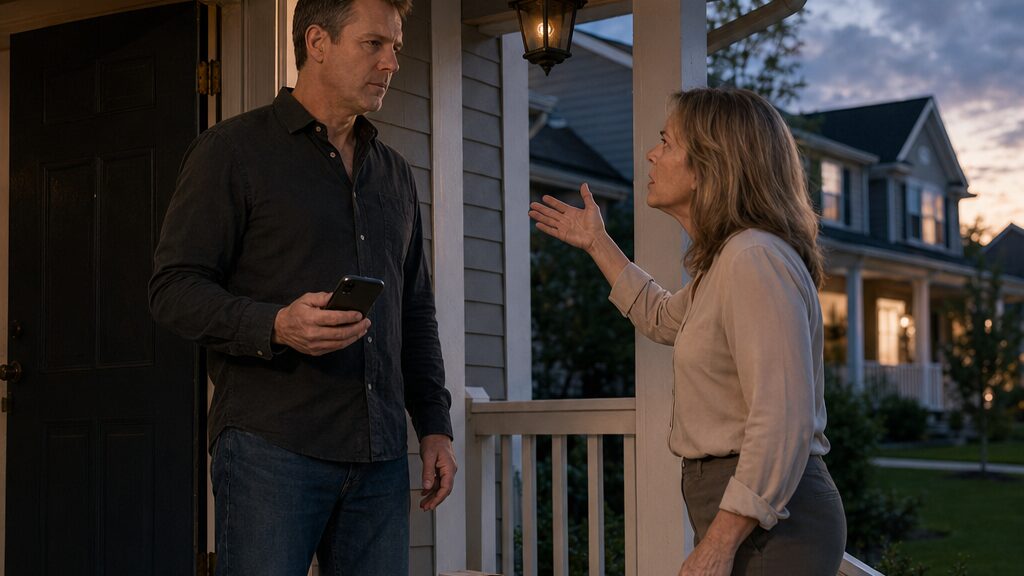
Karen Mitchell was standing under Stephen Moore’s porch light when he opened the front door.
For half a second, he thought she had come to borrow something. Karen lived next door, and although they were not friends, they had exchanged enough packages and trash-day reminders over the years that seeing her on the porch was not unusual.
What was unusual was the way she stood with her arms folded, her face tilted toward the lantern above her.
“That’s new,” she said.
Stephen looked up.
The brass-colored fixture had been there since he bought the house. The bulb inside it was new. Two nights earlier, the old one had burned out, and he had replaced it with a standard LED from the cabinet above the washing machine.
“The bulb?”
Karen nodded.
“It’s pretty intense.”
Stephen glanced at the pale rectangle of light falling across the porch steps. It seemed bright enough to find a keyhole and not much else.
“I hadn’t noticed.”
“I have.”
There was no accusation in her voice yet. That almost made it worse.
Karen stepped back onto the front walk and looked toward the street, where similar houses sat behind trimmed lawns and nearly identical mailboxes. Several porch lights were already on.
“We’ve always tried to keep things cohesive here,” she said. “Your light is a little aggressive compared with everything around it.”
Stephen almost laughed at the word.
Aggressive.
It was a bulb.
Instead, he said, “Okay.”
Karen looked at him as if she had expected a longer answer.
“I’m not trying to make it a big deal,” she added.
“Neither am I.”
“That’s good.”
She gave him the small, satisfied nod of someone who believed a matter had been settled, then walked home.
Stephen stayed outside for another moment.
Across the narrow strip of lawn separating their properties, Karen’s own porch lamp glowed a softer amber. His was whiter. Maybe that was all she meant.
He could have left it alone.
Instead, the next afternoon he stopped at a hardware store on the way home.
The clerk pointed him toward a shelf of outdoor-rated bulbs. Stephen chose one with lower output and a warmer color temperature. It cost less than dinner and took thirty seconds to install.
That evening, he stood at the curb and compared the two houses.
His porch was dimmer now.
Problem solved.
That was how Stephen preferred problems: small, inexpensive, and finished before anyone had the chance to turn them into an argument.
He had spent enough of his childhood listening to arguments travel through walls. His parents could turn a missed phone call into three days of slammed cabinets. His father always had to answer the last sentence; his mother always had another one ready.
Stephen had promised himself, long before he owned anything worth arguing about, that peace was something you protected by refusing to feed small conflicts.
So when Karen mentioned the light, he changed it.
Simple.
Two evenings later, Stephen carried a bag of groceries from his car and noticed Karen standing near the end of her driveway.
She was not looking at him.
She was looking at his house.
More precisely, she was looking at the porch.
Her phone was in her hand.
Stephen slowed.
Karen raised it.
The screen flashed briefly as she took a photograph.
He set the grocery bag on his hip.
“Everything okay?”
Karen lowered the phone.
“Fine.”
“You taking a picture of my house?”
“The lighting.”
Stephen stared at her.
She tucked the phone against her palm.
“I told you some people had noticed.”
That was new.
“What people?”
Karen shifted her weight.
“I’m not going to start naming neighbors.”
“I didn’t ask you to start anything. You said people noticed.”
“They have.”
Stephen looked up and down the street. A man two houses away was pulling a recycling bin toward his garage. Another neighbor was walking a small dog. Neither was looking at Stephen’s porch.
“I changed the bulb,” Stephen said.
“I saw.”
“It’s dimmer.”
Karen gave a restrained shrug.
“Brightness isn’t the only issue.”
“What’s the other issue?”
“The overall feel.”
Stephen waited.
Karen seemed to expect him to understand.
When he didn’t respond, she said, “It stands out.”
He looked at the light again.
This time, the word aggressive did not seem funny.
“What exactly would you like me to do?”
Karen’s expression softened, as though Stephen had finally asked the correct question.
“I’d just use something more appropriate.”
“This is an outdoor bulb.”
“You know what I mean.”
He did not.
But he also did not want to spend his evening defining appropriate porch lighting with the woman next door.
“All right,” he said.
He picked up his groceries and went inside.
For the next several days, nothing happened.
Stephen began to feel faintly embarrassed that he had let the exchange bother him.
Then, on Thursday morning, he opened his mailbox.
Among a utility statement and a grocery flyer was a white envelope with the management company’s return address.
He almost carried it inside unopened.
Instead, something about the bold line visible through the envelope window made him stop beside the mailbox.
NOTICE OF VIOLATION.
Stephen tore the envelope open.
The letter identified his property and stated that his exterior lighting had exceeded the association’s “residential ambience standard.” He was directed to bring the condition into compliance.
Stephen read the paragraph twice.
Then a third time.
At the bottom was a citation.
Section 4.7.
He looked toward his porch.
The replacement bulb was still there, unlit in the morning sun.
The bulb he had already changed because Karen asked him to.
For the first time since the whole thing began, Stephen did not wonder what would make Karen happy.
He wondered what Section 4.7 actually said.
Chapter 2: Section 4.7 Says Something Karen Never Mentioned
The phrase residential ambience standard did not appear anywhere in Section 4.7.
Stephen checked twice before breakfast and once more after pouring coffee.
The HOA handbook sat open on his laptop, a forty-three-page PDF he could not remember ever reading beyond the sections on fencing and trash containers.
He searched “ambience.”
No results.
He searched “lighting.”
Section 4.7 appeared immediately.
Stephen leaned closer.
The language was dry and specific. Exterior residential fixtures were required to remain within an approved range intended to provide safe illumination without excessive glare into neighboring lots or public areas.
That much made sense.
Then he reached the numerical standards.
He read them once.
Then again.
The permitted range included a minimum output of twenty-five lumens.
Stephen sat back.
Twenty-five.
The bulb on his porch was far brighter than that, but the number changed the shape of the problem. Karen had spoken as if there were a single neighborhood expectation everyone understood by instinct. The actual rule did not say warm, subtle, tasteful, cohesive, or aggressive.
It used numbers.
Stephen opened the violation notice beside the handbook.
“Residential ambience standard.”
He searched the document again.
Nothing.
He sent an email to the property-management coordinator.
Could you please identify the specific language in Section 4.7 that my current fixture violates, including the applicable measurement or standard?
He reread the sentence before sending it.
It sounded stiff.
For a second, he considered softening it.
Then he remembered Karen photographing his house.
He clicked Send.
That evening, the response arrived.
Thank you for your cooperation. Please ensure that all exterior lighting is brought into compliance with community standards within the correction period specified in your notice.
Stephen stared at the message.
It answered nothing.
He wrote again.
I am trying to comply. I need to know what provision I am currently violating. Section 4.7 specifies output levels, but the notice uses language I cannot locate in the governing document.
The next reply came the following morning.
Residents are responsible for reviewing all applicable governing documents and maintaining exterior lighting consistent with neighborhood standards.
Stephen closed the laptop.
For three days, he had done what he always did when faced with something irritating: reduced himself. Keep the exchange short. Make the change. Remove the reason for conflict.
Now the reason kept moving.
He printed Section 4.7 and carried it to the kitchen table.
Twenty-five lumens.
The number sat there with a strange kind of clarity.
At lunch, Stephen drove back to the hardware store. He found plenty of decorative bulbs, warm bulbs, dimmable bulbs, low-wattage bulbs, and bulbs marketed for night-lights. None listed anything close to twenty-five lumens.
The clerk eventually came over.
“Looking for something specific?”
“Very specific.”
Stephen showed him the number on his phone.
“Twenty-five lumens?”
“Or slightly above.”
The clerk blinked.
“For a porch?”
“Yes.”
“You trying to light the porch or apologize to it?”
Stephen laughed despite himself.
“That’s about where I am.”
The clerk checked several shelves, then shook his head.
“You’ll probably have better luck online. Specialty decorative bulb. Maybe appliance size. Just make sure the base fits and it’s rated for the fixture.”
Back home, Stephen searched.
Twenty-five produced little.
Thirty produced several possibilities.
Then he found one.
Dimmable LED filament bulb.
Warm output.
Twenty-six lumens.
He stared at the product page.
One lumen above the minimum.
The pettiness of it embarrassed him.
It also made him smile.
He ordered two.
The smile disappeared when he opened his email again and saw another message from the management company reminding him that continued noncompliance could result in a hearing.
He replied with Section 4.7 attached.
Please confirm whether a bulb producing 26 lumens would satisfy the minimum lighting requirement stated in the cited provision.
The answer arrived the next afternoon.
The association cannot pre-approve individual products. Homeowners remain responsible for ensuring compliance with all applicable standards.
Stephen read it slowly.
They would tell him he was wrong.
They would not tell him what right looked like.
The package arrived on Friday.
The bulb was almost comically small inside the shipping box. Stephen held it between two fingers and checked the printed specification again.
26 lumens.
He took a photograph of the packaging before opening it.
That was new for him.
A week earlier, he had thrown away the box from the first bulb without a thought. He had changed it because someone asked and assumed goodwill would carry the rest.
Now he photographed the label, saved the receipt, and placed both files in a folder on his computer.
Then he went outside.
The sun had just dropped below the roofs across the street. Stephen unscrewed the existing bulb and installed the new one.
When he flipped the switch, the lantern gave off a weak amber glow.
Stephen stepped down from the porch.
It looked less like exterior lighting than a candle trapped behind glass.
He could make out the porch railing. Barely.
He laughed once under his breath.
“Twenty-six,” he said.
Across the lawn, something moved.
Karen was standing inside her front window.
The blinds were open just enough for Stephen to see her face.
She was looking directly at his porch.
For a moment neither of them moved.
Then Karen reached up and closed the blinds.
Chapter 3: Twenty-Six Lumens and One Complaint Too Many
Karen came back the next evening and pointed at a porch so dim Stephen could barely read her expression beneath it.
“Now what is this?”
Stephen looked up at the lantern.
“The porch light.”
“You know what I mean.”
He did.
The twenty-six-lumen bulb gave Karen’s face a faint amber edge and left the rest of her in shadow. The absurdity of discussing excessive illumination under a light that could barely illuminate two porch chairs almost made him smile.
He didn’t.
Karen folded her arms.
“This isn’t what anyone was asking for.”
Stephen leaned one shoulder against the doorframe.
“What were you asking for?”
“A normal light.”
“The first one was normal.”
“It was too harsh.”
“So I replaced it.”
“With this.”
“Yes.”
Karen looked at the fixture as though Stephen had hung a protest banner from the roof.
“You’re making a point.”
“I’m complying with the rule.”
Her eyes came back to him.
“There’s a difference.”
“That’s what I’ve been trying to figure out.”
Stephen took his phone from his pocket.
He had prepared for this moment more carefully than he cared to admit. Section 4.7 was already open. The product photograph was saved beside it.
Karen saw the screen and exhaled.
“Stephen, I’m not interested in playing lawyer over a porch bulb.”
“Neither am I.”
“Then why are you doing this?”
“Because I got a violation notice.”
“You got a reminder to fix something.”
“It says violation.”
“That’s standard language.”
Stephen looked at her.
That sentence landed harder than he expected.
“If it’s standard language, it should refer to a standard.”
Karen’s jaw tightened.
He turned the screen toward her.
“Section 4.7.”
She glanced down.
“The section your complaint cited.”
“My complaint?”
“The notice cites it.”
“I don’t write the notices.”
“No. But you made the complaint.”
Karen did not deny it.
Stephen scrolled.
“It says exterior lighting has an approved output range. Minimum twenty-five lumens.”
Karen barely looked.
“I know.”
Stephen paused.
“You know?”
“I’ve read the guidelines.”
He opened the photograph of the bulb packaging.
“This is twenty-six.”
Karen looked at the number.
For the first time since she arrived, she had no immediate answer.
Stephen did not fill the silence for her.
A car moved slowly along the street behind her, tires whispering over pavement. Somewhere farther down the block, a garage door rattled shut.
Karen looked from the phone to the weak lantern.
“That doesn’t mean this looks appropriate.”
Stephen felt something in the conversation shift.
Until then, some part of him had assumed the numbers would end it.
Not win it.
End it.
Here was the written rule. Here was the product specification. Twenty-five minimum. Twenty-six actual.
Documented.
Compliant.
Simple.
Except Karen was still standing there.
“What does appropriate mean?” he asked.
“You know.”
“No, Karen. I don’t.”
“The neighborhood has a certain look.”
“Is that written somewhere?”
“Not every expectation has to be reduced to a number.”
“This one was.”
She shook her head.
“You’re deliberately missing the point.”
“I think the point keeps changing.”
Her expression hardened.
“That’s unfair.”
Stephen almost answered immediately, then stopped himself.
His instinct was still to lower the temperature. He could feel it: the familiar impulse to say never mind, forget it, I’ll change the bulb again.
But he had already changed the bulb.
Twice.
He lowered the phone.
“I’m not trying to embarrass you.”
Karen gave a short laugh without humor.
“You ordered a twenty-six-lumen bulb.”
“Because the rule says twenty-five.”
“Exactly.”
“That’s compliance.”
“That’s mockery.”
Stephen considered that.
Maybe, partly, it was.
The precision had pleased him. One lumen above the minimum was so exact that it felt like taking back control with arithmetic.
But the HOA had left him no other clear instruction.
“I asked management what would comply,” he said. “They wouldn’t tell me.”
“Because they’re not going to shop for your light bulbs.”
“I didn’t ask them to.”
“You’re turning a simple request into a technical fight.”
“No. A violation notice turned it into a technical fight.”
Karen stepped back from the porch.
“I’ll let the board decide.”
Stephen straightened.
“Decide what?”
“Whether this satisfies the community standard.”
He pointed toward his phone.
“It satisfies Section 4.7.”
Karen looked at him steadily.
“Brightness isn’t the only standard.”
There it was again.
Stephen glanced at the dim lamp above them.
A week earlier he would have heard that sentence and started searching for a third bulb.
Now he heard something else.
An exit being closed as soon as he reached it.
“What other standard?” he asked.
Karen did not answer.
She walked back across the narrow strip between their houses.
The next morning, Stephen found an email from the management company.
A second complaint had been received concerning his exterior lighting.
This time, the language had changed.
The issue was no longer described simply as excessive brightness. The message referred to consistency with the subdivision’s broader residential ambience and appearance expectations.
Stephen opened Section 4.7 again.
Then the general appearance provisions.
Then the architectural guidelines.
He searched every version of ambience he could think of.
Nothing defined what his twenty-six-lumen bulb was supposedly failing.
At 11:14 a.m., another email arrived.
NOTICE OF HEARING.
The board had scheduled his case for the following Thursday evening at the clubhouse.
Stephen read the notice twice.
The association was not closing the file.
It was escalating it.
He looked through the kitchen window toward Karen’s house. Her blinds were open now, but she was nowhere in sight.
On the table beside him sat the empty box from the twenty-six-lumen bulb.
For the first time, the number no longer felt like a punch line.
If twenty-six could still be wrong after the written rule said twenty-five was enough, Stephen needed to know what authority the board believed it was enforcing instead.
Chapter 4: The Rule Changed When the Number Stopped Helping Them
“This isn’t really about lumens.”
Donald Clark said it before Stephen had even finished sitting down.
The HOA clubhouse meeting room smelled faintly of coffee and dry-erase marker. A folding table had been pushed into a rectangle, with four board members seated along three sides. Stephen sat alone at the open end.
On the table in front of Donald was a packet containing a photograph of Stephen’s porch.
Even in print, the twenty-six-lumen bulb looked ridiculous.
Barely a glow.
Stephen set his own folder beside the chair.
“I thought the violation cited Section 4.7.”
“It does,” Donald said. “But the board has broader authority to consider appearance and residential ambience.”
Stephen looked toward Rachel Adams, the board secretary. She had a pen resting between two fingers and a copy of the governing documents open beside her.
“What does ambience mean in this context?”
Donald shifted in his chair.
“It means whether something is consistent with the character of the neighborhood.”
“Is there a definition?”
“We’re not here to debate dictionary terms.”
“I’m not asking for a dictionary.”
Stephen opened his folder.
“I’m asking what standard I violated.”
Donald’s expression changed slightly. Not anger. Irritation at the shape of the question.
One of the other board members turned a page in the packet.
Donald said, “The association can’t reduce every community expectation to a measurement.”
“Section 4.7 did.”
“This isn’t only Section 4.7.”
Stephen felt the same sensation he had felt on the porch with Karen.
The boundary moving.
“What is it, then?”
Donald tapped the photograph.
“This.”
Stephen looked at it.
“That picture shows a compliant bulb.”
“It shows a fixture being used in a way that may be inconsistent with the intended appearance of the community.”
Stephen paused.
“Intended by whom?”
The room went still.
Donald leaned back.
“Mr. Moore, nobody is trying to make this adversarial.”
Stephen almost smiled.
He had received two violation notices, replaced two bulbs, emailed management repeatedly, and now sat in a formal hearing over a porch lamp dim enough to lose against moonlight.
“I’m trying very hard not to make it adversarial,” he said. “That’s why I need to know what the actual rule is.”
Rachel looked down at the violation letter.
Stephen noticed it.
“You have the first notice there?”
She nodded.
“Could you read the sentence that says what I supposedly did?”
Rachel hesitated, then read.
“Exterior lighting exceeds the association’s residential ambience standard and must be corrected to restore conformity with community expectations.”
Stephen waited.
Then he opened Section 4.7.
“Can you show me where that language appears?”
Rachel scanned the page.
Donald answered for her.
“It’s interpretive language.”
Stephen turned to him.
“Interpretive of what?”
Donald exhaled through his nose.
“The covenants grant the board discretion over exterior conditions affecting neighboring properties and community appearance.”
“Then why cite Section 4.7?”
Nobody answered immediately.
Rachel ran one finger down the page.
Stephen watched her expression change.
Not dramatically.
Just enough.
She looked at the notice again.
Then at Section 4.7.
“The exact wording isn’t here,” she said.
Donald looked toward her.
“We know that.”
Rachel lifted her eyes.
“I mean none of it is here.”
Stephen stayed quiet.
Donald said, “The management company summarizes violations.”
“That’s normal,” one of the board members added.
Rachel nodded slowly.
“Sure. But the summary should still correspond to the cited provision.”
Donald’s jaw tightened.
“It corresponds conceptually.”
Stephen asked, “What concept?”
Donald looked at him.
“Reasonableness.”
Stephen sat back.
For a moment, he understood why Donald preferred the broader language.
Numbers were clean until they stopped producing the result you wanted.
Reasonableness could move.
“Okay,” Stephen said. “Then what would a reasonable bulb be?”
Donald shook his head.
“We don’t approve products.”
“I’m not asking for a product. I’m asking for a standard.”
“Something consistent with neighboring homes.”
“How bright?”
“That depends.”
“On what?”
Donald’s patience thinned.
“Mr. Moore, this is exactly the kind of circular discussion that makes volunteer boards difficult to run.”
Stephen felt heat rise behind his collar.
He hated meetings like this.
Not because he feared disagreement.
Because he knew how easily disagreement became performance.
His father had been good at that. Once the volume rose, the original question disappeared.
Stephen looked down at the photograph of the nearly dark porch.
When he spoke again, his voice was quieter.
“I changed the first bulb when Karen asked me to. Then I changed it again after the violation. I asked management twice what would comply. Nobody would tell me. So I read the rule you cited and chose a bulb inside the written range.”
Donald looked at him.
“I’m not claiming you did nothing.”
“Then what exactly am I supposed to correct now?”
Silence.
Rachel broke it.
“Can we see the original complaint?”
Donald turned toward her.
“Why?”
“Because I want to see what management was responding to.”
Donald looked at the property-management coordinator seated against the wall.
The coordinator flipped through a file and handed over two pages.
Rachel read the first one.
Stephen could see her eyes moving.
Then she stopped.
“What?” Donald asked.
Rachel placed the page flat on the table.
“The wording is almost the same.”
Stephen leaned forward.
“As what?”
“The notice.”
The coordinator said, “Complaint summaries are often used to draft initial notices.”
Rachel looked at Stephen.
The tone of her voice had changed.
“Karen’s complaint says the light ‘disrupts residential ambience and creates an aggressive visual inconsistency with surrounding homes.’”
Stephen stared at her.
Aggressive.
There it was.
Not a rule.
Not board language.
Karen’s word.
Stephen looked at Donald.
“So the notice used her description.”
Donald frowned.
“The management company converts complaint information into enforcement language.”
“Without checking whether that language exists in the rule?”
Donald did not answer.
Rachel did.
“I assumed they did.”
The meeting ended without a ruling.
Donald said the board would review the matter and notify Stephen in writing.
Outside the clubhouse, Stephen had almost reached his car when Rachel called after him.
“Stephen.”
He turned.
She stood under the parking-lot light with her folder held against her chest.
“I shouldn’t discuss pending matters outside the meeting.”
“Okay.”
She glanced toward the clubhouse door.
“But I want to correct something I said inside.”
Stephen waited.
“I said I assumed management verified the citations.”
“Yes.”
Rachel’s mouth tightened.
“I’m not sure they do.”
Stephen looked at her.
She lowered her voice.
“I pulled three recent notices during the break.”
“And?”
“Different issues. Trash screening. A decorative structure. One landscaping complaint.”
She paused.
“The language in all three notices appears to come from complaint summaries. I can’t find some of it in the sections they cite either.”
Stephen looked back toward the clubhouse.
Until that moment, he had thought the strange wording in his notice belonged to his dispute.
To Karen.
To the porch light.
Rachel shook her head once.
“I need to check more before I say anything definite.”
But she had already said enough.
Stephen’s problem might not be a porch-light mistake at all.
Chapter 5: The Complaint File Was Thicker Than the Rulebook
Stephen found Karen’s sentence three times before he found the actual rule once.
He sat at his dining table with the complaint packet spread around his laptop.
Aggressive visual inconsistency.
Residential ambience.
Community expectations.
The phrases repeated through the complaint summary, management notes, and violation notice.
Section 4.7 itself remained almost painfully plain.
Measurements.
Fixture direction.
Glare.
Output range.
Nothing about aggression.
Nothing about cohesion.
Nothing about visual inconsistency.
Stephen laid Karen’s complaint beside the violation.
The resemblance was no longer subtle.
It was structural.
Karen had described the problem.
Management had converted that description into official-sounding language.
The board had then treated the notice as though the wording came from policy.
Stephen sat back.
He had spent days imagining something more deliberate.
Maybe Karen knew someone on the board.
Maybe Donald had decided to make an example of him.
Maybe the management company had an unwritten policy everyone understood except him.
The truth looked less dramatic.
And somehow more troubling.
Nobody had checked.
Two days later, Rachel met Stephen in the HOA office while the property-management coordinator pulled records they were permitted to review.
Rachel looked tired.
She had a yellow legal pad filled with dates and section numbers.
“I found five more,” she said.
Stephen looked at the pages.
“Same issue?”
“Same process.”
She lowered her voice.
“Not the same violation. That’s important.”
Stephen nodded.
Rachel tapped the pad.
“One homeowner complained about trash containers being visible from the street. The notice added language about ‘visual degradation.’ The governing section just says containers must be screened after collection day.”
She turned another page.
“Another complaint called a front-yard bench ‘commercial-looking.’ The notice described it as inconsistent with residential design harmony.”
“Is that in the rule?”
“No.”
Stephen leaned against the desk.
“So management is inventing standards.”
Rachel shook her head.
“I wouldn’t put it that strongly.”
“Why not?”
“Because I don’t think they believe they’re inventing anything.”
She looked frustrated with herself.
“They’re summarizing. They’re taking the complaint, looking for a related section, then drafting a notice that sounds official.”
“Without asking whether the complaint is actually a violation.”
Rachel looked at him.
“That’s the problem.”
It was not the answer Stephen had expected.
There was no conspiracy.
No secret targeting.
No dramatic payoff where everyone around the table admitted they had been trying to force him out.
There was something more ordinary.
A shortcut.
A workflow.
A habit that had gone unexamined because most homeowners either complied or complained briefly and moved on.
Stephen knew exactly which kind of homeowner he would have been a month earlier.
He would have changed the bulb.
Then changed it again.
Then resented everyone privately while congratulating himself for avoiding drama.
Rachel closed the folder.
“I should have caught this earlier.”
“You’re the secretary, not management.”
“I’m also on the board.”
She hesitated.
“I don’t like confrontation.”
Stephen almost laughed.
“What?”
“Nothing.”
She looked at him.
“You too?”
“Apparently.”
For the first time since the hearing, some of the tension left the room.
Rachel gathered the papers.
“Donald’s going to argue this is fixable without turning it into a major procedural issue.”
“Is he wrong?”
She looked toward the office door.
“No. But that depends on what ‘fixable’ means.”
Stephen understood two evenings later.
Donald called him directly.
“I wanted to see if we could resolve your matter without another full hearing.”
Stephen stood in his kitchen, phone against his ear.
“What does that mean?”
“We withdraw the current notice.”
Stephen went still.
“And?”
“And you replace the twenty-six-lumen bulb with something more conventional.”
Stephen stared through the window at the weak porch glow.
“So I’m compliant, but I need to change it.”
Donald sighed.
“I’m trying to give everyone a graceful exit.”
Stephen knew that phrase.
He had built most of his adult life around versions of it.
Graceful exit.
Let it go.
It’s not worth the fight.
Make the small change.
Keep the peace.
“What happens to the notice process?” Stephen asked.
“We’ll discuss procedures internally.”
“At the board meeting?”
“Internally.”
“What happens to the other notices?”
“Stephen.”
Donald’s tone sharpened.
“Your case is your case.”
“That’s not what Rachel found.”
A pause.
“Rachel should not be discussing other homeowner matters with you.”
“She didn’t give me names.”
“That isn’t the point.”
Stephen looked at the dining table, where his own violation packet still sat in a neat stack.
A week earlier, Donald’s offer would have felt like victory.
The notice gone.
No hearing.
No more Karen.
No more clubhouse.
Just replace the bulb again and return to normal.
Stephen could almost feel the relief of saying yes.
“What exactly are you offering?” he asked.
“I’ll recommend dismissal. No fine. No adverse record. We close this out.”
“If I stop asking about the process.”
Donald was silent for a beat.
“If you stop treating an administrative mistake like a constitutional crisis.”
Stephen looked down.
That stung because part of him worried Donald was right.
It was a porch light.
A stupid porch light.
He had already spent more time thinking about it than the bulb would ever be worth.
But that was no longer the whole issue.
“If management can turn a neighbor’s adjective into violation language,” Stephen said, “then the next person may not know enough to question it.”
“Most people don’t want to spend six meetings arguing about technical wording.”
“Maybe because they assume the notice is based on an actual rule.”
Donald exhaled.
“Think about the offer.”
“I have.”
Another silence.
Stephen surprised himself with how calm he felt.
“No.”
Donald’s voice changed.
“No?”
“I want the issue kept on the board agenda.”
“You understand that means your violation stays open until the board acts.”
“Yes.”
“You could walk away from this.”
Stephen looked toward the porch.
The twenty-six-lumen bulb gave off its absurd little glow.
For once, walking away did not feel like peace.
It felt like leaving the door open behind him.
“Put it on the agenda,” he said.
Chapter 6: Karen Finally Says What the Light Was Really About
“Why couldn’t you just let one thing be easy?”
Karen’s voice came from the sidewalk before sunrise.
Stephen stopped with one hand on the lid of his trash container.
The street was still mostly dark. His porch light glowed weakly behind him while Karen’s cast a warmer, stronger circle across her front steps.
Karen stood between the two houses in running shoes and a light jacket, arms folded against the cold.
Stephen lowered the trash lid.
“What thing?”
“You know exactly what.”
“The hearing?”
“The whole thing.”
She glanced toward his porch.
“It was a light bulb.”
Stephen almost said that was what he had been saying from the beginning.
Instead, he waited.
Karen shook her head.
“Donald called me.”
“That doesn’t surprise me.”
“He said you refused to settle.”
“He offered to withdraw the notice if I changed the bulb again and stopped asking how the notice was created.”
Karen frowned.
“You say that like he threatened you.”
“I didn’t say that.”
“You’ve turned a simple neighborhood issue into an accusation that the board can’t do its job.”
“I asked whether notices are based on written rules.”
“Same difference.”
“No.”
The word came out more firmly than Stephen intended.
Karen looked at him.
He felt the old reflex immediately.
Soften it.
Explain.
Apologize for the tone.
He did none of those things.
Karen looked past him toward his house.
“You have no idea how much work people have put into keeping this neighborhood from sliding.”
“Sliding into what?”
“You know what happens when nobody enforces anything.”
“No, actually.”
“First it’s one exception. Then another. People stop asking. They do whatever they want. Trailers in driveways. Signs everywhere. Floodlights pointed into bedrooms. Dead landscaping. You bought here because it looked a certain way.”
Stephen nodded.
“I bought here because I liked the house.”
“And the neighborhood.”
“Yes.”
“Exactly.”
“That doesn’t make every preference a rule.”
Karen’s mouth tightened.
“You think I’m doing this because I like bossing people around.”
“I think you kept filing complaints after I complied.”
“You did not comply with the spirit of the rule.”
Stephen looked at her.
“The spirit.”
“There are standards that work because people understand them.”
“Then they should be written clearly enough for everyone to understand the same thing.”
Karen looked tired suddenly.
Not defeated.
Older.
She stared at the two porch lights.
“You weren’t here when half these things were put together.”
Stephen waited.
“I was on the landscape committee when nobody else would do it. I organized the cleanup days. I spent six months getting the management company to deal with drainage behind the common area. When people had questions, they used to knock on my door.”
Her voice had lost its edge.
“Now?”
Karen shrugged.
“Now half the neighborhood doesn’t even know who’s on the board. People move in, change things, and tell you to show them the exact sentence saying they can’t.”
Stephen understood then that the argument was not becoming less important to her.
It was becoming more personal.
“That still doesn’t make the sentence exist,” he said.
Karen gave him a sharp look.
“I know the bulb is compliant.”
Stephen did not move.
There was a long enough pause that he heard a sprinkler system click on somewhere down the street.
“You know?”
“The number, yes.”
“Twenty-six.”
“Yes.”
“And you filed the second complaint anyway.”
Karen’s jaw flexed.
“Because twenty-six lumens was not a good-faith solution.”
Stephen felt a slow anger build in him.
Not explosive.
Almost worse because it was clean.
“You knew.”
“I knew the number met the range.”
“That’s compliance.”
“It was a stunt.”
“Maybe it was.”
Karen blinked.
Stephen surprised himself again.
He had been defending the bulb as if admitting any pettiness would weaken his position.
It did not.
“I was angry,” he said. “You complained. I changed it. Then I got a violation anyway. Management wouldn’t tell me what would satisfy them. So yes, when I found twenty-five in the rule, twenty-six felt good.”
Karen looked at him.
“But that doesn’t make your second complaint honest.”
Her expression hardened again, but only for a moment.
“You ignored me before the notice.”
“I changed the bulb.”
“You never actually talked to me.”
Stephen almost rejected that.
Then he remembered the first night.
Okay.
That had been his entire answer.
The second conversation had ended the same way.
He had done what he always did.
Reduced the interaction until it could no longer be called a conflict.
Then resented the person when the conflict survived anyway.
“You’re right about that part,” he said.
Karen seemed unprepared for the answer.
Stephen rested one hand on the trash container.
“I should have asked what you meant the first night. I should have told you when I thought the request was unreasonable instead of pretending I didn’t care.”
Karen’s shoulders loosened slightly.
“That’s all I was trying to—”
“No.”
She stopped.
Stephen continued.
“That doesn’t make the violation okay. And it doesn’t make filing another complaint after you knew I complied okay.”
Karen looked away.
“I’m not going to apologize for caring what happens here.”
“I didn’t ask you to.”
“You want the board to admit the whole process is broken.”
“I want them to stop sending official notices based on language that isn’t in the rules.”
“That will make enforcement impossible.”
“It’ll make them explain what they’re enforcing.”
Karen shook her head.
“You think precision fixes everything.”
Stephen looked back at the twenty-six-lumen bulb.
“No.”
That was the first answer all morning that came easily.
“I thought it did.”
Karen followed his gaze.
For several seconds, both porch lights burned between them.
Hers warm and ordinary.
His dim to the point of absurdity.
Karen spoke more quietly.
“I spent years trying to keep people from treating this place like nobody cared.”
Stephen nodded.
“I believe you.”
She looked at him.
He added, “But caring isn’t the same as deciding for everyone.”
The line landed.
Karen pressed her lips together.
Stephen expected her to leave.
Instead, she said, “I’m still going to the meeting.”
“I figured.”
“I’m still defending the complaint.”
“Even knowing the bulb complies?”
“Yes.”
“Why?”
“Because if every standard only means the narrowest thing somebody can prove on paper, this neighborhood will become impossible to manage.”
Stephen studied her face.
There was no triumph in it.
No smugness.
Only certainty mixed with something that looked uncomfortably like fear.
He understood her better now.
That did not mean he agreed.
Karen stepped toward her driveway.
“At least now you know why.”
Stephen nodded.
“Yes.”
She turned away.
The sun had begun lifting behind the roofs, making both porch lights look unnecessary.
Stephen watched her walk back toward her house.
He no longer needed the board meeting to prove Karen was irrational.
She wasn’t.
That made the next part harder.
He would have to challenge the process without pretending the person defending it had nothing worth protecting.
Chapter 7: The Board Had to Choose Between Preference and Policy
“Before you dismiss my violation, I want to know how it was created.”
Stephen said it before Donald Clark could begin the meeting.
The clubhouse room went quiet.
Donald had a single sheet in his hand, and from the way he had arranged the board packet, Stephen suspected the meeting had been designed to move quickly. Resolve the violation. Say something polite about improved procedures. Go home.
Stephen had nearly let that happen.
Karen sat three chairs behind him with her hands folded in her lap. Rachel Adams was at the board table beside Donald, a binder open in front of her.
Donald looked at Stephen over his glasses.
“You’re asking us not to dismiss the violation?”
“I’m asking you not to dismiss it without explaining why it existed.”
Donald set the sheet down.
“The board has reviewed the circumstances.”
“That’s not what I asked.”
A faint movement came from the audience seats. Stephen did not turn around.
Donald’s mouth tightened.
“We have determined that the matter can be resolved without further enforcement.”
“Was the notice valid when it was sent?”
Donald looked toward the other board members.
One shifted in his chair.
Rachel did not.
Stephen continued.
“The notice cited Section 4.7. The wording in the notice doesn’t appear in Section 4.7. Most of it came from the complaint description. I want to know whether anyone verified that before it became an official violation.”
The property-management coordinator sat near the wall with a laptop open.
Donald glanced over.
“The management company uses resident complaints as one source of information.”
“That isn’t the question.”
Stephen felt the room tighten.
A month earlier, he would have heard his own tone and immediately softened it. He would have added something like I’m not trying to be difficult.
He did not.
Rachel opened her binder.
“I think we should answer him.”
Donald turned toward her.
Rachel placed several pages on the table.
“I reviewed the workflow after the last hearing. The coordinator receives a complaint, identifies a potentially relevant covenant section, and drafts a notice using a combination of the complaint description and standard enforcement language.”
Stephen watched Donald’s face.
Rachel continued.
“The draft is not normally reviewed by a board member before the first notice is issued.”
Karen shifted behind him.
Donald said, “That system has existed for years.”
Rachel nodded.
“Yes.”
“And it has generally worked.”
“Generally isn’t the same as correctly.”
Donald’s eyes narrowed.
Rachel kept her voice level.
“In this case, the complaint said the light created an aggressive visual inconsistency and disrupted residential ambience. Those phrases were incorporated into the violation notice.”
She slid Stephen’s first notice beside the complaint.
“The board never adopted those phrases as standards.”
The silence this time felt different.
Not dramatic.
Administrative.
The quiet of people realizing a routine had been mistaken for authority.
Donald leaned back.
“You’re making it sound as though management invented a rule.”
“I’m saying the workflow outran the written policy.”
Stephen looked at her.
That was the clearest anyone had put it.
Donald rubbed one thumb along the edge of his paper.
“The association still has discretionary authority over exterior conditions.”
Stephen nodded.
“I’m not arguing that you have no discretion.”
Donald looked surprised.
“I’m asking what happens before discretion becomes a violation.”
He turned the photograph of his porch around on the table.
The weak amber bulb sat in the center of the image.
“Twenty-six lumens. Section 4.7 allows twenty-five as the minimum. If the board thinks something else about this fixture violates another provision, cite that provision. Tell me what condition I need to correct.”
He paused.
“But if the real answer is that somebody thought it looked wrong, that should not arrive in my mailbox dressed up as a written rule that doesn’t say what the notice says.”
Nobody applauded.
Stephen was grateful for that.
A board member at the far end asked Rachel, “How many notices have you found with this problem?”
“Enough that I don’t think we should call it a one-off.”
Donald frowned.
“Again, I think ‘problem’ overstates this.”
Karen spoke from behind Stephen.
“What are you proposing instead?”
Everyone turned.
Karen stood.
She looked at Rachel first, not Stephen.
“If every complaint has to match one exact sentence before management can send a warning, you’re going to make enforcement impossible.”
Rachel said, “Not impossible.”
“Slow.”
“Probably.”
Karen nodded.
“And while you’re verifying everything, homeowners will say they didn’t know. They’ll demand measurements. Definitions. Appeals. Half these standards depend on judgment.”
Stephen listened.
He could hear the same argument Karen had made on the sidewalk, but now it sounded less like stubbornness and more like fear of losing a system she believed kept the neighborhood functioning.
Donald gestured toward her.
“That’s the practical concern.”
Stephen looked at the photo of his porch.
“I think she’s right about one part.”
Karen looked at him.
He continued.
“Not everything can be reduced to a number. If somebody points a floodlight into a neighbor’s bedroom, you shouldn’t need a six-week study to decide there’s a problem.”
Donald gave a small nod.
“But that isn’t what happened here.”
The nod stopped.
“My notice used language that wasn’t in the rule. Then when I complied with the numerical standard, the explanation changed. If the board has discretion, it should use that discretion openly. Not borrow a resident’s description and make it sound like policy.”
Rachel turned another page.
“I drafted a procedure.”
Donald looked at her sharply.
“You drafted what?”
“A verification step.”
She placed copies around the table.
“Before a formal violation notice goes out, management identifies the exact provision involved and notes the observable condition supporting it. If the issue depends on board discretion rather than an objective requirement, it goes to board review first.”
One board member skimmed the page.
“That’s going to add work.”
“Yes.”
“How much?”
“I don’t know yet.”
Donald shook his head.
“We’re creating bureaucracy because of one bulb.”
Stephen looked at him.
“No. The bulb showed you bureaucracy you already had.”
Donald stared at him for several seconds.
Then he looked down at the proposal.
The discussion lasted another forty minutes.
There was no grand reversal.
No confession.
Donald argued that volunteers had limited time. Rachel argued that enforcement without verification created more work when homeowners appealed. Another board member worried about delays. The coordinator pointed out that clearer citation requirements would also make management’s job easier because residents would ask fewer follow-up questions.
Karen spoke twice.
Both times, she defended discretion.
But she did not again claim Stephen’s twenty-six-lumen bulb violated Section 4.7.
Eventually Donald called for two votes.
The first concerned Stephen’s violation.
Withdrawn.
No fine.
No adverse record.
The second concerned Rachel’s proposed verification procedure.
It passed, with revisions to be drafted before the next meeting.
Stephen should have felt triumphant.
Instead, he mostly felt tired.
Donald gathered his papers.
“For what it’s worth, Stephen, I don’t think anyone intended for this to become what it became.”
Stephen believed him.
That was part of what made the whole thing matter.
“I know.”
Rachel gave him a small nod.
Karen was already standing.
Stephen turned toward her.
He had no speech prepared. He did not want one.
Maybe just a sentence.
But Karen picked up her bag and walked toward the door before he could reach the aisle.
She did not look back.
Outside, Stephen watched her cross the parking lot alone.
The board had fixed the notice.
It had started fixing the process.
But tomorrow morning, Karen would still live next door.
Chapter 8: He Replaced the Bulb Again for a Different Reason
The twenty-six-lumen bulb began irritating Stephen three weeks after he won.
He noticed it while trying to unlock his front door with a grocery bag tucked under one arm.
The porch was so dim he missed the keyhole twice.
Stephen stopped.
He looked up at the little amber filament behind the glass.
“Ridiculous.”
The bulb had been ridiculous from the beginning.
That had been the point.
For weeks, every time he switched it on, he had felt a small private satisfaction. Twenty-six. One lumen above the minimum. A number precise enough to prove that no matter how much the explanation shifted, he had followed the rule they cited.
Now the hearing was over.
The violation had been removed from his account.
A revised enforcement policy had been circulated to homeowners the previous week. Formal notices would now identify the governing provision and the observed condition. Complaints relying on discretionary appearance standards would receive board review before penalties could begin.
Stephen had read the email twice.
Then, out of habit, he had saved a copy.
He smiled at himself for that.
Some habits changed more slowly than others.
But the porch light remained.
Twenty-six lumens.
Every night.
A memorial to an argument he had supposedly finished.
Stephen carried the groceries inside and set them on the kitchen counter.
Then he opened the cabinet above the washing machine.
Several spare bulbs sat behind a box of batteries.
One was the warmer, lower-output bulb he had purchased after Karen first complained.
He took it down.
For a moment, he stood there with it in his hand.
That bulb had once represented surrender.
Now it was just a bulb.
Stephen laughed softly.
He went outside with a step stool.
The evening was cool. A few houses down, somebody was dragging a trash container back from the curb. Porch lights had begun coming on one by one.
Karen’s was already lit.
Stephen climbed the stool and unscrewed the twenty-six-lumen bulb.
It was warm in his palm.
He looked at it.
For such a small object, it had carried an unreasonable amount of meaning.
At first, the porch light had been nothing.
Then Karen noticed it.
Then it became something Stephen changed to keep the peace.
Then it became evidence.
Then defiance.
Then a number.
Then an argument about whether a preference could become a rule merely because official stationery said it had.
He realized he did not want to look at all of that every night.
Stephen installed the warmer bulb and flipped the switch.
The porch filled with a moderate amber light.
Not harsh.
Not dim.
Bright enough to see the steps, the lock, the chairs, and the edge of the walkway.
Stephen stepped back.
He liked it.
That was almost embarrassingly important.
“Changing it again?”
Karen’s voice came from the sidewalk.
Stephen turned.
She stood near the edge of her lawn holding a small bundle of mail.
For one instant, the old tension returned automatically.
His eyes went from Karen to the light.
She noticed.
“I’m not filing anything.”
Stephen smiled despite himself.
“Good to know.”
Karen looked at the fixture.
“That one looks better.”
He raised an eyebrow.
Karen caught herself.
“To me.”
The correction hung there.
Stephen nodded.
“To me too.”
She shifted the mail against her arm.
They had spoken only twice since the board meeting. Once about trash pickup being delayed after a holiday. Once when a delivery driver had left Stephen’s package beside Karen’s garage.
Both conversations had been short.
Civil.
Careful.
Tonight felt the same.
Almost.
Karen looked at the bulb in Stephen’s hand.
“The twenty-six?”
“Yes.”
“You keeping it?”
“I haven’t decided.”
“You should.”
Stephen laughed.
“As evidence?”
“As a souvenir.”
He looked down at the tiny bulb.
“I think I have enough paperwork for souvenirs.”
Karen smiled faintly.
Then it disappeared.
“I saw the new enforcement procedure.”
“So did I.”
“It’s going to slow things down.”
“Probably.”
She looked toward the street.
“I still think some of this could have been handled without all that.”
Stephen leaned against the porch railing.
“So do I.”
Karen looked back at him.
That answer seemed to catch her off guard.
Stephen continued.
“I could have handled the first conversation better.”
Karen nodded once.
“And I could have handled what came after it better.”
It was not an apology.
Not exactly.
Stephen waited to see if she would add anything.
She did not.
A month earlier, that would have frustrated him.
He would have mentally rewritten the sentence for her.
I’m sorry.
I was wrong.
I shouldn’t have filed the second complaint.
Now he realized he did not need to extract those words from her.
Karen glanced at the new light.
“I really did think the old one was harsh.”
“I believe you.”
“And I wasn’t trying to make your life miserable.”
“I believe that too.”
She looked relieved for half a second.
Stephen added, “But the second complaint was still wrong.”
Karen’s expression tightened.
Then, slowly, she nodded.
“I know you think that.”
Stephen almost laughed.
“That’s as close as we’re getting, isn’t it?”
Karen surprised him by smiling.
“Probably.”
It was enough.
Not because everything between them had been repaired.
It had not.
Karen still believed neighborhoods required more informal restraint than Stephen was comfortable allowing. Stephen still believed her idea of responsibility had drifted too close to authority.
They would probably disagree again.
But disagreement no longer felt like something Stephen had to prevent at any cost.
Karen began walking toward her house.
At the property line, she stopped.
“For what it’s worth, Rachel’s procedure is clearer.”
Stephen nodded.
“That’s worth something.”
Karen gave a small wave and continued home.
Stephen remained on the porch.
The new bulb cast a clean circle across the steps.
He opened his hand.
The twenty-six-lumen bulb rested against his palm, absurdly light for something that had occupied so much space in his life.
For a second, he considered putting it back in its box.
Instead, he carried it inside and placed it in the cabinet with the other spare bulbs.
No frame.
No trophy.
No reminder displayed where he could see it every day.
Later that evening, Stephen stepped outside to bring in a package.
The porch light came on automatically.
He stopped at the top of the steps.
Across the narrow strip of lawn, Karen’s curtains were open.
Once, he would have checked to see whether she was looking.
Whether she approved.
Whether she had noticed the brighter bulb.
He did not look.
Stephen picked up the package, turned back toward the house, and closed the door behind him while the porch remained lit exactly as brightly as he wanted it.
The story has ended.