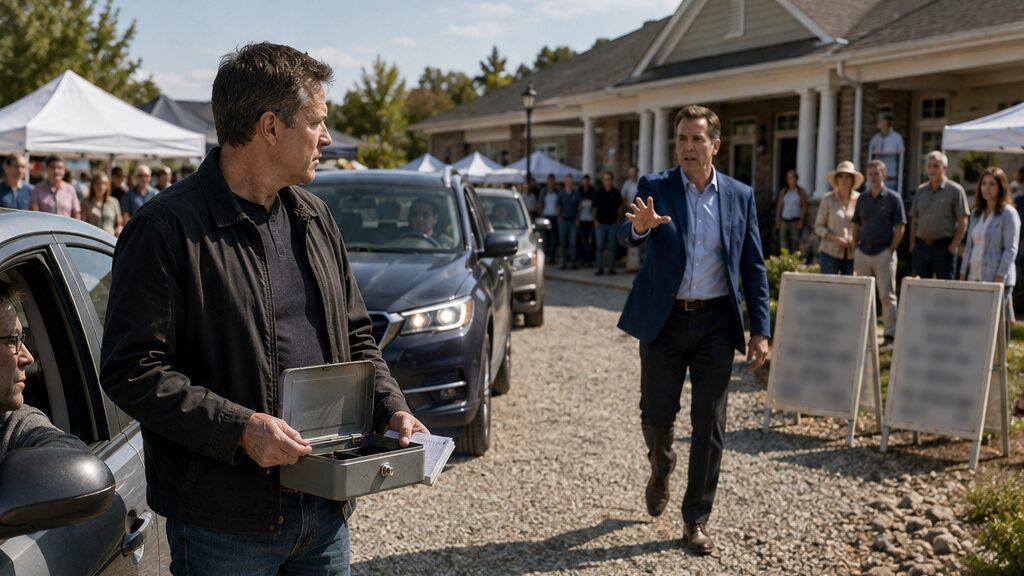
The HOA Used His Empty Lot for Years—Until He Made Their Biggest Event Pay for Every Car
Chapter 1: The Parking Lot He Never Gave Away
The food truck was sitting on Ronald Miller’s land before he knew there was an event.
He slowed at the corner, one hand still on the wheel, and stared through the windshield at a white trailer with its service window raised. Two folding tables stood beside it. Electrical cords ran toward a portable generator. A man in an apron was arranging plastic tubs beneath an awning as if he had been there all morning.
Behind him, three SUVs rolled through the gravel entrance Ronald had never bothered to gate.
Ronald pulled over.
The lot occupied a little more than half an acre beside the subdivision clubhouse, a flat patch of gravel and stubborn grass that had belonged to his family before the first rows of matching brick houses went up around it. He paid the taxes every year. He cut the weeds when they got high. He had never leased it to the homeowners association.
Yet someone had placed orange cones down its center.
A volunteer in a yellow safety vest waved another car toward the back.
Ronald got out.
“Morning,” the volunteer called. “Parking’s straight through.”
“I’m not parking.”
The man pointed automatically toward the clubhouse. “Vendor check-in is over there.”
Ronald looked past him. White tents were rising on the clubhouse lawn. Folding tables lined the sidewalk. A banner frame stood near the pool fence, though the banner had not been attached yet.
Then he looked back at the gravel beneath his shoes.
“Who told you people could park here?”
The volunteer’s hand dropped.
“This is overflow.”
“I know what you’re using it for.”
The man studied Ronald’s face, perhaps trying to decide whether he was joking.
“It’s always overflow for clubhouse events.”
Ronald felt irritation tighten behind his ribs.
“Who owns it?”
The volunteer glanced toward the clubhouse.
“I don’t know. The association, I assumed.”
“It doesn’t.”
The man shifted his weight.
Ronald did not raise his voice. He had spent most of his adult life believing that if he spoke evenly enough, reasonable people eventually became reasonable too.
“My name is Ronald Miller. This is my property.”
The volunteer’s expression changed from confusion to embarrassment.
“Oh.”
Another vehicle approached. The volunteer stepped halfway into the lane, then hesitated between directing it and continuing the conversation.
Ronald moved aside.
The SUV entered.
That bothered him more than it should have.
Not because of the tires grinding over the gravel. Because nobody stopped.
The food-truck operator walked over wiping his hands on a towel.
“Problem?”
“Who assigned you this spot?”
The operator reached into the truck and brought out a printed sheet.
“Vendor coordinator. Space twelve.”
He pointed.
The small map divided Ronald’s lot into numbered rectangles.
At the top was the clubhouse. Beside it, shaded in gray, was the entire half-acre parcel. An arrow marked the open gravel entrance. A neat label identified it as event overflow.
Ronald stared at it.
This was not three neighbors improvising because the clubhouse lot had filled.
Someone had planned this.
“Can I see that?”
The operator handed him the page.
Ronald took out his phone and photographed it.
“You need me to move?”
Ronald looked at the truck, then at the tents going up behind it.
He wanted to say yes.
Instead he heard himself answer, “Not yet.”
It was the answer he always gave when he wanted time to think.
The operator nodded with visible relief and went back to work.
“Ronald?”
Emily Brown was crossing the gravel toward him, carrying a cardboard tray of coffee cups. She lived two streets over and had served on the social committee years earlier. They knew each other well enough to wave, talk over mailboxes, occasionally borrow tools.
She looked at the map in his hand.
“Oh,” she said.
That single syllable told him more than an explanation would have.
“You knew?”
Emily stopped.
“I knew they parked here.”
“How often?”
She glanced toward the clubhouse.
“Ronald—”
“How often?”
She lowered the coffee tray.
“Most of the bigger events.”
He said nothing.
She continued more carefully. “The spring market. Graduation weekend sometimes. The fall festival. Last Christmas they put volunteer parking back here.”
“And nobody thought to ask me?”
Emily’s face tightened.
“I thought they had.”
“Who?”
“The board. The property manager. Somebody.”
Ronald folded the map once.
“I’ve never signed anything.”
“I didn’t know that.”
A golf cart rolled past carrying boxes of bottled water. Its driver lifted two fingers in greeting to Emily and continued deeper into Ronald’s lot.
Emily watched it go.
“I’m sorry,” she said. “I really did think there was an arrangement.”
“How long has this been going on?”
She hesitated.
That hesitation made his anger colder.
“Emily.”
“Several years, at least in some form.”
Ronald looked toward the open entrance.
He remembered neighbor cars there occasionally. He remembered allowing a few people to park during one fundraiser after rain turned the clubhouse shoulder muddy. That had been different. Or he had believed it was different.
A man in a blue polo walked briskly from the clubhouse.
Gregory Harris wore the practiced expression of someone approaching a problem he expected to solve quickly.
“Ronald,” he called. “I heard there was some confusion.”
“Apparently.”
Gregory smiled politely.
“We’re setting up for the neighborhood market. It’ll clear out this afternoon.”
“That isn’t the confusion.”
Gregory’s smile weakened.
Ronald handed him the vendor map.
“My property is printed on your event plan.”
Gregory glanced at it.
“Yes. Overflow and a few vendors. Same as usual.”
“Usual according to whom?”
Gregory exhaled through his nose.
“We’ve used this area for community functions for years.”
“That wasn’t my question.”
A silence settled between them.
Around them, setup continued. Metal tent legs clicked into place. Car doors shut. Someone tested a speaker near the clubhouse.
Gregory lowered his voice.
“Ronald, nobody is trying to take anything from you. This is what we’ve always done.”
Ronald looked at him.
For the first time that morning, the issue felt larger than the cars.
Gregory was not asking whether they could use the lot.
He was explaining why they already had.
Ronald handed back the map.
“I want to know who authorized it.”
“I can check the old records.”
“Do that.”
Gregory gave a small nod, already appearing relieved that the conversation was ending.
Ronald walked toward his truck.
Emily followed him to the edge of the gravel.
“There’s something else,” she said.
He stopped.
She shifted the coffee tray against her hip.
“The annual festival is next month.”
“I know.”
“No, I mean—the big one. Food vendors, kids’ activities, outside guests. They sent the parking information out this week.”
Ronald waited.
Emily looked at the open entrance behind him.
“They’re advertising this lot as overflow for that too.”
Chapter 2: The Courtesy Everyone Remembered Differently
Three days later, Ronald found a photograph that made his certainty less comfortable.
He had been looking through an old storage box for property-tax receipts when a glossy print slid from between two folders.
Eight cars were parked on the gravel lot.
Ronald recognized the year by the unfinished houses beyond the trees. He also recognized the folding tables near the clubhouse and the handwritten fundraiser signs planted along the sidewalk.
He remembered that afternoon.
A storm the night before had soaked the roadside shoulder. A woman from the social committee had knocked on his door and asked whether a few volunteers could use the dry gravel.
Ronald had said, “Sure.”
No form. No email. No conditions.
Just sure.
He sat at his kitchen table with the photograph in front of him.
At the time, the lot had felt almost like an extension of the property he had inherited—a piece of family ground he was responsible for but had no immediate plans to change. After the inheritance was settled, he had promised himself he would not rush to sell it merely because developers kept asking.
Leaving it open had seemed harmless.
Maybe even neighborly.
The problem was that he could no longer identify the moment when eight cars became eighty.
That afternoon he walked to the lot with the photograph in his pocket.
The entrance looked ordinary again. No cones. No vendors. Tire tracks crossed the gravel, but nothing marked them as belonging to anyone.
Emily was trimming a shrub beside her driveway when he passed.
“Got a minute?”
She set down the clippers.
Ronald showed her the photograph.
Emily smiled before she realized why he was holding it.
“I remember that.”
“So do I.”
“That was the school supply fundraiser.”
“I let people park.”
“Yes.”
“Once.”
Emily studied him.
“I think that’s where some of this started.”
Ronald looked toward the clubhouse.
“You were on the committee then.”
“For another year after that.”
“Did I ever tell the committee it could use the lot whenever it wanted?”
“No.”
“Did I sign anything?”
“Not that I saw.”
“Then why does everyone think I did?”
Emily rubbed dirt from her fingers.
“Because you never complained.”
He felt his jaw tighten.
“That isn’t permission.”
“I know that now.”
“Now?”
She met his eyes.
“Ronald, people parked there at the next fundraiser too. Then there was a summer picnic. You were home for at least one of them.”
“And?”
“You didn’t say anything.”
He almost answered sharply.
Then stopped.
That was true.
He remembered seeing cars.
He also remembered deciding it was not worth walking across the street to make an issue of it.
Emily continued.
“After a while, nobody talked about it as borrowing your lot. It was just where overflow went.”
“That doesn’t make it theirs.”
“No. But it explains why some people honestly think there’s an arrangement.”
Ronald looked down at the old photograph.
He had expected to find a clean beginning: a board decision, an unauthorized directive, somebody clearly deciding to use what was not theirs.
Instead he had found his own silence.
That did not excuse what Gregory was doing now.
But it complicated the story Ronald had been telling himself.
“Who started putting it on official maps?”
“I don’t know.”
“Gregory?”
“Maybe. Maybe before him.”
Emily hesitated.
“The association has old event files in the office. Calendars, vendor layouts, committee folders. Ask to see them.”
The property manager was less enthusiastic.
“We don’t usually let homeowners browse administrative files without a specific records request.”
Ronald stood at the front counter of the small HOA office adjoining the clubhouse.
“I’m being specific.”
He placed a copy of the vendor map on the counter.
“I want records showing when my parcel began appearing in event plans.”
The manager looked at the page.
“Gregory handles most event logistics.”
“Then ask Gregory.”
A few minutes later, Gregory appeared.
He remained cordial.
That almost irritated Ronald more than defensiveness would have.
“I’m trying to understand how this happened,” Ronald said.
Gregory leaned against the counter.
“I told you. Longstanding practice.”
“Practice isn’t an agreement.”
“No one said it was a deeded right.”
“Then show me when the HOA decided it could direct vendors onto my property.”
Gregory’s expression hardened slightly.
“You allowed community use.”
“I allowed some neighbors to park one afternoon.”
“That’s not how people remember it.”
Ronald thought of Emily saying the same thing.
“Then maybe people remembered what was convenient.”
Gregory straightened.
“Or maybe you were comfortable with it until suddenly you weren’t.”
The words landed because they contained some truth.
Ronald did not respond immediately.
Gregory softened his tone.
“Look, if you want us to be more careful, fine. We can discuss guidelines. But blowing up a neighborhood tradition over something everyone understood for years seems unnecessary.”
Everyone understood.
Ronald left without arguing.
At home, he requested copies of the association’s publicly available event calendars and committee records.
The pattern was gradual.
A fundraiser.
A picnic.
Volunteer parking.
Then a holiday market.
Then vendor staging.
Then “overflow parking” printed without qualification.
By the previous year, the annual festival schedule listed the lot as if it were no different from the clubhouse lot itself.
Ronald laid the pages across his dining table.
There was no dramatic theft.
No single document where someone declared his land belonged to the HOA.
There was something almost more troubling: repetition had erased the question.
That evening Emily stopped by.
“I heard you asked for records.”
“News travels.”
“It’s an HOA.”
He almost smiled.
She looked at the pages.
“I owe you an apology.”
“For what?”
“I told people years ago that parking there was probably fine.”
Ronald looked up.
Emily continued before he could speak.
“I didn’t say you’d given permission forever. But I helped reinforce the assumption.”
He leaned back.
“At least you’re saying it.”
“I should’ve asked.”
“So should I.”
Emily frowned.
“What do you mean?”
“I should’ve said something the second time. Or the fifth.”
“That doesn’t make it okay.”
“No.”
He gathered the papers into one stack.
“But pretending I had nothing to do with the confusion won’t fix it either.”
The next morning, Ronald wrote a letter.
He kept it short.
The parcel was privately owned. Past informal permission did not constitute continuing authorization. Effective immediately, all HOA-organized parking, vendor placement, staging, or event use required his prior written consent.
Without that consent, use was not permitted.
He read the letter twice.
Then once more.
His first impulse was to soften it.
Add something about appreciating the neighborhood.
Add something about hoping everyone understood.
He deleted both sentences.
At the post office, he sent the letter certified to Gregory Harris and the association office.
When the clerk slid the receipt across the counter, Ronald folded it into his wallet.
For once, he had not left the entrance open and expected everyone else to understand where the boundary was.
Chapter 3: The Email That Turned Courtesy Into Entitlement
Gregory’s reply arrived four days later, and nowhere in it did he ask Ronald for permission.
Ronald read the email once at his desk.
Then again standing up.
The message was polite. That was almost its most aggravating feature.
Gregory acknowledged receiving the certified letter. He described Ronald’s lot as having “served the broader neighborhood for many years.” He emphasized the benefit of association events, the limited availability of nearby parking, and the expectation created by longstanding community use.
He wrote that the board hoped Ronald would reconsider such a “sudden restriction.”
Not once did he say: May we use your property?
Ronald printed the email.
He placed it beside the certified-mail receipt.
For years he had avoided paperwork because paperwork made disagreements feel official.
Now the paper felt cleaner than conversation.
He called Laura Wright that afternoon.
Her office was ten minutes away in a low brick building beside a title company. Ronald brought the deed, tax records, the old photograph, the event maps, his letter, and Gregory’s response.
Laura read everything before speaking.
“You’ve got two different problems.”
“I only own one lot.”
“That’s not what I mean.”
She tapped the old photograph.
“Historically, you created some ambiguity.”
Ronald frowned.
“I let people park once.”
“And then you knew people continued using it and didn’t object.”
“I never granted permanent access.”
“I’m not saying you did.”
She slid the certified letter toward him.
“I’m saying those years explain why a reasonable neighbor might have believed permission continued.”
Ronald sat back.
“And now?”
“Now is different.”
Laura tapped the delivery confirmation.
“This is clear.”
“So they can’t claim they didn’t know.”
“They can claim plenty of things. People always can. But after this notice, the social misunderstanding becomes much harder to confuse with consent.”
Ronald looked at Gregory’s email.
“He still talks like the neighborhood has a right to it.”
Laura read the relevant paragraph again.
“He talks like losing it creates a problem.”
“That’s not the same thing.”
“No. But it may explain why he’s pushing.”
Ronald folded his arms.
“What problem?”
“Ask him.”
He did.
Gregory agreed to meet at the clubhouse late the next afternoon.
The gravel entrance beside it was empty when Ronald arrived.
For the first time since the dispute began, no vehicles were crossing the lot.
He should have felt relieved.
Instead the emptiness looked temporary.
Gregory was already inside the meeting room with a laptop open.
“I don’t want this turning into a lawyer fight,” he said when Ronald sat down.
“Neither do I.”
“Then there should be room to work something out.”
“There is. Ask before using my property.”
Gregory pressed his lips together.
“You know it isn’t that simple.”
Ronald waited.
Gregory turned the laptop around.
A site plan showed the clubhouse, pool, entrance road, fire lane, resident parking, and Ronald’s gravel parcel.
“The clubhouse lot holds sixty-two vehicles if we preserve the fire lane and accessible spaces.”
Ronald said nothing.
“Our annual festival draws several hundred people over the day. Vendors consume part of the paved capacity. If we lose your lot, we either reduce the event substantially or rent off-site parking and arrange transportation.”
“That sounds like an HOA planning problem.”
“It becomes a homeowner problem when we have to pay for it.”
There it was.
Gregory scrolled through figures.
Temporary parking. Shuttle service. Insurance. Traffic control.
Even without studying every number, Ronald understood the point.
The HOA had not merely grown accustomed to his land.
It had built its expectations around free use of it.
Gregory leaned back.
“You think I’m trying to take advantage of you.”
“Aren’t you?”
“I’m trying to avoid spending thousands of association dollars solving a problem nobody thought we had until last week.”
“You had the problem. You just put it on my property.”
Gregory looked away.
For a moment, his polished confidence slipped.
“Homeowners complain when dues go up twenty dollars.”
“So?”
“So try telling three hundred households we need a special assessment because one person changed his mind after years.”
Ronald felt the old reflex immediately: the urge to reduce the conflict, to say he did not want trouble, to offer some temporary compromise simply because another person had made discomfort sound like harm.
He recognized the reflex now.
“My taxes aren’t an HOA assessment,” he said. “I pay them whether you use the lot or not.”
“I understand that.”
“Do you?”
Gregory’s face tightened.
“We’re talking about six or seven community events a year.”
“Then send me six or seven requests.”
“That creates uncertainty.”
“For you.”
“Yes, for us.”
Ronald nodded.
“That’s what ownership means.”
Gregory shut the laptop.
Neither man spoke for several seconds.
Finally Gregory said, “I’ll take your position back to the board.”
Ronald stood.
“My position was already delivered to the board office.”
Gregory did not answer.
Outside, Ronald stopped at the gravel entrance.
Still empty.
He realized he had been waiting to see emptiness as proof the matter was resolved.
Laura had warned him not to confuse acknowledgment with compliance.
That night, Ronald opened the neighborhood email bulletin.
The annual festival announcement was near the top.
Food vendors. Local booths. Family activities. Saturday, nine to four.
He scrolled down.
Under parking instructions was a simple directional map.
The clubhouse lot was marked.
So was his parcel.
An arrow pointed directly through the open gravel entrance.
Ronald stared at it for a long time.
Then he checked the date on the announcement.
It had been sent that afternoon.
After his meeting with Gregory.
Chapter 4: Fifty Minutes Before the First Cars Arrived
Ronald knew something had gone wrong before he reached the gravel entrance.
Two white vendor tents were already standing on his lot.
A third lay half assembled beside a trailer, its metal legs spread across the gravel. Someone had driven stakes into the packed ground along the edge nearest the clubhouse. A refrigerated van idled farther back while volunteers carried boxes toward tables.
The annual festival did not officially start for more than an hour.
Ronald pulled onto the shoulder and sat behind the wheel for three seconds longer than he needed to.
He had spent the week telling himself Gregory might have left the old parking map in circulation by mistake.
Now one of the volunteers was hammering another stake into Ronald’s property.
He got out.
“Hold up.”
The volunteer stopped and looked over.
“This is private property.”
The man glanced toward the clubhouse. “We were told vendor overflow starts here.”
“By whom?”
“I don’t know. Event coordinator, I guess.”
Ronald walked to the closest tent.
A laminated vendor sheet was clipped to one leg. The spaces had been numbered. His lot was divided almost exactly as it had been on the earlier map.
Nothing about the setup looked improvised.
A woman carrying a crate of bottled drinks paused.
“Are we in the wrong place?”
Ronald looked around at the vendors already unloading.
“You were put in the wrong place.”
She frowned. “They sent us this map yesterday.”
Yesterday.
Ronald took out his phone and called Laura.
She answered on the fourth ring.
“They’re setting up.”
“On your parcel?”
“Yes.”
“After the written notice?”
“Yes.”
“Do not start dragging tents around yourself.”
“I wasn’t planning to.”
“Good. And don’t block the public street.”
Ronald looked toward the open entrance.
“What can I do?”
“You can control access to your own property. But you need to do it without creating a traffic hazard or trapping anyone already there.”
A truck turned toward the lot.
Ronald watched the volunteer wave it through.
“What if I close the entrance?”
“You can deny entry. But with this many cars arriving, I’d be careful about doing anything abrupt. Make the boundary clear. Document everything.”
He looked at the tents again.
“Clear hasn’t worked.”
Laura was silent for a moment.
“What are you thinking?”
Ronald did not have an answer yet.
He walked toward the clubhouse.
Inside, volunteers moved through the hallway carrying boxes, extension cords, and stacks of paper plates. Gregory was nowhere in sight.
The HOA treasurer stood beside a folding table counting wristbands.
Ronald approached him.
“Did the board approve using my lot today?”
The treasurer looked up.
“I thought that was handled.”
“What does that mean?”
“That Gregory said the parking issue was under control.”
“Did he show you my certified letter?”
The man’s expression changed.
“What certified letter?”
Ronald felt something settle into place.
Not surprise exactly.
Confirmation.
“I withdrew permission weeks ago.”
The treasurer lowered the wristbands.
“I knew you were unhappy about the parking. I didn’t know you’d formally revoked anything.”
“Did the board vote to ignore it?”
“No.”
“Was there a meeting about it?”
“Not that I attended.”
Ronald glanced through the clubhouse windows toward his lot.
Several more vehicles had arrived.
The treasurer followed his gaze.
“I need to call Gregory.”
“You should.”
Outside, Ronald returned to the gravel entrance.
He could put up a chain. He could park his truck sideways. He could call every vendor over and tell them to leave.
Each option would create a scene before he was certain what he wanted the scene to accomplish.
For years, Ronald had avoided decisions until other people’s choices became facts around him.
He could feel himself doing it again.
Waiting.
Hoping Gregory would appear and make this simpler.
A sedan turned into the entrance.
Ronald stepped aside and let it pass.
Then he became angry with himself.
Not because the car entered.
Because once again, he had surrendered the decision by doing nothing.
He called Laura back.
“I want to charge for access.”
There was a pause.
“Explain.”
“They’re using the lot because free parking solves their problem. I’m not going to trap anyone already inside, and I’m not blocking the street. But anyone entering from now on pays for temporary access.”
“You need clear terms.”
“I’ll make them clear.”
“And receipts.”
“I can do receipts.”
“Do not imply they’re paying the HOA. Make it obvious they’re paying you for temporary access to private property.”
Ronald looked toward the commercial strip beyond the subdivision entrance.
“I’ll call you back.”
Fifty minutes later he returned with two portable signs, a receipt book, thick markers, and the old folding cash box he had kept in a garage cabinet since helping with a family yard sale years earlier.
The box clicked when he opened it.
For some reason, that sound steadied him.
He positioned one sign far enough inside the entrance that drivers could stop without blocking the street.
PRIVATE PROPERTY.
TEMPORARY EVENT ACCESS.
$20 PER VEHICLE.
He added a final line stating that payment granted access only for that day and did not create any continuing right of entry.
The second sign repeated the terms near the interior fork.
He did not close the entrance.
He stood beside it.
The first vehicle slowed.
A middle-aged couple inside stared at the sign.
The driver rolled down his window.
“Is this festival parking?”
“It can be,” Ronald said. “This is private property. Temporary access is twenty dollars today.”
The driver blinked.
“I thought parking was free.”
“The HOA parking may be. This lot is mine.”
The couple exchanged a look.
Then the driver handed Ronald a twenty.
Ronald wrote the receipt.
The next car turned away.
The one after that paid.
By the fifth vehicle, a volunteer hurried over.
“You can’t charge people for HOA parking.”
“I’m not.”
“This is where we send overflow.”
“You can send them somewhere else.”
The volunteer stared at him.
Ronald gestured toward the sign.
“I gave the association written notice. If someone wants temporary access today, those are the terms.”
The volunteer pulled out his phone and walked away.
Ronald knew exactly who he was calling.
Another vehicle stopped.
Then another.
Cash went into the metal box.
Each time the lid opened, the situation became more real.
He was not winning an argument.
He was making a boundary visible.
Across the lot, one of the board members approached the treasurer near the clubhouse. They spoke urgently, both looking in Ronald’s direction.
A vendor walked over.
“Are we supposed to pay too?”
“You’re already inside.”
“So you’re not kicking us out?”
“I haven’t decided what happens with existing setups yet.”
She nodded slowly.
“Gregory told us this was HOA property.”
Ronald looked at her.
“Those were his words?”
“Close enough.”
Before Ronald could ask more, he heard someone call his name.
Not from nearby.
From across the gravel.
“Ronald!”
Gregory had emerged from behind the clubhouse.
He saw the sign first.
Then the cash box.
Then the line of vehicles slowing at the entrance.
For one brief second, he simply stood there.
After that, he started toward Ronald.
Fast.
Chapter 5: The President Who Called It Community Property
“This has always been for the neighborhood.”
Gregory said it before he reached Ronald.
He crossed the last stretch of gravel with his face flushed and his blazer open, one hand already pointing toward the sign.
“Take that down.”
Ronald closed the cash box.
“No.”
“You are creating a traffic problem in the middle of our largest event.”
“I’m standing on my property.”
“You’re charging our guests.”
“I’m charging drivers who choose to enter my land.”
Gregory looked at the waiting vehicles, then back at Ronald.
“People were told parking was included.”
“That’s between you and the people you told.”
The words came more easily than Ronald expected.
Gregory lowered his voice.
“You know what you’re doing.”
“Yes.”
“This is retaliatory.”
“No. Retaliatory would be waiting until everyone parked and then trying to punish them. I posted terms before they entered.”
A car behind them turned around and left.
Gregory watched it go.
“This space has been used by this neighborhood for years.”
“Used is not owned.”
“Nobody said owned.”
“You told vendors where to set up.”
“Because that’s how the event has always functioned.”
Ronald looked at him.
There it was again.
Always.
A word that turned repetition into authority.
Gregory stepped closer.
“You had opportunities to raise this privately.”
“I did.”
“You sent one letter after years of allowing access.”
“And you received it.”
Gregory’s jaw moved.
“Yes.”
A voice came from behind them.
“What letter?”
One of the board members had approached unnoticed.
The treasurer was with him.
Gregory turned.
“This is not the time.”
The board member looked at Ronald.
“What letter?”
Ronald did not take his eyes off Gregory.
“The certified notice delivered three weeks ago. It withdrew all HOA event access unless I approved it in writing.”
The board member looked sharply at Gregory.
“Three weeks?”
Gregory rubbed a hand over the back of his neck.
“We discussed the parking issue.”
“You told us you were working it out.”
“I was.”
Ronald opened the cash box to make change for another driver.
Nobody spoke while he wrote the receipt.
The ordinary movement of pen across paper seemed to make Gregory angrier.
“You are embarrassing the association.”
Ronald tore off the receipt and handed it through the window.
“No. I’m charging for access to my property.”
The car continued onto the gravel.
A few people nearby had started paying attention. Not a crowd, but enough.
A woman waiting beside a vendor table muttered something about greedy homeowners.
Ronald heard it.
He also heard someone else ask why the HOA had scheduled vendors on private property.
The story was already changing depending on who told it.
Gregory glanced toward them.
“This is exactly why I didn’t want this handled publicly.”
Ronald caught the wording.
“Didn’t want what handled publicly?”
Gregory said nothing.
The treasurer stepped forward.
“Gregory, did the board receive a copy of Ronald’s notice?”
“I received it as president.”
“That isn’t what I asked.”
“We had an event coming up.”
The treasurer stared at him.
“So you didn’t circulate it.”
Gregory’s face tightened.
“I was trying to resolve it before turning it into a crisis.”
Ronald almost laughed, but there was nothing funny in it.
Instead he said, “You resolved it by printing my property on the festival map.”
Gregory looked at him.
“You want the truth? Moving this event somewhere else on three weeks’ notice would have cost thousands. The shuttle quote alone was ridiculous. We would have needed traffic control, revised vendor contracts, maybe a special assessment depending on the final number.”
“So you decided I’d absorb the cost.”
“I decided you would calm down.”
The sentence hung between them.
Gregory seemed to realize what he had said.
Ronald felt something shift inside him.
Not triumph.
Clarity.
Gregory had not believed the property belonged to the HOA in any legal sense.
He had believed Ronald’s reluctance to make a scene was part of the HOA’s available resources.
“You counted on me backing down.”
“I counted on you being reasonable.”
Ronald nodded once.
“That’s not the same thing.”
The board member beside the treasurer looked toward the tents.
“What happens to the vendors already set up?”
Ronald had been asking himself that since morning.
He could demand everyone leave immediately.
He had the leverage now.
But the food-truck operator had not ignored his letter. Neither had the woman selling baked goods or the volunteer carrying bottled water. They had followed the directions they were given.
Ronald looked at Gregory.
“Commercial vendor setups need to move off my parcel.”
Gregory’s eyes widened.
“You can’t possibly expect—”
“I do.”
“Where?”
“That is your event-planning problem.”
For the first time, Ronald understood the distinction without anger.
He did not need to make Gregory suffer.
He needed to stop solving Gregory’s problem for him.
The treasurer stepped in.
“We can move some vendors onto the west lawn if we tighten the booth spacing.”
Gregory turned on him.
“That blocks the activity area.”
“Then we adjust the activity area.”
“The fire lane—”
“We preserve the fire lane.”
The two men began arguing in clipped logistical phrases.
Ronald stepped away.
Within twenty minutes, volunteers were carrying tables off his lot.
Tent legs came up one by one.
The food-truck operator started his engine and waited for directions.
Some attendees complained.
A few demanded refunds for parking after learning the HOA had advertised free overflow.
Ronald refunded two drivers who decided to leave before parking.
He was not interested in trapping anyone in a technicality.
Emily appeared near the entrance carrying a box of event programs.
She looked at the moving tents, then at Ronald’s cash box.
“I heard what happened.”
“I imagine everyone has.”
She lowered her voice.
“They think you shut down half the festival.”
“I didn’t.”
“I know.”
She nodded toward Gregory.
“He didn’t tell the board?”
“Apparently not.”
Emily’s expression hardened.
“That changes things.”
“Some things.”
Not everything.
Ronald looked at the families crossing between the clubhouse lawn and the relocated booths. A few seemed annoyed. Some did not know what had happened. A child dragged a balloon through the gravel while a parent tried to read a revised parking sign.
Ronald had wanted his property back.
He had it.
The satisfaction was thinner than he had imagined.
He wondered whether that was because the cost was visible now.
Gregory stood near the clubhouse giving directions with shorter, sharper gestures than before.
The treasurer approached him.
Ronald could not hear the first sentence.
He heard the second.
“Why did none of us see the certified notice?”
Gregory stopped moving.
The treasurer held out his hand.
“I want the copy you received.”
Gregory looked toward Ronald.
Then toward the board members gathering behind the treasurer.
For the first time all day, he had no quick answer.
Chapter 6: What the Board Had Built Around His Silence
“We never budgeted for replacement parking.”
The HOA treasurer said it at Ronald’s kitchen table two days after the festival.
No defensiveness.
No accusation.
Just a fact.
A folder lay open between them, filled with printed event budgets and vendor estimates the board had begun reviewing after Saturday.
Laura sat to Ronald’s right.
Across from her, the treasurer moved a finger down a column of numbers.
“For years, the parking line for major events was essentially zero. Cones, volunteer vests, maybe temporary signs. That was it.”
“Because you used my lot,” Ronald said.
“Yes.”
The answer was immediate.
That mattered.
The treasurer continued.
“Once an assumption gets built into a budget, people stop seeing it as an assumption.”
Ronald looked through the kitchen window toward the empty gravel entrance.
He had placed temporary markers there after the festival.
Nothing permanent.
Yet for the first time in years, cars were staying out.
Laura turned a page.
“These records go back how far?”
“Five years in this format. Older committee files are less complete.”
The pattern was clear enough.
As events grew, the HOA had added vendors, activities, outside visitors, and larger attendance projections.
Parking costs barely moved.
Ronald’s property had absorbed the growth.
The treasurer closed the folder.
“There’s an emergency board meeting tonight. You’re invited.”
“Is Gregory?”
“He’s still president.”
Ronald looked at him.
“For now?”
“That’s not my decision alone.”
The meeting room was full that evening.
Not standing-room-only, but fuller than Ronald had ever seen it outside an annual election. Some homeowners came because they were angry with Gregory. Others came because they were angry with Ronald.
Ronald could tell which group was which before anyone spoke.
One homeowner near the back crossed his arms when Ronald entered.
Another gave him a small nod.
Gregory sat at the front table.
He looked tired.
The treasurer summarized the issue without drama: Ronald owned the parcel; historic permission had never been formalized; Ronald had withdrawn permission in writing; Gregory received the notice; the full board had not.
Then Gregory asked to speak.
He stood slowly.
“I should have circulated the letter.”
Nobody interrupted.
“I didn’t.”
He glanced toward Ronald.
“I believed I could resolve the issue directly before it forced a larger expense onto the association.”
A homeowner spoke from the second row.
“What expense?”
Gregory looked toward the treasurer.
“Alternative parking, transportation, event redesign. Depending on the option, several thousand dollars annually.”
Murmurs moved through the room.
Someone asked whether dues would increase.
Gregory answered carefully.
“Potentially. Or events would need to be reduced.”
There it was.
The pressure he had been carrying.
It did not excuse him.
But Ronald could finally see its shape.
Gregory had not woken up one morning wanting to steal a neighbor’s gravel lot. He had inherited a convenient arrangement, watched the HOA grow dependent on it, and then reached a moment where admitting the arrangement was never secure would make him responsible for a problem nobody wanted to pay to solve.
So he had gambled on Ronald.
Specifically, on Ronald’s reluctance to force an issue.
Gregory looked at him.
“I believed, based on the history, that Ronald would ultimately agree to continued use.”
“You mean relent,” Ronald said.
Gregory paused.
“Yes.”
The honesty surprised the room into silence.
“I thought the alternative cost was unreasonable when we had used the space without conflict for years.”
Ronald leaned back.
A week earlier, he would have heard only entitlement.
Now he heard fear mixed with it.
Fear of assessments.
Fear of homeowners asking why nobody planned for parking.
Fear of admitting that a free solution had never actually belonged to the HOA.
Then a woman in the back row spoke.
“He did let us use it.”
Several heads turned.
She continued.
“For years. My family parked there. Everybody parked there. Now suddenly we’re the bad guys?”
Ronald felt every eye move toward him.
This was the part he could not answer with a deed.
“I did let people use it,” he said.
The woman lifted her hands.
“Exactly.”
“I also should have been clearer when occasional use became routine.”
That quieted some of the room.
Ronald continued.
“I saw cars there before. I didn’t object every time. I assumed people understood it was a favor.”
Emily sat along the side wall.
She met his eyes.
Ronald said, “They didn’t.”
The woman in back seemed surprised.
“So you admit we thought it was allowed.”
“Yes.”
“Then why punish everybody?”
“I’m not asking anyone to pretend the past was clearer than it was.”
He looked toward Gregory.
“But after my certified letter, it was clear.”
Gregory looked down.
That was the line.
The history explained misunderstanding.
It did not explain what happened after notice.
A board member asked, “What do you want now, Ronald?”
The question was harder than he expected.
Money would be simple.
Permanent closure would be simpler.
He could install a fence and never have another conversation about it.
Laura had assumed that was where he might end up. She had even brought preliminary notes on access control and liability.
Yet Ronald thought of the first fundraiser.
Eight cars.
Neighbors carrying folding tables across the gravel.
Nothing stolen.
Nothing assumed.
Someone had asked.
He had said yes.
Somewhere between that afternoon and Saturday’s festival, the yes had stopped belonging to him.
The treasurer slid another document across the table.
“The association is willing to pay for permanent fencing around the parcel, including a controlled gate.”
Several homeowners nodded.
One said, “That solves it.”
Another added, “Probably best for everyone.”
Ronald looked at the estimate.
A full perimeter fence.
Posts.
Gate hardware.
Installation.
It would end the argument by making permission physically inconvenient.
Gregory spoke quietly.
“If that’s what you want, I’ll support it.”
Ronald looked at him.
There was no challenge in his voice now.
Maybe Gregory thought Ronald had earned the right to close everything.
Maybe he hoped a fence would end the public embarrassment.
Ronald folded the estimate once.
“I’m not answering tonight.”
The homeowner in back frowned.
“Why not?”
“Because I spent years avoiding a decision about this property. I’m not going to make the permanent one because everyone in this room wants the discomfort over with.”
Nobody responded.
Ronald stood and picked up the fencing estimate.
Outside the clubhouse, the gravel entrance waited under the parking-lot lights.
Empty.
For years, openness had meant Ronald expected people to know where courtesy ended.
A permanent fence would certainly make the answer obvious.
He just was not sure obvious and closed were the same thing.
For the first time, the decision belonged entirely to him.
And Ronald had not yet decided what kind of boundary he wanted.
Chapter 7: The Boundary Ronald Finally Chose
The first homeowner to speak at the next board meeting wanted Ronald’s lot fenced by the end of the month.
The second wanted the HOA to negotiate permanent access.
By the time Ronald was invited to the front table, both solutions had been repeated enough times to sound inevitable.
He placed a thin folder in front of him and remained standing.
“I don’t want either one.”
The room quieted.
A homeowner near the back frowned. “You don’t want the fence?”
“No.”
Gregory Harris sat two seats from the treasurer. He had spoken little since the meeting began.
Another homeowner leaned forward.
“So after everything that happened, you’re still going to let people use it?”
Ronald looked around the room.
“That depends on what you mean by let.”
A few people shifted.
Laura Wright sat along the side wall, not at the board table. Ronald had asked her to review the language he intended to propose, but the decision itself was his.
He opened the folder.
“I don’t want the HOA to have permanent access. I don’t want the property listed on event maps unless I’ve approved that specific event. I don’t want vendors assigned there automatically. And I don’t want anyone treating the fact that the entrance is open as permission.”
The homeowner who had pushed for fencing crossed his arms.
“That sounds like a fence with extra steps.”
“No.”
Ronald looked toward the clubhouse windows. Beyond them, the gravel lot sat dark and empty.
“A fence says nobody enters. That isn’t what I want.”
He took out one sheet.
“What I’m willing to allow is limited neighborhood use when it makes sense.”
Several people began speaking at once.
The treasurer raised a hand.
“Let him finish.”
Ronald continued.
“For nonprofit neighborhood events, the association can submit a written request in advance. The request identifies the date, hours, purpose, expected number of vehicles, and who is responsible for cleanup.”
He glanced at Gregory.
“No commercial vendor staging unless I specifically approve it.”
Gregory nodded once.
“Liability coverage has to include the parcel for the event. If damage occurs, the association handles it. No overnight parking. No automatic renewals. And approval for one event means one event.”
A woman in the second row raised her hand.
“How far in advance?”
“Two weeks unless there’s an actual emergency.”
“What if you say no?”
“Then I say no.”
The answer produced the first real tension of the evening.
Someone behind Ronald muttered, “So everything still depends on one person.”
Ronald turned.
“Yes.”
The homeowner looked surprised by the lack of apology.
Ronald continued.
“Because it belongs to one person.”
He did not say it sharply.
That made the sentence land harder.
Another board member looked at the conditions.
“What about fees?”
“For neighborhood charity events, probably none.”
“Probably?”
“I’m not promising free access forever.”
A few people exchanged looks.
Ronald knew some of them wanted a permanent formula because formulas removed the discomfort of asking.
He understood that desire now.
It was exactly what had caused the problem.
Emily Brown raised her hand from the side of the room.
“I think the important part is the request.”
Everyone looked toward her.
She continued.
“We spent years saying Ronald didn’t mind. None of us had to find out whether he minded because we stopped asking.”
Ronald met her eyes.
She gave him a small nod.
The treasurer turned to Gregory.
“There’s one more issue before we can vote on any agreement.”
Gregory already knew what it was.
He stood.
The room became very still.
“I received Ronald’s certified notice three weeks before the festival,” he said.
No one interrupted him.
“I did not circulate it to the full board.”
He swallowed once.
“I believed I could persuade him to continue the existing arrangement. I also believed that if I brought the issue to the board immediately, we would either cancel part of the festival or incur expenses we had not budgeted for.”
A homeowner said, “So you hid it.”
Gregory looked at him.
“Yes.”
There was no attempt to soften the answer.
“I thought I was protecting the event. I also thought Ronald would back down because he had never pushed the issue before.”
Ronald felt the words differently than he would have a month earlier.
They still angered him.
But they no longer surprised him.
Gregory continued.
“That was my mistake. The history was ambiguous. The letter was not.”
He sat down.
There was no applause.
No dramatic demand for resignation.
Only the uncomfortable sound of papers shifting and someone clearing a throat.
Ronald preferred it that way.
The board voted to authorize Laura to draft a limited-use agreement based on Ronald’s conditions. The exact language would return for review, but the principle passed without opposition.
After the meeting, homeowners gathered in small groups.
Some stopped Ronald.
A few said they thought the rules were fair.
One man said the whole thing had gone too far.
Ronald agreed with him.
That seemed to confuse the man.
Outside, Emily caught up near the sidewalk.
“You surprised people.”
“By not building the fence?”
“By giving them another chance.”
Ronald looked toward the entrance.
A temporary chain stretched between two posts he had installed that week. It could be removed in less than a minute.
“I wasn’t trying to make the lot useless.”
Emily smiled faintly.
“No. You were trying to make the word yes mean something again.”
She walked toward her house.
Gregory was still inside.
Ronald waited.
A few minutes later, Gregory emerged carrying a folder beneath one arm.
When he saw Ronald, he stopped.
“You need something?”
“I asked you to stay.”
Gregory looked toward the nearly empty parking lot.
“I remember.”
They walked to the edge of the gravel.
For a while neither spoke.
Finally Gregory said, “I assume this is where you tell me not to come near your property again.”
“No.”
Gregory looked at him.
Ronald rested one hand on the temporary chain.
“I want you to understand something.”
“I think I do.”
“I don’t think you stole my land.”
Gregory’s face changed slightly.
Ronald continued.
“I think you decided my discomfort was cheaper than everybody else’s.”
Gregory looked down.
“That’s fair.”
“No. It wasn’t.”
Gregory gave a humorless breath.
“You know what I mean.”
Ronald did.
After a moment Gregory said, “When I took over event planning, that lot was already on every map I was given. Nobody told me there was no agreement.”
“I believe you.”
“The first year, I genuinely thought we had permission.”
“I believe that too.”
Gregory looked toward him.
“And later?”
“Later you knew enough to ask.”
The words sat between them.
Gregory nodded.
“Yes.”
Ronald unhooked the chain, lifted it several inches, then placed it back.
“I’m not interested in pretending nothing happened.”
“Neither am I.”
“But we still live three streets apart.”
Gregory almost smiled.
“That sounds threatening when you say it like that.”
Ronald smiled despite himself.
“It means I’d rather not spend the next ten years staring past you at mailboxes.”
Gregory looked at the gravel.
“I can manage hello.”
“So can I.”
It was not forgiveness.
It did not need to be.
Gregory started toward his car, then turned.
“For what it’s worth, you should have told us sooner.”
Ronald considered taking offense.
Instead he nodded.
“I should have.”
Gregory nodded back.
“And I should have listened when you finally did.”
He walked away.
Ronald remained at the entrance.
For years, the opening had meant whatever everyone else assumed.
Now a simple removable chain crossed it.
Not a wall.
Not a surrender.
A choice.
Chapter 8: An Open Gate Is Not an Invitation
The first car arrived early and stopped outside the chain.
Ronald watched from his porch.
A second vehicle pulled in behind it but did not honk. The drivers simply waited on the shoulder where the temporary event plan instructed them to wait.
Several months earlier, Ronald would have seen cars already spreading across the gravel by now.
This morning, nobody entered.
He picked up the key and walked over.
The event was small—a neighborhood charity collection organized through the HOA. No commercial vendors. No outside advertising. The request had arrived seventeen days earlier with the hours, insurance confirmation, cleanup plan, and estimated number of cars.
Ronald had signed yes.
The driver of the first car rolled down the window.
“Morning.”
“Morning.”
Ronald unlocked the chain.
He lifted it from one post and carried it aside.
Only then did the first car enter.
The gesture took less than thirty seconds.
It felt completely different from leaving the entrance open.
By ten, perhaps two dozen cars sat neatly along the marked gravel.
Volunteers unloaded boxes near the clubhouse but nothing was staged on Ronald’s property beyond the parking area they had requested.
Nobody assumed more space simply because more space existed.
Emily found him near the entrance around noon.
She carried two paper cups and handed him one.
“No cash box?”
Ronald looked at her.
“I retired from the parking business.”
She laughed.
The old folding box was back on a shelf in his garage.
He had kept it.
Not as a trophy.
As a reminder of the day he finally stopped expecting silence to communicate for him.
Emily watched another car enter.
“Do you think all the rules made things colder?”
Ronald took a drink.
“What do you think?”
“I’m asking you.”
He considered the lot.
A volunteer at the far end was moving a cone to give an older driver more room. Someone else picked up a paper bag that had blown loose.
Nothing about the scene felt cold.
“It feels quieter,” Ronald said.
Emily raised an eyebrow.
“That’s not the same answer.”
“No.”
He looked at the open entrance.
“I used to think being neighborly meant not making people ask.”
“And now?”
“Now I think asking is part of being neighborly.”
Emily smiled.
“That sounds like something Laura would put in a contract.”
“She charges too much to write like that.”
They stood together for a while.
Gregory passed on the sidewalk carrying a cardboard box toward the clubhouse.
He no longer handled event planning. The board had reassigned those duties after the festival, though he had remained a board member and a neighbor.
When he reached Ronald, he stopped.
“Everything okay?”
“So far.”
Gregory looked at the parked cars.
“We stayed under the number we requested.”
“I noticed.”
“Progress.”
“Don’t get sentimental.”
Gregory smiled.
“Wouldn’t dream of it.”
He continued toward the clubhouse.
Emily watched him go.
“You two are strange.”
“We’re neighbors.”
“That may be the same thing.”
By late afternoon, the volunteers packed away the last tables.
Cars left gradually.
The final driver stopped at the entrance and lowered the window.
“Thanks for letting us use the space.”
Ronald looked at the nearly empty lot.
“You’re welcome.”
The words surprised him with their simplicity.
After the car turned onto the street, Ronald waited until the dust settled.
Then he carried the chain back across the entrance.
He hooked one end to the post.
Pulled it gently taut.
Locked the other.
The gravel beyond it looked exactly as it had for years—flat, open, ordinary.
The difference was not the chain.
The difference was that Ronald had opened it that morning because someone had asked, and he had wanted to say yes.
Now the last car was gone.
So he closed it.
Not because he was angry.
Not because the neighborhood had lost his trust forever.
He closed it because the decision was his again.
The story has ended.