The Developer Flooded His Family Farm Until an Old Easement Forced Him to Choose
Chapter 1: The Brown Water Reached the Barn Before Noon
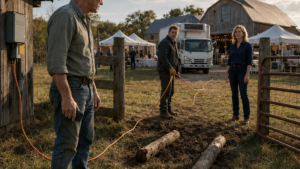
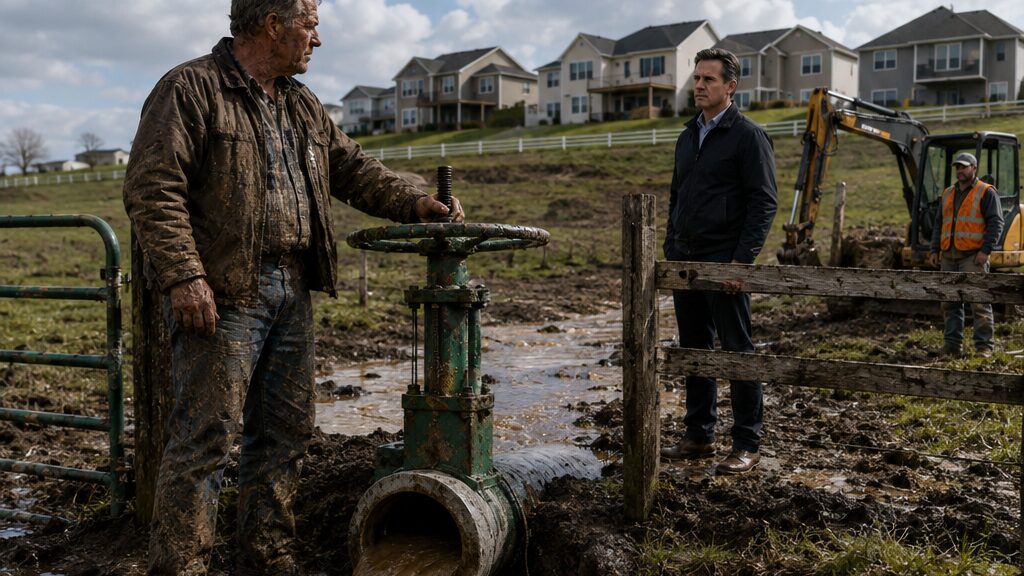
The gray pipe coughed once beneath the fence, then brown water burst from it hard enough to knock dead grass flat.
Robert Baker dropped the fencing pliers from his hand.
For half a second he simply watched. The pipe had carried spring runoff for as long as he could remember, but never like this. Water came out under pressure, thick with silt, spreading in a widening sheet across the lower pasture.
“Son of a—”
He stopped himself, stepped over the wire brace, and splashed toward the outlet.
The ground had already softened around his boots. Fifty yards downhill stood the red barn his grandfather had built before Robert was born. Between the pipe and the barn lay the low forty—the best grazing ground on the farm in a dry summer and the first place to turn ugly when water had nowhere to go.
Robert bent beside the outlet. No rain had fallen since Saturday.
That was the part that made no sense.
He straightened and looked uphill.
Above the old fence line, where soybean ground had once rolled toward the county road, white houses stood in neat rows. New roofs. New retaining walls. New streets cut into a slope Robert had known as pasture when he was a boy.
A drainage ditch along the subdivision glinted in the sun.
Robert stared at it, then back at the pipe.
By ten-thirty, the water had reached the first cattle track.
By eleven, it had crossed it.
At eleven-twenty, a dark pickup stopped at Robert’s gate.
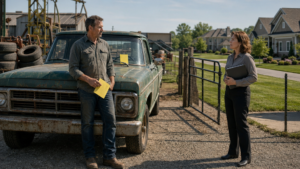
The man who stepped out wore polished boots that had never seen manure and a navy jacket over a white shirt. Robert recognized him from two meetings about the subdivision.
Edward Clark.
Robert met him halfway across the pasture.
“What did you turn on?”
Edward glanced at the water as though Robert had asked about a streetlight.
“Nothing got turned on.”
“That pipe hasn’t run like that in thirty years.”
“The new stormwater system came online this morning.”
Robert looked past him toward the houses.
“So you are dumping it here.”
“We’re discharging through an existing drainage corridor.”
“You’re dumping it here.”
Edward exhaled through his nose.
“The system was designed and approved.”
Robert stepped closer. Mud had already climbed above the stitching on his boots.
“Approved by who to flood my cattle ground?”
“It isn’t supposed to flood.”
Robert pointed.
“Then what do you call that?”
Edward finally looked carefully. Water had reached the shallow depression below the barn road.
“I’ll have engineering check the volume.”
“Shut it off first.”
“I can’t shut down a subdivision drainage system because you don’t like where the water goes.”
Robert’s jaw tightened.
“You’re standing on my land.”
“And the drainage easement crosses your land.”
The word stopped him.
“What easement?”
Edward studied him for a moment.
“You’re serious?”
Robert said nothing.
Edward reached into his truck, returned with a folder, and pulled out a printed site plan. A heavy blue line ran from the subdivision drainage basin down through Robert’s pasture.
“Recorded drainage easement,” Edward said. “It predates our project.”
Robert took the sheet but did not look away from him.
“My family never gave you permission to put a subdivision through my pasture.”
“Not us specifically. The upper property.”
“There wasn’t a subdivision up there.”
“That doesn’t mean the easement vanished.”
Robert folded the plan once, hard enough to crease it.
“Get the water stopped.”
Edward’s expression changed—not much, but enough.
“We have another phase connecting before the next storm.”
Robert looked at him.
“You’re increasing it?”
“The system has to function as designed.”
Behind them, something slapped against the fence. A floating clump of hay had caught against the bottom wire.
Robert walked away without another word.
He spent the next two hours cutting a shallow diversion with the tractor blade, trying to keep the water from reaching the barn lane. It helped for fifteen minutes. Then the ditch filled and spilled over.
An adjacent cattle farmer stopped at the road and climbed through the gate.
“This from up there?”
Robert nodded.
“No rain.”
“I noticed.”
The neighbor crouched, rubbed muddy water between two fingers, and stood again.
“That’s not field runoff.”
Robert had reached the same conclusion.
The flow was too steady. Too controlled.
Engineered.
That bothered him more than the mud.
Rain was something a farmer accepted. Water released through pipework somebody else had calculated was different. Somebody had chosen where it went.
By late afternoon, Robert found the old green flow gate half buried in weeds near the stone drainage structure. His father had called it useless iron. Robert could remember his grandfather turning the wheel when he was small, though he could not remember why.
He wrapped both hands around it.
The wheel did not move.
Rust flaked under his palms.
“You going to break it now?”
Edward’s voice came from behind him.
Robert turned.
Edward had crossed the fence again, this time carrying the same folder.
“I told you to stay off my ground.”
“And I told you engineering is reviewing the discharge.”
Robert stepped between him and the gate.
Edward glanced at Robert’s soaked jeans, then at the brown water spreading behind him.
“I’m not trying to ruin your farm.”
“You’ve got a strange way of showing it.”
“I’ve got houses uphill with drainage permits tied to this outlet. I can’t pretend they aren’t there.”
“And I can’t graze cattle in a pond.”
Edward paused.
“That easement is real, Robert.”
“Then give me the deed.”
“I don’t carry county records in my truck.”
“You carried enough to tell me what I’m supposed to accept.”
Edward opened the folder and wrote something on the back of a business card.
Then he handed it over.
A book number. A page number. A recording date from decades before either subdivision existed.
Robert looked at the date twice.
It fell during his grandfather’s ownership.
Edward tapped the card.
“County recorder. Pull it yourself.”
Robert lifted his eyes.
Edward’s confidence was irritating because it did not look false.
“If you block this system without knowing what that document says,” Edward said, “you could cause bigger problems than the ones you’ve got.”
Robert closed his muddy fist around the card.
Edward walked back toward the gate.
For the first time all day, Robert did not follow him with anger.
He looked at the red barn, the water moving across the grass, and the rusted green wheel his grandfather had once turned with practiced hands.
Then he opened his fist and read the recording number again.
There had been one rule in Robert’s house growing up: family land stayed family land.
Apparently, there had been another rule nobody had bothered to tell him.
Chapter 2: The Easement Was Real, but Robert Had Never Read It
Catherine Wright laid the yellowed document beneath the glass weight and said, “Yes. That’s your grandfather’s signature.”
Robert did not sit down.
The county records office smelled faintly of paper dust and floor cleaner. Behind Catherine, shelves held plats, index books, rolled surveys, and deed copies covering more years than Robert had been alive.
He leaned over the counter.
The signature was unmistakable.
His grandfather had made the capital B in Baker with the same exaggerated loop Robert remembered from livestock bills kept in an old drawer.
“You sure this is the right parcel?”
Catherine pointed to the legal description.
“Your lower acreage. And the upper tract before it was divided.”
Robert read slowly.
Drainage access. Maintenance. Right of passage.
The language was stiff, old, and broad enough to make his stomach tighten.
“So Clark was right.”
“I didn’t say that.”
“You just showed me a drainage easement.”
“I showed you a recorded document. What rights it creates today depends on the document, later recordings, and facts I’m not qualified to decide for you.”
Robert frowned.
“You’ve worked here thirty years.”
“Thirty-two.”
“And you can’t tell me what it means?”
“I can tell you what it says. I can’t be your attorney.”
He looked down again.
That was the kind of answer he disliked about offices. Everything came with another doorway.
But Catherine did not seem evasive. She seemed careful.
She turned the page.
A faded survey was attached behind it. Two parcels. A hand-drawn drainage line. Near the lower boundary sat a small symbol beside two words.
Flow gate.
Robert bent closer.
“That’s mine.”
“The structure?”
“Still there.”
Catherine looked surprised.
“Operational?”
“Depends what you mean by operational.”
She gave him the slightest smile.
“Does it move?”
“No.”
“Then I think we mean the same thing.”
Robert straightened.
He had come hoping to find a clerical mistake. Instead he had found his grandfather’s name and the old green gate drawn on the survey like it had mattered.
His phone buzzed.
Rachel.
He silenced it.
Catherine noticed but said nothing.
“Can I get a copy?”
“Of course.”
“And every amendment after it.”
“That may take a little time.”
“I’ve got water in my pasture now.”
That changed her expression.
“How much?”
“Enough that I moved cattle this morning.”
She turned toward the computer.
“Then let’s make sure we aren’t missing anything.”
Robert left the courthouse with fourteen pages in a manila envelope and drove straight home.
Rachel’s car was waiting beside the kitchen door.
She stood at the table with his notebook open.
Robert stopped.
“What are you doing?”
“What you should have called me to do yesterday.”
“I didn’t ask you.”
“No. You called me at seven this morning and asked where the farm postage scale was. Which is how I knew something stupid was happening.”
Robert set the envelope down.
Rachel pulled a sheet from the notebook.
“This the letter you sent them?”
“I gave Clark notice.”
“You mailed it?”
“I handed it to him.”
“When?”
“Yesterday.”
“Did he sign for it?”
Robert stared at her.
“He took it.”
“That isn’t what I asked.”
“It was in his hand.”
Rachel closed her eyes briefly.
“Dad.”
“What?”
“You wrote that they were trespassing and had forty-eight hours to stop drainage.”
“They are trespassing.”
“Maybe. But where did you get forty-eight hours?”
Robert did not answer.
Rachel pointed toward the envelope.
“What does the easement say?”
“I just got it.”
“So you threatened them before reading the document.”
“I told them to stop flooding us.”
“You told them they had forty-eight hours under a rule you made up.”
Robert pulled out a chair.
He suddenly felt older than he had in the pasture.
Rachel softened, but only slightly.
“You can be right about the damage and still handle it wrong.”
“That line come from your bookkeeping certification?”
“No. It comes from spending fifteen years fixing invoices after you’ve already yelled at somebody.”
He almost smiled. Almost.
Instead he opened the document.
They read it together.
By the third page, Rachel stopped tapping her pen.
The easement was unmistakably real.
Robert’s grandfather had granted the upper parcel the right to convey water through a designated corridor across the low forty. The language even allowed maintenance access.
Edward had not invented anything.
Robert leaned back.
For a moment, the room felt very quiet.
Rachel said, “This is why he was so confident.”
“Looks like.”
“Doesn’t mean they can flood you.”
“It might.”
“It says drainage. It doesn’t say lake.”
Robert rubbed his thumb over a coffee stain on the table.
His father had known about this.
He must have.
Yet in forty years of conversations about fences, deeds, neighbors, taxes, roads and water, the man had never once said: There’s an easement downhill from the ridge.
Robert heard his own voice before he meant to speak.
“He called paperwork cemetery dirt.”
Rachel looked at him.
“Grandpa?”
“My dad. Said once something got buried at the courthouse, only lawyers dug it back up.”
“That explains a lot.”
“It doesn’t explain why he never told me.”
Rachel turned another page.
At the bottom was a notation in smaller type.
“Dad.”
“What?”
“This says ‘subject to conditions contained in Attachment B.’”
Robert leaned closer.
There was no Attachment B.
He flipped through the packet again.
Nothing.
The next morning he was back at Catherine’s counter.
She checked the index twice.
“That’s odd.”
“Meaning?”
“The original recording references an attachment that isn’t scanned with the document.”
“Lost?”
“Maybe misfiled. Maybe recorded separately.”
Robert watched her pull an older index volume from a shelf.
For twenty minutes she searched cross-references by grantor, parcel and recording year.
Then she stopped.
Her finger rested on a narrow handwritten entry.
“There.”
Robert leaned across the counter.
Catherine looked toward a doorway marked for archive access.
“It isn’t in the deed packet,” she said. “It’s filed behind the original survey.”
She removed a key from her desk.
Whatever his grandfather had required in exchange for that easement had been sitting in the courthouse all these years.
And Edward Clark had not shown him that part.
Chapter 3: Three Conditions Were Hidden Behind the Original Survey
Catherine unfolded the brittle attachment as if one careless finger could erase Robert’s advantage before he understood it.
Three numbered paragraphs occupied less than half a page.
Robert read the first one twice.
Then the second.
By the third, he had stopped breathing through his nose.
“Read that line,” he said.
Catherine did.
“‘Discharge shall remain within the designed carrying capacity of the lower channel and control structure.’”
Robert pointed to the next paragraph.
“And that.”
“‘Water conveyed from the upper estate shall be maintained so as not to create unreasonable sediment deposit or standing inundation upon the lower agricultural ground.’”
Rachel, standing beside him, whispered, “There it is.”
Robert did not answer.
The third condition required the upper property owner to maintain its structures and gave the lower owner a formal notice-and-cure process before suspension or termination of the easement could be pursued.
Not forty-eight hours.
Not a shouted warning in a pasture.
A documented cure period.
Robert read it again.
Thirty days after proper notice.
His satisfaction lasted about ten seconds.
Then Catherine said, “Don’t skip the language after that.”
Robert looked lower.
Termination applied only after failure to cure, and exercise of any control structure could not create foreseeable damage to the upper estate.
Rachel gave him a sideways glance.
“That seems important.”
“I can read.”
“I know.”
Catherine folded her hands.
“You asked what the document says. That’s what it says.”
Robert looked through the window toward the courthouse parking lot.
For a day, he had imagined the green gate closing with Edward standing on the other side of the fence.
Now the paper had given him both a weapon and a leash.
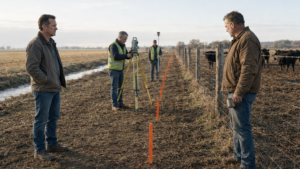
By noon, the county drainage inspector stood ankle-deep in Robert’s pasture holding a measuring rod.
The man checked the outlet, the channel width, the standing water and the old gate structure.
“You got historical flow numbers?” he asked.
Robert handed him a copy of the attachment.
The inspector read the capacity provision.
“This isn’t a modern engineering spec.”
“No.”
“Doesn’t mean it’s useless.”
He walked downstream, checked another point, then looked uphill toward the subdivision.
“System running normally up there?”
“As far as they’ve told me.”
The inspector made several notes.
When he finished, he said, “Current discharge is above what this lower channel is carrying without inundation.”
“How far above?”
“I’m not giving you a legal conclusion. I’m telling you what I measured.”
Robert almost laughed. Apparently everyone who worked around county government learned the same sentence.
“But it’s too much.”
“For the channel as it exists today? Yes.”
That was enough.
By Wednesday evening, Robert and Rachel were clearing weeds from the green gate.
The wheel resisted every turn. Robert soaked the spindle with penetrating oil, tapped the housing with a hammer, waited, then tried again.
Rachel watched from the fence.
“You know what I remember about this thing?”
“That you were told not to touch it?”
“That too.”
“What else?”
“Grandpa used to keep a coffee can over that stem.”
Robert glanced at the rusted top.
“To keep rain out.”
“You remember him turning it?”
“Once.”
Robert did too.
He had been eight, maybe nine, standing in rubber boots while his grandfather adjusted the wheel a quarter turn at a time.
Not opened.
Not closed.
Adjusted.
The distinction stayed with him.
On Thursday morning, an equipment trailer appeared at the farm entrance.
Edward climbed out of his pickup, followed by an equipment operator. A compact excavator sat chained to the trailer.
Robert walked to the gate.
“What’s that for?”
Edward pointed toward the drainage corridor.
“We need to clear the lower channel and open that control structure.”
“No.”
Edward stared at him.
“No?”
“You’re not bringing an excavator into my pasture.”
“We have maintenance access under the easement.”
“You have conditional maintenance access.”
Edward’s jaw moved once.
“So you found the attachment.”
“I did.”
Rachel stood twenty feet behind Robert with a folder against her chest.
Edward noticed her.
“We’re trying to prevent another backup.”
“You’re trying to make my side carry more.”
“We’re trying to make the system work.”
Robert handed him a copy of the inspector’s measurements.
Edward read the first page.
His expression barely changed.
But it changed.
“The county didn’t issue a violation.”
“Didn’t say they did.”
“Then this is just field data.”
“Field data that says your flow exceeds what this channel carries without flooding.”
Edward looked at the green gate.
“We can improve the channel.”
“On your side first.”
“That isn’t how the easement works.”
Robert placed one muddy hand on the wheel.
“No equipment crosses this fence today.”
The operator looked at Edward.
Edward lowered the papers.
“You obstruct this system and water backs into finished lots.”
Robert kept his hand on the wheel.
“I’m not obstructing it.”
He turned.
Metal squealed.
The green wheel moved perhaps an inch.
Edward took a step forward.
Robert turned it again.
The brown discharge slowed—not stopped, but visibly reduced.
Edward’s face hardened.
“You have no idea what you’re doing.”
Robert looked toward the measuring marker Rachel had helped set beside the channel.
“Yes, I do.”
He adjusted the wheel another fraction.
The flow settled below the bank that had been spilling into the pasture.
Edward moved toward the fence.
“You close that gate, I’ll have crews out here with an order.”
Robert met his eyes.
“I didn’t close it.”
For several seconds nobody spoke.
That was the moment Robert had imagined enjoying.
Edward on the wrong side of the fence. The machinery stopped. Robert’s hand on the gate.
Instead, he felt the weight of the houses above them.
Edward pointed uphill.
“There are occupied homes connected to this system.”
“Then you should have built enough storage for them.”
“You think I designed the drainage?”
“I think you’re standing here defending it.”
“That’s my job.”
“And this is my ground.”
Edward’s anger thinned into something more complicated.
“If you take that flow to zero during a storm, water has nowhere to go.”
Robert looked at him.
He had expected denial.
Not that.
“How many houses?”
Edward hesitated.
“Potentially affected?”
“Yes.”
“Depends on rainfall.”
“How many?”
“Twenty-three at the lowest elevations.”
Robert looked at the subdivision.
For the first time, he pictured kitchens instead of siding. Garages. Children’s bicycles. Basements.
He hated that Edward had given him something else to consider.
The satisfaction drained out of the moment.
Robert took his hand off the wheel.
“The gate stays where it is.”
Edward exhaled.
“For now?”
“Until you fix your side or until the document lets me do something else.”
Edward gathered the papers.
“You’re going to regret treating an engineered system like farm plumbing.”
Robert glanced at the water.
“You’re going to regret treating a farm like empty ground.”
Edward left without bringing the excavator through the gate.
That afternoon Robert repaired fence below the drainage strip while Rachel sat in the truck reviewing copies of subdivision records she had obtained through public county filings.
Near sunset, she called him over.
“Dad.”
Robert kept tightening wire.
“What?”
“You need to see this.”
“If it’s another easement—”
“It isn’t.”
Something in her voice made him put down the fence stretcher.
She turned the laptop toward him.
It was a project memorandum attached to a drainage review from months earlier. Technical language filled most of the page, but one paragraph had been highlighted in the county file.
Projected discharge at full buildout approached the lower corridor’s documented carrying limit.
Below it was a distribution list.
Edward Clark’s name was on it.
Robert read the date.
Then he read it again.
It had been sent months before Edward ever crossed Robert’s flooded pasture and acted as though nobody could have known there was a problem.
Chapter 4: Edward Knew the Numbers Before He Crossed the Fence
Edward Clark did not deny seeing the memorandum.
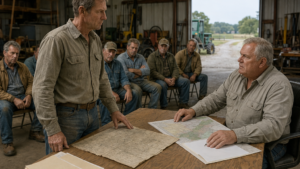
He stood at the far end of the county meeting room with both hands resting on the back of an empty chair while Rachel’s printed copy lay between him and Robert.
“I saw the preliminary review,” Edward said.
Robert watched him.
“Months ago.”
“Yes.”
“And then you walked into my pasture Monday and acted like nobody could’ve known.”
“That is not what I said.”
“You told me the system was approved.”
“It was.”
Robert pushed the memorandum across the table.
“This says full buildout could reach the carrying limit of the lower corridor.”
“Could.”
“It did.”
“According to field measurements taken after the system was activated.”
Robert leaned back.
There it was again. A sentence built to leave no fingerprints.
The county drainage inspector sat along one wall with a folder on his lap. Catherine was not present; the records office had done its part. This meeting concerned what the documents meant in practice, and nobody in the room seemed willing to pretend one old paper answered everything.
Edward finally sat down.
“The review didn’t say the system would fail.”
“It told you there was a problem.”
“It flagged a condition for monitoring.”
Rachel spoke before Robert could.
“Then why wasn’t the lower channel monitored before activation?”
Edward looked at her.
“Because the subdivision system had passed engineering review.”
“That wasn’t my question.”
His expression tightened.
Robert recognized something in him then—not shame exactly. Pressure.
Edward glanced toward the two development-company staff members seated behind him.
“We had retention capacity calculations. We had county approvals. We had contractors scheduled. We had closings tied to final infrastructure.”
Robert said, “And my pasture wasn’t on the closing schedule.”
Edward looked back at him.
“No.”
The answer was so plain it robbed Robert of the pleasure of accusing him again.
Edward continued.
“You think I wanted water on your farm? I didn’t. But every system has a downstream path. Yours existed before our project.”
“My grandfather gave the upper ground a drainage right. He didn’t give you the right to drown the lower forty.”
“I understand that now.”
“Now.”
Edward’s mouth hardened.
“Yes. Now.”
For a moment the room went quiet.
The inspector opened his folder.
“The practical problem is that shutting the route completely creates another risk.”
Robert already knew what was coming.
Edward turned toward him.
“The twenty-three lowest homes aren’t hypothetical anymore. Families are living in them.”
Robert looked at the drainage map projected on the wall.
Twenty-three rectangles sat along the lower streets of the subdivision.
Monday, those shapes had been roofs.
Thursday, after Edward’s warning at the gate, Robert had started imagining kitchens.
Now the inspector traced the map with one finger.
“If the lower outlet is closed during a significant storm, water backs into the retention system. Depending on rainfall duration, the emergency overflow goes toward these lots.”
“How significant?” Robert asked.
The inspector shrugged.
“Not a cloudburst. A strong summer system could do it.”
Rachel folded her arms.
“So the solution is to sacrifice his pasture?”
“No,” the inspector said. “The solution is to bring the drainage system into compliance. Until that happens, somebody has to manage risk on both sides.”
Robert turned to Edward.
“You knew the system was close to its limit. Why didn’t you build more storage?”
Edward rubbed a thumb along the edge of the table.
“We had an alternate basin design.”
Robert waited.
“It required acquiring another strip of land uphill and moving a section of retaining wall.”
“How much?”
Edward did not answer immediately.
Rachel did.
“Expensive.”
Edward looked at her.
“Yes.”
“And it delayed closings.”
“Yes.”
“How long?”
“Potentially eight to twelve weeks.”
Robert let out a humorless breath.
“There it is.”
Edward’s eyes sharpened.
“You want this simple because simple gives you somebody to hate.”
Robert almost stood.
Rachel’s hand touched his forearm.
Edward continued before Robert could answer.
“If we had halted the project every time an engineer wrote ‘approaching capacity,’ half the houses in this county wouldn’t exist. We had approved plans. We had a recorded easement. We had no measured failure.”
“You had a warning.”
“We had a risk.”
“And you put the risk downhill.”
Edward looked at him for several seconds.
“That part,” he said quietly, “I should have treated differently.”
Robert had prepared himself for excuses.
The admission unsettled him more.
It would have been easier if Edward had laughed again.
The inspector broke the silence.
“There is a temporary option.”
A revised diagram appeared.
Portable barriers could add emergency retention uphill. Pumps could divert part of a heavy flow into an unfinished section of the subdivision. Neither measure was elegant. Both cost money.
Edward studied the figure.
“How much?”
The inspector gave the estimate.
Edward’s reaction was almost invisible, but Robert saw it.
“That’s temporary?” Edward asked.
“Yes.”
“For maybe thirty days?”
“Until permanent work is designed.”
Edward shook his head.
“We’d spend six figures on equipment we’d remove weeks later.”
Robert said, “Cheaper than buying my pasture.”
“That isn’t the comparison.”
“It is from where I’m sitting.”
Edward turned toward the inspector.
“What’s the probability we actually need it before permanent design starts?”
The inspector closed the folder.
“I don’t assign weather probabilities.”
The meeting ended without agreement.
Outside, Robert found Edward standing beside his pickup, tie loosened.
“You meant that?” Robert asked.
Edward looked over.
“What?”
“That you should’ve treated the warning differently.”
Edward stared toward the courthouse entrance.
“I should’ve gone downstream before activation.”
“Why didn’t you?”
“Because I had seventy-four open items on the project and yours wasn’t red yet.”
Robert felt the insult, then realized Edward had not meant it as one.
“That how you see land? Colored boxes?”
“That’s how you finish a project with two hundred people calling you.”
“My cattle don’t care what color your spreadsheet is.”
“No. And homeowners don’t care that your grandfather signed something in 1968. They care whether their basement floods.”
Robert stepped closer.
“You keep saying homeowners like that makes what happened here necessary.”
“No. I’m saying they exist.”
Edward opened his truck door.
“So does my farm.”
“I know.”
“Do you?”
Edward paused.
“Yes.”
It was not an apology.
Robert did not offer one either.
That evening, Rachel brought coffee to the barn while Robert worked grease into the green gate spindle.
“You’re thinking too loud,” she said.
“I’m not talking.”
“Exactly.”
He wiped his hands.
“Clark refused the temporary setup.”
“I heard.”
“He’d rather gamble on the weather.”
Rachel watched him turn the wheel a few degrees, then back.
“You’d rather he be completely wrong.”
Robert glanced at her.
“He is wrong.”
“That isn’t what I said.”
He looked toward the hill.
The white subdivision windows were beginning to catch the evening sun.
“He knew enough.”
“Yes.”
“And chose the money.”
“Yes.”
Rachel waited.
Robert said, “But if I shut this thing, those houses take the water.”
“Also yes.”
He hated how easily she said it.
The next morning, the forecast changed.
A slow-moving storm system was expected before the end of the month, with the possibility of several inches of rain.
Robert called Edward.
“Do the temporary retention work.”
Edward was silent.
“Robert—”
“Do it before the storm.”
“We’re reviewing permanent options.”
“That storm won’t review your schedule.”
“The temporary system is too expensive to justify before we know the track.”
Robert gripped the phone.
“You know the risk.”
“And I know we still have time.”
Robert stared at the green gate through the barn doorway.
Edward had admitted the mistake.
He had understood the danger.
And when the correction finally carried a number large enough to hurt, he chose delay anyway.
Chapter 5: The Thirty-Day Notice Became a Test of Both Men
The postal clerk pushed the certified-mail receipt across the counter.
“Sign there.”
Robert signed.
The envelope contained no angry language this time. No invented forty-eight-hour deadline. No threat written at the kitchen table with mud still drying on his boots.
Rachel had made him rewrite it twice.
The final notice identified the recorded easement, the three conditions, the inspector’s measurements, the standing inundation, and the thirty-day cure provision.
It asked for correction.
Nothing more.
“Feels small,” Robert said as they walked toward the door.
Rachel tucked the receipt into a folder.
“That’s because you can’t yell through certified mail.”
“I could’ve written it bigger.”
“You tried.”
Outside, Robert looked at the tracking number.
Thirty days.
The first week passed with survey flags appearing along the subdivision drainage corridor.
The second brought two engineers who inspected the upper basin but never crossed into Robert’s pasture.
Edward sent short updates through email. Design under review. Alternatives being priced. Coordination ongoing.
The water kept coming.
Robert maintained the green gate at a reduced opening. Each morning he checked sediment around the outlet. Each evening he walked the fence line to see how much grass had disappeared beneath muddy standing water.
The low forty smelled wrong.
Not poisoned. Not ruined forever.
Just wet long enough to stop being pasture.
He moved hay feeding to higher ground. Fuel costs climbed. The adjacent cattle farmer loaned him panels to create a temporary lane around the mud.
Robert thanked him once and felt uncomfortable about it for the rest of the afternoon.
On day nine, Rachel found him rebuilding the cover over the gate spindle.
“What’s that?”
“Coffee can.”
“You actually remembered?”
“Your grandfather wasn’t stupid.”
“He was your grandfather too.”
Robert fitted the metal can over the top.
For the first time in years, the mechanism moved without squealing.
Rachel crouched near the stone structure.
“Why do you think he built the gate if the upper property had a right to drain?”
“Control.”
“Exactly.”
Robert looked at her.
She shook her head.
“Not control like ownership. Control like regulation.”
He wiped grease onto a rag.
“You been hanging around Catherine?”
“I can read.”
“Everybody keeps telling me that.”
That night Robert opened the old farm records.
Not the courthouse copies.
His own.
They were kept in a steel cabinet in a back room, sorted according to a system only he understood, which meant they were not really sorted at all.
Tax documents sat beside cattle registrations. Equipment receipts shared folders with boundary surveys. His father’s handwriting appeared on envelopes containing bills twenty years past due.
Rachel sat on the floor and handed him bundles.
“You know, for somebody who hates paperwork, you save every scrap.”
“I hate needing it. Different thing.”
Near the bottom of a drawer they found a folded maintenance note written by Robert’s grandfather.
The paper listed dates beside short observations.
Creek high.
Gate quarter open.
Upper pond repaired.
Lower field dry.
Rachel traced one line.
“He was adjusting it.”
Robert nodded.
Another entry mentioned an agreement with the upper landowner after a wet spring.
Not permission.
Balance.
Robert sat back against the cabinet.
His grandfather had not viewed the gate as a way to stop somebody else’s water. He had treated it as a responsibility shared between properties.
Rachel turned another page.
“Here.”
Robert read the sentence.
Never close against upper storage when basin full.
It was not legal language. Just practical instruction.
Still, it landed harder than the courthouse document.
Robert folded the note carefully.
“My dad never showed me this.”
“You never asked him?”
Robert looked at her.
She seemed to regret the question as soon as she said it.
“No,” he answered.
His father had been a man who answered questions when asked and volunteered almost nothing. Robert had spent years resenting that.
Now he realized how much of the habit he had inherited.
Rachel stacked several files.
“Why didn’t you call me when this started?”
“You had work.”
“I always have work.”
“I handled it.”
“You handled it wrong.”
Robert’s eyes narrowed.
“You’ve mentioned that.”
“Because you keep acting like it was a postage problem.”
“It was.”
“No. It was a trust problem.”
Robert went still.
Rachel set the papers down.
“You call me for tax filings. You call me when the cattle records don’t reconcile. But the minute something threatens the actual land, you shut the door.”
“It’s my responsibility.”
“I know.”
“You say that like you don’t.”
“I say it like you think responsibility means nobody else gets a hand on it.”
Robert looked toward the cabinet.
“This place was your grandfather’s, then mine.”
“And someday?”
He said nothing.
Rachel’s voice softened.
“You made Grandpa a promise. I know.”
Robert looked at her sharply.
“He told me.”
“When?”
“Before he died.”
Robert turned away.
The old promise had always felt private: don’t sell the low forty.
He had taken it as an order.
Rachel apparently had heard it too.
“He didn’t tell me to keep it,” she said. “He told me not to let you confuse keeping it with saving it.”
Robert stared at her.
“What’s that supposed to mean?”
“I think he knew you.”
For several seconds neither spoke.
Then Robert pulled the entire drawer from the cabinet and set it between them.
“Fine.”
Rachel blinked.
“These are everything?”
“Everything I know about.”
“That is not reassuring.”
“You want in, you’re in.”
Her expression changed.
Not victory.
Something quieter.
They spent three hours sorting the records.
On day seventeen, Edward sent a ditch crew.
Robert watched from the pasture as workers reshaped a shallow swale below one subdivision outlet and laid fresh erosion matting along the bank.
It looked impressive from the road.
It changed almost nothing downstream.
Robert met Edward beside the fence.
“That your cure?”
“It’s part of the corrective work.”
“Does it reduce volume?”
“It improves conveyance.”
“To where?”
Edward looked at the pipe.
Robert nodded.
“My place.”
“We’re still evaluating storage.”
“You’re landscaping the problem.”
“That isn’t fair.”
“Neither is calling a ditch repair compliance.”
Edward lowered his voice.
“I got authorization for what I could get authorized.”
“And the temporary retention?”
“No.”
“Permanent basin?”
“Still under review.”
Robert looked toward the new houses.
“You’re running the clock.”
Edward did not answer.
That was answer enough.
By day twenty-four, the grass around the lower drainage line had yellowed beneath a film of sediment.
By day twenty-seven, Robert had stopped checking whether Edward had sent another update.
On day twenty-nine, Rachel came through the barn door carrying her phone.
“Dad.”
Robert was sharpening a mower blade.
“What?”
“Forecast changed.”
She turned the screen toward him.
The storm had strengthened and slowed.
Heavy rainfall was expected overnight and through the following morning.
Robert set the blade down.
Outside, the first drops began tapping against the barn roof.
He walked to the doorway.
Across the low forty, the old green gate stood beside the drainage line, open just enough to carry the controlled flow they had maintained for weeks.
Uphill, the subdivision disappeared behind a wall of darkening rain.
The thirty-day cure period would expire before sunrise.
And no permanent repair existed.
Chapter 6: The Storm Made Revenge Look Like the Easiest Choice
At eleven-thirty that night, brown water climbed over the lowest fence wire.
Robert saw it happen in the beam of his truck headlights.
He had been checking the gate every forty minutes since dark. Rain hammered the cab roof hard enough to drown out the radio. The diversion ditch he had cut on the first day was gone beneath a broad sheet of moving water.
Rachel’s truck pulled in behind him.
He stepped out before she could.
“What are you doing here?”
“Same thing you are.”
“You should’ve stayed home.”
“You should stop saying that.”
Lightning flashed behind the subdivision.
For a second every white house on the hill appeared at once.
Robert waded to the green gate.
The outlet was carrying more than it had at any point since activation. The channel banks trembled under the current.
Rachel held a flashlight on the measuring marker.
“We’re over.”
“I know.”
“By a lot.”
“I know.”
Robert put both hands on the wheel.
One full turn toward closed would protect the lower pasture.
Two might save the barn lane.
A few more and very little water would reach his side at all.
He could do it.
The cure period was almost over. Edward had been warned. The development had known about the capacity risk. They had chosen cosmetic work instead of storage.
Robert began turning.
The flow eased.
He stopped.
Rachel watched him.
“That enough?”
“No.”
“Then keep going.”
Robert looked uphill.
The old maintenance note sat folded inside his coat pocket.
Never close against upper storage when basin full.
His grandfather’s handwriting had survived longer than the man.
Robert turned the wheel another quarter.
Then stopped again.
“Dad?”
“If I close it, their basin backs up.”
“They had thirty days.”
“I know.”
“They chose this.”
“Clark chose.”
Rachel stared at the houses.
Robert said, “People living up there didn’t.”
Headlights bounced along the farm lane.
Edward’s pickup stopped at the fence so abruptly the rear tires slid in mud.
He got out without a jacket.
“What did you do?”
Robert kept one hand on the wheel.
“Reduced it.”
“You need to reopen that gate.”
“No.”
“Our basin is rising.”
“So is my pasture.”
Edward splashed toward the fence.
“We’re approaching emergency overflow.”
Robert looked at him.
“Then use the temporary storage you wouldn’t pay for.”
“We don’t have it.”
“That was your decision.”
“Robert, this is not the night for proving a point.”
Something hot moved through Robert’s chest.
“You think I’m standing waist-deep in your runoff to prove a point?”
Edward gripped the fence post.
“If that gate closes, water goes into occupied lots.”
“And if it stays fully open, it comes through my barn road.”
“I know.”
“No. You finally see it.”
Rain ran down Edward’s face.
“Open it.”
Robert’s hand tightened on the wheel.
For one brief, dangerous second, he wanted to close it completely.
Not because it was safest.
Because Edward had asked.
Thirty days of flooded ground, careful letters, measurements, meetings, delays and polished explanations compressed into that one green wheel.
Robert could make Edward feel powerless.
He understood the temptation so clearly that it frightened him.
Rachel stepped beside him.
“Dad.”
He did not look at her.
“What did Grandpa write?” she asked.
Edward frowned.
Robert slowly released the wheel.
“Get the measuring rod.”
Rachel moved.
Edward said, “What are you doing?”
“Managing your water.”
“Our engineer needs full discharge.”
“Your engineer isn’t standing here.”
Robert checked the marker, then opened the wheel a fraction.
Water surged.
He watched the bank.
Too much.
He closed it slightly.
“Rachel?”
“Still high.”
Another adjustment.
They waited.
The water settled below the top of the lower channel but continued moving steadily through it.
Edward stared.
“You’re throttling it.”
“That’s what the gate is for.”
“You don’t know if that rate is enough.”
“I know what this channel carries.”
“That doesn’t tell you what the basin needs.”
Robert pulled out his phone.
“Then call your engineer.”
Edward hesitated.
“Call.”
Within minutes the subdivision engineer was on speakerphone comparing Robert’s observed flow with the basin level reported by remote sensors uphill.
The engineer asked for a small increase.
Robert made it.
Ten minutes later, another.
Each adjustment was measured.
Not opened.
Not closed.
Adjusted.
At twelve-fifteen the barn lane stopped rising.
At twelve-forty, Edward’s phone showed the upper basin had stabilized below emergency overflow.
Nobody celebrated.
They stood in the rain listening to water pass through a system built decades before any of them had understood they would need it.
Edward stared at the gate.
“This isn’t sustainable.”
Robert wiped water from his eyes.
“No.”
“We can’t have you out here adjusting this every storm.”
“No.”
Edward looked at him.
“So what happens now?”
Robert checked his watch.
12:47 a.m.
The thirtieth day had ended.
“You had your cure period.”
Edward’s face changed.
Robert continued.
“You didn’t cure it.”
“We did corrective work.”
“You improved a ditch. You didn’t bring the discharge inside the conditions.”
“We can dispute that.”
“You can.”
The answer seemed to unsettle Edward.
Robert did not threaten him.
He did not tell him the gate would close at dawn.
He simply returned his hand to the wheel and made one final small adjustment.
At two in the morning, the rain weakened.
By three, the upper basin had begun falling.
Robert and Rachel stood under the barn overhang drinking burnt coffee from a thermos.
Edward remained by his truck.
Rachel looked at Robert.
“You could’ve closed it.”
“Yes.”
“You wanted to.”
“Yes.”
She nodded.
“So did I.”
That made him smile despite himself.
At eight-thirty the courthouse opened.
Robert arrived in muddy boots carrying the recorded easement, the inspector’s measurements, proof of certified notice, photographs of the failed cure work, and Rachel’s organized binder.
Catherine examined the documents.
“You understand I can record what qualifies for recording. I can’t decide whether a termination survives a dispute.”
“I understand.”
“You may end up in court.”
“I understand that too.”
Catherine looked at him over her glasses.
“You’ve improved.”
“Don’t spread it around.”
She almost smiled.
Robert recorded formal notice that the easement’s conditions had not been cured and that termination was being asserted under the original instrument.
Then he did something Edward did not expect.
He drove directly to the subdivision office.
Edward looked exhausted when Robert entered.
Robert placed two documents on his desk.
Edward read the first.
“Termination.”
“Recorded this morning.”
His eyes moved to the second.
“What’s this?”
“Temporary operating agreement.”
Edward looked up.
“For what?”
“The gate.”
“You just terminated the easement.”
“I terminated the old right because you broke its conditions. I’m offering temporary flow while you build something that works.”
Edward stared at him.
“Under your control.”
“Under measured limits.”
“You’re replacing an easement with permission you can withdraw.”
“Until permanent correction.”
Edward pushed back from his desk.
“My company will never agree to that.”
“Then don’t.”
“You’ll close the gate?”
Robert looked at him.
“I’ll operate it as far as safety requires while this gets decided. But you don’t get permanent free use of my pasture after ignoring the agreement.”
Edward looked at the temporary terms again.
“And if we sign?”
“You get enough time to build storage. I get monitoring, repairs, and written limits.”
“This is leverage.”
“Yes.”
Edward almost laughed.
Not mockingly.
More like a man who had finally reached the sentence he could not work around.
Robert stood.
“I could’ve shut you off last night.”
Edward’s expression went still.
“I know.”
“No. I don’t think you do.”
Robert tapped the temporary agreement.
“That’s why this is here.”
He left the office without waiting for an answer.
By noon, the storm had moved east.
The pasture remained scarred and muddy, but the barn lane was open. Twenty-three houses uphill were dry.
Robert placed the new records binder on the kitchen table between himself and Rachel.
For the first time since the water began, he was no longer waiting for a hidden document to save the farm.
The old easement had given him leverage.
What Edward did next would decide whether that leverage became a repair—or a lawsuit.
Chapter 7: The Farm Kept Its Waterline and Shared Its Future
The excavator started digging uphill.
Robert noticed the sound before he saw the machine.
For six weeks, every engine connected to the drainage dispute had seemed to point toward his pasture. Trucks at his gate. Equipment trailers beside his fence. Men discussing access to his ground as though the farm were simply the empty end of somebody else’s plan.
Now the yellow excavator sat inside the subdivision boundary, cutting into a strip of graded earth behind the lowest row of houses.
Rachel parked beside the barn and followed his gaze.
“They actually started.”
Robert nodded.
A temporary retention basin was taking shape above the old drainage route. Stakes marked the footprint of a permanent expansion farther uphill. Large sections of pipe waited beside the road.
None of it crossed Robert’s fence.
“That feels strange,” Rachel said.
“What does?”
“Watching somebody fix their own side.”
Robert grunted.
She smiled.
The temporary operating agreement had lasted longer than either Robert or Edward wanted, but it had done what Robert intended. The subdivision kept enough drainage capacity to protect occupied homes while every discharge through Robert’s property was measured and recorded.
No more vague assurances.
No more relying on the fact that water had always run downhill.
Edward’s company eventually had to choose between litigation over an easement it had already failed to cure or spending money on a system that reduced the burden on the lower farm.
The lawyers had exchanged letters.
The engineers had exchanged drawings.
The numbers won.
Later that morning Edward drove down to the farm alone.
He no longer wore the white shirt and jacket Robert associated with their first confrontation. He had work boots on, though they were still cleaner than Robert thought any honest pair of boots ought to be.
Edward stopped at the fence.
“Can I come through?”
Robert looked at him.
The question itself was new.
“Gate’s open.”
Edward entered and closed it behind him.
They walked toward the green flow gate.
The old structure looked different now. Robert had removed most of the rust, replaced the packing around the stem, and fitted a proper weather cap where his grandfather’s coffee can had once sat.
A monitoring gauge had been installed beside it under the temporary agreement.
Edward checked the reading.
“Construction crew thinks the new storage will be online in three weeks.”
“They thought the original system was enough too.”
Edward gave him a tired look.
“I deserved that one.”
“Probably.”
They stood without speaking.
The pasture still carried scars. Sediment had killed a broad strip of grass near the outlet. Tire ruts crossed the higher ground where Robert had moved hay during the worst weeks.
But new seed had taken in several patches.
Edward nodded toward it.
“Restoration contractor can start after the drainage work is commissioned.”
“Not before.”
“I know.”
Robert glanced at him.
Edward had learned some things too.
At the county records office that afternoon, Catherine Wright placed the revised agreement on the counter.
It was thicker than Robert would have preferred.
Rachel stood on his right. Edward stood on his left.
Catherine turned pages with the same careful hands she had used on the old easement.
“Permanent retention improvements,” she said.
Edward nodded.
“Monitoring requirements.”
Robert nodded.
“Maintenance responsibility assigned to the upper property owner, with scheduled access by written notice except in emergency.”
Another nod.
“Pasture restoration.”
Edward said, “Paid by the development company.”
“Flow limits.”
Robert tapped the page.
“Measured at the gate.”
Catherine looked over her glasses.
“Everybody enjoying how much paperwork it takes to prevent an argument?”
Rachel said, “One of us is.”
Robert looked at her.
“Don’t start.”
Catherine moved to the signature page.
Edward signed first.
His pen paused over the maintenance clause.
Robert noticed.
“You backing out?”
Edward shook his head.
“No.”
He signed.
Then he looked at Robert.
“This is going to follow the property forever.”
“That’s the idea.”
Edward set down the pen.
For the first time, Robert heard no challenge in his voice.
“Fair enough.”
Robert signed next.
Catherine turned the document toward Rachel.
Robert frowned.
“What’s this?”
Rachel looked at him.
“You didn’t read the final revision?”
“I read the important parts.”
“That sentence has caused most of this story.”
Catherine pointed to a paragraph.
The revised agreement allowed the farm owner to designate an additional authorized representative for maintenance notices, records access, and emergency coordination.
The space had been left blank.
Rachel said nothing.
Robert picked up the pen.
For years, every important farm decision had ended at his name.
He had treated that as proof that he was carrying the place properly.
Now he understood the cost of making responsibility look like solitude.
He wrote Rachel Baker.
Rachel stared at the page.
“You sure?”
“No.”
She laughed once.
Robert continued.
“But I’m doing it anyway.”
Catherine witnessed the designation and stamped the recording copy.
The sound was ordinary.
One clean strike.
Yet Robert felt something settle.
Not ownership.
Ownership had never been the real problem.
The burden had.
Outside the courthouse, Edward stopped beside his truck.
“I owe you an apology.”
Robert looked at him.
Edward seemed uncomfortable with the sentence.
“For the first day,” he continued. “I came onto your property assuming you were just going to be another delay.”
Robert waited.
“I knew we had a capacity warning. I convinced myself approved meant acceptable.”
“You also crossed my fence after I told you not to.”
Edward nodded.
“That too.”
Robert thought about making him work harder for it.
Then decided he had already spent enough time wanting Edward to feel small.
“You fixed it.”
“We’re fixing it.”
“That’s better.”
Edward held out his hand.
Robert looked at it, then shook it once.
Nothing about the gesture made them friends.
That was all right.
Six weeks later, the permanent retention basin was nearly complete.
The water passing Robert’s gate during ordinary flow had become clear enough that he could see gravel beneath the channel surface again.
The development company reseeded the damaged pasture and repaired two sections of fence.
Robert made them redo one.
Rachel told him he was impossible.
He told her the brace was crooked.
Both statements were true.
On a cool morning near the end of the work, Robert brought a small records binder from the farmhouse.
Rachel was checking an invoice on the hood of her car.
He set the binder beside her.
“What’s that?”
“Current easement. Revised agreement. Inspection records. Gate maintenance.”
She opened it.
Everything was labeled.
She looked suspicious.
“You did this?”
“I can organize papers.”
“You absolutely cannot.”
“I supervised.”
“That I believe.”
Robert reached into his pocket.
A small brass key rested in his palm.
Rachel stopped smiling.
It opened the padlock on the maintenance box beside the green gate.
Robert held it out.
She did not take it immediately.
“You know I’m not trying to take over.”
“I know.”
“And I’m not promising I’ll never suggest selling something.”
“I know that too.”
“The low forty included.”
Robert looked toward the pasture.
For most of his life, those words would have ended the conversation.
The promise to his father still mattered.
But the land was not preserved simply because nobody spoke about change.
His grandfather had understood that. The old easement had not been written to freeze the hill and the farm exactly as they were. It had been written because two properties shared consequences.
Robert placed the key in Rachel’s hand.
“If you ever think selling is the only way to save it, you better have numbers.”
Rachel closed her fingers around the key.
“You’ll hate the numbers.”
“Probably.”
“You’ll argue.”
“Certainly.”
She slipped the key onto her ring.
“But you’ll listen?”
Robert looked at the green gate.
The wheel stood where it had for decades, no longer rusted shut and no longer treated as a weapon. It could open. It could close. Most of the time, what mattered was knowing how far.
“I’ll listen.”
Rachel picked up the binder.
Together they walked toward the pasture, where new grass was already pushing through the repaired ground.
The story has ended.