They Tore Down the Fence I Built Twenty-Two Years Ago—Then the Survey Stakes Stopped Their Entire Farm Expansion
Chapter 1: The Morning My Old Fence Became Construction Debris
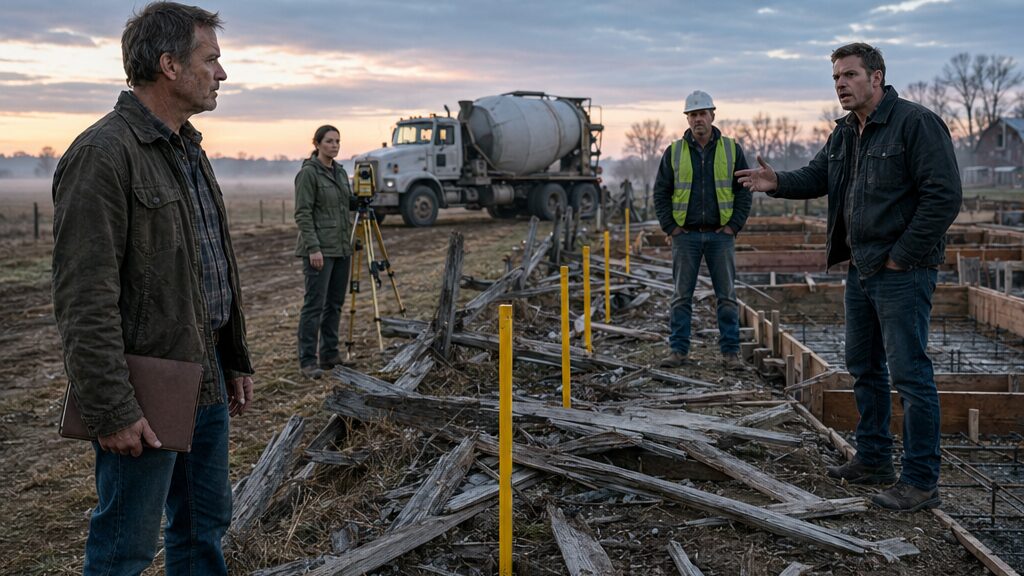
The excavator bucket closed around the last upright section of my cedar fence and lifted it out of the ground like it had never meant anything.
I was halfway across the pasture when I saw it happen.
The engine drowned out my shout, which was probably for the best. The operator swung the bucket toward Benjamin Carter’s side, dropped the panel onto a pile of splintered boards, and turned back toward the line.
Twenty-two years of sun and rain had turned that cedar silver-gray. I had set every post myself.
Now most of it lay flattened under muddy tire tracks.
I stopped at the edge of the work area instead of walking into it.
Two laborers were stripping lumber from the wreckage. Beyond them, fresh wooden forms marked the start of Benjamin’s new farm addition. A concrete truck waited farther up the lane, its drum turning slowly.
One of the laborers finally noticed me.
“Morning.”
I looked at the pile.
“Whose instruction was it to take that fence down?”
He glanced toward the excavator operator.
“You’d have to ask the boss.”
“Where’s the boss?”
“Not here yet.”
That answer almost made me step across the ditch and start asking louder questions.
Instead, I took out my phone.
I photographed the broken posts first.
Then the rails.
Then the tire tracks.
Then the wide gouges where the excavator had pulled the posts out.
The operator shut down his machine.
“You James?”
“Yes.”
He climbed halfway out of the cab but stayed on the step.
“Benjamin said this was coming out.”
“That fence is mine.”
He frowned.
“All I know is the line was marked.”
He pointed.
At first I thought he meant the old fence line.
Then I saw the orange string.
It ran from a bright stake near Benjamin’s equipment shed toward the back of the property.
And it was wrong.
Not a few inches wrong.
Several feet.
The string crossed ground where I had mowed, repaired drainage, and stacked hay for years. It ran inside the pasture side of where my fence had stood.
I walked parallel to it without touching anything.
The farther I went, the worse it looked.
At one point the orange string passed so far inside my land that I could stand between it and the remains of the fence with room to spare.
My first reaction was certainty.
My second was less comfortable.
I had owned the property for twenty-two years, but memory was not a survey.
I knew where the fence had been. I knew why I had put it there. I remembered the old pins shown to me when I bought the land.
But I had not ordered a new boundary survey in years.
That difference mattered.
The concrete foreman arrived in a white pickup while I was photographing the string.
He got out carrying a clipboard.
“You the adjoining owner?”
“Yes.”
He looked at the debris, then at me.
“We’re setting for a pour.”
“Not on my side, you’re not.”
His expression tightened.
“We’re following the construction layout we were given.”
“Who gave you that line?”
“The site layout was already marked.”
“By Benjamin?”
“You need to talk to the owner.”
That was twice in ten minutes someone had pointed responsibility somewhere else.
I nodded toward the orange string.
“Is that the line you’re building from?”
“That’s what we’ve got.”
I showed him one photograph on my phone: the orange string running inside the old fence line.
“I’m telling you I believe that’s on my property.”
He did not argue.
He also did not stop the job.
“We’re working off the approved project documents.”
That sentence cooled me down more effectively than anything else could have.
Approved documents.
If the project was approved, there was a record.
If there was a record, there was something better than two men standing in mud arguing about where they remembered a line being.
“Do you have the permit number?”
He hesitated.
Then he turned his clipboard around.
A county permit reference was printed near the top.
I photographed it.
The foreman tapped the board.
“I’m not getting in the middle of a neighbor dispute.”
“Neither am I.”
He gave me a doubtful look.
I slipped my phone back into my pocket.
“I’m going to find out where the line actually is.”
As I walked back toward my barn, I passed the broken fence again.
One post had split cleanly lengthwise. I remembered cutting that post to length on sawhorses behind the house. I had built the fence when money was tighter, buying lumber in sections as I could afford it.
The fence had never been fancy.
It kept livestock where they belonged. It made the western edge obvious. It weathered until it nearly matched the trunks of the pines behind it.
I had assumed that obvious was enough.
That was my habit.
If something worked for twenty years, I tended to leave it alone.
If a neighbor crossed with a tractor during hay season, I waved.
If somebody needed room to turn equipment, I moved a gate and figured people understood the favor for what it was.
I did not like paperwork between neighbors.
Standing there with my fence in pieces, I began wondering whether that preference had finally cost me something.
A hydraulic whine sounded behind me.
I turned.
The excavator was moving again.
Not toward the remaining fence debris.
Toward the fresh forms.
The project was still going.
I drove straight to the county office.
The permit number sat on my phone screen the entire way.
Chapter 2: The Permit Showed a Different Line
The county planning clerk looked at the permit number, typed for less than a minute, then rotated her monitor toward me.
“There.”
I leaned closer.
A rectangular building footprint filled part of the screen. Parcel lines surrounded it. Measurements were marked along the proposed addition.
“Can you print that?”
“I can print the public site plan.”
“Please.”
I had brought photographs of the fence, the orange string, and the forms. Until that moment, they had felt like evidence of something.
I just did not know exactly what.
The printer behind the counter started.
The clerk placed three pages in front of me.
I spread them out.
Benjamin’s property sat to the west of mine. The proposed addition extended behind an existing structure but stopped before the recorded parcel line.
I traced the dimension with one finger.
“This is the approved footprint?”
“That’s what was submitted.”
“And the outside wall is supposed to stay on his side of this line?”
She looked carefully at the page.
“The plan shows it within the parcel, yes.”
“How far?”
She pointed to a notation.
“Very close. You’d want the building department to interpret setback compliance. I can only show you what was filed.”
That was fair.
I pulled up the photographs on my phone.
“This orange line is what the contractor is using.”
She examined the first picture, then the next.
“You can’t determine a legal boundary from photographs.”
“I know.”
I heard how quickly I said it.
She glanced at me.
I slowed down.
“But if that orange string were the parcel line shown here, the fence would have been several feet onto his property for twenty-two years.”
“That’s possible.”
I looked at her.
She shrugged slightly.
“I’m not saying it is. I’m saying the county map isn’t a substitute for a boundary survey.”
The sentence landed harder than I expected.
I had come hoping for certainty.
Instead, I had received support for my concern and a reminder that support was not proof.
The clerk brought up the older recorded plat.
The line looked familiar.
Not because I had memorized the numbers, but because I remembered the shape: a slight angle through the rear pasture rather than the clean straight line someone might assume from standing on the ground.
My old fence had followed that angle.
The orange construction string did not.
I placed my phone beside the printed plat.
In one photograph, an old cedar post stump appeared near the edge of the frame. Behind it, the orange string cut inward.
For the first time that morning, my confidence stopped being emotional and became measurable.
Something did not match.
I asked for a copy of the recorded plat.
The clerk printed that too.
Before I left, she said, “If construction is actively approaching a disputed line, you might want a licensed surveyor sooner rather than later.”
“How soon?”
She looked at the photographs again.
“As soon as you can get one.”
Back at the farm, the concrete truck was gone.
That did not make me feel better.
A fresh gray strip had appeared along part of the footing.
I parked on my side and walked down with the printed plans folded under my arm.
The concrete was dark and damp, still curing.
The forms ran close to the old fence location.
Too close.
The foreman saw me and came over.
“You went to the county?”
“Yes.”
I unfolded the approved site plan on the hood of my truck.
He looked at it.
Then at the field.
Then at the orange line.
His face changed, but only slightly.
“What?”
I asked.
He tapped the page.
“This is not the layout sheet I was handed.”
“Different measurements?”
“Different reference points.”
“Enough to matter?”
He rubbed his jaw.
“I’m not surveying anybody’s property.”
“I’m not asking you to.”
He straightened.
“I need to call the contractor.”
“Do that.”
He looked toward the curing concrete.
“You getting a survey?”
“Yes.”
I had not arranged one yet, but by then it felt inevitable.
I called three surveyors from the cab of my truck.
The first could not come for two weeks.
The second said maybe Friday.
The third was Anna Lewis.
She listened without interrupting while I explained the destroyed fence, the county plat, the orange construction string, and the concrete already curing near the disputed edge.
“You have the deed description?”
“Yes.”
“Recorded plat?”
“Yes.”
“Any existing monuments you know of?”
“I remember an iron pin near the back corner, but I haven’t looked for it in years.”
“And they’re pouring now?”
“They started today.”
There was a pause.
“I can be there at six-thirty tomorrow morning.”
I looked through the windshield toward Benjamin’s project.
“That early?”
“If this is where you think it is, early is better.”
I told her I would meet her.
Before hanging up, she added, “One thing.”
“What?”
“If the survey comes back different from where you believe the line is, you need to be ready for that too.”
I looked at the broken cedar piled beside the excavation.
“I am.”
I meant it.
Mostly.
That evening I walked the entire western edge alone.
Without the fence standing, the pasture looked wider and somehow less settled. There was no silver-gray line guiding my eye anymore.
Just dirt, broken boards, orange string, and machinery.
Near the rear corner I found what might have been the old iron pin buried under leaves and grass.
I did not touch it.
For once, I did not trust myself to decide what something meant simply because I recognized it.
I left it where it was.
At six-twenty the next morning, headlights appeared on the gravel lane.
Anna’s survey truck stopped beside my barn.
She stepped out carrying equipment cases and a bundle of bright yellow stakes.
Chapter 3: Seven Yellow Stakes Stopped the Pour
Anna Lewis drove the first yellow stake into the ground six inches from the splintered remains of one of my cedar posts.
She checked her instrument again.
Then she looked toward the orange construction string.
“That’s not close.”
I had been waiting nearly a day to hear something definite.
Now that I did, I found I did not want to celebrate.
“How far?”
She gave me the measurement.
Enough.
More than enough.
The orange line had been placed inside my parcel.
Anna worked methodically.
She located recorded control points, checked the older monument near the rear corner, ran measurements twice, and compared them against the deed description and recorded plat.
I followed at a distance.
Every twenty feet or so, another yellow stake went into the ground.
One.
Two.
Three.
By the fourth, the pattern was obvious.
By the seventh, it was impossible to explain away.
The yellow stakes traced almost exactly where my cedar fence had stood.
Not perfectly against every old post—fences wander over decades—but close enough that the intention of the original line was plain.
More importantly, the stakes crossed directly through part of the construction layout.
Anna stood near the footing forms and pointed with the end of her range pole.
“If these forms are intended to continue on that alignment, they cross your boundary.”
I stared at the wood forms.
“What about what they already poured?”
“I can tell you where the line is. The building department can tell you what that means for the project.”
She must have seen something in my face.
“A survey answers a coordinate question, James. It doesn’t settle everything else.”
“I know.”
This time I did not say it defensively.
The first concrete truck arrived before Anna finished packing her equipment.
Its diesel engine rolled over the pasture like distant thunder.
The foreman’s pickup came behind it.
He stepped out, coffee in one hand, and stopped when he saw the yellow stakes.
His eyes followed them from the rear corner toward the forms.
Then he walked over.
“These yours?”
“Licensed survey,” I said.
Anna handed him her card.
“I established the deed line this morning.”
He read the card.
Then he crouched beside one stake and sighted along the row.
The concrete truck idled behind him.
Two laborers climbed out of another pickup carrying tools.
Nobody spoke for several seconds.
The foreman took the site drawing from his truck, unfolded it against the hood, and walked back to the footing.
He checked a measurement.
Then another.
He looked at the orange string.
Then the yellow stakes.
“Shut the truck down,” he called.
The driver killed the engine.
The sudden silence was almost startling.
The foreman took out his phone.
I stayed on my side of the line.
I did not stand in front of the truck.
I did not tell anyone they were trespassing.
I did not touch the forms.
All I had wanted from the beginning was for somebody to stop long enough to verify what they were doing.
Now they had.
The foreman finished his call.
“We’re not pouring anything else here until the contractor and county review this.”
I nodded.
One of the laborers looked at the row of stakes.
“All that over those sticks?”
The foreman gave him a sharp look.
“Those sticks are why we’re stopping.”
That sentence gave me more satisfaction than I expected.
Not because the project had stopped.
Because I had not needed to force it.
The facts had done the work.
Then Benjamin’s truck came fast down the lane.
He braked beside the construction area, got out, and looked from the idle concrete truck to the yellow stakes.
“What happened?”
The foreman pointed.
“Boundary issue.”
Benjamin looked at me.
“You did this?”
“I hired a surveyor.”
“You shut down my pour?”
“I didn’t shut down anything.”
He turned toward Anna.
“Where’d you get that line?”
“Recorded description, monumentation, and field measurements.”
“That fence wasn’t the property line.”
My attention sharpened.
Anna answered calmly.
“I’m not here to interpret your history with your neighbor. I can tell you where the deed line measures.”
Benjamin pointed toward the broken fence.
“That was a convenience fence.”
“It was my fence,” I said.
“You know what I mean.”
“No. I don’t.”
He walked closer, stopping short of the yellow stake between us.
“That strip has always been shared.”
The anger I had expected from him was there, but underneath it was something else.
Certainty.
Not bluffing.
Not pretending.
He genuinely believed what he was saying.
“The deed doesn’t show a shared strip.”
“I’m not talking about the deed.”
“Then what are you talking about?”
Benjamin gave a short laugh without humor.
“You really going to stand there like you don’t remember?”
I felt the first small break in my certainty.
“Remember what?”
“The turn.”
I said nothing.
He pointed toward the lower gate.
“The shared turn. Dad used it every hay season. You moved your gate so he could swing the wagon through.”
Something old and specific moved in my memory.
A green tractor.
A loaded hay wagon.
Benjamin’s father taking the corner too wide for the narrow lane.
Me pulling two fence rails and shifting a gatepost because it was easier than watching him back a wagon three times.
I had said something then.
Use the extra room when you need it.
I remembered that much.
Benjamin saw the recognition on my face.
“Yeah,” he said. “That.”
“That was permission to turn equipment.”
“It went on for years.”
“It wasn’t ownership.”
“I didn’t say ownership.”
“You tore down my fence.”
“Because everybody treated that strip like shared ground.”
“No. Your father crossed it because I let him.”
Benjamin’s face hardened.
“And you never once said otherwise.”
The words hit harder than his anger.
Because they were not completely false.
I had never written anything down.
Never posted a sign.
Never sent a note.
His father had used the turn. Later Benjamin had used it a few times too.
I had assumed everyone understood the difference between neighborly access and a property right.
Maybe they had.
Maybe Benjamin had simply chosen the version that helped him now.
But for the first time since I saw the excavator lift my fence, the dispute was no longer clean.
The foreman folded his drawing.
“I’m still stopping work.”
Benjamin looked at him.
“For how long?”
“Until somebody above me tells me this is resolved.”
He pointed at the stakes.
“I’m not pouring across a surveyed line.”
Benjamin stared at the idle truck, then at the forms already in place.
His jaw worked once.
Finally he looked back at me.
“You want to make this a legal boundary fight, James?”
“I want my property line respected.”
“That turn has been there longer than half this equipment.”
“That doesn’t move the deed.”
He stepped back.
“No. But it changes what you knew.”
The foreman walked away to make another call.
Anna loaded the last tripod into her truck.
Before leaving, she stopped beside me.
“You have the line now,” she said quietly.
I looked toward Benjamin.
“And the rest?”
“That part was never going to be solved by my equipment.”
She drove away.
The yellow stakes remained.
Seven small pieces of painted wood stood between the broken cedar and an idle concrete truck.
They had stopped the pour exactly the way I had hoped.
But as I watched Benjamin walk back toward his pickup, I realized they had also uncovered something I had not expected.
The question was no longer whether the land was mine.
It was whether my years of saying nothing had helped Benjamin believe he could treat it as his.
Chapter 4: The Permission Neither Neighbor Ever Wrote Down
“The shared turn.”
Benjamin said it again two days later, standing beside the lower gate as if the phrase itself settled something.
I hated that I remembered it.
The gate had once been narrower. Benjamin’s father used to bring hay wagons through after cutting the back field, and the turn from his lane was too tight when the wagons were loaded. One summer, after watching him back and straighten three times, I pulled two rails from my cedar fence and shifted the gate opening.
Use the extra room when you need it, I had told him.
I remembered saying those exact words.
What I did not remember saying was that the ground had become anybody else’s.
Benjamin leaned against his truck.
“Dad used that turn for years.”
“With permission.”
“You never called it permission.”
“I didn’t think I had to.”
“That’s convenient now.”
The yellow survey stakes stood twenty yards away, bright against the grass. Construction remained silent beyond them. No concrete truck. No excavator running. Just forms, cured gray footing, and equipment sitting where men had expected to be working.
I pointed toward the stakes.
“Whatever your father did with a hay wagon, those don’t move.”
“I’m not saying they do.”
“You told the crew my fence wasn’t the boundary.”
“Because as far as we were concerned, that strip had always been used.”
“Used isn’t owned.”
Benjamin’s mouth tightened.
There it was again: the place where we could have solved something years earlier with a conversation neither of us had bothered to have.
I had let his father swing machinery across my ground because that was what neighbors did. After his father stopped farming regularly, Benjamin had used the same turn a few times. I had never objected.
I had also never said, Remember, this is still mine.
At the time, saying it would have felt petty.
Now the absence of those words sat between us like another fence.
“You could’ve asked me,” I said.
“You could’ve marked it.”
“I did. For twenty-two years.”
“With a fence you let us cross.”
I looked toward the broken cedar piled near the construction site.
He had a point.
Not the point he wanted.
But a point.
The next afternoon Nancy Hall pulled into my drive.
She got out carrying a folder but left it tucked under her arm.
“I’m not here to argue the survey.”
“That’s a promising start.”
She almost smiled.
Nancy was older than Benjamin and quieter. I had dealt with her mostly around hay, drainage, and the occasional stray animal. She tended to speak only after deciding exactly how much needed saying.
She looked toward the western boundary.
“He told me about the turn.”
“I remember it.”
“He says your fence was never treated like the hard line.”
“That’s his version.”
“What’s yours?”
“That his father asked before he used my ground.”
Nancy nodded slowly.
“That sounds like him.”
The answer surprised me.
“You remember him asking?”
“I remember him asking everybody for everything. He wouldn’t take a shortcut across a field without telling someone.”
For the first time, something in me loosened.
Not because it proved anything legal.
Because it meant I had not invented the difference in my own memory.
Nancy walked with me toward the lower gate.
“Benjamin grew up seeing Dad use that turn,” she said. “By the time he started handling more of the farm, I think he stopped thinking about how it started.”
“That still doesn’t explain tearing down my fence.”
“No.”
Her answer came too quickly to be defensive.
We stopped beside one of the surviving cedar posts.
Nancy touched the weathered top.
“I thought he’d verified the boundary.”
“You thought?”
“He told me the project engineer had the site marked.”
“Orange string isn’t a survey.”
“I know that now.”
I looked at her.
“What exactly is this expansion for?”
“Covered equipment storage and two more horse stalls. We’re trying to consolidate everything before winter.”
“That sounds expensive.”
“It is.”
The folder under her arm suddenly made more sense.
Nancy exhaled.
“The lender tied the next draw to construction milestones. Foundation, framing, enclosure. Miss one badly enough and the schedule gets reviewed.”
“So that’s why he’s pushing.”
“That’s part of it.”
“Part?”
She looked toward Benjamin’s side.
“He thinks this is the project that keeps the farm from sliding backward.”
There was no drama in the way she said it. That made it heavier.
Equipment prices had climbed. Feed prices shifted. Small farms could look solid from the road and still be balancing three months ahead.
I knew that better than most.
But financial pressure did not turn my land into his.
Nancy seemed to read that in my face.
“I’m not asking you to give up anything.”
“Then what are you asking?”
“For you to understand why he’s acting like stopping is the same as losing.”
“That doesn’t make what he did right.”
“No.”
Again, no defense.
I looked toward the broken fence.
“For two days I’ve been thinking maybe he genuinely believed the line was somewhere else.”
Nancy did not answer.
That silence changed the conversation.
I turned toward her.
“What?”
She rubbed her thumb along the folder edge.
“Before demolition, the contractor asked whether they needed a boundary survey.”
I stared at her.
“What did Benjamin say?”
“I wasn’t there.”
“But you know.”
“He told me later.”
“What did he say?”
Nancy looked uncomfortable now.
“He said there wasn’t time to bring somebody out before they cleared.”
The old anger came back, but differently.
Colder.
“Did anyone warn him the fence might actually be on the line?”
“Yes.”
The word was barely above normal conversation volume.
It still seemed to carry across the entire pasture.
“Who?”
“The contractor, I think. Maybe the foreman. They asked what the fence represented.”
“And Benjamin?”
“He said the orange layout was good enough to clear to.”
I looked at the seven yellow stakes.
For two days I had been forcing myself to admit that my silence helped create ambiguity.
That remained true.
But ambiguity was one thing.
Being warned and choosing speed anyway was another.
Nancy shifted the folder beneath her arm.
“I thought you should know before this turns into everybody telling different versions.”
“Does Benjamin know you’re here?”
“No.”
That told me nearly as much as the rest.
I looked back at her.
“He didn’t just misunderstand the line, did he?”
Nancy did not answer directly.
“He knew enough to stop and check.”
Chapter 5: Benjamin Knew Enough to Stop
The concrete foreman rested both hands on the scarred worktable inside Benjamin’s equipment shed and looked straight at him.
“I asked whose fence it was.”
Benjamin did not deny it.
That was how the meeting began.
A broken cedar post lay on the table beside my replacement estimate. I had brought it without thinking much about why. One end was still packed with dried dirt; the other had been split open by the excavator.
The building inspector stood at the far end of the table with the revised field notes. Nancy leaned against a cabinet. Benjamin remained standing.
I sat.
The foreman continued.
“When we got to the clearing limit, I saw the fence didn’t line up with the orange string. I asked whether we needed to hold until somebody confirmed it.”
Benjamin rubbed his forehead.
“And I told you we had the layout.”
“You told me the fence was old and not the legal line.”
“That’s what I believed.”
The foreman shook his head once.
“That’s not all you said.”
Benjamin looked at him.
“You said if we waited on a survey we’d miss the pour window.”
The room went quiet.
Outside, wind rattled something loose against the shed wall.
I kept my hands under the table.
“What pour window?” I asked.
Benjamin looked at Nancy before answering.
“Our lender inspection.”
Nancy’s expression hardened slightly.
Benjamin kept going.
“We had to have foundation work completed before the next draw.”
“How much time did you have?”
“Not enough.”
“That wasn’t my question.”
“Four days.”
The building inspector flipped one page.
“You could’ve requested a construction hold pending survey.”
“And missed the milestone anyway.”
“Yes.”
Benjamin gave a dry laugh.
“Easy to say when it isn’t your loan.”
Nobody answered.
He looked at me.
“You know what margins are like. You think I’m sitting on a pile of cash? If that draw gets delayed, I float labor and materials myself. I can’t do that for long.”
I did know.
There had been years when a tractor repair could decide whether I bought fertilizer on time.
That recognition irritated me because it made his explanation understandable.
Understandable was not the same as excusable.
“You had four days,” I said.
“To get a surveyor during construction season.”
“You could’ve stopped clearing at the fence.”
“And then what? Redesign everything around a line nobody had confirmed?”
“You confirmed it by assuming it favored you.”
His jaw tightened.
“No. I used the line the project had marked.”
“A line you were warned might be wrong.”
Benjamin looked away.
That was the first moment I knew we were finally past versions.
He had not plotted to steal four feet of my pasture.
He had done something more ordinary and, in some ways, more damaging.
He had encountered uncertainty at the exact moment uncertainty became expensive, and he had chosen the answer that kept his project moving.
Nancy folded her arms.
“You told me the contractor was comfortable with it.”
Benjamin glanced at her.
“I said they kept working.”
“That isn’t the same thing.”
“No.”
The word came reluctantly.
The foreman pointed at the broken cedar post.
“For what it’s worth, we shouldn’t have pulled that without something clearer either.”
Benjamin looked at him.
“You’re putting this on me?”
“I’m telling you what happened.”
That mattered.
Until then, every conversation had been about who could shift responsibility somewhere else.
The operator followed Benjamin.
The foreman followed the layout.
Benjamin followed the orange string.
I followed twenty-two years of memory.
Now, for once, several people were admitting where they had made choices.
I slid the replacement estimate across the table.
The fence contractor had priced new cedar, posts, labor, and disposal. The amount was higher than my original lumber cost, but not outrageous.
Benjamin glanced down.
“Thirteen-forty.”
“That’s the estimate.”
“For an old fence.”
“For replacing what was there.”
“It wasn’t new.”
“You didn’t destroy a pile of used lumber. You destroyed a functioning fence.”
Nancy looked at the estimate.
“That seems fair.”
Benjamin’s head snapped toward her.
“You’re not paying it.”
“We both own the property.”
“That doesn’t mean—”
“It means this is our problem too.”
He stopped.
The inspector cleared his throat.
“The more immediate problem is the foundation.”
He laid out a field sketch.
One segment of the poured footing approached the surveyed boundary closely enough that the proposed continuation could not proceed as designed. The forms beyond it were clearly over the line.
“What happens to what’s already there?” I asked.
“That depends on final measurements, setback requirements, and what remedy the owners pursue.”
Benjamin pointed at the sketch.
“We can adjust the wall.”
“Maybe,” the inspector said. “You’ll need revised plans.”
“How much has to come out?”
“I’m not answering that until engineering submits a correction.”
Benjamin stared at the paper.
The anger left his face.
Something more honest replaced it.
Fear.
“If we have to pull the whole footing,” he said, “this project is done.”
No one spoke.
He looked at me.
Not challengingly this time.
“James, I know you don’t care about my financing.”
“That’s not true.”
He seemed surprised.
“I care,” I said. “I’m just not paying for it with my property.”
Benjamin rested both palms on the table.
“I should’ve stopped.”
It was not an apology.
But it was the first admission that mattered.
“I thought the old turn meant there wasn’t going to be a fight over a few feet. I thought the fence had always been more about livestock than the line.”
“It was both.”
“I know that now.”
I looked at the cedar post between us.
For days I had wanted that sentence.
Now that I had it, it did not feel like victory.
Because the inspector’s drawing sat beside it.
Because Benjamin’s project might be salvageable—or might not.
Because I could see exactly where his mistake had moved from arrogance into panic.
Nancy spoke quietly.
“What options are there?”
The inspector explained that revised plans might shift part of the addition, reduce a section, or alter the footing design. But he also made something else clear.
If James insisted on every available remedy connected to the encroachment, portions already constructed near the disputed area could potentially be required to come out, depending on final review.
Benjamin went still.
The inspector looked at me.
“The county can enforce permit compliance. Property remedies between owners are separate. You should get your own advice if necessary.”
“I understand.”
“What I need from you now is straightforward.”
He tapped the drawing.
“Do you intend to demand complete removal of anything that entered or affected your property, or are you willing to consider a corrected design if it fully respects the surveyed line?”
Benjamin’s eyes stayed on me.
For the first time since the excavator tore out my fence, the most powerful decision in the room belonged to me.
I looked down at the split cedar post.
A week earlier, I would have known my answer immediately.
Now I was not sure what justice required.
Chapter 6: I Had the Right to Make Him Tear It Out
The building inspector told me I could insist that any encroaching work be removed.
Then he left me standing alone beside the yellow stakes.
The sentence stayed with me for three days.
I could make Benjamin tear it out.
Not the entire project automatically, not every inch of concrete on his property, but enough that the consequences would be expensive and unmistakable.
Part of me wanted that.
I did not enjoy admitting it.
Each time I walked past the pile of cedar, I pictured the excavator ripping out posts I had set with my own hands. I remembered Benjamin telling me I should have marked the boundary better.
Making him remove concrete felt, for a moment, like restoring balance.
Then I looked at the stakes.
They were not punishment.
They were measurements.
That distinction began to matter.
On the second morning, I started sorting the broken fence.
Most rails were useless. Several had split through the grain. But three sections were sound enough to salvage, and two posts had only been pulled rather than shattered.
I stacked the usable cedar beside the barn.
The old wood felt lighter than I remembered.
Maybe because it had dried for twenty-two years.
Maybe because I was finally carrying only pieces instead of the entire argument.
Anna’s final survey had been filed. The building inspector had confirmed that revised plans could potentially preserve the required line and setback if Benjamin shifted the addition and reworked one section of footing.
Nothing would move until I decided whether I would cooperate.
At the county meeting two days later, Benjamin sat across from me with Nancy beside him.
A revised sketch lay between us.
The new wall line jogged inward. One section of footing would have to be cut back. Several forms would be removed entirely.
It would cost Benjamin money.
It would also save most of the project.
The inspector pointed to the survey line.
“This configuration stays where it needs to stay, assuming final engineering approval.”
Benjamin looked at me.
I looked at the drawing.
“I’ll accept a redesign.”
Nancy exhaled.
Benjamin did not move.
“But I have conditions.”
His expression changed.
“Of course.”
The edge in his voice almost pulled me backward.
I let it pass.
“Fence replacement in full.”
Benjamin nodded once.
“Fine.”
“Survey cost.”
He hesitated.
Then nodded.
“The destroyed section gets rebuilt on the surveyed line, not wherever is easiest for construction.”
“Fine.”
“And no equipment, grading, material storage, drainage work, or temporary access across my property without written permission.”
Benjamin sat back.
“You want me asking in writing every time a tractor needs the turn?”
“Yes.”
“That’s ridiculous.”
“No. What was ridiculous was both of us pretending an arrangement everybody remembered differently didn’t need to be defined.”
Nancy looked at him.
“He’s right.”
Benjamin ignored her.
“We’ve used that corner for years.”
“And that’s exactly why we’re writing it down now.”
His mouth tightened.
I continued.
“If you need temporary access for hay equipment, ask. If it makes sense, I’ll probably say yes. But permission is permission. It isn’t ownership. It doesn’t become permanent because nobody talks about it.”
For a few seconds, he said nothing.
Then he tapped the revised plan.
“And if I agree, you won’t demand the rest of the footing comes out?”
“If the county approves this design and everything remains on your side of the surveyed line, I won’t demand more removal than compliance requires.”
Benjamin studied me.
“You could.”
“Yes.”
That answer seemed to bother him more than if I had threatened him.
“Then why aren’t you?”
I looked through the meeting-room window toward the parking lot.
“I wanted my land protected.”
“That’s not an answer.”
“It is.”
I turned back.
“If I make you destroy work that can legally be corrected just because I’m angry, then this stops being about the line.”
Benjamin’s eyes dropped to the drawing.
I added, “That doesn’t mean I’m pretending what happened was an accident.”
“I know.”
“You were warned.”
“I know.”
“You chose the schedule anyway.”
His jaw worked.
“Yes.”
There it was.
No excuse attached.
The inspector slid a draft acknowledgment toward us. It covered the revised construction boundary, fence replacement, reimbursement, and written permission for future access.
Benjamin read each page slowly.
Nancy read over his shoulder.
When he reached the access section, he stopped.
“This makes the old turn basically yours to control.”
“It has always been mine to control.”
He looked up sharply.
I almost regretted the wording.
Then I decided not to soften it.
That had been my problem in the first place.
I had spent years trusting people to understand what I meant instead of saying it plainly.
Benjamin closed the packet.
“I need to think.”
Nancy turned toward him.
“About what?”
“About signing something that makes me ask permission to move equipment ten feet where we’ve moved it for years.”
“Then don’t move it there.”
He gave her an irritated look.
She did not look away.
I gathered my copy of the plans.
Benjamin watched me.
“You’re really leaving it like this?”
“The line isn’t changing.”
“I mean us.”
That surprised me.
I paused.
“I don’t know what ‘us’ is right now.”
“We’ve been neighbors a long time.”
“Then we should’ve been better at talking before somebody brought in an excavator.”
He looked down.
I picked up the revised plan.
“I’m not asking you to like the agreement.”
“Clearly.”
“I’m asking you to decide whether you can respect it.”
Benjamin took the packet under one arm.
Nancy remained seated for another second before standing.
The inspector gathered his drawings.
Nobody shook hands.
Outside, the yellow stakes were visible in the distance beyond the county lot only in my imagination, but I could picture every one of them.
For the first time, they no longer felt like weapons.
They felt like what they had always been.
A line.
Benjamin reached the door ahead of me.
He held it open, then stepped aside.
“I’ll take this home.”
“Okay.”
“I’m not signing it today.”
“I didn’t ask you to.”
His face tightened again, but there was less anger in it now.
He walked toward his truck with the unsigned agreement under his arm.
I watched him go.
The construction could be saved.
The fence could be rebuilt.
The money could be repaid.
But none of it would happen unless Benjamin decided his pride was worth less than the boundary he had tried to ignore.
Chapter 7: The New Fence Followed the Same Old Line
The fence crew arrived on a Monday morning carrying fresh cedar rails.
For a second, seeing the truck beside the western pasture made my stomach tighten.
Then I noticed the yellow survey stakes were still standing exactly where Anna had left them.
Nothing had moved.
The crew unloaded posts, rails, bags of concrete, and a post-hole auger. The fence contractor walked the line with my copy of the survey in one hand and the county-approved revision in the other.
“Right on these points?” he asked.
“Right on the surveyed line.”
He nodded.
“No shortcuts.”
“No shortcuts.”
That felt important enough to repeat.
Three weeks had passed since Benjamin took the agreement home unsigned.
For the first two days, I heard nothing.
On the third, Nancy called.
“He signed.”
That was all she said at first.
I had been repairing a gate hinge when the phone rang.
“Everything?”
“Everything.”
“Access terms too?”
A pause.
“Yes.”
I rested the wrench on the fence post.
“And the contractor?”
“They agreed to cover the replacement.”
“What about the survey cost?”
“Benjamin is paying that.”
I looked across the pasture toward the stalled addition.
“Permit?”
“Revised plan was accepted this morning.”
The machinery started moving again two days later, but differently.
Forms were pulled back.
One section of footing was cut and reworked.
The new wall line shifted inward, away from my property.
For the first time since the whole thing began, progress on Benjamin’s side did not feel like something being taken from mine.
Now the fence was going back.
The contractor began at the rear corner.
Each new post went into a hole aligned with Anna’s stakes.
The fresh cedar looked almost too bright against the pasture. I had forgotten the old fence had once looked like that.
Golden-brown.
Clean-edged.
New.
I walked to the barn and brought out the pieces I had saved.
Three old rails.
Two posts.
The contractor looked at them.
“You really want these worked back in?”
“If they’ll hold.”
He examined the cedar, pressing a thumb into one weathered end.
“This post is solid.”
He picked up one rail.
“This one too. Other two are cosmetic at best.”
“Use what makes sense.”
He studied me for a moment.
“Most people want everything new after a dispute like this.”
“I don’t need everything new.”
I looked toward the pile of discarded pieces.
“I need it right.”
He nodded.
By midday, one of the salvaged silver-gray rails sat between two fresh cedar posts.
It looked odd.
Old wood suspended inside new work.
But I liked it.
The rail had survived the excavator, the argument, and three weeks stacked beside my barn. Now it was back almost where it had started.
Not because nothing had happened.
Because something had.
A truck rolled up Benjamin’s lane shortly after lunch.
He got out alone.
For a few minutes he stood on his side watching the crew.
We had spoken only once since the agreement was signed.
That conversation had lasted less than thirty seconds.
He told me the documents had been delivered.
I told him I had received them.
Neither of us tried to make the exchange warmer than it was.
Now he walked toward the fence line.
The contractor looked at me.
I gave a slight nod.
Benjamin stopped beside the salvaged post waiting near the next hole.
“That one from the old fence?”
“Yes.”
He ran his hand over the weathered surface.
“Looks familiar.”
“It should.”
His mouth moved like he almost smiled.
He did not.
The fence crew started positioning the post.
Benjamin stepped forward.
“Need a hand?”
The contractor looked at me again.
This time I did not answer immediately.
Benjamin noticed.
“I’m asking.”
There was no edge in his voice.
Just the word.
Asking.
I nodded.
“Go ahead.”
He took one side of the post while the contractor took the other.
Together they lowered it into the hole.
The post had been standing on my boundary before Benjamin ordered the fence removed.
Now Benjamin held it upright while the contractor packed gravel around its base.
Nobody said anything.
That was better than an apology forced into the moment.
When the post stood on its own, Benjamin wiped dirt from his hands.
“I should’ve checked first.”
I looked at him.
He kept his eyes on the post.
“I know I said that at the meeting, but I mean the fence. Before any machine touched it.”
“You should have.”
He nodded.
“I thought I knew what that strip was.”
“So did I.”
That made him look at me.
I continued.
“I thought everybody understood the old arrangement.”
“Dad probably did.”
“Probably.”
“And me?”
“You understood the part that was useful.”
He accepted that without arguing.
After a while he said, “Fair.”
The contractor called for another rail.
Benjamin stepped back toward his side.
Before leaving, he nodded toward the new fence.
“Looks better than the old one.”
“It’s straighter.”
“That what you wanted?”
“No.”
He waited.
“I wanted the old one left alone.”
His face tightened for a second.
Then he nodded again.
“Yeah.”
He walked back to his truck.
The fence crew finished late in the afternoon.
The line was clean now.
Fresh cedar rails followed the surveyed boundary from the rear corner toward the lower gate. Several yellow stakes remained visible beside it, though they were no longer necessary to understand where the property ended.
I left them for the moment.
The old informal turn was the last issue.
The rebuilt gate did not provide the same wide swing Benjamin’s family had used for years.
That was deliberate.
Two days later, I heard a tractor coming down his lane.
Benjamin was pulling a flat hay wagon.
He slowed before the turn.
The old route would have carried the wagon partly through my gate opening.
He stopped.
For several seconds, the tractor idled.
Then he climbed down and walked to the fence.
I was fixing a latch twenty yards away.
“James.”
I looked up.
“I need the extra room to make this turn.”
I glanced at the wagon.
He could probably make it without crossing if he backed twice, maybe three times.
The old arrangement would be easier.
“What are you hauling?”
“Bales to the lower shed.”
“Just this trip?”
“Today, yes.”
He waited.
No assumption.
No tractor nose easing through while we talked.
No joke about the shared turn.
Just a question.
I wiped my hands on my jeans.
“You can use it today. Stay clear of the new post.”
“Okay.”
“And next time, ask again.”
Benjamin gave a short nod.
“Understood.”
I opened the gate.
He returned to the tractor and eased forward slowly. The wagon cleared the corner with room to spare.
When the last wheel crossed back onto his side, he stopped and climbed down long enough to close the gate behind him.
He latched it.
Then he looked toward me.
“Thanks.”
I nodded once.
The tractor moved on.
The silver-gray rail caught the late light between the newer cedar boards.
For twenty-two years, I had believed the fence itself was enough.
A line in the ground.
A row of posts.
A quiet understanding between people who had lived beside each other long enough not to need everything said aloud.
I knew better now.
The boundary had not become stronger because the cedar was new.
It had become stronger because both of us finally knew what the line meant, what permission meant, and what happened when one was mistaken for the other.
The new fence followed the same old line.
The difference was that this time, nobody had to guess.
The story has ended.