She Thought the Farm Road Dispute Was About Money Until the Old Survey File Told a Different Story
Chapter 1: The Stakes Appeared Before Breakfast
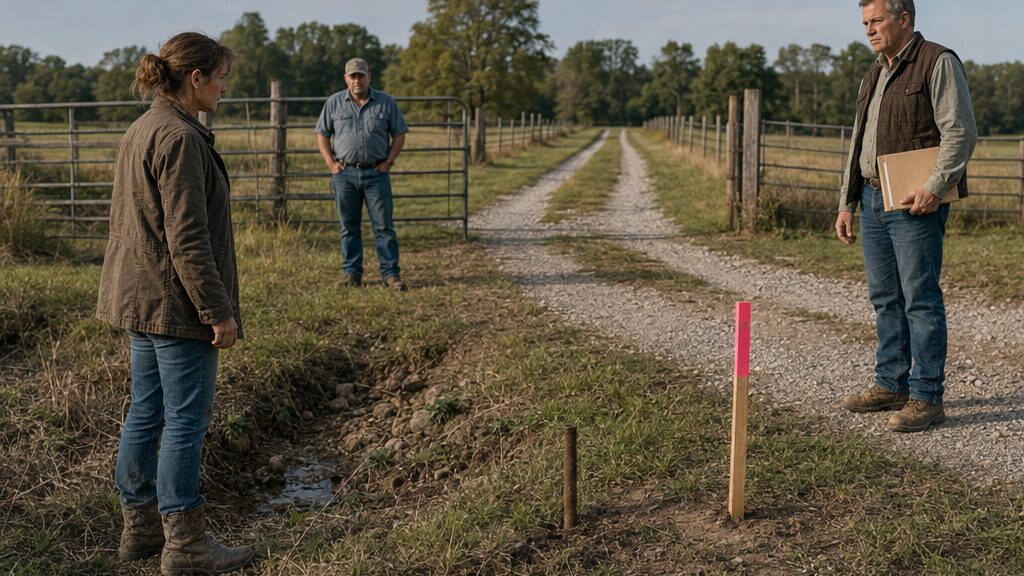
The first orange stake stood directly in the path of Kathleen Roberts’s tractor.
She saw it while walking toward the equipment shed with a coffee mug in one hand and a ring of keys in the other. A second stake leaned beside the drainage ditch. A third had been driven into the grass near the cattle gate, turning a lane that had carried combines, hay wagons, feed trucks, and pickup trailers for decades into something barely wider than an ordinary truck.
Kathleen stopped.
The tractor sat behind her beneath the shed roof, hooked to a flat wagon loaded with empty produce bins. She needed that wagon in the lower field before eight.
Mark Wilson’s pickup was parked beyond the gate.
He was standing beside the lane with a folder under one arm.
“Morning,” he said.
Kathleen looked from him to the stakes.
“Who put those there?”
“I did.”
Mark said it as if he had replaced a broken mailbox.
Two neighboring farmers were farther up the road beside a parked cattle trailer. Neither came closer, but neither left.
Mark crossed the gravel and held out a sheet.
Kathleen did not take it.
“What is it?”
“Road assessment.”
“How much?”
“Fourteen thousand eight hundred.”
Her expression changed so little that Mark glanced at the paper, perhaps checking whether he had said the number correctly.
Kathleen set her mug on the gatepost.
“For what?”
“Damage from the grading work. Shoulder failure, ditch repair, aggregate replacement. The association can’t absorb it.”
“The grading work you approved?”
Mark’s jaw tightened.
“We’ll get to that.”
“No. We can get to it now.”
He opened the folder.
“The larger issue is that your equipment has been using more of the corridor than your parcel is entitled to. We’ve been informal about it for years. That has to stop.”
Kathleen looked again at the stakes.
The widest part of her hay equipment could not pass between them without dropping a wheel into the ditch.
“You’re saying this is the road now?”
“I’m saying this is the lawful access.”
“You had it surveyed?”
“We had the records reviewed.”
That answer landed differently.
Kathleen reached for the assessment.
At the bottom was a signature line. Under it, another page had been clipped to the first.
Mark tapped it.
“If you acknowledge the assessment and the access line today, we can keep this from becoming a bigger problem.”
“And if I don’t?”
“The association can restrict nonconforming use.”
“My fields are down that road.”
“I know.”
“My equipment is wider than your stakes.”
“I know that too.”
The two farmers near the cattle trailer had gone very still.
Kathleen folded the papers once but did not sign them.
Mark lowered his voice.
“I’m not trying to shut you down.”
“You put stakes across my tractor route before breakfast.”
“I’m trying to formalize something everybody should have formalized years ago.”
“And the fourteen thousand eight hundred?”
“That’s separate.”
Kathleen looked at him.
“Is it?”
For the first time, Mark seemed irritated rather than merely firm.
“The road washed after your grading contractor worked it. We had to price corrective work. You know how expensive stone is now.”
Kathleen did know.
She also knew exactly how much cash was in the farm account and exactly how many weeks remained before several invoices came due.
She gave him none of that.
Instead she walked toward the ditch.
“Kathleen.”
She ignored him.
The grass was wet enough to soak the knees of her jeans when she crouched. She pushed aside chickweed and flattened blades with her palm.
There.
A rusty circle no larger than a nickel showed through the dirt.
Mark came closer.
“What are you doing?”
Kathleen scratched around the metal with the edge of her key.
“Looking.”
“For what?”
She cleared another inch of soil.
An old iron survey pin emerged beside the ditch, brown with age but firmly seated.
One of the farmers shifted near the trailer.
Kathleen stood and looked from the pin to Mark’s nearest orange stake.
The difference was not subtle.
She went to the tractor, pulled a steel tape from the toolbox, then returned.
Mark gave a short laugh.
“You planning to resurvey it yourself?”
“No.”
She hooked the tape against the iron pin.
“Then what?”
“Checking whether you gave me a reason to.”
She measured to the orange stake.
Then she measured again.
Mark stopped smiling.
Kathleen wrote the number in the margin of his assessment.
“What’s that supposed to prove?”
“Nothing yet.”
“You’re treating that old pin like gospel.”
“I’m treating it like a monument that was put in the ground for a reason.”
“You don’t know what it references.”
“No.”
That answer seemed to restore some of Mark’s confidence.
He folded his arms.
“Then this doesn’t change anything.”
Kathleen reeled in the tape.
“What plat did you use?”
Mark blinked.
“What?”
“The recorded plat. Book and page, cabinet and slide, instrument number—whatever system they used when it was filed.”
The two men by the cattle trailer looked at each other.
Mark’s face hardened.
“You don’t need all that.”
“If you’re moving my access line, I do.”
“The association already reviewed it.”
“That wasn’t my question.”
Mark picked up the folder he had set on the hood of his pickup.
“This isn’t a courtroom.”
“No.”
Kathleen picked up her coffee.
“It’s my road.”
“Shared road.”
“My access.”
“Subject to the recorded corridor.”
“Then tell me the record.”
A silence settled between them.
It was not dramatic. No one raised a voice. A cow bawled from somewhere beyond Brian Taylor’s pasture, and gravel clicked beneath the cooling exhaust of Mark’s truck.
Mark finally said, “You’ve got until Friday.”
Kathleen looked at the orange stakes.
“To pay?”
“To resolve it.”
“And until then?”
“Use the lane carefully.”
“My wagon won’t fit.”
“That’s the problem.”
He climbed into his pickup.
One of the neighboring farmers gave Kathleen a small nod before following the cattle trailer up the hill.
She waited until Mark’s truck disappeared.
Then she looked down at the rusty iron pin again.
For several years she had walked past it without thinking much about it. She remembered catching a mower tire near it once and cursing whoever had left metal sticking out of the ground.
Now the pin seemed to be asking a question.
Kathleen unfolded Mark’s assessment.
Near the bottom of the attached diagram was a tiny reference line.
She read it twice.
Then she pulled a pencil from her shirt pocket and wrote beneath the measurement she had already taken.
Recorded plat number?
When Mark had said the association had “reviewed the records,” she had heard something in the phrasing.
Not what he had said.
What he had avoided saying.
Kathleen looked toward the lane, toward the three new orange stakes dividing ground that yesterday had required no explanation.
Then she called after Mark, though his truck was already too far away for him to answer.
“Which recorded plat did you use?”
Chapter 2: The Signature Beneath the Gravel Invoice
The mud-stained folder was still where Kathleen had left it Saturday night, wedged beneath a seed catalog on the corner of the kitchen table.
She pulled it free Monday afternoon and spread its contents beneath the hanging light.
Invoices. Aggregate tickets. A hand-drawn drainage note. The gravel contractor’s estimate. Two photographs she had taken after the spring washout.
And, near the bottom, the road-work completion sheet.
Kathleen flattened it with both palms.
Two days earlier, none of it had seemed worth saving beyond tax season.
The trouble had started Saturday morning after the gravel contractor finished shaping the lane.
A hard rain earlier in the month had cut ruts along the downhill section where runoff crossed toward the ditch. Kathleen had arranged for the contractor to crown the road, rebuild the shoulder, and add stone where her produce truck tended to sink.
Because the road was shared, Mark had come over before work began.
He had stood with the contractor beside the grader, hands in his jacket pockets, while the three of them discussed the ditch.
“Don’t push anything farther east,” Mark had said. “Keep the water moving where it already moves.”
The contractor had nodded.
Kathleen had asked, “You want to be here when he finishes?”
“I’ll check it.”
He had.
Late Saturday afternoon Mark drove the lane twice, stopped near the culvert, walked the repaired shoulder, and spoke with the contractor for almost ten minutes.
Then he signed the completion sheet.
Kathleen remembered because she had been holding the clipboard.
At the time, Mark had said, “Looks fine.”
Now she stared at those words in her memory and at his signature on the page.
The assessment delivered Monday morning claimed the work had caused shoulder failure.
Kathleen carried the folder to the equipment shed.
Brian Taylor was there twenty minutes later.
He had come for a hydraulic fitting Kathleen had offered him the previous week, but the moment he saw the paperwork on her workbench, his shoulders changed.
“You heard,” she said.
Brian rubbed his thumb along the cardboard box in his hands.
“Heard what?”
“Mark’s charging me fourteen-eight and moving the access line.”
Brian looked toward the open shed door.
“That’s between you two and the association.”
“That road runs past your pasture.”
“I know where it runs.”
“You were here Saturday.”
Brian did not answer.
Kathleen slid the completion sheet toward him.
“You saw Mark inspect it.”
Brian sighed.
“Kathleen.”
“Yes or no?”
“I saw him walk the road.”
“And?”
“And he talked to the contractor.”
“And?”
Brian’s mouth tightened.
“He signed something.”
“This.”
She tapped the page.
Brian studied the signature.
“Looks like it.”
“Did he say the work failed?”
“No.”
“Did he say we needed corrective grading?”
“No.”
“Did he tell the contractor not to leave because there was a problem?”
“No.”
Kathleen leaned one hip against the bench.
“So the road was acceptable Saturday afternoon, and by Monday morning I owe fourteen thousand eight hundred dollars for damaging it.”
Brian set the fitting box down.
“I didn’t say that.”
“You didn’t have to.”
He looked uncomfortable.
“That rain did more damage than anybody wanted to admit. Maybe Mark got another opinion.”
“Then why didn’t he call me?”
“I don’t know.”
“Why put stakes in before showing me the assessment?”
Brian rubbed the back of his neck.
“I don’t know that either.”
Kathleen pulled a blank sheet from the folder.
“Write down what you just told me.”
Brian stared at it.
“What?”
“That you saw him inspect the road Saturday and that he didn’t raise a problem.”
“No.”
The word came immediately.
Kathleen looked at him.
“Why not?”
“Because I’m not getting in the middle of this.”
“You’re already in the middle. Your cows use the same road.”
“That doesn’t mean I want my name on a statement.”
“It’s not a lawsuit.”
“Not yet.”
The answer struck harder than Kathleen expected.
Brian was not Mark’s friend in any close sense. He had borrowed Kathleen’s post-hole driver. She had helped pull one of his calves during a difficult birth three winters before. They exchanged labor when machinery failed.
But rural favors had boundaries too.
Brian picked up the fitting.
“I’ll tell you what I remember if somebody official asks.”
“You’re telling me you won’t put it down now.”
“I’m telling you I have to live beside both of you.”
“So do I.”
He looked at her for a moment.
“That’s exactly why I’m staying out.”
When he left, Kathleen stood alone beneath the equipment-shed rafters.
The signed sheet remained on the bench.
It was useful.
Brian’s refusal was useful too, though in a way she disliked.
Mark had more than paperwork on his side. He had the advantage of being the person everyone expected to handle road business. Chairman, organizer, caller of meetings, keeper of invoices.
Kathleen had spent years avoiding that kind of role.
Silence had suited her until someone else began using it.
She went back to the kitchen and compared the signed completion sheet with Mark’s assessment.
The dates were impossible to miss.
Saturday: accepted.
Monday: failed.
That contradiction weakened Mark’s road-damage claim.
It did not explain the stakes.
Kathleen turned to the second page.
She had barely looked at it that morning because Mark had kept talking while she read.
Across the top was a simple access diagram.
A pair of parallel lines represented the road. Dashed marks showed a corridor running north from the county road and past the pasture.
Kathleen traced it with one finger.
The western line cut directly through the route she had used for years.
Not just her wagon path.
The diagram narrowed the usable width all the way past the bend near the equipment shed.
Her largest hay wagon would not clear it.
Neither would the fertilizer spreader when the side guards were installed.
She checked the assessment again.
At the bottom, beneath the payment acknowledgment, was a second signature block.
By signing, she would not merely accept the repair charge.
She would acknowledge the diagram as the applicable access corridor.
Kathleen sat down.
For most of the day she had believed Mark was trying to make her pay for a road problem.
Now the signed completion sheet suggested something else.
The money might be pressure.
The road might be the target.
She took a ruler from the kitchen drawer and laid it against the diagram.
Then she thought of the iron pin beside the ditch.
The new stake had been several feet inside it.
Kathleen turned the assessment over and read every line again.
This time, the fourteen thousand eight hundred dollars was no longer the most troubling number on the page.
Chapter 3: The Road Was Narrower on Paper
Mark Wilson placed the boundary acknowledgment beneath the assessment so neatly that Kathleen almost laughed.
Tuesday morning, his farm office smelled of coffee, dust, and machine oil. A window behind his desk looked toward the same gravel lane they were arguing about.
Kathleen remained standing.
“You could’ve saved us both time yesterday,” she said.
Mark leaned back.
“I gave you everything you needed.”
“No. You gave me a bill with a land agreement underneath it.”
“It’s an access acknowledgment.”
“That changes the width.”
“It confirms the width.”
“Then why wasn’t it part of the road discussion Saturday?”
Mark’s expression flattened.
“Because Saturday was about grading.”
“And Monday?”
“Monday was about fixing a larger problem.”
Kathleen put the signed completion sheet on his desk.
Mark looked at it.
His signature was clearly visible.
“You inspected the grading,” she said.
“I inspected what had been done.”
“You approved it.”
“I signed that the contractor completed the listed work.”
“You said it looked fine.”
“That doesn’t mean later damage didn’t show up.”
“Between Saturday afternoon and Monday before sunrise?”
“You’ve got heavy equipment running there.”
“So does Brian.”
“Brian stays inside the corridor.”
Kathleen waited.
Mark realized too late what he had given her.
“What corridor?” she asked.
He tapped the access diagram.
“This one.”
“That line didn’t exist on Saturday.”
“It existed in the records.”
“Which records?”
Mark exhaled through his nose.
“We went over this.”
“No. You told me the association reviewed them.”
“And we did.”
“Who is ‘we’?”
“The road committee.”
“Using what?”
He pushed the diagram toward her.
“This.”
Kathleen did not touch it.
“That’s not a recorded plat.”
“It’s based on one.”
“Which one?”
Mark stared at her for several seconds.
“You’re making this harder than it needs to be.”
“I need to get a twelve-foot wagon to my lower field.”
“Then you may need different equipment.”
The room went quiet.
Kathleen’s anger came so quickly that she had to put both hands into her jacket pockets.
“You’re telling me to replace farm equipment because of a line you won’t identify.”
“I’m telling you we can’t keep operating on handshakes and habit.”
“That part I agree with.”
Mark’s eyes narrowed.
“Then sign it.”
“No.”
The answer surprised him.
Kathleen pulled the steel tape from her coat pocket and placed it on his desk beside the paperwork.
“Your new stake is inside the old iron monument by several feet.”
“That pin may not control anything.”
“Maybe.”
“It could mark an old fence.”
“Maybe.”
“It could predate the road.”
“Maybe.”
Mark leaned forward.
“You don’t know.”
“No,” Kathleen said. “But neither do you, or you’d have told me what it references.”
His face reddened slightly.
“The association had the road reviewed last year.”
“By a surveyor?”
“Yes.”
“Recorded survey?”
“A field review.”
“That isn’t the same thing.”
“For practical purposes—”
“No.”
The single word stopped him.
Kathleen’s tone stayed low.
“Not for this.”
Something changed in Mark’s face.
The condescension did not disappear entirely, but caution entered beside it.
Kathleen had seen that expression before, years ago, across office counters when someone realized the quiet clerk holding a file knew exactly which page was missing.
She pushed the memory away.
“Give me the survey source,” she said.
Mark opened a drawer and removed another copy of the diagram.
“This came from a field sketch commissioned by the association. It referenced the county materials available at the time.”
“Date?”
“Last October.”
“Reference?”
He pointed to a small code in the lower corner.
Kathleen did not react.
Not outwardly.
Inside, something old clicked into place.
The code format was familiar.
Too familiar.
It was not a deed-book reference.
It was not a plat cabinet number.
It resembled the internal cross-reference system used in county mapping work—an office shorthand meant to point staff toward supporting material, not replace the material itself.
She kept her eyes on the paper.
“Can I have a copy?”
“You already have one.”
“This one has the reference code.”
Mark hesitated, then slid it across.
Kathleen folded it once.
“And you’re restricting the lane based on this?”
“We’re enforcing the access shown there.”
“Starting when?”
“Technically, now.”
“My wagon still won’t fit.”
“That’s why I told you to resolve it.”
“By Friday.”
“Yes.”
“What happens Friday?”
Mark stood and walked toward the window.
“The association records the revised road-use policy in its minutes. After that, any use outside the recognized corridor can be treated as unauthorized.”
Kathleen looked at his back.
“That’s not the same as changing an easement.”
“I didn’t say it was.”
“But you want me to sign something saying the corridor is correct.”
“I want everyone using the road under one standard.”
“For whose protection?”
“Everyone’s.”
He turned around.
“You think I enjoy this? The ditch fails, insurance asks questions, contractors blame traffic, everybody remembers the road differently. Then when something goes wrong, they call me.”
Kathleen believed that part.
Mark had spent years being the man people called when a culvert clogged or snow piled at the county-road entrance.
Responsibility had a way of becoming authority if nobody questioned where one ended and the other began.
“You should’ve told me before planting stakes,” she said.
“You should’ve asked before running a grader.”
“You were standing beside it.”
“That’s not the point.”
“It is when you’re billing me fourteen-eight for what it did.”
Mark looked away.
There it was again—that slight retreat whenever the signed approval came up.
Kathleen gathered the papers.
“You’re not signing?” he asked.
“No.”
“Then don’t be surprised if you can’t keep using the lane the way you have.”
She stopped at the door.
“My widest piece of equipment is thirteen feet two inches at the guards.”
“The recognized corridor is twelve.”
“And you knew that before you planted the stakes.”
“I knew your operation would need to conform.”
Kathleen turned.
“You didn’t narrow a road, Mark. You narrowed my farm.”
His expression tightened, but he said nothing.
Outside, she walked directly to the iron pin.
The orange stake still stood several feet away.
She hooked the tape to the old metal and measured once more, then wrote the distance beside the code Mark had given her.
Back at the farmhouse, she laid the paper under the kitchen light.
The letters and numbers at the bottom of the field sketch sat in a familiar sequence.
Kathleen traced them with one finger.
Twelve years of county records work had taught her that codes were rarely important by themselves.
What mattered was what they pointed to.
And this one pointed backward.
Not to a modern survey.
To an older record series she had not thought about since leaving the county office.
Kathleen stared at the code until she could almost see the gray filing cabinets again.
Then she whispered the first words she had spoken aloud about that part of her life in years.
“That’s not a boundary reference.”
Chapter 4: The Job Kathleen Never Mentioned
The archive box almost slipped from Kathleen’s hands when she pulled it from the top shelf.
Dust streaked the lid. One corner had collapsed inward years ago, and the packing tape had yellowed to the color of old straw. She carried it from the storage room to the kitchen table and set it beside Mark’s field sketch.
For several seconds, she did nothing.
Then she cut the tape.
Inside were twelve years of a life she had stopped discussing.
County mapping manuals. Training notes. Copies of retired indexing guides. Old correspondence stripped of case-specific information. A battered brown folder with COUNTY PLATS written across the tab in her own handwriting.
She had once spent her days reading easements until lines on paper stopped looking like lines and became roads, fences, creek crossings, driveways, rights people had forgotten they possessed, and obligations they assumed existed because everyone behaved as if they did.
She had been good at it.
That had been part of the problem.
Her phone buzzed on the table.
Anna.
Kathleen let it ring twice before answering.
“You working?”
“Not exactly.”
“I’m ten minutes away.”
Kathleen looked at the open box.
“For what?”
“For the reason you sounded strange when you called me.”
“I didn’t call you.”
“You sent me a picture of orange stakes with no explanation.”
Kathleen remembered doing it after leaving Mark’s office. At the time it had seemed easier than saying anything.
“That was not an invitation.”
“Too late.”
Anna arrived carrying a paper grocery sack and the expression she wore whenever she believed her mother was minimizing something.
She stopped when she saw the kitchen table.
“What is all this?”
“Old work.”
“You kept all of it?”
“Not all.”
Anna lifted one of the manuals.
“I thought you worked in records.”
“I did.”
“You made it sound like filing.”
Kathleen pulled the manual gently from her hand.
“Mostly it was.”
“That is not an answer.”
Kathleen sat.
The field-sketch reference code was written on a notepad beside her.
“I examined recorded plats. Easements. Survey references. Subdivision maps. Road petitions. Sometimes deeds if the mapping didn’t make sense.”
Anna stared at her.
“For how long?”
“Twelve years.”
“You never told me that.”
“You knew I worked for the county.”
“I knew you worked in an office.”
Kathleen opened the brown folder.
“That was enough.”
“For who?”
Kathleen ignored the question.
Inside the folder were photocopies of obsolete reference tables. The code Mark had shown her used a prefix she remembered from an older indexing system. She flipped through pages until she found the section.
Anna remained standing.
“What happened today?”
Kathleen slid Mark’s diagram toward her.
“He’s saying this is the legal access corridor.”
“And it isn’t?”
“I don’t know yet.”
“You told him that?”
“Yes.”
Anna looked surprised.
“That doesn’t sound like you.”
Kathleen glanced up.
“What does that mean?”
“It means you usually already know before you say anything.”
A page turned beneath Kathleen’s fingers.
She found the prefix.
Her stomach tightened.
The code did not point to a finished survey.
It pointed to a supporting reference file.
“Here.”
Anna leaned closer.
“What am I looking at?”
“This number series. It means the document Mark has was built from an older source.”
“So find the older source.”
“That’s what I’m doing.”
“You think the road is wrong.”
“I think his certainty is wrong.”
Anna studied her.
“And you’ve known that since yesterday.”
“I suspected it.”
“But you didn’t tell anybody.”
“Tell them what? That I suspected something?”
“Tell them you know how to read this stuff.”
Kathleen closed the reference guide.
“That’s not relevant.”
Anna laughed once without humor.
“Mom, apparently it’s extremely relevant.”
“I’m not trying to impress Mark.”
“This isn’t about impressing him.”
Kathleen stood and carried her coffee to the sink although the cup was still half full.
Anna followed her.
“You’re doing it again.”
“Doing what?”
“Waiting until a problem is bad enough that nobody can help without forcing you.”
Kathleen turned.
“I did not ask you to come here.”
“That’s exactly what I mean.”
The words struck a place Kathleen had spent years reinforcing.
She looked away.
Anna lowered her voice.
“You’re worried about the money.”
“The farm can handle it.”
“Can it?”
Kathleen did not answer.
Anna’s face changed.
“You can’t pay fourteen thousand eight hundred dollars.”
“I didn’t say that.”
“You didn’t have to.”
Kathleen felt suddenly tired.
“The assessment is probably not valid.”
“Probably.”
“I’m working on it.”
“Alone.”
“I know how.”
Anna looked at the archive box.
“Is that why you left the county?”
Kathleen’s hand stopped on the back of a chair.
“No.”
Anna waited.
Kathleen could have ended it there. She had ended versions of this conversation for years with a closed expression and a change of subject.
Instead she sat again.
“There was a boundary case,” she said. “A family farm. Two generations using a lane the same way. The recorded documents didn’t support what everybody thought they had.”
“What happened?”
“The county corrected its mapping.”
“And?”
“They lost access for part of their operation until they could negotiate something new.”
“Was it your decision?”
“No.”
“But you worked the file.”
“Yes.”
Anna sat opposite her.
“You were right?”
Kathleen looked at the old papers.
“Technically.”
The kitchen became very quiet.
“That’s why you left?”
“Not immediately.”
“But it mattered.”
Kathleen nodded.
She had watched precision become a weapon without anyone intending it to. A correct line had divided people who had lived by a different understanding for forty years.
After that, the work changed for her.
Or perhaps she had.
Anna reached across the table and turned Mark’s field sketch around.
“So what makes this different?”
Kathleen looked at the orange corridor line.
“I don’t know yet.”
That answer was harder than any confident one.
She returned to the reference index.
Half an hour later she found the matching entry.
The field sketch cited a plat series stored under an older cabinet system.
Kathleen copied the reference onto a clean sheet.
Anna read over her shoulder.
“What year?”
Kathleen checked again.
Her breath slowed.
“Forty-one years before Mark’s sketch.”
“So tomorrow?”
Kathleen nodded.
“County records office.”
Anna stood.
“I’m coming.”
“No.”
“Why?”
“Because I can read a plat without supervision.”
“That isn’t why.”
Kathleen looked at her daughter.
Anna took the grocery sack and began putting food into the refrigerator as if the argument were settled.
Kathleen almost objected again.
Instead she opened the battered county folder completely for the first time in years.
At the bottom was the old index notation.
Cabinet. Slide. Cross-reference.
A trail backward.
Kathleen copied the numbers carefully.
By midnight she knew exactly which original plat she needed to request.
What she did not know was whether it would save her.
Chapter 5: The Old Plat Did Not Save Her
The road on the original plat was in the wrong place.
Kathleen knew it before the county recorder finished laying the oversized sheet flat beneath the weights.
Not wrong as a record.
Wrong compared with reality.
The faded lines placed the access corridor several feet east of the gravel lane near Kathleen’s equipment shed, then brought it back west farther north. The existing road had straightened the old curve decades ago.
Kathleen leaned closer.
Anna stood beside her.
“That’s bad?”
“It’s complicated.”
The county recorder pointed carefully at the reference marks.
“This is the original recorded plat for that series. Later materials reference it, but I don’t see a recorded amendment changing the corridor here.”
Kathleen followed the line with her eyes.
The iron survey pin beside the ditch matched one control point.
That mattered.
But farther north, another call in the survey placed the recorded edge underneath a section of gravel everyone had treated as road for longer than Kathleen owned the farm.
Anna whispered, “Mark’s sketch still doesn’t match.”
“No.”
“So he’s wrong.”
Kathleen did not answer.
The recorder brought up a more recent mapping layer.
“Your equipment apron is here?”
Kathleen looked.
A concrete-and-gravel pad outside her shed extended toward the lane.
“Yes.”
The recorder tapped the screen.
“If this old line controls, part of that apron appears to cross it.”
Anna turned to Kathleen.
“How much?”
“Enough.”
The easy victory disappeared.
Kathleen requested certified copies of the original plat, the later index sheet, and the field-sketch reference information available in the county file.
By the time they left, the documents felt heavier than paper should.
Outside, Anna said, “Mark can’t charge you for a corridor his own sketch gets wrong.”
“Probably not on this basis.”
“So we won.”
Kathleen stopped beside the truck.
“No.”
Anna frowned.
“The original road crosses ground both of us have been using differently for years. His fence line is wrong in one place. My apron is wrong in another. The traveled lane is wrong in two.”
“But he planted stakes like his version was exact.”
“Yes.”
“And it wasn’t.”
“That doesn’t make mine exact.”
Anna leaned against the truck door.
“You always do this?”
“Do what?”
“Find the part where you’re wrong before you let yourself be right.”
Kathleen almost smiled.
“Occupational damage.”
They returned to the farm shortly after noon.
Kathleen carried the copies directly to the lane.
The iron pin waited beside the ditch.
She set the old plat on the hood of the truck and measured from the pin using the recorded bearings and approximate distances she could verify without pretending she was performing a professional survey.
The result confirmed what she had seen downtown.
Mark’s orange stakes narrowed the corridor too far.
But the existing gravel road did not perfectly follow the original alignment either.
At the equipment shed, the edge of Kathleen’s apron crossed the probable historic corridor by several feet.
She stood there staring at her own concrete.
Years earlier, she had expanded the pad because mud collected beneath the spreader.
She had never questioned the boundary.
Everyone used the lane the way it existed.
That was exactly the kind of sentence people had said in the county office.
Her phone rang.
Mark.
Kathleen answered.
“I heard you went downtown.”
She looked toward his property.
“News travels.”
“This is a small county.”
“Yes.”
“You found the old plat?”
“Yes.”
A pause.
“Well?”
“It doesn’t support your sketch.”
Mark said nothing.
“It also doesn’t perfectly support how the road sits now,” Kathleen continued.
“I know that.”
The words stopped her.
“You know?”
“I know there have been adjustments over the years.”
“That isn’t what you told me.”
“I told you the field sketch showed the recognized corridor.”
“No. You told me it was lawful access.”
“It is the corridor the association has been working from.”
“That’s not the same sentence.”
Mark exhaled.
“You want to fight over words?”
“When words are attached to my signature, yes.”
Another silence.
Then Mark said, “Come over.”
“I’m busy.”
“Five minutes.”
Kathleen nearly refused.
Then he added, “I can make the assessment disappear.”
She looked at the iron pin.
“I’ll be there.”
Mark met her outside his office rather than behind the desk.
He had no folder this time.
“I don’t want this turning into a county dispute,” he said.
“It already is.”
“No. You pulled records. That’s different.”
Kathleen folded her arms.
“What do you want?”
“I’ll withdraw the fourteen-eight.”
“For what?”
“You sign the access acknowledgment.”
Kathleen stared at him.
“No.”
“Hear me out.”
“I already did.”
“The lane needs a defined standard. The old plat doesn’t match actual use. You know that now.”
“Yes.”
“The field sketch gives us something workable.”
“For you.”
“For everybody.”
“My equipment doesn’t fit.”
“You can adjust.”
Kathleen’s face hardened.
“You mean I can adjust.”
Mark looked away toward the lane.
“You’ve got room at the shed.”
“Not without moving part of the apron.”
“That may have to happen anyway.”
That was true, and Kathleen disliked him more for saying it.
“Why are you so determined to get my signature?”
“I’m determined to settle this.”
“Why now?”
Mark rubbed both hands over his face.
“Because unfinished access questions cause problems.”
“For what?”
He looked at her.
For a second, Kathleen thought he might answer.
Instead he said, “Take the deal.”
“No.”
“Kathleen, fourteen thousand eight hundred dollars goes away. You get certainty. I get certainty.”
“You get my acknowledgment that your sketch controls.”
“Yes.”
“And if it doesn’t?”
“We stop living by forty-year-old paper nobody follows.”
Kathleen heard the logic inside the pressure.
That made it worse.
“Then bring the old plat to the whole association,” she said. “Show them both.”
Mark’s jaw tightened.
“There’s no reason to make this bigger.”
“That sounds like a reason.”
He stepped closer.
“I’m offering you a way out.”
“No. You’re offering me a price for my signature.”
His expression cooled.
“Friday still stands.”
Kathleen turned toward her truck.
“Kathleen.”
She stopped.
“If you push this,” he said, “you may find out your own property isn’t as clean as you think.”
She looked back at him.
“I already did.”
For the first time since the dispute began, Mark had no immediate answer.
Kathleen drove home with the assessment still hanging over her and the knowledge that her own apron crossed the old line.
But one question had grown larger than both problems.
Mark knew the old records were messy.
He knew his field sketch was not the whole story.
And he still needed her signature badly enough to erase fourteen thousand eight hundred dollars for it.
Chapter 6: What Mark Needed the Boundary For
The real-estate exhibit was clipped behind the road-association agenda.
Kathleen noticed it before Mark called the meeting to order.
A pale parcel outline showed the northern portion of his property divided from the farm. Beside it was an access line running directly along the corridor Mark wanted Kathleen to acknowledge.
She did not touch the sheet.
Brian sat two chairs away at the scarred table inside the association’s equipment shed. Three other members occupied folding chairs beneath the fluorescent lights. Mark stood at the far end beside a coffee maker and a stack of papers.
Kathleen looked at him.
“You’re selling land.”
The room quieted before the meeting had formally begun.
Mark’s eyes went to the exhibit.
“A parcel.”
“How long has that been pending?”
“That isn’t association business.”
“It is if my signature cleans up the access.”
Brian lowered his gaze.
Mark pulled out his chair.
“Sit down, Kathleen.”
She remained standing.
“Does the buyer need documented road access?”
Mark’s mouth tightened.
“Yes.”
There it was.
Not conspiracy.
Not revenge.
A deadline.
Mark finally sat.
“The parcel is twenty-eight acres I don’t use much anymore. Taxes went up. Equipment costs went up. My mother’s care isn’t cheap.”
Kathleen had not known that last part.
Mark continued before anyone could respond.
“The buyer’s lender wants clean access documentation. They saw the old inconsistencies. I told them the association was formalizing the road.”
“With your field sketch.”
“With a practical corridor.”
“That takes three feet out of mine in one section and more near the gate.”
“It also keeps the traveled road mostly where it already is.”
“Mostly.”
Mark looked tired rather than smug now.
“For thirty years nobody cared whether that lane wandered a few feet. Then everybody started insuring everything, borrowing against everything, selling pieces. Suddenly a road that worked perfectly well became a liability.”
One association member cleared his throat.
“He’s not wrong about that.”
Kathleen nodded.
“No. He isn’t.”
Mark seemed surprised.
She placed the old plat on the table.
“But this is still the recorded starting point. His sketch isn’t.”
The room shifted toward the documents.
Brian leaned closer.
Kathleen laid Mark’s field sketch beside the old plat.
“The old corridor doesn’t match current use. My equipment apron crosses it here. Mark’s fence is over it farther north. The traveled gravel is outside it in two sections.”
One member frowned.
“So everybody’s wrong?”
“In places.”
Mark spoke quickly.
“Which is why the field sketch makes sense.”
Kathleen looked at him.
“It makes sense as a proposal.”
“It was reviewed.”
“It was never recorded as a boundary change.”
Mark reached for another sheet.
“That isn’t what the county told us.”
He passed it around the table.
Kathleen recognized the county letterhead.
A preliminary review note stated that the association’s depicted corridor appeared consistent with materials provided for road-maintenance purposes.
Brian looked at Kathleen.
“That sounds like they agreed with him.”
For the first time that evening, uncertainty moved through her.
She read the note twice.
The wording was cautious, but to people who did not live inside records language, it looked strong.
Mark leaned back.
“This is what I’ve been trying to tell you.”
Kathleen kept reading.
“The county reviewed your newer diagram.”
“Yes.”
“And said it was consistent.”
“Yes.”
“With the materials you provided.”
“Yes.”
Mark’s confidence returned.
“I didn’t invent this.”
Kathleen believed him.
That was the complication.
He had not simply drawn a line for personal advantage. Someone at the county had looked at something and sent him a note that appeared to support it.
The association members began talking over one another.
One wanted a vote.
Another wanted to postpone.
Brian asked whether the assessment was still necessary if the road alignment itself was disputed.
Mark rubbed his forehead.
“The repair bill and access issue became connected because I needed this resolved. Fine. I should’ve separated them better.”
Kathleen looked at him.
“That’s one way to say it.”
He met her eyes.
“I’m not trying to take your farm.”
“I know.”
The answer surprised both of them.
Mark glanced toward the real-estate exhibit.
“If that sale falls through, I’m carrying land I don’t need and costs I can’t keep pretending don’t matter.”
Kathleen heard fear beneath the irritation.
It did not excuse the stakes.
It explained why he had driven them in.
She picked up the preliminary county note again.
Something at the bottom caught her attention.
A source reference.
Not the old plat.
Not the recorded easement.
The same internal-style code she had recognized in Mark’s office, followed by two words:
field sketch.
Kathleen’s eyes narrowed.
“What exactly did you send the county?”
Mark gestured toward the stack.
“The sketch. Road photos. Maintenance history.”
“The original plat?”
“I assumed they had it.”
“That isn’t what I asked.”
“No. I didn’t send it.”
A member at the end of the table sighed.
“Why would he send the county something the county already has?”
Kathleen did not look away from the note.
“Because a review answers the question it’s given.”
Mark sat forward.
“What are you saying?”
“I’m saying this letter might be accurate and still not mean what you think it means.”
He shook his head.
“You’re reaching now.”
“Maybe.”
Kathleen folded the note once, then opened it again.
The old habits were returning faster than she wanted—the attention to qualifiers, reference chains, what was attached, what was omitted, what a document did not claim.
Mark pointed toward the agenda.
“We need a decision tonight.”
“No.”
“We can’t drag this out.”
“You can.”
“My buyer can’t.”
“That isn’t the same thing.”
His face tightened.
Kathleen pushed the preliminary note across the table.
“I want the source file behind this review.”
Mark laughed without humor.
“You already went through county records.”
“I went through recorded plats.”
“And?”
“This references a field sketch.”
“The same one you have.”
“No.”
She tapped the code.
“This references the source record for it.”
The room went quiet again.
Brian finally asked, “What difference does that make?”
Kathleen looked at the two maps on the table, then at the preliminary county note that seemed, for the moment, to put Mark back on firmer ground.
“I don’t know yet.”
Mark stood.
“Then we vote.”
Kathleen gathered her copies.
“No vote on my acknowledgment.”
“The road policy doesn’t require your consent.”
“Then pass whatever policy you think you can defend. I’m not signing away access tonight.”
Mark stared at her.
The frustration in his face was real, but so was the exhaustion.
“You think records fix everything.”
Kathleen paused.
“No.”
That answer came from someplace older than the dispute.
“I know better than that.”
She left the equipment shed with the county note in her folder and the sound of low argument behind her.
At home she put the note beside the old plat and read the source line under a brighter lamp.
The code was familiar now.
A support-file identifier.
And support files were not recorded instruments.
Kathleen ran one finger beneath the words field sketch.
Somewhere in the county archive was the document that someone had used to turn a practical maintenance drawing into something Mark now treated like a boundary.
The question was no longer whether the sketch existed.
The question was who had ever decided it was supposed to control anything at all.
Chapter 7: The Record That Should Never Have Become a Rule
The annotation was written in pencil along the bottom edge of the field sketch.
Kathleen almost missed it.
She had spent most of Friday morning in the county archive comparing three generations of road records: the original plat, a maintenance map from years later, and the field sketch Mark had relied on. The sketch looked authoritative until she found the note beside the old reference number.
For maintenance location only. Not boundary determination.
Kathleen read it twice.
Then she sat back.
The sentence did not erase every problem.
It did something more important.
It explained how the problem had been created.
The sketch had been drawn years earlier so crews could identify ditch locations, gravel limits, culverts, and turning areas. It simplified a wandering historic corridor into something workers could use in the field.
Someone later had treated that simplification as if it defined property rights.
Kathleen compared the sketch to the original plat again.
The old iron pin beside her ditch was marked as a survey control point on the older record.
The field sketch referenced that same point but shifted the practical road line inward to reflect where maintenance crews had been placing stone.
That explained Mark’s stakes.
It did not justify them.
The county recorder brought Kathleen the file jacket.
“This is everything associated with that reference.”
Kathleen turned through the pages.
No recorded amendment.
No revised easement.
No signed boundary agreement.
No instrument transforming the maintenance sketch into a legal corridor.
She closed the file.
“So the preliminary county note—”
“Would have been based on the materials submitted for review.”
“The sketch.”
“And whatever else the association sent.”
Kathleen nodded.
The note Mark had waved around Thursday evening might be completely accurate.
The association’s proposed road aligned with the maintenance sketch.
But that did not make the maintenance sketch a boundary document.
She thanked the recorder and carried the certified copies outside.
Anna was waiting beside the truck.
“Well?”
Kathleen handed her the annotated page.
Anna read the pencil note.
Her face brightened.
“That’s it.”
“No.”
Anna looked up.
“What do you mean, no?”
“It solves one part.”
“It proves Mark’s line isn’t legal.”
“It proves the sketch wasn’t created to establish a boundary.”
“That sounds pretty close.”
Kathleen opened the truck door but did not get in.
“The original plat still puts part of my apron over the historic corridor.”
Anna’s expression faded.
“So?”
“So if I use this to force everybody back to the recorded documents, I don’t get to pretend that part doesn’t exist.”
“Mark wasn’t going after your apron.”
“Not yet.”
“He was trying to make you pay fourteen thousand dollars and sign away access.”
“I know.”
“Then use what you found.”
Kathleen rested one hand on the truck roof.
“I am going to.”
Anna waited.
Kathleen added, “All of it.”
For several seconds, Anna said nothing.
Then she laughed once in disbelief.
“You’re going to tell them your own concrete crosses the line?”
“Yes.”
“Why?”
“Because it does.”
“That is the least practical thing you have ever said.”
Kathleen looked at her.
“No. It may be the first practical thing I’ve said all week.”
They drove home in silence.
At the farm, Kathleen laid two maps across the kitchen table.
The old plat.
The maintenance sketch.
She aligned them using the iron-pin reference.
Anna watched while Kathleen traced the differences.
“Here,” Kathleen said. “Mark’s proposed corridor takes too much from my side.”
She moved her finger north.
“Here, his fence comes into the old corridor.”
Then back toward the shed.
“And here, my apron does.”
Anna stared at the maps.
“You could leave that out.”
“Yes.”
“And still make your argument.”
“Yes.”
“Would anybody notice?”
Kathleen thought of the family from years ago at the county office.
They had argued that everyone knew where their lane was supposed to be. The county records had said otherwise. Kathleen had been the person who assembled the clean technical answer.
She had not lied.
She had also never forgotten the look on the farmer’s face when he realized being technically correct could still break something.
Kathleen folded her hands.
“If I hide mine, I’m doing the same thing Mark did.”
Anna pulled out a chair.
“That isn’t fair.”
“No.”
“He tried to pressure you.”
“Yes.”
“He knew the records were messy.”
“Yes.”
“And you’re still going to volunteer something that costs you money.”
Kathleen looked toward the equipment shed through the kitchen window.
The apron had taken years to build in pieces. Gravel first. Then concrete. Then another narrow strip when the spreader grew larger.
Moving it would hurt.
But if she asked everyone else to respect the old record while quietly protecting her own encroachment, the correction would be another version of the same problem.
“I’m not volunteering to lose the farm,” Kathleen said. “I’m proposing we stop pretending one imperfect document fixes everything.”
She spent the afternoon assembling a packet.
Original plat.
Maintenance sketch.
County annotation.
Preliminary county note.
Road-work completion sheet with Mark’s signature.
A simple diagram showing all current conflicts, including her own apron.
Anna watched her slide the final page into the folder.
“You’re putting your part first?”
“Yes.”
“Why?”
“So nobody can accuse me of burying it.”
Anna stared at her mother for a long moment.
“You know, normal people hire someone to help with things like this.”
Kathleen almost answered automatically.
Instead she said, “I know.”
“Do you?”
Kathleen looked at the stack of records.
“Apparently I’m learning.”
Before dinner, she emailed the association members and requested a formal meeting for Saturday morning at the lane itself rather than the equipment shed.
She attached the packet.
No private maps.
No selective pages.
Everything.
Mark called seven minutes later.
Kathleen answered.
“You sent the apron issue to everybody?”
“Yes.”
“Why would you do that?”
“Because it’s relevant.”
“You just handed me leverage.”
“If you need leverage after reading the annotation, use it.”
Mark was silent.
Kathleen continued.
“The maintenance sketch was never a boundary determination.”
“I saw your email.”
“Then you know the assessment can’t be tied to that corridor the way you tied it.”
“You’re assuming everyone will agree with your interpretation.”
“No. That’s why I sent the source.”
His breathing came through the phone.
“You could’ve called me first.”
“You offered me a private deal first.”
Another silence.
When Mark spoke again, the anger had dropped out of his voice.
“If this blows up the sale, I don’t know what I’m going to do.”
Kathleen closed her eyes briefly.
“I’m not trying to blow up your sale.”
“It may not matter what you’re trying to do.”
“No,” she said. “It may not.”
That was the part neither of them could control.
Saturday’s meeting would not decide who was innocent.
It would decide whether they were willing to build a workable road out of a truth that cost both of them something.
Chapter 8: The Boundary That Let Both Farms Through
Kathleen removed her own post before anyone else arrived.
It stood at the corner of the equipment apron where the old plat showed the historic corridor cutting across the edge of her yard.
She wrapped both hands around it, worked it loose from the packed gravel, and laid it beside the shed.
Anna watched from the gate.
“You could have waited until after the meeting.”
“No.”
“Why?”
Kathleen wiped dirt from her palms.
“Because I’m asking them to believe me.”
The iron survey pin beside the ditch was already exposed.
A survey technician hired jointly by the association had arrived before eight and placed temporary marks based on the original plat, the known monument, current occupation, and the proposed practical access corridor Kathleen had sketched in her packet.
It was not a final survey yet.
But it showed something important.
There was room.
Not enough for everyone to keep everything exactly where it was.
Enough for both farms to function.
Mark arrived alone.
He parked beyond the cattle gate and stood for a moment looking at Kathleen’s removed post.
“You already started.”
“My part.”
He nodded once.
The association members gathered slowly along the lane. Brian came last, carrying a thermos.
Nobody brought folding chairs.
The road itself was the meeting table.
Kathleen spread the maps across the tailgate of her truck.
Mark stood opposite her.
She began with the part that hurt her.
“My apron extends into the historic corridor.”
A few heads turned toward the shed.
“I put it there over time. Nobody objected, and I never checked the old line. If the corrected access requires moving part of it, I’ll move it.”
Mark looked at her.
Kathleen continued.
“Mark’s fence also crosses the historic corridor farther north.”
He gave a short nod.
“The traveled gravel doesn’t perfectly match it either.”
Brian leaned over the map.
“So what are we supposed to follow?”
“Not one old line blindly,” Kathleen said. “And not the maintenance sketch as if it were a boundary.”
She placed the annotated page beside it.
“The sketch was created for maintenance location. It says so in the source file. It was never recorded as a boundary determination.”
Mark looked down.
Nobody spoke.
Kathleen laid out the preliminary county note next.
“The county’s review wasn’t false. It answered whether the association’s proposed road was consistent with the materials submitted.”
One member asked, “But those materials didn’t include the original plat?”
“Not in the packet Mark sent.”
Mark raised his head.
“I assumed the county would pull whatever it needed.”
Kathleen nodded.
“I believe you.”
The sentence surprised the group.
Mark’s eyes narrowed slightly.
Kathleen looked at him.
“I also believe you knew the field sketch wasn’t the whole record.”
His jaw tightened.
“Yes.”
The admission came quietly.
Brian shifted.
Mark looked down the lane.
“I knew the old stuff was messy. I didn’t know every detail she found. But I knew the sketch cleaned it up.”
“And you needed it clean,” Kathleen said.
“Yes.”
“For the sale.”
“Yes.”
He rubbed a hand across his mouth.
“The lender wanted certainty. The buyer wanted certainty. The association needed something usable. I kept thinking if we could get everyone on one line, then at least the problem would be over.”
Kathleen said nothing.
Mark looked at her.
“I should not have tied the assessment to your signature.”
“No.”
“I should not have put stakes in before we settled the record.”
“No.”
His mouth tightened.
“I’m not going to stand here and perform an apology for everybody.”
“I didn’t ask you to.”
Mark glanced around at the association members.
“The fourteen-thousand-eight-hundred-dollar assessment against Kathleen is withdrawn.”
No one applauded.
Kathleen was grateful for that.
Brian unscrewed the cap from his thermos.
“What about the road bill?”
“We still have maintenance costs,” Mark said.
Kathleen nodded.
“Then divide actual shared maintenance under a new formula based on use, not on a disputed boundary claim.”
Brian looked between them.
“That makes more sense than making one farm eat the whole thing.”
One association member objected to the cost of a formal survey.
Another pointed out that repeated disputes would cost more.
The survey technician showed them a practical option.
The corrected corridor could preserve Kathleen’s thirteen-foot equipment passage if the line shifted slightly near the gate. Farther north, Mark would need to move part of his fence. Kathleen would give up a strip of her apron. The traveled road could remain mostly where it was.
Most importantly, the new agreement could be recorded properly.
Not assumed.
Not inherited through memory.
Not turned into law because somebody drew a convenient line.
Mark studied the proposed corridor.
“My buyer could live with this,” he said finally.
“You know that?” Kathleen asked.
“He needs documented access, not your three feet.”
Kathleen almost smiled.
“Would’ve been useful to know Monday.”
“Yes.”
The word was dry.
Mark folded his arms.
“The closing will probably be delayed.”
Kathleen nodded.
“I’m sorry.”
He looked at her.
“You mean that?”
“Yes.”
He seemed unsure what to do with the answer.
Brian stepped toward the tailgate.
“I’ll support the maintenance formula.”
Mark glanced at him.
“You’ve been staying out of this.”
Brian poured coffee into the thermos cap.
“I was.”
Kathleen said nothing.
Brian looked at her.
“I thought not choosing sides meant I wasn’t making trouble.”
“And now?”
“Now I think I just made it easier for whichever one of you talked loudest.”
Mark gave him a tired look.
“That would apparently be neither of us.”
A few people smiled.
The tension loosened enough for the work to begin.
They spent the next hour walking the lane.
At Kathleen’s apron, the survey technician marked the section that would have to be cut back.
Kathleen watched the line cross concrete she had paid for herself.
It still hurt.
At Mark’s fence, the new mark required him to move several posts.
He stared at them for a long moment.
“Those are good posts.”
Kathleen said, “So was mine.”
He looked toward the post she had already removed.
“Fair enough.”
Several weeks later, the permanent work was finished.
The association adopted a shared maintenance agreement.
The corrected access corridor was formally surveyed and recorded.
Mark’s parcel sale survived, though later than he had planned.
Kathleen lost a strip of apron wide enough to irritate her every time she walked past it.
Mark moved his fence.
The orange temporary stakes disappeared.
The old iron pin remained.
The survey technician had cleaned around it and incorporated it into the new record instead of pretending it did not exist.
One afternoon, Kathleen backed the tractor toward the lane with her widest hay wagon attached.
Anna stood beside the gate.
“You want me to watch the wheel?”
Kathleen almost said no.
The word rose automatically.
Then she looked at the narrow ditch, the new markers, and the place where her old post had once stood.
“Yes,” she said.
Anna walked beside the wagon as Kathleen eased forward.
The left tire cleared the ditch.
The right side passed the corrected marker with room to spare.
When the tractor reached the iron survey pin, Kathleen slowed.
For years it had been nothing more than rusty metal she worked around.
Then it had become evidence.
Then leverage.
Now it was simply a point everyone had agreed to start from.
Not a weapon.
A reference.
Anna lifted a hand from the gate.
“You’re clear.”
Kathleen looked ahead at the gravel road stretching toward the lower field.
Then she drove on.
The story has ended.