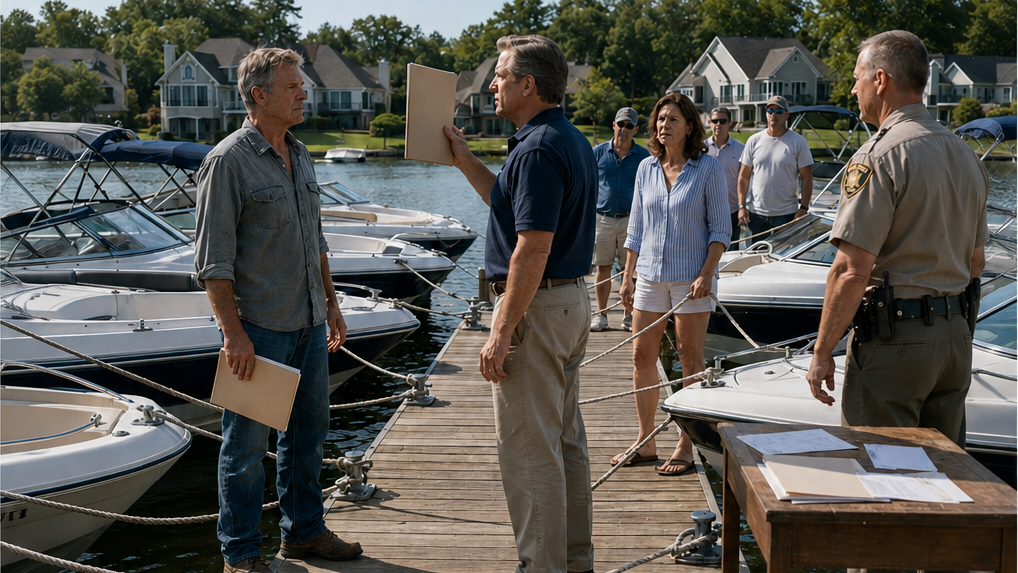
The HOA Turned His Private Dock Into Community Access—Until Six Boats Exposed What the Board Never Owned
Chapter 1: Six Boats Were Tied Where Scott Had Said No
Every cleat on Scott Harris’s dock had a rope around it.
He saw that before he saw the boats.
Six lines pulled tight against the galvanized cleats he had bolted into the cedar planks himself, each rope angling toward a hull rocking gently beyond the end of his yard. A pontoon occupied the deep-water side. Two fishing boats crowded the middle slips. Three runabouts sat along the outer edge.
Scott stopped halfway down the stone path with his coffee in one hand.
At seven fifteen on a Saturday morning, his private dock looked like a marina.
He set the cup on the retaining wall.
“Scott.”
Amy Davis stood near the pontoon, one hand wrapped around a blue dock line. She wore sunglasses pushed onto her head and looked more irritated than embarrassed.
Scott kept walking.
“I told George nobody was tying up here until this was settled.”
Amy glanced toward the other homeowners gathering near the boats. “George said it is settled.”
Scott’s eyes moved from face to face. He knew all of them. That made it worse.
Two summers earlier, some of these same people had called first.
Mind if we tie up for lunch?
Can we leave the boat for an hour while the kids swim?
Scott had almost always said yes.
Now nobody had asked.
A man near the fishing boat lifted his hands. “We’re not trying to start anything.”
“Then whose boats are these?”
The man hesitated.
Amy answered. “Residents’.”
Scott looked at the six ropes again. “That’s not what I asked.”
A vehicle door slammed above the slope.
George Miller came down the path carrying a folder under his arm. He had the deliberate walk Scott had come to associate with board meetings—measured, upright, already prepared to sound reasonable.
“Morning,” George said.
Scott didn’t return it.
George stopped where the lawn met the dock. “I was hoping we’d avoid this.”
“So was I.”
“Then let’s not turn it into something bigger.”
Scott pointed at the boats. “Six boats tied to my dock after I told you in writing not to authorize anybody to use it is already bigger.”
George’s jaw tightened slightly.
Amy looked between them. “You told him in writing?”
Before Scott could answer, George opened the folder.
“The board voted on this months ago.”
He removed a sheet inside a clear sleeve and held it at chest height as if its appearance settled the issue.
Scott recognized the association letterhead.
George tapped the page. “Community waterfront access. Approved by resolution.”
Scott stared at him. “A board vote doesn’t move my property line.”
“It formalizes longstanding community use.”
“Longstanding use with whose permission?”
Nobody answered.
The water knocked softly under the planks.
George lowered the paper. “Scott, nobody is claiming ownership of your house.”
“My dock is part of my property.”
“We’re talking about access.”
“To my property.”
A woman from one of the runabouts muttered that this was ridiculous.
Scott heard it and kept his eyes on George.
For one sharp second, he imagined going from cleat to cleat and releasing every line.
It would take less than a minute.
He could picture the ropes dropping onto the decks, people scrambling aboard, George finally understanding that a resolution printed on association paper did not make Scott’s hands powerless on his own dock.
Instead, Scott stepped away from the first cleat.
“I’m not touching anybody’s boat.”
George seemed to relax.
Scott added, “And nobody here should mistake that for permission.”
The relaxation disappeared.
Scott pulled out his phone.
“I’m documenting what’s here. Hull numbers, time, every line tied to every cleat.”
One of the boat owners swore under his breath.
Amy’s expression hardened. “Are you threatening us?”
“No.”
“It sounds like it.”
“I’m making a record.”
“For what?”
Scott looked at her.
“For whatever comes next.”
That drew murmurs.
George moved closer. “Scott, you don’t need to escalate this.”
Scott almost laughed.
The strange thing was that George appeared to believe he was the one preventing escalation.
“You brought six boats onto my dock.”
“They’re not on your dock. They’re moored alongside an access point that the association—”
“Stop.”
Scott rarely interrupted people. George knew that.
The group quieted.
Scott looked at Amy instead.
She had used his dock before. Once, when her engine had overheated near the opposite shore, Scott had even helped tow her in. Her family had eaten sandwiches at his patio table while the motor cooled.
He had never charged them.
Never asked for anything.
Now she looked at him as if he were taking something away.
Amy folded her arms.
“We paid more for this house because of the lake access.”
That changed the shape of the morning.
Scott frowned. “What lake access?”
“When we bought. It was part of the neighborhood. Waterfront access, convenient mooring, all of it.”
“Who told you my dock was included?”
“The association information. The sales material. Everyone knows.”
Scott looked at George.
George’s face stayed still.
“Is that what you told them?” Scott asked.
George closed the folder. “I told residents what the board recognized.”
“That’s not what I asked.”
“We can discuss this at the meeting.”
Scott’s attention went back to Amy.
She was angry, but there was something beneath it now—a flicker of uncertainty.
“Did you ever see an easement?” he asked.
“A what?”
“Something recorded against my property giving the neighborhood a right to use this dock.”
Amy looked toward George.
George answered for her.
“The board’s resolution addresses the issue.”
Scott felt the first clean edge of suspicion.
Not anger.
Suspicion.
Because George had not said yes.
Scott spent the next several minutes taking photographs. He documented each boat, each line, the position of the dock, and the people who chose to remain. He said little.
Some of the neighbors began leaving.
Amy did not.
When Scott finished, she said quietly, “You really think we’re trespassing.”
“I think somebody told you something they may not have had the right to promise.”
Her mouth tightened.
“That’s not the same thing.”
“No,” Scott said. “It isn’t.”
George gave him a tired look. “You’re making this unnecessarily adversarial.”
Scott picked up the coffee he had abandoned on the retaining wall. It had already gone cold.
“George, I spent twenty-eight years supervising utility crews. If somebody put a line across private ground because they thought a committee had voted for it, we’d still have to prove the easement before we dug.”
“This isn’t a utility corridor.”
“Property records don’t become optional because the object happens to float.”
George looked away toward the boats.
Scott noticed.
That bothered him more than the argument.
By late morning, only two boats remained. Amy’s pontoon was one of them.
Scott did not untie it.
He did not argue again.
He went inside, pulled open the bottom drawer of the cabinet where he kept closing papers, tax records, warranties, and the original deed to the house.
Before he reached the folder, he saw the envelope.
Certified mail.
He had tossed it there several days earlier after reading only the first page and deciding he would deal with it when he had time.
Now he took it back to the kitchen table.
The return address belonged to the homeowners association.
Scott slid out the letter and read the sentence he had skimmed before.
His dock, it said, had been designated an established community waterfront access point by formal board resolution.
Below that was a date from the previous November.
Scott read it twice.
Then he looked through the window at the two boats still tied to his cleats.
The board had not merely misunderstood his generosity.
It had voted to rename it.
Chapter 2: The Letter Made a Favor Sound Permanent
The phrase that kept Scott at the kitchen table was not “community access.”
It was “established.”
Established community waterfront access point.
The word made the arrangement sound ancient, deliberate, almost contractual.
Scott knew exactly how it had actually begun.
Two summers earlier, a neighbor had idled toward the dock on a hot July afternoon while Scott was replacing a warped board near the ladder.
“Mind if we tie up for an hour?”
Scott had looked at the empty cleat beside him.
“Sure.”
That was all.
No form. No agreement. No discussion about future use.
A week later, another neighbor asked. Then Amy and her family stopped during a long afternoon on the lake. By August, Scott had stopped being surprised when a familiar boat approached.
Most people still waved first.
Some called.
Nobody behaved as though they owned the space.
Scott had liked that.
He had moved into the community because the lake felt social without being crowded. People borrowed tools. Someone left tomatoes on porches every August. When storms knocked branches down, three chainsaws usually started before anyone asked whose tree it had been.
Scott considered signs unnecessary.
Once, after finding two unfamiliar teenagers fishing from the dock, a neighbor suggested he put up a PRIVATE DOCK plaque.
Scott had dismissed it.
“If I have to hang a sign for people I know, something’s already wrong.”
At the time, the sentence had sounded principled.
Now it sounded lazy.
He read the certified letter again.
The association claimed the board had voted the previous November to “formalize longstanding waterfront use.”
Scott reached for his phone.
George answered after the fourth ring.
“You saw my letter?”
“I saw it.”
A pause.
Scott said, “What exactly did you formalize?”
“The existing arrangement.”
“There was no arrangement with the HOA.”
“People have used that dock for years.”
“Because I let them.”
“Exactly. Longstanding use.”
Scott leaned back in his chair. “Permission and a property right aren’t the same thing.”
“We never said the HOA owns your dock.”
“The letter says community access.”
“Because that’s how it functions.”
“For whom?”
“For residents.”
“Whenever they want?”
George sighed. “Scott.”
“No. I want to understand what you think you voted on.”
“The board recognized an existing community practice. That’s all.”
“Without asking me.”
“We weren’t changing the physical property.”
Scott stared at the letter.
The logic irritated him because it was slippery rather than stupid.
George was treating behavior as if repetition had converted it into authority.
“Send me whatever legal document gives the association access,” Scott said.
“The resolution is attached.”
“I’m not asking for the resolution.”
“What are you asking for?”
“An easement. Covenant. Deed language. Anything recorded against my parcel.”
Silence.
Then George said, “I’ll have to check the files.”
Scott closed his eyes briefly.
“You voted before checking?”
“That’s not what I said.”
“It’s what I’m hearing.”
George’s voice hardened. “And I’m hearing a homeowner trying to undo something that has existed without complaint.”
Scott nearly answered quickly.
Instead, he looked through the window toward the dock.
George was not entirely wrong about one thing.
Scott had not complained.
He had watched the use grow.
The first summer, people asked.
The second summer, some asked and some waved.
By the end of that season, there were Saturdays when he walked down with coffee and found a boat tied there before he’d spoken to anyone.
Once, Amy had called from the water and said, “We’re taking our usual spot.”
Scott remembered smiling.
“Go ahead.”
Usual spot.
He had heard the words.
He simply hadn’t objected.
That afternoon, Scott drove to the county records office.
The clerk at the counter helped him pull the parcel history. Scott had brought his deed, but he wanted the index, subdivision plat references, recorded covenants—anything that could explain George’s confidence.
He worked slowly.
The parcel description matched what he remembered: the lake frontage, the boundary calls, the dimensions tracing the shoreline.
He found utility easements.
A drainage easement near the road.
Nothing involving the dock.
Nothing granting pedestrian access across his yard.
Nothing providing community mooring rights.
He asked the clerk to check again under the subdivision name.
The clerk searched.
“No waterfront easement tied to this parcel that I’m seeing.”
Scott tapped the counter once.
“Could something exist and not show here?”
“Something could always be filed under an unexpected reference. But if you’re asking whether I see a recorded easement burdening this parcel for HOA waterfront access, no.”
Scott thanked the clerk.
He sat in his truck for several minutes with copies on the passenger seat.
He should have felt relieved.
Instead, he remembered Amy saying they had paid more because of lake access.
That was somebody else’s problem legally.
He understood that.
But it did not feel entirely like somebody else’s problem.
He had helped create a visible pattern that people could point to.
That did not give George the right to turn it into policy.
Still, Scott wished he had posted the sign.
He wished he had told people, every single time, “You’re welcome today, but this is private.”
He wished he had not assumed everyone understood what he had never said.
His phone buzzed.
A message from George.
Scott opened it.
Attached was the board resolution.
Three signatures.
A paragraph describing “longstanding community access.”
No deed reference.
No easement number.
No recorded instrument.
Scott studied the page until one absence became impossible to ignore.
The board had written down what people had been doing.
It had not shown why they had a right to do it.
The next morning, Scott returned to the county system and searched every related instrument one more time.
He found nothing.
No shared dock right.
No waterfront-access easement.
No document linking the HOA to his shoreline.
He printed the result page and placed it beside the board resolution.
One stack said his property was his.
The other said the board had voted otherwise.
Scott called a surveyor before lunch.
Chapter 3: The Survey Found Nothing the Board Could Own
The surveyor stood at the edge of the dock, looked at Scott’s paperwork, then looked back toward the houses uphill.
“Why does the HOA think it has access here?”
Scott had expected questions about old monuments, lake level, or property corners.
Not that one.
“They say longstanding use.”
The surveyor adjusted the tripod.
“That’s not a boundary description.”
“I know.”
“Recorded easement?”
“Not that I can find.”
“Agreement?”
“No.”
The surveyor gave him a brief look.
“Then let’s see what actually exists.”
That sentence settled Scott more than anything George had said.
For most of the morning, he stayed out of the way while measurements were taken along the shoreline and upland boundary. The work was unglamorous—tripod legs pressed into soil, numbers entered, points checked against recorded plats.
Scott liked it.
Measurements did not care who had won a board election.
Near noon, the surveyor marked a point along the waterline several feet beyond the first dock post.
Scott looked down the line toward the structure.
The nearest cleat sat entirely inside the boundary.
So did every board, piling, ladder, and section of decking.
“No overlap?” Scott asked.
“Not from what I’m seeing.”
“And no access strip?”
“Not on the recorded plat.”
The surveyor straightened.
“If somebody claims an easement, they need to show you the instrument.”
Scott glanced toward the empty cleat beside him.
Amy’s boat had finally left the previous evening.
For the first time since Saturday, there was no rope around it.
Two days later, Scott sat across from Ruth Lee in a small conference room with the deed, county records, HOA resolution, and preliminary survey spread between them.
Ruth read quietly.
She did not react dramatically.
Scott trusted her more because of that.
When she finished the resolution, she slid it back across the table.
“This is a corporate action.”
Scott waited.
“It tells us the board voted.”
“Does it give them access?”
“Not by itself.”
“So they can’t do this.”
Ruth held up one finger.
“It means I don’t see the property right they’re claiming.”
Scott frowned. “Isn’t that the same thing?”
“No. And you don’t want to make their mistake by treating an incomplete record as certainty.”
That irritated him.
He had expected the survey and deed to end the argument.
Ruth seemed to notice.
“Your position is strong,” she said. “Very strong. But I want the subdivision declaration, amendments, historical plats, any developer reservations, and anything else they might point to.”
“I already searched.”
“And now I’ll search like someone who expects the other side to disagree.”
Scott sat back.
That was fair.
Ruth spent the next half hour tracing references.
There were restrictions regarding docks extending into the lake.
Architectural provisions.
Common-area language.
A pedestrian path at the other end of the development.
Nothing granting residents access across Scott’s parcel.
Then she found the board resolution in the HOA packet he had brought.
She placed it beside the deed.
“See this?”
“The resolution.”
“See what’s missing?”
Scott read the paragraph again.
“There isn’t a recording number.”
“More than that. No source instrument. It doesn’t say ‘pursuant to easement recorded at…’ It doesn’t identify a deed reservation. It doesn’t point to a plat note.”
Ruth tapped the paper.
“It’s asserting the conclusion without showing the property mechanism.”
Scott felt the tightness in his shoulders loosen.
“So I was right.”
“About the record we have.”
“Ruth.”
She gave him a flat look.
“Do you want reassurance or a clean answer?”
“A clean answer.”
“Then let the survey finish.”
The final survey arrived the next afternoon.
Scott drove directly to Ruth’s office.
The new boundary drawing showed his approximately 180 feet of shoreline, the house parcel, and the dock sitting squarely within the property line. The notes listed existing recorded easements.
None involved shared waterfront access.
Ruth read the certification twice.
“This is what we needed.”
Scott exhaled.
For days, the HOA’s paper had felt larger than it was because it carried a logo, signatures, and the language of authority.
Now there was something quieter in front of him.
Measurements.
Recorded references.
No community access.
No shared dock rights.
No easement.
Scott rubbed his thumb over the edge of the survey.
“I want them told to stop.”
“They will be.”
Ruth began outlining a formal demand: cease representing the dock as community access, advise residents that no such right had been established, and suspend use immediately while the HOA reviewed its records.
Scott nodded through most of it.
Then the receptionist knocked and opened the conference-room door.
“There’s a homeowner here asking for Mr. Harris.”
Scott looked at Ruth.
“Who?”
The receptionist glanced at a note.
“Amy Davis.”
Amy stood in the lobby holding a folded brochure and a thick real-estate packet.
She did not look friendly.
“I heard you hired a lawyer.”
Scott glanced at the papers in her arms. “I did.”
“So did you decide the rest of us are just liars?”
“No.”
“Because that’s what it feels like.”
Ruth stepped into the doorway but did not speak.
Amy pulled the brochure free and opened it across the reception counter.
“Look.”
Scott looked.
The material was old enough that the photographs had the slightly overbright finish common to real-estate marketing from years earlier. There were pictures of the neighborhood entrance, landscaped streets, and the lake.
Under one waterfront photograph was language promoting convenient lake access for community residents.
Scott read it again.
His dock was not named.
But the photograph appeared to have been taken from roughly his side of the cove.
Amy opened another page.
“When we bought, this was in the packet. The agent talked about access. The association packet talked about access.”
“Did anyone specifically say my dock?”
Amy hesitated.
“Not yours by name.”
Scott looked at Ruth.
Ruth was no longer studying Amy.
She was studying the brochure’s date.
“How old is this?” she asked.
“It came with the original subdivision materials,” Amy said. “The previous owners kept everything.”
Ruth pointed to the print line.
“This predates George’s resolution.”
Scott understood the implication before she said anything else.
The board had not invented the expectation last November.
It had inherited it.
Amy folded her arms.
“So what now?”
Scott looked at the survey on Ruth’s conference table, then at the sales brochure in Amy’s hands.
An hour earlier, he had thought the clean boundary line answered the whole problem.
It answered only who owned the dock.
It did not answer who had been promising it to everyone else—or for how long.
Chapter 4: The Promise Was Older Than George’s Resolution
Amy was waiting at the end of Scott’s driveway when he returned from Ruth’s office.
She had left the real-estate packet with Ruth, but she still held the old brochure in one hand. It was folded now, the waterfront photograph hidden inside.
“Can I ask you something before this gets worse?” she said.
Scott stopped beside his truck.
“It already got worse.”
“I know.”
She glanced toward the lake. Her pontoon was no longer tied to his dock. It sat farther down the cove at a temporary public tie-up, awkwardly positioned between two smaller boats.
Then Amy looked directly at him.
“Do you think everybody who used your dock was trespassing?”
Scott had prepared answers for George. He had prepared answers for Ruth. He had not prepared one for that.
“If they were there without permission, technically—”
“No. Not technically.”
Amy’s voice stayed low.
“I mean do you think we knew we were taking something from you?”
Scott looked past her toward the water.
“No.”
Amy let out a breath that sounded almost angry.
“Then you understand why this feels different from what George is saying.”
“What is George saying?”
“That you’ve decided to shut down something the neighborhood has always had.”
Scott’s eyes narrowed.
“Always?”
“That’s the word people are using.”
The HOA meeting that evening filled nearly every folding chair in the clubhouse.
Scott normally avoided meetings unless something affected his property directly. He had spent enough of his working life in fluorescent rooms listening to people argue over things they could have solved with a tape measure.
Tonight, the tape measure had already spoken.
The problem was that half the room did not care.
George sat at the center of the board table. Two other board members flanked him. Ruth had advised Scott not to turn the meeting into a legal presentation, so Scott brought only the survey, his deed, and a copy of the old marketing brochure.
Amy sat three rows behind him.
George called the meeting to order.
“We’re here to discuss lake access concerns.”
Scott heard the choice of words.
Not private-dock dispute.
Lake access concerns.
George summarized the board resolution. He described the dock as having been used by residents for years. He said the board had acted to recognize an existing community practice.
Then he said, “The association has no desire to interfere with Mr. Harris’s ownership.”
Scott raised his hand.
George looked reluctant but nodded.
“If you’re not interfering with my ownership, why are you authorizing people to tie boats to my dock without asking me?”
A murmur moved through the room.
George leaned toward the microphone.
“We are not authorizing unrestricted use.”
“Then what does community waterfront access mean?”
“It means the association recognized a historic pattern.”
“History doesn’t tie a rope.”
Someone in the back laughed once, then stopped.
George folded his hands.
“We’ve been advised to review the records.”
“By whom?”
“Scott.”
“By whom?”
George’s jaw tightened.
“Various people.”
Scott sat down.
That answer mattered.
Halfway through the meeting, Amy stood.
She held up the brochure.
“This came with the records from our house.”
George’s expression changed.
Only slightly.
Scott saw it anyway.
Amy opened the brochure and read the section about convenient lake access for community residents.
A woman across the aisle said, “That’s what we were told too.”
Another homeowner added, “Same here.”
George raised one hand.
“Those materials predate the current board.”
Amy nodded.
“So does the expectation.”
“Yes.”
“And Scott’s dock?”
George hesitated.
“The materials don’t identify a specific structure.”
“Then why did this board decide his was the one?”
The room quieted.
George looked toward Scott.
“Because that’s where community use had developed.”
Scott felt the answer land differently now.
The board had not found an old legal right.
It had found a habit.
Then it had attached the old promise to the place where that habit was easiest to see.
One of the board members spoke.
“To be fair, this issue has come up before.”
George turned his head.
The board member continued carefully.
“Not formally. But people have asked over the years whether the association actually had a dedicated waterfront access point.”
Scott leaned forward.
“And?”
The board member rubbed one thumb against a pen.
“Previous boards didn’t want to reopen the developer documents.”
A few people began talking at once.
George tapped the table.
“That’s not the same as saying anybody knew there was a problem.”
“No,” Scott said. “It means nobody wanted to find out.”
George’s face reddened.
“You are taking a complicated history and reducing it to misconduct.”
“I’m reducing it to one question. Do you have the right to authorize my dock?”
“We’re reviewing that.”
“Then suspend access while you review it.”
George shook his head.
That surprised Scott more than anything else that evening.
“Why not?”
“Because doing that would effectively decide the issue before counsel completes the review.”
Scott stared at him.
“So six boats can keep using my dock while you decide whether you’re allowed to send them there?”
George leaned back.
“We need to preserve the status quo.”
“The status quo was me deciding who could tie up.”
Several heads turned toward Scott.
He felt the room resisting him and understanding him at the same time.
That was worse than simple hostility.
Amy spoke from behind him.
“He’s right about that part.”
Scott looked back.
Her expression remained guarded.
“I’m not saying he’s right about everything,” she said. “But before the board resolution, people asked. At least most of us did.”
A man near the wall frowned.
“Some of us were told we didn’t have to.”
“By who?” Amy asked.
“George. Last season.”
George straightened.
“I said residents shouldn’t be treated as strangers when the dock had been used communally.”
Scott closed his eyes for half a second.
There it was again.
Not ownership.
Not easement.
Communally.
A softer word doing harder work.
After the meeting, Amy walked with Scott toward the lakeside path.
Her pontoon was visible beyond the trees.
She held a loose rope in one hand.
“I moved it,” she said.
“I saw.”
“I still think this is a mess.”
“It is.”
“And I still think people were promised something.”
“I think they were too.”
Amy stopped.
That answer seemed to disarm her.
“You do?”
Scott looked back toward the clubhouse, where George remained inside with the board.
“I don’t think a brochure gives anybody my dock. But if people bought homes believing there was access, they deserve to know how that happened.”
Amy looked down at the rope.
“So what are you doing?”
“Giving George one chance to stop using my property while they figure it out.”
The next morning, Ruth sent the demand by certified mail and email.
The language was narrow.
Stop representing Scott’s dock as community access.
Stop directing residents there.
Suspend all unauthorized mooring.
Preserve records related to the board’s November resolution.
Seventy-two hours.
Scott read the final version twice before authorizing Ruth to send it.
Then he walked down to the dock.
Amy’s cleat was empty.
For the first time, the bare metal did not look lonely.
It looked clear.
Three days later, the delivery confirmation showed George had received the letter.
There was no response.
Chapter 5: Four More Boats Arrived After the Warning
Scott woke to the sound of an outboard engine idling below his bedroom window.
He knew before he reached the glass.
Two boats had remained near the dock through the week, their owners insisting they were waiting for the HOA to resolve the dispute.
Now there were six.
Four new hulls sat against the dock, and every usable cleat carried a taut rope.
Scott stood at the window barefoot, staring down at them.
Ruth’s seventy-two-hour deadline had expired the previous afternoon.
He dressed without hurrying.
By the time he reached the dock, three homeowners were unloading coolers.
One of them lifted a hand.
“Morning, Scott.”
Scott looked at the cooler.
Then at the boat.
“Who told you to tie up here?”
The man’s smile disappeared.
“George said access was still in effect.”
Scott felt something inside him settle.
Not explode.
Settle.
“Did George mention my attorney’s demand?”
“What demand?”
Scott turned.
Amy was coming down the path carrying a life jacket.
Her pontoon was not among the four new boats, but she stopped when she saw the dock.
“You’ve got to be kidding.”
The man with the cooler frowned.
“What?”
Amy pointed at the boats.
“Why are you here?”
“Board said it’s open.”
“When?”
“Yesterday.”
Scott looked at Amy.
She looked back at him.
“You sent something official?” she asked.
“Monday. George received it Tuesday.”
“What did it say?”
“Stop authorizing use.”
Amy’s expression changed.
“He never told us that.”
George arrived twenty minutes later.
By then Scott had called the county sheriff’s nonemergency number.
He had not asked them to arrest anyone.
He had not asked for boats to be seized.
He had explained that multiple vessels were moored to his private dock after written notice revoking permission, and that the HOA president continued claiming authorization.
The dispatcher said a deputy would come out.
George came down the slope holding the same folder Scott had seen before.
“You called law enforcement?”
“I called someone who doesn’t report to the board.”
“This is a civil matter.”
“Maybe.”
George stopped beside the first boat.
“Then why create this spectacle?”
Scott looked at the six ropes.
“I didn’t bring the spectacle.”
More residents were gathering.
Some had come from the boats. Others stood on the lawn above, drawn by the sheriff’s vehicle when it arrived.
The deputy walked down carrying a small notebook.
Scott met him before George could.
“I’ve got the deed, current survey, attorney correspondence, delivery confirmation, and the HOA resolution they’re relying on.”
The deputy looked toward the dock.
“Anybody threatening anybody?”
“No.”
“Anybody refusing to leave right now?”
“Nobody’s been asked by you yet.”
George stepped forward.
“I’m George Miller, HOA president. The board formally recognized this as a community access point.”
The deputy looked at him.
“Do you own the dock?”
“No, but—”
“Does the association have a recorded easement?”
George’s eyes flicked toward Scott.
“The board voted.”
The deputy waited.
George added, “There is a longstanding pattern of community use.”
“That’s not what I asked.”
The silence that followed felt almost identical to the one in Ruth’s conference room.
Scott opened his folder on the small dock table.
The survey lay on top.
The deputy checked the property description, then the boundary drawing. He compared the parcel number to Scott’s identification and the county record printout.
George stood nearby with his resolution.
For several minutes, nobody spoke.
The boats bumped softly against their fenders.
Finally the deputy looked at George.
“This resolution tells me your board took a vote.”
George nodded.
“It doesn’t tell me the association owns this dock or has a recorded right to use it.”
“We’ve already explained that the use predates the resolution.”
The deputy closed Scott’s folder.
“Then you may want your attorney to explain what legal right that creates. I’m not seeing one here.”
A woman near one of the runabouts said, “So what happens to our boats?”
The deputy looked at Scott.
“What do you want?”
That question mattered.
Scott could feel everyone waiting for the harshest answer.
Part of him wanted to give it.
For days he had been called unreasonable. Accused of stealing access. Told that years of courtesy made his consent irrelevant.
But he looked at Amy.
She stood apart from George now.
Then he looked at the other boat owners.
Some looked angry.
Some merely confused.
“I want the boats off my property,” Scott said. “Nothing more than that.”
The deputy nodded.
He told the owners they needed to remove their vessels.
Two did so immediately.
One owner was not present.
Another boat had apparently been left by someone who had gone home after docking earlier.
The deputy contacted the county marina about temporary removal of unattended vessels from private property.
George objected.
“You can’t impound residents’ boats based on his say-so.”
The deputy looked at him.
“I’m not basing anything on his say-so.”
He tapped Scott’s survey.
“I’m basing my involvement on the documentation he provided and the owners’ lack of permission to remain attached to this structure.”
George lowered his voice.
“The association authorized it.”
“The association does not appear to own the structure.”
It was the calmest sentence spoken all morning.
It did more damage to George’s position than any accusation Scott could have made.
When arrangements were made to move the unattended boats to the county marina, one owner demanded to know who would pay retrieval and handling charges.
The deputy said that was between the owner, the marina, and potentially the association if they had relied on incorrect instructions.
Every face turned toward George.
He looked furious.
But not at Scott.
At the situation.
At the paperwork.
At the fact that the language he had been using for months had finally met someone who asked the question beneath it.
Amy walked to Scott’s table.
“Can I see the attorney letter?”
Scott handed her a copy.
She read the first page.
Then the second.
Her brow furrowed.
“He got this Tuesday?”
“Delivery receipt says Tuesday morning.”
Amy looked at George.
“You told people yesterday that access was still authorized.”
George stiffened.
“I told them the board had not rescinded the resolution.”
“Did you tell them Scott’s lawyer said there was no easement?”
“That is counsel’s position.”
“Did you tell them?”
George’s eyes narrowed.
“This is not the place.”
Amy folded the letter.
“Actually, I think this is exactly the place.”
One of the remaining boat owners walked over.
“What letter?”
Amy handed it to him.
George stepped forward.
“That correspondence is part of an active dispute.”
Scott almost said something.
He stopped himself.
He did not need to.
The neighbors were reading now.
The sheriff’s deputy stood beside the dock.
Two boats were already pulling away.
Marina personnel were coordinating removal of another.
The six ropes that had looked immovable at sunrise were disappearing one by one.
Amy waited until George was looking at her.
Then she asked the question Scott had been trying to answer since the certified envelope appeared.
“When did you first find out there was no easement?”
George did not answer.
Chapter 6: What George Knew Before the Board Voted
George opened the emergency board meeting with a sentence nobody in the room expected him to say.
“The association does not possess a recorded easement over Scott Harris’s parcel.”
Nobody moved.
Scott sat in the second row with a length of blue dock rope coiled loosely beside his chair.
He had found it two days earlier after the last boat was removed. One end still carried the shape of the knot that had been pulled tight around his cleat.
He had almost thrown it away.
Instead, he brought it with him.
George continued.
“Our counsel has completed a preliminary review. At this time, there is no recorded instrument establishing a permanent community right to use Mr. Harris’s dock.”
A man near the aisle said, “Then why did you tell us there was?”
George looked down at the papers in front of him.
“I told residents the board had recognized longstanding use.”
“That’s not an answer.”
Another voice joined in.
“You told me the board had authority.”
The room grew louder.
George lifted a hand.
“I understand people are upset.”
Amy, seated near the front, said, “When did you know?”
George looked at her.
She did not raise her voice.
That made the question harder to avoid.
“When did you know the records were incomplete?”
One of the other board members shifted uncomfortably.
George glanced toward the board table.
Then he exhaled.
“Before the November vote, I knew we had not located a recorded easement.”
The room broke open.
Scott heard chairs scrape, voices overlap, somebody say, “Unbelievable.”
He did not join in.
George tapped the microphone, but the sound only sharpened the anger.
Finally, the room settled enough for him to continue.
“That does not mean I knew there was no legitimate access history.”
Amy stared at him.
“You knew you couldn’t find the legal document.”
“I knew the file was incomplete.”
“And you voted anyway.”
George’s face hardened.
“Yes.”
The honesty quieted the room again.
Scott had expected excuses.
What came next was not exactly an excuse.
George looked around at the homeowners.
“Do you know what would have happened if we’d announced last fall that the neighborhood might not have the waterfront access residents had been told existed for fifteen years?”
A man answered, “We would’ve wanted to know.”
“You would’ve wanted answers we didn’t have.”
“Then get them.”
“We tried.”
Scott watched George carefully.
For the first time, George did not look like an HOA president defending authority.
He looked tired.
“We had homeowners who bought based on lake-oriented marketing. We had resale listings referencing community access. We had insurance questions. We had owners already asking whether dues paid for amenities that didn’t exist.”
George looked toward Amy.
“And yes, I worried about property values. I worried about claims against the association. I worried about telling seventy families that something they thought came with their homes might have been nothing more than years of informal permission.”
Scott glanced at the rope beside him.
There it was.
The deeper mistake.
Not a secret deed.
Not corruption.
Fear.
George had found a problem large enough to threaten the association and decided the safest way through it was to make Scott’s generosity carry the weight.
A board member spoke quietly.
“I told George before the vote that we should get a title review.”
George nodded.
“You did.”
Scott looked up.
The board member continued.
“We didn’t have the money budgeted for a full review at the time. George believed the historic use and old sales materials gave us enough basis to preserve access temporarily.”
Amy said, “Temporarily? The resolution doesn’t say temporarily.”
George closed his eyes briefly.
“No.”
That single word mattered.
Scott understood now why George had refused to suspend access.
Stopping it would have been an admission.
And George had spent months trying to prevent the association from reaching that exact moment.
A homeowner stood.
“My boat cost me money to retrieve.”
Another voice followed.
“Same.”
Someone asked whether the HOA would reimburse marina charges.
Someone else wanted to know whether sellers had misrepresented properties.
The room began moving from anger toward consequence.
George looked toward the association attorney seated at the end of the table.
The attorney spoke carefully.
“The board is reviewing reimbursement for direct costs incurred by residents who relied on the association’s access representation. We are also preparing a formal retraction.”
Scott heard the word.
Retraction.
It should have felt like victory.
Instead, he looked at Amy.
She seemed relieved and furious at once.
When the room quieted again, she stood.
“I owe Scott something.”
Scott’s head came up.
Amy turned partly toward him.
“I was angry at you because I thought you were changing the rules after letting us use the dock for years.”
Scott said nothing.
“I still think you should’ve been clearer.”
A few people shifted.
Scott nodded once.
“So do I.”
Amy seemed surprised.
Then she faced George.
“But that’s different from being told the board had a right it knew it couldn’t prove.”
George’s mouth tightened.
Amy sat down.
The distinction moved through the room more effectively than any speech.
Scott had made a mistake.
George had made a choice.
They were not the same thing.
When the board opened the floor to Scott, he carried the blue rope with him.
He set it on the table beside the November resolution.
George looked at it.
Scott said, “I’m not asking the association to punish every person who tied a boat to my dock.”
Several homeowners looked at him.
“I’m not asking for fines. I’m not asking for some public apology tour. The boat owners who paid marina costs because the board told them access continued after my notice should be made whole.”
The association attorney wrote something down.
Scott continued.
“My legal costs related to correcting the title issue need to be addressed too.”
George nodded slowly.
“And I want the community-access designation retracted in writing.”
“It will be.”
Scott looked at him.
“That’s not my main condition.”
George waited.
Scott put one hand on the rope.
“For two summers, I let people use that dock because they asked. Somewhere along the way, asking disappeared. Then permission disappeared. Then the board decided the use itself was enough.”
Nobody interrupted.
Scott pushed the rope slightly toward the resolution.
“If we’re settling this, the association records need to say plainly that my dock is private, that no easement exists, and that past permission does not create future access.”
George looked toward the attorney.
The attorney gave a small nod.
Scott added, “Record it where it won’t disappear when the board changes.”
George’s expression was hard to read.
“You want a permanent acknowledgment.”
“I want the next president to have something better than memory.”
For a moment, Scott thought George might argue.
Instead, George looked around the room.
At Amy.
At the homeowners who had trusted the old brochures.
At the board members who had allowed uncertainty to harden into policy.
Then he said, “All right.”
Scott picked up the rope.
The meeting moved on to reimbursement procedures, attorney review, and how the retraction would be distributed.
The anger did not disappear.
Neither did the embarrassment.
But the argument had finally stopped being about whether Scott was selfish for saying no.
Afterward, George caught him near the door.
“I was trying to keep the whole thing from falling apart.”
Scott studied him.
“I know.”
George looked almost offended by the answer.
Scott continued.
“That’s why you should’ve checked before you made my property the thing holding it together.”
George looked toward the empty meeting room.
“I thought if we preserved access, we’d buy time.”
“You bought time with something that wasn’t yours.”
George nodded once.
He did not apologize.
Scott did not ask him to.
Outside, Amy was waiting by the walkway.
“Think people will ever stop being angry?” she asked.
“Which people?”
She gave him a tired smile.
“Fair.”
Scott looked toward the dark shape of the lake beyond the clubhouse.
The dock was empty now.
No ropes.
No boats.
No argument waiting at the end of his yard.
He should have wanted it to stay that way forever.
Instead, the idea troubled him.
Because if the only safe boundary was a dock nobody could ever use again, then George’s mistake would have changed more than a property record.
It would have changed Scott.
Amy started toward her car.
Scott called after her.
“When the paperwork’s done, I want to talk about one thing.”
She turned.
“What?”
“How somebody asks permission without anyone pretending it means forever.”
Amy looked at him for a long moment.
Then she nodded.
The association still had to sign the retraction.
The deed record still had to be corrected.
Trust, Scott suspected, would take longer.
Chapter 7: The Empty Cleats Finally Meant What Scott Intended
For the first Saturday in years, Scott walked down to the lake and found nothing tied to his dock.
No pontoon.
No fishing boat.
No cooler sitting on the planks.
No rope pulled tight around one of the galvanized cleats.
The emptiness should have felt like relief.
Instead, Scott stood at the end of the dock with his coffee and listened to the small hollow knock of water beneath the boards.
He had wanted control back.
Now he had it.
The association’s retraction had been signed three days earlier. Ruth had sent him the final recorded acknowledgment the afternoon before.
The language was plain.
The dock and shoreline belonged to Scott’s parcel.
No recorded easement granted the association or its members access.
Past permissive use created no continuing right.
The November resolution had been withdrawn.
Direct costs caused by the association’s continued access instructions after formal notice would be reimbursed. Scott’s legal expenses related to correcting the claim would be addressed under the settlement.
Nothing in the document called George dishonest.
Nothing called Scott unreasonable.
That was deliberate.
Ruth had told him the cleanest correction was one that could survive long after everybody involved stopped being angry.
Scott had agreed.
Still, holding the final copy in his kitchen had not felt like winning.
It had felt like closing a valve after a leak and realizing how much water had already escaped.
By midmorning, voices carried from the HOA’s common lakeside area farther around the cove.
Several families had gathered there. A few boats drifted offshore, waiting for space at the smaller public tie-up.
The association had begun discussing long-term alternatives, but nothing had been built or promised yet.
Scott watched one boat circle twice.
There was room at his dock for three of them.
He turned away.
That was when Amy called from the path.
“Scott?”
He looked back.
She was standing at the top of the stone steps, holding a blue rope in one hand.
Not the old rope from the dispute.
A clean one.
Her pontoon floated about twenty yards offshore, idling quietly with another family member at the wheel.
Scott looked from Amy to the boat.
“You need something?”
Amy came down two steps, then stopped.
“I wanted to ask before I came any farther.”
Scott almost smiled at the wording.
“Ask what?”
She lifted the rope slightly.
“Can we tie up for the afternoon?”
The question struck him harder than it should have.
It was exactly what he had said he wanted.
Permission asked.
Permission given or refused.
Clear.
Simple.
Yet his first instinct was no.
Not because Amy had done anything that morning.
Because the last time boats filled the dock, George had stood there with a resolution and told Scott that repeated use had become something larger than his consent.
Amy seemed to read the hesitation.
“If the answer is no, it’s no.”
Scott looked toward the pontoon.
“You know the new acknowledgment says this is private.”
“I read it.”
“And you know permission today doesn’t mean permission next weekend.”
“Yes.”
“It doesn’t transfer with the house.”
“I know.”
“It doesn’t become an association amenity because I say yes.”
Amy let out a short breath.
“Scott, I’m asking if we can eat lunch here. I’m not filing a claim on the shoreline.”
The sentence was dry enough to catch him off guard.
He laughed once.
Amy smiled, but only for a moment.
Then she grew serious.
“I mean it. I understand now.”
Scott rubbed the edge of the nearest cleat with his thumb.
There had been a time when he would have said yes without thinking.
Then a time when he would have said no simply to prove that he could.
Neither felt right anymore.
“What changed?” he asked.
Amy glanced across the lake.
“Besides the obvious?”
“Besides the paperwork.”
She considered.
“I was angry because I thought you were taking something away from us. Then I found out the thing I thought was ours had never really been ours.”
Scott said nothing.
Amy continued.
“That doesn’t mean I wasn’t promised it. I was. Maybe not this exact dock by name, but the whole sales pitch made the lake feel like part of what we were buying.”
“I know.”
“For a while, I needed you to be the person who ruined that. It was easier.”
Scott looked at her.
“And now?”
“Now I’m angry at the right people.”
He frowned slightly.
Amy shook her head.
“Not just George.”
That surprised him.
“The old developer materials. The boards that avoided checking. Residents like me who stopped asking because asking started to feel unnecessary.”
She looked at the cleats.
“And you.”
Scott raised an eyebrow.
Amy met his eyes.
“You made it easy to think there were no rules because you hated saying the rules out loud.”
The words landed cleanly.
Scott could have argued.
Instead, he looked down at the dock.
She was right.
Not legally.
Not in the way George had tried to make him responsible for the board’s decision.
But personally.
Scott had expected everyone to understand a boundary he had never bothered to define.
Amy said, “You don’t have to agree.”
“I do.”
She waited.
Scott gave a small shrug.
“I should’ve been clearer.”
Amy nodded.
“Probably.”
That annoyed him enough to make him laugh again.
“You could’ve softened that.”
“I’ve spent a month softening things.”
Fair enough.
Scott looked at the empty dock.
The metal cleats caught the light.
For weeks, he had imagined that emptiness as the proof he needed.
No boats meant nobody could mistake kindness for entitlement.
No ropes meant no argument.
No permission meant no risk.
But if that was the only lesson he took from the whole mess, then he had allowed fear to write the next rule.
He gestured toward the pontoon.
“One afternoon.”
Amy’s expression changed.
“Seriously?”
“You’re asking. I’m answering.”
“One afternoon.”
“And if you want to come back another day?”
“We ask again.”
“If I say no?”
“You say no.”
“No board vote.”
“No board vote.”
“No resolution.”
“Please never say that word to me again.”
Scott smiled.
“Bring it in.”
Amy waved toward the pontoon.
The engine rose slightly, then softened as the boat approached.
Scott stepped onto the outer edge of the dock.
Amy handed him the blue line.
For an instant, he felt the old memory in his hands—the six taut ropes, the deputy reading the survey, George insisting that the board had voted.
Then the memory passed.
Scott wrapped the rope once around the cleat.
Not too tight.
Just enough.
Amy watched him.
“You sure?”
Scott pulled the line snug and checked the fender against the dock.
“I’m sure about today.”
She nodded.
That was enough.
Later, they ate lunch on the patio with the boat visible beyond the yard.
Nobody called it community access.
Nobody called it an amenity.
At one point, another homeowner walking along the lakeside path stopped and looked toward the pontoon.
Scott saw the question forming before the man spoke.
“Is the dock open again?”
Scott answered before Amy could.
“No.”
The man looked confused.
Scott pointed toward Amy.
“She’s my guest today.”
There was a pause.
Then the man nodded.
“Got it.”
He kept walking.
Scott watched him go.
That exchange lasted less than ten seconds.
A month earlier, Scott would have found it awkward.
Now it felt almost embarrassingly simple.
When Amy prepared to leave that afternoon, she loosened the rope but stopped before lifting it free.
“Your turn,” she said.
Scott looked at her.
“What?”
“You tied it.”
She held out the loose end.
Scott understood.
He took the rope, unwound it from the cleat, then retied it once more so the pontoon would hold while she loaded the last cooler.
One deliberate loop.
One clear permission.
Nothing more.
When she was ready, Scott pulled the line free and handed the loose end back to her.
Amy caught it.
“See you around?”
Scott looked at the empty cleat.
Then at her.
“Ask first.”
She smiled.
“I will.”
The pontoon moved slowly away from the dock.
Scott stood there until the wake reached the pilings.
The cleat was empty again.
This time, it did not mean exclusion.
It meant the choice had returned to the person who owned it.
The story has ended.