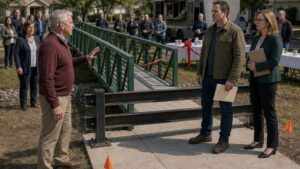
My Neighbor Built His Deck Across My Utility Easement—Then the HOA Learned Why I Had Refused to Sign Their New Boundary Map
Chapter 1: The Footing Went In Before Breakfast
The concrete truck was already backing between the houses when Raymond Miller stepped onto his patio with a mug of coffee in his hand.
For a second, he thought the driver had taken the wrong driveway.
Then he saw the orange mixer chute swinging toward the narrow strip of grass along his western property line.
“Hold up,” Raymond called.
Nobody heard him over the diesel engine.
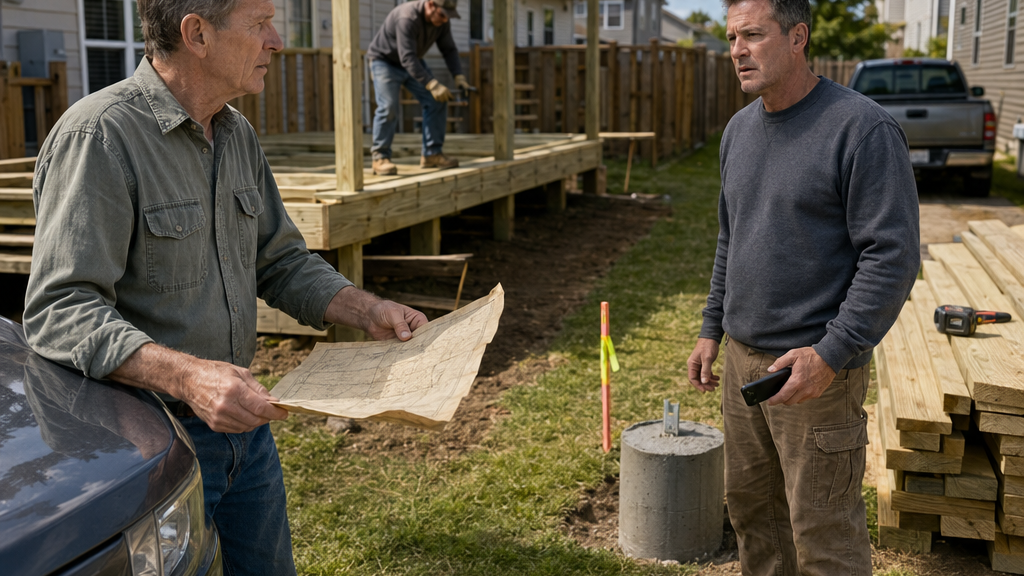
Two workers were standing beside a freshly dug hole near Brian Hall’s backyard, one holding a cylindrical concrete form steady while the other guided the chute. The form sat in the strip Raymond had spent eleven years mowing without thinking much about it. Ten feet of ordinary grass, bordered on one side by his fence and on the other by Brian’s lawn.
Ordinary except for one thing.
His grandfather had always called it the place you never built on.
Raymond set the coffee down on the patio wall and walked faster.
“Excuse me.”
The contractor looked up this time.
“Morning.”
“What are you putting there?”
The man glanced toward Brian’s house. “Deck footing.”
Raymond looked at the hole again.
“How deep?”
“Forty-two inches.”
That answered more than Raymond wanted answered. This was no temporary post. No planter. No movable step. They were sinking concrete below the frost line.
“Don’t pour that yet.”
The contractor straightened.
“Homeowner approved it.”
“I’m one of the homeowners whose property you may be standing on.”
The man’s expression changed, not dramatically, just enough to show that Raymond had moved the conversation out of the category of curious neighbor.
“I’d need Brian to stop it,” he said.
Brian appeared from his back door a few seconds later wearing work pants and an old college sweatshirt. He looked irritated rather than surprised.
“Raymond, what’s going on?”
“That footing.”
Brian followed his finger.
“What about it?”
“It’s in the utility strip.”
Brian exhaled through his nose. “We went over all this.”
“We never went over this.”
“I told you I was putting in a deck.”
“You told me you were replacing the patio.”
“And extending it.”
Raymond looked past him. Stacks of pressure-treated lumber lay across the lawn. There were enough joists for something far larger than a patio extension.
“How far?”
Brian pointed vaguely toward Raymond’s fence.
“About twelve feet.”
Raymond stared at him.
“That takes it right across the easement.”
Brian gave a small laugh, as if the word itself were an overreaction.
“The HOA approved the whole plan.”
Raymond had heard that sentence before in smaller disputes. A shed color. A mailbox post. A fence stain. In their neighborhood, approval from the homeowners association often ended conversations because people wanted it to.
This one felt different.
“The HOA can approve appearance,” Raymond said. “They don’t move recorded property lines.”
Brian’s face tightened.
“It’s not on your lot.”
“It is.”
“No, it isn’t.”
Raymond looked again at the grass.
There was no fence exactly on the line. That had been intentional. His grandfather had kept the utility corridor open. Raymond had done the same. Over the years, Brian had edged a little farther into it when mowing. A shrub had appeared near one corner. One summer, a wheelbarrow sat there for six weeks.
Raymond had said nothing.
He had always believed a person could tell the difference between not complaining and giving something away.
Now he was less certain that Brian had.
“Don’t pour until we check it,” Raymond said.
Brian rubbed a hand across his jaw.
“I already checked it.”
“With who?”
“The HOA.”
“That isn’t what I asked.”
Brian disappeared inside and came back with his phone.
He opened an email and held it out.
Raymond did not take the phone. He read from where he stood.
The message was from the association’s architectural review address. It referred to Brian’s deck expansion and said the submitted layout had been approved subject to local code and permit requirements. A small image was attached beneath it.
Brian enlarged the image.
It was a site diagram.
Raymond recognized his own fence and Brian’s rear lot outline, but something about the western side looked wrong.
“There,” Brian said. “The boundary’s right there. Deck stays on my side.”
Raymond leaned closer.
The heavy line on the HOA diagram ran through the grass several feet farther toward his house than Raymond expected.
“Where did this map come from?”
“It’s the association’s map.”
“That’s not an answer.”
“It’s what they use.”
Behind them, the truck engine continued idling. The contractor shifted his weight.
Brian lowered the phone.
“I paid for the materials. I paid the crew. We filed everything they asked for. I’m not shutting down a job because you suddenly think ten feet of grass is sacred.”
Raymond felt the word suddenly land harder than Brian intended.
Sacred.
His grandfather had not treated the strip that way. He had treated it practically. Keep it open. Never put permanent structures there. Gas, electric, drainage—whatever had rights through it needed access.
But Raymond had let it become visually ambiguous.
He had let Brian mow across it.
He had never corrected the shrub.
He had never pointed out where the line actually ran.
That did not change the deed.
But it explained the confidence in Brian’s voice.
“Give me until this afternoon,” Raymond said.
Brian looked toward the crew.
“For what?”
“To pull the survey.”
“I’ve got approval.”
“And if your approval is based on the wrong line?”
Brian’s mouth tightened.
“That’s not my problem.”
The contractor looked from one man to the other.
“I need a call here.”
Brian answered without looking away from Raymond.
“Pour it.”
The chute swung over the form.
Wet gray concrete began sliding into the hole.
Raymond stood there long enough to watch the level rise.
For years, he had thought keeping peace meant knowing which arguments were too small to have.
The concrete reached the top of the form.
This one was no longer small.
As the truck moved toward the next hole, Brian held up his phone again.
“The HOA map shows that strip on my side, Raymond.”
Raymond looked at the thick black line on the screen, then at the fresh concrete hardening in the grass.
One of those lines was wrong.
By the end of the day, he intended to know which one.
Chapter 2: The Map on the Pickup Hood
Raymond found the survey exactly where his grandfather had left it.
Not framed. Not preserved in plastic. Not tucked into a safe-deposit box.
It was folded into quarters inside a brown property folder in the bottom drawer of an old steel filing cabinet.
The paper had softened along the creases. One corner carried a faint coffee stain that Raymond remembered seeing when he was younger.
He spread it across the kitchen table.
Parcel boundary.
Recorded easement.
Bearings.
Distances.
There it was.
A ten-foot utility easement running along the western edge of the property.
Raymond traced it with one finger.
The line did not run where Brian’s HOA diagram showed it.
Not even close.
He checked the parcel number against the deed. Then the recording reference. Then again, slower.
He had spent enough years around old paperwork to know the danger of seeing what you expected to see.
By noon he had photographed the survey and called the county records office. The clerk would not interpret the legal effect for him, but she confirmed the plat reference and told him the recorded copy was still on file.
That was enough for now.
Brian was in the backyard when Raymond returned outside.
The crew had already set two more forms.
“Can we talk?”
Brian glanced toward the workers.
“You found something?”
Raymond carried the survey to the hood of his pickup.
“I found the recorded plat.”
Brian hesitated, then followed.
Raymond unfolded the paper and weighted two corners with a tape measure and a socket wrench.
“This is my parcel.”
Brian leaned in.
“This line here is the western boundary. This shaded strip is the easement. Ten feet wide.”
Brian studied it.
“That’s old.”
“So is the deed.”
“I mean old as in before the neighborhood redid all the common-area plans.”
Raymond looked at him.
“Common-area plans don’t redraw private lots.”
Brian tapped the paper.
“You know that for a fact?”
“No. I know this was recorded. I know what your HOA email showed me wasn’t.”
Brian pulled out his phone.
“Same line.”
“It isn’t.”
Raymond held the phone beside the survey.
The difference was obvious once they were side by side. The association diagram placed the boundary farther east, effectively absorbing most of the utility strip into Brian’s yard.
Raymond pointed to the approval email.
“Show me the plat reference.”
Brian scrolled.
“There isn’t one.”
“Survey company?”
Nothing.
“Recording number?”
Brian stopped scrolling.
The contractor, carrying a drill, slowed as he passed them.
Brian lowered the phone.
“It came from the HOA. I’m not expected to audit their maps.”
“No,” Raymond said. “You aren’t.”
For the first time that morning, Brian’s certainty weakened.
Raymond saw it in the way he looked past the survey toward the footings.
Then Brian straightened.
“But you’ve never treated that like ten feet of your yard.”
Raymond said nothing.
“You mow to the fence. I mow most of this side. My shrubs have been there for years.”
“They’re shrubs.”
“You never said anything.”
That was true.
The truth irritated Raymond more than if Brian had lied.
“I should have.”
Brian blinked.
The answer had disarmed him.
Raymond folded one side of the survey back.
“I should’ve corrected it when the mowing line drifted. I should’ve said something about the shrub. But none of that gives the HOA authority to approve a permanent footing.”
Brian turned toward the deck materials.
“I’ve already paid eighty percent.”
Raymond looked at him.
“What?”
“The contractor. Materials, labor deposit, everything except final.”
That explained the edge in his voice better than the HOA email did.
“How much?”
Brian shook his head.
“Enough.”
Raymond could have asked again. He did not.
Instead he pointed at the easement notation.
“This is also utility access.”
“So?”
“So if something runs through here and they need to reach it, a deck sitting over it becomes a problem.”
Brian gave a short, frustrated laugh.
“You don’t even know if anything’s under there.”
“That doesn’t change the recorded easement.”
“It might change whether anyone cares.”
A worker called from the far end of the framing layout.
Brian looked toward him.
Raymond could feel the moment narrowing.
If Brian stopped now, he would lose labor and probably materials.
If he kept going and Raymond was right, every additional board would make stopping harder.
“Pause the job,” Raymond said.
“For how long?”
“Until the HOA explains where their line came from.”
“And if they say it’s correct?”
“Then I’ll listen.”
Brian folded his arms.
“You want me to shut down a crew based on a piece of paper from thirty years ago.”
“Based on the recorded property survey.”
“My approval is in writing.”
“So is mine.”
They stood over the hood with the two documents between them.
One official-looking email.
One old survey with a recording number.
Neither man moved.
Finally Brian said, “I’m calling Donna.”
“Fine.”
“She’ll tell you the same thing.”
“Then ask her for the recorded plat number.”
Brian’s jaw shifted.
Raymond carefully refolded the survey.
He had expected the document to solve the argument.
Instead it had exposed a more expensive one.
Before he reached his back door, he heard the contractor’s saw start again.
Raymond stopped.
The first joist was being carried toward the newly set posts.
He turned back.
Brian stood near the patio, phone to his ear.
For a moment their eyes met.
Brian did not wave.
Raymond went inside and called an attorney whose name had been given to him years earlier during a fence issue he never pursued.
Mary Perez listened while he explained the deck, the survey, the utility easement, and the HOA email.
When he finished, she asked one question.
“Are they still building?”
Raymond looked through the kitchen window.
A worker was fastening lumber to the first post.
“Yes.”
“Then stop thinking of this as a disagreement about grass.”
The next morning, at 7:12, the crew’s pickup rolled into Brian’s driveway again.
Chapter 3: The Approval Everyone Trusted
“Why does the boundary matter today if it didn’t matter last year?”
Donna White asked the question before Raymond had even taken his coat off.
The HOA management office occupied a converted front room inside the subdivision clubhouse. There was a conference table, a printer, two framed photographs of neighborhood entrances, and a row of binders with years printed neatly on their spines.
Donna sat at the far end of the table. Lisa Johnson, the property-management representative, had a laptop open beside her.
Raymond remained standing for another second.
“It mattered last year,” he said. “I just didn’t argue about it.”
Donna gestured toward the chair.
“That’s part of the problem.”
Raymond sat.
Lisa looked uncomfortable.
Donna turned a printed diagram toward him.
“This is the map we’ve been using for landscape and architectural review.”
It was the same diagram Brian had shown him.
The line still cut through Raymond’s grass.
“And this,” Raymond said, placing a copy of his survey beside it, “is the recorded plat.”
Donna barely glanced at it.
“We have several homes where actual use doesn’t match these old drawings perfectly.”
“Actual use isn’t the same thing as ownership.”
“No one is saying it is.”
“Brian is building based on this.”
Donna pressed her lips together.
“Brian submitted an application. The architectural committee reviewed it. The project was approved.”
“Using the wrong boundary.”
“That has not been established.”
Raymond looked at Lisa.
“Have you checked the county record?”
Lisa paused.
“I’m still gathering the underlying files.”
Donna continued before Raymond could respond.
“What concerns me is that there has apparently been shared maintenance of that area for years.”
“Shared maintenance?”
“Brian says he has mowed it.”
“He has.”
“And planted near it.”
“Yes.”
“And you did not object.”
“No.”
Donna sat back.
“There you are.”
The phrase irritated Raymond.
“There I am what?”
“Participating in the ambiguity.”
The room went quiet.
Raymond wanted to reject that immediately.
Instead he pictured the strip.
Brian’s mower lines extending beyond where they should.
The shrub he had noticed and ignored.
A bag of mulch once left on the grass for half a summer.
He had treated each thing as too small to justify becoming the neighbor who measured every inch.
Mary Perez had said something similar on the phone that morning.
Your ownership documents may be strong, but don’t confuse a strong legal position with a clean factual history.
Raymond had disliked hearing it from her too.
“I should’ve spoken earlier,” he said.
Donna seemed surprised.
“But that doesn’t make the map accurate.”
Lisa’s fingers stopped above her keyboard.
Raymond continued.
“I’m not asking the HOA to punish Brian. I’m asking you to verify which document you used before approving permanent construction.”
Donna looked toward Lisa.
“We are verifying it.”
“How long?”
“These things take time.”
“The crew is building today.”
“We can’t order a private contractor off a homeowner’s property because another homeowner brings in a conflicting document.”
Raymond almost laughed at the wording.
“That’s exactly the question. Whose property?”
Lisa finally spoke.
“I can request the original source file for the association map.”
Donna looked at her.
“I thought we already had it.”
“We have the current PDF.”
“I mean the source.”
Lisa nodded cautiously.
“I don’t know yet.”
That was the first useful sentence Raymond had heard.
Later that afternoon, Mary called him.
“You did something smart,” she said.
“What?”
“You admitted the mowing issue.”
“I don’t feel smart.”
“That’s usually a good sign.”
Raymond stood at his kitchen window. The deck frame had grown. The joists now reached nearly the full planned width.
“Does my silence hurt me?”
“It can complicate how people tell the story. It does not automatically transfer title. And an easement issue is separate again. But if your goal is to resolve this without litigation, you need to understand why Brian thinks he was reasonable.”
“He kept building after I showed him the survey.”
“That matters too.”
Raymond watched a worker move along the frame.
“So what do I do?”
“Document. Put your objection in writing. Ask the HOA to identify the recorded document supporting their boundary. And decide what outcome you actually want.”
“I want the deck out of the easement.”
“That’s an outcome. Good. Don’t let anger expand it.”
That evening Donna emailed him a proposed temporary agreement.
Raymond printed it because he still trusted paper more than scrolling through legal language on a phone.
The first paragraph sounded harmless. It acknowledged an active boundary disagreement. The second allowed Brian’s construction to remain while the parties investigated.
Raymond nearly stopped there.
Then he read the third paragraph.
For purposes of temporary use and maintenance, the parties acknowledge the association’s current site map as the historically accepted boundary depiction pending further review.
He read the sentence twice.
Then a third time.
Accepted boundary depiction.
Not disputed diagram.
Not temporary reference.
Accepted.
Raymond called Donna.
She answered after several rings.
“I’m looking at the agreement.”
“Good. It protects everyone while we sort this out.”
“No.”
A pause.
“No what?”
“I’m not signing it.”
“Raymond, it doesn’t surrender your claim.”
“It says I acknowledge your map as the accepted boundary.”
“For temporary purposes.”
“You could have written ‘disputed boundary.’ You didn’t.”
Donna’s voice cooled.
“The association needs a stable reference point while the review is underway.”
“You already have one.”
“The documents conflict.”
“No. Your diagram conflicts with a recorded survey.”
“That is your interpretation.”
Raymond looked through the glass door.
Brian’s new deck frame threw a grid of shadows over the grass.
“I’m not signing something that makes your mistake the starting truth.”
Donna exhaled.
“You’re making this harder than it needs to be.”
For years, Raymond had heard versions of that sentence and usually responded by making himself easier.
He looked again at the narrow strip between the houses.
The grass no longer looked insignificant.
It looked like a place whose meaning had been decided by whoever spoke first.
“Maybe,” he said. “But I’m done making it easier by staying quiet.”
After the call, he returned to the printed agreement.
At the bottom was a line for his signature.
Above it, in smaller type, the HOA’s map was identified as the accepted neighborhood boundary reference.
Raymond circled that sentence in black ink.
The question was no longer whether the association wanted peace.
It was what they wanted him to agree had always been true.
Chapter 4: The Diagram Was Never a Survey
Lisa Johnson called Raymond the next morning before eight.
“I found the original file.”
Her voice had the careful flatness of someone who had discovered something inconvenient and had not yet decided how dangerous it was.
Raymond set his coffee down.
“The boundary map?”
“The source for it.”
“And?”
There was a pause.
“It wasn’t filed with the plats.”
Raymond looked through the kitchen window toward Brian’s yard. The deck frame was nearly finished now. Joists crossed the disputed strip in straight parallel lines.
“Where was it filed?”
“Landscaping.”
He said nothing.
Lisa continued.
“I want you to come in before the board meeting tonight.”
An hour later, she slid a faded plan across the conference table.
It showed the subdivision entrance beds, street trees, common irrigation zones, and simplified outlines of residential lots. Several boundaries were drawn in thick gray lines. Raymond found his own property immediately.
The line between his parcel and Brian’s was wrong in exactly the same way as the HOA approval diagram.
Donna White stood near the printer with both hands folded.
“This doesn’t necessarily prove anything,” she said.
Raymond looked at her.
“It proves where your map came from.”
“It proves an old landscape contractor used a simplified site plan.”
Lisa turned her laptop toward them.
“And that simplified plan was later scanned into the architectural-review folder.”
Donna’s expression changed.
“Later by whom?”
“I don’t know.”
“Then we don’t know whether someone corrected it.”
Lisa shook her head.
“The current PDF matches this one.”
Raymond ran a finger along the wrong line.
There was something almost absurd about it. A disagreement that had filled his backyard with concrete and lumber had apparently started years earlier with someone deciding a landscaping drawing was good enough.
“How old is this?”
“Seventeen years.”
Donna pulled out a chair.
“We have used that diagram for years without an issue.”
“That doesn’t make it a survey.”
“No one said it was.”
“You approved Brian’s deck with it.”
Donna looked at Lisa.
“Architectural review is not a title certification.”
Raymond leaned back.
“That’s the first thing you’ve said all week that I agree with.”
Donna’s eyes narrowed slightly.
“The homeowner is responsible for verifying setbacks and ownership.”
“Then why did your approval show a property line?”
“To evaluate placement.”
“Using a line you couldn’t verify.”
Donna’s composure finally cracked around the edges.
“You think I don’t understand what this could mean?”
Raymond stopped.
The anger in her voice was not directed entirely at him.
Donna reached for the landscaping plan.
“If this was used in other approvals, we could have fences, sheds, patios—anything—placed based on it.”
Lisa spoke quietly.
“I already found two.”
Donna turned.
“What?”
“Two older architectural files use the same boundary depiction near side-yard improvements.”
“Actual encroachments?”
“I don’t know yet.”
Donna stared at her.
Raymond watched the calculation happen. Until that moment, Donna had treated his complaint like a difficult homeowner problem. Now it had become a records problem that could multiply.
“That’s why you wanted me to sign the acknowledgment,” Raymond said.
Donna looked back at him.
“No.”
“You needed the association map to remain the accepted reference.”
“I needed something stable while we reviewed this.”
“Stable for who?”
“Everyone.”
Raymond nearly answered, but stopped.
He could see why she was afraid.
A volunteer board president could survive one angry homeowner. What she feared was a neighborhood full of owners pulling old approvals from cabinets and asking whether the association had drawn lines in the wrong places.
That did not excuse the agreement.
But it made it understandable.
“I’m not asking you to announce that every fence in the subdivision is wrong,” he said. “I’m asking you to stop pretending this diagram can decide mine.”
Donna’s shoulders lowered slightly.
Lisa turned the recorded plat toward her.
“We can log Raymond’s objection as supported by the county record while we review the rest separately.”
Donna hesitated.
“That creates exposure.”
“So does ignoring it,” Lisa said.
The room went still.
Raymond had not expected Lisa to say that.
Donna looked at her for several seconds, then at the two maps lying side by side.
Finally she said, “Log it.”
Lisa typed.
Raymond felt no triumph. Only a small loosening in his chest.
For the first time, the HOA record would say the dispute was not simply his opinion.
When he returned home, Brian was fastening railing posts.
Raymond walked to the edge of the strip.
“The HOA found the source of the map.”
Brian stopped drilling.
“And?”
“It was a landscaping plan.”
Brian stared at him.
“That’s ridiculous.”
“Yes.”
“So what happens now?”
“They’re reviewing it.”
Brian looked at the deck beneath his feet.
“They approved this.”
“I know.”
“You keep saying that like it helps me.”
“I’m saying it because it matters.”
Brian climbed down.
“If their map was wrong, they should pay.”
“Maybe.”
“And the deck should stay until they do.”
“That’s different.”
Brian gave him a hard look.
“You get to be calm because you’re not the one with thousands of dollars sitting on posts.”
Raymond almost replied that Brian had chosen to keep building.
He decided not to.
Not yet.
Instead he said, “There’s another issue.”
“What?”
“The easement.”
Brian shook his head.
“We’ve been through that.”
“No. We’ve been through ownership. The utility access is separate.”
That afternoon Raymond sent the deck layout, survey, and photographs to the municipal utility department.
He expected an email in a week.
The phone rang forty minutes later.
The inspector asked him to describe the distance between the deck supports and the recorded access corridor.
Raymond read the measurements from the survey.
There was another pause.
“Can I see it on site?”
“When?”
“Tomorrow if you’re available.”
Raymond looked through the window at the finished railing beginning to wrap around the deck.
“I’m available.”
The inspector arrived shortly after nine the next morning.
He walked the property line once without saying much, then crouched near the first concrete footing.
“Where does your easement start?”
Raymond showed him.
The inspector measured.
Then he walked beneath the deck frame, stopped halfway, and looked toward the far corner.
“How are we supposed to get equipment through here?”
Raymond did not answer.
The inspector took another measurement, photographed the supports, and studied the survey.
Finally he closed his tape measure.
“I’m going to need the completed deck plan.”
Brian, standing on his patio, called across the yard.
“What for?”
The inspector looked toward him.
“Because if these supports are where this survey says they are, we have an access problem.”
For the first time since the concrete had been poured, Brian did not answer immediately.
Chapter 5: The Space Nobody Could Block
The inspector could reach the utility corridor only by turning sideways beneath the new deck.
That was the detail that changed everything.
He ducked between two joists, stepped over a stack of leftover lumber, and stopped where one of the concrete supports stood directly in his path.
“This,” he said, tapping the post with two fingers, “is exactly why access areas are kept open.”
Brian crossed his arms.
“You can still get through.”
The inspector looked at him.
“A person can.”
Brian gestured toward the opening.
“So?”
“We don’t maintain infrastructure with one person and a flashlight.”
Raymond stood several feet away, saying nothing.
The inspector measured again.
Three supports were inside the recorded corridor. A fourth sat close enough to restrict the approach from the street side. The deck itself extended above nearly the entire width.
Brian followed him from point to point.
“I got approval.”
“From who?”
“The HOA.”
The inspector glanced at Raymond’s survey.
“The HOA doesn’t grant utility access rights.”
Brian’s face hardened.
“What are you saying?”
“I’m saying I need to verify our records and the recorded easement language. I’m not issuing an order standing in your backyard.”
It was the kind of sentence Raymond appreciated. Precise. Limited. No performance.
But Brian heard only the part that mattered.
“You’re saying this may have to come out.”
“I’m saying permanent obstruction inside recorded access is a problem.”
After the inspector left, Brian remained beside the deck.
The contractor had finished most of the surface boards the previous afternoon. From a distance it looked complete—clean rails, broad steps, fresh pressure-treated wood.
Only the underside revealed the argument buried beneath it.
Raymond started toward his house.
“Raymond.”
He stopped.
Brian was staring at the first footing.
“When did you know for sure?”
“About what?”
“That the HOA map was wrong.”
“When Lisa found the landscaping file.”
“No. Your survey.”
Raymond understood.
“The day you poured the first footing.”
Brian nodded slowly.
“I knew too.”
Raymond turned fully.
“What?”
“Not for sure.”
“You saw the survey.”
“I saw an old survey that contradicted an approval I already had.”
“You asked me to prove it. I did.”
Brian rubbed both hands over his face.
“I had already paid almost everything.”
“That doesn’t change where the line is.”
“I know that now.”
Raymond felt anger rise, but it was different from the anger he had expected. Less explosive. Heavier.
“You kept building because stopping would cost money.”
Brian stared at the deck.
“Stopping would mean going inside and telling my wife I had burned most of our renovation savings before we even used the thing once.”
There it was.
Not ignorance.
Not a misunderstanding.
A choice.
Brian sat on the bottom step.
“We’ve been putting money aside for four years. Roof came first. Then the furnace. Then one kid needed braces. This was finally the thing we wanted.”
Raymond stayed where he was.
Brian looked up.
“You think I’m telling you this so you feel sorry for me?”
“I don’t know.”
“I’m telling you because once that contractor started, every day I kept thinking the next email would say you were wrong.”
“And when it didn’t?”
“I kept going.”
Raymond looked toward the ten-foot strip.
For years it had been grass nobody thought about. Now it carried survey stakes, chalk marks, footprints, and fresh sawdust.
Brian’s explanation did not make the deck less wrong.
But it stripped away the version of the conflict that had been easiest for Raymond to carry—the one where Brian was simply arrogant and Raymond was simply correct.
“You should have stopped,” Raymond said.
Brian nodded.
“I know.”
It was the first time he had said it.
Two days later Mary Perez forwarded the formal notice.
The municipal utility department had confirmed the corridor was required to remain reasonably accessible. Based on the current structure, several permanent supports interfered with that access.
Mary’s letter to Brian and the HOA set a thirty-day period to propose removal or correction.
Raymond read the draft twice.
“You wrote ‘affected portion of the structure,’” he said over the phone.
“Yes.”
“Not the whole deck.”
“Because the entire deck may not need removal.”
Raymond looked outside.
The structure extended well beyond the easement into Brian’s uncontested yard.
“So I could demand the whole thing?”
“You can demand what your rights support. Those are not always the same thing as whatever causes the most pain.”
Raymond smiled despite himself.
“That sounds directed.”
“It is.”
The final letter went out that afternoon.
By evening, Brian had received it.
He did not knock on Raymond’s door.
For twelve days they barely spoke.
The deadline sat between the houses more heavily than any fence.
Donna sent two emails asking for patience while the association reviewed responsibility. Lisa confirmed that Raymond’s objection remained formally logged. Mary advised him not to negotiate casually.
On day thirteen, Raymond noticed Brian sitting alone on the deck after dark.
On day fourteen, Brian caught him mowing.
He stepped to the edge of the strip.
“Can we talk?”
Raymond shut off the mower.
Brian came closer but stayed on his own side of the surveyed line.
It was the first time Raymond noticed him doing that deliberately.
“I talked to the contractor.”
“And?”
“They can cut back part of it.”
Raymond waited.
“But not without rebuilding the stair section and moving two supports.”
“That sounds expensive.”
“It is.”
Brian looked toward the house.
“Donna says the HOA’s insurance may get involved.”
“Mary says that could take months.”
“I don’t have months.”
Raymond rested both hands on the mower handle.
Brian swallowed.
“What would it take?”
“For what?”
“To let it stay.”
Raymond looked at him.
Brian continued quickly.
“I mean the part over the easement. We record something. I pay. The HOA pays. Whatever. You can still own the strip.”
“That isn’t the problem.”
“Then tell me the problem.”
Raymond looked toward the deck.
A month earlier, he might have answered with the deed.
Now the answer was simpler.
“If I agree that a permanent structure can stay where access has to remain open, then I’m doing exactly what got us here.”
Brian’s jaw tightened.
“So that’s it?”
“No.”
“What does that mean?”
“It means I haven’t decided what else I’m willing to give up.”
Brian stared at him.
The thirty-day clock was still running.
And for the first time, the choice was no longer whether Raymond could force removal.
It was how much of the conflict he wanted to carry beyond it.
Chapter 6: Thirty Days Became One Choice
“You could pursue more than removal.”
Mary Perez had spread three sheets of paper across Raymond’s kitchen table.
On one were projected legal fees.
On another, restoration costs.
On the third, a list of claims and remedies she believed were worth discussing if the matter did not settle.
Raymond looked at the numbers.
“How much more?”
Mary tapped the page.
“Potentially attorney fees, survey expenses, restoration, certain damages depending on how the facts develop. I’m not promising recovery. I’m telling you the leverage exists.”
Raymond leaned back.
“And the HOA?”
“They have their own problem now.”
That problem became clearer at the board meeting that evening.
Donna White sat at the front table beside Lisa and two board members. There were fewer neighbors present than Raymond expected, which relieved him.
He did not want an audience.
Lisa summarized the map review.
“The association’s site diagram should not have been used as a substitute for recorded parcel information in structural-placement decisions.”
Donna immediately added, “That does not mean every historical approval is invalid.”
“No,” Lisa said. “It means future structural approvals need independent boundary verification where placement is close.”
Raymond watched Donna’s face.
She looked exhausted.
Then one of the board members asked a question.
“Was there ever a complaint about this map before Raymond’s?”
Donna did not answer immediately.
Lisa looked down at her notes.
“Yes.”
Raymond sat straighter.
“When?” the board member asked.
Donna finally spoke.
“Several years ago.”
“What kind?”
“A fence placement.”
“And what happened?”
Donna folded her hands.
“The homeowner withdrew the complaint.”
Lisa looked at her.
“After being told the board would review the map later.”
Donna’s head turned sharply.
Raymond felt the room change.
“You knew there was a question about it,” he said.
Donna’s expression hardened.
“I knew one homeowner disputed one side-yard line. There was no survey submitted.”
“But you said the map had never caused an issue.”
“I said we had used it for years.”
“That’s not the same sentence.”
Donna stared at him.
For a moment Raymond expected the argument to sharpen.
Instead she looked away.
“We should have reviewed it then.”
It was not an apology.
But it was the first admission.
After the meeting, Brian was waiting near Raymond’s driveway.
“I heard.”
Raymond unlocked his back door.
“Heard what?”
“About the older complaint.”
“Yes.”
Brian stood with his hands in his jacket pockets.
“So the HOA messed up.”
“They helped.”
Brian gave a humorless laugh.
“You really won’t give me that, will you?”
“Give you what?”
“That this isn’t all me.”
Raymond turned.
“It isn’t all you.”
Brian’s expression softened.
“You kept building after I showed you the survey.”
There it was again.
Brian looked toward the deck.
“I know.”
The deadline had six days left.
The next afternoon Brian came over carrying an envelope.
Mary had told Raymond not to sign anything without sending it to her, so when Brian set the papers on the patio table, Raymond did not touch a pen.
“What is it?”
“A proposal.”
Raymond read.
Brian would pay for a recorded acknowledgment. The HOA would contribute to Raymond’s legal costs. In exchange, Raymond would permit the portion of deck already occupying the easement to remain for its useful life.
“You wrote this?”
“Attorney did.”
Raymond reached the final page.
There was a proposed payment amount.
Enough money to matter.
Not enough to make the strip usable.
“You’d pay me to leave it there.”
“I’d pay you to resolve it.”
“Those aren’t the same thing.”
Brian’s patience frayed.
“What do you want from me?”
Raymond almost answered too quickly.
Then he walked away from the table.
He crossed the backyard and stepped onto the disputed grass.
Ten feet.
That was all.
He walked from the rear fence toward the street side slowly.
Past the first footing.
Past the shrubs he had never complained about.
Past the spot where Brian’s mower tracks once curved casually onto his side.
At the far end, Raymond stopped.
His grandfather had never given speeches about property. He had simply kept the strip clear.
Raymond had misunderstood that restraint.
He had thought silence was part of it.
It wasn’t.
He turned back.
Brian was still beside the table.
Raymond returned and placed the proposal inside the envelope.
“No.”
Brian’s face closed.
“Then I guess we let the lawyers finish it.”
“No.”
“What?”
“I don’t want the whole deck removed.”
Brian stared.
“I want everything inside the easement removed. Supports, framing, stairs—whatever interferes. I want the ground restored. I want the HOA record corrected. I want a recorded acknowledgment of the actual boundary.”
Brian said nothing.
“I’m not asking for the rest of your deck.”
“What about the money?”
“Restoration. My survey costs. Agreed legal costs. Not every dollar Mary says I could chase.”
Brian studied him suspiciously.
“Why?”
“Because I want the strip clear.”
“That’s it?”
Raymond looked at him.
“And because I don’t want to spend another year proving how angry I’m entitled to be.”
Brian lowered his eyes.
Raymond continued.
“You made a mistake trusting the HOA map.”
Brian nodded faintly.
“You made another one after you saw mine.”
Another nod.
“I made mine before either of those. I let that line become something nobody had to talk about.”
Brian looked up.
“That doesn’t make this your fault.”
“No. But it makes it my lesson.”
They stood quietly.
Then Brian asked, “If I agree, you’re done?”
“If everything is restored and recorded correctly, yes.”
“No lawsuit for the rest?”
“Not from me.”
Brian breathed out slowly.
For the first time since construction began, he looked less defensive than tired.
“I need to call the contractor.”
“Okay.”
Brian took out his phone.
He walked several steps toward his yard, then stopped.
“Raymond.”
“Yes?”
“I really did think the approval meant I was safe.”
“I know.”
Brian nodded.
Then he made the call.
Raymond could hear only his side.
“No. Not repair.”
A pause.
“The section over the easement.”
Another pause.
“Yes, remove it.”
Brian looked toward the deck while he listened.
Then he closed his eyes briefly.
“All of it that crosses the line.”
The demolition contractor was scheduled for the following Tuesday.
Chapter 7: What Was Left Beside the Fence
The first section of Brian’s deck came up with the concrete footing still attached.
For several seconds it hung crooked from the demolition contractor’s small excavator, pressure-treated boards tilting toward the yard while a plug of dark soil clung to the base of the post.
Raymond recognized the footing immediately.
It was the one he had watched being poured before breakfast.
The contractor lowered the section onto blocks and shut off the machine. Without the engine running, the backyard felt strangely exposed.
Brian stood near his patio with his arms folded.
Neither man spoke.
The demolition crew had arrived shortly after seven. They were not destroying the entire deck. The agreement Raymond, Brian, Mary, and the HOA had signed the previous Friday was precise: every support, stair section, railing, and piece of framing interfering with the recorded ten-foot utility easement would be removed. The remaining deck would be rebuilt within Brian’s uncontested property.
The distinction mattered to Raymond.
He had spent weeks insisting the line mattered. Now that he had the power to demand consequences, he wanted the correction to stop at that same line.
The excavator operator set the footing beside the driveway.
Brian finally said, “Looks smaller out of the ground.”
Raymond glanced at him.
“The footing?”
“The whole fight.”
Raymond almost smiled.
“Didn’t feel small while it was in there.”
“No.”
A worker stretched a measuring tape across the strip while another checked the survey stakes. They had marked the easement before beginning, something Raymond noticed because no one had bothered to do that the morning construction started.
By ten, two more supports were gone.
The stair section came apart next.
There was no dramatic collapse. No cheering neighbors. No moment when Brian suddenly became a defeated man and Raymond became a winner.
There was mostly noise.
Impact drivers.
A reciprocating saw.
Wood dropped into a trailer.
Occasionally Brian spoke with the contractor about preserving boards that could be reused.
Raymond stayed nearby because Mary had advised him to document the restoration. He took photographs, but after the first few, he stopped checking them.
He knew what was happening.
The strip was opening again.
Near noon, Brian walked over carrying two bottles of water.
He handed one to Raymond.
“Thanks.”
Brian nodded toward the shortened deck.
“My wife hates how it looks.”
Raymond unscrewed the cap.
“I’m sorry.”
Brian gave him a sideways look.
“You actually mean that?”
“Yes.”
“That makes it worse.”
Raymond laughed once.
Brian did too, though not for long.
“They’ll rebuild the stairs from the other side,” Brian said. “Smaller landing.”
“That should work.”
“The contractor says we can reuse most of the boards.”
“Good.”
Brian looked across the cleared ground.
“You could’ve made me tear all of it down.”
Raymond did not answer immediately.
“I could’ve tried.”
“Why didn’t you?”
Raymond looked at the survey stake at his feet.
“Because I wanted this clear.”
He pointed along the ten-foot corridor.
“I didn’t need the rest of your yard to suffer for it.”
Brian stared toward the house.
“That’s more generous than I was.”
Raymond considered correcting him.
Generous was not the word he would have chosen. He had been angry enough to imagine the entire structure disappearing. He had sat at his kitchen table looking at Mary’s numbers and felt a brief satisfaction at the thought of Brian paying every possible cost.
But that satisfaction had not lasted.
“I waited too long before saying anything about the smaller stuff,” Raymond said. “Then when this happened, part of me wanted to make up for all those years in one shot.”
Brian looked back at him.
“That doesn’t sound like you.”
“Maybe that’s why it bothered me.”
By late afternoon the last encroaching post had been extracted.
The crew filled the holes, compacted fresh soil, and spread seed over the disturbed ground. The strip looked rough rather than restored, but nothing permanent stood inside it anymore.
Raymond walked its length once.
For the first time since the concrete truck arrived, he could move from one end to the other without stepping around Brian’s structure.
Three days later, the HOA held a records meeting.
Donna White looked different without a stack of defensive paperwork in front of her. She appeared tired, but not cornered.
Lisa Johnson projected a revised architectural-review procedure onto the wall.
Any future structural application within a specified distance of a property line would require the homeowner to provide a recorded plat, recent survey, or other acceptable boundary documentation. The association’s internal site diagrams would remain available for landscaping and maintenance reference only.
They would no longer be used to establish private property boundaries.
Donna read the motion herself.
One of the board members seconded it.
The vote was unanimous.
Then Donna lifted the old diagram from the table.
“This document should never have been treated as a survey,” she said.
No one applauded.
Raymond was grateful for that.
Donna continued.
“We relied on it because it had been relied on before. That was not enough.”
Her eyes moved briefly toward Raymond.
“We will review other structural approvals where the same issue may apply.”
Lisa entered the change into the association record.
There it was.
Not a dramatic apology.
Not humiliation.
A corrected rule.
After the meeting, Donna stopped Raymond near the door.
“I wish you had raised the mowing issue years ago.”
“So do I.”
She seemed surprised again.
Then she said, “I also wish we had checked the map the first time someone questioned it.”
Raymond nodded.
Neither of them needed to add anything.
The financial settlement was completed the following week.
Brian paid for restoration, the survey-related expenses, and the agreed portion of Raymond’s legal costs. The HOA contributed separately under its own resolution with Brian.
Mary filed the recorded acknowledgment establishing that nothing in the settlement changed the surveyed boundary or the utility easement.
When she sent Raymond the final recorded copy, he printed it.
Then he put it in the same brown property folder as his grandfather’s survey.
Not on display.
Not framed.
Just where it belonged.
By early fall, grass had begun filling the bare patches where the footings had been removed.
The line between the properties was still not marked by a fence.
Raymond preferred it that way.
But he no longer treated the absence of a fence as an excuse not to speak.
Brian and Raymond did not return to the easy friendliness they had shared before the deck.
They waved.
They occasionally spoke while mowing.
Once, Brian borrowed a socket wrench and returned it the same afternoon.
That was enough.
One Saturday morning, Raymond stepped outside and noticed Brian standing beside the far corner of the yard with something under his arm.
It was a bird feeder on a narrow metal pole.
Brian pushed the tip lightly into the soil, then stopped.
He looked toward Raymond.
“This okay here?”
Raymond walked closer.
The feeder stood several feet beyond the protected strip, entirely inside Brian’s side of the surveyed boundary.
Raymond looked at the pole.
Then at Brian.
“You’re good.”
Brian pressed it into the ground.
“That’s all I needed.”
A few minutes later, a small bird landed on the feeder while both men were still outside.
Neither commented on it.
Raymond looked along the ten-foot strip instead.
The grass was uneven where the demolition crew had worked, but it was open from one end to the other.
For years, he had believed peace meant leaving small things unsaid.
Now he understood that silence could become its own kind of permission, even when the law never intended it to.
The strip did not look wasted anymore.
It looked exactly as it was supposed to look.
Clear.
The story has ended.