They Ordered Her Farm Gate Beacon Removed, Not Knowing Why Her Husband Built It
Chapter 1: The Notice Hanging Beside the Flashing Gate
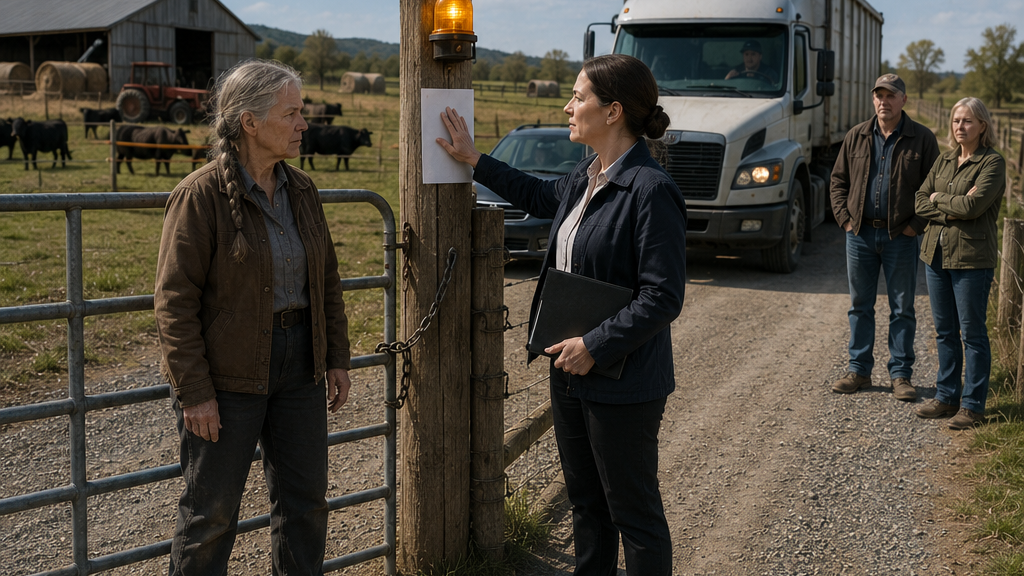
Jessica Carter was fastening a yellow notice to Rachel Harris’s gate when the feed truck came around the bend.
Rachel saw the truck first as a white rectangle beyond Jessica’s shoulder, slowing on the narrow gravel lane. Then the amber beacon above the gate flashed twice, bright even in the morning sun.
Jessica looked up at it.
“There,” she said to one of the two board members standing beside her. “That’s exactly what we’re talking about.”
Rachel stopped ten feet inside the fence.
The feed truck rolled to a halt behind Jessica’s SUV. Its driver leaned forward over the steering wheel, waiting.
Rachel’s cattle shifted in the pasture beyond the gate, irritated by the diesel engine. She walked toward Jessica without hurrying.
“What are you putting on my fence?”
Jessica pressed the last corner of the notice flat against the cedar post. “Formal removal order.”
“For a light.”
“For an unapproved electronic device inside the road-association setback.”
Rachel looked from the notice to the beacon.
The amber lens was no larger than a coffee mug. Her husband had mounted it above the gate nearly three years earlier, running the wire through gray conduit down the back of the post. It flashed only when the buried sensor detected a vehicle stopping at the entrance.
Jessica tapped the paper.
“You have seven days.”
The feed-truck driver raised one hand through his windshield.
Rachel lifted a finger in reply. Wait.
Jessica noticed.
“This is part of the problem. Trucks stop here, people improvise, everybody puts up whatever they think they need.”
“He’s stopped because you’re standing in the entrance.”
One board member glanced away.
Jessica’s mouth tightened. “The rules changed after the collision last spring. Reflectors, signs, lights, posts, chains—anything within the shared access corridor has to meet the approved standard.”
Rachel could hear enough of Jessica’s voice at this distance if she watched her face. The individual words came unevenly, softened at their edges, but years of reading mouths filled in what her ears missed.
The truck engine was another matter. Rachel felt its vibration faintly through the gravel more than she heard it.
She unhooked the gate chain.
Jessica stepped aside. “I’m not trying to make this difficult.”
“You brought two board members to put a paper on my gate.”
“I brought witnesses because previous notices were ignored.”
“I never got a removal notice.”
“You received the equipment-standard letter.”
“That letter listed floodlights and decorative signs.”
“And unauthorized electronic fixtures.”
Rachel pulled the gate open. The feed truck eased past, tires grinding over gravel. The driver pointed toward the feed bins behind the barn, and Rachel nodded.
Jessica waited until the truck had cleared them.
“What does the beacon do?”
Rachel looked at her.
“You’ve been sending me letters about it for two months and you don’t know?”
“I know what your file says. Motion-activated amber signal.”
“Vehicle-activated.”
“Which still requires approval.”
Rachel reached behind the cedar post and opened the weatherproof switch box.
Jessica’s expression changed. “What are you doing?”
“You want it off.”
Rachel flipped the switch.
The amber beacon went dark.
For a moment nothing happened.
Then Rachel closed the gate again and motioned toward the equipment shed.
“Come with me.”
Jessica frowned. “Why?”
“You asked what it does.”
The two board members remained near the vehicles while Jessica followed Rachel across the yard. The equipment shed stood beyond the barn, insulated years ago so machinery could be serviced during winter. Rachel opened the side door.
Inside, the air smelled of grease, dry hay and old metal.
On the wall near the workbench hung a small receiver panel with an amber lamp matching the beacon outside.
Beside it sat an old handheld farm radio.
Rachel shut the heavy door.
Jessica looked around. “What exactly am I supposed to see?”
Rachel checked her watch.
“The feed driver has to leave after he finishes.”
“So?”
“So we wait.”
Jessica folded her arms.
Thirty seconds passed.
Then another minute.
Rachel watched the blank receiver.
Jessica shifted her weight. “I have another property inspection.”
Rachel said nothing.
A shadow moved briefly across the seam beneath the shed door.
Jessica did not react.
Rachel did.
She crossed the shed and opened the door.
The feed truck was already at the gate.
The driver had climbed from the cab and was standing beside the chain, looking toward the house.
Jessica stared at him.
Rachel looked back at the silent receiver panel.
“When that system is on,” she said, “the panel flashes in here.”
Jessica glanced toward the old radio. “You could use a phone.”
“Sometimes.”
“A camera alert.”
“Sometimes.”
“A newer gate system.”
Rachel’s jaw tightened. “Or the one that already works.”
Jessica stepped outside. Her tone softened, but only slightly.
“I didn’t know you couldn’t hear the trucks from in there.”
“I can’t.”
“How much hearing have you lost?”
Rachel hated the question immediately.
Not because it was cruel. Because it was practical.
She looked past Jessica toward the cattle pasture.
“Enough.”
Jessica waited.
Rachel gave her nothing more.
They walked back toward the entrance. The feed driver had opened the gate himself and was pulling onto the shared lane.
The beacon remained dark above him.
Jessica stopped beneath it.
“If this is disability-related, there’s a process.”
Rachel looked at the yellow notice.
“I told your office months ago why it was there.”
“You mentioned hearing difficulty.”
“I said I needed the signal.”
Jessica exhaled. “An informal conversation isn’t the same as an approved accommodation.”
“So pause the order.”
“I can’t do that on my own.”
“You’re the administrator.”
“I administer the rules. I don’t waive them.”
Rachel felt anger rise hard and clean in her chest. She forced herself not to answer quickly.
Jessica opened the folder she had been carrying.
“I checked your file this morning because I expected you to raise this.”
She removed a white sheet and held it out.
Rachel recognized the form before she took it.
At the top was the date from four months earlier.
Halfway down the first page was Rachel’s handwriting.
The rest was blank.
Jessica tapped the empty signature box.
“You started an accommodation request,” she said. “You never completed it.”
Rachel stared at the unfinished form.
The anger did not disappear.
It simply lost its easy direction.
Chapter 2: The Form Rachel Refused to Finish
Emily found the second page of the accommodation form beneath three unopened feed invoices and a seed catalog.
She held it up from Rachel’s kitchen table.
“You told me you filed this.”
Rachel kept rinsing a coffee cup.
“I started it.”
“That isn’t what I said.”
“I know what you said.”
Emily spread both pages side by side. Rachel’s handwriting stopped after the section asking her to describe the requested modification. Beneath that, nearly half the form remained untouched.
Outside the kitchen window, the gate beacon was still dark.
Emily looked toward it.
“Why didn’t you finish?”
Rachel set the cup upside down in the rack.
“They already knew what it was for.”
“That doesn’t answer me.”
Rachel opened the refrigerator, though she wanted nothing from it.
Emily was forty miles from home and had arrived less than an hour after Rachel mentioned the notice. She had come with the determined expression Rachel had learned to distrust—the same expression Emily used when discussing handrails, smaller tractors and whether one person truly needed eighty acres.
Rachel shut the refrigerator.
“I called the office after they sent the form.”
“And?”
“Someone told me they’d need documentation.”
“That sounds normal.”
Rachel gave her a flat look.
Emily sat back.
“What did they actually say?”
Rachel remembered it too clearly.
She had stood in this same kitchen with the phone pressed hard against her better ear. The assistant on the other end had spoken quickly, then repeated herself with exaggerated slowness when Rachel asked her to.
There had been a laugh in the background.
Maybe not at Rachel.
She had never known.
Then the assistant had said, “If everybody put up whatever helped them personally, the lane would look like a carnival.”
Rachel had looked through the window at the amber beacon her husband had installed.
After that, the form had remained on the table for three days before disappearing into a stack of invoices.
“They made it sound ridiculous,” Rachel said.
Emily’s face changed.
“That’s why?”
“That was enough.”
“No, Mom. It made you mad.”
“It did.”
“So you decided not to give them the paperwork they needed.”
Rachel turned toward the sink.
Emily’s chair scraped the floor.
“This is what you do.”
Rachel looked back.
“What do I do?”
“You get treated like somebody thinks you’re helpless, and then you prove you’re not helpless by refusing anything that might actually help you.”
Rachel felt the words land before she could defend against them.
“I run this farm.”
“I know.”
“I handle the cattle. I handle deliveries. I handle the books.”
“I know.”
“I don’t need an office full of people deciding whether my hearing is bad enough for a light on my own gate.”
Emily lowered her voice.
“Then why did Dad build it?”
Rachel turned away.
The kitchen seemed suddenly too small.
On the counter, her phone vibrated. She felt it against the wood before she heard the faint buzz.
An email notification appeared from the road association.
Emily read Rachel’s expression.
“What?”
Rachel opened it.
The message was short. The board had reviewed Jessica’s report from that morning. Because the beacon was currently inactive, enforcement would be held temporarily, but the device had to be removed from the setback by Thursday at five unless Rachel submitted a completed accommodation request.
Emily leaned over her shoulder.
“Thursday.”
“I can read.”
“Then finish the form.”
Rachel locked the phone.
“No.”
Emily stared at her.
Rachel walked out to the equipment shed.
The old handheld radio still sat beside the receiver panel. She picked it up and turned the volume knob.
Static crackled faintly.
At least she thought it did.
She pressed the radio close to her ear.
“Mom.”
Rachel had not heard Emily enter.
That made her angrier.
She switched the radio off.
Emily looked from the radio to the dead amber receiver.
“You couldn’t hear me.”
“I was concentrating.”
“You didn’t hear me.”
Rachel set the radio down harder than necessary.
“I am not signing a paper that asks a board whether I’m allowed to compensate for my own ears.”
Emily’s eyes flashed.
“That isn’t what the form says.”
“It’s what it means.”
“No. It means there’s a record.”
Rachel laughed once without humor. “A record.”
“Yes.”
“For what? So somebody can stamp approved on me?”
“For the next Jessica who takes the job. For the next board. For the next insurance company. For anybody who looks at that light and doesn’t know why it’s there.”
Rachel turned toward the workbench.
“I’d rather take the thing down than ask permission to hear.”
The sentence hung between them.
Emily did not answer immediately.
When she did, the frustration had left her voice.
“That sounds like something you’ve been practicing.”
Rachel looked at the small receiver panel.
She remembered her husband tightening the last screw in it, then stepping back with the satisfied expression he wore whenever he had solved a problem with wire, steel or stubbornness.
Rachel had called the beacon ugly.
He had said, Good. Then you’ll notice it.
Emily gathered the papers from the kitchen and carried them into the shed.
“There’s a serial number here.”
Rachel glanced down.
On the original accommodation form, beside Rachel’s description of the system, she had written the beacon controller’s installation number and date.
Emily frowned.
“You had this installed three years ago?”
“Yes.”
“April seventeenth?”
Rachel’s hand stopped on the radio.
Emily noticed.
“What happened April seventeenth?”
“Nothing you need to dig into.”
Emily turned the form toward her.
“There’s an emergency-service invoice clipped behind this.”
Rachel looked down.
She had forgotten that page entirely.
The date at the top matched.
April seventeenth.
Three years earlier.
Emily read the first line, then raised her eyes.
“Mom,” she said quietly. “What happened at the barn that day?”
Chapter 3: The Morning No One Heard the Truck
By ten on Monday morning, an equipment-delivery truck had been waiting at Rachel’s gate for sixteen minutes.
Rachel knew because the driver showed her his phone.
She had been in the equipment shed replacing a cracked hydraulic hose and had not heard his horn. The beacon receiver, disconnected since Saturday, had given her nothing.
The driver was polite.
That made it worse.
“No harm done,” he said.
Rachel signed the delivery slip.
He unloaded the part she needed and left.
As his truck disappeared down the lane, Rachel stood beneath the dead amber beacon.
Three years earlier, another vehicle had waited at this gate.
That driver had not been delivering machinery.
Her husband had been in the lower barn when a young heifer kicked a loose panel against him. Rachel had been repairing a water line behind the equipment shed.
She remembered seeing him seated on the ground when she came around the corner.
He had waved her away from him first.
Get the gate.
She had called for help.
Then she had waited.
And waited.
What she had not known was that the volunteer EMT had already arrived.
The responder had stopped at the chained entrance and sounded the horn repeatedly.
Rachel heard none of it.
She had been less than two hundred yards away.
By the time she finally saw movement at the road, precious minutes had passed.
Her husband recovered. The injury had not been the thing that killed him two years later.
But neither of them forgot the waiting ambulance.
A week afterward, he brought home a vehicle sensor, lengths of conduit and two amber lights.
One for the gate.
One for wherever Rachel happened to be working.
“You’re making a traffic signal,” she had told him.
“I’m making something you can hear with your eyes.”
She had rolled hers.
He had grinned and kept drilling.
Now Rachel touched the cold mounting bracket.
“You planning to stare at that all day?”
She turned.
Christopher Hall stood on the other side of the gate.
His pickup was parked along the lane.
Rachel unhooked the chain.
“What do you want?”
Christopher pushed his cap back. “Jessica said you might be having trouble with deliveries.”
Rachel’s expression hardened.
“She reporting my schedule now?”
“No. Driver told me when he stopped at my place.”
“That didn’t take long.”
Christopher walked through the gate.
They had known each other for more than twenty years. Their properties shared both the access lane and a drainage ditch. Christopher had borrowed Rachel’s hay rake more than once. Her husband had helped repair his barn roof after a windstorm.
Rachel had assumed, without asking, that Christopher would oppose Jessica.
His next words stripped that assumption away.
“I voted for the new restrictions.”
Rachel stared at him.
“You what?”
“Last meeting.”
“You knew about my beacon.”
“I knew you had a light.”
“You knew why.”
“I knew your hearing was getting worse. I didn’t know that thing was your gate alert.”
Rachel folded her arms.
“That distinction matter now?”
“Yes.”
“It didn’t when you voted.”
Christopher looked toward the lane.
“You remember my south-field tractor?”
“The green one.”
“It was the one that got hit.”
Rachel’s anger stalled.
Christopher rubbed a thumb along the edge of his cap.
“A contractor came through here at dusk. Somebody had put reflective markers around a culvert repair. Somebody else had moved a portable floodlight closer to the lane. There was a homemade sign on a steel post sticking farther out than it should have.”
Rachel had heard about the collision. Everyone had.
She had not known Christopher’s tractor was involved.
“The contractor swerved around the floodlight,” he continued. “Caught the rear wheel of my tractor while my hired hand was turning into the field.”
“Anyone hurt?”
“No. Not badly.”
He paused.
“Could have been.”
Rachel looked down the narrow gravel road.
Christopher continued.
“Insurance investigator came out. Took pictures of every homemade marker, every extra post, every chain, every light. Told the association our roadside rules weren’t rules if nobody enforced them.”
“So your answer was ban everything.”
“My answer was stop pretending every exception is harmless.”
Rachel pointed toward the beacon.
“That one isn’t harmless when it’s off.”
“I see that now.”
“After voting.”
“Yes.”
The answer was so plain that Rachel had nowhere easy to put her anger.
Christopher nodded toward the shed.
“The feed-truck business Saturday. Jessica told the board what happened.”
Rachel’s eyes narrowed.
“She told them?”
“She also asked them to hold your removal order while they reviewed the accommodation issue.”
That surprised Rachel enough that she said nothing.
Christopher shrugged.
“She’s rigid. Doesn’t mean she’s lying.”
Rachel looked toward the house.
“I don’t need you explaining Jessica Carter to me.”
“No. But you might need somebody explaining the board.”
He walked back toward his pickup.
At the gate he stopped.
“For what it’s worth, I’d vote differently if the rule gave us a way to tell a necessary device from junk.”
Rachel almost answered.
Her phone vibrated in her pocket.
She pulled it out.
An association message had arrived.
Christopher watched her read it.
“What now?”
Rachel read the first paragraph twice.
The temporary hold on her individual violation remained in place.
For one second, relief loosened something in her chest.
Then she reached the second paragraph.
At Wednesday’s special meeting, the board would consider a broader amendment: no privately installed electronic lighting, signaling equipment or powered gate-warning devices would be permitted within the shared-road corridor unless installed under a future association-wide standard.
Rachel looked up at the beacon.
If the amendment passed, finishing her old accommodation form might no longer be enough.
Christopher took the phone when she held it toward him.
He read the message and exhaled.
“Well.”
Rachel stared down the lane.
The argument was no longer about her light.
By Wednesday, they meant to make sure nobody could have one.
Chapter 4: A Safer Road With No Exceptions
Rachel arrived at Wednesday’s special meeting expecting to defend one amber light.
Instead, Jessica Carter had projected a map of the entire shared road onto the wall.
Small red marks ran along both sides of the lane: gates, culverts, homemade signs, fence corners, light poles, mailboxes, temporary posts, even a stack of irrigation pipe somebody had left too close to the shoulder.
At the top of the printed agenda in front of Rachel was a proposed amendment.
No privately installed electronic signaling devices within the road corridor.
Rachel read the line twice.
Christopher Hall took the chair beside her.
“So this is bigger than your beacon,” he murmured.
“I noticed.”
Jessica stood at the front of the room with a folder under one arm.
There were seven people in attendance, including two board members Rachel knew by sight and two neighboring landholders who used the road farther east.
Jessica did not look pleased to be there.
That mattered to Rachel more than she expected.
“We’re not voting on one person’s equipment tonight,” Jessica began. “We’re deciding whether the current road standard is enforceable at all.”
Rachel raised a hand.
Jessica stopped.
“If the answer is to ban everything because your paperwork is bad,” Rachel said, “that sounds like an enforcement problem.”
One of the board members shifted in his chair.
Jessica met Rachel’s eyes.
“That would be true if paperwork were the only issue.”
She changed the image on the wall.
A photograph appeared of the road near Christopher’s south-field entrance.
Rachel recognized the bend.
What she had not seen before was how crowded the shoulder had been on the evening of the collision.
A portable work light leaned toward the lane. Two reflective markers stood on mismatched posts. A handwritten detour sign had been wired to a steel rod. A length of black pipe lay partly hidden in the grass.
Then came another photograph.
A tractor tire damaged along the rim.
Another.
Scraped metal on a contractor’s truck.
Another showed tire tracks cutting sharply across the gravel where someone had swerved.
Jessica let the images sit.
“The association’s insurer sent an investigator after the collision,” she said. “Their conclusion was that we had no consistent setback enforcement and no documented approval process for temporary or permanent roadside fixtures.”
She held up a letter.
“If we don’t correct that, our renewal premium rises substantially. If we continue allowing individually installed devices without standards, we may lose coverage under the current policy.”
Rachel glanced toward Christopher.
He did not look triumphant.
He looked tired.
Jessica continued.
“I’m not saying every object shown here is dangerous. I’m saying the insurer does not care about our intentions. They care about measurable placement, visibility, obstruction and documentation.”
Rachel looked back at the projected photograph.
For the first time, she imagined the road through the eyes of someone driving it in darkness who did not know where every dip and gate sat.
Her beacon was not a crooked steel rod.
It was not a floodlight pointed toward traffic.
But the rule had been built because people kept deciding for themselves what was harmless.
Jessica changed the slide again.
A close photograph of Rachel’s gate appeared.
The amber beacon was visible above the cedar post.
Rachel felt her shoulders stiffen.
“You photographed my place.”
“It’s within the association corridor.”
“You could’ve asked.”
Jessica paused.
“Yes.”
The single word was not an apology, but it was not a defense either.
Rachel looked around the room.
“So where does that leave an accommodation?”
Jessica closed the folder.
“That is exactly why your individual enforcement is still suspended.”
“Suspended while you write a rule that bans the device.”
“Suspended while we determine whether the road can support private electronic equipment safely.”
Rachel leaned forward.
“You already saw what happens when mine is off.”
“I did.”
“And?”
“And that doesn’t answer where it should be mounted, how bright it should be, how long it should activate, whether it can face traffic or what happens when the next person installs something different and calls it necessary.”
The words irritated Rachel because they were sensible.
She had come prepared to argue that the beacon was needed.
Jessica was asking a harder question: how to distinguish Rachel’s need from anybody else’s preference without returning to disorder.
One neighboring landholder spoke from the back.
“If Rachel gets an exception, what stops somebody putting blue flashers on a mailbox because they say it helps them find the driveway?”
Rachel turned.
“Common sense.”
Jessica answered before the man could.
“Common sense is what the insurer says we’ve been using instead of standards.”
That quieted the room.
Christopher leaned toward Rachel.
“She’s got you there.”
Rachel shot him a look.
He spread his hands. “Doesn’t mean she’s right about the ban.”
The meeting moved into details: setback distances, power sources, mounting heights, temporary equipment. Rachel listened, watching mouths when voices dropped.
More than once she lost a sentence when someone turned away.
Normally she pretended she had heard.
Tonight she stopped doing that.
“What did he say?” she asked.
The room paused.
The board member repeated himself facing her.
Rachel hated the heat that climbed into her face.
But the next time she missed something, she asked again.
By the time the discussion returned to the beacon, the argument had changed shape in her mind.
She no longer wanted Jessica simply to erase the violation.
If that was all she won, the next administrator could start the same fight in a year.
Or someone else with a legitimate need could face it without the confidence to push back.
Rachel looked at Jessica.
“If I show you a way to make the device measurable, will you put it in the rule?”
Jessica did not answer immediately.
“Measurable how?”
“Placement. Direction. Activation. Brightness. Whatever matters to the road.”
One board member frowned.
“You’re proposing the association allow electronic signals?”
“I’m proposing you stop calling every electronic signal the same thing.”
Jessica rested both hands on the table.
“The insurer would have to accept the distinction.”
“Then give me the conditions they care about.”
“That is not a small job.”
“I didn’t say it was.”
Christopher looked sideways at her.
Rachel continued.
“Forty-eight hours.”
A board member laughed softly in disbelief.
Rachel ignored him.
“Give me the collision report standards, the setback requirements, and whatever the insurer listed. I’ll bring you something that applies to mine and anybody else’s.”
Jessica studied her.
“You understand that if it fails, the blanket prohibition goes forward.”
Rachel looked at the projected image of her dark gate.
“Yes.”
Jessica closed the folder.
“Friday morning.”
Rachel nodded.
As the meeting adjourned, Christopher caught her at the door.
“You know anything about light-spill measurements?”
“No.”
“Timed relays?”
“Enough to get in trouble.”
He almost smiled.
Jessica approached carrying a packet.
She handed it to Rachel.
Inside were the insurer’s recommendations, lane measurements, and required setback diagrams.
Rachel flipped through the pages.
Forty-eight hours suddenly felt very short.
Jessica lowered her voice.
“I’m not asking you to prove you deserve your beacon.”
Rachel looked up.
“I’m asking you to prove I can defend the rule after I approve it.”
For the first time, Rachel understood the real problem she had volunteered to solve.
It was no longer enough to show that she needed the light.
She had to build a rule strong enough for someone else to need it too.
Chapter 5: The Rule She Could Defend Herself
Rachel removed the beacon Thursday morning with a wrench in one hand and Jessica’s insurance packet spread open on the hood of her pickup.
Emily arrived just as Rachel lowered the amber fixture from the cedar post.
For half a second, she stopped beside her car.
“You gave up?”
Rachel tucked the beacon under her arm.
“No.”
“Then why is it off the gate?”
“Because it’s in the wrong place.”
Emily followed her into the workshop.
Rachel set the beacon on the bench beside lengths of scrap conduit, a timer relay, a small metal shield and the old receiver panel.
The insurer’s recommendations were pinned to the wall with magnets.
Required setback.
Maximum projection toward travel lanes.
No continuous flashing.
No obstruction of reflective markers.
No light source directed toward approaching drivers.
Emily read the notes Rachel had written beside them.
“You’ve been up all night.”
“I slept.”
“When?”
Rachel ignored that.
Her first idea was simple: move the beacon farther inside the property and angle it toward the house.
That failed before noon.
From the equipment shed, Rachel could see it perfectly.
From the gate, Christopher could barely tell whether it had activated.
“That’s good,” Rachel said.
Christopher shook his head.
“No, it isn’t.”
“You’re not supposed to need it.”
“I need to know whether it’s functioning if I’m helping you test it.”
Rachel folded her arms.
Christopher pointed toward the post.
“And if an EMT comes at night and the system is supposed to confirm a vehicle has triggered the sensor, they need some indication at the entrance too.”
“The light is for me.”
“Mostly.”
Rachel bristled.
Christopher walked to the temporary cedar post she had driven six feet inside the fence line.
“What happens if your receiver fails?”
Rachel looked toward the shed.
He continued.
“You’re building a standard, remember? Not defending your exact setup.”
She hated that he was right.
The old Rachel would have dismissed him and moved the post only after he left.
Instead, she picked up her notebook.
“What would you change?”
Christopher blinked.
Then he pointed.
“Shield the road side, not the whole lamp. Leave a narrow side angle visible from the gate.”
Rachel wrote it down.
Emily watched from the workshop doorway.
Nobody commented on the fact that Rachel had asked for advice.
By afternoon they had fabricated a half-cylinder shield from thin sheet metal. It blocked direct light toward approaching traffic while allowing the amber pulse to be visible from Rachel’s house, yard and a narrow angle near the gate.
Rachel added a timer so the signal flashed for twelve seconds instead of continuing until reset.
Then she changed the sensor logic.
One vehicle stopping at the gate triggered the pulse.
A vehicle merely driving past on the shared lane did not.
Christopher made six passes in his pickup.
Five worked.
The sixth triggered the light when he slowed sharply but did not turn.
Rachel swore under her breath and adjusted the buried sensor’s sensitivity.
Emily leaned against the workbench.
“Do you realize what you’re doing?”
“Trying not to fail Friday.”
“You’re improving it.”
Rachel tightened a screw.
“It worked before.”
“For you.”
Rachel stopped.
Emily did not say anything else.
That was worse.
Rachel looked at the amber beacon on the temporary post.
Her husband had built the original system for one purpose: make sure Rachel knew someone had arrived.
He had never needed to satisfy an insurer.
He had never needed to write a standard somebody else could use.
Changing it had felt, at first, like admitting he had built it wrong.
Now Rachel saw the difference.
He had built a solution for his wife.
She was trying to build one for a road.
Late Thursday afternoon, Jessica’s SUV appeared at the entrance.
Rachel saw the beacon trigger.
Twelve seconds.
Then dark.
Jessica got out and stood at the shoulder.
“I didn’t see the light until I turned toward the gate.”
Rachel wiped her hands on a rag.
“That’s the idea.”
Jessica walked around the post.
Christopher demonstrated the shielding.
Jessica crouched to inspect the mounting distance.
“You measured from the travel edge?”
“Twice.”
“Height?”
“Forty-six inches to the lower edge of the housing.”
Jessica checked the packet.
“Within the insurer’s proposed range.”
Rachel handed her a single sheet.
It listed the revised standard in plain terms: minimum setback, shielded road-facing side, limited activation period, noncontinuous amber light, vehicle-stop trigger, maintained reflective gate markers and no interference with sight lines.
Jessica read it slowly.
“This is more restrictive than your old setup.”
“Yes.”
“You’re willing to accept that?”
Rachel looked toward the original cedar post.
The empty mounting holes were still visible.
“I’m willing to accept a rule that has a reason.”
Jessica glanced at her.
“And the accommodation process?”
Rachel’s jaw tightened.
She knew what Jessica was asking.
“I’ll complete it.”
Emily looked at her mother but said nothing.
Jessica folded the paper.
“I sent photographs and your proposed specifications to the insurer.”
Rachel stared at her.
“When?”
“This morning, after Christopher told me what you were testing.”
Rachel looked at Christopher.
He raised both hands.
“You wanted it evaluated.”
Jessica continued.
“They won’t approve a policy from photographs alone. But they’re willing to consider a demonstrated standard if we document the results.”
A small satisfaction moved through Rachel, followed quickly by suspicion.
“What kind of demonstration?”
“Normal traffic. Real approach speeds. At least three vehicle types. Visibility from the gate, residence side and roadway.”
Rachel nodded.
“When?”
“Tomorrow morning.”
“Fine.”
Jessica hesitated.
“There’s one more thing.”
Rachel waited.
“The board wants the test during the regular delivery window.”
Christopher frowned. “That road gets busy around nine.”
“That’s why.”
Rachel looked down the lane.
Feed trucks, equipment deliveries, farm pickups, possibly a livestock trailer.
Not controlled passes.
Not six rehearsals with Christopher.
Real traffic.
“If a device is supposed to work here,” Jessica said, “it has to work when this road is actually being used.”
Rachel looked at the beacon.
The modified shield caught the late sunlight but showed no amber glow.
She thought of the original light her husband had mounted without a committee, an insurer or a measuring tape.
Then she thought of the waiting equipment driver on Monday.
“All right,” she said.
Jessica nodded.
“Eight-thirty.”
After she left, Emily picked up the unfinished accommodation form from the bench.
“You still need to sign this.”
Rachel took it.
She filled in the remaining sections standing at the workbench.
When she reached the line asking why the modification was necessary, she stopped.
Three days earlier she would have written as little as possible.
Now she wrote the truth plainly.
Profound hearing loss prevents reliable awareness of vehicles and emergency arrivals from enclosed farm buildings. Visual gate signal provides necessary access notification.
She signed her name.
The next morning would decide whether the light could remain.
But for the first time, Rachel had stopped asking only whether she could keep it.
She wanted to know whether the rule built around it would hold when the road became crowded.
Chapter 6: When the Beacon Finally Meant Safety
At eight forty-seven Friday morning, three vehicles entered the shared road within ninety seconds.
Rachel was inside the equipment shed with the door closed.
That was part of the test.
Jessica stood outside near the gate with a clipboard. Christopher had parked farther down the lane where he could watch approaching traffic. Two board members waited beside Jessica’s SUV.
Rachel could see none of them.
She could hear almost nothing.
The old handheld radio sat on the workbench beside her.
She had deliberately left it switched off.
The modified receiver panel faced her from the wall.
For twenty seconds, nothing happened.
Then the amber lamp flashed.
Once.
Twice.
A steady twelve-second pulse.
Rachel looked at her watch.
She opened the shed door.
A feed truck had stopped at the gate.
Jessica raised one hand.
“First vehicle.”
Rachel could not hear the words clearly from that distance, but she understood.
The driver waited while Christopher observed the road-facing side of the beacon.
From the shared lane, the shield concealed almost all direct light.
From the gate angle, a narrow amber edge remained visible.
Rachel opened the gate.
The truck entered.
Jessica marked something on her sheet.
Five minutes later came a pickup towing a small equipment trailer.
The receiver flashed again.
Rachel counted.
One.
Two.
Three.
At nine seconds, it stopped.
Rachel frowned.
It was supposed to run twelve.
She waited.
Nothing.
She opened the shed door.
Jessica was already looking toward her.
Christopher walked over from the road.
“Short cycle.”
“I know.”
One board member wrote something down.
Rachel felt heat rise under her collar.
Jessica approached.
“Do you want to stop the test?”
“No.”
“We can reschedule.”
“No.”
Rachel went to the post and opened the weatherproof control box.
The timer relay showed a loose terminal.
She stared at it.
Christopher leaned over her shoulder.
“Vibration?”
“Probably.”
Jessica checked her watch.
Rachel tightened the screw.
“This is why we test.”
The sentence came out harsher than she intended.
Jessica nodded.
“That is why.”
No mockery.
No satisfaction.
That helped more than Rachel wanted it to.
Rachel reset the controller and returned to the shed.
The next vehicle came ten minutes later.
An equipment-delivery truck.
The receiver flashed.
Twelve full seconds.
Then darkness.
Rachel stayed inside until the driver had stopped completely.
When she opened the door, Jessica pointed toward the lane.
Christopher was standing where the road curved past the entrance.
He called something.
Rachel cupped a hand behind one ear.
He walked closer.
“Couldn’t see the main flash from the lane,” he said. “Only the edge after I turned my head toward the gate.”
“Distracting?”
“No.”
“Useful?”
“If I needed to confirm the sensor was working, yes.”
Jessica wrote it down.
The fourth test was unplanned.
A neighbor drove past without turning.
Rachel watched the receiver.
Nothing.
The pickup slowed slightly near Jessica’s SUV.
Still nothing.
Rachel felt herself exhale.
Christopher grinned.
“That was the one I was waiting for.”
Rachel looked at him.
“You wanted it to false-trigger.”
“I wanted to know if it would.”
The final test involved a vehicle stopping briefly at the gate, backing up, then approaching again.
The system activated once, reset correctly, and triggered again only after the programmed delay.
Jessica inspected the log.
One of the board members walked the setback with a measuring wheel.
The other photographed the shield from the road.
Rachel came out of the shed and stood beneath the beacon.
For once, nobody was asking whether it looked attractive.
They were asking whether it worked.
Jessica approached with the clipboard.
“We have one failed timing cycle.”
“Loose terminal.”
“Corrected during test.”
Rachel waited.
Jessica looked toward the road.
“The insurer wanted repeatability.”
“We repeated it.”
“Yes.”
“You going to tell me whether that’s enough?”
Jessica closed the clipboard.
“I’ll recommend it.”
The words landed quietly.
Rachel had expected satisfaction.
Instead she felt something more complicated.
Relief, yes.
And irritation that it had taken this much.
And embarrassment that some of the delay had been hers.
One board member approached.
“If we allow this standard, we’ll need documentation for anyone using it.”
Rachel nodded.
“Then require documentation.”
He seemed surprised.
“A week ago you didn’t want to file yours.”
“A week ago I was wrong about what the filing was for.”
Jessica looked at her.
Rachel went on before she could lose the nerve.
“I thought asking for accommodation meant somebody else got to decide whether I was still capable of running my place.”
Nobody interrupted.
She pointed toward the shed.
“I can run it. I also can’t reliably hear a truck through those walls.”
The board member glanced toward the receiver.
Rachel continued.
“Both things are true.”
The words were simple.
Saying them felt harder than building the shield.
Jessica shifted the clipboard under her arm.
“I should have paused enforcement the first time you told the office the light was related to your hearing.”
Rachel looked at her.
“Yes.”
Jessica accepted that without argument.
“I was trying to stop exceptions from swallowing the road standard.”
“You treated the exception like the problem.”
“Yes.”
Christopher cleared his throat.
“Seems like both of you are getting dangerously reasonable.”
Rachel almost smiled.
Jessica did.
Only briefly.
Then she returned to business.
“The board still has to vote. And the insurer has to accept the written version.”
“So this isn’t done.”
“No.”
Rachel looked at the beacon.
“What are you recommending exactly?”
Jessica opened the clipboard.
“Electronic accessibility signals permitted by documented need, provided they meet the setback, shielding, activation and visibility criteria demonstrated here.”
“Not just mine.”
“No.”
Something shifted in Rachel then.
The light above her no longer felt like the last piece of equipment her husband had left behind.
It was still his work.
Still his idea.
Still the thing he had built after an ambulance waited outside their gate while Rachel stood too far away to know it had arrived.
But it was no longer frozen in that moment.
They had changed it.
Measured it.
Improved it.
Made it capable of helping somebody Rachel might never meet.
Jessica stepped away to speak with the board members.
The amber beacon flashed again.
Rachel turned instinctively toward the lane.
A vehicle had arrived.
She saw the light before she saw the truck.
That was the entire point.
Jessica finished her conversation and came back.
“The board is meeting inside the association office now.”
Rachel nodded.
“I’ll wait for the call.”
Jessica shook her head.
“I want you there.”
Rachel frowned.
“You have the test results.”
“Yes.”
“Then why?”
“Because they’re rewriting the rule.”
Jessica looked toward the flashing beacon.
“And if we do this correctly, I don’t want them rewriting it around you. I want them rewriting it with you in the room.”
Rachel glanced at Christopher.
He said nothing.
For years, Rachel had treated needing help as something to conceal behind competence.
Now the board wanted her need entered into the rule itself.
She picked up her jacket from the fence.
“All right,” she said.
Then she followed Jessica toward the association office, where the question waiting for them was no longer whether Rachel Harris could keep one amber light.
It was whether the road would make room for the next person who needed one.
Chapter 7: The Light Left On at Dusk
Rachel expected the new approval to look more important than it did.
Instead, Jessica Carter slid a small laminated tag across the association table.
Rachel picked it up between two fingers.
“That’s it?”
Jessica almost smiled. “You wanted less bureaucracy.”
“I wanted sensible bureaucracy.”
“This is what sensible bureaucracy looks like.”
The tag carried an identification number, the approved installation location, and the date the board had adopted the revised roadside standard. A matching copy would remain in the association file.
Rachel turned it over.
There was nothing on the back.
Three weeks earlier, she had been prepared to remove the beacon rather than complete a form.
Now the association had created an entire process around devices like hers.
Not identical devices. That distinction mattered.
The new policy allowed accessibility-related electronic signals inside the shared-road corridor if they met the standards Rachel had helped test: controlled activation, defined setbacks, shielded road exposure, documented maintenance, and a clear functional need.
Nobody had called it Rachel’s rule.
She was grateful for that.
The room was quieter than it had been at the special meeting.
Christopher Hall sat two chairs away, reading through the final language with a pencil tucked behind one ear. Emily had taken the morning off work to attend, though Rachel had told her not to bother.
Emily had come anyway.
One of the board members finished signing the last page.
“That makes it official.”
Rachel looked at Jessica.
“And the violation?”
Jessica reached into the folder and removed the yellow removal notice.
The same one that had been attached beside Rachel’s gate.
Across its face was a stamped cancellation.
“Rescinded.”
Rachel took it.
For a moment, she saw Saturday morning again: Jessica standing beside the cedar post, the feed truck waiting behind her, the amber light flashing over everybody’s heads like an accusation.
Rachel folded the notice once.
Not angrily.
Just enough to put it in her pocket.
Christopher looked up from the policy.
“I still think twelve seconds is too long.”
Rachel stared at him.
He grinned.
“Ten would’ve done it.”
“You had three weeks to say that.”
“I did say it.”
“Nobody listened.”
Emily laughed softly.
Rachel caught only part of the sound, but she saw it in her daughter’s face.
The meeting moved into routine business.
Drainage gravel.
A damaged culvert marker.
A contractor requesting temporary access for oversized equipment.
Rachel listened differently now.
When someone spoke while looking down at a document and she missed part of the sentence, she asked them to repeat it.
The first time, nobody reacted.
The second time, the speaker turned toward her before repeating himself.
By the third, nobody seemed to notice at all.
That surprised Rachel more than she wanted to admit.
For years, she had imagined each request would place a bright mark over her head.
Difficult.
Old.
Dependent.
Instead, people adjusted and kept talking.
When the meeting ended, Christopher left first.
Emily remained near the doorway while Rachel tucked the approval tag into her coat pocket.
Jessica closed her folder.
“Your mounting inspection is already complete, so you can leave the beacon where it is.”
“I was planning to.”
“I assumed.”
Rachel looked at her.
There was no edge in Jessica’s voice now.
Not much, anyway.
Jessica picked up the original draft of the blanket prohibition and dropped it into a recycling box.
Rachel watched the pages disappear.
“You really would’ve passed that.”
“Yes.”
“Even after you saw what happened in the shed?”
Jessica rested both hands on the table.
“I thought the accommodation should happen somewhere outside the road standard.”
“Meaning I move the light.”
“Or use something different.”
“Something you approved.”
“Yes.”
Rachel waited.
Jessica exhaled.
“I confused uniformity with safety.”
Rachel said nothing.
Jessica continued.
“After the collision, every exception looked like the beginning of the same problem. Somebody saying their object was different. Somebody saying their post was harmless. Somebody saying their floodlight wasn’t actually pointed toward traffic.”
“That still doesn’t excuse the way you handled mine.”
“No.”
The answer came quickly.
Rachel looked at her more carefully.
Jessica did not appear ashamed enough for Rachel to feel victorious.
She appeared tired.
That made the conversation easier.
“I made it harder too,” Rachel said.
Emily looked over.
Rachel ignored her.
Jessica’s eyebrows lifted slightly.
“I should’ve completed the request.”
“That doesn’t make the removal notice appropriate.”
“I know.”
Rachel took a breath.
“I stopped the process because somebody in your office made me feel foolish for asking.”
Jessica’s expression changed.
“The carnival comment?”
Rachel looked at her sharply.
“You know about that?”
“I found the call note after you mentioned the earlier conversation.”
Rachel felt old anger stir.
Jessica went on.
“The employee who made the comment was told it was inappropriate.”
“That person still works there?”
“Yes.”
Rachel did not like the answer.
Jessica did not soften it.
“They apologized internally. They’ll receive training. I’m not going to pretend one bad comment means I automatically terminate someone.”
Rachel considered that.
It was not the dramatic punishment anger sometimes demanded.
It was also more believable than pretending mistakes disappeared because the right person became offended.
“Fine,” Rachel said.
Jessica nodded.
Then Rachel added, “Make sure the next person who calls doesn’t get laughed out of finishing their form.”
Jessica met her eyes.
“I will.”
Outside, Emily waited until they were halfway across the parking area before speaking.
“You apologized.”
“I admitted a mistake.”
“You apologized.”
“Don’t ruin it.”
Emily smiled.
They drove separately back toward the farm.
By late afternoon, Rachel had nearly forgotten the approval tag in her pocket.
She spent two hours checking fence along the lower pasture, then changed a worn latch on the equipment shed.
The old handheld radio was still on the workbench.
Rachel picked it up.
For years, she had kept it charged because her husband had always kept one clipped to his belt.
The plastic casing was scratched white around the corners.
Rachel switched it on.
Static whispered faintly.
She turned the volume all the way up.
A voice came through, thin and broken.
She caught perhaps one word in four.
Once, she would have kept listening and guessed at the rest.
Rachel turned the radio off.
She did not throw it away.
She placed it in the bottom drawer of the workbench.
Then she looked at the receiver panel above it.
The amber indicator was dark.
Waiting.
Emily found Rachel outside near dusk.
Her pickup had not yet reached the gate when the receiver inside the shed began flashing.
Rachel saw the glow through the open side door.
Twelve seconds.
Steady.
Clear.
She walked toward the entrance as Emily’s truck rolled onto the gravel approach.
The shielded beacon pulsed above the cedar post, its light turned inward toward the farm rather than spilling across the road.
Emily stopped at the gate and climbed out.
“You saw me.”
Rachel unhooked the chain.
“That’s generally what the light is for.”
Emily leaned against the pickup.
“So after all this, you were right.”
Rachel pulled the gate open.
“About what?”
“That you can stay here.”
Rachel stopped.
There it was.
The conclusion Emily had wanted from the beginning, only reversed.
At first, Emily had feared Rachel’s independence was denial.
Now she wanted the successful fight to prove the opposite—that Rachel needed no larger changes at all.
Rachel looked toward the pasture.
Cattle moved slowly along the fence line in the fading light.
“I can stay here,” Rachel said.
Emily smiled.
Rachel continued.
“That doesn’t mean I never need help.”
Emily’s smile faded into something quieter.
Rachel looped the chain over the post while Emily drove through.
“I’ll probably need more of it eventually.”
Emily parked on the yard side and got out again.
“You saying that just to scare me?”
“No.”
“That’s new.”
Rachel looked at her daughter.
“So was filing the form.”
Emily laughed.
This time Rachel did not hear much of it.
She did not pretend she had.
“What did you say?”
“I said Dad would’ve enjoyed this.”
Rachel looked toward the beacon.
“Yes.”
Her husband probably would have objected to the new shield.
Then he would have rebuilt it twice and claimed the second version had been his idea all along.
The thought hurt, but not in the sharp way it once had.
Rachel walked back toward the gate.
The approval tag was now fixed discreetly beneath the weatherproof control box.
Small.
Ordinary.
Almost invisible.
Above it, the amber beacon went dark as its timer completed the cycle.
Emily came up beside her.
“You keeping the old yellow notice?”
Rachel touched the folded paper in her coat pocket.
“For a while.”
“Why?”
Rachel looked at the empty lane.
“Reminder.”
“Of Jessica?”
Rachel shook her head.
“Of me.”
Emily did not ask her to explain.
A few minutes later, another vehicle turned onto the shared road, passed Rachel’s entrance without slowing, and continued toward Christopher’s property.
The beacon stayed dark.
Then Emily walked back toward her truck to retrieve a bag she had left inside.
Her movement near the gate did nothing.
The sensor waited for what it was built to detect.
A vehicle arrived.
The amber light flashed.
Rachel saw it from across the yard before she saw the pickup coming through the entrance.
She raised one hand.
Emily raised hers back.
For years, Rachel had thought independence meant making sure nobody could point to the thing she needed.
Now the little amber beacon flashed above the gate without apology, not as proof that Rachel was weaker than she had been, and not as proof that she could manage entirely alone.
It simply told her someone had arrived.
And Rachel turned toward the light.
The story has ended.