They Came at Dawn to Measure His Farm Mailbox, but the Boundary Told a Different Story
Chapter 1: The Man Measuring the Mailbox Before Sunrise
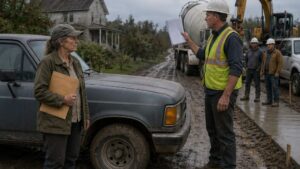
The headlights stopped at Charles Nelson’s mailbox before he had finished feeding the second row of calves.
He saw them from the barn aisle, two pale beams washing across the wet gravel at the farm entrance. For a moment he thought a delivery driver had arrived early and missed the turn. Then the lights went dark, a white utility vehicle door opened, and a man stepped out carrying a clipboard.
Charles set the feed scoop down.
The man did not come toward the house. He went straight to the weathered cedar mailbox post.
That was enough.
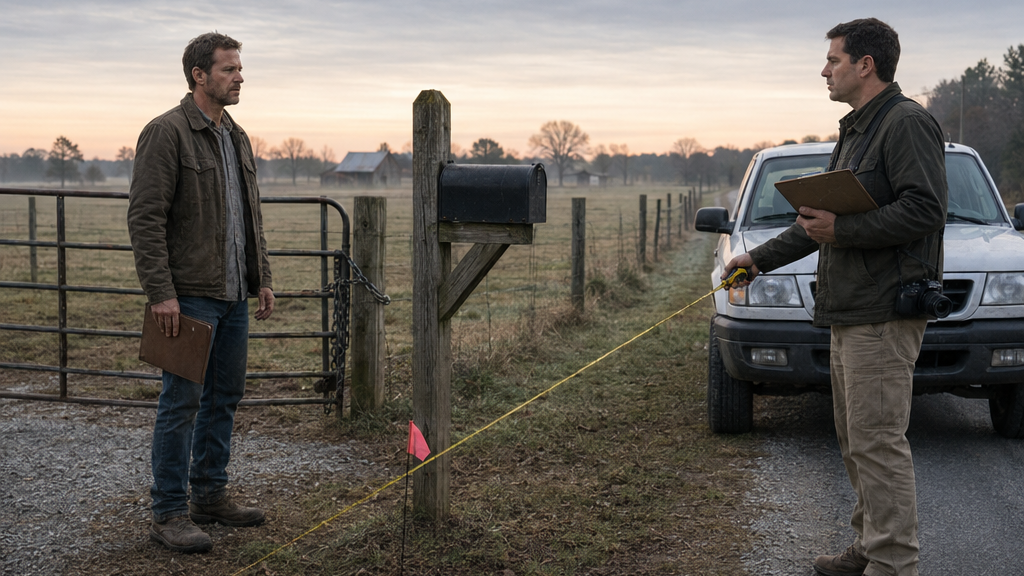
Charles wiped his hands on his jeans, crossed the barn, and looked through the side window before heading outside. The man had a camera hanging from one shoulder and a measuring tape clipped to his belt. He was studying the entrance as though he had been sent to inventory it.
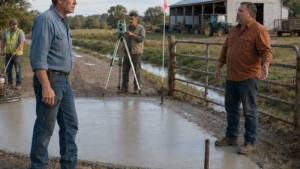
The old cedar post stood where it had stood for years, gray at the base and split near one bolt. Three feet behind it, Charles’s chained farm gate opened onto a gravel lane leading past cattle fencing toward the hay shed. A bright orange survey flag marked the corner Charles had measured twice after his first argument with Samantha Adams.
The stranger pulled out the tape.
Charles turned back toward the farmhouse instead of walking straight down the lane.
On the mudroom shelf sat a slim brown folder.
He picked it up.
By the time he reached the entrance, the stranger had stretched the tape from the roadside shoulder toward the gate.
“Morning,” Charles said.
The man glanced up. “Morning. Andrew Hall.”
He did not offer a hand.
“Who are you working for?”
“The road association contracted me to document clearance issues.”
Andrew lifted the clipboard slightly, as though the object itself answered the question.
Charles looked down.
The metal tape crossed the orange survey flag.
Not beside it.
Across it.
“Stop there.”
Andrew’s expression changed by half a degree. “I’m just taking measurements.”
“I can see that.”
“I was told this strip is association-controlled.”
Charles looked at the tape again, then at Andrew.
“Who told you?”
“Samantha Adams authorized the inspection.”
That landed harder than Charles expected, not because Samantha had sent someone, but because she had sent someone before seven in the morning without calling him.
Behind Andrew, the county road was still mostly empty. Somewhere farther up the lane, a diesel engine started, then faded.
Charles tucked the folder beneath one arm.
“Where did she tell you the association property starts?”
Andrew glanced at the diagram attached to his clipboard.
“Road edge through the entrance shoulder.”
“All of it?”
“That’s what I was given.”
Charles nodded once.
“Then you were given something wrong.”
Andrew gave him the patient look of a man accustomed to homeowners objecting to measurements.
“Mr. Nelson, I’m not here to argue title.”
“Good. Neither am I.”
Charles opened the folder.
The first sheet was the certified letter he had sent Samantha. Behind it was the signed return receipt. Behind that was a copy of his plat, laminated years ago because his father had once spilled hydraulic oil across the original farm records.
Andrew’s eyes moved from the papers to Charles.
Charles held up the receipt.
“She signed for this two weeks ago.”
“What is it?”
“Written notice that nobody representing the association was to enter my private parcel without permission.”
Andrew’s jaw tightened.
“I’m standing by the road.”
“You were.”
Charles pointed to the tape.
“You’re not anymore.”
Andrew looked down.
The tape ran from the shoulder, over the flagged point, and several feet into the grass inside Charles’s fence line.
For the first time, the clipboard stopped looking official. It looked cumbersome.
Andrew reeled in part of the tape.
“I’m documenting the mailbox location.”
“Then document it from where you have a right to stand.”
“I was told we have access.”
“Then show me.”
Andrew flipped through the pages.
There was a diagram. A checklist. A photograph of the entrance taken from the road. A sheet with measurements already printed in blank boxes.
No recorded easement.
No county map.
No deed reference.
Charles felt a familiar satisfaction rise in him, and that was exactly when he distrusted himself most. His father used to say certainty was where men stopped checking their work.
Still, Samantha had been warned.
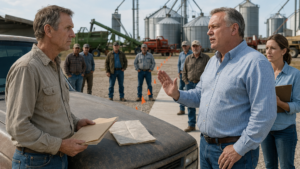
Charles unfolded his plat across the hood of Andrew’s vehicle.
“Here.”
Andrew leaned closer.
The county road line ran one way. Charles’s parcel line ran another. The narrow shared lane angled off behind the gate. The cedar mailbox post sat near the roadside shoulder, but the association-maintained lane did not extend to it on the copy Charles carried.
Andrew placed his own diagram beside the plat.
The two drawings disagreed.
Not by inches.
By enough that neither man could pretend it was a drafting error.
Andrew stared at them.
“Where did you get this?”
“County records. Original closing package matches it.”
Andrew touched the association diagram.
“This one shows the maintenance strip continuing across the entrance.”
“Shows isn’t the same as owns.”
“I didn’t say owns.”
“You said association-controlled.”
Andrew stopped.
Charles noticed then that the man was not angry. Embarrassed, maybe. Careful now.
That mattered.
Andrew took out his phone and photographed both documents side by side.
“You mind if I call Samantha?”
“Call whoever you need.”
Andrew stepped toward the vehicle.
Charles stayed beside the cedar post.
For four weeks, Samantha had treated the mailbox as though its location was a settled fact and his resistance was the only uncertainty.
Now an inspector she had hired was standing in the road with two maps that put the same boundary in different places.
Andrew came back after a short call.
“She says there’s an access instrument recorded separately from the plat.”
Charles’s hand tightened around the folder.
“What instrument?”
“She said an easement.”
Charles stared at him.
He knew the old plat.
He knew the road-maintenance agreement.
He knew the acreage descriptions.
At least, he thought he did.
Andrew added quietly, “She says your copy doesn’t show the whole thing.”
Charles looked at the cedar post, then down at his own neat stack of records.
For the first time that morning, the folder in his hand felt incomplete.
Chapter 2: The Cedar Post That Started a Land Fight
Four weeks earlier, Samantha Adams had laid a folder across the hood of Charles’s pickup and said, “That post doesn’t meet the new clearance standard.”
Charles had been carrying a grease gun toward the equipment shed.
He stopped.
“What post?”
She pointed toward the road.
The cedar mailbox post stood in plain view, leaning no more than it had for the past several winters.
“That one.”
Charles looked at it, then at her.
“You drove out here for my mailbox?”
Samantha did not smile.
“The association adopted roadside-clearance guidance last month. We’re contacting every property with an obstruction near the maintained lane.”
“Obstruction.”
“The post is inside the recommended setback.”
Charles set the grease gun on the truck bumper.
Samantha opened the folder. Inside were photographs of several entrances along the shared gravel road: mailboxes, fence corners, a stone marker, one utility pole.
Bright lines had been drawn over the pictures.
Charles studied them.
“What exactly are you asking me to do?”
“Relocate the post or replace it with something set farther back.”
“Farther back onto my farm.”
“Farther from the travel path.”
“That’s not the same thing.”
Samantha exhaled through her nose.
“Charles, this isn’t personal.”
“I didn’t say it was.”
“We had a truck clip a roadside structure up near the north bend. The association has been told to tighten clearance.”
“By who?”
“Our insurer has concerns.”
“That didn’t answer me.”
Her mouth flattened.
Charles knew Samantha well enough to recognize when she thought someone was being deliberately difficult. She had taken over the road association six months earlier and had already pushed through a new gravel schedule, ditch-cleaning rotation, and gate-access procedure.
Some of it had been needed.
That was what made Charles cautious.
People were easier to challenge when they were wrong about everything.
Samantha rarely was.
He walked toward the mailbox.
She followed.
The cedar post had been installed by his father years before Charles took over daily work on the farm. The mailbox sat on a simple crossarm, nothing decorative about it. No sign, no carved name, no planter box.
Charles crouched and looked at the base.
“What setback are you measuring from?”
“The maintained road area.”
“Where does that start?”
“The lane boundary.”
“Which one?”
Samantha looked at him.
Charles pointed with two fingers.
“You’ve got county right-of-way here. My parcel starts somewhere behind that. The shared lane comes in at an angle. Those are three different things.”
“The association has always maintained this entrance.”
“Part of it.”
“The trucks use all of it.”
“That doesn’t make all of it association land.”
Her tone cooled.
“Nobody said it was association land.”
“You’re ordering me to move something. I’d like to know what authority you’re using.”
Samantha shut the folder.
“You always turn everything into a survey problem?”
“When it’s about where land starts and stops, yes.”
Charles went into the equipment shed.
Inside, on a narrow shelf above the workbench, sat a dented metal file box.
He pulled it down.
Samantha remained by the doorway while he sorted through old closing documents, tax maps, fence invoices, and photocopies of plats.
“What are you looking for?” she asked.
“The part where I gave your association control of my mailbox.”
“Very funny.”
“I’m not joking.”
He found the plat and carried it outside.
The paper was creased from years of use. His father had marked fence lengths in pencil along one edge, then written dates beside two iron-pin locations.
Charles spread the sheet on the hood beside Samantha’s folder.
He traced the county road.
“Here.”
Then his parcel.
“Here.”
Then the shared lane.
“And here.”
Samantha leaned closer.
The cedar post did not appear as an object on the plat, but Charles knew its approximate location from the corner measurement he kept in his notebook.
He pulled the small black notebook from his shirt pocket.
Samantha looked at it.
“You write down where your mailbox is?”
“I write down anything people might argue about later.”
“That sounds exhausting.”
“It’s less exhausting than arguing without numbers.”
He found the page.
Distance from fence corner. Distance from gate hinge. Distance from old iron pin.
He walked the measurements off with a tape from the truck.
When he finished, the cedar post appeared to sit outside the strip marked for the shared lane.
Charles handed Samantha the end of the tape.
“See it?”
She did not answer immediately.
That pause told him more than her expression.
“It isn’t inside the lane boundary,” he said.
She released the tape.
“The association’s maintenance responsibility doesn’t necessarily stop at that line.”
“Then show me where it does stop.”
“We have records.”
“Bring them.”
Samantha collected her folder.
Charles expected the conversation to end there.
Instead she said, “You think because you’ve got an old plat and a notebook, nobody can tell you anything.”
Charles looked at her.
“No. I think if you’re telling me to move something, you should know whose ground it’s on.”
Her face changed.
Not dramatically.
Just enough.
“You think you’re being clever.”
“I think I’m asking a basic question.”
“We’ll document it formally.”
“That sounds fine.”
“You may not like what comes after that.”
Charles watched her walk back toward her vehicle.
The words bothered him less than the way she said them—with the confidence of someone who believed the answer already existed somewhere he had not looked.
That afternoon, he took the plat back into the shed.
He measured the entrance again.
Then he drove two bright survey flags into the ground at the points he believed mattered most.
Before shutting the notebook, he wrote the date beneath the measurements.
Under it, after a moment, he added one more line:
Samantha says formal inspection coming.
Chapter 3: The Certified Letter Charles Thought Would End It
The green return receipt was waiting inside the same cedar mailbox Samantha wanted moved.
Charles stood beside the road and turned the card over in his hand.
Samantha Adams’s signature was on the back.
He read it twice anyway.
Then he carried it to the farmhouse, laid it beside the plat on the kitchen table, and wrote the delivery date in his notebook.
His letter had been simple.
Representatives of the farm-road association were not to enter his private parcel without written permission or invitation. Any inspection could be conducted from the public roadside or another area where the association had documented access rights. Any claim requiring entry onto his land needed to identify the authority supporting it.
Charles had spent twenty minutes on the wording and two hours deciding whether to send it.
Now Samantha could not say she had never seen it.
He slipped the receipt into a clear plastic sleeve.
For the next several days, preparation became part of his chores.
He replaced a faded No Trespassing notice near the pasture corner. He added another near the farm gate where nobody approaching from the shared lane could miss it. He checked the doorbell camera and adjusted an older exterior camera under the shed eave so it captured the entrance.
Then he measured again.
Mailbox to fence corner.
Mailbox to gatepost.
Fence corner to survey flag.
Survey flag to old pin.
Each figure went into the notebook.
There was comfort in numbers.
A measurement did not smirk. It did not imply. It did not get louder because it disliked the answer.
On the following Sunday, Sarah Nelson came by with two storage tubs she wanted him to keep in the shed.
She found the kitchen table covered in property papers.
“What happened in here?”
“Nothing.”
“That’s a lot of paper for nothing.”
Charles slid the certified receipt toward her.
Sarah read it.
“You sent Samantha a no-entry letter?”
“I sent the association one.”
“You sent Samantha one.”
“She’s chair.”
Sarah looked through the first page.
“‘No representative, contractor, employee, or agent may enter any portion of the Nelson parcel without prior written authorization.’”
“That’s what it says.”
She read the sentence again.
“Any portion?”
Charles looked up.
“Yes.”
“What about the old road access?”
“What about it?”
Sarah set the letter down.
“Dad used to let the maintenance crew cut across by the gate when they cleaned the ditch.”
“Let is the important word.”
“Was it?”
Charles did not like the question.
“He let them because it was convenient.”
Sarah folded her arms.
“I remember paperwork.”
“There’s always paperwork.”
“No. I mean when they changed the lane after that washout. Dad and the neighbors signed something.”
Charles leaned back.
“I have the road agreement.”
“You have a copy of something.”
“I have the closing file.”
“That doesn’t mean Dad put every paper in it.”
Charles stared at her.
Sarah had never cared about land records the way he did. She remembered people. Who said what. Who was angry. Who brought food after a funeral. Charles remembered where the fence had stood and who paid for the gravel.
“You think there’s an easement I don’t know about?”
“I think there might be access language.”
“For maintenance.”
“Probably.”
“Then it has nothing to do with measuring a mailbox.”
“Maybe not.”
He heard the softness in her voice and disliked it more than disagreement.
“You think my letter was a mistake.”
“I think you wrote it like you already knew every answer.”
Charles closed the folder.
“I know where the parcel line is.”
“That wasn’t what I said.”
He stood.
The conversation was over as far as he was concerned.
Sarah watched him carry the papers toward the mudroom.
“Charles.”
He stopped.
“Dad made deals because he had to keep using that lane too.”
“He also spent years complaining that nobody remembered what the deals actually were.”
“That’s why maybe you should check.”
He looked back at her.
“If Samantha has a document, she can produce it.”
Sarah shook her head.
“You always do this.”
“Do what?”
“Make the other person prove everything while you treat your own copy like scripture.”
The words stayed with him after she left, but not enough to send him to the county office.
Instead, he checked his records again.
The plat matched his measurements.
The closing file contained the maintenance agreement he remembered.
The association’s recent notice mentioned clearance standards, not an easement.
By Tuesday, Charles had convinced himself Sarah was remembering an informal arrangement and giving it more importance than it deserved.
That evening, he placed the brown folder on the mudroom shelf.
Certified receipt.
Copy of the letter.
Plat.
Notebook photocopies.
Photographs of the signs.
He felt almost foolish arranging it so carefully.
At 6:41 the next morning, his phone buzzed while he was pulling on his boots.
Motion detected: Front entrance.
Charles opened the camera feed.
At first there was only the gray road and the cedar mailbox.
Then a white utility vehicle turned into view and slowed beside the post.
The driver’s door opened.
A man stepped out with a clipboard, camera, and measuring tape.
Charles looked from the screen to the brown folder waiting on the shelf.
He had prepared for the visit.
What he had not prepared for was the possibility that Sarah had been right.
Chapter 4: The Old Easement Neither Side Wanted to Read Carefully
The county records clerk stopped halfway through the file and said, “This parcel has another instrument attached to it.”
Charles looked up.
“What instrument?”
She turned the monitor slightly toward herself and typed again.
“Recorded access easement. Older than the copy you brought.”
He felt the same small tightening in his chest he had felt when Andrew Hall mentioned it beside the mailbox.
“How old?”
The clerk read the date.
Charles knew the year immediately. It was the year a storm had washed out the lower part of the shared lane and forced three neighboring farms to rebuild the entrance approach.
He set his folder on the counter.
“Can you print it?”
“I can print what’s recorded.”
“That’s what I need.”
The county office smelled faintly of paper, carpet cleaner, and old air-conditioning. Charles stood beneath fluorescent lights while the printer behind the counter fed out six pages.
He had come directly from the farm after Andrew left.
The dawn inspection had ended without a citation.
That had felt like a win for approximately forty minutes.
Andrew had rolled up his tape, photographed the competing maps, and said he would not continue onto the disputed strip until Samantha clarified the authority she was relying on.
Charles had watched the white utility vehicle pull away believing the certified notice had worked exactly as intended.
Then Samantha had sent a message saying the association would “proceed under existing recorded access rights.”
That was why he was now standing at the county counter.
The clerk handed him the pages.
Charles moved to an empty table.
The first page contained names he recognized from years ago, including his father’s.
He read slowly.
The easement allowed access for maintenance, grading, ditch work, drainage repair, and other activities necessary to preserve the shared farm lane.
It extended across a narrow portion of the Nelson property near the entrance.
Charles read the description once.
Then again.
He took his notebook from his pocket and copied the measurements.
The easement did not appear to include the cedar mailbox post.
But it did include ground covered by the notice he had sent Samantha.
His broad sentence came back to him word for word:
No representative, contractor, employee, or agent may enter any portion of the Nelson parcel without prior written authorization.
Charles sat back.
Sarah had been right.
Not completely.
That somehow made it worse.
He folded the pages and drove home.
Sarah was already there when he arrived, standing at the kitchen counter with coffee.
He dropped the easement on the table.
“You remembered it.”
She looked at the first page.
“I remembered Dad arguing about it.”
“You knew he signed this?”
“I knew something got signed after the washout.”
“You could’ve said that.”
“I did.”
“You said you remembered paperwork.”
Sarah lifted her eyes.
“You weren’t exactly inviting uncertainty.”
Charles pulled out a chair but did not sit.
“The easement reaches inside the parcel.”
“I figured it might.”
“It doesn’t reach the mailbox.”
Sarah read the legal description.
“So you were right about that.”
“And wrong about the rest.”
“Partly.”
Charles disliked the mercy in the word.
He pointed at the document.
“My letter says no entry anywhere.”
Sarah said nothing.
“That’s broader than this allows.”
“Yes.”
He paced once across the kitchen.
His first instinct was to narrow the problem.
The mailbox was still outside the easement. Samantha had still sent Andrew onto ground not covered by the association diagram. The inspection still looked wrong.
Those facts remained.
But Charles could no longer pretend his own position had been clean.
Sarah touched one line on the paper.
“Look here.”
He leaned over.
The easement did not grant general inspection authority. It permitted entry for maintenance and repair connected to the shared lane.
“Measuring mailbox setbacks isn’t ditch work,” Charles said.
“No.”
“Not grading.”
“No.”
“Not drainage.”
“No.”
He looked at her.
Sarah gave him a tired half-smile.
“You’re waiting for me to tell you you’re right again.”
“I’m checking the language.”
“Same thing, with you.”
He ignored that.
The important question had changed.
Not whether the association had any right to cross his parcel.
It did.
The question now was whether Samantha could use a limited maintenance easement to justify a compliance inspection unrelated to maintenance work.
Charles spread the plat beside the easement.
For the first time, he saw why Samantha’s diagram looked the way it did.
Someone had probably drawn the maintenance corridor from the easement description without distinguishing it from ownership.
That explained the line.
It did not explain the mailbox.
His phone buzzed.
A new email from the association.
Charles opened it.
The message was short. Attached was a formal notice stating that the road association intended to exercise its recorded access rights for inspection and clearance enforcement along the shared lane.
Sarah read over his shoulder.
“She sent that fast.”
Charles opened the attachment.
The phrase that caught him was not “access rights.”
It was “clearance enforcement.”
He returned to the easement.
Maintenance.
Grading.
Ditch work.
Drainage repair.
Necessary preservation of the shared lane.
He read the document from beginning to end.
There was no mention of appearance standards.
No authority to relocate private improvements outside the corridor.
No general enforcement power over roadside structures.
He reached for his notebook.
Sarah watched him.
“What are you writing?”
Charles wrote one sentence.
Easement exists. Purpose limited.
Then, beneath it:
Mailbox still outside.
Sarah pulled out the opposite chair.
“You know what Dad would’ve done.”
Charles looked up.
“He’d have gone down there and argued until everybody hated lunch.”
That surprised a laugh out of him.
Sarah smiled.
Then her expression changed.
“He also would’ve admitted the easement existed.”
Charles closed the notebook.
That was harder.
Not because admitting it would destroy his position.
Because it would destroy the version of the dispute he preferred.
In that version, Samantha had crossed a clear line and he had defended it correctly from the beginning.
The actual facts were less satisfying.
She had overreached.
He had overreached back.
Later that afternoon, Charles drove to the entrance and stood beside the cedar mailbox post.
He measured from the county road edge.
Then to the post.
Then to the easement line described in the old document.
He placed a temporary flag where the maintenance corridor began.
The result was plain.
The association could legally reach part of his entrance for certain purposes.
But the cedar post remained outside that corridor.
Charles stared at the two flags.
One represented the line he had defended.
The other represented the obligation he had ignored.
His phone buzzed again.
Samantha’s formal notice had been forwarded to the association members.
Charles read the final paragraph.
It claimed the existing easement authorized the inspection already conducted.
He looked from the message to the weathered post.
The easement gave Samantha something.
Just not what she was claiming.
Chapter 5: Why Samantha Needed Everyone to Believe the Rule Was Mandatory
Samantha did not begin the association meeting with a covenant, a deed restriction, or a map.
She began with an insurance letter.
Charles noticed that immediately.
The meeting was held in the plain conference room attached to a farm-supply cooperative near the shared lane. Folding chairs faced a long table. A few landowners had brought copies of notices. One still had dirt on his boots from feeding cattle.
Samantha stood at the front with a stack of papers.
“This is why we adopted the clearance guidance,” she said.
She held up the insurer’s letter.
Charles sat near the back with his folder closed on his lap.
A week earlier, he would have interrupted her before she finished the first paragraph.
Tonight he waited.
Samantha explained that a delivery truck had clipped a roadside structure at the north bend several months before. The truck had swerved, damaged a ditch edge, and required expensive repairs to both the lane shoulder and a neighboring fence.
The insurer had warned that repeated clearance hazards could increase premiums.
Charles knew about the accident.
He had not known the insurance part.
Samantha passed copies around.
When one reached him, he read every line.
The insurer recommended identifying fixed objects near vehicle paths, improving clearance where practical, and documenting hazards.
Recommended.
Not ordered.
Not mandated.
Not “association shall relocate.”
Recommended.
Samantha continued.
“We can’t keep waiting until another truck catches a post or a fence corner.”
That was not unreasonable.
Charles hated that it was not unreasonable.
A neighboring landowner raised a hand.
“So everybody has to move their mailbox?”
“Not everybody.”
“Then who?”
“Properties that don’t meet the adopted setback.”
“Adopted by who?”
“The association.”
Charles looked toward the association treasurer.
The treasurer was already reading the insurer letter with a crease between his eyebrows.
Samantha placed several photographs on the table.
One showed Charles’s cedar post.
Another showed a stone marker.
Another showed a mailbox mounted on a steel pipe.
Another showed a fence corner close to the gravel edge.
Seen together, the pictures changed the scale of the dispute.
Charles’s mailbox was not a personal obsession.
It was one item in a roadwide effort.
That was the first thing he learned that evening.
The second came when the treasurer spoke.
“Sam, this letter says recommended clearance.”
Samantha looked at him.
“Yes.”
“It doesn’t say required clearance.”
“We adopted the recommendation.”
“That makes it our policy.”
“It makes it guidance we’re using.”
The treasurer tapped the page.
“I’m just trying to keep the wording straight.”
The room went quiet.
Charles felt the old impulse rise—to seize the opening, push hard, make Samantha admit the rest.
He did not.
Instead he said, “What gives the association authority over structures outside the maintenance easement?”
Samantha turned toward him.
“The easement gives us access.”
“For maintenance.”
“And safety work connected to the lane.”
“Is mailbox relocation maintenance?”
“If the mailbox presents a hazard.”
“Who determines that?”
“The association.”
“Based on what recorded authority?”
Samantha’s jaw set.
“There you go again.”
“No. I’m asking the question I asked the first day.”
“You’re treating this like we’re trying to take your land.”
“You sent someone onto it.”
“To measure.”
“Past the easement line.”
Samantha looked briefly toward the papers in front of her.
That glance was small.
Charles saw it anyway.
“So you know where the easement ends,” he said.
“I know approximately.”
“Did you know before Andrew came out?”
A pause.
Long enough.
The treasurer looked at Samantha.
One of the neighbors shifted in his chair.
Samantha said, “We had the recorded description.”
“That wasn’t my question.”
“I knew the maintenance corridor didn’t cover every object we were evaluating.”
There it was.
Not a confession.
Not an apology.
But enough.
Charles leaned back.
The room felt different.
Samantha continued before anyone else spoke.
“You want the full answer? Fine. Yes, some of these posts and markers sit outside the association-maintained strip. That doesn’t mean they don’t affect vehicles using the lane.”
“That’s true,” Charles said.
She blinked.
He could tell she had expected resistance.
Charles held up the insurer letter.
“This concern is real.”
Samantha’s shoulders eased by a fraction.
Then he added, “But a real concern doesn’t create authority you don’t have.”
The treasurer looked down to hide something that might have been approval.
Samantha’s face hardened again.
“If we tell every owner the guideline is optional, half of them will ignore it.”
“Then call it a request.”
“And when another truck hits something?”
“Then show the actual risk.”
“We did.”
“No. You called it enforcement.”
Samantha gathered the photographs.
For the first time, Charles understood what she was afraid of.
Not just another accident.
Failure.
She had taken over an association that had run informally for years, with agreements made across tailgates and maintenance decisions remembered differently by every family. She wanted rules because rules looked stronger than persuasion.
But somewhere along the way, she had stopped distinguishing between a rule the association could adopt for its own property and a rule it could impose on someone else’s.
That did not excuse Andrew crossing the line.
It explained why she had sent him.
After the meeting, Charles remained while most of the others left.
The treasurer approached him carrying a manila envelope.
“These are the field photos Andrew submitted.”
Charles looked at him.
“You’re giving me copies?”
“They’re part of the association file. You’re entitled to see what we’re relying on.”
Samantha, still packing papers at the front table, heard him.
She did not object.
Charles opened the envelope.
The photographs were timestamped.
Andrew had documented the mailbox, the gate, the tape, the survey flag, and the grass strip.
Several images included visible measurement marks.
Charles studied one.
Then another.
His pulse slowed.
The photographs showed more than the location of the mailbox.
They showed exactly where Andrew had been standing when he stretched the tape.
Charles pulled out the old easement description from his folder.
He compared the landmarks.
One image showed Andrew’s boot beyond the temporary maintenance-line marker Charles later verified.
Another showed the tape extending even farther.
The association’s own evidence placed its contractor outside the recorded corridor.
The treasurer looked over his shoulder.
“That line yours?”
“It matches the recorded description.”
Samantha stepped closer.
Charles handed her the photograph.
She stared at it.
Then at the easement.
Nobody spoke.
The irony was almost too neat.
Andrew had come to create a record against Charles.
His record now measured Samantha’s overreach with better precision than anything Charles had brought to the first confrontation.
Charles slipped the photograph back into the envelope.
A week earlier, he would have wanted to use it like a hammer.
Standing there, he realized the harder question was what came after the blow.
Chapter 6: The Evidence That Hurt Both Sides
Charles removed his own no-entry letter from the folder before the meeting began and placed it on top.
He had considered leaving it at home.
That would have been easier.
The letter was not Samantha’s evidence. It was his. No one had asked him to produce the exact wording again.
But the paragraph he had written in certainty now bothered him more than anything Samantha had said.
No representative, contractor, employee, or agent may enter any portion of the Nelson parcel without prior written authorization.
Any portion.
He left the page visible.
The association conference room was quieter than the previous week. Samantha sat across from him. The treasurer was beside her. Andrew Hall had been asked to attend by phone but had instead sent his complete field file, including the photographs and measurements.
Charles had printed three enlarged images.
He laid the first on the table.
“This is the mailbox.”
Samantha said nothing.
He laid down the second.
“This is the recorded maintenance corridor.”
The third showed Andrew’s tape and position.
“And this is where your contractor went.”
The treasurer leaned closer.
Charles traced the landmarks with his finger.
“The easement crosses this part of my entrance. I’m not disputing that anymore.”
Samantha looked at him sharply.
Charles slid his own letter forward.
“I disputed it too broadly before.”
The room stayed still.
Samantha picked up the page.
“You’re saying your trespass notice was wrong.”
“I’m saying this sentence was wrong.”
He tapped it.
“The association has limited maintenance access under the easement. My letter treated the entire parcel as if no one had any access rights.”
The treasurer sat back.
Samantha looked from the letter to Charles.
“You could have made that correction before accusing us of unauthorized entry.”
“I’m making it now.”
“You already had signs up.”
“Yes.”
“You told Andrew to stop.”
“He had crossed outside the easement.”
“That’s still disputed.”
Charles pushed the photograph toward her.
“No, it isn’t.”
Samantha studied it.
Charles took out the county description and Andrew’s measurement sheet.
“This reference point here is the same culvert head shown in his photo. His own measurement places him beyond the maintenance strip when he took the second set of pictures.”
The treasurer compared the documents.
“How far?”
“Several feet at the closest point. More when he went toward the fence.”
Samantha folded her arms.
“He was measuring an obstruction affecting the lane.”
“Then the question is whether the easement lets you inspect private property outside the corridor because you think it affects traffic.”
“That is the question.”
“No,” Charles said. “That was the question. The answer is in the language.”
He handed her the recorded easement.
“Maintenance. Grading. Ditch work. Drainage repair. Activities necessary to preserve the lane.”
“Safety inspection can be part of preservation.”
“Inside the corridor, maybe.”
“You’re drawing a distinction that isn’t practical.”
Charles looked at her.
“That’s what boundaries are.”
The words came out harder than he intended.
He paused.
Then he added, “But boundaries don’t erase obligations either.”
Samantha’s expression changed.
Charles pulled a new sheet from the folder.
It was not a demand.
It was a sketch.
He had spent the previous evening combining the easement measurements, Andrew’s field photographs, and his own survey notes into a simple proposed access protocol.
The maintenance corridor was marked clearly.
A turning area near the gate was identified.
The cedar mailbox remained outside both.
“For grading or ditch work,” Charles said, “you can access this strip without asking me every time. If equipment needs the turning area, give me notice unless it’s an emergency. Anything outside that area requires permission.”
Samantha read it.
“And the mailbox?”
“Stays unless somebody proves it’s inside county-controlled clearance or an actual traffic hazard under some authority that applies to it.”
“You’re still refusing to move it.”
“I’m refusing to call your preference a mandate.”
The treasurer examined the sketch.
“This is more specific than what we have now.”
Samantha ignored him.
“What about trucks?”
Charles pointed to the entrance.
“If a truck can’t clear because of the post, document the truck, dimensions, and path. Then we discuss the actual problem.”
“You want us to do a case study every time somebody drives down the road.”
“I want you to stop pretending one guideline gives you control over every roadside object.”
Her face tightened.
For several seconds, neither spoke.
Charles could feel the meeting approaching the place where it could become personal.
He thought of the first day beside the truck, when Samantha had said he always turned everything into a survey problem.
She had not been entirely wrong.
So he opened the notebook.
“The north bend accident,” he said. “What did the truck hit?”
Samantha’s posture changed.
“A stone marker.”
“How far from the traveled edge?”
“Too close.”
“Did it cause real damage?”
“Yes.”
“To the truck?”
“And the ditch. The driver swerved.”
Charles nodded.
“Then that owner should’ve moved it.”
The answer surprised everyone, including Samantha.
Charles continued.
“If my mailbox creates the same hazard, I’ll deal with it. But you don’t get to start with the conclusion because asking is harder than ordering.”
Samantha looked down at the sketch.
The fight had become smaller.
More exact.
That made it harder for either of them to hide inside principle.
The treasurer broke the silence.
“We need a survey confirmation.”
Samantha looked at him.
“For the corridor?”
“And the entrance points. If we’re going to enforce anything, we should know what we actually control.”
Charles said, “Association should pay for it.”
Samantha gave him a flat look.
“Of course you think that.”
“You sent the inspector.”
“You disputed access.”
“And admitted where I was wrong.”
That stopped her.
The treasurer looked between them.
“I think the association pays.”
Samantha leaned back.
For a moment, Charles saw exhaustion rather than authority.
She rubbed a thumb along the edge of Andrew’s photograph.
“I was trying to get ahead of a problem before somebody else got hurt or we lost coverage.”
Charles believed her.
That was inconvenient too.
“You still called voluntary relocation enforcement.”
“I thought if I called it voluntary, nobody would do it.”
“That was your mistake.”
She looked at him.
“And yours was acting like an easement disappeared because you didn’t remember it.”
Charles nodded once.
“Yes.”
The word cost less than he expected.
Samantha turned to the treasurer.
“Suspend the mailbox enforcement until the survey comes back.”
The treasurer wrote it down.
Charles did not smile.
He had wanted that outcome for weeks.
Now it felt less like winning than finally putting the argument onto the correct piece of ground.
Samantha picked up his proposed access sketch.
“This part won’t work.”
Charles looked at her.
“Which part?”
“Advance notice every time equipment needs the turning area. During storm cleanup, we may not have time.”
“It says emergencies excluded.”
“Not every urgent maintenance situation is an emergency.”
Charles leaned forward.
“Then define urgent maintenance.”
Samantha slid the page back toward him.
“You define everything like it stays still.”
He looked at the pencil lines.
She was right about that too.
The recorded boundary stayed still.
Work did not.
Charles picked up the sketch.
“Fine.”
Samantha waited.
“I’ll revise it.”
“The enforcement stays suspended,” she said. “But I’m not signing this version.”
Charles placed the rejected page back into his folder.
The first time Samantha had refused him, he had treated refusal as proof she intended to take something.
This time he understood it differently.
The boundary question was nearly settled.
The harder work was deciding what both sides were allowed to do after they knew exactly where it was.
Chapter 7: The Boundary Stayed, but the Meaning of It Changed
The maintenance truck stopped at the new marker and waited.
Charles noticed that before anything else.
It was a cool morning several weeks after the association meeting, and he had been repairing a hinge on the cattle gate when the truck came down the shared lane. The driver slowed near the farm entrance, rolled forward another few feet, then stopped exactly where the surveyor’s final stake marked the edge of the maintenance corridor.
No one crossed into the pasture.
No one started measuring.
No one assumed.
The driver lowered the window.
“Need the turning area for ditch equipment.”
Charles looked toward the shallow drainage cut beside the lane. Overnight rain had washed leaves and gravel into the culvert throat.
“Go ahead.”
The driver nodded and waited while Charles unchained the gate and moved a feed wagon far enough back to clear the agreed space.
It took less than two minutes.
That was the part Charles had not understood when the fight began.
Permission did not always mean surrender.
Sometimes it meant everybody knew what they were asking for.
A week earlier, the county right-of-way technician had confirmed in writing that the cedar mailbox post could remain where it stood. The association’s surveyor had also marked the recorded maintenance easement and the limited turning area both sides had finally accepted.
The association paid for the survey.
Charles kept a copy.
Naturally.
The new agreement was only two pages long. It allowed routine grading, drainage work, and ditch maintenance within the recorded corridor. Equipment could use the marked turning area when reasonably necessary. Advance notice was required when practical, but urgent maintenance did not have to wait for formal permission.
Anything beyond those areas still required Charles’s consent.
The mailbox was explicitly excluded from association enforcement unless some separate county or public-safety authority applied.
It was not the sweeping victory Charles might once have wanted.
It was better.
It was exact.
After the maintenance truck finished, Charles walked to the road.
The cedar post needed work.
The lower corner had softened from years of rain, and the crossarm had started to pull away from one bolt. For nearly a month, he had avoided touching it because repairing it felt too much like conceding that Samantha’s complaint had merit.
Now the argument no longer lived inside the wood.
The post was simply old.
He brought out a drill, two galvanized bolts, and a short cedar brace from the shed.
Sarah arrived while he was fitting the brace.
She parked by the house and walked down carrying two cups of coffee.
“You’re fixing the famous mailbox.”
“It was never famous.”
“It was famous enough to get six meetings’ worth of paper.”
“Three meetings.”
“Felt like six.”
She handed him a cup.
Charles tightened the first bolt.
Sarah glanced at the small survey marker set several feet away.
“So that’s the final line?”
“That’s the maintenance edge.”
“And the post?”
“Outside it.”
She nodded.
“I know you enjoy saying that.”
“I enjoy accuracy.”
“That’s what you call it.”
Charles almost answered, then let it go.
Sarah leaned against the fence.
“Did Samantha sign?”
“Yesterday.”
“What did she say?”
“Not much.”
That was true.
Samantha had met him at the association office with the revised agreement, the survey confirmation, and a short written acknowledgment stating that the mailbox relocation notice was withdrawn.
She had signed without ceremony.
No apology.
No admission that Charles had been right from the beginning.
He had not been.
That made the absence easier to accept.
Her only personal comment came after the treasurer left the room.
“I still think that post is too close for some trucks.”
Charles had looked at her.
“If one has trouble, call me.”
She had nodded.
Then she said, “You know, you could’ve said that the first week.”
Charles had almost laughed.
“So could you.”
That had been the closest they came to reconciliation.
Now Sarah watched him finish the brace.
“You disappointed she didn’t apologize?”
“No.”
She raised an eyebrow.
Charles tightened the second bolt.
“Maybe a little.”
“That sounds more believable.”
He smiled despite himself.
A diesel engine sounded farther up the road.
Charles glanced toward it automatically.
The reflex was still there.
Watch the lane.
Notice who arrived.
Know where they went.
He doubted that part of him would change.
But the notebook in his pocket had changed.
For years, most of its entries recorded things that could become disputes.
Fence measurements.
Dates.
Repair costs.
Gate damage.
Boundary flags.
Conversations he thought he might need to prove later.
After Sarah left, Charles sat on the tailgate of his truck and opened to a clean page.
He wrote the date.
Then:
Maintenance corridor confirmed by survey.
He added the agreed turning-area dimensions.
Under that:
Association access allowed for grading, drainage, ditch maintenance. Notice when practical.
He paused.
The old version of himself would have stopped there.
Instead he added:
Mailbox remains. County confirmed.
Then one final line:
Agreement signed by both sides.
Charles read the page.
It felt strange to see permission recorded with the same care he once reserved for warnings.
He closed the notebook.
A few minutes later, Samantha’s pickup appeared on the county road.
She slowed near the entrance.
Charles looked up.
For an instant, neither moved.
Then Samantha lowered her window.
“The ditch draining?”
“So far.”
“Good.”
She glanced toward the repaired cedar post.
“You reinforced it.”
“Needed it.”
She looked at the survey marker, then back at him.
“The driver stayed inside the line?”
“He did.”
“Good.”
There was no warmth in the exchange, exactly.
But there was no contest either.
Samantha raised the window and drove on.
Charles watched her disappear past the bend.
Then he stood and walked to the mailbox.
The post was still in the same place.
The county line had not moved.
The easement had not moved.
His land had not become less his because somebody else held a limited right across part of it.
That was the thing he had needed longer to understand.
A boundary could protect ownership without pretending nothing crossed it.
Charles put one hand against the cedar brace and gave it a firm push.
Solid.
He went back to the truck, opened his notebook once more, and drew a small line beneath the day’s entry.
For years, the notebook had been a record of where other people had gone too far.
Now it also held a record of where he had agreed they could go.
He closed it and slid it into his pocket.
The cedar post remained beside the road, weathered, repaired, and exactly where it belonged.
The story has ended.