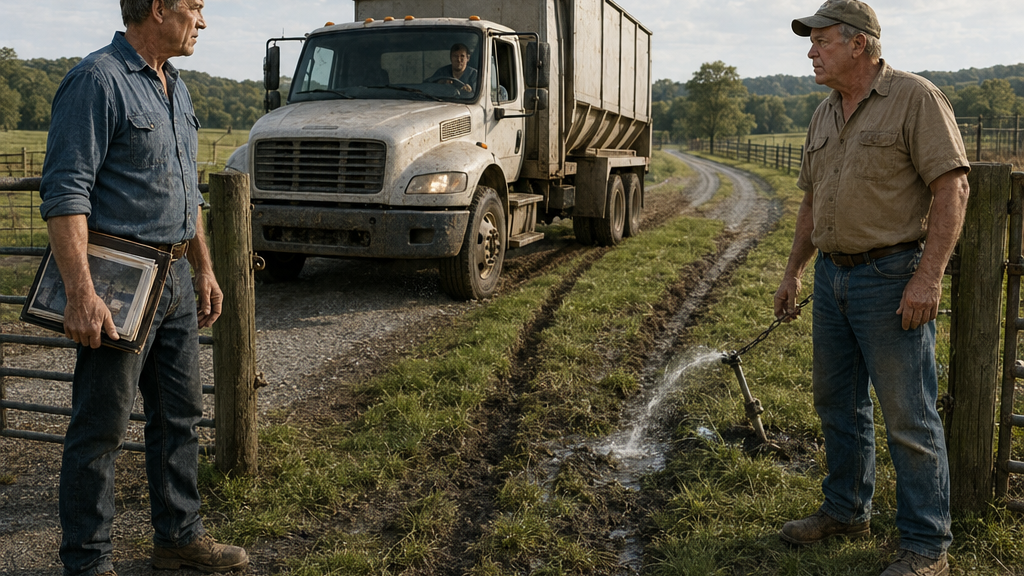
He Thought the Tire Tracks Were Careless Until the Same Farm Gate Opened Fourteen Times
Chapter 1: The Tracks That Crossed His Gate Again
Brian Harris saw the tire tracks before he saw the truck.
Two dark lines cut through the damp grass beside his lower gate, almost perfectly parallel, curving away from the gray gravel lane and disappearing toward the shallow rise beyond the pasture fence. The tracks were fresh enough that beads of water still clung to the crushed blades.
He stopped halfway through fastening the latch on his utility cart.
For a few seconds, he simply looked.
The galvanized chain hung across the livestock opening exactly where he had left it Friday evening. The small weatherproof sign wired to the cedar post faced the lane. It was plain enough that no one could mistake the message. Private farm access. Please stay on road.
Yet someone had crossed anyway.
Brian stepped over the ditch and followed the tracks.
Near the second fence post, the ground had been gouged deeply enough to expose brown soil beneath the grass. A plastic irrigation riser leaned at an angle. He bent, touched it, and felt the looseness in the fitting.
Then water punched through the cracked joint.
A thin stream became a spray, striking the inside of the fence and misting his jeans.
Brian shut his eyes once.
“Of course.”
He hurried uphill toward the valve box while water collected in the rut behind him.
The irrigation line was not ornamental. It fed the small strip of grass around the livestock handling area and the young trees he had planted after losing two old maples in a storm. A broken riser would not ruin the farm. But it would cost him time, fittings, and another section of ground already compacted by tires.
Again.
He shut the valve and returned with a wrench.
By then, the sound of a diesel engine carried up the lane.
A feed truck appeared around the bend, moving slowly because of the ruts in the association road. The driver eased toward Brian’s entrance and stopped.
Brian straightened.
The driver lowered his window.
“Morning.”
Brian looked at the front tires, then at the fresh tracks beside him.
“You come through here earlier?”
The driver hesitated just long enough to answer the question.
“Ronald waved me through.”
Brian said nothing.
The driver pointed back toward the road. “Mud’s bad around the bend. Said everybody cuts across when it gets like that.”
Everybody.
Brian wiped his palm against his work pants.
“The road is over there.”
“I know.”
“This is my field entrance.”
The driver glanced toward the chained opening. “I was told it was all right.”
Brian felt the first sharp rise of anger, but the man behind the wheel did not look defiant. Mostly, he looked inconvenienced.
Brian stepped aside.
“Stay on the gravel going out.”
The driver nodded quickly. “Yes, sir.”
The truck rolled forward, tires keeping to the lane.
Brian watched until it disappeared.
Then he looked back at the tracks.
Everybody cuts across.
The words stayed with him longer than the engine noise.
He spent the next hour replacing the cracked fitting. The damage itself was ordinary enough: one riser, one coupling, a section of packed soil that would need loosening before he reseeded it. He had repaired worse things before breakfast.
But while he worked, another thought bothered him.
The chain had not been moved.
Whoever crossed had entered through the open strip beside it, the same narrow grass shoulder Brian had left unfenced because trucks sometimes needed room to swing wide when he was moving cattle.
That had been intentional.
He had always believed people understood the difference between leaving room and giving permission.
By nine, he was inside the farm office with mud drying on his boots.
A small monitor above the desk displayed four camera feeds: the equipment shed, the upper barn, the cattle pens, and the entrance.
Brian had installed the entrance camera the previous fall after finding two sets of unexplained tire marks within the same month. He had never done much with the recordings. Usually the alert showed deer, delivery drivers, or his own truck.
He opened the saved motion clips from that morning.
At 6:41, the feed truck appeared.
It slowed at the bend.
Then another figure came into view.
Ronald Green.
Ronald stood near the edge of the lane in a faded cap and work shirt, one arm extended toward Brian’s grass. He made a broad sweeping gesture.
The truck turned.
Its front wheels left the gravel.
Brian leaned closer to the monitor.
Ronald walked ahead of it.
He did not look uncertain. He did not glance toward Brian’s house. He did not stop at the chain or examine the sign.
He simply directed the truck across.
Brian replayed the clip.
Once.
Then again.
The feeling that settled in him was different from the irritation he had felt beside the broken riser.
Ronald had worked the adjoining acreage most of his life. Their fathers had traded equipment. Brian had helped Ronald pull a tractor from a ditch years earlier. Ronald had brought over a generator during an ice storm without being asked.
They were not friends in the way people used the word casually, but they had lived beside each other long enough that Brian had assumed certain things did not need saying.
Apparently Ronald had made the same assumption in the opposite direction.
Brian printed a still image from the camera.
Ronald stood at the edge of the lane, palm raised, feed truck turning behind him.
Brian placed the page on his desk.
There was something almost insulting about how ordinary the image looked.
No argument.
No fence cut.
No lock broken.
Just a neighbor deciding where another man’s road began.
Brian opened the folder where he kept repair receipts.
A cracked irrigation riser was a small thing. So were the flattened grass and the rut near the fence.
Small things were easy to dismiss.
That afternoon he photographed the damage from three angles and wrote the date on the back of each print.
He told himself it was only good recordkeeping.
Nothing more.
Before supper, he went back to the camera archive and searched the previous weekend.
There were twelve motion clips on Saturday.
Most showed nothing useful.
At 7:18 Sunday morning, a flatbed pickup appeared at the bend.
It slowed.
Ronald stepped into frame.
Brian’s hand stopped on the mouse.
Ronald pointed toward the same strip of grass.
The pickup turned off the gravel and followed the exact line the feed truck had taken.
Two old tire marks became visible beneath its wheels.
Brian stared at the screen.
The crossing had not started that morning.
He clicked backward another week.
Chapter 2: Fourteen Crossings and One Quiet Assumption
The fourteenth photograph came out of the printer just after sunrise Tuesday.
Brian held it by the edge until the ink dried.
A white utility truck sat halfway across the grass. Behind it, the association lane curved toward the muddy bend. The timestamp showed a Sunday in March.
Brian placed the photograph beside thirteen others.
Fourteen crossings.
Not guesses. Not impressions. Fourteen separate vehicles captured leaving the gravel road and cutting across his entrance strip between early March and the previous Saturday.
He arranged them by date.
The same two tire lines appeared in nearly every picture.
Some vehicles had shifted a foot left or right. One trailer had run wide enough to flatten the edge of the drainage ditch. Another pickup had clipped a reflector. Joseph White’s equipment truck had crossed after a rainstorm and broken the first irrigation head Brian remembered replacing that spring.
Brian had thought those incidents were unrelated.
He had thought careless people were being careless.
The photographs suggested something organized.
By noon he had a legal pad full of names or descriptions.
Three license plates belonged to people he knew well enough to call.
He started with the easiest.
The first driver sounded surprised.
“Ronald said that strip was open when the road got soft.”
The second driver gave nearly the same answer.
“He told me your dad always let folks through.”
The third was even more direct.
“Ronald said you didn’t care as long as nobody bothered the cattle.”
Brian wrote each sentence down.
By the time he set the phone aside, the room felt smaller.
He walked outside.
The grass along the entrance had begun drying in the June heat. From a distance, the damage looked minor. Up close, he could trace the route through compacted soil and faded patches that had never recovered after repeated tires.
He crouched beside the broken reflector and pressed his thumb into the ground.
Hard as packed clay.
He could repair all of it.
That was not what bothered him.
What bothered him was hearing strangers describe his permission with confidence.
Ronald said.
Ronald told me.
Ronald said it was open.
Brian returned to the office and began making a cost list.
Replacement irrigation fittings. Grass seed. Soil conditioner. Two damaged reflectors. Labor for loosening the compacted strip. A small landscaping light near the entrance had been crushed in April, though Brian had not known what hit it at the time.
He resisted the urge to write round numbers.
He found receipts.
He checked actual replacement prices.
If he was going to confront anyone, he wanted the numbers to mean something beyond anger.
Late that afternoon, Joseph White pulled into the gravel turnout in a dusty pickup.
Brian had called him because Joseph’s crossing had caused the most obvious damage.
Joseph climbed out and looked toward the grass.
“You wanted to see me?”
Brian handed him the March photograph.
Joseph studied it.
“That’s mine.”
“You remember crossing?”
“Sure.”
“Why?”
Joseph looked toward the bend.
“Same reason everybody does when that road turns to soup.”
“Everybody?”
Joseph frowned. “Brian, that’s been the wet-weather cut for years.”
“No, it hasn’t.”
Joseph gave him a cautious look.
“It has as long as I remember.”
Brian folded his arms.
“On whose permission?”
“Ronald’s, I suppose.”
“You suppose?”
Joseph sighed. “I never thought I needed to ask. I’ve seen trucks use it since your father was alive.”
Brian felt heat move up his neck.
“My father’s been gone eight years.”
“I know.”
“And that makes it mine.”
Joseph shifted his weight.
“I’m not arguing ownership.”
“You crossed it.”
“I did.”
“You broke an irrigation riser.”
“If I broke it, show me the bill. I’ll pay it.”
The answer took some air out of Brian’s anger.
Joseph continued.
“But don’t stand there like I drove through knowing you’d forbidden it. Ronald told us the route was still good in wet weather.”
Brian studied his face.
There was no smirk. No challenge.
Just certainty.
That bothered him more.
A diesel horn sounded down the lane.
Both men turned.
A loaded feed truck crawled around the bend and stopped where the road narrowed.
Ronald stood ahead of it.
Brian saw his arm lift.
“Not today,” Brian said.
He walked toward the entrance.
Ronald had already moved beside the grass. The truck driver was waiting for direction.
Brian took the galvanized chain from the gatepost and pulled it across the opening.
The links scraped over gravel.
Ronald stared at him.
“What’re you doing?”
“Closing my entrance.”
Ronald glanced at the truck.
“He can’t make that bend loaded.”
“Then he waits.”
“Brian.”
Brian hooked the chain.
Ronald stepped closer and lowered his voice.
“You trying to make a point or trying to run farms?”
Brian carried the folder of photographs under one arm. He opened it and removed the newest page.
Fresh tracks from Saturday.
He laid the photograph flat against the cedar post, holding it there with two fingers.
“This happened after I put the sign up.”
Ronald looked at it.
“So?”
“So I replaced another riser.”
“Send me the bill if that’s what this is about.”
“It isn’t just the riser.”
Brian pulled out another photograph.
Then another.
Ronald’s expression changed.
“How many you got?”
“Fourteen.”
The driver inside the feed truck looked away.
Brian kept his voice level.
“Fourteen vehicles across my property.”
Ronald looked at Joseph, then back at Brian.
“You’ve been counting trucks?”
“I’ve been repairing what they leave.”
Ronald’s jaw tightened.
“That route existed before your cameras.”
Brian felt the words land.
He had expected denial.
Not that.
Joseph spoke quietly. “That’s what I was telling him.”
Ronald nodded toward the bend.
“When that lane floods, we use the inside cut. Always have.”
“That does not make it public.”
“I didn’t say public.”
“You told people they could cross.”
“I told them what we’ve done for years.”
Brian took the photograph off the post.
“You had no right.”
Ronald’s eyes sharpened.
“You sure about that?”
For the first time, Brian heard something underneath Ronald’s defensiveness.
Not bluff.
History.
Ronald stepped close enough that only Brian and Joseph could hear him clearly.
“Before you start calling everybody trespassers, go look through your father’s old farm records.”
Brian said nothing.
Ronald pointed toward the equipment shed.
“You’ll find the washout notes if you kept his files.”
The truck idled behind them.
Brian watched Ronald.
“What washout?”
Ronald gave him a tired look.
“The one that opened this route in the first place.”
Chapter 3: The Permission Nobody Wrote Down Clearly
The note was folded inside a ledger Brian had not opened since his father died.
He found it Wednesday morning between a feed invoice from nearly twenty years earlier and a faded receipt for culvert pipe.
The paper had yellowed along the creases.
Most of the handwriting was his father’s.
Brian recognized the short, hard strokes immediately.
He read the line twice.
Wet-weather passage at lower gate until road is fixed.
Below it were three family names and a date.
No map.
No formal agreement.
No expiration date beyond those four words.
Until road is fixed.
Brian sat alone in the farm office with the note under his palm.
For three days he had been building a clean case in his head.
His land.
His gate.
His damage.
Ronald’s interference.
Fourteen crossings.
Now there was a sentence written by the man Brian had spent half his life trying not to disappoint.
He turned the page.
Another entry mentioned a washout after several days of heavy rain. The association lane had apparently lost part of its shoulder near the lower bend. Loaded trucks had trouble making the turn without sinking into the ditch.
Brian remembered the storm.
He had been in his forties then, working mostly on the upper acreage while his father handled the road association. He remembered mud, a washed-out culvert, and neighbors coming and going.
He did not remember discussing permission.
That absence suddenly mattered.
He carried the ledger to the old equipment shed.
Dust covered the shelves where his father had kept maps, seed records, veterinary receipts, and boxes of photographs no one had sorted.
Brian spent nearly an hour looking.
He found the photograph behind an old county plat.
It showed the lower entrance from years earlier.
His father stood beside the gate with one hand resting on a fence post. Behind him, a grain truck had left the gravel and crossed the grass.
Two tire tracks curved through exactly the same strip Brian had been photographing all spring.
Brian turned the picture over.
No date.
No explanation.
Just his father’s handwriting.
Road still bad.
Brian lowered himself onto an overturned bucket.
The anger he had carried toward Ronald did not vanish.
It became harder to place.
By lunch, he had driven to the county office with copies of the old note, the photograph, and his current survey plat.
The clerk listened patiently and pulled the road records associated with the agricultural lane.
A county survey technician named Nicole Wright met Brian at the counter after reviewing the parcel information.
She spread the plat between them.
“Your boundary is clear enough here.”
She traced the line with a capped pen.
“The cut people are using crosses your parcel.”
Brian nodded.
“So there’s no legal access.”
Nicole did not answer immediately.
“That is not what I said.”
Brian looked at her.
“I can tell you where the property line is. I can tell you the recorded road alignment. I can tell you there is no recorded easement shown in these documents for the route you marked.”
“That sounds straightforward.”
“It sounds straightforward because you’re asking a survey question and a legal-history question at the same time.”
Brian disliked the distinction immediately.
Nicole pointed to his father’s note.
“This isn’t something I can interpret for you.”
“It says temporary.”
“It says until the road is fixed.”
“It was fixed.”
She looked at the county maintenance file.
“Was it?”
Brian leaned closer.
The original washout repair was documented.
Gravel placed.
Drainage opened.
Temporary culvert work.
But the planned reconstruction of the lower bend appeared in a later section marked deferred.
Another year showed the same project listed again.
Deferred.
Then again.
No completion record.
Brian frowned.
“They must have repaired it privately.”
“Possible.”
“Ronald’s people maintain that lane.”
“Then the association may have records the county doesn’t.”
Brian looked through the pages.
The visible problem was suddenly larger than a strip of grass.
If the bend had never been properly rebuilt, his father’s temporary permission had been attached to a condition that, at least on paper, had never fully occurred.
He imagined Ronald saying, We’ve always done it.
That sentence no longer sounded entirely invented.
Nicole gathered the papers.
“One more thing.”
Brian looked up.
“If you want the boundary marked again, I can schedule that.”
“I already know where it is.”
“Then you know the physical answer.”
She tapped the old note.
“The rest is about what people believed they were allowed to do, and when that belief should reasonably have ended.”
Brian drove home without turning on the radio.
That evening, he pulled the agricultural-association records from a metal cabinet in the machine shed.
His father had kept copies because he once served as treasurer.
Brian expected gaps.
Instead, he found careful entries for road dues collected every year.
Small amounts at first.
Larger later.
Gravel purchases.
Drainage work.
Equipment rental.
Routine grading.
Then repeated references to the lower bend.
Rebuild postponed.
Assessment deferred.
Temporary maintenance only.
Brian read through five years.
Then eight.
The same problem had been carried forward under different handwriting.
One entry showed Ronald’s initials beside a note recommending delay because several farms were already struggling with fuel and feed costs.
Brian sat back.
There was the first piece of Ronald’s reasoning.
Not greed.
Not some secret claim to Brian’s property.
Avoiding a bill.
Brian could understand that.
He could even understand how an emergency route, used often enough, could begin feeling permanent.
What he could not understand was why Ronald had never told him.
He kept reading.
The most recent maintenance ledger covered the previous six years.
Road dues had continued to be collected.
The lower bend had been graded repeatedly.
Drainage stone had been added.
But the major rebuild remained unfinished.
Brian took out a pencil and added the totals in the margin.
The association had collected enough money over those years that the absence of a reconstruction could not be blamed entirely on having nothing.
Not unless the money had gone somewhere else.
He turned another page.
There were expenses, but nothing that explained the whole gap.
And Ronald’s initials appeared beside more than one decision to postpone.
Brian closed the ledger.
The fourteen photographs on his office desk no longer told the complete story.
His father had opened the route.
The neighbors had remembered.
The road had never been fully fixed.
But someone had kept collecting dues.
Someone had kept postponing the repair.
And Ronald, who had stood beside Brian’s gate directing trucks through as if the matter were settled, had known far more about that history than he had admitted.
Chapter 4: The Road Problem Behind the Gate Fight
The hay trailer dropped into the rut so hard that its left rear tire nearly disappeared.
Brian was fifty yards away when he heard the tractor engine climb in pitch.
The driver tried once to pull forward.
Mud rolled beneath the tire without moving the trailer.
“Easy,” Brian called.
He crossed the association lane and stopped beside the bend. The outside shoulder had slumped toward the drainage ditch, leaving barely enough firm gravel for the tractor. Loaded with round bales, the trailer leaned just enough to make everyone watching uncomfortable.
Ronald Green came down the lane in his pickup.
He got out, studied the wheel, then looked toward Brian’s lower entrance.
“We can back him out and take the cut.”
Brian followed his gaze.
Across his grass.
Again.
“No.”
Ronald exhaled through his nose. “Then you got a better idea?”
Brian looked at the trailer.
“Unload two bales. Pull it back straight.”
“That’ll take an hour.”
“It’ll take less than repairing another irrigation line.”
Ronald stared at him.
The driver climbed down and began loosening straps.
Nobody argued.
That surprised Brian.
For years, urgency had been used as its own kind of permission. Hay needed moving. Feed needed delivering. Rain was coming. Equipment had to get through.
Standing beside the buried tire, Brian could finally see why the shortcut had survived.
The bend was worse than he had admitted to himself.
The inside edge was soft enough to swallow a boot heel. Gravel had been pushed outward by years of trailers making the turn. A shallow drainage channel carried water toward the exact place where the road needed support most.
Ronald kicked at the mud.
“This is what I’ve been talking about.”
Brian looked at him.
“You haven’t been talking about it. You’ve been sending people through my gate.”
Ronald’s mouth tightened.
The two men helped unload the bales.
Twenty minutes later, the tractor backed free.
The driver took the long route around.
No one applauded. No one complained.
The inconvenience simply became real.
That evening, the agricultural association met in a machine shed belonging to one of the neighboring farms. Folding chairs had been placed around a scarred worktable. A box fan pushed warm air through the open door.
Brian brought copies of the maintenance ledger.
Ronald noticed them immediately.
“You been auditing us now?”
“I’ve been reading.”
“That can be dangerous.”
A few men smiled.
Brian did not.
He opened the ledger to the section covering the lower bend.
“Why was this postponed?”
Ronald sat back.
“You know why.”
“No. I know what the notes say.”
One of the farmers leaned forward.
Ronald rubbed his thumb along the edge of the table.
“The rebuild estimate came in high.”
“How high?”
“High enough.”
“That’s not an answer.”
Ronald’s patience slipped.
“Because half the people on this road were already complaining about dues. Fuel was up. Fertilizer was up. Two farms had equipment notes coming due. You wanted me to walk around asking for another assessment?”
“You were road coordinator.”
“I was a volunteer.”
“And you kept postponing the repair.”
“I kept the road usable.”
Brian looked at the rut outside the shed.
“By using my land.”
Ronald’s voice dropped.
“By keeping trucks moving.”
The room quieted.
There it was.
Not denial.
Not confusion.
Choice.
Brian tapped the ledger.
“You knew the bend needed rebuilding.”
“Yes.”
“You knew my father’s passage was temporary.”
Ronald looked away for half a second.
“I knew what he said.”
“Then why keep telling drivers the route was open?”
Ronald leaned forward.
“Because every time we priced that bend, somebody was going to get hurt by the assessment. Maybe not you. Maybe not me. But somebody.”
“So you decided I’d pay instead.”
“That’s not what I said.”
“It’s what happened.”
Ronald pushed his chair back.
“You think I enjoyed sending people through there? You think I wanted this mess?”
“I think it was easier than admitting the road hadn’t been fixed.”
The accusation landed harder because Brian said it quietly.
Ronald stood.
For a moment, Brian expected him to leave.
Instead, Ronald walked to the shed opening and stared down the lane.
“My father used that crossing,” he said. “Your father used ours when the creek rose. Nobody wrote letters about it.”
Brian felt the old pressure immediately.
The promise he had made years before surfaced without invitation.
Don’t become the man who closes every gate behind him.
His father had said it after a dispute over borrowed equipment. Brian had carried the sentence like an instruction ever since.
Ronald turned.
“And don’t act like you never used an informal route.”
Brian frowned.
Ronald pointed toward the north fields.
“The night your father got sick.”
The room seemed to narrow.
Brian remembered.
An ambulance had taken his father from the farmhouse. Brian had been thirty minutes away with a tractor and hay rake. Ronald had called him.
Brian had cut through the Green property because the county road route would have cost him another ten minutes.
No one had asked about permission.
No one had needed to.
Ronald said, “You came straight across our lower field.”
Brian looked at the ledger.
“That was one emergency.”
“So was the washout.”
“For one season.”
“And then the bend never got rebuilt.”
The distinction still mattered.
But it no longer felt as clean.
Brian closed the ledger.
He could see two truths sitting at the same table.
Ronald had been protecting working farms from costs some of them genuinely struggled to absorb.
Ronald had also made Brian’s land the unofficial solution without asking him.
Understanding the first did not erase the second.
One of the association members spoke from the end of the table.
“Maybe we need to stop arguing about twenty years ago and fix the bend.”
Ronald looked at him.
“With what money?”
“The dues we’ve been paying would be a start.”
Brian opened the ledger again.
That was when another farmer slid a copy of an email across the table.
“I got this from Ronald in May.”
Brian took it.
The email concerned wet-weather access and instructed delivery traffic to use Brian’s lower crossing when necessary.
The date stopped him.
May twenty-seventh.
Brian reached into his folder and removed the certified receipt for the notice he had sent Ronald earlier that month.
Delivered May twentieth.
Seven days before the email.
Brian placed the two papers side by side.
Ronald saw what he was looking at.
His face changed.
The room went still.
Whatever ambiguity belonged to the old arrangement, the dates after May twentieth did not share it.
Chapter 5: The Difference Between Damage and Revenge
Brian removed the first file from the stack and placed it on the far side of his desk.
Then a second.
Then a third.
By the time he stopped, nine folders sat apart from the five remaining in front of him.
He had expected narrowing the case to feel like surrender.
Instead, it felt unpleasantly like accuracy.
The fourteen incidents stretched back into early spring.
His written notice to Ronald had been delivered May twentieth.
Five crossings happened after that date.
Nine happened before.
Those nine drivers might have been careless. Some should have asked. Some had seen the sign and used the grass anyway.
But the records now showed a long history of temporary passage, an unrepaired association road, and Ronald telling people the route remained available.
Brian could not honestly treat every crossing the same.
He picked up the oldest file.
The photograph showed a pickup turning over the grass in March.
He had already calculated the damage beneath it.
Seventy dollars for soil work.
Seed.
A broken reflector.
He closed the folder and set it with the nine.
The satisfaction of fourteen claims had been simple.
Five felt harder.
He drove down to the entrance where a fence contractor was replacing one damaged post.
Joseph White was there helping straighten a length of wire.
When Brian approached, Joseph wiped his hands on his jeans.
“You figure out what you’re doing with everybody?”
“Working on it.”
Joseph nodded toward the repair.
“I brought the money for that sprinkler head.”
“You don’t have to do that today.”
“I broke it.”
Brian looked at him.
“You were told you could cross.”
“I still drove over it.”
Joseph handed him an envelope.
Brian took it.
The exchange was so uncomplicated that it irritated him in a different way.
Joseph noticed.
“What?”
Brian shook his head.
“Nothing.”
“No. Say it.”
Brian looked toward the gate.
“I’ve spent three months trying to understand why none of you asked me.”
Joseph gave a short laugh without humor.
“You want me to answer that?”
“Yes.”
“Because Ronald said it was open.”
“That shouldn’t have been enough.”
“Maybe.”
Joseph leaned against the post.
“But you want to know something else?”
Brian waited.
“If you’d called me in March and said, ‘Joseph, don’t cross there anymore,’ I wouldn’t have.”
The sentence was almost too plain.
Brian felt himself stiffen.
“There was a sign.”
“I saw the sign later.”
“You know whose property it is.”
“I know whose property half the roads around here run across too.”
“That isn’t the same.”
“I didn’t say it was.”
Joseph glanced at the grass.
“I’m saying you’ve been mad at people for months without actually telling some of us you were mad.”
Brian’s jaw tightened.
“It shouldn’t take an argument for people to respect a boundary.”
“No.”
Joseph met his eyes.
“But silence isn’t a fence either.”
Brian said nothing.
The words stayed between them.
Joseph returned to the wire.
Brian walked toward the damaged strip.
Two faint tire tracks were still visible where the soil had compacted. In the early weeks, he had looked at those lines and seen disrespect.
Now some of them carried another meaning.
Assumption.
Not innocent assumption. Not harmless assumption.
But something more complicated than fourteen deliberate violations.
His father had created the first ambiguity through generosity.
Ronald had preserved it through convenience.
Brian had let it continue through silence until the resentment became large enough to organize.
He went back to the office that afternoon and opened every file.
The five post-notice incidents remained.
May twenty-third.
May twenty-ninth.
June second.
June eighth.
June tenth.
For those, there was no reasonable argument that Ronald did not know Brian had withdrawn permission.
Brian attached repair photographs to each.
He added receipts.
He removed speculative costs.
One damaged patch of grass could not be confidently tied to a single vehicle, so he deleted it.
A reflector had already been loose before one crossing. He removed that too.
By sunset, the total claim was smaller than he had expected.
It was also stronger.
Ronald arrived after six.
He did not knock on the office door. He stood outside until Brian noticed him.
“You got a minute?”
Brian stepped onto the porch.
Ronald held his cap in one hand.
“I heard you’ve been talking to everybody.”
“I talked to Joseph.”
“He paid you.”
“For what he knew he broke.”
Ronald looked past Brian into the office.
“You still planning to send fourteen bills?”
“No.”
Ronald seemed surprised.
“Five.”
The surprise disappeared.
“For what?”
“The five crossings after you received my notice.”
Ronald’s expression hardened.
“We already went over this.”
“No. We went over the old arrangement.”
“And I told you the road wasn’t fixed.”
“And I told you permission was over.”
“You can’t just change twenty years of practice in one letter.”
“It wasn’t your practice to grant.”
Ronald put his cap back on.
“Then send your bills.”
“I’m sending the road records too.”
Ronald stopped.
Brian continued.
“Every postponement. Every temporary repair. The email you sent seven days after receiving my notice.”
Ronald’s eyes narrowed.
“What are you trying to prove?”
“That there were two problems.”
Brian pointed toward the entrance.
“One is what happened to my land.”
Then toward the bend.
“The other is why you kept using it.”
Ronald’s voice became low.
“You want to embarrass me in front of the association.”
“No.”
“Sounds like it.”
“If I wanted that, I’d bring fourteen files.”
Ronald looked at him.
Brian let the silence sit.
“I’m bringing five.”
For the first time, Ronald had no immediate answer.
Brian went inside.
He gathered the five folders into one stack.
Beside them he placed the maintenance ledger and the current estimate for rebuilding the lower bend.
For months, he had treated the evidence as a way to prove how much had been done to him.
Now he wanted it to show something narrower.
Exactly where misunderstanding ended.
Exactly where choice began.
He clipped the five photographs together and put them on top of the road-repair estimate.
The association meeting was the following Thursday.
This time Brian intended to bring both problems through the same door.
Chapter 6: Five Photographs at the Association Table
Brian carried five folders into the machine shed.
Not fourteen.
Ronald noticed before Brian even sat down.
His eyes dropped to the small stack, then to the rolled road plan and repair estimate beneath Brian’s arm.
The association members filled the same folding chairs as before. Someone had brought a cooler of bottled water. The box fan rattled near the open door.
Brian put the five folders on the table.
No one spoke.
Ronald finally said, “Thought there were fourteen.”
“There were.”
Brian took his seat.
“There aren’t fourteen claims.”
One of the farmers leaned forward.
“What changed?”
Brian rested both hands on the table.
“I found my father’s records.”
Ronald watched him carefully.
Brian unfolded a photocopy of the old note.
“I was wrong about one thing.”
The admission felt heavier than he expected.
“My father did allow wet-weather passage across the lower entrance after the washout.”
Nobody looked surprised except Brian himself, remembering how certain he had been only two weeks earlier.
He continued.
“There’s a photograph too. Trucks used that strip. People had reason to believe there was an arrangement.”
Ronald shifted in his chair.
Brian looked directly at him.
“But the note says until the road is fixed.”
Ronald answered, “And it wasn’t.”
“No.”
Brian placed the maintenance ledger beside the note.
“That’s the second problem.”
He opened the ledger to the repeated deferments.
“The bend was temporarily patched. The full rebuild was delayed. Then delayed again.”
A member at the end of the table asked, “How many times?”
“Enough that we’re still talking about it.”
Brian slid copies of the pages outward.
“No one here needs me to pretend those delays happened for no reason. Costs were bad. Some farms were struggling. I understand that.”
Ronald looked at him differently.
The accusation he had prepared for did not come.
Brian pulled the five photographs from the first folder.
He placed them in a row.
Parallel tire tracks crossed each image.
“These are different.”
He tapped the first timestamp.
“May twenty-third.”
The second.
“May twenty-ninth.”
Then the others.
“All after Ronald received written notice that I was closing the route.”
Ronald folded his arms.
Brian placed the delivery receipt beside the photographs.
Then Ronald’s later email directing traffic through the crossing.
A murmur moved around the table.
Ronald looked down.
One farmer said, “You sent this after he closed it?”
Ronald’s jaw flexed.
“The bend was impassable for loaded trucks.”
“That isn’t what he asked.”
Ronald looked up.
“I was trying to keep operations moving.”
Brian answered before anyone else could.
“I know.”
That quieted the room again.
“I believe that.”
Ronald stared at him.
Brian continued.
“And I believe some people genuinely thought they still had permission. That’s why I’m not billing the other nine.”
The five folders suddenly looked more substantial.
Not because there were many.
Because there were only five.
Brian opened them one at a time.
A broken irrigation riser.
Compacted soil requiring repair.
One damaged light.
Fence-post work.
No penalties.
No invented inconvenience charge.
Actual receipts and estimates.
When he finished, he pushed the total toward the center.
“This is what I’m asking to be reimbursed.”
One association member studied it.
“That’s less than I expected.”
“It’s what I can prove.”
Ronald looked from the total to Brian.
“And after we pay it?”
Brian unrolled the road estimate.
“Then we fix the bend.”
Several people began talking at once.
The estimate was not small.
Brian let them read.
One farmer shook his head.
“We’ll need an assessment.”
“Yes.”
“People aren’t going to like that.”
“No.”
Brian looked around the table.
“But we’ve already been paying for the problem. Just not honestly.”
He pointed to the photographs.
“I paid in grass, irrigation, fence work, and time.”
Then toward the lane outside.
“Drivers paid by taking risks at the bend.”
He touched the maintenance ledger.
“And the association paid for temporary fixes that never solved it.”
Ronald remained silent.
Brian turned toward him.
“You were right that the road problem was real.”
Ronald’s face tightened.
“But you were wrong to make my farm the solution after I told you to stop.”
There was no applause.
Brian was grateful for that.
The room did not need a winner.
It needed a decision.
One member asked about widening the bend.
Another suggested adding drainage stone and replacing the old culvert.
The discussion became practical.
Numbers replaced accusations.
Equipment availability.
Contractor schedules.
Assessment shares.
Brian listened.
Something in him loosened as the argument shifted away from whether his boundary deserved respect.
That question had finally become settled enough to move past.
Near the end of the meeting, a vote was taken.
The association would fund the rebuild.
The five documented post-notice repairs would be reimbursed from the association account, with Ronald contributing personally toward the portion tied to the access directions he had continued giving.
Ronald did not object.
Not immediately.
When the others began stacking chairs, he approached Brian.
“You made me look pretty bad.”
Brian gathered the photographs.
“I left nine folders at home.”
Ronald gave him a dry look.
“That supposed to make me feel better?”
“No.”
Brian slipped the old note into his folder.
“It’s supposed to be accurate.”
Ronald studied him for a moment.
Then he looked toward the open shed door.
“If we approve the contractor tomorrow, they’ll tear into that bend next week.”
“Good.”
“Could be three weeks before loaded trucks can use it.”
Brian waited.
Ronald rubbed the back of his neck.
“We’ve got feed deliveries coming.”
The question was already visible before he asked it.
Brian felt his body resist.
The old answer rose immediately.
No.
Lock the chain.
Make them live with the consequences.
Then he remembered Joseph standing beside the fence.
Silence isn’t a fence either.
Ronald said, “I’m asking this time.”
Brian looked toward the road.
“One temporary route?”
“Only while they’re rebuilding.”
“Every crossing cleared with me first.”
Ronald hesitated.
Then nodded.
“No telling drivers it’s open.”
“No.”
“No assumptions.”
Ronald met his eyes.
“All right.”
Brian picked up the galvanized chain lying beside his folder.
He had brought it to the meeting because the damaged hook needed replacing.
The cold links settled into his palm.
For years, the chain had meant almost nothing.
Then it had become the line Brian used to say no.
Now Ronald was asking whether Brian would open it again.
Brian closed his hand around the links.
“I’ll give you an answer before the first truck comes through.”
Chapter 7: A New Gate Where the Tracks Ended
The loaded feed truck reached the rebuilt bend and never touched Brian’s grass.
Brian stood beside the lower pasture fence and watched its rear wheels follow the new gravel shoulder through the turn. For years, that was the exact place where drivers had slowed, looked toward his entrance, and decided the shortest way forward ran across his land.
This time the truck stayed on the road.
Its suspension rocked once over the fresh stone, then settled. The trailer cleared the ditch with several feet to spare.
Brian did not realize he had been holding his breath until the truck disappeared beyond the trees.
Six weeks had passed since the association meeting.
The bend barely resembled the place where the hay trailer had nearly sunk. The old culvert had been replaced, the drainage channel reshaped, and the inside shoulder widened with compacted stone. The association had divided the assessment according to its existing schedule. Nobody had been happy about writing the checks.
They had written them anyway.
The five repair claims had been handled the same way.
No courtroom.
No dramatic settlement.
The association reimbursed the documented damage, and Ronald paid the portion connected to the crossings he had personally directed after receiving Brian’s notice.
Brian used the money to repair the irrigation line properly, replace the damaged light, loosen the compacted soil, and reseed the scarred strip.
The grass was coming back.
You could still see the old route if you knew where to look. Two faint bands remained slightly thinner than the ground around them, tracing the curve vehicles had followed from the association road.
They no longer looked like fresh injuries.
They looked like something that had ended.
During construction, Brian had agreed to temporary access exactly as Ronald requested.
But there had been rules.
Every vehicle was cleared with Brian first.
The gate opened only when he opened it.
No driver was told the route was generally available.
For three weeks, Brian received calls at inconvenient times. Feed deliveries. A fertilizer truck. One equipment trailer that needed enough turning radius to avoid the excavation.
Sometimes he said yes.
Twice he said no.
Nothing terrible happened either time.
The first refusal had surprised him more than the driver.
Brian had spent years acting as though saying no required a defense. He discovered that a clear answer, given before resentment accumulated, was often easier for everyone than a silent concession nobody understood.
The temporary construction route closed when the contractor packed the last gravel into the bend.
After that, Brian moved the lower gate.
Not far.
Nicole Wright had returned to mark the parcel line before the fence contractor set the posts. The new opening sat more squarely inside Brian’s property, leaving no grassy shoulder wide enough to resemble an accidental road.
The galvanized chain remained.
Brian had replaced the old hook but kept the same links.
He was checking the latch one afternoon when he heard a pickup slow behind him.
Ronald.
The truck stopped on the gravel.
For a moment neither man moved.
Then Ronald climbed out.
He looked first at the repaired bend, then at the new gate.
“Looks different.”
“That was the idea.”
Ronald nodded.
Brian expected some remark about the assessment or the fence.
Instead Ronald said, “You got your cattle in the upper field?”
“Most of them.”
“I’ve got a mower attachment coming back from Joseph’s place. Trailer’s too long to turn into my lower field from my side.”
Brian waited.
Ronald looked toward the gate.
“Could I bring it through here?”
The question was ordinary.
That was what made it matter.
Six weeks earlier Ronald would have directed the trailer through and explained afterward.
Now he stood on the road and waited.
Brian looked past him.
No trailer yet.
No urgency manufactured into permission.
Just a neighbor asking.
“When?”
“About half an hour.”
“You’ll come through this gate and stay along the fence line?”
“Yes.”
“Not across the reseeded strip.”
“No.”
Brian unhooked the chain.
“All right.”
Ronald glanced at the opening.
“That simple?”
“It can be.”
Something almost like embarrassment crossed Ronald’s face.
He rubbed a hand along his jaw.
“I should’ve asked before.”
Brian could have made him say more.
Part of him wanted to.
There were still mornings when he remembered the broken riser and the fourteen photographs lined across his desk. There were still moments when Ronald’s certainty at the gate irritated him all over again.
But demanding humiliation would not restore anything the repair checks had not already restored.
Brian said, “Yes.”
Ronald nodded once.
Then, after a moment, he added, “You should’ve told me sooner how far past done you were with it.”
Brian looked at him.
That answer would have angered him earlier in the summer.
Now he heard the uncomfortable truth inside it.
“I should have.”
They left it there.
Half an hour later, Ronald returned with the trailer.
He stopped before the gate even though the chain was already loose.
Brian walked over and opened it.
The trailer came through slowly. Its tires stayed exactly where Brian had directed. Ronald raised one hand from the steering wheel as he passed.
Brian closed the gate behind him.
Not locked.
Closed.
There was a difference.
Later that evening, Brian walked the entrance before heading inside.
The rebuilt association road was empty.
His irrigation system clicked on.
Water rose in even arcs across the reseeded grass, darkening the soil where the old tire tracks had once hardened it. No broken riser sprayed against the fence. No wheel ruts carried water toward the ditch.
Brian stopped beside the new gate.
He thought of the photograph from his father’s records: the old grain truck crossing this same ground, his father standing nearby as though opening the farm to a neighbor required no explanation.
For years Brian had treated that memory as a command.
Keep helping.
Keep the gate open.
Do not become difficult.
But his father had never told him that generosity meant surrendering the right to choose.
The old arrangement had failed because permission had outlived the conversation that created it.
Brian understood that now.
A gate could open.
A gate could close.
Neither act meant much unless the people on both sides knew who was choosing and why.
Headlights appeared down the lane.
Brian recognized Joseph’s pickup.
It slowed near the bend, stayed on the new gravel, and continued without hesitation.
Brian smiled despite himself.
He reached for the chain.
Then he heard another engine from inside his property.
Ronald’s truck approached from the field after dropping the mower trailer.
He stopped before the gate.
Brian opened it.
Ronald drove through onto the association road and pulled forward far enough for Brian to swing the gate closed.
“Appreciate it,” Ronald said through the open window.
Brian nodded.
“Anytime you ask.”
Ronald gave him a look, then laughed once.
“Fair enough.”
He drove away.
Brian stood with one hand on the chain.
He did not fasten the lock.
Not yet.
The gate remained unlocked because he was still there, because permission had been asked for, because the crossing had a beginning and an end.
Behind him, the repaired grass held no new tracks.
Ahead of him, the trucks had a road that finally worked.
Brian hung the chain loosely between the posts and walked toward the house, leaving the gate exactly as open as he had chosen it to be.
The story has ended.