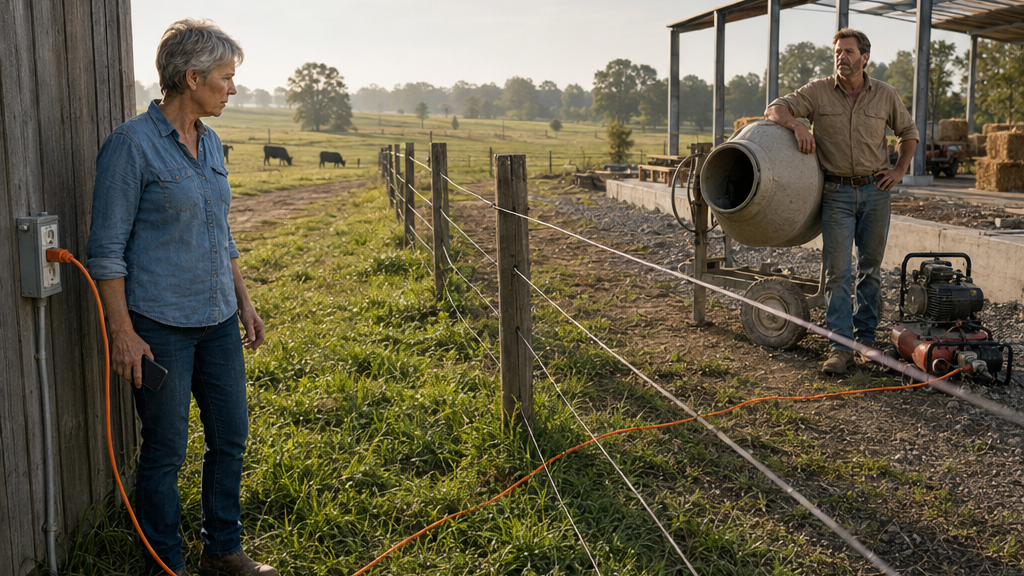
The Neighbor Ran His Farm Equipment Through Her Power Line—Then One County Inspection Changed Everything
Chapter 1: The Orange Cable Across Her Pasture
The orange cable was already plugged into Margaret Hill’s outlet when she stepped out of the mudroom with her first cup of coffee.
She stopped with one boot on the concrete and one on the gravel.
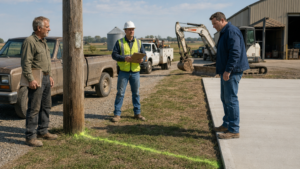
The cord was thick enough for shop equipment, bright enough to look unnatural against the wet green grass, and it ran from the weatherproof receptacle beside her barn all the way toward the fence separating her place from Brian Clark’s.
Margaret stared at it for several seconds before setting her coffee on the porch rail.
She had not loaned anybody a cord.
More importantly, she had not loaned anybody electricity.
A low mechanical growl drifted from beyond the fence.
Margaret followed the cable.
It crossed the strip where she usually parked the hay wagon, disappeared beneath the lowest fence wire at a shallow wash, then continued along the grass beside the shared farm lane. There was enough slack that the cable had been looped around one cedar post rather than stretched tight.
Whoever had laid it there had taken time.
That bothered her more than if it had been careless.
At the far end, Brian stood beside a portable concrete mixer.
A compressor rattled nearby. Fresh lumber lay stacked beside a rectangular pad of compacted gravel, and wooden forms marked the beginning of what looked like a machinery shed twice the size Margaret had expected when Brian first mentioned “putting up some cover.”
He glanced up when she approached.
“Morning.”
Margaret pointed at the cord.
“That yours?”
Brian followed her finger as if he had forgotten it existed.
“Yeah.”
“You’re plugged into my barn.”
“I know.”
His answer was so casual that Margaret waited for the rest of it.
None came.
The mixer continued turning.
“Why?”
Brian wiped his hands on his jeans. “Needed power over here. Generator wouldn’t start this morning.”
“You could’ve asked.”
“I figured you wouldn’t care.”
Margaret looked back along the cable. From here it was a bright orange line cutting across the grass between them.
“That isn’t the same thing.”
Brian gave a small shrug.
“It’s a mixer, Margaret. Not a grain dryer.”
“That’s not the point.”
“It’ll be a few dollars at most.”
He said it lightly, like he was trying to help her see how small the matter was.
Margaret felt something tighten behind her ribs.
She had spent most of her working life doing payroll for a regional feed company. She knew exactly how quickly people started deciding what didn’t matter when the amount was small.
Three dollars missing from a check was still somebody else’s three dollars.
A gate left open for five minutes was still an open gate.
And somebody else’s outlet was still somebody else’s outlet.
“I don’t want you using it without asking.”
Brian looked toward the forms.
“We’re only pouring the footings today.”
“You heard what I said.”
For the first time, his expression hardened slightly.
Then he laughed once through his nose.
“Your husband never worried about stuff like this.”
The sound of the mixer seemed louder.
Margaret looked at him.
Brian had known her husband for years. They had traded labor on fence repairs, hauled each other’s cattle when trailers broke down, borrowed tools and brought them back with new blades or full fuel tanks.
There had been plenty of things Margaret had never bothered learning the details of because her husband had handled them with a handshake.
But her husband had been dead for almost three years.
Brian knew that too.
“What does that have to do with this?”
“He let me hook up over here before.”
“When?”
“Plenty of times.”
Margaret searched his face, trying to decide whether he was remembering something real or simply broadening an old favor until it covered whatever he needed now.
“I don’t remember plenty of times.”
“You weren’t always out here.”
It was not quite an insult, but it found the place where one would have landed.
Margaret had kept the farm accounts, scheduled the veterinarian, arranged feed deliveries and worked a full-time office job for twenty-seven years. Her husband had handled more of the visible outside work because that division had suited them both.
Since his death, people had occasionally spoken to her as though the land had become less familiar to her when he died.
She hated how much that still unsettled her.
Brian nodded toward the mixer.
“Look, I’ll be done with this part before lunch.”
Margaret could have walked over and unplugged the cord.
The thought came cleanly.
So did another one: Brian telling people down at the farm-supply counter that she had become hard to deal with since her husband died.
She despised herself for caring.
“Finish what’s already in that mixer,” she said. “Then unplug it. And don’t hook into my power again unless you ask me first.”
Brian lifted both hands.
“Fine.”
Margaret picked up the cable where it crossed the lane and moved it out of a shallow tire rut before walking home.
She told herself that counted as handling it.
By ten-thirty, the mixer had stopped.
She saw the cord lying loose in the grass and felt an unreasonable amount of relief.
The rest of the morning passed in ordinary work. She checked a mineral feeder, replaced a bent latch on the north gate, and wrote down two supply purchases in the small ledger she kept in the barn office.
That ledger had once been her husband’s.
His handwriting filled the older pages—fuel, salt blocks, fencing staples, calf medicine, names of men who owed him labor and names of men he owed back.
Margaret rarely read those entries.
She used the blank pages at the back.
Around noon, she heard Brian’s tractor.
She looked through the barn window.
His compact tractor rolled slowly beside the new foundation. A load of crushed stone shifted in the bucket.
The orange cable still lay disconnected.
Good, she thought.
She went back to her figures.
Near four o’clock she walked down to close the south pasture.
The sun had dried the top of the grass, and the cattle were gathering near the trough.
Margaret reached the fence corner and stopped.
The orange cable was no longer lying loose.
It ran tight through the grass.
She followed it with her eyes toward her barn.
Then toward Brian’s construction pad.
The compressor had started again.
Margaret stood there without moving.
Across the fence, Brian stepped behind the mixer, bent down, and adjusted something near its motor.
He did not look toward her.
At the barn, the plug sat firmly inside Margaret’s outlet.
Brian had waited until she was out of sight.
Then he had plugged it back in.
Chapter 2: What Her Husband Had Actually Allowed
The cable was still there at five forty the next morning.
Margaret saw it before sunrise because she had gone to the barn early to check a heifer that was close to calving. In the blue-gray light, the orange insulation looked almost luminous across the dark grass.
She did not follow it this time.
She walked straight to the outlet.
For several seconds she stood with one hand hovering over the plug.
Then she stopped herself.
If she unplugged it, Brian could say she had cut power while he had equipment running. He could turn the argument into something else.
Margaret hated that she was already thinking in terms of what he might claim.
She took out her phone instead.
One photograph of the plug.
One of the cable crossing her grass.
One wide shot showing the fence line and the direction it ran.
Then she opened the weatherproof cover beside the outlet and photographed the small digital submeter her husband had installed years earlier to track barn use.
She wrote the number in her ledger.
By seven, Brian’s compressor was cycling again.
Margaret called the electric cooperative after breakfast.
The representative could not tell her exactly which appliance had consumed which amount, but she confirmed that Margaret’s recent daily usage was running noticeably above the same period from the previous week.
“How noticeable?” Margaret asked.
The representative gave her the figures.
Margaret wrote them down.
The difference was not enormous.
That almost made her angrier.
Brian had been right about one thing: on a single morning, the cost probably was not much.
But it was measurable.
Which meant the argument had never been about whether she could afford it.
Margaret carried the ledger to the kitchen table and stared at the numbers.
Then she found herself remembering a summer from years earlier.
Brian had owned a welder but lost a generator in a storm. Her husband had run a temporary line from their barn while the two men repaired a stock trailer together.
She remembered seeing the cord.
Orange.
Possibly the same one.
Another memory followed. A winter afternoon when both men had been working on a frozen water line near the fence. There had been power coming from somewhere on Margaret’s side.
She frowned.
Maybe Brian had not invented the history.
That possibility weakened the clean certainty she had felt the previous night.
Had her husband told Brian he could use the outlet whenever he needed it?
She could imagine him saying something loose and generous.
Use it if you need it.
Don’t bother asking.
What she could not imagine was him telling Margaret about it afterward. Not because he would hide it, but because to him it might not have seemed worth mentioning.
By midmorning Margaret crossed the lane.
Brian was fastening metal brackets along the new shed framing.
“Brian.”
He turned.
“I called the cooperative.”
His face changed almost imperceptibly.
“About what?”
“You know what.”
He climbed down from the step ladder.
Margaret held her ledger against her hip.
“My usage is up.”
Brian sighed. “Margaret.”
“Don’t do that.”
“Do what?”
“Say my name like I’m making this harder than it is.”
He glanced toward the cable.
“I already told you I’d cover the power.”
“No. You told me yesterday you’d unplug.”
“We needed the compressor.”
“And I told you not to use my outlet again without asking.”
Brian dragged one glove off with his teeth.
“Your husband and I had an understanding.”
“What understanding?”
“If I needed power, I used it. If he needed something from me, he asked.”
“That vague?”
“It worked.”
“For him.”
“For both of us.”
Margaret’s grip tightened on the ledger.
“You asked him each time?”
Brian hesitated.
That was enough to tell her the answer.
“Sometimes.”
“And sometimes you didn’t.”
“He didn’t care.”
“You don’t know what I care about unless you ask me.”
Brian looked past her toward her pasture.
For a moment he seemed more tired than irritated.
“We have a season coming, Margaret. I’m not trying to steal anything from you. I’m trying to get a building finished.”
“Then get power on your own side.”
“That takes time.”
“So does arguing with me every morning.”
He gave a humorless smile.
“There it is.”
“What?”
“You acting like everything changed because he’s gone.”
The words hit harder than she expected.
Margaret looked at him for a long moment.
“Things did change.”
Brian’s expression softened slightly, but not enough.
“I didn’t mean—”
“Yes, you did.”
She turned and walked back toward her property before he could improve the sentence.
At the barn, she unplugged the orange cable.
This time she carried the end to the fence and set it on Brian’s side.
Then she photographed it there.
For the rest of the day, Margaret tried to remember exactly how her husband had handled shared work.
Not the comforting version.
The practical version.
He had borrowed Brian’s post driver once. Brian had used their cattle trailer twice. There had been diesel traded for labor, labor traded for hay, repairs exchanged without invoices.
But there had almost always been some return.
Some acknowledgment.
Her husband had been generous, but he had not been careless with accounts. He simply kept a different kind of account than she did.
Late that afternoon, Margaret opened the old part of the barn ledger.
She stopped at a page dated seven years earlier.
Her husband’s handwriting ran diagonally across one margin:
Clark—tractor tire / 2 hrs.
Another entry:
Helped south fence. Owe diesel.
She turned more pages.
There were references to Brian, but none she could immediately connect to electricity.
Margaret closed the book.
Maybe she was searching for permission because she feared finding it.
Maybe she was searching for its absence because she wanted to be right.
Neither felt especially honorable.
The next morning the cable was gone.
Margaret felt relief again, but this time she distrusted it.
She walked the fence line before breakfast.
Near the shared lane, the grass was flattened in two parallel strips.
Fresh tire tracks.
They crossed the usual path, continued past the fence corner and curved several yards onto Margaret’s side before turning back toward Brian’s construction pad.
Margaret crouched.
The soil was still moist where the tires had pressed into it.
Beside one track lay a crushed clump of pasture grass.
She looked toward Brian’s equipment.
The cable had been only the easiest thing to see.
Chapter 3: The Water Started Moving the Wrong Way
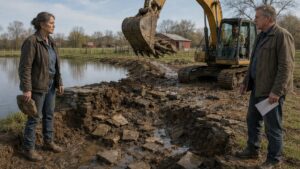
By Wednesday morning, the cattle crossing below the south pasture was under six inches of muddy water.
Margaret stopped her utility vehicle at the edge and stared.
The crossing was never dry enough to be called pretty, but it had always drained. Even after a hard rain, water moved through the shallow swale and disappeared toward the tree line.
Now it sat brown and motionless across the route the cattle used between pastures.
One cow stepped toward it, tested the mud with a front hoof and backed away.
Margaret killed the engine.
Rain had fallen hard during the night, but not hard enough for this.
She stepped down and walked the edge.
The water had spread through flattened grass toward the fence. A thin trail of cloudy runoff still entered from the direction of Brian’s new shed.
Margaret followed it.
Near the fence corner, the orange cable lay coiled beside one of Brian’s posts, unplugged for the moment.
Beyond it, fresh earth sloped away from the building pad.
She stood there trying to remember what the ground had looked like two weeks earlier.
There had always been a slight rise on Brian’s side.
Now the rise had been shaved down.
A shallow trench ran along the edge of the construction area and ended almost directly above Margaret’s old swale.
The grading had not created the rain.
It had changed where the rain went.
Margaret pulled out her phone.
Photographs first.
Wide shot of the flooded crossing.
Close-up of the runoff line.
Fence post for reference.
Tire tracks.
The new slope.
She opened her ledger when she reached the barn and wrote the time beside each photograph.
Her hand was steady.
That surprised her.
Two days earlier, Brian’s comments about her husband had left her unsure of nearly everything. The water made one part simple again.
Whatever informal permission had once existed for a cord or a borrowed tool, nobody had agreed that Brian could reshape his land so Margaret’s pasture caught the consequences.
Around ten, she drove to the farm-supply store for mineral tubs.
Brian’s truck was already there.
She nearly turned around.
Instead, Margaret parked.
Inside, a delivery driver was discussing pallets near the loading counter. Brian stood by the register with a box of masonry anchors.
He saw Margaret.
Neither spoke.
That silence followed her through the aisle.
At the counter, the clerk rang up her order, and Margaret noticed mud dried along the rocker panels of Brian’s truck through the glass doors.
Dark clay.
The same color as the tracks beside her fence.
Brian picked up his box.
“Crossing still wet?”
Margaret looked at him.
“So you know about it.”
“I saw water down there.”
“Did you see where it came from?”
Brian shifted the box against his hip.
“It rained three inches.”
“Not here.”
“Close enough.”
“The swale has handled worse.”
He glanced toward the clerk, then lowered his voice.
“We shaped the pad. That’s all.”
“You shaped it toward my pasture.”
“No, we shaped it away from the building.”
Margaret almost laughed.
“That’s the same water, Brian.”
His jaw tightened.
“It has to go somewhere.”
“Yes.”
She held his eyes.
“It does.”
Brian left without answering.
The clerk did not ask what had happened, which Margaret appreciated.
Back at the farm, Margaret found Michelle Clark near the shared lane.
Michelle was photographing stacked roof panels with her phone.
Margaret walked toward her.
“Can you come look at something?”
Michelle lowered the phone.
“What?”
“The lower crossing.”
“I’ve got a delivery coming.”
“It’ll take five minutes.”
Michelle looked toward Brian’s shed, then followed.
At the flooded crossing, Margaret pointed to the incoming runoff.
Michelle studied it.
For a moment her face showed something Margaret had not yet seen from either Clark.
Concern.
Then it disappeared.
“That’s from the rain.”
“It’s from the rain after your grading redirected it.”
Michelle folded her arms.
“Brian said you were upset about the power.”
“This is not the power.”
“It’s starting to feel like everything is the power.”
Margaret stared at her.
“What does that mean?”
“It means you had one problem with an extension cord, and now you’re walking around looking for reasons this whole project is wrong.”
There it was.
The accusation Margaret had been afraid of making true.
She felt the urge to defend herself immediately, to list measurements, photographs, meter readings, years of drainage history.
Instead she pointed at the water.
“Do you remember this crossing being flooded before you started grading?”
Michelle said nothing.
“That’s all I’m asking.”
“It rained hard.”
“Yes.”
“And Brian has got half a building open to the weather.”
“That still doesn’t make this mine to absorb.”
Michelle’s mouth tightened.
“You know what this place costs us every month?”
Margaret frowned.
“What does that have to do with drainage?”
“Everything has to do with everything right now.”
The answer came sharper than Michelle seemed to intend.
She looked away.
For several seconds neither woman spoke.
Then Michelle said, more quietly, “We can’t afford another delay.”
Margaret heard fear underneath the irritation.
Not annoyance.
Fear.
“What delay?”
Michelle shook her head.
“Forget it.”
“No.”
Margaret’s voice stayed calm.
“You brought it up.”
Michelle looked toward the construction site, where bare framing stood against the pale sky.
“We lost equipment last year. More than we should have. Brian’s trying to get the new stuff under cover before hay season.”
“So that’s why you’re rushing.”
“That’s why we’re working.”
“It doesn’t explain using my property.”
Michelle exhaled.
“You think we don’t know that?”
Margaret stopped.
It was not the answer she had expected.
Michelle seemed to realize she had said too much.
She started back toward the lane.
“Michelle.”
Michelle turned.
“If you know it, why keep doing it?”
For an instant, her expression looked exhausted rather than defensive.
Then she shut it down.
“Because stopping right now isn’t as simple as you think.”
She walked away.
Margaret remained beside the flooded crossing.
A cow called from the upper pasture.
She looked from the muddy water to Brian’s new shed, then to the orange cable coiled near the fence.
For the first time, she understood that the Clarks were not simply treating her land as convenient.
They were afraid of something large enough that convenience had begun to feel, to them, like necessity.
And necessity was exactly the kind of word people used when they wanted permission after the fact.
Chapter 4: The Farm They Were Afraid to Lose
The broken baler was sitting in Brian Clark’s yard with a blue tarp snapping over half its exposed pickup assembly when Margaret drove past the following Monday.
The forecast called for storms by evening.
Brian was underneath the machine with one shoulder on the ground, reaching into the housing with a wrench. The new machinery shed stood twenty yards away with walls only partly enclosed and no roof over the section closest to the lane.
Margaret slowed without meaning to.
The orange cable was nowhere in sight.
That should have pleased her.
Instead, she noticed the baler.
Her husband had owned one nearly like it years ago. When its gearbox failed during first cutting, the repair had swallowed most of what they made from hay that month.
Brian rolled out from under the machine and saw her truck.
He did not wave.
Margaret kept driving.
At the farm-supply store, the loading area was busy with seed, fencing and mineral pallets. Margaret was signing for two rolls of wire when Michelle came through the side entrance carrying a folder and a calculator.
Michelle stopped when she saw her.
For a second, neither woman spoke.
Then Michelle walked to the counter and handed the clerk a payment slip.
Margaret tried not to look at the figures.
She failed.
The amount was substantial.
Michelle noticed.
“It’s equipment financing,” she said.
“I wasn’t asking.”
“You were looking.”
Margaret folded her receipt.
Michelle rubbed her thumb against the calculator’s edge.
“We replaced the mower conditioner in February. Then the tractor transmission went.”
Margaret said nothing.
Michelle gave a tired laugh that held no humor.
“We thought the baler would make it through one more season.”
“The one outside?”
“That’s it.”
Margaret pictured Brian under the tarp.
“And the shed?”
Michelle nodded.
“We’ve got new equipment sitting outside because there wasn’t enough cash to build the shed and replace machinery at the same time.”
“Then why build now?”
“Because leaving forty thousand dollars’ worth of machinery in the weather isn’t saving money.”
That was true.
It did not make anything else true.
Margaret tucked her receipt into her purse.
“Brian could have explained that instead of telling me my husband wouldn’t care.”
Michelle looked down.
“He shouldn’t have said that.”
The admission caught Margaret off guard.
Michelle continued before she could answer.
“He’s scared.”
“Of me?”
“Of losing another season.”
The clerk called for a delivery driver, leaving the women in a pocket of relative quiet.
Michelle lowered her voice.
“If we miss enough hay this year, we don’t just lose hay income. We start choosing which payment gets made late.”
Margaret thought of her own years of payroll work. Behind every neat figure had been someone’s mortgage, someone’s medical bill, someone’s bad month hidden inside ordinary arithmetic.
For the first time, Brian’s urgency looked different.
Not better.
Different.
“You encouraged him to keep going,” Margaret said.
Michelle looked directly at her.
“I told him we couldn’t lose days every time somebody wanted another form or inspection.”
“Somebody?”
“I didn’t mean you.”
“You did.”
Michelle looked away.
Margaret felt irritation rise, but something else came with it now.
Understanding was inconvenient.
It removed the comfort of simple anger.
“Being worried about losing your farm doesn’t make my pasture part of yours,” Margaret said.
“I know.”
“Do you?”
Michelle’s answer took too long.
“Yes.”
Margaret nodded once.
That afternoon the first heavy clouds appeared over the western ridge.
Margaret checked her cattle, then walked the lower swale.
The standing water had receded, but the mud remained soft enough to hold her boot print.
On Brian’s side, work had slowed.
No mixer.
No compressor.
No orange cord.
Margaret found herself hoping the argument might finally settle.
At six, Brian drove over in his truck.
He stopped outside her barn and stepped out.
“I moved the drainage cut.”
Margaret looked at him.
“When?”
“This afternoon.”
“Where?”
“Farther east.”
“You checked where it empties?”
“It’s on my side.”
“That wasn’t what I asked.”
Brian leaned against his truck door.
“I’m trying here.”
Margaret almost told him that she could see that.
Instead she said, “Trying would’ve started before the water reached my cattle crossing.”
His face tightened.
Then he nodded.
“Fair.”
That one word did more than any apology he had offered so far, mostly because he had not actually offered one.
Margaret walked toward the fence with him.
The new cut did angle farther away from her pasture, but the construction pad itself still had a broad crown sloping toward the old swale.
“Did the contractor design this?” she asked.
“He shaped it.”
“To a plan?”
Brian gave her a look.
“It’s a farm shed.”
“That doesn’t answer me.”
“It doesn’t need a building permit.”
Margaret paused.
“You checked?”
“Everybody knows agricultural structures are exempt.”
Everybody knows.
Her husband had disliked those two words.
They usually meant nobody had actually asked.
Brian pointed at the unfinished walls.
“I’m putting a roof over machinery, Margaret. I’m not building a shopping center.”
“I didn’t say you were.”
“Then stop treating it like one.”
He left before the conversation could harden again.
The storm arrived after dark.
Margaret sat at her kitchen table with the old ledger open and rain tapping the windows.
She had gone looking for records about Brian and her husband.
Instead, she found herself searching county information on her laptop.
Agricultural structure exemption.
Farm building permit.
Erosion.
Grading.
Most of the language was technical and full of exceptions.
One county page seemed to confirm Brian’s claim that qualifying farm structures could be exempt from ordinary building-permit requirements.
Margaret sat back.
For a moment, she felt embarrassed.
Was she becoming exactly what Michelle had accused her of being—someone who had begun with one legitimate complaint and then searched for technical reasons to stop everything?
She nearly closed the laptop.
Then a separate line caught her attention.
Land disturbance associated with exempt agricultural structures may remain subject to drainage, erosion-control, access, utility, and environmental requirements depending on scope and location.
Margaret read it twice.
The shed might be exempt.
The dirt around it might not be.
She opened a second county page.
Then a third.
Near midnight, she wrote one sentence in her ledger beneath the utility figures:
Ask county about grading, not shed.
The distinction mattered.
If she was going to challenge Brian, she was not going to do it by stretching a rule until it gave her the answer she wanted.
She closed the ledger.
Outside, rainwater ran steadily through the dark.
This time, Margaret wanted to know exactly where it was legally supposed to go.
Chapter 5: The Rule She Almost Got Wrong
“The shed itself may not require the permit you’re asking about.”
Margaret had been sitting in the county office for less than four minutes when the clerk said it.
She felt heat rise into her face.
On the desk between them sat a folder containing photographs of the orange cable, electric-meter figures, pictures of the flooded crossing and several printed pages from the county website.
Margaret had arranged everything by date.
Now the first sentence she heard made half of it feel foolish.
“So Brian was right.”
“I didn’t say that.”
The clerk turned one of the pages toward herself.
“I said the structure may qualify for an agricultural exemption. That’s a different question from everything surrounding the structure.”
Margaret looked at the folder.
She had come prepared to prove Brian had built without the correct permit.
Instead, she had nearly accused him of violating a requirement that might not apply.
The realization was unpleasant.
It was also clarifying.
“What should I be asking?”
The clerk tapped the photographs of the lower pasture.
“Land disturbance. Drainage. Whether the work changed an established flow. Temporary utility use if wiring or service arrangements are involved. Access if equipment crossed property lines.”
Margaret nodded slowly.
“I don’t care whether his shed exists.”
The clerk looked at her.
“I care whether getting it built damages my land.”
“That’s a better way to frame it.”
Margaret left the office with less certainty and a stronger case.
She was halfway across the parking lot when someone called her name.
A man carrying a field folder approached from a county vehicle.
“Margaret Hill?”
“Yes.”
“Robert Martinez. They said you had some drainage photographs.”
He was the agricultural zoning and erosion-control inspector assigned to the area.
Margaret reopened the folder on the hood of her truck.
Robert examined the photographs without commenting at first.
He paused over the image of the flooded cattle crossing.
“How long has that swale been there?”
“As long as I can remember.”
“Usually carries water?”
“During storms. It doesn’t usually hold it.”
“And this?”
He pointed to the graded slope.
“New.”
“How new?”
“Within the last couple weeks.”
Robert studied another photograph.
“What’s the orange line?”
“Extension cable.”
“Whose?”
“Brian Clark’s.”
“From where?”
“My barn outlet.”
Robert looked up.
“Your permission?”
“Not after the first day.”
Margaret heard the sharpness in her own answer and made herself continue calmly.
“He says my husband used to let him hook into the barn. That may be true in some situations. I told him directly not to keep using it now.”
Robert nodded and returned to the photographs.
“That part may be primarily a private utility and property issue unless there’s unsafe temporary wiring. But it helps establish where equipment was operating.”
Margaret felt a faint disappointment.
She had expected the cable to matter more.
Robert seemed to read it.
“People usually bring me the thing that made them angry first,” he said. “That isn’t always the thing the county can act on.”
Margaret almost smiled.
“That sounds familiar.”
He pointed to the grading photograph.
“This interests me more.”
“Why?”
“If the pad has been shaped so concentrated runoff leaves the Clark property differently than it did before, that can require corrective work regardless of the structure exemption.”
“So the shed can be legal and the dirt around it can still be wrong?”
“Basically.”
Margaret looked toward the county building.
It was a simple distinction.
She had nearly missed it because she wanted the obvious offense—the cord—to carry the whole case.
“What happens now?”
“I inspect.”
“When?”
Robert checked his schedule.
“Tomorrow morning if nothing urgent comes in.”
Margaret’s relief lasted less than ten seconds.
Her phone rang.
She almost ignored it, then saw that the caller was the farm-supply delivery driver.
“Ms. Hill? Just checking the shared lane before we bring your mineral blocks Thursday. There’s a concrete truck scheduled through there tomorrow morning for the Clark place. Didn’t know if that would interfere with your cattle trailer.”
Margaret looked at Robert.
“What time is their inspection?”
“Eight-thirty.”
She covered the phone.
“There’s a concrete truck coming tomorrow.”
Robert’s expression sharpened.
“What time?”
She asked.
The delivery driver checked.
“First load at seven.”
Margaret ended the call.
“They’re pouring at seven.”
Robert looked back through the photographs.
“If they complete the slab before I inspect, that doesn’t make drainage concerns disappear.”
“No.”
“But it makes changing things more expensive.”
Margaret understood.
Brian understood too.
By the time she reached home, equipment was moving at the Clark place.
A tractor compacted the edge of the pad. Workers adjusted forms. Brian was measuring near the future wash area.
The orange cable was stretched across the grass again.
Margaret parked by her barn.
She could have walked over.
She could have told Brian an inspector was coming.
For one dangerous moment, she considered saying nothing simply because she wanted him caught with the cord plugged in and the work underway.
The thought embarrassed her more than the county clerk had.
She did not want correction anymore in that moment.
She wanted vindication.
Margaret stood beside the outlet until the feeling passed.
Then she took out her phone and called Brian.
He answered over machinery noise.
“What?”
“I went to the county.”
Silence.
Margaret continued.
“The shed may be exempt.”
Brian gave a short laugh.
“Told you.”
“The grading may not be.”
The laugh stopped.
“They’re inspecting tomorrow morning.”
A longer silence.
“You called an inspector.”
“I asked what rules applied. They decided to inspect.”
“We pour tomorrow.”
“I know.”
Brian lowered his voice.
“Margaret, that concrete is booked.”
“Then maybe postpone it until you know the drainage is right.”
“You have any idea what canceling a concrete crew costs?”
“No.”
“A lot.”
“That doesn’t change where the water goes.”
He said nothing for several seconds.
Then, “You really want to do this?”
Margaret looked at the orange cable.
“No. I wanted you to ask before using my electricity.”
“This isn’t about electricity anymore.”
“No.”
She watched the cable tremble slightly as the compressor cycled.
“That’s the problem.”
Brian ended the call.
At dusk, work lights came on beside his shed.
Margaret heard machinery after she went inside.
At ten, she could still see movement from her kitchen window.
Brian was accelerating.
She opened her ledger and arranged the photographs in order: cable, meter, tire marks, flooding, grading.
No accusations.
No guesses.
Only dates and what she could prove.
At five thirty the next morning, before Margaret had made coffee, a diesel engine groaned on the lane.
Headlights swept across her kitchen wall.
She went to the window.
A concrete truck was turning toward Brian’s unfinished shed.
Chapter 6: The Morning the Mixer Went Silent
The concrete mixer started before daylight.
Margaret heard the grinding drum from her kitchen as she pulled on her boots. When she stepped outside, the truck was already positioned beside Brian’s forms, its chute folded above the pad.
Work lights threw long white bars across the grass.
And from Margaret’s barn outlet, the orange cable ran straight toward Brian’s compressor.
He had plugged it in again.
Margaret stood beside it with her phone in her hand.
She took one photograph.
Then another showing the truck beyond the fence.
She did not unplug anything.
At seven fifteen, the first concrete slid down the chute.
Brian moved between workers, pointing toward sections of the formwork. Michelle stood near the unfinished shed holding a clipboard against her coat.
Neither came over.
Margaret checked the time.
Robert was not due until eight-thirty.
By eight, a broad gray section of slab had already been placed.
Margaret’s stomach tightened.
She reminded herself what Robert had said: finishing concrete did not erase drainage requirements.
But it could make correction expensive.
Brian knew that.
Which was likely why the crew was moving so quickly.
At eight twenty-six, a county vehicle appeared at the end of the lane.
Margaret felt relief.
Then shame at the relief.
Robert parked on the gravel shoulder rather than in either farmyard.
He stepped out with a field folder and looked first at the shed, then at the concrete truck, then at Margaret.
Brian reached him before she did.
“Morning.”
“Brian Clark?”
“That’s me.”
“Robert Martinez. County agricultural zoning and erosion control.”
Brian glanced at Margaret.
“Let me guess.”
Robert ignored the implication.
“I understand this is an agricultural machinery structure?”
“Yes.”
“Commercial livestock and hay operation?”
“Yes.”
Robert asked several routine questions about use, dimensions and location.
Brian answered confidently.
Then Robert walked around the building.
Margaret stayed back.
She had expected him to look concerned immediately.
Instead, after several minutes, he returned to the lane and said, “The structure appears consistent with an agricultural use based on what I’m seeing.”
Brian looked at Margaret.
There was no smile, but the satisfaction was obvious.
“So we’re good.”
“I didn’t say that.”
Brian’s expression changed.
Robert pointed downslope.
“I need to look at the grading.”
They walked toward the lower pasture.
Margaret followed several yards behind.
At the fence, Robert studied the cut along Brian’s pad and the disturbed soil near the old swale.
He asked where runoff had historically traveled.
Brian pointed east.
Margaret pointed lower, toward the established channel.
Robert looked at both.
“Do either of you have older photographs?”
Margaret did.
She opened her phone and found pictures taken the previous spring when she had photographed a calf near the crossing. The shed did not exist then, but the natural slope and swale were visible in the background.
Robert zoomed in.
Brian shifted his weight.
“That doesn’t prove anything.”
“No,” Robert said. “It helps establish conditions.”
They continued downhill.
Mud clung to their boots.
The crossing still held water in its lowest section.
Robert crouched and examined sediment along the grass.
“When was this last dry?”
Margaret told him.
“When did grading begin?”
Brian answered.
Robert wrote something.
Then he climbed back toward the pad and stopped beside the orange cable.
“What’s powering this?”
“My compressor,” Brian said.
“Source?”
Brian looked toward Margaret’s barn.
Robert followed his gaze.
“Your service?”
“No.”
“Permission?”
Brian rubbed a hand across the back of his neck.
“We’ve shared power between farms for years.”
Margaret said, “I told him not to use it again.”
Robert looked at Brian.
“When?”
“Last week.”
“And you’re using it today?”
Brian’s face hardened.
“I needed the compressor for the pour.”
“That wasn’t my question.”
For the first time that morning, Brian had no quick answer.
Robert followed the cable to Margaret’s outlet.
He examined the connection but did not touch it.
“This doesn’t become a county enforcement case just because you two disagree about electricity,” he said. “But if temporary equipment is operating across property lines without current permission, you need to disconnect it.”
Brian stared at the ground.
Robert continued.
“The larger issue is drainage. This pad and cut appear to have altered concentrated runoff toward the Hill property. I’m going to require work in the affected area to pause until the drainage path is corrected or documented as compliant.”
The mixer continued turning behind them.
Brian looked toward it.
“You’re stopping the whole project?”
“I’m stopping work that affects the drainage and unfinished slab area until we know how runoff is being handled.”
“The shed is exempt.”
“The structure may be.”
Brian looked at Margaret.
She saw the exact moment his confidence gave way—not to panic, but to calculation.
“How long?”
“That depends on how quickly you submit a correction and make the changes.”
“We’ve got concrete on the truck.”
Robert looked at the crew.
“Then secure what’s already placed safely. Don’t extend into the affected area.”
Brian’s jaw tightened.
He walked toward the workers.
A few minutes later, the concrete chute folded upward.
The compressor shut off.
The sudden quiet was startling.
The orange cable lay across the grass with nothing humming at the far end.
Brian returned.
He stopped several feet from Margaret.
“You happy?”
“No.”
He laughed bitterly.
“You called the county over a power cord.”
“I called because water from your project ended up in my pasture.”
“It started with a cord.”
“It started when you decided asking me wasn’t necessary.”
Brian pointed toward the unfinished slab.
“You know what this costs?”
“I know what you told Michelle it costs.”
He looked sharply at her.
Margaret regretted the phrasing immediately. It sounded as though she had collected his private troubles for ammunition.
“I know you’re under pressure,” she said. “That doesn’t mean I wanted this.”
“You could’ve come to me.”
“I did.”
“Not about the county.”
“I told you the grading was sending water onto my land.”
“You always used to let things work themselves out.”
Margaret stared at him.
“I did.”
That answer seemed to surprise both of them.
She looked at the silent mixer.
“I waited too long this time.”
Brian shook his head.
“No. You decided you were going to prove a point.”
Margaret felt anger flare.
Partly because there was a piece of truth in it.
Yesterday she had wanted him caught.
She had recognized the impulse and warned him anyway.
“I told you the inspector was coming.”
“So that makes this reasonable?”
“No. It makes it not an ambush.”
Robert was speaking with Michelle near the forms. The workers waited beside the truck.
Brian lowered his voice.
“My whole season depends on getting this done.”
“I believe you.”
“Doesn’t look like it.”
Margaret held his gaze.
“Believing you’re desperate doesn’t mean I have to let you solve it with my land.”
Brian looked away.
For a moment he seemed less angry than defeated.
Then he turned back.
“You know what he would’ve done?”
Margaret knew who he meant before he said it.
“Don’t.”
“Your husband would’ve helped me finish this.”
“Brian.”
“He would’ve run the power himself. He would’ve helped fix the ditch after.”
“You don’t know that.”
“I knew him twenty years.”
“So did I.”
Brian stepped closer, not threatening, but close enough that Margaret could see the strain around his eyes.
“He would’ve been ashamed of this.”
The words landed more quietly than the first time he had invoked her husband.
That made them worse.
Margaret did not answer.
Brian walked back toward his unfinished shed.
Behind him, the mixer remained silent.
Margaret looked down at the orange cable lying between the two properties.
For days she had been asking whether Brian had abused an old permission.
Now a harder question had taken its place.
What if her husband really would have chosen differently?
Chapter 7: The Difference Between Help and Permission
Margaret found Brian Clark’s name in her husband’s handwriting three days after the inspection.
It was not where she had been looking.
She had already gone through the obvious pages in the barn ledger—the years when Brian borrowed the post driver, the winter they repaired the shared fence, the summer a tractor tire failed near the south pasture.
Nothing had answered the question Brian had thrown at her beside the silent mixer.
Your husband would’ve been ashamed of this.
Margaret had told herself she did not need an answer from a dead man.
Then she had spent three evenings searching for one.
The entry appeared on a page stuck to the one behind it by an old smear of grease.
Clark—power for welder. Trailer repair together. Brought diesel.
Margaret stopped turning pages.
Below it, in the same handwriting:
Clark—barn line for frozen pipe. Both sides. He supplied fittings.
She read both entries again.
Neither said permission.
Neither said debt.
They were records of exchanges.
Her husband had not written that Brian owed him for electricity because Brian had contributed something else. Labor. Fuel. Parts. Shared work.
Margaret sat at the small metal desk with the ledger open in front of her.
For years, she had thought her husband’s way of keeping accounts was loose.
Now she saw the structure inside it.
He had not counted every dollar.
He had counted reciprocity.
When two men repaired a trailer together, nobody billed for the extension cord.
When a frozen water line served both farms, nobody asked whose outlet the heat gun used.
Those were not blanket permissions.
They were shared jobs.
Margaret placed her current utility notes beside the old ledger.
On one side: her husband’s short entries about work done together.
On the other: photographs of Brian’s cable powering Brian’s construction after Margaret had told him to stop.
The difference looked almost painfully simple.
A truck slowed outside the barn.
Margaret looked through the window.
Brian parked near the fence.
He had not come onto her property since the inspection.
The concrete crew had finished only what Robert had allowed. The remaining area sat untouched while the Clarks waited on a drainage correction.
Brian got out but stayed beside his truck.
Margaret carried the ledger outside.
He noticed it.
“What’s that?”
“My husband’s.”
Brian looked toward the barn.
“I know.”
“I found the entries about you using power here.”
His face tightened, though whether from relief or caution she could not tell.
“So he did let me.”
“Yes.”
Brian exhaled.
Margaret opened the ledger.
“He let you use it when you two were repairing your trailer together.”
Brian said nothing.
“And when you were fixing the frozen line that served both sides.”
“That wasn’t the only time.”
“Probably not.”
Margaret closed the book.
“But every thing I found had something attached to it. You brought diesel. You supplied fittings. You worked his fence. He hauled your cattle. It wasn’t you helping yourself to whatever was available.”
Brian stared across the pasture.
“That’s how people did things.”
“Yes.”
“So you understand.”
“I understand better than I did.”
He looked at her.
Margaret kept her voice even.
“That doesn’t mean what you want it to mean.”
Brian rubbed both hands over his face.
“The man never made me ask every time.”
“Maybe not.”
“He trusted me.”
“I believe he did.”
Brian gave a short, frustrated laugh.
“Then what are we doing?”
“We’re talking about what happened after I told you no.”
That stopped him.
The wind pushed lightly through the fence grass.
Margaret could hear a loose piece of metal ticking against the unfinished shed.
She continued.
“I can believe my husband trusted you and still believe you were wrong.”
Brian looked down.
“You think I don’t know that now?”
“I don’t know what you know.”
He was quiet for so long that Margaret nearly answered for him.
Then Brian said, “I knew you meant it.”
Margaret’s grip tightened on the ledger.
“When?”
“The first day.”
She looked at him.
He kept his eyes on the ground.
“You told me not to plug back in. I knew exactly what you meant.”
“Then why did you?”
Brian swallowed.
“Because if I stopped every time something went wrong, the shed wasn’t getting built.”
“That was your decision.”
“I know.”
“You blamed me for the county.”
“I know.”
“You used my husband against me.”
His jaw worked.
“I know.”
Margaret had imagined hearing an admission like this.
In those imagined versions, it had felt satisfying.
It did not.
Brian leaned against the truck.
“We had a payment due on the replacement mower. The baler was failing. We’d already moved money from one account to another just to keep the fuel bill current. Michelle kept saying we couldn’t afford another week.”
Margaret said nothing.
“I kept thinking if I could get through the pour, get the equipment under cover, then I’d fix everything after. The ditch. Your power. Whatever.”
“You decided the order.”
“Yes.”
“And I was supposed to absorb it until you were ready.”
Brian looked at her then.
“Yes.”
The honesty was harder to reject than another excuse.
Margaret looked toward his unfinished slab.
“I’m sorry you’re in trouble.”
“I know.”
“But I’m not going back to pretending that makes the line between our places optional.”
Brian nodded once.
“What do you want?”
Margaret had thought about that too.
She could have handed him the utility figures and demanded reimbursement.
It would have been easy.
Too easy.
“The power cost.”
“Fine.”
“The drainage correction Robert approves.”
“Fine.”
“And the section where your equipment crossed my property gets restored.”
Brian nodded.
Margaret did not move.
“There’s more.”
He gave her a tired look.
“Of course there is.”
“I want it written down.”
His expression hardened immediately.
“Margaret.”
“No.”
“We don’t need a contract to be neighbors.”
“We already tried not having one.”
“That’s not how it works out here.”
“That’s exactly how it worked out here. My husband and you understood one thing. You and I understood different things. Nobody said it plainly, so you picked the version that helped you.”
Brian looked away.
Margaret continued.
“I’m not asking for twenty pages from a lawyer. I want the boundary acknowledged. I want drainage responsibility stated. And if either one of us needs temporary access or utilities from the other, we ask first.”
“What about emergencies?”
“We can write that in.”
Brian shook his head.
“This is ridiculous.”
Margaret almost softened.
That was the old reflex.
She felt it happen and let it pass.
“No,” she said. “What was ridiculous was spending three weeks arguing because neither of us wanted to say exactly what the rule was.”
Brian stared at her.
Then his eyes moved to the ledger.
Margaret held it against her chest.
“My husband’s way worked because he was here to say yes.”
Brian’s face changed.
Not much.
Enough.
Margaret continued, quieter now.
“He isn’t here anymore.”
Neither spoke.
At last Brian reached for his truck door.
“I’ll talk to Michelle.”
Margaret nodded.
He opened the door, then paused.
“You won’t take a check and call it done?”
“No.”
Brian looked back at the unfinished shed.
For the first time since the argument began, Margaret did not care whether he thought she was difficult.
“I want something neither one of us has to remember differently later,” she said.
Brian closed the truck door without getting in.
He stood there another moment, staring at the fence between them.
Then he said, “All right. Write it up.”
Chapter 8: The Cable Stayed on His Side
The excavator arrived on a Tuesday morning, and this time Margaret knew exactly why it was there.
Before the machine crossed the shared lane, the operator stopped beside her gate.
Margaret walked out carrying a folded copy of the drainage correction Robert Martinez had approved.
The operator pointed toward the lower pasture.
“Mrs. Hill?”
“Yes.”
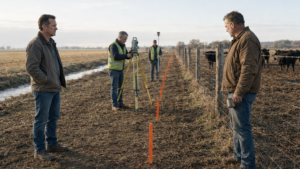
“They told me not to cross this line without you.”
He indicated two temporary stakes marking the edge of her property.
Margaret looked toward Brian’s place.
Brian stood near the unfinished shed with his hands in his jacket pockets.
“That’s right,” she said.
The operator nodded.
“Then I’ll stay east of the stakes.”
Such a small exchange.
Permission asked.
Permission answered.
Margaret stepped aside.
The excavator rolled toward Brian’s construction pad.
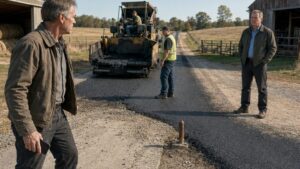
Over the next several hours, the machine reshaped the grade, cut a gentler drainage path on the Clark side and rebuilt the section that had concentrated stormwater toward Margaret’s swale.
At the lower crossing, the damaged edge was packed and seeded.
Brian paid for it.
He also paid Margaret the amount she had calculated from the utility difference.
It was less money than either of them had spent in time and irritation.
Margaret deposited the check anyway.
Not because the amount mattered.
Because acknowledging it did.
The written agreement took longer.
Brian disliked nearly every version.
Margaret disliked the one Michelle first brought over because it referred to “historic shared access” without explaining what that meant.
They sat at Margaret’s kitchen table on a Friday afternoon and crossed out sentences until the paper looked more handwritten than typed.
Michelle had brought a calculator.
Margaret had brought the ledger.
Brian brought nothing.
At one point he pushed his chair back and said, “If we make this too formal, next thing you know we’ll be asking permission to pull somebody out of a ditch.”
Margaret looked at him.
“If your tractor is upside down, Brian, I’m probably not going to make you sign a form.”
Michelle covered a smile with her hand.
Brian looked annoyed.
Then he laughed.
It was the first genuine laugh Margaret had heard from him since before the orange cable appeared.
They added a short emergency clause.
Immediate action was allowed when necessary to protect a person, animal or property from imminent harm.
Routine work required permission.
Temporary power required permission.
Crossing the property line with equipment required permission.
Drainage alterations affecting either parcel had to be discussed before work began.
No complicated legal language.
No attempt to turn neighboring farms into hostile territories.
Just terms nobody could later expand by memory.
When they finished, Brian read the page again.
His finger stopped on the line about temporary utilities.
“I was wrong about that.”
Margaret waited.
He did not qualify it.
“I knew you said no,” he continued. “I kept telling myself it wasn’t hurting anything.”
Michelle looked down at her hands.
Brian’s voice was quieter when he added, “Then when the water showed up, I was already too far into defending myself.”
Margaret knew something about that.
She had spent days wanting to prove the cord mattered because admitting the shed itself might be exempt had briefly felt like losing.
“I nearly reported the wrong thing,” she said.
Brian looked at her.
“I thought the shed permit would stop you. The county clerk told me I had it wrong.”
“You could’ve left that part out.”
“I could have.”
Michelle leaned back.
“So everybody gets to be embarrassed.”
“Seems fair,” Margaret said.
Brian signed the agreement.
Margaret signed next.
Michelle signed as witness to the terms they had all negotiated.
Nothing magical happened.
The anger did not disappear when the ink dried.
Margaret still remembered Brian plugging the cable back in after she had explicitly told him not to.
Brian still had an unfinished shed, extra excavation costs and a concrete schedule that had been pushed back.
But something had changed.
They no longer had to argue about what had happened.
The facts had stopped moving.
Two weeks later, Robert returned.
He walked the corrected drainage path after an afternoon shower.
Water moved along Brian’s side, spread through a stabilized channel and joined the natural swale without pooling at Margaret’s cattle crossing.
Robert stood with his boots in the damp grass.
“This is what I wanted to see.”
Brian looked at Margaret.
She nodded.
Robert cleared the paused work to continue.
The next concrete truck arrived three days later.
Margaret heard it before breakfast.
For a moment, the old tension returned automatically.
She stepped outside.
No orange cable crossed her pasture.
Brian had a generator beside the compressor.
He saw Margaret looking.
“Loud enough for you?”
“It’s terrible.”
“Good.”
She almost smiled.
The pour went ahead.
No county vehicle arrived.
No argument followed.
By late afternoon, Brian’s slab was finished.
The shed roof went on the following week.
Margaret noticed how much equipment fit beneath it: tractor attachments, the replacement mower, the baler after its repairs, tools that had previously sat under tarps.
Michelle had not exaggerated the need.
Seeing that did not make Margaret regret what she had done.
It simply made the story less convenient.
Brian had been afraid.
He had also been wrong.
Both could be true.
One evening, Michelle walked over carrying a small envelope.
Margaret was fastening a gate chain.
“What’s this?”
“Last part of the grass seed and fence repair.”
“You already paid the contractor.”
“This is for the section the tires tore up before that.”
Margaret looked at the amount.
“You calculated this?”
Michelle nodded.
“Brian said your ledger would have it down to the penny anyway.”
Margaret laughed.
“Not quite.”
Michelle rested one hand on the gate.
“I pushed him to keep going.”
Margaret looked up.
“I know.”
“I kept thinking if we stopped, we’d lose the farm.”
“That scared you.”
“Yes.”
Michelle stared toward their new shed.
“And then somehow that made anything that slowed us down feel unreasonable.”
Margaret folded the envelope.
“I understand that better than you think.”
Michelle glanced at her.
Margaret did not explain.
There were years after her husband died when every change had felt like a threat to something larger. She had kept old tools she did not need, postponed replacing broken gates, refused help because accepting it made his absence feel more permanent.
Fear could make a person defend strange things.
That did not absolve the damage.
It only made the damage understandable.
As summer moved toward hay season, the farms settled into a different rhythm.
Not the old one.
Brian no longer drove equipment across the fence corner without checking.
Margaret stopped assuming that every engine near the lane signaled another violation.
Once, when one of her calves pushed through a damaged section of wire, Brian saw it first.
He called.
“Your calf’s on my side.”
“I’ll come get her.”
“She’s headed toward the road. I’m closing the lower gate.”
“You don’t need permission for that.”
There was a pause.
“I figured.”
Margaret smiled after the call ended.
A week later, Brian’s tractor stalled while pulling a loaded wagon near the shared lane.
Margaret brought her own tractor down.
She stopped beside him.
“You want a pull?”
Brian looked at the tow chain in her hand.
“You going to make me fill something out?”
“Depends how annoying you are.”
He laughed.
They hooked the chain and moved the wagon clear.
No ledger entry was necessary.
No agreement had forbidden generosity.
That had been the lesson Margaret had been slowest to understand.
Boundaries did not prevent people from helping each other.
They made help recognizable as help.
By early August, grass had grown across the repaired drainage channel.
After a hard evening rain, Margaret walked to the lower pasture.
Water moved where it was supposed to move.
The cattle crossed without sinking.
At the fence corner stood a new permanent boundary marker, simple and unremarkable.
Margaret rested one hand on the cedar post.
On Brian’s side, beneath the roof of the completed machinery shed, an orange extension cable hung in a neat coil from a wall hook.
The same bright color.
The same heavy cord.
It had not become dangerous.
It had not become shameful.
It had simply returned to the place where it belonged.
Brian stepped out of the shed and saw Margaret looking.
“You need power over there?” he called.
Margaret glanced toward her barn.
“I’ve got my own.”
“Thought I’d ask.”
She looked back at him.
“That’s usually how it works.”
Brian nodded.
There was no apology attached to the exchange, no reopening of the argument, no claim that everything between them had been repaired.
Some things did not need to be restored to what they had been.
Sometimes the better repair was making the new terms clear.
Margaret turned toward home.
Behind her, water moved cleanly through the swale.
Ahead, her pasture lay open and familiar.
And across the fence, the orange cable stayed coiled on Brian’s side.
The story has ended.