The New Development Tried to Condemn His Farm—Until They Asked Him About the Rule He Helped Write
Chapter 1: They Arrived at the Farm Before Breakfast
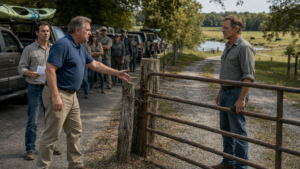
The first county truck turned into William Campbell’s lane while he was still carrying a bucket toward the cattle trough.
A second truck followed.
Then came Brian Young’s black SUV.
William stopped beside the old white fence and watched all three vehicles climb the gravel lane toward the farmhouse. The cattle raised their heads from the pasture. Gravel snapped beneath the tires. Nobody had called to say they were coming that early.
He set the bucket down.
Brian stepped out first.
He wore a navy blazer despite the farm dust, a leather folder tucked against his ribs. Patrick Lopez climbed from the first county truck wearing a county environmental-health shirt. Another county employee remained near the vehicles with equipment.
Two residents from the development stood beyond Brian’s SUV.
William looked at them, then at Brian.
“Quite a delegation.”
Brian gave him the thin, careful smile William had learned to distrust.
“We wanted to make sure everything was handled properly.”
“At seven in the morning?”
Patrick glanced at his watch.
“Mr. Campbell, I apologize for the hour. We had another inspection nearby. The complaint listed access before eight as acceptable.”
William looked at Brian.
“I never listed anything.”
Brian opened his folder.
“The association submitted the complaint.”
“That isn’t what he said.”
Patrick shifted his clipboard. “Mr. Campbell, I’m here because the county received a wastewater-system complaint. Whatever disagreement exists between you and the association is separate from my inspection.”
That distinction should have eased him.
It did not.
William had found three letters from Brian’s association in his mailbox during the past month. He had left each one on the corner of his desk until eventually sliding them into a drawer unopened. The development had been complaining for years about weeds along his road frontage, equipment parked beside the shed, the faded barn roof, and once, memorably, the sound of his tractor before eight on a Saturday.
He had decided that answering them would only teach Brian that persistence earned attention.
Now Brian stood on William’s property with county trucks behind him.
Silence, William thought, had apparently taught him something else.
Brian removed several stapled pages.
“The issue is straightforward. Your septic leach field does not meet the required setback from the adjoining residential boundary.”
William’s eyes moved from Brian to Patrick.
“Is that your finding?”
“Not yet,” Patrick said.
Brian continued as if he had not heard.
“The county ordinance provides the minimum separation. You’ve already been notified. Our residents should not have to wonder whether an outdated system is creating a sanitation risk.”
One of the subdivision residents folded his arms.
William felt heat rise behind his collar, but he kept his voice level.
“My cattle are closer to you than my septic system.”
“This isn’t about cattle.”
“No. I expect not.”
Patrick cleared his throat. “I need to inspect the field location and verify the permit history.”
Brian pulled another page free.
“The association has given Mr. Campbell thirty days to bring the condition into compliance before additional action is considered.”
Patrick looked over.
“The county hasn’t issued a thirty-day correction order.”
Brian paused.
“I said the association.”
William looked toward the two residents. Both had heard the difference.
“What additional action?”
Brian’s jaw tightened slightly.
“Continued complaints. Legal review. Recovery of costs where appropriate.”
“Recovery from whom?”
“William, nobody wants this to become adversarial.”
William almost laughed.
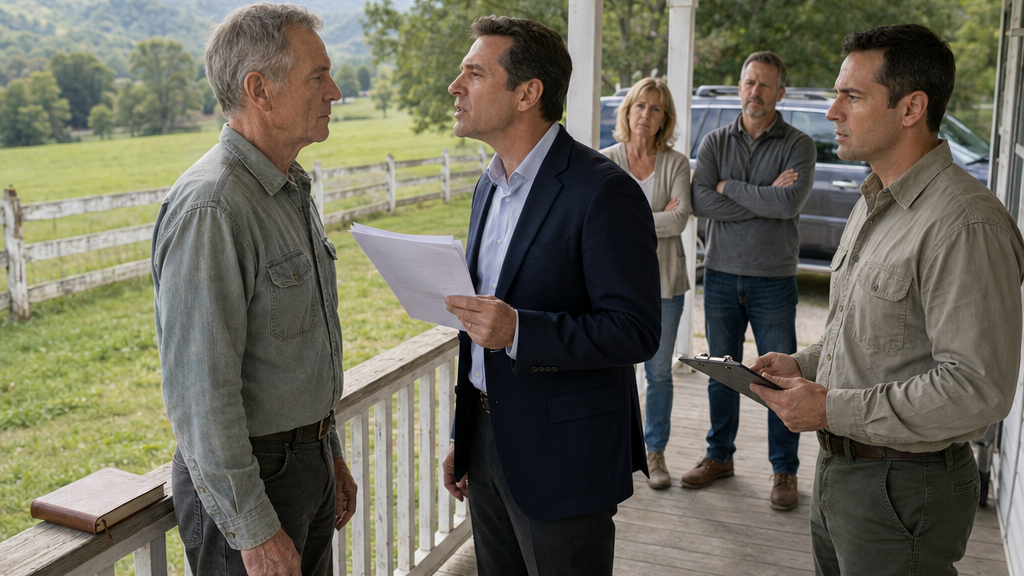
Instead, he turned toward the porch.
“Patrick, you need the access point?”
“Yes, sir.”
William led them around the house.
The farmhouse looked older with strangers studying it. Paint had thinned along the southern wall. The porch posts needed scraping. Beyond them, however, the pasture lay clean under the rising light, hay stacked beneath the equipment shed and the fence lines exactly where William expected them to be.
Brian stopped near the steps.
“Section Fourteen, Paragraph B,” he said. “County residential wastewater ordinance. Adopted in 2008.”
William’s hand stopped on the porch rail.
For the first time that morning, the irritation drained out of him.
“Say that again.”
Brian mistook the question for uncertainty.
“Section Fourteen. Paragraph B. Adopted in 2008.”
Inside the study window, barely visible through the glass, lay an old brown field notebook beneath a stack of farm receipts.
William had not opened it in months.
He looked at Brian’s clean printed pages.
Then at Patrick’s clipboard.
Then back at Brian.
“Where’d you get that language?”
“It’s public law.”
“That wasn’t what I asked.”
Brian gave a small shrug. “The county website.”
William remembered folding survey maps across a conference table. Remembered coffee going cold beside soil charts. Remembered an argument over whether standards written for quarter-acre lots could be forced onto farms that had existed long before the subdivisions arrived.
Two thousand eight.
He had spent years trying not to think about that period.
Brian tapped the paper.
“The language is clear.”
“Maybe.”
That answer finally unsettled him.
Patrick turned toward William. “You recognize it?”
William did not answer. He looked instead at the residents behind Brian. One had already taken out a phone, not recording openly but checking something on the screen.
“Have you been telling people I’m under a county violation?”
Brian closed the folder halfway.
“We informed residents there was an active compliance concern.”
“That isn’t what I asked.”
A silence settled across the porch.
One resident looked toward Brian.
William understood then that this morning had begun before the county trucks ever entered his lane. The conclusion had already traveled through the development. His farm had become a problem before anyone had measured anything.
He should have answered those letters.
The admission irritated him more than Brian did.
Patrick gestured toward the field. “Mr. Campbell, we still need to inspect.”
William nodded.
“In a minute.”
He pointed at the pages in Brian’s hand.
“You said Section Fourteen, Paragraph B.”
“Yes.”
William stepped closer, not enough to threaten, only enough that Brian could no longer perform for the people behind him without addressing the question.
“Read it.”
Brian blinked.
“I just told you what it says.”
“No. You told me what you think it means.”
William rested one hand on the porch rail.
“Read the paragraph word for word.”
Chapter 2: The Paragraph Brian Did Not Finish Reading
Brian opened the ordinance with the confidence of a man expecting the document to settle the argument for him.
Patrick remained by the steps.
The two neighboring residents edged closer.
William said nothing.
Brian found the paragraph and began.
“Wastewater dispersal fields serving residential structures shall maintain the prescribed separation from adjoining residential property lines—”
He stopped.
William waited.
Brian looked up.
“That is the operative requirement.”
“I asked for the paragraph.”
“That is the relevant portion.”
“Keep reading.”
Brian’s expression changed by half a degree.
Patrick extended a hand. “May I see that?”
Brian hesitated, then passed him the pages.
Patrick scanned the text.
His eyes moved down.
Then back up.
“There’s another sentence.”
William looked toward the study window.
He knew the sentence already.
Brian spoke before Patrick could.
“It doesn’t change the applicability.”
William walked inside.
Nobody followed him.
The study smelled faintly of paper, leather, and the coffee he had abandoned before dawn. Framed engineering certificates hung behind the desk, mostly ignored now. He had once meant to take them down. Instead, he had simply stopped looking at them.
The brown notebook lay beneath two feed invoices.
Its cover was cracked at the corners. A strip of faded masking tape still carried the year in William’s handwriting.
He picked it up.
For a moment he considered leaving it closed.
Then he returned to the porch.
Brian saw the notebook and frowned.
William set it on the railing beside the printed ordinance.
“Go ahead, Patrick.”
Patrick read the second sentence.
“For tracts exceeding two acres and classified for established rural residential or agricultural use, separation may be determined according to site-specific soil loading, approved dispersal design, and preexisting permitted infrastructure.”
The resident nearest the steps unfolded his arms.
Brian answered immediately.
“That says may. It doesn’t create a blanket exemption.”
“No,” William said. “It doesn’t.”
Brian seemed relieved.
William opened the notebook.
Pages of faded pencil calculations appeared beneath his thumb—soil depths, slope percentages, handwritten references, sketches of lot shapes. He turned several pages until he found the note he remembered.
“It was never meant to.”
Patrick leaned slightly toward the book.
“What is that?”
“Field notes.”
“From when?”
William looked at him.
“Two thousand eight.”
Brian gave a short breath through his nose.
“You expect us to treat a personal notebook as controlling authority?”
“No.”
William’s answer came so quickly that Brian lost the next line he had prepared.
“I expect you to read the law you brought onto my porch.”
He pointed at the printed paragraph.
“That second sentence exists because large rural tracts don’t behave like subdivision lots. Different soil areas. Different reserve fields. Existing permits that predate later parcel lines. The rule lets the county review those conditions instead of pretending every property was built from the same plan.”
Patrick looked from the ordinance to the pasture.
“And this tract?”
“Just under fourteen acres.”
Brian said, “The adjoining development is residential now.”
“It is.”
“So the residential boundary exists.”
William nodded.
“It does.”
Brian spread his hands. “Then I fail to see the issue.”
“The issue is that you read the first sentence as though the second one wasn’t there.”
The quiet after that was different from the quiet before it.
Brian was no longer directing the scene.
Patrick studied the pages again.
“Mr. Young, is this the same version you submitted with the complaint?”
“Yes.”
“Did you include the full section?”
Brian’s lips pressed together.
“The complaint form had a character limit. I provided the relevant language.”
Patrick looked down at his clipboard.
William watched that answer settle.
Not a lie exactly.
Not an innocent omission either.
One of the residents spoke for the first time.
“So is there a violation or not?”
Patrick looked toward him.
“I haven’t inspected anything yet.”
Brian stepped forward.
“The setback can still be noncompliant.”
“It can,” Patrick said. “And it can also fall under site-specific review. That’s why I’m here.”
William closed the notebook.
For one brief second, satisfaction moved through him.
He disliked himself for enjoying it.
Brian had arrived certain he would make an example out of an old farmer. Now the county inspector was correcting him in front of the same neighbors.
William could have stopped there.
Instead, Brian looked toward the farmhouse and said, “The larger issue remains that this property has visible signs of deferred maintenance.”
There it was.
The septic system was no longer enough.
William turned his head slowly.
“What visible signs?”
“The house exterior. Fencing. Equipment storage. The wastewater concern.”
“My house paint is affecting your wastewater complaint?”
“I’m explaining why residents are concerned.”
“No. You’re explaining why you are.”
Brian’s voice sharpened.
“People paid a great deal of money for those homes. They deserve to know conditions next door won’t affect their investment.”
Patrick lowered his clipboard.
“Mr. Young, property appearance is outside the scope of this inspection.”
Brian looked at William rather than Patrick.
“We’re talking about responsible maintenance.”
William felt the old instinct returning: end the conversation, let the man talk himself empty, go back to work.
That instinct had put county vehicles in his yard.
He placed the notebook back on the rail.
“You want responsible?”
“Yes.”
“Then start with accurate.”
Patrick picked up his soil probe.
“I’d like to see the dispersal area now.”
William nodded and led him around the house.
Brian followed.
At the edge of the pasture, William showed Patrick the approximate boundaries of the original field. He still remembered the trench alignments. The system had been modified once, inspected twice, and maintained longer than some houses in the development had existed.
Patrick measured from the current boundary.
Then again.
He entered figures into his tablet.
Brian watched.
“How close?”
“I’m not making a determination in the field.”
“You can tell whether it meets the standard.”
“I can tell you I need the original permit and soil record.”
William pointed toward the notebook.
“The early design references are in there.”
Patrick looked at him.
“You designed it?”
“No. Not this system.”
Patrick paused.
“But you know the ordinance history.”
“Yes.”
“How?”
William could have said he had worked for the county.
He could have said he had attended meetings.
Both would have been true.
Neither would have been the whole truth.
Brian’s face still carried the expression of someone waiting to catch him exaggerating.
William looked at Patrick instead.
“I was on the team that wrote it.”
Chapter 3: Knowing the Rule Did Not Clear the Field
Patrick’s probe sank six inches deeper than William expected.
He pulled it out, wiped the tip against the grass, and tried the ground two feet away.
It sank again.
William’s earlier satisfaction disappeared.
“What are you finding?”
Patrick did not answer immediately. He crouched near the edge of the dispersal area and pressed a gloved hand against the soil.
“Ground’s softer here.”
“It rained three days ago.”
“Not enough for this.”
Brian stood several yards back with the two residents. He had stopped talking since William’s admission about the ordinance, but his silence now felt watchful rather than defeated.
Patrick moved downslope.
“Any recent backups?”
“No.”
“Odor?”
“No.”
“Slow drains?”
“Kitchen sink once last winter. Cleared the line.”
Patrick made another note.
William knew what he was doing. Worse, he knew what Patrick was thinking.
He crossed to a shallow rise near the equipment shed.
“The distribution box is uphill of this point.”
Patrick looked at him.
“When was it last opened?”
William hesitated.
“Long enough ago.”
“That’s not a date.”
“No.”
Patrick waited.
William rubbed a hand across his jaw.
“Seven years, maybe eight.”
Brian shifted behind them.
William heard it.
Patrick did too.
“That component should be checked.”
“I know.”
“Has it been?”
“No.”
There was no excuse worth offering.
After William retired, he had kept careful records for years. Pumping dates. Flow estimates. Fence repairs. Equipment hours. Then his wife had died, the cattle herd had shrunk, and the notebooks on the desk had gradually become places where he stored things he meant to handle later.
Later had grown comfortable.
Brian spoke from behind them.
“So there is a maintenance problem.”
Patrick stood.
“I didn’t say that.”
“You just heard him.”
“I heard him say the distribution box hasn’t been inspected recently.”
Brian looked at the residents.
“This is exactly the concern we’ve been raising.”
William turned.
“No. Your concern was a setback.”
“It’s all part of the same pattern.”
Patrick’s voice hardened.
“It isn’t the same issue.”
Brian stopped.
Patrick pointed toward the field.
“A setback determination is one question. System condition is another. If there’s a maintenance defect, that does not make your interpretation of Section Fourteen correct.”
The distinction should have felt like rescue.
Instead, William felt exposed.
Brian had been wrong loudly.
William might have been wrong quietly.
By midmorning, Patrick had called a septic contractor who worked the county’s rural routes. The contractor arrived in a mud-streaked pickup and opened the distribution box while William stood beside him.
The concrete lid resisted before lifting with a wet scrape.
Inside, one outlet showed uneven flow.
The contractor crouched closer.
“There’s your trouble.”
William saw it immediately.
An aging baffle had shifted enough to favor one line over the others.
“Failure?”
“Not yet.”
“How bad?”
The contractor shrugged.
“Depends what I find after cleaning it out. Box may be salvageable. Could replace the component and rebalance the lines. Worst case, replace the box.”
Brian had remained near his SUV but came closer when he heard the word replace.
“What kind of cost?”
The contractor looked at him.
“Are you the owner?”
“No.”
“Then I’ll discuss cost with the owner.”
William almost smiled.
The estimate, when it came, was not ruinous, but it was enough to sting. Several thousand dollars if the box could be saved. More if excavation showed damage to the connected lines.
William signed the inspection authorization.
Patrick stood beside him.
“For what it’s worth, this is not evidence of the setback violation.”
William folded the paper.
“It is evidence I let something go too long.”
Patrick did not contradict him.
Brian approached as the contractor packed his tools.
“I hope you understand why residents were concerned.”
William looked toward the development beyond the old white fence. New roofs rose over the slope, close enough now that porch lights were visible from his pasture at night.
“No,” he said. “I understand why a county inspector was concerned.”
Brian’s mouth tightened.
“That sounds like a distinction without much difference.”
“It’s the whole difference.”
Brian lowered his voice.
“You keep acting as if this is personal.”
“You brought neighbors to watch you read me a county rule you hadn’t read all the way through.”
“They came because they’re affected.”
“By my septic box?”
“By the condition of the property next to theirs.”
William stared at him.
Brian looked away first.
Later, when the vehicles had gone and the pasture was quiet again, William carried the 2008 notebook into the study.
He opened it beneath the green banker’s lamp.
Near the back were calculations he had made years after retirement: pump intervals, estimated flow, notes about inspecting the distribution box.
The most recent line ended four years earlier.
Check before winter.
He had never crossed it out.
William sat back.
He had wanted Brian to be entirely wrong because that would have made everything simple.
But rules did not become false simply because the wrong person invoked them.
His daughter arrived just after noon with groceries she had picked up in town. William had not told her about the morning, but three minutes inside the house were enough for her to notice the papers spread across his desk.
“What happened?”
“County inspection.”
Her eyes narrowed.
“Because of that development?”
“Because I ignored three letters and gave Brian room to make himself important.”
“That sounds more like him than you.”
William closed the notebook.
“Don’t make me innocent just because you like me.”
She studied him, then began gathering loose documents so she could set the grocery bag down.
A thin photograph slipped from behind the notebook and landed faceup on the floor.
She bent to pick it up.
William saw what it was before she turned it over.
A county planning committee, seated behind a long table.
He was twenty years younger in the photograph, wearing a tie he had hated and leaning toward a stack of maps.
His daughter looked from the photograph to him.
“What is this?”
“Old county work.”
“You were on the planning board?”
“Technical committee.”
She looked more closely.
At the bottom, faint type identified the year.
Then she noticed the handwritten notes on the back.
Lot-size standards. Rural access. Utility extension corridors.
Her expression changed.
“Dad.”
William reached for the photograph.
She did not hand it over yet.
“You didn’t just help write a septic paragraph, did you?”
The room seemed smaller.
Outside the study window, beyond the old white fence, the roofs of the development filled a hillside that had once been open pasture.
William looked at the photograph in her hand.
“No,” he said.
And for the first time that day, Brian Young was no longer the part of the story William least wanted to explain.
Chapter 4: The Farm Was Not His Only Regret
The photograph stayed on William’s desk for two days.
He did not put it away.
That bothered him more than if he had hidden it.
On the third morning, he carried it into the county records office along with the brown 2008 notebook and the inspection papers Patrick had left behind. The records clerk took one look at the photograph, then at William, and said, “I think we still have those minutes downstairs.”
William wished she had not sounded pleased.
He waited at a metal table beneath fluorescent lights while she disappeared into the archive room.
The photograph lay faceup beside his hand.
Twenty years younger. Darker hair. Straight-backed. A tie pulled too tight around his neck.
Behind him in the picture were maps showing roads that had not yet been built.
He remembered every argument about them.
His daughter had asked him why he had never talked about that work.
He had told her it was old county business.
She had looked at him long enough to make clear that she knew an evasion when she heard one.
The clerk returned carrying a gray archival box.
“Planning technical committee. Two thousand seven through two thousand nine.”
William opened the first folder.
Meeting minutes.
Draft ordinances.
Staff memoranda.
He found Section Fourteen in less than ten minutes.
The language was familiar enough that he could hear the room where it had been argued over.
One engineer wanted a uniform setback.
William had objected.
A rule designed for small residential lots, he had said, would create nonsense on large tracts where permitted septic fields already existed hundreds of feet from occupied structures but happened to sit near future parcel lines.
He turned the page.
There, in the margin of a working draft, was his handwriting.
Rural tracts greater than 2 acres—retain site-specific review. Existing permitted systems must not become nonconforming solely because adjacent land is subdivided later.
William sat very still.
The final adopted language was cleaner.
But the structure was his.
Not merely something he had voted on.
Something he had written.
The clerk leaned over the box.
“Looks like you were busy.”
“Too busy.”
She smiled politely, not understanding.
William continued through the minutes.
The septic language was not what made his stomach tighten.
Three folders later he found transportation planning.
Utility corridors.
Road connectivity standards.
Recommendations encouraging developers to connect new subdivisions rather than build isolated dead-end systems.
At the time, William had believed in that work.
Some of it he still did.
Connected roads gave fire trucks choices. Water lines became cheaper to extend. School buses did not have to reverse down narrow lanes. Growth was coming whether anyone liked it or not, and he had believed good planning meant shaping it before it arrived.
One map showed a proposed corridor running along the ridge east of his farm.
That ridge was now Brian Young’s development.
William closed his eyes.
He remembered farmers coming to public meetings and saying the county was building rules for people who had not arrived yet.
He remembered thinking some of them were simply afraid of change.
He remembered being impatient.
The clerk returned to ask whether he needed copies.
“Yes.”
“Which pages?”
William looked at the stack.
“All the Section Fourteen drafts. These road-connectivity minutes too.”
She raised an eyebrow.
“That’ll be a fair number.”
“I know.”
His phone vibrated.
Patrick.
William stepped into the hallway to answer.
“We’ve pulled your original wastewater permit,” Patrick said. “The setback issue is going to Virginia Davis for review. She supervises our environmental-health section.”
“Good.”
“She also asked whether you served on the committee that drafted the ordinance.”
William looked through the glass wall at the open archive box.
“Yes.”
“I told her I believed so.”
“You can tell her yes.”
Patrick paused.
“She’ll want to review this independently.”
“She should.”
Another pause.
William could hear office noise behind him.
“Mr. Campbell, I want to be clear. Your committee involvement won’t determine the present inspection.”
“I’d be disappointed if it did.”
Patrick seemed relieved by the answer.
After the call, William returned to the table.
Beside the road minutes sat a later planning memorandum.
He almost skipped it.
Then he saw the parcel number adjoining his farm.
The memorandum discussed future access possibilities if the ridge development expanded west.
Nothing had been approved. Nothing had been promised.
But the direction was unmistakable.
Toward his frontage.
William copied that too.
By the time he left the county building, the copies filled a thick envelope.
His pride in the ordinance language had disappeared.
The same meetings in which he had fought to protect rural septic systems had also helped build the planning framework that made dense development easier beside farms.
He had spent years blaming the houses for arriving.
He had never quite admitted that he had once helped draw the road toward them.
At home, his daughter was waiting at the kitchen table.
William set the envelope down.
“You were right.”
She looked up.
“About what?”
“I did more than write a paragraph.”
He showed her the copies.
She read quietly.
“You helped with the road standards.”
“Yes.”
“That doesn’t mean you built Brian’s subdivision.”
“No.”
“But you think it does.”
William looked through the kitchen window toward the pasture.
“I sat across from men who told us exactly what those policies would do to their land. I thought they were resisting anything new.”
“Were some of them?”
“Probably.”
“That doesn’t make you wrong about everything.”
“No.”
She waited.
William tapped the envelope.
“It doesn’t make me right about everything either.”
A farm supply truck came up the lane before he could say more.
The driver carried a padded mailing envelope with William’s name printed across the front.
“Dropped at the store for you by mistake,” he said.
William thanked him and opened it on the porch.
Inside was a letter from Brian’s association.
Behind it was a color map.
A red line began inside the development, crossed the old white boundary fence, and continued through the narrow pasture frontage beside William’s lane.
The heading described it as a proposed emergency-access and future connectivity corridor.
William read the note attached to it twice.
The association wanted to discuss purchasing an access strip.
At the bottom was Brian’s signature.
William laid the county planning minutes beside the new map.
The old proposed corridor and the new red line were not identical.
They did not have to be.
They were close enough.
His daughter stood behind him.
“So the septic complaint came before this?”
William looked at the red line crossing his pasture.
“By a few weeks.”
“You think Brian planned it?”
“I don’t know.”
That answer mattered.
William folded the map once, carefully.
“But I think it’s time I stopped letting other people explain what they want from my land.”
Chapter 5: The Complaint Was About More Than Septic
William had never attended a meeting of the development’s association until the night they put a chair for him at the far end of the room.
He carried the 2008 notebook under one arm.
He did not open it.
Brian sat at the center of a long table with several board members. His navy blazer hung on the back of his chair. Without it, he looked less like an official and more like a tired man who had been answering angry emails all day.
Two rows of residents filled the small meeting room.
William recognized the men who had stood at his farmhouse during Patrick’s inspection.
Brian called the meeting to order, dealt with landscaping bids and a pool-maintenance contract, then finally looked toward William.
“Mr. Campbell, thank you for coming.”
“William’s fine.”
Brian nodded.
“The board wanted to discuss the access proposal directly rather than continue by correspondence.”
“That’d be a change.”
A few people shifted in their seats.
Brian let the remark pass.
He projected the map onto a screen.
The red line appeared again, running from a subdivision street to William’s frontage.
“This corridor would provide an alternate emergency route and potentially improve circulation if the final phase is developed.”
William looked at him.
“Final phase.”
Brian hesitated.
“Potential final phase.”
“Toward my farm.”
“Toward the western boundary.”
“My farm is the western boundary.”
“Yes.”
A board member cleared his throat.
Brian continued.
“The proposal is preliminary. No one is suggesting condemnation or compulsory transfer. The association would purchase an easement or narrow strip at fair market value if you were willing.”
“I’m not.”
The answer came without force.
That made the room quieter.
Brian folded his hands.
“We expected you might feel that way. But there are legitimate concerns.”
“About emergency access?”
“Among other things.”
William looked toward the residents.
“Say the other things.”
Brian did not immediately answer.
A woman in the second row did.
“Resale.”
Brian glanced at her.
She kept going.
“People ask what’s behind the development. They see the old buildings and equipment. We’ve had two buyers ask about the farm.”
William nodded once.
“At least that’s plain.”
Brian leaned forward.
“This is not an attack on farming.”
“No?”
“No. But residents bought into a managed community. They expect predictable conditions.”
William tapped one finger against the closed notebook.
“My cattle aren’t predictable.”
A few people smiled despite themselves.
Brian did not.
“Wastewater problems aren’t humorous.”
William’s hand stopped.
“My wastewater problem is being repaired.”
“And it was discovered only after a complaint.”
“Correct.”
Brian seemed surprised by the admission.
William continued.
“I should have had the distribution box inspected earlier. Patrick was right to flag it.”
Nobody spoke.
The admission changed the room more than denial would have.
Brian sat back.
“So you understand why we were concerned.”
“I understand why the county inspected.”
William looked at him.
“I still don’t understand why you told people I was violating a setback before the county measured one.”
Brian’s expression tightened.
“There were complaints from residents. I reviewed the ordinance.”
“You reviewed half a paragraph.”
“I reviewed the portion that appeared applicable.”
“And then you used it to tell people my property was a compliance problem.”
Brian glanced toward the board.
William saw something then that he had missed on his porch.
Brian was not merely performing superiority.
He was afraid of losing control of the room.
The residents around him had paid for certainty. Every drainage issue, fence complaint, traffic concern, and falling sale price eventually landed on Brian’s desk because he had volunteered to be the man with answers.
That did not excuse what he had done.
But it explained why he had preferred an answer that was wrong to uncertainty that was honest.
One board member asked, “Is the setback complaint still active?”
“County review is pending,” Brian said.
William corrected him.
“The system-condition inspection is active. The setback interpretation is under review.”
Brian looked irritated.
“Yes.”
The woman in the second row said, “That’s not how the email read.”
Silence.
William looked at Brian.
Brian rubbed a thumb along the edge of the table.
“The email could have distinguished those issues more clearly.”
It was not an apology.
It was more than William expected.
Then Brian added, “But the broader concern remains. If the farm infrastructure is aging and the development expands, we need a workable relationship.”
William took the access map from his folder.
“Did you connect the septic complaint to this proposal?”
“No.”
“Did you use the maintenance issue when discussing why the board should approach me about access?”
Brian did not answer quickly enough.
A board member looked toward him.
Brian finally said, “I told the board uncertainty about neighboring infrastructure strengthened the case for formalizing future access and boundaries.”
There it was.
Not a conspiracy.
Not a secret scheme.
Something more ordinary and, in William’s experience, more dangerous: one concern being used to strengthen another until nobody remembered where either had started.
“You should’ve told me that before coming to my porch with an audience,” William said.
Brian’s voice dropped.
“And you could have answered any of the three letters we sent.”
That landed.
William looked down at the notebook.
He could deny that his silence mattered.
He did not.
“You’re right.”
Brian blinked.
William looked around the room.
“I threw them in a drawer because I decided anything from this association was interference. That gave you room to assume silence meant I had no answer.”
Brian said, “It did.”
“It didn’t give you the right to invent one.”
“No.”
The word came quietly.
For the first time, neither man seemed to know what came next.
William unfolded the access map.
“I’m not selling you that strip.”
Several board members exchanged glances.
Brian’s shoulders tightened.
William pointed instead to the development’s existing entrance and then to an old farm service lane running parallel to the boundary but remaining entirely on his side.
“But there may be another way to address emergency access.”
Brian leaned forward.
William traced a route that stopped short of granting permanent subdivision access across the farm.
“For emergency use only, the county could evaluate a gated connection point near the southern corner. No daily traffic. No future street. No development rights. And the association recognizes, in writing, that my farm remains outside your covenants and maintenance authority.”
Brian stared at the map.
“That doesn’t solve circulation for a future phase.”
“No.”
“Then the board may not accept it.”
“That’s your board’s problem.”
The old version of William would have stopped there.
Instead, he added, “But it would solve the emergency-access concern you keep putting first.”
Brian looked at him for a long moment.
William knew exactly what he had done.
He had separated Brian’s defensible concern from the advantage Brian hoped to gain from it.
Just as Patrick had separated the genuine maintenance defect from the false setback claim.
A board member asked, “Would you really consider emergency-only access?”
“If the county recommends it and the terms protect the farm.”
Brian looked toward the residents.
The room no longer gave him a simple position to defend.
William closed the map.
“The septic repair is mine. I’ll pay for it. The county can inspect it. Your association’s rules are yours.”
Then he placed one finger on the red line crossing his pasture.
“But this land stays mine.”
Chapter 6: He Fixed What Was Actually His Responsibility
The excavator bucket cut into William’s septic field two weeks later.
Brian Young was nowhere in sight.
William stood beside the contractor while damp earth rolled away from the old distribution box. The baffle looked worse once it was fully exposed. One corner had deteriorated, and mineral buildup narrowed two outlets.
The contractor pointed with a gloved hand.
“You caught it before the field got overloaded.”
William nodded.
“How long would you have given it?”
The contractor shrugged.
“Could’ve limped along another year. Could’ve caused trouble next month.”
William disliked both answers.
The old distribution box came out before noon.
He watched the new one settle into place and thought of the line in his notebook.
Check before winter.
Four winters had passed.
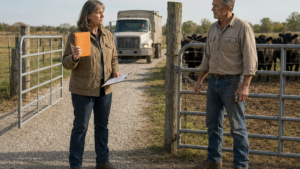
Patrick arrived after lunch carrying survey equipment.
“You replacing the whole box?”
“Seemed foolish not to.”
Patrick nodded approval but did not praise him.
William appreciated that.
They measured the trench alignment, outlet elevations, distance to the current property boundary, and the older permitted reserve area.
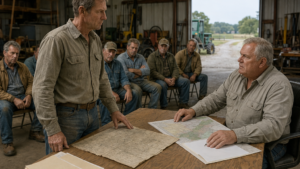
William brought the 2008 notebook from the farmhouse.
Patrick set it beside his tablet on the hood of the county truck.
For an hour, numbers moved between the old pages and new instruments.
Some matched.
Some had shifted because the neighboring parcel had been subdivided.
None produced the violation Brian had claimed.
The next morning William sat across from Virginia Davis in a county conference room.
Patrick was beside her.
Brian attended at the far end of the table with an association board member.
Virginia had a narrow folder open before her.
“I want to separate three questions,” she said.
William almost smiled.
He was beginning to like people who separated questions.
Virginia continued.
“First, system condition. Second, current setback compliance. Third, jurisdiction and representations made by neighboring private entities.”
Brian shifted.
Virginia looked to Patrick.
“Condition?”
“The distribution box was deteriorated and flow was uneven. Replacement was appropriate. Repair has been completed subject to final operational inspection.”
Virginia nodded.
“Mr. Campbell, no disagreement?”
“None.”
“Good.”
She turned a page.
“Second. Setback.”
Brian leaned forward.
Virginia did not look at him.
“The county reviewed the original permit, subsequent parcel maps, soil records, the 2008 ordinance history, and present field measurements. Section Fourteen, Paragraph B does not create the automatic violation described in the complaint.”
Brian’s face remained still.
Virginia continued.
“This is an established rural tract exceeding two acres with preexisting permitted infrastructure subject to site-specific review. The adjacent subdivision of neighboring land did not, by itself, invalidate the lawful dispersal configuration.”
The sentence felt less dramatic than William had imagined.
That made it better.
No cheers.
No humiliation.
Just the record becoming accurate.
Brian said, “So there is no setback problem at all?”
Virginia looked at him.
“There is no violation under the theory submitted.”
“Under that theory.”
“Yes.”
She tapped the folder.
“If the system is modified substantially in the future, contemporary review requirements may apply. Today’s decision does not grant permanent immunity from wastewater regulation.”
William said, “It shouldn’t.”
Brian glanced toward him.
Virginia turned another page.
“The drafting history supports that interpretation.”
She looked at William.
“Your committee notes were useful, but they were not controlling. We confirmed the intent through adopted minutes, staff memoranda, and subsequent administrative practice.”
“I’m glad.”
“I assumed you would be.”
There was just enough dryness in her voice to remind him she had expected resistance from a retired engineer defending his own work.
William accepted that too.
Virginia looked toward Brian.
“Third issue. The association does not administer county wastewater law on Mr. Campbell’s farm.”
Brian’s jaw tightened.
“I understand that.”
“I’m not certain your residents do.”
The room went still.
Virginia slid a printed copy of the association’s earlier notice across the table.
“This document uses language that could reasonably lead a reader to believe the association had determined a county code violation.”
Brian looked at it.
“We relied on publicly available ordinance language.”
“You relied on part of it.”
William kept his hands flat on the table.
Virginia continued.
“I’m not addressing intent. I’m addressing effect. The county will issue a written determination distinguishing the legitimate maintenance repair from the unsupported setback allegation.”
Brian said, “You want us to circulate it.”
“I strongly recommend that you correct any communication in which the two issues were combined.”
“That could be read as the association admitting fault.”
Virginia closed the folder.
“That is a matter for your board.”
Brian’s mouth tightened.
William could see the calculation behind his eyes.
Residents.
Board members.
Property values.
The same people who had expected certainty would now be told their president had spoken too soon.
William knew how tempting it would be to enjoy that.
Instead, he slid the 2008 notebook away from the center of the table.
Brian noticed.
“What does that mean?”
“It means this isn’t about me having an old notebook.”
William looked at Virginia, then Patrick.
“They measured it. They checked it. That’s what should decide it.”
Patrick gave the smallest nod.
William continued.
“And when they found something wrong, I fixed it.”
Brian looked down at the association notice.
For once, he had no prepared response.
The final inspection happened that afternoon.
Patrick ran water through the system and checked distribution across the repaired lines.
Everything balanced.
He signed the inspection sheet on the hood of his truck.
William set the paper beside the brown notebook.
Old calculations.
New measurements.
One did not erase the other.
Patrick handed him his copy.
“You’re good.”
William folded the inspection sheet.
“For now.”
Patrick smiled slightly.
“That’s usually how maintenance works.”
After the county truck left, William walked to the old white boundary fence.
One rail had peeled nearly bare.
He ran a thumb over the rough wood.
The farm was not preserved by pretending nothing needed attention.
Neither was a boundary.
His phone rang.
Brian.
William almost let it go.
That habit no longer felt harmless.
He answered.
“William.”
Brian’s voice was quieter than usual.
“I got Virginia’s written determination.”
“So did I.”
“I think we need to talk about the correction.”
“Then correct it.”
A pause.
“Not over the phone.”
William looked across the fence toward the development.
“Where?”
“Your south boundary. Near the old service lane.”
“When?”
“Tomorrow morning.”
William rested his hand on the fence rail.
“Are you bringing the board?”
“No.”
“The residents?”
“No.”
Another pause.
“Just me.”
William looked at the strip of pasture where the proposed red access line had crossed his map.
“All right,” he said.
“Come alone.”
Chapter 7: The Line Between Their Homes Became Clear
Brian arrived without his blazer.
He came alone in the black SUV, parked beside the southern pasture gate, and stood with both hands visible at his sides while William walked down the service lane to meet him.
No folder.
No board members.
No residents watching from behind him.
That absence changed the shape of the conversation before either man spoke.
William stopped on his side of the old white fence.
Brian looked along the rails. Paint had peeled away in long strips, exposing gray wood beneath.
“I suppose this is the fence everybody keeps talking about.”
“Among other things.”
Brian almost smiled.
Then he looked toward the narrow service lane.
“I received the county determination.”
“So you said.”
“The board received it too.”
William waited.
Brian put his hands into his jacket pockets, then seemed to remember he was not wearing one.
“The association will send a correction to the residents.”
“Good.”
Brian looked at him.
“You don’t make anything easy.”
“I answered the phone this time.”
“That’s progress.”
William let that sit between them.
Across the boundary, rooftops stepped down the hillside where pasture had once stretched beyond sight. A lawn-service truck moved slowly along one of the subdivision streets.
Brian said, “The board is withdrawing the road-access proposal.”
William looked at him more sharply.
“All of it?”
“The future circulation connection across your frontage. Yes.”
“And the emergency option?”
“That’s different.”
William nodded.
“It should be.”
Brian pulled a folded sheet from his back pocket.
Not a legal document. A marked-up map.
“We discussed the route you suggested. The board is willing to ask the county whether an emergency-only gate at the southern corner would help.”
“No residential traffic.”
“No residential traffic.”
“No development street later.”
Brian hesitated.
William said nothing.
Finally Brian nodded.
“No future street unless you or whoever owns this farm someday enters a separate agreement.”
“That needs to be in writing.”
“I know.”
William looked at the map but did not take it.
“And the association?”
“What about it?”
“My farm isn’t in your covenants.”
Brian exhaled.
“We know that.”
“You knew it before.”
“Yes.”
“But your notices didn’t sound like you knew it.”
Brian looked across the fence toward his own development.
When he spoke again, the defensiveness had gone out of his voice.
“I overstated our authority.”
William had expected some version of the sentence.
Hearing it still surprised him.
Brian continued.
“I thought if the county rule applied, then pressing you to resolve it was protecting the neighborhood.”
“You weren’t just pressing me.”
“No.”
“You were telling people the question had already been answered.”
Brian looked down at the map.
“Yes.”
William waited for more.
Brian did not offer it.
That was all the admission he had.
Perhaps all he could manage.
William could have pushed.
He could have reminded him of the porch, the neighbors, the phrase responsible maintenance, the way Brian had used uncertainty as evidence.
Instead he said, “I ignored your letters.”
Brian glanced up.
“I noticed.”
“I decided before I opened them that nothing you sent me deserved an answer.”
“That made this worse.”
“It did.”
Brian seemed almost disappointed that William had conceded the point so easily.
William looked toward the farm lane.
“My silence didn’t give you authority you didn’t have.”
“No.”
“But it gave you an empty space to fill.”
Brian folded the map smaller.
“That’s one way to put it.”
“It’s the accurate way.”
For a moment, neither spoke.
Then Brian said, “There’s another thing.”
William waited.
“The board wants to describe the correction as a mutual misunderstanding.”
“No.”
Brian’s expression tightened immediately.
“William—”
“No.”
“We both made mistakes.”
“We did.”
“Then I don’t see the objection.”
“My mistake was not answering you. Yours was telling residents that a county violation existed before the county determined one.”
Brian rubbed his forehead.
“If we frame it that way, some people are going to demand board changes.”
“That’s between you and them.”
“They elected me to protect property values.”
“They didn’t elect you to rewrite county law.”
Brian looked toward the development again.
Several houses along the ridge had FOR SALE signs near their driveways. William had noticed them before but never given them much thought.
Brian saw him looking.
“Two owners have already dropped their asking prices.”
“Because of my fence?”
“No.”
The answer came with unexpected force.
Brian stared at the houses.
“Because interest rates moved. Because one couple is relocating. Because another builder opened a competing development six miles away. Because people panic when a house sits for thirty days.”
William said nothing.
Brian gave a tired laugh.
“But every time somebody gets nervous, they want a reason they can point at. The farm is visible. So the farm becomes easy.”
There it was.
Not absolution.
Something closer to truth.
Brian had allowed the old farmhouse to become an explanation for problems he could not control.
William understood the temptation better than he wanted to.
For years he had done the same thing in reverse. Every new roof beyond the pasture had become proof that planning had failed, that growth itself was the enemy, that the county work he once believed in had been a mistake.
Simple explanations were comfortable.
Land rarely was.
“Send the correction plainly,” William said.
Brian nodded slowly.
“No mutual misunderstanding.”
“No.”
“County found no violation under the setback theory. The maintenance defect was separate and repaired.”
“That will do.”
“And the association does not have enforcement authority over the farm.”
“That too.”
Brian looked almost pained.
“You’ve thought this wording through.”
William glanced toward the farmhouse.
“I had practice.”
That afternoon, the county’s corrected record arrived electronically.
William printed it.
The first section stated that the distribution box had been replaced and the repaired system had passed final inspection.
The second stated that the previously alleged setback violation was unsupported under the applicable rural-tract provision.
Both facts remained on the same page.
William liked that.
He had been wrong about something.
Brian had been wrong about something else.
The paper did not need to choose a hero.
A week later, the association sent its correction.
Brian had kept his word.
The county also began reviewing whether its public guidance should explain the rural-lot language more clearly. Virginia asked William for copies of several pages from the 2008 notebook.
He made them.
For a long time he stood at the copier with the notebook open beneath his hand.
Those pages had once felt like proof that he still possessed something the new people did not.
History.
Knowledge.
Authority.
Now they felt different.
They were working notes written by a younger man trying to solve a practical problem. Some ideas had held up. Others belonged to an era that had already disappeared.
William mailed the copies to Virginia and carried the notebook back to his study.
His daughter was there replacing a loose hinge on one cabinet.
“You giving it to the county?”
“Copies.”
“And the original?”
“Stays here.”
He placed it beneath the green banker’s lamp.
Not hidden behind invoices.
Not displayed like a trophy.
Simply within reach.
That evening he carried a paint scraper, brush, and small can of white exterior paint to the southern fence.
His daughter followed him halfway down the lane.
“You’re finally doing the whole thing?”
William looked at the fence.
It ran farther than he felt like painting.
“No.”
She laughed.
He scraped one badly peeled section until sound wood showed underneath.
Then he painted that rail.
Only that rail.
The fresh white stood out almost absurdly against the weathered boards on either side.
His daughter looked at it.
“That’s going to bother people.”
“Probably.”
“You going to finish the rest?”
“When it needs it.”
She smiled and headed back toward the house.
William stayed by the fence until the first coat stopped shining wet.
Beyond it, porch lights came on one by one across the development.
Behind him, cattle moved slowly through the pasture.
The boundary had not become a wall.
The houses were still there. So was the farm.
Brian would still have residents to answer to. William would still have machinery that broke, fence rails that peeled, and systems that needed inspection before he felt like inspecting them.
Nothing had returned to the way it had been before the ridge was developed.
That was not the victory.
William ran the brush once more along the edge of the repaired rail, stopping exactly where the old paint began.
For years, he had thought keeping his ground meant refusing to engage with anyone who questioned it.
Now the line looked clearer because he had finally been willing to name it.
He closed the paint can and carried it back toward the farmhouse.
The story has ended.