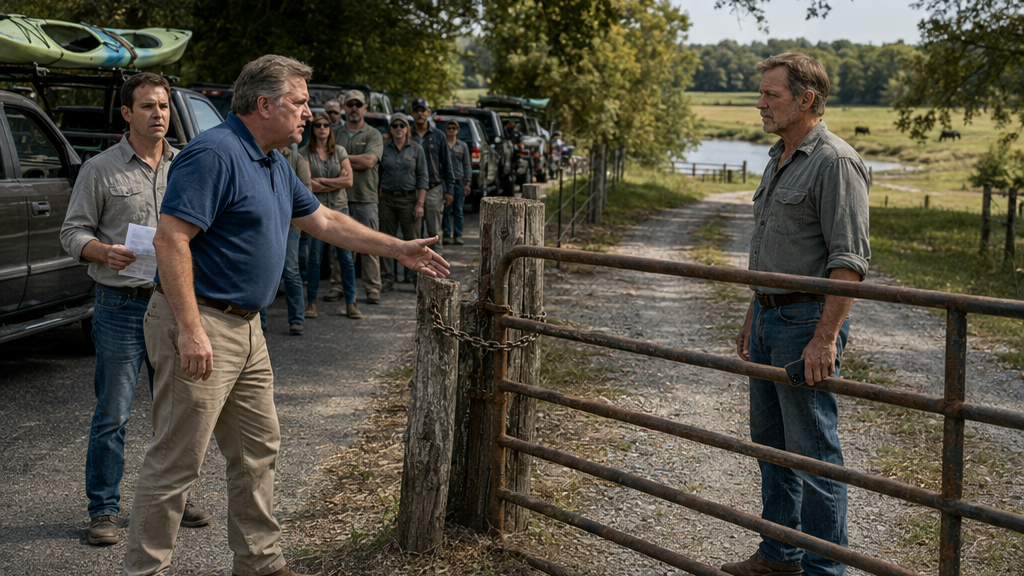
They Sold Weekend Access Through His Farm Gate—Then the Old Easement Exposed Who Actually Owned the Landing
Chapter 1: The Strangers Who Knew His Gate Code
The third trailer was already through the gate when Anthony Martin saw it.
He was halfway across the lower pasture in his feed truck, headlights cutting through the last gray before sunrise, when a red pickup rolled beyond the weathered iron gate and turned onto the gravel lane toward the river. Two kayaks were strapped to its roof. Behind it bounced a small aluminum fishing boat.
Anthony took his foot off the accelerator.
The first two vehicles were farther down the lane, their taillights slipping between the sycamores.
For a moment he wondered whether he had forgotten somebody.
Then the red pickup slowed beside a cattle gap, and the driver leaned out as if searching for a marker.
Anthony swung the feed truck across the lane.
The pickup stopped.
A man in his forties stepped out wearing a fishing vest over a clean T-shirt. He looked irritated rather than guilty.
“Morning,” Anthony said.
“Morning.” The man glanced past him toward the river. “Landing B down this way?”
Anthony looked at him.
“What landing?”
The man gave a short laugh, assuming it was a joke. “Landing B. We’re booked for seven.”
Anthony heard another engine behind the gate.
He turned.
A dark SUV was entering with two kayaks on a rack.
The iron gate stood wide open.
It had hung there since before Anthony was born, pipe-frame steel with rust bleeding down from the hinges. His father had almost never locked it. Neighbors hauling firewood, families headed to the river, somebody checking a fence after a storm—people came through, shut it behind them, and went on.
But strangers did not arrive in a line before daylight.
Anthony stepped closer to the fisherman.
“Who booked you?”
“The lake-road association.”
The man reached into his truck and returned with a folded sheet of paper.
Anthony took it.
At the top was the association’s name. Beneath that were the date, the man’s name—Timothy White—and a line marked LANDING B. The payment line showed eighty-five dollars.
Anthony read it twice.
Timothy watched him. “There a problem?”
Anthony looked toward the river.
One of the earlier pickups had reached the old turnaround near the landing. He could hear doors slamming faintly through the trees.
“You paid eighty-five dollars to come through here?”
“For reserved access.” Timothy pointed toward the paper. “I’ve got two kids coming with my brother. They told us this gave us the landing until noon.”
Anthony lifted his eyes.
“They told you whose landing it was?”
Timothy’s expression changed slightly.
“The association’s, I assumed.”
“It isn’t.”
Neither man spoke for a second.
The irritation drained from Timothy’s face.
“You’re saying they sold us somebody else’s place?”
“I’m saying this road is on my farm, and the river landing is on my property.”
Timothy looked down at his reservation as if the print might rearrange itself.
Another vehicle stopped behind them. The driver lowered his window.
“Everything all right?”
Anthony raised a hand. “Give us a minute.”
He could feel anger climbing, but it had changed direction. Five minutes earlier, he had been ready to run strangers out.
Now the paper in his hand made them look less like trespassers and more like customers who had been sold something.
“You got a phone number for whoever took the booking?” Anthony asked.
Timothy showed him the confirmation email on his phone.
Anthony recognized the contact name.
The association office.
He took a photograph of the reservation, then another of the email.
“I’m not asking you to leave this second,” he said. “You paid somebody in good faith. But don’t assume that means they had the right to sell it.”
Timothy rubbed the back of his neck. “I drove an hour and a half.”
“I understand.”
“You want me to call them?”
“I do.”
Anthony walked back toward the gate while Timothy made the call.
The SUV driver had gotten out now. A woman stood beside him holding two paddles. She had a similar printed sheet.
“Landing B?” Anthony asked.
She nodded.
“How much?”
“Eighty-five.”
That was when the thing stopped feeling accidental.
By the time the sun broke over the pasture, Anthony had photographed four reservations. Same association. Same price. Same landing name.
Landing B.
There had never been a Landing B.
There was an old gravel lane, a dirt turnaround, a narrow strip of riverbank, and a concrete ramp Anthony’s father had poured decades ago for farm use and fishing boats.
Nobody in the Martin family had ever called it anything with a letter.
Anthony stood beside the open gate and called Gregory King.
Gregory answered on the fourth ring.
“You’re up early,” he said.
“I’ve got strangers coming through my cattle gate with paid reservations.”
A pause.
Then Gregory said, “They’re supposed to be there.”
Anthony gripped the phone harder.
“Supposed to be there according to who?”
“The association.”
“You’re charging them?”
“It’s a weekend access program.”
“To my land?”
Gregory sighed, not alarmed, only inconvenienced.
“Anthony, people have used that road for years.”
“That is not what I asked.”
“It’s established access.”
“You’re taking eighty-five dollars from people and sending them through my gate.”
“We’ve used that access for years.”
Anthony looked down the lane at the vehicles gathered under his sycamores.
The answer was too quick.
Gregory had not discovered a mistake.
He had known exactly what was happening.
Chapter 2: Eighty-Five Dollars for a Road He Never Rented
By noon, a man Anthony had never seen before was standing beside the river calling the place “the association landing.”
Anthony heard him say it while backing his empty boat trailer toward the ramp.
“Can you guide me into the association landing?”
Anthony stopped walking.
“What did you call it?”
The man pointed toward the water. “Landing B.”
Anthony said nothing.
The name had already become real to people who had paid for it.
That bothered him almost as much as the money.
He spent the afternoon doing work he had intended to finish before dark—moving mineral tubs, checking a section of fence flattened by a fallen limb—but every engine on the county road made him look toward the gate.
At four, he drove back up and pulled the iron frame shut.
The hinges protested.
Anthony stood with one hand on the warm metal.
He could not remember the last time he had closed it simply because he wanted nobody through.
He did not chain it yet.
That felt like crossing some line he had spent most of his life refusing to draw.
Inside the farm office, he spread the photographs of the reservations across his desk.
Four from that morning.
Then Timothy emailed him another.
His brother had received a separate confirmation for the following Sunday.
Anthony enlarged the image.
Different date. Same eighty-five-dollar fee.
He called the association office.
Gregory answered.
“How long has this been going on?”
A silence this time.
“Going on?”
“Bookings.”
“It’s seasonal.”
“That’s not a number.”
Gregory exhaled. “Since early summer.”
Anthony leaned back.
It was August.
“You’ve been selling access through my farm for months.”
“You keep saying it like we’re selling your farm.”
“What are they paying for?”
“River access.”
“Through my gate.”
“Through an established right-of-way.”
“And onto my landing.”
Gregory’s voice hardened. “Anthony, that road has served those parcels longer than either of us has owned what we own.”
“That doesn’t make my riverbank yours to rent.”
“You’ve let people use it for years.”
“Neighbors.”
“Members.”
“Neighbors,” Anthony repeated.
Gregory was quiet for a moment.
Then he said, “The association has a recorded easement.”
Anthony stared toward the office window.
Beyond the glass, the iron gate was visible between two cedar posts.
“What easement?”
“The forty-foot access easement.”
Anthony almost answered immediately.
Then something in the phrase stopped him.
Forty-foot.
He had heard that number before.
Not recently. Not in any conversation with Gregory.
On paper.
“I’ll call you back.”
“Anthony—”
He ended the call.
The closing documents from when he had bought the remaining share of the farm from family were in a steel filing cabinet beneath old insurance papers and equipment receipts.
Anthony pulled out one folder, then another.
The deed was there. Tax plats. A survey copy. Loan releases. A title-policy packet he had not opened in years.
He spread everything across the desk.
The phone rang twice while he worked.
He ignored it.
By evening, the light outside had flattened to gold, and Anthony had found three more reservation dates through screenshots Timothy forwarded from an online booking page.
Friday evening.
Saturday morning.
Sunday afternoon.
Some slots were marked full.
This was not somebody at the association telling two friends where to launch a canoe.
It was a schedule.
Anthony wrote the dates on a legal pad.
Then he noticed an old yellow sticky tab inside the title-policy packet.
EASEMENT.
He opened to the marked page.
The language was dense, the kind he had skimmed when the transaction was happening because other people at the closing table seemed satisfied.
Then his eyes caught the phrase.
FORTY FOOT ACCESS EASEMENT.
He read the paragraph once.
Then again.
The easement crossed a portion of the farm from the county road toward older parcels nearer the river.
Anthony sat very still.
He had been certain Gregory was inventing authority.
Now there it was in Anthony’s own records.
Not ownership.
Not Landing B.
But an easement.
He walked outside after dark with a flashlight.
The gate was still closed.
A neighboring cattle farmer’s pickup pulled onto the shoulder.
The man lowered his window.
“You locking up now?”
“Maybe.”
The neighbor glanced toward the gate. “Haven’t seen that closed in years.”
Anthony did not answer.
The neighbor nodded toward the river.
“Association folks causing trouble?”
“Something like that.”
“Well, they’ve always had some access through there, haven’t they?”
Anthony looked back at the closed gate.
That was the problem.
Everybody seemed to know a version of the same thing.
Nobody had ever bothered to define exactly what it meant.
He returned to the office and placed the old title packet beside the weekend reservations.
Eighty-five dollars on one side.
Forty feet on the other.
For the first time since sunrise, Anthony was no longer sure Gregory was entirely wrong.
Chapter 3: The Forty-Foot Easement That Changed the Argument
The county recorder slid a document across the counter Monday morning and tapped Anthony’s signature.
“You acknowledged it here.”
Anthony stared down at handwriting that was unmistakably his.
The signature was fourteen years old.
He remembered the closing. A long table. Too much paper. His mother still alive then. His brother impatient to get back to work. A title agent turning pages and explaining things Anthony had believed he already understood.
He did not remember this page.
“Does that mean the association owns the road?” he asked.
The recorder shook her head.
“I can tell you what’s recorded. I can’t interpret it for you.”
Anthony nodded.
That was fair.
He read the instrument again in the hallway.
A forty-foot easement for ingress and egress benefiting several adjoining tracts.
No mention of a public landing.
No mention of paid recreation.
No mention of an association booking system.
But it was not nothing.
He had spent Sunday telling himself that ownership settled the matter.
On Monday morning, the county records had taken that comfort away.
By lunch he was sitting across from Emily Green in a small office two blocks from the courthouse.
She read the easement without speaking.
Anthony waited.
Finally she set it down.
“You own the underlying land.”
“That much I knew.”
“And they may have rights across part of it.”
“That part I apparently decided not to remember.”
Emily almost smiled.
“Most people remember ownership better than encumbrances.”
“Can they sell access?”
“That’s a different question.”
Anthony leaned forward.
“They’re charging people eighty-five dollars to drive through my gate and use my river landing.”
“Do you have the booking material?”
He handed her the printed screenshots.
Emily studied them.
“Landing B?”
“There is no Landing B.”
“Not on any plat?”
“Not that I’ve ever seen.”
She pulled the survey closer.
The easement line ran from the county road through Anthony’s acreage toward several old parcels. Near the river, however, the markings became less helpful.
Emily traced the line with one finger.
“An easement can burden land you own without giving the easement holder ownership. It can also allow more use than the owner likes. The hard part is determining the scope.”
“So close the gate or don’t?”
“I wouldn’t reduce it to that yet.”
Anthony sat back.
He had wanted a sentence.
Gregory is wrong.
Instead Emily gave him categories.
Who benefited from the easement? What was its original purpose? How had it been used historically? Had the use expanded? Had commercial activity changed the burden? Did visitors have any connection to the benefiting parcels?
Each answer created another question.
Emily looked at the reservation slips again.
“Selling access to the public is important.”
“Because they can’t?”
“Because it is different from a neighboring owner using a right-of-way to reach his property.”
“That sounds like lawyer language for they can’t.”
“It’s lawyer language for don’t chain the gate and assume the argument is over.”
Anthony looked toward the window.
“So what can I say for certain?”
“You can say they do not own your river landing merely because an easement crosses your property.”
That was something.
Not everything.
But something.
Emily turned the old survey toward him.
“And I’d want to see the deeds for the benefiting parcels. Also anything showing when this recreational use started.”
“I can get that.”
“One more thing.”
Anthony waited.
“Have you ever objected before?”
“To strangers paying to use it? I didn’t know it was happening.”
“I mean recreational access generally.”
He frowned.
“People have fished down there.”
“Association members?”
“Some.”
“Kayaks?”
“Yes.”
“Boat trailers?”
“Sometimes.”
Emily folded her hands.
“Did you give permission?”
Anthony thought about how many ways that question could be answered.
There had been calls.
Hey, Anthony, mind if we take the kids down to the river?
Sure. Shut the gate.
Mind if my brother launches his jon boat?
Fine. Don’t tear up the bank.
Sometimes nobody called because they had been through before.
There had never been a sign-in sheet.
No written rules.
No fee.
No reason, Anthony had thought, to make neighborly things complicated.
“I allowed people through,” he said.
“Did you limit that permission in writing?”
“No.”
“Did you ever tell the association not to use the road?”
“No.”
Emily did not react, but Anthony felt the weight of the answer anyway.
“I didn’t tell them they could rent it.”
“That distinction matters.”
“But?”
“But history matters too.”
Anthony looked down at the survey.
The line on the paper seemed impossibly thin compared with the gravel road it represented.
He had thought the mistake belonged entirely to Gregory.
Now he could see another possibility.
Gregory had taken something loose and informal and pushed it much farther than Anthony intended.
But Anthony had helped leave it loose.
Emily handed him a list of records she wanted.
“Don’t concede commercial use. Don’t threaten anybody. And before you physically block the easement, let me see the rest.”
Anthony picked up the papers.
At the door, Emily stopped him.
“One question you need to answer for yourself before this gets bigger.”
He turned.
“When your neighbors used that road all those years, did you think you were granting permission each time?”
“Yes.”
“Did they know that?”
Anthony said nothing.
Emily’s expression stayed neutral.
“If they thought they were exercising a right while you thought you were extending a favor, then this dispute started long before anybody charged eighty-five dollars.”
Anthony left with the gate key in one hand and the old plat folded under his arm.
For the first time, he wondered whether the association’s strongest argument might not be hidden in the county records at all.
It might be in every year he had chosen not to say exactly where the favor ended.
Chapter 4: The Permission Anthony Never Put on Paper
“Just shut the gate behind you.”
The neighboring cattle farmer said it from the other side of Anthony’s kitchen table Wednesday morning, and the words landed harder than anything Emily Green had said in her office.
Anthony stopped pouring coffee.
The neighbor rubbed a thumb around the rim of his mug. “That’s what you used to tell everybody.”
Anthony set the pot down.
“Everybody?”
“You know what I mean.”
“No. I’m starting to think I don’t.”
The neighbor shifted in his chair.
They had known each other long enough that silence usually did the work. Their farms shared fence in two places. They had borrowed each other’s hay equipment, pulled calves together, and once spent half a night clearing a storm-felled oak from the county road.
Anthony had never thought of him as somebody who needed permission to go to the river.
That was the problem.
“People called,” Anthony said.
“Sometimes.”
“And asked.”
“Sometimes.”
Anthony looked toward the kitchen window.
From there he could see the top of the iron gate through a gap in the trees.
His father had kept it open more often than closed.
Not because the farm was public.
Because he believed a closed gate between neighbors meant something.
Anthony could still hear him saying, If a man has to ask you every time he crosses ground you both know he’s crossed for twenty years, pretty soon he’ll quit asking you for anything.
Anthony had inherited the sentence without ever examining it.
The neighbor took a sip of coffee.
“Gregory probably figured it was the same arrangement.”
“Gregory charged strangers eighty-five dollars.”
“I’m not defending that.”
“Sounds like it.”
“I’m telling you why he might not think he stole something.”
Anthony sat across from him.
The distinction bothered him because it made sense.
“What did you think all these years?” Anthony asked. “That you had a legal right to my landing?”
“No.”
“To the road?”
The neighbor hesitated.
“Some of it, yes.”
Anthony’s jaw tightened.
“Because of the easement?”
“Because of the easement, and because nobody ever said otherwise.”
There it was again.
Not a deed.
Not a conspiracy.
Silence.
Anthony spent the rest of the morning driving the route from the gate to the river at tractor speed.
He wanted to see it the way somebody else might.
The gravel lane entered through the Martin gate, crossed the edge of the upper pasture, then followed a wooded slope before splitting near the river. One branch led toward old adjoining parcels. The other curled down to the concrete landing.
There were no signs explaining which branch belonged to whom.
No marker saying permitted traffic ended here.
No written notice separating neighbor access from recreational permission.
To Anthony, the distinctions had always been obvious because he knew every bend.
To a visitor carrying a reservation, it was one road.
By afternoon he was angry again.
This time some of it was directed at himself.
Debra Taylor called just after three.
Anthony knew her mostly from community dinners and tax-season conversations at the farm supply counter. She kept books for the lake-road association and spoke in a careful voice, as though every sentence should be entered into a ledger.
“Gregory said you’re asking about the weekend program.”
“I’m asking who authorized it.”
A pause.
“I thought he had.”
“Based on what?”
“That’s why I called.”
Anthony leaned against the kitchen counter.
“Go ahead.”
Debra took a breath.
“When the road washed out in the spring, the repair estimate came in higher than we expected. Gregory brought up temporary weekend access fees.”
“To my property.”
“He called it association river access.”
“That isn’t the same thing.”
“I understand that now.”
“Did you understand it when you took the money?”
Her silence answered before she did.
“I assumed the access had already been cleared.”
“With me?”
“Yes.”
“Did Gregory tell you I approved it?”
“Not in those words.”
Anthony closed his eyes.
“What words?”
“He said you’d never objected to association families using the road or the river.”
“That is not permission to rent it.”
“I know.”
“Do you?”
Her voice tightened.
“I’m trying to tell you what happened, Anthony.”
He stopped.
Debra continued.
“The repair reserve was nearly gone. Another assessment would have been difficult. Some of the owners are already stretched. Gregory thought weekend fees could cover gravel and drainage work without another bill.”
Anthony looked at the floor.
“So the money went to the road?”
“Mostly.”
The answer caught him off guard.
He had pictured the booking revenue as something dirtier. A hidden account. A private benefit. Something that would make the whole conflict simple.
“How much?”
“I don’t have the exact number in front of me.”
“But it wasn’t going into Gregory’s pocket.”
“No.”
Anthony rubbed his forehead.
“That doesn’t make it his to sell.”
“I didn’t say it did.”
Debra’s tone had changed. Less defensive now. More tired.
“You should know something else.”
Anthony waited.
“When Gregory first suggested it, one of the board members asked whether you needed to sign anything.”
“And?”
“He said you’d refused paperwork over the access before.”
Anthony straightened.
“What paperwork?”
“The old proposal. Years ago. To set out who used the lane and who maintained it.”
He remembered.
Barely.
A two-page draft Gregory had once brought him after a culvert repair. Anthony had skimmed the first paragraph and pushed it back across the hood of Gregory’s truck.
We don’t need contracts to act like neighbors.
He could still hear himself saying it.
At the time it had felt principled.
Now it sounded careless.
“You thought that meant I didn’t care what happened down there?”
Debra answered slowly.
“I thought it meant you preferred the arrangement informal.”
“That’s not the same as unlimited.”
“No.”
“And informal doesn’t mean commercial.”
“No.”
Anthony looked through the window again.
The iron gate was closed now.
He had shut it because strangers were arriving.
But for thirty years the thing had mostly existed as a reminder rather than a barrier.
His father would have understood that.
His father might also have told him a reminder only worked when everyone agreed what it meant.
Anthony asked, “Did anybody ever get my written permission to charge for the landing?”
Debra answered immediately this time.
“No.”
“An email?”
“No.”
“A board minute saying I agreed?”
“No.”
“A text?”
“No.”
“Anything?”
“No.”
Anthony let the silence settle.
Debra spoke first.
“That’s the part Gregory doesn’t want to discuss.”
Anthony’s hand tightened around the phone.
“Why?”
“Because he can explain the road repairs. He can explain the easement. He can explain why he thought you would tolerate visitors.”
She paused.
“But he can’t show that you ever authorized him to sell your river landing.”
Anthony looked at the closed gate.
For the first time all week, the argument felt clearer.
Not simpler.
Clearer.
Gregory might have reasons.
Anthony might have helped create the confusion.
But somebody had taken a favor that was never written down and turned it into a product with a price.
And nobody had ever asked the man who owned the landing.
Chapter 5: Saturday Morning at the Chained Farm Gate
There were six trailers lined along the county road before Anthony finished feeding the cattle.
He saw them from the pasture.
Pickup trucks. Kayak racks. A small fiberglass fishing boat. One SUV with two children visible in the back seat.
Anthony stopped the feed truck beside the fence.
The iron gate was closed.
This time a chain ran through it.
He had put it there Friday evening after Emily told him that, until the scope of the easement was clarified, he could suspend the disputed recreational use so long as he did not interfere with necessary access to the benefited parcels.
Anthony had read her email three times.
Then he had driven to the gate and stood there with the chain in his hands for almost five minutes.
Now a man was rattling it.
Anthony shut off the truck.
By the time he reached the entrance, voices were already rising.
A woman held up a printed reservation.
“We paid for eight o’clock.”
Anthony recognized the format.
LANDING B.
Eighty-five dollars.
Another man stepped forward. “There’s six of us booked.”
“I know.”
“You know?”
Anthony nodded.
“I know you were sold access.”
The wording quieted them more effectively than an accusation would have.
A man beside the fishing boat said, “Are you with the association?”
“No.”
“Then who are you?”
“I own this farm.”
The man looked at the gate, then the gravel lane beyond it.
“And the landing?”
“Yes.”
Nobody spoke for a second.
Anthony took out his phone.
“If you have a reservation, I’d like a photograph of it. You can cover your address if you want.”
“What for?” the woman asked.
“Because whoever took your money needs to refund it.”
A voice came from behind her.
“They told us this was guaranteed access.”
Anthony turned.
Timothy White stood near a pickup he had not noticed.
“You again.”
Timothy gave a small, uncomfortable shrug.
“My brother booked before last weekend. Nobody canceled it.”
Anthony looked at him.
“You came anyway?”
“I came to see if they’d fixed it.”
He held up his printed reservation.
Anthony almost smiled, but didn’t.
“Looks like they didn’t.”
He photographed Timothy’s paper.
One by one, the others began handing over confirmations.
Same booking system.
Same language.
Some called it reserved river access. Some said guaranteed launch access. All named Landing B.
Anthony felt his anger sharpen with each photograph.
The visitors had not been told there was a dispute.
They had not been warned the property owner contested the bookings.
Someone had kept selling certainty after certainty was gone.
A golf cart appeared on the county road shoulder.
Gregory King was driving.
Anthony watched him come to a stop beside the line of trailers.
Gregory climbed out before the cart had fully settled.
“What are you doing?”
Anthony slipped his phone into his pocket.
“Morning, Gregory.”
“Unlock the gate.”
Several visitors turned toward them.
Anthony kept his voice low.
“No.”
Gregory stepped closer.
“You are obstructing association access.”
“I’m stopping paid recreational use while the easement question is reviewed.”
“The easement isn’t a question.”
“It is when you’re selling something that isn’t written in it.”
Gregory glanced at the people standing nearby.
“This is an established route.”
Anthony nodded.
“For certain access.”
“For association access.”
“Show me where it says that.”
Gregory’s face tightened.
“You know exactly what it says.”
“I know it says ingress and egress over forty feet.”
“That’s access.”
“To the benefited parcels.”
“To the river corridor.”
Anthony shook his head.
“Where does it say Landing B?”
A few people looked down at their reservation papers.
Gregory stared at Anthony.
“This isn’t the place.”
“You made it the place when you sent six paying groups here.”
Gregory lowered his voice.
“You’re embarrassing everybody.”
“I’m not the one who sold them something under dispute.”
Timothy stepped forward.
“So are we getting refunded?”
Gregory turned toward him.
“The association will handle individual reservations.”
“Does that mean yes?”
Gregory’s jaw worked.
Anthony felt something in the crowd beginning to shift, and he did not like it.
He had no interest in turning Gregory into a public spectacle. That would only make both men harder.
Anthony raised a hand.
“Nobody here did anything wrong by showing up with a paid reservation.”
Gregory looked at him.
Anthony continued.
“I’m not accusing any of you of trespassing. I’m asking you not to enter until the ownership and easement issue is settled.”
The woman with the children crossed her arms.
“Where do we go now?”
Anthony pointed back toward the highway.
“There’s a public launch eleven miles east.”
“We paid for this one.”
“I know.”
“That doesn’t help.”
“No. It doesn’t.”
Her frustration was fair.
Anthony let it stand.
Timothy looked at Gregory.
“I called yesterday. Your office told me the reservation was still good.”
Anthony’s attention snapped back.
Gregory said nothing.
“You knew the gate would be closed,” Anthony said.
“I knew you were threatening to interfere with the easement.”
“That isn’t what I asked.”
“You don’t get to unilaterally suspend rights because you’re angry.”
Anthony felt the old impulse rise—the desire to end the conversation with force, certainty, a chain and a property line.
Instead he pulled Emily’s printed letter from the truck seat.
“I’m not stopping parcel owners from necessary access. I’m stopping paid public bookings to a landing you don’t own.”
Gregory glanced at the letter but did not take it.
Anthony held up one of the reservation pages.
“This says guaranteed access.”
Gregory’s eyes flicked toward the visitors.
Anthony saw the first break in his confidence.
Small, but visible.
“Tell me,” Anthony said, “where does the recorded easement call this Landing B?”
Gregory’s face colored.
“You’ve allowed people down there for years.”
“I have.”
The admission seemed to surprise him.
Anthony continued.
“That is why we’re sorting out what access exists. But permission to neighbors is not permission for you to create a business.”
“It’s not a business.”
“You charge eighty-five dollars.”
“To offset maintenance.”
“That may explain the money. It doesn’t create authority.”
Gregory stepped closer.
The visitors had gone quiet.
“This association has kept that road passable.”
“Parts of it.”
“We spent thousands after the storm.”
“I know.”
That stopped Gregory.
Anthony saw it.
“You talked to Debra.”
“I asked questions.”
Gregory looked away toward the trailers.
For the first time, Anthony understood exactly what Gregory feared.
Not simply losing the argument.
Losing the story he had told everyone: that the program was sensible, necessary, and already within the association’s rights.
Anthony lowered his voice.
“Cancel the bookings.”
Gregory looked back at him.
“Open the gate.”
“No.”
“Then the board will handle it.”
“Handle what?”
“You.”
The word sat between them.
Gregory turned toward his golf cart.
Before climbing in, he faced Anthony once more.
“Monday, this stops being a conversation between neighbors.”
Then he drove away.
Anthony stood beside the chained gate while the visitors slowly returned to their vehicles.
Timothy folded his reservation and put it in his pocket.
“Guess I’ll try that public launch.”
Anthony nodded.
“Keep your receipt.”
“For the refund?”
“For whatever comes next.”
The last trailer pulled away ten minutes later.
The county road became quiet again.
Anthony put his hand on the chain.
He had expected the locked gate to settle something.
Instead Gregory’s parting words had turned it into evidence of a new dispute.
Monday, the board would decide what it believed the chain was worth.
Chapter 6: The Fine That Made the Dispute Bigger
The envelope was in Anthony’s mailbox before he had eaten breakfast Monday.
He knew what it was before he opened it.
Association letterhead.
Certified delivery notation.
His name typed above the farm address.
Anthony carried it to the kitchen, set it beside his coffee, and opened it with a pocketknife.
The amount was printed halfway down the first page.
$3,200.
He read it once standing up.
Then again sitting down.
The board called it an obstruction and compliance assessment based on interference with established easement access, disruption of association operations, and costs connected to canceled weekend reservations.
Anthony put the paper flat on the table.
Thirty-two hundred dollars.
For locking his own gate.
He called Emily before eight.
She answered on the second ring.
“They fined me.”
“How much?”
“Thirty-two hundred.”
A pause.
“Send it.”
He photographed every page.
By ten, he was sitting in her office again.
Emily had the assessment beside the easement, the survey, and copies of Anthony’s photographs from Saturday.
“They held an emergency vote Sunday night,” she said.
“You can tell that from this?”
“They reference it here.”
Anthony leaned closer.
Three board votes were listed.
Gregory had requested the emergency action.
“What authority do they have to fine me?”
Emily tapped the document.
“That is one of the questions.”
“One?”
“The association may have authority to regulate conduct affecting its easement rights if its governing documents reach you in that capacity.”
“I don’t belong to the association.”
“No, but the easement relationship is still real.”
Anthony stared at her.
“You’re doing it again.”
“What?”
“Giving me an answer with two doors.”
“That’s because you keep bringing me problems with two doors.”
Despite himself, Anthony gave a dry laugh.
Emily turned serious.
“Their position is not frivolous simply because you own the fee title. If your chain unlawfully obstructed a valid easement, that matters.”
“And selling my landing?”
“Also matters.”
“So which matters more?”
“That is not how courts usually organize human stubbornness.”
Anthony sat back.
Emily pointed to the old instrument.
“They can exercise the easement within its lawful scope. They cannot automatically enlarge its purpose just because broader use became convenient.”
“And the weekend customers?”
“That is where their argument weakens.”
She picked up one of the booking confirmations.
“Repeated paid public access is materially different from a benefiting landowner passing through.”
Anthony felt some of the pressure ease.
Not much.
“Can we get the fine thrown out?”
“We can challenge it.”
“That wasn’t my question.”
“No guarantee.”
Anthony nodded.
That was Emily’s way.
Never sell certainty you did not own.
By Wednesday evening, Gregory requested a private meeting in the association room.
Anthony went alone.
The room smelled faintly of coffee and damp carpet. Gregory sat at the end of a folding table with the assessment notice between them.
No board members.
No Debra.
“Thirty-two hundred is ridiculous,” Anthony said.
Gregory folded his hands.
“It’s avoidable.”
Anthony looked at him.
“How?”
“Restore normal access.”
“To whom?”
“Association users.”
“That means what?”
Gregory’s expression tightened.
“You know what it means.”
“No. That’s how we got here.”
For several seconds Gregory said nothing.
Then he slid the notice across the table.
“Open the gate for weekend access. We cancel the assessment.”
Anthony looked down at the number.
The offer was tempting for exactly one second.
Not because he wanted to pay.
Because ending the conflict would be easy.
Unlock the gate.
Let the summer finish.
Tell himself he had made the point.
That was how he had handled problems most of his life: say enough to be understood, then trust other people to respect the edge.
Gregory was offering him the same ambiguity again.
Only now it had a price.
Anthony pushed the notice back.
“No.”
Gregory’s eyes narrowed.
“Think carefully.”
“I am.”
“You could spend more fighting this than the assessment costs.”
“Maybe.”
“And still lose.”
“Maybe.”
“Then what exactly are you trying to prove?”
Anthony looked at him.
“That you don’t get to turn silence into permission whenever it suits you.”
Gregory leaned back.
“You think this is about me?”
“I think you kept taking bookings after I told you to stop.”
“I had obligations.”
“So did I.”
“You have a farm. We have a road system serving dozens of owners.”
“And that makes my landing yours?”
“No. It makes access more complicated than whatever Emily Green told you.”
Anthony noticed Gregory knew which attorney he had hired.
That irritated him more than it should have.
Gregory continued.
“The spring storm took out drainage, shoulder, and gravel. We needed money.”
“Then assess your members.”
“We did last year.”
“That doesn’t authorize you to sell my property.”
“You benefited from the repairs too.”
Anthony paused.
Some of the upper section of road did serve his farm.
Gregory saw the hesitation.
“There it is.”
“What?”
“You know this isn’t one-sided.”
Anthony stood.
“No. It isn’t.”
Gregory seemed surprised.
Anthony picked up the assessment copy.
“I should have put limits in writing years ago. I didn’t. That was foolish.”
Gregory said nothing.
“But when I told you I disputed the bookings, you kept selling them.”
His voice stayed even.
“That was your choice.”
Gregory looked away.
Anthony walked to the door.
Behind him Gregory said, “The offer expires Friday.”
Anthony turned.
“I’ll give you something before Friday.”
“What?”
“A records request.”
Gregory’s expression changed.
Anthony continued.
“I want the weekend booking records. Revenue. Refunds. Repair invoices. Board minutes approving the program. Everything showing where the money went and who authorized the use.”
“You don’t have the right to all association records.”
“Then give me the ones supporting a thirty-two-hundred-dollar claim against me.”
Gregory’s mouth tightened.
Anthony opened the door.
“If the board wants to treat this like an official dispute, we can stop relying on what everybody remembers.”
He left the assessment on the table.
By the following morning, Emily had sent the formal request.
Anthony printed a copy and placed it beside his gate key on the farm-office desk.
He no longer cared whether the records made Gregory look worse.
What bothered him now was the possibility that they might make Gregory look reasonable.
Because if the money had gone exactly where Gregory claimed, Anthony would have to decide whether winning the property argument was enough.
And whether he was willing to close the gate on people who had legitimate rights simply to stop the man who had abused them.
Chapter 7: Where the Weekend Money Really Went
The first ledger page disappointed Anthony.
He had expected it to make Gregory easy to hate.
Instead, every dollar from the weekend bookings appeared to go somewhere ordinary.
Gravel.
Drainpipe.
Equipment rental.
A contractor who had rebuilt a washed-out shoulder after the spring storm.
Anthony sat at the association records table with the ledger open in front of him while Debra Taylor sorted invoices into dated stacks.
There was no payment to Gregory King.
No unexplained withdrawal.
No neat piece of corruption Anthony could carry into Emily Green’s office and place on her desk like the end of an argument.
He turned another page.
“Seven hundred forty dollars for stone.”
Debra nodded.
“The north bend washed almost to the ditch.”
“Culvert?”
“Eleven hundred.”
Another page.
“Equipment rental.”
“For the grader.”
Anthony leaned back.
The records room was barely more than a converted storage space. Metal shelves held meeting binders, faded maps, and boxes of receipts. Through the window he could see the association road climbing toward the ridge.
He had driven that road after the storm.
It had been bad.
Worse than he wanted to remember now.
“How short were you?” he asked.
Debra stopped sorting.
“After the first repair?”
“Yes.”
“Enough that another assessment was probably coming.”
“And Gregory knew people would fight it.”
“They already had.”
Anthony looked down at the ledger.
“So he found eighty-five dollars at a time.”
Debra said nothing.
Anthony turned another page.
There were dozens of payments.
Not enough to make anybody rich.
Enough to buy gravel.
Enough to avoid sending another bill to owners who had already paid one the previous year.
Debra finally said, “He thought if the access program worked through summer, we could rebuild the reserve without asking everybody for more.”
Anthony closed the ledger halfway.
“That explains why.”
“Yes.”
“It doesn’t explain why he thought he could sell my landing.”
Debra met his eyes.
“No.”
There was no defensiveness in her voice now.
Only fatigue.
Anthony reached into his pocket and placed the iron gate key on top of the invoices.
The small piece of metal looked absurdly important against all that paper.
“When did Gregory first know I objected?”
Debra pulled a folder toward her.
“The Monday after your first call.”
“I called him Saturday.”
“I know.”
She found a printed email.
Gregory had written to two board members and Debra that Anthony was disputing the recreational program but that Gregory believed the easement and historical use supported continuing it while the issue was reviewed.
Anthony read the sentence twice.
“Then he kept taking bookings.”
“Yes.”
“That matters.”
“Yes.”
“He wasn’t confused anymore.”
Debra hesitated.
“He still believed he was right.”
“That isn’t the same as being confused.”
“No.”
Anthony placed the email beside the ledger.
There it was.
The line he had been searching for.
Gregory had not invented the program to enrich himself. He had not started with the intention of stealing anything.
But once Anthony told him the permission was disputed, Gregory had chosen the association’s need over Anthony’s right to object.
The motive was understandable.
The choice was still his.
Debra sat across from him.
“You should know why he was so afraid of another assessment.”
Anthony looked up.
“He thought he’d lose the presidency?”
“That too.”
“Too?”
“Several owners told him they couldn’t manage another bill this year. One is behind already. Another threatened to sell.”
Anthony said nothing.
“Gregory took that personally,” Debra continued. “He ran on fixing the road without pricing people out.”
“So he promised something he couldn’t afford.”
“In a way.”
“And then used my property to cover the promise.”
Debra’s face tightened.
“I’m not asking you to excuse it.”
“I know.”
That was what made the conversation difficult.
Anthony had wanted an enemy.
Instead he had found another stubborn man who had decided his own problem justified taking liberties with somebody else’s.
The difference was not as large as Anthony preferred.
He looked through the window at the road.
Some of the adjoining parcel owners depended on the easement. One hauled firewood through it. Another used it to reach a small tract near the river. Closing everything would not only stop Gregory’s bookings.
It would punish people who had never sold a thing.
Anthony picked up the gate key.
That evening, he spread the records across his farm-office desk.
Emily had already outlined two possible strategies.
One was aggressive: challenge the assessment, seek an injunction defining the easement narrowly, and push to stop nearly all nonessential use until the dispute was resolved.
The other was harder.
Define what belonged to whom.
Preserve legitimate passage.
End the commercial program.
Put maintenance responsibilities in writing.
Anthony stared at the second option.
For years, paperwork had felt like distrust.
Now he was beginning to understand that the absence of paper had required everyone to remember the same promise.
They had not.
He pulled a blank legal pad toward him.
The first line took longer than it should have.
Historic access preserved for benefited parcels.
The second came easier.
No paid public recreational bookings.
Then:
No commercial representation of the Martin river landing as association property.
Shared maintenance standards.
Notice before extraordinary use.
Written amendment only.
He stopped.
His father would have disliked the page.
Or Anthony had always assumed he would.
That was not necessarily the same thing.
The next afternoon, Anthony drove to the association office.
Gregory was standing beside his pickup.
When he saw Anthony carrying a folder, his expression hardened.
“If that’s another demand letter, send it to the board.”
“It isn’t.”
Anthony held out the folder.
Gregory did not take it immediately.
“What is it?”
“A way to stop doing this.”
“You withdrawing the challenge?”
“No.”
Gregory’s mouth tightened.
Anthony kept the folder extended.
“It preserves the old easement for the people who actually benefit from it. Sets maintenance responsibility. Ends paid public bookings. Withdraws the fine.”
Gregory finally took it.
His eyes moved across the first page.
“You want me to sign away association access.”
“I want you to define it.”
“We already have an easement.”
“Then defining it shouldn’t scare you.”
Gregory looked up sharply.
Anthony did not move.
“There’s one more thing,” he said. “I’m not asking to close the road.”
That changed Gregory’s face more than any accusation had.
Anthony nodded toward the folder.
“I could try. Maybe I’d win some of it. Maybe I wouldn’t. But people who actually depend on that road didn’t create this mess.”
Gregory glanced down again.
“And the landing?”
“Mine.”
“No paid bookings?”
“No.”
“Not even limited ones?”
“No.”
Gregory exhaled through his nose.
“You’re asking me to admit the program was unauthorized.”
“I’m asking you to stop pretending the money gave you authority.”
Gregory stared at him.
Then he looked back at the agreement.
For once, neither man had the luxury of hiding behind what had always been understood.
Everything was on paper now.
Chapter 8: The Gate Reopened Under Different Rules
Gregory arrived at the Martin farm three weeks later expecting to find the chain across the gate.
Instead, the iron gate stood open.
He slowed his pickup before turning onto the gravel shoulder.
Anthony was waiting beside the fence with the chain coiled over one arm.
Gregory got out holding the final agreement.
“You trying to make a point?”
Anthony looked at the open gate.
“No.”
“It feels like one.”
“That’s because we’ve spent a month arguing about it.”
Gregory glanced toward the river lane.
The morning was quiet. No trailers waited on the county road. No kayaks were strapped to unfamiliar SUVs.
Only a neighboring farmer’s pickup was visible farther down the easement, headed toward one of the benefited parcels.
Gregory held up the agreement.
“The board approved it last night.”
Anthony nodded.
“All of it?”
“Most of it.”
Anthony looked at him.
Gregory gave a tired half-smile.
“Emily already sent you the final changes.”
“I read them.”
“Then why ask?”
“I wanted to hear you say it.”
Gregory shook his head.
“You’ve gotten difficult.”
“I always was. I just used to be less specific.”
That earned the smallest laugh.
It disappeared quickly.
Gregory unfolded the agreement against the hood of his truck.
The easement remained.
That mattered.
Owners of the benefited parcels retained ingress and egress across the defined forty-foot corridor. Necessary service vehicles could enter. Maintenance obligations were divided according to use. Extraordinary access required notice.
The river landing remained Anthony’s.
That mattered too.
The association could not advertise it, name it, reserve it, charge for it, or represent it as communal property.
The weekend booking program was finished.
Gregory tapped that section.
“I still think there was room for a smaller program.”
Anthony shook his head.
“No.”
“Members only. Six weekends a year.”
“No.”
“Maintenance contribution instead of a fee.”
“That’s still selling access under another name.”
Gregory looked toward the open gate.
“You know the road repairs helped you.”
“Yes.”
“And you know the association has to fund them.”
“Yes.”
“Then why not allow something?”
“Because your funding problem doesn’t decide what my property becomes.”
Gregory looked back at him.
Anthony continued, quieter.
“If you need contribution from me for the portion I use, put it in the maintenance formula. If your owners need another assessment, vote on it.”
“That’s easy for you to say.”
“No. It isn’t.”
Gregory waited.
Anthony rested a hand on the gatepost.
“I spent most of my life believing putting things in writing meant you expected people to cheat you.”
Gregory said nothing.
“I was wrong about that.”
The words felt more difficult than Anthony expected.
“My part in this was leaving too much undefined because I wanted everybody to behave like we all remembered the same agreement.”
Gregory glanced at the papers.
“We didn’t.”
“No.”
The silence between them was no longer hostile.
Not comfortable either.
Something more useful.
Accurate.
Gregory folded the agreement again.
“The assessment is withdrawn.”
Anthony nodded.
“Officially?”
“Officially.”
“And the refunds?”
“Debra processed the remaining ones Friday. Timothy White was in the last batch.”
Anthony looked toward the lane.
“That cost you.”
“It did.”
“How bad?”
Gregory shrugged.
“We’ll probably have to assess.”
Anthony almost smiled.
“Imagine that.”
Gregory gave him a hard look that softened before it became an argument.
“Don’t enjoy it too much.”
“I don’t.”
And he meant it.
The association’s repair bills had not disappeared because Gregory had overreached.
Some owners would be angry.
Some would complain that Anthony had taken away an easy source of money.
But the easy source had never been theirs.
The county recorder accepted the clarification the following week.
Anthony stood beside Emily while the clerk stamped the final pages.
He had signed his name more carefully than usual.
Not because the document gave him something new.
Because it finally described what everyone had spent years assuming.
Outside the courthouse, Emily handed him his copy.
“You realize this is much less dramatic than a lawsuit.”
“That’s the idea.”
“You sure?”
Anthony tucked the document under his arm.
“Ask me again after the first person ignores it.”
Emily smiled.
At the farm, Anthony removed the chain from the gate completely.
For a moment he considered putting it in the truck.
Instead he carried it to the equipment shed and hung it on a wall hook.
The gate key went back on the old nail beside the farm-office door.
That was where his father had kept it.
Anthony stood looking at it.
Years earlier, Gregory had brought him a proposed access agreement, and Anthony had dismissed it with one sentence.
We don’t need contracts to act like neighbors.
He could admit now that the sentence had sounded wiser than it was.
A contract could not make neighbors decent.
But it could keep one person’s memory from becoming another person’s permission.
Late that afternoon, Anthony was checking mineral tubs in the lower pasture when he heard a pickup at the gate.
He looked up.
The neighboring cattle farmer slowed, passed through, and headed along the defined easement toward his parcel.
Anthony watched from beside the feed truck.
The pickup disappeared around the bend.
A few minutes later it returned.
The neighbor stopped at the iron gate.
Got out.
Swung it closed carefully behind him.
Then he climbed back into his truck and drove away.
Anthony waited for the familiar impulse to come—the urge to walk up and check the latch, to see whether the gate was exactly where he wanted it, to make certain nobody had mistaken openness for surrender again.
It did not come.
The gate was closed because the man had closed it.
Not because Anthony had forced him to.
Not because Gregory had claimed authority over it.
Not because a reservation had assigned it a name and a price.
The boundary was finally clear enough that nobody had to guess what the gesture meant.
Anthony turned back toward the cattle.
Behind him, the weathered iron gate remained shut.
He did not check the lock.
The story has ended.