The HOA Padlocked His Father’s Garage—Then an Old Parcel Map Exposed What Nobody Had Checked
Chapter 1: The Morning They Locked Andrew Out of His Own Garage
The metal snapped shut before Andrew Harris understood what he was looking at.
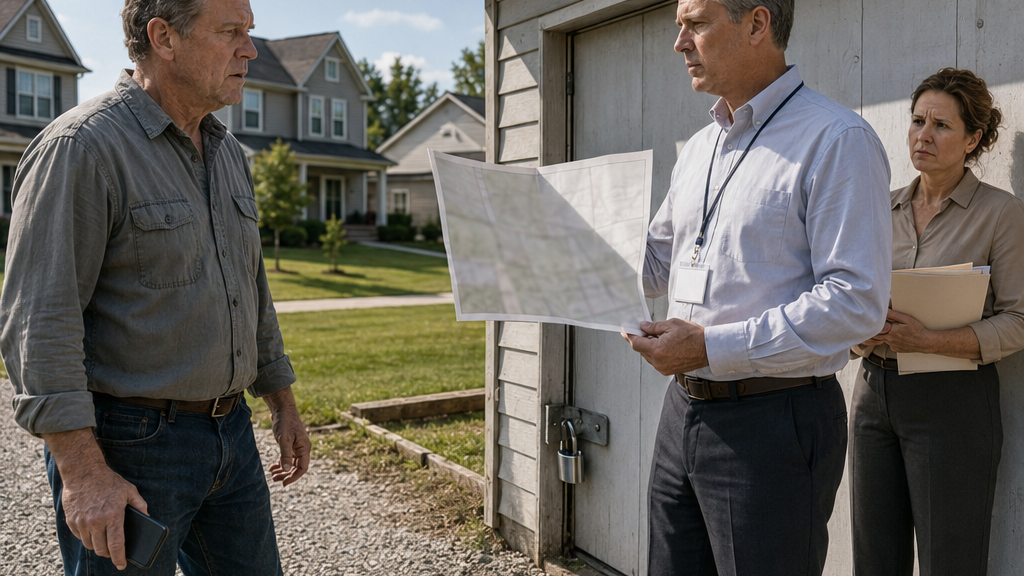
He was halfway down the gravel strip beside his house when the HOA management representative pulled her hand away from the garage door. A heavy silver padlock now hung through the steel hasp Andrew had installed himself eleven years earlier.
Jonathan Mitchell stood beside her holding a folder against his chest.
Andrew stopped.
“Did you just lock my garage?”
Jonathan glanced toward the door as if confirming something routine. “The board authorized temporary control of the structure pending review.”
Andrew looked from Jonathan to the lock.
Inside that garage were his mower, compressor, two ladders, his father’s old workbench, and the pickup he used only when something around the property needed hauling. None of that mattered as much as the simple fact that the building stood on land Andrew paid taxes on every year.
“You don’t control this property.”
Jonathan’s expression tightened, but he did not raise his voice. “We have a boundary issue that’s been ignored too long.”
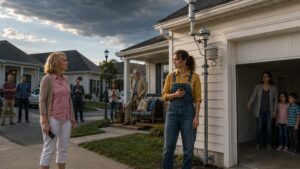
Behind them, the neighborhood changed almost exactly where Andrew’s gravel ended. On one side stood his older cedar fence, the detached garage and a narrow strip of unmown grass. On the other were trimmed lawns, matching mailboxes and the curving street of Pine Ridge Estates.
Andrew had lived beside the subdivision long enough to know where one ended and the other began.
Or he had thought he did.
The management representative handed him a laminated notice.
Andrew read the first few lines, then stopped.
“This says demolition review.”
“It says structural review pending determination of encroachment,” Jonathan corrected.
“It says removal may be required.”
“If the structure occupies association-controlled access, yes.”
Andrew felt heat climb behind his ears.
He had spent thirty-five years in building maintenance. He knew what anger did to people around paperwork. They stopped reading. They said something careless. They touched something they later wished they had not.
So he took out his phone instead.
He photographed the padlock.
Then the hasp.
Then Jonathan standing six feet away with the folder.
Jonathan frowned. “You don’t need to turn this into something.”
“You put a lock on my building.”
“We’re trying to keep this orderly.”
Andrew took one more photograph. “What gives you the authority?”
Jonathan opened the folder.
The page he removed was a neighborhood site map. Andrew recognized the subdivision streets immediately, but a pale shaded band ran along the rear edge of several lots before narrowing beside his garage.
Jonathan put a finger on it.
“Association access corridor.”
Andrew leaned closer.
The shaded line appeared to cut beneath the eastern corner of the garage.
For the first time that morning, his certainty shifted—not enough to become doubt, but enough to make him look twice.
“That isn’t my deed.”
“No,” Jonathan said. “It’s the recorded site plan used by the association.”
“Recorded where?”
“It’s in the association files and the management package.”
“That isn’t what I asked.”
Jonathan exhaled.
The management representative looked away.
Andrew knew that gesture. He had seen it in boiler rooms and mechanical closets when two supervisors discovered neither one knew who had approved the work order.
He went back to the house and returned with a plastic document sleeve.
Inside was his county tax card.
He held it out without giving it to Jonathan.
“Parcel number ends in 47B. Separate assessment. Separate tax bill.”
Jonathan looked at it.
“That doesn’t eliminate an easement.”
“I didn’t say it did. I said this is not association property.”
“The board believes otherwise.”
“The board can believe the moon belongs to it.”
Jonathan’s jaw shifted.
Andrew regretted the line as soon as he said it. Not because it was inaccurate, but because he had promised himself he would not let Jonathan turn this into a contest of tempers.
Jonathan folded the map.
“Your father may have owned the parcel separately once. That doesn’t tell us what happened later.”
The reference to his father landed harder than Andrew expected.
“My father transferred it to me.”
“And there are decades of subdivision records after that.”
Andrew stared at him.
His father had bought the narrow parcel before Pine Ridge Estates had reached this side of the county. When developers arrived, he had refused three purchase offers. Years later, when he transferred the property to Andrew, he had made him promise one thing.
Don’t let them blur the line until nobody remembers there was one.
Andrew had always thought that promise meant refusing to yield.
Jonathan tapped the folder.
“We’re not demolishing anything today. We’re preserving the status quo until the inspection.”
“You changed the status quo when you locked me out.”
“The board disagrees.”
Andrew looked at the management representative.
“Did the board vote specifically to padlock my garage?”
She hesitated.
Jonathan answered for her. “The board authorized protective measures.”
“That wasn’t my question.”
“Andrew.”
“Did it vote to put that lock on that door?”
Jonathan closed the folder. “You can take that up at the next meeting.”
Andrew walked to the garage and examined the lock without touching it.
A bolt cutter hung inside, less than twelve feet away.
For one foolish second he imagined breaking a side window, climbing in, cutting the lock and dropping the pieces at Jonathan’s feet.
Instead he stepped back.
“Leave it there.”
Jonathan blinked. “What?”
“The lock. Nobody touches it.”
“We weren’t planning—”
“I want it exactly where you put it.”
Jonathan studied him more carefully then.
Andrew lifted his phone and photographed the lock again.
By noon, three neighbors had slowed their cars while passing. One stopped long enough to ask whether Andrew was finally “moving that old garage.” He told her no.
At twelve-thirty, an email arrived from the management company.
The subject line identified the matter as a boundary compliance review.
The attachment was four pages long.
Andrew read every word.
There were references to drainage access, maintenance responsibility and an alleged encroachment. The final page gave him forty-eight hours to provide documentation before an inspection team evaluated whether the structure interfered with association-controlled property.
Near the bottom was one sentence Andrew read three times.
If the claimed encroachment was confirmed, the board reserved the right to require removal of the affected structure.
He printed the notice.
Then he walked to the kitchen window.
Beyond the glass, sunlight flashed on the silver padlock.
For the first time, Andrew allowed himself to consider the possibility he hated most.
Not that Jonathan was right.
That somewhere in forty years of records there might be one document Andrew had never seen.
Chapter 2: The Deed Andrew Thought Should End Everything
Andrew found the deed in the same brown envelope his father had used when he handed it to him.
The envelope had softened at the corners. His father’s handwriting crossed the front in black marker: PROPERTY—KEEP.
Andrew stood at the kitchen counter with the HOA notice beside it and slid the deed free.
There it was.
Lot 47B.
The legal description ran in dense lines of bearings, distances and references to iron pins that had probably been buried under roots for decades. Andrew skipped to the language that mattered to him.
Grantor.
Grantee.
Parcel.
Recorded.
His name.
He felt his shoulders loosen.
Then he looked through the window and saw the padlock.
By ten that morning, he was at the county records office.
The clerk behind the counter listened without reacting while Andrew explained that an HOA had locked a garage on what he believed was a separately deeded parcel.
“Believed?” she asked.
“Is.”
She gave him a look over the top of her monitor.
“Then we’ll start with what’s recorded.”
That irritated him more than it should have.
He slid his deed across.
The clerk searched by parcel number and pulled up the assessor information first.
“Separate tax parcel,” she said.
Andrew nodded.
“I know.”
“Separate billing address. Current taxes paid.”
“I know that too.”
She looked at him again.
“You want confirmation or an argument?”
Andrew closed his mouth.
“Confirmation.”
“Then let me confirm it.”
Ten minutes later she printed the assessor record. Lot 47B had its own parcel identification number. It was not bundled with any Pine Ridge lot. The tax history ran separately.
Andrew felt vindicated enough to call Jonathan from the hallway.
Jonathan answered on the fourth ring.
“The county confirms it’s separately assessed.”
“I never said it wasn’t.”
“You locked a building on it.”
“Separate assessment doesn’t determine easements.”
Andrew leaned against the wall.
“You keep saying easement. Yesterday you said association property.”
“I said association-controlled access.”
“That’s not the same thing.”
“No,” Jonathan said. “It isn’t.”
The answer took some of the force out of Andrew’s next sentence.
Jonathan continued. “That is why the review is happening.”
Andrew hung up before irritation could do the talking for him.
Back inside, he asked the clerk for every recorded plat connected to his parcel and the neighboring subdivision.
That took longer.
The oldest document she found quickly was a scanned plat with faint handwritten notations. Another map, recorded years later during a subdivision phase expansion, used cleaner lines and block lettering.
Andrew put the pages side by side on a reading table.
On the older map, Lot 47B was a narrow independent shape bordering a larger tract.
On the newer one, Pine Ridge wrapped around it.
And along the rear of the subdivision ran the same shaded corridor Jonathan had shown him.
Andrew traced it with one finger.
The line came toward his parcel.
Then the reproduction became difficult to read.
“What does that symbol mean?”
The clerk bent closer.
“Could be a utility or drainage reference. I’d want the legend from the full plat.”
“Does it cross my lot?”
“Looks like the graphic does.”
“Then how can my lot still be separate?”
The clerk straightened.
“Ownership and easement rights aren’t the same thing.”
He had heard that twice now.
Andrew disliked it more each time.
“If the HOA had rights over my land, wouldn’t that be on the deed?”
“Not necessarily in the way you’re expecting. Could be referenced in another instrument. Could be older. Could be later. Could be an easement without changing ownership.”
“Could they make me tear down a garage?”
“That’s a lawyer question.”
Andrew stared at the maps.
His simple answer had become two documents pointing in different directions.
The clerk searched the subdivision declaration.
Pine Ridge’s original covenants had been recorded years after the first plat involving Andrew’s land. Later amendments added phases and lots.
Andrew watched her scroll through an index.
“Is 47B in there?”
“Not that I see.”
“There.”
He pointed at a page containing a list of numbers.
“That says forty-seven.”
“Lot 47,” she said. “Not 47B.”
Andrew leaned back.
A small satisfaction returned.
“So I’m not in it.”
“I said I don’t see it in this document.”
“You just—”
She raised one hand.
“If you want me to tell you what I can verify, I can do that. If you want me to tell you the HOA has no rights of any kind over your property, I can’t.”
Andrew looked away.
The clerk softened slightly.
“I also don’t see an obvious annexation entry indexed under your parcel number.”
“Meaning?”
“Meaning I don’t see one. Not that one never existed.”
By late afternoon, Andrew’s kitchen table had disappeared beneath paper.
His deed.
The tax card.
Two subdivision plats.
The declaration.
The HOA’s enforcement notice.
He placed his deed on top as though weight might establish priority.
His father had transferred the parcel to him in 2009. Andrew had built the garage after checking the setback requirements with the county. There had been no HOA architectural review because he had never believed one applied.
For eleven years, nobody had told him otherwise.
That should have meant something.
His phone rang.
Nicole Adams had been recommended by a contractor Andrew had known from his maintenance days. Her office handled boundary disputes, easements and title problems.
Andrew gave her the condensed version.
She listened without interrupting.
When he finished, she asked, “Did the county issue your building permit?”
“Yes.”
“That helps with permitting. It doesn’t resolve private property rights.”
Andrew stared at the ceiling.
“Everybody keeps telling me what my deed doesn’t prove.”
“Because I don’t want to tell you what you want to hear and discover Friday that there’s an easement from 1986.”
“There isn’t.”
“Good. Then we should be able to prove there isn’t.”
He disliked her immediately.
Which was one reason he hired her.
The next morning Andrew brought the documents to Nicole’s office.
She placed the deed beside the newer subdivision map.
“This confirms ownership,” she said, tapping the deed.
Andrew waited.
She tapped the shaded corridor.
“This raises a separate question.”
“It’s a bad map.”
“Maybe.”
“That line wasn’t on the older one.”
“Maybe.”
Andrew leaned back. “Do you ever say anything definite?”
“When the records are definite.”
She turned toward him.
“Before we go further, I need the history. Not the version where everyone else made mistakes. The whole history.”
Andrew folded his arms.
“There isn’t much.”
Nicole studied him for a moment.
“Did the HOA ever contact you about this boundary before Jonathan became president?”
Andrew’s eyes shifted to the map.
There had been letters.
He had not forgotten them.
He had simply decided, years ago, that they did not deserve answers.
Nicole saw the pause.
“Andrew.”
He rubbed his thumb across the edge of his father’s envelope.
Nicole asked the question he had hoped would never matter.
“Did anyone ever ask you to participate in a boundary survey?”
Chapter 3: The Survey Andrew Refused Came Back to Matter
“Bring me every letter you didn’t answer.”
Nicole said it before Andrew had taken off his coat.
He stood in the doorway of her office holding a grocery bag full of old correspondence.
“I didn’t say I never answered anything.”
“You said there were two letters.”
“There were.”
“And?”
Andrew put the bag on her desk.
“I didn’t answer them.”
Nicole opened it.
“That distinction is doing a lot of work.”
Andrew took the chair across from her.
He had spent half the night in the hall closet where he kept property records, warranties, expired insurance policies and instruction manuals for appliances he no longer owned.
The two HOA letters had been exactly where he remembered.
One from six years earlier.
One from four.
Nicole unfolded the older letter first.
It was from a previous management company. The tone was mild. Pine Ridge planned drainage maintenance along the rear lots and wanted neighboring property owners to verify existing boundaries before work began.
The second letter was more specific.
Nicole read a paragraph, then slid it toward Andrew.
Joint survey.
Shared cost.
Clarification of maintenance corridor.
Andrew looked at the words as if someone else had written them overnight.
“You turned this down?”
“I didn’t turn it down.”
“You ignored it.”
“My parcel wasn’t theirs to survey.”
“That wasn’t the question.”
“It was to me.”
Nicole sat back.
Andrew felt the old defensiveness rising.
“My father dealt with that subdivision before half those houses existed. Every time the developers wanted another few feet, they called it access or grading or temporary use. He spent twenty years saying no.”
“And you inherited that history.”
“I inherited the land.”
“And the habit.”
Andrew looked sharply at her.
Nicole did not retreat.
“Your refusal didn’t give them ownership. It didn’t create an easement by magic. But if this ends up in front of a judge, I need to understand why there was a known boundary question and nobody resolved it.”
“There wasn’t a question on my side.”
“That sentence is the problem.”
Andrew went silent.
Nicole spread the records across the desk.
“You thought the deed made discussion unnecessary. They seem to have treated your silence as permission to keep using their own map. Both of those things can be true without either one deciding the legal issue.”
Andrew looked down at his father’s brown envelope.
PROPERTY—KEEP.
For years he had read that as an instruction to resist.
He had never considered that keeping something could also mean making its edges unmistakable.
Nicole pointed at the survey letter.
“Did they ever come onto your property?”
“Landscaping crew trims brush along the ditch.”
“For how long?”
“Years.”
“How many?”
Andrew thought.
“Maybe eight.”
Nicole’s pen stopped.
“You knew?”
“It’s brush.”
“Did you give permission?”
“No.”
“Did you object?”
“No.”
“Why not?”
“Because I didn’t care if they cut weeds.”
Nicole wrote something down.
Andrew disliked the scratch of her pen.
“What?”
“Nothing yet.”
“That sounded like something.”
“It means usage history matters. It doesn’t mean they own the land.”
By noon they were standing beside the garage.
The HOA had placed two temporary orange flags in the grass near the eastern wall. The padlock still hung from the door, untouched.
Nicole photographed everything.
Andrew pointed toward the shallow depression running behind several backyards.
“That’s the drainage line. Their crews mow to about here.”
He marked a spot with his boot.
Nicole looked toward the garage.
“And the disputed corridor?”
“Jonathan’s map puts it farther over.”
“How far?”
“Enough to catch the corner of the building.”
She crouched beside one orange flag.
“Did you place this?”
“No.”
“Then don’t move it.”
Andrew laughed without humor.
“First the lock. Now flags.”
“Good evidence is often very boring.”
A maintenance truck slowed on the subdivision street.
The driver raised a hand toward Andrew and continued on.
Andrew watched it disappear.
“I used to fix problems before people noticed them,” he said.
Nicole stood.
“What kind?”
“Commercial buildings. Pumps, boilers, roof leaks. If water appeared on the third floor, you found the broken line on the fourth before arguing about whose department it was.”
“That sounds useful.”
“It was.”
“Why didn’t you treat this boundary the same way?”
Andrew looked at her.
Because buildings did not remind him of his father.
Because a failed pump had never asked him to surrender anything.
Because every request from Pine Ridge had sounded, in his head, like the developers who used to sit at his father’s table and explain why a little strip of land did not matter.
He said only, “I thought answering gave the question legitimacy.”
Nicole nodded once.
“And now?”
Andrew looked at the padlock.
“Now they’ve made the question legitimate whether I like it or not.”
That afternoon Nicole requested the HOA’s maintenance records through counsel.
The response arrived faster than Andrew expected.
Pine Ridge had invoices documenting vegetation clearing along the corridor for seven years. There were drainage inspection notes, contractor diagrams and photographs. One diagram placed the maintenance line within feet of Andrew’s garage.
Jonathan had not invented the corridor after becoming president.
That bothered Andrew.
It would have been easier if he had.
Nicole called him back to her office Thursday morning.
She arranged three items in front of him: the joint-survey letter he had ignored, several maintenance invoices, and a photograph taken four years earlier showing an HOA contractor clearing brush beside Andrew’s fence.
“You’re still the titled owner,” she said.
Andrew waited for the rest.
“But they have a history they’ll use to explain why they believed they had access rights.”
“Belief isn’t authority.”
“No. But it affects how this dispute looks.”
Andrew stared at the photograph.
He remembered that crew.
He had been outside that day replacing a hinge on the garage door. One worker had waved. Andrew had waved back.
At the time, it had seemed neighborly.
Now the same moment looked different on paper.
“Can seven years of mowing take my property?”
“I’m not giving you a legal conclusion from invoices. We need to identify what right they claim and where it came from.”
“And if it came from nowhere?”
“Then that matters.”
His phone vibrated.
An email from the HOA management company.
Andrew opened it.
Nicole watched his face.
“What?”
He handed her the phone.
The demolition-review inspection had been scheduled for Friday morning. The notice said representatives would assess the garage’s location relative to the association maintenance corridor and determine whether further enforcement was required.
Andrew stood.
“They know I have counsel.”
“Yes.”
“They know we’re checking the title.”
“Yes.”
“And they’re coming anyway.”
Nicole looked again at the email.
“That tells us Jonathan thinks the maintenance history is enough to keep moving.”
Andrew walked to the window.
The anger was still there, but it had changed shape.
Two days earlier he had wanted to prove Jonathan had fabricated the whole thing.
Now he knew better.
Pine Ridge had maintained the strip.
Andrew had watched them do it.
He had ignored the survey request.
He had treated silence as a boundary marker.
None of that made the garage theirs.
But it meant the argument had roots.
Behind him, Nicole closed the file.
“Tomorrow we stop asking what everyone assumed.”
Andrew turned.
“What do we ask?”
“Where the line came from.”
His phone buzzed again.
A second message from management confirmed Jonathan Mitchell would personally attend the inspection.
Friday morning, the HOA was coming back to the locked garage.
And this time Andrew no longer had the comfort of believing the other side had nothing at all.
Chapter 4: The Map Jonathan Trusted Had a Missing Beginning
The first map Nicole laid on the archive table showed a line Andrew had never seen before.
Not the shaded corridor from Jonathan’s copy.
A property line.
It ran straight along the eastern edge of Lot 47B, then turned before reaching the place where Andrew’s garage now stood. No shaded band crossed the parcel. No notation suggested Pine Ridge controlled it.
Andrew leaned closer.
“What year?”
Nicole checked the recording stamp.
“1971.”
Andrew looked at her.
“That’s before Pine Ridge.”
“By a while.”
Friday morning had begun with Jonathan’s inspection notice still sitting on Andrew’s kitchen counter. Instead of waiting beside the garage for another confrontation, Andrew and Nicole had gone to the county archive as soon as it opened.
They had already spent nearly an hour working backward through records.
The newer Pine Ridge map showed the maintenance corridor.
An earlier subdivision expansion map showed something similar, though the line was less clearly labeled.
Now this older plat showed Lot 47B as a separate parcel beside a much larger tract that had not yet become the subdivision.
Andrew put both palms on the table.
“So that settles it.”
Nicole did not answer.
He looked at her.
“You can say it.”
“I can say this plat is good for us.”
“For us?”
“For your position.”
“You know what I mean.”
Nicole pulled the newer map closer.
“We still need to know how this became that.”
Andrew frowned.
“It became that because somebody drew it wrong.”
“Maybe. Or because somebody later recorded an easement. Or because the subdivision acquired rights when it was created. Or because the map is depicting drainage rather than ownership.”
Andrew straightened.
He had come to dislike the word maybe.
Nicole seemed to regard it as a professional obligation.
The county records clerk brought them a box of older subdivision instruments and placed it carefully on the table.
“No food, no pens near the originals.”
Nicole thanked her.
Andrew began with the first declaration for Pine Ridge Estates.
The document was recorded years after the 1971 plat. Its legal description covered the land that would become the subdivision. Lot numbers appeared in schedules attached to later amendments.
Andrew followed them slowly.
Lot 44.
Lot 45.
Lot 46.
Lot 47.
Then the next sequence.
No 47B.
He checked again.
Nicole was reading an amendment from several years later.
“Anything?”
“No.”
“Same here.”
For the first time since Tuesday, Andrew felt something close to solid ground beneath him.
He pulled out another amendment.
Nothing.
A later phase added more property to the association.
Still nothing.
Nicole opened her laptop and began searching the grantor-grantee index using several variations of the parcel description.
Andrew watched.
“No annexation?”
“Not yet.”
“How many ways can somebody annex land?”
“Enough that I don’t stop after one search.”
They worked until late morning.
The archive room was quiet except for turning paper and the soft click of Nicole’s keyboard.
Then she stopped.
Andrew looked up.
“What?”
“I’m not finding it.”
“The annexation.”
“I’m not finding a recorded instrument bringing 47B into the declaration.”
Andrew felt the satisfaction arrive more cautiously this time.
He had learned something over the previous three days.
A good fact was not the same as a finished argument.
“So Jonathan’s map is wrong.”
Nicole rotated the subdivision map.
“His map may accurately show what Pine Ridge has been using as a maintenance corridor.”
“That’s not ownership.”
“No.”
“Or HOA jurisdiction.”
“Not necessarily.”
“Nicole.”
She gave him a thin smile.
“No recorded annexation is a serious problem for their claim.”
That was enough.
Andrew sat back.
Then Nicole pointed to a notation near the lower corner of the 1971 plat.
“Look at this.”
A narrow drainage easement ran across part of the original larger tract. It approached Lot 47B but did not follow the same course as the broad corridor on Jonathan’s later map.
Andrew traced it.
“That’s outside my garage.”
“Mostly.”
“Mostly?”
“The description matters more than the drawing.”
They found the corresponding recorded easement after another forty minutes.
The language granted drainage access over a defined strip near the boundary. It did not convey ownership. It did not place Lot 47B inside an HOA. But the description was old, written before some of the later roads and fences existed.
Nicole compared it with the newer association map.
“This may be the beginning of the confusion.”
Andrew leaned over.
The old drainage strip and the newer maintenance corridor overlapped for part of their length. Farther down, the newer map widened and shifted closer to Andrew’s garage.
“Somebody expanded the line.”
“Graphically, yes.”
“On what authority?”
“That’s what we need to find.”
At eleven-thirty, Andrew’s phone rang.
Jonathan.
Andrew let it ring once more before answering.
“We’re at the garage,” Jonathan said.
“I know.”
“The inspection was scheduled for eleven.”
“I didn’t agree to attend.”
“You were notified.”
“And my attorney notified management yesterday that no inspection inside the structure was authorized.”
A pause.
“We’re not entering the building.”
“Good.”
Jonathan’s voice hardened.
“We are documenting the exterior encroachment.”
“Document whatever you can see from where you’re legally allowed to stand.”
Nicole looked up at him.
Andrew kept his tone level.
Jonathan said, “This would be easier if you stopped treating every step like an attack.”
Andrew looked at the 1971 plat.
“You put a lock on my garage.”
“And you refused to settle this boundary when the association tried years ago.”
The words hit because they were true.
Andrew said nothing.
Jonathan continued.
“We have drainage work scheduled. Our insurer wants access clarified. The board cannot keep pretending this strip doesn’t matter because you won’t discuss it.”
Andrew’s hand tightened around the phone.
Three days earlier he would have answered with his deed.
Now he knew the situation was messier than that.
But he also knew something Jonathan did not.
“Did you verify my parcel was ever annexed?”
Silence.
Andrew waited.
Jonathan finally said, “Our records show the corridor.”
“That wasn’t my question.”
“The association has relied on those records for years.”
Andrew looked at Nicole.
She was already writing something on a legal pad.
“Did you verify annexation?”
Jonathan’s voice became flat.
“If your lawyer believes the association records are defective, she can send that position through counsel.”
Then the call ended.
Nicole looked at Andrew.
“That answer was useful.”
“He didn’t know.”
“Or he doesn’t want to discuss it with you directly.”
Andrew stared at the dark phone screen.
Neither possibility made Jonathan look stronger.
They spent the afternoon tracing the history of the Pine Ridge site plan.
The key came from an old planning submission, not a deed.
A development drawing prepared during a subdivision expansion showed a proposed maintenance route running along the rear lots and bending around the older parcel. A later internal HOA copy appeared to simplify that route. The distinction between proposed drainage access and association-controlled property became less clear with each reproduction.
There was no single dramatic moment where someone had written, This land now belongs to Pine Ridge.
Instead there were copies of copies.
A line reused.
A label shortened.
An assumption carried forward.
Andrew found that more disturbing than a deliberate land grab.
Nobody had needed to steal the property if everyone simply stopped checking what the line originally meant.
Late in the afternoon, Nicole gathered the important pages.
“The 1971 plat gives us the original separation.”
“No annexation.”
“None found.”
“The drainage easement is real.”
“Yes.”
“But it isn’t where Jonathan says the HOA boundary is.”
“Correct.”
Andrew looked at the newer map.
“So Pine Ridge may have access rights near my land without having jurisdiction over my parcel.”
“That is becoming the strongest reading.”
He let out a breath.
It was vindication, but not the clean kind he had imagined.
The HOA had not invented the drainage problem.
His father’s old parcel did sit beside infrastructure the subdivision needed to maintain.
Andrew’s years of refusing to discuss the line had not helped anyone distinguish access from ownership.
Still, none of that explained the padlock.
His phone buzzed with a text from an unfamiliar number.
This is Patricia Hall. I was board secretary before Jonathan became president. We should talk before Monday.
Andrew read it twice.
A second message arrived.
I told Jonathan the old parcel records needed to be checked before the board took enforcement action.
Andrew handed the phone to Nicole.
She read the screen without changing expression.
Then she looked at him.
“Now we have a different question.”
Andrew already knew what it was.
If Jonathan had been warned the records were uncertain, why had he locked the garage anyway?
Chapter 5: The Warning Jonathan Chose Not to Slow Down For
“The board never verified annexation.”
Patricia Hall said it before Andrew had finished sitting down.
They were in the small Pine Ridge meeting room Saturday morning, with the blinds half closed and a coffeemaker humming unused in the corner.
Patricia had chosen the room because, as she put it, she did not want the conversation taking place in either Andrew’s house or Jonathan’s.
Neutral ground.
She placed a binder on the table.
Andrew did not touch it.
“You were secretary?”
“For six years. Treasurer now.”
“And you knew my parcel wasn’t in the declaration?”
“I knew I had never seen an annexation document for 47B.”
“That is not quite the same answer.”
“No.”
Andrew appreciated that she did not pretend otherwise.
Patricia opened the binder.
Inside were meeting minutes, maintenance summaries and correspondence.
“The boundary question predates Jonathan. So does the drainage issue.”
“I know.”
She glanced at him.
“You know now.”
Andrew let the correction stand.
Patricia turned several pages.
“A contractor flagged access problems last year. The ditch narrows behind the eastern lots. Equipment has to swing closer to your side than anyone likes. Then the insurer asked the board to document which corridors it controlled before the drainage project started.”
“And somebody looked at that map.”
“Yes.”
“And decided my garage was in the way.”
“Not immediately.”
Patricia seemed uncomfortable.
That made Andrew listen more closely.
“When Jonathan became president, he inherited three projects the prior board had delayed. Drainage was the expensive one. Residents were already angry about standing water. The insurer was pushing. The contractor’s pricing was only guaranteed for a limited period.”
Andrew leaned back.
“So he was in a hurry.”
“He wanted decisions.”
“That’s a polite word.”
“He thought the board had spent years using uncertainty as an excuse.”
Andrew pictured Jonathan beside the garage, folder pressed to his chest, talking about keeping things orderly.
That version of him made more sense now.
Not more justified.
More understandable.
Patricia slid a copy of meeting minutes toward Andrew.
The board had discussed the corridor two months earlier. His parcel was referenced indirectly as “adjacent nonmember property.”
Andrew pointed to the phrase.
“They knew I wasn’t a member.”
“Of course.”
“Then why would they claim HOA jurisdiction?”
Patricia rubbed one thumb along the binder edge.
“Because they started treating control of the maintenance corridor as control over whatever sat inside the corridor.”
“That’s not the same thing.”
“I know.”
“Did Jonathan?”
“I told him it needed legal review.”
Andrew looked up.
“When?”
“Before the vote.”
There it was.
Not a missing document.
A choice.
Patricia continued before Andrew could respond.
“He said the association had maintained the corridor for years and that your refusal to participate in the survey showed you were never going to cooperate voluntarily.”
Andrew felt the sting of that because he had given Jonathan the argument.
“I refused a survey. I did not give him my garage.”
“I’m not saying you did.”
“Did you vote for the lock?”
“No.”
“The enforcement?”
“I voted to authorize legal review and exterior inspection.”
Andrew’s jaw tightened.
“And what happened?”
“The motion that passed used broader language about protective measures. Jonathan and management interpreted that to include securing the structure.”
“You mean padlocking it.”
“Yes.”
“Did you object afterward?”
Patricia hesitated.
That hesitation told him more than the answer.
“Not immediately.”
“Why?”
“Because I thought if we challenged him in public, the whole project would collapse into another six months of nothing.”
Andrew looked through the blinds toward the row of houses outside.
Everyone had a reason.
Jonathan had deadlines.
Patricia had institutional fatigue.
The insurer wanted clarity.
The contractor wanted access.
Andrew had his father’s promise.
Each person had taken one reasonable concern and used it to excuse the next step.
Patricia pulled a photograph from the binder.
It showed Andrew’s garage four years earlier. An HOA landscaping crew was clearing brush beside the fence.
“You were there that day.”
“I remember.”
“You waved at them.”
“I was being civil.”
“Jonathan has cited that photograph at least twice.”
Andrew laughed once, without humor.
“As proof I gave away the land?”
“As proof the association’s use wasn’t hidden.”
“That’s different.”
“Yes.”
“But useful if you want to make me look unreasonable.”
Patricia closed the binder.
“Andrew, you did make it harder.”
He looked at her.
“You ignored two letters. You let crews maintain the edge because it was convenient. You never made anyone define exactly where permission stopped because you believed talking about the line weakened your ownership.”
He did not answer.
Patricia’s voice softened.
“That doesn’t make the lock right.”
Andrew looked down at his hands.
For the first time since Tuesday, he found himself thinking less about how to embarrass Jonathan and more about how many people had helped build the confusion.
Including him.
After the meeting, Andrew walked back to his property instead of driving.
The silver padlock was visible before he reached the garage.
He stopped several feet away and took out his phone.
The first photographs he had taken showed the lock as an insult.
Now he opened them as evidence.
Time.
Date.
Jonathan present.
Management representative present.
Door secured.
No prior determination of annexation.
He zoomed in on one image.
The lock looked almost absurdly ordinary.
Twenty dollars of steel had done what years of unclear maps had not.
It forced everyone to define the boundary.
Nicole arrived an hour later carrying a slim folder.
Andrew told her what Patricia had said.
She listened, then asked, “Do you want Jonathan punished, or do you want the problem fixed?”
Andrew looked at her.
“I want my garage back.”
“That’s the immediate problem.”
“And I want them off my property.”
“That may be too broad if the drainage easement is valid.”
Andrew started to object.
Then stopped.
Nicole noticed.
“That was different three days ago.”
“I’m learning to enjoy disappointing you.”
She almost smiled.
He looked toward the ditch.
“If they have a legitimate right to maintain drainage, we can define it. That doesn’t mean they get the building.”
“No.”
“And it doesn’t mean the HOA governs 47B.”
“No.”
“Then that’s what I want established.”
Nicole opened the folder.
“We can send another demand today. Monday morning, if they refuse to remove the lock and pause the enforcement, we can seek emergency relief.”
“How emergency?”
“A temporary restraining order.”
Andrew looked at the garage.
“Would that decide the title?”
“No.”
“Would it decide the easement?”
“No.”
“What would it do?”
“Ask the court to stop them from interfering with the structure while those questions are resolved.”
He nodded slowly.
“That sounds narrower than I expected.”
“It should be.”
Andrew thought about Jonathan’s mistake.
He had taken uncertainty and treated it as permission to act.
Andrew did not want to make the same mistake in reverse.
Nicole handed him a draft declaration.
“We need your statement about the ownership history, the lock, the inspection notice and the threatened removal.”
Andrew scanned it.
One paragraph described his refusal of the earlier survey.
He looked up.
“You put that in.”
“It happened.”
“It helps them.”
“It gives the court the full context.”
Andrew considered asking her to remove it.
Instead he took the pen.
His father had taught him to keep the papers clear.
For years Andrew had thought that meant keeping unfavorable people away from them.
Maybe it meant something simpler.
Write down what happened.
All of it.
He signed.
Nicole closed the folder.
“If they don’t back down by Monday, we file first thing.”
Andrew looked once more at the padlock.
On Tuesday it had felt like someone else taking control.
By Saturday, it had become something different.
A line Jonathan had crossed while trying to prove where another line belonged.
Monday morning, Andrew intended to ask a judge to stop him.
Chapter 6: The Court Order Stopped the Lock but Not the Argument
Andrew walked into the courthouse Monday morning with his truck still locked inside his own garage.
That fact mattered more to him than the folder under Nicole’s arm.
Five days had passed since Jonathan authorized the padlock. The HOA had not removed it. Management had acknowledged Nicole’s demand but refused to suspend the boundary review without board approval.
So Andrew sat beside Nicole on a wooden bench outside the courtroom while people passed carrying files, coffee cups and expressions suggesting their problems had started long before breakfast.
“You understand what we’re asking for?” Nicole said.
Andrew nodded.
“Temporary restraint. No removal. No entry. No further physical interference.”
“And what are we not asking the judge to decide today?”
“Who owns every inch of the drainage corridor.”
“Good.”
He looked at her.
“You enjoy these tests.”
“I enjoy clients not confusing temporary relief with winning the case.”
Andrew almost smiled.
When their matter was called, the hearing was shorter than he expected.
Nicole presented the deed, the separate tax parcel, the 1971 plat, the absence so far of any recorded annexation and photographs of the padlock. She also disclosed the old drainage easement and Andrew’s refusal of the earlier survey.
The HOA’s attorney argued that Pine Ridge had longstanding maintenance responsibilities along the corridor and needed access for pending drainage work. He did not claim the court could determine title that morning.
The judge focused on the lock.
Who authorized it?
What legal interest had been established before it was installed?
Was demolition actually imminent?
Could the HOA preserve its claimed rights without physically excluding Andrew from his garage?
Andrew watched Jonathan’s attorney answer carefully.
There had been no final title determination.
No annexation instrument had yet been produced.
The structure was under review, not scheduled for immediate removal.
The judge granted temporary relief.
The HOA was prohibited from removing, entering, damaging or physically securing the garage while the dispute proceeded. The padlock had to come off.
Andrew felt Nicole touch his sleeve lightly before he stood.
Not celebration.
A reminder.
This was not the end.
Outside the courtroom, Jonathan stood near his attorney.
Andrew had not known he would attend.
For several seconds neither man spoke.
Then Jonathan said, “This doesn’t establish your boundary.”
Andrew nodded.
“I know.”
Jonathan seemed prepared for a different answer.
“It only freezes things.”
“I know that too.”
Jonathan looked toward Nicole, then back at Andrew.
“The drainage project is still an issue.”
“Then we should figure out the drainage project.”
Jonathan’s expression changed slightly.
Andrew could not tell whether it was suspicion or surprise.
“But the garage,” Andrew continued, “stays mine while we do.”
Jonathan looked away first.
That afternoon, a sheriff’s deputy met them at the property to document compliance with the order.
The same silver padlock hung from the hasp.
Jonathan arrived with the management representative and one board member. No crowd gathered at Andrew’s property. There was no argument.
The deputy read the relevant portion of the order, then looked at the lock.
“Who has the key?”
The management representative did.
She opened it.
The shackle released with a small metallic click.
Andrew had imagined that sound for almost a week.
He expected satisfaction.
Instead he felt mostly tired.
The representative removed the lock and handed it to Jonathan.
Jonathan looked at it, then at Andrew.
“Do you want this?”
Andrew almost said no.
Then he held out his hand.
Jonathan placed the padlock in it.
The steel was warm from the sun.
Andrew opened the garage door himself.
The smell of oil, lumber and dust came out exactly as it always had. His pickup sat where he had left it. His father’s workbench stood against the rear wall beneath a row of hand tools.
Nothing inside had changed.
Andrew had.
He put the padlock on the workbench rather than throwing it away.
Two evenings later, Pine Ridge held its regular board meeting.
Andrew attended with Nicole.
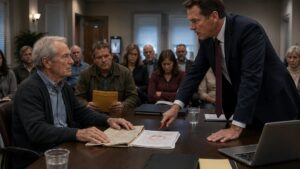
The room was fuller than usual, though not packed. About a dozen homeowners sat in folding chairs. Patricia was already at the board table. Jonathan sat at the center with the court order beside his folder.
The sheriff’s deputy entered shortly after the meeting began.
A few people turned.
The deputy approached the table and handed Jonathan formal service related to the pending title action.
The room quieted.
Jonathan read the first page.
Nobody applauded.
Nobody laughed.
Andrew was glad.
Humiliation would have been easy to enjoy for about thirty seconds. It would not have clarified a single boundary.
Jonathan looked up.
“You filed quiet title.”
Andrew answered from his chair.
“Yes.”
“And wrongful interference.”
“Yes.”
One homeowner whispered something to another.
Jonathan’s face reddened, but his voice stayed controlled.
“You could have waited for the board process.”
Andrew looked at the court papers, then at him.
“I waited years to clarify the boundary. That was my mistake.”
Patricia’s eyes lifted.
Andrew continued.
“Locking the garage before you clarified it was yours.”
Jonathan did not answer.
The meeting moved on awkwardly.
Over the next week, attorneys exchanged records. The HOA suspended the demolition review. Andrew regained full use of the garage.
Then Nicole called him into her office.
“They want to settle.”
Andrew sat down.
“How much?”
“They’ll reimburse most of your legal fees to date.”
“And?”
“Remove the enforcement notices permanently. Confirm they won’t seek demolition based on the current claim.”
“That sounds like what we wanted.”
Nicole did not respond immediately.
Andrew knew that look now.
“What’s wrong with it?”
She slid the proposed agreement across the desk.
He read.
The money was there.
The lock issue was addressed.
The enforcement file would be closed.
Then he reached the confidentiality paragraph.
And after that, the clause stating that settlement did not constitute any admission regarding the permanent jurisdictional status of Lot 47B.
Andrew read it again.
“They want to pay me and leave the map alone.”
“They want to settle the immediate dispute without resolving every title issue.”
“So five years from now another president can find the same map.”
“Potentially.”
“And start again.”
“Potentially.”
Andrew set the pages down.
A week earlier, he might have taken the offer.
The garage was open.
The demolition threat was gone.
Most of his legal expenses would be covered.
He could return to the life he had before Tuesday.
Except there had never really been a life before Tuesday.
There had been two ignored survey letters, years of maintenance nobody defined, maps nobody traced backward, and a promise to his father that Andrew had interpreted as refusing every conversation.
The settlement offered him silence.
It did not offer clarity.
Nicole watched him.
“The money isn’t bad.”
“I know.”
“The temporary order protects you while we litigate.”
“I know.”
“And litigation costs money.”
Andrew looked at the proposed confidentiality clause.
“What happens if I sign this?”
“Your immediate dispute ends.”
“And the next one?”
Nicole said nothing.
Andrew pushed the agreement back across the desk.
“Tell them no.”
She studied him.
“To all of it?”
“To the part where they pay me to leave the same mistake in the records.”
“What do you want instead?”
Andrew thought of the 1971 plat.
The drainage easement.
The shaded corridor.
The garage.
The old letters he had never answered.
Then he thought of the padlock sitting on his father’s workbench.
“I want one recorded document that says exactly what Pine Ridge controls and exactly what it doesn’t.”
Nicole picked up her pen.
“And the drainage access?”
Andrew hesitated.
That was the part the old Andrew would have refused automatically.
“If they actually have a right to it, mark it correctly.”
Nicole nodded.
“And if maintaining it requires reasonable access?”
Andrew looked through the office window toward the parking lot.
“Then we define that too.”
Nicole wrote something down.
Andrew pointed at the settlement.
“But no more assumptions.”
She looked up.
“No more assumptions.”
For the first time since the lock had closed, Andrew was no longer fighting merely to get back what he had before.
He was asking for something neither side had bothered to create in forty years.
A boundary nobody would have to guess about again.
Chapter 7: Andrew Asked for a Boundary Nobody Could Misread Again
The settlement offer put money on the first page and the boundary on the fourth.
Andrew noticed that before Nicole said anything.
He sat across from her in a mediation room six weeks after the court order, reading the latest proposal while Jonathan and the HOA’s attorney waited on the other side of a closed door.
The association had increased its reimbursement offer. Most of Andrew’s legal expenses would be covered. The enforcement notices would be withdrawn. The demolition review would be formally closed.
But the paragraph Andrew cared about was still too careful.
Pine Ridge would acknowledge that it had not located documentation establishing Lot 47B as property subject to the association declaration.
Andrew tapped the sentence.
“That is not the same as saying it isn’t.”
Nicole nodded.
“No.”
“They’re still leaving themselves room.”
“They’re trying not to make a broader admission than necessary.”
“Necessary for who?”
Nicole folded her hands.
“For an association that has to explain to its members why it spent money enforcing a boundary it could not prove.”
Andrew glanced toward the closed door.
Months earlier, that answer would have made him want to push harder simply because Jonathan wanted room to retreat.
Now he understood something he had not understood when the padlock closed.
A permanent solution required more than forcing the other side to admit humiliation.
It had to be precise enough that nobody could reinterpret it later.
“Then we make the admission narrower,” Andrew said.
Nicole raised an eyebrow.
“Narrower?”
“And clearer.”
He pulled the 1971 plat from his folder.
By now, the paper felt familiar beneath his fingers. He knew where Lot 47B narrowed toward the eastern edge. He knew where the old drainage easement approached it. He knew where later association maps had allowed one line to blur into the other.
“Pine Ridge doesn’t own 47B,” he said. “It never annexed 47B. That’s what gets recorded.”
Nicole waited.
“And?”
Andrew pointed to the drainage strip.
“If this easement is valid, we identify it separately.”
There was a brief silence.
Nicole leaned back.
“That is not what you were saying when we met.”
“I know.”
“You wanted them off every inch.”
“I was wrong about that part.”
The admission felt strange in his mouth, but not as painful as he had expected.
Nicole slid a legal pad toward him.
“What are you willing to allow?”
“Only what the recorded easement actually allows. Maintenance access. Reasonable notice except emergencies. No storage. No widening it because somebody buys a bigger machine.”
“And if equipment has to cross a small portion of 47B to reach the drainage structure?”
Andrew looked at the plat.
That was the hard part.
The original easement did not neatly fit the modern maintenance route. Trees had grown. Fences had moved. The subdivision drainage system now served dozens of homes his father had never imagined when the older property lines were drawn.
Andrew could insist on the narrowest possible interpretation.
He might even win.
But doing so could leave a drainage problem that affected people who had never put a lock on his garage.
“My father used to say a line only works if both people can find it,” Andrew said.
Nicole looked at him.
“He said that?”
“Something close to it.”
Andrew smiled faintly.
“He also told me to keep the papers clear. I heard the first half of that advice better than the second.”
Nicole wrote for a moment.
“So: recorded acknowledgment that Lot 47B was never annexed. Separate agreement defining limited drainage access. Surveyed description attached to both.”
“Yes.”
“No HOA architectural jurisdiction.”
“Yes.”
“No right to regulate the garage merely because it lies near the access corridor.”
“Correct.”
“And new enforcement procedure?”
Andrew nodded.
“If they’re going to touch somebody’s property because of a boundary claim, they verify the title first.”
Nicole looked at him for another second, then stood.
“I’ll take it in.”
The next hour moved slowly.
The mediator carried proposals between rooms.
Jonathan resisted the phrase “never annexed” at first. The board’s attorney preferred language saying no annexation instrument had been located.
Andrew refused.
“If one existed,” he told the mediator, “they’ve had weeks to find it.”
Twenty minutes later, another version came back.
Lot 47B had not been made subject to the Pine Ridge declaration by any recorded instrument identified in the title review.
Nicole read it twice.
“That is defensible.”
Andrew shook his head.
“It still sounds like somebody might find a magic page later.”
Nicole did not argue.
The next draft was simpler.
Lot 47B was not part of the Pine Ridge common-interest community and was not subject to the association’s declaration.
Andrew read that sentence several times.
Then he turned the page.
The drainage provision described a narrow access corridor using surveyed bearings rather than the broad shaded band from Jonathan’s map.
It required notice before ordinary maintenance.
It prohibited the association from expanding the corridor without Andrew’s written consent or a separate legal right.
Most importantly, it treated access as access.
Not ownership.
Not jurisdiction.
Not control of everything inside a colored line.
Jonathan entered the room with his attorney before Andrew signed.
For several seconds, the two men regarded each other across the table.
Jonathan looked older than he had the morning of the padlock.
“The board can accept this,” he said.
Andrew nodded.
Jonathan glanced at the survey exhibit.
“I still think the drainage problem had to be addressed.”
“It did.”
Jonathan seemed surprised again.
Andrew continued.
“You were right about that.”
Nicole said nothing.
Jonathan’s expression tightened.
“But?”
“You decided being right about the problem meant you were right about the authority.”
Jonathan looked down at the map.
After a moment, he said, “We had residents with water behind their fences and an insurer asking what we controlled. Every time the issue came up, you refused to engage.”
Andrew did not defend himself.
“I did.”
Jonathan looked up.
“That mattered.”
“Yes.”
Another silence.
“It didn’t give you my garage.”
“No,” Jonathan said.
It was the first time Andrew had heard him say it without qualification.
The final agreement required Pine Ridge to reimburse most of Andrew’s legal expenses, withdraw every enforcement notice related to the garage, record the jurisdiction acknowledgment and adopt a policy requiring documented title or easement authority before physical enforcement on disputed property.
Andrew, in turn, agreed to the surveyed maintenance corridor.
When the papers were ready, Nicole placed the signature page in front of him.
Andrew held the pen but did not immediately sign.
For years, signing anything connected to Pine Ridge had felt like surrender.
That was why he had ignored the survey letters.
That was why every request had sounded like the beginning of losing something.
Now the survey exhibit lay beside his hand with the property line in black and the drainage access marked separately.
Nothing blurred.
He signed.
Jonathan signed after him.
At the property later that afternoon, temporary stakes marked the corrected line.
The garage stood entirely on Andrew’s side.
The drainage corridor ran beside it, close enough to explain years of confusion but not close enough to justify the lock that had started everything.
Jonathan stopped near one marker.
“We should have done this first.”
Andrew looked at the stake.
“Yes.”
Then he added, “So should I.”
Jonathan turned toward him but said nothing.
Nicole handed Andrew a copy of the final instrument.
It would go to the county recorder the next morning.
Andrew folded it carefully and placed it inside his father’s brown envelope.
For the first time, PROPERTY—KEEP no longer felt like an instruction to refuse.
It felt like an instruction to leave the next person something they could understand.
The corrected document was ready to be recorded.
And Andrew had finally agreed to put a line on paper that neither side would have to guess about again.
Chapter 8: The Old Padlock Stayed After the Boundary Finally Changed
The new boundary markers appeared on a Tuesday morning.
Andrew noticed the first one from his kitchen window: a small capped survey monument set where years of assumption had done the work of measurement.
He carried his coffee outside.
The garage door was open.
Inside, the silver HOA padlock still sat on his father’s workbench.
Andrew had considered throwing it away more than once.
Instead, he had left it where he could see it.
Not because he wanted a trophy.
Because twenty dollars of steel had exposed forty years of bad habits.
A month had passed since the settlement.
The jurisdiction acknowledgment had been recorded. Nicole had sent Andrew the stamped copy, and he had placed it behind the 1971 plat in the brown envelope.
Pine Ridge had also adopted its new enforcement procedure.
Patricia had emailed him the final version after the board vote.
Before anyone could physically secure, remove, alter or restrict access to property based on a disputed boundary, management now had to verify the association’s recorded authority and obtain legal review when ownership was uncertain.
Andrew read the policy once.
Then he filed it.
There had been no victory lap.
Jonathan remained president.
Patricia remained treasurer.
The neighbors still drove past Andrew’s garage every morning, most of them probably knowing only that there had been “some boundary thing” and lawyers had gotten involved.
That suited Andrew.
The point had never been to make everybody choose a side.
At least, he no longer wanted it to be.
A maintenance truck rolled slowly down the subdivision street and stopped near the drainage strip.
The driver got out but remained on the Pine Ridge side of the new marker.
“Mr. Harris?”
Andrew walked over.
The driver held a work order.
“We’re clearing the inlet next Thursday. Management said we need to give you notice because we may need to come through the access corridor.”
Andrew almost laughed.
Not because anything was funny.
Because the sentence was exactly what should have happened years earlier.
“When?”
“Probably nine in the morning.”
“What equipment?”
“Compact loader. Hand tools.”
Andrew looked toward the narrow corridor.
“Stay inside the marked access.”
“Yes, sir.”
“If you need more room, call before you move anything.”
The driver nodded.
“That’s what the work order says.”
Andrew looked at the paper.
“Good.”
The man returned to the truck.
Andrew stood beside the marker after he drove away.
The old version of himself would have heard the conversation differently.
He would have heard intrusion in the words access corridor.
He would have wanted to establish, immediately and forcefully, that Pine Ridge had no claim beyond it.
Now the marker did that for him.
He did not need to.
Two days later, Nicole sent the final access protocol.
Andrew had already agreed to its substance during mediation, but the maintenance details still required signatures.
He carried it into the garage and laid it on his father’s workbench.
The old padlock sat beside the pages.
Andrew read every paragraph.
Ordinary maintenance required notice.
Emergency drainage work could proceed when delay threatened property damage, with prompt notice afterward.
No permanent equipment could be placed on 47B.
No expansion of the access corridor occurred without a new agreement.
The garage was specifically excluded.
Andrew reached the signature line.
For a moment, his hand stopped.
He remembered the survey letter from years earlier.
Shared cost.
Boundary clarification.
He had read that letter at the same kitchen counter where he later read the demolition notice.
Then he had put it away unanswered.
He had believed refusing to participate protected him.
What it actually protected was uncertainty.
Andrew signed.
The following Thursday, the drainage crew arrived at nine-ten.
Jonathan came with them.
Andrew had not expected that.
Jonathan stayed beside the street while the crew unloaded equipment.
“You don’t have to supervise them,” Andrew said.
“I know.”
“Then why are you here?”
Jonathan looked toward the inlet.
“Because the last time the association did work beside your property, nobody was very clear about what anybody was doing.”
Andrew nodded.
“That’s fair.”
The compact loader moved through the surveyed corridor without touching Andrew’s fence or garage.
One worker cleared the blocked inlet while another removed brush.
The job took less than two hours.
No argument.
No management representative with laminated papers.
No one explaining authority after the fact.
At one point Jonathan stepped toward the boundary, then stopped before the marker.
Andrew noticed.
Jonathan noticed him noticing.
Neither man commented.
When the crew finished, the driver walked over.
“All done.”
Andrew inspected the strip.
The ditch was clear. The ground was disturbed only within the access area.
“Looks fine.”
Jonathan remained near the street.
Andrew could have gone inside.
Instead he walked toward him.
“The drainage needed it.”
Jonathan nodded.
“It did.”
Andrew looked along the rear yards. Several low places that had held standing water were already draining.
“My father would have hated that agreement,” Andrew said.
Jonathan gave him a cautious glance.
“The access agreement?”
“For about five minutes.”
That drew the smallest smile.
“What happened after five minutes?”
“He usually started asking practical questions.”
Jonathan put his hands in his pockets.
“I never met him.”
“No.”
Andrew looked back toward the garage.
“He didn’t trust subdivisions much.”
“I gathered that.”
“He had reasons.”
“I imagine.”
Andrew waited for himself to feel defensive.
The feeling came, but smaller now.
“My mistake was thinking I had to inherit every argument with the land.”
Jonathan looked at the new marker.
“My mistake was thinking a board vote could settle a question the records hadn’t settled.”
Neither statement erased the week of the padlock.
Neither man apologized again.
Andrew found that he did not need them to.
That evening he opened the garage and sorted through his father’s workbench.
Old drill bits.
A carpenter’s square.
A coffee can full of mismatched screws.
The brown property envelope.
He removed the contents and arranged them in order.
The 1971 plat.
His deed.
The tax record.
The recorded jurisdiction acknowledgment.
The surveyed drainage agreement.
Then he added one sheet of his own.
A simple note identifying what each document was and where the originals were recorded.
He nearly laughed at himself.
His father had written two words on an envelope.
Andrew required a full page.
But the papers were clear.
He returned them to the envelope and placed it in the steel cabinet beneath the workbench.
The padlock remained outside.
He picked it up.
The surface was scratched where the management representative had pushed it through the hasp. The keyhole had a small rust-colored stain beginning around the edge.
For a week, Andrew had hated the sight of it.
Later, he had considered keeping it as proof that Jonathan had been wrong.
Neither reason felt right anymore.
He drove a small screw into the wooden strip above the bench and hung the lock there.
Not centered.
Not displayed.
Just present.
A reminder that property lines could exist for decades and still become useless if everyone relied on memory, habit and confidence instead of making them clear.
Outside, the new marker caught the last light beside the garage.
Andrew lowered the door.
Before it reached the concrete, he stopped it and looked toward the drainage corridor.
Nothing dramatic had changed about the land.
The subdivision was still there.
His parcel was still there.
Pine Ridge still had a legitimate need to reach the drainage system.
Andrew still owned the ground beneath the garage.
Those truths had never required one of them to erase the other.
He lowered the door the rest of the way.
Then he took his own lock from the shelf.
It was smaller than the one Pine Ridge had used.
Andrew slipped it through the hasp and turned the key.
The click sounded almost identical to the one that had stopped him on the gravel two months earlier.
This time, the sound meant something entirely different.
Behind him stood the recorded boundary marker.
Inside hung the old padlock.
And in the cabinet beneath his father’s workbench were papers clear enough that nobody should ever again have to decide ownership by assumption.
Andrew put the key in his pocket and walked toward the house.
The garage was locked.
But now it was Andrew who had locked it.
The story has ended.