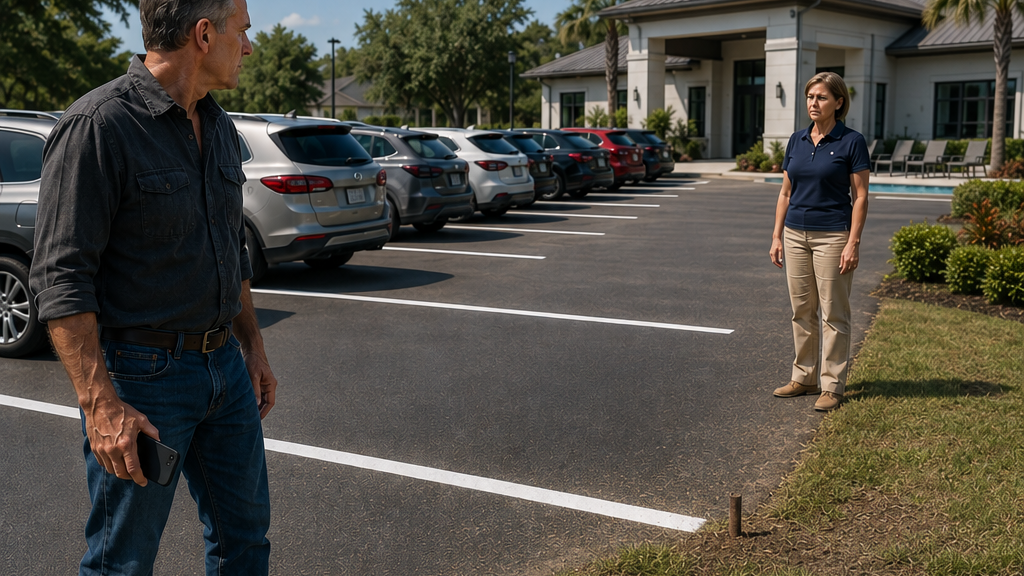
The HOA Painted Parking Spaces Across His Empty Lot—Then One Saturday Forced Everyone to Read the Boundary
Chapter 1: They Painted the Spaces Before Asking Him
Michael Adams counted twelve cars before he understood what bothered him most.
It was not that they were parked on his land.
It was the lines.
Fresh white stripes ran across the narrow parcel beside the clubhouse, bright enough to look almost blue in the Saturday morning sun. Someone had measured them, snapped them straight, and numbered the spaces with small painted marks near the curb. SUVs, sedans, and a minivan sat neatly between them as if the parking lot had always existed.
Michael stopped his truck at the edge of the grass.
For six years, the parcel had been mostly weeds, packed dirt, and a strip of cracked asphalt left from an old service drive. His uncle had owned it before him. Michael paid the taxes, cut the growth twice a year, and otherwise rarely visited.
Apparently, somebody had decided that meant it was available.
A folding sign near the clubhouse entrance pointed toward the cars.
EVENT PARKING.
Michael took out his phone.
He photographed the sign first.
Then the painted spaces.
Then every vehicle.
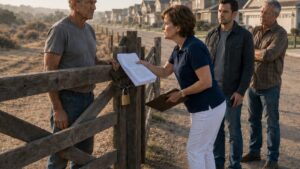
He was taking a wide shot from the rear corner when a woman in a navy polo crossed the clubhouse lawn toward him. He recognized Catherine Moore from neighborhood mailers. HOA president. Early sixties, silver beginning at the temples, always photographed beside some ribbon-cutting or landscaping project.
“Michael?”
He lowered the phone.
“Catherine.”
She looked at the camera screen and then at the lot.
“I heard you might come by.”
“You heard?”
“Amy said she sent you a picture.”
That answered one question. Amy Rivera lived three streets inside the subdivision and had texted him the previous afternoon: You know they striped your lot, right?
Michael had thought she was joking until the photograph loaded.
He gestured toward the nearest white line.
“Who authorized this?”
Catherine did not look embarrassed.
“The association did.”
“The association authorized painting my property?”
“We’ve used this area for overflow for years.”
“That isn’t what I asked.”
Her expression tightened slightly, but her voice remained practical.
“The clubhouse has thirty-one dedicated spaces. We had nearly eighty people registered for the pool event today. Your uncle always let residents use this strip when we needed it.”
Michael looked toward the cars. A family was unloading a cooler from the minivan. Two children in swim shirts ran toward the clubhouse.
“Letting someone park once isn’t the same as painting stalls.”
“We’ve maintained the edge for years. We trim it. We clear trash. Nobody has heard from you about the property in a long time.”
There it was.
Not quite an accusation. Almost worse.
An explanation.
Michael slipped the phone into his pocket.
“So because I wasn’t here, you assumed permission?”
“I assumed the arrangement continued.”
“Did you call me?”
Catherine hesitated.
“We have access rights along this side.”
“That wasn’t my question either.”
A volunteer appeared at the clubhouse door and called Catherine’s name. She lifted one hand without turning around.
“Michael, I’m not trying to create a fight. This is a practical problem. We’ve had access here for years, and the striping keeps people from parking crooked or blocking the service lane.”
He looked down.
One of the lines ran almost directly beneath his shoe.
Something about it felt too deliberate to argue over casually. He had spent thirty-five years estimating commercial jobs. Paint meant layout. Layout meant somebody had measured. Somebody had approved an invoice. Somebody had decided where another person’s land began and ended.
He walked toward the far rear corner.
Catherine followed.
“What are you doing?”
“Checking something.”
Grass had grown thick around an old utility box. Michael remembered his uncle showing him the corner years earlier, tapping the ground with the toe of his work boot.
There’s iron under there. County pin. Don’t let anybody move it.
Michael crouched and pulled at the grass.
It took less than a minute to expose the rust-darkened head of the survey pin.
A new white parking stripe passed less than a foot away.
Catherine stopped talking.
Michael wiped dirt from the metal with his thumb and photographed it with the line in the same frame.
“That’s the boundary marker,” he said.
“I know what a survey pin is.”
“Then whoever laid these spaces should’ve known where they were.”
Catherine folded her arms.
“You’re treating this like we seized your property. We’re using an access area that has served the association for years.”
“Access for what?”
“Utilities. Service. Emergency vehicles. General access.”
“Parking?”
She did not answer immediately.
From the clubhouse came the muffled sound of music and children shouting near the pool.
Michael stood.
“Show me something that says parking.”
“The property manager has the old paperwork.”
“What paperwork?”
“The recorded access documents. I’m not carrying thirty years of association records around at a pool event.”
Michael felt the anger in him change shape.
Until then, the issue had seemed insultingly simple. His lot. Their paint. End of discussion.
But Catherine had said recorded.
Not minutes. Not an old board email. Recorded.
That word mattered.
He looked again at the line passing beside the iron pin.
“Send me whatever you have.”
“I’ll ask the manager Monday.”
“And until then?”
Catherine glanced toward the occupied spaces.
“These people were told they could park here.”
Michael almost told her to move every car.
The words reached the back of his teeth.
Then he saw the father from the minivan carrying two folding chairs while one of his children dragged a pool noodle behind him.
The residents had not painted the lines.
Michael pulled out his phone again.
“Today stays,” he said.
Catherine relaxed slightly.
“But nobody paints anything else, installs anything permanent, or tells me this is settled.”
“We can review it Monday.”
“No. We can read it Monday.”
Her expression changed at that.
Michael took one final photograph: the survey pin, the white stripe, and Catherine standing just beyond both.
As he walked back to his truck, she called after him.
“The property manager really does have the old access paperwork, Michael.”
He opened the driver’s door.
For the first time that morning, he wondered whether the line painted across his property was not the beginning of the dispute at all.
Maybe the dispute had started decades earlier, in paperwork he had never bothered to read.
Chapter 2: The Easement Was Real, but Smaller
The word appeared halfway down the second page.
EASEMENT.
Michael stared at it on his monitor Monday morning, then leaned closer as though distance might change the language.
Catherine had not invented it.
The county recorder’s online index showed an easement tied to the parcel, recorded more than twenty years earlier. Michael downloaded the scanned instrument and printed all six pages.
He read it once.
Then again with a yellow legal pad beside him.
The document granted the neighboring association a narrow corridor along the eastern edge of the parcel for “utility installation, inspection, maintenance, emergency access, and necessary service passage.”
Michael circled the last two words.
Necessary service passage.
He searched the document electronically.
Parking: zero results.
Vehicle storage: zero.
Recreation: zero.
Event: zero.
He sat back.
The relief came, but not cleanly.
He owned the parcel. The deed confirmed that. Yet Catherine had been right about one thing: the HOA possessed a legitimate right across part of it.
At noon Michael drove to the county recorder’s office because he wanted copies stamped from the official system rather than relying only on images downloaded at home.
The clerk printed the deed, easement, and parcel map.
“Anything else attached to this legal description?” Michael asked.
She checked the index.
“Nothing granting parking that I can see.”
“Any amendments?”
“Not under this parcel.”
Michael thanked her and took the documents to a counter near the windows.
The parcel map showed the easement as a narrow rectangular strip.
The new parking configuration did not.
Michael opened the photograph from Saturday and compared it to the recorded dimensions. Most of the painted stalls extended well beyond the access corridor. Several crossed almost the full width of his property.
At home, he scanned everything and made a simple overlay using the same estimating software he had once used for site plans.
Gray rectangle: his parcel.
Narrow shaded strip: HOA easement.
White marks: approximate parking stalls.
The difference was almost absurd.
Catherine had described the entire lot as an access area.
The recorded document described something closer to a lane.
Michael emailed the overlay and copies of the records to the HOA property manager, Catherine, and the association’s general inbox.
He kept the message short.
The recorded easement does not grant parking rights. Please suspend use of the parcel for vehicle parking and remove the painted markings pending resolution.
He received the property manager’s reply forty minutes later.
Thank you. We are reviewing historical records.
Catherine replied six minutes after that.
The association disagrees with your interpretation and will continue existing operations while the board reviews the matter.
Michael read the sentence twice.
Existing operations.
He called her.
She answered on the third ring.
“You got my email.”
“I did.”
“You saw the easement.”
“Yes.”
“Where does it say you can park twelve cars?”
“Michael, easement language is not always read as narrowly as you’re reading it.”
“I’m reading the words on the page.”
“And I’m telling you this area has been used as part of clubhouse access for years.”
“Access is not storage.”
“Parking for two hours during an event is hardly storage.”
“That’s not the point.”
“Then what is the point?”
He looked at the overlay on his screen.
“The point is you changed the land. You painted spaces. You directed people there. You did all of it without asking the owner.”
A pause.
Then Catherine said, “We’re trying to avoid turning a manageable neighborhood issue into a legal dispute.”
Michael almost laughed.
“You painted the dispute on the ground.”
“That’s exactly the kind of line that makes this harder.”
She sounded tired rather than angry.
For a moment, he imagined the Saturday crowd, the undersized clubhouse lot, volunteers waving cars into whatever open space they could find.
Then he remembered the white stripe passing beside the survey pin.
“What happens at the next event?” he asked.
“We have a board review scheduled.”
“That wasn’t my question.”
“We aren’t canceling community activities while documents are being reviewed.”
Michael’s grip tightened around the phone.
“You have notice now.”
“And you have notice that the association disputes your interpretation.”
After the call, he printed her email and placed it behind the easement in a folder.
The old version of Michael would have considered the folder enough. He had spent years in construction disputes where the person with the better records usually won.
But this was not a contractor disagreement.
People lived beside the land.
By Tuesday afternoon, Amy called.
“You two are really digging in, huh?”
“Did Catherine send everybody my email?”
“No. That’s why I’m calling.”
Michael turned away from his computer.
“What did she send?”
“Nothing about a dispute. Just that overflow arrangements were being reviewed.”
“That could mean anything.”
“Exactly.”
Amy hesitated.
“Most people here think that strip belongs to the HOA.”
Michael looked out his home-office window.
“Why?”
“Because we use it. Because the landscaping crew cuts the edge sometimes. Because every summer there are cars there during events.”
“My uncle allowed some parking.”
“People don’t know that distinction.”
“I didn’t either until Saturday.”
“That’s my point.”
Michael heard the implication and disliked it because it landed too close to something true.
He had inherited the land but not the relationships attached to it.
After his uncle died, Michael had handled taxes, title work, and maintenance like items on a checklist. He had never asked why cars sometimes appeared in old photographs of neighborhood events.
His phone chimed.
Amy said, “I just sent you something.”
An image opened.
It was an HOA event notice for Friday evening.
At the bottom was a parking diagram.
The clubhouse lot was shaded one way.
Michael’s parcel was shaded another.
A small arrow pointed directly toward the newly painted stalls.
OVERFLOW PARKING.
Michael enlarged the image.
No mention of disputed ownership.
No caution.
No request.
His first reaction was anger.
His second was colder.
Catherine had now seen the easement.
She knew what it said.
And she was still directing cars onto the land.
Michael saved the image into the folder beside the deed.
Then he looked at Friday’s date.
Four days away.
Chapter 3: His Warning Signs Changed the Fight
Michael arrived at the parcel Thursday morning and found an HOA sign planted six inches from his own.
His sign was red and white, installed the previous afternoon by a local sign contractor:
PRIVATE PROPERTY. PARKING BY OWNER AUTHORIZATION ONLY. UNAUTHORIZED VEHICLES SUBJECT TO TOW.
The HOA sign beside it was smaller, laminated, and attached to a green stake.
EVENT OVERFLOW PARKING.
For several seconds Michael simply stood between them.
Two instructions.
One patch of land.
Only one could be true.
He photographed both signs together.
Then he called the property manager.
“Did you put this out?”
A pause followed.
“I didn’t personally.”
“Did the association?”
“I’ll have to check.”
“Please check now.”
Another pause.
“I believe event volunteers may have placed directional signs last night.”
“After my notice went up?”
“I don’t know the timing.”
Michael looked across the white stalls.
“Remove it.”
“I’ll contact Catherine.”
“No. I’m notifying management. Remove it.”
His voice stayed level, but he could hear the hardness in it.
By lunchtime the green sign was gone.
At three, another appeared twenty yards closer to the clubhouse.
This one pointed with an arrow rather than naming the parcel.
Michael understood the tactic immediately.
Technically less direct.
Practically identical.
Amy pulled up while he was photographing it.
She lowered her car window.
“You’re going to wear out that camera.”
“It doesn’t get tired.”
“That’s what worries me.”
She parked and came over.
Michael showed her the sign.
“They know this is disputed.”
“I know.”
“Then why keep directing people here?”
Amy looked toward the clubhouse.
“Because they don’t have anywhere else to put forty extra cars.”
“That doesn’t make this theirs.”
“I didn’t say it did.”
She folded her arms.
“But you need to understand something. Nobody coming tomorrow thinks they’re trespassing.”
Michael said nothing.
Amy continued.
“They got an event email. They got a parking map. Some of them have parked here for years. If you tow them, they’re not going to think Catherine did something wrong. They’re going to think you did.”
“Then Catherine should correct the email.”
“She should.”
“She hasn’t.”
“No.”
Michael looked at the white lines.
“And I’m supposed to keep letting it happen because she made residents believe something that isn’t true?”
“I’m saying you can be right and still make this worse.”
He felt himself stiffen.
There were certain sentences Michael had heard too often in construction disputes. Be reasonable usually meant accept the problem. Work with us usually meant absorb the cost.
“I gave notice.”
“To the board.”
“It’s their event.”
“It’s residents’ cars.”
That stayed with him after Amy drove away.
For ten minutes.
Then Michael called a licensed towing operator.
The dispatcher explained the requirements for private-property towing. Proper signage. Verified authority. Clear photographs. Contract documentation. Local notification procedures.
Michael asked questions until he understood each one.
By Friday morning, he had signed the agreement.
The tow company verified his deed and photographed the posted signs.
Michael added two more notices along the parcel perimeter so nobody could reasonably enter without passing one.
The result looked almost ridiculous.
Fresh white parking spaces framed by red private-property warnings.
The paint invited people in.
The signs told them to stay out.
At noon, Catherine called.
“You hired a towing company.”
It was not a question.
“Yes.”
“This is escalating.”
“I asked you to suspend parking.”
“The board hasn’t finished its review.”
“You don’t need a board review to stop using land while ownership rights are disputed.”
“We are not disputing ownership.”
Michael paused.
That was new.
“Then what are you disputing?”
“The scope of our historical access.”
“Your historical access does not say parking.”
“We’ve been over this.”
“Yes.”
“Then why are we doing it again?”
“Because the cars are coming tonight.”
Catherine exhaled.
“Michael, some of those residents are elderly. Some will have children with them. You know the main clubhouse lot fills quickly.”
“Then tell them not to park on my property.”
“You could give us one more event while this is reviewed.”
“You had Saturday.”
“That was before you retrieved the records.”
“Exactly.”
Silence.
Then Catherine said more quietly, “Your uncle never handled it like this.”
Michael felt the remark where she intended it to land.
“My uncle is dead.”
“I know that.”
“Then stop using what you think he would have done as permission from me.”
He ended the call before she could answer.
At six-thirty that evening, Michael parked across the street where he could see the parcel without blocking traffic.
He told himself he was there to document.
Nothing more.
Cars began arriving within minutes.
Some drivers slowed at his red signs.
A few continued toward the clubhouse lot.
Others followed an HOA volunteer’s hand signal toward the painted stalls.
Michael watched one sedan stop beside the private-property notice. The driver leaned forward as if reading it.
The volunteer walked over, spoke through the open window, then pointed toward an empty white space.
The sedan pulled in.
Michael lifted his phone and photographed the scene.
That was the moment something changed for him.
Until then, he had allowed room for confusion.
Now there was a visible warning on one side and an association volunteer overruling it on the other.
Amy had been right that residents believed the HOA.
But Catherine had created that belief and was continuing to reinforce it after receiving the deed, easement, photographs, and written objection.
By seven-fifteen, every painted stall was occupied.
Twelve vehicles sat in clean white rectangles across Michael’s parcel.
Music drifted from the clubhouse patio.
A volunteer removed the last directional sign and carried it inside.
Michael sat behind the wheel of his truck with the towing contract open on his phone.
The dispatcher had told him one call would activate the agreement.
He looked at the families walking toward the clubhouse.
Then at the red signs.
Then at the white lines.
His thumb rested over the dispatcher’s number.
For the first time since Saturday, there was nothing left for Catherine to misunderstand.
Chapter 4: The Tow Trucks Made Him Question Himself
The first woman out of the clubhouse stopped so abruptly that the people behind her nearly walked into her.
“My car was right there.”
Michael heard her from across the lot.
She stood beside an empty white space with a folded sweater over one arm and a paper plate covered in foil in the other. A man stepped around her, looked toward the next row, then back at the blank pavement.
Within thirty seconds, three more people were outside.
Then six.
Michael remained beside his truck.
Two tow trucks had already left. A third had pulled away less than five minutes earlier. The dispatcher had followed the contract exactly: photograph the vehicle, verify the signage, record the stall, tow only from Michael’s parcel.
The clubhouse lot itself had not been touched.
That distinction had seemed important when Michael made the call.
Now, watching a father search his pockets while two tired children stood beside him, it seemed smaller.
Catherine came through the clubhouse doors at a fast walk.
She saw the empty spaces first.
Then Michael.
Her face changed.
“You actually did it.”
Michael put his phone in his pocket.
“I gave notice.”
“To me.”
“To the association. To management. On the property.”
A resident near them turned.
“You had our cars towed?”
Michael said, “The posted signs said unauthorized vehicles would be removed.”
“The HOA told us to park here.”
Catherine looked at him.
“There. Do you hear that?”
Michael felt the eyes settling on him now.
He had expected anger from Catherine.
He had not fully pictured the residents.
The woman with the foil-covered plate said, “I read the red sign. The volunteer told me the HOA had permission.”
Michael remembered the sedan stopping beside that exact sign.
The volunteer walking to the window.
The hand pointing toward the stall.
He had photographed it.
At the time, the image had felt like proof.
Now it felt like something else too.
Catherine stepped closer.
“You knew they were being directed here.”
“Yes.”
“And you towed them anyway.”
“You knew they were being directed onto private property.”
“This isn’t about me right now.”
“It became about you when you kept telling people to park here.”
A man behind Catherine said, “Where are the cars?”
Michael gave him the towing company’s number.
The man stared at the card Michael held out.
“You planned this.”
“Yes.”
The answer quieted the small group more effectively than an argument would have.
Catherine’s voice dropped.
“You could have stopped them as they came in.”
Michael looked at her.
“So could you.”
For a second neither spoke.
Then someone farther back muttered that the fee was more than two hundred dollars.
Michael felt a hard little satisfaction when Catherine flinched.
It lasted perhaps two seconds.
Amy arrived ten minutes later.
She did not greet him.
She walked straight past Catherine and stood beside the empty spaces. White paint remained where the cars had been, orderly and bright under the parking-lot lights.
“You called them,” she said.
Michael nodded.
“All of them?”
“Only vehicles on my parcel.”
Amy looked toward the clubhouse lot.
“That’s not what I asked.”
Michael did not answer.
She turned toward him.
“My neighbor’s daughter parked here because a volunteer waved her in. She’s nineteen, Michael.”
“The signs were posted.”
“And she was told the signs didn’t apply during HOA events.”
He looked at Catherine.
Catherine said nothing.
Amy did not let him redirect it.
“I told you people thought this was association parking.”
“I gave the board four days.”
“The board isn’t standing at an impound yard tonight.”
Michael felt himself harden again.
“If I let it happen one more time, what exactly changes?”
“Maybe nothing. Maybe you stand here and tell drivers yourself.”
“That makes me the parking attendant on my own land.”
“No. It makes sure the people paying for Catherine’s mistake are the people who made it.”
The words landed harder because Amy was not defending the HOA.
She was defending the residents.
Michael looked at the empty stalls.
Three days earlier those white lines had represented Catherine’s assumption that his silence meant consent.
Now they represented his own assumption—that clear signs meant everyone understood the dispute.
He had been legally careful.
He was no longer sure he had been careful enough.
Catherine’s phone began ringing.
Then ringing again.
She stepped aside to answer.
Michael watched her explain the towing company’s location to somebody, her voice clipped and controlled.
For the first time since the dispute began, she looked like someone who no longer controlled the situation.
That should have felt like victory.
It did not.
The next morning an envelope arrived by email from the HOA’s attorney.
Michael opened it at his kitchen table.
The letter accused him of interfering with rights granted under the recorded easement and demanded that he suspend towing and restore association access while the dispute was resolved.
The language was firm without being dramatic.
Michael read it twice.
Then he forwarded it to his own attorney with the deed, easement, towing contract, photographs of every sign, and the parking diagram Amy had sent.
His attorney called an hour later.
“You documented well.”
Michael waited.
“But?”
“But their easement is real. Narrow, yes. That doesn’t mean they win the parking argument, but don’t treat this like nothing exists on their side.”
“I’m not.”
“You sound like you are.”
Michael rubbed his forehead.
“What would you do?”
“I’d stop talking in absolutes until we know the history.”
After the call, Michael opened the folder containing Saturday’s photographs.
He stopped at the picture of the sedan beside the red sign.
The volunteer was visible through the windshield reflection, pointing toward the stall.
Proof again.
But proof of what?
That Catherine had ignored him?
Or that the driver had been caught between two people fighting over authority she could not possibly verify from behind the wheel?
His phone buzzed.
A text from an unfamiliar number.
Dennis Mitchell, HOA treasurer. Catherine gave me your contact information.
Michael almost ignored it.
A second message followed.
Could you send me the easement copy you pulled from the county?
Michael typed: Your management company should have it.
Dennis replied almost immediately.
They do.
Then, after a pause:
What I need is the version you’re relying on. Our board file doesn’t contain any separate parking agreement.
Michael stared at the screen.
He read the sentence again.
No separate parking agreement.
He sent Dennis the recorded easement.
Thirty seconds later, Dennis replied:
Thank you. We need to talk before the next board meeting.
Michael set the phone down.
Until that moment, he had assumed Catherine and the board were speaking with one voice.
Now he wondered whether Catherine had ever told them exactly what she had painted over.
Chapter 5: The Missing Agreement Was Really a Budget Problem
Dennis Mitchell slid a single invoice across the conference table and tapped the description with one finger.
Michael read it.
Grounds maintenance—striping and traffic control.
He looked up.
“This is the parking lot?”
Dennis nodded.
“The white lines.”
They were sitting in the HOA management office two evenings before the scheduled board meeting. The property manager had agreed to let Dennis review financial records after he asked why there was no parking license, lease, or easement amendment in the association file.
The striping invoice was for less than Michael expected.
That almost made it worse.
A decision about his land had been reduced to a maintenance expense small enough to disappear inside an ordinary monthly report.
“No board vote?” Michael asked.
“Not that I can find.”
“Who approved it?”
Dennis turned the paper around.
At the bottom was an electronic authorization.
Catherine Moore.
Michael leaned back.
Dennis seemed uncomfortable rather than triumphant.
“I thought we had permission.”
“You’re the treasurer.”
“I review money. I don’t verify title every time we repaint something.”
“You never wondered why the HOA owned a strip of land that wasn’t on the association parcel?”
Dennis exhaled.
“That’s fair.”
Michael had expected defensiveness.
Instead Dennis looked at the invoice again.
“I assumed Catherine had handled it. That’s on me.”
The admission took some heat out of Michael’s next sentence.
“Why would she do this without checking?”
Dennis was quiet for several seconds.
Then he opened a different folder.
Inside were estimates.
Paving.
Drainage.
Curb work.
A small additional parcel near the clubhouse.
The numbers were not enormous by commercial standards, but Michael understood immediately what they meant for a residential association.
“You were looking at expanding parking.”
“For three years.”
“What happened?”
Dennis pointed to the reserve balance.
“Roof work. Pool equipment. Storm drainage. We deferred the parking project twice.”
“And the board didn’t want a special assessment.”
“Nobody wants a special assessment.”
“Catherine especially?”
Dennis gave a tired smile.
“Catherine is the person who has to stand in front of seventy homeowners and tell them their annual dues aren’t enough.”
Michael folded his arms.
“That still doesn’t explain painting my property.”
“No. It explains why solving the actual parking problem kept getting postponed.”
At the board meeting two nights later, the invoice was on the table before Michael arrived.
The atmosphere felt different from the confrontation beside the pool.
No children.
No music.
No residents unloading coolers.
Just folding tables, bottled water, documents, and adults forced to attach names to decisions.
Catherine sat at the center.
Dennis sat two chairs away.
The property manager opened the discussion by summarizing the title records and the easement language.
Michael listened without interrupting.
When she finished, Catherine said, “The association’s position has always been that the area functioned as overflow connected to our access rights.”
Dennis looked at her.
“Always?”
Catherine turned.
“What does that mean?”
“It means I’d like to know when the board approved permanent parking.”
The room became very still.
Catherine glanced toward the other board members.
“We’ve discussed parking repeatedly.”
“We discussed capacity,” Dennis said. “We discussed paving options. I cannot find a vote authorizing striping on Michael’s parcel.”
“It was treated as maintenance of an existing use.”
Michael looked at the invoice.
There it was.
The same phrase.
Existing use.
A phrase broad enough to hide the moment temporary became permanent.
Michael said, “Did you know there was no current written permission from me?”
Catherine met his eyes.
“I knew we did not have a new agreement with you.”
“That’s not the question.”
Her jaw tightened.
“Yes.”
Dennis shifted in his chair.
Michael asked, “Did you know the recorded easement did not say parking?”
“I knew it did not use that word.”
“And you painted spaces anyway.”
Catherine’s restraint finally cracked.
“Because every alternative we priced cost money this association does not have.”
Nobody interrupted her.
She continued, quieter now.
“We have a clubhouse that was built when this neighborhood had half the number of homes it has now. We have a pool people expect to use, meetings people expect to attend, holiday events, senior lunches, summer programs. Every time parking comes up, residents want a solution until they see the price.”
Dennis said, “That doesn’t make his lot ours.”
“I didn’t say it did.”
“You treated it like it did.”
Catherine looked at him.
“And when I brought the last expansion estimate to finance, what did you say?”
Dennis hesitated.
“That the reserves couldn’t support it.”
“Exactly.”
Michael watched the exchange.
For the first time, Catherine’s decision looked less like casual entitlement and more like a series of avoided conversations.
Still wrong.
But not mysterious.
She had solved a public problem by using a private resource whose owner had been mostly absent.
Convenience had become policy because policy would have required somebody to pay.
Michael said, “You could have called me.”
Catherine looked back at him.
“And asked what? Whether you’d donate a parking lot?”
“You don’t know because you never asked.”
“No. I thought I already knew the arrangement.”
There was something in the way she said it.
Michael noticed Dennis did too.
“What arrangement?” Michael asked.
Catherine reached into her folder.
“I was hoping we wouldn’t need to go back this far.”
She removed a yellowed sheet of paper folded twice.
Michael recognized his uncle’s handwriting before she placed it in front of him.
The letters leaned slightly to the right. Heavy pressure on the downstrokes. The same handwriting Michael had seen on tool labels and old tax envelopes.
Catherine said, “Your uncle gave this to the association years ago.”
Michael unfolded it carefully.
It was short.
Use the side strip for overflow on event days if the clubhouse fills. Keep the service lane clear.
No date appeared at the top, but a note in different handwriting referenced a neighborhood charity picnic.
Michael read it again.
Something cold moved through him.
Catherine did not sound victorious.
“He never made us ask every time.”
Michael looked up.
“You told me there was old access paperwork.”
“There is.”
“This isn’t the easement.”
“No.”
“You let me spend a week arguing about easement language when you had this.”
“I was trying to locate the original.”
Dennis said, “Was this shown to the board before the striping?”
Catherine did not answer quickly enough.
Michael looked at the handwriting again.
His uncle had permitted overflow.
Not once, apparently.
Maybe repeatedly.
A fact Michael had never known because he had never asked what relationships came with the property.
Still, one detail bothered him.
He touched the paper.
“Where does he authorize permanent spaces?”
Catherine’s eyes dropped to the note.
Now it was Michael’s turn to see uncertainty cross her face.
Chapter 6: His Uncle’s Courtesy Had Become Somebody Else’s Rule
The second note was in a dented metal file box Michael had nearly thrown away three years earlier.
He found it beneath old insurance policies, mower receipts, and a stack of property-tax stubs tied with a rubber band.
The paper was addressed to the HOA property manager from more than a decade ago.
Michael sat on the floor of his home office and read the final sentence twice.
Event overflow is fine when needed. Nothing permanent on the strip—no paving, signs, striping, or structures without checking with me first.
He rested the page against his knee.
For days, he had been angry that Catherine knew more about his uncle’s arrangement than he did.
Now the missing half of that arrangement was in his own house.
He had inherited the file box.
He had simply never opened it.
Michael called his attorney first.
Then Dennis.
Then Catherine.
Catherine did not answer.
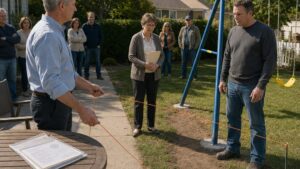
At the survey meeting two days later, she arrived before the licensed surveyor had finished setting his equipment.
Michael handed her a copy of the note without comment.
She read it beside the first white stall.
Her face gave away the answer before she spoke.
“You found this.”
“You remember it.”
Catherine looked toward the clubhouse.
“Yes.”
Michael felt a sharper anger than he expected.
“So you knew.”
“I knew he didn’t want anything permanent at the time.”
“At the time?”
“That was years ago.”
“The sentence didn’t expire.”
“No.”
The surveyor moved behind them, measuring from the exposed iron pin toward the front of the parcel.
Michael watched him place a temporary mark across one painted stall.
The bright survey mark cut directly through the white line.
For weeks the painted stalls had looked official because they were straight.
Now another straight line told a different story.
Michael said, “Why didn’t you tell me about this when I asked who authorized the striping?”
Catherine folded the copy carefully.
“Because I knew how it would sound.”
“It sounds like you knew you weren’t supposed to do it.”
“I knew your uncle had objected to permanent improvements. I also knew he let us use the strip for years after that.”
“Use it. Not redesign it.”
“I understand that now.”
“You understood it then.”
Catherine looked at him.
This time she did not argue.
“Yes.”
The admission was quieter than Michael expected.
It also left him with nowhere easy to put his anger.
She continued.
“The parking expansion estimate came back. We couldn’t afford it. Dennis said a special assessment would be a hard sell. We had events coming up, and people had already been parking on the strip anyway.”
“So you painted it.”
“I told myself striping wasn’t really permanent.”
Michael glanced at the lines.
“Paint lasts longer than permission.”
Catherine nodded once.
“I know.”
The surveyor called Michael over.
He explained the measured boundary and the easement corridor. The recorded access strip remained valid along the eastern edge, wide enough for utility and emergency/service passage.
The stalls extended well outside it.
The result did not erase the HOA’s rights.
It defined them.
Michael photographed the survey marks where they crossed the parking lines.
For the first time since Amy’s original picture, the lot looked understandable.
Not his entirely free of obligations.
Not the HOA’s to use however it pleased.
A boundary with a legitimate corridor through it.
That afternoon Amy stopped by while Michael was collecting copies of the survey stakes.
She looked at the marks.
“So you won.”
Michael surprised himself by saying, “Not exactly.”
Amy raised an eyebrow.
“They have an access easement.”
“But no parking.”
“No parking.”
“That sounds like winning.”
Michael looked toward the clubhouse.
“I also found proof my uncle let them use it for events.”
“I thought Catherine already had that.”
“She had half of it.”
He told her about the second note.
Amy listened.
Then she said, “That sounds like your uncle.”
Michael smiled faintly.
“You barely knew him.”
“He used to complain about people blocking the service lane, then bring extra folding chairs to the picnic.”
That image struck Michael harder than the documents had.
His uncle had not treated permission as weakness.
He had simply kept the distinction clear.
Yes to a neighbor.
No to ownership by habit.
Michael had inherited the no and forgotten the yes.
At the settlement meeting the following Monday, his attorney placed two options in front of him before anyone else arrived.
The first was a litigation draft seeking removal of the striping, injunctive relief, costs, and damages associated with unauthorized use.
The second was a proposed settlement.
Remove the parking lines.
Stop directing general event parking onto the parcel.
Preserve only the recorded utility and emergency/service easement.
Reimburse affected residents for part of the towing expense.
Pay for the survey and removal work.
Document everything.
Michael read both.
“What would you choose?” he asked.
His attorney shook his head.
“I’m not the one who has to live beside them.”
When Catherine and Dennis arrived, the discussion lasted almost two hours.
Dennis supported reimbursement.
Catherine resisted using reserve funds.
Michael agreed the reserves should not be depleted for a mistake that had nothing to do with roofs, drainage, or pool equipment.
The practical pieces slowly narrowed.
Then Catherine said, “If you intend to pursue the association and me personally over the authorization, I’ll resign.”
Dennis turned toward her.
Michael said nothing.
Catherine looked tired.
Not defeated.
Not dramatic.
Just tired.
“I made the decision,” she said. “The board relied on me. If you want an individual defendant, then I won’t sit as president while this goes forward.”
Michael looked at the unsigned litigation draft.
A month earlier, the offer might have satisfied something in him.
She had painted lines across his property.
She had ignored his objection.
She had continued directing cars there after reading the easement.
She had remembered his uncle’s limitation and convinced herself it no longer mattered.
All of that remained true.
So did the fact that Michael had watched residents park while knowing they were being misled, then chosen the cleanest legal remedy rather than the messier human one.
He had been right about the boundary.
Amy’s question still followed him.
Who paid for whose mistake?
Michael closed the litigation draft.
“I don’t want your resignation.”
Catherine looked at him carefully.
“That’s not the same as saying you’re settling.”
“No.”
“What do you want?”
Michael glanced through the conference-room window toward the clubhouse beyond the parking area.
“I want the lines gone. I want the access easement written down in terms nobody can stretch into something else. I want the residents who were towed reimbursed fairly.”
“And after that?”
He looked back at her.
“After that, I want everyone to stop pretending silence means yes.”
No one answered immediately.
Catherine rested both hands on the table.
For the first time since Saturday morning, Michael realized the hardest decision was no longer whether he could force the association off his property.
He could.
The question was what he would choose to leave behind once they moved.
Chapter 7: They Removed the Lines and Kept the Boundary
Michael carried the unsigned litigation draft into the HOA meeting in a plain manila folder.
He had not decided whether that was leverage or insurance.
Catherine noticed it the moment he sat down.
So did Dennis.
The property manager had arranged the tables in a square instead of rows. No audience. No pool volunteers. No residents waiting to speak. Just the people who had to turn several weeks of arguments into something that could survive after everyone left the room.
Michael placed the folder beside his copy of the survey.
His attorney sat to his right.
Across from them, the HOA attorney opened a settlement draft.
“We’re close,” the attorney said. “But we’re not finished.”
Michael looked at the first page.
The association agreed to remove the white parking lines from his parcel.
It agreed to discontinue all event-parking instructions directing residents onto his land.
It agreed to pay the survey cost and the cost of restoring the surface where the striping had been applied.
Those were the easy parts.
The difficult language began on page three.
The HOA wanted written confirmation that its existing easement remained enforceable for utility crews, emergency vehicles, and necessary service access to the clubhouse infrastructure.
Michael read the paragraph twice.
Three weeks earlier, he might have struck it out simply because Catherine wanted it.
Now he picked up a pen.
“This needs dimensions.”
The HOA attorney nodded. “We can attach the survey.”
“And no parking within the corridor.”
“Agreed.”
“No temporary event staging either.”
Catherine said, “What about a utility vehicle that has to stop while work is being done?”
Michael looked at her.
“That’s service access.”
“So stopping isn’t automatically parking.”
“No.”
A faint expression crossed her face. Not a smile. Something closer to relief that the conversation had finally become precise.
Michael added, “But it doesn’t become overflow because somebody puts a folding sign beside it.”
Dennis lowered his eyes toward the papers.
Catherine accepted the point without argument.
The towing reimbursements were harder.
Several residents had paid removal and storage charges. The association attorney proposed reimbursing half.
Michael’s attorney had originally suggested the HOA cover all of it.
Dennis opposed using reserve funds.
“We shouldn’t take money designated for drainage and major repairs,” he said. “Not for this.”
Michael agreed.
Catherine looked surprised.
He said, “The reserve didn’t paint my lot.”
Dennis leaned forward.
“We can use current operating funds. It means postponing some nonessential landscaping and one clubhouse equipment purchase.”
“How much reimbursement?” Michael asked.
Dennis named the amount available without creating a deficit.
It would cover the towing charges themselves and a portion of storage costs for residents who had retrieved their cars the following day.
Not every dollar.
But most of the direct loss.
Michael thought of the woman holding the foil-covered plate.
The nineteen-year-old Amy had mentioned.
The father with two tired children.
He had told himself the posted signs had made the choice theirs.
That was only partly true.
They had been standing between two competing claims of authority, and he had knowingly allowed the conflict to reach them.
“Use the operating funds,” Michael said.
Catherine looked at him.
“And the remainder?”
“I’ll cover the difference between the tow charge and what the association reimburses for the people who were directed there by volunteers.”
His attorney turned toward him.
“You’re not legally obligated to do that.”
“I know.”
The room stayed quiet.
Michael continued.
“They were warned by my signs. They were also told by your people those signs didn’t apply. I’m not going to pretend only one of those things happened.”
Dennis slowly nodded.
Catherine looked down at the settlement draft.
“That’s more than I expected.”
Michael almost said, So was painting my property.
The sentence formed easily.
He let it go.
“What I want,” he said, “is something nobody has to interpret next year.”
The property manager moved the survey to the center of the table.
They spent the next forty minutes doing what should have been done before the first gallon of white paint had ever been opened.
They defined the access corridor by measured boundary.
They identified its permitted uses.
They prohibited general parking, event parking, storage, signs implying association ownership, and permanent improvements without the property owner’s written consent.
They also wrote down Michael’s obligations not to obstruct legitimate utility or emergency access.
The document bound both sides.
That mattered to him.
By the time they reached the signature pages, the manila folder containing the lawsuit had not been opened.
Catherine noticed.
“You’re not filing?”
Michael rested his hand on the folder.
“Not if this gets signed and carried out.”
“And the claim against me personally?”
“Gone with the settlement.”
She sat back.
For several seconds she looked less like the HOA president than a tired homeowner who had spent too many evenings solving problems nobody else wanted to own.
“I should have called you,” she said.
It was not an apology shaped for a room.
No speech followed.
Michael answered, “Yes.”
Catherine nodded.
“I thought I was preserving something that already existed.”
“You were preserving the convenience.”
“That too.”
Dennis said quietly, “We all were.”
Michael looked at him.
Dennis had admitted his own part weeks earlier. He had seen parking estimates, rejected costs the reserves could not carry, and assumed Catherine had solved the remaining problem properly.
No conspiracy.
Just several people allowing an easy arrangement to become easier than asking what it actually meant.
Michael signed.
Catherine signed after him.
The next Saturday, a contractor arrived at the parcel with a grinding machine.
Michael stood near the rear corner while the white stripes disappeared one by one.
The process was less dramatic than painting them had been.
No confrontation.
No residents gathering around.
The machine scraped across the surface, leaving pale scars where the stalls had been.
Amy walked over from the clubhouse carrying two coffees.
She handed one to Michael.
“You planning to photograph every line coming off too?”
“Yes.”
“I figured.”
He took a picture.
She watched the machine for a moment.
“So what happens when the clubhouse lot fills?”
“They figure out legal parking.”
“That sounds less convenient.”
“It probably will be.”
Amy smiled.
“Progress.”
A utility contractor’s van entered the narrow easement corridor and stopped near the service equipment behind the clubhouse.
Michael glanced at it.
Amy noticed.
“You okay with that?”
“That’s what the easement is for.”
She studied him.
“You would’ve hated saying that a month ago.”
“I still don’t enjoy it.”
“That sounds more believable.”
Near the rear corner, the contractor reached the last remaining white stripe.
It ran beside the iron survey pin Michael had uncovered on the first Saturday.
The grinding wheel crossed the paint.
White became dust.
The pin remained.
Michael crouched and brushed the loose grit away from its rusted head.
His uncle had shown him that marker years ago as if boundaries were simple things: iron in the earth, a point that did not move because people wished it somewhere else.
Michael understood now that the marker was only half the lesson.
The land could have a boundary and still carry an obligation across it.
A neighbor could have permission without ownership.
A right could be defended without turning every mistaken person into an enemy.
Behind him, Catherine approached from the clubhouse.
She stopped a few feet away.
“The board approved the reimbursement checks yesterday.”
“Dennis told me.”
“We also removed the overflow diagram from the event packet.”
Michael stood.
“Good.”
Catherine looked toward the faint marks where the stalls had been.
“For what it’s worth, I don’t think your uncle would have liked the striping either.”
Michael glanced at the survey pin.
“No.”
Then he looked at her.
“But I don’t think he would’ve liked the towing much.”
Catherine did not answer immediately.
“Probably not.”
Michael nodded.
Neither of them needed to make more of it.
The contractor finished the last line and shut down the grinder.
For the first time in weeks, the parcel looked unfinished again.
Not abandoned.
Not claimed.
Simply defined.
Michael took one final photograph.
At the bottom of the frame sat the exposed iron pin.
Beyond it ran the narrow access corridor the HOA legitimately possessed.
And where the painted parking spaces had once announced a certainty nobody had earned, there was only bare pavement and a boundary everyone had finally agreed to read.
The story has ended.