They Turned His Farm Lane Into a School Pickup Line—Then the Old Permission Letter Changed Everything
Chapter 1: The Minivans Arrived Before the Feed Truck
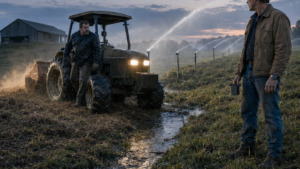
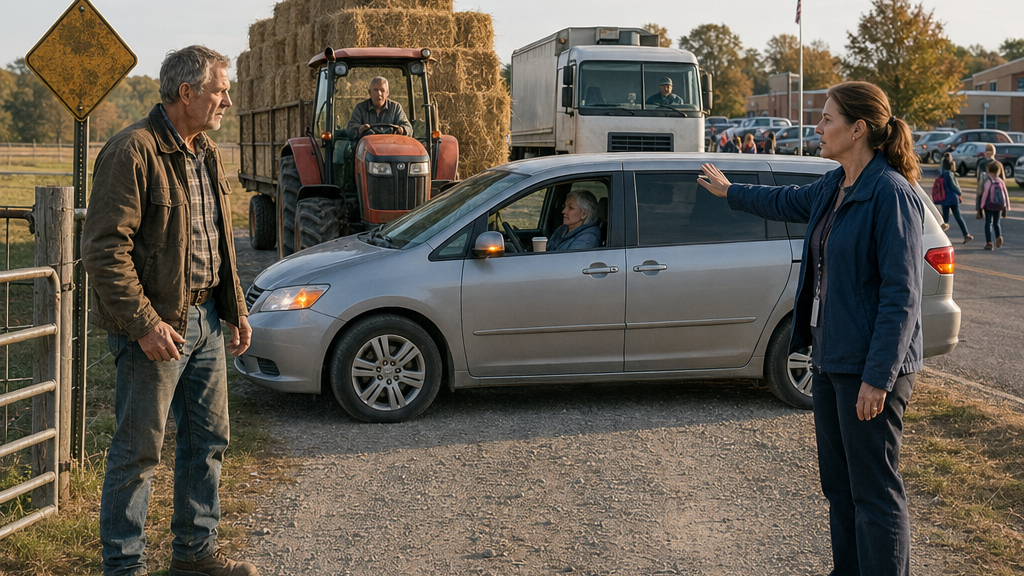
The silver minivan rolled across Larry Miller’s farm entrance just as the front tires of his tractor reached the gate.
Larry hit the clutch.
The tractor stopped hard enough to make the stacked hay on the wagon behind him shift against its straps. Dust pushed forward around the tires, then settled over the narrow gravel lane.
The minivan stopped sideways across the entrance.
Its hazard lights began blinking.
Larry stared through the tractor windshield.
Thirty yards farther down the county road, the elementary school’s dismissal line had already formed. Cars crawled past the low brick building in two uneven rows. A crossing aide stood near the bus entrance. Children would not be released for another few minutes.
The woman in the minivan looked down at her phone.
Larry tapped the horn once.
She did not look up.
He glanced behind him. The feed truck he had been expecting since noon had finally arrived and was now stopped on the county road behind the hay wagon. Its driver lifted one hand from the wheel in a question Larry could not answer.
Beside the gate, a yellow metal sign faced the road.
PRIVATE FARM LANE.
The bottom line was smaller but still plain enough to read from a car window.
KEEP ENTRANCE CLEAR.
Larry had bolted the sign to the cedar post three years earlier after pickup traffic first began creeping toward his property. At the time, two or three cars might nose onto the gravel shoulder during dismissal. Nobody stayed long. Nobody blocked the gate.
That had changed.
Larry set the brake and climbed down.
The woman finally looked up when he approached her window.
She was gray-haired, perhaps in her sixties, with a paper coffee cup in the holder beside her. Her window came down only halfway.
“You’re blocking the farm entrance,” Larry said.
She glanced toward the school.
“I’m just waiting for my granddaughter.”
“I need to get this tractor through.”
“It’ll be one minute.”
Larry looked at the school clock visible above the gym doors. The minute hand stood three ticks before three.
“The feed truck behind me needs in too.”
The woman sighed, not angrily, exactly. More as if Larry had asked her to do something unnecessarily difficult.
“They’re about to dismiss.”
“You can pull ahead.”
“There’s nowhere to pull ahead.”
“There’s a county road.”
“And there are children walking along it.”
Larry looked back at the feed truck. Another vehicle had stopped behind it.
He lowered his voice.
“Ma’am, this is a working entrance.”
She raised her coffee and took a sip.
“One minute.”
Larry stood there another second before walking back to the tractor.
He could have argued.
He could have called the school.
He could have blocked her in with the tractor and forced the issue.
Instead, he climbed into the cab and did what he had done too many times in the last year. He waited.
At 2:59, children began appearing outside the school.
At 3:04, the minivan still had not moved.
At 3:09, a boy climbed into a pickup parked behind it.
At 3:13, the feed-truck driver stepped down from his cab.
“You want me to come back tomorrow?” he called.
“No.”
Larry pulled out his phone and opened the notes app.
Silver minivan. Tuesday. 2:57.
He watched the blinking hazard lights.
At 3:19, the minivan door finally opened. A girl with a purple backpack climbed inside.
The woman backed away from the gate without looking at Larry.
Twenty-two minutes.
Larry entered the time beneath the first note.
3:19.
The feed-truck driver whistled when he finally pulled through.
“That happen every day?”
“Enough.”
“School tell them they can park there?”
Larry looked toward the road.
“I never told them they could.”
That answer bothered him more after he said it aloud.
By three-thirty the feed truck was beside the commodity shed, but Larry had lost the rhythm of the afternoon. He had planned to move the hay wagon to the lower barn, check a leaking trough valve, and finish before dark.
Instead, he kept thinking about the woman saying one minute while the yellow sign stood ten feet from her windshield.
The next afternoon there were four minivans.
None blocked the gate completely, but two had their rear tires on Larry’s gravel.
On Thursday there were six.
One driver waved when Larry slowed his truck, as if they shared some private arrangement.
By Friday, the first vehicle arrived at 2:41.
Larry parked his pickup beside the gate and watched.
He noticed a pattern now that he was looking for one.
A woman in a dark SUV would arrive first and stop near the school driveway. Another car would tuck behind her. Then somebody would move onto Larry’s gravel apron. Once one vehicle did it, three more followed.
The yellow sign ceased to exist.
At 2:48, a woman in a blue jacket stepped into the road and motioned a minivan forward.
Larry recognized her.
Katherine Davis.
He had seen her at school fundraisers and once at the feed store. Her family lived a few miles east. She was not a school employee, as far as Larry knew, but she often wore a volunteer badge during school events.
She directed the minivan toward Larry’s entrance.
Larry walked down from the gate.
“Katherine.”
She turned.
“Larry.”
“Why are you sending cars over here?”
Her expression changed, but only slightly.
“We’re trying to keep them off the shoulder.”
“You’re putting them on my lane.”
“Just during pickup.”
“They blocked a feed delivery Tuesday.”
“I heard about that.”
That stopped him.
“You heard?”
Katherine tucked her phone into her jacket pocket.
“One of the parents mentioned you were upset.”
“I wasn’t upset. I needed to use my gate.”
“The county shoulder is narrow, Larry. We’ve got kids crossing around parked cars.”
“And I’ve got trucks and tractors coming through here.”
“I understand.”
“No, I don’t think you do.”
A minivan moved behind them. Its tires crunched across Larry’s gravel.
Larry pointed to the yellow sign.
“That is not school property.”
“I know.”
“Then stop directing people onto it.”
Katherine’s mouth tightened.
For the first time, she seemed less like a volunteer trying to organize traffic and more like someone who believed Larry had misunderstood the arrangement.
“We’ve used this entrance for years.”
“People have used it. That doesn’t mean they had permission.”
She gave him a long look.
Then she said, “Larry, your family already agreed to this.”
Chapter 2: The Notes Disappeared but the Cars Returned
The first note Larry left on a windshield was folded under the wiper the next morning.
Not removed.
Not read and thrown away.
Folded neatly into quarters and tucked back beneath the blade as though someone had returned unwanted mail.
Larry picked it up.
Please keep this entrance clear between 2:30 and 4:00. Working farm traffic uses this lane daily.
He had written ten copies at his kitchen table the night before.
Now one sat damp with dew in his palm.
By Friday afternoon, he had distributed seven.
On Monday, five of the same vehicles returned.
Larry watched from his farm office window as a white crossover pulled halfway onto the gravel apron and stopped beneath the yellow sign.
He felt something inside him settle.
Not anger exactly.
Something colder.
He took a picture.
Then another.
He had spent most of his life avoiding unnecessary arguments. His father had been the opposite. If somebody needed a loader for an hour, his father lent the loader. If a church needed hay bales for a fall festival, his father found twenty. If the fire department wanted to practice drafting water from the stock pond, the gate was open.
Larry had admired that generosity when he was young.
Later he had noticed who usually did the returning, repairing, or waiting.
By Tuesday afternoon, he had photographs of seventeen vehicles using the entrance over five school days.
Some stopped only a minute or two.
Others waited fifteen.
Two blocked the gate.
One driver parked directly beside the yellow sign, got out, and walked toward the school.
Larry put another note beneath the wiper.
When he returned twenty minutes later, the note was gone.
The car remained.
That evening he posted one photograph in the local parent discussion group the school used for reminders and lost jackets.
He cropped out license plates.
The picture showed his gate, the yellow sign, and three vehicles occupying the gravel entrance.
He wrote only:
Please do not use the Miller farm entrance for school pickup. This is an active farm lane and must remain open for equipment and deliveries.
For ten minutes, nobody responded.
Then a parent wrote that she had been told the entrance was part of the overflow route.
Another said school volunteers had directed her there twice that week.
A third wrote:
Maybe talk to the school instead of photographing parents.
Larry read that twice.
A few minutes later another response appeared.
We all have to share the road during pickup.
Larry typed an answer, deleted it, then typed another.
The road is public. The farm lane is not.
He posted that.
By bedtime there were thirty-seven comments.
Several parents supported him.
Others did not.
One called the sign “unfriendly.”
Another said Larry had chosen to live next to a school, though his family had owned the farm longer than the school building had stood there.
Then Katherine commented.
We are trying to keep cars and children off a dangerous county shoulder. This access has been used as overflow for many years. Nobody is trying to interfere with farm operations.
Larry stared at the last sentence.
Nobody is trying.
As though intent changed where a minivan stopped.
He took his phone to the kitchen, where Ruth Miller was sitting with a cup of tea and sorting prescription receipts into a small envelope.
His mother no longer kept the farm books, but she still arranged every piece of paper before throwing anything away.
“You see this?” he asked.
She put on her reading glasses.
Larry handed her the phone.
Ruth read Katherine’s comment. Her eyes paused at “many years.”
“What?” Larry asked.
“Nothing.”
“You made a face.”
“I made an old-woman face.”
“You know anything about this?”
Ruth handed the phone back.
“Your father let people use things.”
“That isn’t an answer.”
“It’s the answer I have tonight.”
Larry waited.
She returned to the receipts.
That bothered him enough that he almost asked again.
Almost.
Instead, he slipped the phone into his pocket.
Silence was easier.
It always had been.
By Wednesday afternoon, the online argument had changed the traffic rather than reduced it.
More drivers seemed to know about the dispute, and some now stopped short of the gate.
But Katherine and another parent volunteer stood near the school entrance directing vehicles.
Larry watched Katherine gesture toward the farm lane twice.
He walked over.
“You’re still sending them here.”
“We’re keeping the gate opening clear.”
“That’s not what I asked.”
“We moved them back from the gate.”
“You moved them farther onto my property.”
Katherine glanced at the cars.
“They’re not hurting anything.”
Larry pointed at a deep rut along the gravel edge where a vehicle had turned around after rain.
“That gets repaired by me.”
“We can talk about gravel.”
“I’m talking about access.”
“And I’m talking about twenty-five cars trying to fit on a shoulder that was never designed for school traffic.”
“So ask the county.”
“We have.”
“Ask the school.”
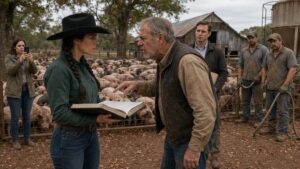
“We are the school pickup volunteers.”
“That doesn’t make this school property.”
Katherine exhaled.
“We’re going in circles.”
“No. I’m standing in one place. You keep sending cars around me.”
For a moment neither spoke.
A child laughed somewhere across the road.
Then Katherine said, more quietly, “Larry, nobody decided this last week. This is how pickup has worked before I ever volunteered.”
“Who authorized it?”
She hesitated.
That hesitation mattered.
“I was told your father did.”
“Told by who?”
“People who were here.”
“Who?”
“I don’t know. The old principal. Parents. Everybody knew about it.”
Everybody knew.
Larry looked back at the yellow sign.
It seemed ridiculous now, not because it was wrong, but because he had assumed a sign could settle something nobody had bothered to define.
That evening he emailed Thomas Walker, the current principal.
He kept the message short.
Vehicles are being directed onto my private farm entrance during dismissal. I have asked that this stop. Please confirm whether the school believes it has permission or an easement to use Miller property for pickup traffic.
Thomas replied the next morning before seven.
Mr. Miller, I was under the understanding that the school has a longstanding access arrangement with your family for afternoon overflow. I am checking our files and would be glad to discuss.
Larry read the sentence three times.
Longstanding access arrangement.
Not rumor.
Not habit.
Arrangement.
He printed the email and laid it beside the damp, folded warning note on his desk.
For the first time, he wondered whether Katherine had not been bluffing at all.
Chapter 3: Larry Stopped Asking and Read the Rules
The county records clerk found no easement.
She searched the Miller parcel by number, then by owner history, then again using the school district’s name.
Nothing.
“No recorded access right to the school,” she said.
Larry leaned toward the monitor.
“What about temporary agreements?”
“Not unless somebody recorded one.”
“Would they have to?”
“Depends what kind of agreement it was.”
“So this doesn’t prove there wasn’t one.”
“It proves there isn’t a recorded easement in the land records.”
Larry nodded.
It was less than he wanted and more than he had the day before.
He left the courthouse with copies of the parcel map and deed records in a brown envelope.
Saturday morning traffic moved slowly through town. Larry drove past the hardware store, the bank, and the towing company he had called the previous evening.
He had spent Friday night reading state towing statutes and county ordinances until his eyes hurt.
What mattered seemed straightforward.
Private property owners could remove unauthorized vehicles under certain conditions.
Notice mattered.
Signage mattered.
Location mattered.
So did how the tow was authorized.
Larry had no interest in discovering afterward that being right about the lane had made him wrong about everything else.
The towing company’s dispatcher had told him to come by with identification and proof of ownership.
Inside the office, a laminated rate sheet hung beside the counter.
The dispatcher looked through Larry’s deed copy, then asked where the cars were parking.
“Across the entrance. Sometimes inside the gravel apron.”
“School traffic?”
“Yes.”
“That gets ugly.”
“I’m not asking whether it gets ugly.”
The dispatcher gave him a brief smile.
“No. You’re asking whether we can tow.”
Larry unfolded a photograph.
The yellow sign stood clearly beside the gate.
The dispatcher studied it.
“How long has that been up?”
“Three years.”
“Can drivers see it from where they stop?”
“Yes.”
“You got more pictures?”
Larry showed her six.
She separated two.
“These are the cleanest. Vehicle clearly on your lane. Sign visible.”
“So?”
“So if everything checks out and the vehicle is on private property without permission, you may have enough notice. We’d still verify before pickup.”
Larry tapped the photograph.
“What if the school claims it has permission?”
“Then that’s between you and the school unless somebody produces something giving them a right to be there.”
There it was again.
Permission.
The word followed him home.
He spread everything across the farm-office desk: county parcel map, deed copy, photographs, screenshots from the parent group, principal’s email, towing information.
The yellow sign was visible in almost every picture.
For days it had felt like proof that everyone else was ignoring something obvious.
Now Larry saw the weakness in that thought.
A sign said what he believed now.
It said nothing about what his father might have said before.
Still, he was done waiting for people to take him seriously.
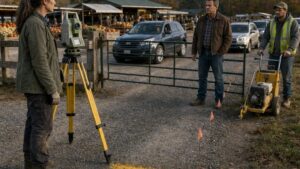
On Sunday afternoon he measured the entrance.
He marked the county right-of-way on a printed map and photographed the gravel edge where tires had pushed stone into the ditch.
He calculated what he had spent adding gravel the previous spring.
He listed three delayed deliveries and two occasions when equipment had been unable to enter promptly.
Numbers steadied him.
They did not argue back.
When Ruth came into the office carrying a basket of folded towels, she stopped at the door.
“What’s all this?”
“Paperwork.”
“I can see that.”
Larry held up the county search.
“No easement.”
Ruth’s face changed.
Barely.
But he saw it.
“So Katherine was wrong,” he said.
Ruth set the basket down.
“I didn’t say that.”
“There’s nothing recorded.”
“Your father didn’t record every promise he made.”
Larry pushed back from the desk.
“What promise?”
Ruth looked toward the window.
Outside, the lane ran straight toward the road. The yellow sign caught the afternoon sun.
“Mom.”
“I’m trying to remember exactly.”
“You remembered enough the other night to make a face.”
“That isn’t fair.”
“Neither is finding out from Katherine Davis that Dad may have given away access to our lane.”
“He did not give away the lane.”
Larry went still.
Ruth closed her eyes for a moment.
“You know something.”
“I know he let the school use part of it for a while.”
“For a while when?”
“Years ago.”
“How many?”
“I don’t remember.”
“Why?”
Ruth picked up one of the photographs.
A minivan sat beneath the sign.
“He had reasons.”
“What reasons?”
“I said I’m trying to remember.”
“No, you’re trying not to tell me.”
She put the picture down.
Larry regretted the words as soon as he heard them.
But he did not take them back.
That was his other bad habit.
He stayed quiet too long, then said too much all at once.
Ruth looked at him with the tired patience of someone who had watched that pattern develop over fifty years.
“Your father is dead,” she said. “You don’t need to win an argument with him.”
“This isn’t about him.”
“You’re standing over a desk full of papers trying to prove he had no right to make a decision twenty years ago.”
“It’s my farm now.”
“Yes.”
“And cars are blocking it now.”
“Yes.”
“So I’m dealing with now.”
Ruth nodded slowly.
“Then deal with now. Just make sure you know what came before it.”
She turned toward the door.
Larry looked at the towing-company folder.
“If they block the lane Monday, I’m having them removed.”
Ruth stopped.
“Larry.”
“I have asked. I’ve written notes. I contacted the school. They’re still directing cars onto private property.”
“Give me one day.”
“For what?”
She did not answer immediately.
Then she said, “There was a box after your father died. School papers, tax papers, things I couldn’t throw away.”
Larry stared at her.
“What school papers?”
“I don’t know until I find them.”
“You’ve had them all this time?”
“I had a husband for forty-one years. I have a lot of things he left behind.”
She picked up the laundry basket.
“Don’t tow anyone tomorrow.”
Larry looked at the yellow sign outside.
“Mom.”
“One day.”
She started down the hall, then stopped once more.
“I want to find something your father kept.”
Chapter 4: The First Tow Solved Nothing
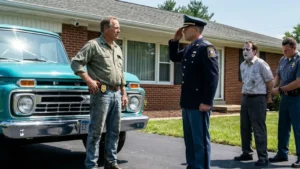
The silver minivan was already halfway up the flatbed when Katherine Davis came running from the school.
“Larry!”
The tow operator kept working.
The steel bed sat tilted toward the road, its edge nearly touching the gravel. A cable ran taut beneath the minivan. Its hazard lights flashed uselessly as the front wheels climbed another foot.
Larry stood beside the gate with both hands in his jacket pockets.
The yellow sign was ten feet from the minivan.
Katherine reached him out of breath.
“What are you doing?”
“What I said I was going to do.”
“You said you were asking people to stay clear of the gate.”
“I asked them to stay off the lane.”
“This woman was picking up her child.”
“She left the vehicle on private property.”
“For fifteen minutes.”
Larry looked at her.
“That’s the argument?”
Katherine turned toward the tow operator.
“Stop.”
The operator did not.
She raised her voice.
“I said stop.”
The operator glanced at Larry.
Larry shook his head once.
The winch continued.
Katherine stared at him.
“You cannot just tow parents.”
“I can tow unauthorized vehicles from my property.”
“This is an arrangement with the school.”
“Then somebody should have shown me the arrangement.”
“I told you about it.”
“You told me people had used the lane for years.”
“Because your family permitted it.”
“And the county found no easement.”
“That doesn’t mean there wasn’t permission.”
“It means nobody has shown me any.”
The flatbed leveled with a hydraulic groan.
The minivan was secured.
Across the road, several parents had stopped walking. A few held phones, though Larry could not tell whether they were calling somebody or recording.
He disliked the attention.
He disliked even more that a small part of him felt relieved.
The gate was clear.
For the first time in months, if a feed truck arrived at three o’clock, Larry would not have to ask anyone to move.
The tow truck pulled away.
Its rear tires rolled past the yellow sign, then onto the county road.
Katherine watched it go.
“This is going to cost her hundreds of dollars.”
Larry said nothing.
“She thought she was allowed to park there.”
“She saw the sign.”
“She thought the school had permission.”
“Then the school should have made sure it did.”
Katherine looked at him sharply.
“You think every parent in that line has researched your property records?”
“No. I think when the owner tells you to stop using his property, you stop.”
Her expression hardened.
“Fine.”
She crossed the road.
Larry remained beside the gate.
At 2:52, another vehicle moved onto the gravel.
He walked over and told the driver not to stop there.
The driver pointed toward Katherine.
“She told us this was overflow.”
“Katherine does not own the farm.”
The driver looked embarrassed.
“I didn’t know.”
“Now you do.”
She moved immediately.
That should have pleased him.
Instead, it made the first tow feel heavier.
At 3:07, a dark crossover stopped just inside the entrance.
Larry approached.
The woman behind the wheel rolled down her window before he reached her.
“I know who you are,” she said.
“Then you know why I’m here.”
“My daughter is coming out.”
“You need to move.”
“I was told this is school overflow.”
“I withdrew permission, assuming permission ever existed.”
Her face tightened.
“You towed my friend.”
“She left her vehicle.”
“She’s a single mother.”
Larry stopped.
He had no answer that would improve the conversation.
The woman continued.
“She can’t pick up her car until after work tomorrow. Do you understand what you’ve done?”
“I understand what it costs when my deliveries are delayed too.”
“That’s not the same thing.”
“No. It isn’t.”
The woman stared at him, perhaps surprised he had agreed.
Then she pointed toward the school.
“You should have worked this out with them before punishing parents.”
Larry felt the sting because it touched the part he had been avoiding.
He had emailed Thomas.
He had asked.
He had waited.
But he had never sat across a table from anyone.
He had chosen the rule before the conversation.
“You need to move the vehicle,” he said.
She did.
Ten minutes later, Thomas Walker crossed the road from the school.
The principal wore no jacket despite the cold. He had a folder tucked beneath one arm.
“Larry.”
“Thomas.”
“I need to ask you to pause the towing.”
“You found the agreement?”
“Not yet.”
“Then no.”
Thomas rubbed one hand across his jaw.
“I’m not saying you’re wrong about the property.”
“That’s a start.”
“I’m saying we have parents who sincerely believed they were following school pickup procedure.”
“Who told them that?”
Thomas looked toward Katherine.
“Katherine and the volunteer team have been managing overflow.”
“Under whose authority?”
“Mine, indirectly.”
Larry waited.
Thomas exhaled.
“When I became principal, I was told the Miller entrance had been used during heavy pickup periods for years. I understood that arrangement to still exist.”
“Did you ever ask me?”
“No.”
“Did Katherine?”
Thomas looked down briefly.
“No.”
“Then everybody assumed.”
“Yes.”
The admission should have felt like victory.
It did not.
Thomas shifted the folder beneath his arm.
“I’m asking for twenty-four hours.”
“My mother asked for the same thing yesterday.”
Thomas frowned.
“Why?”
“She thinks there are old papers.”
His expression changed.
“So there may be something.”
“There may be paper. That’s not the same as a right.”
A car horn sounded near the school.
Thomas turned, then looked back.
“If there’s a document, I need to see it.”
“So do I.”
By 3:25, the lane was empty.
Larry stood at the gate after the school traffic disappeared.
The absence of vehicles felt almost unnatural.
Gravel lay undisturbed beneath the yellow sign.
A feed truck could have turned in without slowing.
A tractor could have crossed.
Nobody was arguing.
Nobody was blocking anything.
Larry should have felt satisfied.
Instead, he heard the first woman again.
She thought she was allowed.
He went back to the farmhouse.
Ruth had spread three cardboard boxes across the dining-room floor.
Old tax folders leaned against Christmas cards, seed invoices, insurance statements, school newsletters, and envelopes yellowed along their edges.
“You found it?” Larry asked.
“Not yet.”
He crouched beside one box.
“You should have told me about this years ago.”
“I should have done a lot of things years ago.”
They searched without speaking.
At five-thirty, Ruth opened a thin green file folder.
She froze.
Larry noticed before she said anything.
“What?”
Ruth pulled out a single sheet.
The paper was faded cream, folded twice.
At the top was the school district letterhead from years earlier.
Below it was a paragraph typed in black ink.
At the bottom were two signatures.
Ruth held the paper by its edges.
Larry took it.
He did not read the paragraph first.
His eyes went directly to the signature line.
There, beneath a date nearly two decades old, was his father’s unmistakable handwriting.
Chapter 5: His Father Had Said Yes—But Not Forever
The first sentence made Larry’s stomach drop.
I grant the elementary school permission to use the gravel apron and entrance area of Miller Farm for afternoon student pickup overflow.
He stopped reading.
Ruth sat across from him at the kitchen table.
“You knew.”
“I remembered something existed.”
“You remembered enough.”
“I remembered your father helping the school. I did not remember the wording.”
Larry put the letter flat against the table.
For three days he had told Katherine she was directing cars onto land nobody had permission to use.
For two days he had told parents the same thing.
That afternoon, a woman’s minivan had left on a flatbed.
His father had signed permission.
Larry read the sentence again.
Ruth said quietly, “Finish it.”
He did.
The second sentence changed the shape of the first.
Permission was limited to weekday dismissal periods during the county road safety project and was to remain in effect only until safe roadside loading accommodations were restored.
Larry moved closer to the page.
The next paragraph contained conditions.
No parked or waiting vehicle was to block the farm gate, equipment lane, livestock access, or commercial deliveries.
School personnel or designated volunteers were responsible for keeping the entrance open at all times.
The arrangement could be withdrawn by the property owner if farm operations were interfered with.
Larry read the final sentence twice.
“This wasn’t permanent.”
“No.”
“It wasn’t even permission to park where they’ve been parking.”
“No.”
“And it could be withdrawn.”
“Yes.”
Ruth folded her hands.
Larry leaned back.
The relief arrived first.
Then anger.
Not clean anger.
Something knotted with embarrassment.
Katherine had been telling a partial truth.
So had he.
“My father never gave them what they claim.”
“He gave them something.”
“For a temporary road project.”
“Yes.”
“Which ended.”
“Yes.”
“How long ago?”
Ruth looked at the date.
“Seventeen years.”
Larry laughed once without humor.
“Seventeen years.”
He stood and walked to the kitchen window.
The yellow sign was visible beyond the yard.
It looked smaller from inside.
“I towed somebody today.”
“I know.”
“She probably thought she had permission.”
“Probably.”
“You don’t have to say it like that.”
“How should I say it?”
Larry turned.
Ruth’s face was not accusing him.
That made it worse.
“I warned them.”
“You did.”
“I told Katherine.”
“You did.”
“I contacted the school.”
“Yes.”
“And they kept coming.”
“Yes.”
He pressed both hands against the counter.
“Then why do I feel like I did something wrong?”
Ruth considered him.
“Because being within your rights and handling something well are not always the same question.”
Larry looked away.
The next morning he carried a copy of the letter into Thomas Walker’s office.
Katherine was already there.
She looked tired.
Thomas closed the door.
Larry placed the copy on the desk.
Thomas read the first paragraph.
His shoulders loosened slightly.
Then he reached the conditions.
The change in his face was immediate.
“This expired with the road project.”
“That’s how I read it.”
Thomas continued.
“And it says the farm lane must remain unobstructed.”
“Yes.”
He looked at Katherine.
“Did you know about this document?”
Katherine hesitated.
Larry noticed.
Thomas noticed too.
“Katherine?”
“I had seen a copy.”
Larry stared at her.
“When?”
“A few years ago.”
“Then you knew.”
“I knew there had been permission.”
“You knew it was temporary.”
“I knew it was old.”
“That isn’t what I asked.”
Katherine’s jaw tightened.
“Yes.”
The room went quiet.
Larry felt the anger become sharper.
“You stood at my gate and told me my family agreed.”
“They did.”
“You left out the part where the agreement ended.”
“I did not think it had ended in practice.”
“The paper says it ended.”
“The paper also explains why the access existed.”
“That doesn’t make it yours forever.”
“I never said it was ours.”
“You directed cars onto it after I told you to stop.”
Katherine looked at him.
“Yes.”
The answer caught him off guard.
No excuse.
No denial.
Thomas leaned forward.
“Why?”
Katherine looked down at her hands.
“Because we changed two bus routes this semester. We have more pickup vehicles than we had last spring. The county shoulder is too narrow, and when the line backs up, cars stop where children are walking.”
“You could have asked me.”
“Yes.”
“You didn’t.”
“No.”
“Why?”
Her voice dropped.
“Because I thought you would say no.”
Larry almost answered immediately.
Then he realized she was probably right.
Katherine continued.
“When you put up the yellow sign three years ago, people still used the apron. You complained sometimes. You never shut it down. I treated your silence like permission.”
“That was your mistake.”
“Yes.”
The simple admission removed the argument Larry had prepared.
Katherine looked at the copy of the letter.
“But I also knew why your father opened it in the first place.”
Larry’s anger slowed.
“What does that mean?”
Thomas glanced at her.
Katherine said nothing for several seconds.
Then she asked, “Your mother didn’t tell you?”
“Tell me what?”
“The letter came after something happened.”
Larry looked at the date again.
He had been away from the farm much of that year helping with seasonal work farther north. He remembered road construction near the school. He remembered orange barrels. Not much else.
“What happened?”
Katherine pushed her chair back slightly.
“The pickup line used to sit entirely on the county shoulder.”
“So?”
“So one afternoon two children walked between stopped cars.”
Larry waited.
Katherine’s expression had changed.
The defensiveness was gone.
“There was a truck coming down the hill.”
Thomas spoke quietly.
“Nobody was hit.”
Larry looked at him.
“But it was close,” Katherine said. “Close enough that your father changed his mind about the school using the farm entrance.”
Larry looked down at the letter.
The first paragraph no longer seemed generous.
The conditions no longer seemed merely legal.
They had been written because somebody had been frightened.
Katherine met his eyes.
“That’s why people kept using the lane, Larry. Not because of the gravel.”
She paused.
“Because of what happened on the shoulder.”
Chapter 6: The Reason the Lane Became a Promise
Larry stood on the county shoulder the next afternoon and finally understood how little room there was.
The ditch began less than four feet from the white edge line.
On the other side, the school fence crowded close to the road.
At dismissal, a child walking between stopped vehicles could disappear completely from the view of a driver coming over the rise.
Larry had driven that road thousands of times.
He had never stood there at three o’clock and looked at it from the height of a child.
A minivan passed.
The rush of air tugged at his jacket.
Katherine stood several yards away.
“This is where it happened?”
“About here.”
Larry looked uphill.
“You were there?”
“No. I was still in college.”
“Then how do you know?”
“My mother was in the pickup line. She talked about it for years.”
Larry looked at her.
Katherine pointed toward the ditch.
“Two children had been released to an older sibling. They walked along the line because their ride was parked farther down.”
“And the truck?”
“Came over the rise. Driver moved toward the center line. Another vehicle was coming the opposite direction.”
Larry imagined the geometry.
Nowhere good to go.
“What stopped it?”
“The truck driver stopped.”
“That simple?”
“No.”
Katherine looked toward the school.
“One child fell in the ditch. The other froze.”
No collision.
No injury.
Nothing that would appear in a headline seventeen years later.
Just a moment close enough to become local memory.
“My father saw it?”
“He arrived afterward. People were arguing about what to do. The county road project had taken away part of the shoulder, and the school didn’t have enough internal stacking space.”
“So he opened the apron.”
“Yes.”
Larry looked toward his entrance.
From here the yellow sign was easy to see.
PRIVATE FARM LANE.
KEEP ENTRANCE CLEAR.
The sign had seemed complete when he installed it.
Now it looked like half a sentence.
He and Katherine crossed to the school.
Thomas had maps spread over the conference table.
One showed current bus routes. Another showed the school parking area and county road.
“We’ve looked at three alternatives,” Thomas said.
Larry sat.
“And?”
“We can move some pickup traffic through the rear staff lot.”
“Why haven’t you?”
“Fire-lane clearance and bus departure timing.”
“Can it be done?”
“With staffing.”
Katherine added, “Not all of it.”
Thomas nodded.
“The route changes added about thirty-two regular pickup vehicles. We can absorb most, not all.”
“Then fix the shoulder.”
Thomas gave him a tired look.
“That requires county work.”
“Ask the county.”
“We have.”
“When?”
“Twice this year.”
“And?”
“We’re on a capital list.”
Larry understood what that meant.
Not soon.
Thomas slid a document toward him.
“This is what we were working with before your complaint.”
It was not an agreement.
It was a traffic plan.
Someone had drawn arrows showing vehicles turning onto Larry’s gravel apron, waiting along the edge, then merging back toward the school.
His gate was marked with a small square.
“Who drew this?”
Thomas glanced at Katherine.
“I did,” she said.
Larry looked at her.
“You put my property in a school traffic plan.”
“It was an internal volunteer plan.”
“Without asking me.”
“Yes.”
“How did that seem reasonable?”
“It didn’t seem unreasonable because people had been using it for years.”
Larry pushed the paper back.
“There it is again.”
Katherine nodded.
“I know.”
“No. You know now.”
Her eyes flashed.
“I knew we were leaning on an old arrangement. I did not think we were creating a crisis.”
“You didn’t think because it wasn’t your gate.”
“No.”
The admission came quickly.
Then she added, “And you didn’t think about why thirty parents would rather risk making you angry than put their children on that shoulder.”
Larry stiffened.
Thomas said, “Katherine.”
“No. He gets to be angry. But I get to be scared.”
Larry looked at her.
She continued.
“My youngest is still in that school. I have watched cars pass that line at fifty miles an hour. I have watched parents stop halfway in the roadway because they’re afraid to pull onto the soft shoulder. When the bus routes changed, we had a mess within two days.”
“So you used my lane.”
“Yes.”
“Even after I told you not to.”
“Yes.”
“That was wrong.”
“Yes.”
Again, she did not fight him.
That made it harder to stay angry in the simple way he wanted.
Thomas tapped the map.
“We have two problems. Larry needs uninterrupted farm access. We need to move children and vehicles away from the road.”
“Then solve yours without using mine,” Larry said.
Thomas was quiet.
Katherine looked toward the window.
Larry heard his own words after they were spoken.
Solve yours.
That was exactly how he had thought of the school for years.
Not our school.
Not the school where neighbors’ grandchildren waited.
Theirs.
He remembered his father lending equipment, opening gates, answering calls.
He had spent years interpreting that as a failure to establish boundaries.
Maybe sometimes it had been.
But the letter showed something else.
His father had said yes.
Then he had written conditions.
That was not the same as never saying no.
Larry tapped the old copy he had brought with him.
“He put limits on this.”
Thomas nodded.
“Clearly.”
“And you ignored them.”
“Yes.”
“And the original reason still exists.”
Thomas looked at the shoulder map.
“In part.”
Larry sat back.
“What would it take to keep every vehicle off the road without blocking my gate?”
Katherine looked at him.
Thomas answered carefully.
“Most vehicles can be rerouted internally. On normal days, probably all of them if we stagger release slightly.”
“And abnormal days?”
“Events. Bus cancellation. Severe weather. Those are harder.”
Larry looked at Katherine.
“No one goes onto my property until we have something in writing.”
She nodded.
“No vehicles tomorrow?”
“No vehicles tomorrow.”
“What if the shoulder backs up?”
“Then use school property.”
Thomas said, “We’ll staff the rear lot.”
Larry folded the old letter.
“There’s another issue.”
“What?”
“The gravel edge is damaged. So is the gatepost.”
Thomas glanced toward Katherine.
“We’ll document it.”
“I already did.”
A faint expression crossed Ruth’s son’s face before Larry could stop it.
Numbers.
Receipts.
Photographs.
Thomas almost smiled.
“I assumed you had.”
They agreed to meet again the following week after Thomas reviewed traffic capacity and repair costs.
When Larry returned to the farm, Ruth was beside the mailbox collecting the day’s mail.
“How did it go?”
“I didn’t agree to anything.”
“That wasn’t my question.”
Larry looked down the road toward the school.
“I understand why Dad did it.”
Ruth nodded.
“He was frightened.”
“You were there?”
“No. He came home angry.”
“At the truck?”
“At everybody. The county. The school. Himself.”
“Why himself?”
“He’d complained for months about parents pulling onto our apron.”
Larry looked at her.
Ruth continued.
“He had said no too.”
That surprised him more than the letter.
“He complained?”
“Constantly.”
Larry almost laughed.
Ruth smiled faintly.
“Your father was generous, Larry. He was not a saint.”
“What changed him?”
“The children.”
They stood without speaking.
At 2:45 the next afternoon, the school traffic began.
For the first time in weeks, no vehicle turned onto Miller Farm.
Cars remained on school property or moved through the rear lot under Thomas’s new temporary plan.
The yellow sign stood beside an empty entrance.
Larry should have felt victorious.
Instead, he watched one line briefly form near the shoulder before a volunteer waved it forward.
He saw how close the cars were to passing traffic.
The problem had not disappeared.
It had simply moved back across the property line.
That evening Larry called Thomas.
“I’ll come to the meeting next week.”
“I hoped you would.”
“I’m not restoring the old arrangement.”
“I understand.”
“No assumptions. No volunteer plan. No permanent access.”
“Understood.”
Larry looked through the office window toward the gate.
“And until we agree, nobody uses the lane.”
Thomas paused.
“Fair enough.”
Larry had spent years believing that the cleanest boundary was the one nobody crossed.
Now he looked at the worn gravel where hundreds of tires had passed and understood that the harder question was not whether he could close the gate.
It was whether he could open it under terms that belonged to him too.
“I want the old informal arrangement ended,” he said. “Completely.”
Thomas was silent.
Then Larry added, “After that, we can talk about building a new one.”
Chapter 7: The New Rule Had His Name on It Too
Larry removed the yellow sign before the meeting.
The bolts had rusted into the cedar post, and the lower one fought him hard enough that he had to brace a boot against the gravel and work the wrench with both hands.
When it finally broke loose, the sign swung sideways.
PRIVATE FARM LANE.
KEEP ENTRANCE CLEAR.
For three years Larry had thought those words were plain enough.
He lowered the sign and carried it toward the pickup.
Ruth stood on the porch with her arms folded.
“You throwing it away?”
“No.”
“Good.”
Larry looked at the scratched yellow face.
“What am I keeping it for?”
Ruth shrugged.
“So you remember a sign isn’t a conversation.”
He gave her a look.
She smiled and went back inside.
By ten that morning, Larry was sitting across from Thomas Walker and Katherine Davis at the school conference table.
Thomas had brought a new traffic map.
This one looked nothing like Katherine’s old volunteer sketch.
Most afternoon vehicles would enter through the regular school drive, loop through the rear staff lot after buses cleared, and leave through the opposite exit. Pickup times for two grade groups would be staggered by several minutes.
Larry studied the arrows.
“What does that leave?”
Thomas tapped a small boxed area.
“On an ordinary day? Nothing on your land.”
“And when a bus breaks down?”
“Then we may need overflow.”
“How much?”
“Eight to twelve vehicles, depending on the route.”
Katherine added, “Not thirty.”
Larry looked at her.
She did not look away.
“And school events?”
Thomas said, “Separate plan. No automatic use of your property.”
Larry leaned back.
That sentence mattered.
No automatic use.
For most of the argument, everyone had spoken as if years of habit had created something nobody needed to ask for anymore.
Now they were asking.
Thomas slid another sheet across the table.
It listed proposed conditions.
Emergency overflow only.
Specific hours.
A designated gravel waiting strip well clear of the farm gate.
A school employee or volunteer physically present whenever access was opened.
No unattended vehicles.
Immediate clearance for farm machinery, livestock movement, deliveries, or emergency access.
Permission revocable by the property owner.
Larry read each line.
Then he pointed to the last one.
“Not just revocable.”
Thomas waited.
“Reviewable every school year.”
Katherine nodded.
“That’s reasonable.”
“And if the school changes its traffic pattern, this agreement doesn’t automatically expand.”
“Agreed,” Thomas said.
Larry pointed again.
“No one waves vehicles onto the farm because the main line looks inconvenient.”
Katherine’s mouth tightened briefly.
“I understand.”
Larry looked at her.
“Do you?”
“Yes.”
The room went still.
Katherine folded her hands on the table.
“I should have asked you when the bus routes changed.”
Larry said nothing.
“I knew the old letter was temporary,” she continued. “Not every condition. But enough.”
Thomas looked at her, though he had heard most of this already.
Katherine kept her eyes on Larry.
“I told myself the arrangement had continued because no one had formally stopped it. Then when you objected, I told myself you didn’t understand the safety issue.”
“I didn’t.”
“No. But that wasn’t the same as me having permission.”
Larry waited.
Katherine took a breath.
“I used your silence because it was easier than solving the problem properly.”
There it was.
Not an apology designed to end the meeting.
An admission.
Larry felt some of the resistance leave him.
He had wanted that sentence badly a week earlier.
Now that he had it, it did not feel triumphant.
It felt useful.
“I did something easier too,” he said.
Katherine looked surprised.
“I went from warning notes to a towing contract without sitting down here.”
“You did email.”
“That’s not what I said.”
Thomas glanced between them.
Larry continued.
“I was tired of asking people one car at a time. So I stopped asking anybody.”
Katherine looked at the table.
“The woman whose minivan got towed was furious.”
“I know.”
“She paid the fee.”
Larry nodded.
“I’m not reimbursing the tow.”
“I didn’t ask you to.”
“She was on private property after warning.”
“I know.”
That mattered too.
Understanding Katherine’s reasons did not erase what had happened at the gate.
Thomas opened another folder.
“We also inspected the farm entrance.”
He slid two photographs across the table.
One showed the gravel edge pushed into the drainage ditch.
The other showed the cedar gatepost with a fresh split near its base.
“We compared these with Larry’s older photographs,” Thomas said. “The damage lines up with vehicle use during pickup.”
Larry looked at the repair estimate beneath them.
“The district will cover that?”
Thomas nodded.
“Gravel restoration and the gatepost.”
“All of it?”
“All documented damage attributable to the traffic pattern.”
Larry had expected an argument over every dollar.
There wasn’t one.
He turned the estimate over.
“And the towing?”
Thomas shook his head.
“The district won’t reimburse private towing charges. The vehicle owners can dispute those through the normal process if they choose.”
Larry nodded.
Fair enough.
Katherine unfolded a separate map.
“We marked where the emergency waiting strip could go.”
She pointed to an area fifteen yards back from the gate on the outer edge of the gravel apron.
“That keeps the gate throat open. A tractor with a wagon can turn through without crossing parked vehicles.”
Larry studied the dimensions.
“You measured?”
“Yesterday.”
He almost smiled.
“Good.”
The three of them drove to the farm after lunch.
Thomas parked at the road.
Katherine carried temporary stakes.
Larry had already moved the yellow sign into the equipment shed.
Without it, the cedar post looked strangely bare.
They paced the proposed waiting strip together.
Larry drove the tractor through once with an empty hay wagon to test the turning radius.
Katherine stood beside the stakes watching the wagon swing.
“More room,” she said before Larry did.
She moved the nearest marker another six feet outward.
Larry tried again.
This time the wagon cleared easily.
Thomas watched from beside the gate.
“That work?”
“It works if nobody gets creative.”
Katherine said, “Then nobody gets creative.”
Larry looked at her.
She gave him a tired half-smile.
By Thursday, the school had installed temporary directional markers on its own property and repainted part of the rear-lot traffic pattern.
The damaged gravel at the Miller entrance had been repaired.
A contractor replaced the split gatepost.
Larry paid the invoice first, as he always did, then found a reimbursement check from the district in the mailbox the next afternoon.
Ruth watched him open it.
“Well?”
“They covered it.”
“All of it?”
“All of it.”
She nodded.
“What about the new agreement?”
Larry held up the envelope in his other hand.
“Thomas dropped off the final copy.”
Ruth reached for her glasses.
Larry did not hand it to her immediately.
“What?”
“Nothing.”
“That face again.”
“This is my regular face.”
Larry laughed.
Then he placed the agreement on the kitchen table.
At the bottom were signature lines for the district representative and the property owner.
His father’s old permission letter lay in the green folder nearby.
Larry pulled it out and set the two pages side by side.
The old paper had softened along its folds.
His father’s signature angled upward at the end, impatient and familiar.
Larry read the old conditions once more.
Keep farm access open.
Temporary use.
Permission could be withdrawn.
For years Larry had remembered his father mainly as a man who said yes too often.
Looking at the page now, he saw something more precise.
His father had not opened the farm because boundaries did not matter.
He had opened it because danger mattered too.
And then he had written down where the opening stopped.
Larry signed the new agreement.
Ruth looked at the signature.
“Looks like his.”
“Mine always did.”
“I didn’t mean the handwriting.”
Larry capped the pen.
“I know.”
The following Monday, Larry stood beside the gate at 2:50.
School pickup had begun.
Cars entered through the main drive.
A volunteer directed several toward the rear lot.
Katherine stood near the school entrance holding a radio, but she did not wave a single vehicle toward Miller Farm.
At 3:02, a feed truck appeared over the rise.
Larry watched it approach.
For months, that sound had made him check the gate before anything else.
Now the lane was empty.
The truck slowed for the turn.
At the edge of the gravel apron stood two new boundary markers, plain and unmistakable. Beyond them was the narrow emergency waiting strip, unused.
The driver turned in.
The truck passed between the posts, rolled through the gate, and continued toward the commodity shed without stopping.
Larry stepped aside.
Across the road, Katherine looked over.
She raised one hand.
Not a victory gesture.
Not an apology.
Just acknowledgment.
Larry returned it.
Behind him, the feed truck climbed the lane in a cloud of pale dust.
In the equipment shed, the old yellow sign leaned against the wall where Larry had left it.
He had considered putting it back up.
He decided not to.
The new markers said where people could go.
The written agreement said when.
And if somebody needed something different next year, they would have to ask.
That, Larry understood now, was the part his silence had been missing.
A boundary did not become weaker because you opened it deliberately.
It became clearer because everyone knew who had opened it, why, and where it ended.
The feed truck rolled past the barn while the school line continued across the road.
For the first time, both moved at the same time.
Neither had to wait for the other.
The story has ended.